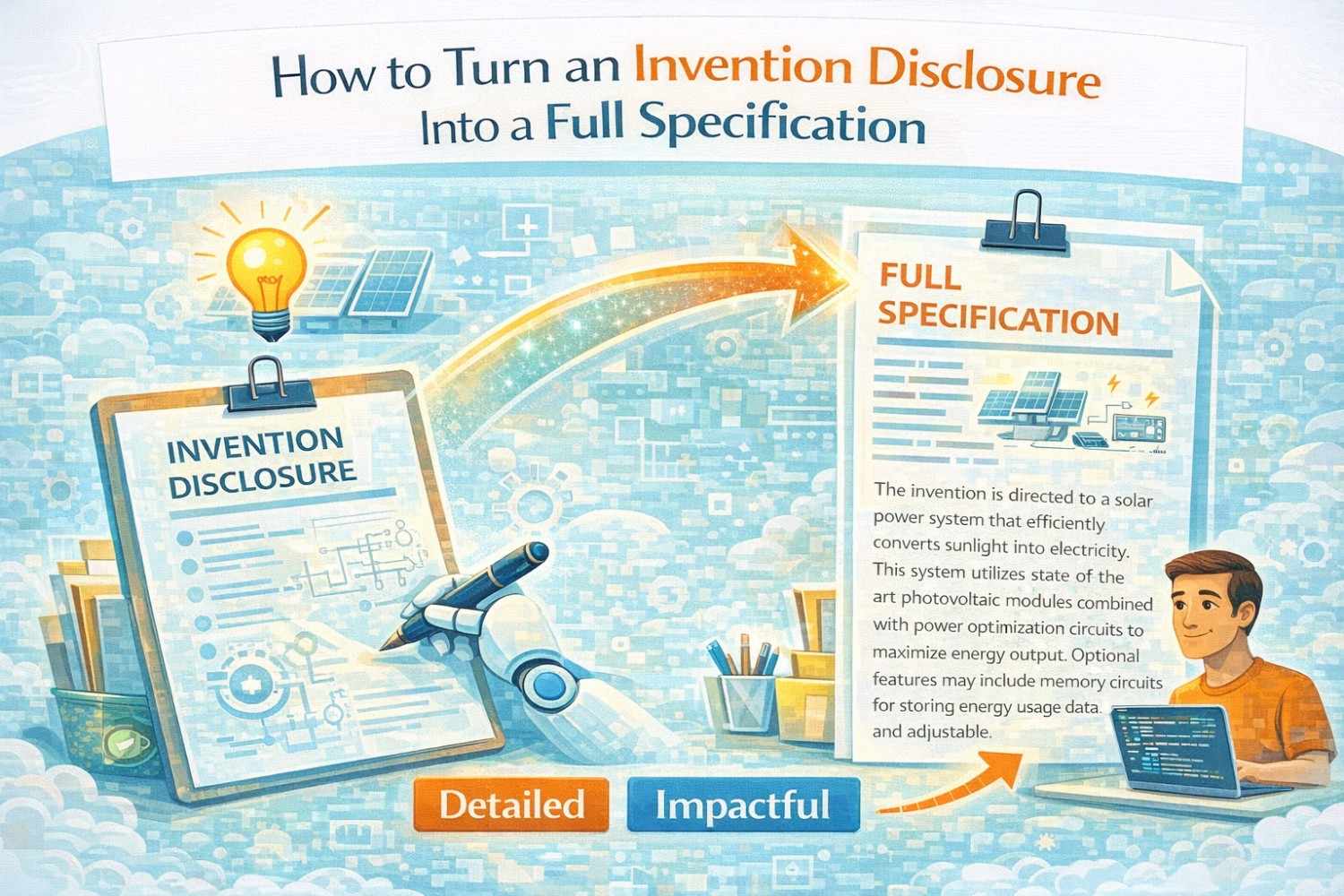
You had an idea. You wrote it down. Maybe you filled out a short invention disclosure form. Maybe you dropped notes into a doc at midnight after a product sprint.
Maybe you recorded a voice memo because you did not want to lose the thought.
That is a good start. But it is not the finish line.
If you want real patent protection, you need to turn that rough idea into a full, clear, complete specification.
That is the document that explains what you built, how it works, what makes it different, and how to describe it in a way that gives your invention real support later.
This is where many founders get stuck. The good news is that there is a simple way to do it well.
And if you want a faster path with software plus real attorney oversight, PowerPatent can help you move from rough notes to a stronger patent application without the usual pain, delay, and confusion. You can see how it works here: https://powerpatent.com/how-it-works
An invention disclosure is the seed, not the tree
An invention disclosure is usually short. It is meant to capture the core of the idea before it slips away. It may include a title, a short summary, a few drawings, the names of the inventors, the date, and some notes on what problem the invention solves.
That is useful. It helps preserve the big picture. It gives you a place to start. It can also help your team talk through what was actually invented and who contributed to it.
But a disclosure is usually not enough to carry the weight of a full patent filing.
Why not? Because a full specification has a much bigger job. It has to teach. It has to explain. It has to show that the inventors truly possessed the invention.
It has to support future claims. It has to give room for changes, broader protection, narrower backup positions, and different ways of describing the same idea.
A short disclosure says, “Here is what we built.”
A full specification says, “Here is what we built, here is how it works, here are different forms it can take, here are the important parts, here are optional parts, here are examples, here are workflows, here are system pieces, here are variations, and here is how someone skilled in this area would understand and use it.”
That is a very different level of detail.
Many startups lose value right here. They have a smart product, but the write-up is too thin. It describes only one version.
It focuses too much on product marketing language. It skips the technical logic. It does not capture alternatives. It says what the product does, but not enough about how.
Then later, when the company grows, raises money, or faces a copycat, they realize the filing did not fully protect what mattered.
That is why learning to turn a disclosure into a real specification is such an important skill.
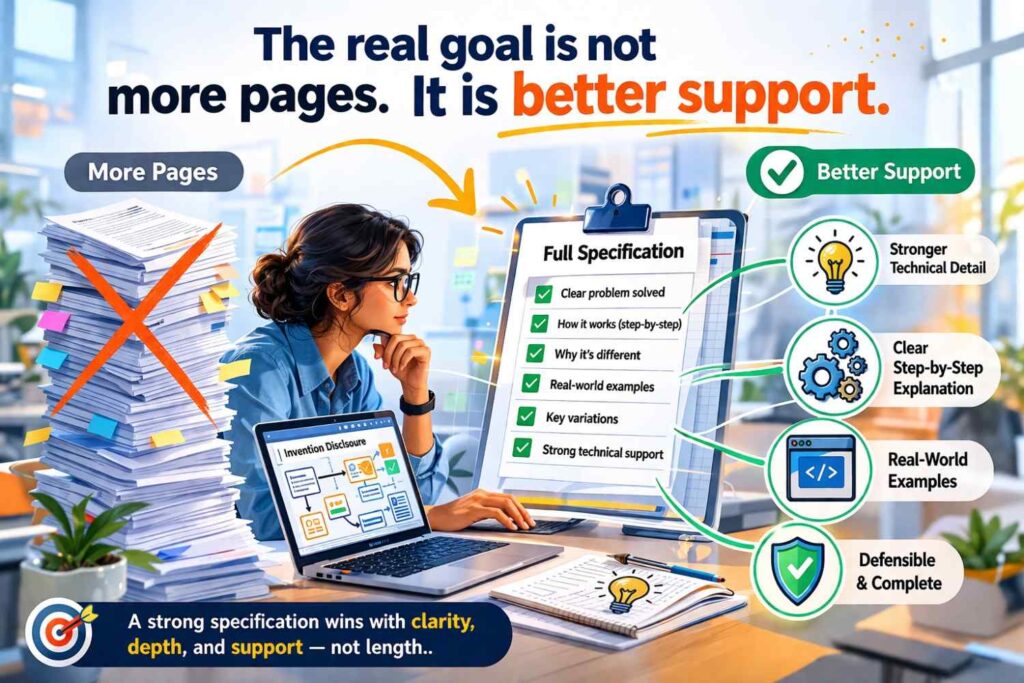
The real goal is not more pages. It is better support
Founders sometimes think a full specification just means adding length. So they pad the draft. They write long background sections.
They repeat the same idea in different ways. They add general statements that sound formal but do not add real value.
That is not what makes a strong filing.
The goal is not to make the document longer for the sake of length. The goal is to make it fuller in the right places.
A strong specification gives support. Support means the document truly backs up the invention from many angles.
It supports broad claims by describing the invention at a higher level.
It supports narrower claims by explaining the details.
It supports future edits by including different options and variations.
It supports real-world understanding by showing examples.
It supports technical meaning by using clear words and consistent terms.
It supports business value by protecting what competitors might copy.
This is why the jump from a disclosure to a specification matters so much. You are not just cleaning up notes. You are building the foundation for protection.
That process can feel hard when you do it alone. It gets much easier when you use a system built for founders and technical teams.
PowerPatent helps companies take what they already know and turn it into a stronger patent draft, with real attorney review layered in so important details do not get missed. You can learn more here: https://powerpatent.com/how-it-works
Start with the heart of the invention, not the form
The first mistake people make is opening a blank patent template and trying to fill sections in order.
That sounds organized, but it often leads to weak writing. You end up spending time on headings instead of substance.
You write a title, then a background, then a summary, and before long you are polishing surface-level text while the most important thinking has not happened.
A better way is to begin with the heart of the invention.
Ask one simple question: what is the real technical idea here?
Not the brand message. Not the pitch deck line. Not the user benefit in marketing terms. The actual technical idea.
That might be a new model training flow. A better way to route data. A sensor setup that improves signal quality. A control system that reacts in a smarter way.
A security layer that changes how access is granted. A workflow that reduces compute cost. A hardware structure that improves speed, accuracy, or reliability.
If you cannot say the core technical idea in plain words, the full specification will be shaky from the start.
So before drafting, take the disclosure and strip it down to the central point. Write a short paragraph that explains the invention as if you were talking to a smart engineer who has not seen your product before.
Keep it direct.
What problem is being solved?
What was the old way?
What is the new way?
Why is the new way better?
What parts make it work?
That short paragraph becomes your compass. Everything in the full specification should connect back to it.
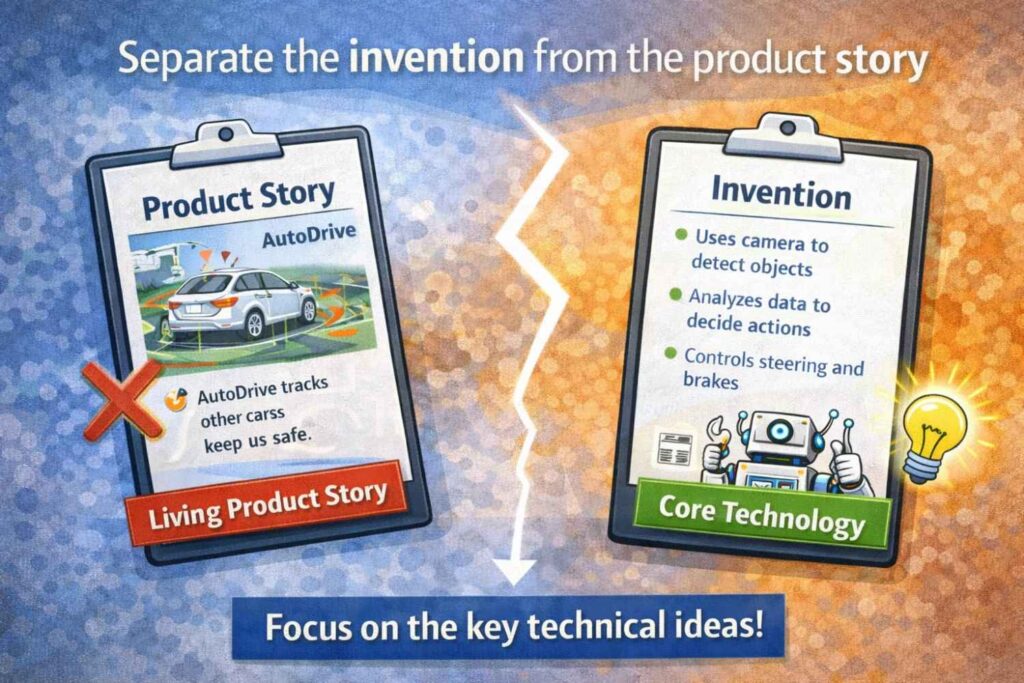
Separate the invention from the product story
This is one of the biggest moves you can make.
Founders are close to the product. That is a strength, but it can also create a blind spot. You may describe the product exactly as it exists today, down to the user flow, screen names, and current stack. That feels natural because it is familiar.
But the invention is often broader than the current product version.
Your current product may be a web app. The invention might actually be a backend method that could also work in mobile, embedded, cloud, or edge settings.
Your current product may use a specific model. The invention might be the way inputs are pre-processed, ranked, or verified, which could work across many models.
Your current product may serve one market. The invention may apply across many industries.
If the full specification gets trapped inside the current product story, your protection gets smaller than it should be.
This is why you need to pull the invention away from the current packaging.
Think of it like this. The product is one example of the invention. It is not always the whole invention.
That does not mean you should write vague fluff. It means you should identify the technical principle underneath the current implementation.
For example, imagine the disclosure says your company built a medical triage chat tool. The rough notes focus on the chatbot screens and patient workflow.
But the real invention may be a method for combining symptom extraction, risk scoring, uncertainty tracking, and escalation rules into a safer recommendation flow.
That broader idea could be valuable far beyond the exact chat interface you launched first.
The more clearly you see that difference, the stronger your specification will become.
Gather the raw material before you draft
A full specification is much easier to write when you collect the right raw material first.
You do not need everything to be polished. In fact, messy source material is fine. What matters is that you gather the facts, examples, and technical detail that the final draft can be built from.
This usually includes design docs, system diagrams, architecture notes, code snippets, whiteboard captures, engineering tickets, experiment results, internal demos, slide decks, and notes from the inventors.
If the invention involves hardware, you may also want photos, part descriptions, test setups, measurements, and manufacturing notes.
If the invention involves machine learning, you may want training flow notes, feature descriptions, model pipeline details, inference steps, data handling logic, confidence handling, error correction logic, and deployment paths.
If the invention involves security, you may want access flows, trust boundaries, verification steps, key handling logic, permission logic, alert logic, and failure cases.
The point is simple. The disclosure gives you the starting spark. The supporting material gives you the fuel.
A strong specification often comes from asking the inventors to talk through the invention in a way that surfaces what the short disclosure missed.
What happens before the main step?
What happens after it?
What inputs are needed?
What outputs are produced?
What optional parts could be swapped?
What edge cases were handled?
What tradeoffs were considered?
What alternatives were rejected?
What assumptions were made?
What pieces can live in software, hardware, firmware, or some mix?
These details matter. Not because every detail goes into a claim, but because a specification gets stronger when it captures the full technical shape of the invention.
Interview the inventors like a builder, not like a clerk

A weak invention interview feels like form filling. A strong one feels like product deep work.
Do not just ask inventors to repeat what is already in the disclosure. Push deeper.
Ask them what changed in the system because of the invention.
Ask where the old approach broke down.
Ask what hidden problem they solved that outsiders may miss.
Ask what they would tell a new engineer joining the team who had to rebuild this from scratch.
Ask which parts are essential and which parts are flexible.
Ask what they think a competitor would copy first.
Ask how they would implement the same idea a different way if they had to ship it next month on a new stack.
Ask what future version of the product would still use the same core idea.
These kinds of questions reveal the true shape of the invention.
They also help pull out valuable fallback material. Sometimes the broad idea is strong, but you also want detailed backup positions.
Sometimes one flow is central, but there are three alternative flows that should also be described. Sometimes a single algorithm matters, but the surrounding system context matters too.
A good inventor interview is not about collecting pretty words. It is about getting the technical truth out into the open.
This is another place where founders benefit from a modern workflow instead of the old law-firm model.
PowerPatent helps turn technical work into patent-ready content in a way that fits how startups actually build, while still bringing real attorneys into the process so strategy and legal quality do not get lost. See how that works here: https://powerpatent.com/how-it-works
Write down the problem in a way that leads to protection
Many people rush past the problem statement because they think the invention is the exciting part. But the way you frame the problem matters a lot.
A good problem statement does more than explain pain. It sets up the logic for the invention. It helps show why the technical approach matters. It gives context without boxing you in too tightly.
The trick is to describe the problem in a real but balanced way.
If you state the problem too narrowly, you may shrink the invention.
If you state it too broadly, the draft may sound generic.
A useful approach is to describe the limits of prior approaches in practical terms.
Maybe current systems use too much compute.
Maybe they require too much manual review.
Maybe they break when inputs are noisy.
Maybe they cannot handle latency limits.
Maybe they expose security gaps.
Maybe they fail to adapt in real time.
Maybe they depend on a central server when local action is needed.
Maybe they produce poor results when data is missing or uncertain.
This gives you a clear setup. The invention can then be presented as a technical solution to that technical problem.
That matters because a good patent specification often works best when it tells a technical story with cause and effect.
Here is the problem. Here is the old limit. Here is the new structure or method. Here is why it improves the result.
Move from idea to architecture

Once the core idea is clear, the next step is to map the architecture of the invention.
This does not have to be a formal chart at first. It can be a plain-language breakdown of the main pieces and how they interact.
Think in terms of components, stages, and flows.
What are the main parts of the system?
What data enters?
What happens first?
What decisions are made?
What transformations happen?
What triggers the next step?
What outputs are produced?
Where does feedback come in?
Where are rules applied?
Where are models used?
Where is storage involved?
Where is communication involved?
Where is user input involved?
If you can explain the architecture clearly, writing the full specification becomes much easier.
This is because a specification often needs to do two things at once. It needs to describe the invention at a system level and at a method level.
The system level explains the parts.
The method level explains the steps.
Both matter.
A software invention may include a server, a client device, a model engine, a policy module, and a storage layer.
The method may include receiving input, extracting features, scoring options, applying thresholds, selecting an action, and sending output.
A hardware invention may include a sensor array, a controller, a filter stage, an actuator, and a feedback loop.
The method may include measuring signals, filtering noise, comparing against thresholds, generating a control signal, and adjusting output.
The architecture is the bridge between the rough disclosure and the full write-up.
Name things clearly and stay consistent
One of the easiest ways to weaken a specification is to keep changing words for the same thing.
In casual writing, variety can sound nice. In patent writing, too much variety can create confusion.
If you call something a “decision engine” in one paragraph, a “selection module” in another, and a “ranking unit” later, readers may wonder whether those are three different things or one thing with three names.
That is why it helps to choose clear names for the main elements early and stay consistent.
The names do not need to be fancy. In fact, simple names are often better.
Input data store. Signal processor. Policy engine. Confidence score. Sensor unit. Routing module. Verification service. Output generator.
The main thing is that the label should be clear enough to help the reader follow the logic.
Once you have a name, use it steadily. You can say that a module may also be referred to in other ways, but keep the core term stable.
This simple step makes the full specification easier to read, easier to draft, and easier to support later.
Build the specification in layers
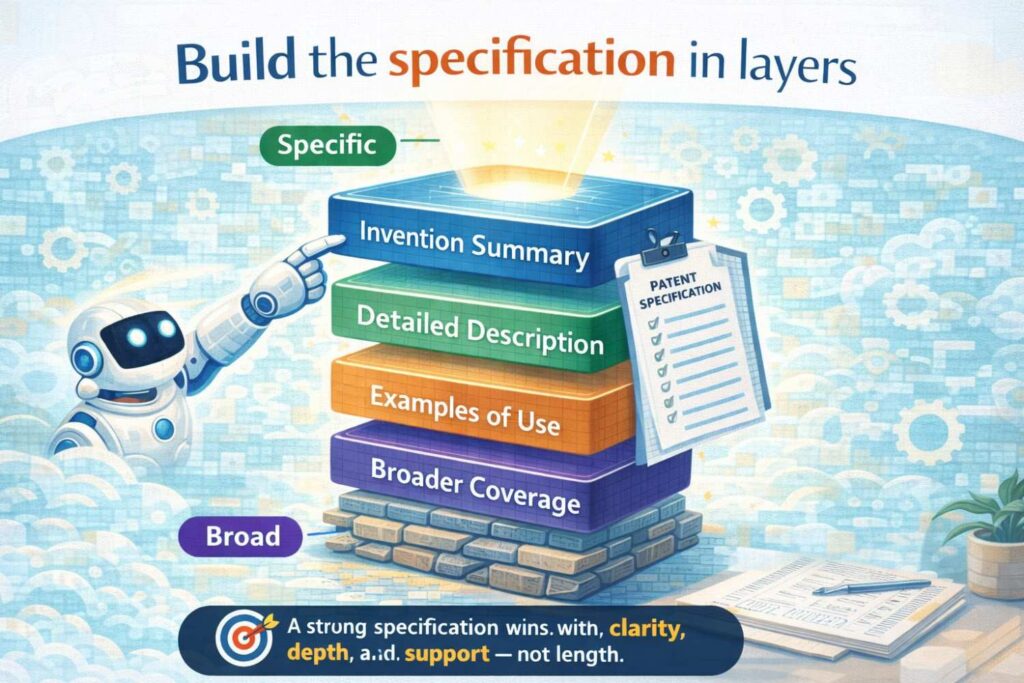
A good specification usually moves from broad to specific.
That does not mean every section has to follow one strict pattern, but the overall idea helps. Start with the broad concept. Then explain the main architecture. Then explain the flows. Then explain examples. Then explain variations.
Think of it like zooming in.
At the top layer, explain the invention in a broad and simple way.
At the next layer, explain the main pieces.
Then explain how those pieces interact.
Then explain one or more detailed examples.
Then explain optional features, alternative setups, and different implementation choices.
This layered approach is powerful because it gives the document both breadth and depth.
Breadth helps support broader claims.
Depth helps support narrower claims and practical clarity.
If you only write broad language, the draft may feel hollow.
If you only write narrow implementation detail, the draft may feel trapped.
You need both.
The title should be clear, not cute
People sometimes overthink the title. They try to make it sound novel or impressive.
That is usually not the best move.
A title should be clear enough that the topic is obvious right away. It should point to the area of the invention without boxing it into one tiny form unless that narrowness is intentional.
“Systems and Methods for Adaptive Resource Allocation Based on Real-Time Signal Confidence” is usually better than a flashy label that sounds like product marketing.
The title is not where the value is won. It just needs to set the table.
The background should set context, not argue like a sales page
A common mistake is turning the background into a pitch.
The background section is not there to brag about the company or to dump market stats. It is there to explain the technical field and the problems with earlier approaches.
Keep it clean.
Describe the area of technology.
Explain the practical problem.
Mention some limits of prior techniques in a fair and general way.
Do not lock yourself into very specific attacks on one prior system unless there is a reason to.
Do not promise that your invention solves everything.
Do not overstate.
You want the reader to understand the setting and why the invention matters.
That is enough.
The summary should capture the invention without giving away only one version
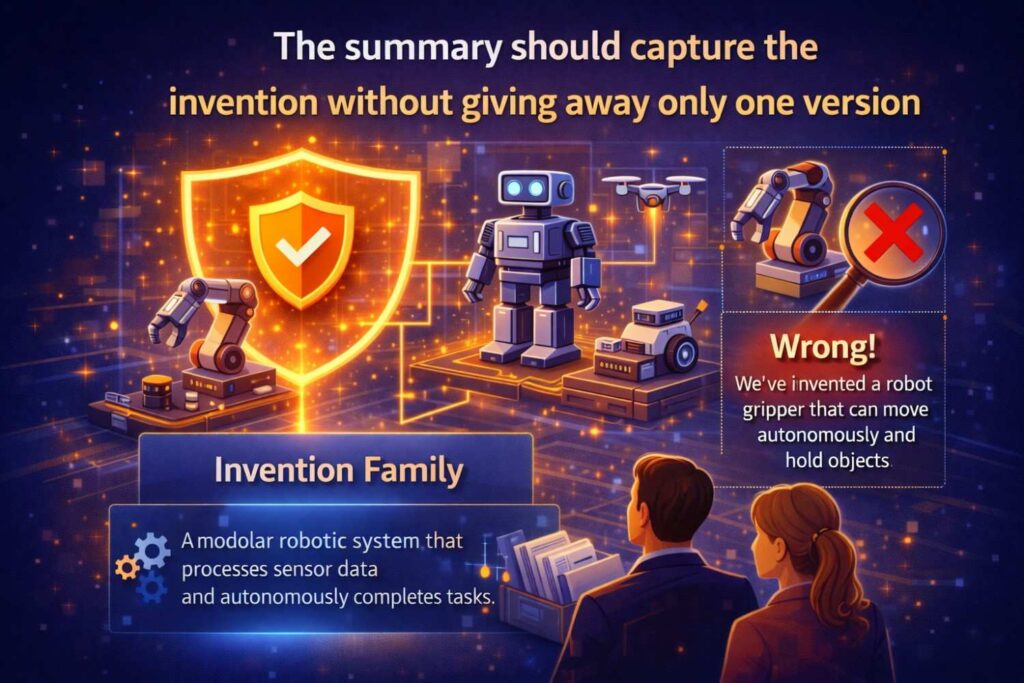
A good summary introduces the invention in a way that is broad enough to cover multiple forms but concrete enough to feel real.
This is not the place for every detail. It is the place for the core concept, framed clearly.
For example, instead of saying only, “A mobile app displays a ranked list of treatment providers to a patient,” a broader and stronger summary might explain that a system receives user-specific data, determines provider suitability using a set of weighted factors, updates rankings based on real-time availability, and outputs a tailored recommendation set.
See the difference? The second version focuses on the technical logic rather than one user interface snapshot.
That broader framing gives more room later.
The drawings are not decoration. They unlock clarity
Many founders think drawings are just formal extras. In reality, they are one of the best tools for turning a short disclosure into a full specification.
Drawings force structure.
When you sketch the system, you have to decide what the main components are.
When you sketch the flow, you have to decide what the key steps are.
When you sketch example screens or hardware layouts, you have to decide what matters and what is optional.
Good drawings often include a high-level system diagram, one or more method flow diagrams, and example diagrams for key embodiments.
You do not need artistic beauty. You need clear communication.
A simple block diagram can do a lot of work. A flowchart can reveal missing logic. An example architecture can surface hidden assumptions.
A signal diagram can show timing. A hardware sketch can show placement or relationship of parts.
Then, once you have the drawings, the specification can walk through them one by one.
This makes the document feel grounded. It also helps ensure the written description and figures reinforce each other.
Describe one main embodiment in enough detail that it feels buildable

This is one of the strongest moves you can make.
After the broad description, include at least one main embodiment that is described in enough practical detail that a technical reader can really understand how the invention works.
That does not mean including full code or production-ready manufacturing instructions. It means giving enough structure, sequence, and context that the invention feels concrete.
Suppose your invention is a method for reducing false alerts in industrial monitoring.
Your detailed embodiment might explain how sensor data is collected at a first rate, filtered using a rolling window, passed into a fault detection model, checked against a confidence threshold, compared to a historical profile, and then used to trigger or suppress an alert depending on the combined evaluation.
That kind of description is useful. It gives life to the invention. It also creates support for claims that may later focus on one or more of those steps.
A weak disclosure often says, “We use AI to reduce false alerts.”
A strong specification explains how.
That is the whole game.
Then widen it with alternative embodiments
Once you have one strong embodiment, do not stop there.
Now ask how else the same core idea could be done.
Could the order of steps change?
Could a hardware module be replaced by software?
Could a centralized service be distributed?
Could one model be replaced by a rules engine?
Could thresholding be dynamic instead of fixed?
Could the communication happen over a different channel?
Could inputs come from different sources?
Could outputs take different forms?
Could the same method work in a different industry or environment?
Alternative embodiments matter because real products change. Your claims may change too.
Competitors may copy the heart of your invention while swapping one piece. If your specification only describes the one exact version you shipped, your room later gets smaller.
A fuller specification anticipates variation. It says, in substance, “This invention can take different forms, and here are several of them.”
That extra work can make a huge difference later.
Capture optional features without making them seem required
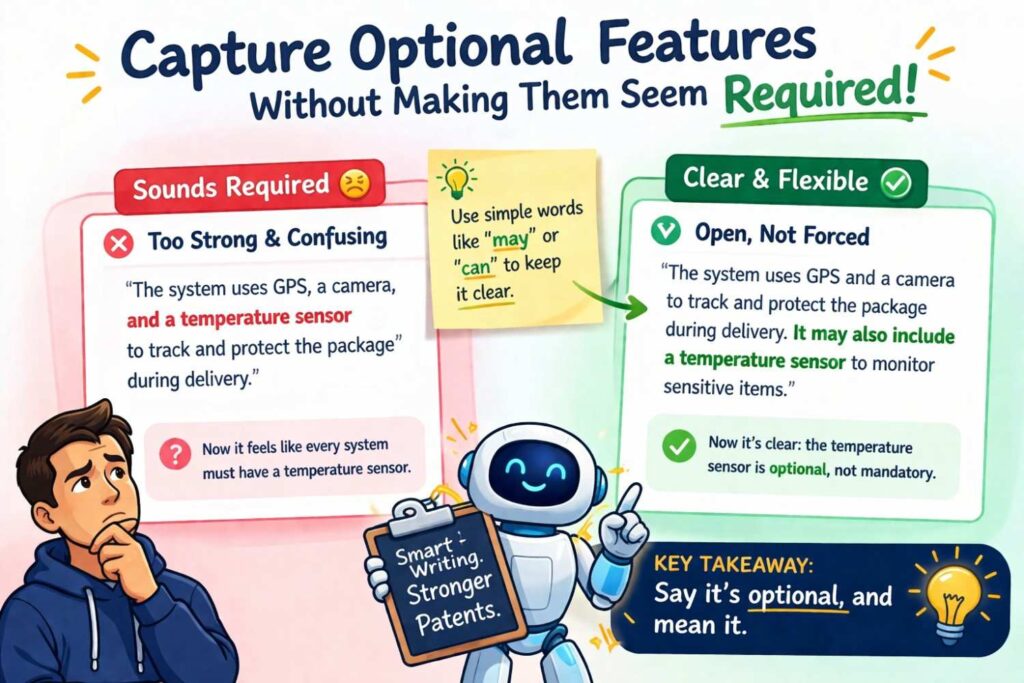
This is a subtle but very important drafting move.
Some features are helpful but not essential. Maybe encryption is used in one embodiment, but the core invention is broader than encryption.
Maybe a machine learning model is one option, but the key idea works with other decision engines too. Maybe a mobile app is one interface, but the backend process is not limited to mobile.
You want to describe these optional features clearly while avoiding language that accidentally makes them sound mandatory.
That means being thoughtful in the way you write.
Instead of always saying “the system includes X,” you may sometimes say “in some embodiments, the system may include X.”
Instead of saying “the method requires Y,” you may say “the method can further include Y.”
This helps preserve flexibility.
At the same time, do not overdo it so much that everything sounds uncertain and foggy. The document still needs a real structure. The point is balance. Some parts are core. Some parts are optional. The writing should reflect that.
Explain the invention from different claim angles
When moving from a disclosure to a full specification, one powerful habit is to think beyond the single story in the notes and ask how the invention could later be claimed from different angles.
Could it be claimed as a method?
As a system?
As a device?
As a computer-readable medium?
As a platform?
As a process performed by one or more processors?
As a distributed arrangement across multiple machines?
Even if you are not writing final claims yet, thinking this way improves the specification.
Why? Because it pushes you to describe the invention in multiple forms.
If you only describe steps, you may miss system support.
If you only describe modules, you may miss method support.
If you only describe server-side logic, you may miss device-side angles.
If you only describe one actor, you may miss multi-party or networked versions.
A full specification should make later claim strategy easier, not harder.
Do not just describe what happens when everything goes right
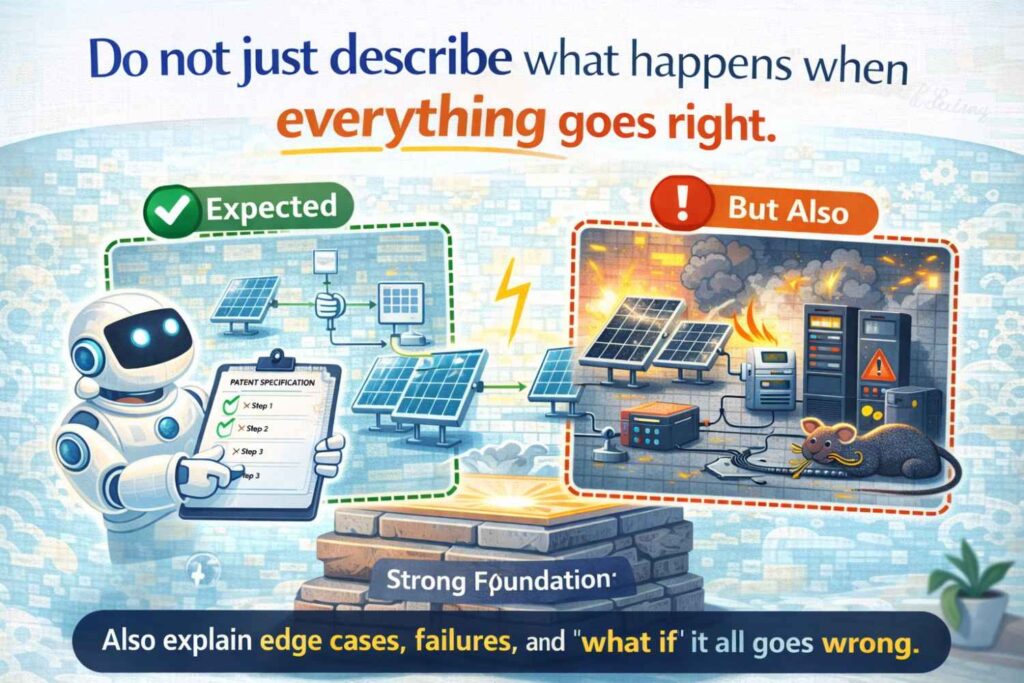
Real systems handle edge cases. Real inventions often shine most when the situation is messy.
That is why a strong specification benefits from discussing failure cases, exception handling, uncertainty, fallback logic, and alternate paths.
What happens if input data is missing?
What happens if a sensor fails?
What happens if confidence is low?
What happens if two outputs conflict?
What happens if a connection drops?
What happens if a threshold is not met?
What happens if a user denies permission?
What happens if the model returns an ambiguous result?
You do not need to turn the document into an error log. But where these issues matter to the invention, describing them can add serious value.
It shows the invention is more than a happy-path idea. It shows practical depth. It may also create support for useful narrower claims later.
Use examples that teach, not examples that trap you
Examples are great. They make abstract ideas easier to understand.
But examples should be framed as examples.
This sounds obvious, yet many weak drafts accidentally write their examples as though they define the invention.
For instance, if your invention can apply to logistics, healthcare, and finance, but you only describe it in a healthcare setting and write as if healthcare is the invention itself, you may narrow the perceived scope.
A better move is to use examples clearly while signaling that the invention can extend beyond them.
You might explain one detailed healthcare embodiment because it is the easiest to understand, while also stating that similar logic may be applied in other settings where entities are ranked, classified, routed, monitored, or controlled based on incoming data and decision logic.
Examples should illuminate the invention, not cage it.
Watch out for accidental admissions
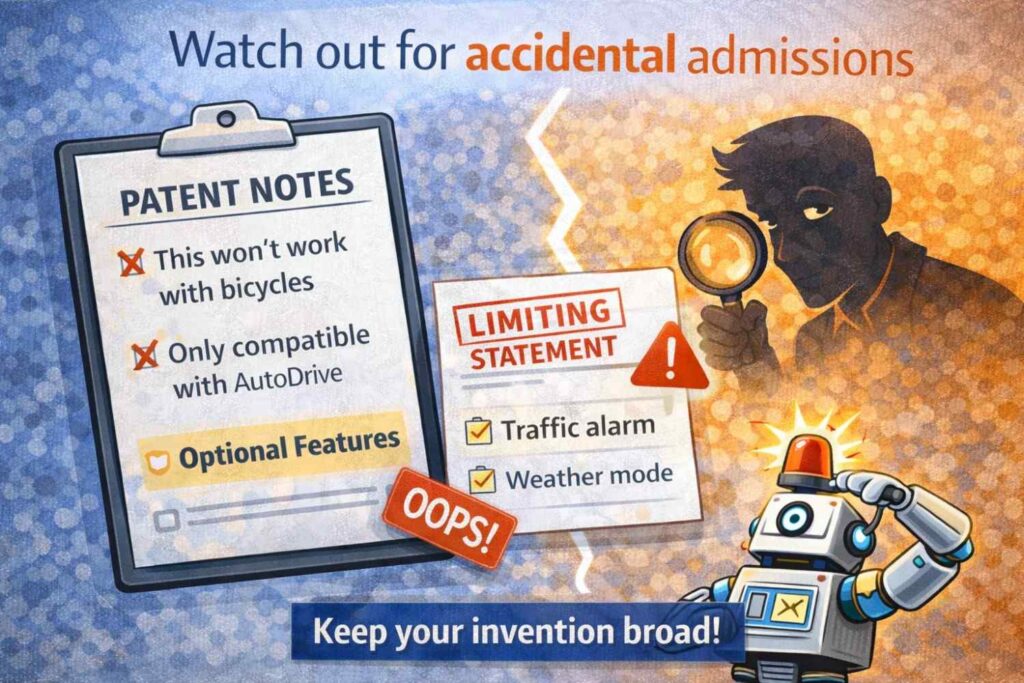
When founders write their own first patent drafts, they sometimes use words that sound harmless but may create trouble later.
They say things like “conventional systems all fail to do X” when that may not be fully true.
They say “the invention requires” when they really mean one embodiment uses that feature.
They say “the key novelty is” and name only one detail, even though other inventive ideas are present too.
They say “must,” “always,” “never,” and other absolute terms too casually.
A stronger approach is to write with care. Be accurate. Be specific. Avoid dramatic statements that create unnecessary limits or admissions.
This is one reason why founder-friendly software alone is not enough. You also want human legal judgment in the loop.
PowerPatent combines both, helping startups move fast while still getting real attorney oversight where it counts. That means you can capture technical detail without making costly drafting mistakes. Learn more here: https://powerpatent.com/how-it-works
Translate code and technical work into patent language without losing the truth
Many modern inventions live partly in code. That creates a practical challenge. You do not want to paste raw code into the specification and call it done.
But you also do not want to drift so far into abstract language that the real technical work disappears.
The answer is translation.
Take the actual technical logic from the code or system and describe it in clear, structured terms.
What inputs are received?
What operations are performed?
What decisions are made?
What data structures or relationships matter?
What outputs are generated?
What triggers repeated execution?
What conditions cause branching?
What modules or services interact?
You can describe algorithms in plain but precise language. You can explain pipelines, loops, filters, ranking logic, training flows, validation logic, and update flows in a way that is understandable and useful.
The key is to preserve the technical substance without tying the document to one narrow syntax or implementation detail unless that detail is actually important.
For AI inventions, focus on the full pipeline, not just “we used AI”
This is a huge issue today.
Many invention disclosures in AI-heavy startups say something like, “We use a model to predict X” or “We apply machine learning to optimize Y.”
That alone is not enough for a strong specification.
A real AI-related specification should usually go much deeper.
How is data collected?
How is it filtered or labeled?
What features are extracted or selected?
How is the model trained, updated, or deployed?
How is inference triggered?
How are confidence levels handled?
How are outputs validated?
How does the system act on the output?
How is human review added, reduced, or directed?
How does the invention solve a technical problem in the system?
The best patent drafts in this area do not rely on buzzwords. They explain the process in a way that shows actual technical contribution.
That does not mean every AI invention needs the same level of depth in every section. But it does mean that a vague statement about “using AI” is almost never enough on its own.
For hardware inventions, describe structure, function, and relationships

Hardware disclosures also need expansion when turning into full specifications.
Do not stop at “device includes sensor, controller, and actuator.” Explain how they are arranged, how they connect, what signals move between them, what materials or dimensions may matter, how control logic interacts with physical parts, and what operating conditions are relevant.
If a part can vary, say so.
If placement matters, explain why.
If a range matters, consider including examples.
If there are different configurations, describe them.
A hardware invention often becomes much stronger when the draft includes both structural description and operational description. In other words, what the thing is and how it behaves.
For software inventions, describe environment and deployment options
Software inventions often live in many places at once. Client side. Server side. Cloud side. Edge side. Hybrid setups.
A full specification gets stronger when it reflects that flexibility.
Could the logic run on one device or many?
Could the process be centralized or distributed?
Could storage be local or remote?
Could modules be combined or separated?
Could communication happen through APIs, internal buses, peer links, or network channels?
Could processing happen in real time, near real time, or batch mode?
These kinds of details help keep the invention from being pinned to one deployment choice unless that choice is central.
Use plain words first, then layer in precision
One of the best drafting habits is to explain the invention first in very plain words, then refine the language for precision while keeping it readable.
This matters because if you cannot explain it simply, you may not fully understand the inventive point yet.
The final specification can and should be precise. But precision does not require stiff, robotic writing. In fact, readable drafting often reveals weak spots faster.
A sentence like “the system receives input data associated with a target entity, generates an evaluation score based on at least a subset of the input data, and selects an action according to the evaluation score and a rule set” is both plain and precise.
You do not need bloated language to sound formal.
Simple, direct writing often does the job better.
Make sure the specification supports the business, not just the invention
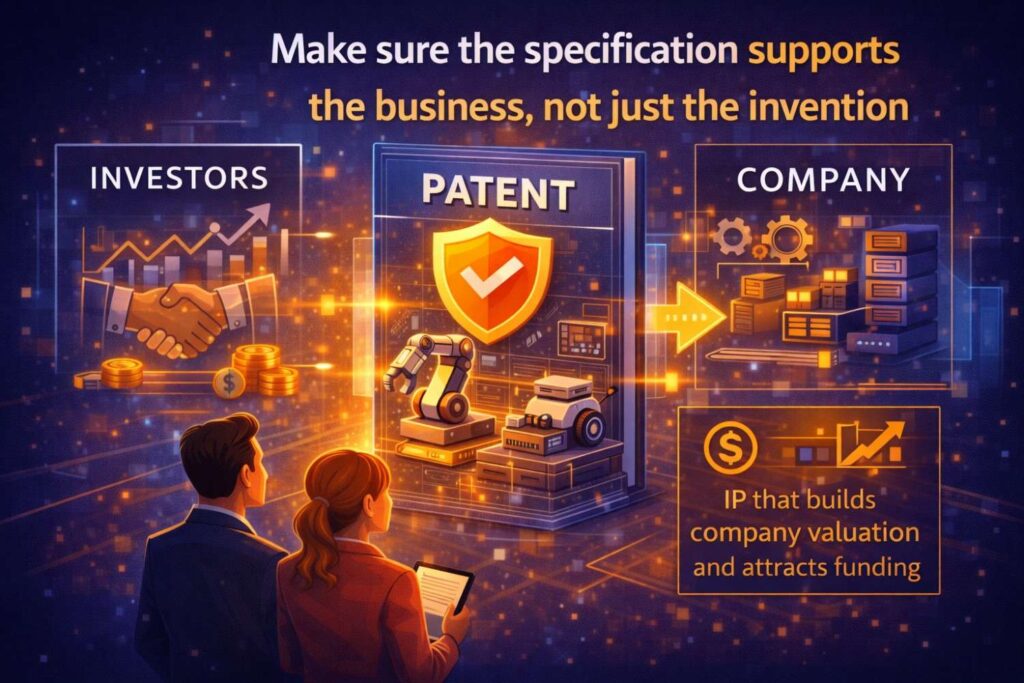
A patent is a technical document, but it also supports a business goal.
That means when turning a disclosure into a full specification, you should ask a business question too: what do we actually want protected?
Maybe the value is in the core engine.
Maybe it is in the onboarding flow that makes the engine work at scale.
Maybe it is in the way hardware and software are combined.
Maybe it is in the feedback loop that improves results over time.
Maybe it is in the verification layer that makes the system safer or more trusted.
Maybe it is in the operational path that cuts cost or latency.
Do not write the specification only around the most intellectually interesting piece if that is not the piece competitors would copy. Write around the real value.
This does not mean gaming the process. It means aligning the draft with what matters commercially.
A strong patent strategy protects what gives you leverage.
Think beyond version one of your startup
This is hard but important.
Your startup today may be tiny. Your product may still be shifting. That can make founders hesitate to file because they think they should wait until the product settles.
But waiting can create risk.
A better approach is to draft the specification in a way that captures the present invention while leaving room for future versions.
What parts are likely to stay the same even if the interface changes?
What architecture choices may evolve?
What core logic will remain valuable in version two or version three?
What adjacent use cases may open up?
What extra modules may be added later?
A good specification does not have to predict the entire future. It just needs enough breadth and variation to grow with the business better than a narrow snapshot would.
Use the figures and text to reinforce each other
One drafting move that often separates stronger applications from weaker ones is alignment between the figures and the written description.
If the figures show a module, the description should explain it.
If the flowchart shows a decision branch, the text should cover it.
If the text names several embodiments, the figures should help make at least the main ones visible.
This sounds basic, but many rushed drafts have thin figures and thick text or the reverse. The result is a document that feels uneven.
A better approach is to draft them together. Let each diagram reveal what the text must explain. Let each paragraph suggest what a figure could clarify.
Do not be afraid to include multiple embodiments in one filing

Some founders worry that including too much will muddy the patent.
In reality, where the embodiments share a common inventive concept, describing multiple embodiments can strengthen the specification.
For example, maybe the invention is fundamentally about adaptive decision making based on confidence and policy logic.
One embodiment applies it to cloud workload routing. Another applies it to edge-device alerting. Another applies it to secure user access.
If the shared technical logic is real and well described, the fuller write-up may give more support than a narrower one.
The key is coherence. The embodiments should not feel random. They should connect through the common inventive idea.
The specification should answer the silent question: what exactly was invented here?
A great way to test your draft is to imagine a smart outsider reading it and asking, “What exactly was invented here?”
If the answer is still fuzzy after several pages, the draft needs work.
This is where some long patent drafts fail. They have many sections, but the inventive center is buried.
A stronger draft makes the inventive point clearer as the reader moves through it.
The problem becomes clear. The solution becomes clear. The mechanics become clear. The options become clear.
Not in a simplistic way, but in a grounded and logical way.
One useful workflow for turning a disclosure into a full specification
Let us make this practical.
Imagine you start with a two-page invention disclosure. It has a title, a problem statement, a short solution summary, a few screenshots, and some names of inventors.
How do you turn that into a full specification?
You begin by reading the disclosure and identifying the core inventive concept in one paragraph.
Then you gather supporting material from the team. You ask for architecture notes, workflow docs, diagrams, and code references.
Then you interview the inventors and push past the first summary.
You ask what is essential, what is optional, what changed technically, what alternatives exist, and where the competitive value lives.
Then you map the architecture. You name the components. You outline the process flow.
Then you draft the broad description of the invention at a high level.
Then you write a cleaner background and summary.
Then you develop one detailed embodiment that really explains the invention.
Then you add alternative embodiments, optional features, edge cases, and implementation variations.
Then you draft figures or revise the figures so they align with the text.
Then you review the whole thing for consistency, support, and scope.
Then you refine the language to avoid accidental narrowing and strengthen clarity.
This is the real work.
It is not magic. It is structured thinking.
And it gets much easier when the system supports the way technical teams already work. PowerPatent was built for exactly this kind of process, helping startups turn invention notes, product thinking, and engineering context into patent-ready filings with much less friction than the traditional path. You can explore the workflow here: https://powerpatent.com/how-it-works
The most common gaps between disclosure and full specification
If you want to get better fast, it helps to know the usual gaps.
The first gap is missing alternatives. The disclosure often describes only one version.
The second gap is weak technical detail. The disclosure says what the invention does, but not enough about how.
The third gap is product lock-in. The write-up mirrors the current product too closely.
The fourth gap is missing system context. A method is described without enough environment around it.
The fifth gap is fuzzy terminology. Important parts are not named clearly or used consistently.
The sixth gap is no edge-case handling. The draft only describes ideal conditions.
The seventh gap is thin figures. The drawings do not carry their weight.
The eighth gap is not enough business focus. The draft misses what actually creates strategic value.
The ninth gap is accidental narrowing. Optional features get written as required ones.
The tenth gap is lack of review by people who understand both the tech and the patent side.
Seeing these gaps early can save a lot of pain later.
A full specification is a strategic asset, not a filing chore
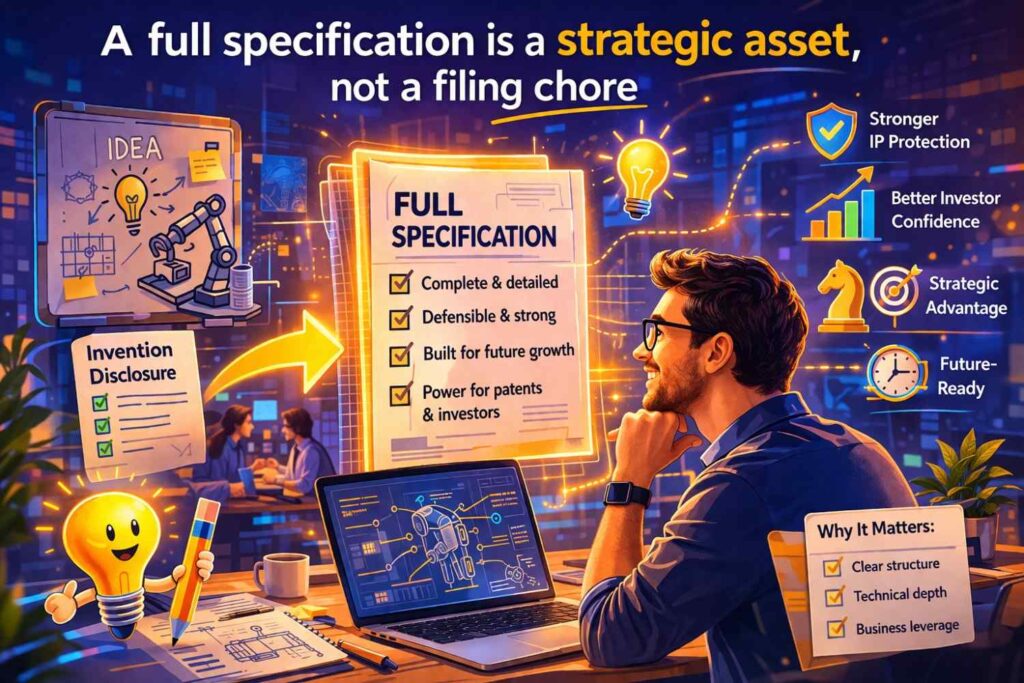
This point matters, especially for founders moving fast.
If you treat patent drafting as annoying paperwork, the result usually shows. The draft feels rushed, shallow, and disconnected from the company’s real leverage.
If you treat the specification as a strategic asset, everything changes.
You ask better questions.
You capture more variations.
You think more carefully about what should be protected.
You document the technical advantage more clearly.
You create a stronger foundation for future filings too.
This mindset shift is important. A well-developed specification can support not just one filing moment, but a broader IP path over time.
How detailed is detailed enough?
This is a fair question.
There is no magic page count. More detail is not always better if it is the wrong detail.
A useful test is this: does the draft explain the invention at a level where a technically skilled reader can understand the structure and operation of the invention and see that the inventors had possession of the concept across meaningful variations?
If yes, you are moving in the right direction.
If the draft still feels like a product brochure or brainstorming memo, it is not there yet.
Detailed enough usually means the document includes the technical logic, the main components, the key interactions, one or more useful examples, and enough alternatives that the invention does not depend on a single narrow setup unless that narrowness is intentional.
Editing matters as much as drafting
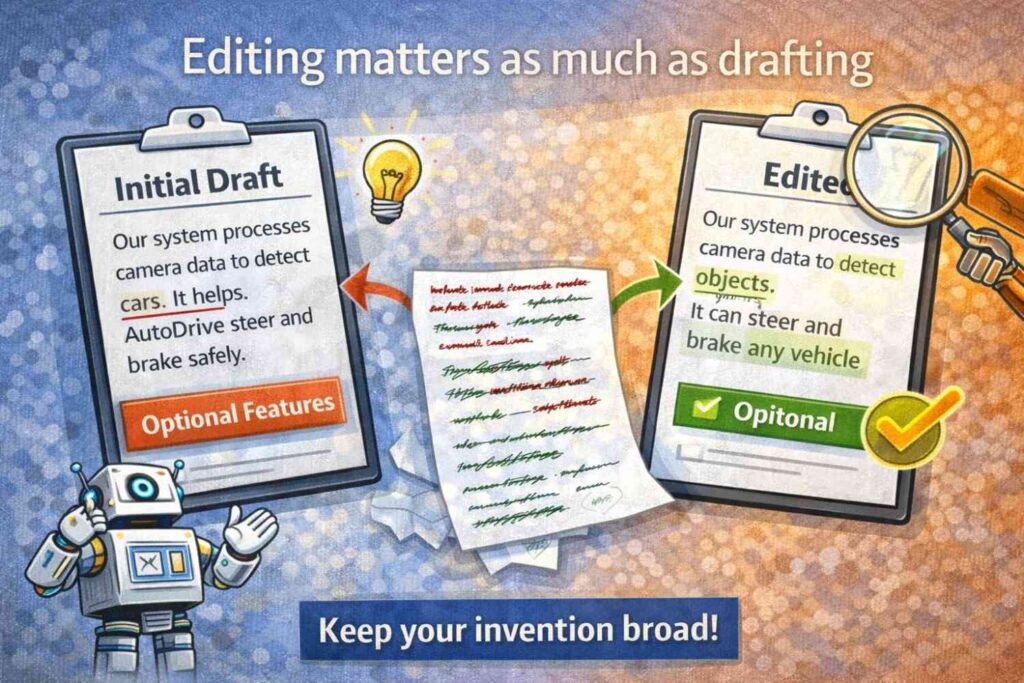
Once the first full draft exists, the work is not done.
Editing is where many weak areas become visible.
Read the draft and look for repeated language that says nothing new.
Look for terms that shift meaning.
Look for steps that appear in one section but not another.
Look for figures that no longer match the text.
Look for places where optional features sound mandatory.
Look for places where broad statements lack support.
Look for places where the real inventive point is buried under filler.
Look for places where technical substance could be clearer.
A strong edit usually shortens some parts and deepens others. It removes fluff. It sharpens the core. It makes the document more useful.
Read the draft like a future examiner, competitor, and investor
This is a helpful triple test.
Read it like an examiner and ask: is the invention actually clear here?
Read it like a competitor and ask: could I work around this easily based on how narrowly it is described?
Read it like an investor and ask: does this document reflect real technical depth and protect what makes this company different?
You may not answer all three perfectly, but the exercise reveals a lot.
Be careful with founder assumptions
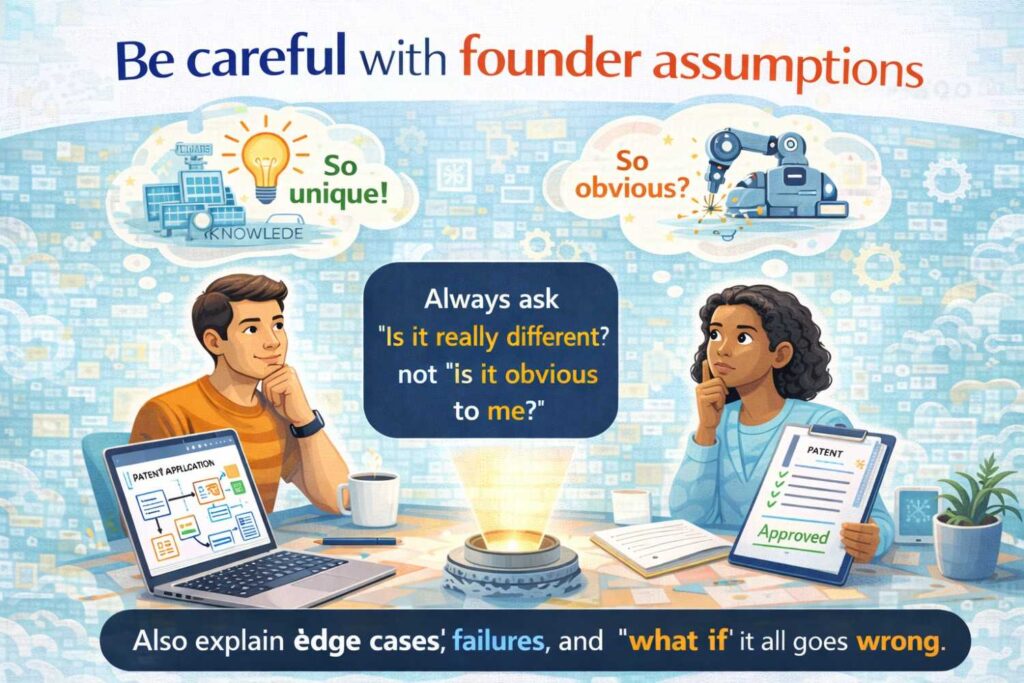
Founders often assume certain things are obvious because they live inside the product every day.
But what feels obvious internally may be invisible on the page.
Maybe the team knows the input validation step is critical. Did the draft explain it?
Maybe everyone knows the system uses dynamic thresholds. Did the draft say that clearly?
Maybe the ordering of stages matters. Did the draft preserve that logic?
Maybe the invention depends on combining two data streams before inference. Is that stated?
Never trust internal familiarity to do the work of written clarity.
Use a repeatable intake process so good ideas do not die in notes
This article is about turning one disclosure into a full specification, but there is a bigger lesson too.
If your company invents often, you need a repeatable way to capture invention details before they fade.
That means simple intake, good questions, fast follow-up, and a drafting workflow that does not drag for months.
Otherwise strong technical ideas stay buried in Slack threads, sprint docs, and engineers’ heads.
This is where modern startups need a modern system. PowerPatent helps teams capture inventions, draft faster, and move toward filing with support from real attorneys, so valuable ideas do not get lost between shipping and legal process. See the approach here: https://powerpatent.com/how-it-works
Why traditional patent drafting often fails fast-moving teams
The old model often breaks because the workflow is too slow and too disconnected from the real source material.
An outside lawyer sends a questionnaire. The founder answers quickly between meetings. Weeks pass. A draft arrives. It sounds formal, but it missed key details because the intake was thin and the iteration loop was weak.
This is not always because the lawyer is bad. It is often because the process itself is a poor fit for modern product development.
Startups need a better bridge between engineering reality and legal drafting quality.
That bridge should make it easy to capture technical detail from the team, shape it into a real specification, and keep strategy in sight while moving quickly.
That is exactly the kind of gap PowerPatent is built to solve.
A practical example: from rough disclosure to robust specification
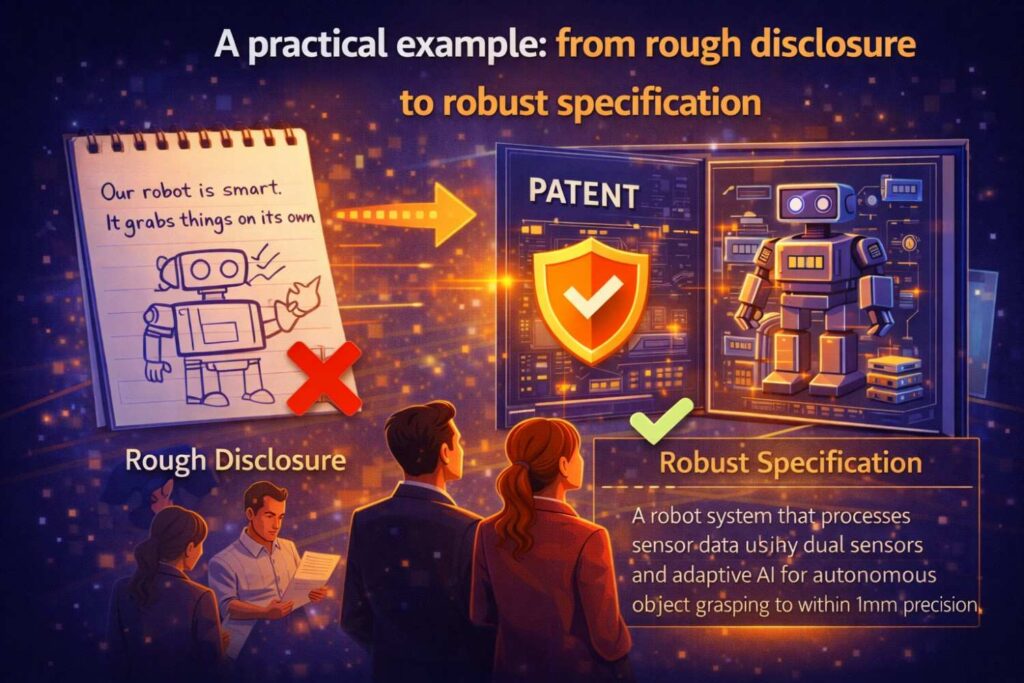
Let us walk through a simplified example.
Suppose a startup builds a platform that helps delivery fleets reduce failed drop-offs. The invention disclosure says the system predicts failed deliveries by combining driver route data, customer response behavior, location access patterns, and time-of-day risk.
It then changes routing and customer prompts in real time.
That is a good start.
But as a full specification, it is still thin.
To expand it, you first identify the core invention. It may not simply be “predict failed deliveries.”
The real idea might be a dynamic decision framework that fuses live route data, historical access patterns, and user engagement signals to generate a failure-risk score and trigger adaptive delivery actions.
Now you have a stronger center.
Then you gather details. How is data collected? What signals are used? How often is the score updated? What actions can be triggered? Are there threshold levels? Can a human dispatcher override? Does the system learn from outcomes?
Then you map the architecture. Driver device, route service, risk engine, message engine, customer interaction store, action module.
Then you write one detailed embodiment. The system receives planned delivery data and live route telemetry.
It retrieves historical access information for the destination.
It computes a first risk score before arrival. It updates the score based on customer message response or lack of response.
If the score passes a threshold, it triggers one of several actions such as modifying route sequence, sending a location confirmation request, or flagging a stop for special handling.
Then you widen it. Maybe different scoring models can be used. Maybe thresholds are adaptive. Maybe the action logic uses policy rules.
Maybe the same approach works for service visits, pickups, or field operations. Maybe the customer signals can come from app responses, texts, call logs, or smart lock integration.
Now the invention has real shape. It can support more than a short idea summary.
That is what turning a disclosure into a specification looks like in practice.
Do not confuse confidentiality with completeness
Some founders hold back detail because they are afraid to write too much down. They think a shorter draft feels safer.
In reality, once you decide to pursue a patent filing, completeness usually matters more than vague caution.
A thin draft does not become strong because it says less. It usually becomes easier to challenge, easier to work around, and less useful.
Of course, you should be thoughtful about what you disclose and how it fits your broader business strategy.
Not every trade secret belongs in a patent. But if you are filing on an invention, the specification should still do the real work needed to support protection.
This is where good judgment matters. You want to disclose enough to support a strong filing without accidentally exposing value that should remain outside the patent strategy.
That balance is easier to strike when experienced patent counsel is part of the process.
Your first draft will usually be too narrow
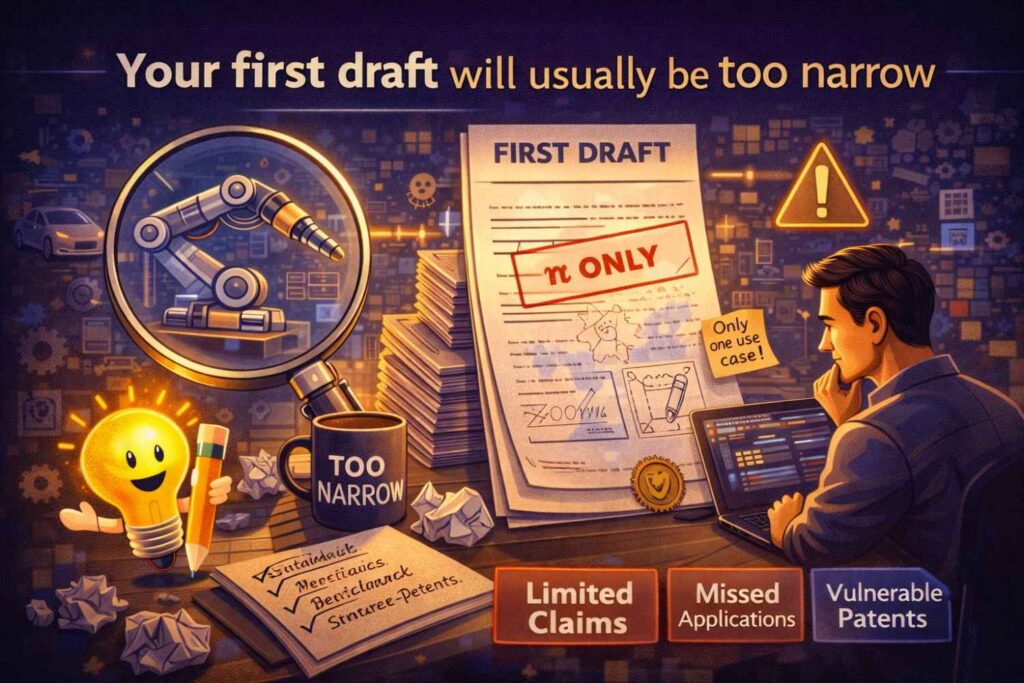
This is normal.
Most first drafts reflect the first way the inventors explain the invention. That first explanation is often narrower than the real scope.
Why? Because people naturally describe what they built first, not all the ways the inventive idea can live.
So expect the first version to be incomplete.
That is not failure. That is part of the process.
The important thing is to revise with broader vision and stronger support.
Ask after the first draft: what variations are missing? What optional features are locked in too tightly? What alternative environments should be added? What edge cases deserve mention? What business-critical angles are underdeveloped?
The second and third passes are often where the specification becomes truly valuable.
Strong specifications are written for the future, not just the filing date
A patent specification should never be treated like a one-day filing task.
It should be treated like a long-term business asset.
The filing date matters. Of course it does. It can lock in priority. It can mark an early stake in the ground. It can help show that your team got there first.
But the real value of a strong specification often shows up later.
It shows up when your product changes.
It shows up when your market expands.
It shows up when a competitor starts copying the part of your system they once ignored.
It shows up when investors ask how deep your protection really goes.
It shows up when your team wants to file follow-on patents but needs strong support from what was written before.
That is why smart companies do not draft only for the filing moment. They draft for the business they are becoming.
A weak specification may work for a date on a calendar.
A strong specification helps support a company over time.
Your Patent Should Be Able to Grow With Your Product

Most startups do not look the same twelve months later.
Features move. Architecture changes. Models improve. Interfaces get replaced. Customers ask for different things. Teams rebuild parts of the stack. New markets open.
That is normal.
But here is the problem. If your specification is tied too tightly to the exact version of the product you had on filing day, the document can age badly.
The product grows.
The patent stays stuck.
This is why future-focused drafting matters so much. Your specification should be broad enough to stay useful even as your implementation evolves.
That does not mean writing vague language. It means capturing the deeper logic of the invention so the patent still maps to the business after version one is gone.
A very practical way to do this is to ask a simple question during drafting:
What parts of this invention are likely to stay true even if the product changes shape?
That question helps you separate the lasting engine from the temporary wrapper.
Maybe your current interface changes.
Maybe your database setup changes.
Maybe your current model provider changes.
But if the core invention is really about how signals are combined, how decisions are made, how resources are allocated, how trust is established, or how system behavior adapts in response to changing inputs, that is what the specification should protect at the deepest level.
Businesses that understand this early make better IP decisions.
Write for the Roadmap, Not Just the Release
One of the most strategic things a company can do is connect patent drafting to its product roadmap.
Many teams file based only on what has already shipped. That is better than doing nothing, but it leaves a lot on the table.
Your roadmap often contains some of your most valuable future protection ideas.
That does not mean you should invent fake embodiments or claim things your team has not really conceived. It means you should look at the real near-term path of the product and ask whether the current invention naturally extends into those future directions.
For example, maybe today your system works in a central cloud setup. But your roadmap already includes edge deployment.
Maybe today your workflow is semi-automated. But the roadmap shows staged automation with policy controls.
Maybe today the invention supports one customer type. But next quarter it will be adapted to enterprise teams, partners, or third-party platforms.
If those future directions are true extensions of the same inventive concept, your specification should have room for them.
This is one of the highest-leverage habits a business can build.
Before finalizing a draft, sit down with product and engineering leads and ask:
What is changing in the next twelve to eighteen months that still uses this same core invention?
That conversation can surface valuable embodiments, deployment options, workflow changes, and commercial use cases that deserve support now.
A Good Specification Creates Options Later
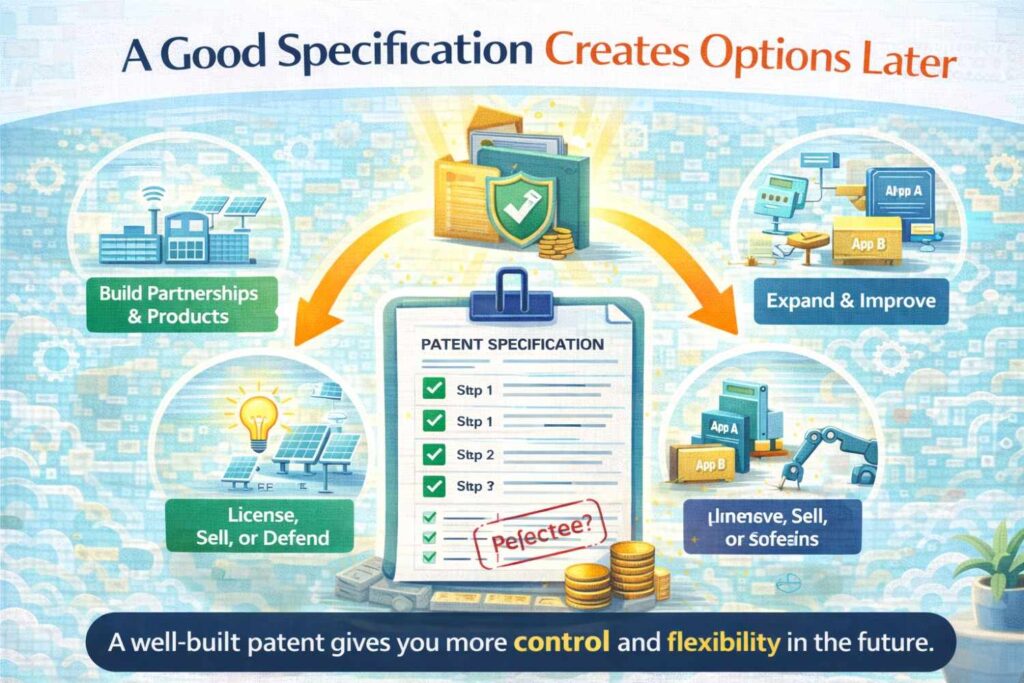
The strongest businesses value options.
A strong specification gives you them.
It can support different claim strategies later.
It can support continuation filings.
It can support narrower fallback positions if needed.
It can support new angles that become more important once the market matures.
It can support enforcement theories that were not obvious on day one.
This is one of the biggest differences between checking the filing box and drafting strategically.
If a specification is thin, your future options shrink.
If a specification is rich in the right ways, your future options expand.
This matters because business conditions change. The part of your invention that seems most exciting today may not be the part competitors copy tomorrow.
A feature that looks secondary now may become central once customers adopt it at scale. A detail that feels optional at filing may become critical in licensing, diligence, or competitive pressure later.
A strong specification gives you room to respond.
That room is valuable.
Protect the Part of the Business Competitors Will Want to Copy

Founders often draft around what they are most proud of.
That makes sense emotionally, but it is not always the best business move.
A stronger approach is to ask what competitors are most likely to imitate if your company starts winning.
That is where patent value often becomes real.
Competitors may not copy your homepage.
They may not copy your exact internal codebase.
But they may copy the decision flow, the automation logic, the scoring method, the control loop, the system layout, the data handling framework, or the integration path that gives you your edge.
That is the part the specification should describe with real care.
This requires business judgment, not just technical documentation.
A helpful exercise is to imagine that a well-funded competitor sees your traction and wants to build a close substitute in six months.
What would they borrow first?
What would they keep if they changed the branding, design, and language?
What hidden system logic would still matter?
Those answers should shape the way the specification is expanded.
That is how patents become more than legal paperwork. They become part of market defense.
Draft So the Next Patent Is Easier to File
Most companies do not stop at one filing.
If they are building meaningful technology, they usually uncover follow-on inventions as the product matures.
This is another reason to draft for the future.
A strong first specification can make later filings easier, faster, and smarter.
It creates language your team can reuse.
It creates technical context that later applications can build on.
It creates a clearer record of how the platform evolved.
It gives future drafts a stronger starting point.
A weak first specification does the opposite. It forces every later filing to rebuild basic context from scratch. It creates gaps. It creates inconsistency. It makes your portfolio feel fragmented instead of connected.
From a business perspective, that fragmentation can hurt.
A more strategic approach is to treat each core specification as part of a larger IP foundation.
When reviewing a draft, ask:
If we file two more related patents next year, does this document help us or limit us?
That one question can change how much care you put into the broader framing, the terminology, the embodiments, and the system description.
Future Buyers and Investors Read Patents Differently Than Founders Do
Founders often read a patent draft and ask, “Is this accurate?”
That matters. But buyers and investors often ask something different.
They ask, “Does this give the company a durable edge?”
They look for signs that the company understands what makes its technology valuable.
They look for evidence that the patent strategy is tied to the real product, not random ideas.
They look for coverage that feels commercially relevant.
They look for depth.
A future-focused specification helps answer those questions better.
It shows that the company did not just document a feature. It documented a defensible technical advantage.
It shows that the team understood the broader shape of the invention.
It shows maturity.
That can matter a lot in diligence.
A patent portfolio does not need to be huge to be impressive. But the filings should show thought, clarity, and strategic alignment with the business.
That starts at the specification level.
Build a Habit of Capturing “Next Likely Variants”
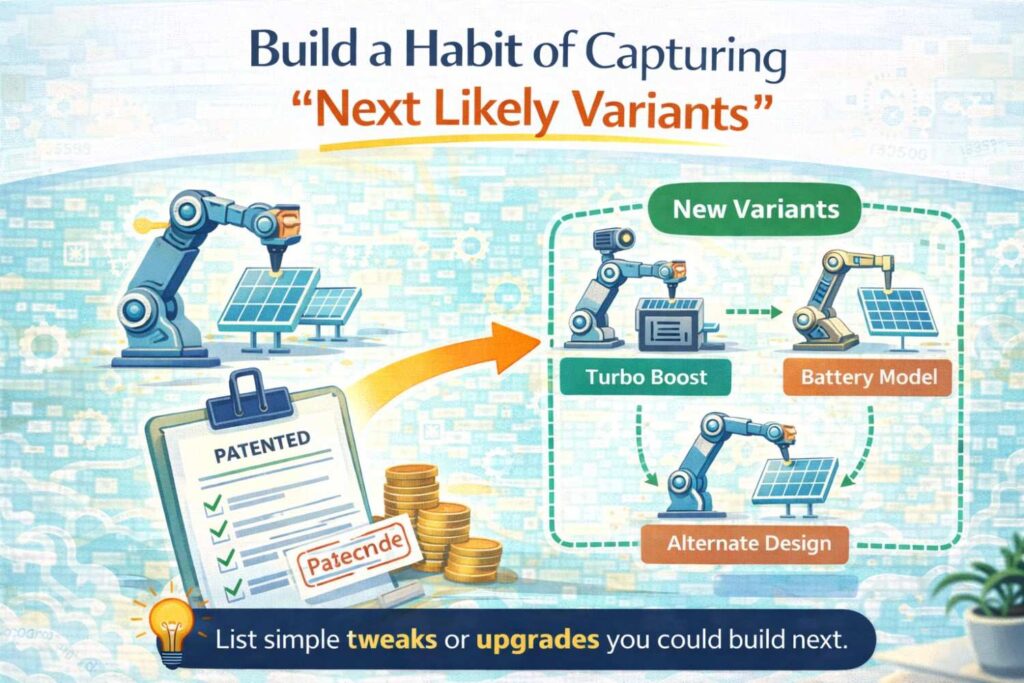
Here is one very practical move that almost any startup can use.
When expanding a specification, add a short internal exercise called “next likely variants.”
This is not marketing brainstorming. It is a technical strategy exercise.
Take the core invention and ask:
What is the most likely way we will improve this in the next product cycle?
What is the most likely way a competitor would repackage this?
What is the most likely deployment change we will make?
What is the most likely input or output change?
What is the most likely scaling change?
What is the most likely policy, security, or workflow layer we will add?
Then look at the draft and see whether those likely variants are supported.
This is one of the best ways to make a specification more future-ready without filling it with random ideas.
It keeps the drafting grounded in reality.
It also helps the business protect where it is actually heading.
Create a “Do Not Over-Narrow” Review Pass
Most teams review for errors. Fewer teams review for unnecessary narrowing.
They should.
Before filing, run one full review pass with a single purpose: identify places where the specification may be accidentally smaller than the business.
Look for language tied too tightly to one interface.
Look for wording locked to one deployment environment.
Look for examples that sound like definitions.
Look for optional features that have become mandatory through wording.
Look for technical concepts described only through one tool, one stack, one model type, one sensor, one communication path, or one data source when the invention is actually broader.
This review can be extremely valuable.
It is one of the easiest ways to improve long-term patent value without changing the core truth of the invention.
For businesses, that is a high-return habit.
Use Your Specification to Support Internal Alignment
There is another business benefit that does not get enough attention.
A strong patent specification can help align internal teams.
When written well, it forces the company to clarify what the invention really is, what technical advantage matters most, what pieces are central, and where the platform may expand.
That can help product, engineering, and leadership teams speak more clearly about the company’s core technology.
In fast-moving startups, that kind of alignment has real value.
It can sharpen roadmap thinking.
It can improve invention spotting.
It can make future patent intake easier.
It can even help founders explain technical defensibility more clearly in fundraising and strategic conversations.
A future-focused specification does not just protect value. It can also help the company see its own value more clearly.
Action Steps Businesses Can Use Right Away
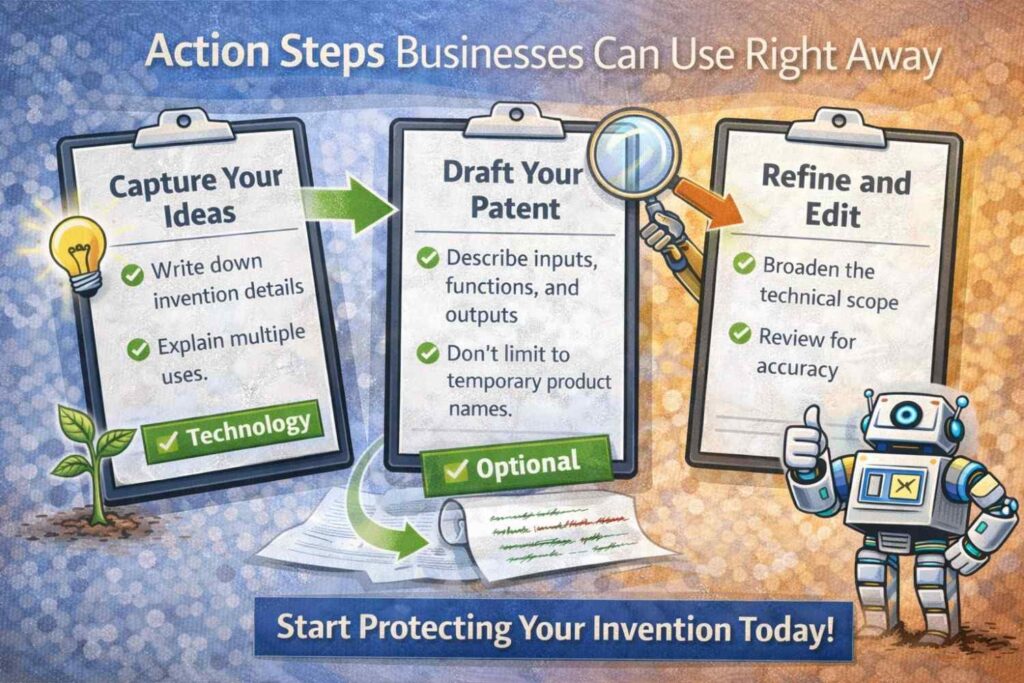
Here is a simple way to make your next specification more future-ready.
Start by pulling in one product lead, one engineering lead, and one business decision-maker before the draft is finalized. Ask them to review the invention through three lenses.
First, ask the product lead what is most likely to change in the product while keeping the same underlying advantage.
Second, ask the engineering lead what technical variants or deployment changes are realistic in the next one to two years.
Third, ask the business decision-maker what part of the invention would hurt most to lose to a competitor.
Then compare those answers against the draft.
If the specification does not reflect them, there is likely strategic value still missing.
This is not a hard process to run. But it can dramatically improve the long-term usefulness of a filing.
The Filing Date Starts the Story. It Does Not Finish It
The businesses that get the most value from patents understand this point deeply.
The filing date is important, but it is not the finish line.
It is the beginning of a longer business story.
Your specification should be written so it still matters when the company is bigger, the product is better, the market is more crowded, and the stakes are higher.
That is what makes the work worth doing carefully.
And that is why strong specifications are written for the future, not just the filing date.
What founders should do right now
If you have a rough invention disclosure sitting in a folder, do not assume the hard part is done. The hard part may just be starting.
Pull it up and read it with fresh eyes.
Ask whether it clearly explains the technical idea.
Ask whether it captures how the invention works.
Ask whether it includes the main components, flows, examples, and alternatives.
Ask whether it protects the business value, not just the current feature.
Ask whether it would still make sense to someone outside your team.
If the answer is no, that is not bad news. It means there is still important value to unlock.
And you do not have to do that work the slow, painful, old-school way.
PowerPatent helps startups turn invention notes into stronger patent applications faster, with software that fits the way modern teams work and real attorneys who help make sure the protection is solid. If you are building something worth protecting, this is a smart place to start: https://powerpatent.com/how-it-works
Final thought
An invention disclosure is where the story begins.
A full specification is where the invention becomes real on paper.
That move—from rough idea capture to full technical support—is one of the most important steps in building meaningful patent protection. It is where you go from “we have an idea” to “we have described it in a way that can truly support the business.”
Done well, this process gives you more than a filing. It gives you clarity. It gives you leverage. It gives you a stronger foundation for what comes next.
If your team is sitting on disclosures, design docs, code, or product ideas that deserve real protection, now is the time to turn them into something stronger.
PowerPatent can help you do exactly that, with a faster, founder-friendly process backed by real attorneys. See how it works here: https://powerpatent.com/how-it-works
Leave a Reply