The summary section looks small.
But it carries a lot of weight.
It is one of the first places where your invention starts to feel real on the page. It helps frame what the invention is, what it does, and why the rest of the patent deserves close attention.
When written well, it gives the whole application more shape. When written badly, it can make a strong invention sound thin, narrow, or confused.
That is why this section matters more than most founders think.
This article will show you how to write the summary in a patent specification in a way that is clear, useful, and strategically strong.
We will keep the language simple. We will focus on what actually helps.
And we will make this practical enough for startup founders, engineers, inventors, and technical teams who want to protect what they are building without getting lost in old-school patent language.
If you are building something worth protecting and want a faster way to turn your invention into a real filing, PowerPatent helps startups do exactly that with smart software and real attorney oversight.
You can see how it works here: https://powerpatent.com/how-it-works
Why the summary section matters so much
A lot of people think the summary is just a short bridge between the background and the detailed description.
That is partly true.
But it does more than connect sections.
A strong summary gives the reader a clean first view of the invention. It helps the reader understand the general shape of the system or method before the document dives into deeper detail.
It also starts building support for how the invention may later be claimed.
That last part matters.
The summary is not where claims are written, but it can help show the invention in broad, useful ways. It can describe the invention as a method.
It can describe it as a system. In software cases, it can also describe it as instructions stored on a computer-readable medium.
These different views matter because they can support different claim styles later.
So the summary is not filler.
It is a strategic section.
It helps the invention feel organized. It helps the filing feel stronger. And it can quietly improve the flexibility of the whole application.
That is why it deserves more care than founders usually give it.
What the summary section is supposed to do
Let us make this very simple.
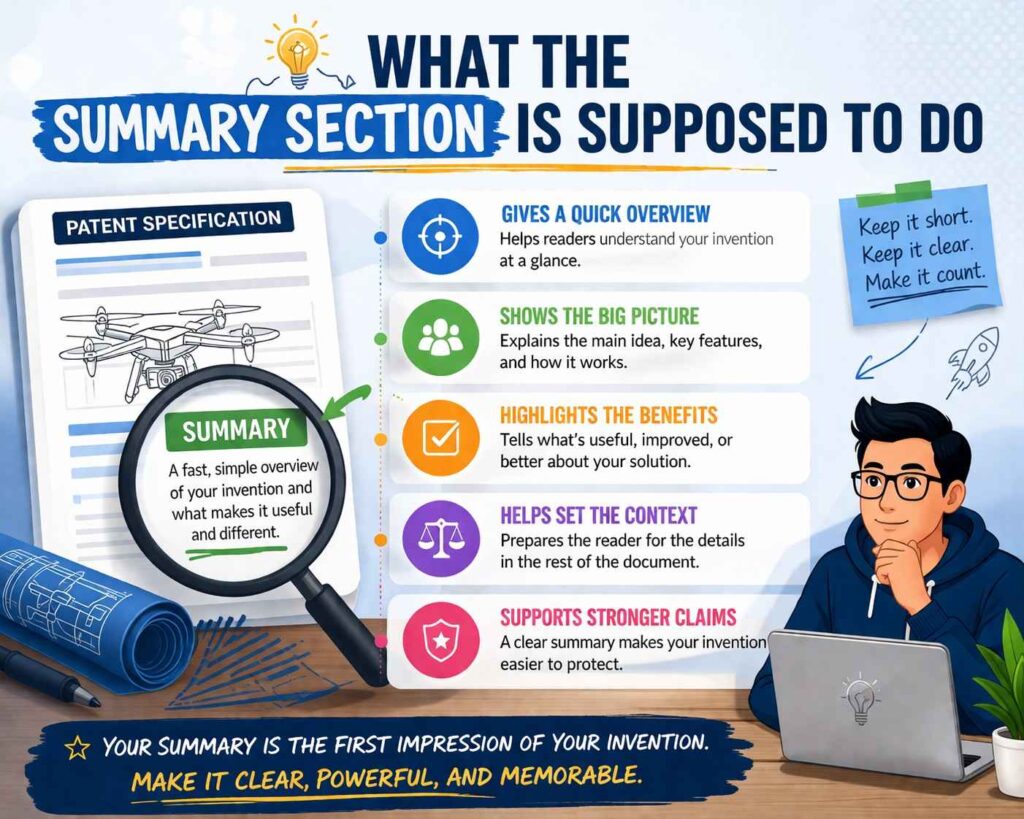
The summary section is supposed to explain the invention at a high level.
That is its job.
It should tell the reader what the invention broadly is, how it generally works, and what major parts or steps it may include. It should also begin to show different ways the invention can be carried out, without getting stuck in too much detail.
Think of it like the best kind of overview.
Not vague.
Not overstuffed.
Not full of marketing talk.
Just clear.
A good summary helps the reader answer these questions quickly.
What kind of invention is this?
What is it generally doing?
What are the main components or steps?
What kinds of variations does it include?
What problem area is it operating in?
That is enough.
The summary should not try to explain every detail. The detailed description will do that later.
It should also not spend too much time arguing why the invention is amazing. This is not a pitch deck. It is not a homepage. It is not a product launch post.
It is a patent document.
So the summary should stay technical, clear, and broad enough to help.
Why founders often get the summary wrong
Founders usually get the summary wrong in one of three ways.
The first way is by writing too little.
They write something so short and thin that it barely helps. It says the invention improves something, maybe names one part of the system, and then stops. That kind of summary does not add much value. It can make the invention feel underdeveloped.
The second way is by writing too much detail.
They start using the summary as a mini detailed description. Suddenly the section is packed with tiny implementation facts, narrow examples, and exact workflows that belong later in the application. That can make the summary heavy and awkward.
The third way is by writing like a marketer.
They use broad phrases about innovation, powerful systems, smart automation, and transformative results. That kind of language may sound polished, but it does not help a patent application much. It often replaces clarity with fluff.
A strong summary avoids all three mistakes.
It gives enough substance to matter. It stays at the right level of generality. And it sounds grounded, not promotional.
The summary is where your invention first becomes easy to understand
This is one of the hidden powers of the summary section.
A good summary gives shape to the invention before the reader gets into all the details. It acts like a map.
That matters because patent specifications can be long. They often include many embodiments, optional features, alternate flows, system parts, drawings, and examples. Without a clean summary, the reader may not know what to hold onto as they move through the rest of the document.
A good summary solves that problem.
It gives the reader the central idea first.
Then, when they reach the detailed description, they already understand the main technical picture.
This is useful for many readers.
It helps the patent examiner.
It helps your attorney.
It helps the founder reviewing the draft.
It helps future investors or acquirers who may read the filing during diligence.
It even helps your own team understand the invention in more structured form.
That is why the summary is not just a formality. It is one of the places where the invention starts to become readable.
The summary is not the abstract
People mix these up all the time.
They are not the same thing.
The abstract is usually very short. It gives a compact snapshot of the invention. It is often more compressed and more limited.
The summary section is broader. It gives the reader more room to understand the invention at a high level. It often introduces several embodiments or views of the invention. It gives more context than the abstract, but less detail than the full detailed description.
So do not treat the summary like a slightly longer abstract.
It needs more shape than that.
It should feel like a real overview section, not a rushed paragraph inserted because the template asked for one.
The summary is not the background either
The background and the summary serve different jobs.
The background explains the technical setting and the problem context.
The summary introduces the invention itself.
That difference matters a lot.
A weak draft often blurs those sections together. The background starts previewing the invention too early. Or the summary keeps repeating the problem story instead of clearly explaining the solution.
A clean application keeps the roles separate.
The background says, here is the kind of technical problem that can arise.
The summary says, here is the kind of invention being disclosed to address that space.
That structure helps the patent read better and makes the invention feel more deliberate.
What a strong summary feels like
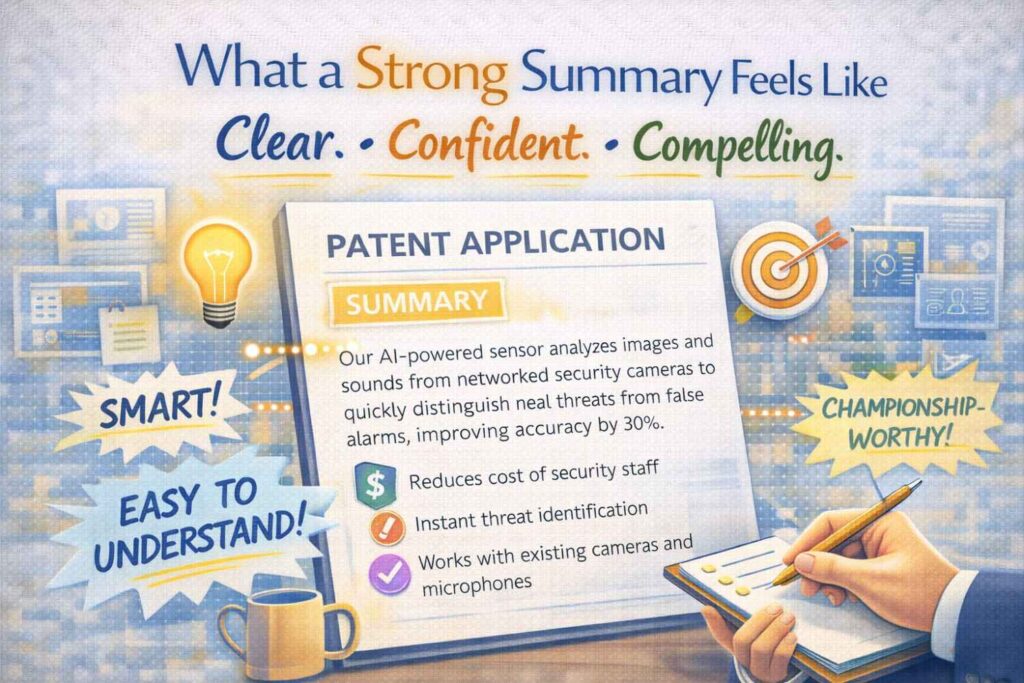
A strong summary feels calm.
It feels clear.
It feels broad enough to support the invention well, but grounded enough to mean something.
When you read a strong summary, you should feel like you understand the main idea without yet needing every detail.
You should be able to say, I see what kind of system this is. I see roughly what it does. I see the general flow. I see that there are different ways it can be carried out.
That is the feeling you want.
A weak summary often creates the opposite feeling. The reader finishes it and still does not know what the invention really is. Or the reader feels buried in too much detail too early.
So one useful test is simple.
After reading the summary, does a technically literate person have a strong general picture of the invention?
If yes, the section is probably working.
The simple structure of a good summary
A strong patent summary usually follows a very simple pattern.
It begins by stating that the disclosure relates to certain systems, methods, or apparatuses.
Then it introduces the invention at a high level.
Then it explains some main parts, steps, or operations.
Then it may describe several embodiments or implementation options.
Then it may present the invention in different forms, such as a method, a system, or a non-transitory computer-readable medium.
That is the general shape.
This structure works because it gives the invention more than one useful view without turning the section into a full technical deep dive.
The summary should move with rhythm.
First the reader sees the core idea.
Then the reader sees how that idea may be carried out.
Then the reader sees that the invention may take more than one form.
That makes the filing stronger and more flexible.
Why breadth matters in the summary
This section is one of the places where breadth starts to matter.
A startup founder may think the summary should describe the current product exactly as it exists today.
That is not usually the best move.
The summary should be tied to the real invention, of course. It cannot be fantasy. But it should also avoid trapping the invention inside one narrow product version.
Suppose your current product uses one specific machine learning model, one data source, and one deployment setup.
A narrow summary may describe only that exact model, that exact source, and that exact setup.
A stronger summary may describe the invention more broadly. It may say the system can use one or more predictive models. It may say the data can come from one or more sensors, devices, user interactions, or stored records. It may say the processing can occur locally, remotely, or in a hybrid environment.
That kind of breadth matters.
It gives the application room.
It reflects the real invention more fully.
And it can help support better claims later.
This is one reason founders like working with PowerPatent. It helps capture the invention in a way that is broad where it should be broad and grounded where it should be grounded, with real attorney oversight built in. That means less guesswork and fewer painful mistakes.
You can explore it here: https://powerpatent.com/how-it-works
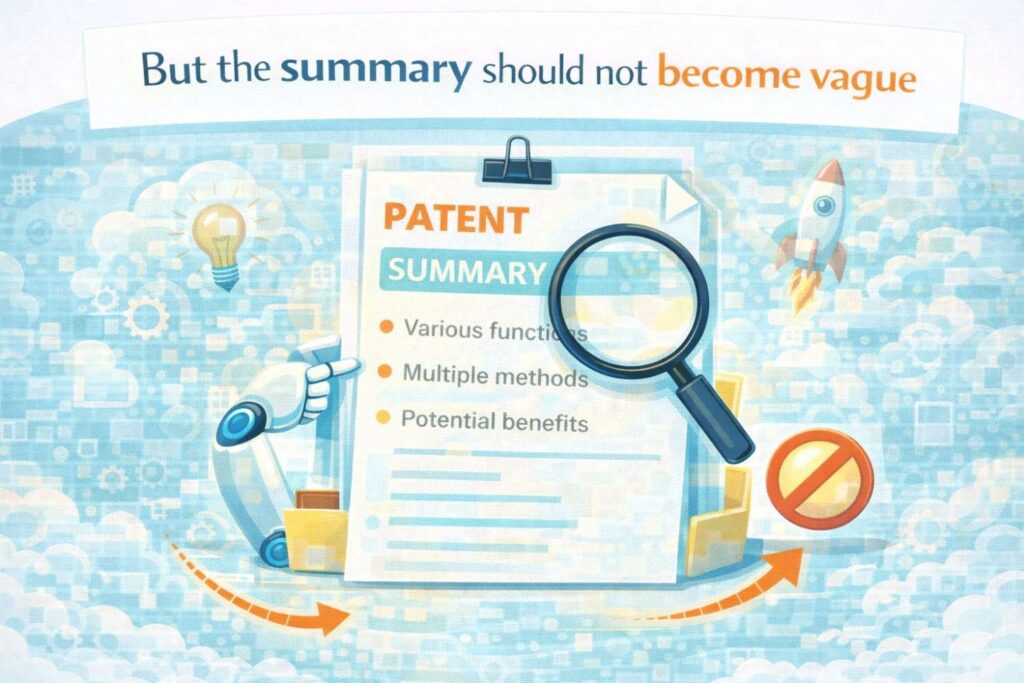
But the summary should not become vague
Breadth is good.
Vagueness is not.
These are not the same thing.
A vague summary says things like the system improves efficiency or intelligently optimizes workflows without saying how the system generally does that.
A broad but useful summary says the system receives certain inputs, processes them using certain types of logic, and produces certain outputs or actions.
That difference is everything.
The summary should give enough technical shape that the invention feels real. It should tell the reader something about the mechanics.
What kind of input does the system receive?
What kind of operation does it perform?
What kind of output or action results?
What kind of components or modules are involved?
You do not need every detail.
You do need a real technical outline.
The best place to start writing the summary
Many people try to write the summary too early.
They open the patent document, see the heading, and try to force a polished overview before they have fully mapped the invention.
That is usually not the easiest way.
A better approach is to start with invention capture.
Describe the system in ordinary language first. Explain what it does, how it works, what parts are involved, what the main steps are, what the key improvement is, and what variations could exist.
Then map the background.
Then sketch the detailed description.
Only after that should you refine the summary.
Why?
Because the summary is easier to write once you know the whole shape of the invention.
The summary is not the place where you discover the invention.
It is the place where you present the invention cleanly.
That is much easier when the deeper thinking has already happened.
What to gather before writing the summary
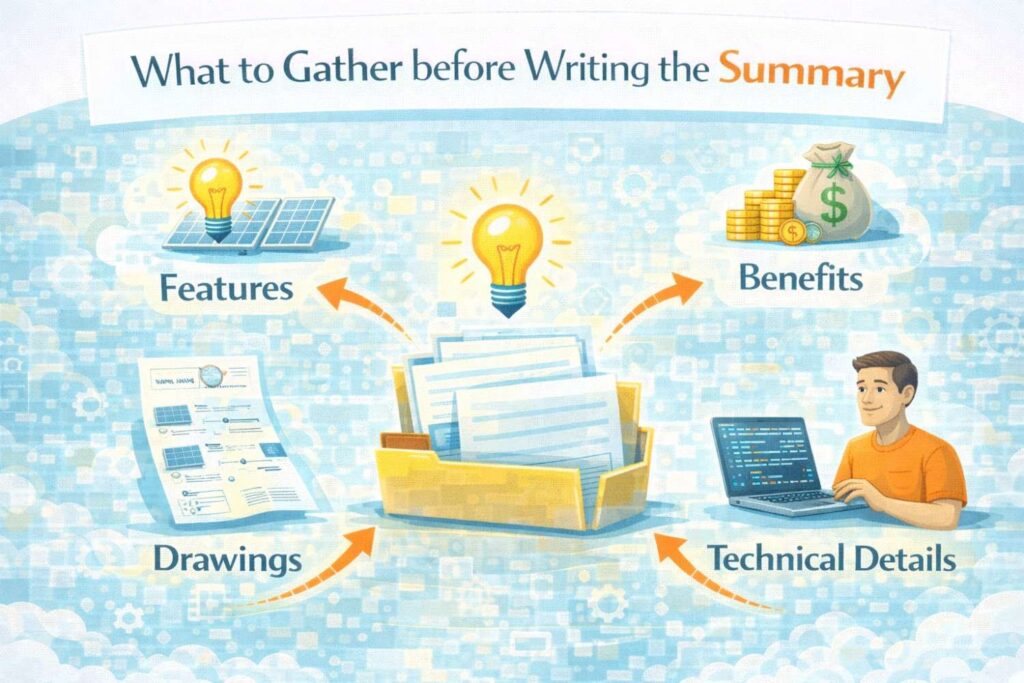
Before you draft the summary, it helps to have clear answers to a few invention questions.
What is the invention broadly about?
What problem does it address at a technical level?
What are the major parts or steps?
What kinds of input data, signals, components, or conditions are involved?
What kinds of outputs, decisions, actions, or results are produced?
What meaningful variations exist?
Can the invention be described as a method and also as a system?
For software, can it also be described as instructions stored on a computer-readable medium?
When these answers are clear, the summary usually becomes much easier to draft.
That is because the summary is really a structured answer to those questions in paragraph form.
The core job of the first paragraph
The first paragraph of the summary is important.
It is usually the paragraph that introduces the invention in broad form.
A good first paragraph often says something like this in substance:
In some implementations, a system or method receives certain inputs, performs certain operations, and generates certain outputs or actions.
That is the core shape.
It should give the reader a clean first look at the invention without overloading them.
For example, if the invention is a fraud detection system, the first summary paragraph may explain that the system receives transaction-related data and contextual information, evaluates one or more fraud indicators, generates a fraud-related score or classification, and causes one or more downstream actions based on the result.
That already does a lot of work.
It frames the invention.
It shows input, processing, and output.
It stays broad.
And it makes the invention feel real.
How to write the first sentence well
The first sentence matters.
A weak first sentence is broad and empty.
It says the disclosure provides improved systems and methods for better performance.
That is too generic.
A stronger first sentence enters the invention directly.
It says the disclosure relates to systems and methods for doing a specific thing in a specific technical setting.
For example:
The present disclosure provides systems and methods for generating adaptive routing decisions for digital tasks based on contextual data and dynamic priority information.
That is better.
Or:
In some implementations, a system receives sensor data associated with operation of an industrial device, processes the sensor data to determine one or more condition indicators, and generates a maintenance-related output based on the condition indicators.
Also good.
The goal is not to sound fancy.
The goal is to tell the reader what kind of invention they are about to learn about.
The summary should usually include multiple embodiments
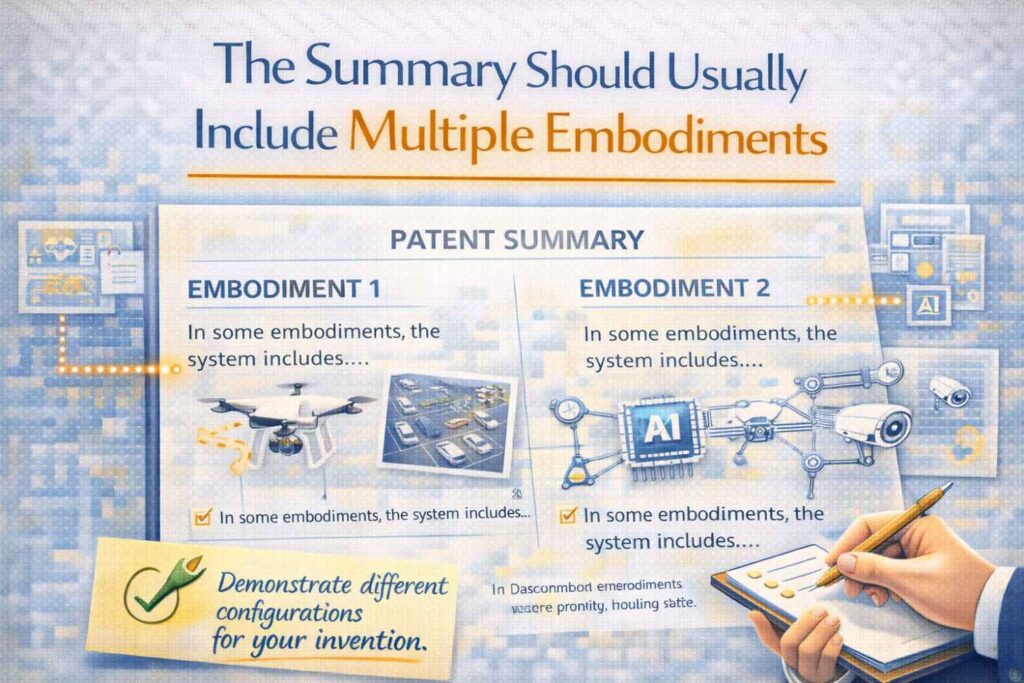
This is one of the most useful drafting habits.
A strong summary often presents the invention in more than one embodiment or form.
For example, the section may say that in one embodiment, a method includes receiving data, processing the data, and generating an output.
Then it may say that in another embodiment, a system includes one or more processors and memory configured to perform similar operations.
Then it may say that in yet another embodiment, a non-transitory computer-readable medium stores instructions that cause one or more processors to perform similar operations.
Why do this?
Because it helps support different claim types later.
It also makes the invention feel more complete and more deliberately framed.
This matters especially in software and AI-related applications, where method and system claims often work together.
How much detail belongs in each embodiment
Enough to give shape.
Not so much that the summary becomes crowded.
That is the balance.
If you are describing a method embodiment, include the main steps.
If you are describing a system embodiment, include the main components or general functional parts.
If you are describing a computer-readable medium embodiment, include the general operations the instructions cause the processor to perform.
You do not need every optional substep in the summary.
You do not need every module dependency or every parameter range unless that information is truly central to the invention at the summary level.
Save the heavier detail for later.
The summary should stay readable.
How to decide what belongs in the summary and what belongs later
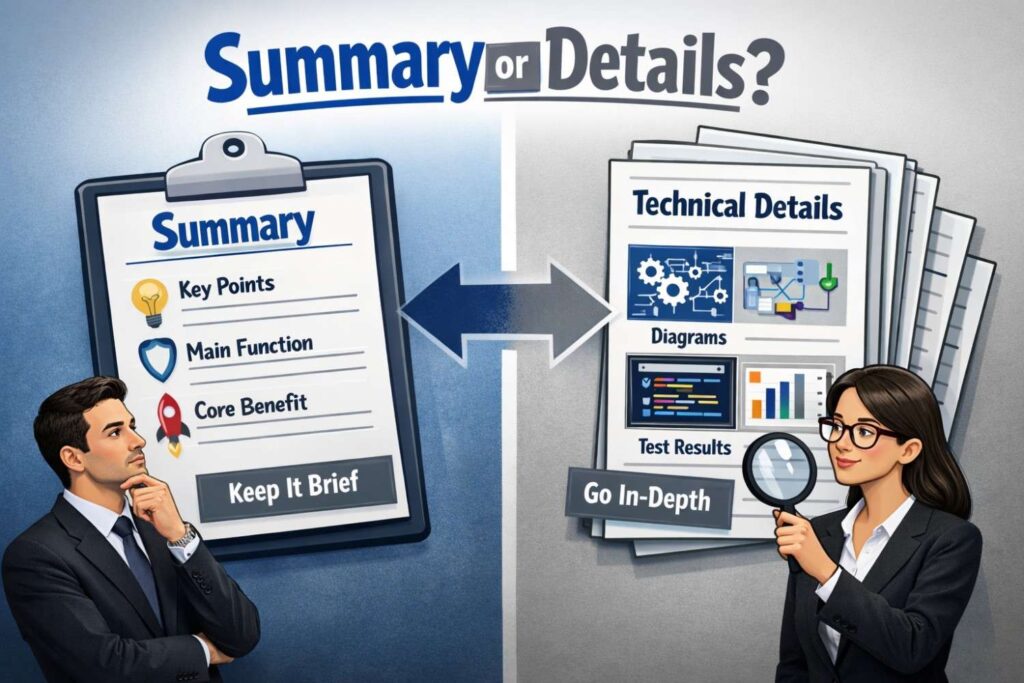
This is where many writers struggle.
A simple rule helps.
If the detail is necessary for understanding the invention at a high level, it probably belongs in the summary.
If the detail is necessary only for understanding one particular implementation, it probably belongs later.
For example, saying that a system receives device state data, user behavior data, and environmental context may belong in the summary if those input categories are central to understanding the invention.
But saying that one implementation samples sensor data every 250 milliseconds and applies a specific smoothing filter before a specific model stage probably belongs later.
The summary should teach the reader the shape of the invention.
The detailed description should teach the reader the deeper mechanics.
That distinction helps a lot.
What to do when the invention is a software system
Software inventions often make people nervous during patent drafting.
Founders wonder whether they need to describe code.
They wonder whether the invention should sound more technical.
They wonder how to write the summary without falling into either buzzwords or too much implementation detail.
The answer is to focus on the real system.
What inputs come in?
What processing happens?
What decisions or outputs occur?
What components or modules are involved?
What does the system achieve technically?
A strong software summary often describes a workflow, not just a result.
For example, if your startup built an AI-driven scheduling system, the summary should not just say that the system improves scheduling.
It should explain that the system receives task data and resource data, determines one or more scheduling scores or priorities, selects one or more scheduling assignments based on the scores and operating constraints, and updates the assignments in response to new inputs.
That is much better.
It gives the invention a concrete workflow.
That makes the summary stronger.
What to do when the invention is AI-based

AI inventions benefit from careful summaries.
A lot of AI patent drafts use broad words like model, intelligence, prediction, and optimization without explaining the real technical shape of the system.
That weakens the section.
A better AI summary explains the pipeline at a useful level.
What data comes in?
How is it processed?
How is the model used?
What output is generated?
What action or system behavior changes as a result?
If the invention involves training, say so.
If it involves inference, say so.
If it involves model updates, scoring, ranking, classification, anomaly detection, or control logic, say that too.
The key is to make the invention sound like a real technical system, not just “AI that improves things.”
For example, a strong AI summary might explain that the system receives historical interaction data and current session data, generates one or more relevance features, applies a trained ranking model to produce a set of candidate outputs, and selects or reorders the outputs based on one or more constraints or feedback signals.
That sounds grounded.
That is what you want.
What to do when the invention is hardware-based
For hardware inventions, the summary should usually highlight the main components and how they generally interact.
It should not drown in dimensions, materials, or exact placements unless those are essential to the high-level understanding.
Suppose the invention is a sensor housing system that improves thermal stability.
The summary may explain that the apparatus includes a housing, one or more internal supports, a thermal barrier structure, and a sensing element arranged in a way that reduces thermal transfer from an outer surface to the sensing element.
That is enough at the summary level.
Then the detailed description can go deeper into shape, materials, mounting, and alternatives.
What to do when the invention is a process or manufacturing method
For process inventions, the summary often works best when it clearly walks through the main stages in order.
What is provided first?
What is formed, treated, measured, or transformed next?
What result is produced?
A clean process summary helps the reader follow the flow without needing every fine point immediately.
If the process includes optional stages, alternative sequences, or different materials or environments, those can be mentioned at a higher level too.
Again, the summary is not the place for every variable. It is the place for the major process picture.
The role of optional language in the summary
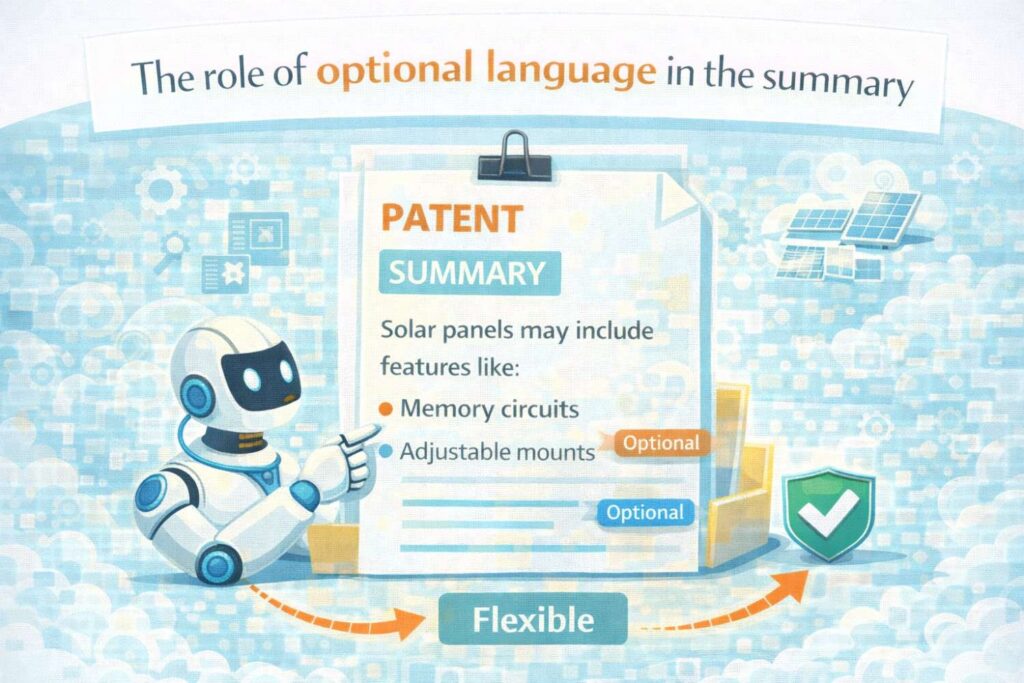
Optional language matters a lot.
Phrases like in some implementations, in some embodiments, in certain examples, or optionally can help keep the summary flexible.
This is useful because not every feature should sound mandatory.
A rigid summary can accidentally make the invention feel narrower than it needs to be.
Optional language helps describe meaningful variations without locking everything in.
For example, a system may optionally perform a validation step before generating an output. Or a scoring engine may in some embodiments use historical interaction data, while in other embodiments it uses real-time session data or both.
That kind of drafting helps keep the invention open while still being clear.
But do not overuse optional language
This is also important.
If every sentence says may, can, optionally, in some embodiments, or in certain implementations, the summary can start to feel soft and slippery.
You still need a strong central description of the invention.
The key is balance.
Use optional language where it adds needed flexibility.
But also state the core workflow or structure clearly and directly.
The reader should still walk away with a solid sense of what the invention generally is.
The summary should line up with the detailed description
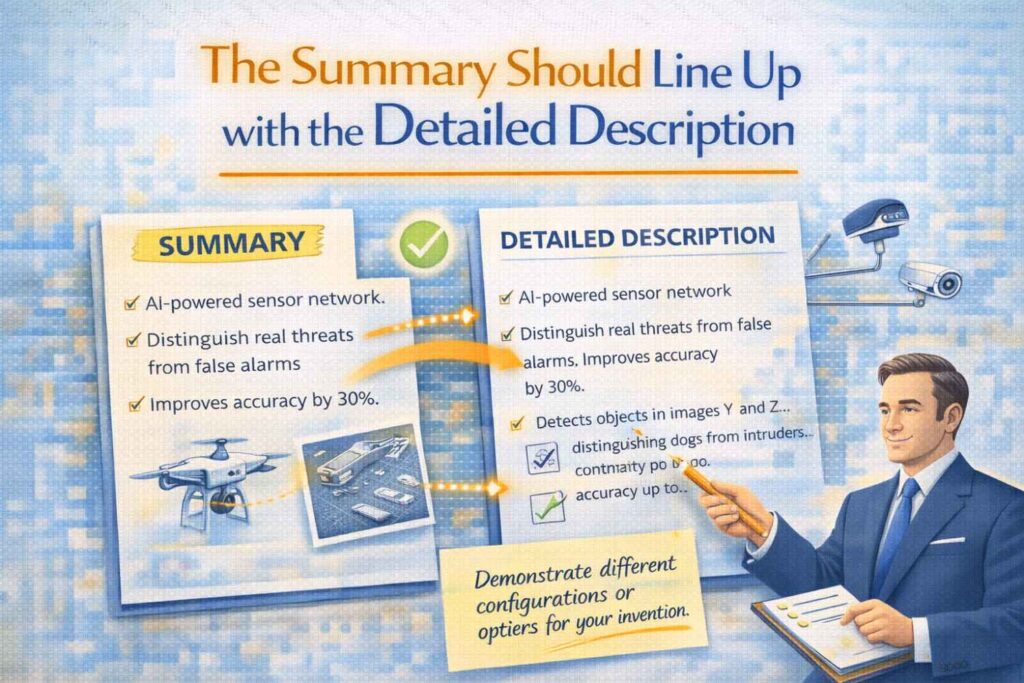
This sounds obvious, but it is one of the biggest practical issues in patent drafting.
Sometimes the summary is drafted first and never updated.
Then the detailed description evolves. New embodiments are added. Components are changed. The workflow gets clearer. But the summary stays old.
That creates mismatch.
A strong filing needs internal alignment.
The summary should reflect the actual invention as described later.
It does not need to cover every detail from the detailed description, but it should not describe a different invention or ignore major parts that later become central.
That is why the summary should usually be reviewed again after the detailed description is more settled.
The summary should also support the claims
The summary is not the claims section, but it still matters strategically.
A thin or badly framed summary can make the invention feel narrow.
A stronger summary can help present the invention in multiple useful forms and highlight the major technical relationships that later matter for claims.
That is why the best summaries are written with quiet awareness of claim strategy.
What are the likely core claim forms?
Method?
System?
Computer-readable medium?
Apparatus?
What major features or relationships may matter?
What breadth needs support?
What alternatives may later become useful?
The summary does not need to sound like claim language.
But it should quietly help support the same invention story the claims will rely on.
A founder-friendly way to draft the summary from scratch

Let us make this very practical.
Suppose you are a founder or engineer trying to draft the summary and you do not know where to start.
Use this workflow.
First, explain the invention in one plain sentence.
For example: we built a system that uses transaction context and user behavior data to decide whether to allow, block, or review a digital action.
Second, expand that sentence into three parts.
What comes in?
What happens?
What comes out?
Third, think about what general components or modules are involved.
Fourth, think about what meaningful alternatives exist.
Fifth, think about whether the invention can be framed as a method, a system, and software instructions.
Now you have the basic raw material for the summary.
From there, turn it into patent-style prose.
This is much easier than trying to sound formal from the beginning.
A plain example of summary drafting
Let us walk through an example.
Suppose the invention is a system for reducing false alarms in warehouse safety monitoring.
Plain description first:
The system receives data from cameras and sensors in a warehouse. It checks whether a possible safety event is real by looking at movement history, zone rules, and context.
Then it decides whether to trigger an alert.
Now turn that into a patent-style summary.
In some implementations, a safety monitoring system receives input data associated with one or more monitored areas, the input data including image data, sensor data, or both.
The system processes the input data to identify a potential safety-related event and determines a context-aware event assessment based on one or more additional factors, such as movement history, zone status, equipment state, or rule information.
Based on the event assessment, the system selectively generates an alert, suppresses an alert, or causes a response action.
That already works pretty well.
Then you could add a system embodiment.
In some implementations, a system includes one or more processors and memory storing instructions that, when executed, cause the one or more processors to receive monitored-area data, identify a candidate event, determine a context-aware event assessment based on one or more operational inputs, and initiate one or more actions based on the event assessment.
Then you could add a computer-readable medium embodiment.
In some implementations, a non-transitory computer-readable medium stores instructions that, when executed by one or more processors, cause the one or more processors to perform operations including receiving monitored-area data, determining whether a candidate event satisfies one or more event criteria, generating a context-aware assessment for the candidate event, and causing an output action based on the assessment.
That is the general idea.
How to keep the summary from sounding repetitive
This is a common issue.
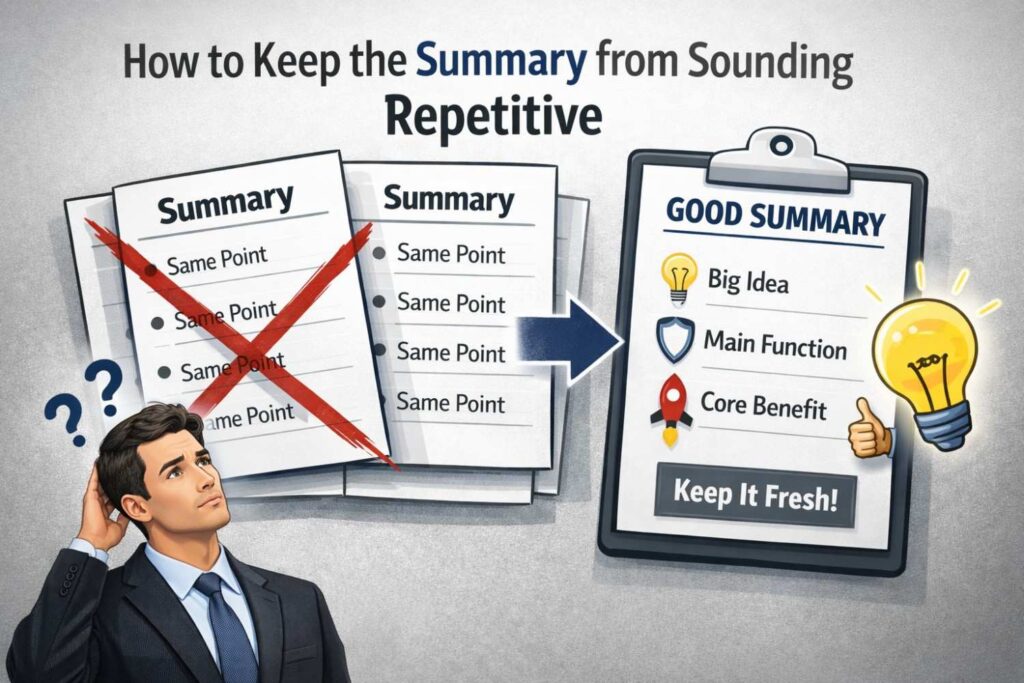
When you describe the invention as a method, a system, and a computer-readable medium, you can end up repeating the same sentence structure three times.
That gets boring fast.
A cleaner way is to vary the framing while keeping the content aligned.
Start with a fuller overview paragraph.
Then introduce a system embodiment with more emphasis on components or functionality.
Then introduce a computer-readable medium embodiment in a shorter form.
You do not need each paragraph to sound identical.
They should support the same invention, but they can be phrased with some variety.
This improves readability and makes the section feel more human.
How to use sub-features in the summary without making it messy
Sometimes the invention has several important sub-features that matter to the story.
For example, a model may use both historical and current data. A control system may use both local and remote processing. A decision engine may both score and rank candidates before selecting one.
Should all of that go into the summary?
Sometimes yes.
But the trick is to group the sub-features into natural clusters instead of listing every detail mechanically.
For example, instead of writing a long string of steps with no structure, you might explain that the system receives one or more sources of operational data, generates one or more evaluation outputs based on the data, and selects or causes one or more actions based on the evaluation outputs and one or more constraints.
That keeps things readable.
It gives the reader a strong general idea while leaving room for detail later.
How to write a summary that sounds formal but still human
This is especially important for PowerPatent content, because founders want clear writing, not robotic writing.
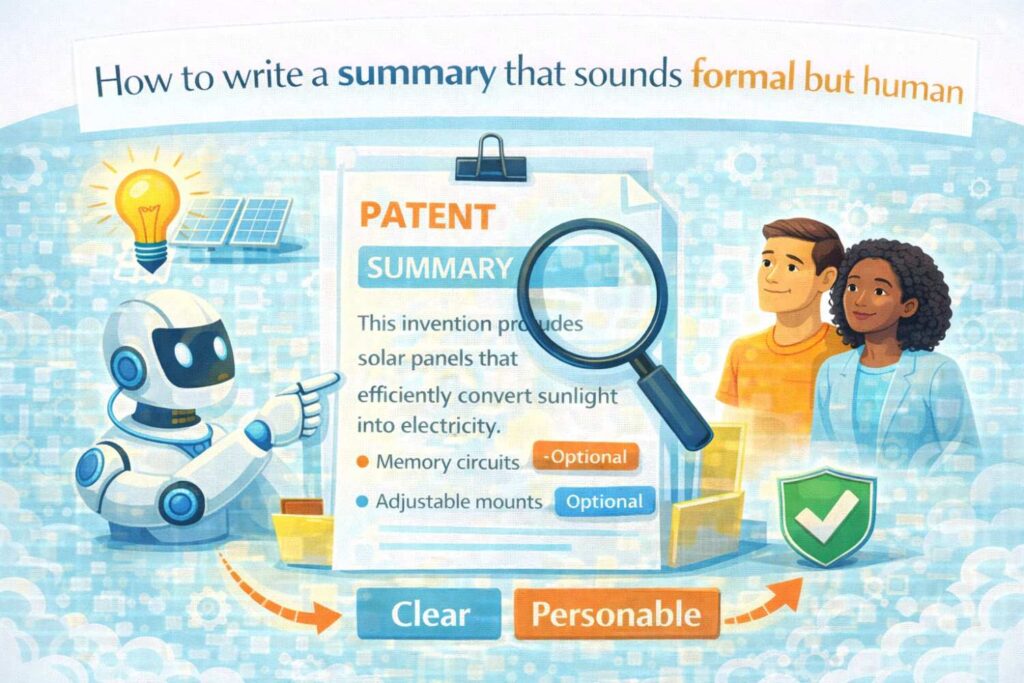
A summary in a patent application should sound formal enough to fit the document. But it does not need to feel dead.
The way to do this is by choosing clear sentence structures and real technical nouns instead of bloated phrases.
Say the system receives data, not that it effectuates acquisition of data.
Say the system generates a score, not that it facilitates score determination functionality in a scoring context.
Say the model processes input features, not that the artificial intelligence subsystem performs an intelligent processing event.
Good writing is still good writing inside a patent.
Formal does not have to mean stiff.
Why the summary is a good place to show invention families
This is a subtle but powerful point.
Sometimes the invention is not just one isolated mechanism. It is a family of related implementations built around one core idea.
The summary is a good place to start showing that family.
For example, maybe your core invention can apply across different data types, different device types, or different deployment environments. The summary can hint at that breadth in a clean way.
Maybe the same workflow can be used in financial systems, industrial systems, health systems, or logistics systems. The summary can describe the invention broadly enough to support that without drifting into empty generality.
This matters because it helps the patent feel like it covers the real invention family, not just one frozen snapshot.
How to avoid making the summary too narrow
There are a few common traps.
One is tying the summary too tightly to product names, internal labels, or one exact implementation.
Another is treating optional features as if they are always required.
Another is focusing too much on one example use case.
Suppose your product currently uses mobile app data to help detect unsafe driving. A narrow summary may describe only mobile app GPS data and one exact driving score process.
A stronger summary may say the system receives motion-related data associated with a vehicle or user, processes the data to determine one or more driving-related indicators, and generates one or more outputs related to driving behavior or response actions.
That gives you more room.
It is still real.
It is just not trapped by one version.
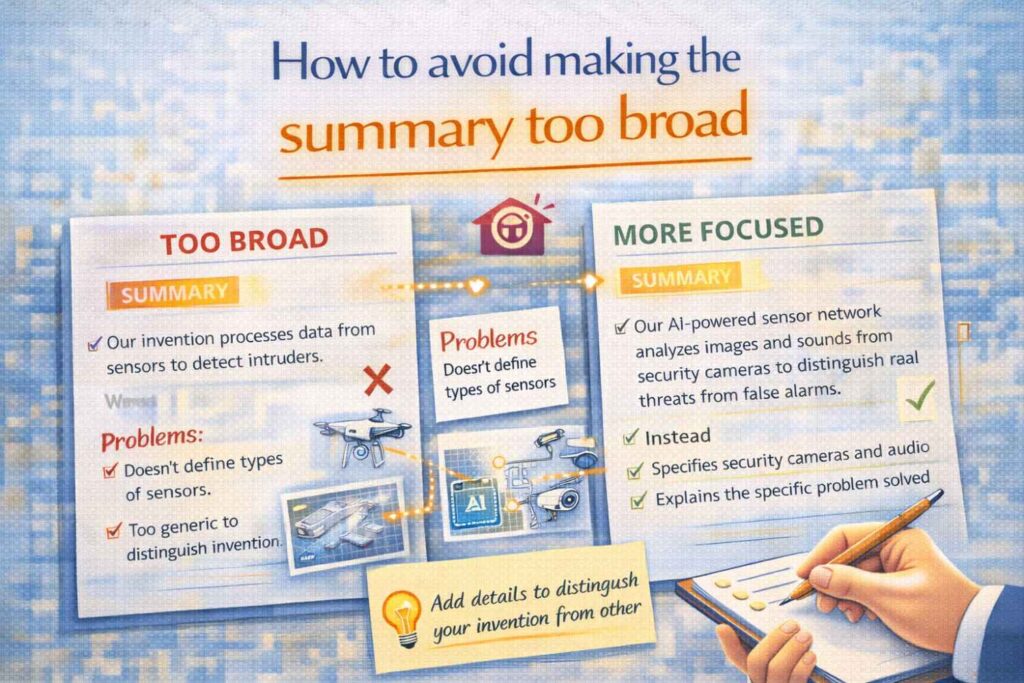
How to avoid making the summary too broad
This is the other trap.
A summary that tries too hard to be broad often says almost nothing.
It talks about intelligent systems improving operations.
It talks about dynamic decision support.
It talks about enhanced performance across environments.
That kind of writing sounds polished but weak.
The fix is simple.
Make sure the summary includes real input, real processing, and real output.
Make sure it names the technical setting.
Make sure it describes the major function of the invention, not just the result.
That brings the section back to life.
Writing summaries for inventions that involve many moving parts
Some inventions are simple enough to summarize in a compact way.
Others are more complex. They may involve several modules, data sources, timing rules, model stages, devices, or processing environments.
In those cases, do not try to cram everything into one overloaded paragraph.
Use two or three clean paragraphs.
Let the first paragraph explain the core system flow.
Let the next paragraph explain an important alternative or a system embodiment.
Let a third paragraph explain another form, such as a medium embodiment or a deployment variation.
The summary can be compact without being cramped.
That is a better reading experience.
Why the summary should be reviewed by both technical and legal eyes
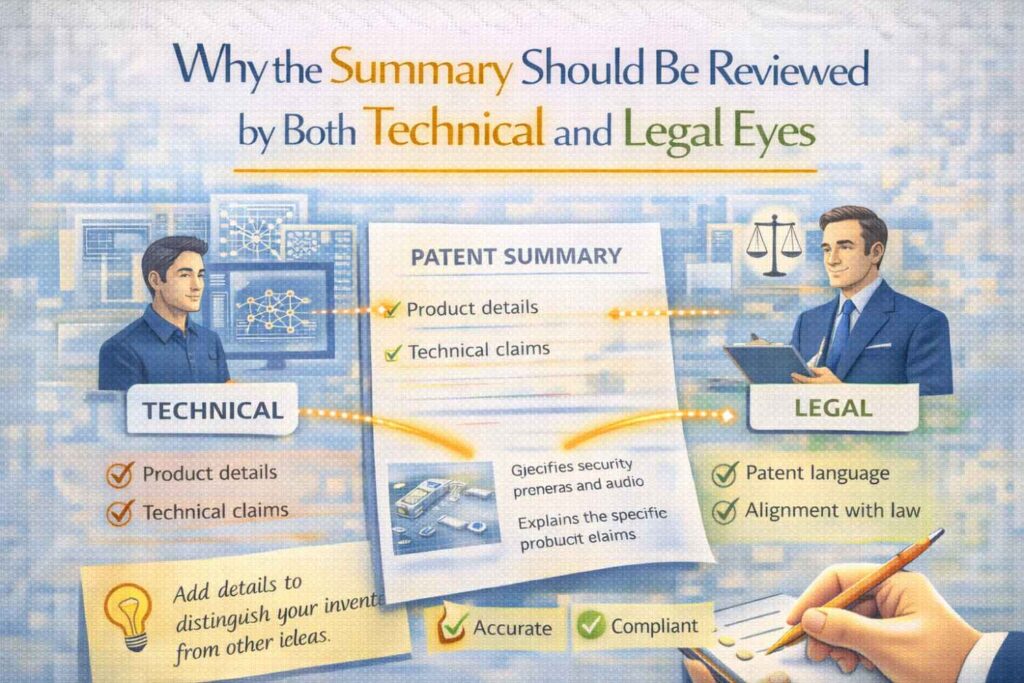
A strong summary often sits at the intersection of technical truth and patent strategy.
That means it benefits from both technical review and legal review.
A technical founder or engineer can check whether the section actually reflects the system and whether the overview makes sense.
A patent attorney can check whether the section is framed in a way that supports the invention broadly and aligns with claim strategy.
This kind of combined review matters because a summary can be technically accurate but strategically weak, or strategically broad but technically fuzzy.
The best version gets both right.
That is one reason modern startup teams do better when they use a workflow that combines smart software with real patent attorney oversight.
It helps keep the draft clear for founders while still making it stronger where patent strategy matters. That is exactly the model PowerPatent is built around. You can see it here: https://powerpatent.com/how-it-works
What weak summary sections usually sound like
It helps to know what to watch for.
A weak summary often sounds like this:
The present disclosure provides improved systems and methods for enhancing digital operations in a dynamic environment.
That tells the reader almost nothing.
Or it sounds like this:
The disclosed invention includes a first module, a second module, a third module, a fourth module, a fifth module, and a sixth module configured to communicate with each other to provide improved performance.
That is too stiff and too vague at the same time.
Or it sounds like this:
Current systems struggle with many problems, and the present invention solves these problems through a novel and highly efficient approach.
That sounds more like sales language than useful summary drafting.
A strong summary sounds better because it actually explains the invention.
What strong summary sections usually sound like
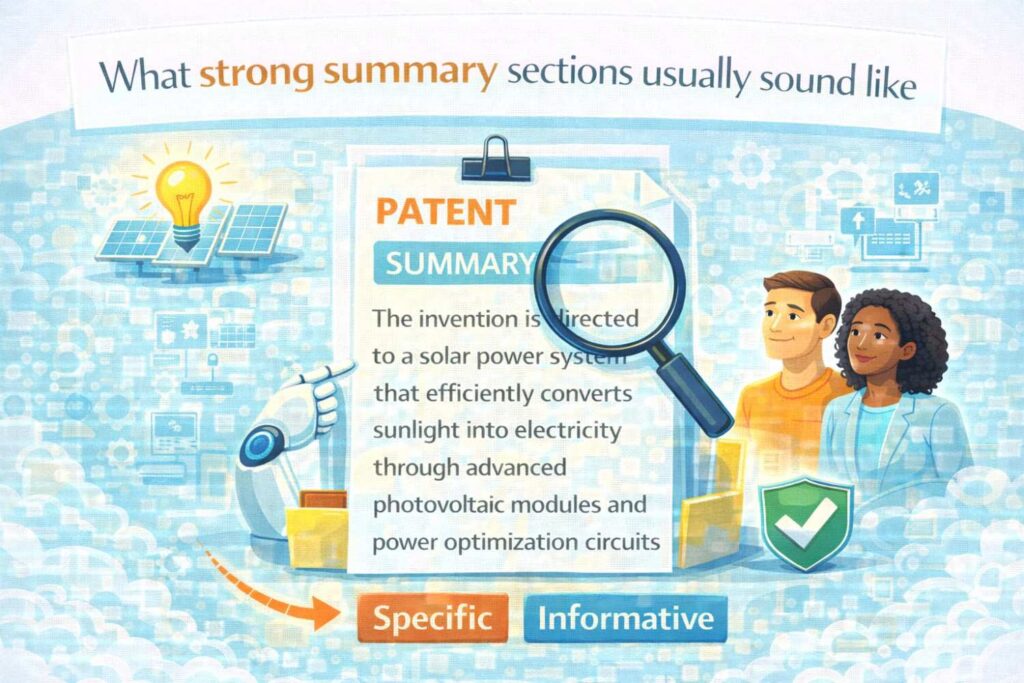
They sound specific enough to teach.
They sound broad enough to support variation.
They sound formal, but not inflated.
For example:
In some implementations, a system receives data associated with a set of candidate tasks and a set of available resources.
The system determines one or more priority values based on the candidate tasks and one or more operating constraints, selects one or more resource assignments based on the priority values, and updates the resource assignments in response to changes in the candidate tasks, the available resources, or both.
That is good summary language.
It gives the reader something to hold onto.
How to revise a weak summary section
Revision matters a lot here.
A weak first draft is common. That does not mean the summary cannot become strong.
A good revision process starts by asking a few hard questions.
Does this section actually explain the invention, or does it just praise it?
Does it identify the real technical setting?
Does it describe a real workflow or structure?
Is it too narrow?
Is it too vague?
Does it support the same invention story as the rest of the application?
Then revise accordingly.
If the summary is too broad, add more technical shape.
If it is too narrow, open it up with meaningful alternatives.
If it is too detailed, pull specifics back into the detailed description.
If it sounds like a product pitch, replace results language with system language.
That process usually improves the section quickly.
A practical editing test that works
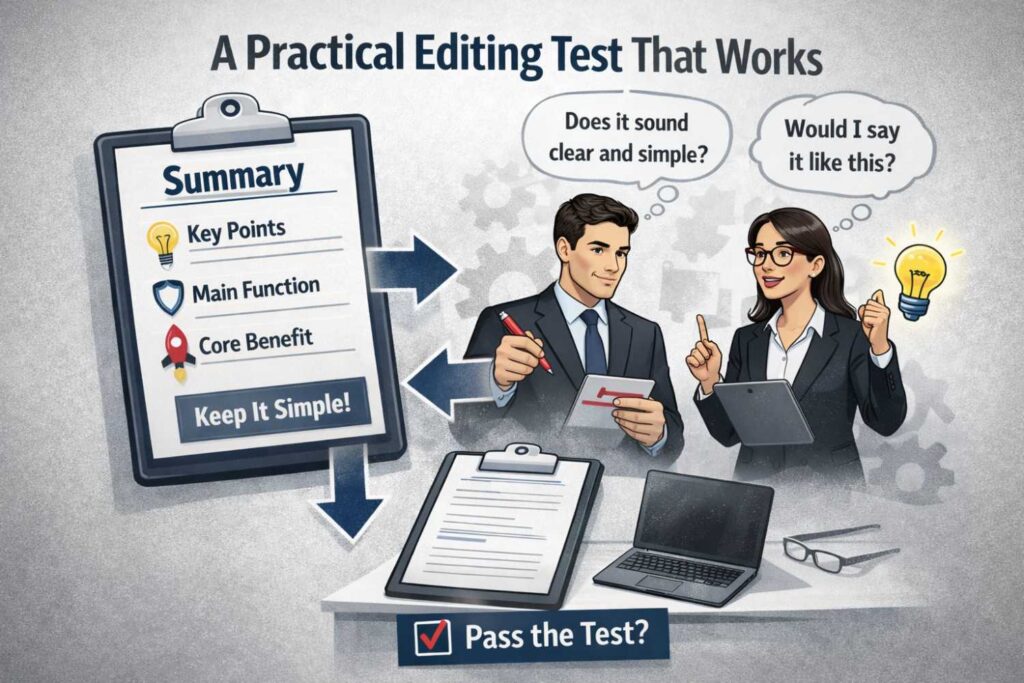
Here is a very useful test.
Give the summary to a technically literate person who has not seen the rest of the draft.
Then ask them to answer three questions.
What kind of invention is this?
What does it generally do?
What are the main parts or steps?
If they can answer those well, the summary is probably doing its job.
If they cannot, the section needs work.
This is simple, but it works.
How the summary helps during fundraising and diligence
Most people do not think of the summary this way, but it matters.
When investors, acquirers, or partners look at a patent filing, they often do not read every line first.
They skim.
They look for a strong sense of what the invention is and whether it maps to a real technical advantage.
The summary helps there.
A weak summary can make a strong invention look generic.
A strong summary can make the filing feel organized, grounded, and relevant to the company’s technical moat.
This is not the main legal purpose of the section, but it is a real business benefit.
Clear patent drafting supports clearer business storytelling.
How a strong summary sharpens internal company thinking
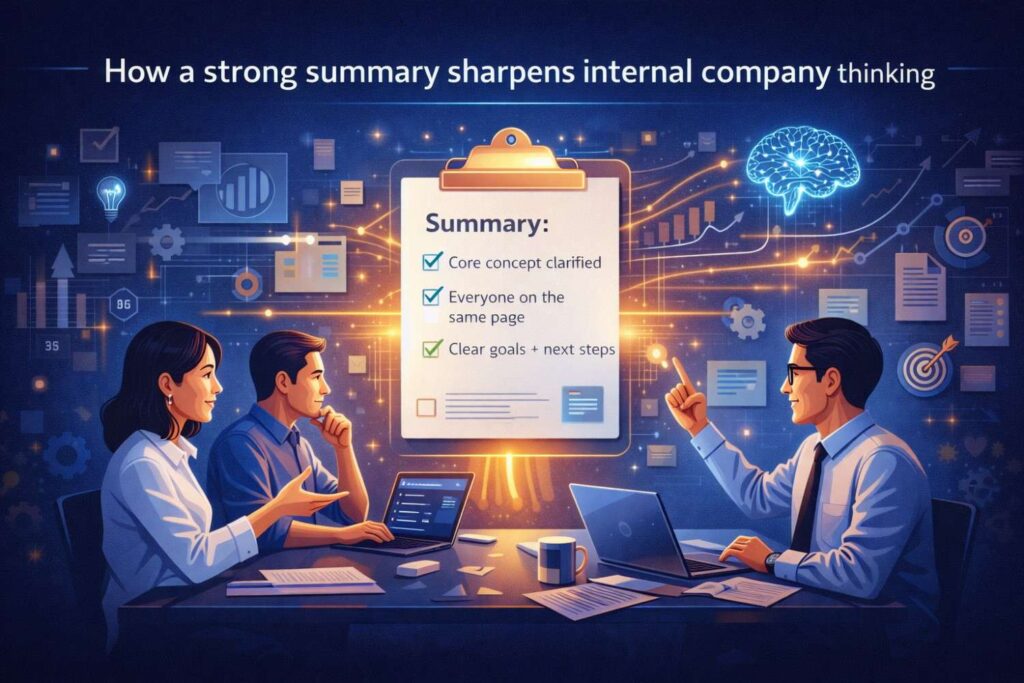
A strong summary does more than support the patent.
It forces the company to explain its invention in one clear, disciplined way. That is valuable because many teams know their product deeply, but describe it differently across founders, engineers, product leads, and outside counsel.
When that happens, the company may look aligned on the surface while still being fuzzy about what its real technical edge actually is.
A well-written summary helps fix that.
It Forces the Team to Name the Core Advantage
When a company writes a strong summary, it has to answer one hard question: what is the invention at its center?
That sounds simple, but it is often where confusion shows up. Teams sometimes mix the customer benefit with the technical invention.
The summary forces the business to separate those two and name the real mechanism that creates the value.
That kind of clarity is useful in product strategy, hiring, and leadership discussions.
It Helps Reduce Internal Drift
As startups grow, different people often describe the same product in different ways. Engineering may focus on architecture.
Sales may focus on outcomes. Product may focus on workflows. A strong summary creates one clean reference point that keeps those views closer together.
That reduces drift and helps leadership stay consistent when talking about what the company has actually built.
It Makes Roadmap Decisions Smarter
A sharp summary can also help the team see which part of the system matters most. Once that is clear, it becomes easier to decide what should be improved, defended, or expanded next.
A practical way to use this is simple: after the summary is drafted, ask the team which sentence describes the company’s real moat.
If people point to different parts, that is a sign more alignment is needed.
A Simple Internal Test
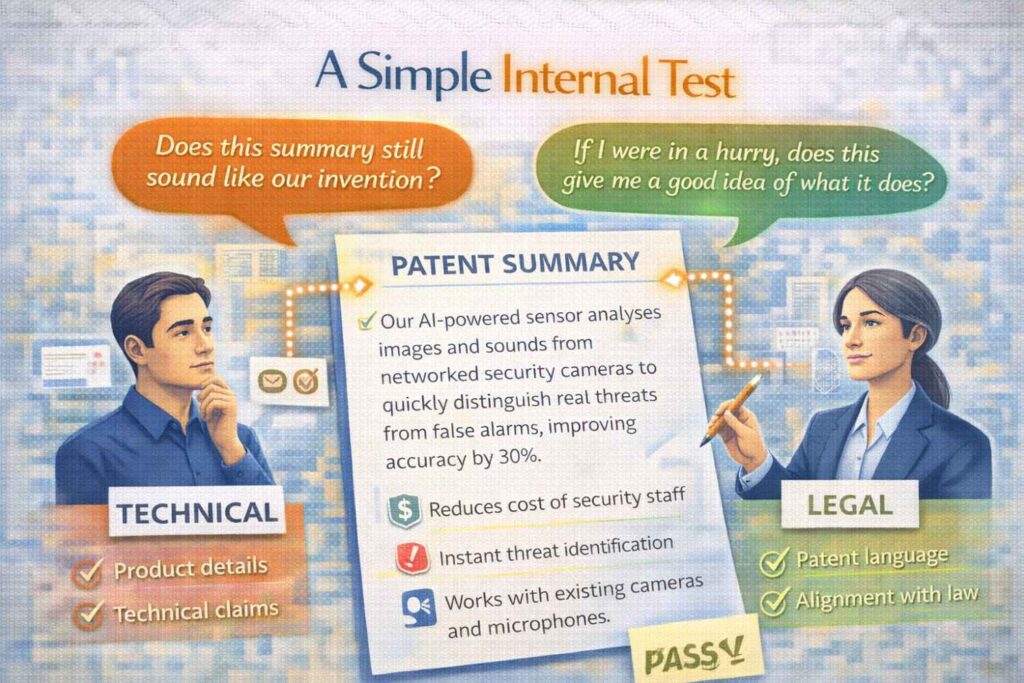
One useful habit is to share the summary with your founder, product lead, and lead engineer and ask each person to explain the invention back in one sentence. If those answers are close, the company is thinking clearly.
If they are far apart, the summary has done something helpful already: it exposed confusion early.
That is why this section matters. A strong summary does not just improve the patent. It helps the business think more clearly about what it is truly building.
It Clarifies What Should Be Protected Next
A strong summary can reveal whether the company’s most important technical value is fully captured or whether another filing may be needed later.
This helps businesses make better decisions about what to protect next instead of filing in a random way. It turns patent planning into a more focused business decision.
It Improves Cross-Functional Communication
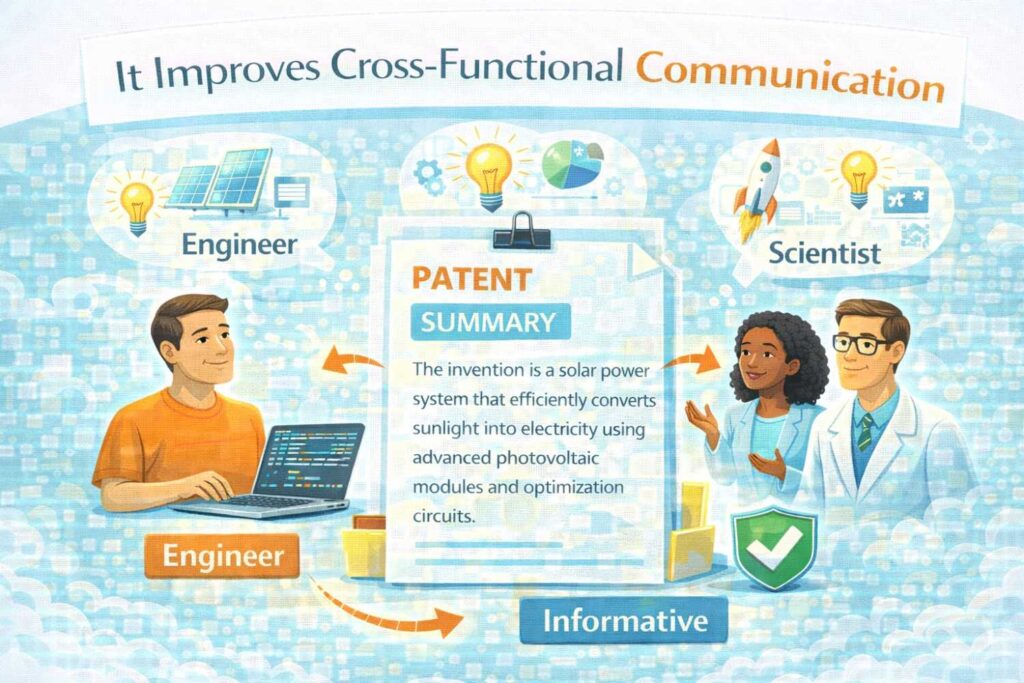
When the summary is clear, legal, product, engineering, and leadership teams can work from the same core description of the invention.
That reduces wasted time, mixed messages, and repeated explanations. For fast-moving companies, this kind of shared language is a real operational advantage.
It Creates a Better Standard for Future Invention Reviews
A strong summary gives the company a useful benchmark. Future inventions can be tested against the same question: can we explain this clearly, at a high level, in a way that shows the real technical value?
That makes the company better over time at spotting important inventions early and describing them well.
Common mistakes founders make in summary drafting
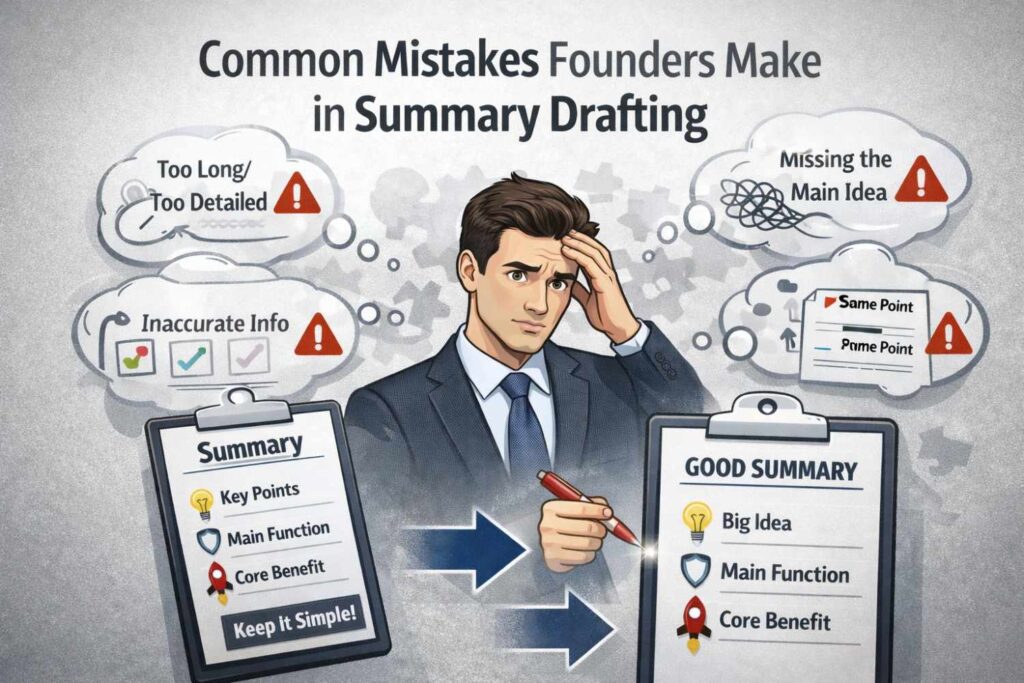
One mistake is copying too much from internal product docs.
Internal docs often describe the current build, not the invention at the right level for a patent summary.
Another mistake is using internal feature names that will not age well.
A patent should outlast your current naming system.
Another mistake is focusing only on user benefits.
A patent summary should focus on the technical system, not just what the customer likes about it.
Another mistake is forgetting alternatives.
If the summary only reflects the exact current product version, it may become outdated quickly.
Another mistake is writing the summary once and never revisiting it after the rest of the draft evolves.
That creates mismatch.
All of these mistakes are fixable once you know to watch for them.
Confusing the Product Benefit With the Invention
Many founders describe what the customer gets, but not what the system actually does. That makes the summary sound useful on the surface, but weak at the technical level.
Writing the Summary Too Early
Some teams try to finalize the summary before the invention is fully mapped.
This often leads to broad language, missing details, or a summary that no longer matches the rest of the draft.
Using Narrow Language From the Current Product Version
Founders often describe only the exact version the company is shipping today. That can make the summary too tied to one release instead of the broader invention.
Overloading the Section With Implementation Detail
Sometimes the summary becomes too dense because the draft includes too many low-level steps, technical settings, or example-specific details that belong in the detailed description.
Forgetting to Show More Than One Form of the Invention
A weak summary may describe the invention only as one workflow or one feature. A stronger summary often shows the invention as a method, a system, and other useful forms where appropriate.
Letting Internal Language Leak Into the Draft
Teams often use internal labels, shorthand, or feature names that make sense inside the company but do not belong in a patent summary. That can make the section feel temporary and less clear to outside readers.
Making the Summary Sound Like a Claim Set
Some founders try to make the summary sound highly formal and end up writing stiff, legal-style sentences that are hard to read. The summary should support the claims, but it should still read like a clear overview.
Failing to Recheck the Summary After Revisions Elsewhere
As the detailed description and claims evolve, the summary can quietly fall out of sync. Founders often miss this, which creates mismatch across the application.
How to draft a summary from claim thinking without turning it into claims
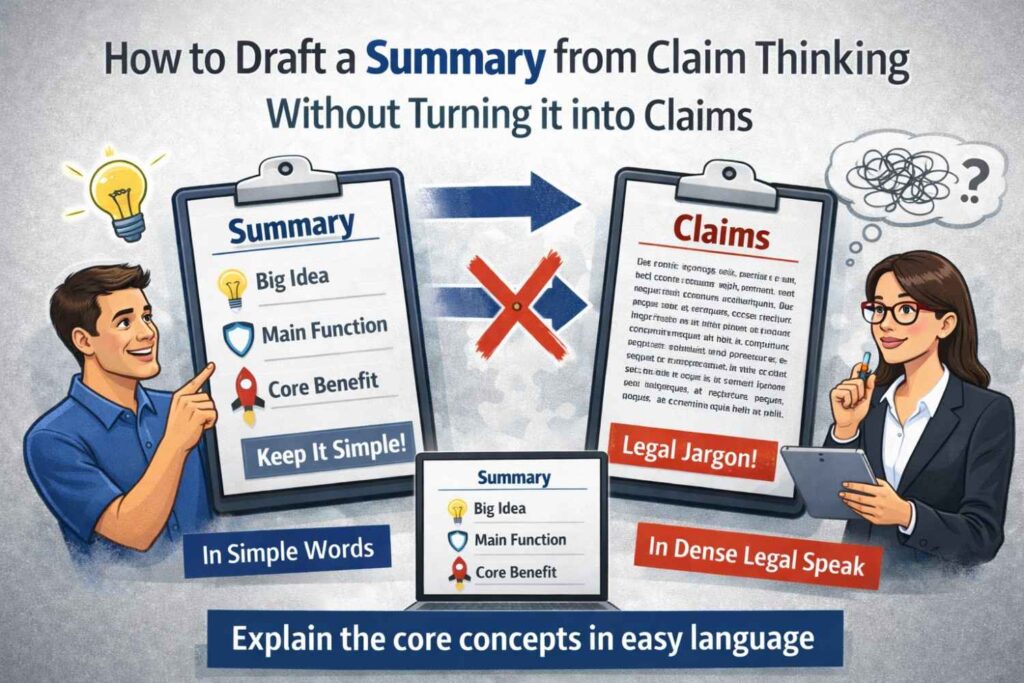
This is a useful trick.
Sometimes it helps to think about what the likely independent claims may cover.
What are the core steps?
What are the core components?
What is the key relationship or flow?
Then step back and write the summary in broader, more readable prose.
This can help make sure the summary covers the real center of gravity of the invention.
But be careful.
Do not turn the summary into stiff claim language with endless chains of clauses.
The summary should read like a high-level technical overview, not like a claims section with paragraph breaks.
Use claim thinking as a guide, not a style.
The summary should give the invention momentum
A good patent application has rhythm.
The title sets the topic.
The field and background set the scene.
Then the summary moves the reader forward.
It says, here is the invention.
That movement matters.
A strong summary gives the application momentum. It makes the reader want to keep going because the invention now feels concrete enough to be interesting.
That is one reason sloppy summaries hurt more than people realize. They break that momentum.
A full example of a stronger summary
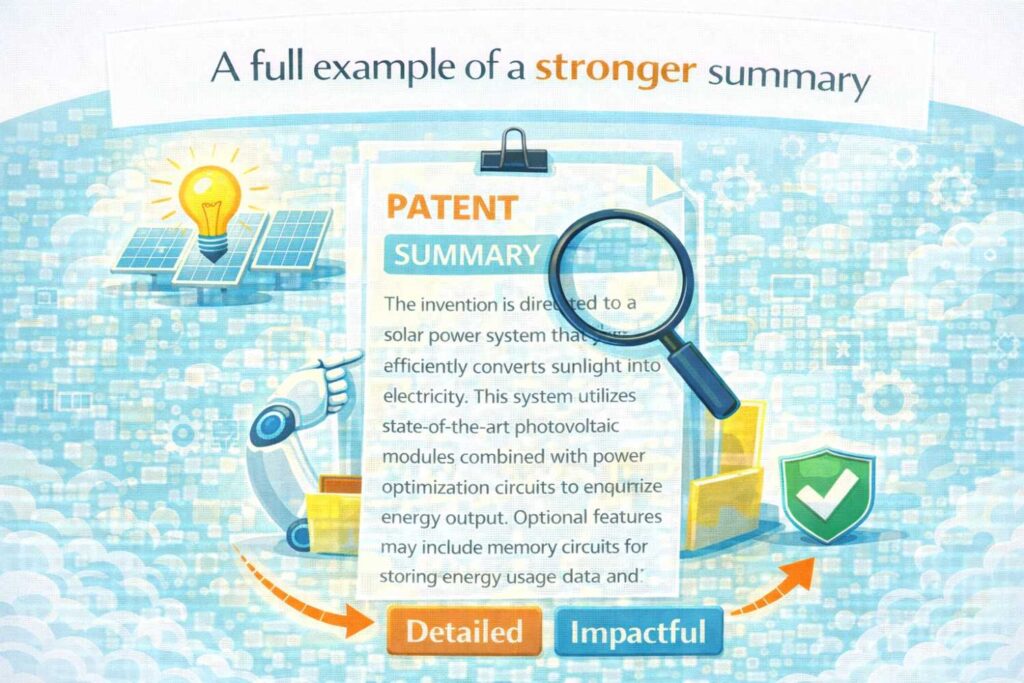
Let us build a fuller example.
Suppose the invention is an AI-based system for routing insurance claims for review.
A weak summary might say:
The present disclosure provides improved systems and methods for claim handling using artificial intelligence.
That is not enough.
A stronger version might say:
In some implementations, a system receives claim-related data associated with one or more insurance claims.
The claim-related data may include structured claim fields, unstructured text, image data, prior claim history, policy-related information, or combinations thereof.
The system processes the claim-related data to generate one or more evaluation outputs, such as a complexity score, a fraud-related indicator, a routing category, or a review priority value.
Based on the one or more evaluation outputs, the system selectively routes a claim to one or more processing paths, review queues, or response actions.
In some implementations, the one or more evaluation outputs are generated using one or more trained models, one or more rule-based components, or combinations thereof.
The system may further update a routing decision based on additional information received after an initial claim submission, such as newly received documents, investigator inputs, external data, or intermediate review results.
In some implementations, a system includes one or more processors and memory storing instructions that, when executed, cause the one or more processors to receive claim-related data, determine one or more evaluation outputs for a claim, assign the claim to one or more processing paths based on the one or more evaluation outputs, and update the assignment in response to one or more changed conditions.
In some implementations, a non-transitory computer-readable medium stores instructions that, when executed by one or more processors, cause the one or more processors to perform operations including receiving claim-related data, generating one or more claim-handling outputs, and causing routing, review, or response actions based on the one or more claim-handling outputs.
That feels much stronger.
It gives the invention real shape.
It stays broad.
And it supports multiple embodiments.
How to make the summary more tactical and more useful
The best summaries do not just sound good.
They make later work easier.
They make claim drafting easier because the invention has already been framed clearly.
They make figure review easier because the major components or steps are already introduced.
They make inventor review easier because the section reflects the system in understandable language.
They make later diligence easier because the filing looks like it maps to a real technical workflow.
That is why the summary deserves tactical thinking.
It is not just a section to get through.
It is one of the places where the quality of the whole application starts to show.
A simple founder exercise for drafting the summary
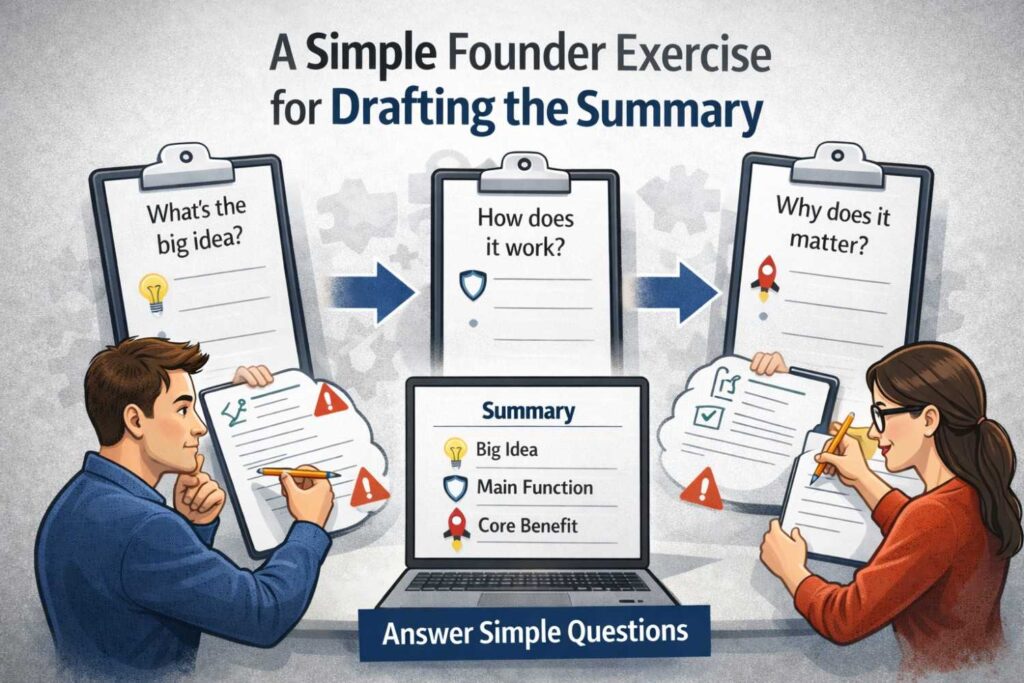
Here is a useful exercise.
Take your invention and explain it in plain language using only three sentences.
The first sentence should say what kind of system or method it is.
The second sentence should say what goes in and what the system does with it.
The third sentence should say what comes out or what action is taken.
Then look at those three sentences and ask where broader support is needed.
Are there important alternative inputs?
Alternative outputs?
Different implementations?
Different system forms?
Now turn those three sentences into a patent-style summary section.
This exercise works because it strips away the noise first.
It helps you find the real spine of the invention.
Why founders should not leave this section entirely to chance
Yes, patent professionals play a big role here.
Yes, attorney review matters.
But founders and technical leads should still care about the summary.
Why?
Because the summary is one of the clearest mirrors of how the invention is being understood.
If the section feels off, too broad, too thin, too narrow, or too disconnected from the real system, that may signal a bigger drafting problem.
Founders can often spot that quickly because they know the invention deeply.
So do not treat the summary like a legal black box.
Read it closely.
Push for clarity.
Make sure it reflects the invention you actually want protected.
Why modern startups need a better patent drafting process
The old workflow for writing patent applications is often slow and frustrating.
Founders send scattered notes. Attorneys ask long follow-up questions. Drafts come back in dense language. Review cycles drag on. Important variations get missed because the process was too painful to do thoroughly.
That is not ideal, especially for fast-moving technical teams.
A better system helps founders capture invention details in a structured way, draft stronger sections like the summary more quickly, and still get real attorney oversight before filing.
That is where PowerPatent is different. It is designed to help startups turn technical work into strong patent filings with more speed, control, and clarity. Instead of making you choose between DIY confusion and slow old-school workflows, it gives you a better path. Here is how it works: https://powerpatent.com/how-it-works
The summary is one of the clearest signs of patent quality
The summary section often tells you very quickly whether the patent draft was built with care or just assembled to get something on file.
That is why this section matters so much for businesses.
A strong summary usually signals that the invention was understood well, framed well, and drafted with a real strategy in mind. A weak summary often points to the opposite. It may show that the invention was described too loosely, that the filing was rushed, or that the patent does not cleanly match the company’s real technical advantage.
For a business, that difference is not small.
It affects how the filing holds up internally, how clearly it maps to product value, and how confident the company can be when using the patent as part of a broader IP strategy.
A Strong Summary Shows the Team Knows What the Invention Really Is
One of the biggest hidden problems in patent drafting is false clarity.
A company may feel sure it knows its invention, but when the summary is written, the language starts to drift. It becomes vague. It starts talking about benefits instead of mechanisms. It leans on broad words instead of naming what the system actually does.
That is a warning sign.
A strong summary usually reflects a team that knows the technical center of the invention. It shows that the company is not confusing product features with the real inventive structure underneath them.
That matters because businesses do not get much value from patents that protect the wrong layer.
If the summary clearly captures the true invention, that usually means the rest of the application has a better chance of protecting something meaningful.
It Often Predicts the Strength of the Rest of the Draft
In practice, the summary is often a quality signal for the whole patent.
When the summary is sharp, the detailed description is often better organized. The figures usually make more sense. The claims are more likely to track a coherent invention story. The whole filing tends to feel more deliberate.
When the summary is weak, the opposite is often true.
That does not mean the draft cannot be fixed. It does mean the summary is often the first place where deeper problems become visible.
For businesses, this is useful because it gives a fast way to evaluate draft quality early. You do not always need to read every page first to sense whether the application is on the right track. The summary often tells you that very quickly.
It Helps the Business Judge Whether the Filing Matches the Product Roadmap
A patent may sound technically polished and still miss the business.
This happens when the summary reflects an old version of the product, a side feature, or a narrow implementation that no longer connects to where the company is actually going.
That is why the summary is such a valuable checkpoint.
It gives leadership a compact place to ask an important question: does this filing protect something central to the business, or are we spending time and money around the edges?
That question matters a lot for startups and growth-stage companies. Patent budgets are not endless. Filing time is not endless. Review energy is not endless. So the business needs a simple way to test whether a draft is aligned with what really matters.
The summary is one of the best places to do that.
If the summary clearly maps to a core workflow, core system layer, or core technical advantage, that is a good sign. If it feels disconnected from the company’s roadmap, that is the moment to step back and revise.
Why Businesses Should Treat the Summary as a Strategy Checkpoint
Many teams treat the summary like a drafting task.
Smart businesses treat it like a strategy checkpoint.
That is a much better use of the section.
The Summary Can Reveal Whether the Patent Is Built Around a Real Moat
Founders often talk about moat, but the word gets used loosely.
A true moat usually comes from something deeper than a visible feature. It often comes from the technical logic, system structure, model workflow, control layer, or data handling method that makes the product hard to copy cleanly.
A strong summary helps reveal whether the patent is aimed at that deeper layer.
If the summary mostly describes a surface output, the filing may be too shallow.
If the summary describes the mechanism that creates the advantage, the filing is usually more valuable.
This is a very strategic distinction. Businesses do not just need patents. They need patents that point at the right technical leverage points.
The summary helps test that.
The Summary Can Surface Misalignment Between Teams
Sometimes legal thinks the invention is one thing, product thinks it is another, and engineering thinks it is something else entirely.
That kind of misalignment is more common than people admit.
A strong summary can help expose it early.
If the founder reads the summary and says it misses the real company edge, that is useful. If engineering says the workflow in the summary is not how the system actually creates value, that is useful too. If product says the filing is focused on a capability the roadmap is moving away from, that matters as well.
The summary becomes a place where the business can test whether everyone is seeing the same invention.
That is a powerful internal function, not just a drafting function.
It Can Help Leadership Decide Whether a Filing Is Worth Advancing
Not every draft deserves to move forward unchanged.
Sometimes the right move is to revise. Sometimes it is to split the invention into more than one filing path. Sometimes it is to shift the focus before investing further.
The summary makes this easier because it gives leadership a compact version of the patent story.
That allows a simple decision process.
Is this central enough?
Is this broad enough to matter?
Is this grounded enough to hold value?
Is this the right angle for the business?
If the answer is weak, it is often better to fix that at the summary stage than later, after time and money have already been spent deepening the wrong draft.
Actionable Ways Businesses Can Use the Summary to Judge Patent Quality
This is where the section becomes very practical.
Run a “Core Value” Test
Take the summary and ask one simple question:
If this were the only part of the filing an investor, acquirer, or competitor saw first, would it point them toward the company’s real technical value?
If the answer is no, the draft may be protecting the wrong thing or describing the right thing badly.
This test is powerful because it forces the company to separate “a feature we built” from “the technical advantage that drives business value.”
That distinction should guide revision.
Run a “Roadmap Fit” Review
Have product and engineering review the summary together and answer this:
Does this summary still match the technical direction of the business over the next twelve to twenty-four months?
This is a smart check because startups evolve fast. A patent draft can become stale before it is even filed if it is tied too closely to an old implementation.
A strong summary should usually reflect the durable invention concept, not just a temporary build.
Run a “Copy Risk” Test
Ask the team:
If a competitor built something similar, is the summary aimed at the part we would most want to stop them from copying?
This helps businesses focus on practical defensive value.
If the summary is built around a small or cosmetic detail, it may not support the right protection strategy. If it centers on the mechanism that gives the product lift, it is probably closer to where the filing should be.
Have a Non-Legal Leader Read It Cold
A very useful exercise is to hand the summary to a technical executive who was not involved in the drafting and ask them what they think the invention is.
If their answer is muddy, the summary may be muddy.
This is one of the fastest ways to spot whether the section is truly clear or only seems clear to the people who already know the whole backstory.
What High-Quality Summaries Usually Have in Common
Good summaries tend to share a few deeper strengths.
They are not just better written. They are better thought through.
They Reflect Real Invention Discipline
A strong summary usually comes from a team that took the time to define the invention properly.
That means they identified the true technical problem, the real mechanism, and the important variations worth supporting. The summary becomes strong because the thinking underneath it is strong.
This is why summary quality is often a proxy for invention discipline across the company.
They Balance Product Reality With Legal Breadth
A low-quality summary often falls to one side or the other.
It is either so tied to the current product that it feels brittle, or so broad that it stops saying anything meaningful.
A high-quality summary finds the middle. It stays close to the real system while still giving the patent room to matter over time.
That balance is one of the clearest signs that the draft was done with skill.
They Make the Filing Easier to Use as a Business Asset
A strong summary does something else valuable. It makes the patent easier to use.
It becomes easier to discuss in diligence.
It becomes easier to explain in board settings.
It becomes easier to connect to a moat narrative.
It becomes easier to align with future filings.
That matters because businesses do not benefit much from IP they cannot clearly understand or explain.
A Smart Internal Review Habit for Businesses
One very effective practice is to create a short internal summary review step before a filing moves forward.
It can be simple.
Have the founder, one technical lead, and one business lead each answer these questions after reading only the summary:
What is the invention?
Why does it matter to the company?
What would a competitor likely try to work around?
If those answers are strong and consistent, the summary is probably doing its job.
If the answers are scattered, the draft likely needs work.
This small habit can save businesses from filing patents that look fine on paper but do not support the real strategic needs of the company.
Why a Weak Summary Should Never Be Ignored
A weak summary is not just a writing issue.
It is often a signal that the patent may not yet be serving the business properly.
It may mean the invention has not been framed at the right level. It may mean the filing is too narrow. It may mean the company has not fully aligned around what is truly inventive. Or it may mean the application is drifting away from the company’s real technical advantage.
That is why weak summaries deserve attention early.
They are often telling you something important.
The Summary Is a Small Section With Big Strategic Value
In the end, the summary is one of the clearest signs of patent quality because it compresses so much into a small space.
It shows whether the invention is understood.
It shows whether the draft is aligned.
It shows whether the filing has real business relevance.
And it shows whether the patent is likely to become a useful asset or just another document in the folder.
For businesses, that makes the summary much more than a formal section.
It becomes a quality screen, a strategy screen, and a clarity screen all at once.
Final thoughts
Writing the summary in a patent specification is not about sounding impressive.
It is about making the invention understandable at the right level.
A strong summary explains what the invention is, how it broadly works, and what major forms it may take. It gives the reader a useful map. It supports the rest of the application. It quietly helps with claim flexibility. And it makes the filing feel more deliberate from the start.
The best summary sections are broad, but not vague.
Clear, but not stiff.
Helpful, but not overloaded.
They do not sell.
They explain.
They do not hide behind buzzwords.
They describe the real technical shape of the invention.
So when you sit down to draft your next patent summary, do not think of it as a small section that just needs a few lines.
Treat it like the first real window into the invention.
Start with the core idea.
Show the main workflow or structure.
Include meaningful embodiments.
Support breadth without losing technical shape.
Then revise until the section gives a strong, clean picture of what you built.
That is how to write the summary in a patent specification.
And if you want a smarter, faster way to turn invention details into a strong patent draft with real attorney oversight, PowerPatent is built for exactly that. You can learn more here: https://powerpatent.com/how-it-works
Leave a Reply