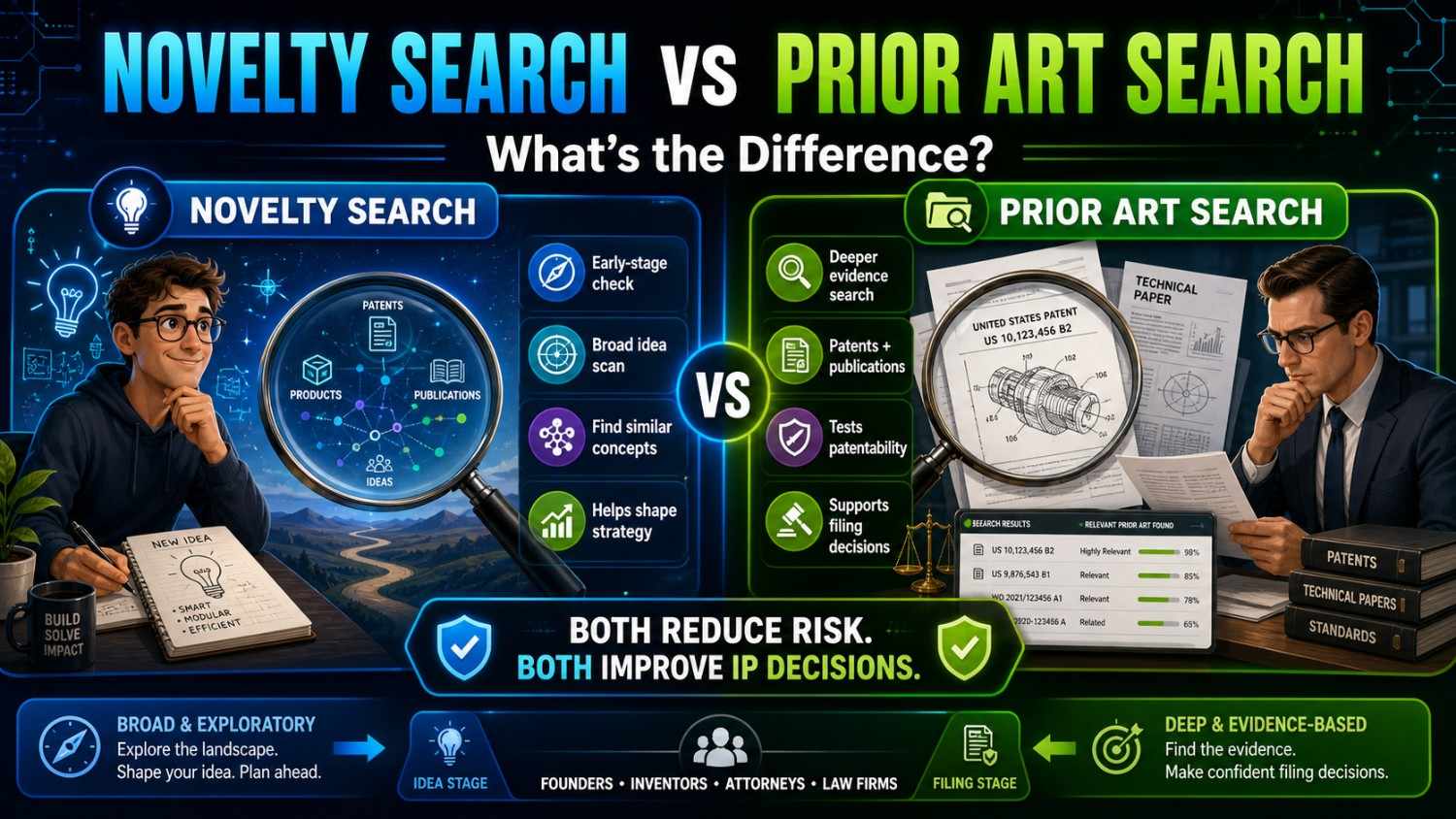
Most founders hear the words “novelty search” and “prior art search” and think they mean the same thing.
They are close, but they are not always used the same way.
A novelty search asks, “Is this invention new enough to file?” A prior art search asks, “What already exists that may affect this patent, this product, this claim, or this business decision?”
That small difference matters. It can save money. It can shape better patents. It can help lawyers draft stronger claims. And it can help startups avoid filing weak patents that look good on paper but do little in the real world.
PowerPatent helps founders turn inventions into stronger patent filings with smart software and real attorney oversight. To see how the process works, visit https://powerpatent.com/how-it-works.
The simple difference
A novelty search is a type of prior art search.
That is the cleanest way to think about it.
Prior art is the big bucket. It includes public information that may be relevant to whether an invention can be patented. In the United States, prior art can include things that were patented, published, publicly used, sold, or otherwise made available to the public before the effective filing date of the claimed invention. That basic idea comes from 35 U.S.C. § 102, the U.S. law section that deals with novelty and prior art. (Legal Information Institute)
A novelty search is more focused. It looks for earlier public information that shows the same invention, or very close parts of it, before you spend time and money filing a patent application.
In plain words, a novelty search is often done before filing.
A prior art search can be done before filing, during drafting, during examination, before a product launch, before buying patents, before suing, before responding to an examiner, or before investing in a company.
So the difference is not always about the search tools. Many of the same tools may be used. The difference is the purpose.
A novelty search asks, “Can we still call this new?”
A prior art search asks, “What earlier public information matters for this patent question?”
That means every novelty search is a prior art search, but not every prior art search is a novelty search.
Why this difference matters for startups
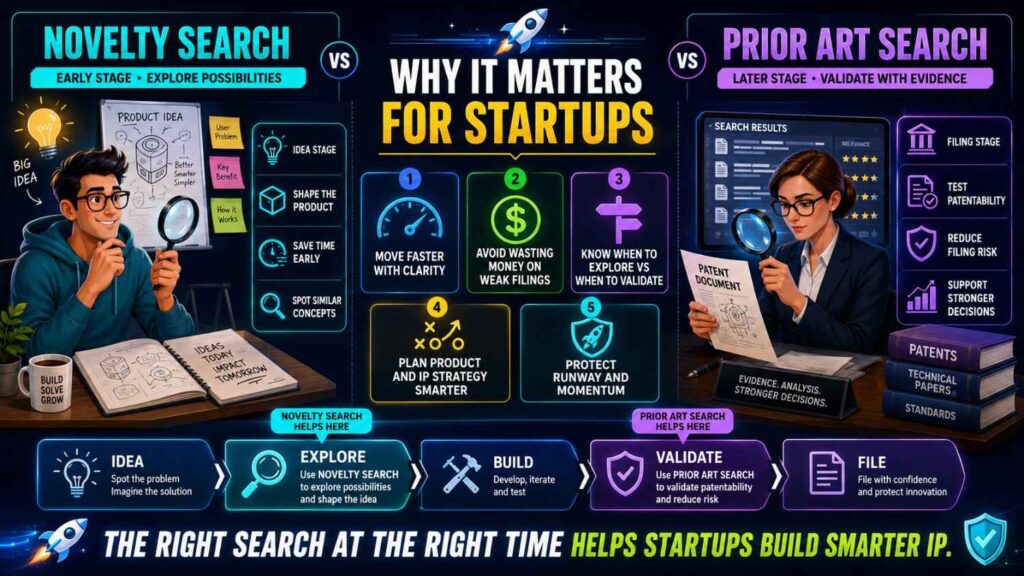
Startups do not have unlimited time or money.
A founder may have one strong technical idea, a small team, and a short runway. The company may need to file before a launch, investor meeting, demo day, partner call, GitHub release, paper, or customer pilot. The team needs to move fast, but not blindly.
This is where the difference between novelty search and prior art search becomes practical.
A novelty search helps the founder decide whether the invention looks new enough to pursue. It can stop the company from spending money on a patent idea that was already disclosed by someone else. It can also help the team see what parts of the invention are actually different.
A broader prior art search can help with many other choices. It can show what competitors are filing. It can help a lawyer draft around old systems. It can help the company understand risk before launching a product. It can help investors see whether a patent portfolio has real value. It can help a startup decide whether to file more patents, change claim scope, or keep something as a trade secret.
Founders often make the mistake of asking for “a patent search” without knowing which kind they need.
That can lead to wasted effort.
If you are trying to decide whether to file your first patent, you likely need a novelty-style search focused on the invention. If you are worried your product may run into someone else’s patent, that is a different type of prior art or freedom-to-operate review. If you are responding to an office action, you may need a search aimed at examiner references and claim amendments. If you are buying a patent portfolio, you may need validity and landscape work.
Same general world. Different job.
PowerPatent helps founders cut through this confusion. The platform helps technical teams capture the invention, understand what they are protecting, and move toward filing with attorney oversight. Learn more at https://powerpatent.com/how-it-works.
What “prior art” means in simple words
Prior art is the world’s earlier public knowledge.
It may be a patent. It may be a published patent application. It may be a journal paper. It may be a product manual. It may be a blog post. It may be a GitHub repo. It may be a conference talk. It may be a standards document. It may be a thesis. It may be a product that was sold or shown publicly.
The exact legal rules can vary by country and by fact pattern, so a lawyer should review important questions. But the core idea is simple: if the public could already learn the invention before you filed, that earlier information may hurt your patent.
The European Patent Office explains this in a very broad way. Under the European approach, the “state of the art” includes everything made available to the public anywhere in the world, by written or spoken description, by use, or in any other way, before the filing or priority date. (EPO)
That is a big universe.
This is why patent searching is hard. You are not only searching issued patents. You may also be searching academic papers, product pages, old manuals, standards, videos, forum posts, datasets, public code, technical reports, and more.
For a startup, this matters because the most dangerous prior art is not always a famous patent.
Sometimes it is a small paper from a university lab. Sometimes it is an old product manual. Sometimes it is a conference slide deck. Sometimes it is an abandoned patent application. Sometimes it is a public GitHub project with the same workflow.
A good search tries to find the closest public material before major patent money is spent.
But no search can prove with perfect certainty that nothing exists. That is important. A search can reduce risk. It cannot make risk zero.
What a novelty search is really trying to answer
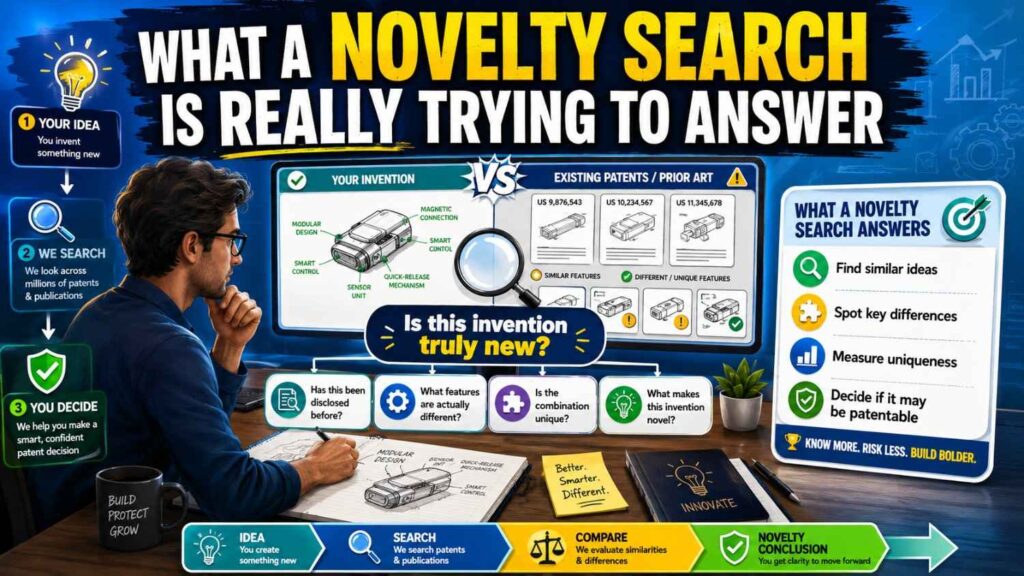
A novelty search tries to answer one main question: has someone already publicly disclosed this invention?
That sounds easy. It is not.
Most inventions are not one single feature. They are combinations of parts, steps, data flows, design choices, and results. A startup may say, “Our invention is an AI system that predicts failures.” But that is too broad. Many systems predict failures. The real invention may be a special sensor signal, a filtering step, a model update method, a threshold rule, or a control action.
A good novelty search starts by defining the invention clearly.
What is the core idea? What are the key steps? Which parts are required? Which parts are optional? What makes it different from normal practice? What technical problem does it solve? What would a competitor need to copy?
Once the invention is clear, the search looks for earlier references that disclose the same thing or close versions of it.
The goal is not just to find one scary document. The goal is to understand the space.
Sometimes the search finds that the broad idea is already known, but a narrower technical detail looks new. That can still be useful. The patent strategy may shift from “protect the whole concept” to “protect the specific improvement.”
Sometimes the search finds that the invention is crowded. That does not always mean “do not file,” but it may mean the claims must be more careful.
Sometimes the search finds almost nothing close. That is helpful, but still not a guarantee. It may mean the invention is newer, or it may mean the search needs better terms, more databases, or deeper technical review.
The value of a novelty search is not only a yes-or-no answer. The value is better judgment before filing.
What a broader prior art search may be trying to answer
A prior art search can have many goals.
It may ask whether an invention is new. That is a novelty search.
But it may also ask whether a granted patent is valid. That is often called a validity search or invalidity search, depending on who is asking.
It may ask whether a company can launch a product without a high risk of infringing someone else’s patent. That is often part of freedom-to-operate work.
It may ask what competitors are filing in a field. That is often a landscape search.
It may ask whether a patent application should be amended in light of examiner-cited references.
It may ask whether an investor should trust a startup’s patent portfolio.
It may ask whether a company should buy, license, challenge, or design around a patent.
This is why the phrase “prior art search” can be confusing. It describes the material being searched, not always the purpose of the search.
A lawyer who says “we need a prior art search” may mean something very specific based on context. A founder who says the same phrase may mean “please tell me if my idea is patentable.”
Those are not always the same request.
The best first step is to define the decision the search must support.
Are you deciding whether to file? Drafting claims? Preparing for launch? Checking a competitor patent? Responding to an examiner? Raising money? Buying patents?
The search should match the decision.
Novelty search vs prior art search in one clear example
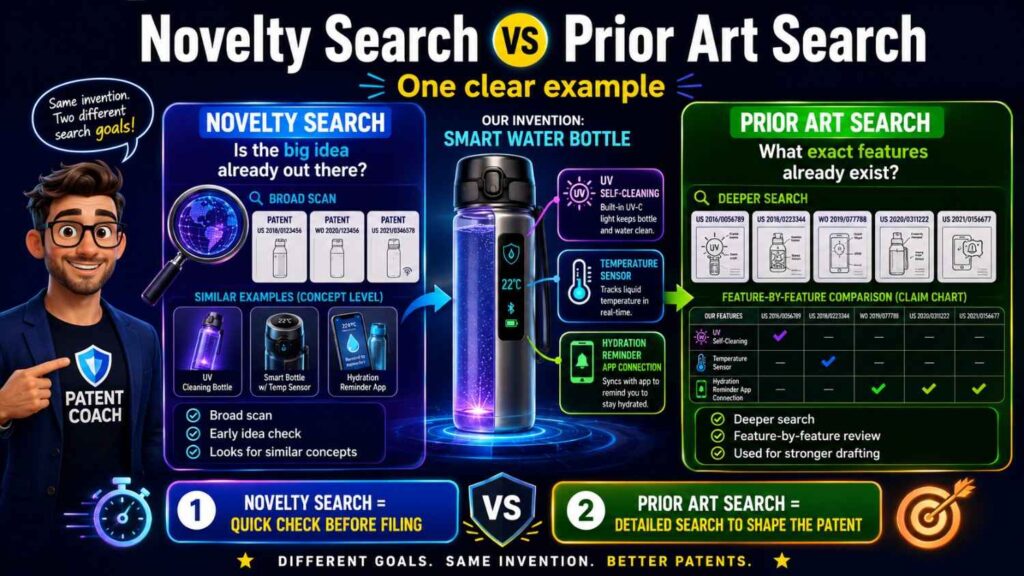
Imagine a startup builds a new wearable device.
The device uses motion data, skin temperature, and heart rate changes to detect early signs of heat stress. It then changes alert timing based on a confidence score and recent user activity.
The founder wants to file a patent.
A novelty search would focus on whether this invention, or a very close version, was already disclosed. The search would look for earlier patents, papers, products, and public materials that combine similar sensors, similar scoring, and similar alert logic for heat stress detection.
The goal would be to answer: is this new enough to justify a patent filing, and what part seems most different?
Now imagine the same startup is about to launch the wearable.
A broader prior art search for product risk may look very different. It may focus on active patents owned by competitors. It may look at claim language. It may focus on whether the product may fall inside someone else’s patent claims. The goal is no longer just “is our invention new?” It becomes “could our product create patent risk?”
Now imagine an examiner rejects the startup’s patent application using two older patents.
A prior art search at that stage may look for better ways to distinguish the invention. It may search for references that show what certain terms meant. It may help support an argument or amendment.
Same startup. Same product. Different search purpose.
That is why the label matters.
Why novelty is only one part of patentability
An invention must be new, but new is not enough.
In patent law, novelty is one requirement. Non-obviousness is another. Patent eligibility, usefulness, and proper disclosure also matter. A novelty search mainly focuses on whether the invention is already disclosed. But even if no single earlier reference shows the exact invention, the patent office may still reject the claims as obvious based on a combination of references.
This is a common surprise for founders.
A founder may say, “No one has built exactly what we built, so we should get a patent.”
Maybe. But the patent office may ask whether the invention would have been an obvious next step based on what was already known.
That is why a strong novelty search often looks beyond exact matches. It should also help the attorney understand nearby references that may be combined against the invention.
This is where human judgment matters.
AI tools and search platforms can help find references quickly. But deciding how close those references are, what they teach, and how they affect claim strategy is skilled work.
For startups, the practical lesson is simple: do not treat a novelty search as a magic green light. Treat it as a risk check and drafting guide.
The best outcome is not just “we found nothing.” The best outcome is “we understand what is close, and we can now draft smarter.”
Why a novelty search should happen before drafting when possible
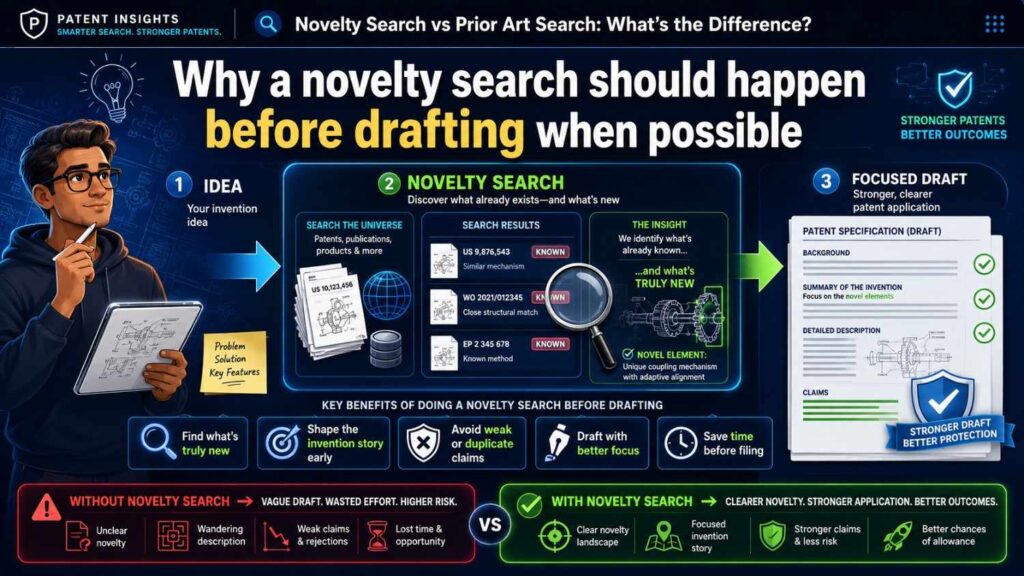
A novelty search is often most useful before the patent application is drafted.
At that point, the team can still shape the filing strategy. If the search finds close prior art, the attorney can draft around it. If the search shows the broad concept is old, the team can focus on the real improvement. If the search shows the field is crowded, the team can include more examples and fallback positions.
This can save money.
Without a search, a founder may file a broad application that later runs into obvious problems. The examiner may find a close reference. The claims may need heavy changes. The application may become narrow. The company may wonder why it spent money on a filing that could have been drafted better from the start.
A pre-filing novelty search does not remove all risk, but it gives the drafting team a better map.
This is especially important for AI, software, robotics, climate tech, cybersecurity, semiconductors, and biotech tools. These fields often have dense prior art. The key invention may be a narrow but valuable technical improvement. You want to know that before drafting, not after.
PowerPatent’s guided process helps founders capture the technical detail that makes a novelty search and patent draft more useful. See how it works at https://powerpatent.com/how-it-works.
Why prior art searches are not all equal
Not every search has the same depth.
A quick search may use a few keywords in Google Patents and general web search. This can be useful for an early screen. It may find obvious references. It may help the founder see whether the idea is already common.
A deeper search may use patent classification codes, assignee searches, inventor searches, citation chains, non-patent literature, foreign patents, academic databases, product manuals, standards, and technical archives.
A professional search may use trained searchers, specialized databases, legal review, and careful claim mapping.
The right level depends on the decision.
A startup may not need a massive search for every early idea. But it may need deeper work before spending heavily on a core patent, entering a crowded market, raising a major round, or launching a product near known competitors.
The mistake is using a shallow search for a high-stakes decision.
A five-minute search can be useful. It should not be treated like a legal opinion.
A full legal search and analysis can be expensive. It should be used when the value justifies it.
Smart founders match search depth to business risk.
The role of AI in novelty and prior art searching
AI is changing patent searching.
It can help find related references faster. It can expand search terms. It can summarize long patents. It can compare features. It can group documents by theme. It can help explain technical references in plain words.
This is a real advantage.
Patent documents are dense. Many founders do not have time to read dozens of long patents. Lawyers and searchers can use AI to move faster through the first pass.
But AI has limits.
It can miss important references. It can misunderstand claim language. It can summarize a document in a way that sounds right but is wrong. It can overstate similarities. It can understate key differences. It can rely too much on words and not enough on technical meaning.
Patent search is not just finding documents. It is understanding them.
AI is a strong helper, but it should not be the only judge.
The best workflow uses AI to speed up search and review, then uses human expertise to decide what the references mean for patent strategy.
That is the same philosophy behind PowerPatent: smart software plus real attorney oversight. Founders get speed and clarity, while important legal choices stay in human hands. Learn more at https://powerpatent.com/how-it-works.
What founders should do before asking for a novelty search
A novelty search gets better when the invention is clear.
Before asking someone to search, a founder should write a plain-English invention summary. It does not need legal words. It needs facts.
Explain the problem. Explain the old way. Explain what your system does differently. Explain the steps. Explain the parts. Explain the result. Explain what would be hard for a competitor to copy. Explain what versions may come next.
This helps the searcher avoid wasting time.
If the founder only says, “We use AI to improve customer support,” the search will be broad and messy. If the founder says, “Our system routes support tickets by using a confidence score from a small local model, then calls a larger model only when the score is below a threshold, reducing cost while keeping answer quality high,” the search can be much sharper.
Details make the search better.
This is one reason invention capture matters so much. A poor invention description leads to a poor search. A clear invention description leads to better search results and better patent drafting.
PowerPatent helps founders explain their invention in a guided way, so the patent process starts with stronger input. Visit https://powerpatent.com/how-it-works to see the process.
What a good novelty search report should include
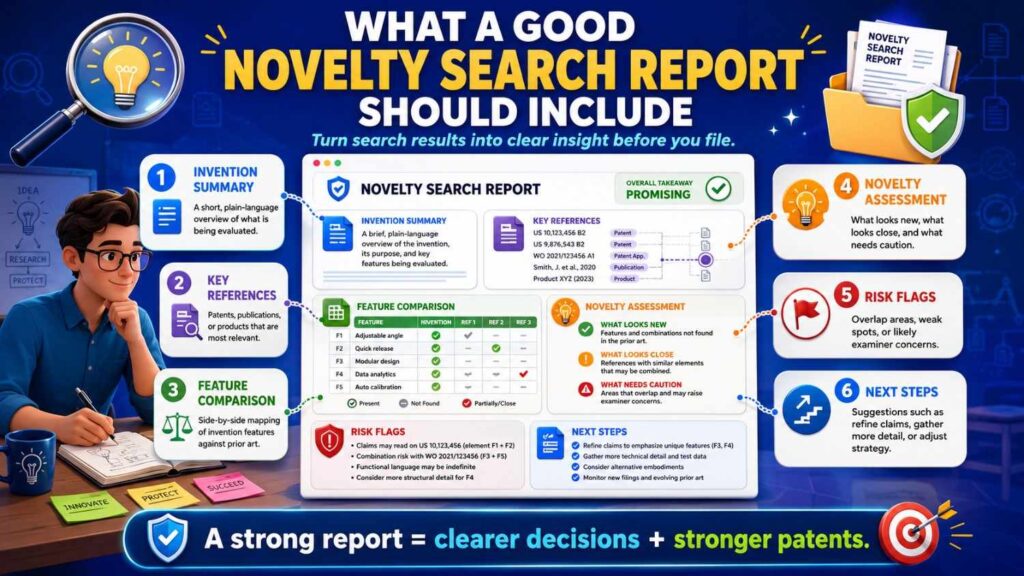
A good novelty search report should not just dump links.
It should help the team make a decision.
It should explain what was searched, what terms were used, what databases or sources were reviewed, what the closest references are, and why those references matter. It should compare the invention’s key features to the closest references. It should explain which features appear old, which features may be different, and where more review may be needed.
The report should also be honest about limits.
No search covers everything. Some references are hard to find. Some public uses are not well documented. Some non-English references may be missed. Some product details may not be visible. Some documents may use strange terms.
A useful report does not promise certainty. It gives practical risk insight.
For a founder, the most valuable part may be the “so what” section. Should we still file? Should we narrow the focus? Should we add more technical examples? Should we change the claim strategy? Should we do a deeper search? Should we hold off?
That decision should involve a patent professional.
A search report is raw material. Legal strategy turns it into action.
What a good prior art search report should include
A broader prior art report depends on the purpose.
If the search is for validity, the report should map prior references to the patent claims. It should show where each claim element appears. It should explain whether one reference shows all elements or whether multiple references may be combined.
If the search is for freedom to operate, the report may focus on active patents, claim scope, expiration, ownership, and product mapping. That is a different kind of legal review.
If the search is for landscape work, the report may show filing trends, major players, technology clusters, white space, and competitor activity.
If the search is for drafting support, the report should help the attorney understand the closest references and draft around them.
That is why “prior art search” is too broad by itself.
The report should answer the business question behind the search.
For startups, the business question may be simple: “Are we spending our patent budget wisely?” A good search helps answer that.
Novelty search and patent claims
Novelty is judged against claims, not just the general idea.
This is a key point.
A founder may describe the invention broadly. But when a patent application is examined, the examiner looks at the claims. The claims define what the applicant is trying to protect.
This means a novelty search should focus on the likely claim features.
If the future claim will include steps A, B, and C, the search should look for references showing A, B, and C. If the key feature is step C, the search should pay close attention to it.
This is why a novelty search is stronger when a patent attorney helps define the invention before searching.
Without claim thinking, the search may focus on the wrong thing. It may find broad background references but miss the feature that matters. Or it may miss a close reference because the search terms do not match the likely claim language.
Good patent searching and good patent drafting work together.
A search helps shape claims. Claim strategy helps shape the search.
Prior art search and patent drafting
A prior art search can make a patent draft stronger.
When the drafting team knows the closest prior art, it can write with more care. It can explain the technical problem more clearly. It can avoid claiming old features as if they are new. It can focus the claims on the real improvement. It can include fallback positions that may matter during examination.
This does not mean the patent application should argue against prior art in a heavy-handed way. In many cases, the draft should simply describe the invention clearly and include enough support.
But awareness helps.
For example, if older systems used a fixed threshold, and the startup uses an adaptive threshold based on live sensor confidence, the application should explain that adaptive part well. If older systems used cloud processing, and the startup’s edge-device workflow is the improvement, the application should describe local processing and its benefits in detail.
Without prior art awareness, the draft may bury the most important difference.
A good search helps the patent attorney know where to shine the light.
Novelty search and provisional patents
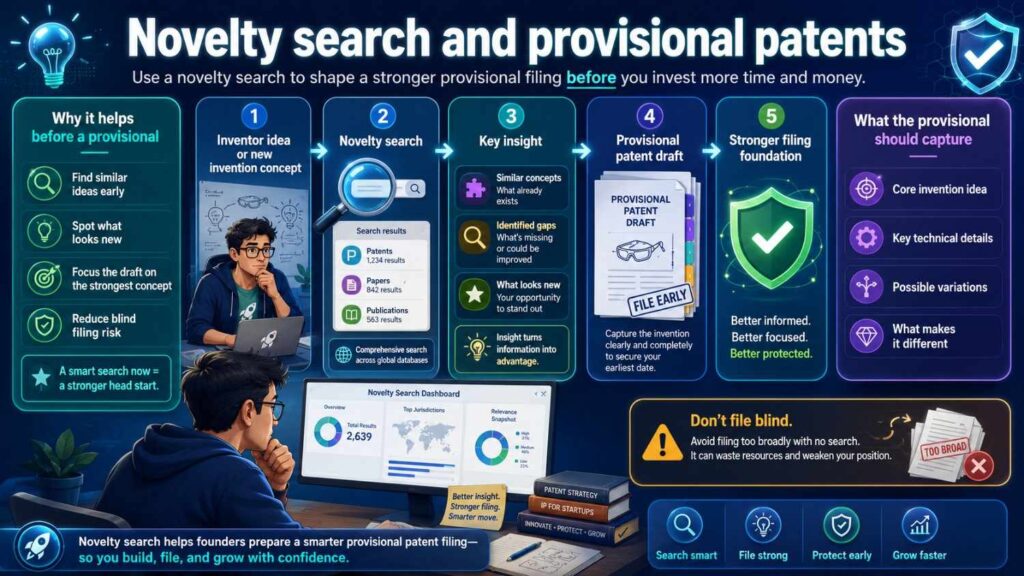
Many startups file provisional patent applications first.
A provisional can be useful because it gives the startup an early filing date and more time to develop the full application. But a provisional must still describe the invention well. A thin provisional may not support strong claims later.
A novelty search before a provisional can help the team decide what to include.
If the search shows close references, the provisional can focus on the true improvement. It can include examples, variations, and technical details that support future claims.
Some founders skip the search because they want to file fast. That may be fine in urgent cases. If a public disclosure is coming tomorrow, filing quickly may be more important than searching. But when time allows, even a focused novelty search can improve the filing.
The best path depends on timing, budget, and risk.
PowerPatent helps founders move quickly while still building a stronger invention record. That can be very helpful when filing a provisional under time pressure. See how it works at https://powerpatent.com/how-it-works.
Novelty search and non-provisional patents
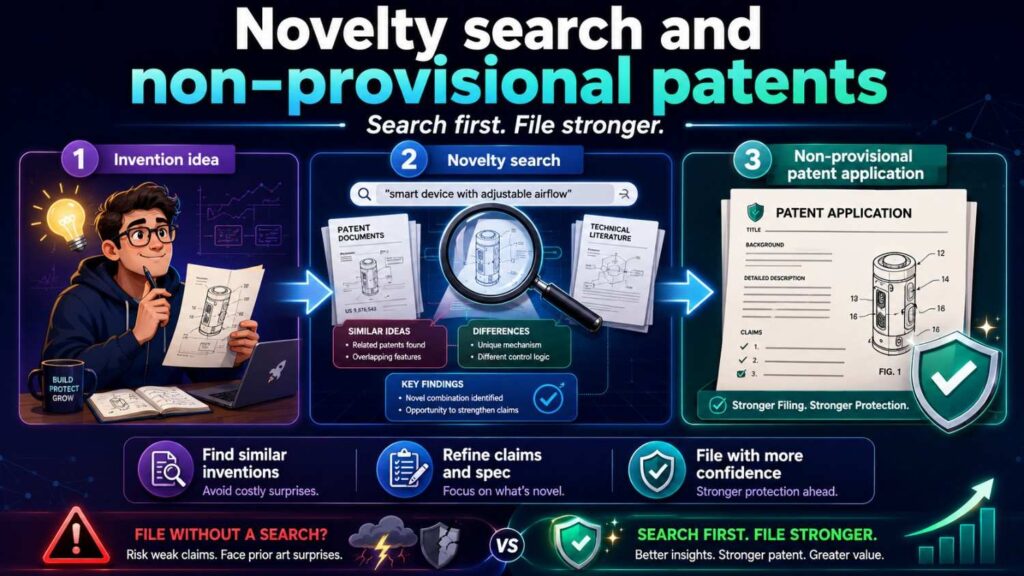
A non-provisional application is examined by the patent office.
Before filing a non-provisional, a deeper search may be worth it, especially for core technology. The company is making a larger investment. The claims matter more. The application may shape the future patent portfolio.
A novelty search at this stage can help refine claims and add support.
It may show that broad claims are risky but narrower claims are promising. It may show that certain fallback features should be described in more detail. It may show that the draft should include more examples or alternate versions.
This is where startups can make smarter patent spending decisions.
Instead of filing broad claims and hoping, the company can file with better knowledge.
That does not mean the search must be perfect. It means the team should know the obvious risks before filing.
Novelty search and office actions
A novelty search can also help after filing.
If an examiner rejects claims based on prior art, the applicant may need to respond. The attorney may search for more context around the examiner’s references. They may look for ways to distinguish the invention. They may search for technical meaning of claim terms. They may find other references that show why the examiner’s combination is weaker than it appears.
At this stage, the search is no longer just about whether to file. It is about how to respond.
The attorney may use search results to amend claims, explain differences, or decide whether to continue.
For founders, this is important because office actions are normal. A rejection does not mean the invention is bad. It often means the claims need to be clarified, narrowed, or argued.
A strong original search and draft can make office action response easier. But even if no search was done before filing, search work during prosecution can still help.
Prior art search and freedom to operate
Freedom to operate, often shortened to FTO, is different from novelty.
Novelty asks whether your invention is new.
FTO asks whether your product may infringe someone else’s active patent.
These are very different questions.
You can have a new invention and still risk infringing an older patent. For example, you may improve a known device. Your improvement may be patentable, but the improved product may still use parts covered by someone else’s active patent.
That surprises many founders.
A novelty search is not an FTO search. It may find some relevant patents, but it is not designed to clear a product for launch.
An FTO review often focuses on active patent claims in countries where the company plans to make, use, sell, or import the product. It may require legal claim interpretation and product mapping.
This can be more complex and more expensive than a novelty search.
Startups should understand the difference. If you are deciding whether to file a patent, ask for novelty or patentability search support. If you are deciding whether to launch near a competitor’s patents, ask about FTO.
Using the wrong search can create false comfort.
Prior art search and patent validity
A validity search asks whether a patent should have been granted.
This often comes up when a company is accused of infringement, considering a challenge, buying a patent, licensing a patent, or reviewing a competitor’s portfolio.
The goal is to find prior art that shows the claimed invention was not new or was obvious before the patent was filed.
This search is usually claim-focused. The searcher looks at each claim element and tries to find earlier references that match.
This is different from a startup novelty search. A novelty search may start with an invention description before claims are drafted. A validity search starts with issued claims or pending claims and asks whether those claims survive.
Both use prior art, but the work product is different.
For founders, this matters during diligence. If an investor asks whether your issued patent is strong, a validity-style review may be more useful than a simple novelty search.
Prior art search and patent landscapes
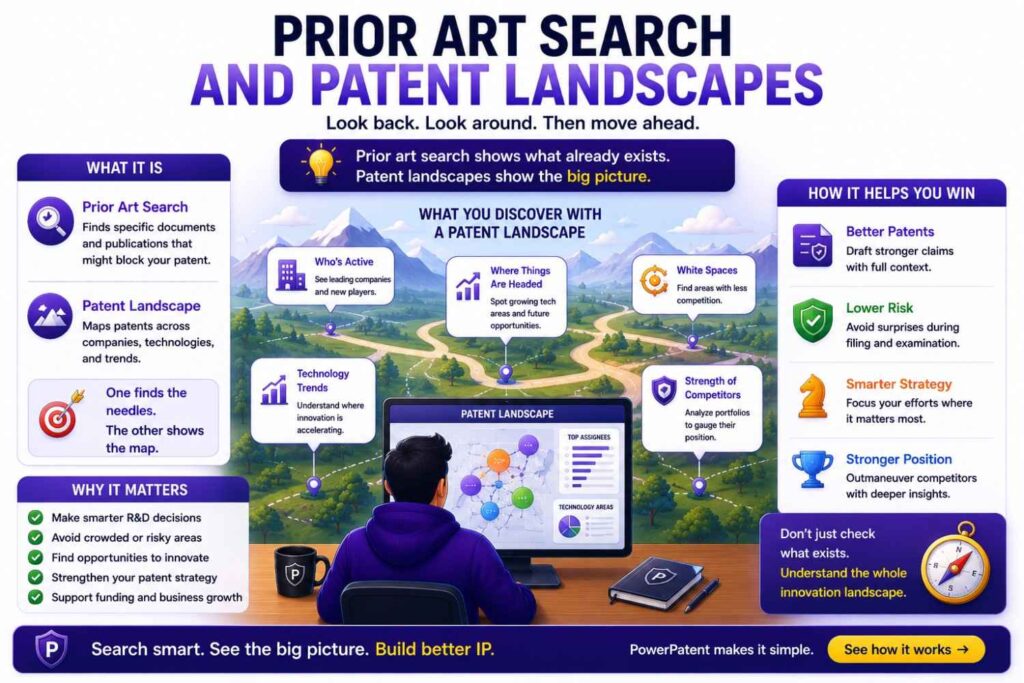
A landscape search gives a broad view of a technology area.
It may show who is filing patents, what subfields are crowded, where activity is growing, and where there may be open space.
This can be valuable for startups entering a technical market.
A landscape search may help a founder see which companies are active. It may reveal old approaches that failed. It may show white space for future filings. It may support product strategy, R&D planning, or investor storytelling.
But a landscape search is not the same as a novelty search.
It may not answer whether your exact invention is new. It may not map every reference to your claim. It may not clear your product for launch.
It gives context.
Context is useful, but it should not be confused with legal clearance.
Search tools founders should know
Founders do not need to become search experts, but they should know the basic tools.
Google Patents is a common starting point. Google says it lets users search and read the full text of patents from around the world and includes non-patent literature in its index.
The USPTO also offers patent search tools and resources. The USPTO has a prior art search page focused on search strategies and resources, including materials related to preliminary patent searching.
Other tools include Espacenet from the European Patent Office, WIPO’s PATENTSCOPE, The Lens, and commercial patent databases. Academic search tools, standards databases, GitHub, product manuals, and general web search can also matter.
The tool is only part of the job.
Search skill matters more than the search box.
A strong search uses different words for the same idea. It searches by function, structure, result, and problem. It looks at patent classes. It checks citations. It searches competitors and inventors. It reviews non-patent materials.
For AI and software inventions, this is especially important because different writers may describe the same idea in very different words.
One patent may say “confidence score.” Another may say “trust value.” Another may say “uncertainty metric.” Another may say “classification probability.” A simple keyword search may miss close references if the words differ.
Why keywords are not enough
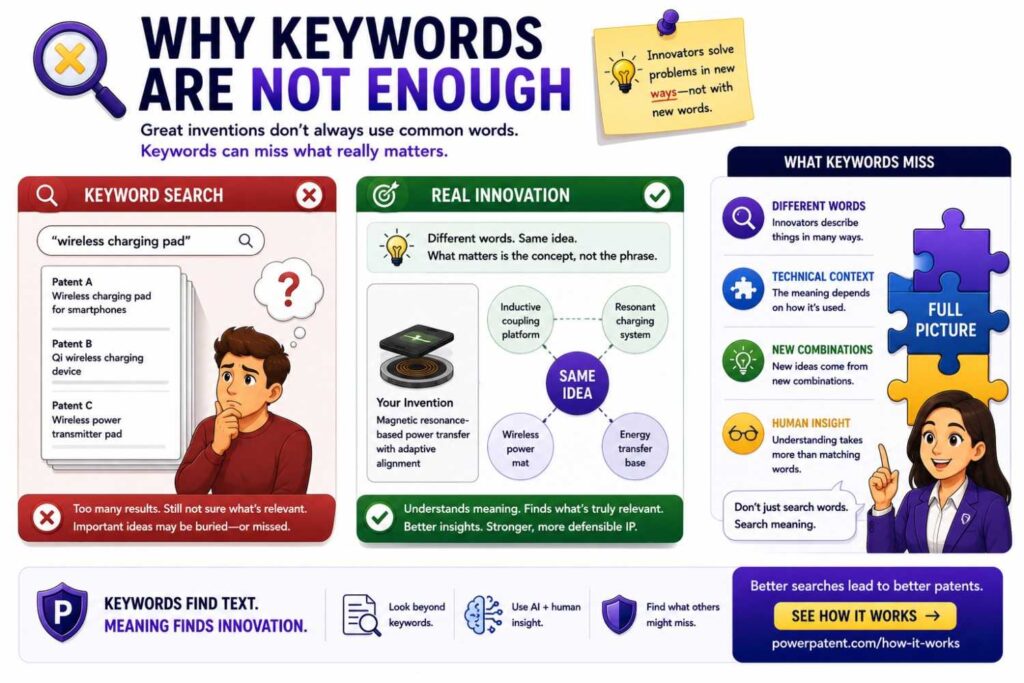
Keywords are helpful, but they are not enough.
Patent writers often use broad or unusual words. They may avoid the common product term. They may describe a feature by function instead of name. A search for “chatbot memory” may miss patents that say “conversation state store.” A search for “drone battery swap” may miss documents that say “unmanned aerial vehicle power module replacement.” A search for “AI medical triage” may miss references using “patient prioritization engine.”
This is why searchers use many strategies.
They search synonyms. They search technical effects. They search components. They search classifications. They search known companies. They search inventors. They search citations. They search foreign patent families. They search papers and product documentation.
AI can help expand terms, but it should be checked.
The best search starts with a clear invention breakdown. What is the device? What are the steps? What data is used? What changes? What result is achieved? What field uses it?
Then the search can look for each concept in different language.
Why non-patent literature matters
Prior art is not only patents.
Academic papers, technical blogs, product manuals, standards documents, videos, code repositories, theses, and public presentations can matter too.
For startups, this is important because many new ideas appear first outside the patent system. AI methods may appear in papers or GitHub repos. Hardware techniques may appear in conference slides or product manuals. Biotech methods may appear in journal articles. Cybersecurity methods may appear in white papers or open-source projects.
A novelty search that only reviews patents may miss important references.
The right mix depends on the field.
For machine learning, papers and code may be very important. For telecommunications, standards documents may matter. For medical devices, regulatory materials and product manuals may matter. For robotics, academic papers and videos may help. For semiconductor work, patents and technical papers may both be critical.
A strong prior art search follows the invention into the places where people in that field actually publish.
The danger of searching too late
Many founders search after they have already filed.
Sometimes that is unavoidable. If a launch is near, filing quickly may be the right move.
But when time allows, searching earlier is better.
If a search happens after drafting, the team may discover that the broad claim is already known. The application may need revision. If the application has already been filed, adding new matter may not be allowed in the same way. The team may need a new filing.
Searching early can prevent this.
It can also help the founder make better choices. Maybe the idea is not worth filing. Maybe a narrower feature is worth filing. Maybe the company should file a quick provisional now and do more work later. Maybe trade secret protection makes more sense.
A search is not just a legal step. It is a business filter.
Startups should use it before spending major patent budget, when possible.
The danger of searching too broadly
There is also a problem with searching too broadly.
Some founders want to search the whole world before filing anything. That can lead to delay. It can also become expensive and overwhelming.
Patent searching is never perfect. At some point, the company must make a decision.
The best search is not always the biggest search. It is the search that fits the decision.
For an early idea, a focused screen may be enough. For a core platform patent, deeper searching may be worth it. For a launch near known competitors, FTO may be needed. For investor diligence, portfolio review may matter.
Do not let search become an excuse to avoid action.
Patents are tied to timing. If you wait too long, public disclosure or competitor filing can create problems.
The smart path is balanced: search enough to reduce risk, then move.
How novelty search results should shape patent drafting
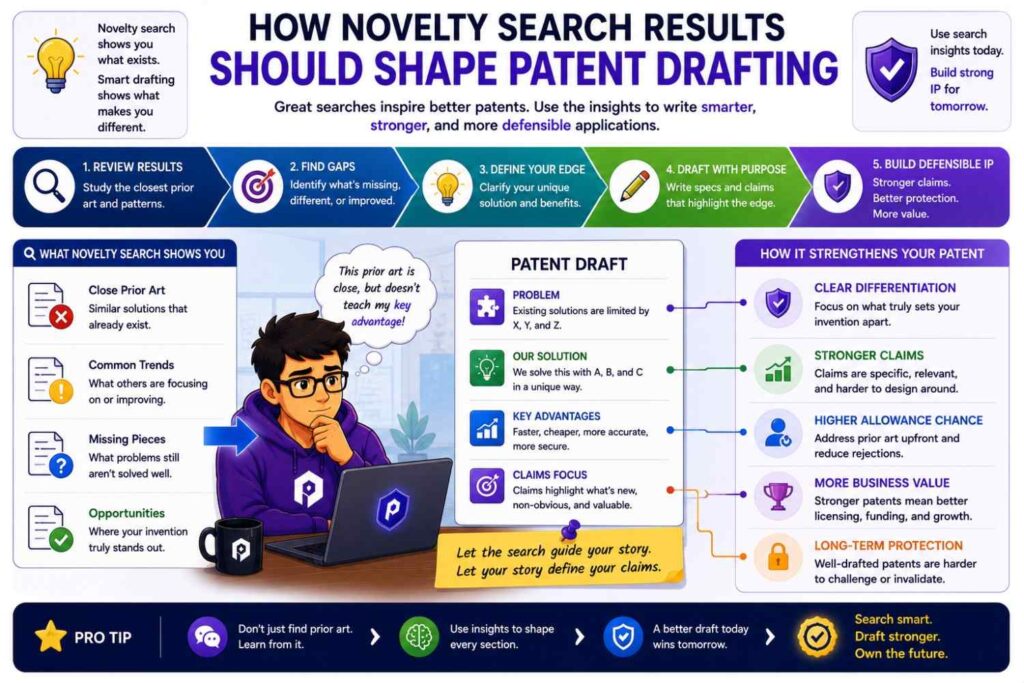
Search results should change the draft.
If they do not, the search may not be used well.
When a novelty search finds close references, the drafting team should study what those references teach. Then the patent application should focus on what is truly different.
For example, if old references show collecting sensor data, but not the startup’s special confidence-based control loop, the draft should explain that loop clearly. If old references show a machine learning model, but not the startup’s training data selection method, the draft should describe that method in detail. If old references show a user workflow, but not the startup’s privacy-preserving architecture, the draft should highlight that architecture.
The claims should also reflect the difference.
This does not mean the claims must be too narrow from the start. It means broad claims should be supported by a detailed description that includes fallback positions.
A novelty search can also help avoid accidental admissions. The application should be careful when describing old systems. It should not say more than needed about what was known or obvious.
This is why attorney oversight matters.
Search results are powerful, but they must be used with care.
How search results should shape startup strategy
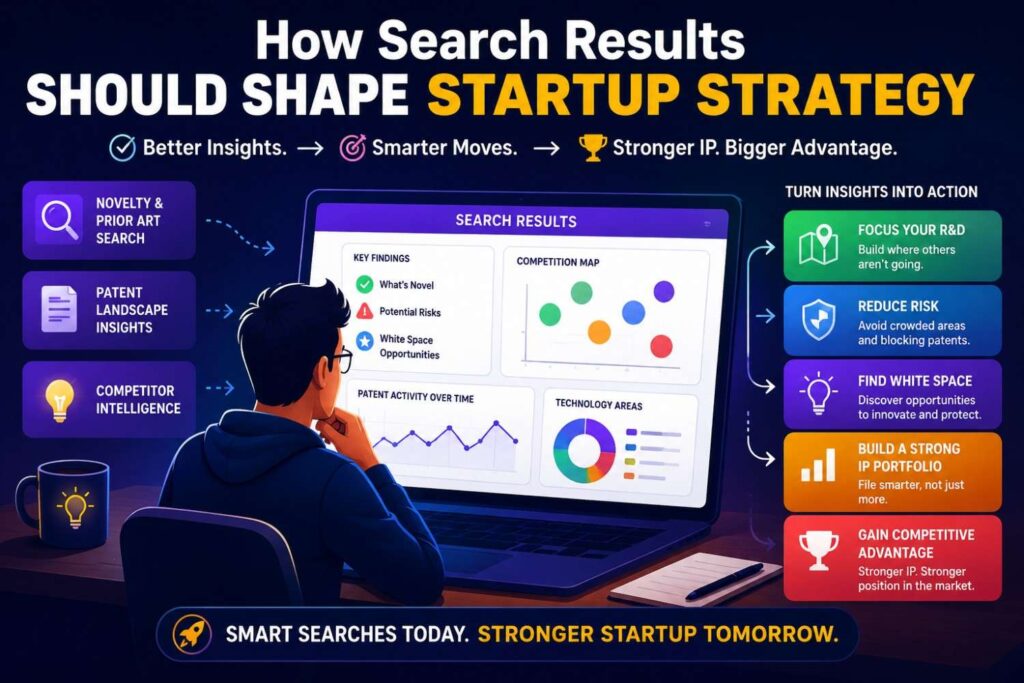
Search results are not only for lawyers.
They can help the business team too.
If a search shows a crowded field, the startup may need a more focused IP strategy. It may file on narrow but important improvements. It may also invest in speed, data, brand, partnerships, or trade secrets.
If a search shows a large competitor filing heavily in the same space, the startup may want to monitor that competitor. It may also want to file early around its own improvements.
If a search shows open space, the startup may decide to build a stronger portfolio around a core platform.
If a search shows the invention is likely old, the startup may save money by not filing, or by changing focus.
A patent search can also help with product positioning. It can reveal how others describe the problem. It can show common technical approaches. It can help a founder explain why their approach is different.
For deep tech startups, this kind of insight is valuable.
Patent strategy should not sit in a legal silo. It should connect to product, fundraising, R&D, and market strategy.
How PowerPatent makes this easier
Most founders are not trained to run patent searches.
They should not have to be.
The hard part is not only searching databases. The hard part is explaining the invention clearly enough so the right search can happen, then turning the results into a better filing.
PowerPatent helps with that.
The platform guides founders through invention capture. It helps turn code, technical notes, model designs, system diagrams, and product ideas into clearer invention records. That makes search and drafting more useful.
Then real patent attorney oversight helps turn the work into a stronger filing strategy.
This matters because AI alone can produce fast output, but fast output is not the goal. The goal is a patent process that helps protect what the startup is really building.
PowerPatent gives founders speed, control, and confidence without asking them to become patent experts. To see how it works, visit https://powerpatent.com/how-it-works.
A practical search plan for founders
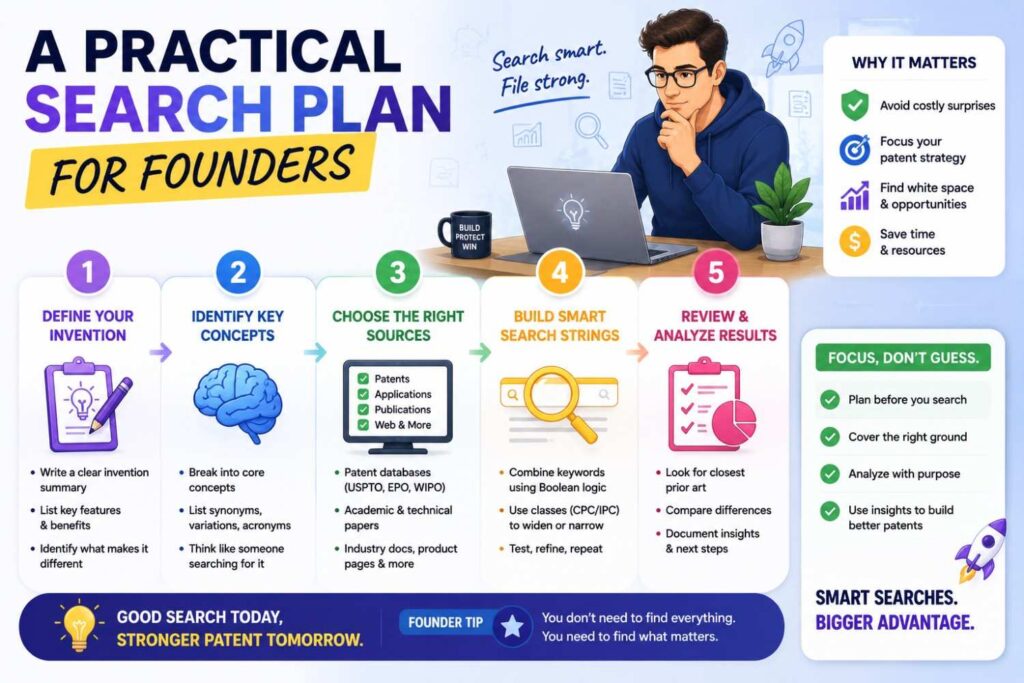
A founder can think about patent searching in stages.
At the idea stage, do a light screen. Search obvious keywords. Look at major competitors. Check Google Patents and basic web results. This can help find easy blockers.
At the invention capture stage, define the invention more clearly. Write down the core steps, parts, and technical difference. This makes any later search much better.
Before filing a core patent, consider a focused novelty search. Use the results to shape the patent draft.
Before product launch, ask whether freedom-to-operate review is needed. This is especially important if the field has large patent holders or known competitors.
Before fundraising or acquisition, organize patent summaries and ownership records. Investors care about what is protected and whether the company owns it.
This staged approach keeps search practical.
It avoids both extremes: filing blindly and searching forever.
What lawyers should explain to clients
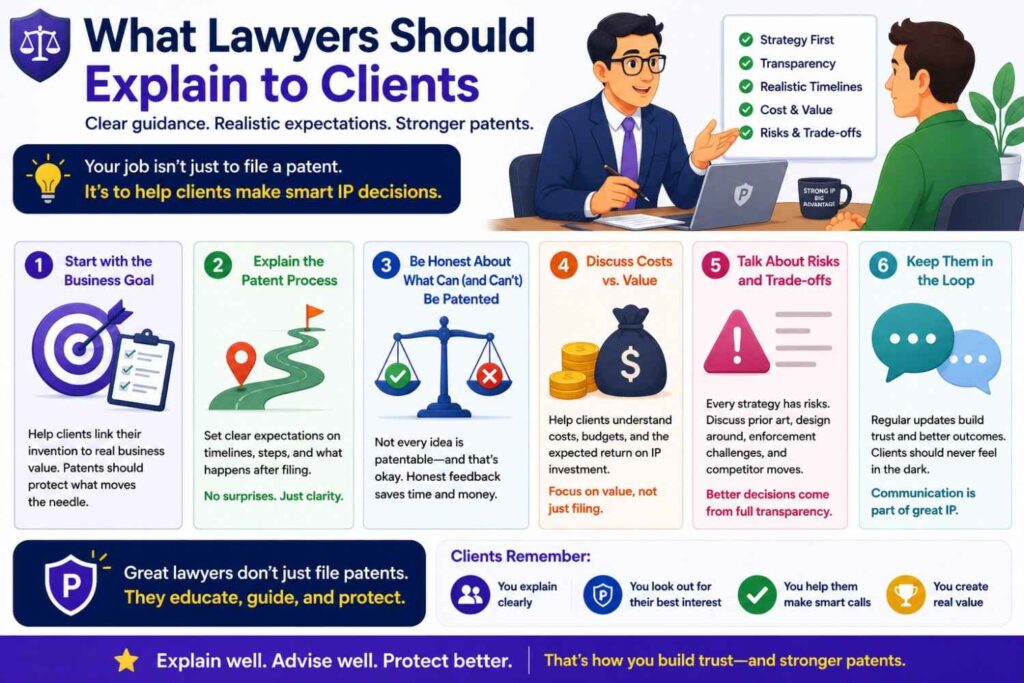
Lawyers can help clients by using plain language.
Many founders do not know the difference between novelty, prior art, patentability, validity, and freedom to operate. They may use these words loosely. That is normal.
A good lawyer should clarify the decision first.
Are we deciding whether to file? Are we checking product launch risk? Are we responding to an examiner? Are we reviewing a competitor patent? Are we preparing for diligence?
Once the decision is clear, the lawyer can recommend the right search.
This builds trust. It also prevents the client from paying for the wrong thing.
Law firms that serve startups should make search options easy to understand. Founders want practical guidance, not a lecture. They want to know what search level fits their stage, budget, and risk.
AI tools can help lawyers explain results more clearly. They can create plain-English summaries and feature maps. But lawyers should still review the message.
Clear communication is part of good patent service.
What law firms should build into their workflow
Law firms should not treat search as an isolated task.
Search should connect to intake, drafting, claim strategy, prosecution, and portfolio planning.
At intake, the firm should capture the invention clearly. At search, it should define the core features and likely claims. At drafting, it should use search results to focus the application. During prosecution, it should use prior art knowledge to respond more effectively. During portfolio review, it should use search insights to guide future filings.
AI can help connect these steps.
It can help summarize invention disclosures. It can help generate search strings. It can help compare references. It can help build claim charts. It can help prepare client summaries.
But the firm needs rules.
Who reviews AI search results? Which tools are approved? How is confidential data handled? How are search limits explained to clients? How are references stored and connected to the matter?
A modern law firm should have answers.
The best firms will use AI to create better workflows, not just faster drafts.
Common mistake: thinking a novelty search guarantees a patent
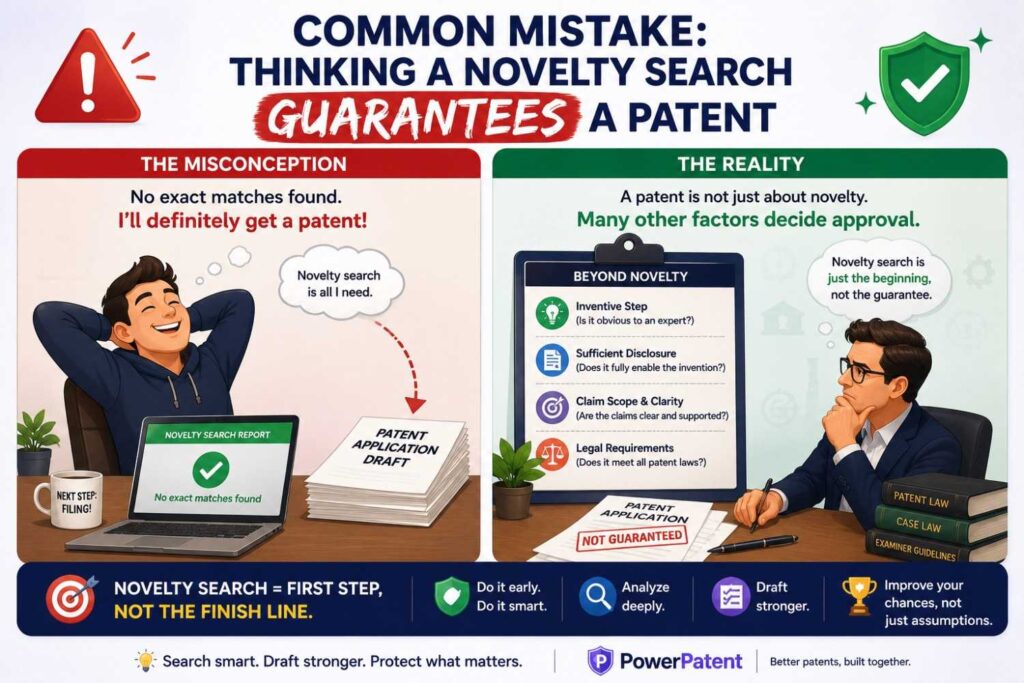
A novelty search does not guarantee a patent.
It can find close prior art. It can reduce risk. It can guide drafting. It can help decide whether filing makes sense.
But the patent office may find other references. The examiner may combine references for an obviousness rejection. Claim language may change. Legal standards may affect the outcome. The invention may face eligibility or disclosure issues.
A search is not a promise.
It is a decision tool.
Founders should be wary of anyone who says, “We searched and you will definitely get a patent.” That is not how the system works.
The better message is, “Based on what we found, these parts look promising, these parts look risky, and here is how we should draft.”
That is useful. That is honest. That is how smart patent work gets done.
Common mistake: thinking no exact match means the invention is safe
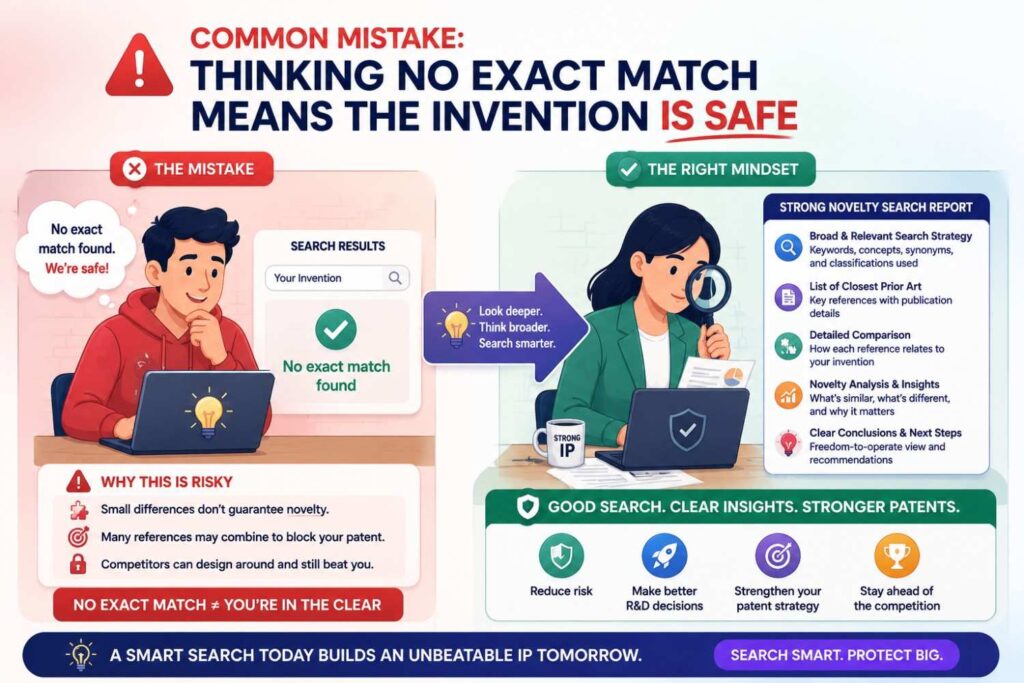
No exact match does not always mean the invention is patentable.
Patent examiners can use combinations of references. They may find one reference for part A, another for part B, and argue that combining them would have been obvious.
This is why a novelty search should also pay attention to nearby art.
If many references show similar parts, the attorney should know that. The claims may need to focus on a specific technical improvement, unexpected result, or practical implementation detail.
This is especially true in software and AI. Many broad ideas are already known. The patentable value often lies in a specific architecture, data method, control logic, or deployment technique.
Founders should not be discouraged by crowded art. Many valuable patents are improvements. But the improvement must be captured clearly.
Common mistake: searching the product name instead of the invention
Founders often search using their own product language.
That can miss prior art.
Your product may have a catchy name. Prior art will not use that name. Your team may use internal terms. Older references may use different words.
Search the function, structure, and technical effect.
If your product is a “smart intake assistant,” search for automated triage, request classification, routing engine, confidence-based escalation, and workflow assignment.
If your product is a “battery health brain,” search for charge state estimation, degradation prediction, impedance monitoring, thermal control, and cycle-life management.
If your product is a “robot safety shield,” search for collision prediction, human proximity detection, motion planning constraints, emergency stop control, and sensor fusion.
The invention is not the brand.
The invention is the technical method, system, or design that creates the result.
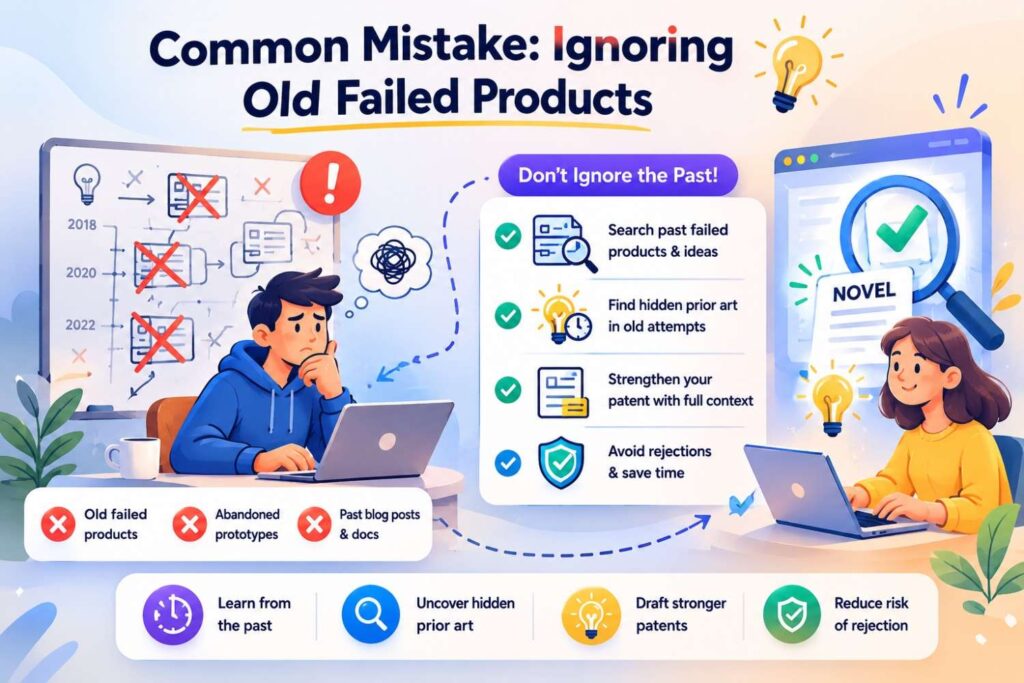
Common mistake: ignoring old failed products
Founders often focus on current competitors.
Prior art can be old. It can come from failed companies, abandoned products, research labs, or expired patents.
An old failed product may still count as prior art if it was publicly disclosed. An abandoned patent application may still matter. A paper from years ago may still affect novelty. This is why prior art searching is broader than market research.
Market research asks, “Who is active now?”
Prior art searching asks, “What was publicly known before filing?”
Those are different questions.
A failed product may not be a business threat, but it can still be a patent threat.
Common mistake: ignoring your own disclosures
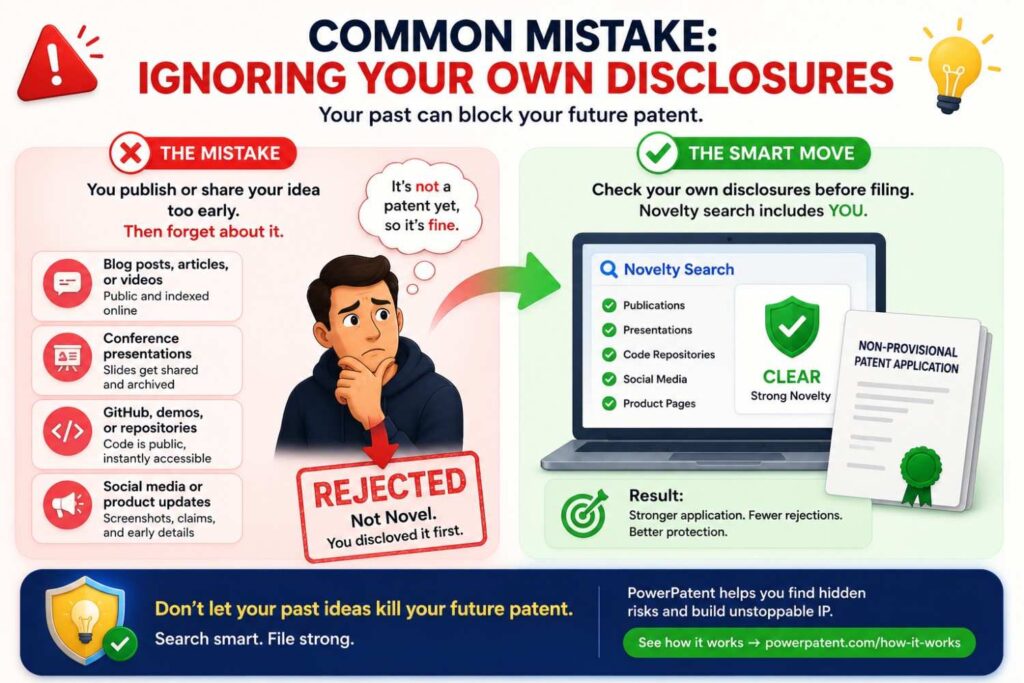
Your own public disclosures can become a problem.
A founder may publish a blog post, release a white paper, post code, give a conference talk, show a demo, or pitch details before filing. In some countries, this can seriously hurt patent rights. In the United States, there are grace-period rules in some cases, but relying on them can be risky and fact-specific.
The safe habit is simple: file before public disclosure when possible.
A novelty search should also ask about the startup’s own disclosure history. Has the team already shown this invention? When? To whom? Under NDA or publicly? Was anything sold or offered for sale?
These facts matter.
PowerPatent helps founders move faster so they can protect inventions before key public moments. Start here: https://powerpatent.com/how-it-works.
Novelty search for AI startups
AI startups need careful searching because the field moves fast.
Many AI ideas are published in papers, preprints, open-source repos, and product updates before they appear in patents. A search that only looks at patents may miss important material.
An AI novelty search should focus on the real technical contribution.
Is it a model structure? A training method? A data labeling workflow? A retrieval system? A prompt control method? A confidence scoring method? A model routing system? A privacy method? An edge deployment technique? A feedback loop?
The search should use terms from patents and from the AI research world. Those terms may differ.
For example, a patent may describe “semantic vectors,” while a paper may say “embeddings.” A product blog may say “memory,” while a technical document may say “context window management” or “state representation.”
AI startups should also search code and papers when relevant.
The key is to avoid claiming “using AI” as the invention. The invention is usually how AI is used to solve a technical problem in a specific way.
Novelty search for software startups
Software novelty searches can be tricky because software ideas are described in many ways.
The invention may be in data flow, system architecture, caching, authentication, ranking, error handling, interface control, synchronization, or workflow automation.
A founder may describe the invention as a product feature. The searcher must translate that into technical concepts.
For example, “one-click onboarding” may involve identity verification, permission mapping, data migration, role creation, and account linking. “Smart scheduling” may involve constraint solving, calendar conflict scoring, user preference learning, and real-time updates.
The search should look for the technical engine under the product feature.
Software founders should prepare diagrams if possible. Even a simple flowchart can improve the search.
A strong software patent usually protects the technical method, not just the business idea.
Novelty search for hardware startups
Hardware searches often need drawings, part names, materials, and use cases.
The invention may be a structure, an arrangement, a control method, a manufacturing step, or a combination of physical and software features.
A good hardware novelty search may use patent classifications more heavily because different documents may use different names for the same part. It may also look at product manuals, catalogs, academic papers, and standards.
Founders should provide sketches, photos, CAD images, and descriptions of what changed from older designs.
The search should not only ask whether the whole device is new. It should ask which part of the device is new and useful.
Many hardware patents protect improvements. A small physical change can matter if it solves a real problem.
Novelty search for robotics startups
Robotics inventions often combine many fields.
A robot may include sensors, motors, cameras, control software, machine learning, mapping, grasping, safety, and human interaction. This means the search must be focused.
Trying to search the whole robot is too broad.
The team should identify the specific invention. Is it a grasping method? A safety handoff? A path planning rule? A calibration method? A sensor fusion technique? A low-power control loop? A failure recovery process?
Once the core idea is clear, the search can target the right field.
Robotics prior art often appears in patents, academic papers, videos, and product demos. Searching only one source may miss important references.
For robotics startups, the best patent strategy often covers several layers over time: hardware, control, perception, safety, and workflows. Novelty searches can help decide where to start.
Novelty search for climate tech startups
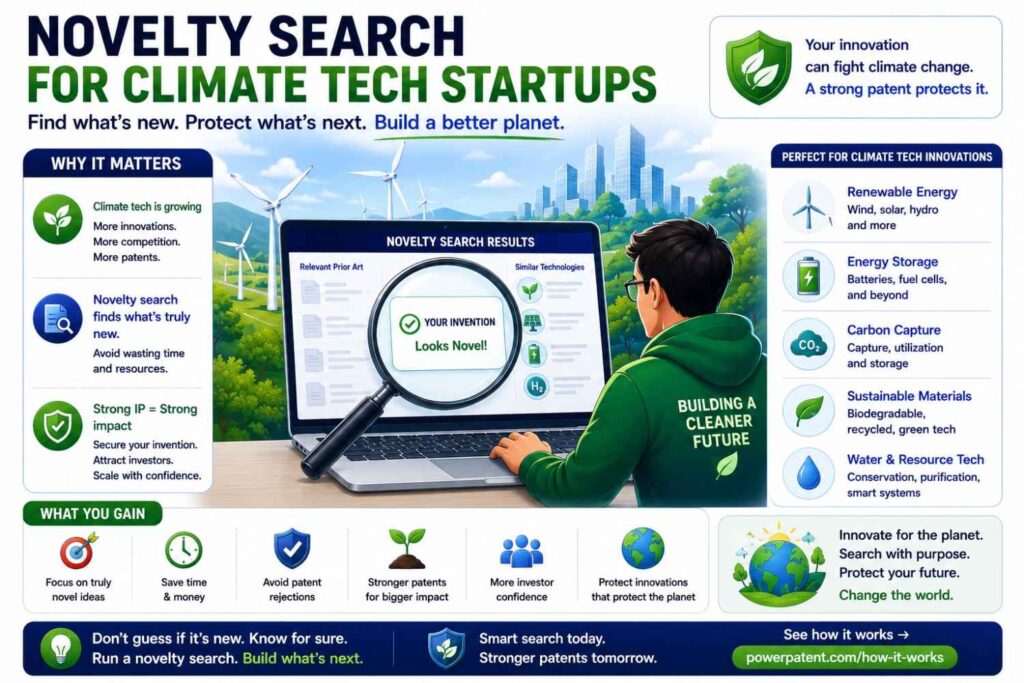
Climate tech inventions may involve energy storage, carbon capture, grid systems, materials, sensors, manufacturing, or software control.
The prior art can be dense and old. Energy and industrial fields often have decades of patents and papers.
A novelty search should focus on the specific improvement.
Is it a new material? A process condition? A control method? A sensor placement? A thermal management system? A predictive maintenance method? A manufacturing step? A grid dispatch algorithm?
Climate tech founders should provide test data and technical context where possible. If the invention improves efficiency, stability, cost, or durability, the search should look for similar approaches and the draft should explain how the improvement happens.
Because these inventions often require capital and partnerships, early patent strategy can be very important.
A strong novelty search can help founders spend patent budget on the parts that matter most.
Novelty search for biotech and medtech startups
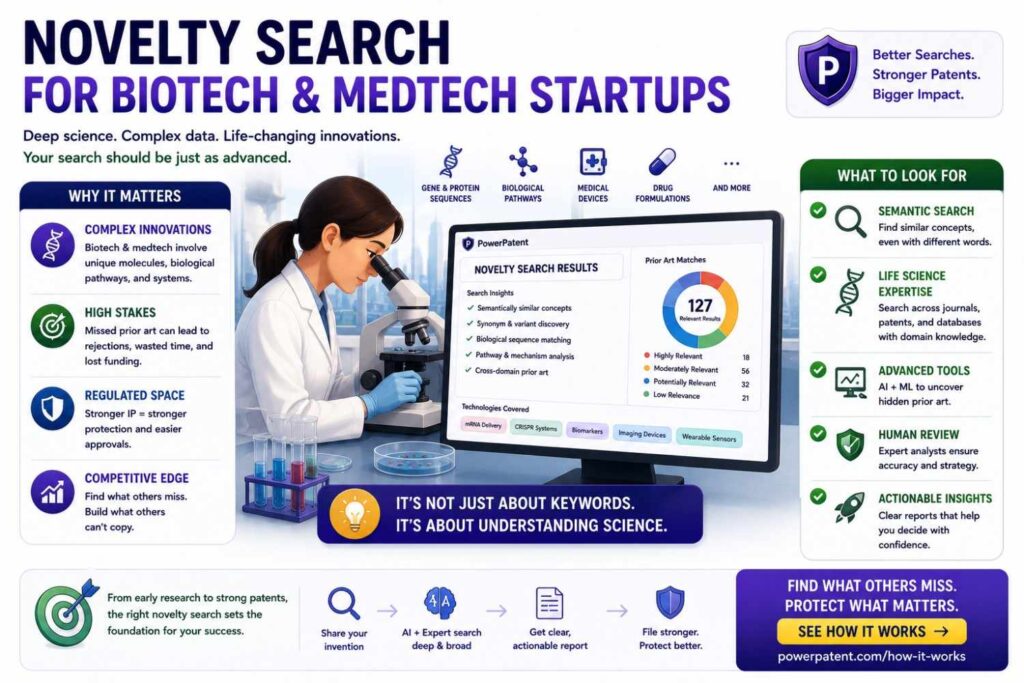
Biotech and medtech novelty searches can be complex.
The search may need patents, journal articles, clinical materials, device manuals, regulatory filings, and scientific databases. The terms may be highly technical. Small differences may matter.
A medtech invention may involve a device structure, sensor method, diagnostic workflow, image analysis system, treatment planning method, or software-controlled medical process.
A biotech invention may involve compositions, methods, assays, sequences, formulations, delivery systems, or manufacturing steps.
Founders in these fields should not rely on casual searching for major decisions. The cost of mistakes can be high.
AI can help summarize references, but expert review is essential.
The search should be tied closely to claim strategy, data support, and filing timing.
How to read a prior art reference
Founders do not need to read patents like lawyers, but they should know what to look for.
Start with the title and abstract to understand the topic. Then look at the drawings. Drawings often reveal the system faster than the text. Then read the summary and detailed description for the parts that relate to your invention.
Do not stop at the abstract. Patent abstracts can be too broad or too vague.
Also look at the claims, especially if the patent is active and you are thinking about product risk. Claims define the legal boundary. The description may show many examples, but the claims matter most for infringement and validity questions.
For novelty, the whole reference can matter, not just the claims. A published patent application may disclose something even if it was not claimed.
This is another reason legal review matters. The same reference can matter in different ways depending on the question.
How to compare your invention to prior art
A useful comparison breaks the invention into features.
For example, suppose your invention has four key parts: a sensor input, a confidence score, a model selection step, and a control action.
Now compare each prior art reference to those parts.
Does the reference show the sensor input? Does it show the confidence score? Does it show model selection based on that score? Does it show the control action? Does it show them together in the same way?
This feature-by-feature comparison is much better than asking, “Does this look similar?”
Many references will look similar at a high level. The key is whether they disclose the same combination or make your claimed invention obvious.
A simple chart can help.
But be careful. Claim analysis can get legal quickly. Use charts as a thinking tool, not as a final legal opinion unless reviewed by counsel.
Why search results can feel discouraging
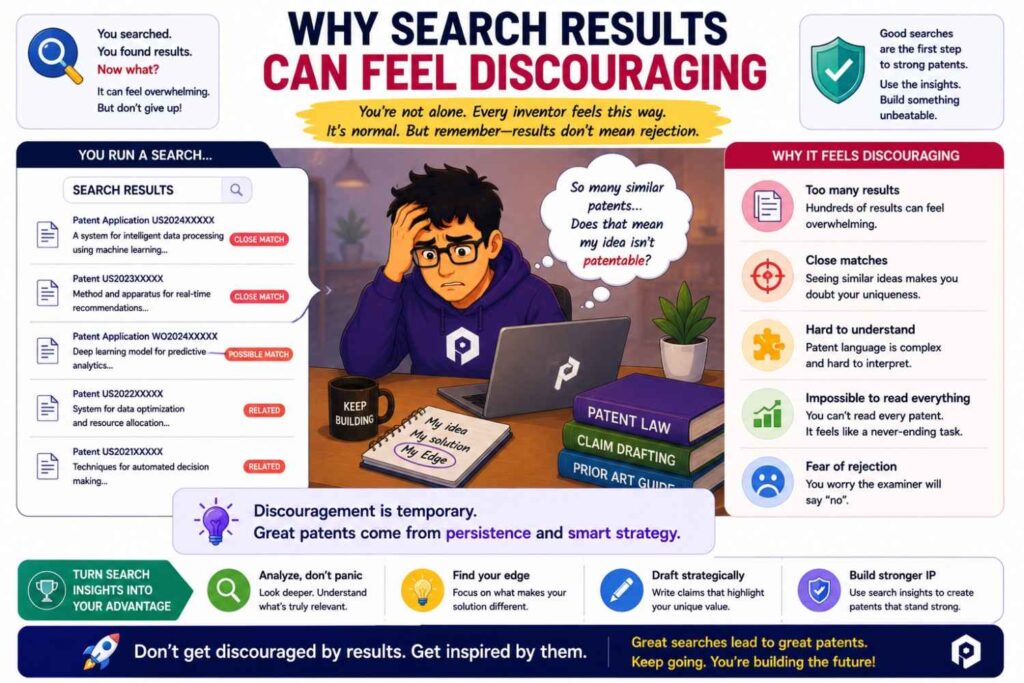
Many founders feel bad when a search finds similar work.
That reaction is normal, but it is not always warranted.
Most inventions build on older work. Finding related references does not mean your invention has no value. It means you now know the field better.
The question is what is different.
Maybe your broad idea is old, but your implementation is new. Maybe others tried the same goal but used a different method. Maybe your system solves a problem the older references did not address. Maybe your invention works in a setting where older systems failed.
A good patent team can use search results to sharpen the invention story.
In many cases, the search does not kill the patent. It improves it.
When not to do a full novelty search
A full novelty search is not always the best first move.
If a public disclosure is about to happen, filing quickly may matter more. If the invention is early and likely to change, a light screen may be enough. If the budget is very limited, the startup may choose to file a focused provisional and search more before the non-provisional.
The point is not that every invention needs the same search.
The point is that founders should make an informed choice.
A patent attorney can help decide whether to search now, file now, or do both in stages.
PowerPatent helps founders move quickly when timing is tight while still creating a better invention record for attorney review. Learn more at https://powerpatent.com/how-it-works.
When a deeper prior art search is worth it
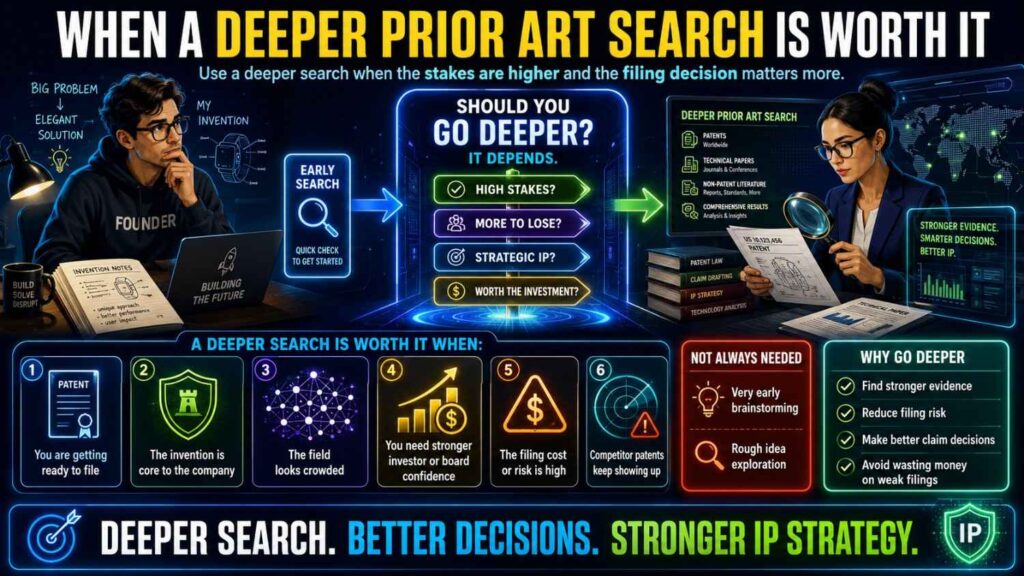
A deeper search may be worth it when the invention is core to the company.
If the patent could support fundraising, licensing, enterprise deals, or an exit, search quality matters. If the field is crowded, deeper searching may save money later. If a large competitor owns many patents nearby, search depth may reduce risk. If the startup plans to spend heavily on international filings, a deeper search before filing may be wise.
A deeper search is also worth considering before enforcing a patent. If you plan to assert a patent, you should expect the other side to search for invalidating prior art. It is better to know the risks early.
The bigger the business decision, the more search depth matters.
How novelty search affects claim scope
Claim scope is how broad or narrow the patent claims are.
A novelty search helps set realistic claim scope.
If the search finds very close references, broad claims may be hard. The attorney may need to claim a specific improvement. If the search finds only distant references, broader claims may be worth trying.
But broad claims still need support.
A patent application should describe enough variations to support the scope. If the draft only shows one narrow product version, broad claims may be weak.
Search results can help the attorney decide what variations to include. They can also help identify which features should be dependent claims.
A good claim set often has layers. Broad claims protect the main idea. Narrower claims protect important fallback versions. The search helps build those layers.
How novelty search affects patent cost
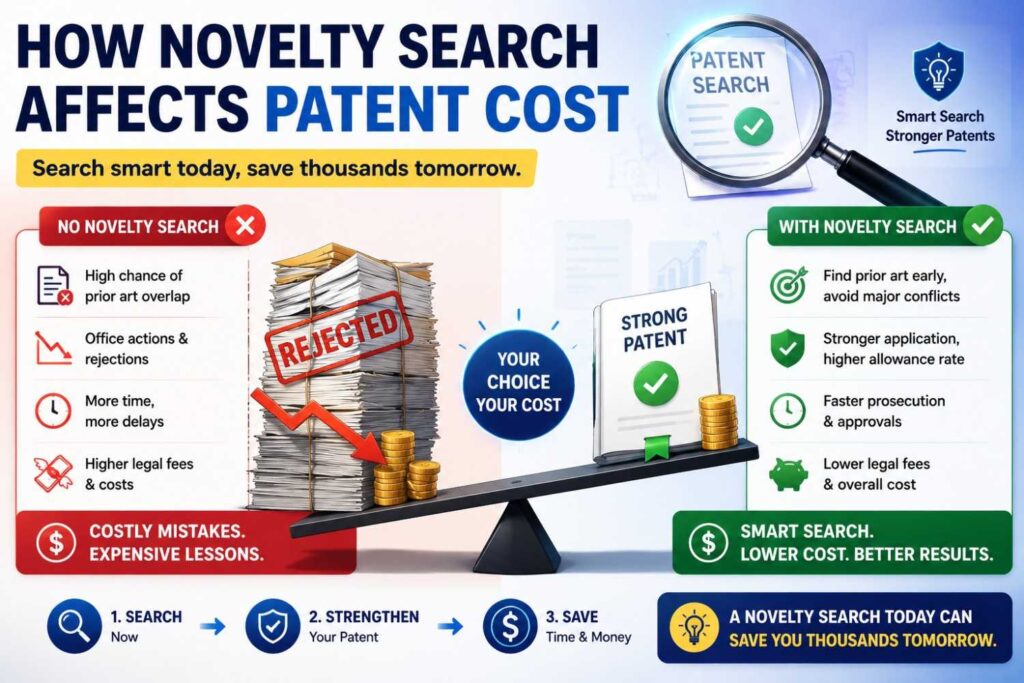
A novelty search adds cost at the start, but it can save cost later.
It may prevent filing on an invention that is not worth pursuing. It may reduce office action trouble by helping the attorney draft better claims. It may help avoid major rewrites. It may support better portfolio choices.
But the cost must fit the stage.
A seed-stage startup may need a lean search and fast filing. A later-stage startup protecting core technology may need deeper work.
The right question is not “Is search expensive?” The right question is “What risk are we reducing, and is that worth the cost?”
PowerPatent’s software-plus-attorney model is designed to make patent work more efficient for founders. It helps reduce friction while keeping quality in view. Start here: https://powerpatent.com/how-it-works.
How prior art searches help investors
Investors want to know whether a startup has a real moat.
A patent search can help answer that.
A novelty or patentability search can show whether the company’s invention looks different from known work. A portfolio review can show whether filings map to core products. A landscape search can show whether the field is crowded. A validity search can test whether key patents look strong.
Investors do not expect zero risk. They expect clear thinking.
A startup that can explain its patent strategy well looks more mature.
It can say: “We searched the closest art, focused our filing on the technical improvement, filed before public disclosure, and have a plan for future inventions.”
That is much stronger than saying, “We filed something, but we are not sure what it covers.”
How prior art searches help acquirers
In an acquisition, patents may be reviewed closely.
The buyer may ask whether the patents cover the product, whether the claims are strong, whether ownership is clean, whether public disclosures happened before filing, and whether the patents may survive validity challenges.
Prior art searches can help prepare for this.
A startup that has kept search reports, invention records, claim charts, and filing summaries may have an easier diligence process.
This does not mean every startup needs enterprise-level patent operations from day one. But it should keep clean records.
PowerPatent helps founders build a clearer patent process from the start, which can make later diligence less painful. See how it works at https://powerpatent.com/how-it-works.
The role of attorney oversight
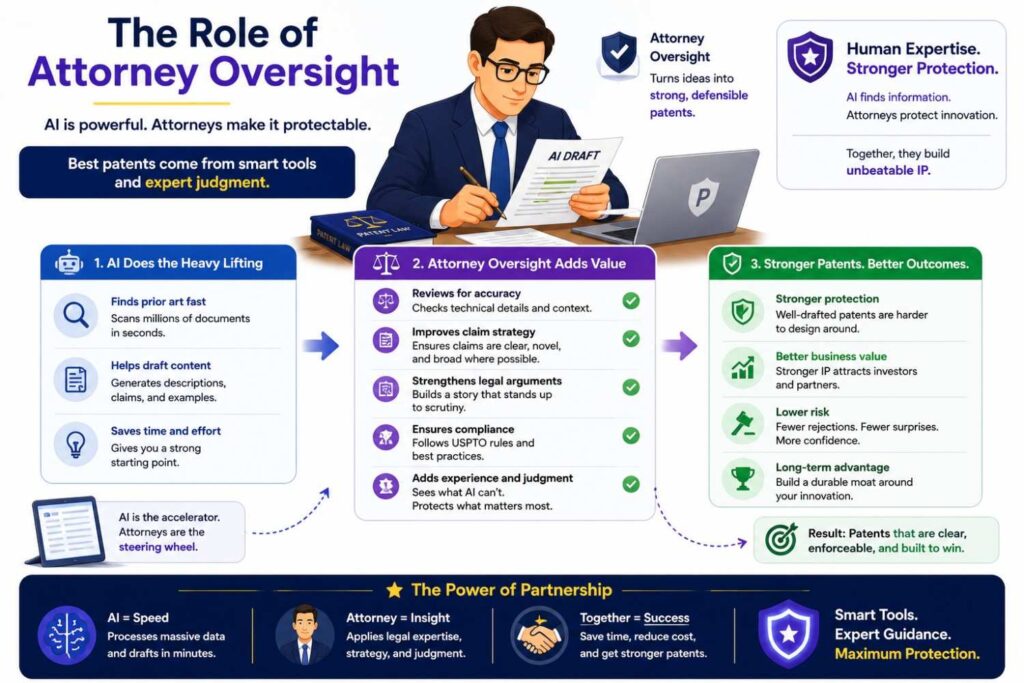
Search tools are helpful. AI is helpful. Founder knowledge is helpful.
But attorney oversight matters because patent decisions have legal and business consequences.
An attorney can help define the search target, review references, assess novelty and obviousness risk, shape claims, advise on timing, and explain options. They can also help decide when more search is needed and when it is time to file.
This is especially important because search results can be misunderstood.
A reference that looks scary may not actually disclose the claimed invention. A reference that looks harmless may contain one paragraph that causes trouble. A patent that appears expired may have family members still active. A product page may raise different issues than a patent publication.
Founders should not carry this alone.
The best model gives founders speed and clarity, while keeping experienced patent professionals in the loop.
How to avoid wasting money on the wrong search
Start with the decision.
Do not begin by saying, “I need a prior art search.”
Say what you are trying to decide.
“I need to know whether to file a patent on this invention.”
“I need to know whether our product may run into competitor patents.”
“I need to know whether this competitor patent is weak.”
“I need to know what patents exist in this market.”
“I need to respond to an examiner rejection.”
Each statement points to a different search.
This is one of the simplest ways to save money.
A good patent team will scope the search based on the decision, the technology, the budget, and the timeline.
How to use search results after filing
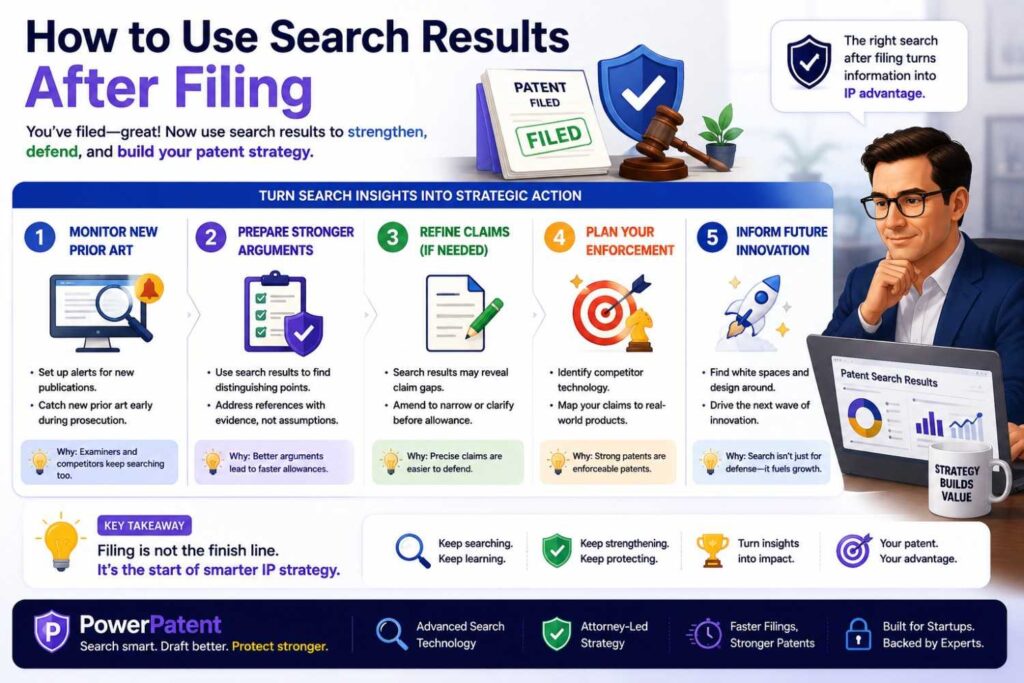
Do not put the search report in a drawer.
Use it.
The search can help guide future filings. It can help explain the invention to investors. It can help monitor competitors. It can help prepare for office actions. It can help decide whether to file continuation applications. It can help identify improvements worth protecting.
Patent strategy is not one event.
For startups, it should grow with the product.
Each new feature, model update, hardware change, or technical improvement may create new IP questions. Prior art knowledge helps the team make better choices over time.
The best search starts with better invention capture
The quality of the search depends heavily on the quality of the invention description.
If the invention is vague, the search will be vague.
If the invention is clear, the search can be targeted.
This is why PowerPatent focuses so much on helping founders capture their inventions. The platform helps turn messy technical work into a clearer record. That makes search, drafting, and attorney review more effective.
Founders do not need to write like patent lawyers. They need to explain what they built, why it matters, and how it works.
PowerPatent helps bridge that gap. Visit https://powerpatent.com/how-it-works.
Novelty search vs prior art search: the final answer
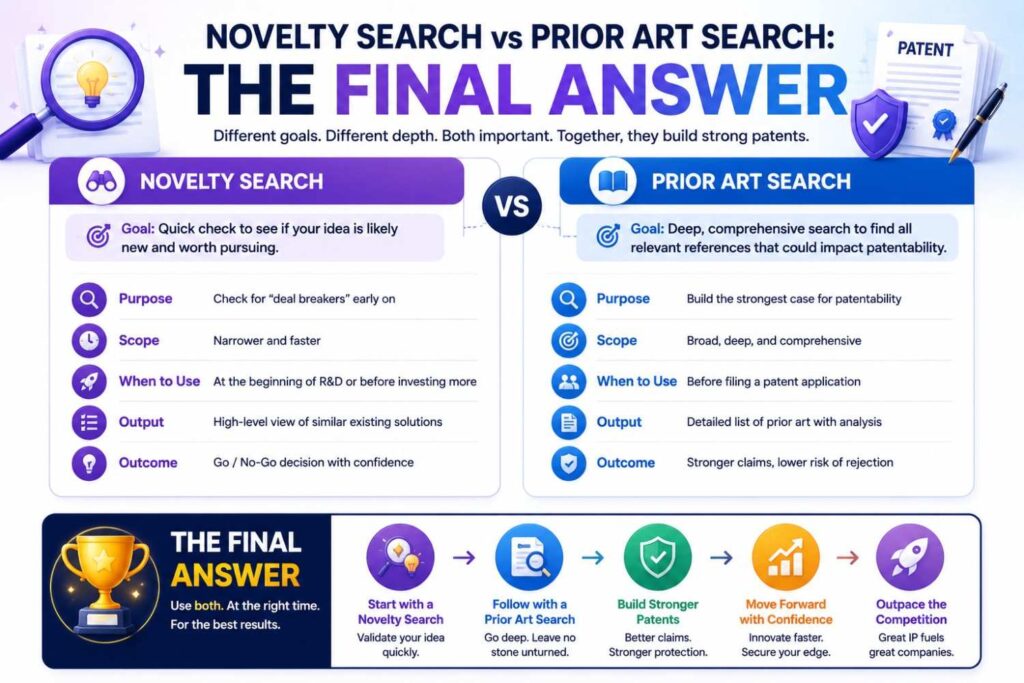
A novelty search is a focused search used to see whether an invention appears new before filing or drafting.
A prior art search is the broader category. It can be used for novelty, patentability, validity, freedom to operate, landscapes, office actions, diligence, and strategy.
The difference is the purpose.
For startups, that purpose matters. The right search can save money, improve claims, reduce risk, and create a stronger patent strategy. The wrong search can create false comfort or waste budget.
Founders should not feel overwhelmed by the terms. The main question is simple: what decision are we trying to make?
Once that is clear, the search can be scoped the right way.
Final thoughts
Novelty searches and prior art searches are closely related, but they are not always the same.
A novelty search helps answer whether your invention looks new. A prior art search can answer many broader questions about patents, products, competitors, and risk.
Both can be valuable. Both have limits. Both work best when the invention is clearly captured and reviewed by people who understand patents and the technology.
For founders, the goal is not to become a patent search expert. The goal is to protect what you are building without slowing down the company. A smart search gives you a clearer path. It can show what is worth filing, what needs more detail, and where your true edge may be. It can also help your attorney draft claims that are stronger, sharper, and better tied to your real product.
That is where PowerPatent can help.
PowerPatent combines smart software with real patent attorney oversight, so founders can move from invention to stronger patent filings with more speed, control, and confidence.
To see how your team can protect its next invention, visit https://powerpatent.com/how-it-works.
Leave a Reply