
Most founders think patent diligence is something only investors worry about. But the truth is, it’s one of the fastest ways for you to understand the real strength of your own invention. And when you know how to read that strength, you can shape your product roadmap, protect your edge, and avoid being blindsided by a competitor with a stronger position. Patent analytics is not just for lawyers. It’s a tool you can use right now to make smarter decisions as you build.
Why Patent Strength Matters More Than Most Founders Realize
Patent strength is one of the most misunderstood parts of patent analytics. Many teams assume a granted patent is automatically powerful, but strength is not about the certificate on the wall. It is about how well the claims can hold up when they are tested by competitors, questioned by investors, or reviewed during a deal. Strong patents give a business room to grow without fear. Weak patents create a false sense of safety and can break the moment real pressure hits. When you understand how strength works, you can guide your product decisions with clarity, avoid waste, and build an IP foundation that supports long-term growth.
How Real Patent Strength Shows Up in the Claims
Patents live or die by their claims. These lines define exactly what you own. When claims are clear, supported, and written with precision, they form a strong shield.
When they are vague or scattered, even small competitors can find paths around them. The key is to think of claims as boundaries that need to be tight enough to keep others out but flexible enough to match real product evolution.

If your team is planning a major feature update or entering a new market, reviewing your claim strength can show you whether your current coverage reaches far enough or if you need a continuation strategy to stay ahead.
Why Strength Shapes Investor Confidence
Investors do not just want to know that you have patents. They want to know whether those patents can actually protect your business. A strong patent signals that your foundation is solid.
It suggests you understand your market, you know how to defend your inventions, and you have done the work to stay ahead of rivals.
When investors see that your claims have survived tough examination or are built on a clear technical contribution, their confidence rises.
This often speeds up diligence, cuts friction in negotiations, and positions your team as the smarter bet in a crowded field.
How Strength Helps You Avoid Hidden Risks
Weak patents often create problems that founders do not notice until much later. A broad claim that seems appealing at first might collapse if a competitor shows earlier work you failed to consider.
A claim written without enough technical detail might be easy to challenge. When you analyze patent strength early, you reduce the risk of sudden surprises.
This gives your team more control and fewer last-minute fire drills, especially during fundraising or acquisition talks.

It also helps you decide whether certain ideas are worth filing at all, which saves budget and keeps your IP strategy focused on assets that matter.
Using Strength Analysis to Guide Product Roadmaps
When your team knows which parts of your technology are covered by strong claims, you gain a strategic advantage.
You can double down on protected areas, shift away from exposed ones, and plan new features with a clear view of where competitors might try to push in.
Patent strength becomes a practical tool rather than a legal concept. It helps product teams understand where they can innovate safely and where they may need additional filings.
It keeps engineering aligned with the long-term business plan instead of operating in the dark.
How PowerPatent Makes Strength Analysis Faster and More Accurate
Studying claim strength by hand used to take days and often required reading dense legal documents. PowerPatent changes that by turning the process into simple, clear insight.
The platform highlights key strength indicators, shows where examiners pushed back, and reveals how solid the claims are compared to the field.
Every insight is backed by real attorney review, which eliminates guesswork. Founders get a fast, reliable picture of whether a patent is sturdy enough to support deals, defend markets, or justify continued investment.
This level of clarity was once available only through long legal reviews, but now it is accessible on demand.
Actionable Ways Businesses Can Use Strength Analysis Today
One of the fastest ways to improve your patent strategy is to run a strength review on your top filings. This gives you a baseline understanding of which inventions are solid and which need attention.
From there, you can plan your next filings to reinforce weak areas, build stronger continuation paths, and close gaps before competitors find them.

You can also use strength insights to prepare cleaner messages for investors, structure better licensing conversations, and choose markets where your coverage is strongest.
When strength becomes part of your regular product and business planning, you avoid surprises and move with more certainty.
How Citations Reveal Influence, Risk, and Hidden Competitors
Citations are one of the clearest windows into how an invention shapes its field. They show which earlier ideas influenced it and which later ideas depend on it.
Many founders overlook citations because they seem like small details tucked inside the paperwork, but they hold powerful clues about market trends, competitor behavior, and long-term opportunity.
When you learn how to read citations with intention, you gain a simple way to understand where your technology sits in the larger landscape and how you should position your business moving forward.
Why Citations Act Like a Map of Influence
Every citation tells a story about how ideas move. When another company cites your patent, it means they saw something important in your work.
It suggests your invention shaped their direction, even if only in a small way. Over time, these signals build a picture of influence.
A patent that gathers citations from several strong players often hints at a deeper impact. It means your idea did not just solve a problem; it touched the foundation others now rely on.

This kind of influence strengthens your negotiating power and raises the strategic value of your IP portfolio.
How Backward Citations Help You Understand the Past
Backward citations are the references your patent lists when it is filed. They reflect the earlier inventions your work builds on or improves. When you study backward citations closely, you see the roots of your idea.
You see which fields it touches and where it fits into historical progress. For businesses, this is useful because it reveals how crowded or open a space might be.
If you are stepping into an area filled with decades of heavy activity, you know to prepare for fast-moving competitors and sharp examiners.
If the space is lighter, you gain more room to carve out strong claims. This guides everything from product timing to the tone of your pitch to investors.
How Forward Citations Signal Future Demand
Forward citations come from patents filed after yours. They tell you who is following your lead. When you notice a surge of forward citations, it often means the market is waking up to something your team already saw.
This is a strong sign that your invention sits on a growing frontier. Companies use this insight to time expansions, secure partnerships, or increase investment into specific product lines.
A rising number of forward citations can also boost your valuation because it shows that others view your technology as a foundation rather than a side note.
Using Citations to Identify Potential Competitors
Citations make it easier to spot companies moving in your direction long before they become visible in the market. If you begin seeing the same organizations appear again and again in the citation trail of your field, that is a signal to pay attention.
It tells you they are building near your territory. This early awareness gives you time to strengthen your filings, adjust your roadmap, or speed up product releases.
Competitor research often feels slow and reactive, but citation patterns make it predictive.
How Citation Networks Reveal Hidden Connections
Citations rarely exist in isolation. They form webs. When you trace a set of patents across multiple organizations and time periods, the connections reveal deeper patterns.
You may discover that a mid-stage startup is quietly influencing a large enterprise. Or that two companies you thought were unrelated are actually building on the same technical thread.

Understanding these networks helps your team avoid blind spots. It also helps in strategic conversations because you can explain not only what your patent does but how it affects the broader system.
Why Citations Matter in Deals and Negotiations
During diligence, investors often pay close attention to the citation history of key patents. A patent that has strong forward citations often appears more valuable because it shows industry influence. It makes a buyer or investor more confident that the invention has long-term relevance.
On the other hand, a patent with scattered backward citations and few forward citations might raise questions about uniqueness or staying power.
When you can walk into a room and clearly explain the meaning of your citations, you show control over your space. This reduces friction and builds trust fast.
Using Citation Insights to Shape Filing Strategy
When planning your next filings, citation review helps you target the right areas.
If your earlier patents are getting strong forward citations, you may want to file continuations to capture more variations of those ideas before others expand into them.
If your backward citations show heavy prior work in one area, you may choose to shift your innovation efforts toward cleaner ground.
These decisions keep your IP budget focused on assets with real commercial potential, not just technical ambition.
How PowerPatent Makes Citation Analysis Clear and Fast
Citations can be messy to track by hand. It takes time to compare patents, trace relationships, and interpret signals accurately. PowerPatent solves this by turning citation networks into clear visuals and simple explanations.
The platform highlights who is building on your ideas, where trends are forming, and which competitors might pose a threat. Every insight is reviewed by patent attorneys to ensure accuracy.
This means founders get clean, actionable intelligence without needing to sift through endless patent documents or guess at what the data means.
Turning Citation Knowledge into Business Momentum
Once you understand your citation patterns, you can move with greater precision. You can enter markets with confidence, adjust your messaging, decide which features to prioritize, and spot opportunities before they become obvious to the rest of the industry.
Citation awareness becomes a quiet competitive edge. It gives your business the same level of insight normally reserved for legal teams at large corporations, but in a much faster and more accessible way.

It helps your team protect what you have built while also opening doors to future inventions that extend your lead.
What Patent Family Trees Tell You About Long-Term Strategy
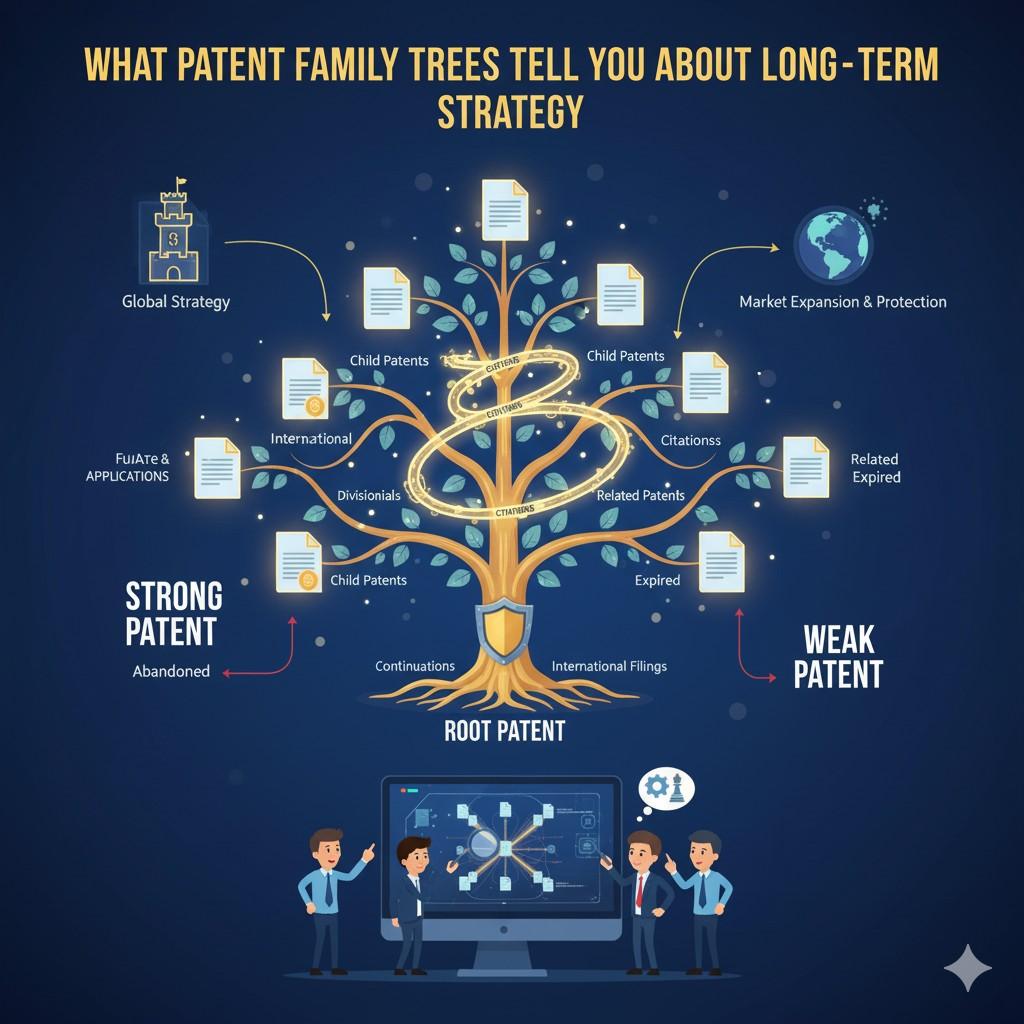
Patent family trees help you see the bigger picture behind an invention. They show how an idea grows, how many versions exist, where it has been filed around the world, and how committed the owner is to protecting it.
While a single patent can tell you what was invented, a family tree reveals how the inventor thinks. It exposes the strategy behind the filing, the markets they care about, the improvements they expect to make, and the level of investment they are putting toward keeping competitors out.
For founders, this is one of the clearest ways to understand both opportunity and risk as you scale your business.
How Family Size Reflects Business Intent
The size of a patent family often reflects how serious the owner is about their invention. When a company builds a large family tree with filings in multiple regions and several continuation applications, it signals confidence and long-term vision.
It shows they believe the invention will matter across many markets, not just one. On the other hand, a small or narrow family may point to a limited strategy or smaller commercial plans.

This does not make the invention weak, but it shows you what level of commitment the owner has made. When you evaluate competitors, this helps you see which ideas they view as core to their future and which ideas sit on the sidelines.
Why Family Trees Reveal Market Priorities
Every country added to a patent family is a deliberate choice. Filing in Europe tells one story. Filing in China tells another. Filing in a smaller region you would not expect can signal a new market direction.
When you look closely at these decisions, you learn what matters to the business behind the patent. You can see where they expect demand to grow and where they believe competition may rise.
Understanding these details can help your team make smarter decisions about your own international filings. It can also help you decide how to price your products or where to direct early sales efforts.
How Family Growth Shows Technological Momentum
A patent family that grows over time usually means the technology behind it is evolving. New versions might cover improvements, new features, or expanded use cases.
This is a sign of momentum. It means the inventor is not treating the patent as a one-time event but as part of an ongoing innovation cycle. When your own team studies these patterns, you gain insight into where the field is going.
You can see which areas are expanding quickly and which areas are maturing. This helps you place your resources where they will matter most.
It keeps your engineering and product strategy aligned with where the market is moving instead of reacting after the fact.
Why Overlapping Family Members Create Stronger Protection
A single patent can be challenged or worked around. But a web of related patents covering the same core idea from different angles is much harder to bypass.
When a company builds a dense family with multiple applications covering improvements, variations, or alternative implementations, they form a shield around the invention.
This makes it difficult for competitors to find a safe path without crossing one of the claims. For founders, this is important because it shows how serious a competitor is about creating a defensible moat.
It also helps you decide whether you should build similar density around your own high-value inventions.
How Family Trees Help with Freedom-to-Operate Insight
When evaluating freedom to operate, family trees offer clarity that individual patents cannot.
They show whether a competitor has locked down the same idea across several countries, whether they are still expanding their coverage, and whether new filings might soon appear.
This helps you time product launches, structure licensing talks, and avoid stepping into legal risk unknowingly.
Many young companies think freedom-to-operate is too complex to understand without a law firm, but family trees make it more approachable. They show patterns that even non-experts can recognize quickly with the right tools.
Why Family Trees Matter in Mergers, Acquisitions, and Partnerships
During any serious deal, companies look closely at the maturity and structure of your patent families. A well-developed family signals that your business has long-term defensibility.
It suggests you have been thoughtful in protecting your technology and that your IP will hold value across multiple stages of growth.
Buyers and investors also pay attention to how the family evolved because it reflects your ability to innovate over time.
A strong family often increases deal value and reduces friction during diligence because it gives partners confidence that the invention will continue to matter in the future.
Using Family Insights to Strengthen Your IP Strategy
Once you understand how family structures reflect strategy, you can use that knowledge to shape your own filings. If you see that your strongest inventions are protected only by a single application, you can choose to expand those into continuations or regional filings before competitors move in.
If you notice that your family tree does not match the markets where you expect to grow, you can adjust your filing plan to match your business trajectory.
Family trees also help you decide whether new ideas should branch from existing filings or start fresh. This keeps your portfolio organized and aligned with long-term goals, not short-term reactions.
How PowerPatent Helps You See Family Trees Clearly
Manually tracking a patent family can feel overwhelming because filings often appear in different regions, use slightly different titles, and arrive at different times.
PowerPatent simplifies this by showing the entire family in a unified view. You can see how it grew, where it expanded, and where gaps might exist. The platform also highlights patterns that matter to investors and helps you spot strategic signals you might miss when reading documents one by one.
Real attorney oversight ensures that the insights are accurate and actionable, which gives you confidence in your next move.
Turning Family Tree Knowledge into Market Advantage
When you combine family tree insight with your product roadmap, you unlock a powerful advantage. You can move into markets at the right time, strengthen positions that matter most, and plan innovation cycles with clearer foresight.
You gain a sense of where competitors are committing their energy and where openings may still be available. With this understanding, you lead your category instead of reacting to it.

Patent family trees become more than a legal tracking tool. They become a strategic guide that shapes your long-term business design.
Using Modern Patent Analytics to Move Faster and Protect Your Edge
Patent analytics has shifted from a slow, manual task into a real-time strategic advantage for teams that know how to use it.
Instead of spending weeks digging through dense documents or relying entirely on outside firms, founders can now understand the competitive landscape in minutes.
Modern tools make everything clearer and more practical, turning what used to feel like legal homework into actionable insight for product, engineering, and leadership.
This matters because speed is now one of the strongest advantages any company can hold.
When you can see threats early, measure the true strength of your ideas, and follow the movement of your field with confidence, you can make decisions faster and protect your edge while others are still trying to catch up.
Why Modern Analytics Helps You Cut Through Noise
Old patent research often gave teams more information than clarity. You would get pages of reports without knowing what really mattered or what to do next.
Modern analytics changes that. It reveals patterns, highlights the important signals, and filters out noise so you can stay focused on decisions that move the business forward.
Instead of wondering whether a competitor’s patent might affect you, you can see clear indicators of strength, reach, and market intent.

This saves time, removes guesswork, and gives founders a sense of control even as their markets shift quickly. When the information is easy to understand, your team becomes faster at responding and more confident in its direction.
How Real-Time Data Improves Product Planning
Product decisions become much stronger when they are backed by live insight into what is happening in your field. If a competitor expands their patent family or begins filing in new technical areas, you can adjust your roadmap before the market shifts.
If you notice that your own patents are gaining forward citations, you know the field is following your lead and you may want to invest more into that line of work.
This kind of alignment keeps product development ahead of risk and closer to opportunity. Instead of guessing, you move with purpose. Instead of reacting to surprises, you plan around them.
How Better Analytics Strengthen IP Budgets
Every company has limits on how many patents they can file, maintain, and defend. Modern analytics lets you see which ideas deserve deeper investment and which ones may not need as much attention.
When you understand citation activity, competitive movement, and family tree expansion, you can direct budget to the assets that matter.
You avoid spending on filings that add little strategic value and concentrate on building strong, defensible coverage around your core technology.
This not only protects your edge but also ensures that your IP spending actually supports the business rather than draining resources without clear return.
Why Faster Insight Matters in Fundraising and Deals
In any high-stakes conversation, whether you are raising a round or exploring a partnership, speed and clarity help you stand out. When investors ask about your IP, you can answer cleanly and with confidence because you have up-to-date analytics at your fingertips.
You can explain why your strongest patents matter, how your claims hold up, where your competitors are moving, and how your family trees reflect long-term commitment.

This kind of clarity builds immediate trust. It shows that you have done the work, that you understand your moat, and that your business is not depending on hope.
In a competitive fundraising environment, this alone can shift an entire negotiation in your favor.
How Analytics Help You Spot Market Gaps
Modern analytics platforms make it easier to spot areas where no one is filing yet.
When you see open spaces in a citation network or a lack of family expansion in areas that matter, it may signal an opportunity to file early and secure new territory.
These gaps often go unnoticed by teams relying on manual research because the landscape is too large to analyze by hand. But when a platform highlights them for you, they become strategic entry points.
Filling these gaps early can protect future product directions and create leverage that others cannot easily copy.
How Analytics Support Freedom-to-Operate Decisions
Freedom to operate determines whether you can safely bring a product to market. Without clear analytics, many founders discover risks too late, often after investing heavily in development.
Real-time patent analytics helps you catch potential obstacles early by showing where others have filed, how strong those filings are, and whether their claim boundaries intersect with your roadmap.
Instead of waiting for a legal review at the end of development, you can run quick checks at each stage. This keeps your team moving forward without fear of hidden legal challenges waiting down the line.
How PowerPatent Brings Speed and Clarity Together
PowerPatent blends advanced analytics with real attorney oversight, so founders get both speed and accuracy. The platform makes strength, citation, and family insights simple to understand and even easier to act on.
Instead of wading through complex legal language, you get clean explanations, visual cues, and strategic takeaways. This helps you make decisions faster, protect your competitive position earlier, and move into deals with more confidence.
It also means you do not have to wait weeks for guidance or depend solely on high-cost firms for every small question.
The combination of software and expert review gives you the best of both worlds: the speed of automation and the certainty of legal insight.
Turning Analytics Into a Competitive Practice
Once you start using patent analytics regularly, it becomes more than a tool. It becomes a practice that strengthens your entire company. You begin to see how technical decisions tie into long-term strategy.
You understand how competitors think and where they are moving. You notice patterns that help you build products with more staying power.
This practice sharpens your instincts and helps the entire team build with awareness instead of assumption.

Over time, it becomes one of the reasons your business stays ahead even in crowded markets. Patent analytics stops being something you check only during fundraising and becomes something you use to design the future of your company.
Wrapping It Up
Every founder wants clarity. Every team wants to move fast without stepping into danger. And every growing company wants to build something that lasts. Patent analytics gives you the tools to do all three. When you understand patent strength, you know whether your ideas can stand firm when challenged. When you study citations, you see how your work fits into the shifting landscape of innovation and who is moving in your direction. When you follow patent family trees, you uncover strategy, commitment, and long-term intent. Each angle gives you a different view, but together they form a complete picture you can use to make better decisions every day.
Leave a Reply