
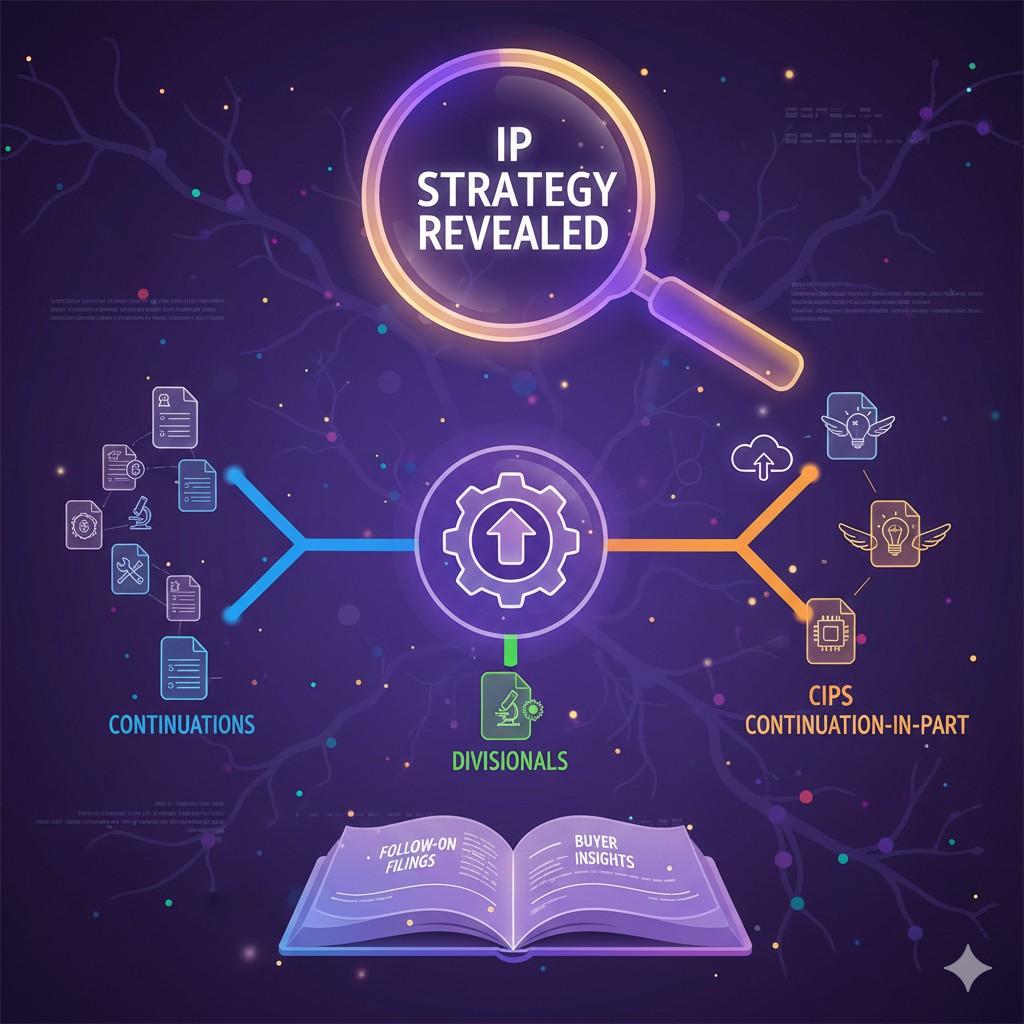
When a company files a patent, the story isn’t always finished. Sometimes the most important signals hide in what comes next—continuations, divisionals, and CIPs. Buyers, investors, and partners often miss these clues, but they matter. They show whether a founder is still building, still protecting, and still betting on the long-term value of the invention. They also show where risk sits, where opportunity lives, and how seriously the team protects its edge.
Why Follow-On Filings Reveal a Startup’s Real IP Strategy
Before you look at a startup’s tech, team, or traction, it helps to look at something quieter but far more honest. Follow-on filings often reveal how the founders think about the long game.
They expose where the invention is heading and how much confidence the team has in its future value. A single patent can be a strong start, but the real signal comes from what happens after that first filing.
When a founder continues adding protection, updating claims, or carving out new branches of the invention, it shows commitment, momentum, and strategic intent.
This section explains how buyers can read these moves with clarity and turn them into better decisions.
Why follow-on filings show the builder’s mindset
Many startups talk about having defensible IP, but their follow-on filings show whether they actually mean it.
When a founder uses continuations, divisionals, or CIPs, they are not just keeping a case open. They are shaping a fence around the technology as it grows.
They are protecting optionality, allowing the invention to stretch into new features, new use cases, or new technical angles without losing the original priority date. For a buyer, this mindset matters.

A founder who treats patents as living assets often builds stronger technology and thinks more carefully about market positioning.
How follow-on filings expose long-term planning
A startup that files only once might have strong tech but weak planning. A startup that keeps expanding its filings almost always understands that innovation keeps moving and competitors react quickly.
Continuations show the founder expects the field to expand and wants room to evolve the claims later. Divisionals often appear when the invention has multiple layers, and the founder chooses to protect each piece with its own patent family.
CIPs come into play when the team is actively improving the technology and wants to pull new ideas into the original family to preserve continuity. These are not random actions.
They are signals of a founder who is thinking beyond the next quarter.
Why buyers should treat follow-on filings as a growth chart
Buyers often use financial statements, product metrics, and hiring patterns to gauge growth. But follow-on filings are another form of growth chart. They show how the invention itself is growing.
When you see a continuation appear right after the parent case is allowed, you learn that the team has more ideas ready but prefers to protect them in stages.
When you see a divisional unfold years later, you know the original concept had enough depth to support multiple independent inventions. When a CIP appears, you see that the team is actively advancing the technology.
These patterns help you understand the health of the innovation, not just the health of the business.
How follow-on filings show whether a moat is widening
A startup does not widen its moat by accident. It does it by filing smart patent work that locks down the edges of the idea. When you see a chain of continuations, it usually means the founder is tightening the moat along the path of future product lines.
When you see divisionals, it shows that the moat is being widened sideways into sub-technologies the founder believes are worth owning.
And when you see CIPs, the moat grows in a forward direction, toward improvements that may soon hit the market. For a buyer, this tells you whether the founder is building a narrow fence or a full shield.
Why the timing of these filings matters as much as the filings themselves
Founders who file at the right moments show discipline and situational awareness. When they file continuations before allowance, they keep their options alive to adapt the claim scope.
When they file divisionals to separate inventions cleanly, they avoid restrictions that could weaken the overall portfolio.
When they file CIPs soon after breakthroughs, they preserve early priority while capturing new value. Each timing choice reveals how the founder views risk and opportunity.
Buyers often overlook these signals, but they are some of the clearest indicators of strategic maturity.
How follow-on filings reveal resource allocation
A company that commits to follow-on filings is putting real money behind its belief in the technology. Each filing, even with modern tools that lower cost, still requires focus and energy.
When a founder chooses to invest in continuations, divisionals, or CIPs, they are saying they believe the invention will pay off.

They are saying the runway is long enough and the upside is high enough. They are saying the technology is still alive and actively shaping the company’s future. For buyers, this financial commitment is as important as the technical one.
Why follow-on filings reveal competitive awareness
Sometimes a founder files a continuation because they know a competitor is getting close. Sometimes they file a divisional because they want to wall off a part of the invention before anyone else gets near it.
Sometimes they file a CIP because they see the market shifting and want their IP to match the new direction. These choices reveal how the founder reads the competitive landscape.
When you see follow-on filings tied closely to changes in the industry, it tells you the team is not only building. They are watching.
How the depth of claim strategy shows sophistication
The structure of the filings themselves can tell you how experienced the team is. When you see continuations with claims that broaden and narrow in thoughtful ways, it shows strategic layering.
When you see divisionals that isolate core functionality from optional features, it shows careful planning.
When you see CIPs that cleanly introduce new matter while preserving original claims, it shows strong coordination between engineering and IP counsel.
Buyers should pay attention to these patterns because they reveal the level of care going into the portfolio.
Why follow-on filings help buyers measure future revenue potential
Every new filing increases the set of rights the company may enforce or license later. Continuations can produce patents with broader reach, opening doors to licensing deals.
Divisionals can cover multiple revenue streams within the same technical space. CIPs can protect new features that may later become the company’s best-selling offering.
When buyers analyze these filings, they can estimate not just what the company protects today, but what it might earn tomorrow.
How follow-on filings reveal whether the founder is building a platform or a product
A single patent often points to a single product. A series of continuations, divisionals, and CIPs often points to a platform. Buyers need to understand the difference.
When the filings show that the invention can support many features, integrations, or verticals, it usually means the founder is building something that can scale across markets.
Follow-on filings make this clear, often more clearly than a pitch deck.
How founders use follow-on filings to control the pace of disclosure
A founder who is careful with follow-on filings can release information in stages. This lets them reveal just enough to secure rights without exposing their full roadmap.
When buyers see this pattern, it shows that the founder understands how to balance transparency with protection. It also shows that the company’s future development is likely more advanced than the original filing suggests.
Why buyers should focus on consistency in filing behavior
When filings appear randomly, with large gaps and no clear purpose, the team may be improvising.
When filings follow a steady pattern tied to product releases or research cycles, the founder is likely using patents as an intentional part of the business.
Consistency is a sign of discipline. Buyers should pay close attention to it because disciplined IP teams often build stronger long-term value.
How to use these filings to gauge leadership quality
Founders who handle follow-on filings well tend to make better long-term decisions in other areas too. They plan ahead. They allocate resources wisely. They understand markets.
They protect what matters. When a buyer sees thoughtful patterns in continuation or divisional filings, it often reflects the same thoughtful patterns in how the company runs.
This becomes an invisible but powerful signal of leadership quality.
How buyers can use these insights during diligence
When reviewing a portfolio, buyers can ask simple but revealing questions. They can ask why a continuation was filed at that moment. They can ask what led to splitting a case into a divisional.
They can ask what new information or breakthrough drove the company to file a CIP. The answers show how the company thinks, not just what it owns. These conversations often reveal more than any data room spreadsheet.
Where tools like PowerPatent help buyers see the story more clearly
IP can feel messy, but modern tools make the picture clear. PowerPatent gives founders a simple way to keep their filings organized, updated, and aligned with their roadmap.
For buyers, this means the company’s patent story is easier to read and trust.

If you ever want to see how this works behind the scenes, you can explore it at https://powerpatent.com/how-it-works. Strong tools create strong signals, and strong signals help buyers make better decisions with confidence.
How Continuations, Divisionals, and CIPs Shape Competitive Advantage
Every growing company faces the same challenge. Technology moves fast, markets shift, and competitors chase the same opportunities. A single patent can block one door, but a series of well-timed follow-on filings can shape the whole battlefield.
Continuations, divisionals, and CIPs are not just filing types. They are levers that help a founder stay ahead while guiding how the market evolves around them.
This section explains how each type quietly shapes competitive advantage in ways that buyers, investors, and acquirers should understand deeply.
How continuations help founders shape the future landscape
Continuations let a founder adapt their claims as the world changes. The original invention stays the same, but the claims can evolve to match new product features, new customer needs, or emerging threats from competitors.
This ability to adjust gives the company a living tool for staying ahead. When a market starts moving in an unexpected direction, the continuation acts like a steering wheel, letting the founder guide the protection toward the new path.

Buyers should see this as a sign that the company is not locked into yesterday’s idea but ready to shape tomorrow’s market.
Why continuations create quiet pressure on competitors
A competitor looking at a company with active continuations cannot easily predict the final shape of the claims. This uncertainty creates a chilling effect.
If the competitor builds too close to the protected concept, a future patent could sweep them in. If they move too far away, they may lose the chance to compete.
This pressure gives the patent holder a stronger position without saying a word. For buyers, this quiet power is extremely valuable because it limits how freely others can move in the same technical space.
How continuations help founders protect long product roadmaps
Many companies plan features years before they launch. With continuations, the founder can file claims that match the roadmap over time without giving away the full plan on day one.
This staggered approach lets them protect only what is ready while keeping future claims flexible.
Buyers should value this because it means the IP portfolio grows in step with the business and never locks the company into a single version of the invention.
How divisionals carve out entire new branches of protection
A divisional lets a founder split an invention into multiple independent pieces. Each piece gets its own patent path, creating extra layers of protection.
This is powerful when the invention covers multiple technical ideas or when different features may one day stand as separate products.
Buyers should see divisionals as a sign that the company’s technology has depth and that the founder is working to secure every important angle before others can.
How divisionals help founders own adjacent markets
When a divisional emerges, it often means the original invention touched more than one market.
A founder may create a divisional because one part of the invention fits the core business, while another part fits a future expansion.
This allows the company to expand without giving competitors room to grow in those adjacent areas.

Buyers should recognize this as a sign that the company understands the full commercial potential of its invention, not just the first place it lands.
Why divisionals can strengthen negotiating power
When multiple patents come from the same original filing, they can be used together in negotiations.
A company with a strong divisional portfolio can negotiate licensing deals with more leverage because each patent covers a different part of the solution.
This makes it harder for a competitor to design around the technology. Buyers benefit because a portfolio with many strong divisionals often supports better licensing revenue and higher defensive value.
How CIPs pull new breakthroughs into the existing story
A CIP allows a founder to add new material to the existing patent family. This is incredibly useful when the team continues to innovate after the original filing.
Instead of starting fresh, the founder extends the existing family so the improvements stay connected to the earlier work. Buyers should note that CIPs show momentum.
They reveal that the company is not done inventing but actively building on its early breakthroughs.
Why CIPs often signal the next phase of the product
When a CIP appears, it often means the team has made a major leap forward. That leap may involve performance, architecture, manufacturability, user experience, or efficiency.
And because the CIP ties the new idea to the original invention, it shows that the company is strengthening its core advantage.
Buyers should pay close attention to this moment because it often lines up with the next major step in the product roadmap.
How CIPs protect the company’s learning curve
Startups grow by learning quickly. They experiment, test, fail, and refine. Most of this learning happens after the first patent filing. A CIP captures that learning as new intellectual property.
Instead of letting improved ideas float unprotected, the founder locks them into the family. This protects the company from copycats who might exploit those refinements.
Buyers should understand that a strong CIP portfolio protects not only the invention but also the discovery journey behind it.
Why buyers should value the interplay of these filings
When a company uses continuations, divisionals, and CIPs together, they build a dynamic system of protection. Continuations control future claim scope.
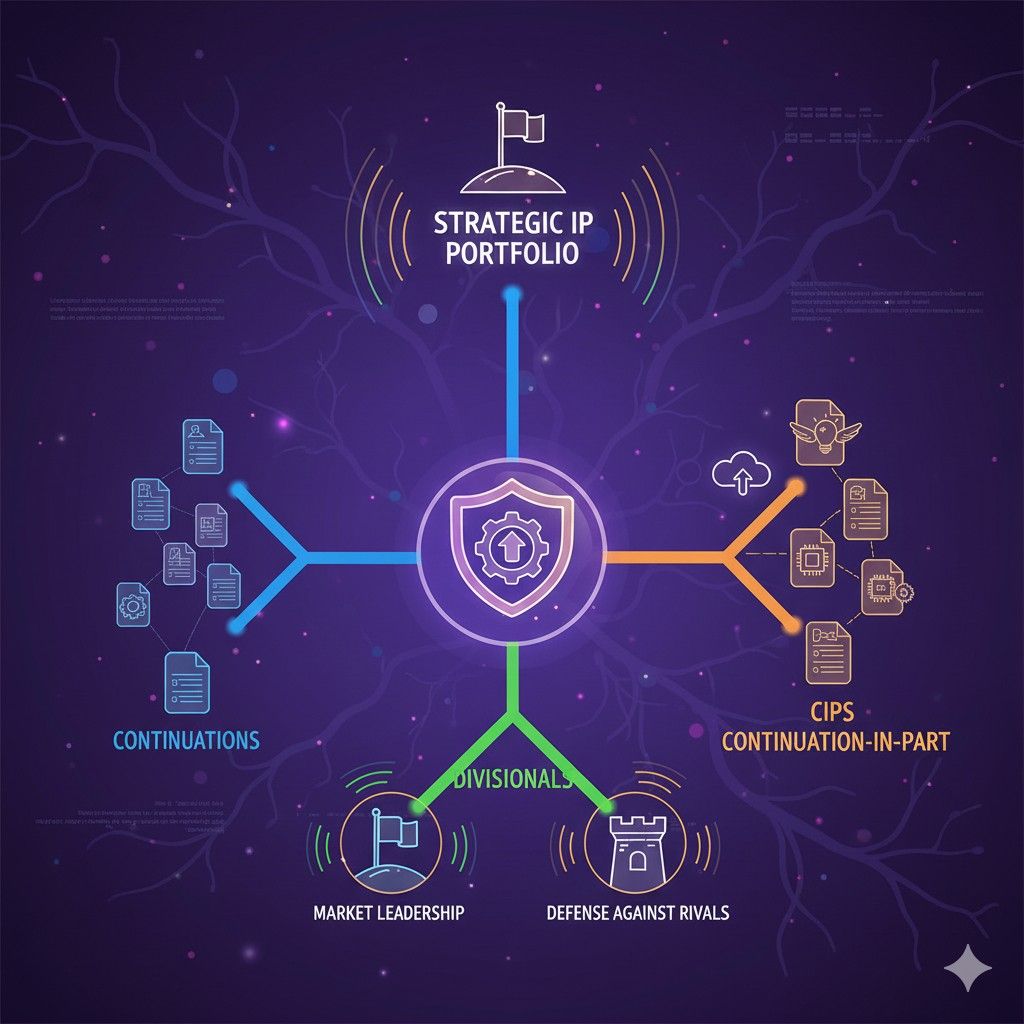
Divisionals cover multiple technical branches. CIPs protect improvements as they happen. This interplay creates a complex shield that is far harder for competitors to navigate than any single patent could achieve.
Buyers should look for this pattern because it shows the company treats patents as a strategic engine, not as a formality.
How this filing strategy shapes how the market grows
A company that leverages all three filings can influence how entire markets take shape.
By protecting core pathways and improvements, they can direct where competitors are allowed to innovate and where they are forced to avoid.
This has real impact on adoption curves, product standards, and competitive positioning.
Buyers who understand this dynamic can better predict which companies will lead their market and which ones will always trail behind.
How founders use these filings to stay ahead without slowing down
One common fear among founders is that patent work will slow them down. But when a company uses a smooth system for follow-on filings, they can move fast while still building strong protection.
They file early, keep continuation paths open, add divisionals when needed, and use CIPs to fold in new ideas. This keeps the protection aligned with the pace of innovation.
Tools like PowerPatent make this even easier by letting founders handle complex filing timelines without losing focus on building. If you want to see how this works, you can explore it at https://powerpatent.com/how-it-works.
Why these filings give buyers confidence in long-term defensibility
When buyers see that a startup uses follow-on filings with intention, it reduces fear around copycats, big incumbents, and fast followers. It shows the technology can be defended for many years.
It shows the claims can adapt. It shows the protection can grow. This gives buyers confidence that the company’s competitive advantage is not temporary but durable. And durable advantages create long-lasting value.
How these filings help founders control their narrative in the market
A founder who manages continuations, divisionals, and CIPs well can shape how the industry views them. They can show that their invention is deep, evolving, and far-reaching. They can show that competitors are boxed into narrow paths.
They can show that the company is constantly improving. Buyers should understand that this narrative power matters. Markets often follow the perception of strength, and these filings help create that perception.
Why buyers should treat these filings as a signal of maturity
A young company might file one patent. A mature startup files one and then builds a full strategy around it. Continuations, divisionals, and CIPs are signs of that maturity.

They show that the founder understands risk, opportunity, timing, and the long-term arc of innovation. And when a buyer sees this, it becomes easier to trust that the company will keep growing without losing its edge.
What Buyers Can Learn from a Founder’s Filing Patterns
Before looking at revenue, contracts, or product demos, buyers can learn a surprising amount simply by studying how a founder handles continuations, divisionals, and CIPs.
These patterns paint a clear picture of discipline, ambition, and strategic thinking. They reveal whether the founder is building a quick product or a long-term platform.
They show whether the company is defensive or aggressive. They even show how the team reacts to pressure, opportunity, and discovery. This section breaks down how buyers can translate filing behavior into real insights about the company they are evaluating.
How filing patterns reveal the founder’s true priorities
A founder’s priorities become clear when you track how they maintain their IP after the first patent is filed. When filings appear in a smooth rhythm, the founder is prioritizing long-term protection.
When filings cluster around product milestones, the founder is tying IP directly to commercial strategy. And when filings focus heavily on continuations or CIPs, the founder is prioritizing flexibility and improvement.

Buyers can read these signals to understand what the founder values most and how closely aligned the IP strategy is with the company’s actual goals.
Why steady filing behavior often signals operational discipline
Founders who treat follow-on filings as part of their business routine tend to manage other parts of the company with similar discipline.
They track details, manage timelines, make informed decisions, and stay ahead of problems.
Filing patterns are a good early indicator of how the team might handle manufacturing, scaling, partnerships, regulatory work, or technical debt. Buyers should take note because disciplined founders usually build more resilient companies.
How irregular filing patterns may signal risk
When filings appear in erratic bursts, it often suggests that the founder is reacting rather than planning. The gaps may show resource strain or uncertainty.
The late filings may reflect rushed attempts to catch up. The missing filings may hint at blind spots in the company’s approach to protecting its inventions.
Buyers should examine these irregularities closely because they can signal deeper structural issues that do not show up on financial statements.
Why the tone of the filings shows how the founder thinks about competition
Some founders file aggressively, using broad continuations and carefully carved divisionals. Others file defensively, focusing on narrow claims and basic coverage.
Both strategies can work, but buyers should look at the intent behind them. Aggressive patterns may signal a founder who intends to lead the category.
Defensive patterns may show a founder who wants to secure enough rights to survive while building the product. Understanding this tone helps buyers predict how the company will perform in a crowded or fast-moving market.
How filing patterns help identify hidden technical depth
Sometimes a company looks simple on the surface but is far deeper underneath.
When a founder files multiple divisionals that cover different layers of the system, it shows the invention has more complexity than a pitch deck might suggest.
When they file a CIP with detailed improvements, it shows active research that might be years ahead of competitors.

Buyers who read these filings carefully often discover that the technology has far greater value than publicly stated.
Why buyers should look for alignment between filings and product evolution
A healthy IP strategy follows the product’s journey. When a feature evolves, a continuation appears. When the company enters a new market, a divisional arrives.
When performance improves, a CIP updates the family. This alignment shows that the founder is not filing for the sake of filing.
They are filing because each step of the business demands a new layer of protection. Buyers can use this alignment to judge whether the IP portfolio truly supports the commercial vision.
How filing depth helps buyers estimate the cost of competition
When a company has a shallow portfolio, a competitor can often design around it with only moderate effort. When a portfolio includes many continuations, divisionals, and CIPs, the cost of competing rises significantly.
Competitors must hire more lawyers, run more risk analyses, and spend more on redesigns. This raises their barrier to entry and gives the startup extra protection.
Buyers should see this as an advantage because it increases the value of the acquisition and strengthens the company’s long-term position.
How filing patterns reveal the founder’s level of market awareness
Founders who file at key industry moments show they understand timing. When a breakthrough occurs in the field and the founder quickly files a CIP, they are responding to the shift.
When a competitor launches a new feature and the founder files a continuation, they are positioning strategically. These moves reveal how closely the founder monitors the landscape.
Buyers benefit from this awareness because it indicates a leadership team that can adapt and pivot intelligently.
Why buyers should pay attention to abandoned or incomplete filings
Every abandoned or incomplete filing tells a story. It may show that the founder changed direction. It may show that a feature was cut from the roadmap.
It may show a lack of resources at the time. Or it may simply reflect a strategic decision to narrow the focus.
Buyers should review these filings to understand why they were dropped. Often the reasons reveal more about the company’s evolution than the filings that remained active.
How filing patterns expose the founder’s ability to think in systems
Patents work best when they fit into a system, and founders who understand this tend to build portfolios that grow coherently. Continuations fill future gaps. Divisionals cover adjacent use cases.
CIPs strengthen improvements. Everything works together. Buyers can see this system thinking by examining how each filing connects to the next.
When the filings tell a clear, logical story, it often mirrors the clarity with which the founder builds the company itself.
How buyers can predict future innovation using filing behavior
One of the strongest signals in all of IP is momentum. When filings continue year after year, the founder is still inventing.
When filings slow down, innovation may be slowing too. Buyers should map the timing of filings against the company’s history and roadmap.
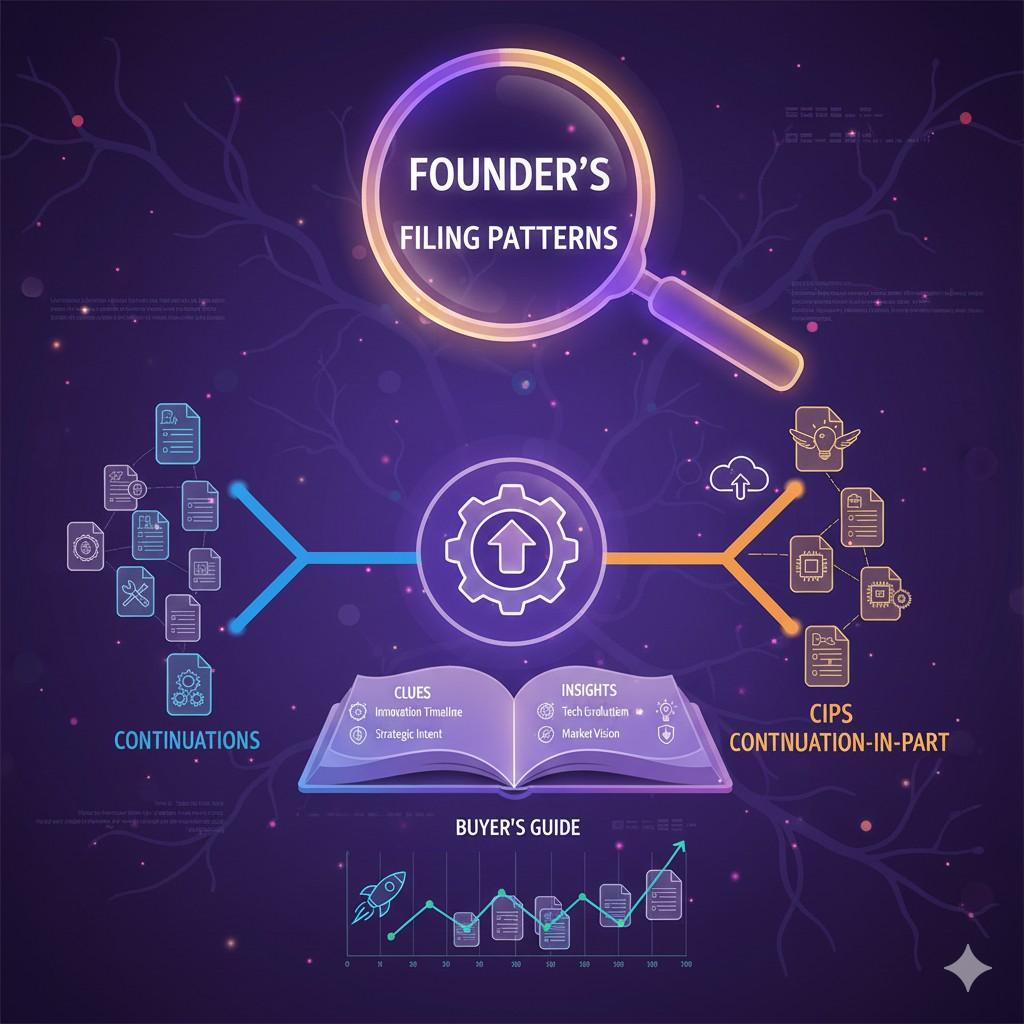
This reveals whether the company is accelerating, stabilizing, or losing steam. It is one of the simplest ways to predict where the technology is headed next.
Why filing patterns show how reliant the company is on the original invention
A company that uses many CIPs may be evolving a single powerful idea. A company that uses many divisionals may be branching into multiple directions.
A company that uses many continuations may be refining one core platform while testing new angles.
Buyers should understand this because it shows how much value comes from the original concept versus how much comes from ongoing innovation. This helps predict durability and strategic fit after acquisition.
How filing behavior helps buyers estimate future portfolio strength
A company with active continuation chains is likely to keep gaining new patents over the next few years. A company with strong divisionals is likely to own multiple layers of protection across different market segments.
A company with frequent CIPs is likely to build a portfolio that stays ahead of technical improvements. Buyers can use this to estimate the long-term strength of the portfolio and factor that into valuation models.
How founders use filing patterns to create signals for potential buyers
Sometimes founders file in ways designed to attract acquirers. A long chain of continuations signals active innovation. A strong set of divisionals signals a broad platform with multiple commercial paths.
A series of CIPs signals rapid technical progress that could pair well with a larger company’s resources.
Buyers who understand these signals gain an advantage during diligence because they can decode the founder’s long-term intentions.
Why tools like PowerPatent help buyers trust the filings they see
When a startup uses PowerPatent, the filings tend to be cleaner, better organized, and more aligned with the product roadmap. This gives buyers confidence that the company’s IP strategy is intentional, not improvised.
It shows that the founder has access to both smart software and real attorney oversight, which reduces the risk of errors and strengthens the future value of the portfolio.

If you want to understand how this works in practice, you can explore it anytime at https://powerpatent.com/how-it-works.
Wrapping It Up
Every buyer wants clarity. They want to understand what they are acquiring, how strong it is, how long it will last, and how well it can hold its ground in a competitive world. Continuations, divisionals, and CIPs create that clarity. They give buyers a direct look into how a founder thinks, plans, defends, and innovates. They show whether the invention is static or alive, narrow or wide, fragile or expandable. And they reveal whether the company is building a single product or an entire platform that can shape an industry for years.
Leave a Reply