
That sounds simple. It is not. Every time a user types a query, clicks a result, scrolls a feed, opens a marketplace, or asks an AI tool a question, there is a system behind the scenes making choices. It is sorting, scoring, filtering, comparing, and re-ordering. That system is often where the real value lives. Not just in the interface. Not just in the data. In the logic.
What Makes a Search or Ranking System Patentable
Search and ranking systems often look ordinary from the outside. A user types something in, and the system returns results in an order that seems useful.
But inside that simple experience, there may be a very real technical invention.
For a business, that distinction matters. If your team has built a search or ranking engine that solves a hard problem in a new way, that work may be worth protecting.
The hard part is knowing what counts as the invention and how to describe it in a way that shows real technical value instead of a vague business idea.
It is not enough to say the system gives better results
A lot of companies describe their search product in outcome terms. They say the system is more relevant, more personalized, faster, or more accurate.
Those benefits matter, but they are not the invention by themselves. Patentability usually comes from the way the system gets there. That means the real focus has to be on the mechanics under the hood.
If your team only talks about the result, you leave the most important part unprotected. A stronger approach is to ask what the engine is actually doing that a standard search stack does not do.
Maybe it combines intent signals from live session behavior with a historical relevance model. Maybe it changes ranking weights based on time decay and inventory volatility.

Maybe it uses a two-stage flow that reduces compute load while preserving quality. Those kinds of technical choices are where patent value often lives.
Patentable value often hides in the system design
Many founders miss patentable material because they are too close to the product. The ranking flow feels obvious to them because they built it step by step.
But what feels obvious after months of engineering is often far from obvious to the rest of the market.
A good internal exercise is to map the full search journey from input to final result ordering. Look at query intake, feature extraction, candidate generation, scoring, filtering, re-ranking, feedback loops, and result presentation.
Then ask where your system behaves differently from a standard setup. That difference may be the patent story.
A business method is weak on its own, but a technical implementation can be strong
This is where many businesses get confused. They describe the invention as a rule like “show the most useful results first” or “rank products based on buyer likelihood.”
That sounds like a business goal, not a technical invention. On its own, that kind of statement is usually too loose to carry real protection.
The stronger path is to explain how the system technically implements that outcome. Instead of claiming the goal, you describe the architecture and process that make the goal possible.

That can include how signals are collected, how they are normalized, how scores are blended, how thresholds are applied, and how feedback updates the next round of results.
The more concrete the technical flow, the more real the invention becomes.
The invention may be in how your system handles trade-offs
Search and ranking systems rarely optimize for one thing. They balance relevance, speed, freshness, fairness, trust, monetization, personalization, and compute cost.
A patentable invention often appears when your team finds a new way to handle one of these trade-offs without breaking the others.
That is important for business leaders because many of the most valuable product wins come from exactly this kind of balancing act.
A ranking system that keeps latency low while improving result quality can be a major commercial edge.
A search flow that filters noisy data before heavy model scoring can reduce infrastructure cost and improve user trust at the same time.
A patent should not just describe the final result ordering. It should capture the way your system navigates these competing demands.
Novelty usually comes from a specific combination, not a single feature
Most search systems use known pieces. They use queries, embeddings, user data, click signals, item metadata, and ranking models. That does not mean there is nothing patentable.
The invention may lie in the exact way those pieces are combined.
This point matters because many founders wrongly assume that if each individual component already exists somewhere, there is no protectable invention left. That is not always true.
A new combination, sequence, or interaction between known components can still be highly valuable if it creates a system behavior that was not previously done in that form.
Ask where the ranking engine behaves differently than a generic stack
One very useful business question is this: if a skilled engineer built a standard version of our system from common tools, what would still be missing? The answer usually points to the protectable layer.
Maybe the missing piece is a context-aware re-ranking stage that reacts to short-term user behavior. Maybe it is a relevance score that changes based on trust signals tied to source quality.
Maybe it is a feedback mechanism that updates category-specific weighting in near real time.
That “missing piece” is often the difference between a product that works and a product that wins. That is also often where a strong patent starts.
Patentable search systems usually solve a technical problem, not just a commercial one
Businesses naturally think in market terms. They want more clicks, more conversion, better retention, stronger user satisfaction. Those are valid goals, but for patent purposes, it helps to frame the problem technically.
A technical problem might be that keyword-only retrieval fails when queries are vague. It might be that ranking quality drops when inventory changes too quickly. It might be that personalization causes latency spikes.
It might be that spam signals distort relevance scores. Once you define the technical problem clearly, the solution can be framed as a technical invention rather than a business preference.
A ranking invention becomes stronger when tied to a measurable system effect
One of the most practical ways to make a search patent story more persuasive is to connect the invention to a system-level effect. This is not about making marketing claims.
It is about showing that the architecture does something concrete.
That effect could be faster retrieval time, reduced memory load, better use of sparse data, more stable ranking under changing inputs, lower need for repeated full-model scoring, or improved precision in specific query classes.

Businesses should train teams to document these effects early. Internal benchmarks, A/B test notes, engineering memos, and architecture discussions can all become valuable raw material later.
Businesses should treat unusual data handling as possible patent material
A lot of ranking advantage comes from how data is prepared and used. That includes how features are selected, cleaned, weighted, refreshed, or grouped.
It also includes how the system deals with missing data, unreliable signals, cold-start cases, and conflicting inputs.
This is one of the most overlooked patent zones in modern software companies. Teams often focus only on the model and ignore the support layers around it.
But sometimes the real invention is not the scorer itself. It is the data transformation pipeline that makes the scorer work far better than off-the-shelf alternatives.
The timing of a decision can be patentable too
In search and ranking systems, not every decision happens at the same stage. Some happen before candidate selection. Some happen after rough scoring.
Some happen right before display. Some happen after observing user interaction. The stage at which your system applies a decision can matter as much as the decision itself.
For business teams, this is important because product value often comes from where in the pipeline the system gets smarter. A trust filter applied before candidate expansion can cut waste early.
A personalization layer applied after base relevance scoring may preserve broad result quality while still improving fit. A claim that captures that timing can be far more meaningful than one that merely says the system “uses personalization.”
Search inventions are often stronger when grounded in a full workflow
An isolated feature can be easy to copy around. A workflow-level invention is often harder to avoid. That is why businesses should think about claiming the full operational sequence, not just a single scoring trick.
The full workflow may begin with receiving a query, generating a first candidate set, enriching those candidates with session-level features, scoring them with a hybrid model, filtering based on quality thresholds, and re-ordering based on updated context.
When that full path works together to solve a real technical problem, it creates a stronger story than any single piece alone.
Why novelty in search systems is often missed by founders
Founders are often too focused on speed of shipping to stop and isolate what is truly new. They think of the ranking engine as a moving part inside the product, not as a protectable asset.

That is understandable, but it creates blind spots. A business that does not learn to identify novelty early may end up giving competitors a free map of what works.
How to Write Patent Claims That Protect the Real Ranking Logic
Writing patent claims for a search or ranking system is where many strong inventions lose power. The team built something real. The product works. The ranking quality is better.
Users stay longer, find better matches, and convert faster. But when it is time to write claims, the language often becomes too loose, too broad, or too generic. That is the moment where real technical advantage can slip away.
The goal is not to write claims that merely sound impressive. The goal is to write claims that capture the actual logic that makes your system valuable.
That means the claims should reflect the real flow of the engine, the real signals being used, the real sequence of actions, and the real technical choices that separate your system from a basic search stack.
If the claim does not reach that layer, it may look fine on paper while doing very little for the business.
Start with the exact ranking problem your system solves
A good claim almost always starts with a clear technical problem. That problem gives shape to the language that follows. Without it, the claim tends to drift into general software wording that could apply to almost anything.
In search and ranking systems, the problem is usually not “we wanted better results.” That is too broad. The real problem is often more specific.
The system may need to rank items under changing inventory conditions. It may need to adjust relevance without increasing delay.

It may need to improve result quality when user queries are vague or when source data is noisy. Once you define that problem tightly, the claim can be written around the solution instead of around a marketing message.
Write the claim around the engine, not the business outcome
This is one of the biggest shifts founders need to make. Many teams describe the invention in business terms because that is how they talk about the product every day.
They say the system improves engagement, raises click-through, increases conversion, or shows more useful results. Those things may be true, but they are not enough to protect the ranking logic.
A stronger claim focuses on what the system actually does. It may receive a query, generate a candidate set, extract user-session signals, calculate a first score, apply a source-quality filter, and then re-rank the remaining items using an adaptive weighting process.
That is much closer to the real invention. The point is to claim the mechanism that creates the result, not just the result itself.
Map the ranking flow before writing a single claim
Before anyone tries to draft claim language, the ranking system should be mapped step by step. This is not busy work. It is one of the most practical things a business can do to avoid weak filings.
The team should lay out the full operational path from input to output. What comes in first. What is transformed. What is scored. What gets filtered out. What is enriched. What is reordered.
What updates later based on user response. This map helps reveal where the invention truly lives. Very often, the value is not spread evenly across the whole system.
It sits in one or two critical transitions. Those transitions deserve special attention in the claims.
Do not claim “ranking” as a black box
Many weak software patents use broad language that hides the most important part of the system. They say the platform “ranks results” or “orders content based on relevance.”
That wording sounds broad, but it often protects very little because it does not say how the ranking is being done.
A black-box claim is easy to challenge and easy to design around. A stronger claim opens the box. It shows what signals go in, how they are processed, when they are processed, and how the system uses them to produce an ordered set.

That does not mean every line must be packed with tiny implementation details. It means the claim must expose enough of the real ranking logic to make the invention identifiable and meaningful.
Focus on the choice points that change system behavior
Every search and ranking system has moments where the engine makes an important choice. It chooses which candidates to keep. It chooses when to apply trust signals.
It chooses whether to use session data, historical data, or both. It chooses whether to re-rank now or defer that step. These decision points often matter more than the raw scoring formula.
For claim drafting, these choice points are highly useful because they show where your system behaves differently from a standard stack. They also make it easier to explain why the invention is not just a generic ranking system.
A business should train its product and engineering teams to spot these moments. If a design choice changes how the engine behaves under real conditions, it may belong in the claims.
Use the sequence of operations as part of the protection
Order matters in ranking systems. Two systems may use similar inputs but produce very different results because one applies a filter before scoring and the other applies it after.
One system may use a lightweight stage to narrow the set before a heavier ranking pass. Another may use behavioral feedback only at the re-ranking stage to avoid biasing retrieval.
That sequence is often where protectable value sits. Claims should not flatten the workflow into a vague description when the order of operations is part of what makes the system work.
If your ranking logic depends on a particular sequence, the claim should say so in a way that is clear and deliberate.
Why sequence creates practical protection
A claim that captures sequence can be harder for competitors to work around because it does not only protect ingredients. It protects how those ingredients are used together.
That matters for businesses because competitors often try to imitate success while changing surface details. A claim tied to a meaningful process flow can make that much harder.
Name the important inputs with care
Search and ranking systems often use many signals. Query text, click behavior, dwell time, freshness, location, source quality, inventory state, user profile data, semantic similarity scores, and many more.
It is tempting to throw every input into the claim. That usually makes the claim messy and less strategic.
A better approach is to identify the inputs that actually drive the invention. These are the signals that change the system in a meaningful way. Maybe the engine uses session-level intent signals that are absent from the base retrieval stage.
Maybe it applies a confidence score derived from source trust before final ranking.
Maybe it combines live demand data with static metadata to improve ordering during rapid catalog change. Those are not just features. They may be the core of the claim.
Avoid accidental narrowing
One of the easiest ways to weaken a patent claim is to include details that are not necessary to define the invention. This often happens when engineers describe the exact production version instead of the core idea behind it.
For example, if the invention is really about using short-term behavioral data to re-rank candidates after a first relevance pass, the claim may not need to be tied to one exact model type, one exact score range, or one exact feature representation unless those details are truly part of what makes the invention new.

Otherwise, the claim becomes narrow in a way that gives competitors room to copy the concept with small changes.
Avoid empty breadth too
The opposite mistake is just as dangerous. Some claims try to stay broad by stripping out all meaningful detail. They end up saying little more than “receive data, analyze data, rank results, display results.”
That may look broad, but it often lacks real protection because it does not describe anything distinctive.
The right approach sits between those two extremes. The claim should be broad enough to cover the invention in a useful way, but specific enough to show what is actually new. This balance is where strong claim drafting becomes strategic rather than mechanical.
Claim the technical improvement, not just the existence of a model
Many modern ranking products involve machine learning, and that can create a drafting trap. Teams become so focused on the model that they forget to claim the actual technical improvement.
Saying that a machine learning model ranks results is usually not enough.
What matters is what the model is doing in the system and why that matters technically. Is it reducing the need for full-set scoring by narrowing candidates first.
Is it using one kind of signal only after a threshold is met. Is it separating trust estimation from relevance estimation and then blending them in a controlled way.
Is it adapting weights across contexts without rebuilding the base index. These kinds of improvements are much more useful to claim than a generic reference to learning-based ranking.
Build claims around the real point of differentiation
A useful internal question is simple: what would a capable competitor need to copy to get close to our result quality? The answer often points to the right claim center.
If the answer is your hybrid scoring logic, claim that logic. If the answer is your staged retrieval and re-ranking flow, claim that flow. If the answer is your dynamic adjustment of weights based on live marketplace conditions, claim that adjustment.
A patent should cover the part of the system that carries the commercial edge. Otherwise, the filing may exist, but it may not defend what matters most.
Separate core claims from fallback positions
A strong patent strategy usually does not rely on one single expression of the invention. The core claim should protect the broad technical concept at the heart of the ranking system.
But the filing should also include narrower forms that cover valuable variations and backup positions.
This matters for businesses because claim scope often changes during examination. If the broadest version faces resistance, narrower claims tied to specific workflows, feature interactions, or ranking stages can preserve meaningful protection.
The point is not to surrender scope early. The point is to create a layered structure that survives pressure.
Think in concentric rings of protection
A useful way to think about this is to imagine rings around the core invention. The inner ring is the exact technical engine that makes your system special.
The next ring captures practical variants that still use the same core logic. The outer ring captures surrounding workflows that make the engine commercially useful.

This mindset helps businesses avoid over-reliance on one narrow phrasing.
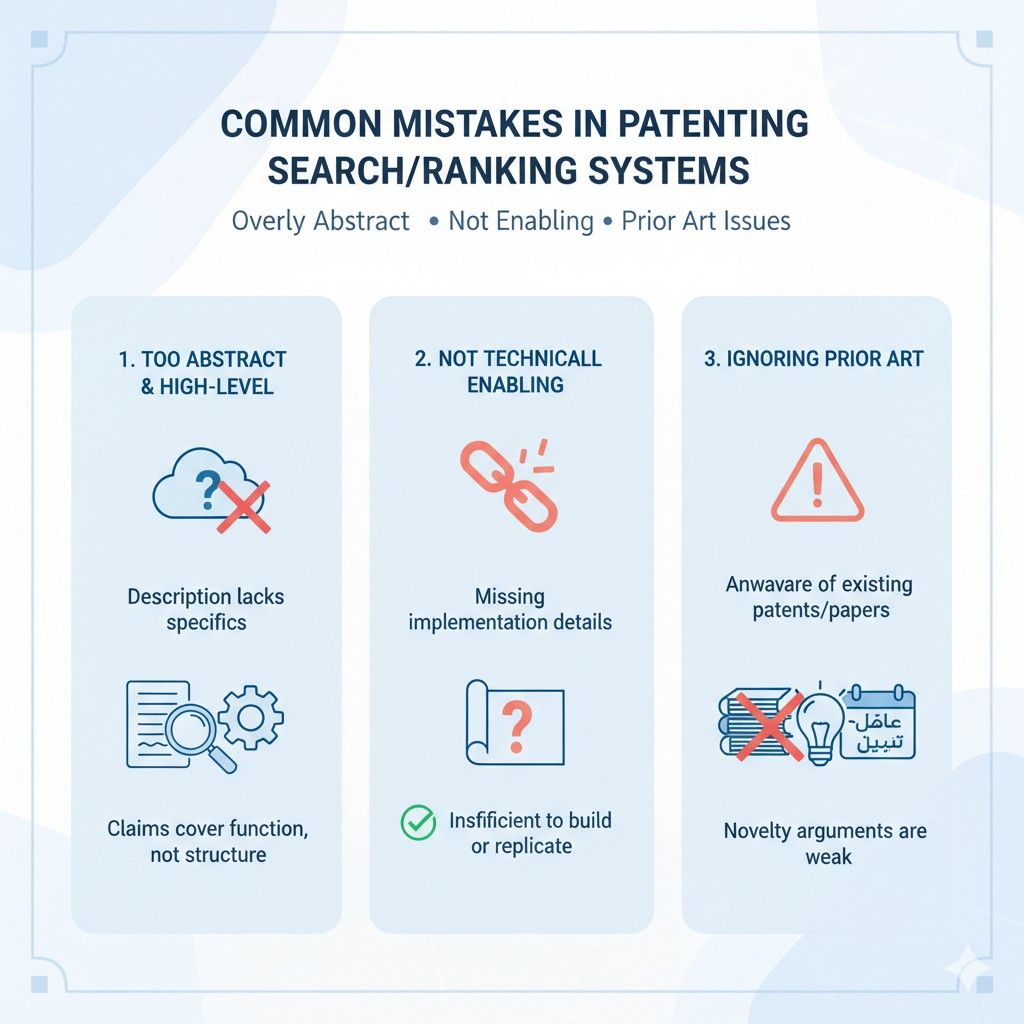
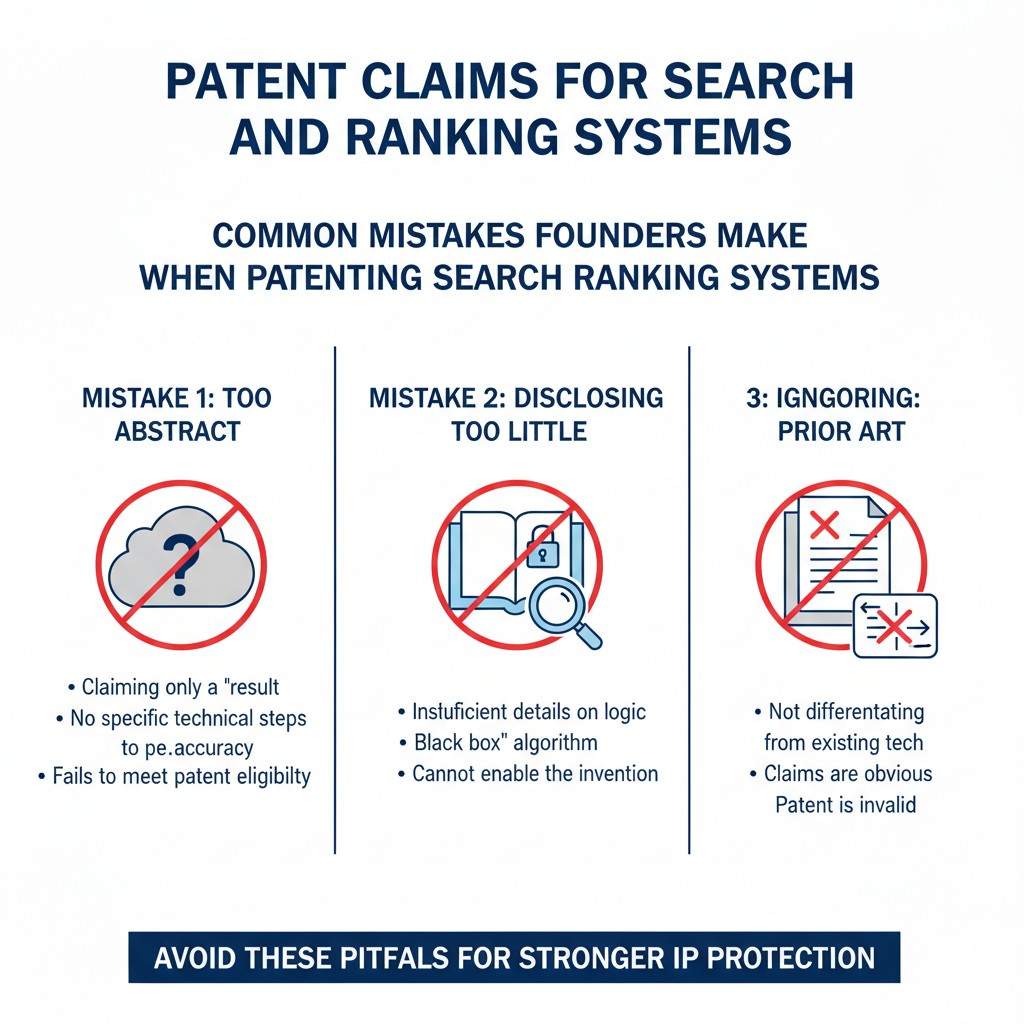
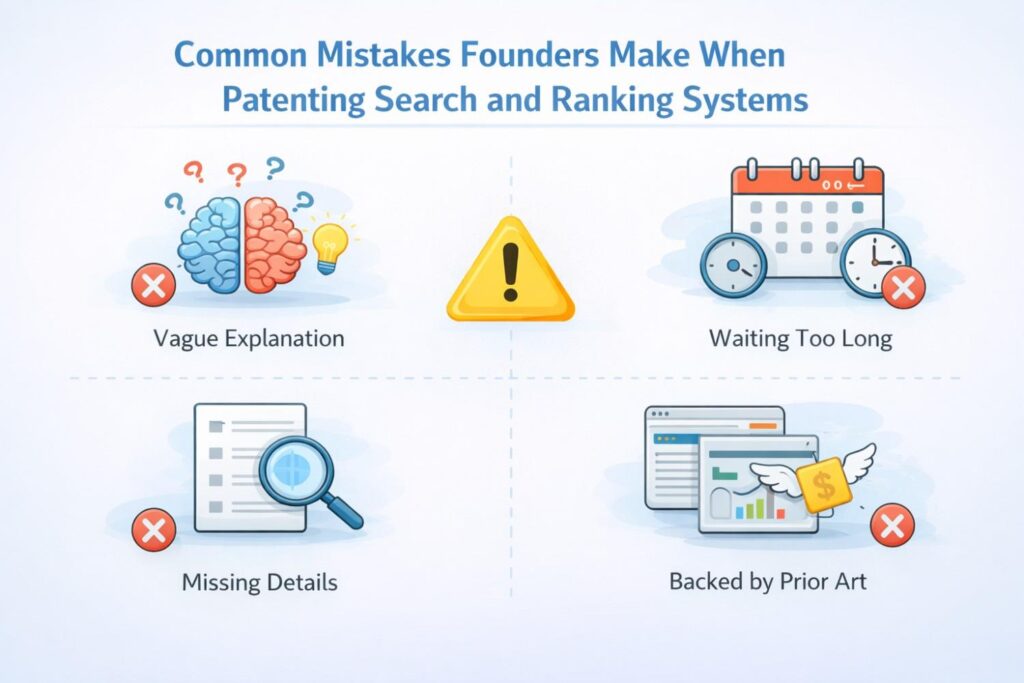
Common Mistakes Founders Make When Patenting Search and Ranking Systems
Founders often make one big mistake at the start. They assume the hard part is building the search or ranking engine, and the patent is just paperwork that comes later.
That mindset causes real damage. In search products, the most valuable work usually lives inside the ranking logic, the signal flow, the filtering rules, and the way the system adapts under pressure.
If that work is described badly, the patent may exist on paper but still fail to protect what actually matters. The goal is not just to file. The goal is to protect the part of the business a serious competitor would want to copy.
Mistaking product value for patent value
This is one of the most common founder errors. A company knows users love the product, so it assumes the patent story is obvious.
But patent value does not come from the fact that customers like the experience. It comes from the technical system that creates that experience.
A founder may say, “Our search is better because it gives more relevant results.” That may be true, but it is not yet a useful patent position. Relevance is the outcome.

The patent must capture the engine that creates that outcome. If the company never makes that shift, it ends up protecting the story around the product instead of the system inside it.
Why this mistake hurts strong teams the most
The irony is that strong technical teams are often the ones most likely to miss this point. They move fast, they know their system deeply, and they assume the ranking flow is self-evident.
Because it feels natural to them, they do not stop to isolate the unusual parts. That makes it easy to file language that sounds polished but misses the real invention.
The practical fix is simple.
Before talking about benefits, force the team to answer one hard question: what exactly does the system do differently from a standard search or ranking stack? That answer is usually where the patent work should begin.
Describing the invention too broadly
Many founders think broad language creates strong protection. In practice, broad language without technical substance often creates weak protection.
A patent that says a system receives a query, processes data, ranks results, and presents results may sound wide, but it may not meaningfully cover the real ranking logic at all.
This happens because founders want to avoid being boxed in. That instinct is understandable.
But when the language gets too abstract, it stops reflecting what makes the system special. It becomes easy for others to argue that the patent covers only a generic concept rather than a real technical method.
Broad does not mean vague
A strong patent can still be broad, but it becomes broad by anchoring itself to the true technical idea and expressing that idea in a way that covers meaningful variants.
That is very different from writing empty, high-level statements.
For a business, this means the goal is not to remove detail until the claim feels expansive. The goal is to keep the detail that defines the invention and remove only the details that do not matter.
That balance is where real protection begins.
Describing the invention too narrowly
The opposite mistake is also common.
A founder or engineer explains the system exactly as it exists in the codebase today, down to very specific model choices, threshold values, data structures, or implementation details that are not essential to the inventive concept.
That creates a different problem. The patent may become so tied to one version that competitors can avoid it with small changes.
This happens a lot in startups because technical teams are proud of the exact version they built. They naturally describe the working implementation, not the broader inventive principle.
But patents should protect the thing that matters across versions, not just the snapshot that happened to be in production when the filing started.
The right target is the core logic
Founders should push the discussion one layer deeper. Ask what part of the system would still matter even if the model changed, the interface changed, or the infrastructure changed. That lasting part is usually the core logic worth protecting.
A smart patent process does not ignore implementation details. It uses them to understand the invention.
Then it separates essential structure from temporary engineering choices. That separation is critical if the company wants protection that remains useful as the product evolves.
Focusing on the model and ignoring the system around it
In modern search and ranking products, machine learning gets a lot of attention. Founders often assume the patent story must revolve around the model itself. Sometimes that is true. Very often it is not.
A ranking system may be special because of how it generates candidates before scoring, how it decides when to apply personalization, how it filters low-trust items before re-ranking, or how it updates weights based on fresh user behavior.
Those system-level decisions are often more valuable than the model in isolation. If the filing focuses only on the model, it may miss the actual edge.
Businesses should patent what creates the moat, not what sounds advanced
This is where companies can become too impressed by the words “AI” or “machine learning.” The important question is not which part sounds cutting-edge.
The important question is which part of the stack creates the business advantage.
If the system wins because it handles cold-start ranking better than others, or because it preserves quality while cutting compute cost, or because it blends live and historical signals in a smarter way, that is the part that deserves serious patent attention.
A patent should follow the moat, not the hype.
Treating search as generic infrastructure
Another mistake is assuming search is just a common software layer and therefore not worth patenting.
Many founders treat it like plumbing. They think the real invention is elsewhere. That view can be expensive.
In many products, the search and ranking layer is where value is actually created. It determines discovery, trust, conversion, retention, and user satisfaction. In a marketplace, it shapes what gets sold. In a content product, it shapes what gets consumed.
In enterprise tools, it shapes how fast users find answers. If the company built a technically distinct way to handle that work, brushing it aside as generic infrastructure is a strategic miss.
Hidden systems often deserve the strongest protection
Founders tend to pay more attention to visible features because customers talk about them directly. But invisible systems can be the real engine of growth. Search and ranking are often exactly that kind of hidden engine.
This means leadership should not decide patent value based on what users can see. They should decide based on what drives the product’s performance. Many of the most important inventions sit below the surface.
Waiting too long to start the patent process
Timing causes a lot of damage in software companies. Teams say they will handle patents after launch, after fundraising, after traction, or after the next product cycle.
That delay often means critical details are forgotten, public disclosures stack up, and the company loses the clean moment when the system design was easiest to document.
In search and ranking systems, this is especially dangerous because the real invention often develops through many small technical decisions over time. If no one captures those decisions while they happen, the final patent story becomes thinner than it should be.
Early capture creates stronger filings
A company does not need to stop building in order to preserve patent value. It just needs a habit of capturing what changed and why.
When a new ranking stage is added, when a new signal changes quality, when a filtering rule solves a failure mode, that moment should be documented.
This is one reason startups benefit from a more modern patent process. If the company can move quickly from technical insight to structured patent drafting, it is much less likely to lose the real story.
PowerPatent is built for that kind of speed and clarity, with software that helps founders capture what matters and real attorney oversight that helps shape it into a stronger filing.
You can see how it works here: https://powerpatent.com/how-it-works
Filing before the invention is actually understood
There is also a different timing problem. Some founders file too early, before they really understand what is special about the system.
They know they are building something new, but they have not yet isolated the part that truly changes system behavior.
That can lead to premature filings built around rough ideas rather than proven mechanisms.
The result is a patent that follows the early concept but misses the stronger invention that later emerged during engineering. This is why speed matters, but clarity matters too.
Do not file around noise
The right move is not to wait forever, but it is also not to patent every rough concept the moment it appears. Founders should look for the point where the technical insight has become concrete enough to describe clearly.
Usually that means the team can explain the problem, the failed standard approach, the specific system change, and the measurable effect of that change.
That level of maturity gives the patent work real substance. Without it, the filing may end up protecting a blurry version of the story.
Using business language instead of technical language
Founders naturally speak in business terms. They talk about better engagement, higher conversion, more relevant recommendations, lower churn, and stronger retention.
Those outcomes matter, but patent claims need a different kind of language.
The patent must explain what the system technically does. It must describe inputs, steps, transformations, scoring behavior, timing, and system flow.
If the filing leans too heavily on business outcomes, it becomes harder to show the technical invention underneath.
A good business story is not the same as a good patent story
This distinction is simple but important. The investor pitch explains why the market should care. The patent explains why the system is technically different.
Businesses that understand this early are much easier to protect. They can still use the commercial story as context, but they do not let it replace the technical explanation. That discipline makes the filing far more useful later.
Wrapping It Up
Search and ranking systems are easy to undervalue from a patent point of view because so much of their power sits behind the screen. Users do not see the scoring layers, the filtering logic, the signal blending, or the re-ranking flow. They only see that the product works better. But for a business, that hidden logic is often the exact thing worth protecting.
Leave a Reply