
Workflow automation sounds simple on the surface. A task starts, a rule runs, a handoff happens, and work moves forward. But under the hood, real workflow systems are rarely simple. They route data, trigger actions, make timing choices, handle failures, assign jobs, connect tools, and keep everything in sync across a moving system. That is exactly why patent claims in this space matter.
Why Workflow Automation Inventions Are Harder to Claim Than They Look
At first glance, workflow automation can seem easy to protect. A founder may think, “We built a system that moves work from one step to the next, so that should be patentable.”
But this is where many teams get trapped. The outside view of the product is usually too broad, too common, and too easy to describe in plain business terms.
A patent examiner will not care that your system “automates approvals” or “routes tasks” if those ideas sound like normal software behavior.
The hard part is that workflow automation products often solve deep technical problems while presenting a simple user experience. That gap creates risk.
If the patent application only describes the surface result, the most valuable part of the invention stays hidden.
Businesses that understand this early can create much stronger protection. They stop describing the feature like a sales page and start describing it like an operating system for work.
The Outside Result Often Looks Ordinary
Most workflow tools promise something that sounds familiar. They save time. They reduce manual work. They route requests. They trigger tasks. They connect systems. Those outcomes are useful, but they are not enough by themselves.
That is why many workflow inventions are harder to claim than founders first expect.
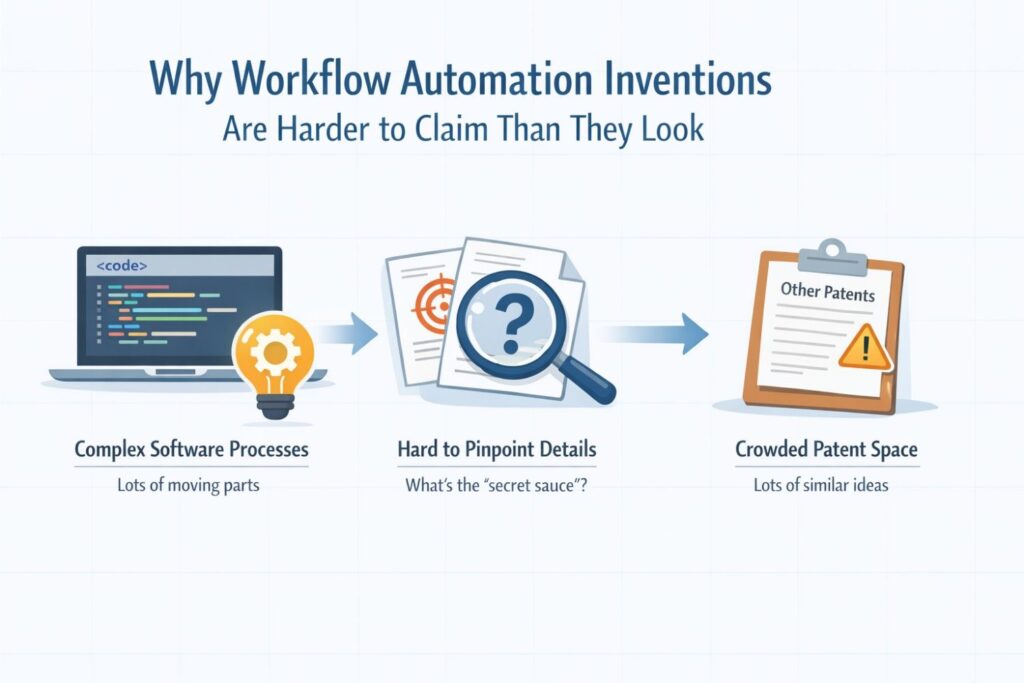
Two products can produce the same business result while using very different technical methods behind the scenes. The patent value usually sits in those hidden methods, not in the visible result alone.
The Business Pitch Is Not the Patent Story
A business team may explain the product by saying it automates vendor onboarding, customer support, employee approvals, or document review.
That may be perfect for sales, but it is usually weak for patents. It tells people what the system does, but not why the system is different in a way that matters technically.
For a stronger patent position, businesses should train themselves to ask a better question.
Instead of asking what job the workflow performs, ask how the system decides, adapts, routes, retries, prioritizes, sequences, and resolves steps in changing conditions. That is often where the claim-worthy material lives.
The Real Invention Is Often Hidden in the Decision Layer
Many workflow systems are not just moving tasks through a line. They are making choices at every stage.
They may choose the next action based on timing, risk, system state, user role, data quality, past outcomes, confidence scores, or external signals from other tools.
This decision layer is where many businesses have more patent value than they realize. It is also the place they fail to document clearly enough.
The Strongest Claims Usually Protect Control, Not Just Movement
A weak claim might say a system receives a request, identifies a next step, and sends the request to another service. That sounds clean, but it is often too thin.
A stronger claim may focus on how the next step is selected, how competing rules are resolved, how system health affects routing, or how the orchestration layer changes execution order when one resource becomes unavailable.
That shift matters. It moves the invention from “moving work” to “controlling a live process under real conditions.” That is much harder to dismiss and much harder for competitors to work around.
Action founders can take right now
A very practical move is to sit with the engineering team and map every place where the system makes a decision without human input. Do not just note that a decision happens.
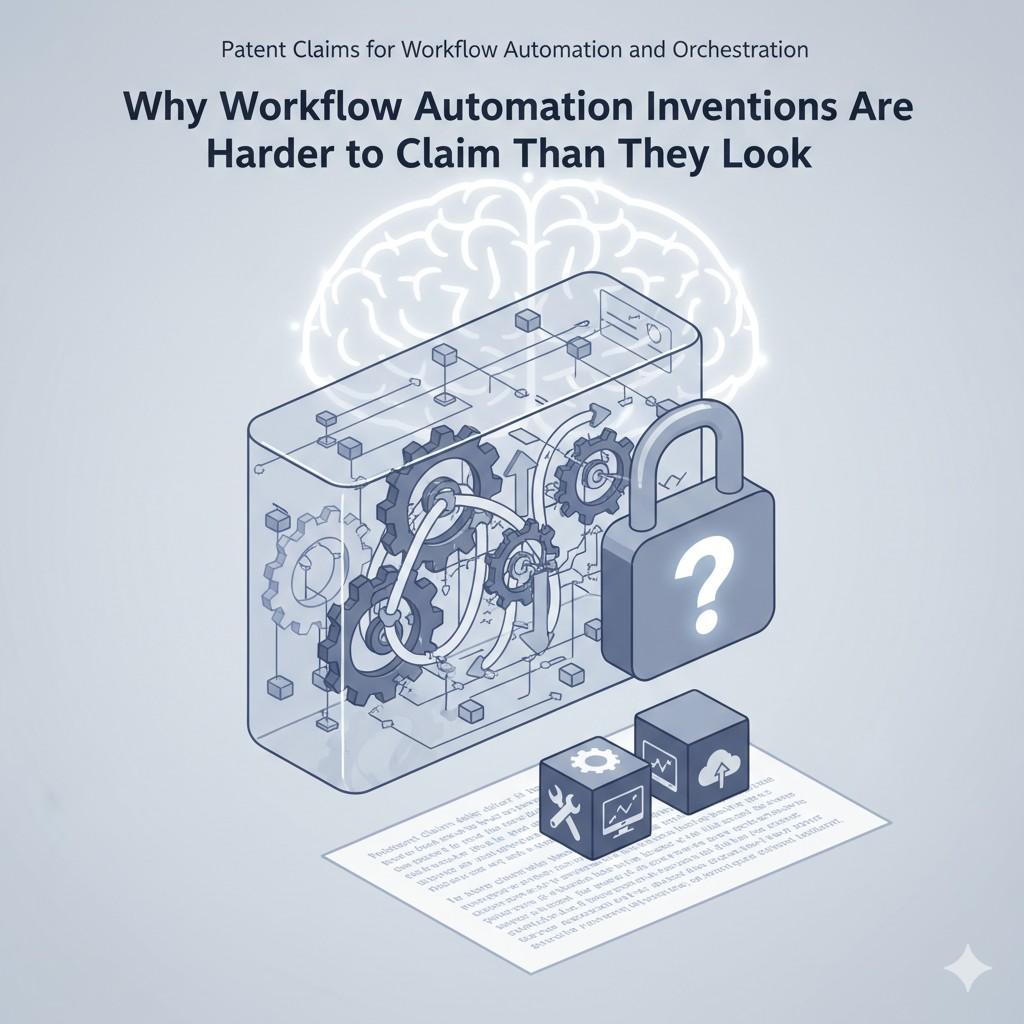
Capture what inputs are used, what logic is applied, what exceptions exist, and what happens when the expected path fails. Those details often become the backbone of strong claims.
Workflow Systems Often Look Like Rules Engines Even When They Are Not
Another reason these inventions are harder to claim is that patent examiners often see workflow language and think of old rule engines, basic schedulers, and traditional business process tools.
If your application sounds too close to those older systems, your invention may get grouped into a crowded area right away.
That does not mean your invention lacks value. It means your application must clearly show where your system goes beyond ordinary rules.
Modern Orchestration Is More Than If-Then Logic
A lot of modern workflow products are doing much more than simple branching.
They may handle dynamic resource assignment, event-driven state changes, adaptive retries, partial completion, cross-platform synchronization, or confidence-based execution.
They may coordinate human actions and machine actions in the same flow. They may also react to late data, conflicting states, or real-time system load.
If those points are not described in detail, the invention can look much simpler than it is. That is a major business risk because it reduces the chance that the patent captures the real competitive edge.
A useful internal test
A strong test is to ask whether a basic engineer could rebuild the invention from a short product description. If the answer is yes, then the patent story is probably still too shallow.
The application should force a reader to understand that the system depends on a deeper mechanism, not just a broad concept.
Orchestration Creates Value Across Many Moving Parts
Workflow automation becomes much harder to claim when the invention sits across many systems instead of inside one feature.
A lot of real value comes from how a platform coordinates APIs, queues, services, user actions, permissions, timing windows, and fallback paths. That is powerful, but it can be difficult to describe in one clean sentence.
Businesses often lose strength here by trying to oversimplify. They strip away the moving parts so the application sounds neat. But in doing that, they often remove the very elements that make the system special.
The Interaction Pattern Is Often the Invention
In some cases, the invention is not a single step at all. It is the sequence of interaction between components.
It is the way one service publishes a state change, another service evaluates dependency conditions, a third service reserves execution capacity, and a fourth service updates a shared task model before the next action is triggered.
That kind of invention can be very strong, but only if the application explains the cooperation clearly.
A business that frames its invention as a system-level coordination method is often in a better position than one that frames it as a generic automation feature.
What businesses should document during product development
Teams should keep simple internal notes on system interactions that were hard to design.
Capture why one event model failed, why one sequencing method created errors, why one retry approach caused duplicate work, and why the final orchestration design solved the issue.
That history helps prove that the invention was not obvious guesswork. It also gives patent counsel much richer raw material.
Many Valuable Workflow Inventions Solve Failure, Not Success
One of the biggest mistakes businesses make is focusing only on the happy path. They describe how the workflow runs when everything goes right. But patent strength often comes from what happens when things go wrong.
This is especially true in orchestration systems, where real technical value shows up in failure handling, partial execution, recovery, and continuity.
Exception Handling Can Be More Valuable Than the Main Flow
Your system may know how to resume after a timeout, preserve state across disconnected services, prevent duplicate execution after a retry, or reroute work when a downstream system gives incomplete output.
Those are not side details. In many cases, they are the invention.
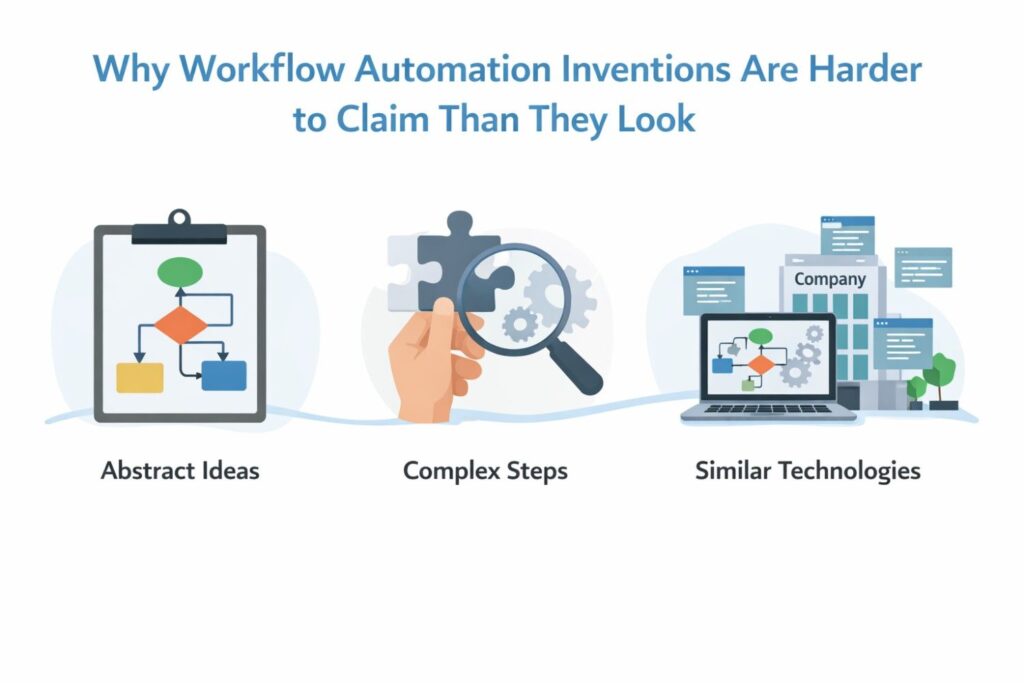
A competitor may copy the main flow fairly easily. What they struggle to copy is the resilience layer that makes the product actually usable at scale. That resilience layer deserves serious attention in patent claims.
A strong drafting habit
When preparing invention notes, use twice as much space on exception handling as on the default flow. That one choice can dramatically improve the quality of the patent strategy.
It pushes the team to describe the hard-earned engineering logic that others are most likely to miss.
The Invention May Sit in Timing and State Management
Workflow systems live in time. Actions happen in sequence, in parallel, on delay, after approval, on trigger, on timeout, or after a condition changes.
At the same time, the system must track state across objects, users, and services. This makes workflow inventions more technical than they first appear.
Yet many applications fail because they treat timing and state as background details instead of core parts of the invention.
State Is Not Just Storage
In orchestration, state can control what the system is allowed to do next. It may show whether a task is pending, blocked, retrying, escalated, reserved, stale, complete, or invalid.
It may also determine which downstream action is safe to run.
That means a patent application should not merely say the system stores state. It should explain how state is created, updated, checked, shared, and used to govern execution.
Those details can sharply separate a strong application from a weak one.
Timing logic often hides the moat
A business may discover that its secret advantage is not the workflow step itself but the timing policy around it. Maybe the system waits for a threshold of signals before acting.
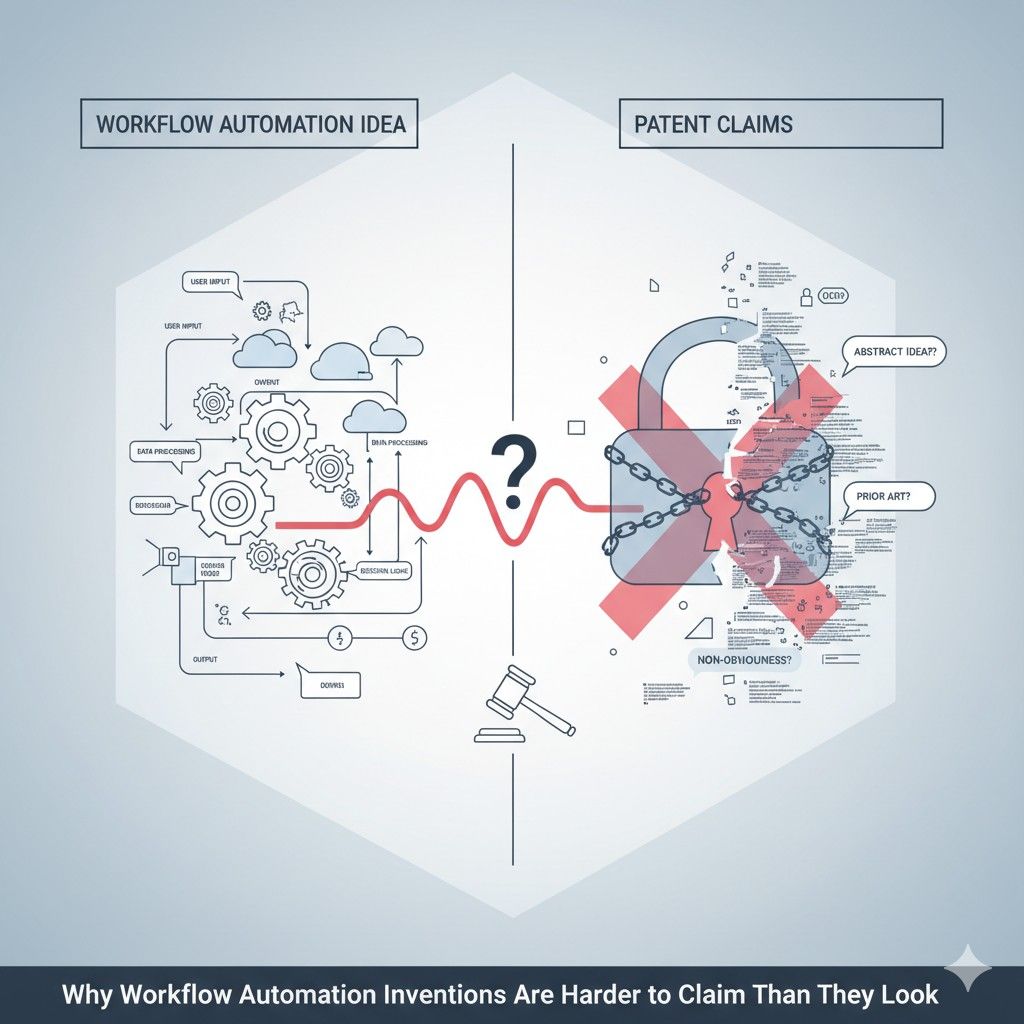
Maybe it opens a time window for grouped execution. Maybe it delays a task to avoid conflict with another process. These timing choices can create real technical advantage and should be treated as first-class invention material.
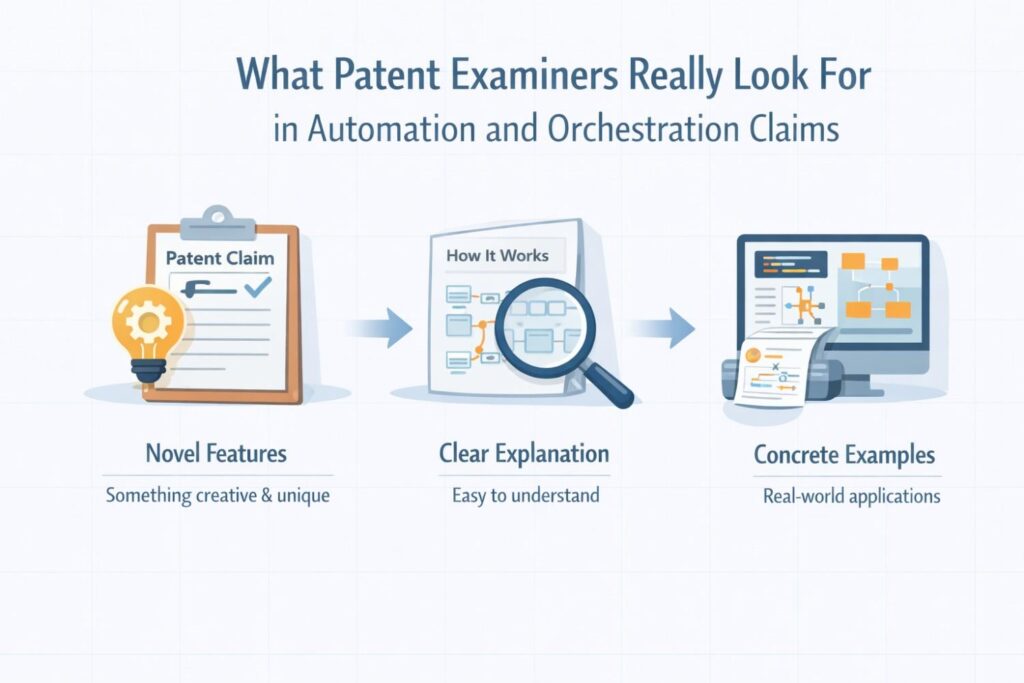
What Patent Examiners Really Look For in Automation and Orchestration Claims
Patent examiners do not read workflow claims the way a founder reads a product roadmap. They are not asking whether your software is useful in business.
They are asking something much stricter. They want to know what your system is actually doing, how it is doing it, and whether that technical approach is meaningfully different from what already exists.
In automation and orchestration, that difference is easy to hide by accident. Many teams describe the business result and assume the technical value will be obvious. It usually is not.
That is why this part matters so much. If you understand what examiners truly pay attention to, you can draft your application in a way that speaks to the real test.
This is not about gaming the system. It is about describing your invention in the language of substance instead of the language of promotion.
Examiners Look Past Business Benefits Very Fast
A workflow product may save time, reduce labor, improve consistency, or help teams move faster.
Those benefits matter to customers. They do not carry much weight by themselves in examination. An examiner is trained to look through those outcomes and ask what the system is actually adding at the technical level.
This is where many businesses lose momentum. They lead with the promise instead of the mechanism.

They talk about streamlining processes, improving operations, or removing friction. Those phrases sound polished, but they do not tell the examiner what the engine does that is new.
The claim must show more than a business goal
A good claim does not stop at saying a request is received, analyzed, and routed.
That sounds like ordinary software behavior. A stronger claim shows how the routing decision is made, what conditions are evaluated, how system state affects the path, and what happens when the expected path is no longer valid.
The practical lesson for businesses is simple. When drafting invention notes, remove the sales language and force each sentence to answer one question: what exactly is the system doing under the hood?
Examiners Want a Clear Technical Story
A strong patent application feels coherent from start to finish. The problem is concrete. The architecture matches the problem. The flow of data makes sense. The control logic is not vague.
The examiner should be able to see that the inventors faced a real technical challenge and built a specific solution for it.
That does not mean the writing must sound overly technical or hard to read. It means the content must be grounded.
In workflow automation, a clear technical story often comes from showing how the system handles sequencing, coordination, timing, dependency rules, failure recovery, and live state changes across multiple components.
The invention must feel engineered, not imagined
Examiners are often skeptical of claims that read like a concept without enough implementation detail. If the application sounds like it was written from a whiteboard dream instead of a real product design, that can create problems quickly.
Businesses can avoid this by grounding the application in actual system behavior. Describe the services involved. Describe the triggers. Describe how a workflow instance changes state. Describe how decisions are made when multiple rules conflict.
Describe how the orchestration engine responds when one downstream process returns incomplete data. These details signal that the invention is real, built, and thought through.
A helpful internal drafting habit
Before filing, ask your technical team to explain the invention without using the words automate, optimize, streamline, or improve. That exercise often exposes whether the real technical story is strong enough on its own.
Examiners Compare Your Claims to Old Systems
One hard truth in this space is that workflow language is crowded. Examiners have seen many applications involving routing, approvals, triggers, task assignment, and process execution.

If your claim uses broad workflow terms without a clear technical distinction, it may quickly get grouped with old business process tools or general software systems.
That does not mean your invention is weak. It means the burden is on the application to show why your system is not just another version of familiar process logic.
Familiar words can hide a new architecture
A modern orchestration platform may use terms that sound ordinary even when the backend is highly original.
Words like step, rule, task, condition, event, and queue can make a new system look old unless the interaction between those parts is described carefully.
This is why the architecture matters so much. Examiners often look for the specific arrangement of components and the specific behavior that arrangement creates.
If your invention uses a state evaluation layer before execution, a dependency resolver during orchestration, and a rollback controller after a failed downstream action, that should not be buried deep in the application. It should be central.
The business takeaway
Do not assume the novelty will be inferred from general workflow words. Spell out the structure that makes your system different.
The more the core architecture is visible, the harder it is for the invention to be mistaken for old art.
Examiners Focus on What Makes the Claim Definite
A claim has to be clear enough to understand and precise enough to examine. If important terms are fuzzy, the examiner may push back.
In automation and orchestration, this issue comes up often because teams use broad phrases like intelligent routing, dynamic workflow, adaptive execution, or automated decisioning without pinning down what those phrases mean in practice.
Examiners want to know what those labels refer to. They want the claim language tied to actual operations.
Abstract labels do not carry the claim
Saying that a system uses a dynamic orchestration engine is not enough. What makes it dynamic? Does it recalculate downstream paths based on updated state data?
Does it reassign execution targets based on resource thresholds? Does it suspend one branch while allowing another branch to continue? Without those details, the phrase sounds impressive but does little work.
For businesses, this is highly actionable. Every label in the application should be backed by concrete behavior. If you call something adaptive, explain what changes, what triggers the change, and how the new path is chosen.
A simple review method
Take every adjective in the draft and test whether it can be replaced with a measurable system action. If it cannot, the term may be too soft to support a strong claim.
Examiners Look Closely at the Source of the Decision
Workflow inventions often rise or fall based on decision logic. The examiner will want to know whether the claim is just expressing a result or whether it actually describes how the result is reached.
This is especially important when the invention involves selecting a next action, choosing a destination, resolving a conflict, or deciding when execution should occur.
That source of the decision is often where patentable value lives.
Decision logic should not sound like a black box
If a claim says the system determines an execution path based on one or more conditions, that may be too empty unless the surrounding language gives the examiner something to hold onto.
What conditions? Derived from where? Compared in what way? Used by which part of the system? Affecting what next operation?
Examiners do not need every line of code. But they do need a believable structure that ties inputs to processing and processing to outcome. When the logic is described as a black box, the claim becomes easier to attack.
What businesses should capture
When your engineers describe a workflow decision, ask them what data is inspected, what thresholds or comparisons matter, and what alternate outcomes exist.
That material often turns vague claim language into strong technical substance.
Examiners Notice Whether Failure Handling Is Real or Decorative
In orchestration systems, one of the strongest signs of real engineering depth is failure handling. Examiners often notice when an application includes serious treatment of incomplete execution, retries, duplicate prevention, fallback sequencing, or state restoration.
Those details can help show that the invention is addressing a practical systems problem rather than just dressing up a basic workflow idea.
This matters because resilient orchestration is usually much harder to build than simple straight-line execution.
Recovery paths can prove technical depth
If your platform preserves execution state across interruptions, reroutes around unavailable services, or selectively retries only unresolved branches, those are not side notes.
They can show that the invention deals with hard operational realities. Examiners often respond better when the application makes those realities visible.
Businesses should take this seriously during drafting. A workflow patent that only explains the success path may understate the invention. A workflow patent that explains how the system survives disruption often tells a much stronger story.
A useful drafting question
Ask not only how the workflow runs, but how it avoids breaking when timing shifts, inputs arrive late, or connected services fail. The answer may contain some of the strongest claim language in the whole application.
Examiners Want to See a Real Link Between Components
In orchestration claims, it is not enough to name several system parts and assume the combination feels inventive. Examiners look for the relationship between components.
They want to understand how one part feeds another, how state is shared, how triggers propagate, and how control passes across the system.
This is especially important when a business is trying to protect a platform rather than one narrow feature.
The interaction model often matters more than the pieces alone
A queue, a rules store, an execution engine, and a monitor may all be known parts on their own. What may be new is how they work together. Maybe the rules store is updated from runtime feedback.
Maybe the execution engine branches only after a dependency validator confirms upstream completion. Maybe the monitor changes priority values that alter later routing decisions.
That is the kind of relationship examiners look for. They often test whether the claimed combination is just a stack of familiar parts or a true system with a specific cooperative behavior.
A practical move for founders
When preparing invention disclosures, do not just describe each module. Describe what each module causes another module to do. That cause-and-effect chain often becomes the strongest foundation for claim drafting.
Examiners Reward Specificity That Supports Coverage
Founders sometimes fear that adding detail will shrink protection. In reality, the right detail often strengthens the claim because it gives the invention a firmer core.
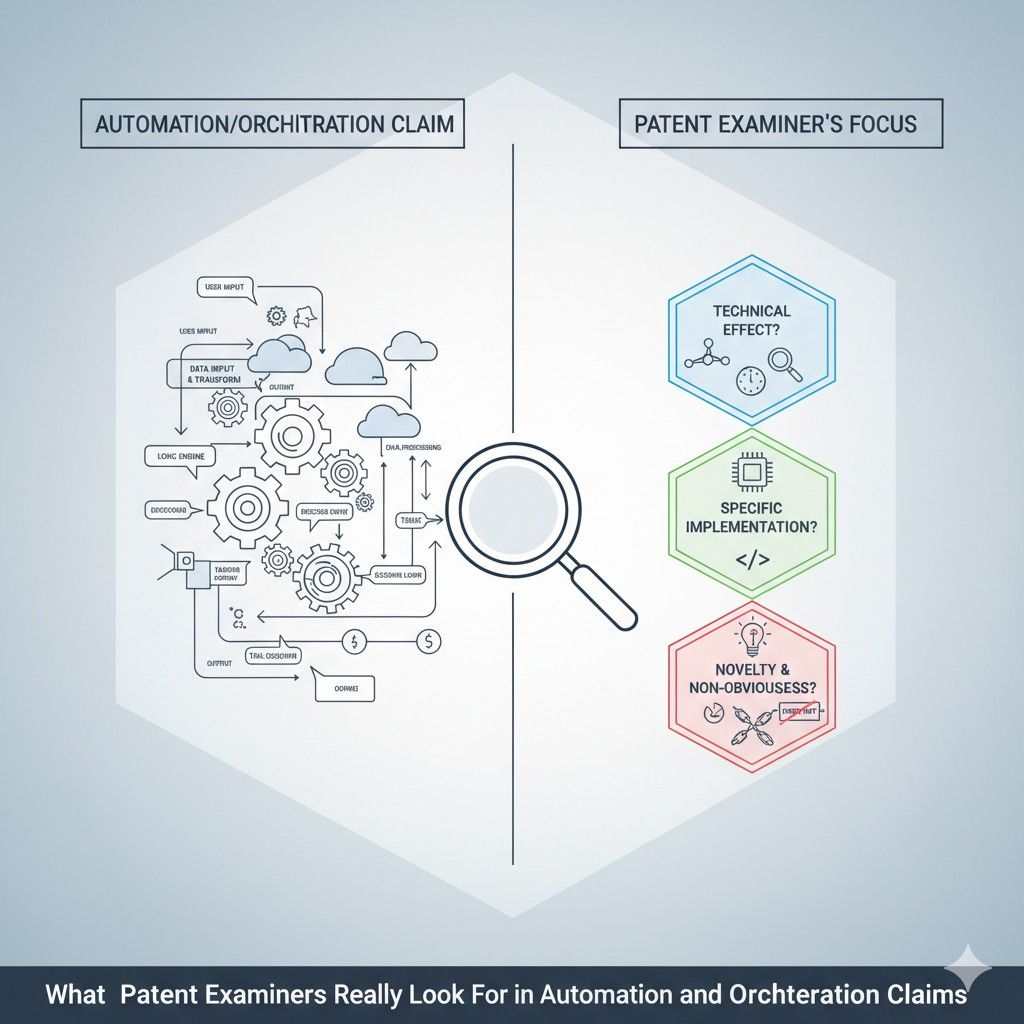
Examiners are more likely to accept claims that are specific enough to show a true technical approach than claims that try to float above the implementation entirely.
How to Write Claims That Protect the Real Logic Behind Your Workflow System
Writing claims for a workflow system is not about describing that work moves from one step to another.
That is too easy to say, and because it is easy to say, it is also easy for others to work around or for an examiner to dismiss as ordinary software activity.
The real goal is to protect the logic that makes your system useful, reliable, and hard to copy. That means the claim has to reach past the surface feature and into the operating method that gives the feature its value.
For businesses, this is where patent strategy becomes very practical. A strong claim can help protect the engine of the product, not just the label on the dashboard.
If your team gets this part right, you are not merely filing a patent application. You are creating leverage around the technical choices your competitors will most want to imitate.
Start with the System Decision, Not the User Outcome
The biggest shift in claim writing is moving away from customer language and toward system behavior. Many teams begin with what the user sees because that is how they sell the product.
They say the platform automates approvals, routes requests, manages tasks, or coordinates software tools. That may explain the value in the market, but it usually does not protect the real invention.
To write stronger claims, begin with the hidden decision your system makes. Ask what the platform is actually deciding, when it makes that decision, what inputs it uses, and what action follows.
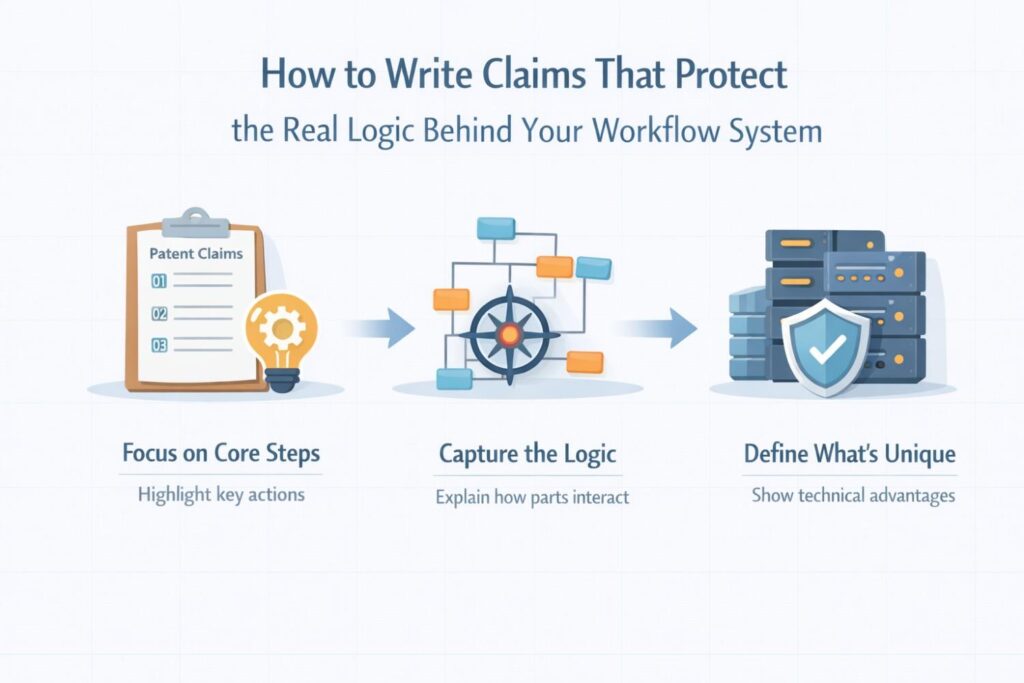
The claim should begin to form around that point of control. This is where the workflow becomes more than a business process. It becomes a technical system with rules, state, conditions, and response behavior.
The protected asset is often the logic gate inside the flow
In many workflow platforms, the strongest invention is not the flow itself. It is the moment where the system evaluates current conditions and changes the path.
That could be a priority reassignment, a state check before execution, a branch decision based on resource status, or a reroute triggered by a downstream failure.
If you do not claim that logic gate, you may leave the most valuable part exposed.
Build the Claim Around a Technical Sequence
Good workflow claims usually become stronger when they follow a technical sequence instead of a business summary. That sequence should show the actual operations the system performs in a meaningful order.
A claim that tracks how data is received, evaluated, transformed into an execution decision, and used to control downstream behavior will usually have more force than a claim that simply says the system automates a business operation.
This matters because claims are tested on what they actually recite. If the sequence is vague, the protection is vague.
If the sequence captures the true control method, the claim has a much better chance of covering what matters in practice.
Show how one operation changes the next
A workflow claim becomes more powerful when each step causes the next step for a reason. The sequence should not read like disconnected software verbs. It should read like a controlled process.
One operation should produce a state, evaluation, or output that drives the next operation. That chain of cause and effect is often what gives the claim its backbone.
For a business, the practical lesson is clear. Do not describe your platform as a bag of functions. Describe it as a control flow where each operation affects system behavior in a specific way.
A useful drafting move for product teams
Before claim drafting starts, ask an engineer to write the runtime story of a workflow instance from trigger to completion.
Then ask the same engineer to write the failure story when one service does not respond or one condition changes midstream. Those two stories often reveal the exact sequence that deserves protection.
Claim the Rules That Matter Most
Many workflow systems depend on rules, but not all rules are equally valuable. Some are simple settings that any competitor can replace with a slightly different version.
Others are central to how the platform behaves under live conditions. The second kind is where the strongest claim material usually sits.
This means businesses should not try to claim every rule they have.
They should focus on the rule structures that actually create technical advantage. That may include rules for conditional execution, dependency resolution, retry control, exception escalation, or priority balancing across shared resources.
Focus on rules that change system behavior under pressure
A rule becomes worth claiming when it shapes what the system does in a non-trivial situation.
A simple rule that assigns a task to a department may have less value than a rule that defers execution until conflicting branches resolve, or one that reorders tasks when a downstream service becomes unavailable.
Strong claims often grow from these pressure points because that is where engineering difficulty shows up.
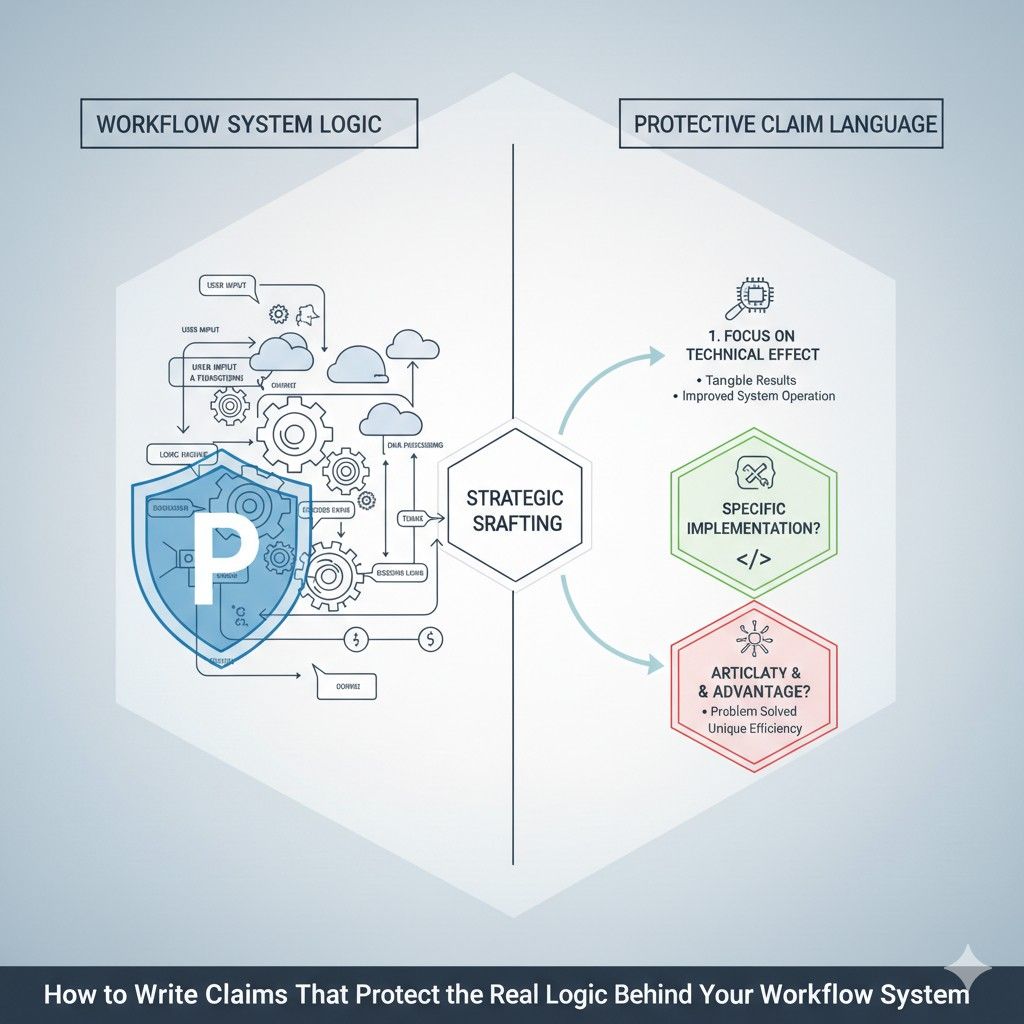
For businesses, this is actionable in a very direct way. When reviewing your product, do not ask which rules users can see. Ask which rules keep the system stable, accurate, or efficient when reality gets messy.
The best rules are often invisible to the customer
Customers may never notice the logic that prevents duplicate execution, protects against stale state, or avoids triggering dependent actions too early.
But those invisible rules can be the most defensible part of the platform. That is why claim strategy should not be driven only by product demos or front-end features.
Treat State as a Core Claim Element
One of the best ways to protect real workflow logic is to bring system state into the claim structure. Workflow automation is rarely just about receiving an event and taking an action.
It is about knowing what has already happened, what is currently pending, what cannot happen yet, and what must change before the next operation becomes valid.
If your claims leave out state, they may miss the very thing that makes the workflow intelligent and reliable.
State turns a simple process into a controlled system
A workflow system becomes much harder to copy when its behavior depends on tracked state across multiple steps, services, or actors. The state may reflect completion, reservation, failure, delay, dependency satisfaction, or timing conditions.
Once the claim ties system action to that state, it becomes easier to show that the invention is more than a generic automation concept.
Businesses should look closely at where state drives control.
If a workflow advances only when certain statuses align, or if execution branches depend on current state across different components, that relationship may deserve a central place in the claim set.
A strong internal question to ask
Where does your system refuse to proceed unless the right state exists? That answer often points to a powerful claim feature because it reveals how the system governs execution rather than simply initiating it.
Write for Design-Around Risk, Not Just for Approval
A claim is not strong merely because it gets allowed. It is strong when it protects something a competitor would actually need to use in order to match your product.
This is one of the most important business lenses in patent drafting. If the claim covers a shallow version of the feature, a competitor may avoid it with a cosmetic change.
If it covers the real logic behind the system, avoiding it becomes much harder.
That is why claim writing should always include design-around thinking. Do not ask only whether the language is broad.
Ask whether a rival could recreate the same value while stepping around the wording without much pain.
Protect the hard-to-replace mechanism
The best target is usually the mechanism that supports the product promise.
That might be the way your system sequences dependent actions, the way it resolves conflicting triggers, the way it preserves execution continuity through interruptions, or the way it updates workflow behavior in response to changing runtime conditions.
These are the things that often matter most in competition because they are not easy to rebuild cleanly.
For businesses, this changes how invention reviews should work. The team should identify what part of the product a serious competitor would most want to copy, then ask whether the claim language really reaches that part.
A practical business filter
If a competitor could swap in a simpler technique and still offer the same customer result, the claim may be aimed too high at the surface and too low at the mechanism.
The stronger move is to claim what the competitor would struggle to replace without harming performance, reliability, or scale.
Use the Specification to Support Multiple Claim Angles
Claims become much more valuable when the underlying application gives room to draft them from different directions. A workflow invention should not be described in only one narrow way.
The written description should support claims focused on method, system behavior, component interaction, state management, execution control, and failure handling where appropriate.

This does not mean adding empty pages. It means making sure the invention is described richly enough that the same core idea can be claimed from several meaningful angles.
A single invention can support several layers of protection
For example, one layer may focus on how the orchestration engine selects a next action. Another may focus on how it updates shared state after partial completion.
Another may focus on how it reroutes execution when a dependent service fails. These are not random variations. They are different legal views of the same real technical logic.
That approach matters for businesses because it creates flexibility.
If one claim angle faces resistance, another may still protect an important part of the system. It also gives you a better chance to cover real-world competitor behavior from more than one side.
The drafting lesson
When documenting the invention, do not stop after describing the default flow. Also describe alternate flows, failure responses, timing changes, and component interactions.
Those details often become the material that supports stronger fallback claims later.
Make the Claim Read Like Real Engineering
Workflow claims become weak when they sound abstract, inflated, or disconnected from actual implementation. They become stronger when they sound like something an engineering team truly built.
That does not mean stuffing the claim with code detail. It means grounding the wording in real operations, real relationships, and real control behavior.
This is especially important for software businesses because the best claims often feel simple on the surface while carrying a very precise technical structure underneath.
Plain language can still carry technical force
A claim does not need fancy language to be strong. In fact, plain language often works better because it forces the invention to stand on its substance.
If the claim clearly states how a system receives workflow data, determines an execution condition from stored state and runtime signals, selects a next action based on that condition, and updates the workflow instance based on execution results, that can be far more powerful than vague language dressed up to sound advanced.
For businesses, this is good news. It means the path to stronger claims is not writing in a more complex way. It is thinking in a more exact way.
The commercial payoff of clear claims
Clear claims are easier to defend internally, easier to explain to investors, and easier to map against competitor products.
They also tend to reflect the actual product more honestly, which makes the whole patent asset more useful over time.
The heart of claim writing for workflow systems is simple to say, even if it takes discipline to do well. Do not claim the promise. Claim the control logic that delivers the promise.
Do not claim that work moves. Claim how the system decides when, where, and whether that work moves at all. That is how you protect the real logic behind your workflow system.
Wrapping It Up
Patent claims for workflow automation and orchestration are rarely won by saying your software saves time or moves work faster. That is the easy part. The real value sits deeper. It sits in the way your system makes decisions, manages state, handles failure, coordinates moving parts, and keeps execution on track when real conditions change.
Leave a Reply