
A patent draft can look finished and still be weak. That is the hard truth many founders learn too late. The idea may be brilliant. The science may be strong. The device may work. The prototype may turn heads. But if the patent draft misses the real invention, uses narrow wording, skips key versions, or fails to explain why the work matters, it can leave the door open for copycats.
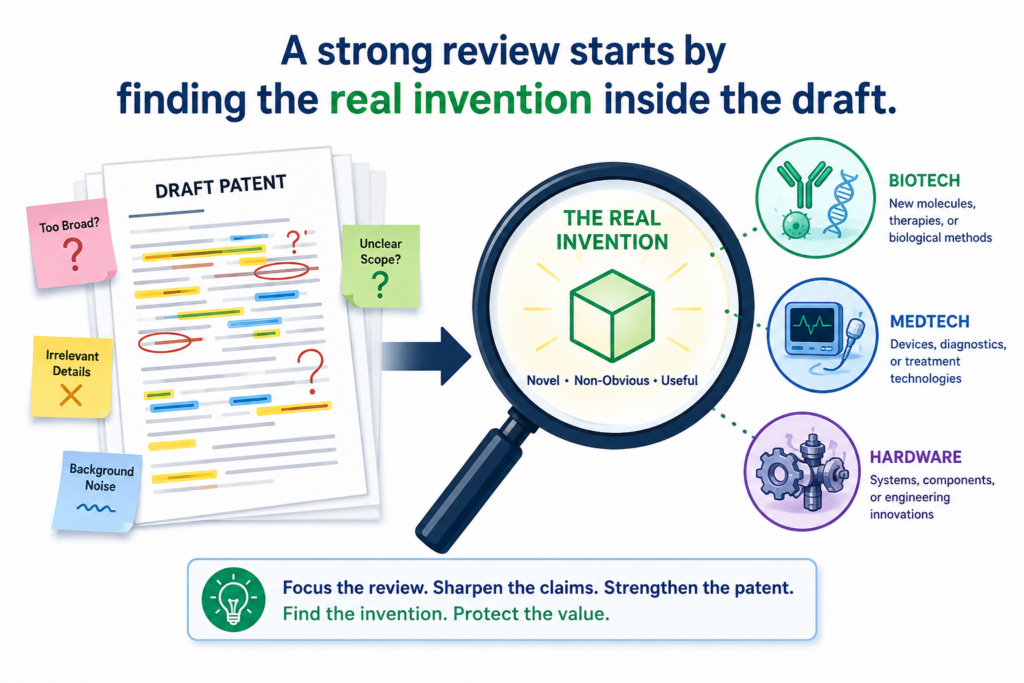
A strong review starts by finding the real invention inside the draft
A good patent draft review does not start with grammar. It starts with one simple question: what is the real thing worth protecting here? In biotech, medtech, and hardware, the answer is often not as clear as it seems.
A founder may think the invention is the product. An engineer may think the invention is one part of the system.
A scientist may think the invention is the result. But a strong patent often protects the smart path that makes the result possible.
This is why the first review must slow down and look at the core of the invention. The reviewer should ask what problem the team solved, why that problem was hard, and what the team did that others did not do before.
This is not just a legal step. It is a business step. If the draft protects the wrong part, the company may spend money on a filing that does not guard the thing that gives it value.
For a biotech invention, the real invention may be a method, a molecule, a cell line, a test, a dose plan, a way to screen targets, or a way to make a therapy more stable.
For a medtech invention, it may be a device shape, a sensor setup, a control method, a treatment workflow, a user safety feature, or a way the device responds to body data.
For a hardware invention, it may be an assembly, a material stack, a control circuit, a cooling path, a manufacturing method, or a way parts work together under stress.
The patent draft should make that core idea easy to see. If it does not, the review should fix that before anything else.
The draft should show what makes the invention hard to copy
The most common weak draft sounds like a product brochure. It talks about what the product does, how helpful it is, and why users like it. That may be useful for sales, but it is not enough for a patent.
A patent draft needs to explain how the invention works, what parts matter, and what other teams would need to copy if they wanted the same result.
This matters because copycats rarely copy every part of a product. They look for the parts they can change. They swap one sensor for another. They move a step from the device to the cloud.
They change the material, shape, dosage, or timing. They keep the benefit but try to avoid the exact wording of the patent.
A strong review looks for those escape paths. It asks whether the draft only covers the first version, or whether it also covers smart changes that a rival may try.
It checks whether the patent draft names the key parts in a way that is clear but not too tight. It also checks whether the draft explains enough versions so the company has room to grow.
For example, a medtech founder may draft a patent around one wearable patch with one kind of sensor. But the real invention may be the way the patch filters body signals and adjusts treatment guidance.
If the draft only talks about that one sensor, the protection may be too narrow. A review should catch this and help widen the draft in a fair and clear way.
The review should test whether the broad idea is still clear
A patent draft should not be so broad that it becomes vague. It should also not be so narrow that it only protects one lab sample or one prototype.
The right review looks for the middle ground. It checks whether the draft tells a clear story about the invention while also showing different ways to build it.
This is where many startup teams need help. They know the product deeply, but they may not know which details belong in the patent and which details limit it too much.
PowerPatent helps founders pull out the key parts from notes, code, diagrams, test data, and invention calls, then shape them into a cleaner patent draft with real attorney oversight. You can see the process here: https://powerpatent.com/how-it-works
A helpful review also asks what the company plans to build next. If the first product is a handheld device, but the roadmap includes a robotic version, the draft should not be blind to that future.
If the first biotech assay uses one marker, but the platform can use a group of markers, the draft should make room for that.
If the first hardware system uses one housing shape, but the value is really in the internal layout, the draft should focus on the layout instead of locking itself to the outer form.
The goal is simple. The draft should protect the invention as it exists now, while giving the company space to improve it later.
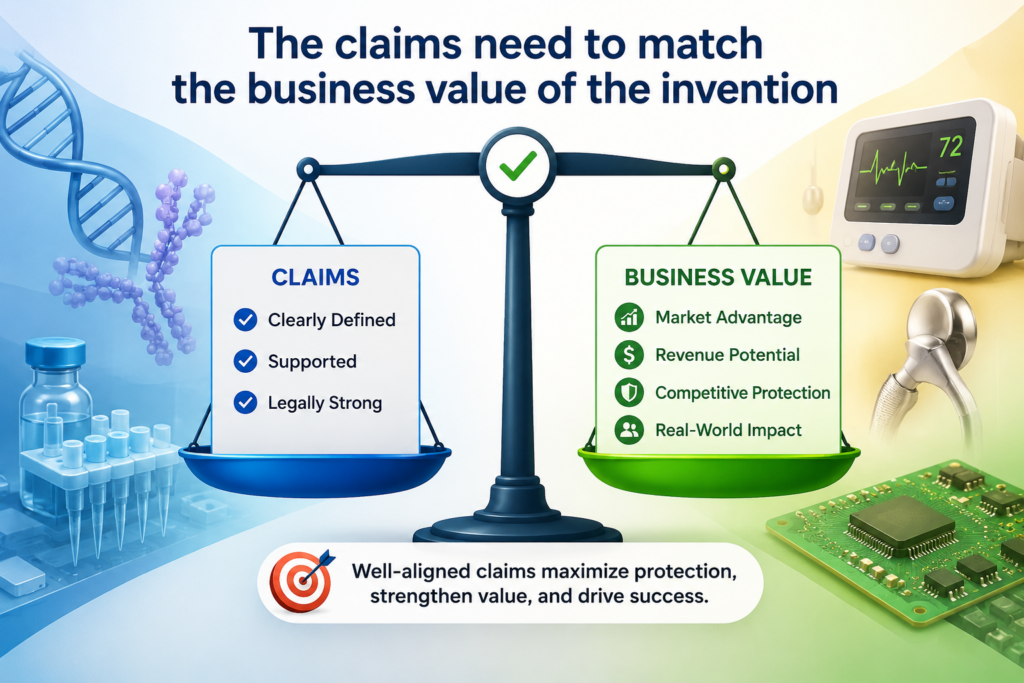
The claims need to match the business value of the invention
The claims are the heart of the patent draft. They are the part that says what the company is trying to own.
Everything else in the draft supports them. If the claims are weak, unclear, or aimed at the wrong feature, the rest of the patent may not help much.
This is why claim review is one of the most important parts of patent draft review. It is not enough to ask whether the claims sound technical.
The better question is whether the claims protect the part of the invention that gives the startup power in the market.
That power may come from better results, lower cost, faster use, safer care, smaller size, better data, longer life, or easier scaling.
In biotech, the claims may need to cover a compound, a use of that compound, a way to make it, a test method, a treatment method, a patient group, or a set of steps that lead to a useful result.
In medtech, the claims may need to cover the device, the system, the software logic, the user flow, the signal processing, or the way the device works with a clinician.
In hardware, the claims may need to cover the structure, the process, the control method, the arrangement of parts, or the way the product performs under real conditions.
A strong review asks whether the first claim is doing the right job. It should not be packed with small details that do not matter.
It should not skip the feature that makes the invention different. It should not read like a full product spec. It should read like a clean fence around the core idea.
The claim language should not trap the company inside the first prototype
Many founders file too early with claims that describe only what is sitting on the bench. That is understandable. The prototype is real. It is easy to explain. It gives the team confidence.
But the first prototype is often not the best version, and it is rarely the only version a rival could copy.
A review should look for words that make the claims too tight. Sometimes a claim names a specific material when many materials could work. Sometimes it names one shape when the shape is not the real point.
Sometimes it requires a step order that is not needed. Sometimes it ties the invention to a narrow setting, such as one disease, one device type, one chip, one sensor, or one kind of user.
Those details may belong in the patent draft, but they may not belong in the broadest claim. A good review separates core features from optional features. Core features are the parts that make the invention work.
Optional features are useful versions, but not always required. When those two things get mixed up, the patent can become easier to design around.
For example, a hardware team may invent a new cooling path for a dense electronics module. The first version may use copper fins, a certain fan angle, and one housing size.
But if the real invention is the flow path and heat transfer layout, the claim should not depend on every one of those first-build choices. The draft can still describe them as examples. The main claim should stay focused on the idea that matters most.
The claims should support how the company plans to win
Patent review should connect to business strategy. This does not mean the patent draft should sound like a pitch deck. It means the reviewer should know what the company wants to protect against.
Is the biggest risk a large company copying the device? Is it a rival using the same biomarker method? Is it a manufacturer making a similar part overseas? Is it a software-enabled device company copying the control flow?
The claims should be shaped with those risks in mind. A biotech company may need claims that protect both the lab method and the clinical use.
A medtech company may need claims that cover the device alone and also the full care system. A hardware company may need claims that cover the product, the manufacturing process, and the way the product is used in a larger machine.
This is also why founder input matters. Attorneys bring patent skill. Engineers and scientists bring deep truth about the invention.
The best review happens when both sides work from the same source of facts. PowerPatent is built for this kind of work.
It helps technical teams share the right invention details faster, while real patent attorneys guide the legal side.
The result is a draft that is easier to review, easier to improve, and better tied to what the company is building. Learn more here: https://powerpatent.com/how-it-works
When claims match the business value, the patent becomes more than a filing. It becomes a tool the company can use when raising money, talking with partners, planning a product line, or setting a clear line between its work and the market.
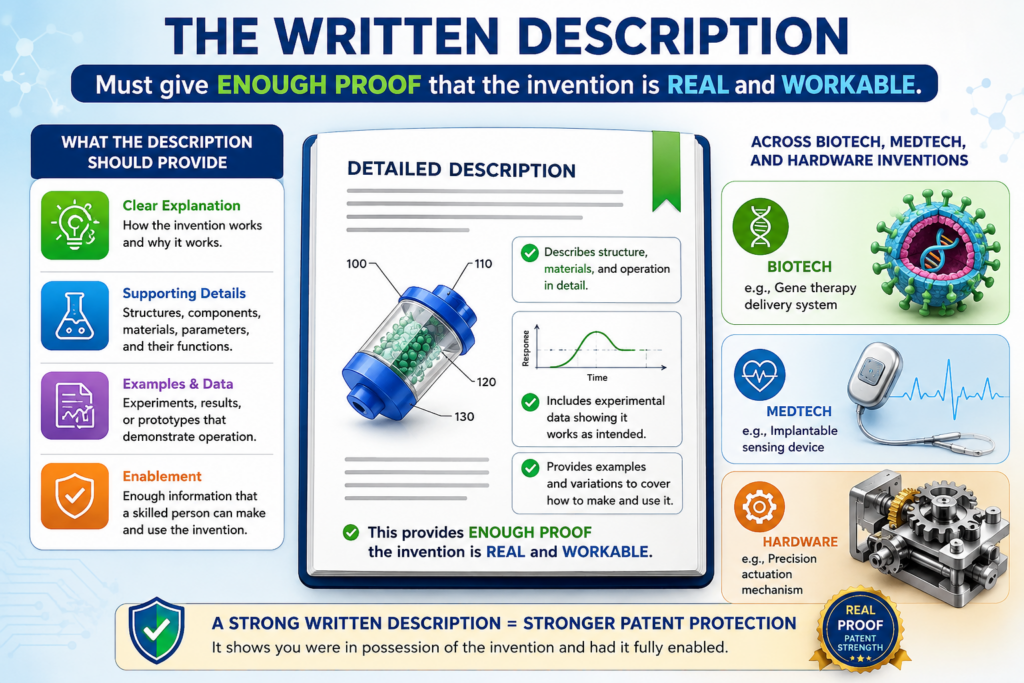
The written description must give enough proof that the invention is real and workable
A strong patent draft does not just say what the invention is. It teaches how the invention can be made and used. This is often where biotech, medtech, and hardware drafts become risky.
The draft may name the idea, but not explain enough detail. It may describe the result, but not the path. It may show the best version, but not enough other versions. It may sound strong at first, but leave gaps that become painful later.
A patent draft review should look for those gaps early. The reviewer should ask whether a skilled person in the field could read the draft and understand how to practice the invention.
This does not mean the draft must include every lab note, every line of code, or every small build choice. But it does need enough detail to support the claims and show that the team had more than a wish.
For biotech inventions, this may mean adding details about sequences, assays, targets, controls, formulations, dosing ranges, cell types, sample types, test conditions, or data patterns.
For medtech inventions, it may mean adding details about device parts, patient contact points, sensors, signal handling, safety checks, user steps, cleaning, calibration, or clinical use settings.
For hardware inventions, it may mean adding details about dimensions, materials, tolerances, assemblies, control logic, power flow, heat flow, or manufacturing choices.
The draft should not force a reader to guess. It should give enough support so the claims feel earned.
The examples should make the invention feel solid, not narrow
Examples are powerful, but they must be handled with care. A good example can make a patent draft much stronger.
It can show a real test, a working build, a clear setup, or a strong result. It can also help show why the invention is different from what came before.
But an example can also make the draft too narrow if it is written the wrong way. If the draft keeps saying that one exact version is the invention, it may make other versions seem less important.
If the example is the only detailed part of the draft, the claims may look too broad compared with the support. A review should check whether the examples support the broader idea instead of shrinking it.
For example, a biotech draft may include test results for one antibody format. That may be useful, but the review should ask whether the invention also covers related formats, fragments, variants, or use cases. A medtech draft may show one catheter design.
The review should ask whether the real point is the tip shape, the sensor placement, the material blend, the delivery path, or the full system.
A hardware draft may show one machine layout. The review should ask whether other layouts can perform the same smart function.
The review should also check whether the examples are written in a way that founders, attorneys, and examiners can follow.
Simple words help. Clear cause and effect helps. Clean drawings help. A patent draft should not hide the invention under dense language.
The draft should support both current use and future growth
A startup patent should not only protect the first use case. It should also support the next steps that are already in sight. This is very important for deep tech companies because the product often changes while the science stays valuable.
The first device may become smaller. The first assay may become faster. The first hardware module may move into a new market. The first medical tool may shift from hospital use to home use.
A good review asks whether the draft has enough support for these natural paths. It may add alternate materials, other sensor types, different patient groups, other dose forms, more device sizes, wider operating ranges, or more ways to connect the system.
These additions should be real and sensible. They should come from the team’s knowledge, test work, design plans, or technical judgment.
This is where a guided process can save a lot of time. Founders often have the right details scattered across slides, lab notes, CAD files, code, test sheets, and team chats. The hard part is getting those details into the patent draft in a clean way.
PowerPatent helps teams turn that scattered invention record into a stronger filing package, with smart AI tools and real attorney review working together. See how PowerPatent helps here: https://powerpatent.com/how-it-works
The best written description feels complete without being bloated. It gives enough examples to show depth. It gives enough versions to show range.
It explains the invention in plain terms, but with real technical support. That is the balance a strong draft review should aim for.
Drawings should make the invention easier to understand and harder to misunderstand
In biotech, medtech, and hardware patents, drawings are not just decoration. They are part of the story. They help explain the invention when words alone may feel too heavy.
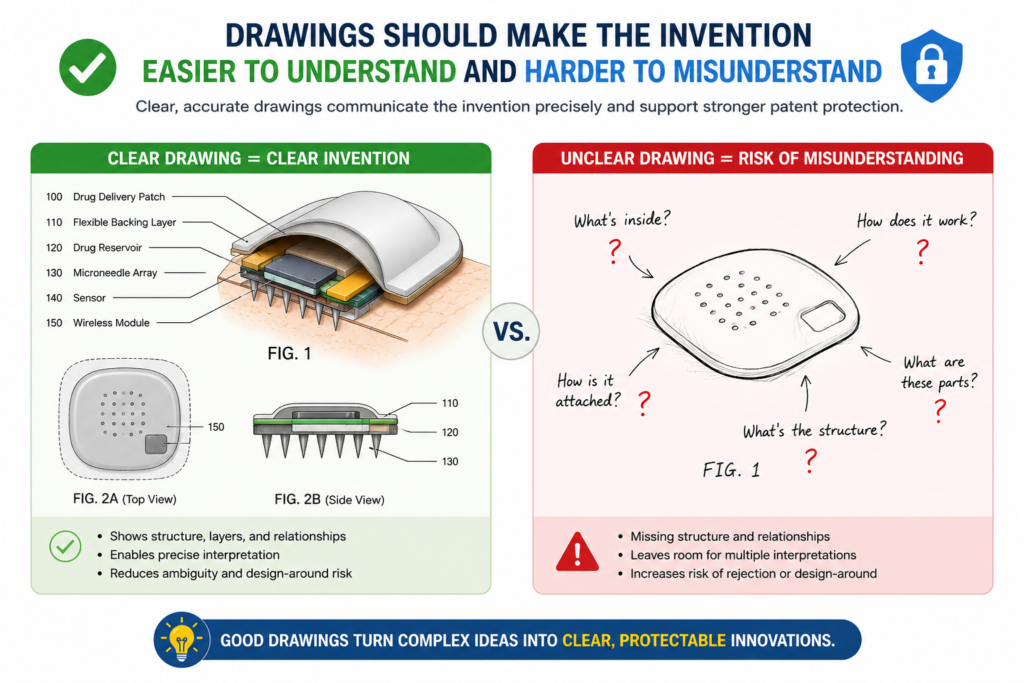
They show how parts connect, how steps happen, how signals move, how samples are handled, how a device touches the body, or how a machine part fits inside a larger system.
A weak draft often has drawings that look nice but do not carry much weight. The figures may show the product from the outside, but they do not show what is new inside.
They may show a clean device shape, but not the parts that make the device work. They may show one process flow, but not the key step that makes the test faster, safer, or more accurate.
A strong patent draft review should ask what each drawing does for the patent. A figure should not be added just to fill space. It should help explain a claim, support a key feature, or show a version of the invention that may matter later.
When drawings are clear, the draft becomes easier to read, easier to defend, and easier for a reviewer to improve.
For hardware inventions, drawings often need to show more than the finished product. They may need exploded views, cross-sections, part layouts, airflow paths, electrical paths, fastener locations, moving states, or manufacturing steps.
A founder may think the final product view is enough, but the inside may be where the invention lives. If the patent only shows the outside, it may miss the part that gives the company real value.
For medtech inventions, drawings should often show the device in use. This does not mean they need to be fancy. They need to be clear.
A drawing may show how a sensor sits near tissue, how a catheter bends, how a wearable patch reads a signal, how a tool fits in a hand, how a screen guides a user, or how a safety feature stops a bad action.
These details can make the invention feel real and can help the draft support stronger claims.
For biotech inventions, drawings may look different. They may be flow charts, assay steps, treatment paths, molecular diagrams, data plots, sample handling flows, or system diagrams.
A biotech figure should make the science easier to follow. It should show the order of steps, the inputs, the outputs, and the point where the invention creates a better result.
The best drawings help protect more than the first version
A patent draft review should not only ask whether the drawings match the current prototype. It should ask whether the drawings support the full invention.
If the figures only show one build, one size, one sample type, one sensor, or one part layout, the draft may feel narrower than it should.
This does not mean the drawings should show every possible version. That would be too much. But they should show enough meaningful options so the patent does not look tied to one exact design.
A hardware draft may show two ways to place a cooling path. A medtech draft may show a handheld version and a mounted version. A biotech draft may show a method that works with several sample types or several targets.
The drawings should also match the words in the draft. If the draft talks about a control module, the drawings should show it. If the claims mention a sample chamber, the figures should identify it.
If the invention includes a user alert, signal processor, fluid path, reagent mix, actuator, implant surface, or pressure control step, the drawings should help the reader see where it fits.
When the figures and words do not match, the patent can feel messy. That can slow the review. It can also create weak spots.
A careful review should compare each key claim feature against the drawings and ask whether the visual support is strong enough.
Clear labels make the patent easier to review and improve
A drawing can be technically correct and still be hard to use if the labels are messy. During review, each label should have a purpose. The same part should not have many names unless there is a reason.
A sensor should not be called a detector in one place, a probe in another, and a module somewhere else without clear meaning. This kind of loose wording can make the patent harder to understand.
Good labels help everyone. The founder can review the draft faster. The attorney can improve the claims with less back-and-forth.
The patent office can follow the invention with less confusion. Future investors and partners can also see that the company has taken its invention seriously.
PowerPatent helps teams organize drawings, technical notes, invention details, and attorney feedback in one cleaner workflow.
That matters because patent review becomes much easier when the whole invention is not spread across ten folders and old email threads. You can see how the process works here: https://powerpatent.com/how-it-works
A strong drawing set should make the invention feel simple, even when the technology is complex. That is the real test.
When a smart reader can look at the figures and quickly understand what problem is being solved, the draft is moving in the right direction.
The review should catch narrow wording before it limits the patent
Many patent drafts become weak because of small words that seem harmless. A draft may say “must,” “only,” “always,” “required,” or “the invention is” when it really means “one version may be.”
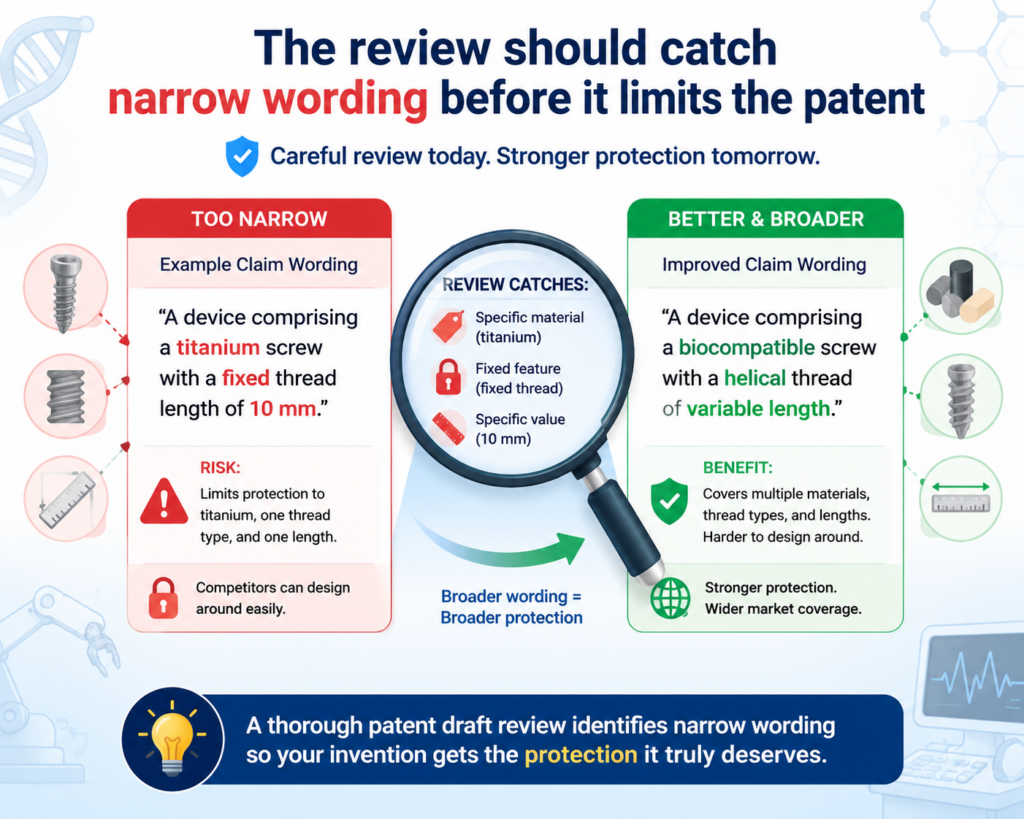
These words can quietly shrink the patent. They can make the invention look smaller than the founder meant it to be.
This is why wording review is so important. It is not about making the draft sound fancy. It is about making sure the language matches the true scope of the invention.
The draft should be clear enough to explain the work, but flexible enough to cover fair versions of the same idea.
A founder may write, “The device uses a stainless-steel needle.” That may be true for the first build. But if other metals, polymers, coated parts, or flexible tips could also work, the draft should not make stainless steel sound like the only option.
A biotech team may write, “The sample is blood.” But if saliva, tissue, plasma, or another sample could work, the draft should make that clear. A hardware team may write, “The motor is mounted above the chamber.”
But if the motor could sit beside or below it, the draft should not lock the invention into one layout unless that location is truly required.
The job of review is to find these traps before filing. Once a patent is filed, adding new matter can become hard or impossible. That means weak wording can follow the company for years.
A good review slows down long enough to ask which words are true limits and which words are just habits from the first design.
The draft should separate required features from helpful options
A strong patent draft tells the reader what is required and what is optional. This sounds simple, but it is one of the hardest parts of drafting.
Technical teams often describe the product as a whole because that is how they built it. But a patent must separate the invention from the product.
The product may have a battery, screen, handle, processor, housing, adhesive layer, fluid port, valve, sensor, or software dashboard.
Some of those parts may be central to the invention. Others may just make the product easier to use. The review should sort them carefully.
For a medtech device, a safety alarm may be required if the invention is about safe treatment control. But if the invention is really about a new sensing layout, the alarm may be optional. For a biotech assay, a certain reagent may be central if it creates the result.
But a certain brand of plate or reader may only be an example. For a hardware system, a specific fastener may be required if it creates a new mechanical lock. But if it only holds a cover in place, it may not belong in the broadest language.
This matters because rivals design around details. They look for extra parts in the patent and ask, “Can we remove this and still get the same benefit?” If the claim includes that extra part, they may have a path around the patent.
A strong review helps remove unneeded limits from broad parts of the draft while keeping those details in the examples where they can still support the invention.
Simple language can still be broad and strong
Some people think strong patents need hard words. That is not true. A strong patent needs clear words.
Simple wording can be very powerful when it is used with care. In fact, clear wording often makes review better because it helps the team spot gaps faster.
The problem comes when simple wording becomes too absolute. A draft can say that a device “may include” a part when the part is optional.
It can say that a method “can be performed” in a certain way when other ways are also possible. It can describe examples without making them sound like the whole invention.
A good review checks for this kind of balance line by line. It looks for hidden limits. It checks whether the same term is used in the same way across the draft.
It asks whether a word is too vague, too narrow, or too tied to one product build. This level of care may feel slow, but it can save a founder from a very costly mistake.
PowerPatent is built to help technical teams move faster without losing this care. Smart software helps structure the invention details, while real patent attorneys review the draft with the legal judgment founders need.
For teams moving fast, that blend can make the difference between a rushed filing and a strong one. Learn how PowerPatent works here: https://powerpatent.com/how-it-works
The best patent wording does not try to impress people. It protects the invention in a clean, fair, and useful way. That is the goal.
The draft should explain the problem in a way that makes the invention feel necessary
A patent draft should not spend pages selling the product. But it should explain the problem clearly. When the problem is clear, the invention makes more sense.
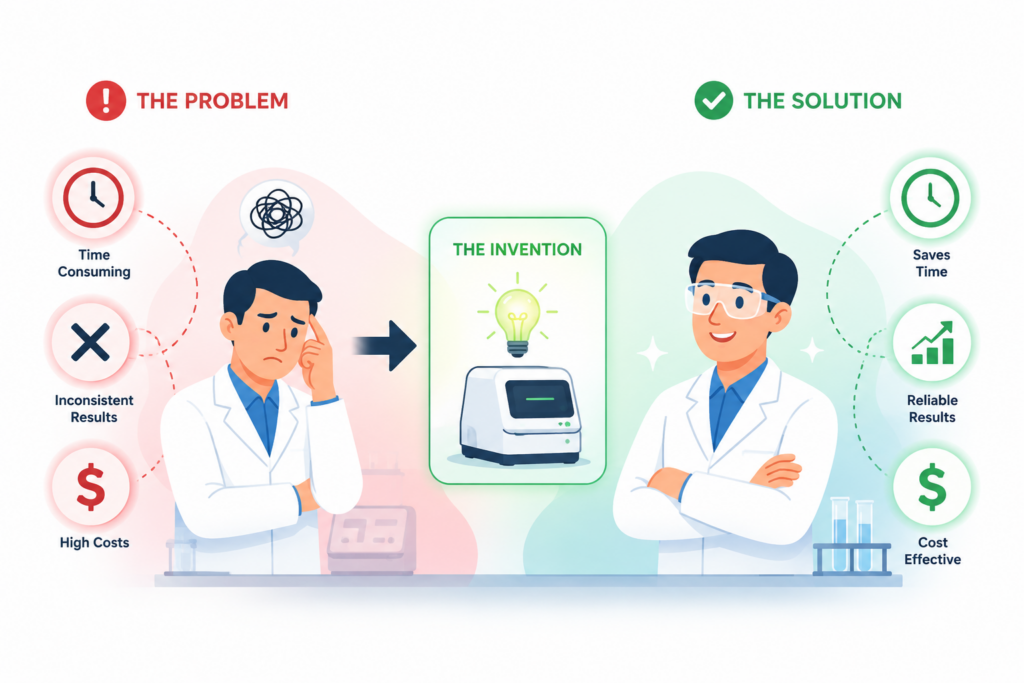
The reader can see why the work matters, why the old way was not enough, and why the new approach is more than a small tweak.
This is especially important for biotech, medtech, and hardware inventions because the value is often hidden inside hard technical work. A new assay may reduce false results.
A device may lower risk during a procedure. A hardware layout may prevent heat damage. A sensor method may cut noise from messy real-world signals. These gains may not be obvious unless the draft sets up the problem well.
A weak draft may say, “There is a need for improved systems.” That sentence does almost nothing. It is too vague.
It does not show what was hard. It does not point to the real pain. It does not help the reader understand why the invention deserves protection.
A better draft explains the real bottleneck. It may say that current tools are too slow for bedside use, too large for home care, too fragile for field work, too costly for wide use, too noisy in live tissue, too hard to scale, or too unsafe for certain users. The words should stay simple, but the issue should be specific.
A review should check whether the draft explains the gap between the old way and the new way. That gap is where the invention lives.
The problem section should support the claims without turning into a sales page
Founders often want to explain why their invention is better. That is natural. But a patent draft should not sound like an ad. It should explain benefits in a grounded way.
The draft can describe better speed, accuracy, safety, size, cost, stability, comfort, or reliability, but it should tie those benefits to technical features.
For example, a medtech draft should not just say the device is safer. It should explain what feature creates the safer result.
Is it a sensor check before energy delivery? Is it a pressure limit? Is it a shape that avoids tissue damage? Is it a control step that stops use when the reading looks wrong?
A biotech draft should not just say the method is more accurate. It should explain what makes it more accurate.
Is it a marker combination? A sample prep step? A binding condition? A timing window? A control group? A data pattern?
A hardware draft should not just say the system is more durable. It should explain the structure or process that makes it durable. Is it a load path, coating, support frame, cooling channel, seal design, or assembly order?
This kind of review makes the draft sharper. It also helps the claims because the claims can then point back to real technical reasons, not broad promises.
The invention story should be clear enough for investors and partners to understand
Even though patents are legal documents, they often become business tools. Investors may skim them. Partners may ask about them. Buyers may review them during a deal.
A confusing patent draft can make a strong invention look weak. A clear draft can help a company show that it knows what it owns.
This does not mean the patent should be written for marketing. It means the invention story should be easy to follow.
The draft should explain what was hard, what the team changed, and what result came from that change. That story should run through the problem section, the summary, the drawings, the examples, and the claims.
A founder should be able to read the draft and say, “Yes, this is what we built, and yes, this protects the thing that matters.” If the founder cannot say that, the draft needs more review.
This is one reason PowerPatent focuses on helping inventors share deep technical details in a guided way before the patent is finalized.
When the attorney can see the real problem, the key design choices, the test details, and the product direction, the patent draft can become much stronger. You can explore the workflow here: https://powerpatent.com/how-it-works
A clear problem section does not need drama. It needs truth. It should show the pain in the old approach and make the new solution feel logical, useful, and worth protecting.
A biotech patent draft needs special care because the science must be backed by detail
Biotech patents are often hard because the invention is not always visible. You cannot hold a biomarker pattern in your hand. You cannot always see a molecular change with the naked eye.
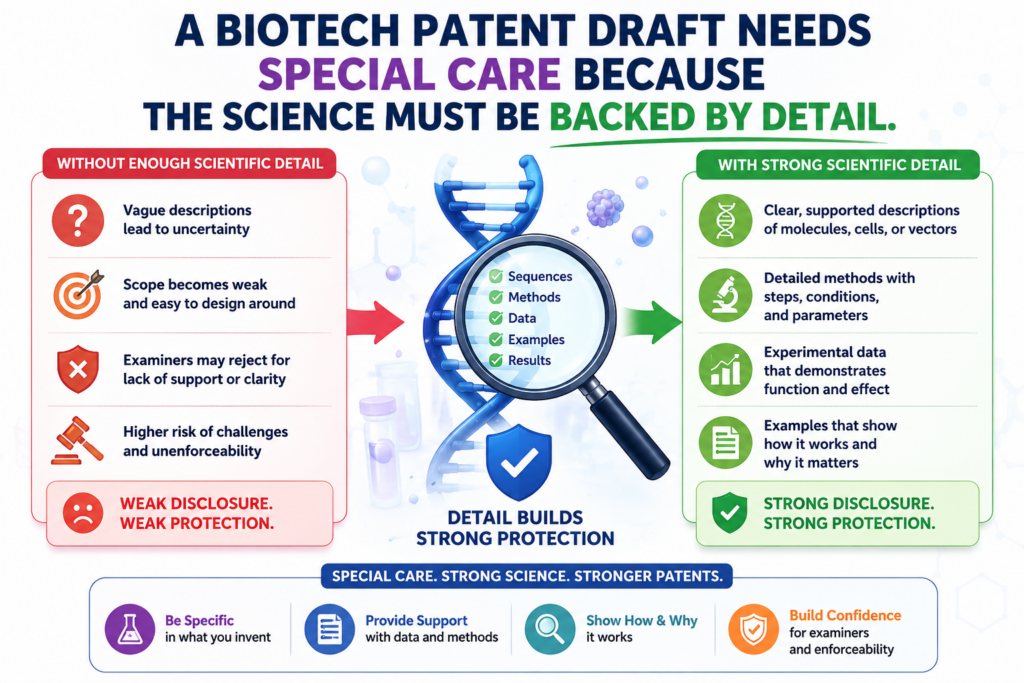
You may be dealing with cells, proteins, genes, assays, pathways, samples, targets, formulations, or treatment steps. That means the patent draft must explain the science with enough detail to make the invention real.
A biotech draft review should ask whether the patent supports the full scope of what the team wants to claim.
If the draft claims a wide group of molecules, targets, patients, or uses, it should include enough facts, examples, and reasoning to support that range. If the draft only has one small example but claims a very broad field, that can create risk.
The review should also check whether the draft is too narrow. Many biotech teams write around the exact experiment that worked first. That can be useful, but it may leave out clear variations.
The team may have tested one concentration, one cell type, one marker set, or one sample source. But the invention may also work across a range. The draft should explain those ranges where they are fair and technically sound.
This is a careful balance. The draft should not overreach. It should not claim what the team cannot support. But it also should not give away natural versions that the team already knows are possible.
The review should look closely at data, examples, and fallback positions
Biotech patent review should pay close attention to experimental detail. The data does not always need to be huge, but it should be useful.
It should help show what was done, what was measured, and why the result matters. When a draft includes data without clear context, the value may be lost.
For example, if a team has assay data, the draft should explain the test setup, sample type, controls, readout, and meaning of the result. If a team has formulation data, the draft should explain stability, storage, concentration, delivery form, or other key features.
If a team has therapeutic data, the draft should explain the model, dose, timing, and observed effect in clear terms.
The review should also ask what fallback positions are included. A fallback position is a narrower version of the invention that may still be valuable if the broad claim changes during review.
In plain words, it is a backup path. Biotech filings often need strong backup paths because the field can be crowded and the details matter.
A draft may include broad marker groups, then smaller marker groups, then certain pairings, then certain thresholds, then certain use cases.
A therapy draft may include broad treatment methods, then dose ranges, patient groups, timing windows, combination therapies, or delivery forms.
A manufacturing draft may include broad process steps, then specific conditions that improve yield or quality.
The draft should protect the platform, not just one lab result
Many biotech startups are not building one isolated result. They are building a platform.
The first data point may prove the engine works, but the company may plan to use the same approach across targets, diseases, sample types, or patient groups. A strong draft review should look for this platform value.
If the patent only protects one result, it may miss the larger company story. If it claims the platform too broadly without support, it may become vulnerable.
The review should help shape a smart middle path. It should show the core method, the logic behind it, and real examples that support the broader plan.
This is where early invention capture matters. Founders should not wait until the last week before a conference, fundraise, or product launch to clean up their patent story.
Biotech details are often scattered across lab books, slide decks, spreadsheets, sequence files, and team notes. The sooner those details are organized, the easier the draft review becomes.
PowerPatent helps biotech founders turn complex science into clearer patent drafts with software that speeds up the process and attorney oversight that keeps the work grounded.
For deep tech teams that cannot afford slow, messy filings, this can be a major advantage. See how it works here: https://powerpatent.com/how-it-works
A biotech patent draft should make the science clear without drowning the reader. It should show enough detail to earn trust, enough range to support growth, and enough care to protect the real engine behind the company.
A medtech patent draft should protect the device, the workflow, and the safety logic
Medtech inventions often sit at the center of many moving parts. There may be a physical device, software, sensors, patient data, clinician steps, safety checks, treatment rules, alerts, disposable parts, sterilization needs, and user training.
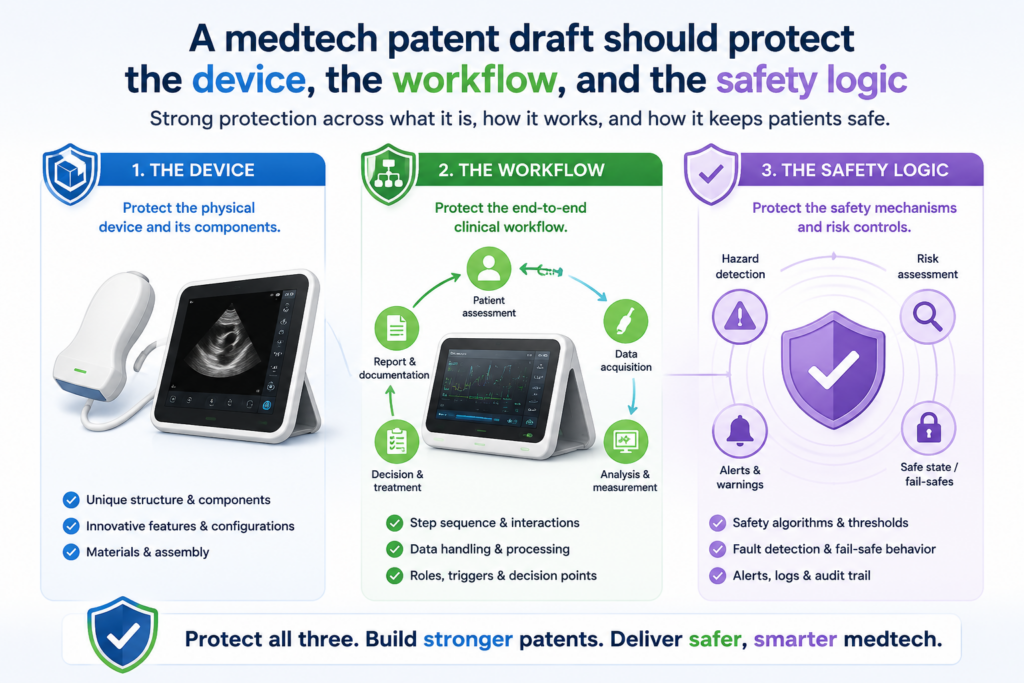
A good patent draft review should not look at the device alone. It should look at the full way the invention creates better care.
A weak medtech draft may focus only on the outer device. It may describe the handle, housing, screen, strap, or probe, but miss the control logic that makes the tool safer.
It may show the part that touches the body, but not the way the device reads signals or guides action. It may describe the app screen, but not the treatment step that makes the system useful.
A strong review asks where the real invention sits. Is it in the shape of the device? Is it in the way sensors are placed? Is it in the way data is filtered?
Is it in the way the device warns the user? Is it in the way the device limits energy, flow, pressure, dose, or motion? Is it in the way a clinician and patient interact with the system?
Medtech patents are often strongest when they protect more than one layer. One claim path may cover the device. Another may cover the system. Another may cover the method of use.
Another may cover the safety check or data process. This does not mean every filing must cover everything. It means the review should ask what layers matter for the business.
The review should test the draft against real use in messy settings
Medical devices do not live in perfect labs. They are used by busy people, in real rooms, on real bodies, under time pressure. Signals can be noisy. Patients can move. Parts can wear out.
Fluids can leak. Users can make mistakes. A patent draft that ignores real use may miss some of the most valuable invention details.
A medtech draft review should ask what happens when conditions are not ideal. What if the sensor loses contact? What if the signal is weak? What if a user applies the device at the wrong angle?
What if the patient has a different body shape? What if the tool is used at home instead of in a clinic? What if the disposable part is not seated correctly?
The answers may reveal patent-worthy features. A safety lock, calibration step, alert rule, shape guide, pressure limit, motion check, or treatment pause may be central to the invention.
These features are often born from hard testing. They should not be left out of the draft.
The review should also check whether the patent explains the user flow. For some medtech inventions, the workflow is where the value lives.
A device may be useful because it reduces steps, prevents wrong use, or helps a less trained person perform a task safely. If that workflow is new and technical, the patent draft should explain it.
The draft should support future product versions and clinical paths
Medtech startups often change the product as they learn from users, pilots, and regulatory work. The first prototype may be wired, but the next version may be wireless.
The first tool may be used by doctors, but later versions may be used by nurses or patients. The first sensor may be optical, but a later version may use pressure, electrical, chemical, acoustic, or motion data.
A strong review should ask whether the draft leaves room for these likely changes. It should include sensible alternatives where the team can support them.
It should also avoid wording that traps the invention inside one care setting or one user type unless that is truly required.
This does not mean a medtech patent should be vague. It should be clear. But it should describe the invention in a way that reflects how medical products grow.
The first device is often only the start. The patent should protect the core idea across the path the company is likely to take.
PowerPatent helps medtech teams capture device details, workflows, drawings, software logic, and safety features in a cleaner review process.
Real patent attorneys then help shape the draft so it is not just fast, but strong. You can see how PowerPatent supports founders here: https://powerpatent.com/how-it-works
A medtech patent draft should make one thing clear: the company did not just build a gadget. It solved a care problem in a technical way. The review should make sure the patent protects that full solution.
A hardware patent draft should capture how the parts work together under real stress
Hardware inventions are often easy to see but hard to protect well. A founder may point to the product and say, “This is the invention.” But in many cases, the invention is not the whole object. It is the way parts work together.
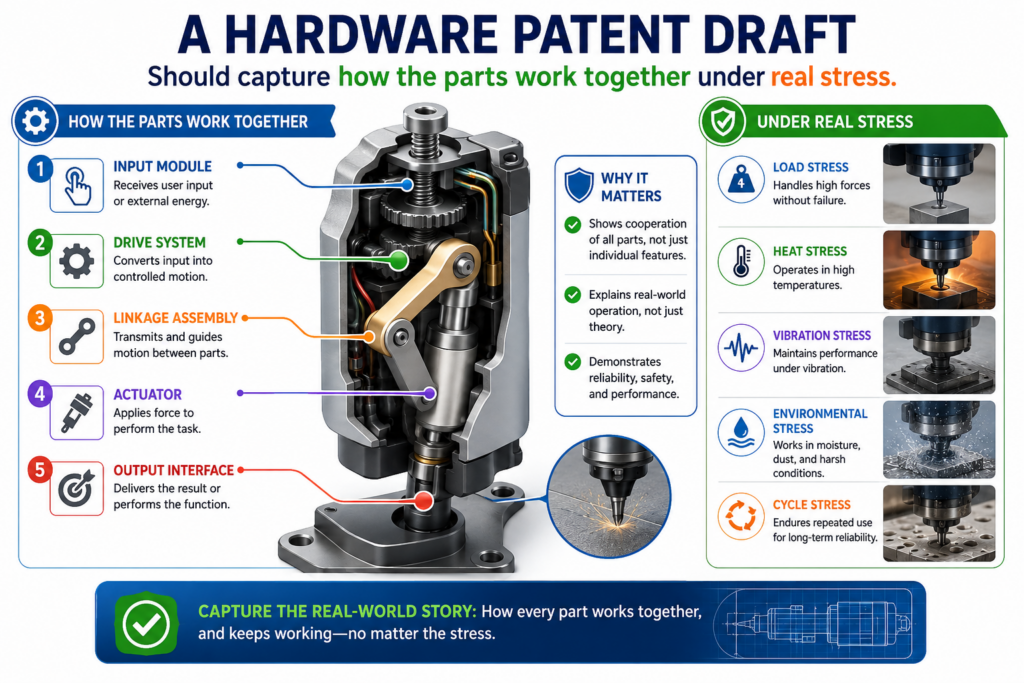
It is the load path, seal, hinge, latch, airflow channel, sensor mount, power layout, thermal path, material stack, assembly order, or control step that makes the product perform better.
A hardware patent draft review should look beyond the outside shape. It should ask what the invention does when force, heat, pressure, vibration, dust, moisture, wear, or repeated use enters the picture.
Many hardware breakthroughs come from solving these real-world problems. If the draft only describes the clean product, it may miss the hard work that makes the product valuable.
For example, a robotics company may invent a joint that stays accurate after many cycles. The key may not be the robot arm as a whole. It may be a bearing layout, preload method, sensor placement, or control loop that handles drift.
A battery hardware company may invent a safer pack layout. The key may be the thermal barrier, vent path, connector placement, or module spacing.
A manufacturing tool company may invent a faster fixture. The key may be the alignment system, clamp sequence, or feedback step.
The review should find that working core and make sure the draft supports it in the claims, drawings, and detailed description.
The draft should not confuse product features with invention features
Hardware products often include many parts. Some are new. Some are standard. Some are there because they are needed for the product to work, but they are not part of the invention. A good review separates these parts.
A draft may describe a housing, base, cover, switch, bracket, fastener, cable, and controller. But the invention may only require a few of those items.
If the broad claim includes every part of the product, the patent may become too easy to avoid. A rival may remove one part, move another, or replace a standard piece and argue they are outside the claim.
The review should ask which parts create the new result. If a seal design allows a device to survive deep water, that seal may matter. If a bracket simply holds a common board in place, it may not belong in the broadest claim.
If a cooling channel allows a smaller device to run longer, that path may be central. If a decorative cover does not affect function, it should not control the scope.
This kind of thinking is practical. It helps the patent line up with how copycats behave. They do not need to copy everything. They only need to copy enough to get the same benefit. The draft should protect that benefit where the invention truly supports it.
Manufacturing details can be just as valuable as the final device
Many hardware inventions are not only about the final product. They are about how the product is made.
A startup may discover a faster assembly method, a better tolerance stack, a lower-cost material process, a cleaner bonding step, or a way to test parts during production. These details can be highly valuable, especially if they help the company scale.
A patent draft review should ask whether the manufacturing side deserves protection. If the team has a novel build process, it may need its own method claims or at least strong support in the description.
If the product looks easy to copy but is hard to make, the process may be where the real moat sits.
The review should also check whether the draft includes enough operating ranges. Hardware often depends on size, force, speed, temperature, pressure, voltage, current, timing, distance, or material properties.
The draft should include ranges where they are useful and supported. It should avoid locking into one value unless that value is truly key.
PowerPatent helps hardware founders pull together CAD details, technical notes, diagrams, test results, and product plans so the patent draft can reflect the real invention, not just a surface-level summary.
With smart software and real attorney oversight, the process helps teams move faster while staying careful. See how PowerPatent works here: https://powerpatent.com/how-it-works
A strong hardware patent draft should feel like a clear map of how the invention survives the real world. It should show the parts, the forces, the choices, and the reason the design works when others fail.
The review should check whether the patent draft covers what competitors may copy first
A strong patent draft review should think like a founder and also like a competitor. This does not mean being negative. It means being honest. If your invention works, someone else may try to build around it.
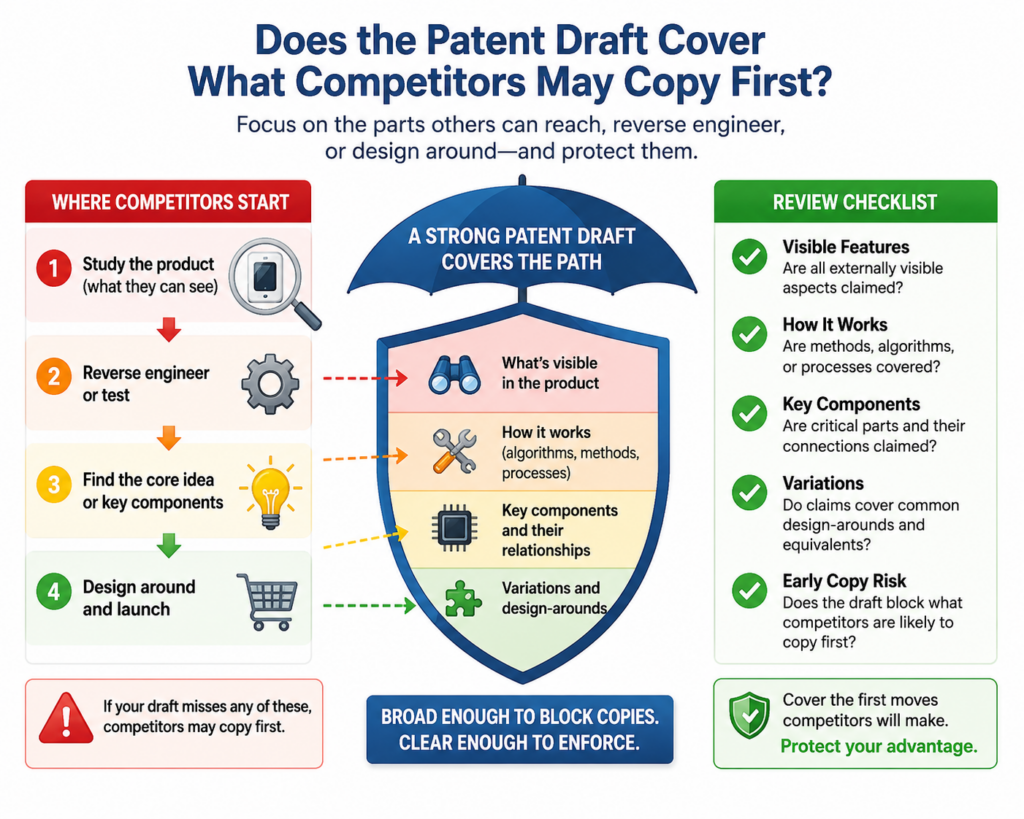
They may not copy your product exactly. They may copy the result. They may copy the clever part and change the parts around it.
They may use a different material, a different sensor, a different shape, a different sample type, or a different software step.
That is why a patent draft should not only describe what your team built. It should also protect the parts that make the invention valuable in the market.
During review, the key question is simple: if another company wanted the same benefit, what would they copy first?
For a biotech startup, a rival may copy the target, the assay logic, the marker group, the sample prep method, the treatment path, or the way results are read.
For a medtech startup, they may copy the sensing method, the safety check, the device-to-app flow, the disposable part, or the treatment control rule.
For a hardware startup, they may copy the internal layout, the thermal path, the assembly method, the material stack, or the control system.
A weak draft may protect the wrong thing because it focuses too much on the company’s current product.
A strong review looks past the product shell and finds the part that others would want. That is the part the draft must explain with care.
The patent should make design-arounds harder without becoming vague
A design-around is when a competitor changes enough details to avoid the patent while keeping the same useful result. This is one of the biggest risks in patent drafting.
Many early drafts make design-arounds too easy because they include small details in the broad claim that do not need to be there.
A medtech draft may claim a sensor in one exact place, even though other nearby places would work. A biotech draft may claim one sample type, even though the same method can work with other sample types.
A hardware draft may claim one material, even though the invention is really about the way force moves through the part.
During review, each claim detail should be tested. The reviewer should ask whether that detail is needed for the invention to work.
If it is needed, it should stay. If it is only one example, it may belong in the written description, not the broadest claim.
This is not about claiming everything. It is about claiming the right thing. A patent that is too broad without support can face problems. A patent that is too narrow can lose value.
The best draft gives fair protection around the real invention and includes enough examples to support that protection.
A founder should review the draft from the buyer’s point of view
A useful trick is to review the patent as if you were trying to buy the company. What would you want to see protected?
What would make the company harder to copy? What would make the technology look like an asset instead of just a product?
This mindset helps founders spot weak spots fast. If the draft protects a feature that customers do not care about, that may not be enough.
If it misses the feature that drives speed, safety, accuracy, cost savings, or performance, the draft needs work. If it only protects today’s version and ignores the next product version, the company may outgrow its own patent.
PowerPatent helps founders review patent drafts through this more practical lens.
The platform helps organize invention details, product direction, technical notes, and attorney input so the draft can better protect the business value behind the technology. You can explore the process here: https://powerpatent.com/how-it-works
A strong review should leave you with more than a cleaner document. It should leave you with confidence that the patent is aimed at the right target.
For biotech, medtech, and hardware teams, that target is rarely just a feature. It is the hard-won technical edge that lets the company win.
The review should make sure the draft supports fundraising, diligence, and future deals
A patent draft is not only read by patent offices. It may also be read by investors, partners, acquirers, board members, grant reviewers, and technical advisors.
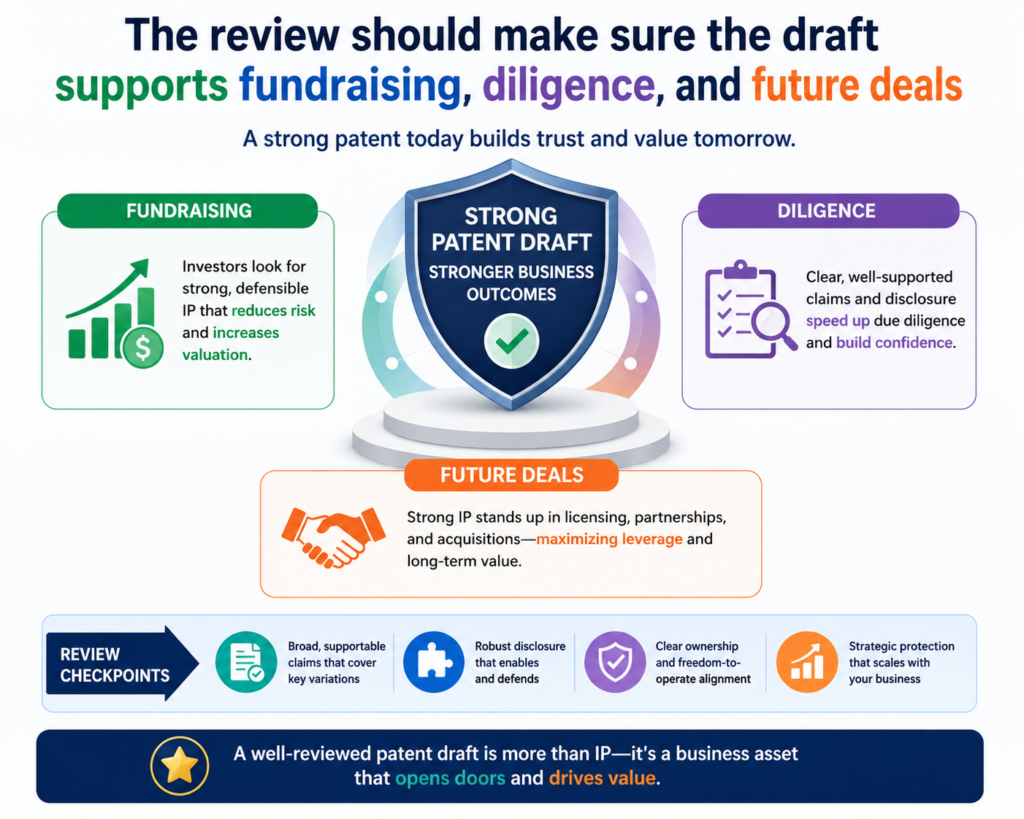
These people may not study every word, but they will look for signs that the company understands its invention and has taken care to protect it.
This is why patent draft review should be tied to company goals. A filing should not feel like a rushed document created just to check a box.
It should show that the team knows what it built, why it matters, and how the protection fits the future of the business.
For deep tech startups, this can matter a lot. Biotech companies may raise money long before revenue. Medtech companies may need partners, clinical work, or regulatory steps before broad sales.
Hardware companies may need capital for tooling, manufacturing, and supply chains. In all of these cases, the patent draft can help show that the company has a real edge.
A weak draft can create doubt. If the claims are too narrow, investors may wonder whether the moat is small. If the draft is vague, partners may wonder whether the team can defend the invention.
If the patent only covers the first prototype, buyers may wonder whether the IP matches the future product line.
A strong review helps reduce these concerns before they appear.
The patent story should match the company story without sounding like a pitch deck
Your patent draft should not be filled with sales language. But it should line up with the company’s real story. If the company says it has a platform, the draft should not read like it only protects one small experiment.
If the company says its device is safer because of a smart control method, the draft should explain that method.
If the company says its hardware is easier to scale, the draft should describe the manufacturing or design feature that makes that true.
This matters during diligence. Diligence is when another party checks the company before investing, partnering, licensing, or buying.
During that process, people may compare the patent draft against the pitch deck, product roadmap, technical data, and market plan. If those pieces do not match, the company may face hard questions.
A review should catch those mismatches early. It should ask whether the draft protects the same thing the founder is presenting as the company’s advantage.
It should also ask whether the draft includes enough backup detail for future product versions, not just the current demo.
A stronger draft can make hard conversations easier
Fundraising and partnership talks often create pressure. Founders may need to explain why their technology is hard to copy.
They may need to show why their approach is not just an idea. They may need to prove that they have thought through the next versions of the product.
A strong patent draft can help with those talks. It gives the founder a clearer way to describe the technical edge.
It can also help the attorney answer questions with more confidence because the invention details are already in the filing.
This does not mean a patent guarantees funding or a deal. It does not. But a thoughtful patent draft can support trust. It can show that the team is serious.
It can show that the company is not leaving key value exposed. It can also help avoid the painful moment when an investor asks what is protected and the answer is unclear.
PowerPatent is built for founders who need speed, but cannot afford sloppy work. The platform combines smart software with real attorney oversight so invention details can move from messy notes into stronger patent drafts faster.
For teams facing fundraising, demos, launches, or partner meetings, that can be a real advantage. See how PowerPatent works here: https://powerpatent.com/how-it-works
A patent draft review should not be treated as a side task. It is part of building a company that others can trust, fund, partner with, and take seriously.
The final review should turn the draft into a stronger filing before it goes out the door
The final patent draft review is the last major chance to catch problems before filing. This step should not be rushed.
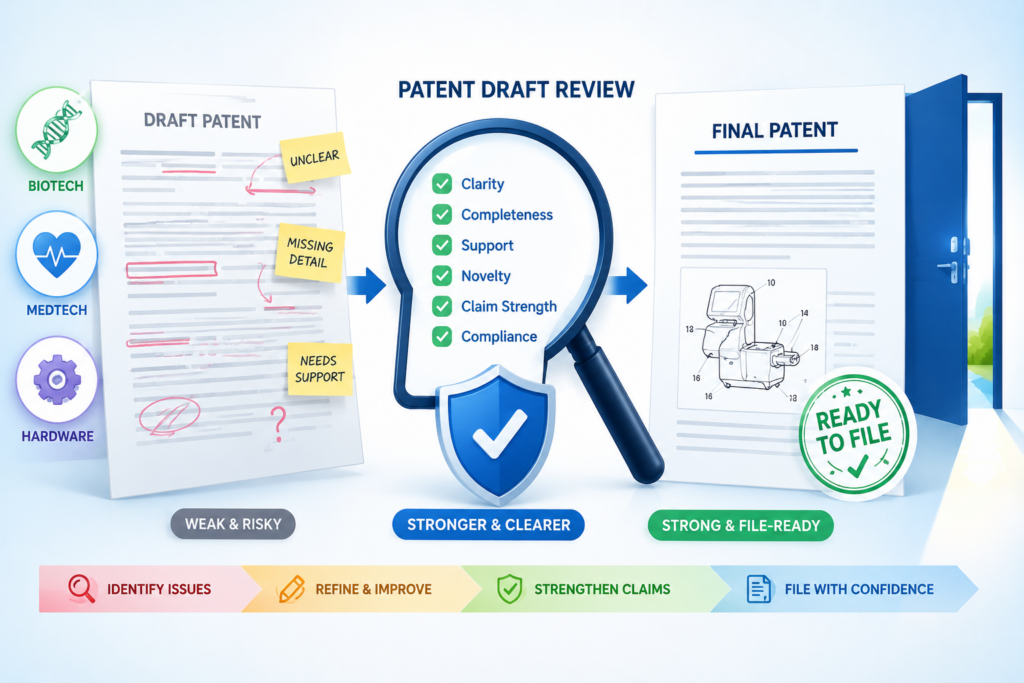
It should also not become a slow, painful loop where everyone edits small words forever. The goal is to make the draft stronger, clearer, and more aligned with the invention before it is submitted.
A good final review looks at the full draft as one connected document. The claims, summary, written description, drawings, examples, and terms should all work together.
If the claims mention a feature, the description should support it. If the drawings show a part, the text should explain it. If the examples prove a result, the draft should connect that result to the invention.
This is where many errors are found. A part may have two different names. A claim may mention a module that is not explained. A drawing number may be wrong.
A biotech example may lack the sample details needed to understand the result. A medtech method may skip a safety step that the device always uses. A hardware draft may describe the outside but not the internal structure that makes the product work.
These issues may seem small, but they can matter. Patent drafts are built from details. When the details are clean, the whole filing becomes easier to understand.
The final review should focus on strength, not perfection
No patent draft can predict every future version of a company. No filing can capture every thought the team has ever had.
The goal is not perfection. The goal is a strong, clear, well-supported filing that protects the real invention and gives the company room to grow.
This is an important point for founders. Many teams wait too long because they want the invention to be fully finished. But deep tech products change. Biotech work keeps adding data.
Medtech designs improve through testing. Hardware products evolve through build cycles. If the team waits for everything to be final, it may create public disclosure risk or lose speed.
The better path is to file when the invention is ready enough to support a strong patent draft, then keep building an IP plan around later improvements.
The review should help decide whether the current filing has enough support for the core invention, enough examples to show real work, and enough room for near-term versions.
The best review process makes founders feel more in control
Patent work can feel confusing when founders are kept outside the process. That is not ideal. The people who built the invention should be able to understand the draft.
They should be able to see what is being protected. They should be able to point out missing details, future versions, and technical choices that matter.
A final review should invite that input without turning the process into chaos. The founder should not have to become a patent expert.
The attorney should not have to chase scattered details across old files. The process should make it easier for both sides to work from the same clear record.
That is the reason PowerPatent exists. It helps founders move faster from invention to filing by combining guided software, organized invention capture, and real patent attorney oversight.
The result is a review process that feels less like a black box and more like a clear path. You can see how PowerPatent helps teams file smarter here: https://powerpatent.com/how-it-works
Before a patent draft goes out the door, the team should be able to answer a few plain questions with confidence.
Does this draft protect the real invention? Does it explain how the invention works? Does it support future product versions? Does it reduce easy design-arounds? Does it match the business value we are building?
When the answer is yes, the patent draft is no longer just a document. It becomes part of the company’s foundation.
Conclusion
A strong patent draft review helps biotech, medtech, and hardware founders protect the real value inside their work before it is too late. It checks the claims, drawings, examples, wording, future versions, and business fit so the filing does more than describe a product.
It helps build a stronger shield around the science, device, or system your team worked so hard to create. With PowerPatent, founders get smart software plus real attorney oversight, so the process feels faster, clearer, and more in your control. See how PowerPatent helps you file smarter here: https://powerpatent.com/how-it-works
Leave a Reply