Writing a software patent spec is not about making your product sound smart.
It is about making your system easy to understand.
That sounds simple. It is not.
A lot of founders, engineers, and product teams know exactly what they built. They can explain it in a meeting. They can walk through the code. They can show the flow in a diagram.
But when it is time to put that same system into a patent specification, things get messy fast. The writing becomes too broad, too abstract, too formal, or too thin. The real logic of the system gets buried under generic language.
That is the problem.
A software patent spec should not sound vague. It should not read like a template. It should not feel like a cloud of words floating around the invention. It should explain the system in a way that is clear, grounded, and useful.
It should help show what the software does, how it does it, why it does it that way, and what different versions can look like.
That is what this article is about.
And if you are building software worth protecting, this is exactly where a modern patent process helps. PowerPatent helps founders and technical teams turn real systems into strong patent filings with smart software and real attorney oversight, so the result is not just fast, but clear and defensible. You can see how it works here: https://powerpatent.com/how-it-works
Why software patent specs go wrong so often
Software teams are used to moving fast.
They build, test, ship, fix, improve, and repeat. The product changes quickly. Features evolve. Architecture grows. Work gets split across services, layers, tools, and workflows. The team understands the moving parts because they live in them every day.
But patent drafting asks for something different.
It asks the team to stop moving for a moment and explain the system in a stable way.
That is where the trouble begins.
The first problem is that software is easy to describe badly. It is very easy to say a system receives data, processes data, generates output, and sends the output somewhere else.
That may all be true. It may even sound formal. But it does not tell the reader much. It does not show what is special. It does not explain the logic of the system. It does not make the invention feel real.
The second problem is that software teams often think in shorthand. Inside the company, people say things like routing layer, state sync, ranking pass, orchestration logic, inference service, feature store, retry path, and policy engine.
Everyone on the team knows roughly what those phrases mean. But a patent specification cannot rely on that kind of shared internal understanding. It has to explain the system in a way that works for an outside reader.
The third problem is fear of being too narrow. Many founders worry that if they describe the actual system too clearly, the patent will only cover that exact version. So they start cutting details.
They make the wording broader and broader. Then the draft becomes generic. Instead of protecting the system, it starts sounding like it could describe almost any software product.
The fourth problem is that people try to sound like patent lawyers.
That usually makes the draft worse.
They stop using plain words. They switch into stiff, formal language. They say a computing device is configured to perform one or more operations on one or more data elements using one or more modules. The sentence is not always wrong. But if the whole spec sounds like that, the invention disappears into fog.
This is why strong software patent drafting is not just a legal task.
It is a translation task.
You are taking a real software system and turning it into a clear written explanation that captures its architecture, behavior, decisions, variations, and value.
That takes care.
It also takes the right process. PowerPatent is built for exactly this kind of work. It helps technical founders capture what they actually built without getting lost in a slow, painful drafting process, and real attorneys help make sure the result is strong. Learn more here: https://powerpatent.com/how-it-works
What a software patent specification is really supposed to do
Many teams think a patent specification is just a long description of the product.
That is not quite right.
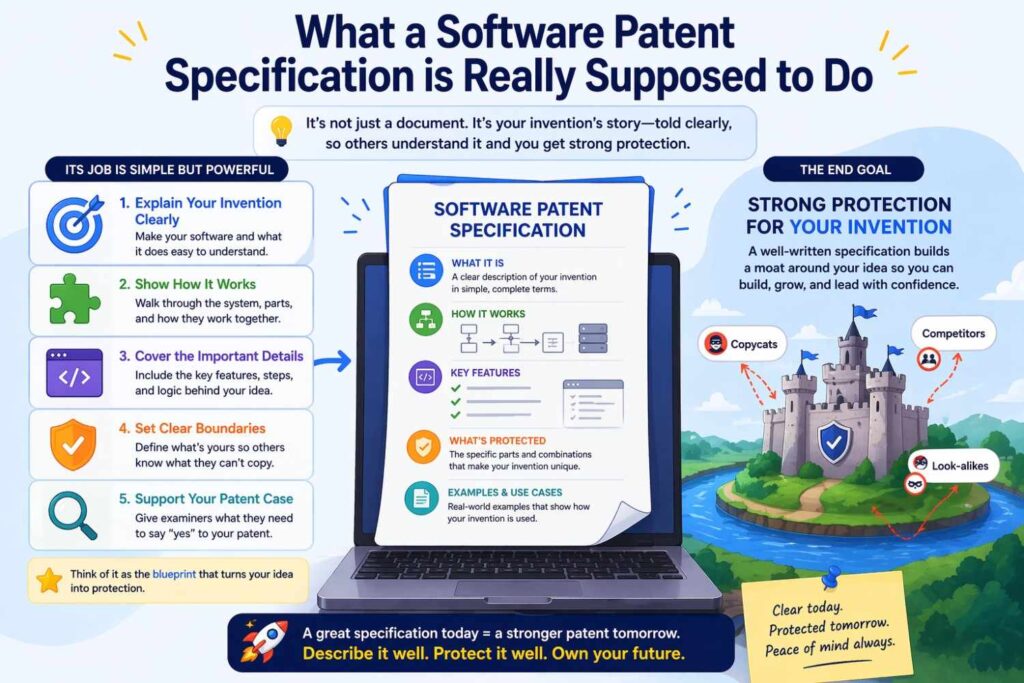
A software patent spec is a detailed record of the invention. It is meant to show that you had the system, understood the system, and could explain how the system works in enough detail to support the claims you want now and later.
That means the spec has several jobs at once.
It needs to explain the software in a way that is technically clear.
It needs to show what problem the software solves.
It needs to describe the structure of the system and the flow of operations.
It needs to reveal the inventive logic, not just the final result.
It needs to give enough examples and variations that broader protection has real support.
And it needs to do all of this without becoming unreadable.
For software inventions, this is especially important because the danger of abstraction is high. Software can be described at many levels. You can describe the user experience.
You can describe the business result. You can describe the general concept. You can describe the internal architecture. You can describe the data flow. You can describe the logic that controls decisions. If the spec stays too high, it gets weak. If it gets too tied to one tiny implementation detail, it may miss broader paths.
The art is in describing the system clearly enough to show the invention, while also showing room around it.
That is why the best software patent specs are not only complete.
They are well-shaped.
They make the reader feel the system.
They show the parts that matter. They explain why those parts are arranged that way. They walk through the flow in a way that makes the technical idea visible.
A good spec should not feel like a dump of features.
It should feel like an organized explanation of a system that solves a real problem in a real way.
Start with the system, not the feature list
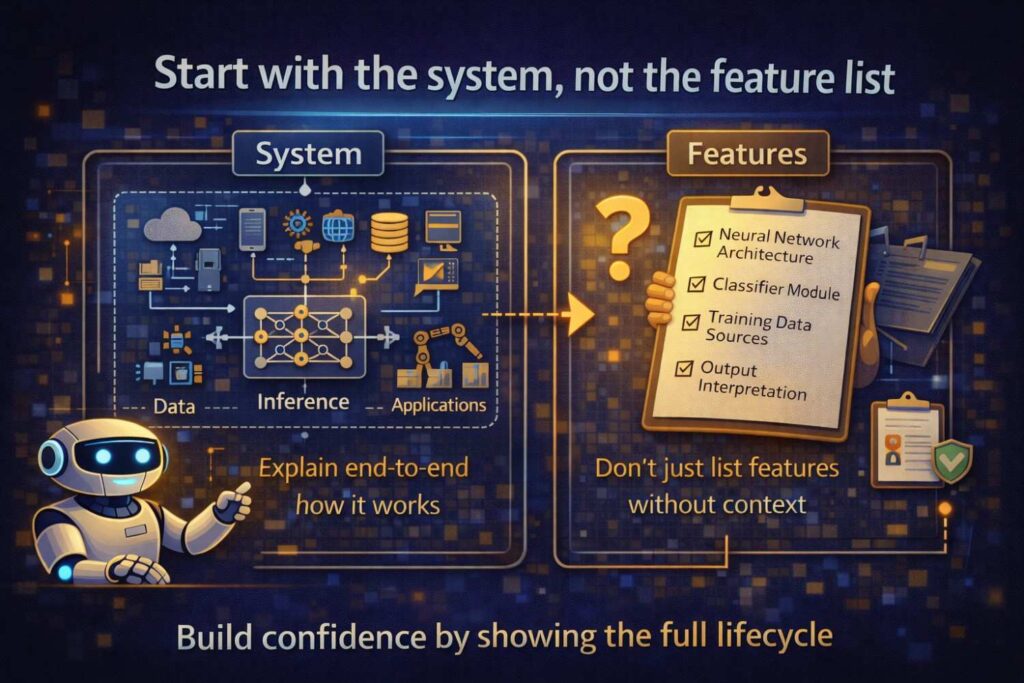
One of the biggest mistakes teams make is starting with a feature list.
They say the product has a dashboard, alerting, scoring, user roles, AI suggestions, synchronization, and reporting. Then they try to turn that list into a patent specification.
That almost never produces great drafting.
Features are not the same as the system.
A system is about relationships.
It is about what talks to what, what happens first, what happens next, what changes state, what triggers action, what data moves where, and what logic shapes the result.
If you start with the feature list, you usually get a spec that sounds like marketing. It names parts of the product, but it does not reveal the architecture or the real inventive step.
The better place to start is with the system itself.
Ask what the software is doing behind the scenes.
What are the main components?
What inputs come in?
What decisions get made?
What transformations happen?
What outputs go out?
What stores state?
What controls flow?
What steps are optional?
What steps are required?
What did the team build that changed how the problem gets solved?
Those questions lead to a much stronger patent spec because they pull the writing toward the operating logic of the software.
That is where protection gets stronger.
If your system uses a ranking stage before a generation stage, say that.
If it routes tasks based on confidence level, explain that.
If it splits work between edge and cloud, show that.
If it creates a shared state record that changes how future actions are taken, describe that clearly.
These things matter much more than a broad list of product functions.
The feature list may still help later. It can remind you of use cases and outputs. But it should not drive the drafting. The system should drive the drafting.
The clearest specs explain the problem before the solution
A software patent spec gets much easier to understand when the reader knows what problem the system is really solving.
This part is often rushed.
The draft says something broad like existing systems are inefficient, inaccurate, slow, or difficult to scale. Then it quickly moves on.
That is not enough.
A stronger spec describes the actual problem in a more grounded way.
Maybe existing tools required manual review at a step that delayed decisions.
Maybe prior systems treated all inputs the same, which created wasted processing and poor results under low-confidence conditions.
Maybe earlier approaches searched too much content without considering trust or permissions, so the outputs looked relevant but were not safe to use.
Maybe systems updated state in separate silos, which caused stale results and inconsistent behavior.
When the problem is clear, the reader is ready for the solution.
That changes the entire feel of the spec.
Now the system is not just a set of software pieces. It becomes a response to a real technical limitation. The architecture starts to make sense. The process flow starts to feel motivated. The inventive choices become easier to appreciate because the reader can see what pressure shaped them.
This is especially useful for software because many products sound obvious after they exist. Once a workflow is clean and fast, people can forget how clunky the old way was. The patent spec should help preserve that contrast.
Do not overdramatize the problem.
Just explain it honestly.
A specific problem leads to a specific solution. That creates a stronger foundation for the rest of the draft.
Describe what the system is, then what it does, then why it works
A lot of weak software specs get the order wrong.
They start with broad benefits. Or they jump into process steps without defining the parts. Or they describe the parts without explaining how they interact.
A much better order is simple.
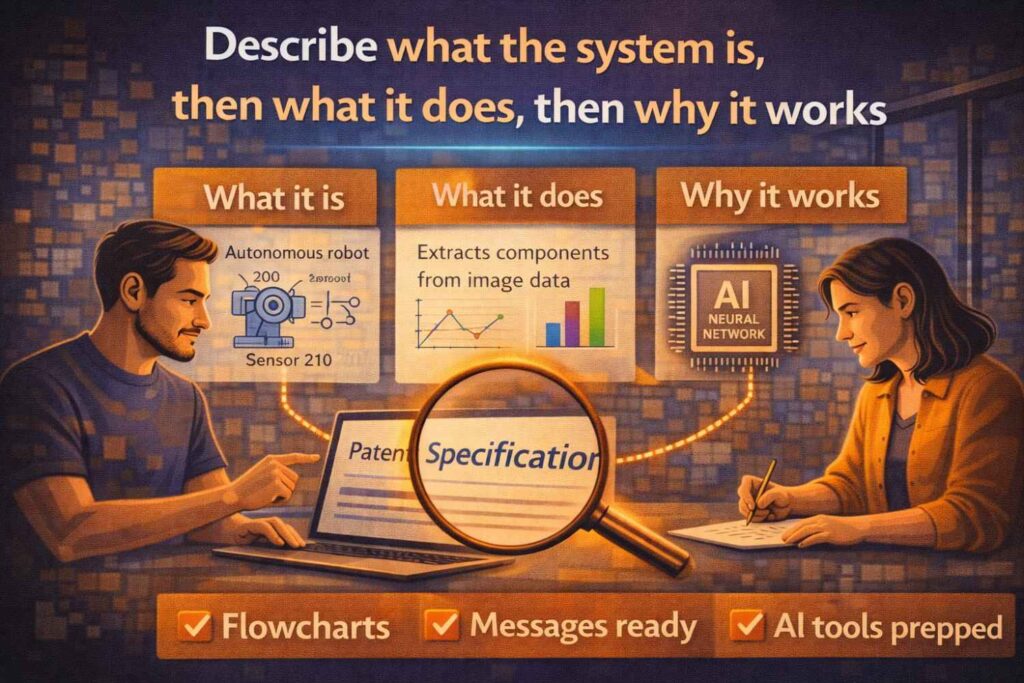
First explain what the system is.
Then explain what it does.
Then explain why it works.
This order helps the reader stay grounded.
When you explain what the system is, you are giving the main components and their roles. That might include an input handler, a ranking engine, a policy layer, a storage layer, a model interface, a synchronization service, a state manager, or some other set of meaningful components.
The point is not to use fancy names. The point is to define the main pieces in a way that makes later explanation easier.
Then explain what the system does.
This is where you walk through the actual flow. Data comes in. A condition is checked. A ranking happens. A state is updated. An output is produced. A validation step occurs. A later action depends on the result. The flow should feel like the software is moving, not like it is frozen in a diagram.
Then explain why it works.
This is the part many drafts skip or underuse.
Why is the ranking stage before the generation stage?
Why does the system split tasks across different services?
Why does it preserve certain records and drop others?
Why does it adjust behavior under low-confidence conditions?
Why does it use certain control rules or thresholds?
When you explain this, you are no longer only describing software behavior. You are revealing the design logic behind the invention. That gives the spec more depth and makes it much more useful later.
This three-part rhythm works well across the entire specification. It helps you keep paragraphs grounded. It reduces the chance that the draft drifts into abstract filler.
Use plain names for parts of the system
There is a strong temptation in software patent drafting to label every part of the system with polished language.
A team may call one part a dynamic processing optimization module, another part an intelligent contextual inference subsystem, and another part a decision orchestration engine.
This usually hurts clarity.
The goal is not to impress the reader with component names.
The goal is to help the reader follow the system.
That means the names should be simple, stable, and meaningful.
If a part of the system ranks items, calling it a ranking engine may be enough.
If a part manages state, state manager may be enough.
If a part applies rules, policy layer may be enough.
If a part handles retries, retry manager may be enough.
If a part stores session data, session store may be enough.
The clearer the name, the easier it becomes to explain what happens when the system runs.
This also helps reduce confusion later. One of the biggest problems in patent specs is terminology drift. The same part gets called a module in one section, an engine in another, a service in another, and a component in another. AI-generated drafts do this a lot. The result is that the reader starts to wonder whether these are different things or the same thing in different clothes.
Simple names help keep the spec stable.
That makes the draft stronger.
It also makes internal review much easier. Engineers can read it and see whether the system is being described honestly instead of trying too hard to sound formal.
Show the architecture without drowning in architecture

Software teams love architecture diagrams.
That makes sense. They are useful. They show relationships quickly. They help internal teams stay aligned.
But in a patent spec, architecture can become a trap if it takes over the whole document.
A weak draft often spends too much time naming boxes and arrows without explaining the inventive point of the relationships. It tells you there is a client, server, database, model, queue, and interface. It may even describe how they communicate. But it never gets to the heart of why the structure matters.
A better spec uses architecture as a support tool, not as the whole story.
The architecture section should help the reader see the main arrangement of the system. It should show where the important logic lives. It should reveal how the system is broken up. It should highlight where the key movement of data or control happens.
Then the rest of the spec should build on that.
It should walk through what those parts actually do.
It should explain how they interact under specific conditions.
It should show how data changes as it moves.
It should reveal how state, timing, ranking, scoring, validation, permissions, or control logic affects the result.
That is how architecture becomes useful.
Too little architecture, and the system feels shapeless.
Too much architecture without behavior, and the system feels static.
The goal is balance.
Make the structure visible, then make the behavior clear.
Describe the flow like a real system, not a simple pipeline
Many software patent specs oversimplify the system into a neat, linear pipeline.
Input comes in. Processing happens. Output comes out.
That can work for some inventions.
But many real software systems are not that simple.
They branch.
They retry.
They score.
They check permissions.
They update state.
They use feedback from earlier results.
They split tasks between services.
They apply conditions before continuing.
If your actual system behaves this way, the spec should show it.
This matters because the richness of the system often holds the inventive value.
A routing condition may be important.
A confidence threshold may matter.
A retry path may matter.
A fallback mode may matter.
A record update that changes future processing may matter.
A permissions check before retrieval may matter.
A post-processing validation stage may matter.
If the draft smooths these things into a straight line, it can lose the shape of the invention.
That is why the flow description should feel like real software.
Not messy for the sake of being messy.
Just honest.
If step B happens only when a score falls below a threshold, say that.
If two services operate in sequence only after a gating condition is satisfied, explain that.
If the system may choose between local execution and remote execution based on device state, bandwidth, or privacy conditions, make that visible.
These kinds of details make the spec stronger because they show how the software really behaves under real conditions.
That is much better than pretending the system is simpler than it is.
Make the data visible
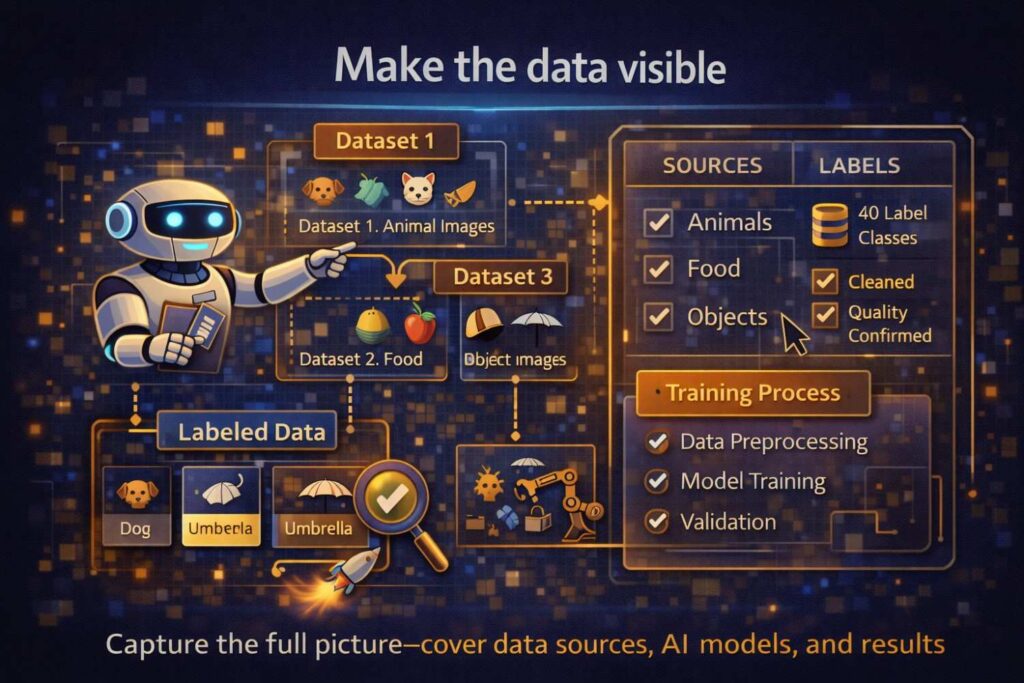
Software systems are not only about components and steps.
They are also about data.
What data comes in?
What form is it in?
What gets extracted?
What gets transformed?
What gets stored?
What gets compared?
What gets scored?
What gets passed to another layer?
What gets discarded?
What gets remembered?
A software patent spec becomes much clearer when it makes the data visible.
This does not mean you need to dump a schema into the draft. It means the reader should understand what kinds of data the system is working with and how the data changes over time.
For example, if the system receives a user query, expands the query, retrieves candidate records, filters them by permission, ranks them by trust and relevance, then selects a subset for downstream use, the draft should say that clearly.
If the system receives event data, creates feature values, applies a model, compares the output to confidence thresholds, and stores the result along with decision context for later reuse, the draft should walk through that.
If the system takes source code context, repository metadata, dependency rules, and generation prompts, then uses those together to create and validate a code suggestion, that should appear in the spec as real data flow, not just as generic processing.
Data is often where the invention becomes concrete.
It helps the reader picture the system. It makes the operations more believable. It supports later claim work because the transformations and relationships are visible.
A spec that says only that the system processes data is almost always too vague.
A spec that shows what the data is and what happens to it is much stronger.
Explain system states and changes over time
A lot of software is stateful.
It remembers something. It tracks progress. It stores context. It uses history. It changes later behavior based on earlier actions. It synchronizes across sessions or devices. It marks things as complete, pending, stale, trusted, rejected, or ready.
These time-based or state-based behaviors often matter a lot.
But many patent specs barely describe them.
They focus on the one-time process flow and forget that the system may act differently after a state change. That can weaken the explanation and hide a big part of what makes the software valuable.
If your system changes based on prior activity, stored signals, user history, prior approvals, synchronization state, previous model results, or earlier routing decisions, the spec should say so.
That does not mean the draft needs to become hard to follow. It just means that time and state should not vanish from the story if they matter.
Maybe a first pass is fast and broad, and a second pass is narrower because state has been updated.
Maybe a session record changes which content gets retrieved next time.
Maybe a status flag determines whether a workflow continues or pauses.
Maybe a cached result is reused only under certain freshness conditions.
Maybe feedback from human review changes how later outputs are ranked.
These are strong software details.
They show that the system is not just a one-time processor. It is a living system that behaves over time in a structured way.
That makes the spec more realistic and often more valuable.
Separate the user view from the system view
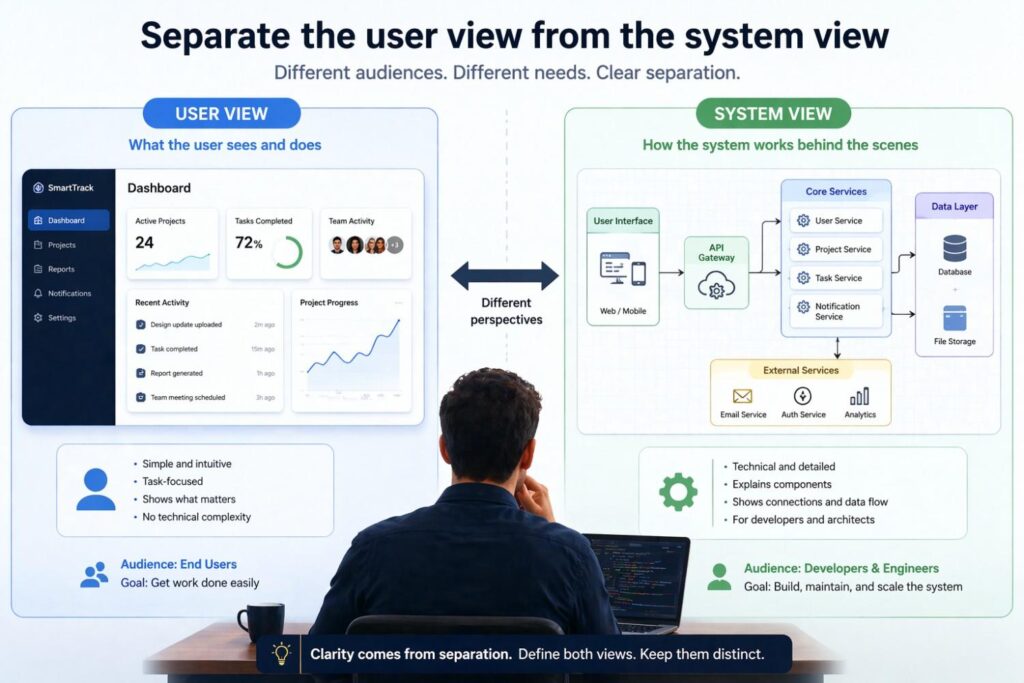
Software products often look simple from the outside.
A user clicks a button, gets an answer, sees a suggestion, receives a score, or triggers an action. That is the user view.
But the patent specification usually needs the system view.
The user view matters because it provides context. It may explain the input, the output, or the visible effect. But if the draft stays too close to the user interface, it can miss the real invention.
The system view goes deeper.
It explains what happens after the input arrives.
It shows how requests are parsed, how records are selected, how rules are applied, how models are invoked, how memory is handled, how output is filtered, how state is updated, and how downstream actions depend on earlier results.
This distinction matters a lot for software because many teams accidentally write product copy instead of system description. They talk about what users can do. They talk about the improved experience. They talk about the convenient result.
That is not enough.
The patent spec needs to go behind the screen.
If the invention truly lies in the user interaction itself, then yes, describe that carefully. But many software inventions are really about internal logic, architecture, orchestration, validation, or data handling. The spec should make that visible.
A strong drafting habit is to ask, after every user-facing statement, what the system is doing underneath.
That question usually leads to better patent writing.
Describe one strong embodiment before chasing every variation
Teams often try to cover everything too early.
They worry about missing versions of the product. They want the spec to be broad. They want to mention alternatives. So they start scattering many possible options into the draft before one core embodiment is explained clearly.
This usually makes the writing weaker.
The better approach is to build one strong embodiment first.
Show one clear version of the system.
Explain the parts.
Walk through the flow.
Describe the data.
Show the conditions.
Explain the outputs.
Reveal the design logic.
Once that base embodiment is solid, then add variations.
This works because the reader needs an anchor.
Without an anchor, the spec becomes a pile of possibilities. The system starts to blur. The invention becomes harder to follow. Broadness turns into vagueness.
But once one embodiment is clear, the alternatives become much easier to understand.
Now you can say that the ranking stage may use different signals. Or the validation stage may occur before or after a model pass. Or the state may be stored locally, remotely, or in distributed form. Or the feedback signal may come from users, reviewers, or automated metrics. Those variations feel meaningful because the core embodiment already exists.
This is how strong breadth gets built.
Not by starting with clouds.
By starting with something real and then expanding outward.
Use examples that make the system easier to see
Examples are powerful in software patent specifications.
They make abstract explanations concrete. They reveal the flow. They force the writer to fill in missing pieces. They help future readers understand what the invention is really doing.
Yet many software specs avoid examples because teams worry they will be too narrow.
That fear is overstated.
A good example does not trap you. It helps support you.
If the system improves retrieval for an AI assistant, show an example query, a retrieval stage, a trust filter, and a final selected context set.
If the system routes low-confidence events to a deeper validation stage, show one event that goes through the high-confidence path and another that takes the slower path.
If the system generates code using repository context and dependency rules, show a case where a proposed output is accepted and another where it is blocked or revised.
These examples help the reader see what the system is actually doing.
They also improve the rest of the drafting. Once an example exists, it becomes easier to identify useful variations, stronger claim angles, and places where the original explanation was too thin.
The best examples are not random.
They are chosen because they illuminate the inventive logic.
They show the system under conditions that matter.
They reveal how the design solves the original problem.
That is what makes them valuable.
Explain the rules that shape system behavior
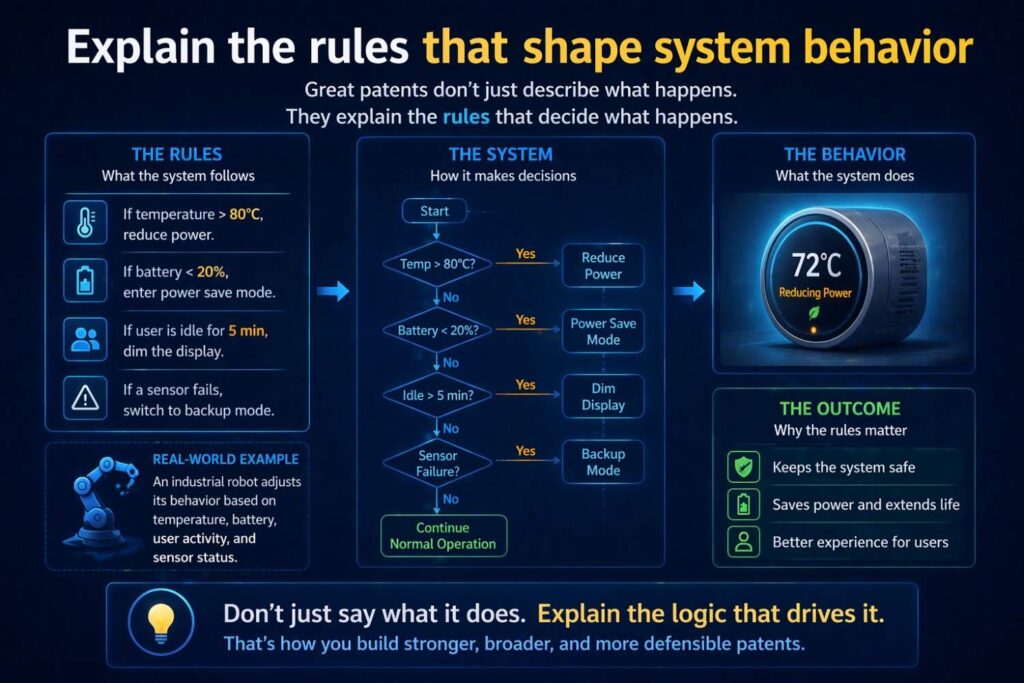
Software systems rarely act with no rules.
Something governs decisions.
A score threshold.
A policy check.
A routing condition.
A time window.
A permission setting.
A confidence range.
A retry limit.
A source trust value.
A dependency rule.
A session state condition.
These kinds of rules matter a lot in software patents because they often define how the system behaves differently from other systems.
If the specification ignores them, the invention can start sounding like generic automation.
If the specification explains them, the behavior becomes sharper.
You do not always need exact values. You do not need to hard-code the numbers into the spec unless that matters. But you should still explain what kinds of rules shape the flow.
Maybe the system routes an item to deeper review if the score falls below a threshold.
Maybe it blocks use of a source if permissions are missing.
Maybe it preserves a memory record only if the confidence and recency exceed certain levels.
Maybe it triggers fallback execution when a resource constraint is detected.
Maybe it prefers local execution when privacy conditions apply.
These rules turn software from a black box into a designed system.
That is important.
It shows that the invention is not just an outcome. It is a controlled process shaped by meaningful decisions.
Do not hide the hard part of the system
Many founders and engineers instinctively simplify the difficult part when they explain their software.
Sometimes they do this because the hard part feels too technical. Sometimes because they assume it is obvious. Sometimes because they think the patent should stay broad.
That is a mistake.
The hard part is often where the invention lives.
Maybe the hard part is how the system selects context under limited space.
Maybe it is how state stays synchronized across disconnected sessions.
Maybe it is how routing happens without adding latency.
Maybe it is how rules and models work together.
Maybe it is how the system handles uncertainty.
Maybe it is how multiple signals are combined before output.
If that is the hard part, the spec should not run away from it.
It should explain it clearly.
Not with unnecessary jargon. Not with code dumps. But with enough detail that the reader can understand what challenge the system had to overcome and how the design addresses it.
This is where many weak specs fail. They smooth over the technical heart of the invention and replace it with generic function language.
That hurts later.
A better spec leans into the hard part. It makes the difficult design choice visible. It helps the reader understand why the system is built that way. It gives the invention texture.
That is what strong software patent drafting looks like.
Use diagrams as discipline tools, not decoration
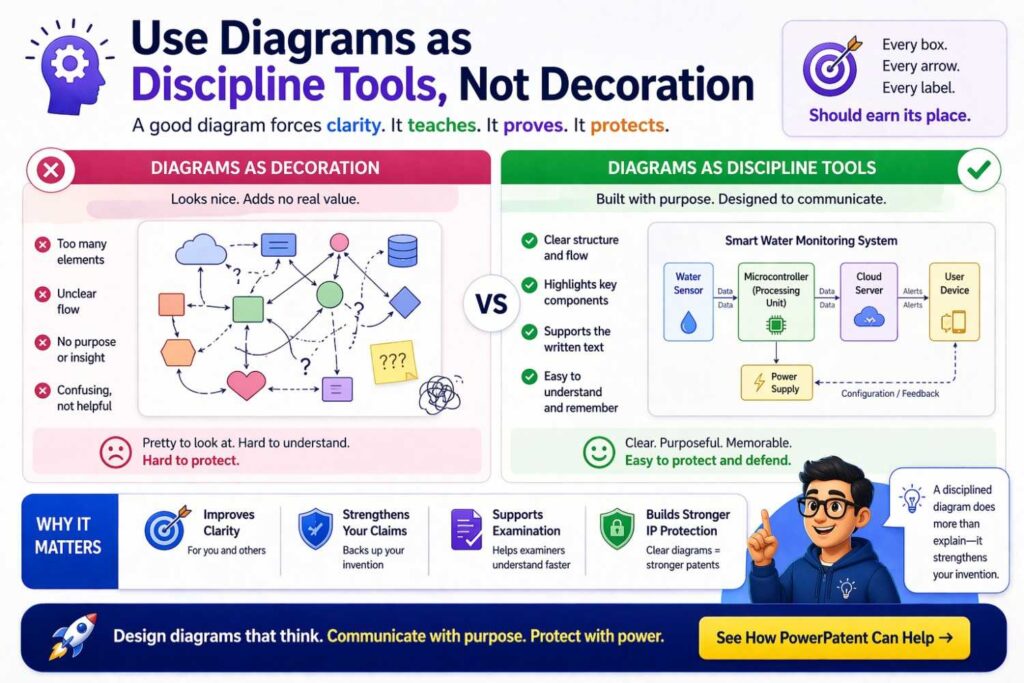
Figures matter a lot in software patent work.
But their value is not only that they help explain the system to the reader.
They also help discipline the drafting itself.
A good figure forces clarity.
If you cannot show the architecture, the flow, the state transitions, the ranking logic, the interaction points, or the validation sequence, that may be a sign the invention has not yet been captured clearly enough in words.
This is why figures should not be treated like decoration added near the end.
They should be part of how the invention gets understood.
A system diagram can show meaningful components and relationships.
A flow diagram can show condition-based movement.
A sequence diagram can show interactions over time.
A state diagram can show how system behavior changes based on previous actions.
A data flow diagram can show transformations between stages.
These are all useful depending on the invention.
The key is that the figures should reflect the real system, not just a generic technical environment.
If the figure contains only broad boxes like server, client, database, and model, it may not be doing enough. If it shows where the actual inventive logic occurs, it becomes much more helpful.
Then the written description can explain the figure in a grounded way.
That makes the entire spec stronger.
The best software specs describe alternatives on purpose
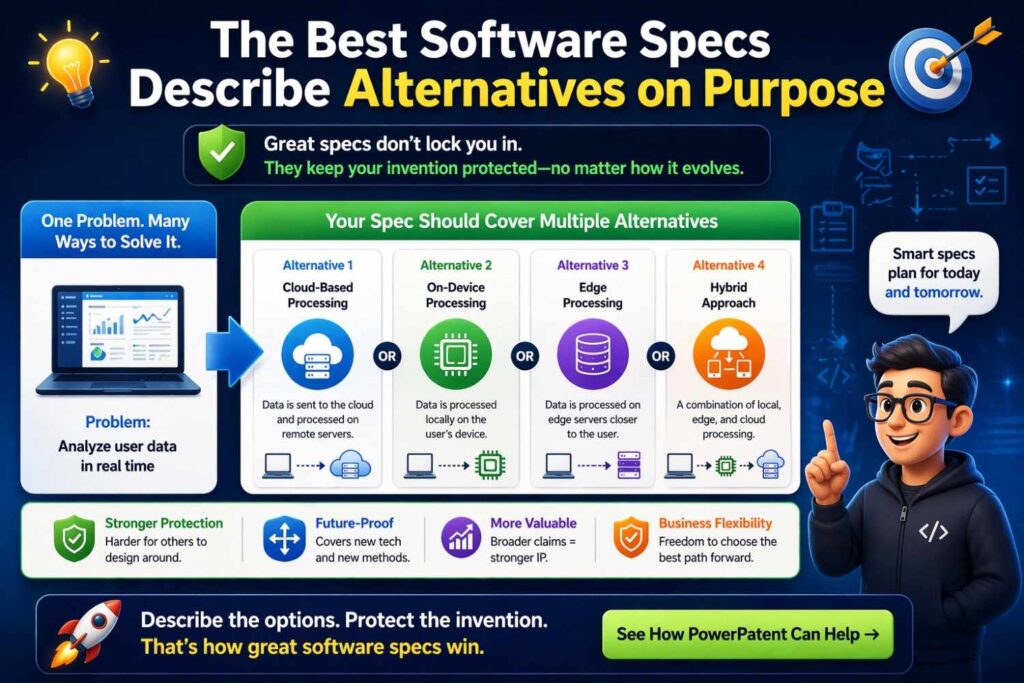
A good patent spec does not stop at one embodiment.
But it also does not dump random alternatives into the draft.
The alternatives should be purposeful.
They should reflect real ways the same inventive concept can appear in different forms.
Maybe the same flow can operate with different input types.
Maybe the same ranking logic can use different scoring signals.
Maybe the same state update can be stored in a local cache, distributed store, or centralized record.
Maybe the same orchestration pattern can use different model types.
Maybe the same permission-aware retrieval structure can work across different repository sources.
These are good variations because they track the same core technical idea.
They help broaden support while staying tied to the invention.
This is much better than adding generic sentences that say parts may be replaced, reordered, combined, or omitted in various embodiments. Those sentences are not always useless, but they do not do much on their own.
Real alternatives do more.
They show that the inventors understood the shape of the invention beyond one single version.
That is what gives the draft more strength later.
Write for a smart reader outside the company
A strong software patent specification does not assume the reader already knows your product.
That sounds obvious, but many drafts still fall into internal language, internal assumptions, and internal shortcuts.
The best standard is this: write for a smart technical reader outside the company.
This reader understands software. They can follow a system. They know what a queue, score, state, threshold, cache, model, or service is. But they do not know your architecture. They do not know your company language. They do not know what your team means when it says smart matching or adaptive control or context memory unless you explain it.
That standard is very useful.
It keeps the writing plain enough to be clear, but technical enough to stay accurate.
It also helps expose weak sections. If an outside reader would not understand how the system works from this paragraph, the paragraph probably needs work.
You are not writing for insiders only.
You are writing a record that must stand on its own.
That is why clarity matters so much.
This idea matters more than most teams think.
A software patent spec is often written by people who are very close to the system. They built it. They argued about it. They named the parts. They understand the shortcuts. They know which details matter. That closeness is useful for invention capture, but it can also create blind spots.
What feels obvious inside the company may be unclear outside it.
That gap creates real risk.
A patent spec does not get the benefit of internal memory. It does not get the benefit of hallway context, old design meetings, product demos, or team shorthand. It has to stand on its own. That is why writing for a smart reader outside the company is not just a style preference. It is a business discipline.
The right outside reader is not a random beginner.
It is someone technically capable who understands software systems, but does not know your product, your team vocabulary, or the story you have been telling yourselves internally. If that reader can follow the spec clearly, the draft is usually in much better shape.
Internal clarity is not the same as external clarity

Many teams make the same mistake.
They review a draft and say it looks fine because everyone in the room understands it.
That is not a strong enough test.
Of course the team understands it. The team already knows what the system does. They know what the missing words are supposed to mean. They know that “the routing layer” really refers to a confidence-based decision path with two validation modes. They know that “memory sync” is actually a sequence involving cache freshness checks, state reconciliation, and update timing.
But the draft may not say any of that clearly.
This is where companies get fooled by their own familiarity.
The document feels clearer than it is because the readers are unconsciously filling in the missing explanation. That is dangerous in patent drafting because the spec has to work without that invisible support.
A good business habit is to assume that internal review alone is never enough to test clarity. A draft should be evaluated as if the reader has strong technical ability but zero exposure to your internal product culture.
That mindset catches hidden gaps much earlier.
Your future reader may matter more than your current one
When companies review patent drafts, they often focus on the immediate audience in front of them.
Maybe that is the founder.
Maybe it is the internal engineering lead.
Maybe it is outside counsel.
But the more strategic question is this: who may need to rely on this document later?
That future reader matters a lot.
It could be a patent examiner trying to understand what is actually new.
It could be litigation counsel years later.
It could be an investor doing diligence.
It could be a buyer reviewing the strength of the portfolio.
It could be a future team member trying to understand what the company believed was inventive.
It could be another attorney handling continuation strategy.
None of those readers will have the benefit of today’s internal context.
That is why smart businesses draft with future readability in mind. They do not only ask whether the current team can follow the spec. They ask whether the document will still make sense later, after the product evolves, the team changes, and the original discussions are gone.
That is a very strategic way to think about clarity.
A clear spec makes business handoff easier

Patent work does not stay with one person forever.
That is especially true in growing companies.
Over time, there are handoffs between founders, engineers, product leaders, IP counsel, investors, outside firms, and sometimes acquirers. When a patent spec is hard for an informed outsider to follow, each handoff becomes slower and riskier. People start rebuilding context from scratch. They make assumptions. They misread what matters. They spend time trying to decode what the original team meant.
That is wasted effort.
A clearer spec reduces that burden. It acts like a durable record of the invention rather than a puzzle that only the original builders can solve.
For businesses, this has real value. It means less friction during financing, diligence, continuation planning, portfolio review, and internal transition. It also means the company is less dependent on one or two people to explain what the filing really covers.
That is not just nice to have.
It is a real operational advantage.
Product language and patent language should not drift too far apart
There is another reason to write for a smart outsider.
It helps keep the patent aligned with the business.
When drafting gets too wrapped up in internal shorthand, the spec may end up reflecting a private version of the system that no outsider can connect to the real product story. On the other hand, when drafting becomes too abstract, it can drift so far from the product that it stops protecting the real moat.
Writing for an informed outsider creates a useful middle ground.
It forces the company to explain the system in a way that connects to real technical behavior without becoming trapped in company-only language. That balance helps preserve alignment between what the business builds, what the patent says, and what outsiders will later believe the patent protects.
That alignment matters a lot.
A patent portfolio is more valuable when it feels tied to the actual business, not to a foggy internal description that outsiders struggle to decode.
Clear outsider-facing writing helps reveal what is truly inventive
One hidden benefit of writing for an outside reader is that it pressures the team to separate the ordinary parts of the system from the real invention.
Inside the company, everything may feel important because the whole product matters. But an outside reader forces a sharper question: what would this person see as the actual technical point once the internal shorthand is stripped away?
That is a powerful review lens.
If the draft still makes the inventive part stand out to a smart outsider, the spec is probably on solid ground. If the inventive part disappears once the internal language is removed, the team may not yet be describing it clearly enough.
Businesses should use this as a strategic checkpoint. A patent filing should not depend on insider familiarity to make the invention sound meaningful. The invention should remain visible even after the company-specific labels are removed.
That makes the filing stronger and easier to work with later.
Actionable ways to draft for a smart outside reader

Companies do not need to guess how to apply this. There are practical ways to build this habit into the drafting process.
Replace company-only terms with functional descriptions first
Internal labels can still be useful, but only after the role is clear. Before using a company phrase like “adaptive trust mesh” or “signal fusion layer,” explain what that part of the system actually does in plain terms. This prevents the draft from leaning too hard on names that only make sense internally.
Add one sentence of meaning after every major component name
A simple discipline helps a lot here. Every time a major component is introduced, follow it with one sentence that explains its job in the system. This small habit prevents the draft from becoming a wall of named parts without clear function.
Review the draft with the “new technical hire” test
Imagine a strong engineer joining the company tomorrow. They know software well, but they do not know your product. Could they read the spec and understand the invention without a live walkthrough? This is a much better review test than asking whether the current team understands it.
Mark every sentence that depends on shared context
During review, ask which sentences only make sense because the team already knows the backstory. These are often the most dangerous lines in the draft. They may sound fine internally while hiding missing explanation.
Create a short outsider summary before the full draft is finalized
Before locking the full specification, write a one-page version meant for an informed outsider. Explain the problem, the core system, and the key design logic in plain language. If that summary is hard to write, the full draft likely still has clarity problems.
Strong outsider readability improves patent portfolio value
Clear drafting does more than help one filing.
It improves the whole portfolio over time.
Why? Because later filings often build on earlier ones. Continuations, follow-on applications, and portfolio strategy all become easier when the original filing is easy for informed outsiders to understand. The clearer the base document, the easier it is to identify what new claim paths exist, what additional embodiments may be worth filing, and where the business has room to expand protection.
A weak base spec does the opposite. It slows everything down. It creates uncertainty. It makes each new portfolio decision more expensive because the team first has to reconstruct what the old filing actually captured.
For businesses that want patents to become a real asset class, not just isolated filings, outsider readability is a strategic advantage.
It improves reuse.
It improves speed.
It improves confidence in future portfolio moves.
If the draft needs a guide, it is not clear enough yet

This is a simple rule, but a very useful one.
If the patent draft only works when someone from the company is there to explain it, the draft is not yet doing its job.
That is the standard businesses should hold.
A strong spec should not require a translator from inside the company to make sense of it. A smart outsider should be able to follow the architecture, the flow, the important decisions, and the inventive point by reading the document itself.
That does not mean every outsider will instantly become an expert in your product. It means the document should carry its own weight.
When businesses draft with that standard in mind, they usually produce stronger specifications, smoother handoffs, better future claim support, and more credible patent assets overall.
That is why writing for a smart reader outside the company is not just a drafting trick.
It is a smart business move.
Keep the tone formal, but do not make it stiff
Patent writing does need some formality.
It should be careful. It should be precise. It should avoid slang and loose phrasing.
But formal does not mean stiff.
A lot of software patent specs become hard to read because they try too hard to sound official. The sentences get long. The verbs get weak. The nouns get abstract. The paragraph says everything in the most indirect possible way.
That is not necessary.
You can be formal and still be clear.
You can say the system receives a request, checks a permission state, retrieves candidate records, ranks the records, selects a subset, and provides the subset to a generation service. That is formal enough. It is also readable.
You do not need to say the computing environment may be configured to facilitate provision of one or more candidate records in response to one or more determinations. That kind of sentence usually adds fog.
Clear writing is not less professional.
In software patent work, it is often more useful.
It makes the invention easier to understand. It helps expose weak logic. It makes internal review better. It reduces the chance that the draft turns into generic legal-sounding filler.
That is a big reason startups like PowerPatent. The process is built to keep patent work founder-friendly and clear, while still involving real attorneys who know how to turn that clarity into strong filings. See how it works here: https://powerpatent.com/how-it-works
Show where the invention begins and where ordinary computing ends
One thing that helps a software patent spec a lot is separating the inventive part from the ordinary computing environment.
Yes, most software runs on typical hardware. It may use processors, memory, storage, and networks. Fine. That can be described briefly where needed.
But the real focus should be on where the invention starts.
What is the non-obvious system behavior?
What part of the flow is not just standard software plumbing?
What arrangement, rule set, orchestration pattern, scoring method, storage approach, or validation logic creates the new result?
That is where the draft should spend time.
Too many specs give pages to ordinary computing context and only a little space to the actual invention. That is backwards.
The computing environment matters only as support.
The invention deserves the spotlight.
One useful drafting move is to ask, paragraph by paragraph, whether this section is describing routine implementation context or invention-specific behavior. If it is routine context, keep it lean. If it is invention-specific behavior, deepen it.
That helps the whole document stay focused.
Describe interfaces and interactions clearly

Many software inventions live not inside one isolated component, but in the way components interact.
A request comes from one service to another.
A result is returned with metadata.
A signal changes how a later stage behaves.
A local device and remote service split processing.
A state store feeds into a ranking step.
A user action triggers a workflow path with validation and logging.
These interactions matter.
The spec should not only name the components. It should describe how they interface and what information passes between them.
This is another place where generic drafting often fails. It says components communicate. It says data is exchanged. It says services interact. That is not enough.
Explain what is being passed, when it is being passed, why it is being passed, and how the receiving part uses it.
That makes the system feel connected and real.
It also helps future readers understand that the invention may lie in the arrangement and cooperation of parts, not just inside one isolated module.
Use the invention story to organize the spec
A strong software patent specification is not just technically complete.
It is also narratively organized.
That does not mean it tells a story in a casual way. It means the sections unfold in a logical sequence that mirrors the invention.
First the problem becomes clear.
Then the system is introduced.
Then the main embodiment is explained.
Then the figures and flows deepen the understanding.
Then examples and variations expand support.
This kind of organization helps a lot.
It keeps the draft from feeling like a collection of disconnected technical notes. It makes the invention easier to follow. It makes later review easier because the reader can see the progression from problem to architecture to behavior to alternatives.
The opposite is common in weak drafts. They bounce around. They introduce a component before the reader knows what problem it solves. They mention a variation before the base embodiment is clear. They describe outputs before the system flow exists.
Good organization fixes a lot of this.
When the order is right, the reader spends less effort trying to orient themselves and more effort understanding the invention.
Connect technical choices to business value without turning it into marketing
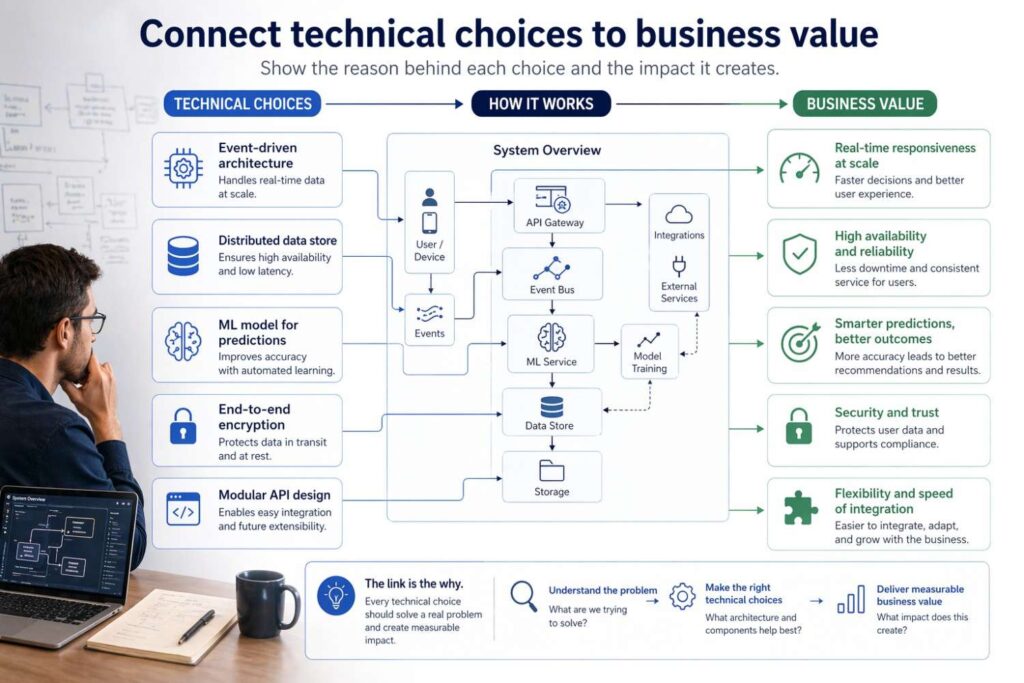
Software patent specs should not read like sales pages.
But they also should not ignore the real value of the design choices.
If a technical arrangement reduces delay, lowers compute cost, improves trust, protects privacy, reduces manual review, or improves relevance in a meaningful way, that can and should be described.
The key is to tie the value to the mechanism.
Do not say the system is revolutionary.
Say that local feature extraction reduces transmission of sensitive raw inputs.
Do not say the system is highly efficient.
Say that routing low-confidence items to a deeper validation stage avoids using full processing on every input.
Do not say the system improves quality.
Say that source-aware ranking reduces use of low-trust records in downstream generation.
This kind of explanation helps the spec in two ways.
It shows why the design choices matter.
And it avoids empty praise.
That is much stronger.
Review each paragraph for real work
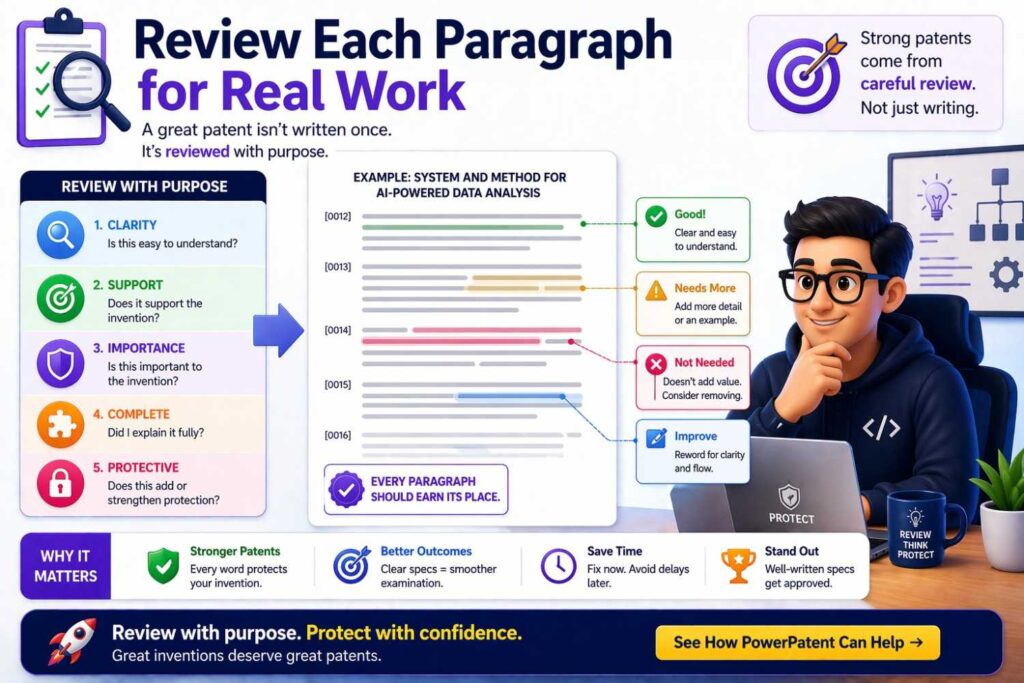
When a software patent draft is almost done, one of the best final habits is to review paragraph by paragraph and ask what each paragraph is doing.
Is it defining a component?
Is it explaining a flow?
Is it describing a rule?
Is it showing a data transformation?
Is it clarifying a state change?
Is it giving an example?
Is it supporting a useful variation?
If the answer is not clear, the paragraph may not be doing enough.
A lot of weak software specs contain paragraphs that sound formal but add very little. They restate that a system can perform a function. They repeat earlier language. They say components may be configured to communicate. They announce flexibility without providing real alternatives.
That kind of language can be trimmed or rewritten.
The goal is not to make every line dramatic.
It is to make sure the important parts of the draft are earning their place.
This kind of review improves the density of support and often makes the whole specification feel clearer and stronger.
Common software drafting mistakes to avoid
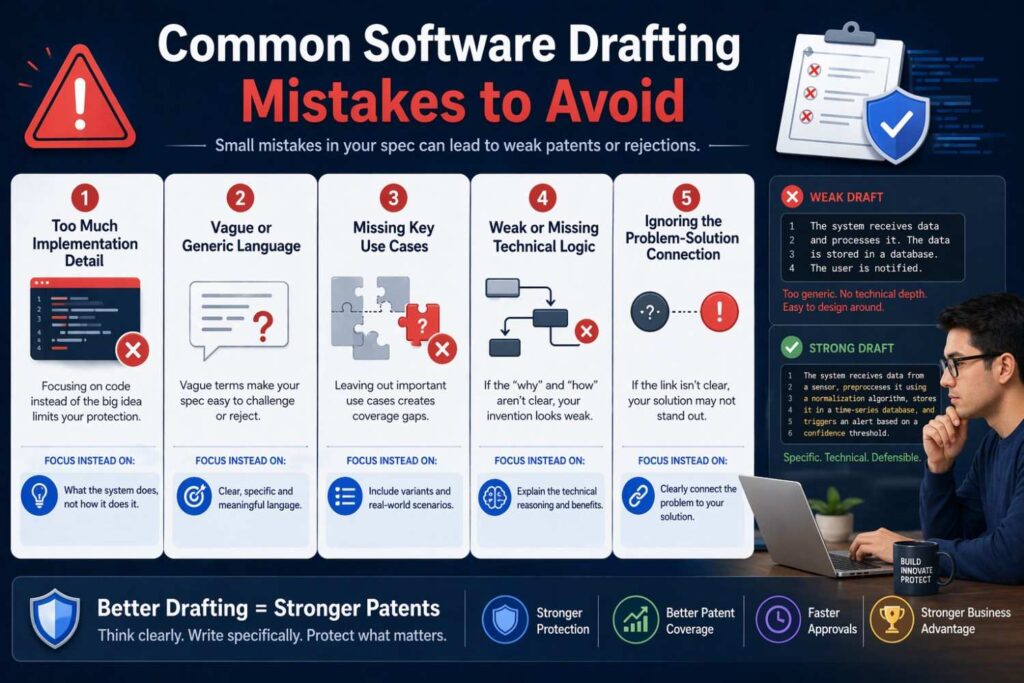
There are some patterns that hurt software specs again and again.
One is describing only outcomes.
The draft says the software improves ranking, speeds up processing, or gives better results. But it never explains how.
Another is describing only the interface.
The draft focuses on what the user sees, while the actual system logic stays hidden.
Another is describing only generic computing structure.
The spec gives lots of space to servers, processors, memory, and networks while skipping the inventive arrangement.
Another is naming many parts without showing how they interact.
Another is using internal team jargon without explanation.
Another is trying to be broad by removing useful detail.
Another is adding alternatives too early and making the core embodiment hard to follow.
Another is using stiff legal tone to hide lack of clarity.
These mistakes are common because software feels easy to summarize and hard to pin down. But they can be avoided with the right mindset.
The job is not to sound like a patent.
The job is to clearly explain the system as an invention.
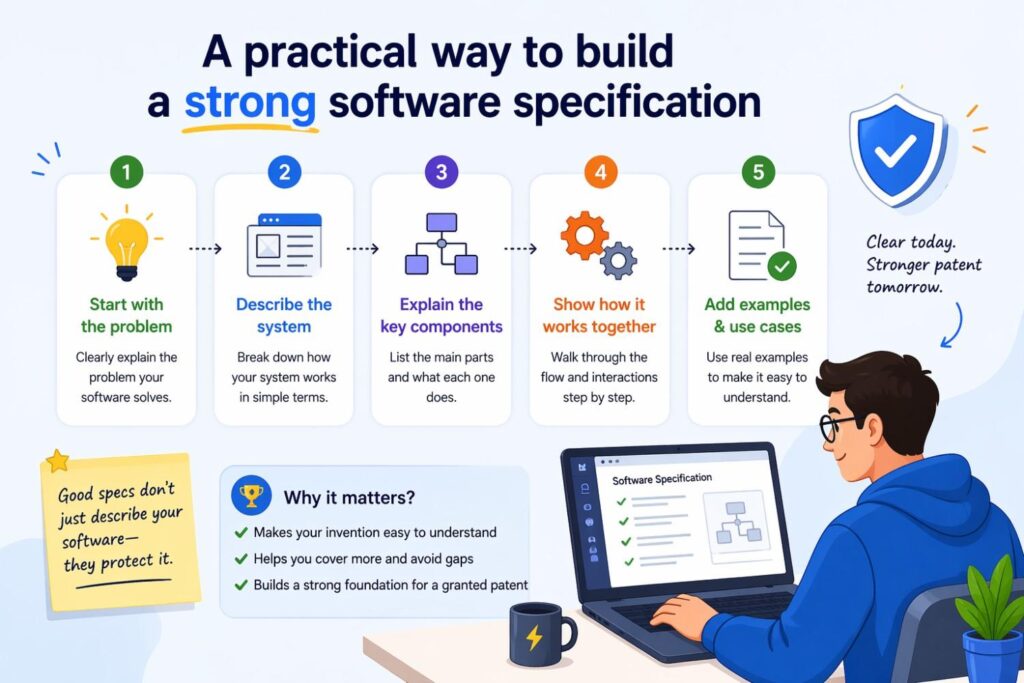
A practical way to build a strong software specification
The simplest practical approach is this.
Start by writing a plain explanation of the system for a smart engineer outside the company.
What is the problem?
What is the system?
What are the main parts?
What is the flow?
What decisions shape the result?
What changes over time?
What examples make the logic easy to see?
Then create a strong base embodiment.
Then build figures that reflect the real architecture and flow.
Then add meaningful alternatives tied to the same inventive concept.
Then tighten the language so it stays formal but clear.
Then review it with engineers and a patent professional who can see where support is thin, where terms drift, and where the core invention needs sharper framing.
That kind of workflow produces much better software patent specs than starting with a template and trying to fill it with broad phrases.
It is also much more founder-friendly.
That is exactly why PowerPatent exists. It helps founders and technical teams capture their software systems clearly, without the usual law-firm friction, and it brings in real attorney oversight to make sure the final filing is not just polished, but strategically strong. If you are building real software innovation, it is worth seeing how that process works: https://powerpatent.com/how-it-works
Why clarity now creates flexibility later
Founders sometimes think clarity will box them in.
In reality, clear support often creates more options.
When a software spec clearly explains the system, the flow, the rules, the data, the state changes, and the variations, it gives more room for later claim work. It helps future drafting stay grounded. It makes it easier to pursue different claim angles because the invention has been captured in a rich way.
By contrast, vague drafting feels broad at first but often limits flexibility later. The system was never described deeply enough, so the paths available may be narrower than expected.
That is why clarity matters so much.
Clarity is not the enemy of breadth.
Clarity is often the path to supported breadth.
Many teams think flexibility comes from keeping things vague.
It usually does not.
For software businesses, real flexibility comes from having a clear record of what the system actually does, where the value sits, and which parts can change without changing the core invention. When that record exists in the patent specification, the company has more room to make smart moves later.
That room matters.
Products change. Architecture changes. Go-to-market changes. A feature that looks small today may become central next year. A workflow that feels secondary now may become the thing competitors copy first. A system that starts in one market may expand into another with different user needs, different data constraints, or different deployment choices.
If the original specification is clear, the business can often adapt its patent strategy as the company evolves.
If the original specification is vague, those future options can shrink very quickly.
That is why clarity is not a drafting preference. It is a business asset.
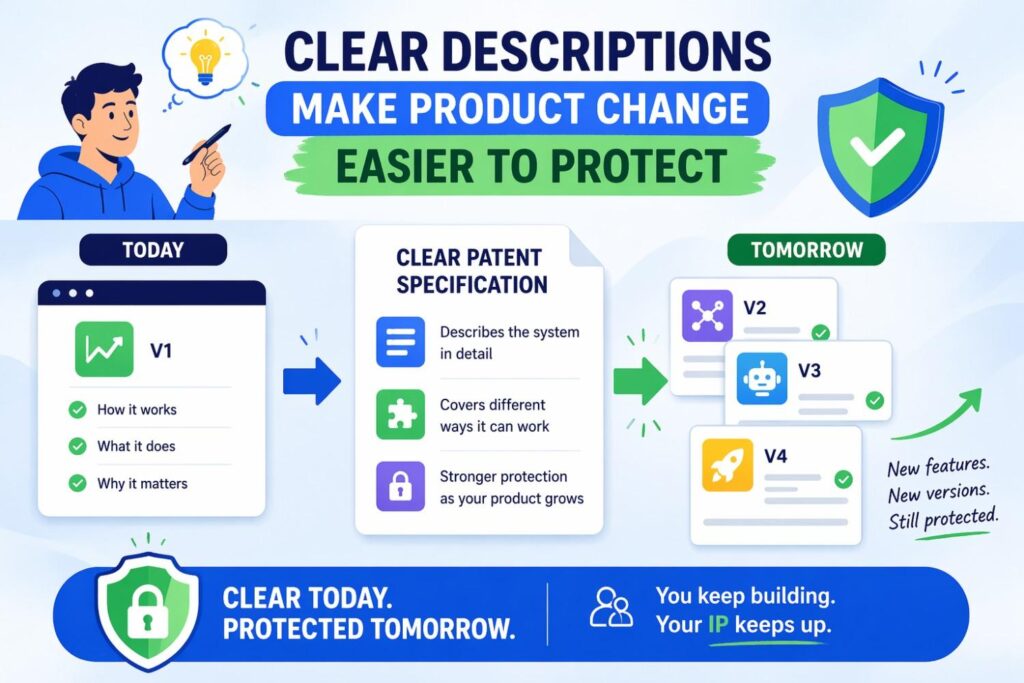
Clear descriptions make product change easier to protect
Software rarely stands still.
A team may launch with one architecture, then later split services, change model providers, revise storage methods, shift orchestration, or redesign workflow logic based on customer use and scale needs. That is normal. In many cases, it is a sign the product is getting stronger.
The challenge is that the patent filing needs to remain useful even as the product matures.
A clear specification helps because it captures the underlying system logic, not just a thin surface version of the product. That gives the company more freedom to evolve implementation details while still staying close to the same protected concept.
This is highly strategic.
If the spec clearly describes what role each part of the system plays, why certain decisions happen, what data relationships matter, and what alternatives still follow the same idea, the company has a better chance of supporting future patent work even after the product changes.
Businesses should review the draft with this exact question in mind: if we rebuild part of this system in twelve months, will this specification still sound like us?
That is a far better test than asking only whether the draft describes the current release.
Clarity helps teams protect what the market will care about later
Early in a product’s life, it is not always obvious which part of the system will matter most in the market.
Sometimes the thing the team thinks is most important turns out not to be the real moat. Another part becomes the real driver of retention, cost savings, trust, speed, or customer value. This happens often in software because the market teaches the company what matters through usage, integration, and competition.
A clear specification gives the company a better chance of staying ready for that shift.
Why? Because clear drafting tends to capture the system in layers. It preserves not only the visible feature, but also the hidden control logic, the flow decisions, the state behavior, the interaction points, and the alternate ways the same core idea may be implemented. That gives the business more room if the market later reveals that one of those layers is especially valuable.
This is one reason vague drafting is risky. It often locks the company into the narrowest understanding of its own invention. It protects only what looked important at the time of filing, not what may prove important after customer behavior and competitor response become clearer.
A helpful internal exercise is to ask product, engineering, and go-to-market leaders the same question before filing: which part of this system do you believe customers, competitors, or acquirers will care most about a year from now?
Where those answers overlap, the specification should probably go deeper.
Clear drafting improves internal business alignment

A patent specification is not only for outside readers.
It can also be a strategic internal document.
When written clearly, it helps the company align around what the actual invention is. That matters more than many businesses realize. Teams often use the same product language but mean different things.
Engineering may see the innovation in system orchestration. Product may see it in workflow simplicity. Leadership may see it in cost reduction. Sales may see it in faster outcomes for customers.
Those views can all be valid, but they are not identical.
A clear specification forces the business to define where the real technical value lives. It helps separate what is nice in the product from what is actually inventive in the system. That creates stronger internal clarity, which in turn helps with roadmap decisions, follow-on filing strategy, and even messaging to investors or partners.
This is highly useful for growing startups.
As the team expands, memory gets messy. People join later. Systems become more complex. Original design choices become less obvious. A clear patent specification can help preserve that understanding in a way that supports long-term company thinking.
Businesses should treat this as a strategic benefit, not just a legal side effect.
Clear support gives the company more leverage in board, investor, and diligence conversations
Flexibility later is not only about future legal drafting.
It is also about business leverage.
When a company can clearly explain what it invented and how that invention maps to product value, it becomes easier to tell a stronger story in diligence, fundraising, strategic partnership, and acquisition conversations.
A vague patent filing often weakens that story because it does not clearly connect the protected invention to the real software system the business is building.
A clear filing helps the company say, with confidence, this is the system we created, this is the technical change we introduced, and this is the area where we have built a position.
That kind of confidence matters.
Sophisticated investors and buyers do not just care that a filing exists. They care whether it appears to reflect a thoughtful, defensible effort to protect a real technical advantage. Clear drafting supports that impression. It shows discipline. It shows that the company understands its own architecture. It shows that the patent strategy is not an afterthought.
For businesses, that can become a form of optionality. It makes the patent more useful across more situations, not only in formal legal contexts.
Clarity helps future teams build on the same invention family

As a company grows, the people handling product and IP may not be the same people who were there at the start.
That is normal.
What is not always normal is having a strong written record that future teams can use. A clear software specification creates that record. It helps later product leaders, later engineers, later counsel, and later executives understand what was originally built and how it was framed.
That matters if the company wants to grow a broader patent family around the same platform.
Without clarity, follow-on work becomes much harder. Future teams may see the old filing as too abstract to use well or too fuzzy to connect to new product developments. That can lead to missed opportunities because nobody feels confident expanding on the original foundation.
With clarity, the opposite happens. New teams can see where the original core idea sits, what variations were already recognized, what parts of the system were treated as central, and where new product work may naturally branch into new filings.
That is a real advantage for businesses that want a patent strategy that grows with the company instead of becoming stale.
Clarity reduces the cost of future rework
There is also a very practical business reason to value clarity.
It reduces rework.
When a software specification is vague, the company often ends up paying for that later. More meetings are needed to reconstruct the invention. More time gets spent explaining old design choices. More effort goes into figuring out whether a new feature is actually supported by the prior filing or whether it needs a new one. The team has to revisit old architecture decisions because the original specification did not capture them well enough.
That is expensive.
Not only in legal cost, but in founder time, engineering interruptions, and decision drag.
A clear filing lowers that burden because it preserves the logic of the system in a useful way. It gives later reviewers something real to work from. It shortens the path from “we may want to file on this” to “we know how this relates to what we already protected.”
For a fast-moving software company, that kind of efficiency matters a lot.
Clear specifications help businesses decide what not to file
This is a less obvious benefit, but an important one.
When the original specification is clear, the company gets better at seeing the boundary of the invention. That helps not only with what to protect, but also with what not to spend time filing.
A vague patent record often creates confusion. Teams start wondering whether every product improvement should become a filing because the original scope feels unclear. Or they assume a new development is already covered because the old language sounds broad, even though the support may be weak.
Clear drafting helps avoid both mistakes.
It makes it easier to identify when a new product change is truly part of the same inventive line and when it is a different idea that deserves separate treatment. That gives the company a more disciplined IP strategy and helps avoid wasted filings or missed coverage.
For businesses managing budget carefully, this is a very useful advantage.
Use clarity to map invention layers before filing

One highly actionable way to create flexibility later is to map the invention in layers before the specification is final.
This does not need to be a complex exercise. The goal is to identify where the system’s value sits across different depths.
There may be a visible user-facing layer.
There may be a system coordination layer.
There may be a data handling layer.
There may be a control-rule layer.
There may be a deployment layer.
There may be a memory or state layer.
When businesses map the invention this way, they can check whether the draft clearly describes each layer that may matter later. This creates stronger optionality because the patent record is not tied only to one surface version of the system.
It also helps the company think more strategically about where future product growth may occur.
Create a “future change” review before the spec is locked
Another practical move is to run a future-change review before filing.
Gather the right people and ask a few business-focused questions.
What part of this system are we most likely to redesign in the next year?
What part is most likely to stay constant?
What part would a competitor try to copy without copying our exact implementation?
What part could become more valuable as we scale or integrate with more customers?
The answers to those questions can reveal where the specification needs more clarity. In many cases, the team will realize that one important area has been described too generally or that a likely future version of the system has not been captured clearly enough.
Fixing that before filing is much easier than wishing it had been captured later.
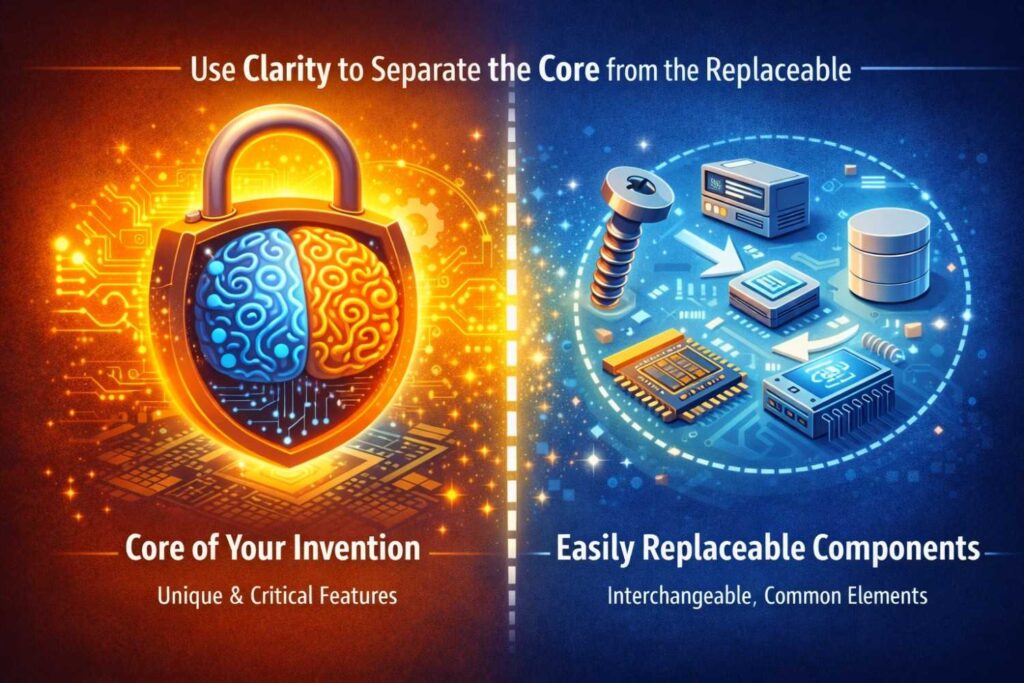
Use clarity to separate the core from the replaceable
One of the most strategic things a software business can do in a patent specification is clearly separate what is core from what is replaceable.
Not every detail deserves equal weight.
Some parts of a system are central to the inventive idea. Others are implementation choices that may change over time. If the specification makes that distinction clearly, the business gets more flexibility later.
Why? Because it becomes easier to defend the heart of the system while still allowing room for evolution around it.
This is incredibly useful for software companies because implementation details often shift as scale, performance, customer needs, or infrastructure choices change. A clear specification helps preserve the core idea even as the edges move.
A strong review question here is simple: if we changed this part of the architecture, would the invention still be the same in substance?
If yes, the spec should show that flexibility.
If no, the spec should probably treat that part as central and describe it with more depth.
Clarity supports smarter timing decisions for follow-on filings
Not every filing decision has to be made at once.
But later timing choices get much better when the original specification is clear.
A business with a clear first filing can more easily decide whether a new product development deserves a fresh filing now, later, or not at all. It can compare the new work against the existing record with more confidence. It can see where the original invention ends and the new one begins.
That helps the company time its IP investments more strategically.
Instead of filing reactively or hesitating because the old filing is too fuzzy, the business can make cleaner calls based on an understandable foundation.
This is another reason clarity now creates flexibility later. It gives the company better decision-making power over time.
Actionable steps businesses can take now

Here are a few practical ways to build this kind of flexibility into the specification before it is filed.
Review the draft against next year’s roadmap
Do not limit the draft review to today’s product. Look at the roadmap and ask whether the specification still sounds useful if the next major version ships. This helps expose where the draft is too tied to the present release.
Mark the system areas most likely to change
Identify where the architecture, model setup, orchestration, or storage design may evolve. Then make sure the specification captures the core concept clearly enough that those changes do not break the value of the filing.
Ask what part of the invention the company would most regret losing
This question is simple, but powerful. If a competitor copied one part of the system and you later realized the patent did not clearly support that area, what would hurt most? That answer often shows where the specification needs deeper treatment now.
Test whether a new team could use the spec later
Imagine a future product lead, engineer, or patent counsel reading the filing two years from now. Would they understand what the core invention was and how it could connect to newer product work? If not, the draft may still be too vague.
Compare today’s implementation to the underlying concept
Make sure the specification does not only describe the exact current build. It should also explain the deeper system idea that remains true even if the implementation evolves.
Clarity is a strategic advantage, not just a writing quality
The biggest mistake businesses make here is thinking clarity is only about readability.
It is much more than that.
Clarity gives the company room to grow, room to adapt, room to tell a better story, room to build future filings, room to align internal teams, and room to respond when the market reveals which parts of the system matter most.
That is why clarity now creates flexibility later.
It is not because clear writing sounds nice.
It is because clear writing preserves strategic options.
And for a software business building something valuable, those options matter a great deal.
Final thoughts
A software patent specification should not feel like a puzzle.
It should feel like a system.
The reader should be able to understand what was built, how it works, what problem it solves, and why the design is arranged the way it is. The system should not disappear behind broad language, stiff phrasing, or a pile of disconnected features.
The clearest software specs start with the real architecture, the real flow, the real data, and the real decision points. They build one strong embodiment before widening out. They use examples and figures to make the logic visible. They explain the hard part instead of hiding it. They keep the tone formal without making it lifeless. And they focus on the invention, not on generic computing background.
That is how you describe the system clearly.
That is also how you create a much stronger foundation for the patent itself.
If your team is building software worth protecting, do not settle for a slow process or a generic draft. PowerPatent helps startups move from real technical work to real patent filings with smart software and real attorney oversight, so what you file actually reflects what you built. See how it works here: https://powerpatent.com/how-it-works
Leave a Reply