A patent can be one of the most valuable things your startup owns.
Not your logo. Not your pitch deck. Not even your code by itself.
Your real edge is the thing you built, the way it works, and the proof that you got there first in a clear and complete way.
That is what a patent specification helps you do.
But most founders do not know what a patent specification should look like. They hear words like “claims,” “embodiments,” “prior art,” and “enablement,” and the whole thing starts to feel heavy, slow, and hard to approach.
It does not need to feel that way.
A strong patent specification is not magic. It is a structure. It is a simple, repeatable way to explain what you built so clearly that someone skilled in the field could understand it, use it, and see why it matters.
That is what this article is about.
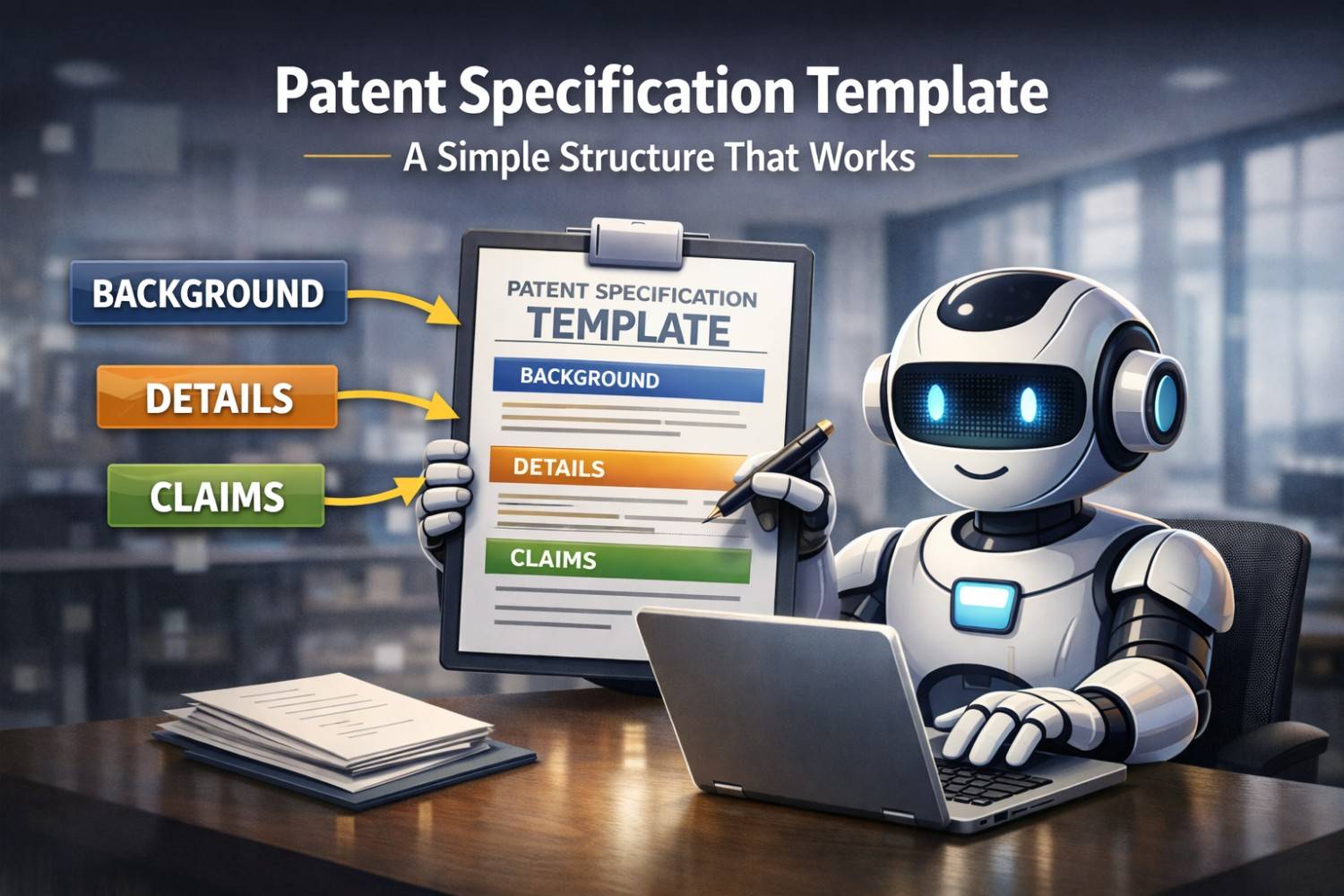
We are going to walk through a simple patent specification template that works. Not a stiff academic template. Not a vague outline that leaves you more confused than when you started. A practical structure founders and engineers can actually use.
You will learn what each part is for, what to put in it, what to avoid, and how to turn your real product thinking into a patent-ready draft. By the end, you will have a mental model you can use again and again as your startup grows.
And if you want a faster way to turn your invention into a real filing, with smart software and real attorney oversight, PowerPatent is built for exactly that. You can see how it works here: https://powerpatent.com/how-it-works
Why the specification matters more than most founders think
When many people think about patents, they think about the claims.
That makes sense. Claims matter a lot. They define the legal boundary of what you are trying to protect.
But the claims do not stand alone.
The specification is the foundation under them. It is the detailed written description of your invention. It explains what the invention is, how it works, what problems it solves, and how it can be built or used in different forms.
If the claims are the fence, the specification is the land underneath the fence. If the land is weak, the fence will not hold.
This is where many founders get into trouble. They move too fast, write too little, and treat the specification like a formality. They file something thin because they are in a rush or because they think they can “fill in the details later.”
That approach can hurt you.
A weak specification can limit what you are able to claim later. It can make your application easier to challenge. It can also leave out important variations of your invention, which means competitors may find easy ways around it.
A strong specification does the opposite. It gives you room. It gives your attorney room. It gives your startup better options as the product changes, the market shifts, and new competitors show up.
This is why the specification is not just paperwork. It is strategy in written form.
That is also why getting the structure right matters so much.
The simple truth about a good patent specification

A good specification does three things well.
First, it explains the invention in plain, complete detail.
Second, it describes the invention in more than one way, so you are not boxed into one narrow version.
Third, it supports strong claims now and later.
That is it.
You do not need to sound fancy. You do not need to write like a textbook. You do not need to impress anyone with big words.
You do need to be clear.
Clear beats clever in patent drafting.
The best patent specifications often feel almost boring in one good way: they are complete. They are careful. They do not leave holes. They walk through the invention step by step and variation by variation.
That is what works.
So let us make this simple.
A practical patent specification usually has these core parts:
Title
Technical field
Background
Summary
Brief description of the drawings
Detailed description
Claims
Abstract
Some filings may include extra sections or slight changes in order, but this basic structure is the heart of it.
Now let us go section by section and make each one easy to understand.
Start with the invention, not the form
Before you open a document and start typing section headings, stop for a moment.
The biggest mistake founders make is starting with patent language before they fully map the invention itself.
You should begin by answering simple product questions.
What did you build?
What problem does it solve?
How does it work from start to finish?
What are the key steps, parts, models, flows, or rules?
What are the most important choices you made?
What could be changed without breaking the core idea?
Where are the likely copycats going to try to work around you?
These are not side questions. They are the raw material for the entire specification.
A strong patent draft starts with invention capture, not formatting.
In practice, this means you should first collect the substance of the invention in a way that feels natural to your team.
That might come from code walk-throughs, product notes, whiteboard diagrams, research summaries, or a founder explaining the system out loud.
The point is simple: get the invention out of your head before you try to make it look like a patent.
This is one reason founders like working with PowerPatent. The process helps turn what you already know about your product into a structured draft without forcing you into old-school, painful workflows.
It is software built for speed, but with real patent attorney oversight, so you can move fast without making risky mistakes. You can learn more here: https://powerpatent.com/how-it-works
Now let us look at the actual template.
Section one: the title

The title is short, but it matters.
A good title tells the reader what the invention is about without being overly narrow. It should be clear and direct. It should not read like marketing. It should not be vague fluff.
Bad titles are often too broad or too cute.
Something like “Smart Platform for Better Digital Experiences” says almost nothing.
Something like “A Revolutionary AI-Based Quantum-Grade User Delight Engine” is even worse.
A better title says what the invention is in straightforward terms.
For example:
“System and Method for Detecting Fraudulent Transactions Using Adaptive Risk Scoring”
Or:
“Method for Compressing Sensor Data in a Distributed Edge Computing Network”
Or:
“System for Generating Personalized Training Plans Based on Biometric and Behavioral Inputs”
These titles are not flashy. That is good. They do the job.
When writing your title, think about the core function of the invention. Focus on what it does, not why your company is exciting.
A useful test is this: if someone saw only the title, would they have a decent first sense of the technical topic?
If yes, you are probably on the right track.
Section two: the technical field
The technical field section is usually very short.
Its job is to say what technical area the invention belongs to.
That is all.
It often reads like this:
“The present disclosure relates generally to machine learning systems, and more particularly to systems and methods for detecting anomalous network behavior in cloud environments.”
Or:
“The present disclosure relates to medical imaging, and more particularly to image reconstruction methods for low-dose computed tomography.”
Simple. Clean. Direct.
Do not try to squeeze your whole invention into this section. Do not overstuff it. This is not the place for detailed benefits or deep explanation.
Think of it as a signpost. It tells the reader the general technical lane your invention sits in.
If your startup works in software, hardware, biotech, robotics, climate tech, or any other deep tech area, this section helps frame the invention from the start.
The key is to be specific enough to be useful, but not so narrow that you shrink the perceived scope too early.
Section three: the background
This section is often misunderstood.
Many founders think the background is where they “sell” the invention. That is not quite right.
The real job of the background is to explain the problem space in a fair and useful way.
What is the existing situation?
What kinds of systems or methods are already used?
What limits or pain points exist in those approaches?
What technical problems remain unsolved or poorly solved?
That is what belongs here.
The background should set the stage. It gives context for why the invention matters. But it should not overstate things, and it should not make careless admissions that could hurt you later.
That last point matters.
If you write the background badly, you can accidentally frame the old technology too narrowly, or make broad statements that box in your invention. You can also make it sound like certain features are required when they are not.
So the right tone is measured and factual.
For example, suppose your startup built a new way to schedule workloads across distributed GPUs.
A weak background might say:
“Current systems cannot efficiently allocate GPU tasks across large-scale environments.”
That is too absolute. It invites pushback.
A better background might say:
“In some distributed computing environments, existing task allocation approaches may lead to underuse of available GPU resources, increased latency, or reduced throughput, especially where workloads vary over time.”
This version is better because it is grounded. It describes a real issue without claiming that all existing systems fail in all cases.
That is the right style.
Another good rule is to focus on technical pain, not just business pain.
Saying “companies need to save money” is less useful than saying “existing data pipelines may require repeated full-table scans, which can increase compute cost and delay results.”
The more concrete and technical your problem framing is, the stronger the setup becomes.
Section four: the summary
The summary gives a high-level description of the invention.
Think of it as the clean overview section. It should explain the core idea, the main system or method, and some of the ways it can be implemented. It should be broad enough to cover the invention well, but concrete enough to be meaningful.
This is not the place for every detail. The detailed description will handle that.
The summary should answer these core questions:
What is the invention?
What are its main parts or steps?
How does it generally solve the problem?
What kinds of versions or implementations can it include?
A simple way to write this section is to describe the invention through a few main embodiments.
For example, you might describe a method embodiment, a system embodiment, and a non-transitory computer-readable medium embodiment if the invention is software-based.
That is common because the same core invention may be claimed in different legal formats later.
Here is the deeper point: the summary is where you begin opening doors.
If your invention can be implemented on-device, in the cloud, or in a hybrid model, say that.
If your invention can use different kinds of input data, say that.
If a scoring step can happen before, during, or after another operation, say that.
If a model can be rules-based, statistical, or learned from training data, say that.
You are not writing random “maybe” ideas. You are building support for real variations that matter.
That is how a strong specification stays useful over time.
Startups change quickly. Product details shift. A narrow draft can age badly in a few months. A broad but well-supported draft can stay valuable as the product evolves.
Section five: the brief description of the drawings
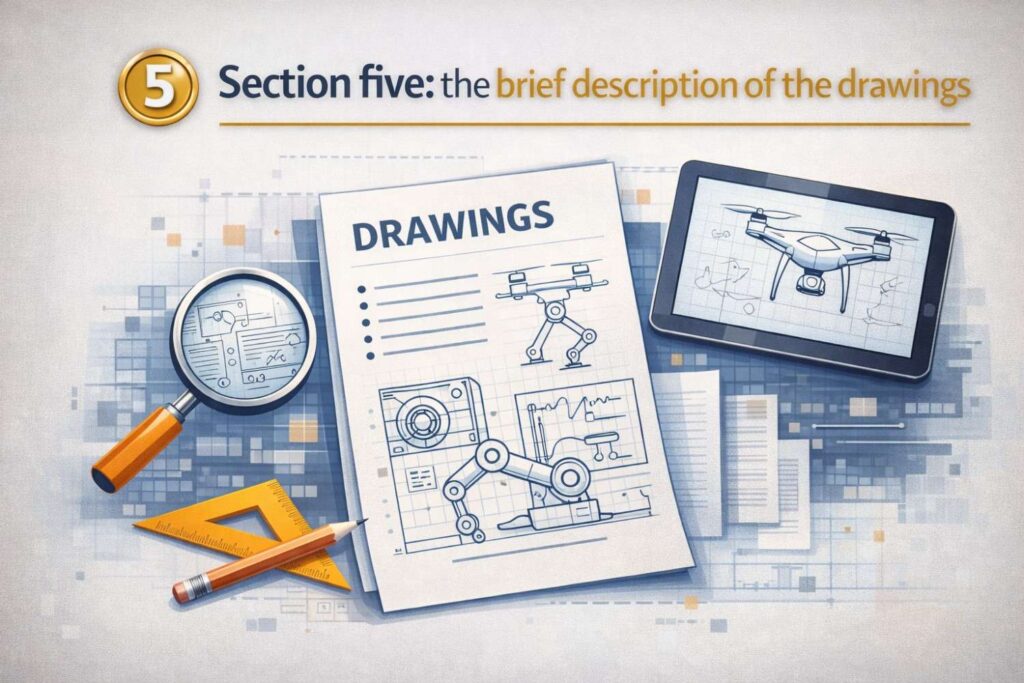
If your application includes figures, this section briefly explains them one by one.
It might say:
“Figure 1 illustrates an example system architecture.”
“Figure 2 illustrates an example process flow for generating a recommendation score.”
“Figure 3 illustrates an example user device interacting with a remote server.”
“Figure 4 illustrates an example training pipeline for updating a predictive model.”
This section is usually concise. It is not the same as the detailed description of the figures. It is more like a guide to what each figure shows.
Founders sometimes skip figures when filing early because they think drawings are only for mechanical inventions.
That is not true.
Figures can be extremely helpful for software, AI, data systems, medical devices, robotics, and many other technologies.
A simple architecture diagram, flow chart, state diagram, data flow, or user-device interaction diagram can make the specification much stronger and easier to understand.
More importantly, figures often help you think better.
When you draw the system, gaps become visible. Hidden assumptions show up. Steps that felt obvious in your head become clearer on paper.
That is useful before filing, not just after.
A good drafting process does not treat figures as decoration. It treats them as part of the invention record.
Section six: the detailed description
This is the heart of the specification.
If there is one section you must not rush, it is this one.
The detailed description is where you fully explain the invention. This is where you describe the system, the method, the components, the steps, the data flow, the decision logic, the variations, the optional features, the alternatives, and the examples.
This section is where you show that you actually possess the invention.
You are not trying to be poetic. You are trying to be complete.
A useful way to think about the detailed description is this: you are teaching a technically skilled person how your invention works, while also making sure you describe enough versions of it to support strong protection.
That means the detailed description usually needs to cover several layers at once.
It should explain the core architecture.
It should explain key workflows.
It should explain what can vary.
It should explain what inputs may be used.
It should explain what outputs may be produced.
It should explain what parts are optional.
It should explain what parts can be replaced by equivalent approaches.
And it should do all that without locking you into one tiny implementation.
That may sound hard, but there is a simple way to structure it.
Start with the system view

Begin by describing the invention at a system level.
If the invention is software, describe the main modules, services, data stores, interfaces, models, or devices involved.
If the invention is hardware, describe the physical components and how they interact.
If it is a process, describe the main stages.
If it is AI-based, describe the training and inference parts, input features, output forms, and deployment options.
The system view gives the reader a map.
For example, suppose your invention is a platform that predicts machine failures in a factory using sensor streams and adaptive thresholds.
Your system-level description might explain that the system includes sensor interfaces, a preprocessing engine, a feature extraction module, a predictive model, a threshold adjustment engine, and an alerting module. It might also describe local edge deployment, remote server deployment, and hybrid implementations.
That already does something important. It shows the invention as more than one isolated trick. It shows the technical environment in which it works.
Then walk through the method step by step
After the system view, describe how the invention operates.
This often works best as a step-by-step process.
What happens first?
What data is received?
What transformation is applied?
How is a score, label, or output produced?
What happens next?
How is the result used?
Where does feedback go?
Where can the sequence change?
If the invention includes decision rules, describe them.
If the invention includes model updates, describe them.
If the invention includes user actions, device events, or network messages, describe those too.
For software and AI inventions, process flow is often where the real value becomes visible.
A founder may say, “It is basically a model that ranks leads.”
But the patent-worthy part may actually be the full pipeline: how data is collected, normalized, weighted, filtered, scored, updated, and used in downstream actions. The value may live not in one isolated score, but in the orchestration of steps.
That is why step-by-step detail matters.
Explain each component in plain language
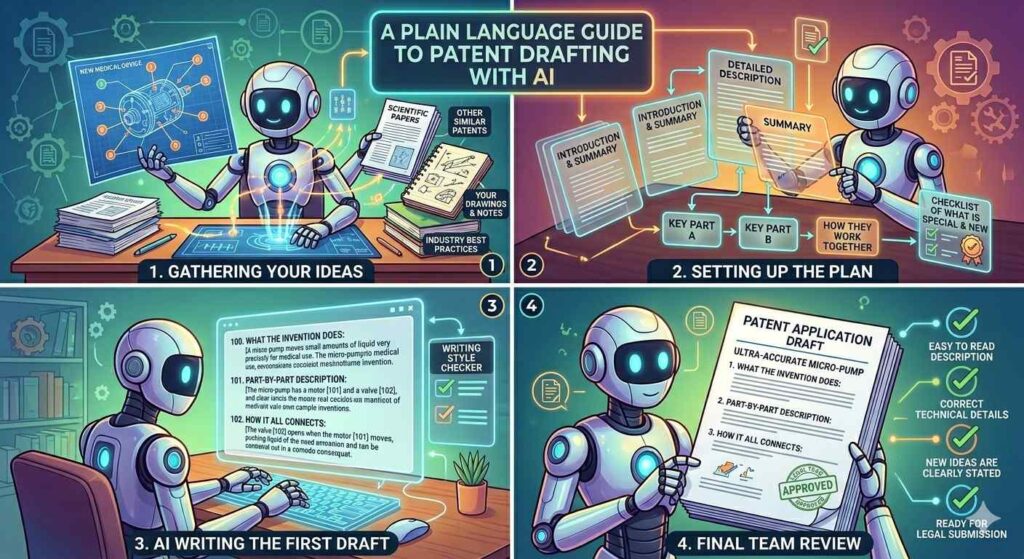
After the system and method views, go deeper into each major component.
If there is a classifier, explain what it does and what kinds of inputs it may use.
If there is a scheduling engine, explain how it decides among tasks.
If there is a feature store, explain what it contains and how data gets there.
If there is a sensor fusion module, explain how signals are aligned or merged.
If there is a policy engine, explain how policies are represented and applied.
Do not assume the name of a component explains its function. It does not.
A good detailed description makes each major part understandable on its own.
This is one place where founders often leave too much unsaid because the system feels obvious to them. But what feels obvious inside your company may be invisible to everyone else.
That gap must be closed in the writing.
Include alternatives early and often
This is one of the most important drafting habits.
Do not describe only your current product version.
Describe alternatives throughout the detailed description.
If a task can be handled by a remote server or a local device, say so.
If a model can be neural, probabilistic, or rules-based, say so.
If a communication channel can be wired or wireless, say so.
If identifiers can be generated from metadata, content analysis, or user input, say so.
If thresholds can be fixed, learned, or adjusted in real time, say so.
Alternatives matter because they help keep your protection from collapsing around one narrow implementation.
Many weak startup patents read like internal product documentation for the current release. That is not enough.
A patent specification should capture the invention family, not just the product snapshot.
This does not mean adding random filler. It means thoughtfully describing meaningful variations that a skilled person would see as part of the same inventive concept.
That kind of thoughtful breadth is where strong drafting lives.
The template that founders can actually use
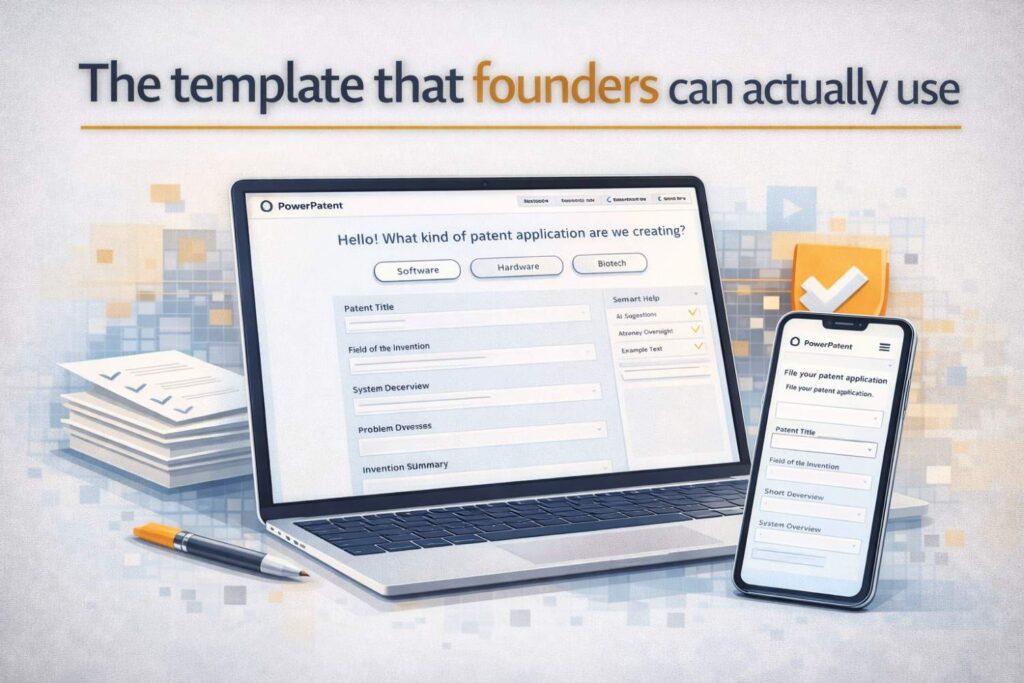
Now let us put this into a working format.
Below is a practical template structure you can use as a starting point when drafting a patent specification. The point is not to copy this word for word. The point is to use it as a simple shape that keeps you from missing key parts.
Title
State the invention in clear technical terms.
Example:
System and Method for Adaptive Battery Management in Electric Delivery Vehicles
Technical Field
State the technical area.
Example:
The present disclosure relates to battery management systems and, more particularly, to adaptive control techniques for managing battery usage in electric vehicles.
Background
Describe the technical setting and the problem.
Example style:
Electric delivery vehicles may operate under changing route, load, and weather conditions. Existing battery management approaches may rely on static estimates or limited real-time adjustment, which can reduce efficiency, shorten useful battery life, or increase risk of unplanned charging events. There remains a need for improved systems that adjust battery usage decisions based on dynamic operating conditions.
Summary
Give the broad overview.
Example style:
In some implementations, a system receives vehicle state data, route data, environmental data, and battery condition data.
The system generates a projected energy usage profile and determines one or more battery control actions based on the projected profile.
The control actions may include charge balancing, route-aware power allocation, charging recommendations, or speed-related adjustments.
In some implementations, the system updates control actions in real time as new data is received.
Brief Description of the Drawings
Briefly explain each figure.
Example style:
Figure 1 illustrates an example electric vehicle energy management system.
Figure 2 illustrates an example process for generating a projected energy usage profile.
Figure 3 illustrates an example interface between a vehicle controller and a remote optimization service.
Figure 4 illustrates an example process for updating battery control actions in response to route changes.
Detailed Description
This section can be broken into subparts such as:
System architecture
Data inputs
Processing steps
Decision logic
Output actions
Deployment options
Alternative embodiments
Use examples
Claims
The claims are separate from the specification body, but they rely on it. We will cover them more below.
Abstract
A short summary, often around one paragraph, that gives a quick technical overview.
This template is simple on purpose.
It works because it mirrors how people actually understand inventions: context first, then overview, then details.
What founders should put into the detailed description
This is where many people still feel stuck, so let us make it even more practical.
When drafting the detailed description, imagine you are answering these questions in order.
What are the major parts of the invention?
How do those parts connect?
What inputs come in?
What processing happens?
What outputs come out?
What decisions are made along the way?
What different versions of each step are possible?
What can be done locally, remotely, manually, or automatically?
What examples show the invention in action?
That is the core.
Now let us go deeper into the kinds of content that make this section stronger.
Describe real inputs and outputs
A weak draft says “the system receives data.”
A stronger draft says what kind of data.
Does it receive text, images, sensor signals, API responses, transaction records, user behavior logs, geolocation data, model features, or device state information?
Does the system output a ranking, prediction, anomaly flag, control signal, recommendation, generated content item, routing plan, or access decision?
Naming the real inputs and outputs makes the invention more concrete and more usable.
This does not mean you have to expose trade secrets that are not needed. It means you should not hide behind vague words.
Describe transformations
Many inventions live in the transformation step.
How is the raw input changed into something useful?
Is data cleaned, normalized, compressed, filtered, tokenized, embedded, segmented, clustered, aggregated, weighted, or fused?
Is an input mapped into a state representation?
Is a confidence score computed?
Is a sequence reordered?
Is a graph built?
Is an optimization step run?
This is where the technical story usually becomes real.
The more clearly you explain the transformation, the better.
Describe decision rules
A lot of startup technology is not just passive processing. It makes decisions.
It chooses whether to alert, route, block, rank, predict, recommend, adjust, or trigger something.
So explain how those decisions happen.
Do not stop at “the system determines an action.”
Describe the logic at a practical level. That may include thresholds, comparisons, priority rules, weights, confidence values, timing rules, conflict resolution rules, fallback paths, or learning-based selection.
Again, clarity matters more than buzzwords.
Describe timing and order
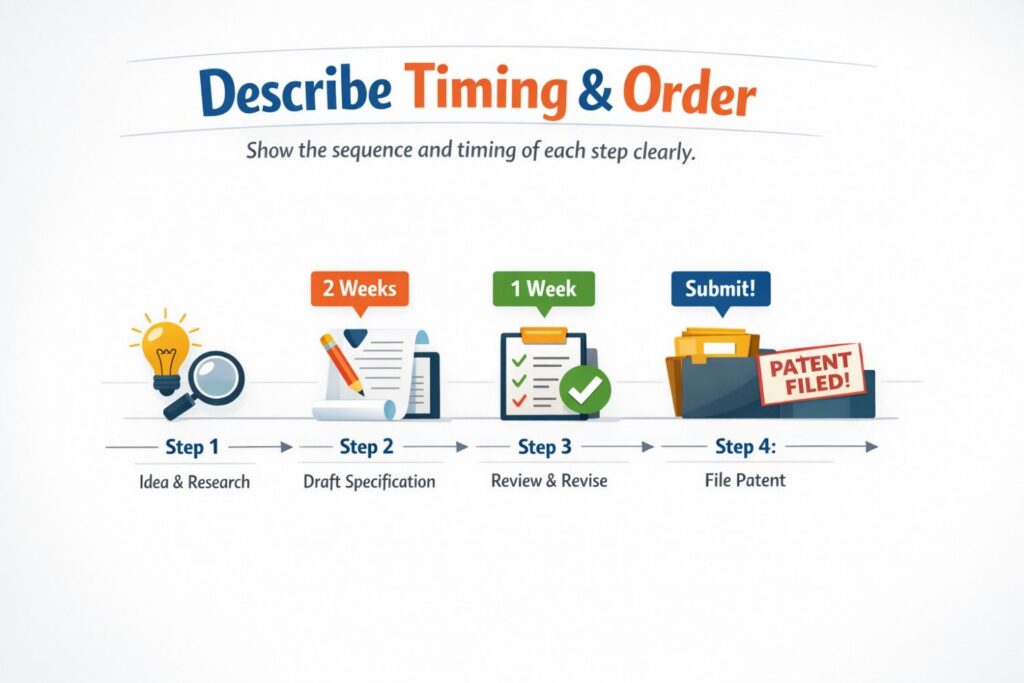
Sometimes the value of an invention lies in when things happen, not just what happens.
A task may be performed before transmission to save bandwidth.
A model may run in two stages to reduce latency.
A policy may be checked before data is stored.
A feature may be updated after user confirmation.
A threshold may be recalculated only when drift exceeds a set value.
These timing details can matter a lot.
If sequence or timing is part of the advantage, include it.
Describe optional features
A good specification often uses phrases like “in some implementations,” “optionally,” “in certain embodiments,” or “in some examples.”
This is helpful because it lets you describe useful features without making them mandatory.
That matters.
If every detail is written as essential, you may end up narrowing the invention more than you intended.
Optional language gives you flexibility while still providing support.
Describe examples, but do not trap yourself in them
Examples are powerful.
They make abstract ideas easy to understand. They can show how the invention behaves in real scenarios. They can make the drafting more complete.
But examples should stay examples.
If your fraud detection system uses credit card transactions in one example, that does not mean the invention only applies there. It may also apply to login events, insurance claims, blockchain transactions, device usage patterns, or other behavior streams.
So use examples to teach, not to trap.
A clean way to do this is to introduce an example clearly, then zoom back out and explain that other data types, environments, and use cases are also possible.
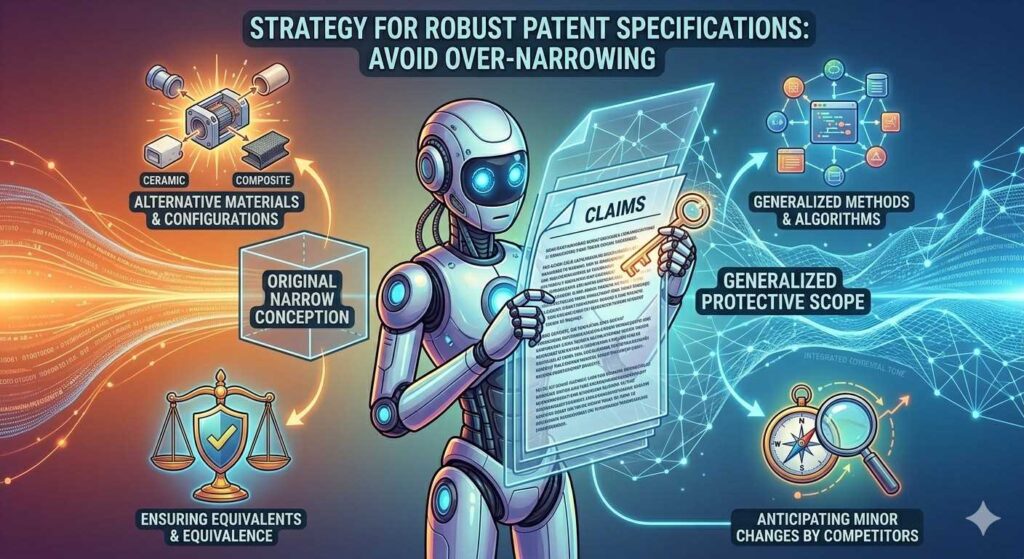
How to avoid writing a patent specification that is too narrow
This is one of the biggest practical issues for startup founders.
You file once, but your product changes.
If your specification is too narrow, it may protect an old version of your product while missing the better version you build six months later.
That is why you need to draft for the invention concept, not just the current release.
How do you do that?
You describe the core idea at the right level.
For example, imagine your product currently uses mobile phone GPS data to detect delivery delays.
A narrow draft says:
“The system receives GPS coordinates from a smartphone app and compares them with a route schedule.”
A broader but still grounded draft may say:
“The system receives location-related data associated with a delivery resource. In some implementations, the location-related data may include smartphone GPS data, vehicle telematics data, beacon-based position data, cellular triangulation data, or other position-indicating information.”
The second version does not make things vague. It makes them resilient.
The same applies across your invention.
Do not write only “a neural network” if other models may also work.
Do not write only “a web browser” if a mobile app, API client, or embedded interface could also be used.
Do not write only “warehouse robots” if the same control approach may apply to drones, carts, forklifts, or autonomous vehicles.
Broader support gives you future room.
This is one of the hardest things to do well if you are drafting alone, especially under startup time pressure. It helps a lot to use a system that guides the invention capture process and involves real patent attorneys who know how to keep the draft broad without making it empty. That is exactly the gap PowerPatent is designed to close. Here is the page if you want to see the workflow: https://powerpatent.com/how-it-works
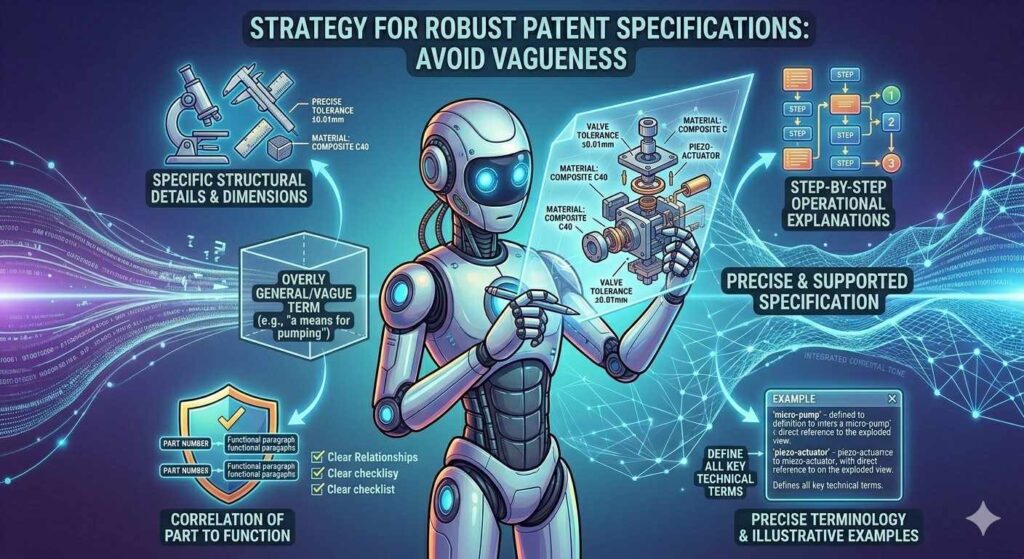
How to avoid writing a patent specification that is too vague
Too narrow is bad.
Too vague is also bad.
A vague draft says things like “the system optimizes the process” or “the engine intelligently improves performance” without clearly saying how.
That kind of writing feels polished, but it often does not hold up well.
Good patent drafting lives in the middle. Broad, but supported. Flexible, but concrete.
You want enough detail that a skilled person can understand the invention and see that you actually built or conceived it.
That means naming real structures, real operations, and real alternatives.
If your invention uses embeddings, say that.
If it uses a scoring function, explain the factors.
If it uses a local cache before syncing to a server, explain that flow.
If it groups data into windows before classification, say that.
You do not need every line of code.
You do need the real technical shape.
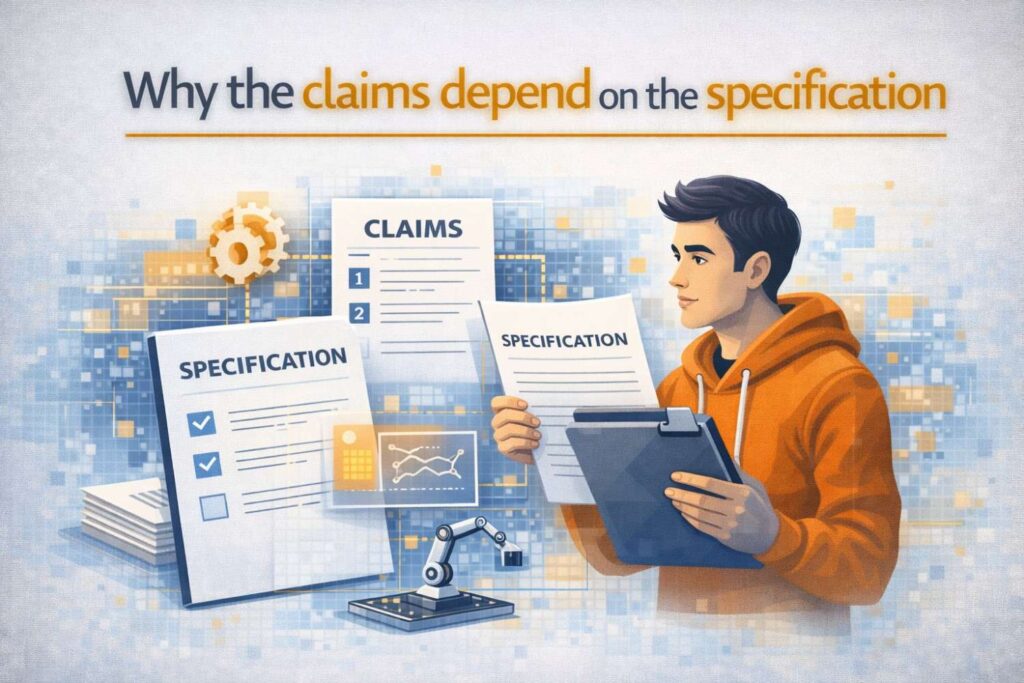
Why the claims depend on the specification
Even though this article is about the specification, we need to talk about claims for a moment.
Claims get most of the attention because they define the legal scope of protection.
But a claim can only reach so far if the specification underneath it supports that reach.
If your specification describes only one narrow version, broader claims may be hard to defend.
If your specification leaves out key alternatives, you may struggle to claim them later.
If your specification lacks enough detail for the invention, that can create serious problems.
So a good specification is not separate from claim strategy. It is what makes claim strategy possible.
This is why founders should not think, “We will just write a quick spec and let the claims handle the rest.”
That is backwards.
Write the specification as if future claims will need room to move, because they will.
A practical way to think about it is this: every meaningful variation you may want to claim later should appear somewhere in the specification now.
Not in a random pile of buzzwords. In a real, coherent, technically grounded way.
That is how you build optionality.
The role of figures in a strong patent specification
We touched on drawings earlier, but they deserve more attention.
Figures can carry a lot of value in a patent specification.
They can show architecture.
They can show process flow.
They can show hardware layout.
They can show user-device interaction.
They can show model training and deployment paths.
They can show how different modules talk to each other.
Many founders underestimate how much clarity a simple figure can create.
Even a clean block diagram can strengthen a draft by making relationships visible and easier to describe.
For example, if your invention involves a client device, a local processing engine, a remote inference service, a datastore, and an alerting system, a figure can show that in seconds. Then the written description can walk through it with confidence and structure.
A good figure also helps expose what is missing.
If you cannot draw the workflow clearly, you may not understand the invention clearly enough yet.
That is not a failure. It is useful feedback.
Often the best drafting sessions happen when a founder talks through a system while someone captures the diagrams live. That process turns fuzzy understanding into protectable structure.
How software founders should think about patent specifications

Software founders often hear mixed messages about patents.
Some are told software patents are impossible.
Others are told to file broad, abstract language and hope for the best.
Neither approach is helpful.
Software patents live or die on detail, structure, and practical technical framing.
If you are a software founder, your specification should usually explain things like:
What systems or devices are involved
What data is received and from where
How that data is processed
What models, rules, or transformations are used
How outputs are generated and used
How the architecture improves speed, accuracy, reliability, security, efficiency, or another real technical outcome
What alternative implementations exist
Notice what is missing from that list: buzzwords.
A weak software patent draft leans on buzzwords. A strong one explains the mechanics.
If your startup is building with AI, the same rule applies.
Do not just say “we use AI to improve results.”
Explain what is input, what is learned, what is inferred, what is updated, and how the output changes the operation of the system.
Specificity is your friend.
How AI founders should draft the specification

AI inventions often move fast, and founders worry that a patent draft will be outdated by the time it is filed.
That is a real concern, but it is not a reason to skip patents.
It is a reason to draft smarter.
For AI-related inventions, the specification should not focus only on one model name or one training setup unless that is truly the key point.
Instead, it should describe the invention at several levels.
Describe the problem being solved.
Describe the pipeline.
Describe the data inputs.
Describe how features or representations are generated.
Describe how one or more models may be trained, selected, updated, or deployed.
Describe how outputs are used in a larger system.
Describe alternatives, including different model classes or deployment environments where appropriate.
This layered approach protects more than one moment in time. It captures the architecture and method, not just the current model choice.
That is especially useful in AI, where models change quickly but pipeline advantages often remain valuable.
How hardware founders should draft the specification
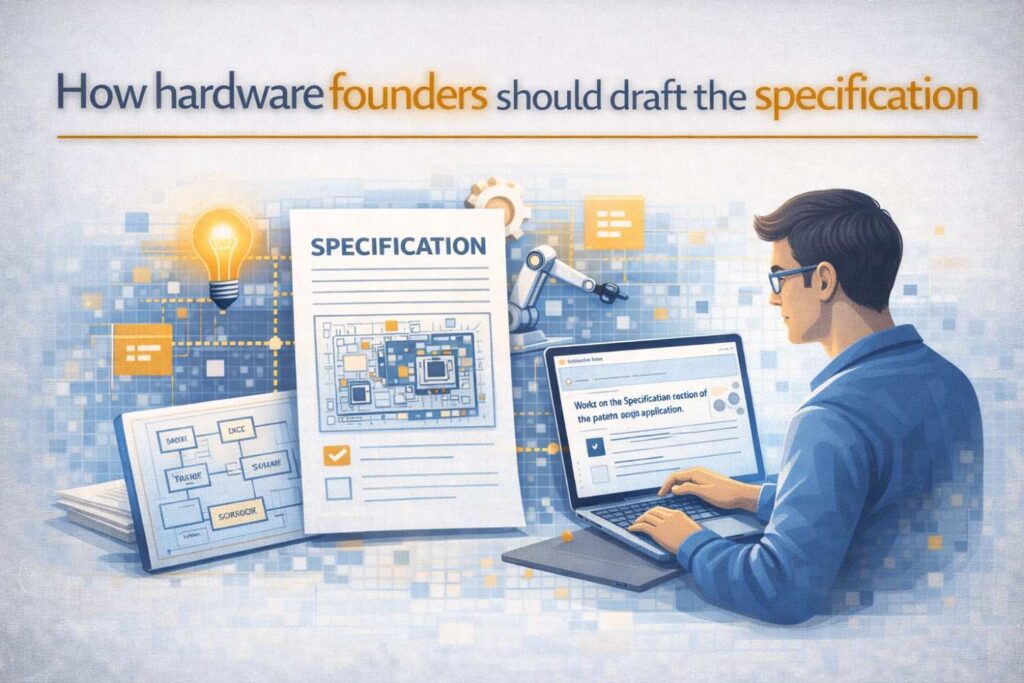
Hardware inventors often do better at describing concrete structure, but they can still run into drafting problems.
One common issue is focusing too much on the exact physical product version and not enough on variations.
Another is forgetting to describe functional relationships between parts.
A strong hardware specification should usually explain:
The major components
How they are arranged
How they connect
What they do
What materials, dimensions, or operating ranges may be used where relevant
What alternatives exist for key parts
How the system operates in use
What technical benefit comes from the arrangement or operation
Again, examples help, but they should not become cages.
If a connector can be mechanical, magnetic, or electrical, say so where it makes sense.
If a housing shape can vary, note that.
If a sensor can be optical, acoustic, or thermal in different implementations, that can matter.
Think in families, not frozen snapshots.
How biotech and life sciences teams should think about the structure

Biotech and life sciences inventions can be more complex and often require even more care, but the same structural idea still holds.
You still need a clear field, background, summary, figures, and detailed description.
You still need to explain the invention completely.
You still need to support variations.
The details may involve compounds, sequences, formulations, assay steps, treatment protocols, delivery mechanisms, or measurement techniques. But the drafting principle remains simple: explain the invention in a way that is specific, complete, and broad enough to support meaningful protection.
In these areas, precision really matters. So does expert guidance.
That is where structured invention capture plus attorney review can make a major difference.
A plain-English example of building a specification from scratch
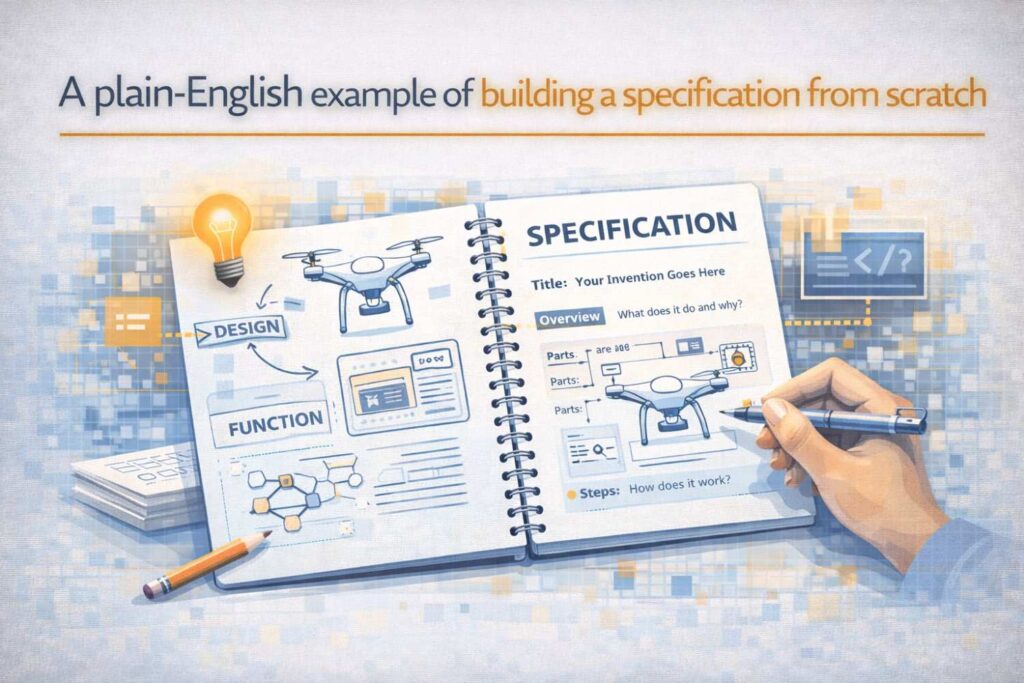
Let us make this feel real.
Suppose your startup built a system that reduces false alarms in home security monitoring by combining sensor data, historical activity patterns, and context from user devices.
Here is how you might think through the specification.
The title might be:
System and Method for Context-Aware Alarm Validation in a Security Monitoring Environment
The technical field might say the invention relates to security monitoring systems and event validation methods.
The background might explain that conventional systems may trigger alarms based on isolated signals, such as motion or door activity, without using broader context, which can lead to false alarms and unnecessary response actions.
The summary might explain that the system receives event data from one or more security sensors, receives contextual data from one or more user-associated devices or historical patterns, generates a confidence measure regarding whether an event represents a true security condition, and selectively triggers or suppresses a response based on the confidence measure.
So far, that is straightforward.
Then the detailed description would open up the full invention.
You would describe the types of sensors that may be used, such as motion sensors, door sensors, cameras, glass-break sensors, and sound sensors.
You would describe contextual data sources, such as mobile device location, known occupancy schedules, authorized user proximity, network presence, prior event history, and environmental conditions.
You would describe how signals may be time-aligned, weighted, filtered, or scored.
You would describe that a decision engine may use rules, statistical models, machine learning models, or combinations of these.
You would describe how the confidence measure may be based on sensor correlation, time of day, known user behavior, recent arm or disarm activity, and other factors.
You would describe different response actions, such as suppressing an alarm, sending a user prompt, escalating to a monitoring agent, or directly triggering emergency response.
You would describe deployment options, including local hub processing, cloud processing, or hybrid systems.
You would describe examples, such as a pet-triggered motion event that is suppressed based on weight profile and user device presence, or a nighttime entry signal that is escalated because it conflicts with expected occupancy data.
You would also describe alternative embodiments. Maybe the same architecture can validate industrial safety alerts, vehicle intrusion events, or elder care monitoring events.
Now you have something much more powerful than a quick feature description. You have a real patent specification framework.
That is the shift founders need to make.
The hidden value of “embodiments”

Patent drafting often uses the word “embodiment.”
The word sounds formal, but the idea is simple. An embodiment is just a version or implementation of the invention.
Why do embodiments matter?
Because your invention can often be expressed in different forms.
One embodiment may use a central server. Another may use edge processing. One may use a ranking model. Another may use rule-based logic with weighted values. One may use one kind of input data, while another uses a different mix.
Describing embodiments helps you cover the invention more fully.
It also helps avoid the trap of making one version seem like the only version.
This is a powerful way to future-proof a filing.
When founders hear “embodiment,” they sometimes assume they need dozens of wildly different versions.
That is not the goal.
The goal is to describe meaningful, grounded versions of the same inventive idea so the patent record reflects the real breadth of what you built and what it could become.
What not to do when drafting a specification
Some drafting mistakes come up again and again.
One common mistake is writing like a marketer.
A patent specification is not a landing page. It should not say your invention is “game-changing,” “world-class,” or “revolutionary.” Those words do not help. They can actually make the draft worse by replacing substance with hype.
Another mistake is writing too little.
Founders are busy. Engineers are busy. Everyone wants to get the filing done and move on. But thin drafting is expensive in the long run.
A rushed draft can miss the exact variations you later wish you had protected.
Another mistake is using overly absolute language.
Words like “must,” “always,” and “cannot” should be used with care unless they are really true and really necessary. Often they narrow the invention more than intended.
Another mistake is mixing business value with technical detail in the wrong places.
It is fine to explain why the invention matters, but the specification should stay grounded in technical operation.
“Improves user trust” is weaker than “reduces false positive alerts by combining event correlation with device proximity data.”
Another mistake is locking into brand names, product names, or temporary implementation choices.
Your patent should outlast your current interface, codebase, and roadmap names.
Describe the invention in stable technical language.
The best way to capture invention details from a founding team
Most startups do not have time to sit around writing formal drafts from scratch.
So what actually works?
Usually, the best raw material comes from structured conversations with the people closest to the invention.
That may be the founder, CTO, lead engineer, research scientist, product architect, or some mix of them.
A strong invention capture process often pulls from these kinds of questions:
Walk me through the system.
What happens first?
What happens next?
What is different about your approach?
What other ways could this be implemented?
What parts are optional?
Where would a competitor try to copy this in a cheaper or simpler way?
What technical tradeoffs did you solve?
When those answers are captured well, the specification becomes much easier to draft.
This is exactly where most old-school patent workflows feel painful. They rely too much on slow back-and-forth, scattered notes, and manual translation.
PowerPatent takes a very different approach by helping founders turn product knowledge into a real patent draft much faster, while still keeping real attorneys involved where it counts.
That combination of speed and oversight is a big reason startups choose it. You can see the process here: https://powerpatent.com/how-it-works
A founder-friendly drafting workflow that actually works
Let us turn all this into a workflow you can use.
Start by describing the invention in ordinary language. Pretend you are explaining it to a smart engineer who just joined the company.
Then map the system. Draw the parts, the flows, the main steps, and the outputs.
Then identify the core inventive idea. Ask what makes this different from the obvious way others would do it.
Then list meaningful variations. Think about different data sources, architectures, models, hardware setups, timing choices, and operating environments.
Then organize the material into the standard structure: title, field, background, summary, drawings, detailed description, claims, abstract.
Then review for two risks: too narrow and too vague.
Then refine.
This is the kind of repeatable approach that scales with your startup. It works far better than waiting until a financing event or competitor threat forces you into a rush filing.
How to know whether your specification is strong enough
Founders often ask, “How do I know if the draft is actually good?”
That is a smart question.
A strong specification can usually answer yes to these tests.
Could a skilled person understand what the invention is and how it works?
Does the draft explain the main system or process clearly?
Does it include real technical detail instead of hype?
Does it describe alternatives and variations?
Does it avoid trapping the invention in one narrow example?
Does it support the kinds of claims you may want later?
Does it still make sense if your product changes somewhat over the next year?
If the answer to several of those is no, the draft likely needs work.
One more test is especially useful: could a competitor read this and understand the broad shape of what they are not going to easily copy without risk?
That is often a strong sign the specification is doing its job.
Why simple writing wins
There is a myth that patent drafting has to sound dense and hard to read.
It does not.
Yes, patent documents have formal structure. Yes, some legal wording appears in practice. But the underlying technical explanation should still aim for clarity.
Simple writing is not weak writing.
Simple writing is strong because it reduces confusion. It makes errors easier to spot. It makes the invention easier to map, review, and improve.
This matters even more in startups, where the people reviewing a draft may include technical founders, operators, investors, and outside counsel.
If only one person can understand the spec, that is a problem.
Clear writing helps everyone do better work.
That is one reason PowerPatent’s approach resonates with founders. It makes the process feel understandable instead of buried under old language and slow habits. The goal is not to make patents feel scary. The goal is to help startups file strong patents with more speed, control, and confidence. You can explore it here: https://powerpatent.com/how-it-works
A sample expanded structure you can follow
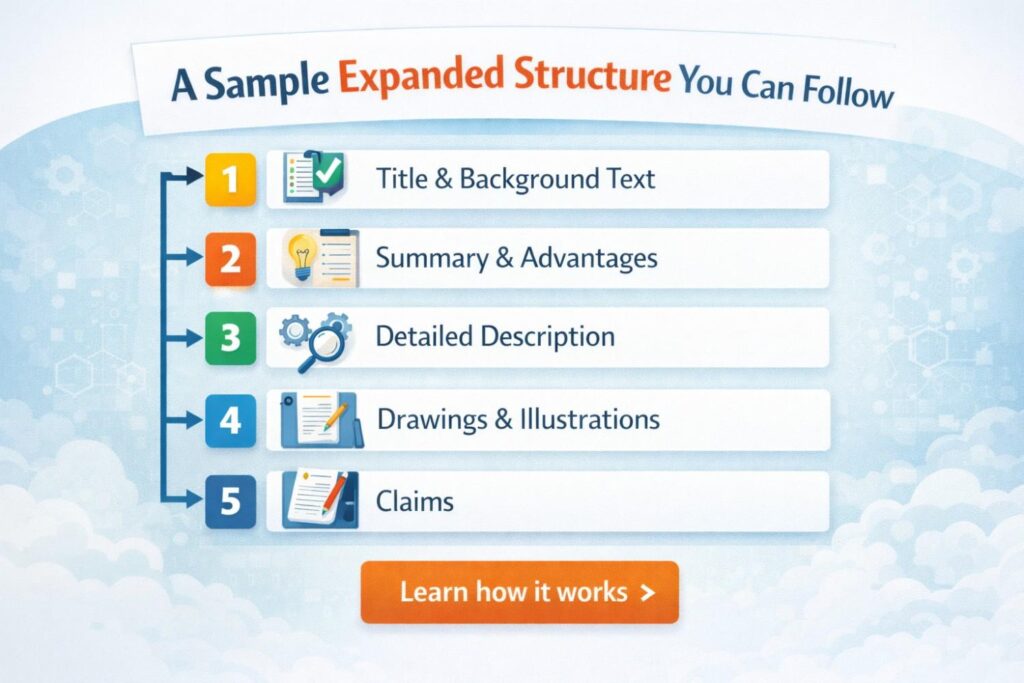
To make this even more practical, here is a fuller structure you can adapt when writing a patent specification. Think of it as a working blueprint.
Start with a title that clearly names the invention.
Then add one or two sentences for the technical field.
Then write a background section that explains the technical setting and why existing approaches leave room for improvement.
Then write a summary that introduces the broad invention, including a method view, a system view, and any other useful high-level form.
Then add a short section naming the figures.
Then move into the detailed description with subheadings that may include:
An overview of the system
A description of the computing or physical environment
A description of major components
A process flow for operation
Optional data sources or inputs
Optional decision logic or models
Output types and actions
Deployment options
Example use cases
Alternative embodiments
Then add claims and an abstract.
That is the simple structure that works.
It is not fancy. It is dependable.
How claims and the specification work together in practice
A good way to think about claims is that they are built from the materials the specification provides.
If the specification describes the invention as a system, a method, and a computer-readable medium, that gives room for several claim styles.
If the specification includes alternatives for how a task is performed, claims can later be shaped around broader or narrower versions depending on what is strategic.
If the specification includes fallback positions, that can be very useful during examination.
This matters because patent prosecution is often dynamic. You may need to refine claims as prior art appears. A richer specification gives you more options when that happens.
A thin specification leaves you with less room to maneuver.
That is why strong early drafting saves pain later.
Thinking about competitors while drafting
One of the smartest ways to improve a specification is to ask how a competitor would try to get around it.
Suppose your invention includes a specific scoring formula. Could someone change the formula but keep the same core system idea?
Suppose your invention uses one data source. Could someone swap in a different but equivalent source?
Suppose your invention uses a central server. Could someone move the same logic to an edge device?
Suppose your invention includes one exact threshold. Could someone make it adaptive and bypass a narrow claim?
These are not just claim questions. They are specification questions.
If you identify likely workarounds early, you can make sure the specification describes those variants where appropriate.
That is how stronger patent protection is often built: by thinking one step ahead.
The difference between documentation and patent drafting
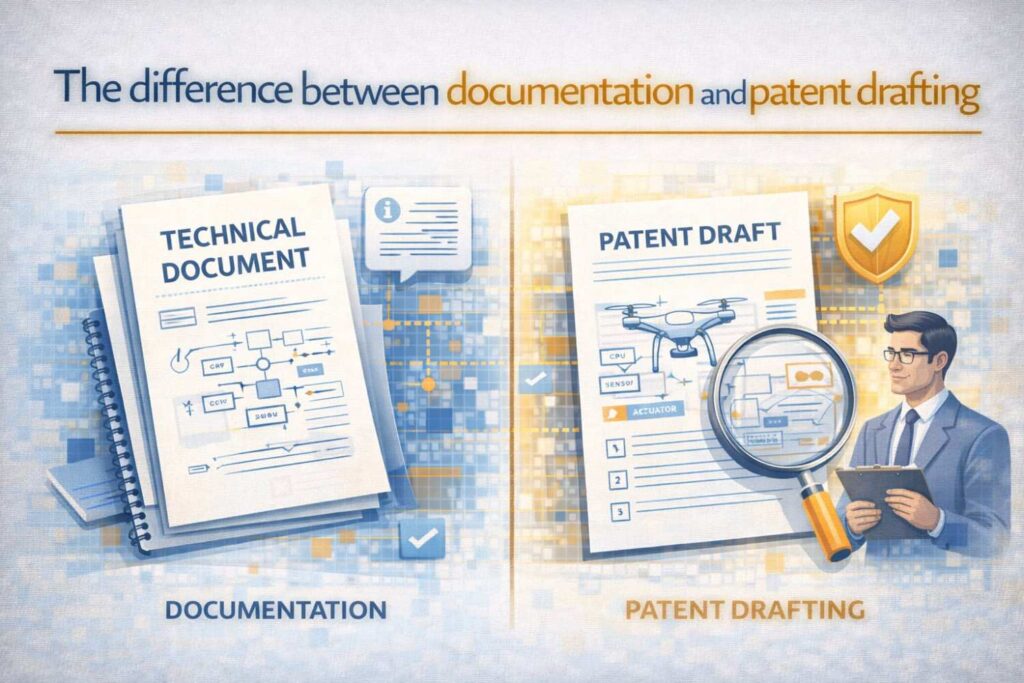
Your internal docs and your patent specification may overlap, but they are not the same thing.
Internal docs often explain how the current system is built today.
A patent specification should explain the invention in a way that supports legal protection across meaningful versions.
Internal docs may focus on implementation details that are too narrow or temporary.
A patent specification should include enough detail to be real, but not be trapped by one release cycle.
Internal docs may ignore alternatives because the team already picked one.
A patent specification should often describe alternatives because they matter for scope.
This is why copying and pasting internal product docs into a patent draft rarely works well on its own.
The materials help, but they need translation into the right structure and level.
How early is too early to draft?
Founders often worry they are too early.
Maybe the product is still changing. Maybe the model is still improving. Maybe the team has not launched yet.
In many cases, early is fine if the inventive concept is clear enough.
You do not need every production detail locked down.
You do need a real invention.
That means you can explain what it is, how it works, and what makes it different.
In fact, waiting too long can be risky. You may disclose too much publicly. You may ship before protecting core ideas. You may let valuable invention details fade into the background as the team gets busy.
The right time is often earlier than founders think.
The better question is not “Is everything final?”
The better question is “Do we understand the inventive system well enough to describe it clearly and support meaningful variations?”
If yes, that is often enough to begin.
How to make the process less painful
The old way of getting a patent specification drafted is often slow and frustrating.
You send notes. Then more notes. Then answer a long list of questions. Then wait. Then review dense language that does not sound like your product. Then revise. Then repeat.
That process loses momentum.
Founders need a better way.
The best workflows today help capture invention details in a structured, founder-friendly format and turn that into a real draft faster. Even better, they combine that speed with attorney oversight so quality does not get sacrificed.
That is the promise behind PowerPatent. It helps startups turn inventions into strong patent filings without the usual confusion, cost drag, and slow cycle. For teams building real technical products, that can be a major advantage. You can take a look here: https://powerpatent.com/how-it-works
A practical drafting exercise you can do today
Here is a useful exercise for any founder or engineer.
Open a blank document and write these short prompts:
What problem does our invention solve?
What are the main parts?
What happens step by step?
What data goes in?
What comes out?
What is optional?
What could be changed without losing the core idea?
How would a competitor try to copy it?
Now answer those in simple language.
Do not worry about formal style yet.
Once you do that, you are already much closer to a patent specification than you may think.
From there, the structure becomes easier. The field, background, summary, and detailed description can be built from those answers.
This exercise also makes invention gaps visible. If one step is fuzzy, or one key module is hard to explain, that is useful. It tells you where to think more before filing.
The quiet power of examples and use cases
A good specification often includes examples that show the invention in real settings.
These examples are helpful because they bring the system to life.
Suppose your startup built a route optimization platform for cold-chain delivery.
One example may involve vaccine transport in urban traffic.
Another may involve food delivery in hot weather.
Another may involve sensor outages during transit.
Each example can show how the system responds, what data it uses, and what outputs it produces.
These examples make the specification easier to understand and can help support a wider range of practical implementations.
Again, examples should open the invention up, not close it down.
The goal is to show usefulness and flexibility, not just one narrow scenario.
How much detail is enough?
This is the question behind almost every drafting decision.
The answer is not a magic page count.
Enough detail means the invention is clearly described and the important variations are supported.
For a simple mechanical improvement, that may be fairly compact.
For a complex software platform or AI pipeline, it may require a much longer and richer draft.
The right amount of detail depends on the invention.
But here is a reliable rule: if key parts of the invention live only in the founder’s head and not in the draft, there is probably not enough detail.
If the draft describes a result but not the path to the result, there is probably not enough detail.
If the draft names only the current version and ignores realistic alternatives, there is probably not enough detail.
This is why many strong startup filings are more detailed than founders first expect. That detail is not waste. It is support.
Why founders should care even if they have outside counsel
Some founders think they do not need to understand specification structure because that is the lawyer’s job.
That is a mistake.
Yes, strong legal guidance matters. Very much.
But you still need to know what makes a specification strong because your team holds the technical truth. No attorney can invent detail that was never captured. No one can protect variations they were never told about.
The best results happen when founders and attorneys work from the same clear model.
You do not need to become a patent expert.
You do need to understand enough to give better inputs, review drafts more intelligently, and spot when something important is missing.
That is part of building a strong company.
How a strong specification supports fundraising and strategy
A strong patent specification does more than support a filing.
It can quietly improve how your company is seen, how your story is told, and how your long-term advantage is understood.
That matters in fundraising.
It matters in board discussions.
It matters in partnership talks.
And it matters when your market gets crowded and people start asking the hard question: what makes this company hard to copy?
A weak patent story usually sounds shallow. It says, “We filed a patent,” but it cannot explain what is actually protected, why it matters, or how it maps to the business.
A strong patent story is different. It shows that the team understands its own edge at a deep level. It shows that the company is not just shipping features. It is building protectable systems, repeatable technical advantages, and defensible product ground.
That kind of signal can be more powerful than founders realize.
It Helps Investors See That Your Edge Is Real
Investors hear many startup pitches that sound similar on the surface.
Faster workflows. Better AI. Smarter automation. Lower costs. Better user outcomes.
The problem is that many of those claims are easy to say.
What investors really want to know is whether your edge is durable.
A strong specification helps answer that without needing to sound dramatic. It gives substance behind the story. It shows that your company has identified a real technical problem, built a real solution, and thought carefully about how that solution works across different versions and use cases.
That changes the conversation.
Instead of sounding like a company with a product feature, you start sounding like a company with technical infrastructure that can become a category advantage.
This is especially useful when your startup operates in a crowded market. If five companies all claim they use AI to improve outcomes, the team that can clearly explain its system architecture, its core method, its technical tradeoffs, and the parts that are protectable will usually come across as more serious and more prepared.
That does not guarantee funding.
But it does strengthen belief.
And belief matters.
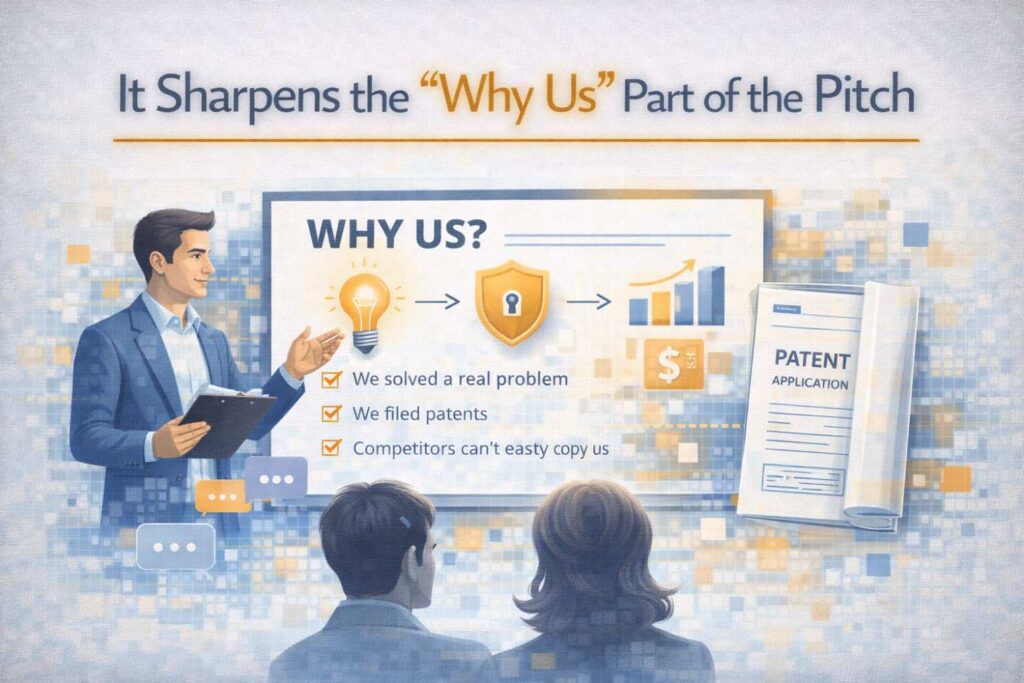
It Sharpens the “Why Us” Part of the Pitch
Many founders spend a lot of time on market size, team strength, and growth plans.
Those things matter. But in many investor meetings, the “why now” and “why us” parts of the story need to be stronger.
A well-built specification can help you sharpen the “why us” part.
Why?
Because writing a real specification forces the team to define what is actually unique in its approach.
Not the slogan. Not the homepage line. The real thing.
It forces questions like:
What exact technical problem did we solve better than others?
What design choice gives us leverage?
What part of our workflow would be hard for another team to recreate quickly?
What hidden technical layer creates our product advantage?
Those are powerful strategic questions, even outside patent work.
When answered well, they often improve fundraising language too. They help founders replace broad claims with specific, credible points of differentiation.
That makes the company easier to believe in.
It Gives You a Better Defensibility Narrative
“Defensibility” is one of those words that gets used all the time and explained poorly.
A lot of startups answer defensibility questions with weak points.
They say they move fast.
They say they have great design.
They say they know their customer better.
Those can be real advantages, but by themselves they are often not enough.
A strong specification gives you a better defensibility narrative because it ties your edge to technical substance.
It helps you say, in a grounded way, that your advantage is not just a brand promise. It is built into the method, architecture, workflow, model pipeline, control logic, hardware arrangement, or system design.
This is stronger than saying, “We have patents.”
It lets you say, “We have built a technical approach that is both important to our product and hard to copy cleanly without stepping into the same invention space.”
That is a much better strategic position.
It Helps You Speak Clearly in Diligence
As companies grow, diligence gets deeper.
At first, an investor may just ask whether you have filed anything.
Later, they may want to know what the filings cover, whether they map to the actual product, whether more filings are planned, and whether the team is treating IP as a real business asset or just a checkbox.
This is where weak preparation shows up fast.
If your patent filing is disconnected from the product, or if no one on the team can explain what the specification actually supports, you lose credibility.
A strong specification makes diligence easier because it gives you a real document that tracks the invention clearly. It becomes easier to connect the filing to product architecture, roadmap themes, and future market opportunities.
That kind of clarity can reduce friction in fundraising and later in acquisition diligence too.
It Can Shape Product Strategy, Not Just Protect It
This is the part many founders miss.
A strong specification is not only about capturing what already exists. It can also help shape what the company decides to build next.
When you go through the drafting process carefully, you usually surface more than one version of the invention. You identify optional paths, alternate deployment models, extra use cases, and adjacent applications.
That is not just patent material. That is strategic product insight.
Sometimes the specification process reveals that your core invention can support a much broader platform than the team first thought.
Sometimes it shows that a small internal tool is actually a key control point in the business.
Sometimes it reveals that a technical workflow built for one market can apply to three others.
This means the patent process, when done well, can become a strategy exercise. It helps you see where the real leverage sits.
That can affect roadmap choices in a very practical way.
Using the Specification to Build a Better Fundraising Story

A strong specification can help you tell a cleaner and more convincing company story.
That does not mean quoting patent language in a pitch deck. It means using the thinking behind the specification to improve how you talk about the business.
Translate Technical Depth Into Investor-Friendly Language
Investors do not always want the full technical detail, but they do want proof that the depth exists.
So take the work done in the specification and turn it into simple business-facing language.
For example, instead of saying:
“We built a proprietary orchestration engine.”
You may be able to say:
“Our system does not just run a model. It controls how data is filtered, scored, and acted on across the workflow, which is a key reason results improve over time.”
That is more concrete.
It shows there is a real system underneath the product.
This translation step is valuable. It helps you move from “smart sounding” to believable.
Use the Specification to Support Your Technical Moat Slide
Most moat slides are too thin.
They often mention data, speed, talent, and patents in a very general way.
A stronger approach is to build that slide around the actual technical pillars reflected in your specification.
What are the two or three invention-level advantages the document makes clear?
Maybe your moat is not the front-end feature. Maybe it is the way your system handles sparse data, real-time feedback, edge deployment, low-latency decisioning, multi-source fusion, or adaptive control.
Those are better moat anchors because they are harder to copy and easier to defend.
When your moat slide matches your actual invention record, the whole story becomes stronger.
Connect the Filing to Business Milestones
One of the smartest things a company can do is connect IP work to key business milestones.
Do not let the specification sit in a legal folder with no strategic use.
Map it to moments that matter.
Does the filing support a core product launch?
Does it protect a new platform capability?
Does it strengthen your story before a major raise?
Does it line up with expansion into a new customer segment?
Does it help protect technology that will become central to enterprise sales?
When founders make those connections, IP becomes part of business planning instead of legal cleanup.
That is a far better use of the asset.
How Founders Can Use the Specification in Strategic Planning
A strong specification can become a planning tool if the team knows how to use it.
Find Your Real Core Technology
Many startups think their core value is one thing, but the specification process reveals something deeper.
For example, a company may think its value lies in a dashboard, recommendation engine, or automated workflow. But after mapping the invention fully, it becomes clear that the real edge is in the underlying method for data validation, event ranking, exception handling, or system coordination.
This matters because companies often invest too much energy in surface features and not enough in the technical layer that creates long-term leverage.
The specification can help correct that.
A good exercise is to review the draft and ask: if competitors copied our visible product features, what hidden technical layer would still be hardest for them to reproduce?
That layer is often where your strongest strategy should focus.
Use It to Prioritize What Gets Protected Next
Most startups will not stop at one filing.
As the product grows, the question becomes what to protect next.
A strong first specification helps with that because it reveals the edges of what is already captured and what is becoming newly important.
This lets you build a smarter filing roadmap.
You may find that one area deserves a continuation strategy.
You may find that a separate subsystem now deserves its own filing.
You may find that one customer-driven feature is not important enough to protect, while an internal technical workflow absolutely is.
This prevents random filing behavior.
Instead of filing based on noise, you file based on leverage.
Align Engineering and IP Early
In many startups, engineering and IP only meet when something needs to be filed urgently.
That is too late.
A better move is to use the specification process to create light alignment between technical planning and IP planning.
This does not need to be formal or slow.
Even a short quarterly review can help.
Look at what the team has built, what changed in the architecture, what new workflows now matter, and what upcoming launches may reveal protectable invention.
That kind of review keeps patent work tied to actual product evolution.
It also reduces the chance that major technical breakthroughs go undocumented until after they are publicly exposed.
Actionable Advice for Businesses
This is where strategy becomes useful only if it leads to action.
Here are practical ways to use a strong specification beyond the filing itself.
Turn the Specification Into a Defensibility Memo
After a draft is complete, create a short internal memo with plain-language answers to three questions.
What core technical advantage does this specification protect?
Why would that matter to our business over the next two to three years?
Where are competitors most likely to try to work around it?
This memo can be helpful for founders, board members, fundraising prep, and product leadership.
It turns a legal document into a business asset people can actually use.
Build an IP Map Against Your Product Roadmap
Take your core product roadmap and mark which features or systems are already covered, partly covered, or not covered by existing filings.
This is a powerful exercise because it shows whether your IP strategy matches where the company is actually going.
Some teams discover they spent time protecting side features while leaving central platform logic exposed.
Others discover the opposite: they already have stronger coverage than they realized.
Either outcome is useful.
Rehearse One Clear Fundraising Answer
Every founder should be able to answer the IP question in a sharp, simple way.
Not with vague lines like “we filed broadly.”
A better answer sounds like this:
“We have protected the core technical method behind how our system processes and acts on data, not just the visible feature layer. That matters because it maps directly to the part of the product that drives performance and would be hardest to copy.”
That kind of answer feels grounded and strategic.
It also shows maturity.
Review the Specification Before Major Public Releases
Before a major launch, conference talk, white paper, customer announcement, or demo day push, review whether the underlying invention has been captured well enough.
This habit can save a lot of regret.
Fast-moving teams often disclose important technical detail long before they protect it.
A short pre-release review can help you decide whether something meaningful should be filed first.
Use the Draft to Train Internal Leadership
Do not let the specification live only with outside counsel or one founder.
The CEO, CTO, and key product or engineering leaders should understand what the document covers at a high level.
That shared understanding improves consistency in fundraising, sales, partnerships, and roadmap planning.
It also makes future invention capture much easier.
The Strategic Risk of a Weak Specification
It is worth saying clearly: a weak specification is not just a legal weakness.
It is often a business weakness too.
Why?
Because a weak specification usually means the company has not fully captured its own technical edge in a durable form.
That can lead to poor fundraising answers, scattered filing strategy, weak diligence performance, and missed opportunities to protect the parts of the system that actually matter most.
In other words, weak patent work can reflect weak strategic framing.
The opposite is also often true.
A strong specification usually comes from a team that understands its invention deeply and can connect technical design to business value.
That kind of thinking is useful far beyond the patent itself.
Strong Specifications Create Strategic Clarity
In the end, one of the biggest benefits of a strong specification is clarity.
Clarity about what the invention really is.
Clarity about what makes the company hard to copy.
Clarity about where product leverage sits.
Clarity about what should be protected next.
And clarity about how to explain all of that to investors, partners, and future acquirers.
That is why this work matters.
A strong specification is not just a legal document prepared for filing.
It is a structured record of what gives your business technical weight.
And for startups trying to build lasting advantage, that can be one of the most useful forms of clarity they ever create.
The simple structure that works, again
Let us bring this back to the main idea.
A patent specification does not need to be mysterious.
It needs a solid structure.
Start with a clear title.
State the technical field.
Explain the background and the technical problem.
Summarize the invention at a high level.
Briefly describe the figures.
Then write a full, careful detailed description that covers the system, method, components, steps, alternatives, examples, and meaningful variations.
Then support that with claims and an abstract.
That is the simple structure that works.
It works because it gives shape to the invention.
It works because it supports clarity.
It works because it gives room for stronger protection.
And it works because it helps founders move from vague “we built something smart” language to a real written asset.
Final thoughts
If you are building something new, your patent specification is not just paperwork.
It is a written map of your invention.
Done well, it can protect more than your current feature set. It can protect the deeper system thinking behind your startup. It can give you room as the product evolves. It can help you avoid weak filings, missed scope, and painful do-overs later.
The good news is that the structure is not complicated.
Clear title. Clear field. Honest background. Broad summary. Useful figures. Detailed description with real technical substance and real alternatives.
That is the backbone.
The hard part is not the template. The hard part is capturing the invention well and turning it into a draft that is both clear and strategic.
That is exactly why PowerPatent exists.
It helps founders and technical teams create stronger patent filings faster, using smart software and real attorney oversight. So you are not stuck with slow, old workflows or weak DIY drafts. You get more speed, more control, and more confidence without losing quality where it matters.
If you want to see how that works in practice, start here: https://powerpatent.com/how-it-works
And if you are sitting on an invention right now, this is your reminder not to wait until it is too late, too public, or too messy.
Capture it clearly. Structure it well. Protect what you are building.
That simple structure can go a very long way
Leave a Reply