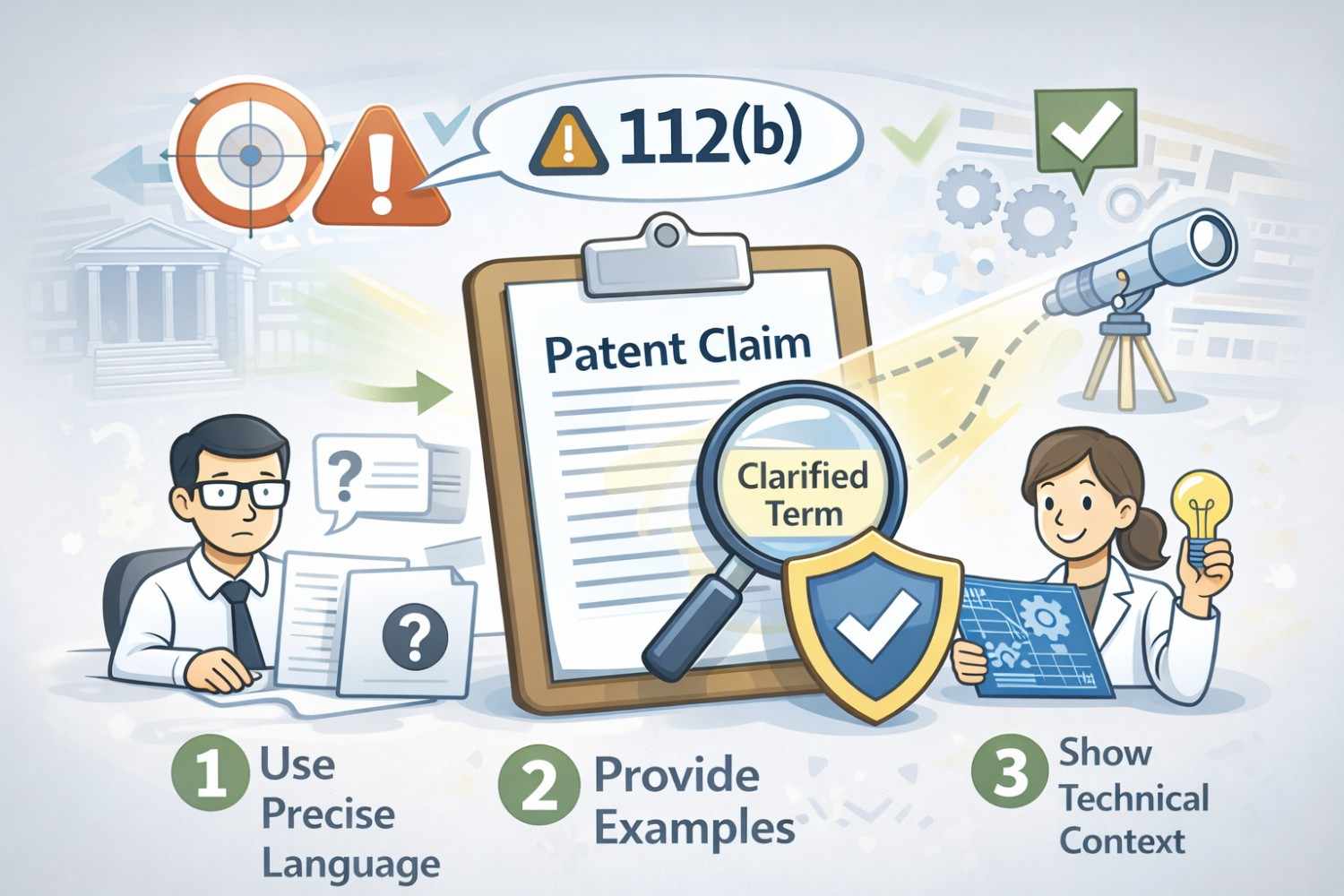
A 112(b) rejection feels small on paper and huge in your gut. The patent office is not saying your idea is bad. They are saying your words are fuzzy. That sounds easy to fix, but this is where many founders make a quiet mistake. They rush to clean up language and, without meaning to, give away real ground. They narrow the claim. They lock themselves into one version. They trade clarity for control. This article is about doing the opposite. You will learn how to answer a 112(b) indefiniteness rejection in a way that makes your patent clearer without making it weaker. You will see how to keep your reach while removing doubt. You will understand what the examiner is really asking for, how to respond with calm confidence, and how to protect the full shape of what you built.
What the Examiner Is Really Saying When They Raise 112(b)
A 112(b) rejection often looks short, dry, and almost harmless. That is what makes it dangerous. Many teams skim it, assume it is a small wording issue, and move fast.
In reality, this rejection is the examiner telling you something important about how they see your invention on paper. If you understand that signal early, you can respond in a way that strengthens your position instead of shrinking it.
This section breaks down what is actually happening in the examiner’s head, why they raise 112(b) in the first place, and how smart companies use this moment to regain control of the narrative around their invention.
The Examiner Is Not Saying Your Idea Is Vague
When founders read “indefinite,” they often hear “confusing” or “poorly thought out.” That is not what the examiner means. The examiner is trained to look at claims as legal boundaries, not as engineering explanations.
If a boundary cannot be tested, measured, or clearly understood by someone skilled in the field, the examiner has to raise 112(b), even if they fully understand what you meant.
This is important because it changes how you should respond. You are not defending your intelligence or your tech. You are helping the examiner draw a clean box around it.
Once you see that, the emotional reaction fades and the strategic response becomes clearer.

At PowerPatent, this is where founders often relax once they see how the system and attorney review work together.
The goal is not to overexplain, but to define just enough so the boundary becomes solid. You can see how that process works in practice at https://powerpatent.com/how-it-works.
Indefiniteness Is Often About Measurement, Not Meaning
Most 112(b) rejections come down to one quiet issue: the examiner cannot tell how something would be judged as inside or outside the claim.
Words like “efficient,” “fast,” “secure,” or “optimized” are common triggers. Not because they are bad words, but because they lack a clear test.
The examiner is asking a simple question, even if it is not written simply. How would someone know if this element is present or not? If your claim does not answer that, the examiner has no choice but to push back.
The strategic move here is to look for implied tests that already exist in your description. Many inventions already explain how performance is improved or how a result is achieved.
The mistake is adding new limits instead of pointing the examiner to what is already there. Clarifying does not mean narrowing when done correctly.
Why Examiners Use 112(b) to Slow Things Down
Examiners are under pressure to move applications forward while avoiding mistakes. When a claim feels slippery, even if it seems innovative, 112(b) becomes a safe pause button. It lets them say, “I need this tighter before I go further.”
Understanding this helps you respond with empathy and precision. A response that shows you understand the concern, without rewriting the invention, builds trust.
Overly aggressive rewrites do the opposite. They suggest uncertainty and invite more scrutiny later.

This is where having a structured response process matters. PowerPatent is designed to help founders avoid reactive edits by framing responses around examiner comfort without sacrificing scope. That balance is hard to strike without guidance.
The Difference Between Ambiguity and Breadth
One of the biggest misunderstandings around 112(b) is the belief that broad claims are the problem. They are not. Ambiguous claims are the problem. You can be broad and clear at the same time, but it requires careful language.
Examiners are trained to allow breadth if the edges are visible. What they reject is a claim where the edges blur.
When founders panic, they often trade breadth for certainty, when what the examiner really wants is visibility, not restriction.
A strong response keeps the width of the claim intact while sharpening the edges. That usually means defining relationships, not locking in structures. It means explaining how parts interact, not naming specific tools unless absolutely required.
When the Examiner Is Asking for Support Without Saying It
Sometimes a 112(b) rejection is not really about the claim language at all. It is about the examiner not seeing enough support in the description to back up how the claim is written.
Instead of raising a written description issue, they raise indefiniteness because it is simpler.
This is a subtle but critical moment. If you respond by narrowing the claim, you confirm the examiner’s hidden concern.

A better move is often to point directly to passages in the specification that already explain the concept, using the examiner’s own words where possible.
This is one of the most tactical responses a business can make. You are not changing the invention. You are changing the examiner’s line of sight. That is a powerful distinction and one that experienced patent teams use often.
Reading the Rejection Like a Negotiation
A 112(b) rejection is not a verdict. It is an opening position. The examiner is saying, “This is where I am uncomfortable.”
Your response is your counter. If you treat it like a correction task, you lose leverage. If you treat it like a conversation, you gain ground.
The most effective responses mirror the examiner’s language, acknowledge the concern, and then guide them to a solution that preserves scope. This shows professionalism and control. It also reduces the chance of follow-on rejections.
Founders who try to handle this alone often miss these signals. That is why PowerPatent combines software clarity with attorney judgment.
It is not just about writing words. It is about steering outcomes. If you want to see how that works in real filings, visit https://powerpatent.com/how-it-works.
Why Speed Matters More Than Perfection at This Stage
One final point businesses often miss is timing. A clean, confident response that moves the application forward is usually better than a perfect rewrite that introduces new questions.
Examiners value momentum. They are more likely to work with you when they see progress instead of hesitation.

This does not mean rushing blindly. It means responding with intent. Fix what needs fixing. Clarify what needs clarity. Leave everything else untouched. That discipline is what separates strong patents from over-edited ones.
Why “Just Clarifying” Often Shrinks Your Patent Without You Noticing
Many good patents do not fail because the invention was weak. They fail because the response was too eager to please. When a 112(b) rejection arrives, the natural instinct is to clean things up fast.
Clarify the words. Make the examiner happy. Move on. That instinct is understandable, but it is also where quiet damage happens.
This section explains why simple clarification is rarely simple, how well-meaning edits can slowly give away value, and what businesses should watch for before touching a single claim word.
Clarification Feels Safe Because It Sounds Small
The word “clarify” feels harmless. It sounds like polishing, not changing. Founders often assume they are just making the same idea easier to read. In reality, patent claims do not work like normal writing.
Every added word, removed phrase, or reordering of language changes the legal shape of the invention.
What makes this dangerous is that the loss is not obvious in the moment. The claim still looks good. The invention still sounds right. But the outer edges quietly move inward. Once that happens, you cannot move them back.

This is why experienced patent teams slow down at this stage, even when the fix looks easy. The cost of a rushed clarification often shows up years later, when enforcement or fundraising begins.
How Narrowing Sneaks In Through Examples
One of the most common ways founders surrender scope is by adding examples into the claim itself. They do this to help the examiner understand what they meant.
The problem is that claims are not the place for teaching. They are the place for boundaries.
When an example moves from the description into the claim, it stops being an illustration and becomes a requirement. What was once one possible way becomes the only allowed way.
This is how a platform turns into a feature, and how a system turns into a single workflow.
A safer move is almost always to clarify by reference, not by replacement. Point the examiner to where the idea is explained, instead of rewriting the idea to look like the explanation.
The Hidden Cost of Adding Technical Detail
Another common mistake is adding technical detail to “remove ambiguity.” Founders do this because they want to sound precise. Engineers especially feel this pull. More detail feels more correct.
In patent claims, more detail often means less protection. Every technical choice you lock in becomes a door you close. Competitors love closed doors because they show exactly where to step around.
Examiners do not require full implementation detail in claims. They require clear boundaries.

There is a difference. Strong responses focus on relationships and outcomes, not on internal mechanics unless those mechanics are the invention itself.
This distinction is subtle, but it is critical for businesses that plan to evolve their product after filing.
Why Claim Language Is Not the Same as Product Language
Founders often reuse product language when responding to 112(b). That language works great in demos and pitch decks. It does not always work in claims.
Product language is designed to persuade. Claim language is designed to define. When you bring marketing clarity into a legal boundary, you often make promises you did not mean to make.
For example, product language tends to highlight best-case performance. Claims should avoid tying protection to performance levels unless absolutely necessary. Otherwise, the claim becomes fragile. It works only when everything goes right.
Understanding this difference helps teams respond to 112(b) without falling into the trap of overspecifying.
The Risk of Locking Into Today’s Version
Startups move fast. The version of the product you have today is rarely the version you will ship next year. When founders clarify claims using current architecture, they often lock the patent to a moment in time.
This happens when clarification is done by naming specific components, data flows, or configurations that feel obvious today.
The examiner may accept it. The problem shows up later, when the product shifts and the patent no longer covers it cleanly.
A better approach is to clarify at the level of function and interaction, not at the level of implementation. This keeps the patent aligned with the direction of the business, not just its current snapshot.
PowerPatent is built around this idea. The platform helps founders describe inventions in a way that survives product evolution, with attorney review to catch overcommitment early. You can explore that approach at https://powerpatent.com/how-it-works.
When Silence Is Stronger Than Change
One of the hardest lessons for founders is that not every examiner concern requires rewriting the claim. Sometimes the best response is explanation, not amendment.
If the language is already supported and reasonably clear, changing it may create more problems than it solves.
In these cases, a response that explains how a skilled reader would understand the term, backed by the description, can resolve the issue without altering scope.

This requires confidence and experience. Many first-time filers assume the examiner always expects edits. That is not true. Examiners often accept clarification through argument when it is well grounded.
Knowing when to stay still is just as important as knowing when to move.
How Businesses Lose Leverage Without Realizing It
Each time you narrow a claim, you reduce future options. That affects licensing, partnerships, and acquisition discussions.
Sophisticated buyers look closely at how claims changed during prosecution. They can see where value was traded away.
What looks like a harmless clarification today can raise questions later about why certain paths were excluded. Those questions weaken negotiating position, even if the product is strong.
This is why businesses should treat 112(b) responses as strategic decisions, not editorial tasks. The response is part of the asset, not just a step toward allowance.
The Role of Structure in Avoiding Accidental Surrender
One of the best defenses against accidental narrowing is having a structured response process. That means reviewing each proposed change with one question in mind: does this limit future interpretations?
If the answer is yes, the change should be reconsidered. Often there is another way to achieve clarity without locking in detail. This discipline is hard to maintain without outside perspective, especially under time pressure.

That is where systems like PowerPatent help. By combining structured drafting with attorney oversight, founders get clarity without overcorrection. The result is speed without regret.
How to Respond With Precision While Keeping Your Full Scope
A strong 112(b) response is not about fixing words. It is about controlling meaning. This is the stage where smart companies separate clarity from concession.
The goal is to make the claim easier to understand without making it easier to design around. That requires intent, restraint, and a clear sense of what must stay flexible.
This section walks through how businesses can respond with precision, protect future options, and guide the examiner toward allowance without shrinking the invention.
Start by Freezing the Business Goal, Not the Claim Text
Before touching the claim, pause and restate the business goal of the invention. Not the feature. Not the current product. The real value. Is it control over a workflow, a class of models, a way of handling data, or a system-level advantage?
This matters because claim edits made without anchoring to business value tend to drift toward convenience. Founders solve the immediate problem in front of them and forget the larger reason the patent exists.

Teams that do this well treat the claim as a boundary around value, not as a sentence to improve.
Once that boundary is clear in your mind, every proposed change becomes easier to judge. If it protects the value, it stays. If it risks narrowing the value, it goes.
Use the Examiner’s Confusion as a Map
A 112(b) rejection tells you exactly where the examiner got uncomfortable. That discomfort is useful. It shows which part of the claim needs framing, not which part needs cutting.
Instead of rewriting broadly, isolate the precise term or relationship the examiner flagged. Then ask why that part felt unclear. Was it because two elements were not clearly connected?
Was it because a result was described without a mechanism? Or was it because a term was used differently in different places?
Responding at that exact point keeps the rest of the claim intact. This focused approach prevents accidental ripple effects that come from global rewrites.
Clarify Through Definition, Not Limitation
One of the most effective ways to respond to 112(b) is by defining how a term is understood, rather than narrowing what it includes. This often means explaining what the term refers to, not what it excludes.
For example, instead of replacing a flexible term with a specific structure, you can explain how a skilled reader would understand that term based on the description. This reinforces meaning without shrinking coverage.
This type of response shows confidence. It tells the examiner that the invention is already clear when read as intended. Often, that is enough to resolve the rejection without touching the claim language at all.
Let the Description Do the Heavy Lifting
Many founders forget how powerful the description already is. The specification exists to support and explain the claims. When responding to 112(b), your job is often to reconnect the examiner to that support.
Pointing directly to passages that explain how a term operates, how a result is achieved, or how elements interact can resolve indefiniteness without amendment. This approach preserves scope and keeps future flexibility intact.

The key is alignment. Use the examiner’s words when pointing back to the description. Mirror their concern and then show where it is already addressed. This feels cooperative rather than defensive.
Be Careful When Adding Words Like “Configured To”
Certain phrases feel safe because they are common. Words like “configured to” or “operable to” are often added to clarify function. While they can help, they can also introduce unintended limits if used carelessly.
These phrases tie behavior to structure. If the structure changes later, coverage may become unclear. Before adding them, consider whether the relationship is truly structural or whether it can be described as a capability or outcome.
Precision here means choosing language that describes what the system achieves, not how it must be built to achieve it.
Keep Future Variations Alive
Every business evolves. A good 112(b) response keeps room for that evolution. When clarifying, ask whether the language still covers variations you might build next year.
If the clarification relies too heavily on current architecture, it may solve today’s rejection but create tomorrow’s regret. A better approach is to describe roles and interactions, not specific implementations.
This is especially important for software, AI, and platform companies, where internal designs change often while the core value stays the same.
Use Argument Strategically, Not Emotionally
Argument in patent responses is not about persuasion in the usual sense. It is about showing reasonableness.
A calm explanation of how the claim would be understood by someone skilled in the field often carries more weight than aggressive rewriting.
Founders sometimes avoid argument because it feels risky. In reality, thoughtful argument is one of the safest ways to preserve scope. It resolves confusion without creating new constraints.

The key is tone. Acknowledge the concern. Explain the understanding. Support it with the description. Then stop. Over-arguing invites more questions.
Why Coordination Matters More Than Cleverness
The best 112(b) responses are rarely clever. They are coordinated. Claims, description, and response all point in the same direction. There are no surprises, no contradictions, and no unnecessary creativity.
This coordination is hard to achieve when responses are rushed or handled in isolation. It is much easier when there is a system in place that keeps the big picture visible.
That is why PowerPatent focuses on structured drafting and review. Founders move fast, but with guardrails.
Clarity improves without surrendering scope. If you want to see how that works in practice, you can explore it at https://powerpatent.com/how-it-works.
Turning a Rejection Into a Stronger Asset
Handled correctly, a 112(b) rejection can actually strengthen your patent. It forces you to tighten meaning, align language, and remove ambiguity that could have caused problems later.
The difference between strength and shrinkage is intent. When you respond with precision and restraint, the patent becomes clearer without becoming smaller.

That is the real win. Not just allowance, but durable protection that grows with the business.
Wrapping It Up
A 112(b) indefiniteness rejection is one of the few moments in the patent process where small choices carry long shadows. The words you change, the words you leave alone, and the reasons you give all shape how your invention will be understood for years. This is not cleanup work. It is boundary setting. The strongest companies treat this stage with respect. They do not rush to please the examiner, and they do not freeze in fear either. They respond with purpose. They clarify meaning without locking in form. They explain understanding without surrendering flexibility. Most of all, they remember that the patent exists to protect future value, not just today’s version of the product.
Leave a Reply