
When you’re building something new, every dollar matters. And when you’re filing a patent, the fees can stack up fast. The good news is that the U.S. Patent and Trademark Office gives big discounts to inventors and startups that qualify as small entities or micro entities. These aren’t fancy terms. They’re simply ways to help real builders—like you—save money while protecting what you’re creating.
What “Small Entity” Really Means and Why Most Startups Qualify
When you hear the term small entity, it might sound like another legal box you need to check. But in the world of patents, this simple status can be a real advantage for early-stage teams.
It is the USPTO’s way of saying that young companies, solo inventors, and research teams should not pay the same fees as massive corporations with endless budgets.
The rules themselves are not complicated once you see what they are really trying to do, which is to reduce the financial pressure on the people who are actually doing the building.
To qualify as a small entity, your business must have fewer than five hundred employees, and you must not have handed off your patent rights to a larger company that exceeds that size.
Many founders worry they need to comb through every corner of their structure or cap table, but for most early-stage teams, it is very straightforward. If you are a startup without a giant parent company or an acquisition already in motion, you very likely qualify.
Where people sometimes get confused is when investors are involved. The presence of investors alone does not disqualify you. Venture firms, angels, accelerators, or university programs typically do not count as large businesses even if they manage large funds.
What matters is whether you assigned or licensed your patent rights to an entity that does exceed the size limit. Most early investments do not come with that kind of transfer, which means most funded startups still fall neatly inside small entity rules.
The real reason this matters is the cost difference. The USPTO reduces many of the major patent fees by half when you qualify as a small entity. This applies to filing fees, search fees, examination fees, and a series of maintenance fees that come back years later.
This immediate reduction can free up cash for actual product development instead of administrative expense.
Many teams underestimate how much these small savings compound over the life of a patent, but they add up quickly, especially if you are filing more than one application as your technology evolves.
Why Most Startups Miss the Small Entity Advantage and How to Avoid That Mistake
Even though most startups qualify, many fail to claim the status simply because they are unsure or worried about choosing the wrong box.
Some founders do not want to risk a misclassification, so they default to paying full fees. Others assume the discount is only for tiny one-person inventor teams, which is not true.
The rule is designed to help early teams protect their technology before they have the resources to fight giants.
One of the most helpful ways to avoid mistakes is to get clear on your ownership path. Ask yourself who holds rights to your invention today and who might receive rights later.
If there is no plan to hand the patent to a large company, and no existing agreement that does so, you are likely safe. If you do have agreements where rights shift in the future, timing matters.
Your status is determined at the moment you pay a fee, not at the moment you file your invention. As long as you still meet the small entity criteria at the time of that payment, you qualify.
PowerPatent makes this part easier because the platform guides you through a simple set of questions that clarify your status early in the process.

You always know exactly what you qualify for, and you avoid second guessing or worrying about penalties. If you want to see how this works, you can explore the workflow at any time at https://powerpatent.com/how-it-works.
Strategic Ways to Use Small Entity Status to Your Advantage
There is a smart way to use this status, and it goes beyond saving money. When you know you qualify for the discount, you can strategically push forward with more of your IP earlier.
Many founders delay filing because the costs feel heavy. But small entity pricing removes much of that burden. Filing sooner can protect your invention from competitors, protect your fundraising story, and protect future partnerships where you need a strong IP position.
Startups that wait too long often discover someone else has filed something similar, or they lose rights by disclosing too much publicly before filing.
Another powerful move is to build an IP roadmap early. Instead of treating a patent like a one-time event, use your small entity advantage to create a rolling plan.
When your product evolves, when your model trains to new capabilities, or when your hardware gets redesigned, each of these steps may contain invention-level improvements worth protecting.
Because the reduced fees apply to multiple filings, you can spread your protection across several applications without breaking your budget.
Many founders also underestimate the role patents play in attracting investors.
When you can show that your IP is filed, protected, and properly classified under small entity status, it signals a level of operational maturity. Investors want to see founders who think ahead about risk and defensibility.
A clear IP strategy, supported by lower USPTO fees, strengthens your pitch and makes you look more prepared.

PowerPatent helps you communicate this even more clearly by turning your technical work into clean, attorney-reviewed filings that investors understand.
The Hidden Pitfalls to Avoid When Claiming Small Entity Status
There are two common mistakes that startups fall into. The first is forgetting to update their status when something changes. If your company grows, gets acquired, or enters agreements that shift rights to a larger entity, you may no longer qualify.
You are allowed to update your status at any point, and you only need to do it before paying the next fee. The second mistake is claiming micro entity status when they only qualify for small entity.
Micro status has more rules, and founders sometimes mistake it as a simple extension of small entity discounts. Incorrect claiming can open the door to legal headaches you do not want.
The best way to avoid these issues is to keep a clean record of your ownership structure, investor agreements, and any licensing terms. A simple table can help, showing who holds rights, when changes occur, and whether any party crosses the five-hundred-employee threshold.
With PowerPatent, you do not have to track this alone. The system keeps your disclosures organized and makes sure you stay aligned with the rules throughout the life of your application.
Why Starting Early Gives You the Most Savings
The small entity discount is not just about paying less right now. It affects a series of fees that appear at different stages of the patent timeline. When you file early, you lock in your status under the fee schedule of today.
When you delay, you risk paying higher rates later or missing opportunities to claim the status correctly. Many founders do not realize that small entity savings extend into the future with maintenance fees that arrive at three separate milestones.
These are easy to overlook when your focus is on shipping product or closing customers, but proper planning can save you thousands over the life of your patent.

If you want a simple way to understand all the stages, PowerPatent walks you through each step and shows where the discounts apply. You can see a full breakdown here: https://powerpatent.com/how-it-works
How Micro Entity Status Works and When You Can Claim It
Micro entity status is the deeper level of savings that many founders do not even realize they qualify for. While small entity cuts your patent fees in half, micro entity pushes those savings even further by reducing many of the same fees by seventy-five percent.
When you apply the discount across the whole patent timeline, the difference becomes meaningful for any startup trying to stretch runway, reduce burn, or get filings in motion without slowing product development.
The term micro entity might sound like it is only for tiny operations or solo inventors, but it is actually designed for anyone who meets a very specific set of conditions.
The rules are a bit more detailed than small entity status, which is why some teams skip it altogether. But once you break them down into simple ideas, the picture becomes clear.
You can qualify through two different paths. One is based on your income and your past patent history. The other is based on your connection to a qualifying university.
Most founders fall into the first path, especially if they are filing their first set of patents.
Micro entity qualification starts with your past year’s gross income. You have to be below a specific income limit that the USPTO adjusts every year. For many early founders who are not taking large salaries, this is surprisingly easy to meet.
The second part of the rule is that neither you nor your company can have filed more than four U.S. patent applications in the past.
The idea is simple. Micro entity status is meant for people and teams who are still early in their patent journey, not for those with large portfolios.
These rules may seem tight, but most new startups, especially those building deep tech, AI, or hardware products, begin their patent journey with zero or one filing.
And most founders are not pulling in high salaries while building version one of their product. So the micro entity path is often easier to qualify for than people assume.
Where it gets tricky is making sure you check both your personal qualifications and your company’s qualifications. If you are filing on behalf of your startup, the company itself has to qualify.
If you are filing personally before assigning the patent to your company, then you personally have to qualify. Keeping the ownership and assignment plans clear helps avoid confusion later.
Why Micro Entity Status Hits the Sweet Spot for Early Startups
Micro entity status is powerful at the earliest stage of your company because that is the moment when you feel financial pressure the most. You may be pre-seed, pre-revenue, or still trying to finish your prototype.
You may be debating whether to hire another engineer or hold off. Patent fees can feel like a distraction or a cost you want to delay. Micro entity pricing makes those decisions easier by reducing the upfront fees dramatically.
One of the most common mistakes founders make is waiting until they hit revenue or funding before filing for protection.
But once you cross certain income thresholds or once your company matures, you may no longer qualify as a micro entity.
By claiming your status early and filing early, you lock in savings while securing your place in line at the USPTO. That early filing date becomes a powerful shield, especially in fast-moving fields like AI or robotics where new disclosures appear constantly.
Micro entity status also helps you act with more confidence when planning a multi-application strategy. Many inventions grow in branches.
You might file a core patent today, a related system in a few months, and a product-specific version later.
When each filing has significantly reduced fees, you free yourself to protect more pieces of your technology without feeling like you are draining your budget.
It is not about filing more for the sake of filing. It is about giving your company the strongest possible IP foundation while you still qualify for the maximum savings.

If you want to see exactly how PowerPatent maps out this patent strategy for startups, you can explore the workflow at https://powerpatent.com/how-it-works. The platform simplifies your status, flags qualification issues early, and connects your technical work to real attorney review so nothing gets missed.
The Ownership Details That Matter for Micro Entity Qualification
Micro entity status is driven heavily by who owns the rights to the invention. This is where things get more sensitive because any assignment or transfer of rights can affect the qualification.
If you assign your rights to a company, then that company must meet the micro entity requirements even if you still meet them as an individual.
If your company grows in size or starts to generate significant revenue later, it may lose qualification even though you personally would have qualified at the beginning.
A strategy that many founders use is to file at the earliest possible stage while they still meet the income and history limits. They then assign the rights to the company after the filing is complete.
This approach can secure micro entity savings at the outset while still giving the startup full ownership of the patent.
But it is important to time this correctly and make sure it does not conflict with investment agreements, employment agreements, or internal company policies. Clean paperwork is critical because the USPTO expects the status to match the ownership at the moment fees are paid.
PowerPatent’s guided workflow helps avoid these ownership timing mistakes. The system asks the right questions, prompts you when assignment strategies may impact your status, and ensures the attorneys reviewing your application provide clarity.

It removes the fear of choosing the wrong path and gives you a straightforward way to keep everything aligned.
How Micro Entity Status Can Reduce Long-Term Patent Pressure
The first time you pay patent fees is not the last time. The USPTO charges a series of maintenance fees several years after the patent is granted. These fees are due at different milestones and are often forgotten until they suddenly appear on your company’s radar.
If you qualify as a micro entity early, you benefit from reduced fees not only during your filing but also during these later stages. This long-term discount can make the total cost of owning a patent far more manageable.
This matters because startups often find themselves cash-tight at the exact moment those maintenance fees come due. You may be navigating a funding round, attempting to reach profitability, or trying to scale your team.
Micro entity savings help protect you from having to choose between maintaining your IP and pushing forward with growth plans.
Even more importantly, the savings allow you to keep multiple patents active without feeling overwhelmed. Many founders only think about the cost of filing but forget that maintaining a full IP portfolio can also become expensive. Strategic use of micro entity status in the early stages allows you to build that portfolio at a fraction of the long-term cost.
Why Acting Early Helps You Lock In Micro Entity Status
Micro entity status is not permanent. It is something you must qualify for each time you pay a fee. If your income rises, if your company grows, or if you file additional applications over time, you may lose qualification.
That is why acting early is one of the smartest moves a founder can make. Filing early locks in the discount for the first round of fees and secures your priority date.
Waiting can mean missing out on substantial savings, and worse, losing the competitive advantage of being the first to file.
It is also important to understand that your status can change between fees without causing trouble as long as you update it correctly.
The USPTO does not expect you to remain a micro entity forever. It simply expects your status to reflect the truth each time you pay.
This means you can start as a micro entity, switch to small entity later, and eventually become a large entity as your company scales.
That progression is common, and the key is simply keeping your paperwork clean and your classification honest.
PowerPatent helps you stay on top of these changes by tracking your filings, flagging upcoming fee deadlines, and prompting you when it is time to reassess your status.
You never have to guess or dig through complicated forms. Everything is structured in a way that helps founders avoid risk and stay focused on building.
How Much Money You Actually Save With Each Status
When people talk about patent savings, they often focus on the filing fee alone. But the truth is that the USPTO fee schedule stretches across the entire life of a patent.
It begins at the moment you file and continues through examination, issuance, and long-term maintenance. This is why small entity and micro entity status matter much more than most founders realize.
They do not just save you a little money today. They reduce the total cost of owning your patent for decades.
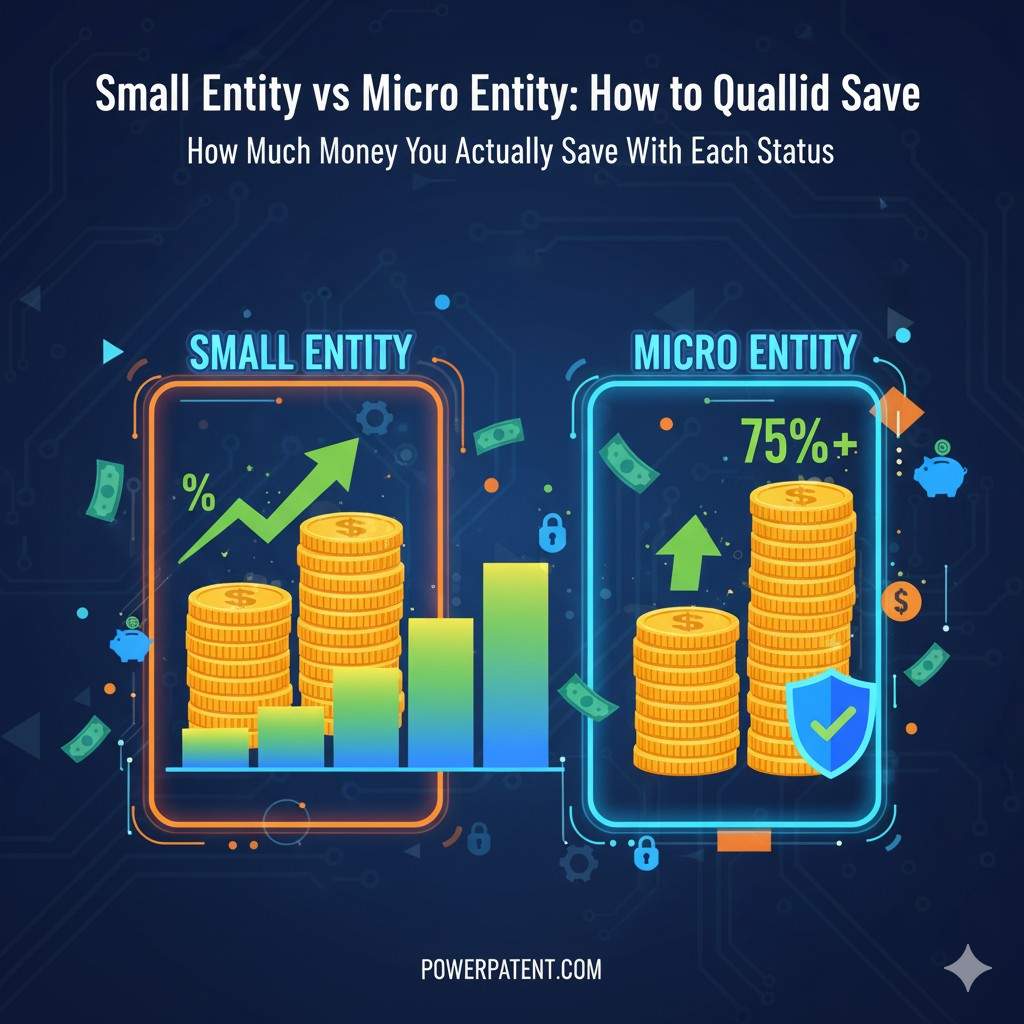
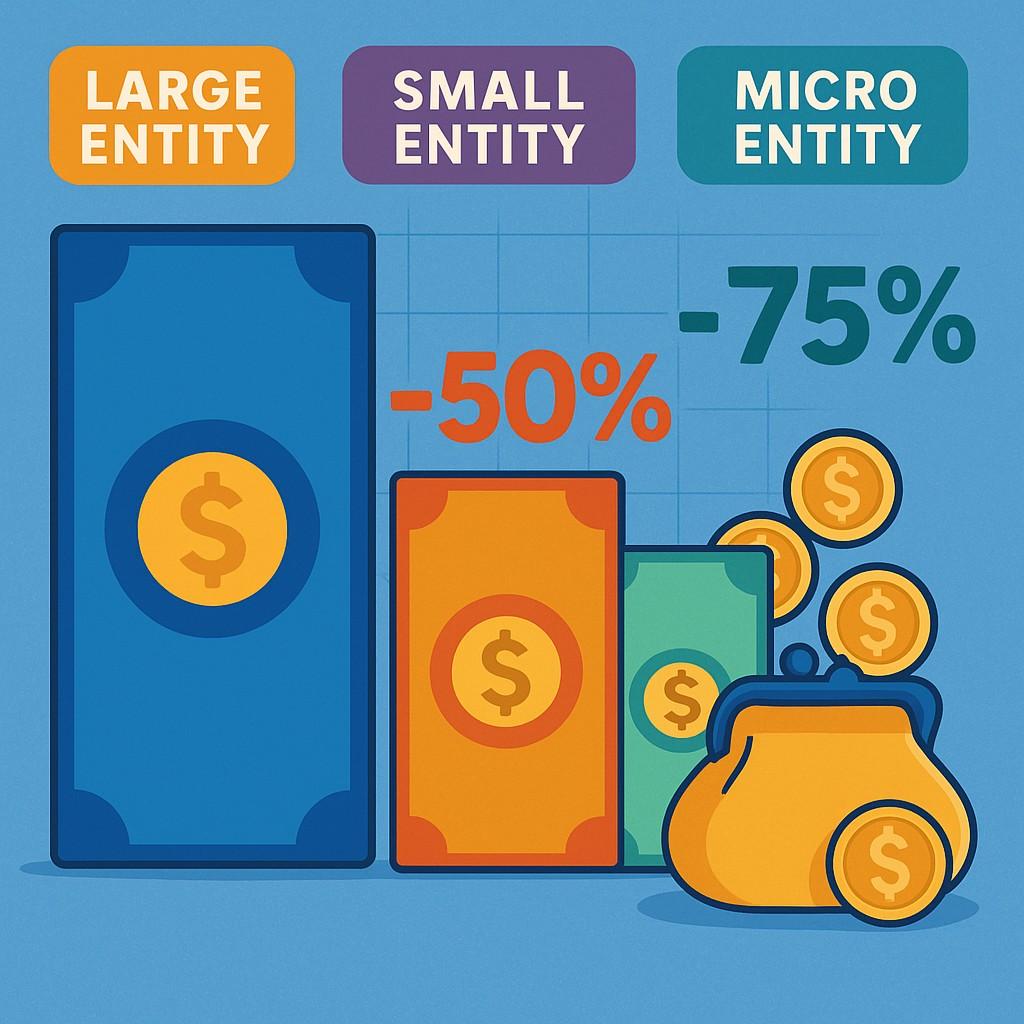
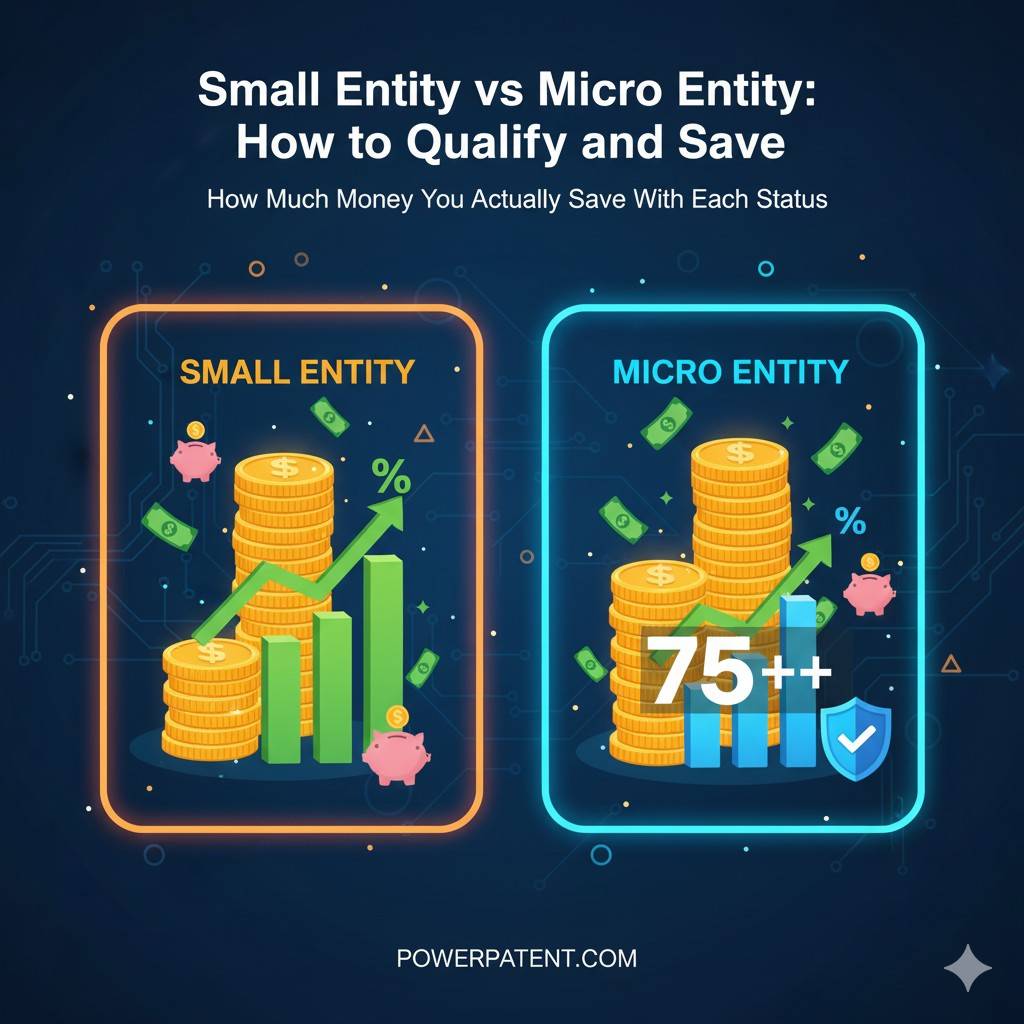
The difference between the three categories is simple once you see the flow. A large entity pays the full price. A small entity pays half of that. A micro entity pays one quarter.
That means when a major company pays four hundred dollars for a fee, a micro entity pays just one hundred. When a large company pays two thousand, a micro entity pays five hundred.
Once you look at the entire timeline, the savings become significant enough to change how you plan your IP strategy.
Where the savings really show up is in the early filing stage. The filing fee, search fee, and examination fee form the foundation of the cost. When you apply the micro entity discount here, you create instant breathing room in your budget.
For a startup operating with a tight runway, this reduction can be the difference between filing now and delaying until later. And delaying often brings larger risks, from losing your priority date to exposing your invention publicly without protection.
Small entity status still delivers solid savings even if you do not qualify for micro entity. Startups that have grown a bit, raised more money, or filed several patents still receive a meaningful reduction in cost.
When your team has fewer than five hundred employees and you have not transferred rights to a larger company, the USPTO recognizes that you are still in a building phase and should not carry the full financial burden.
The savings add up especially when you are filing multiple applications across different parts of your technology.
How Savings Grow Across the Patent Timeline
Many founders focus only on the front end of the patent process, but the true cost of owning a patent plays out over many years. After your patent is granted, you will receive maintenance fee deadlines at approximately four, eight, and twelve years.
These fees are often larger than the original filing fees, and they arrive at moments when your company might be navigating growth challenges, expanding your team, or preparing for new fundraising rounds.
The last thing you want is a surprise cost that forces you to choose between keeping your patent alive and covering operational needs.
When you qualify as a micro entity, those maintenance fees are dramatically reduced. Even small entity status can cut them in half. This reduction changes how you plan your long-term IP strategy.
Instead of worrying about the burden of holding multiple patents, you can maintain a portfolio more confidently. This matters because patents compound in value over time.
An older patent becomes a foundation for future improvements, licensing opportunities, or acquisition value. Saving on maintenance lets you hold that value longer.
This is also where early planning with PowerPatent can make a difference. The platform helps you map out each stage of your filing, including future maintenance deadlines, so you are not caught off guard.
When you can see your entire IP lifecycle from day one, you make better decisions about what to file, when to file, and how to budget for long-term ownership.
If you want to explore how the process works, the full overview is available anytime at https://powerpatent.com/how-it-works.
Why the Real Savings Come From Strategic Timing
Knowing whether you qualify for small or micro entity status is important, but the biggest savings come from understanding the timing. Your status is evaluated at the moment a fee is paid.
That means if you qualify as a micro entity today, you can immediately lock in those savings by filing now. If you wait until you raise a large round or increase your income, you may lose that qualification.
Early filing lets you secure your position before your company grows out of it.
This timing strategy gives founders a unique advantage. Many teams wait to file until they have stronger funding or until their product is more polished. But this delay can cost them both money and protection.
Filing while you still qualify for micro entity status can reduce your cost by thousands over the long term, and it also strengthens your legal position against future competitors.
The earlier your filing date, the stronger your protection.
If your company is already past the micro entity limit but still qualifies as a small entity, timing still matters.
You want to file before any ownership transfer or partnership that could move your rights to a larger company.
Once those rights shift, you may lose access to the discount. A clear understanding of your roadmap helps you make these decisions confidently.
The Hidden Impact of Savings on Your Startup’s Valuation
Most founders think of patents as protective tools, but they also play a major role in valuation. Investors value patents because they reduce risk and create leverage.
A company with a strong IP position appears more defensible, more mature, and more serious about guarding its technology. This makes fundraising conversations smoother and often increases investor interest.
When you take advantage of small or micro entity pricing, you can build your patent foundation earlier and with less financial strain. You may be able to file two or three targeted applications instead of just one.
That broader coverage can make your technology harder to copy and easier to defend. When investors see this, they view your company as one that understands long-term strategy instead of short-term reaction.
You did not wait until someone threatened your idea. You protected it early, smartly, and affordably.
This is also where PowerPatent gives you leverage. The platform helps founders turn technical explanations, prototypes, models, and code into clear patent applications supported by real attorneys.
Instead of submitting something rough and hoping it holds up, you get a refined, well-supported filing that stands out.
When you combine that quality with entity-based savings, you create a powerful advantage that compounds over time. If you want to see how the system works step by step, you can visit https://powerpatent.com/how-it-works.
Why Savings Should Guide How Many Applications You File
Patent strategy is not just about filing one big application. It is about understanding your technology and breaking it into parts worth protecting. Your core invention might sit at the center, but surrounding it are methods, systems, improvements, integrations, and future features that also deserve their own filings.
When you have access to small or micro entity pricing, you have the flexibility to pursue a layered IP strategy instead of a single-shot approach.
For example, an AI startup might file one application for the core model architecture, another for the training pipeline, another for the data optimization process, and another for the deployment method.
Without small or micro entity savings, filing four applications might be too expensive to pursue early. But with reduced fees, you can capture all these innovations while they are still fresh. This creates a strong defensive wall that grows with your product.
The same is true for hardware startups, robotics teams, biotech founders, energy innovators, and anyone in deep tech. When the USPTO reduces your fees, it frees you to think bigger about what deserves protection.
Instead of choosing one piece of your technology to protect, you can cover the full scope of your invention and ensure competitors cannot easily work around it.
Why Many Founders Underestimate the Lifetime Savings
The biggest misunderstanding founders have is assuming the savings are small. They often think the micro entity discount only applies to a few filing fees and maybe saves a few hundred dollars.
In reality, when you follow the full path from filing to examination to issuance and then through all three maintenance periods, the total savings often reach thousands or even tens of thousands of dollars. For a startup, that is not a minor benefit. That is real budget, real runway, and real impact.
This misunderstanding usually comes from not seeing the whole map. The fee schedule is spread out over many years, so founders do not see the full picture at once.
But when you put the numbers together, it becomes clear that choosing the right entity status and filing at the right time can shape the financial health of your patent strategy for more than a decade.
PowerPatent helps reveal this full picture upfront. The platform gives you a clean way to understand what fees apply, when they appear, and how they change based on your entity status.
Instead of guessing, you plan with clarity. And when you combine this clarity with smart filing decisions, you get the best possible return from your IP investment.
How to Choose the Right Status and Avoid Costly Mistakes
Choosing between small entity and micro entity status should be simple, but many founders get tripped up by timing, ownership changes, or assumptions about what they qualify for.
The goal is not to memorize legal rules. The goal is to understand a few core ideas that help you move fast, save money, and protect what you are building without fear of misclassification.
Once you grasp how the USPTO views your company, the right status becomes obvious.
The first thing to understand is that the USPTO is not trying to trick you. They created these discounts to help inventors and young companies. As long as you stay honest, update your status when things change, and make your decisions based on real facts about your company, you are safe.
Problems happen only when founders guess, assume, or ignore changes in their corporate structure.
You never want to be in a position where your patent is questioned years later because of a classification error you never meant to make. Fortunately, avoiding that situation is straightforward once you know what to look for.
The simplest path to choosing the right status is to start with micro entity. If you meet the income limit, have not filed more than four U.S. patents, and have not assigned your rights to a large organization, you likely qualify. If you do not meet those rules, step down to small entity.
If your company has fewer than five hundred employees and retains the rights to the invention, that status usually applies. Anything bigger than that pushes you into large entity territory, but very few early-stage startups fall into that category.
The challenge comes when your ownership picture isn’t clean. For example, imagine your startup is in an accelerator, has raised money from several funds, and has agreements that transfer certain rights under specific conditions.
In this situation, you need clarity on who actually holds the rights today, not who might hold them later. The USPTO cares about the moment you pay the fee.
This means you can qualify for micro or small entity status now even if you expect future ownership changes. The key is keeping the timing straight so you avoid misclassifying yourself at a later stage.
Why Ownership and Timing Matter More Than Anything Else
Your entity status is determined by a snapshot in time. This is something many founders overlook, and it can either save you money or cause problems depending on how you manage it.
Every time you pay a USPTO fee — whether it is the filing fee, examination fee, or a maintenance fee years down the road — the USPTO expects your status to reflect the truth on that specific date.
If your company grows, gets acquired, or transfers rights, your status might change between payments, which is normal. But you must update the USPTO before the next fee is paid.
This timing becomes especially important when investors enter the picture. Most investments do not affect your entity status because investors usually do not take ownership of your patent rights.
They take equity in your company, not ownership of your invention. However, in rare cases where a rights transfer does occur — such as licensing deals, acquisition agreements, or research partnerships — your status can change immediately.
This is where founders need to stay aware, because even a small clause hidden in a contract can shift your rights from a small entity to a large one.
The safest approach is to keep a clear record of who holds what and when. A simple internal file that tracks your assignments, license agreements, and ownership structure protects you from confusion later.
PowerPatent makes this even easier by prompting you with the right questions and ensuring your disclosures match the facts of your business. This prevents misclassification and gives you confidence that the USPTO sees exactly what you see.
Why Many Startups Accidentally Overpay and How You Can Avoid It
The largest mistake startups make is paying full fees because they assume they do not qualify for discounts. This happens more often than you might think. A founder might assume that a venture fund counts as a large entity because it manages a big pool of capital.
Another founder might assume that their salary disqualifies them from micro entity status, even though income calculations are based on a specific federal limit that changes each year.
Another might assume that because their company has a few dozen employees, they are too big for small entity status.
These assumptions cause founders to leave money on the table. They also slow down patent filings because founders wait until their next round or until they feel more financially stable.
But delaying is risky. Waiting gives competitors more time to file something similar, more time to publish disclosures, and more time to tighten the window of opportunity around your invention.
You can avoid overpaying by confirming your status early. If you think you might be micro entity but are unsure about income limits or filing history, check it early in the process.
If you think you might be small entity but are confused about your investors or agreements, review your ownership path. PowerPatent simplifies this by asking clear questions that translate your answers into the correct status. Instead of guessing, you get clarity.
How to Keep Your Status Accurate as Your Company Grows
Your entity status is not something you set once and forget. Your company will change. You may raise larger rounds. You may bring on corporate partners. You may expand your team.
You may file more patents. Any of these changes can affect whether you qualify as micro, small, or large entity the next time you pay a USPTO fee.
This is why it helps to build an internal habit of checking your classification during key moments. When you close a funding round, review your agreements.
When you file a new application, confirm whether your salary or filing history affects micro entity eligibility.
When you sign a licensing deal or partnership, verify whether any rights you transfer change your status. These quick checks take minutes but save you from misclassification that could become a problem later.
PowerPatent automates much of this awareness for you. The system holds your information in one place, flags potential issues, and alerts you before deadlines.
You stay focused on your invention while the platform watches the compliance details for you. If you want to see how this guidance works in practice, you can explore it here: https://powerpatent.com/how-it-works.
Why Choosing the Right Status Protects You Just as Much as It Saves You Money
It is easy to think of entity status as just a discount category, but it is also a compliance category. When you choose the correct status, you are protecting the integrity of your patent.
You ensure that nothing about your discount becomes ammunition for a challenge later.
If your startup succeeds and competitors look for ways to weaken your patents, the last thing you want is a misclassification issue that could have been avoided.
Choosing the right status also helps you protect future partnerships, licensing deals, and due diligence conversations. Investors, acquirers, and partners will review your patents closely.
They will look at how they were filed, how they were maintained, and whether everything was done correctly.
When your status is clean, consistent, and well-documented, you remove unnecessary friction from these conversations. It shows you managed your IP professionally from day one.
If your patent is supported by PowerPatent’s attorney review, this confidence goes even further. Investors trust filings that blend smart software with real legal oversight.
This combination brings clarity, structure, and reliability that founders often struggle to achieve alone.
Why You Should Always Choose the Path That Lets You File Sooner
At the end of the day, the best status is the one that allows you to file now rather than later. Your filing date is your shield.
It gives you priority, blocks competitors, strengthens investor confidence, and keeps your invention safe even while you continue building.
Waiting for the perfect moment often results in filing too late, losing rights, or paying more than necessary.
If you qualify for micro entity, it makes sense to file as soon as your invention is ready.
If you qualify for small entity, you still benefit from immediate savings and strong protection. In either case, the earlier you act, the more secure your position becomes.
PowerPatent exists to remove the friction from this process. It helps you capture your invention with simple prompts, turn your technical work into a strong draft, and bring a real patent attorney into the loop without slowing you down.
When you combine that speed with the right entity status, you get the strongest protection at the lowest cost.
Wrapping It Up
Saving money on patent fees is not just about finding discounts. It is about understanding how the system works so you can protect your invention without slowing down your company. Small entity and micro entity status exist to help real builders like you file strong patents early, avoid unnecessary costs, and stay focused on product and growth instead of paperwork. These categories are not meant to be confusing. They are meant to give you a real advantage at the exact moment you need it most.
Leave a Reply