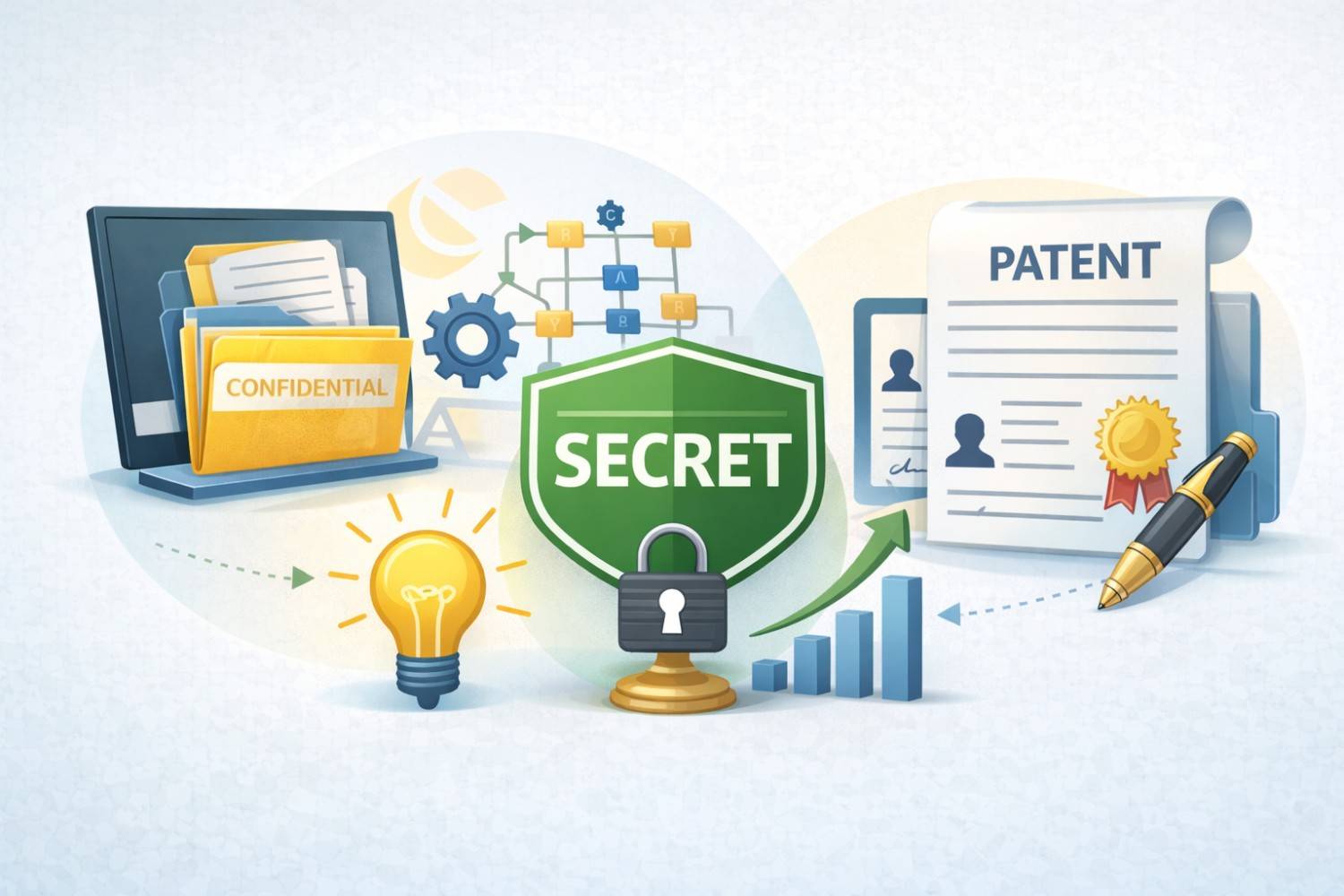
Most founders think trade secrets are some old, dusty legal idea. Something only big companies worry about. That belief is wrong, and it quietly costs startups real money and real leverage. A trade secret is often the first form of protection your startup has. It exists before patents. It exists before revenue. It exists the moment you build something valuable and keep it close. If you do not understand what counts as a trade secret, you may already be losing one without knowing it.
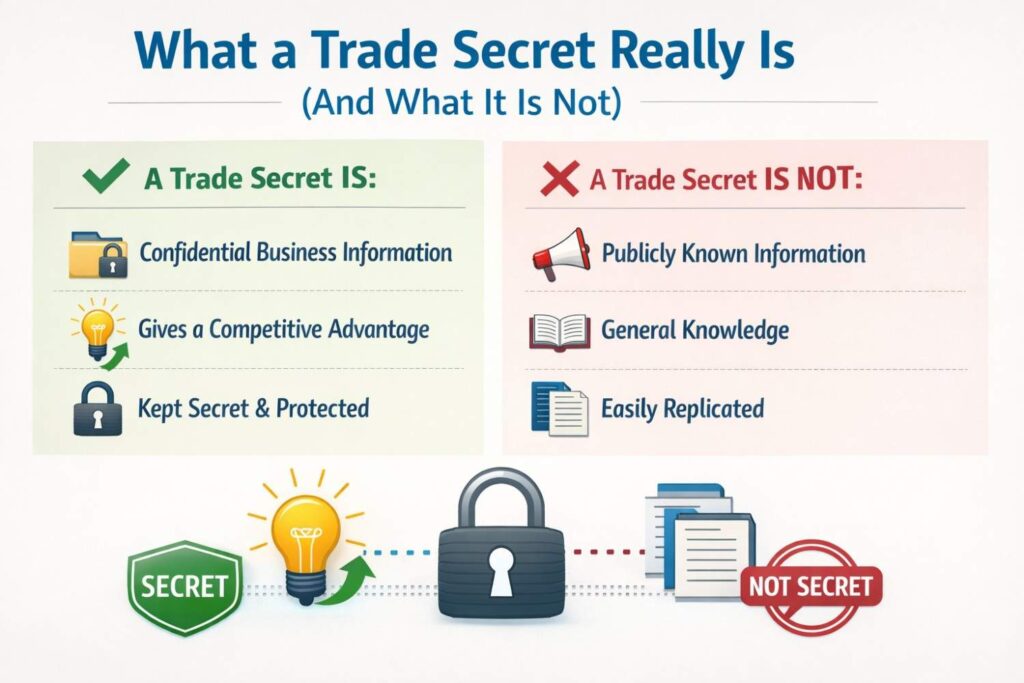
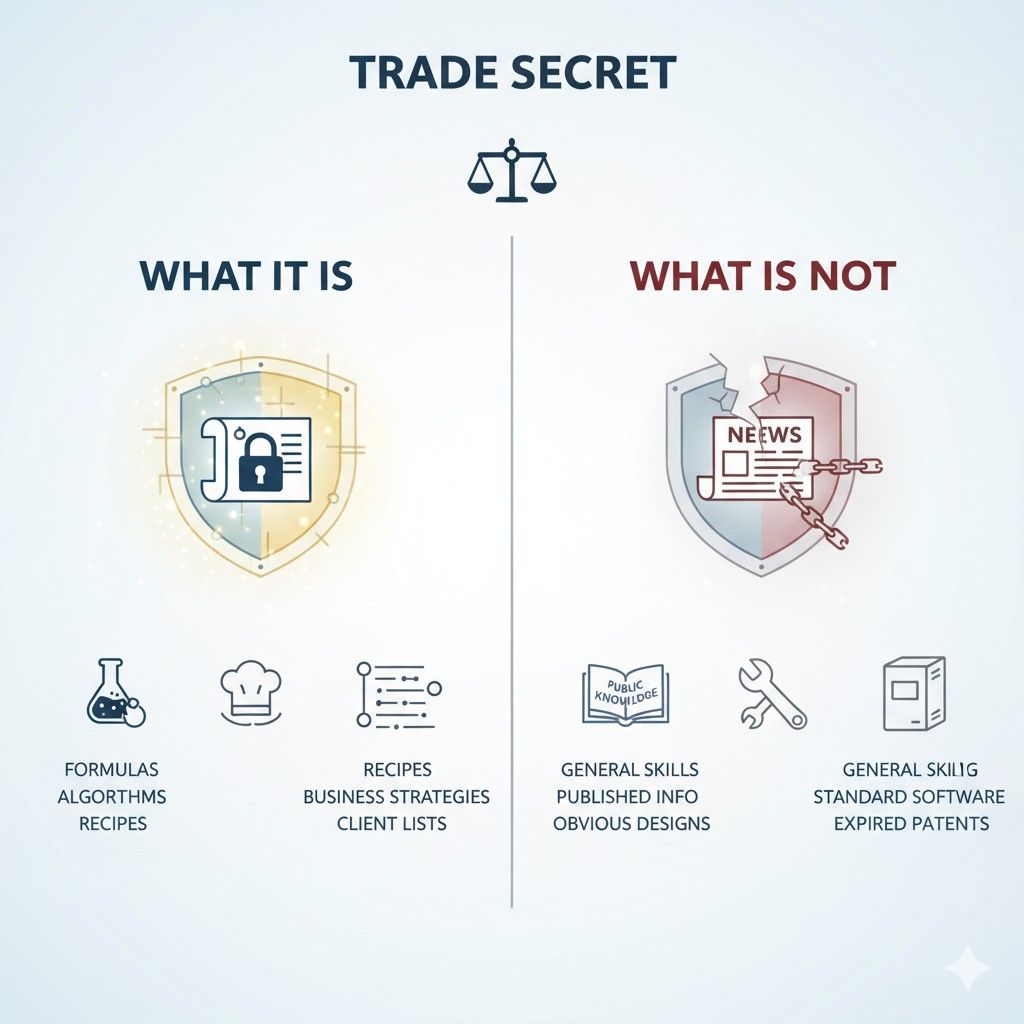
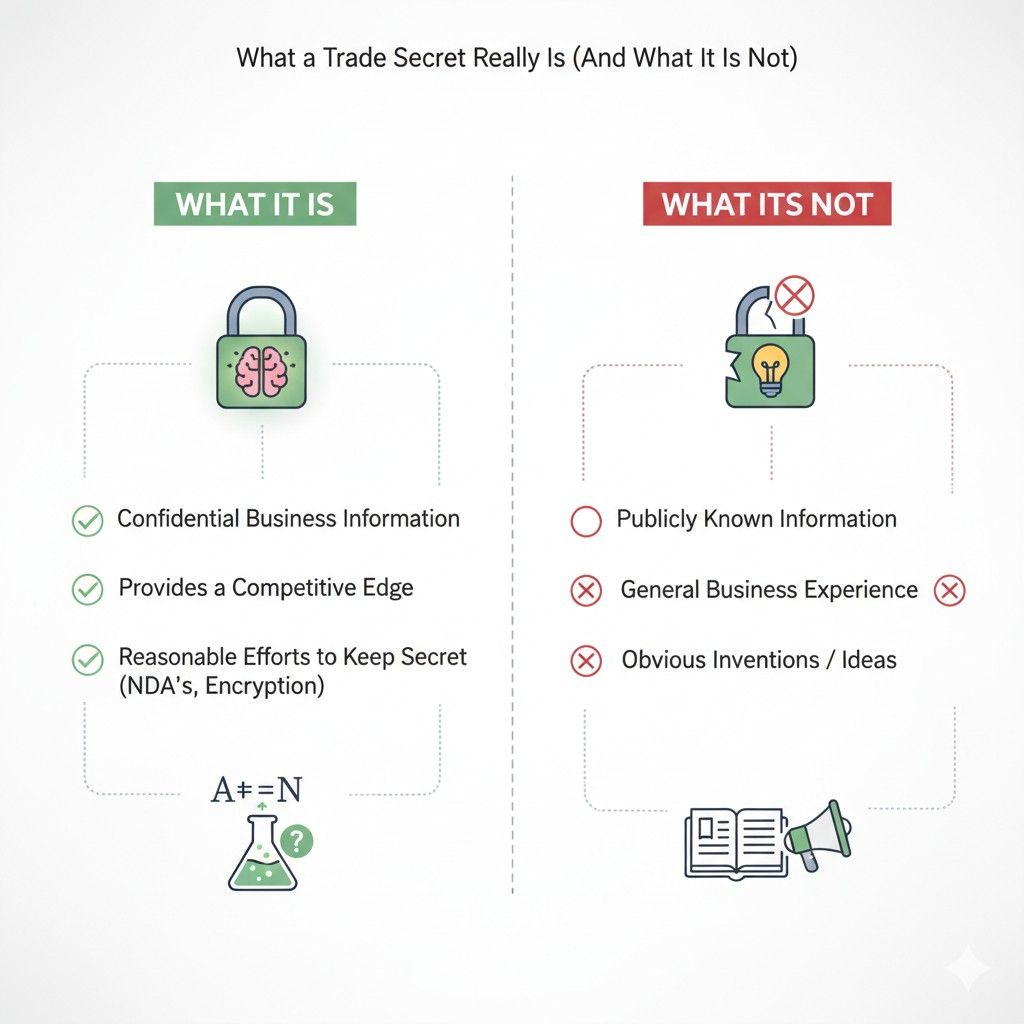
What a Trade Secret Really Is (And What It Is Not)
This section matters because most companies get trade secrets wrong in quiet ways. Not dramatic mistakes. Small daily choices that slowly strip away protection.
A trade secret is not a label you put on something. It is a living thing. It exists only if your behavior supports it. Once you see how simple the rules really are, you can use trade secrets as a real business tool instead of a vague hope.
A Trade Secret Is Information That Creates an Edge
At its core, a trade secret is information that helps your business win. It saves time, saves money, improves quality, or makes something possible that others cannot easily copy.
The value comes from the fact that others do not know it. The moment everyone knows it, the edge disappears.
This information can live anywhere. It might be inside code, inside a process, inside a model, or inside a playbook your team uses every day. The form does not matter.
What matters is that it gives you an advantage and that advantage depends on secrecy.
Actionable advice here is simple. Ask yourself one hard question about anything you build or document. If a competitor had this tomorrow, would it hurt us.
If the honest answer is yes, you are likely looking at a trade secret candidate.
A Trade Secret Does Not Need to Be Fancy or Technical
Many founders assume trade secrets must be complex or scientific. That is not true. Some of the strongest trade secrets are boring on the surface. A pricing rule.
A supplier shortcut. A testing workflow that avoids wasted effort. A simple data cleaning trick that improves results.
What makes it powerful is not how impressive it sounds. It is how useful it is in practice. If it took time to figure out and saves time every day, it may qualify.
Businesses should stop asking whether something feels important enough and start asking whether it quietly drives results. If it does, treat it carefully.
A Trade Secret Is Not an Idea in Your Head
Ideas alone are not trade secrets. Thinking of something first does not create protection.
A trade secret must be tied to real information that exists in a form that can be shared, stolen, or misused. That usually means it is written down, coded, diagrammed, or taught to someone else.
This is where many founders get confused. They believe they are protected because they have not told anyone yet. The problem is that protection only matters once others are involved.
The moment you hire, pitch, partner, or outsource, your idea leaves your head and enters the real world.
The smart move is to identify which ideas are becoming real assets and put simple guardrails around them before they spread.
A Trade Secret Is Not Something Public or Easy to Find
If information can be found with a quick search, it is not a trade secret.
If it is visible in a demo, in marketing copy, or in open documentation, it is no longer secret. This sounds obvious, yet companies accidentally publish secrets all the time.
Sometimes it happens through blog posts that explain too much. Sometimes through job listings that describe internal systems in detail. Sometimes through open source commits that reveal more than intended.
The business takeaway is to review outward-facing content with a protection lens. Ask whether it teaches competitors how you actually operate. Teaching outcomes is fine. Teaching methods often is not.
A Trade Secret Only Exists If You Act Like It Matters
This is the rule that breaks most trade secrets. Courts and investors look at behavior.
If you treat information casually, they assume it was not truly secret. If everyone has access, if nothing is marked, if no one is trained, the protection weakens fast.
You do not need heavy process. You need consistency. Limit access to people who need it. Explain to your team what should stay internal. Use basic agreements. Keep sensitive documents in controlled systems.
From a strategy point of view, this is about signaling. You are signaling to employees, partners, and future acquirers that you understand how to protect value.
A Trade Secret Can Be Temporary by Design
Some information only needs to stay secret for a short time to create value. Early product decisions. Launch timing. Experimental results. Even if secrecy lasts months instead of years, it can still matter.
This is especially important for startups moving toward patents. Trade secrets can act as a bridge. You keep things quiet while you validate and then file when ready.
Once disclosed through a patent, the trade secret role ends, but the value transfers into a stronger asset.
Businesses that plan this transition intentionally avoid rushed filings and accidental disclosures.
This is where tools like PowerPatent help founders move from secret to protected without slowing execution. You can see how that works here: https://powerpatent.com/how-it-works.
A Trade Secret Is Not Automatic Protection
Calling something a trade secret does not make it one. Protection comes from facts, not labels. If a dispute ever arises, the question will be whether the information was valuable, unknown, and reasonably protected.
This is why documentation matters. Not heavy legal files, but simple records. When was this developed. Who had access. How was it shared. These details are boring until they are critical.
Smart companies build this discipline early. It costs almost nothing when done right and can save the business when stakes are high.
A Trade Secret Is a Business Choice
The final truth is that trade secrets are strategic decisions. You choose what to keep internal. You choose what to share. You choose when secrecy serves growth and when it blocks it.
Founders who win are not paranoid. They are intentional. They understand that secrecy is a tool, not a religion. Used well, it buys time, leverage, and confidence. Used poorly, it creates risk or friction.
If you want help deciding what should stay secret and what should move toward patent protection, PowerPatent was built for exactly this moment.
You can explore how founders do this without slowing down here: https://powerpatent.com/how-it-works.
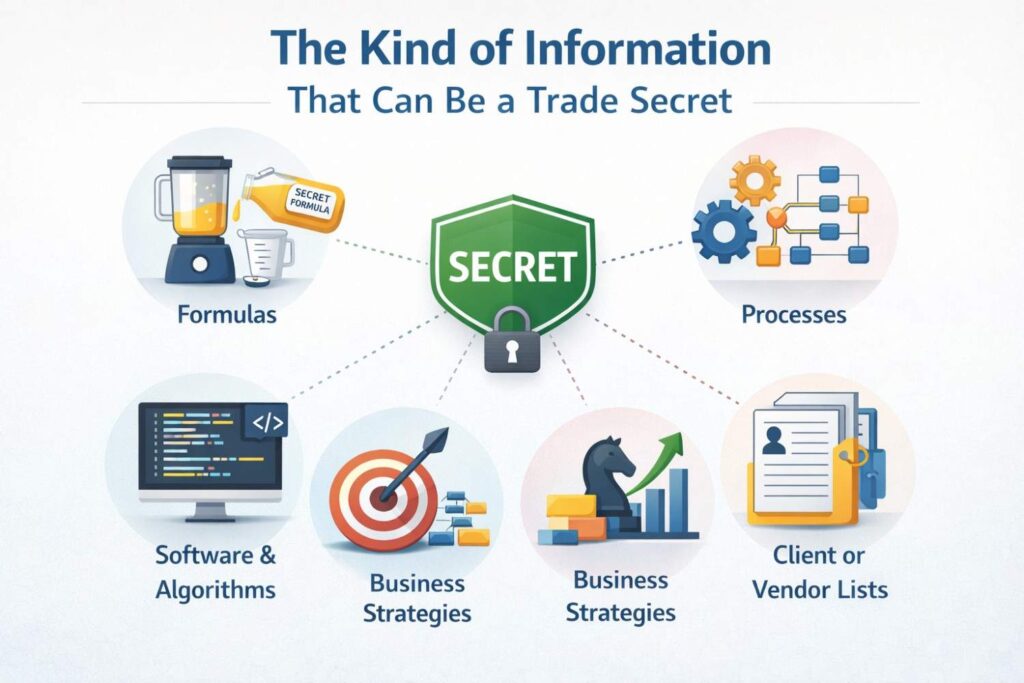
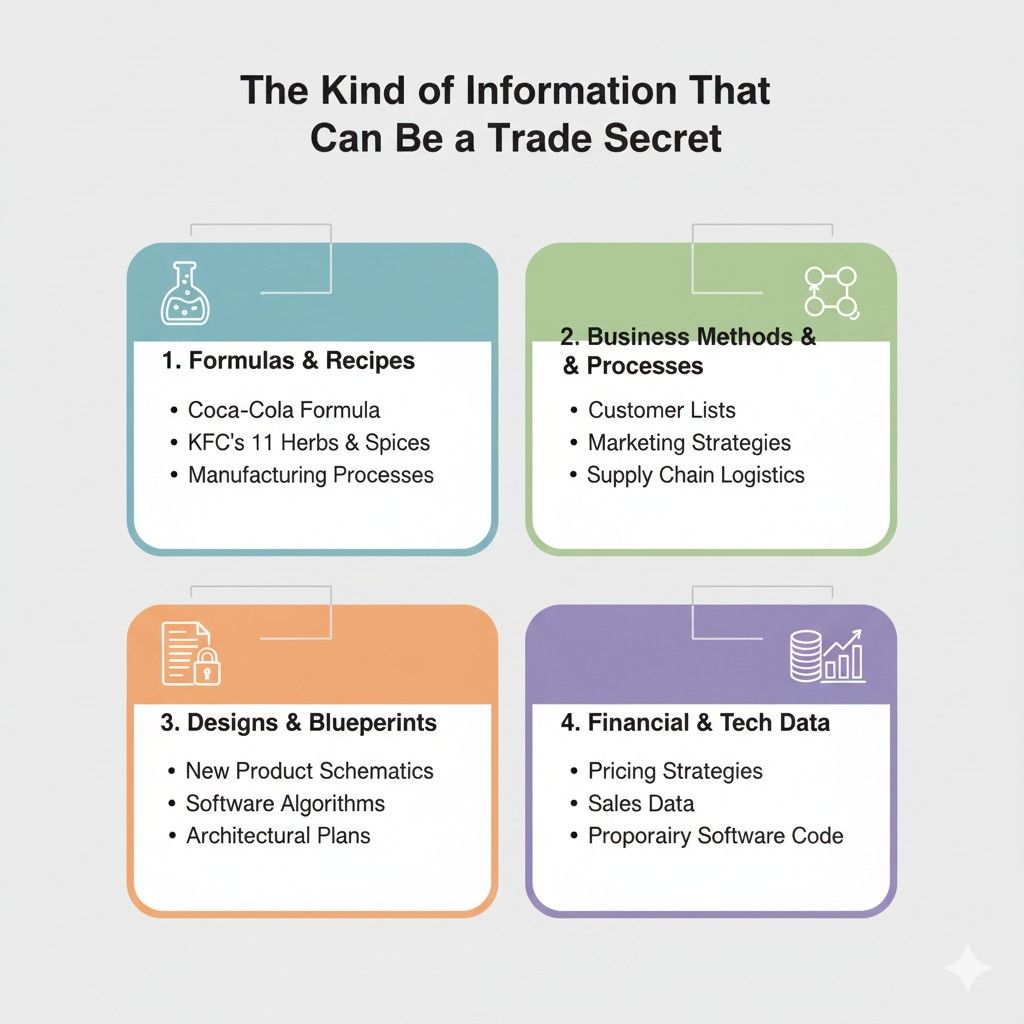
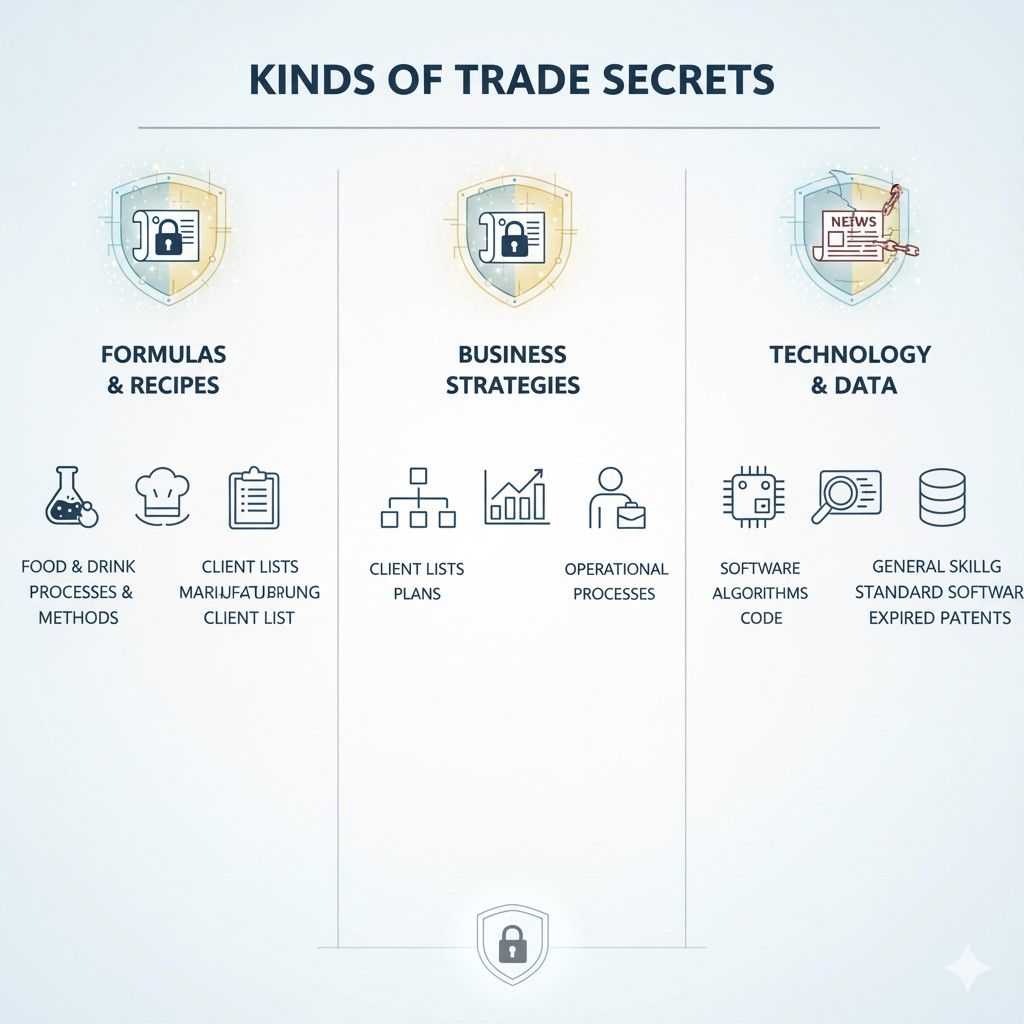
The Kind of Information That Can Be a Trade Secret
This section is about expanding your view. Many businesses protect too little because they assume trade secrets only apply to one narrow thing.
In reality, trade secrets show up everywhere once you know how to spot them. The goal here is not to lock everything down.
The goal is to clearly see which parts of your business quietly create leverage so you can protect them on purpose.
Product Design Choices That Are Hard to Reverse
Every product is full of decisions that never show up in the final interface. These choices shape how the product works, scales, and survives edge cases.
Often they are the result of painful trial and error. These are strong trade secret candidates because they save future pain.
This includes system layouts, architecture tradeoffs, fallback logic, and decisions about what not to build.
A competitor might copy the surface of your product, but if they do not know why you made certain calls, they will struggle to match performance.
A practical move is to keep internal design notes private and limit how much reasoning you expose in public talks or docs. Share lessons at a high level, but not the exact path you took to get there.
Internal Processes That Save Time or Reduce Risk
Processes are one of the most overlooked forms of trade secrets. How you ship faster, test smarter, onboard customers, or handle failures can be just as valuable as the product itself.
If your team can do something in one day that takes others a week, that gap is often process-driven. That process likely came from iteration, not luck. Treat it like an asset.
Businesses should document these workflows internally but avoid turning them into public playbooks. When hiring or training, explain the what and the outcome before sharing the how.
Data That Is Cleaned, Labeled, or Combined in a Unique Way
Raw data is often easy to find. What makes data valuable is the work done on top of it. Cleaning steps, labeling rules, feature selection, and filtering logic often matter more than the source itself.
This is especially true for AI and analytics-driven companies. Two teams can use the same public dataset and get very different results based on how they prepare it. That preparation is frequently a trade secret.
The smart move is to treat data pipelines as sensitive even if the inputs are public. Control access, avoid sharing screenshots or examples that reveal structure, and be careful during demos.
Pricing Logic and Deal Structures
Pricing is not just numbers. It is logic. How discounts are applied, when flexibility exists, and how deals are shaped can be a quiet advantage. Many companies give this away without realizing it.
Sales decks, contracts, and public case studies often leak more than intended. Over time, competitors reverse engineer how you sell.
Businesses should separate public pricing signals from internal pricing rules. Train sales teams on what can be discussed openly and what stays internal.
Supplier and Partner Knowledge
Knowing who to call, how to negotiate, and which shortcuts exist inside supply chains is often learned the hard way. This knowledge is not obvious and not easily replaceable.
These relationships and insights can be trade secrets if they are not generally known and give your business an advantage. The risk comes when this knowledge lives only in people’s heads.
A strong tactic is to capture this information in internal systems with limited access. Make sure departures do not walk away with irreplaceable insight.
Experiments That Failed for Specific Reasons
Most teams only think about protecting what worked. What failed can be just as valuable. Knowing which paths do not work saves enormous time and money.
If you ran tests, pilots, or launches that failed due to specific constraints, those lessons are trade secrets if they are not obvious to outsiders.
Be careful when sharing failure stories publicly. High-level lessons are fine. Detailed mechanics often are not.
Customer Behavior Patterns That Are Not Obvious
Understanding how customers actually behave versus what they say is powerful. This includes usage patterns, drop-off points, workarounds, and unexpected value drivers.
If this insight comes from internal data and analysis, it may qualify as a trade secret. Competitors would love to shortcut this learning.
The business action here is to restrict raw analytics access and anonymize insights when sharing externally.
Code That Solves a Narrow but Critical Problem
Not all code needs protection. Boilerplate and standard approaches are not trade secrets. But small pieces of code that solve a specific hard problem in a clean way often are.
These pieces usually emerge after many attempts. They may look simple once finished, which makes them easy to underestimate.
Teams should identify these moments and treat the surrounding logic carefully.
This is also where early patent thinking becomes valuable. PowerPatent helps founders spot when a trade secret should remain secret and when it should move toward patent protection.
You can see how that works here: https://powerpatent.com/how-it-works.
Training and Decision Rules Used by Your Team
How your team decides what to prioritize, when to say no, and how to resolve conflicts can be a hidden advantage. These rules often live in culture, not documents.
If these patterns consistently lead to better outcomes, they are valuable information. While culture itself is hard to protect, explicit decision frameworks can be treated as confidential.
Be intentional about what you codify and who has access.
Information That Is Valuable Because of Timing
Some information only matters at the right moment. Roadmaps, launch plans, hiring strategies, and expansion timing can all be trade secrets for a period of time.
The key is recognizing that secrecy here is temporary but still important. Leaks can blunt impact or invite unnecessary competition.
Simple controls like limited access and clear internal communication go a long way.
Seeing the Pattern Clearly
Trade secrets are not rare. They are everywhere in a well-run business. The common thread is not the type of information, but the role it plays. It creates advantage because others do not have it.
Founders who train themselves to see this pattern make better protection choices. They share less by accident and protect without slowing down.
If you want to build this mindset into your company and connect it cleanly with future patent strategy, PowerPatent is built for that exact flow. You can explore how founders do this here:
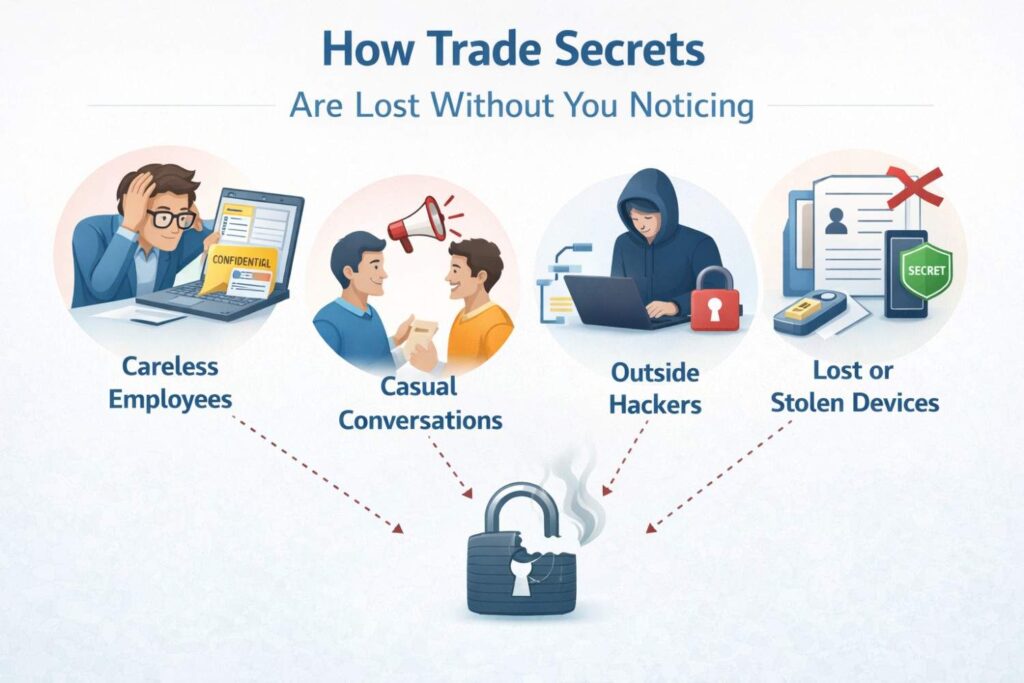
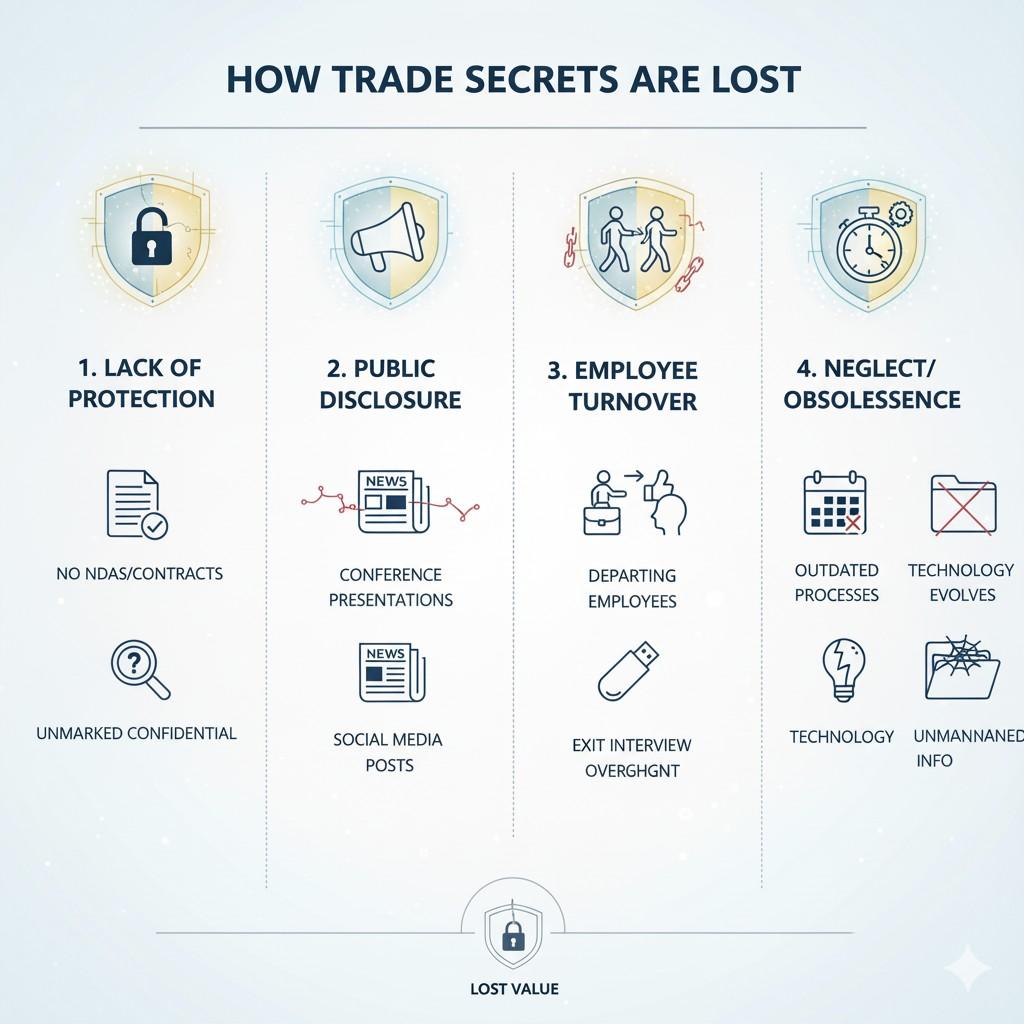
How Trade Secrets Are Lost Without You Noticing
This is the quiet danger zone. Most trade secrets are not stolen. They are slowly given away through normal business activity. No bad actors. No dramatic breach.
Just small choices made under pressure. This section is about spotting those moments early and tightening behavior without adding friction.
Oversharing While Trying to Sound Credible
Founders often explain too much because they want to sound smart, open, or helpful. This happens in investor meetings, sales calls, podcasts, and conference talks. The intent is good. The result can be costly.
When you explain exactly how something works instead of what it delivers, you move from storytelling into disclosure. Competitors listen carefully. So do future hires who may not stay.
The better habit is to speak in outcomes and constraints, not mechanics. Explain the problem you solved and the value it unlocked. Leave out the internal logic that made it possible.
Treating Internal Documents Like Casual Notes
Documents feel harmless. Slides, memos, shared docs, and whiteboards often hold the most sensitive knowledge in the company. When access is wide and controls are loose, secrets spread faster than you expect.
This gets worse as teams grow. New hires are onboarded quickly. Contractors are added. Temporary access becomes permanent.
A strong move is to assume that any document will eventually be seen by someone new. Write and store sensitive material accordingly. Restrict access by role, not by trust.
Letting Contractors See More Than They Need
Contractors are essential for speed. They are also a common leak point. Not because of bad intent, but because they move between companies and projects.
Many businesses give contractors full system access for convenience. This exposes trade secrets far beyond what is required to get the work done.
The fix is simple and tactical. Scope access tightly. Share only what is needed for the task. Remove access promptly when work ends. These steps signal that information matters.
Publishing Technical Detail Too Early
Marketing teams love detail. Engineers love clarity. Together, they sometimes publish too much. Blog posts, docs, and case studies can unintentionally reveal internal methods.
Once published, secrecy is gone forever. You cannot undo disclosure.
The smart approach is timing. Keep deeper technical explanations internal until you decide whether something should stay secret or be protected by a patent.
PowerPatent helps founders make this call before content goes live. You can see how that works here: https://powerpatent.com/how-it-works.
Assuming NDAs Solve Everything
NDAs are useful, but they are not magic. They do not turn public information into a secret. They do not fix careless sharing. They only help if you already behave as if the information is confidential.
Many founders rely on NDAs as a substitute for discipline. This creates a false sense of safety.
Use NDAs as backup, not as your first line of defense. Behavior always comes first.
Forgetting That Employees Eventually Leave
Turnover is normal. When employees leave, they take experience with them. If trade secrets live only in memory, they walk out the door.
This is not about mistrust. It is about continuity.
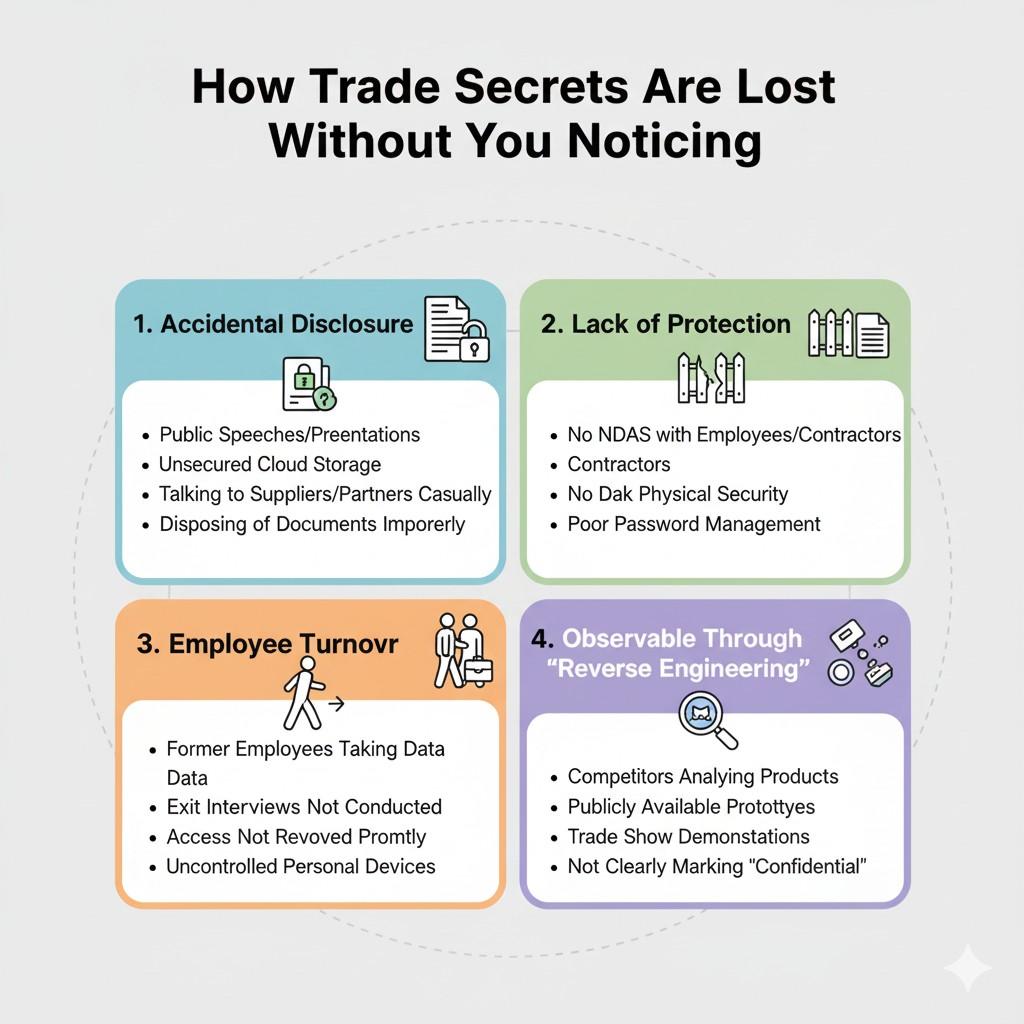
Capture key knowledge in controlled systems. Make sure access ends when roles end. Treat offboarding as seriously as onboarding.
Mixing Public and Private Code Carelessly
Open source is powerful. It also blurs lines. Teams sometimes copy internal logic into public repos without realizing the impact. Even small snippets can reveal patterns.
Before open sourcing anything, review it through a protection lens. Ask whether it teaches someone how your system actually works behind the scenes.
Once code is public, it cannot be reclaimed.
Confusing Speed With Sloppiness
Fast companies sometimes believe protection slows them down. This leads to careless sharing and weak habits. In reality, simple rules often speed things up by reducing future risk.
Clear boundaries save time. They reduce rework. They prevent awkward cleanup later.
The best startups protect quietly and move quickly at the same time.
Losing Secrets During Fundraising
Fundraising encourages transparency. Decks get shared. Notes get forwarded. Sensitive details travel farther than expected.
Investors do not need to know everything. They need to understand the problem, the solution, and the potential. They do not need your secret sauce recipe.
A tactical move is to create different levels of material. High-level decks for broad sharing. Deeper detail only in controlled settings.
Assuming Everyone Knows What Is Sensitive
Teams cannot protect what they do not recognize. If you never explain what counts as confidential, people will guess. Guessing leads to leaks.
This does not require long training sessions. A short explanation during onboarding and reminders during key projects go a long way.
Clarity is a form of protection.
When Loss Is Invisible Until It Is Too Late
The hardest part about losing trade secrets is that you often do not notice. There is no alert. No warning. You only see the impact when competitors catch up faster than expected.
By then, the window is closed.
Founders who stay ahead treat secrecy as an operational habit, not a legal event. They build awareness early and adjust as the company grows.
If you want help setting these habits without slowing your team, PowerPatent is designed to fit into real startup workflows. You can explore how it works here: https://powerpatent.com/how-it-works.
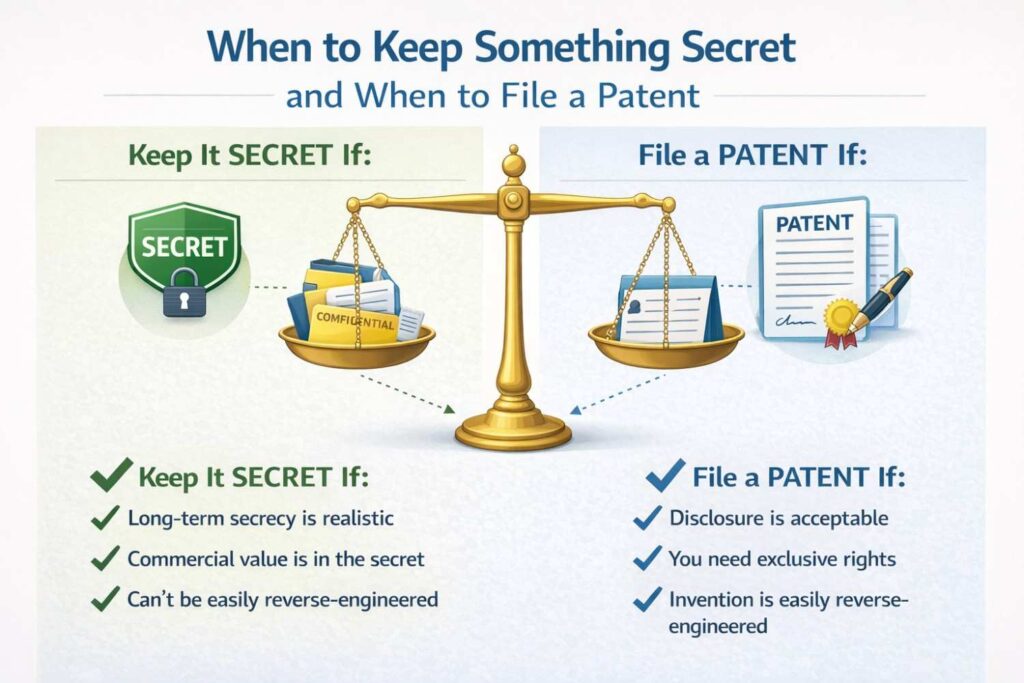
When to Keep Something Secret and When to File a Patent
This is where strategy replaces instinct. Many founders either keep everything secret for too long or rush to file patents before they are ready. Both paths create risk.
The real advantage comes from knowing when secrecy is doing real work for the business and when it is time to lock in long-term protection.
Secrecy Is Best When You Are Still Learning
Early on, your product is not finished. Your approach is not stable. You are testing assumptions and changing direction fast. In this phase, trade secrets are often the right tool.
Keeping things internal gives you freedom. You can experiment without committing to a public version of your idea. You can pivot without explaining old decisions. You can refine without rushing paperwork.
The practical move here is to delay public disclosure while your core logic is still shifting. Focus on learning. Let trade secrets protect the work in progress.
Patents Make Sense When the Core Stops Changing
A patent freezes an idea in time. That is powerful, but only when the idea is ready. Filing too early locks you into an immature version. Filing too late risks losing the right to file at all.
The signal to watch for is stability. When your solution keeps working across use cases and stops changing in fundamental ways, you may be ready.
This is where founders benefit from guidance that understands both tech and timing. PowerPatent helps teams recognize this moment and move fast without guesswork.
You can see how that works here: https://powerpatent.com/how-it-works.
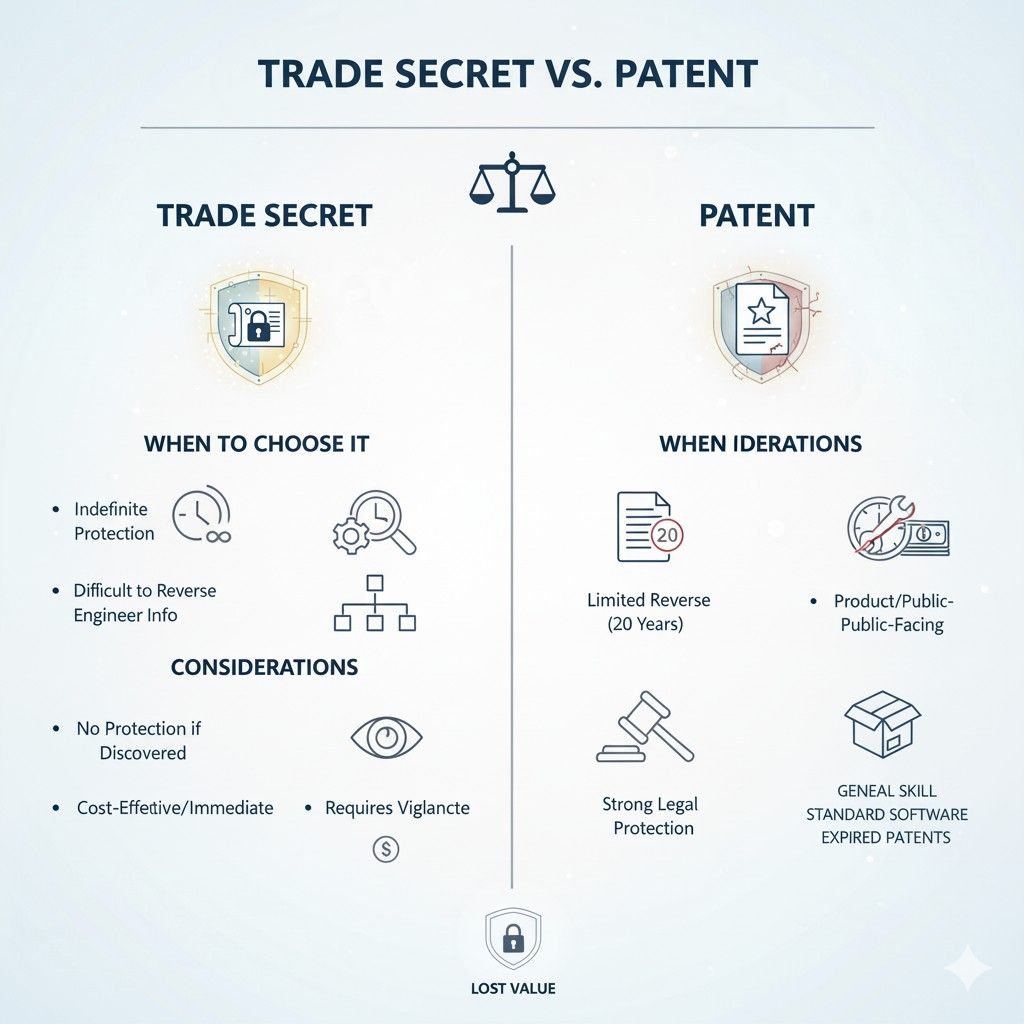
Keep Secrets When Others Cannot Easily Reverse Engineer
If someone can look at your product and quickly figure out how it works, secrecy is weak. In those cases, patents are often the better path.
If your advantage lives behind the scenes and would take years to uncover, secrecy may be enough for a long time.
The business move is to honestly assess how exposed your advantage is. This is not about optimism. It is about realism.
File Patents When Disclosure Is Inevitable
Some disclosure cannot be avoided. Customers need documentation. Partners need detail. Regulations require explanation. Hiring requires training.
When sharing becomes unavoidable, relying on secrecy alone becomes risky. This is often the right moment to file.
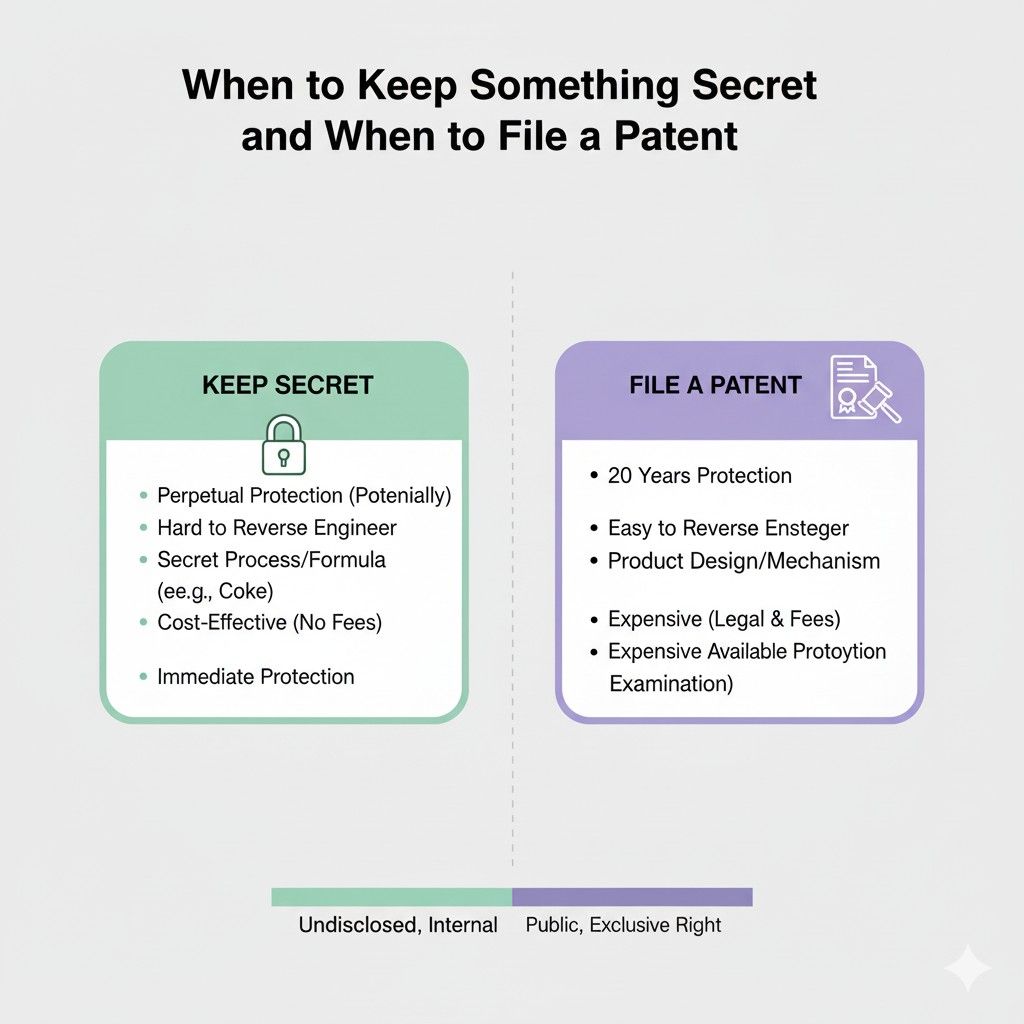
A patent allows you to share without fear. It turns disclosure from a threat into an asset.
Use Trade Secrets and Patents Together
This is not an either-or decision. The strongest companies layer protection. They patent what must be shared and keep other elements secret.
For example, you might patent a system concept while keeping tuning parameters, workflows, or data handling methods confidential.
This hybrid approach creates depth. Even if someone reads your patent, they still cannot fully copy your advantage.
Avoid Waiting Until It Is Too Late
Once something is public, patent rights may be gone. Blog posts, demos, talks, and even some sales conversations can count as disclosure.
Founders often realize this after the fact.
The tactical habit is to pause before public sharing and ask one question. Does this reveal how we actually do this. If the answer is yes, consider filing first.
Let Business Goals Drive the Decision
Protection is not about fear. It is about leverage. Are you planning to raise? Partner? Sell? Enter a crowded market?
Different goals require different timing.
A clear protection strategy supports growth instead of slowing it.
Make the Decision a Process, Not a Guess
The worst approach is relying on gut feeling. The best approach is having a simple repeatable process for deciding what stays secret and what gets filed.
This is exactly what PowerPatent was built to support.
It helps founders make these calls with confidence and speed, without turning protection into a distraction. You can explore how that works here: https://powerpatent.com/how-it-works.
Wrapping It Up
Trade secrets are not a legal trick. They are a business discipline. They live in your daily choices, your habits, and the way your team treats information. When used well, they quietly protect your advantage while you build, test, and grow. When ignored, they disappear without warning.
The most important shift is mental. Stop thinking of trade secrets as rare or special. Start seeing them as the natural result of building something valuable. If your company is learning faster than others, solving harder problems, or operating more efficiently, trade secrets are already there. The question is whether you are recognizing and protecting them on purpose.
Leave a Reply