Most founders get this decision wrong. Not because they are careless. Not because they do not care about protecting what they are building. They get it wrong because no one ever explains it in plain words. You are building something valuable. Maybe it is software. Maybe it is hardware. Maybe it is a system, a model, a process, or a new way of doing something that did not exist before. At some point, a quiet but serious question shows up in your head. Should I patent this? Or should I keep it secret?
The One Question That Decides Almost Everything
This section exists for one reason. If you understand this question deeply, most of the confusion around patents versus trade secrets disappears. You stop guessing.
You stop copying what other companies did. You start making a choice that fits how your business actually works.
The mistake most teams make is jumping straight to cost, speed, or fear. They ask how much a patent costs or how long it takes. They worry about copycats or lawyers. None of that matters until you answer the core question first.
This question is not legal. It is not technical. It is about exposure.
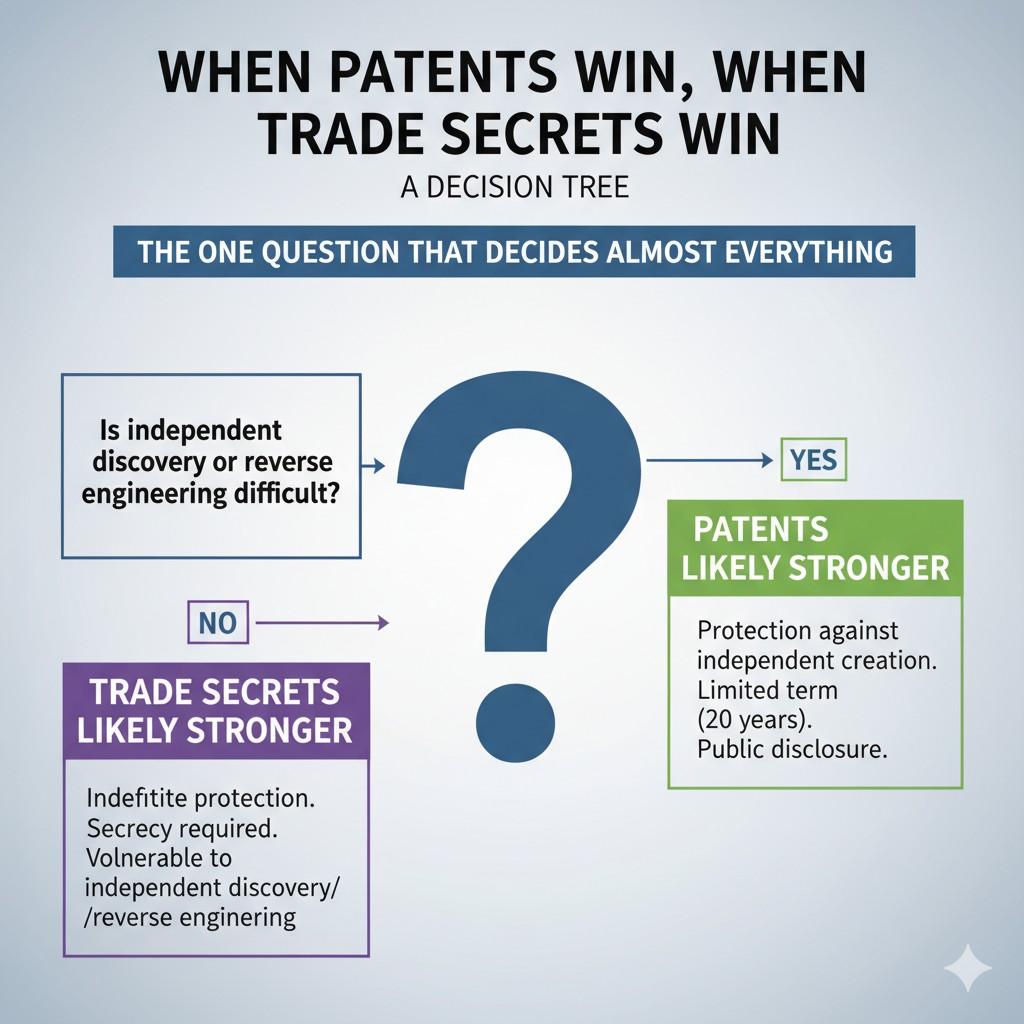
Can someone figure this out once it is in the world?
This single question decides more outcomes than any other factor. Everything else flows from it. Before you think about filing, secrecy, or timing, you need to sit with this honestly.
If your product ships, gets used, or runs in front of customers, what happens next? Can a smart competitor observe it, test it, or inspect it and understand how it works?
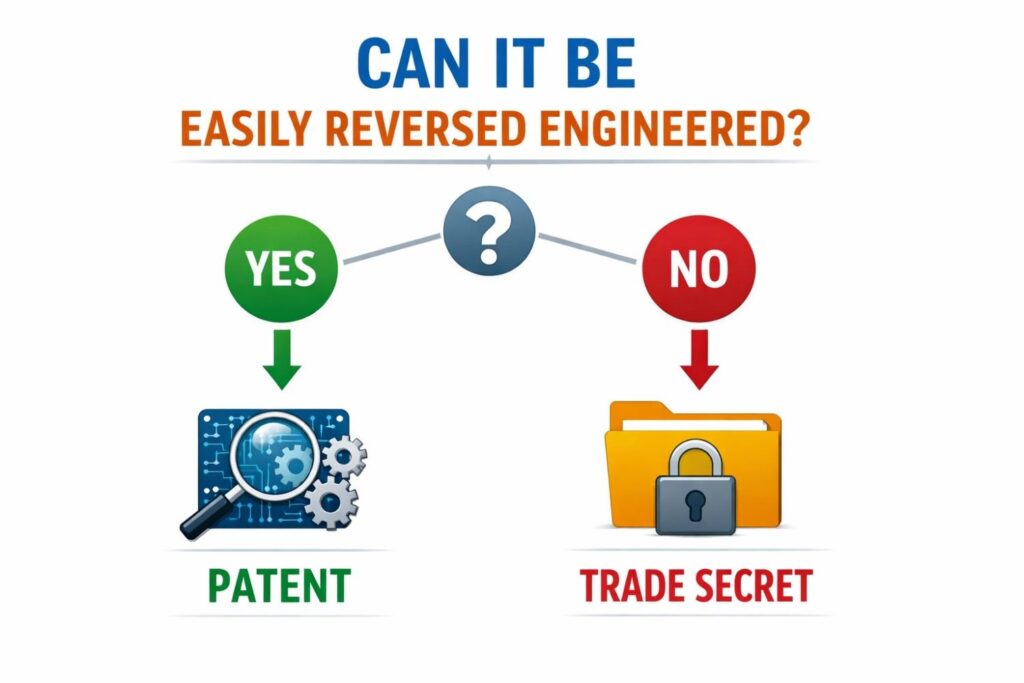
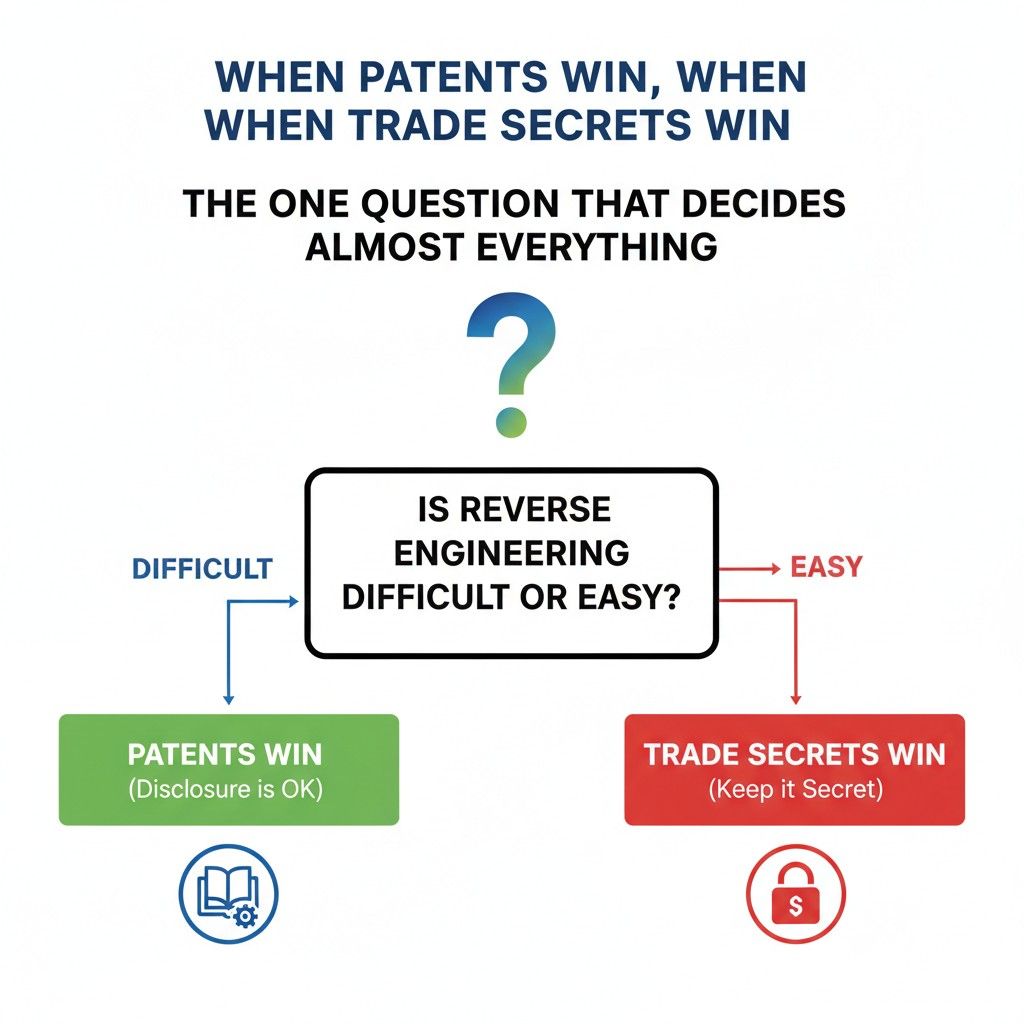
If the answer is yes, patents start to matter fast. If the answer is no, trade secrets may be stronger than you think.
This is not about whether it is easy. It is about whether it is possible.
Exposure Is Not the Same as Visibility
Many founders confuse exposure with visibility. They assume that if customers can see the product, then the secret is already out. That is rarely true.
A user interface can be visible while the core logic stays hidden. A device can be used while the manufacturing process stays unknown. A model can produce results while the training method stays private.
What matters is not what users see. What matters is what a competitor could learn if they really tried.
The moment your advantage can be learned through use, testing, teardown, or reverse work, secrecy becomes fragile. You are now relying on hope instead of protection.
Software That Runs on Other People’s Machines
If your software runs on customer hardware, phones, browsers, or edge devices, exposure risk goes up immediately. Once code leaves your servers, it becomes something others can inspect.
Obfuscation slows people down, but it does not stop them. Given enough time and money, a motivated team can understand what is happening under the hood.
This is especially true if your software solves a clear problem in a clear way.
In these cases, patents tend to win. A patent does not care how someone learned your method. It only cares that they are using it. That shifts power back to you.
If you are shipping client-side logic that matters to your advantage, you should strongly lean toward patent protection early, before the market teaches others what you built.
Server-Side Systems Change the Equation
When your core system runs only on your servers, the balance shifts. Now competitors cannot directly inspect how things work. They only see inputs and outputs.
This creates room for trade secrets to work. But only if you are disciplined.
Ask yourself how many people truly need access to this system. Ask how logging, monitoring, and debugging are handled. Ask how easy it would be for an employee to walk away with the knowledge.
Trade secrets are not protected by filing. They are protected by behavior. If your systems are loose, shared widely, or poorly documented, secrecy will fail quietly.
Hardware That Can Be Taken Apart
Physical products bring their own risk. If someone can buy your device and take it apart, assume they will.
Materials, layouts, sensors, and components are all learnable. Even manufacturing shortcuts can be inferred with enough samples.
If your value lives in a physical structure or arrangement, patents often matter more than founders expect. Once a product ships, you cannot make it secret again.
A common mistake is waiting until sales pick up. By then, the clock has already started for everyone else to learn from your success.
Processes That Live in People’s Heads
Some advantages are not code or hardware. They are workflows, processes, or ways teams operate.
These can be powerful trade secrets when handled correctly. But they are also fragile.
If your process depends on a few key people making judgment calls, you need to ask how replaceable that knowledge is. If those people leave, what happens to the secret?
Patents can sometimes cover processes, but only if they are defined clearly and repeatably.
If your process cannot be written down in a way that others could follow, it may not be a good patent candidate. In that case, secrecy plus strong internal controls becomes the strategy.
The Speed of Learning in Your Market
Some markets learn fast. Others move slowly.
If competitors can test, copy, and deploy changes within weeks, secrecy erodes quickly. In fast markets, exposure is magnified. Even small clues add up fast.
In slower markets, trade secrets last longer. Learning cycles are longer. Teams are smaller. Incentives to reverse engineer may be lower.
You need to match your protection to your market’s learning speed, not just your product type.
Customer Demos and Sales Conversations
Founders often leak more than they realize during sales.
Detailed demos, technical deep dives, and proof-of-concept builds can expose how things work. Over time, this information spreads. Sales engineers change jobs. Notes get shared.
If selling your product requires explaining how it works in detail, secrecy becomes harder to maintain. In these cases, patents provide cover. They let you speak openly without fear.
This is an often-missed reason to patent early. It gives you freedom to sell aggressively.
Partners, Vendors, and Integrations
The moment third parties touch your system, risk increases.
APIs, SDKs, shared pipelines, and joint builds all create paths for knowledge to leak. Even with contracts, control is never perfect.
If your advantage requires deep integration with others, assume parts of it will escape. The more hands involved, the weaker secrecy becomes.
Patents are designed for this reality. They assume disclosure will happen and still protect you.
Internal Discipline Is the Hidden Cost of Trade Secrets
Trade secrets are not free. They cost focus and discipline every single day.
You need access controls, training, clean exits, and strong culture. You need to think about secrecy when hiring, onboarding, and scaling.
Most startups underestimate this cost. They plan for secrecy like a side task, not a core system.
If you are moving fast and scaling quickly, ask whether you realistically have the time and structure to protect secrets long term. If not, patents may actually be the simpler path.
The Moment Exposure Becomes Permanent
There is a point of no return.
Once your idea is public, used widely, or explained openly, secrecy is gone forever. You cannot rewind.
Patents, on the other hand, must be filed before that moment. Timing matters.
The strategic move is to identify when exposure becomes permanent and act before it happens. That often means filing earlier than feels comfortable, not later.
Turning the Question Into Action
Here is how to use this question in practice.
Sit down with your product team and map where your advantage lives. Then trace how that advantage travels when the product ships, sells, or scales. Be brutally honest about what others could learn.
If exposure is likely, lean toward patents early. If exposure is controllable and discipline is strong, trade secrets may win.
At PowerPatent, we help founders do this analysis quickly, without legal fog. The goal is not to patent everything. The goal is to protect what actually matters, in a way that fits how you build and sell.
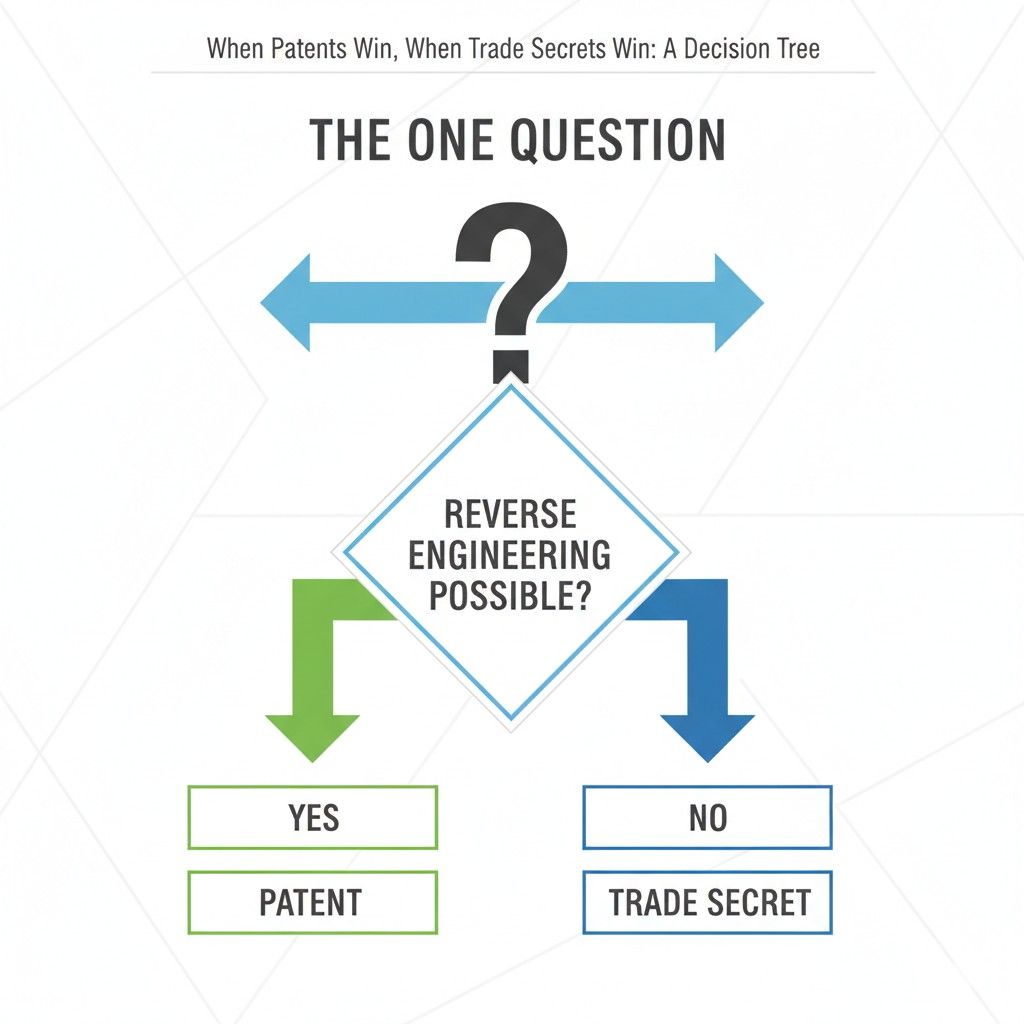
Once you answer this question clearly, the rest of the decision tree becomes much easier to navigate.
If you want help pressure-testing your exposure risk and choosing the right path, you can explore how PowerPatent works here: https://powerpatent.com/how-it-works
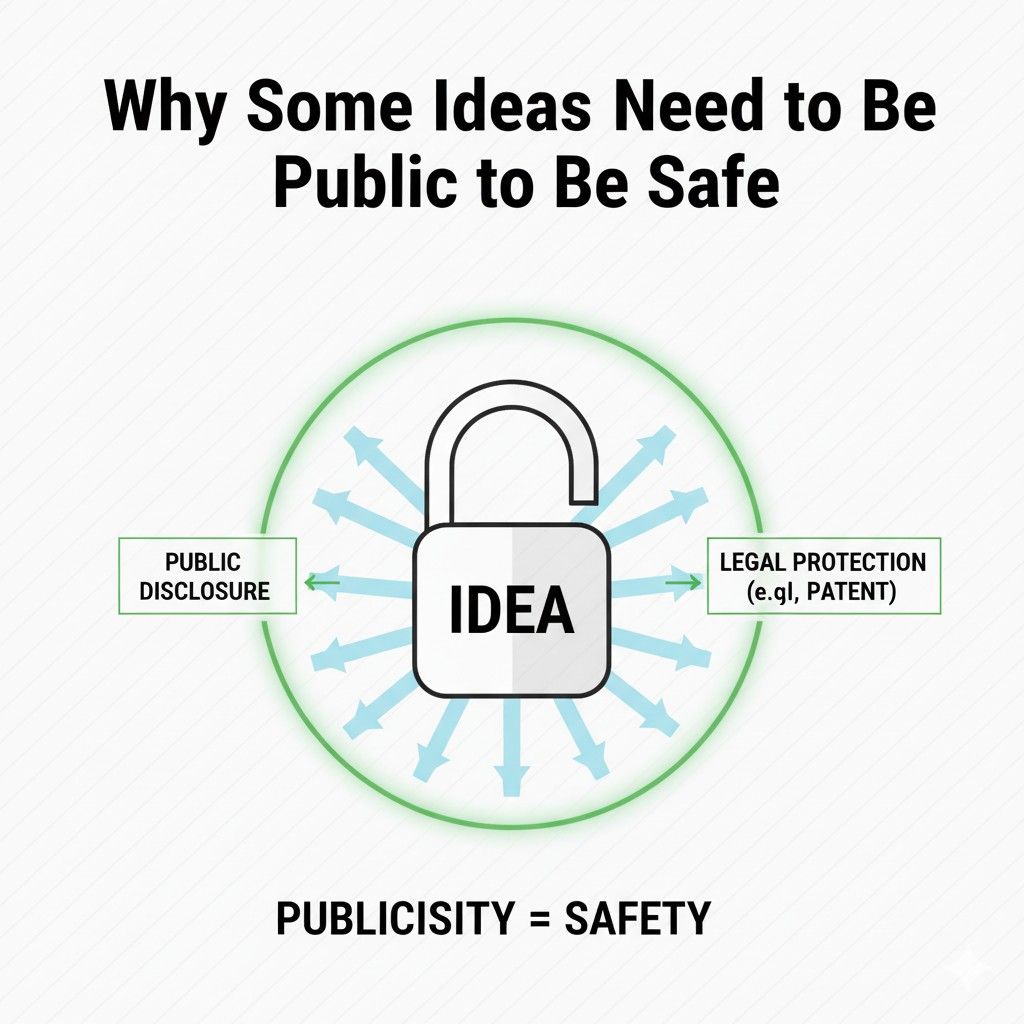
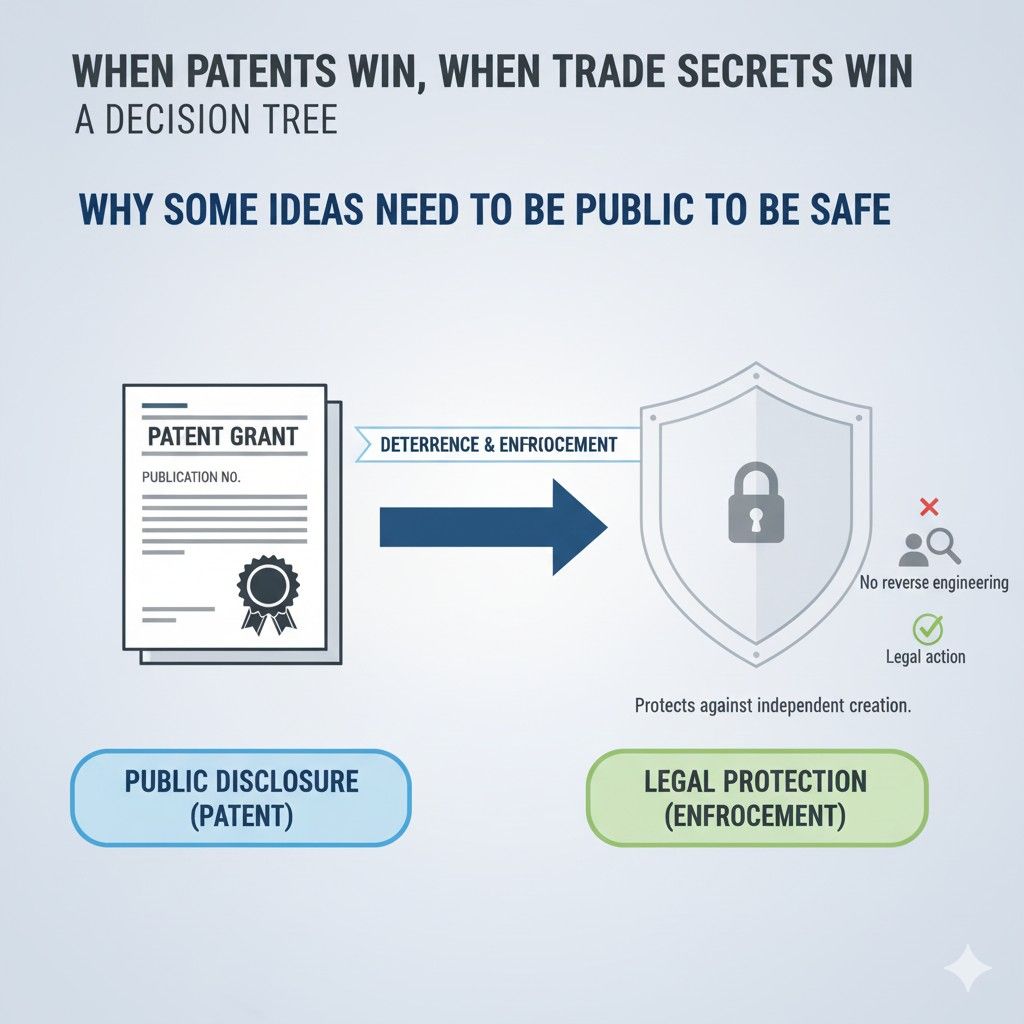
Why Some Ideas Need to Be Public to Be Safe
This part often feels backwards to founders. The idea that sharing details could make something safer sounds wrong at first.
We are taught to guard ideas closely, especially early. But in many cases, keeping quiet is actually the riskier move.
Patents exist for one simple reason. Some ideas lose all protection the moment they leave your hands unless you lock them down first.
This section explains when that happens and how to spot it early, before the damage is done.
The Myth That Silence Equals Safety
Silence feels safe because it delays conflict. No one can copy what they cannot see. No one can challenge what they do not know exists.
But silence also creates a vacuum. If your idea can be discovered independently, someone else can patent it before you. If your idea spreads quietly through use, others can copy it without asking.
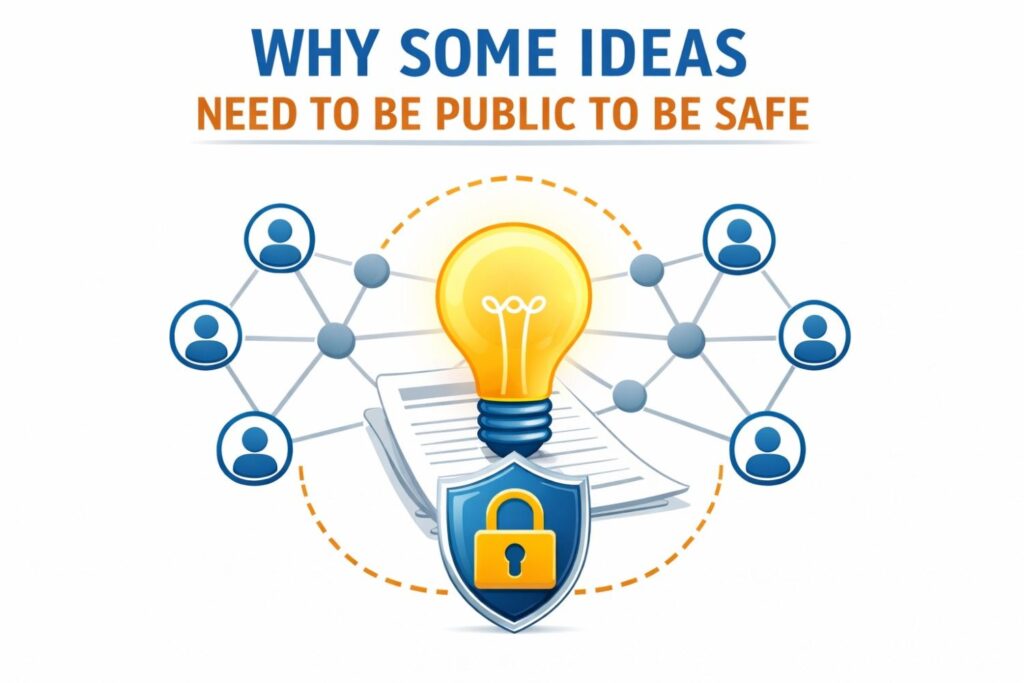
The danger is not that people steal ideas. The danger is that they learn from reality faster than you expect.
When Use Teaches More Than You Think
Some products explain themselves just by working.
A system that routes data in a new way teaches that method every time it runs. A device that saves power through a clever design reveals clues every time it is tested. A model that produces better results invites others to ask why.
You do not need to explain anything for learning to happen. Results alone are often enough.
In these cases, secrecy fades the moment customers use the product. By the time you realize others understand the core idea, it is already too late to claim ownership.
Patents are built for this moment. They reward early clarity instead of late regret.
The First Mover Fallacy
Many founders assume speed protects them. They believe shipping first creates a moat. Sometimes that works. Often it does not.
Speed attracts attention. Attention attracts smart teams. Smart teams reverse engineer fast.
Being first without protection can mean doing free research for the rest of the market. Patents turn first-mover effort into long-term leverage instead of short-term applause.
Investors Notice What You Protect
Investors rarely say this out loud, but they think about it constantly.
If your advantage is obvious and unprotected, they worry. They wonder what happens when a bigger team shows up. They wonder how defensible your traction really is.
A patent does not need to be perfect to matter. It signals intent. It shows you understand what is core and took steps to secure it.
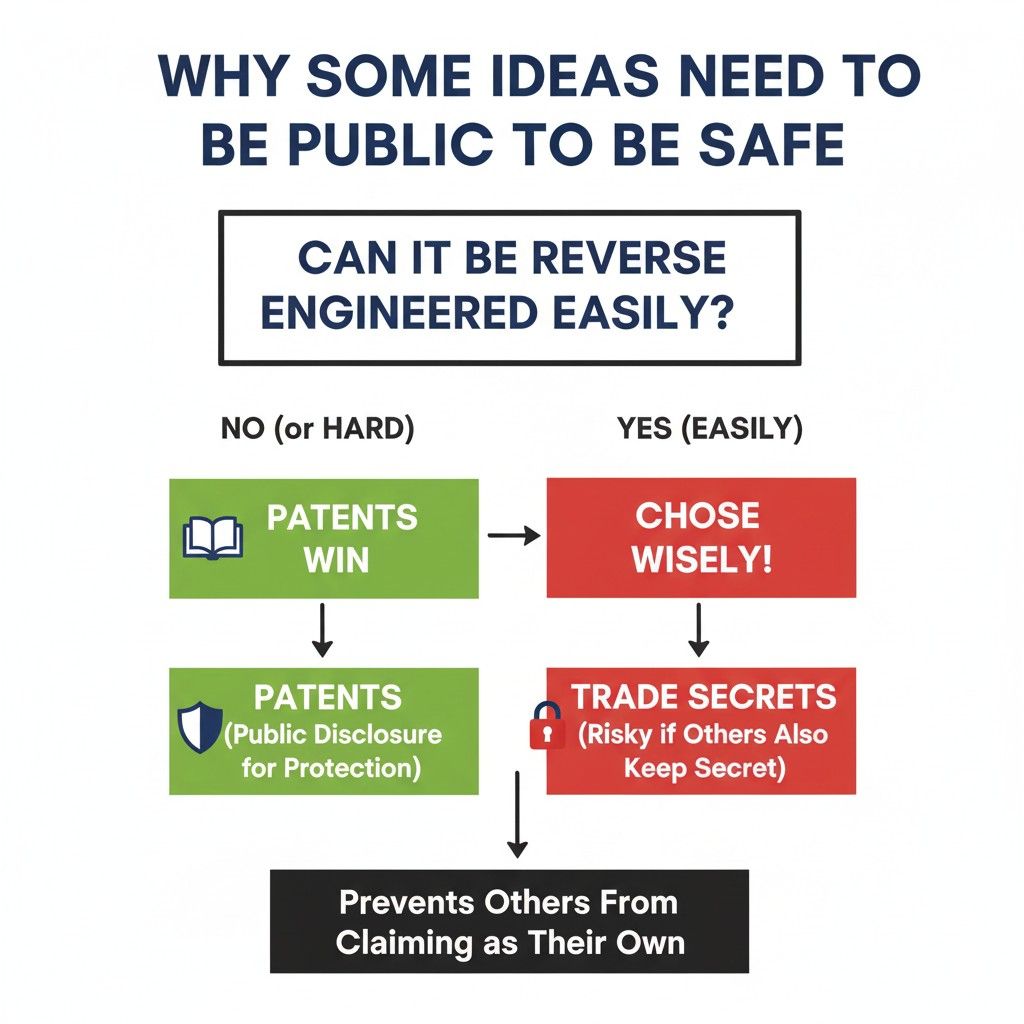
Trade secrets can also be respected by investors, but only when the secrecy story is strong and believable. Vague claims rarely convince.
Open Conversations Without Fear
Patents give you permission to talk.
Once something is filed, you can explain it clearly. You can sell with confidence. You can partner without dancing around details.
This freedom has real business value. Deals move faster. Trust builds quicker. Teams align better.
Founders who rely only on secrecy often speak in half sentences. Over time, that costs opportunities.
Hiring Without Anxiety
Growth requires people. People require context.
When your core idea is unprotected and secret, every hire feels risky. You share less. You delay trust. You slow onboarding.
Patents remove that friction. They allow you to train teams properly without feeling exposed. They make knowledge transfer safer.
This matters more as companies scale. What works for three founders rarely works for thirty employees.
Competitors Will Assume, Then Act
If something works, competitors do not wait for proof. They assume there is a method behind the results and start building their own version.
Even if they guess wrong at first, iteration gets them closer. Over time, their version may land uncomfortably close to yours.
A patent stops this drift. It draws a clear line. Even if others try, they know there are consequences.
When Disclosure Is a Strategic Weapon
Filing a patent means disclosure. That scares many founders.
But disclosure can also shape the market. It defines the language of the problem. It sets a reference point others must work around.
Done right, it makes your approach the standard and forces competitors into narrower paths.
This is not about giving away secrets. It is about choosing what to reveal in a way that strengthens your position.
Timing Is the Real Skill
The biggest mistake is waiting for certainty.
Founders often say they will file once revenue grows or once the product stabilizes. By then, exposure has already happened.
The right time to patent is before learning escapes. That moment is earlier than most expect.
PowerPatent is built around this reality. It helps founders move early, clearly, and without slowing down building.
Turning Protection Into Confidence
Patents do not replace execution. They support it.
When you know your core idea is protected, you move differently. You pitch harder. You sell louder. You build bolder.
That confidence compounds over time. It affects how the company behaves at every level.
This is why some ideas need to be public to be safe. Not because sharing is harmless, but because controlled disclosure backed by protection is stronger than quiet hope.
If you want to see how founders use PowerPatent to file early without friction, you can explore how it works here: https://powerpatent.com/how-it-works
Why Keeping It Quiet Sometimes Wins
Not every advantage wants a spotlight. In some businesses, the strongest move is to say nothing at all. This section is about those cases. The ones where silence is not fear, but strategy.
Trade secrets get a bad reputation because they are misunderstood. People think they are fragile or informal. In reality, when used correctly, they can be brutally effective.
Some of the most durable advantages in history were never patented and never published. They survived because they were designed to stay hidden.
When the Value Lives Behind Closed Doors
Some ideas never leave your walls.
They do not ship to customers. They do not run on devices you do not control. They do not need to be explained to sell the product.
In these cases, exposure is optional. If no one outside your company can touch the core system, secrecy becomes a real option, not a gamble.
This is common in internal optimization tools, pricing engines, risk models, routing logic, and operational systems. The product customers buy is the result, not the method.
Systems That Look Simple From the Outside
Some of the best secrets look boring.
From the outside, the product seems straightforward. Nothing about it invites teardown or deep inspection. The magic happens quietly in how decisions are made or how resources are used.
Competitors can see what you do, but not how you do it. That gap is where trade secrets thrive.
In these situations, filing a patent may actually expose more than it protects. Disclosure would teach others what to copy instead of keeping them guessing.
When Reverse Engineering Is Impractical
Not all things can be figured out, even if someone wants to.
Some systems depend on scale, data history, or long-term tuning. Others rely on many small choices that only make sense together.
Even a motivated team may struggle to recreate this without years of trial and error. When learning costs are high, secrecy lasts longer.
This is where trade secrets shine. They do not need legal walls if practical walls already exist.
The Power of Compounding Secrecy
Trade secrets get stronger over time if managed well.
As your system improves, the gap between you and others grows. Each improvement builds on the last. Even if someone starts copying today, they are years behind tomorrow.
Patents have a clock. Trade secrets do not.

For long-term advantages that evolve continuously, silence can outlast any filing.
Culture as a Defensive Tool
Trade secrets only work if your company treats them seriously.
This does not mean paranoia. It means clarity. People should know what matters, why it matters, and how to handle it.
When teams understand that certain knowledge is core to survival, behavior changes. Sharing becomes thoughtful. Documentation becomes intentional.
This kind of culture cannot be added later. It has to be designed early.
Fewer Touchpoints, Stronger Control
The fewer people who need to know a secret, the safer it is.
If your advantage requires only a small, stable team, secrecy becomes manageable. If it requires constant hiring, training, and external collaboration, risk rises.
Smart founders design systems so that critical logic is centralized and abstracted. Most employees interact with interfaces, not internals.
This limits exposure without slowing growth.
When Speed Favors Silence
In some markets, filing slows you down.
If your edge depends on moving faster than everyone else, the time spent formalizing and filing may cost more than it protects.
Trade secrets allow you to act immediately. No waiting. No publication. No delay.

This is not about avoiding protection. It is about choosing a protection that does not interrupt momentum.
Avoiding the Signaling Effect
Patents signal where value lives.
Sometimes you do not want to signal that.
Filing tells the world what you care about. It points competitors toward your core. In crowded spaces, that attention can be dangerous.
Keeping quiet forces others to guess. Guessing wastes time.
The Risk of Over-Explaining
Patents require clarity. That clarity can be a gift to others.
If your advantage is subtle or hard to define, trying to write it down may oversimplify it. What reads cleanly on paper may be easier to copy than what exists in reality.
In these cases, secrecy preserves complexity.
Trade Secrets Still Require Planning
Silence is not passive.
You still need rules, controls, and exit plans. You need to think about what happens when people leave. You need to design systems that do not leak by accident.
Founders who win with trade secrets treat them like assets, not afterthoughts.
Choosing Quiet With Confidence
The worst position is not choosing secrecy. It is choosing it by default.
If you decide to keep something secret, do it deliberately. Know why. Know how long. Know what would force a change.
At PowerPatent, we often help founders decide not to file, at least for now. The goal is not more patents. The goal is the right protection at the right time.
When secrecy is the right move, we help teams understand the risks and build guardrails. When it stops being the right move, we help them switch fast.

If you want help deciding whether silence is a strength or a liability in your case, you can see how PowerPatent works here: https://powerpatent.com/how-it-works
Wrapping It Up
At the end of the day, this decision is not about law. It is about control. Founders who think clearly about patents and trade secrets are really thinking about how their advantage survives contact with the real world. Customers. Competitors. Employees. Partners. Time. There is no universal right answer. But there is a right answer for your business at this moment. Patents win when your idea must travel outside your company to create value. When use teaches others. When selling requires explanation. When growth increases exposure faster than culture can contain it. In those moments, filing is not paperwork. It is defense.
Leave a Reply