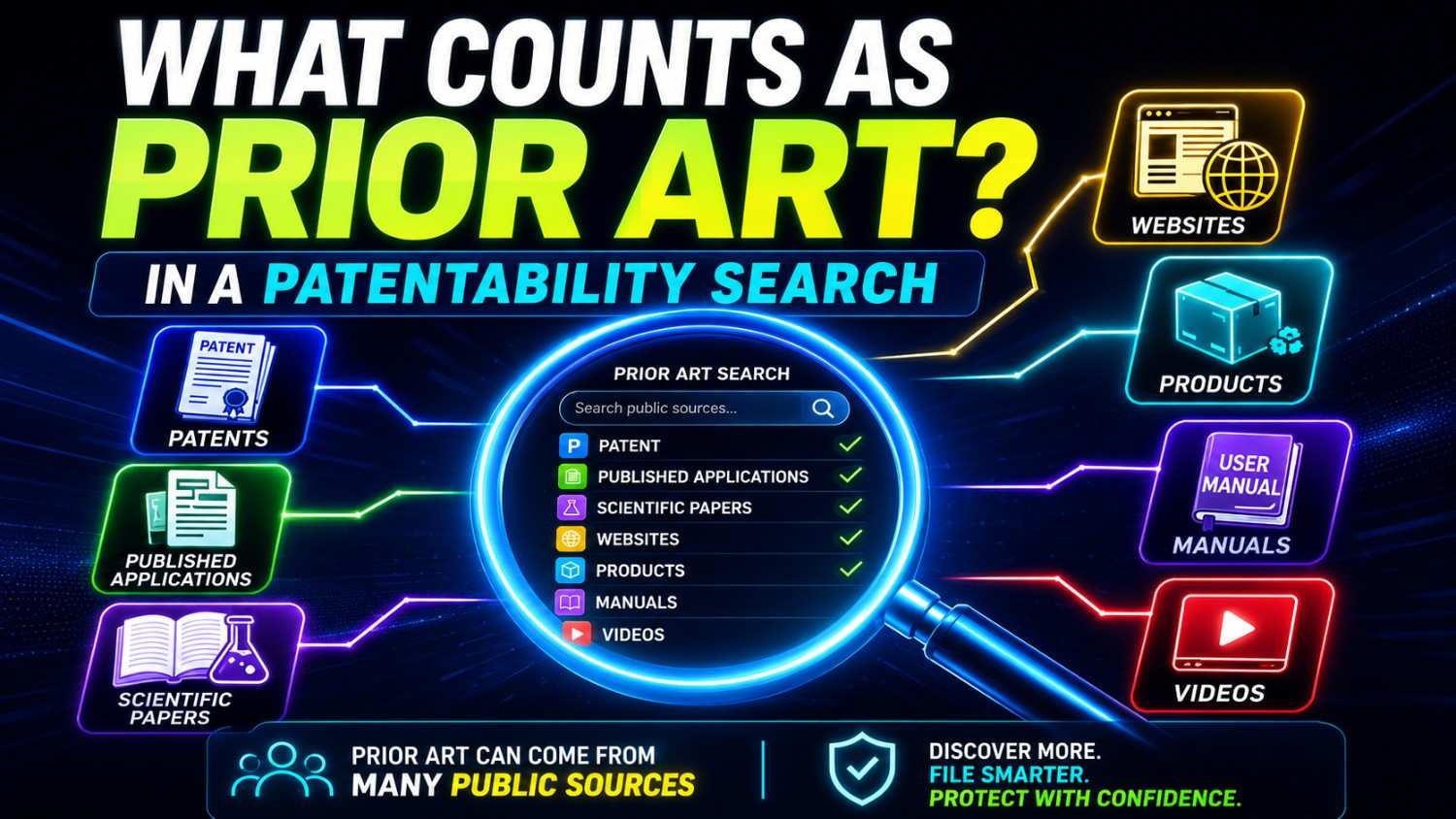
Prior art is anything already public that may block, narrow, or weaken your patent.
That sounds simple. It is not.
A patentability search is not just a quick Google search. It is a hunt for earlier public information that may show your invention is not new, or that it would have been an easy next step from what already existed.
For founders, this matters because a patent filing is not just a document. It is a business asset. A good patentability search can help you avoid weak filings, protect the real invention, and spend your patent budget with more confidence.
PowerPatent helps founders turn code, models, technical systems, and inventions into stronger patent filings with smart software and real patent attorney oversight. To see how the process works, visit https://powerpatent.com/how-it-works.
What prior art means in plain English
Prior art means earlier public knowledge.
It can be a patent. It can be a published patent application. It can be a research paper. It can be a product manual. It can be a conference talk. It can be a blog post. It can be a YouTube video. It can be a public GitHub repo. It can be a product that was sold, used, shown, or described before your filing date.
In the United States, 35 U.S.C. § 102 says a claimed invention may be blocked if it was patented, described in a printed publication, in public use, on sale, or otherwise available to the public before the effective filing date. It also covers certain earlier-filed patents and published applications by another inventor.
That is the legal version.
Here is the founder version: if the public could already learn the key idea before you filed, it may count against your patent.
The European Patent Office uses a broad idea too. It treats the “state of the art” as what was made available to the public by written or spoken description, by use, or in any other way before the filing or priority date.
That phrase “made available to the public” is important.
Prior art does not need to be popular. It does not need to be easy to find. It does not need to be written in English. It does not need to be sold by a big company. It does not even need to come from a competitor.
A small university paper can count. An old patent from a failed company can count. A forgotten product manual can count. A public code repo can count. A conference slide deck can count. A thesis in a library can count. A standards document can count.
That is why patentability searches require care.
You are not only asking, “Has anyone built my exact product?” You are asking, “Has anyone publicly disclosed the invention I want to claim?”
Those are very different questions.
Why prior art matters before you file
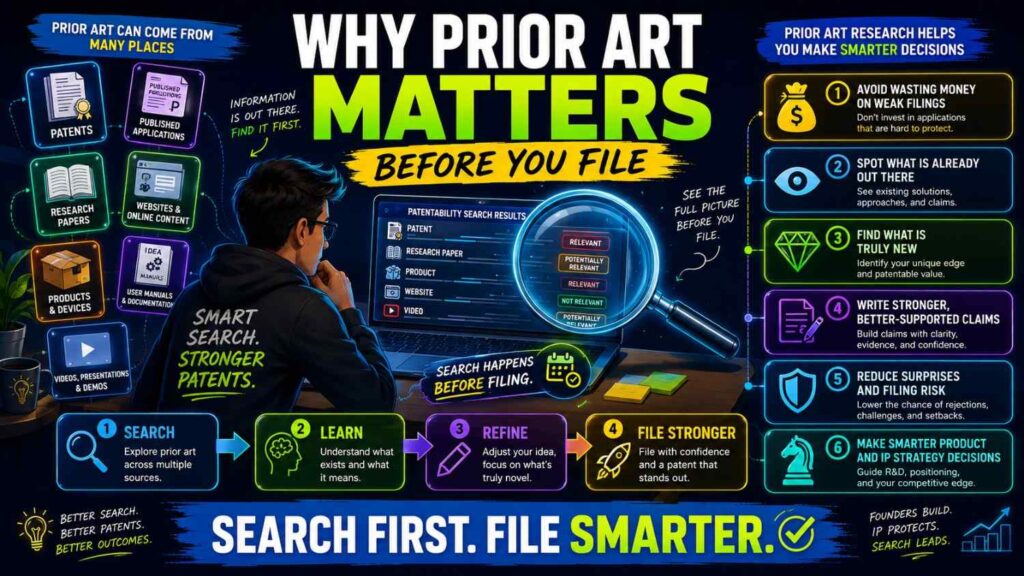
A patentability search helps you decide whether your invention is likely worth filing.
It does not guarantee that you will get a patent. No search can do that. But it can show what is already out there, where the risks are, and what parts of your invention may still be protectable.
This is very useful for startups.
A founder may have a big idea and want broad patent protection. Then a search shows that the broad idea is already known. That does not always mean the patent is dead. It may mean the real value is in a smaller but more important improvement.
For example, a founder may say, “We invented an AI system that helps doctors review images.”
That broad idea is likely not enough. Many teams have worked on medical image AI.
But the real invention may be more specific. Maybe the system uses a special way to combine image quality scores with model confidence. Maybe it routes uncertain cases to a second model. Maybe it reduces false alerts on low-quality scans. Maybe it trains on a special data flow without exposing patient data.
Those details may be more useful.
A patentability search helps find the line between what is old and what may be new.
That line shapes the patent draft.
If you know the closest prior art before drafting, your patent attorney can focus on the true technical difference. The application can include better examples, stronger fallback positions, and claims that are less likely to collapse when the examiner finds old references.
Without a search, you may file in the dark.
Sometimes that is necessary because timing is urgent. But when you have time, searching before filing can save money and help you file smarter.
PowerPatent helps founders capture the real technical invention before filing, so patent work starts with better facts. You can see how that process works at https://powerpatent.com/how-it-works.
Prior art is not just patents
This is one of the biggest founder mistakes.
Many people think prior art means earlier patents only.
That is wrong.
Earlier patents are important, but prior art can also include non-patent information. This is often called non-patent literature. It may include papers, books, websites, manuals, standards, videos, public talks, product pages, code, and other public materials.
This matters a lot in modern technology.
AI methods often appear first in research papers, preprints, GitHub repos, model cards, product blogs, and conference talks. Software workflows may appear in open-source projects or developer docs. Robotics ideas may appear in lab papers and demo videos. Climate tech inventions may appear in technical reports. Semiconductor ideas may appear in conference papers. Medical devices may be described in manuals, clinical materials, or regulatory documents.
A search that only checks patents may miss the strongest prior art.
For example, suppose your startup has a new model routing system. It chooses between a small model and a large model based on cost, latency, and confidence. A patent search may find some related filings. But the closest disclosure may be a public blog post from an AI lab or an open-source repo that explains the same routing logic.
That blog post may matter.
Or suppose your startup has a new battery monitoring method. The closest prior art may be an old journal article or equipment manual, not a patent.
A good patentability search follows the technology wherever it was publicly described.
That is why search strategy should depend on the field.
For software and AI, search papers and code. For hardware, search patents, product manuals, and diagrams. For telecom, search standards. For biotech, search patents, scientific papers, and sequence or assay databases where relevant. For robotics, search patents, papers, videos, and product demos.
The question is not “Where do patent lawyers like to search?”
The question is “Where would this kind of invention have been made public?”
Patents as prior art
Patents are one of the most common forms of prior art.
A patent can describe a technology long before a product reaches the market. Many companies file patents on ideas they never commercialize. Some patents come from companies that later shut down. Some come from universities. Some come from large companies exploring future directions.
This means market research is not enough.
You may look at the market and think no one is doing what you do. But an old patent application may already describe a close version.
Patent documents can count as prior art even if the patent never issued. Published patent applications can matter. Foreign patent publications can matter. Older patents that have expired can still matter for patentability, even if they no longer create infringement risk.
That last point is important.
An expired patent may not stop you from selling a product, but it can still show that an idea was already public. So it can still hurt your ability to patent the same idea now.
When searching patents, the goal is not just to find exact words. Patent writers often use unusual language. A “drone” may be called an “unmanned aerial vehicle.” A “chatbot” may be called a “dialogue management system.” A “recommendation engine” may be called an “item ranking module.” A “wearable” may be called a “body-worn monitoring device.”
Good patent searches use many words for the same idea.
They also use classification codes, citations, inventor names, company names, and related patent families.
A founder does not need to master all of this. But a founder should know that patent searching is not just typing the product name into a search box.
Published patent applications as prior art
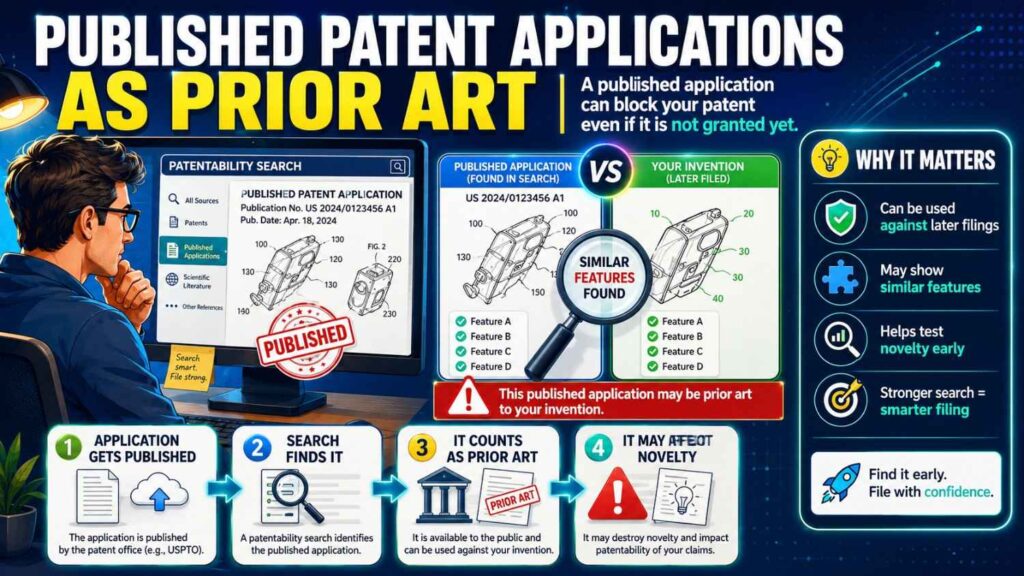
Published patent applications are especially important.
A patent application may publish before it becomes a granted patent. It may never become a granted patent at all. But the publication can still disclose technical information that counts as prior art.
This surprises founders.
They may search issued patents and think the field is clear. But a pending or abandoned published application may describe the same invention.
In the U.S., 35 U.S.C. § 102 includes certain patents and published applications by another inventor that were effectively filed before the effective filing date of the claimed invention. (Legal Information Institute)
In practice, this means patentability search work should include published applications, not just granted patents.
For startups, this is very important in fast-moving areas like AI, robotics, cybersecurity, fintech infrastructure, health tech, and climate tech. Many companies file early. Their applications may publish later. A search may reveal filings that never turned into products but still affect your patent path.
This is another reason it helps to work with patent professionals who understand search scope.
A shallow search may miss pending or abandoned publications.
A better search looks across the full patent record.
Research papers as prior art
Research papers can be strong prior art.
They are often detailed. They may include diagrams, algorithms, test results, system architecture, and implementation choices. In technical fields, research papers may be more important than patents.
For AI startups, this is huge.
A new model training method, prompt workflow, retrieval method, compression trick, data labeling process, or evaluation pipeline may have been described in a paper before anyone filed a patent. That paper can matter.
For robotics, papers may describe control loops, navigation methods, grasping systems, sensor fusion, safety systems, and calibration methods.
For biotech, medtech, energy, materials, and semiconductors, papers may contain the closest technical disclosures.
A founder may say, “No company sells this product.”
That may be true. But if a research paper described the key method, it may still be prior art.
The key issue is public availability. If the paper was publicly available before your filing date, it may count.
This is why patentability searches often include academic databases and preprint servers, depending on the field.
It is also why founders should be careful with their own papers.
Publishing your invention before filing can create patent problems. In some places, your own public disclosure may hurt you right away. In the U.S., certain grace period rules may help in some cases, but relying on them can be risky and fact-specific.
The safer habit is simple: file before public disclosure when possible.
Public websites and blog posts as prior art
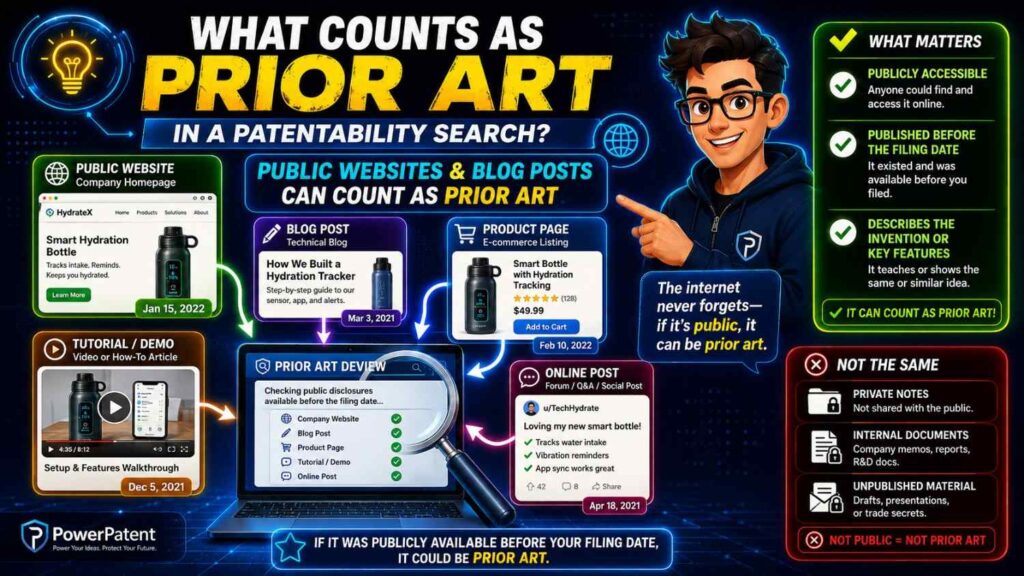
A public website can be prior art.
A blog post can be prior art.
A product page can be prior art.
A technical documentation page can be prior art.
A public FAQ can be prior art if it describes the invention clearly enough.
This matters because modern technical work is often shared online. Startups publish launch posts. Developers publish docs. Engineers write technical blogs. Research labs explain systems. Open-source projects publish readme files. API companies publish integration guides.
Any of those can matter in a patentability search.
For example, a startup may file a patent on a way to reduce compute cost in AI workflows. The closest prior art may be a developer blog from another company that explains a similar model-selection pipeline.
Or a startup may file on a payment risk scoring system. The closest prior art may be a technical product page from a fraud platform that described the same scoring flow years earlier.
Web prior art can be hard to search because pages move, change, or disappear. Archived pages may matter. Screenshots, timestamps, release notes, and old documentation versions can become important.
A good search may include web archives, especially when products or online docs are relevant.
Founders should also remember their own websites.
A launch post that explains too much before filing can become a problem. A public demo page can do the same. So can a technical blog written by the engineering team.
Marketing and patent timing should work together.
PowerPatent helps founders move faster from invention capture to filing, so teams can protect key ideas before public launch moments. Learn more at https://powerpatent.com/how-it-works.
Public code repositories as prior art
Public code can count.
A GitHub repo, package registry, public notebook, open-source model, or developer example may disclose how a system works.
For software and AI startups, this is a major issue.
Patent claims often focus on steps, logic, data flows, or system behavior. Public code can show those things directly. A repo may include source files, comments, commit history, examples, configuration files, tests, or documentation that disclose the invention.
Even if the repo is obscure, it may still be publicly available.
A patentability search for software should not ignore code.
This is especially true when the invention relates to developer tools, AI agents, model routing, data processing, security workflows, infrastructure, APIs, or open-source libraries.
A founder may think, “Nobody has patented this.”
But someone may have published the same method in open-source code.
That can still matter.
Public code can also help explain older patents or products. Sometimes a patent document is vague, but a related open-source implementation shows more detail.
For founders, the practical lesson is clear: do not publish code that reveals your invention before filing, unless you have made a conscious decision with your patent team.
Open source can be a great business strategy. But it should be coordinated with IP strategy.
Product sales as prior art
A product that was sold before your filing date can count as prior art in some situations.
In the U.S., § 102 refers to inventions that were “on sale” before the effective filing date.
This can matter even when the product is not described in a patent.
If a product was publicly sold and the invention could be learned from the product or related materials, it may affect patentability. Product manuals, catalogs, videos, teardown reports, user guides, sales sheets, and customer-facing documents can all help show what was public.
This is important for hardware startups.
A competitor’s old device may contain the same mechanical feature. A medical device manual may describe the same workflow. A factory tool catalog may show the same fixture. A battery system brochure may describe the same control process. A robotics demo may show the same safety behavior.
A product does not need to be successful to count.
A failed product can still be prior art.
This is why market history matters. Prior art searches often look beyond current companies. They may include old brands, discontinued products, archived manuals, and earlier product versions.
Founders should not assume “no one sells it now” means “no one disclosed it before.”
Public use as prior art
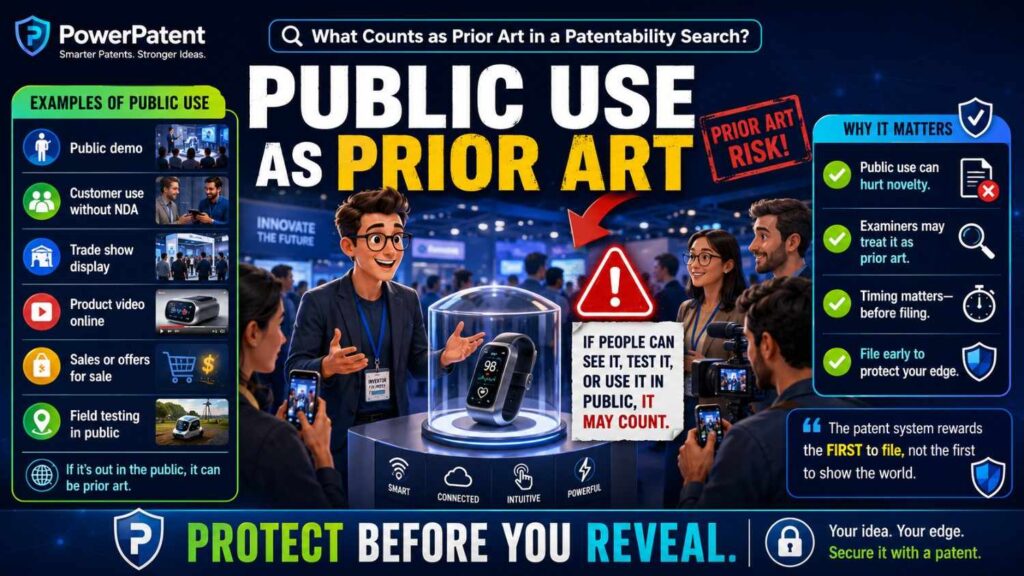
Public use can count as prior art too.
If an invention was publicly used before the filing date, that use may matter. The exact legal effect depends on the facts, the country, and the type of use.
For founders, the simple warning is this: public demos can be risky.
A demo at a trade show, a conference booth, a pitch event, a customer site, or a public test may reveal enough about the invention to become prior art.
Sometimes the details are hidden. Sometimes they are visible. Sometimes the demo is paired with slides or conversations that reveal the method. Sometimes a product is used publicly in a way that lets people understand the invention.
This can be tricky.
For example, a robot navigating a warehouse may reveal some behavior but not the control logic. A wearable device may show alerts but not the internal scoring method. A SaaS dashboard may show output but not backend processing.
Still, public use should be discussed with a patent professional.
The safest rule for startups is to file before public demos when possible.
If that is not possible, use NDAs where appropriate and avoid revealing technical details until a filing strategy is in place.
Offers for sale as prior art
An offer for sale can also create patent issues.
This is not just about whether the product shipped. In some cases, commercial offers or sales activity before filing can matter.
For startups, this is easy to miss.
A founder may think, “We have not launched yet.” But the company may already be offering the technology to pilot customers, enterprise buyers, partners, or distributors. It may have sent proposals. It may have signed beta agreements. It may have quoted pricing. It may have offered a custom implementation.
Those facts can matter.
This does not mean every customer conversation destroys patent rights. The details matter. But founders should not ignore sales activity when planning patent filings.
A patentability search and filing strategy should include a simple timeline.
When was the invention created? When was it first shown? When was it first offered? When was it first used by a customer? Was there an NDA? What exactly was disclosed? What was sold? What was still experimental?
This timeline can help the patent team avoid surprises.
PowerPatent helps founders move earlier in the process, before sales and public launch create more risk. Start here: https://powerpatent.com/how-it-works.
Conference talks and slides as prior art
A conference talk can be prior art if it publicly discloses the invention.
So can slides, posters, abstracts, panel remarks, workshop materials, and recorded sessions.
This matters for technical founders and research-heavy startups.
Founders often speak at conferences to build trust, hire talent, attract investors, or show leadership. That is good marketing. But if the talk reveals how the invention works before filing, it may create patent risk.
Academic founders should be especially careful.
A poster session, thesis defense, journal submission, preprint, or conference paper may disclose the invention before a patent application is filed.
The issue is not whether the audience was large. A small public presentation can matter if the information was made available without confidentiality limits.
Patent timing should be part of the publishing plan.
Before giving a technical talk, ask: Are we revealing the key method? Has a patent application been filed? Are slides being posted online? Will a recording be public? Are we sharing diagrams, data flows, or implementation details?
A simple pre-talk patent check can save a lot of pain.
Theses and dissertations as prior art
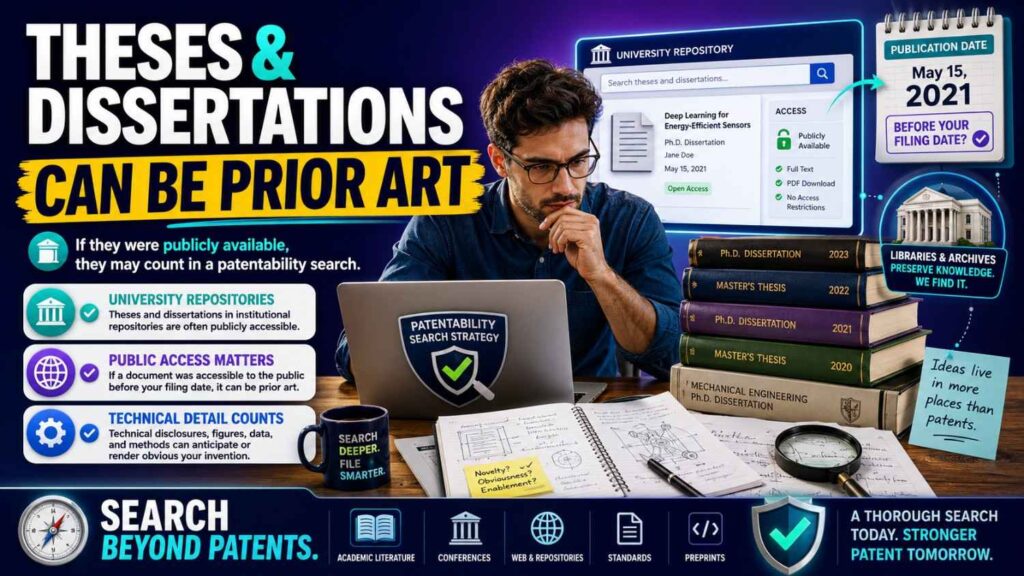
A thesis can be prior art if it was publicly available.
This can surprise founders because theses may feel hidden. But university libraries, online repositories, and indexed academic databases can make theses public.
In deep tech, this matters.
Some of the best technical work starts in universities. A thesis may describe a method, material, device, architecture, or experiment in detail. It may not be commercial. It may not be patented. But it can still disclose the invention.
If your startup spins out of university work, pay close attention.
Your own thesis, your cofounder’s dissertation, your lab’s public reports, or your advisor’s papers may affect patent timing. Ownership issues may also arise if university resources were used.
This does not mean university work cannot become strong patents. It often can. But the patent strategy should start before public academic disclosure when possible.
Founders coming out of labs should speak with a patent team early.
Standards documents as prior art
Standards can be prior art.
In fields like wireless communication, video coding, networking, cybersecurity, semiconductors, payment systems, and data formats, standards documents may describe technical methods in detail.
A standard may include protocols, message flows, timing rules, signal structures, encoding methods, device behavior, and compliance requirements.
If your invention sits near a standard, search the standards.
This is especially important because standard-related prior art can be highly technical and may not use the same words as your product.
For example, a startup may describe its product as “low-latency device pairing.” A standard may describe related steps using protocol language, message frames, authentication states, or handshakes.
Ignoring standards can lead to missed prior art.
Standards can also matter for freedom-to-operate and licensing questions, but that is a separate issue from patentability.
For a patentability search, the main point is that standards documents can show what was already public.
Videos and demos as prior art
Videos can count if they make the invention public.
A YouTube demo, product walkthrough, webinar, conference recording, training video, or public pitch recording may show important details.
For software, a video may show user flows, system behavior, dashboard outputs, or workflow logic.
For robotics, a video may show movement, grasping, navigation, safety behavior, or device interaction.
For hardware, a video may show structure, assembly, use, or operation.
A video may not show hidden backend steps. But it can still matter, especially when paired with slides, narration, docs, or product pages.
In a patentability search, videos are harder to search than text. Titles and descriptions may use marketing words. The important details may appear only in the footage.
AI tools may help summarize videos, but human review is often needed.
Founders should also remember their own demo videos.
A public product demo before filing can become part of the prior art story.
Social media posts as prior art
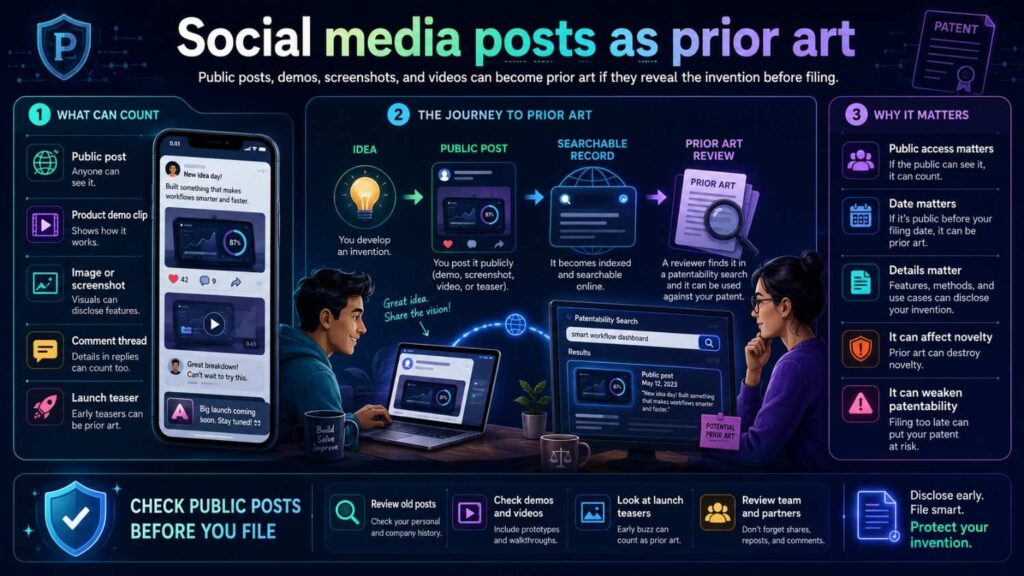
Social media can create patent problems.
A tweet, LinkedIn post, Reddit thread, Hacker News comment, Discord message in a public channel, or public forum post may disclose technical details.
Most social posts are too thin to matter. But some are not.
Engineers sometimes explain how something works in public threads. Founders sometimes share architecture diagrams. Researchers sometimes post model details. Developers sometimes answer questions with technical depth.
Those posts may be searchable. They may be archived. They may be timestamped.
For startups, the practical rule is simple: do not publicly explain the secret sauce before filing.
Marketing can still be strong without revealing the invention.
You can talk about the problem, the result, the customer value, and the product benefit. But be careful with the actual method, architecture, algorithm, materials, or control logic before patent protection is in place.
Customer pilots and beta tests as prior art
Customer pilots can be risky if they reveal the invention without confidentiality.
Many startups test with early users before filing patents. That is normal. But patent timing should be considered.
If the pilot is under a strong NDA and technical details are not public, the risk may be lower. If the pilot is public, open, advertised, or not confidential, the risk may be higher.
A beta test may also involve offers for sale, public use, or public disclosure issues depending on the facts.
This is not something founders should guess about.
Before a major pilot, ask whether a provisional patent application should be filed. A provisional can sometimes be prepared quickly if the invention record is strong.
PowerPatent helps founders capture invention details early so patent filings can happen before key pilots, demos, or launches. See how it works at https://powerpatent.com/how-it-works.
Internal company documents are usually not prior art unless public
Not everything old is prior art.
Internal private documents usually do not count as prior art unless they became publicly available or fit another legal category.
A secret memo inside another company may not be prior art if the public could not access it. A private lab notebook may not be prior art by itself. A confidential pitch under NDA may not be public. A private customer test under confidentiality may be different from a public demo.
This is why public availability matters.
Prior art is not just “someone thought of it before.” It is usually about what was made available to the public, plus certain earlier patent filings.
That said, private materials can still matter in other ways. They may affect ownership, inventorship, trade secrets, contracts, or disputes. But for a patentability search, the main focus is public or legally qualifying earlier information.
Founders should not assume all old information counts. They should also not assume private activity is always safe. The facts matter.
Secret use by another company may not show up in a search
A patentability search has a practical limit.
It can only find what is searchable or knowable.
If another company secretly used the same method and never disclosed it, a normal patentability search may not find it. That secret use may not always count as prior art against you in the same way public disclosures do, but it may create other business issues.
The important point is that a search cannot prove the universe is clear.
It can reduce risk by finding public references. It cannot find every secret, every private sale, every hidden use, or every unpublished document.
This is why search reports should be honest.
A good search says what was searched, what was found, and what limits remain. It does not say, “Nothing exists anywhere.”
Founders should treat search as a decision tool, not a guarantee.
Earlier-filed patents can be prior art even if published later
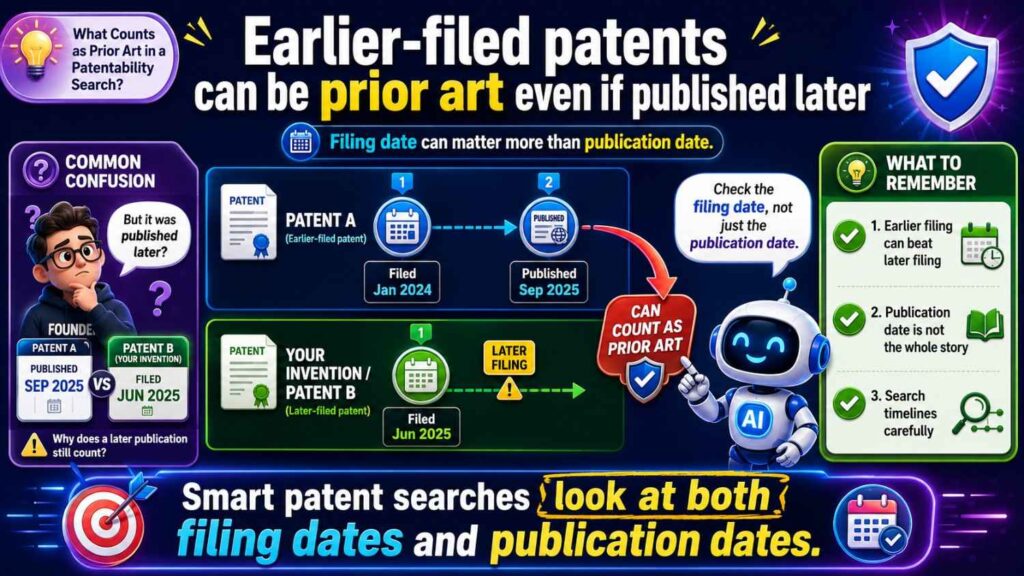
Patent systems can treat certain earlier-filed patent applications as prior art once they publish, even if they were not public on the day you filed.
This is one of the more confusing areas.
In the U.S., § 102 includes certain patents and published applications that name another inventor and were effectively filed before the effective filing date of the claimed invention. (Legal Information Institute)
Here is the simple version: another team may have filed before you, and their application may publish after you file. Once it publishes, it may be used as prior art in certain ways.
This is one reason filing early matters.
A search done today may not reveal unpublished patent applications. They are still confidential. Later, one may publish and create a problem.
No search can fully solve this.
The best defense is to file promptly once the invention is ready and to keep improving the patent portfolio as the product evolves.
Your own disclosures can count against you
Founders often ask whether their own publication can be prior art against them.
The answer can be yes, depending on the country, timing, and facts.
The U.S. has some grace period rules, but they are not a free pass for every situation. Other countries may be stricter. Public disclosure before filing can reduce or destroy patent rights in many places.
This is why startups should file before public disclosure when possible.
Your own blog post, paper, demo, pitch deck, GitHub repo, app release, public documentation, webinar, or sales page may create issues.
The safest startup habit is to build an “IP check” before major public moments.
Before launch, ask whether new technical features need filing. Before publishing a paper, ask whether an invention should be protected. Before open-sourcing code, ask whether any patent filings are needed. Before a conference talk, ask whether the slides reveal the method.
This habit is simple, but it can save major value.
Investor pitch decks can become prior art if public
A private investor pitch under confidentiality is different from a public pitch.
But many startup pitch moments are not truly private. Demo days may be recorded. Pitch competitions may be open. Slides may be shared widely. Investors may not sign NDAs. A founder may post the deck online later.
If the pitch deck reveals the invention, it may create prior art risk.
Most pitch decks stay high level. That may be fine. But technical founders sometimes include architecture diagrams, data flows, model details, performance methods, or product workflows to impress investors.
That can be risky before filing.
A good rule is to separate business pitch content from technical invention content.
Tell investors what problem you solve, why customers care, and why your team is strong. But be careful with the exact technical method until patent filings are in place.
PowerPatent helps founders move quickly before fundraising moments, so they can protect key inventions before sharing more detail. Visit https://powerpatent.com/how-it-works.
NDAs and prior art
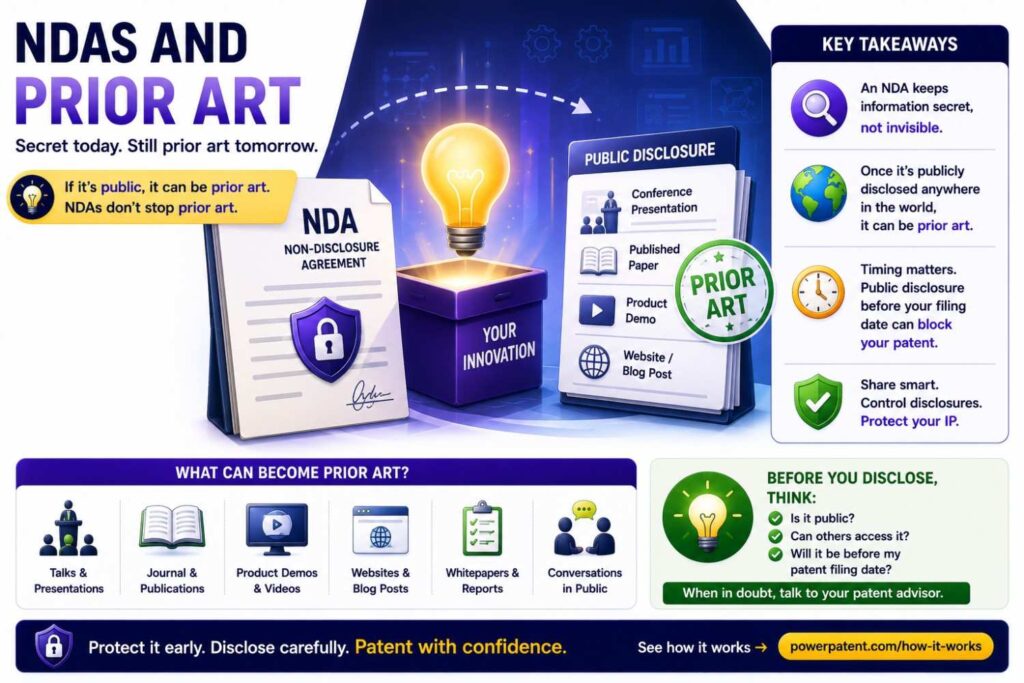
An NDA can help keep information confidential.
If information is shared under a real confidentiality duty, it may not be “public” in the ordinary sense. That can reduce prior art risk.
But NDAs are not magic.
Not all NDAs are strong. Not all people sign them. Some pitch settings do not allow them. Some information may be shared outside the NDA later. Some disclosures may be partly public and partly private. Some countries and fact patterns can be complex.
Founders should use NDAs where appropriate, especially with partners, contractors, manufacturers, and technical collaborators. But they should not use NDAs as a replacement for filing.
If the invention is important, filing before broad sharing is often safer.
Public availability is the key idea
A lot of prior art questions come back to one phrase: public availability.
Could people access the information? Was it published? Was it sold? Was it used publicly? Was it posted online? Was it shown without confidentiality? Was it in a patent publication? Was it in a library, database, standard, or public repo?
If yes, it may count.
If no, it may not.
But there are many gray areas.
Was the product reverse engineerable? Was the demo public enough? Was the thesis indexed? Was the webpage archived? Was the talk recorded? Was the sale confidential? Was the pilot experimental? Was the document accessible only to members? Did the standard draft become public?
These questions can be fact-heavy.
A patentability search may flag the references, but legal analysis may be needed to decide how they count.
Enabling disclosure matters
Not every mention is enough.
A prior art reference usually needs to disclose the invention in a way that matters legally. In many cases, it must teach enough for a skilled person to understand or make/use the invention, depending on the issue and jurisdiction.
The EPO guidelines include discussion of enabling disclosure in the state-of-the-art analysis, showing that not every vague mention has the same value. (epo.org)
Here is the simple version: a headline is usually weaker than a detailed technical paper.
If an article says, “Company X is building smarter batteries,” that may not disclose your battery control invention. If the article explains the exact sensing method, threshold logic, and charge-control steps, it may be much more relevant.
A patentability search should not only ask whether a reference is similar. It should ask what the reference actually teaches.
This is where human review matters.
AI can summarize a reference, but a patent professional should decide whether the reference truly discloses the key claim features.
Dates matter more than founders think
Prior art is tied to time.
The key date is usually your effective filing date or priority date. In simple terms, that is the date your patent filing can rely on for the claimed invention.
A reference before that date may be prior art. A reference after that date usually is not prior art for that claim, though it may matter in other ways.
This is why search reports should include dates.
Publication date. Filing date. Priority date. Public release date. Conference date. Product launch date. Archive date. GitHub commit date. Manual date. Standards release date.
Dates are not boring. Dates can decide outcomes.
Founders should also keep their own invention dates and disclosure dates organized.
When was the feature invented? When was it reduced to practice? When was it shown? When was it launched? When was it filed? When was it published?
A clean timeline helps the patent team.
Geography usually does not save you
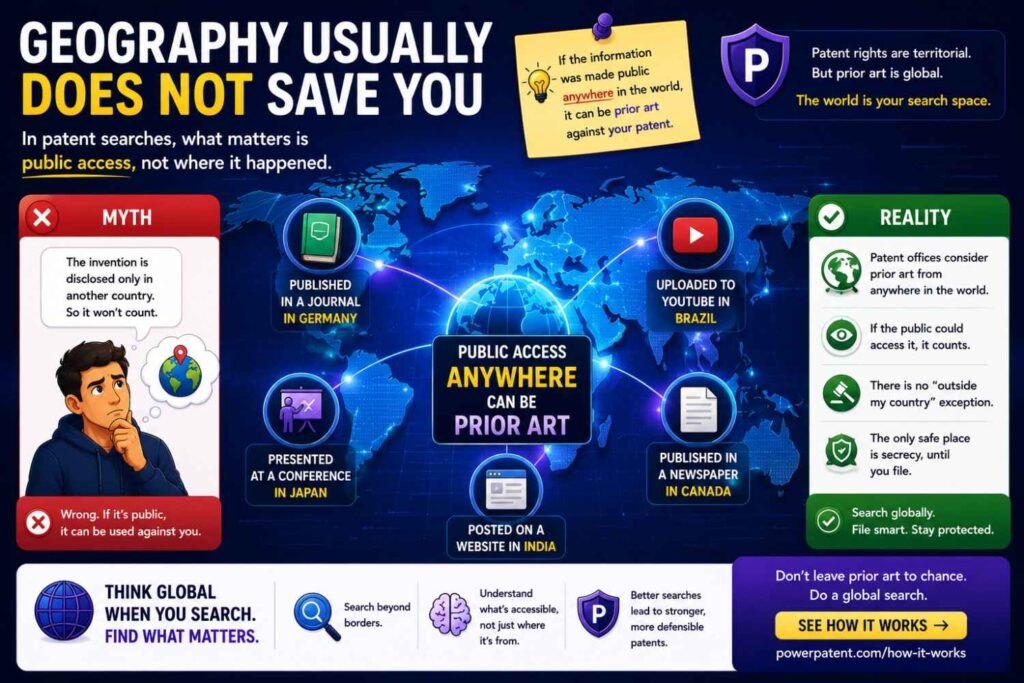
Founders sometimes think foreign references do not matter.
That is usually wrong.
Prior art can come from anywhere in the world. A Japanese patent, a German paper, a Korean thesis, a Chinese product manual, or a European standard can matter in a U.S. patentability search if it was publicly available and meets the legal requirements.
The EPO’s “state of the art” concept is also worldwide in scope, covering what was made available to the public before the filing or priority date. (epo.org)
This is why good searches often include foreign patent databases and non-English references.
Language can make searching harder. The same technical idea may be described with translated terms. Machine translation helps, but it is not perfect.
For deep tech fields with global activity, foreign prior art can be very important.
A startup should not limit its search to its home country unless the search is intentionally narrow and the limits are understood.
Public products can be prior art even if hard to analyze
Products create hard questions.
If a product was publicly sold, what technical information became public? Only what users could see? What could be learned by taking it apart? What was in the manual? What was shown in demos? What was known from marketing or reviews?
The answer depends on the facts and the legal system.
The EPO has addressed marketed products and public availability in recent guidance and case law discussions, including the idea that technical information made available to the public about a marketed product can be part of the state of the art. (epo.org)
For founders, the lesson is practical: do not ignore old products just because you cannot find a patent.
A product can reveal enough to matter.
A teardown article can matter. A repair manual can matter. A datasheet can matter. A user guide can matter. A public API behavior can matter.
When searching, look for products as well as documents.
Public APIs and developer docs as prior art
Software companies often publish developer documentation.
Those docs may disclose workflows, endpoints, data structures, authentication methods, event triggers, error handling, integration flows, and system behavior.
That can be prior art.
For example, if your invention involves a special webhook flow, an old developer doc from another platform may describe something close. If your invention involves rate-limit handling, token refresh, or multi-tenant access control, API docs may be highly relevant.
Public APIs can also reveal behavior through examples and SDKs.
For software startups, patentability searches should include developer docs when the invention relates to platform behavior.
This is especially true in fintech, cloud infrastructure, security, AI tools, dev tools, and enterprise SaaS.
Datasheets and manuals as prior art
Datasheets and manuals are often overlooked.
They can be very strong prior art because they are written to explain how a product works.
A sensor datasheet may describe signal processing. A chip datasheet may describe power modes. A machine manual may describe control steps. A medical device manual may describe workflows. A router manual may describe network behavior. A battery system manual may describe monitoring and safety logic.
These documents may not be called “patents,” but they can disclose technical details.
Hardware, industrial, medical, electronics, and energy startups should search manuals and datasheets when relevant.
Old manuals can be hard to find, but they are worth looking for.
Sometimes the closest prior art is not in a patent office database. It is in a PDF manual from a discontinued product.
White papers and technical reports as prior art
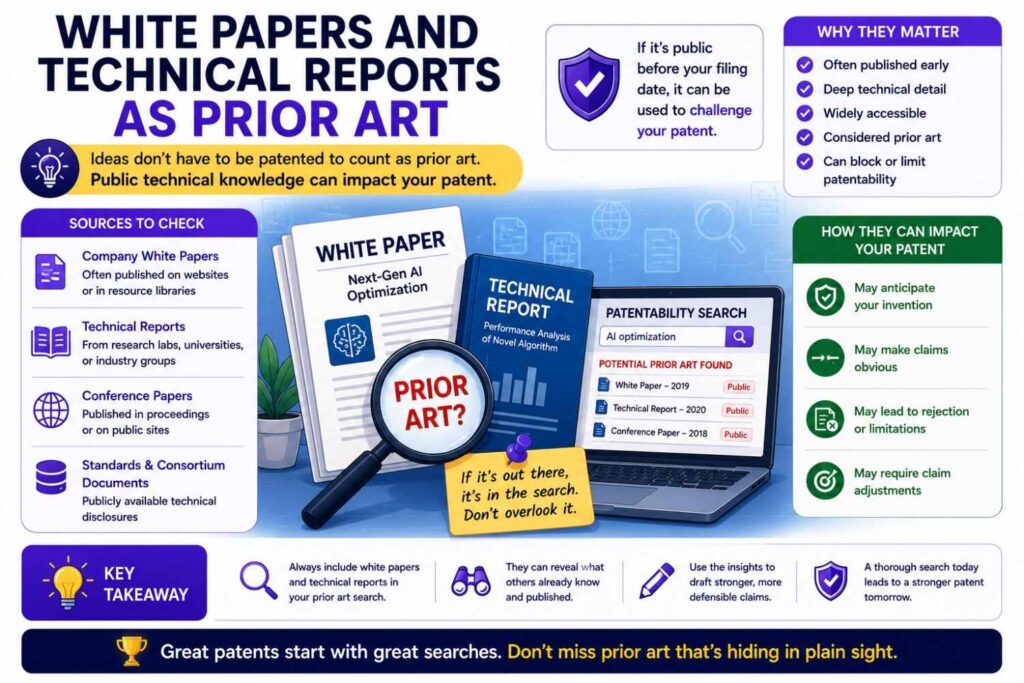
White papers and technical reports can count too.
Companies often publish white papers to explain their technology. Government labs publish reports. Standards groups publish drafts. Research groups publish technical notes. Industry groups publish guidance.
These documents may describe systems in enough detail to matter.
For startups, white papers are especially relevant in cybersecurity, cloud computing, telecom, AI infrastructure, climate tech, energy, and enterprise software.
A vendor white paper may explain an architecture that looks very similar to your invention. A government report may describe a method before it reached the market. A technical report may disclose test methods or system designs.
A strong patentability search should include these materials when the field uses them.
Public datasets as prior art
A dataset itself may not always disclose an invention. But public datasets can matter when the invention relates to data structure, labeling, training, benchmarks, or processing workflows.
For AI startups, public datasets and benchmark papers may show what was known about data formats, labels, features, or evaluation methods.
If your invention is a special way to label data or train on certain data, older dataset documentation may be relevant.
For example, a public dataset may include metadata fields that your system also uses. A benchmark paper may describe a preprocessing method. A data card may explain labeling rules.
The prior art may not be the data alone. It may be the documentation around the data.
Searchers should consider this when the invention depends on data.
Model cards and AI system documentation as prior art
AI companies increasingly publish model cards, system cards, safety reports, benchmark notes, and deployment guides.
These documents can disclose model architecture, training data categories, evaluation methods, safety filters, routing behavior, limitations, and use cases.
For AI patentability searches, these materials can matter.
A model card may show that a certain evaluation or filtering step was known. A system card may describe a safety workflow. A deployment guide may show how the model is used in a larger system.
Founders should also be careful when publishing their own model documentation before filing.
Transparency is important, but patent timing should be planned.
You can publish responsibly and still protect inventions. The key is to file first when protection matters.
Public prompts and prompt libraries as prior art
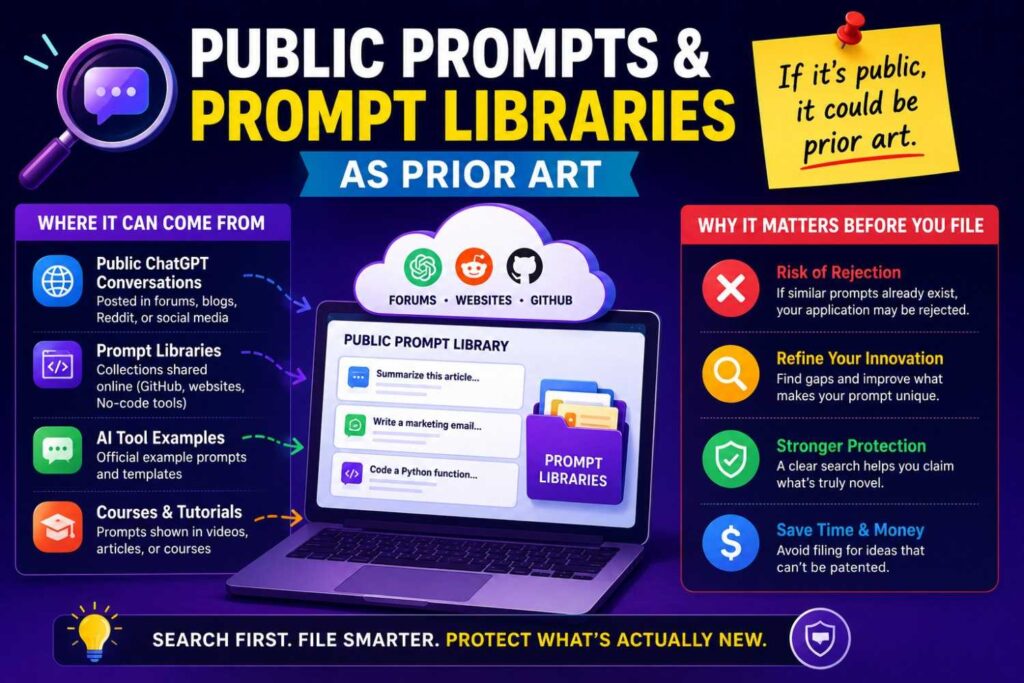
As AI products grow, prompt workflows may become part of patent filings.
Public prompt libraries, agent templates, workflow examples, and automation recipes may be prior art if they disclose the claimed method.
A simple prompt may not be enough. But a detailed public workflow that selects prompts, retrieves context, calls tools, checks output, and updates memory may matter.
For startups building AI agents, search public agent frameworks, docs, repos, papers, and examples.
The invention may not be “a prompt.” It may be how prompts are generated, selected, ranked, tested, or combined with tools and retrieval.
Public examples can be highly relevant.
This is a fast-moving area, so search should include current developer ecosystems as well as patents.
Public blockchain records as prior art
For blockchain and web3 inventions, public ledger data can sometimes matter.
Smart contracts, protocol documentation, governance proposals, white papers, GitHub repos, transaction behavior, and deployed code may disclose technical methods.
A smart contract deployed publicly may reveal logic. A protocol proposal may describe a consensus or incentive mechanism. A public repo may show implementation.
Patentability searches in this field should include both patent and non-patent sources.
Founders should also remember that launching on-chain can be public by design.
If the invention is in the contract logic, filing before deployment may be wise.
Public app behavior as prior art
Mobile apps, web apps, and SaaS tools can reveal features through public use.
Even if backend code is hidden, the app may show workflows, screens, interactions, outputs, and timing. App store descriptions, screenshots, release notes, help docs, and user reviews may add detail.
For user interface inventions, workflow inventions, and software behavior, public app evidence can matter.
A search may include app store archives, release notes, support docs, screenshots, and videos.
But hidden backend logic may be harder to prove from app behavior alone.
This is why patentability analysis needs careful thought. A public app may be close at a product level but may not disclose the key technical method.
Public sales materials as prior art
Sales decks, brochures, catalogs, and product sheets can be prior art if publicly distributed.
They may describe product features, system architecture, workflows, performance, and use cases.
In B2B fields, sales materials can be very revealing.
A company may publish a brochure that explains how its platform routes data, detects errors, controls devices, or integrates with customer systems.
These materials can be easy to miss because they may not appear in patent databases.
Searchers may need to search company websites, archived pages, PDFs, trade show materials, and industry catalogs.
Founders should also be careful with their own sales materials before filing.
Sales teams like clear technical proof. Patent teams need timing control. The two should coordinate.
Public procurement and grant documents as prior art
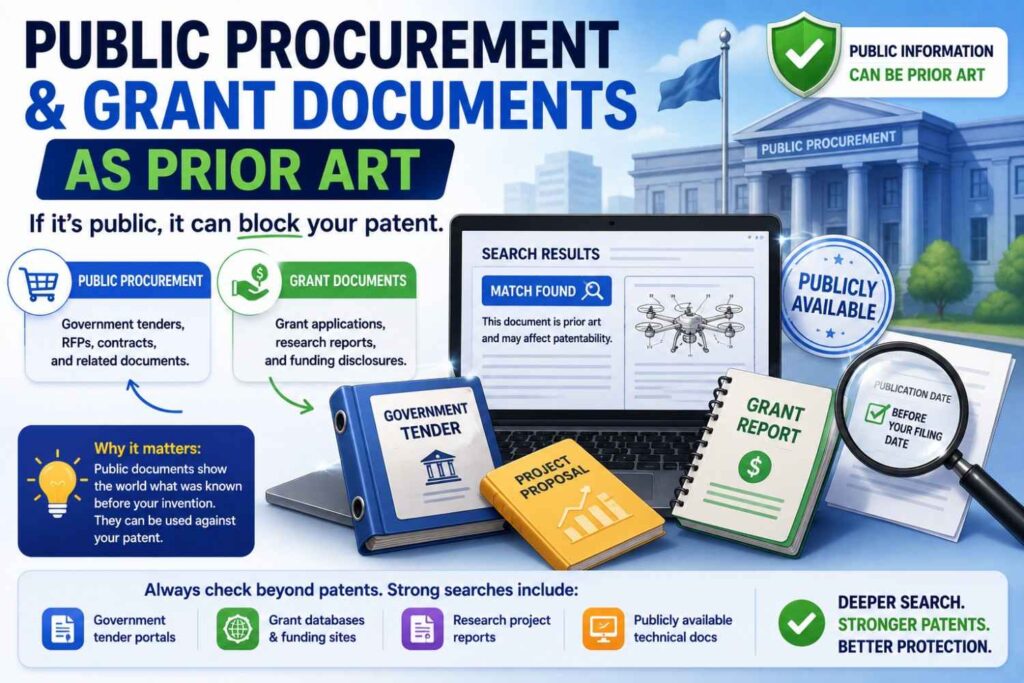
Government procurement documents, grant reports, and public project summaries can disclose technical work.
A startup or lab may describe a system in a government proposal summary, public award abstract, progress report, or procurement response. Some of these documents become public.
These materials may count as prior art if they disclose the invention.
This matters for defense tech, climate tech, health tech, transportation, energy, infrastructure, and university spinouts.
Founders working with grants or government programs should ask which documents become public and when.
A patent filing before public grant disclosure may be important.
Press releases are usually thin, but not always
Press releases often use marketing language. Many do not disclose enough technical detail to be strong prior art.
But some do.
A press release may include diagrams, technical steps, performance methods, product architecture, or links to deeper materials. It may announce a public launch or sale. It may describe a feature clearly enough to matter.
Do not ignore press releases, but do not overread them either.
A patentability search should treat a press release as a clue. It may lead to product pages, manuals, videos, patents, papers, or archived materials.
Often the press release is not the key reference. It points to the key reference.
News articles can be prior art
News articles can count if they disclose enough.
Most news stories are high level. They may say a company “uses AI to improve logistics.” That may not be enough. But some technical journalism includes detailed workflows, diagrams, interviews, and descriptions.
A founder profile may reveal how a system works. An industry article may describe a product’s technical method. A launch article may include screenshots and process steps.
News can also establish dates and public availability.
In a search, news articles can help build the story around a product or disclosure.
But as with press releases, they should be read carefully. A vague article is not the same as a detailed patent publication.
Public forums and Q&A sites as prior art
Technical forums can contain prior art.
Stack Overflow, Reddit, Hacker News, research forums, maker forums, robotics boards, medical device forums, security forums, and product communities can include detailed public explanations.
A developer may post code. An engineer may explain a workaround. A researcher may describe a method. A user may document a product behavior.
These sources are messy, but they can matter.
For software and hardware troubleshooting inventions, forums may be relevant. For cybersecurity, public exploit discussions and technical writeups may matter. For maker hardware, forum posts may show device designs before patents were filed.
Searchers should use these sources when the field relies on public communities.
Public oral disclosures as prior art
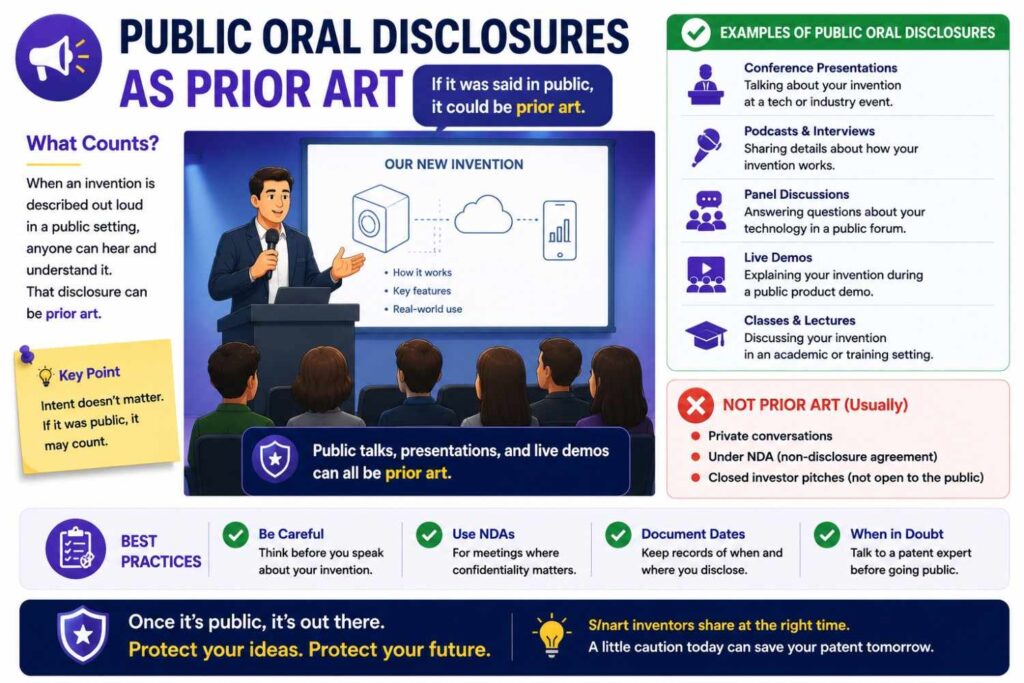
Not all prior art is written.
Public oral disclosures can matter too. The EPO definition expressly includes oral description as a way something can be made available to the public. (epo.org)
In practice, oral prior art can be harder to prove than written documents. But it should not be ignored.
Conference talks, lectures, panels, product demonstrations, webinars, and public meetings can disclose inventions.
Recordings, slides, event programs, attendee notes, or published summaries may help show what was disclosed.
For founders, the safe rule is the same: file before public technical talks.
Experimental use can be different, but do not guess
Sometimes testing is experimental and may be treated differently from ordinary public use or sale.
But this area can be fact-specific.
A startup testing a prototype with a few users may think everything is experimental. A patent examiner or court may not agree, depending on the facts. Was there confidentiality? Was the test controlled? Was the invention ready? Was there a sale? Was the public able to learn the invention? Was the purpose testing or commercial use?
Do not guess.
If you are testing before filing, talk to a patent professional. Keep records. Use confidentiality where appropriate. File early when possible.
Experimental testing is part of startup life. It just needs to be handled carefully.
What does not usually count as prior art
A private idea in someone’s head usually does not count.
A confidential notebook usually does not count.
A private internal design document usually does not count.
A secret prototype hidden in a lab usually does not count as public prior art.
A discussion under a proper NDA may not be public.
But each of these can still raise other issues. They may matter for inventorship, ownership, trade secrets, contracts, or disputes. They may also become prior art later if disclosed.
The simple rule is this: private is usually different from public, but facts matter.
A patentability search focuses mainly on public or legally qualifying earlier information. It is not a full investigation into every private thing that ever happened.
Anticipation versus obviousness
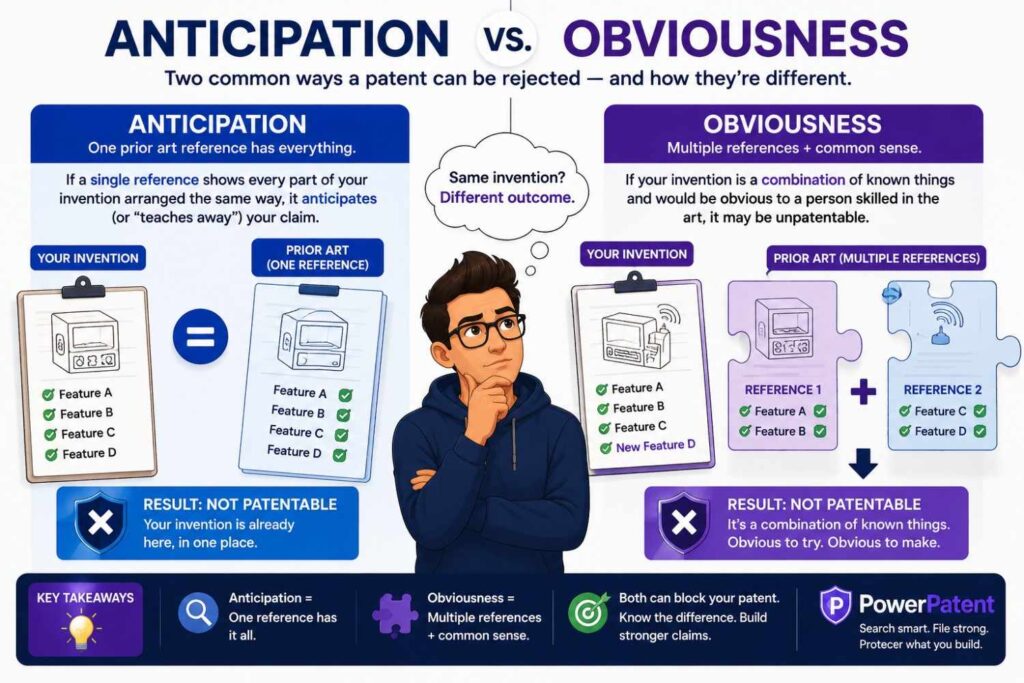
Prior art can hurt a patent in two main ways.
First, one reference may disclose the whole claimed invention. This is often called anticipation. In simple words, the invention is not new because one earlier reference already shows it.
Second, multiple references may make the invention look like an obvious combination. In the U.S., 35 U.S.C. § 103 says a patent may not be obtained if the differences between the claimed invention and prior art would have been obvious before the effective filing date to a person having ordinary skill in the field. (USPTO)
For founders, this distinction matters.
You may not find one exact match. But if many references show all the pieces, an examiner may argue that combining them would have been obvious.
This is why a patentability search should not only look for identical inventions. It should also look for close building blocks.
For example, your invention may combine sensor confidence scoring with adaptive model selection. One reference may show confidence scoring. Another may show model selection. A third may show the same application area. That combination may become an obviousness issue.
A good patent strategy prepares for this.
It explains why your combination is not just a routine mix. It may point to a technical problem, a special architecture, unexpected performance, or a practical constraint that old systems did not solve.
Prior art must be compared to the claims
Patents are examined through claims.
A founder may talk about the invention as a product. But the patent office looks at the claims. Claims define what you are trying to protect.
This means prior art must be compared to claim features.
If your claim says a system receives sensor data, creates a confidence score, selects one of several models based on the score, and controls a device based on model output, then the search should look for those parts.
A reference that shows only sensor data may be background. A reference that shows sensor data and confidence scoring may be closer. A reference that shows all four steps may be very important.
This is why patentability searching works best when the invention is broken into pieces.
What are the required parts? What are the optional parts? What is the key difference? What will likely appear in the independent claim? What might be a dependent claim?
A lawyer can help shape this before the search.
Prior art can narrow your patent even if it does not block it
Prior art does not always kill a patent.
Sometimes it narrows it.
This is common.
A search may show that the broad idea is old, but a specific implementation is new. The startup may still file, but the claims should focus on that implementation.
For example, “using AI for customer support” is broad and crowded. But a specific method that routes requests based on real-time confidence, user risk, and model cost may be more focused.
“Monitoring battery health” is broad and crowded. But a specific method of adjusting charge behavior based on impedance change and temperature history may be more promising.
“Robot navigation” is broad and crowded. But a specific fallback control mode when two sensors disagree may be valuable.
Prior art helps you find the protectable edge.
That edge is what a strong patent draft should capture.
Why a patentability search is not a freedom-to-operate search
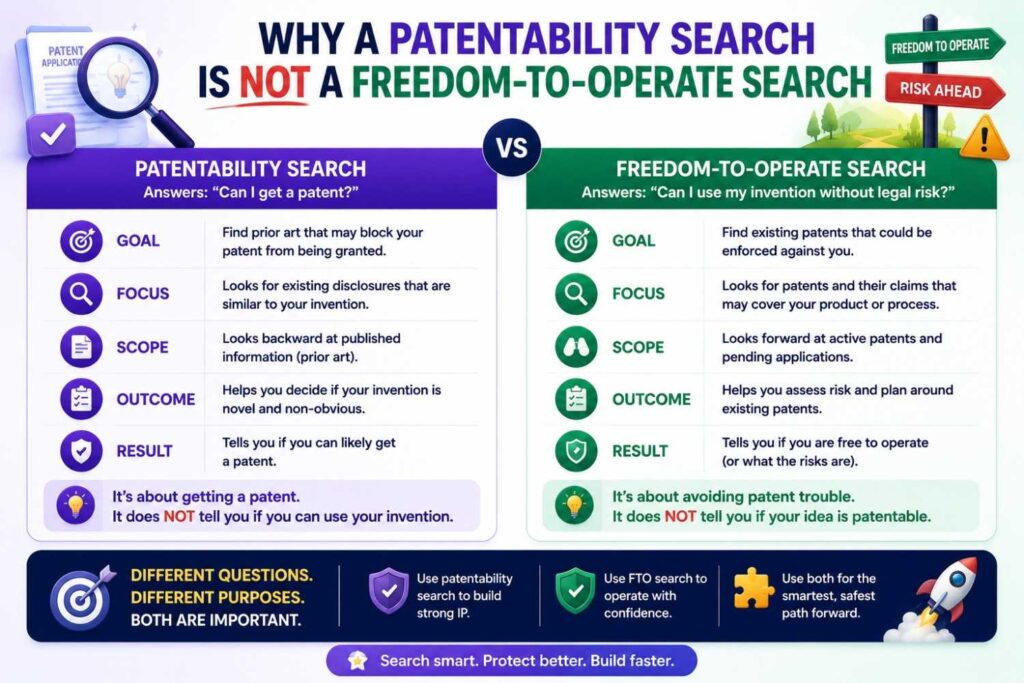
A patentability search asks whether your invention can be patented.
A freedom-to-operate search asks whether your product may infringe someone else’s active patent.
These are different.
You can have a patentable improvement and still infringe a broader older patent. For example, you may invent a better coffee machine part. Your improvement may be patentable. But the full machine may still use technology covered by someone else’s active patent.
A patentability search looks at prior art against your future claims.
An FTO search looks at active claims against your product.
The sources may overlap, but the question is different.
Founders should not treat a patentability search as launch clearance.
If you are entering a crowded field with large patent owners, ask your attorney whether FTO work is needed.
Why a patentability search is not a market search
A market search asks who is selling what.
A patentability search asks what was publicly disclosed before filing.
These can be very different.
A product may have failed, but its manual may still be prior art. A patent application may have published, but the product was never built. A research paper may disclose the method, but no company uses it yet.
Market research is still useful. It helps you understand competitors and customers.
But it does not replace patent searching.
Founders should do both for important inventions.
Why founder language can hide the real invention
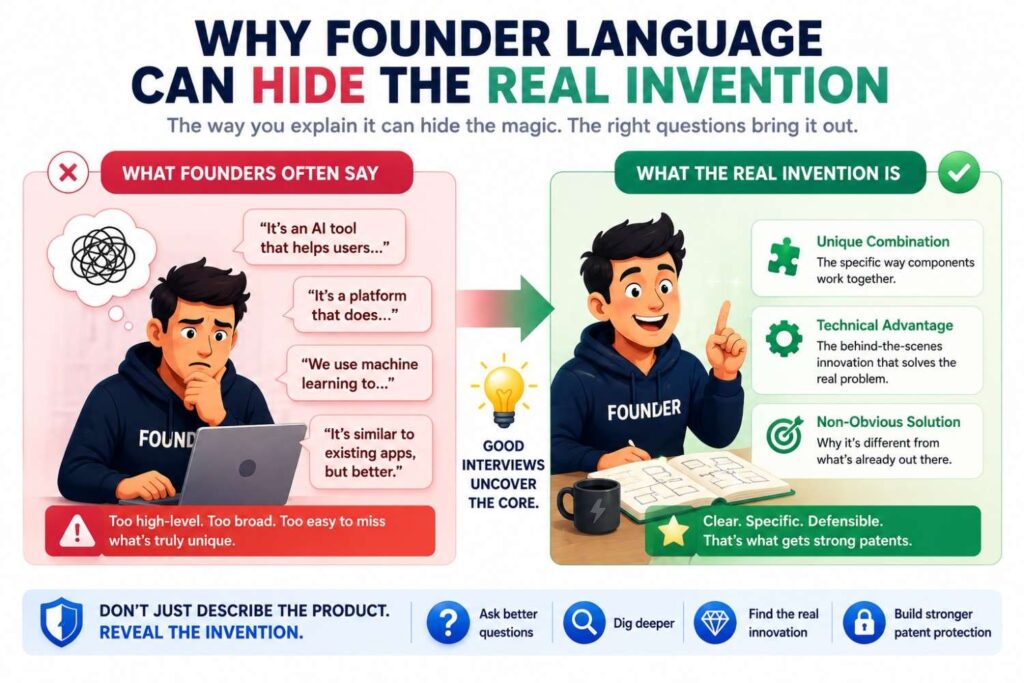
Founders often describe inventions in business terms.
“We automate compliance.”
“We improve onboarding.”
“We make diagnosis faster.”
“We reduce energy waste.”
“We help teams write better code.”
These statements are useful for customers, but not enough for patent searching.
A search needs technical features.
What data is received? What steps happen? What model or rule is used? What device changes? What output is created? What makes the system different from older systems?
The same invention should be described in several ways.
Customer benefit. Technical problem. System structure. Method steps. Data flow. Hardware components. Software modules. Edge cases. Variations.
PowerPatent helps founders translate product language into invention language. That makes patentability search and drafting much stronger. See the workflow at https://powerpatent.com/how-it-works.
AI can help find prior art, but it can miss things
AI search tools are getting better.
They can suggest synonyms. They can summarize long references. They can cluster similar patents. They can compare features. They can help founders understand dense documents.
This is a real advantage.
But AI is not perfect.
It may miss references that use different language. It may misunderstand a technical feature. It may summarize a patent incorrectly. It may treat vague similarity as exact disclosure. It may miss non-patent materials. It may fail to understand claim scope.
A polished AI summary can create false comfort.
The best use of AI is to speed up the search process, not replace expert review.
PowerPatent follows this balanced view. Smart software helps founders move faster, while real patent attorneys help review and guide the work. Learn more at https://powerpatent.com/how-it-works.
How to build a search map before searching
Before searching, build a simple map of the invention.
Start with the problem. What was hard, slow, costly, inaccurate, unsafe, or unreliable?
Then write the old approach. How did people solve it before?
Then write the new approach. What steps does your system take?
Then identify the core feature. What part would a competitor need to copy to get the same advantage?
Then write variations. Could the system use a different model, sensor, material, device, network, or order of steps?
Then list search terms. Use normal words, technical words, patent-style words, and competitor words.
This map helps the search stay focused.
Without it, you may search too broadly and drown in results. Or you may search too narrowly and miss close references.
A good search starts with a good invention map.
How to search by function
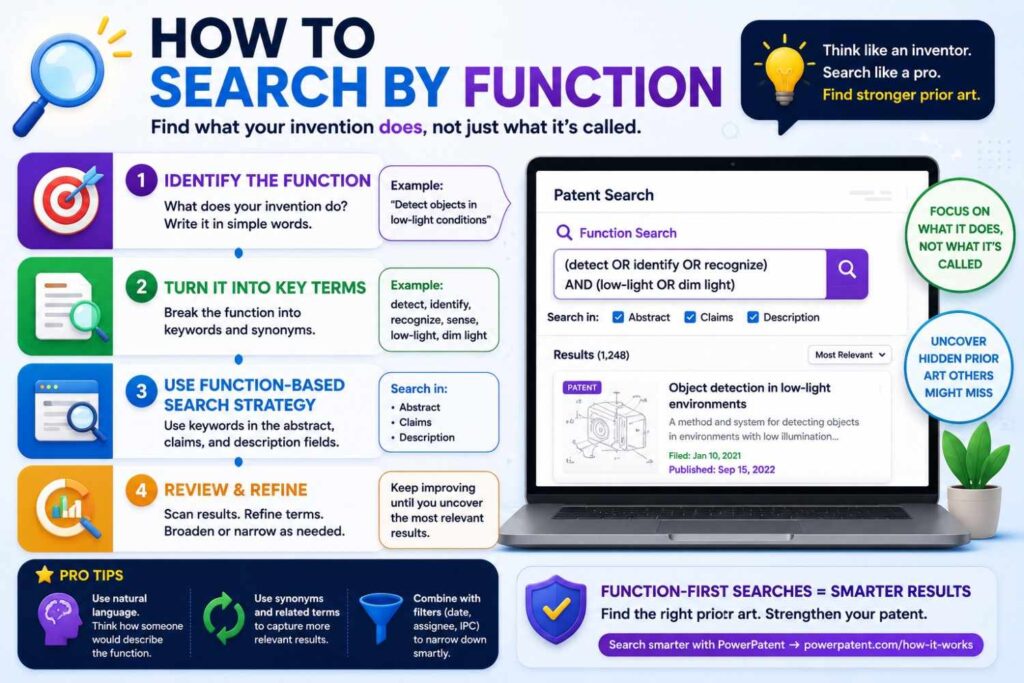
Searching by function means searching what the invention does.
If your invention reduces latency, search for latency reduction, response time, delay, real-time processing, caching, prefetching, edge processing, batching, or routing.
If your invention improves accuracy, search for confidence scoring, error reduction, validation, calibration, filtering, ensemble selection, quality score, or false positive reduction.
If your invention saves power, search for low-power mode, duty cycling, sampling rate control, sleep mode, adaptive sensing, and energy management.
Function words help find references that solve the same problem with different structures.
But function searching alone can be too broad. Pair it with structure and context.
How to search by structure
Searching by structure means searching the parts.
For hardware, this may include sensors, housings, layers, circuits, valves, connectors, batteries, actuators, filters, lenses, or materials.
For software, structure may include modules, databases, queues, APIs, models, clients, servers, agents, caches, tokens, graphs, or pipelines.
For AI, structure may include embeddings, vector stores, retrievers, classifiers, ranking modules, confidence estimators, model routers, feedback loops, or training sets.
Structure searching helps find references that use similar components, even if the stated benefit differs.
A good search uses both function and structure.
How to search by problem
Searching by problem can reveal older attempts.
What pain was your team solving? False positives? High compute cost? Sensor drift? Data leakage? Latency? Manual review? Battery degradation? Noisy signals? Poor edge performance? Unsafe robot movement?
Older references may describe the same problem but use different terms for the solution.
This helps you understand the field.
Sometimes the invention is not the first to solve the problem. Sometimes your method is different. Sometimes old references show why the problem was hard, which can help patent drafting.
A strong patent story often starts with a real technical problem.
How to search by result
Searching by result means searching the outcome your invention achieves.
Examples include reduced memory use, faster training, lower false alarm rate, improved thermal stability, better route safety, lower cloud cost, reduced bandwidth, higher yield, better signal quality, or longer battery life.
This can find references that do not use the same method but chase the same goal.
Be careful, though. Results are broad. Many references claim improved performance.
Use result terms with specific technical features.
How to search competitors
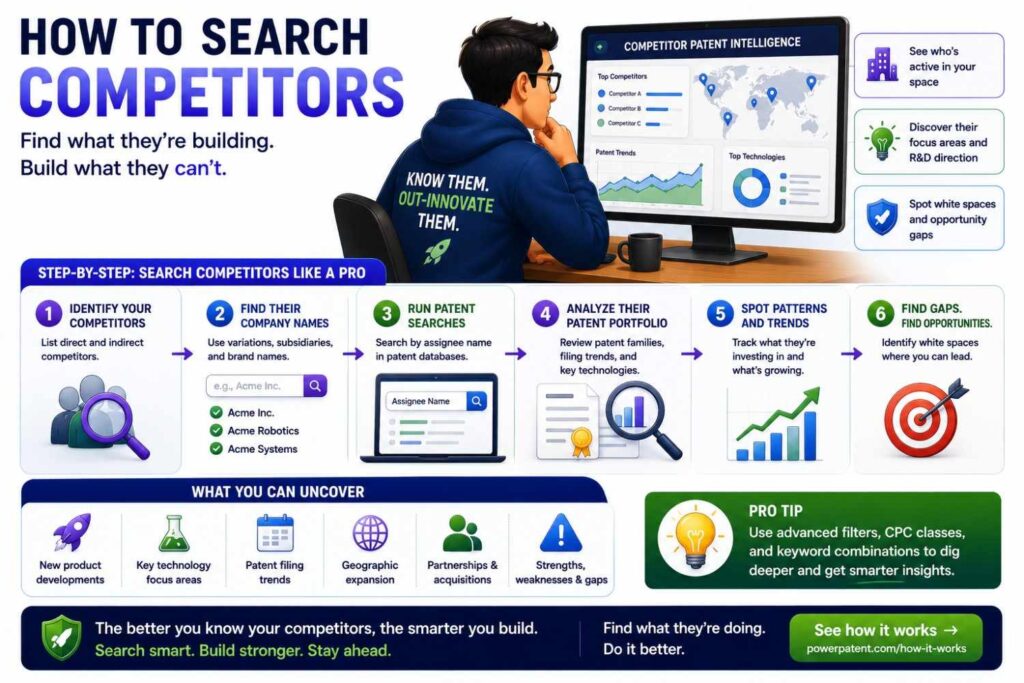
Competitor searching is useful but incomplete.
Search company names, product names, founders, engineers, advisors, university labs, and acquired companies.
Look at patent filings, papers, docs, manuals, blogs, and product releases.
Competitor patents can reveal where the market is going. They can also show language and classifications useful for broader searching.
But do not stop with competitors.
The closest prior art may come from a university, a failed startup, a foreign company, or a different industry.
How to search by inventor
Inventor searching can be powerful.
Technical experts often work on related problems across companies and years. An engineer may file patents at one company, publish papers at a university, then work at a startup.
Searching inventor names can reveal related work that keyword searches miss.
This is useful in specialized fields where a small group of people publish often.
For founders, this can also help identify experts, competitors, and possible partners.
How to use citations in patent searching
Patent citations are clues.
A patent lists references that may relate to the invention. Later patents may cite earlier patents. Examiners may cite references during review.
Searching backward and forward through citations can uncover close art.
If you find one relevant patent, look at what it cites and who cites it. This can lead to a cluster of related references.
Citation searching is useful because patent language can vary. Even if your keywords miss a document, citation links may find it.
AI tools can help map these networks.
But a human still needs to decide which references matter.
How to use patent classifications
Patent offices classify inventions by technical area.
Classification searching can find references that use different words but fall in the same technology class.
This is especially useful when keywords are messy.
For example, many documents may describe similar sensor systems using different terms. A classification search can reveal them.
Founders do not need to learn classification systems deeply. But they should know they exist and that professional searchers often use them.
A search based only on keywords may be too shallow for important inventions.
How to search foreign patents
Foreign patent documents can matter.
A company may file first in China, Japan, Korea, Europe, or another country. The patent family may later include U.S. filings, or it may not. Either way, the foreign publication can be prior art.
Machine translation makes foreign searching easier, but translations can be imperfect. Technical terms may shift. Names may be transliterated. Claims may differ between countries.
For important inventions, foreign patent searching can be worth the effort.
This is especially true in fields with global R&D, such as electronics, telecom, batteries, robotics, automotive, semiconductors, and AI.
How to search non-English literature
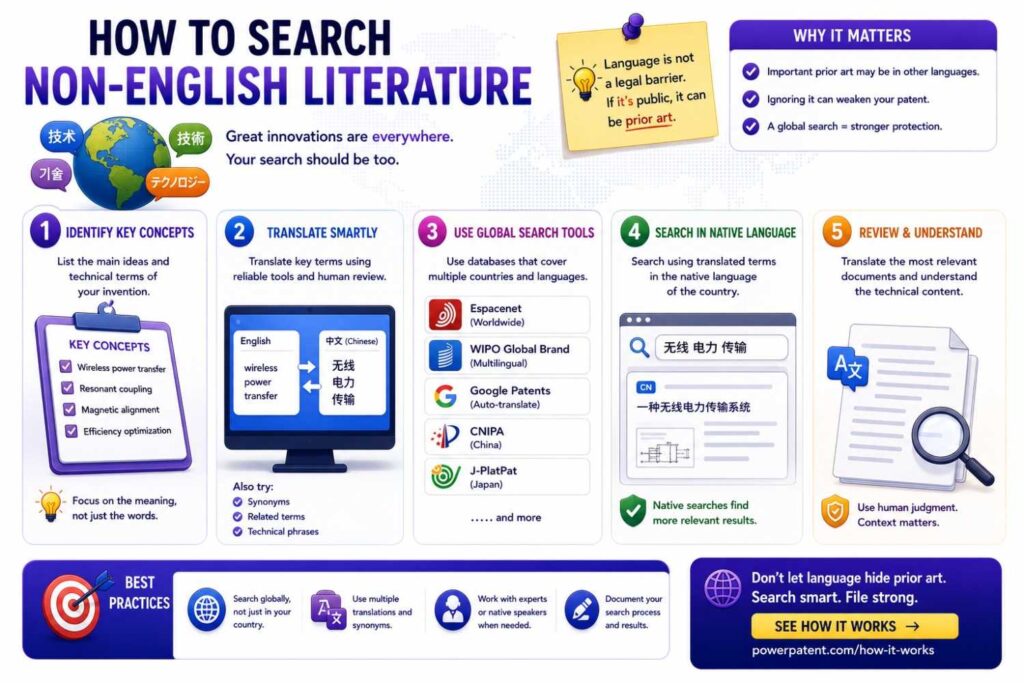
Non-English papers, manuals, standards, and websites can be prior art too.
This can be hard because search terms may not translate directly. Some databases are better than others. Some sources are poorly indexed.
For high-value inventions, consider whether non-English search is needed.
A U.S. startup building battery materials should not ignore Japanese, Korean, Chinese, or German literature. A robotics startup should not ignore Japanese and European work. A telecom startup should search international standards and filings.
Prior art is global.
How to know when a reference is “close”
A close reference teaches several key features of your invention.
It may be in the same field. It may solve the same problem. It may use similar steps. It may have the same structure. It may produce the same result.
But closeness is not only about vibes.
Break your invention into claim-like parts. Then compare.
Does the reference show part A? Part B? Part C? The order? The relationship? The same trigger? The same output? The same technical effect?
A reference that shares the field but not the method may be background.
A reference that shares the method but in another field may still matter.
A reference that teaches all key parts may be serious.
A patent attorney can help judge this.
How to read a patent reference quickly
Patent documents are long, but you do not always need to read every word first.
Start with the abstract to understand the topic. Then look at the drawings. Drawings often explain the system faster than text. Then read the summary. Then search within the document for your key terms. Then read the detailed sections around those terms. Finally, look at the claims.
For patentability, the whole disclosure can matter, not just the claims.
This is important. A published patent application may disclose something in the specification even if it did not claim it.
Do not stop at the title.
Patent titles can be vague. Abstracts can be broad. The important detail may be in the middle of the description.
How to read a research paper for prior art
Research papers have their own structure.
Start with the abstract and introduction to understand the problem. Then look at figures and tables. Then read the method section. Then review experiments and results. Then check related work for more references.
For patentability, the method section is often the most important.
That is where the paper explains how the system works.
Also check dates. Publication date, online first date, conference date, preprint date, and submission date may differ. Which date matters can be a legal question.
For startups, papers are especially important when the invention comes from AI, biotech, robotics, materials, or academic research.
How to read product documentation for prior art
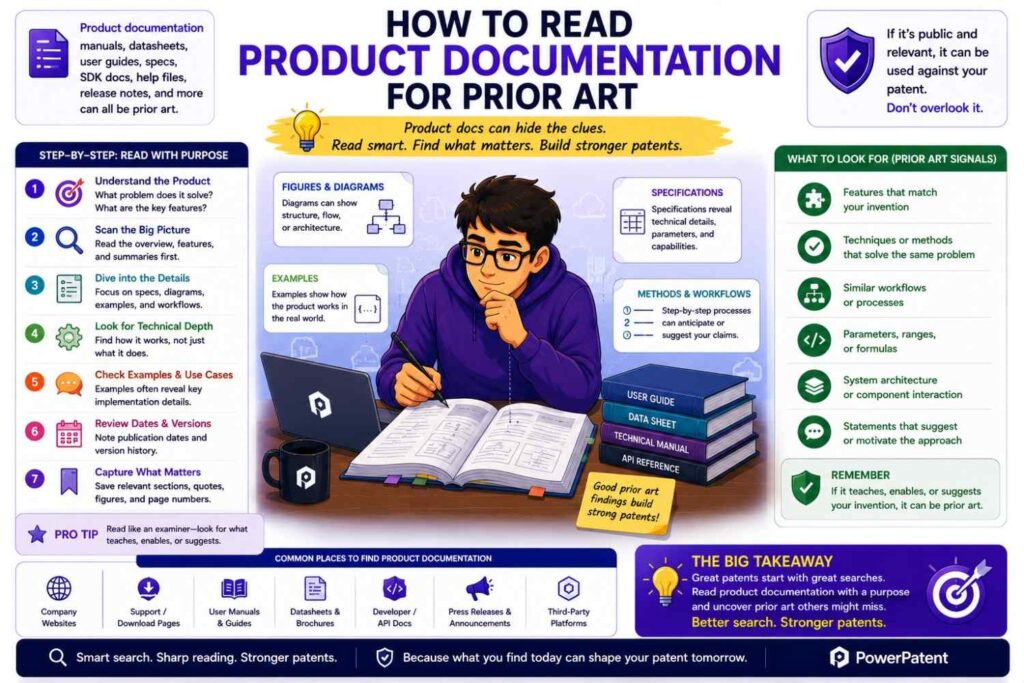
Product documentation can be practical and clear.
Look for setup guides, admin guides, API docs, release notes, troubleshooting sections, architecture diagrams, configuration options, and example workflows.
These materials often reveal how a product behaves.
For software products, release notes can show when a feature became public. API docs can show data flows. Help articles can show user steps. Admin guides can show backend options.
For hardware, manuals can show components, modes, settings, signals, and use steps.
Documentation may be more useful than marketing pages.
Why claim charts help
A claim chart is a table that compares claim features to prior art.
Even before claims are final, a simple feature chart can help.
Write each key invention feature on one side. Write what each reference teaches on the other.
This makes the comparison clearer.
It also helps avoid emotional decisions. A founder may panic because a reference “looks similar.” A chart may show it lacks the key feature. Or a founder may dismiss a reference too quickly, and the chart may show it teaches nearly everything.
Claim charts are not just for lawsuits. They are useful thinking tools during patentability review.
What to do when you find strong prior art
Do not panic.
Strong prior art is useful information.
First, confirm what it actually teaches. Does it disclose the same invention or just a similar goal?
Second, identify what is different. Your invention may still have a protectable improvement.
Third, adjust the patent strategy. The claims may need to focus on a narrower feature. The draft may need more examples. The team may need more technical data. The company may decide not to file.
Fourth, consider business impact. If the prior art is from a competitor patent that is still active, you may also need FTO analysis. That is a different question.
Strong prior art is not always bad news. It can prevent wasted filings and lead to better patents.
What to do when you find no close prior art
Finding no close prior art is encouraging, but not a guarantee.
It may mean your invention is new. It may also mean the search missed something. The terms may have been wrong. The right database may not have been searched. The closest reference may be in another language. An unpublished patent application may exist.
Use the result wisely.
If the invention is important, consider whether deeper searching is needed before a major filing. If timing is urgent, file with the best information available. If the search was only a quick screen, do not treat it like a full legal review.
No search proves a negative perfectly.
The goal is not perfect certainty. The goal is smarter action.
How prior art shapes the patent draft
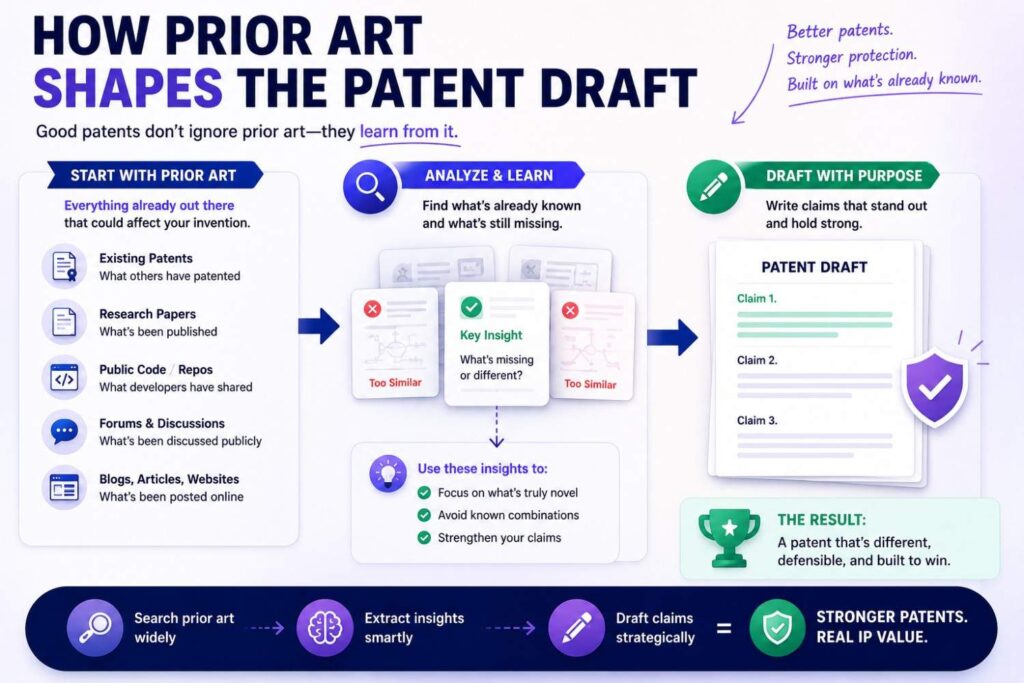
Prior art should guide the draft.
If old references show the general system, your draft should focus on the improvement. If old references show one implementation, your draft should explain alternate versions. If old references use similar terms, your draft should define your terms clearly. If old references solve related problems, your draft should explain your technical advantage.
Prior art can also help identify fallback positions.
A fallback position is a narrower feature that may help if broad claims are rejected.
For example, if a broad AI routing claim is risky, fallback positions may include a specific confidence score, a specific model selection trigger, a specific cost-latency rule, or a specific feedback update.
These details should be in the patent application before filing.
You cannot always add new matter later.
This is why prior art search and drafting should work together.
Why invention capture comes before search
A good search depends on a clear invention record.
If the invention is fuzzy, the search will be fuzzy.
Founders often start with a product idea. Patent teams need the technical invention.
PowerPatent helps bridge that gap. The platform guides founders through invention capture, helping them explain the problem, system, steps, variations, and technical value. This makes patentability searching and drafting more focused.
You can see how PowerPatent works at https://powerpatent.com/how-it-works.
Prior art in AI inventions
AI inventions need special search care.
The prior art may be in patents, papers, preprints, code repos, model cards, system cards, benchmark docs, product blogs, and conference talks.
A founder should not search only for “AI” plus the product name.
Search the actual technical contribution.
Is the invention about training? Data cleaning? Labeling? Retrieval? Prompt selection? Model routing? Edge deployment? Confidence scoring? Fine-tuning? Evaluation? Safety filtering? Memory management? Tool use? Human review?
Each of these has different prior art.
For example, “AI assistant for sales” is broad. The real invention may be a retrieval method that selects customer records based on deal stage and message intent, then uses a confidence rule to decide whether to draft or escalate. Search that.
In AI, the patentable edge often lives in the workflow around the model, not just the model itself.
Prior art in software inventions
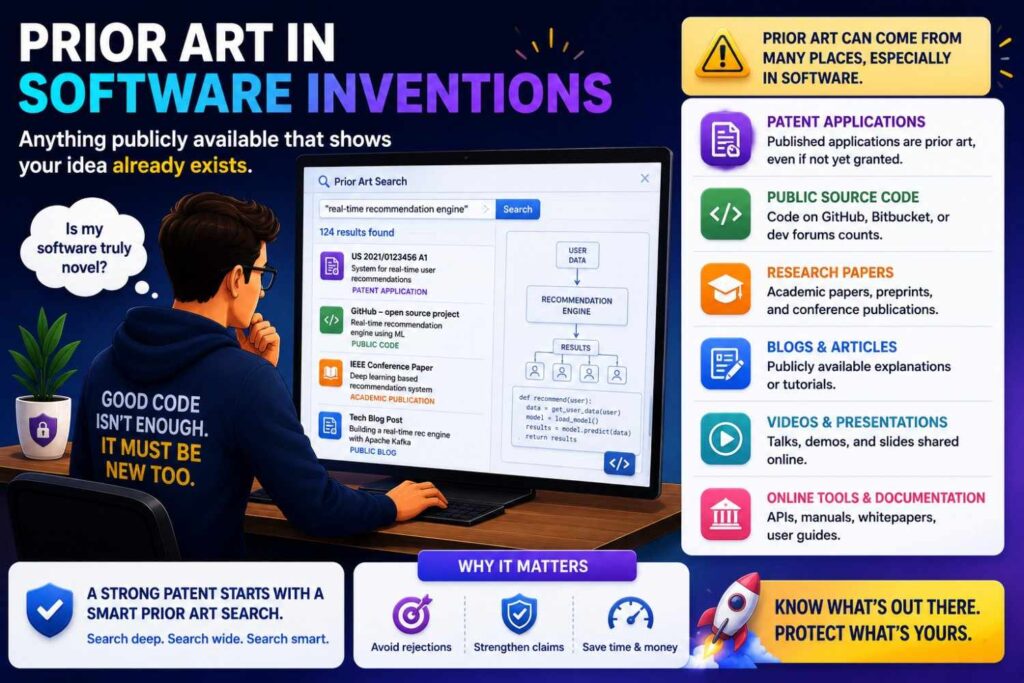
Software prior art can be scattered.
It may appear in patents, docs, open-source projects, API guides, blogs, old apps, forum posts, and academic papers.
Software terms change quickly. The same idea may be described as automation, orchestration, routing, workflow, pipeline, module, engine, service, agent, or controller.
A good search breaks the invention into technical actions.
What data is received? How is it transformed? What rule or model is applied? What output is created? What system action follows? What technical limit is improved?
Search those actions.
Avoid searching only the product benefit.
“Better onboarding” is not enough. Search identity matching, permission mapping, account linking, data migration, role assignment, and error recovery.
Software patents need concrete technical support. The search should help find where that support must be strongest.
Prior art in hardware inventions
Hardware prior art often includes patents, manuals, catalogs, datasheets, videos, and product photos.
A search should focus on structure and operation.
What parts are present? How are they connected? What moves? What signal passes? What material is used? What shape or layer matters? What manufacturing step is different? What problem is solved?
Hardware founders should share drawings, CAD screenshots, prototype photos, test data, and known competing products with the patent team.
The search may reveal old devices that look different but use the same structure. Or it may reveal similar products that solve a different problem.
Both can matter.
Prior art in robotics inventions
Robotics combines hardware, software, AI, and control.
Search should be focused.
Do not search “robot” broadly. Search the actual inventive layer.
Is it perception? Grasping? Navigation? Mapping? Calibration? Human safety? Motion planning? Sensor fusion? Failure recovery? Control handoff? Low-power operation?
Robotics prior art may appear in patents, academic papers, videos, product demos, and open-source robot software.
A video may show behavior. A paper may show the algorithm. A patent may show system architecture. A repo may show implementation.
A strong search may need all of them.
Prior art in climate tech inventions
Climate tech prior art can be deep and old.
Energy storage, grid control, carbon capture, thermal systems, materials, and industrial processes have long histories.
A search should identify the exact technical improvement.
Is it a material? A process step? A control rule? A sensor arrangement? A manufacturing method? A thermal pathway? A predictive model? A system integration?
Climate tech founders should provide data where possible. Performance claims like higher efficiency, longer life, lower cost, or better stability should be backed by real facts.
Prior art may show similar goals, but the method may differ.
The patent draft should explain the method clearly.
Prior art in medtech inventions
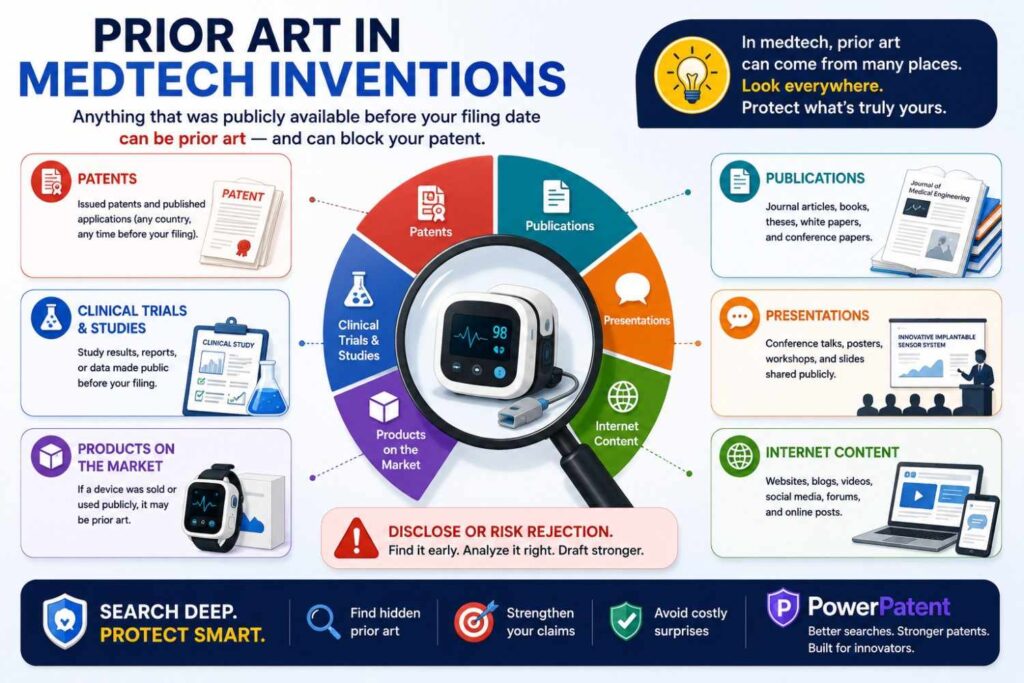
Medtech prior art can include patents, clinical papers, device manuals, regulatory materials, conference abstracts, and product documentation.
Search should consider both device structure and workflow.
Is the invention a sensor system? A diagnostic method? An image processing method? A treatment planning tool? A patient monitoring flow? A device control feature? A data privacy method?
Medtech founders must be careful with public studies, posters, grant disclosures, and pilot programs.
Patent timing should be planned before clinical or public materials are shared.
AI can help organize medtech references, but expert review is essential.
Prior art in biotech inventions
Biotech searches can be highly technical.
Prior art may include patents, journal articles, sequence databases, assay protocols, formulations, public datasets, theses, and conference abstracts.
Small differences can matter. Dates matter. Data support matters.
A casual web search is usually not enough for important biotech patent decisions.
Founders should work with patent professionals who understand the science and the search landscape.
AI may help summarize papers, but scientific accuracy must be checked.
Prior art in cybersecurity inventions
Cybersecurity prior art is often public in unusual places.
It may appear in patents, white papers, exploit writeups, open-source tools, standards, threat reports, conference talks, blogs, and forum discussions.
The invention may involve detection, scoring, authentication, access control, anomaly analysis, behavior fingerprints, response automation, or secure data flow.
Search the technical workflow.
What signals are collected? How are they normalized? How is risk scored? How are false positives reduced? What action is triggered? How is the system updated?
Security founders should also be careful when publishing technical blogs. Those blogs can be great for trust, but they may disclose patentable methods.
File first when the method matters.
Prior art in semiconductor inventions
Semiconductor prior art can include patents, papers, datasheets, standards, process documents, conference proceedings, and product teardowns.
Search requires technical detail.
Is the invention about circuit design? Layout? Power control? Memory architecture? Packaging? Fabrication? Testing? Signal timing? Thermal behavior?
Patent language in this field can be dense. Classification searching and citation searching may be important.
Founders should provide diagrams and known competing approaches.
A small design change can be valuable if it solves a real technical problem, but the search must be precise.
Prior art in fintech inventions
Fintech prior art may include patents, payment standards, API docs, security protocols, product docs, white papers, and regulatory technology materials.
The invention may involve fraud scoring, identity checks, transaction routing, settlement, risk controls, privacy, compliance workflows, or data syncing.
Search should focus on technical implementation, not just the financial goal.
“Improving loan approval” is broad. The invention may be a specific data validation flow, model update method, privacy-preserving identity link, or real-time risk trigger.
Fintech founders should also think about FTO when operating near large financial platforms, but that is separate from patentability.
How much prior art search is enough?
There is no one answer.
For a quick early-stage idea, a light search may be enough to decide whether to keep exploring.
For a core platform patent, deeper searching may be worth it.
For a crowded field, a professional search can save money later.
For a filing under urgent deadline, the team may file first and search more later.
The right depth depends on value, timing, budget, and risk.
The mistake is pretending all searches are equal.
A five-minute search is useful only as a first screen. A full professional search is more useful for high-stakes decisions. Both have a place.
What a good patentability search report should say
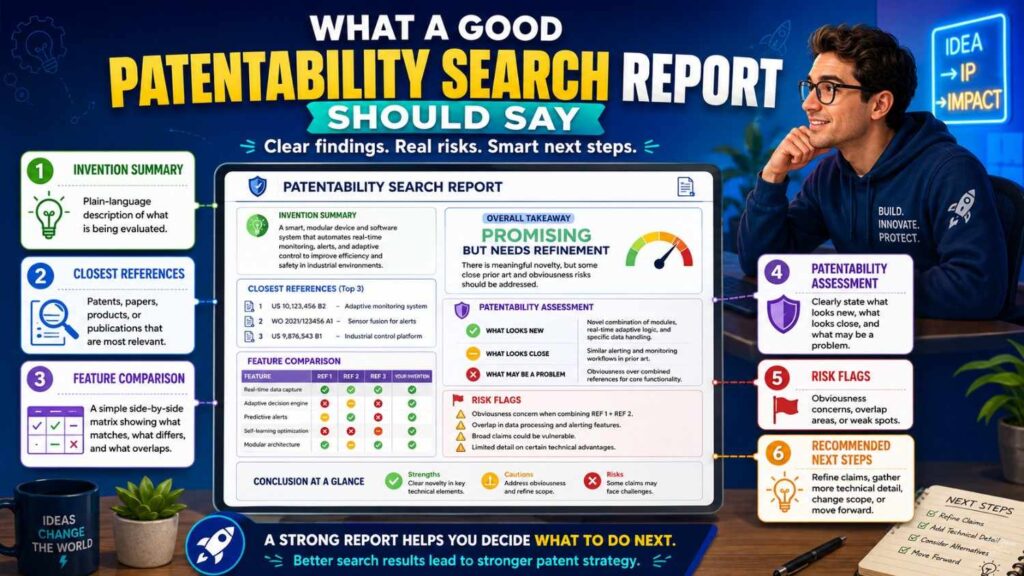
A useful report should not just list references.
It should explain what was searched, what was found, and what it means.
It should describe the invention features used for searching. It should list key search terms and sources. It should identify the closest references. It should compare those references to the invention. It should flag features that appear old and features that may be different. It should explain limits.
Most importantly, it should support a decision.
Should the startup file? Should the claims focus differently? Should the invention record be expanded? Should more search be done? Should the company consider trade secret protection instead?
A search report without practical guidance is only half useful.
What founders should give the search team
Founders can make the search much better by sharing the right material.
Give a plain-English invention summary. Share diagrams, screenshots, architecture notes, code comments, test results, product docs, and known competitors. Explain the old way and why it failed. Explain what your team changed. Explain what parts are optional. Explain future versions.
Also share planned public dates.
Launch date. Demo date. Investor pitch. Conference talk. Paper submission. GitHub release. Customer pilot. Partner meeting.
This helps the patent team manage timing.
You do not need perfect legal language. You need clear technical truth.
What founders should not do
Do not assume a quick Google search is enough.
Do not publish technical details before filing without advice.
Do not rely on an AI tool alone for patentability decisions.
Do not hide known prior art from your attorney.
Do not file broad claims without understanding the closest references.
Do not treat “no exact match found” as a guarantee.
Do not wait until after launch to think about patents.
These mistakes are common, but avoidable.
A better process starts early and stays practical.
Why hiding known prior art is a bad idea
Some founders worry that if they tell their patent attorney about close prior art, it will hurt the filing.
The opposite is usually true.
Your attorney needs to know the closest references to draft wisely. Hiding them can lead to weaker claims, bad surprises during examination, and credibility problems.
Patent work is not about pretending old things do not exist. It is about finding the real invention in view of what already exists.
If you know about a close product, paper, patent, or repo, share it.
A good patent team can use that information.
Prior art and the duty of candor
In U.S. patent practice, people involved in patent prosecution have duties of candor and good faith toward the USPTO, including duties tied to material information. The USPTO’s MPEP discusses these duties in examination practice. (USPTO)
Founders do not need to become experts in patent-office rules. But they should understand the basic idea: do not play games with important known information.
Tell your patent counsel what you know.
Let them decide how to handle it properly.
Why stronger searches lead to stronger patents
A patent is stronger when it is built with awareness.
Awareness of the old systems. Awareness of close papers. Awareness of competitor filings. Awareness of product history. Awareness of the true technical difference.
This awareness helps the attorney draft better claims and a richer specification.
It helps the founder make better budget choices.
It helps the company build a smarter portfolio.
A patent filed in ignorance may still issue. But it may be narrow, weak, or easy to challenge.
A patent filed with a clear view of prior art has a better chance of protecting what matters.
How PowerPatent helps founders handle prior art
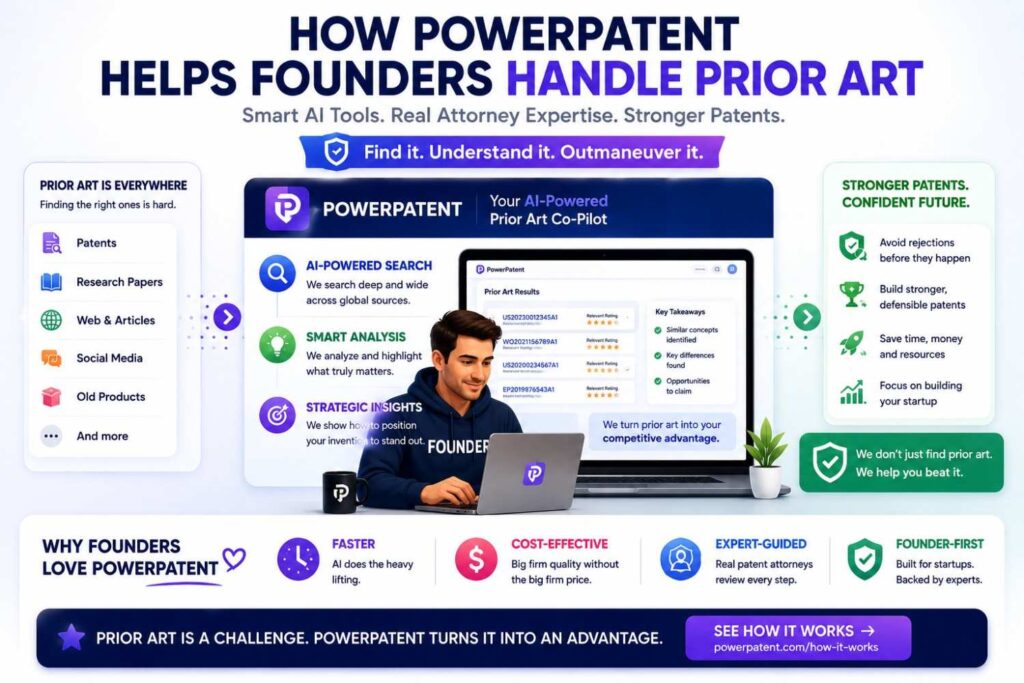
PowerPatent helps founders start with the right foundation.
The platform guides technical teams through invention capture, so the invention is not just a vague product idea. It helps gather the problem, solution, system parts, method steps, examples, and variations.
That better invention record makes patentability searching more useful.
Then attorney oversight helps turn search insights into real patent strategy.
This matters because founders need speed, but they also need confidence. AI alone may be fast, but patent decisions need human judgment. Traditional patent work may be careful, but it can feel slow and hard to use. PowerPatent brings smart software and real patent attorneys together.
To see how your startup can move from invention to filing with less friction, visit https://powerpatent.com/how-it-works.
A practical founder checklist before a patentability search
Keep this simple.
Before the search, write down what the invention does, how it does it, and why it is different.
Collect any diagrams, specs, code notes, test results, and product screenshots.
List known competitors, papers, patents, products, and open-source projects that seem close.
Write a timeline of public disclosures, sales, demos, pilots, and planned launches.
Identify what business decision the search must support.
Are you deciding whether to file? Are you preparing a provisional? Are you filing a non-provisional? Are you entering diligence? Are you launching a product? Are you comparing portfolio options?
That decision will shape the search.
The biggest lesson: prior art is about public knowledge, not just competitors
Founders often focus on competitors.
That is natural. Competitors feel real.
But prior art is much broader.
It includes old patents, abandoned applications, papers, public code, manuals, product docs, talks, videos, standards, websites, public sales, and more.
Some of the most dangerous prior art may come from people who are not in your market now.
A failed startup. A university lab. A foreign manufacturer. A standards group. An open-source developer. A researcher. A government report. A product manual from ten years ago.
A patentability search must look beyond the obvious.
That does not mean searching forever. It means searching intelligently.
Final thoughts
Prior art is any earlier public information that may affect whether your invention can be patented.
It can be a patent, but it does not have to be. It can be a paper, product, manual, website, video, code repo, conference talk, standard, thesis, sales material, or public use.
The key question is whether the invention, or important parts of it, were already made available before your filing date.
For startups, this is not just a legal detail. It is a business issue.
A good patentability search can help you avoid wasting money on weak filings. It can show what part of your invention is truly different. It can help your attorney draft stronger claims. It can guide your product and IP strategy. It can also help you move faster because you are no longer guessing.
The best time to think about prior art is before you file, before you launch, and before you publish.
You do not need to become a patent search expert. You need a process that captures the invention clearly, checks the right sources, and brings in legal judgment when it matters.
That is what PowerPatent is built to do.
PowerPatent combines smart software with real patent attorney oversight, helping founders turn technical inventions into stronger patent filings with more speed, control, and confidence.
To see how your team can protect what it is building, visit https://powerpatent.com/how-it-works.
Leave a Reply