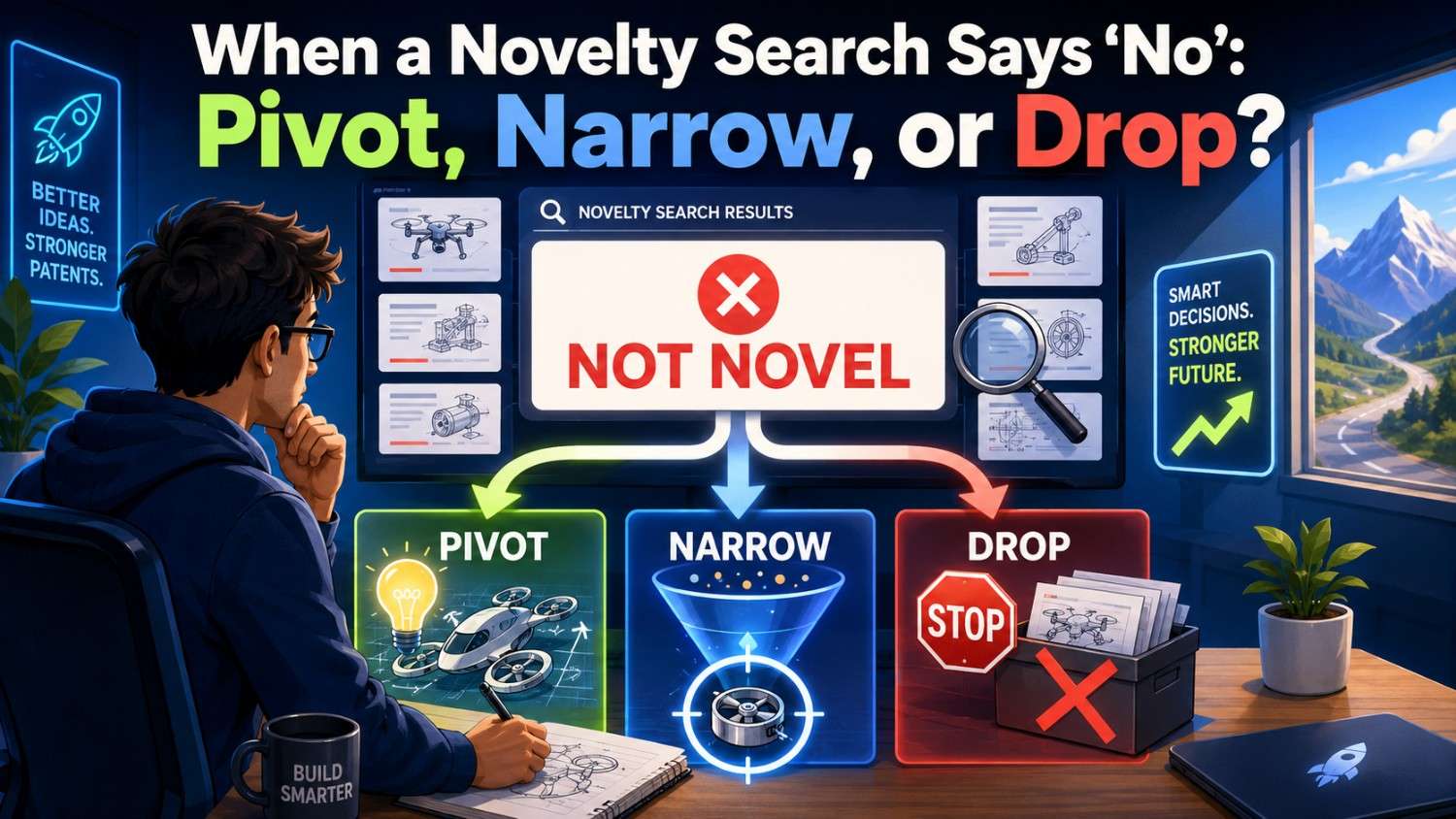
A novelty search can feel like a hard stop.
You search your invention. You find prior art. The broad idea looks taken. The first reaction is often panic.
But a “no” from a novelty search does not always mean the invention is worthless. It means the first version of the patent idea may not be the right one. The next move is strategy.
PowerPatent helps founders, engineers, and inventors turn search results into better filing decisions, with smart software and real patent attorney oversight. See how PowerPatent works here.
What It Means When a Novelty Search Says “No”
A novelty search says “no” when earlier public information appears to show the key parts of your invention.
That earlier information may be a patent, a paper, a product manual, a blog post, a demo video, a GitHub repo, a clinical record, a conference slide, a standards document, or another public source.
For a patent, the big issue is this:
If one earlier reference already shows every important part of what you want to claim, your broad claim may not be new.
That does not always mean your product has no value. It does not always mean you cannot file anything. It does not always mean your company has no moat.
It means the first claim idea may be blocked.
That is very different from “we are done.”
A novelty search is not a judge slamming the door. It is a map. It shows you where you cannot stand. It also helps you see where you may still have room.
The smart question is not “Are we dead?”
The smart question is:
What exactly did the prior art show, and what can we still protect?
That question changes everything.
Do Not Treat Every “No” the Same
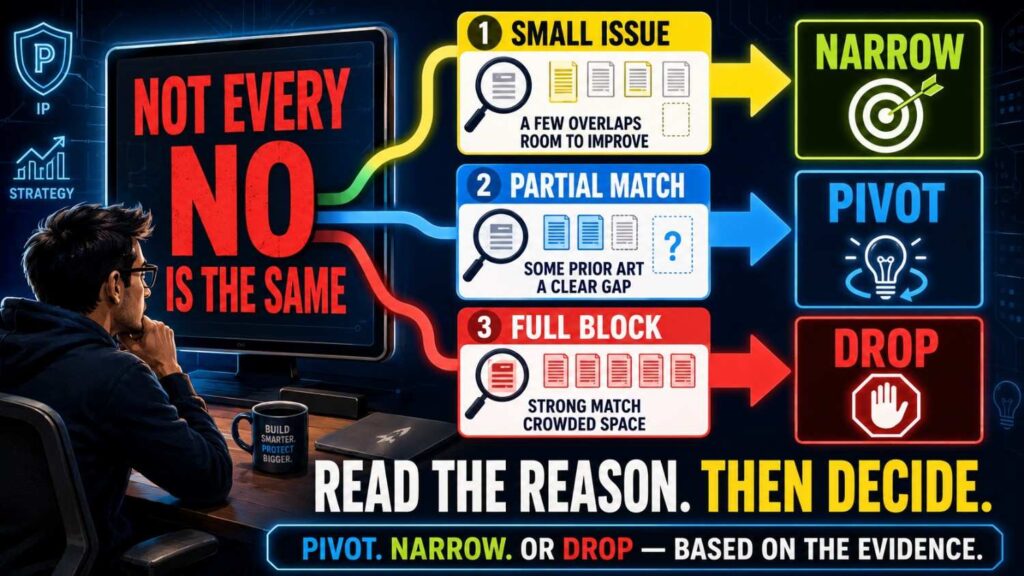
Not all negative search results are equal.
Some are true blockers. One reference shows every important feature of your proposed invention. That is a serious issue.
Some are partial blockers. The prior art shows the broad idea, but not your specific implementation.
Some are broad-field blockers. The category is crowded, but your deeper method may still be different.
Some are language blockers. The search found something that sounds close, but after reading it carefully, it may not actually teach your invention.
Some are business blockers. The remaining patentable part is so narrow or easy to design around that it may not be worth filing.
You need to sort the “no.”
A founder may say, “The search says no.”
But a patent team needs more detail.
No to what?
No to the broad product idea?
No to the main feature?
No to one version?
No to a future roadmap feature?
No to a specific claim?
No to patent filing at all?
A good decision depends on the type of “no.”
PowerPatent helps teams organize search results and invention details so a negative search can turn into a clear decision instead of a messy debate. See how PowerPatent works.
Start by Slowing Down
When founders see close prior art, they often move too fast.
They either give up right away or argue that the reference “is not exactly us.”
Both reactions can lead to bad decisions.
Slow down.
Read the reference carefully. Map it against your invention. Ask what it actually teaches.
Does it show every key step?
Does it show the same input?
Does it show the same timing?
Does it show the same output?
Does it show the same control action?
Does it show the same feedback loop?
Does it solve the same problem?
Does it create the same technical result?
Sometimes a reference looks close from the title but is not close in the details.
Sometimes it looks harmless from the title but is very close in the drawings, examples, or claims.
Do not decide from the first impression.
A novelty “no” should be tested, not feared.
Build a Clear Element Map
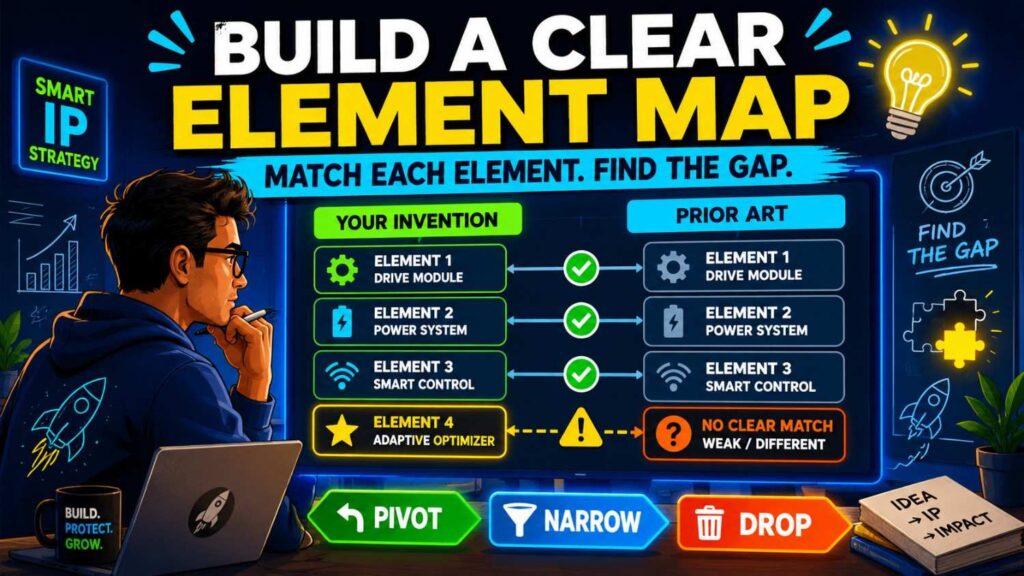
The best way to understand a negative search result is to map it.
Write your invention as a set of required parts.
For example, imagine your invention is:
“A system that validates AI-generated workflow actions against permission scope, customer policy, and source-data support before allowing execution.”
Break it down.
The system generates a workflow action using AI.
The system checks user permission.
The system checks customer policy.
The system checks source-data support.
The system allows, blocks, or routes the action.
The system records the decision in an audit log.
Now map the blocking reference.
Does it generate AI actions? Yes.
Does it check permission? Yes.
Does it check customer policy? Yes.
Does it check source-data support? No.
Does it allow, block, or route the action? Yes.
Does it record the decision? Yes.
That is not a complete novelty “no.” The source-data support check may still be a gap.
Now imagine the reference shows all six elements. That is a stronger no.
The map turns emotion into facts.
Without a map, teams argue in circles.
With a map, you can decide whether to pivot, narrow, drop, or search more.
Ask Whether the Prior Art Shows the Full Combination
Many inventions are combinations of known parts.
That is normal.
A novelty search says no only when one prior art reference shows the full combination you want to claim.
This distinction matters.
Suppose you find one reference that shows source trust. Another shows AI-generated actions. Another shows audit logs. That may raise obviousness questions, but it is not the same as one reference showing the whole workflow.
For novelty, start one reference at a time.
Does this one reference show the full invention?
If yes, you may need to change the claim focus.
If no, the invention may still be novel, though it may still face other patentability questions.
This is where many teams make a mistake.
They see pieces scattered across many references and assume novelty is gone.
Maybe. Maybe not.
Do the clean analysis first.
Then ask whether combining the references would be an easy next step.
That second question is important, but it is different.
The Three Main Choices: Pivot, Narrow, or Drop
When a novelty search says no, most teams have three main paths.
You can pivot.
You can narrow.
You can drop.
A pivot means you shift the patent focus to a different invention or a different technical layer.
A narrow path means you keep the same invention area but claim a more specific version that is not shown in the prior art.
A drop decision means you do not file on that idea because the remaining patent space is too weak, too narrow, or not worth the cost.
These are not failures.
They are signs of a working patent strategy.
A bad process files anyway because the team is emotionally attached.
A good process uses the search to decide what deserves protection.
When to Pivot
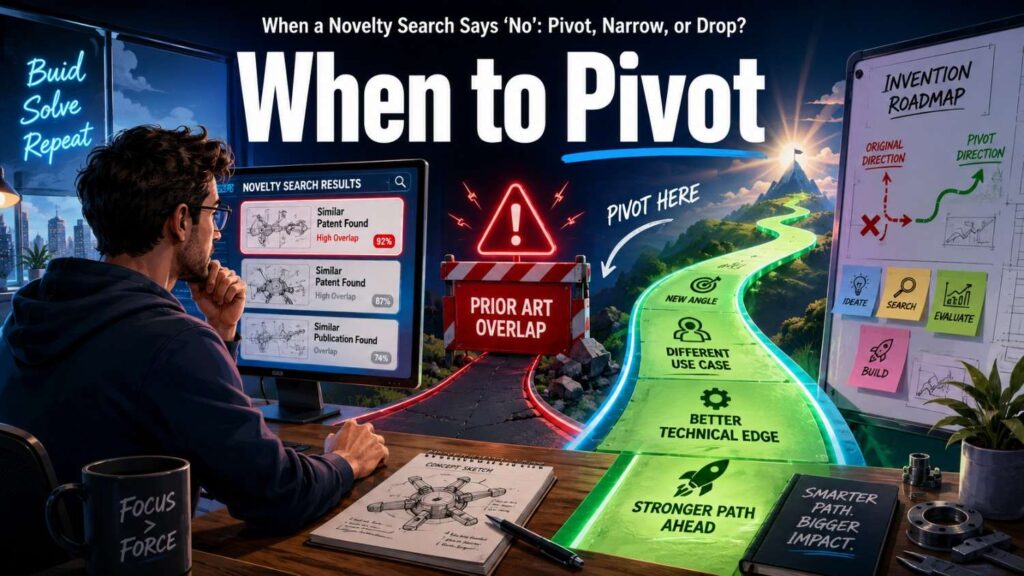
Pivot when the prior art blocks the first idea, but the product still contains another technical feature worth protecting.
This is common.
A SaaS team may discover that the broad workflow automation idea is old. But the platform’s tenant-specific validation method may be new.
An AI team may discover that the model pipeline is known. But the output verification and review trigger may be new.
A hardware team may discover that the device structure is old. But the calibration method may be new.
A robotics team may discover that obstacle avoidance is crowded. But pre-visual risk prediction may be new.
A biotech team may discover that the biomarker is known. But the normalized marker ratio or patient subgroup may still be strong.
A MedTech team may discover that the sensor is known. But the alert confidence method or placement workflow may be different.
A pivot is not a retreat.
It is a move toward the real invention.
How to Find the Pivot Point
The pivot point is often hidden in the answer to one question:
What did we do after the old method failed?
That question is powerful.
Maybe the old method used fixed thresholds. Your team added context-aware thresholds.
Maybe the old method routed low-confidence AI outputs to review. Your team routed high-confidence outputs to review when source trust was low.
Maybe the old method used a pressure sensor. Your team compared pressure drift during matched operating windows.
Maybe the old method used a biomarker alone. Your team adjusted the marker result based on inflammation.
Maybe the old method synced records. Your team repaired field-level conflicts using trust scores.
The pivot point is the improvement.
It may be smaller than the original broad idea, but it may be more valuable.
Founders often want the patent to cover the whole product category. But strong startup patents often protect the technical improvement that makes the product work better.
Pivot From Product Category to Technical Mechanism
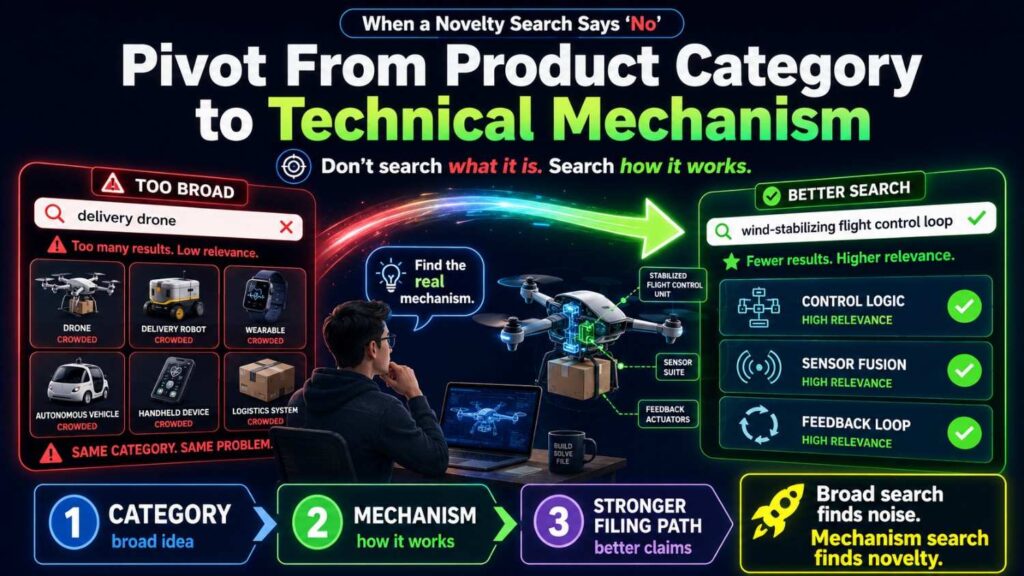
A broad product category is often crowded.
“AI document review” is crowded.
“Robot obstacle avoidance” is crowded.
“Wearable health monitoring” is crowded.
“Cloud compliance automation” is crowded.
“Battery safety monitoring” is crowded.
“Cancer biomarker testing” is crowded.
That does not mean there is no patentable invention.
It means the search should move from category to mechanism.
For example:
Instead of “AI document review,” pivot to “source-supported claim extraction with missing-support review routing.”
Instead of “robot obstacle avoidance,” pivot to “pre-visual blind-corner risk prediction using non-visual signals and map geometry.”
Instead of “wearable health monitoring,” pivot to “alert confidence adjustment based on skin contact and motion state.”
Instead of “cloud compliance automation,” pivot to “tenant-scoped evidence packet generation with field-level redaction.”
Instead of “battery safety monitoring,” pivot to “pressure drift scoring during matched charging windows.”
Instead of “cancer biomarker testing,” pivot to “inflammation-normalized marker ratio for a defined patient group.”
This is how you turn a negative novelty search into a better filing angle.
Pivot From Frontend to Backend
Sometimes the user-facing feature is old.
The backend method may not be.
A dashboard is old.
The way the system groups data before display may be new.
A chatbot is old.
The way the system validates answers before display may be new.
A workflow approval screen is old.
The way the system decides whether approval is needed may be new.
A wearable alert is old.
The way the system decides alert confidence may be new.
A robotic gripper is old.
The way it changes pressure after micro-slip may be new.
When prior art blocks the visible feature, look behind the screen or inside the device.
Ask:
What happens before the output?
What data is used?
What is compared?
What score is made?
What step changes the result?
What does the system do differently next time?
The backend is often where the patentable invention lives.
Pivot From Main Feature to Edge Case
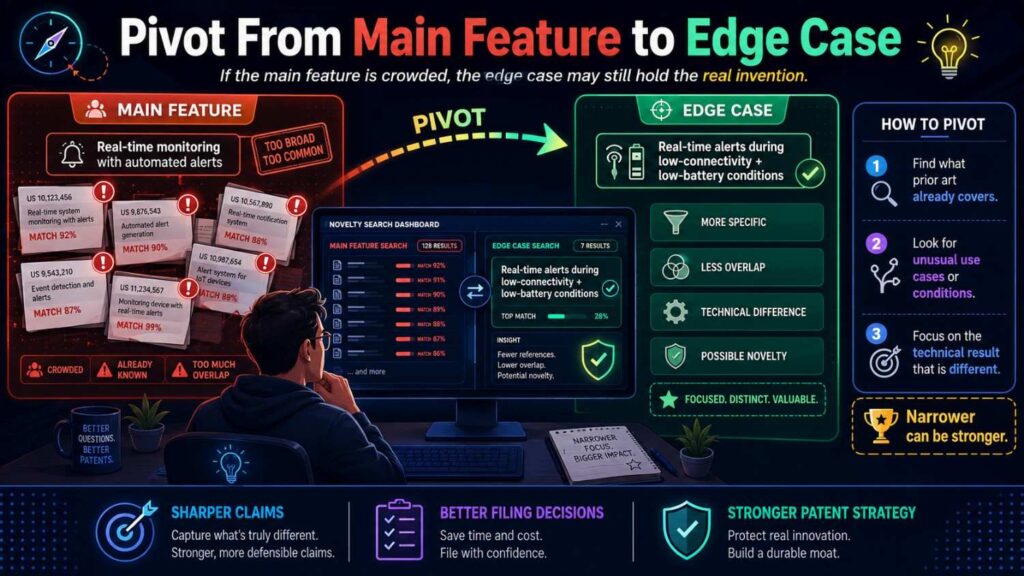
A search may show that your main feature is known.
But your system may solve an edge case old systems do not handle.
That edge case may be valuable.
For SaaS, the edge case may be out-of-order API events, stale evidence, cross-tenant data leakage, or broken workflow state.
For AI, it may be high-confidence hallucinations, missing sources, prompt injection, unsafe tool calls, or conflicting model outputs.
For robotics, it may be blind corners, reflective floors, low light, wet surfaces, payload shifts, or hidden humans.
For hardware, it may be heat drift, vibration, pressure spikes, false alerts, assembly error, or wear over time.
For biotech, it may be inflammation, low sample volume, noisy markers, patient subgroups, storage instability, or immune response.
Edge cases often create real customer pain.
If your invention solves one, search and file around that.
A patent that protects a key edge-case fix can be more valuable than a broad but weak category claim.
Pivot From Device to Method
Sometimes the physical device is old, but the method of using it is new.
For example, a catheter may be old, but the placement confirmation method may be different.
A sensor patch may be old, but the signal correction method may be different.
A pump may be old, but the clog prediction test pulse may be different.
A drone may be old, but the landing adjustment method may be different.
A diagnostic assay may be old, but the scoring or timing method may be different.
When the device structure is blocked, ask:
Is the use method new?
Is the calibration method new?
Is the safety response new?
Is the control loop new?
Is the testing method new?
Is the manufacturing method new?
This can open a new filing path.
Pivot From Method to System
The reverse can also be true.
Sometimes the method is old, but your system architecture is new.
For example, a manual review method may be known, but your cloud system may automate it across tenants with privacy controls.
A scoring method may be known, but your device may apply it locally under strict power limits.
A diagnostic rule may be known, but your lab automation system may perform it with a new cartridge structure.
A robot planning method may be known, but your fleet system may apply it across many robots with deadlock prevention.
If the method is blocked, ask whether the system implementation creates a new technical result.
Does it reduce latency?
Does it work offline?
Does it protect privacy?
Does it reduce compute?
Does it improve safety?
Does it scale across many users, devices, robots, or samples?
That may support a different filing strategy.
Pivot From Core Product to Manufacturing
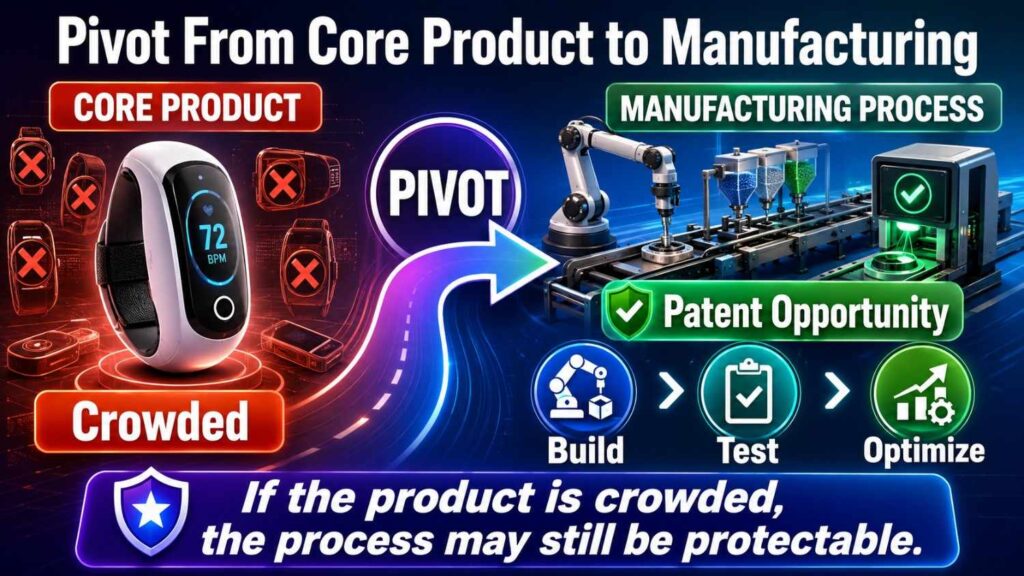
Manufacturing inventions are often missed.
A novelty search may block the product feature. But your production method may still be valuable.
Maybe your device has a self-aligning part.
Maybe your assay has a faster sample prep step.
Maybe your sensor can be calibrated during assembly.
Maybe your robot part can be built with fewer fixtures.
Maybe your formulation is more stable because of a mixing order.
Maybe your cloud platform can deploy tenant-specific workflows without downtime.
These may not be customer-facing, but they can protect business value.
Manufacturing and scaling methods can be hard for competitors to match.
If the product feature is blocked, ask:
What makes this easier, cheaper, safer, or more reliable to build?
That may be the patentable part.
When to Narrow
Narrow when the broad idea is blocked, but a more specific version still appears different and valuable.
This is probably the most common outcome.
A novelty search may show that the broad claim is not new.
So you add a meaningful technical limitation.
Not a random detail.
A meaningful limitation.
For example:
Broad claim: “AI system that routes support tickets.”
Prior art: shows AI ticket routing.
Narrower claim: “AI support system that creates a failure-pattern score from ticket text, error logs, software version, and recent configuration changes, then asks one clarifying question when the score falls in a middle-confidence range.”
That narrower claim may still be valuable if it protects the reason your product works better.
Another example:
Broad claim: “Wearable device that monitors heart rhythm.”
Prior art: shows wearable heart monitors.
Narrower claim: “Wearable device that adjusts arrhythmia alert confidence based on skin-contact pressure and user motion state before sending an alert.”
That is more specific, but it may still protect a key product advantage.
Narrowing is not weakness when done well.
It is precision.
Narrow Around the Technical Result
When narrowing, do not add details just to be different.
Add details that connect to the technical result.
For example, do not add “the alert is blue” just because the prior art has red alerts.
That does not matter much.
Add “the alert is triggered only when signal confidence remains above a threshold after motion correction.”
That may matter.
Do not add “the workflow sends an email” just because prior art sends a dashboard notification.
Add “the workflow blocks execution when source-data support is below a threshold.”
That matters more.
The right narrowing feature should answer:
Why does this make the system work better?
What problem does it solve?
Would competitors need it?
Can it be explained clearly?
Does it match the product?
Does it support the business moat?
Narrowing should make the patent more focused, not merely smaller.
Narrow by Input
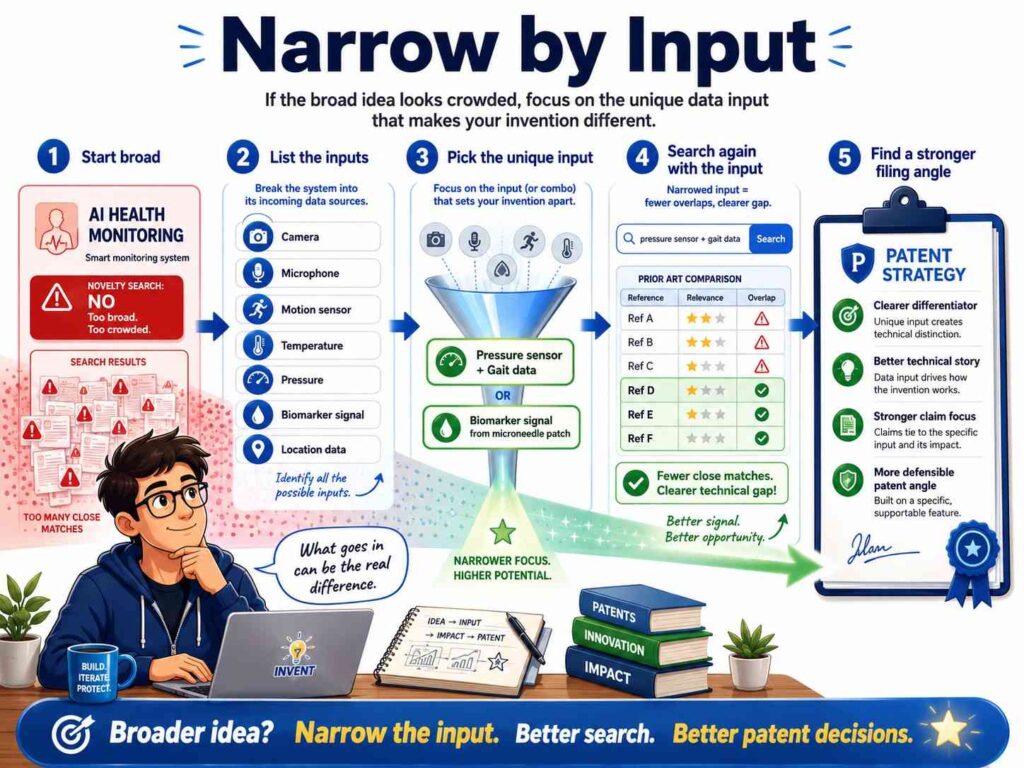
Many inventions can be narrowed by input.
What data does your system use that the prior art does not?
For AI, the input may be source trust, user correction history, document lineage, model confidence, prompt risk, or tool output.
For SaaS, it may be event history, customer policy, permission scope, usage logs, tenant rules, or audit evidence.
For hardware, it may be pressure drift, temperature, vibration, load, contact force, or motion state.
For robotics, it may be sound direction, traffic history, map geometry, wheel slip, payload, or human intent.
For biotech, it may be marker ratios, sample type, patient subgroup, inflammation score, gene variant, or treatment response.
If a prior art reference uses one input but your system uses a different input that changes the result, that can be a useful narrowing point.
The key is to explain why the input matters.
“We use source trust” is okay.
“We route high-confidence AI output to review when source trust is low, catching unsupported answers that confidence-only systems may miss” is much better.
Narrow by Timing
Timing can be a powerful way to narrow.
When does your system act?
Before failure?
After a signal changes?
During a specific operating window?
Only when two conditions agree?
Only after a confirmed event?
Only when confidence falls in a middle range?
Prior art may act too late, too early, or continuously.
Your timing may be the difference.
For example:
A robot may slow before visual detection, not after seeing an object.
A battery system may compare pressure during matched charging windows, not at random times.
A support tool may ask a clarifying question only in a middle-confidence range, not every time.
A diagnostic may measure a marker after a treatment window, not at baseline only.
A cloud system may isolate jobs only when risk passes a threshold, not for all jobs.
Timing often connects directly to performance.
It can reduce false alarms, lower cost, improve safety, or avoid delay.
If the prior art blocks the broad method, search the timing.
Narrow by Condition
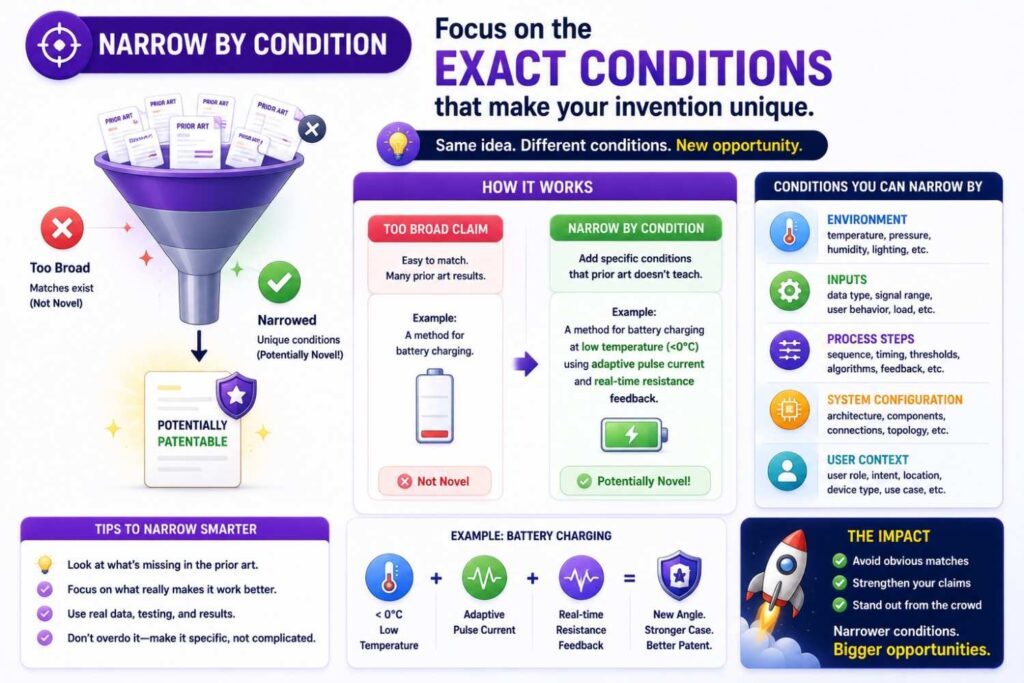
Conditions are often strong claim features.
A condition is a trigger.
The system acts when something happens.
For example:
When source trust is low.
When model confidence and source trust conflict.
When skin-contact pressure is poor.
When motion state is high.
When charging rate matches a prior window.
When signal drift passes a threshold.
When patient biomarker ratio changes.
When workflow state changes.
When tenant policy blocks an action.
When risk score and business priority both exceed thresholds.
Prior art may perform the same broad action, but under different conditions.
That difference can matter.
For SaaS and AI, conditions often control automation safety.
For hardware and robotics, conditions often control physical action.
For biotech and MedTech, conditions often control diagnosis, dosing, or alerts.
Narrowing by condition can protect the system’s decision logic.
Narrow by Output or Action
Sometimes the input is known, but the action is new.
Prior art may detect a problem and display it.
Your system may detect it and change machine behavior.
Your system may use the score to block an AI action.
Prior art may measure a biomarker.
Your system may use the result to select a treatment subgroup.
Prior art may detect robot risk.
Your system may reroute the robot or notify the fleet.
Prior art may detect battery swelling.
Your system may reduce charge current.
The action matters.
A patent claim can often be strengthened by tying the detection step to a specific technical response.
Search and compare what the prior art does after detection.
If it only reports and your system controls, that may be meaningful.
Narrow by Feedback Loop
Feedback loops are often strong.
Prior art may make a decision once.
Your system may update future decisions based on what happened.
For example:
A support system may update failure patterns after a confirmed fix.
An AI system may update source trust after reviewer approval.
A wearable may update a personal baseline after confirmed false alerts.
A cloud platform may update workload routing based on later job outcomes.
A robot may update path risk based on near-miss events.
A diagnostic system may adjust thresholds based on lab-specific performance.
If the broad idea is blocked, the feedback loop may still be new.
But be specific.
“The system learns” is weak.
“The system updates a tenant-specific approval threshold after reviewer rejection of an automated action” is stronger.
Feedback loops are also business-friendly because they can create a growing product advantage.
The more the system is used, the better it becomes.
Narrow by Environment
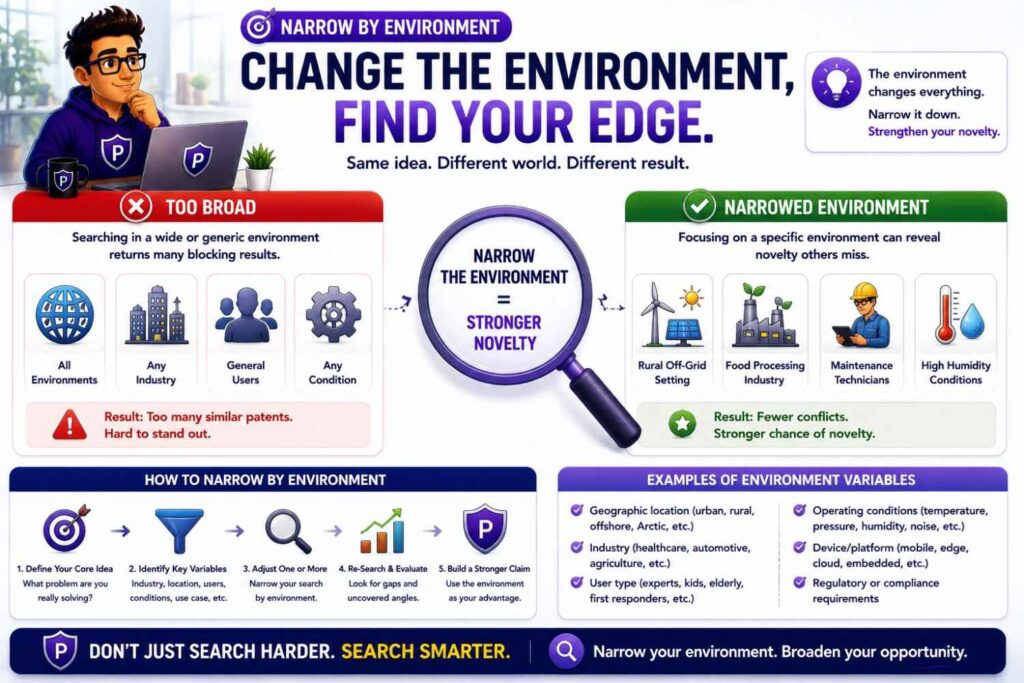
A known invention may become different when adapted to a hard environment.
For robotics, that may be low light, wet floors, dust, crowds, tight aisles, or moving humans.
For hardware, it may be heat, vibration, pressure, moisture, shock, or space limits.
For SaaS, it may be multi-tenant environments, regulated data, cross-system sync, or high-scale event streams.
For biotech, it may be low-volume samples, inflamed patients, unstable markers, storage limits, or immune response.
For MedTech, it may be home use, motion artifacts, poor scan quality, or clinician workflow limits.
Be careful. Merely saying “used in a different environment” may not be enough.
The environment should force a technical change.
For example:
“Use source trust in SaaS” is broad.
“Generate audit packets in a multi-tenant cloud system while removing unrelated tenant data” is more specific.
“Use a sensor in a wearable” is broad.
“Adjust alert confidence based on skin-contact pressure during high-motion states” is more specific.
The environment should explain the invention.
Narrow by User or Patient Group
For certain inventions, a group can matter.
In biotech, a patient subgroup may be central.
A treatment may work in patients with a marker. A diagnostic may be accurate in early-stage disease. A dose may be safe in a certain population.
In SaaS, a user group may matter less by itself, but a tenant class, role, or permission state may affect the technical method.
In MedTech, a device may be adapted for pediatric patients, home users, or people with a specific condition.
Narrowing by group should be tied to technical result.
Do not narrow only because it is a market segment.
Narrow because the group changes how the invention works or why it works.
For example:
A diagnostic threshold for patients with high inflammation may be meaningful if it reduces false positives.
A workflow permission rule for temporary contractors may be meaningful if it prevents unsafe access to customer data.
A wearable calibration for elderly users may matter if skin contact and motion patterns affect signal quality.
The group should not just be a label. It should drive the method.
When to Drop
Dropping an idea can be the smartest move.
Not every invention deserves a filing.
Drop when the prior art shows the full invention and the remaining differences are weak.
Drop when the only available claim would be easy to design around.
Drop when the feature is not central to the business.
Drop when the product has moved away from the idea.
Drop when the invention is not developed enough and no public disclosure is near.
Drop when the cost of filing is not justified.
Drop when the better protection path is trade secret.
Drop when another invention inside the product is much stronger.
This is not failure.
It is focus.
Startups do not have unlimited patent budgets. Filing everything is not strategy. Filing the right things is strategy.
A search that tells you to drop a weak idea may save thousands of dollars and months of distraction.
How to Know If the Remaining Claim Is Too Narrow
After a novelty search says “no,” narrowing can be the right move. But there is a danger.
You can narrow so much that the patent becomes easy to avoid.
That kind of patent may still look useful on paper. It may even get allowed. But if a competitor can step around it with a small change, it may not help the business much.
The goal is not to get the narrowest claim possible. The goal is to get a claim that is different from the prior art and still protects something competitors would need if they wanted the same result.
Test Whether a Competitor Can Remove One Detail
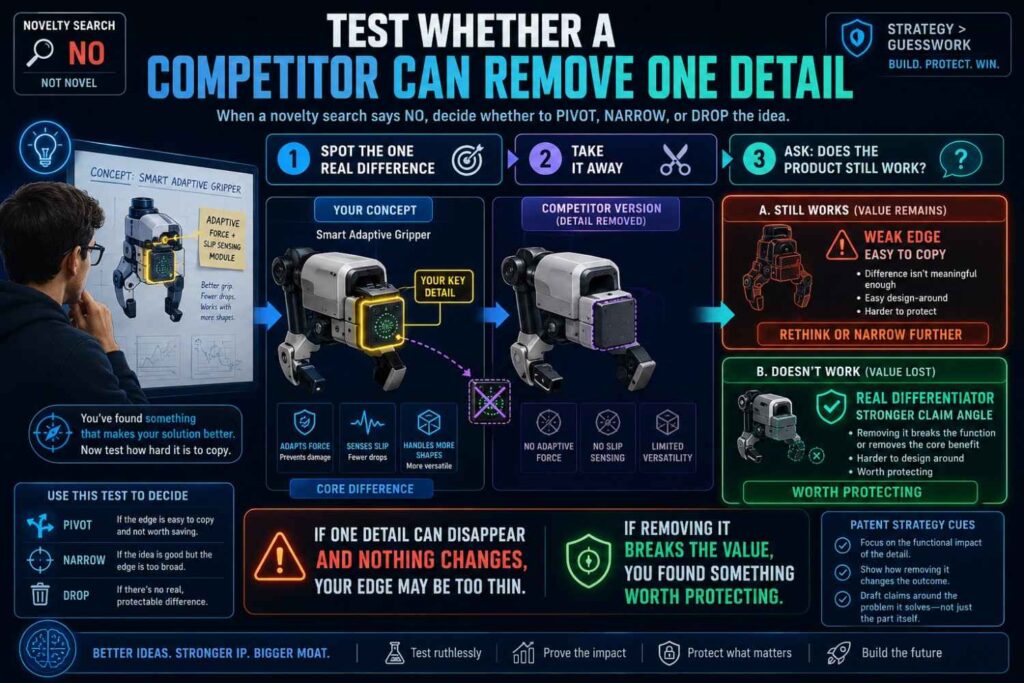
A simple test is to ask:
Could a competitor remove or change one claim detail and still get most of the benefit?
If yes, the claim may be too narrow.
For example, imagine your claim requires an AI system to send a review alert by email. A competitor could send the same alert through Slack, SMS, an in-app notification, or a task queue. If the value is the review trigger, not the email, then “email” should probably not carry the claim.
The same problem happens with exact numbers.
If your claim requires a threshold of 80%, but a competitor can use 78% or 85% and still get the same result, the claim may be too easy to avoid.
The better move is to claim the decision logic more broadly, then use exact values as examples or backup claims when appropriate.
A useful founder question is:
Is this detail the invention, or is it just one way we built the invention?
If it is only one way, be careful about making it required in the main claim.
Check Whether the Claim Protects the Customer Value
A claim is too narrow if it misses the reason customers care.
For example, customers may buy your SaaS platform because it prevents unsafe AI actions. If the narrowed claim only protects one specific audit log format, it may miss the real value.
Customers may buy your wearable because it reduces false alerts during movement. If the claim only protects one sensor housing shape, but the false-alert method can be done with another shape, the claim may be too narrow.
Customers may buy your diagnostic because it lowers false positives in a patient group. If the claim only protects one lab workflow detail that can be swapped out, the claim may not protect the commercial edge.
To test this, write the customer value in one sentence.
Then write what the claim protects in one sentence.
If those two sentences do not line up, the claim may need work.
For example:
Customer value: “The system blocks risky AI actions before they run.”
Claim focus: “The system records blocked actions in a JSON audit file.”
That may be misaligned.
Better claim focus: “The system checks an AI-generated action against permission scope, customer policy, and source support before allowing execution.”
Now the claim is closer to the business value.
Look for “Optional Product Details” That Accidentally Became Required
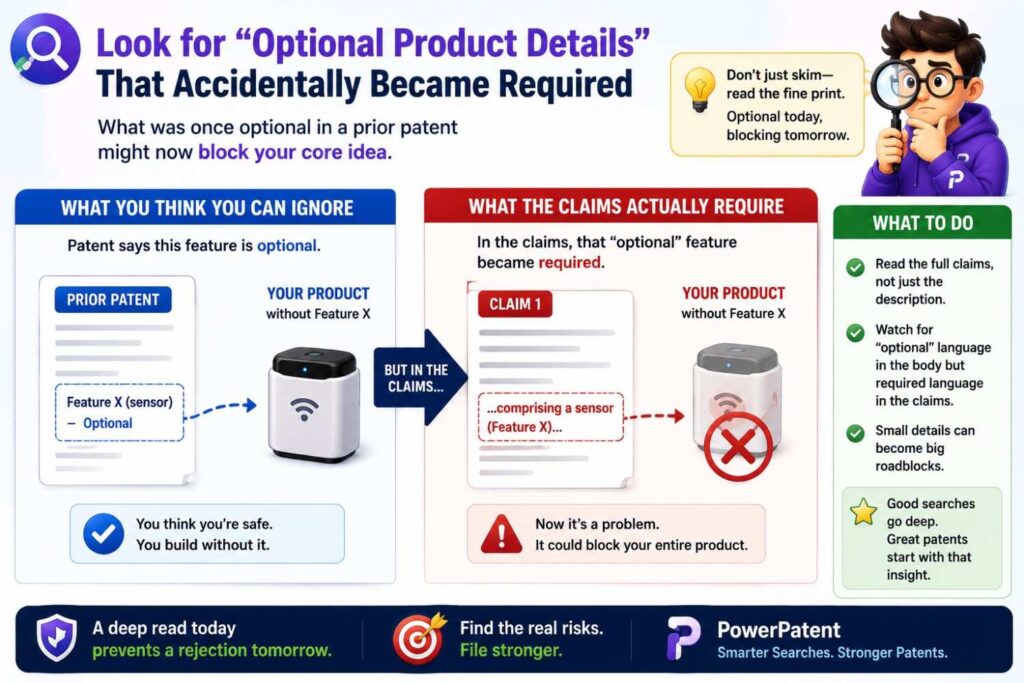
Claims can become too narrow when optional product details sneak into the main claim.
This often happens because teams describe the current product too literally.
The product uses a certain cloud provider.
The product sends a certain notification.
The product uses a certain screen.
The product stores data in a certain table.
The product uses one model type.
The product uses one sensor brand.
The product uses one sample size.
Some of these details may be useful examples. But they may not belong as required parts of the broadest claim.
Ask:
Could we swap this part later without changing the invention?
Could a competitor swap it and still copy the value?
Is this detail needed to avoid prior art?
Is this detail needed to create the technical result?
If the answer is no, consider keeping it out of the main claim and using it only as a backup detail.
This is where attorney guidance matters. The goal is to avoid the prior art without turning your claim into a blueprint of one exact product version.
Run a Design-Around Exercise
One of the best ways to test claim strength is to design around it on purpose.
Gather the founder, one engineer, one product lead, and patent counsel if possible. Then ask:
How would we copy the product benefit without meeting this claim?
Be honest.
Could we change the input?
Could we change the output?
Could we move the step earlier or later?
Could we use a different sensor?
Could we replace the human review with a second model?
Could we use a different threshold?
Could we change the notification channel?
Could we run the process locally instead of in the cloud?
Could we use a different biomarker ratio?
Could we use a different control signal?
If the team can design around the claim in five minutes, the claim may be too narrow.
That does not mean the invention is dead. It means you may need broader language, more alternative versions, or a different claim focus.
A strong patent filing should make the obvious workarounds harder.
Check Whether the Claim Covers the Roadmap
A claim may protect today’s product but miss tomorrow’s product.
That is a common startup problem.
The current version may use human review. The roadmap may use automated second-model review.
The current device may use pressure sensing. The roadmap may add strain sensing.
The current SaaS workflow may send alerts. The roadmap may block actions automatically.
The current diagnostic may use plasma. The roadmap may support saliva or urine.
If the narrowed claim only covers the current version, it may become less useful as the company grows.
Ask:
Will this claim still matter in twelve months?
Will it cover the next product version?
Will it cover the version customers are asking for?
Will it cover the version competitors are likely to build?
If not, the filing should describe real alternatives, and the claim strategy should account for them.
This does not mean claiming fantasy features. It means protecting the technical path the business is actually building.
PowerPatent helps teams capture both current implementations and real roadmap variations so filings can better support where the company is going. See how PowerPatent works.
Watch for Claims That Depend on Easy-to-Change Numbers
Numbers can make a claim clear, but they can also make it fragile.
A claim that requires “three markers,” “five seconds,” “80% confidence,” “two sensors,” “ten records,” or “one human reviewer” may be too narrow if those numbers are not essential.
Sometimes numbers matter. A dose range, timing window, threshold range, sample size, or physical spacing may be the invention.
But if the number is just an implementation choice, be careful.
Ask:
Does the exact number create the technical result?
Did testing show this range matters?
Would a nearby number work?
Is the number needed to avoid prior art?
Can the claim use a range instead?
Can the application describe several examples?
Good patent drafting often uses layers. The broad claim may describe the logic. Narrower claims may include specific ranges or values as backup.
Check Detectability
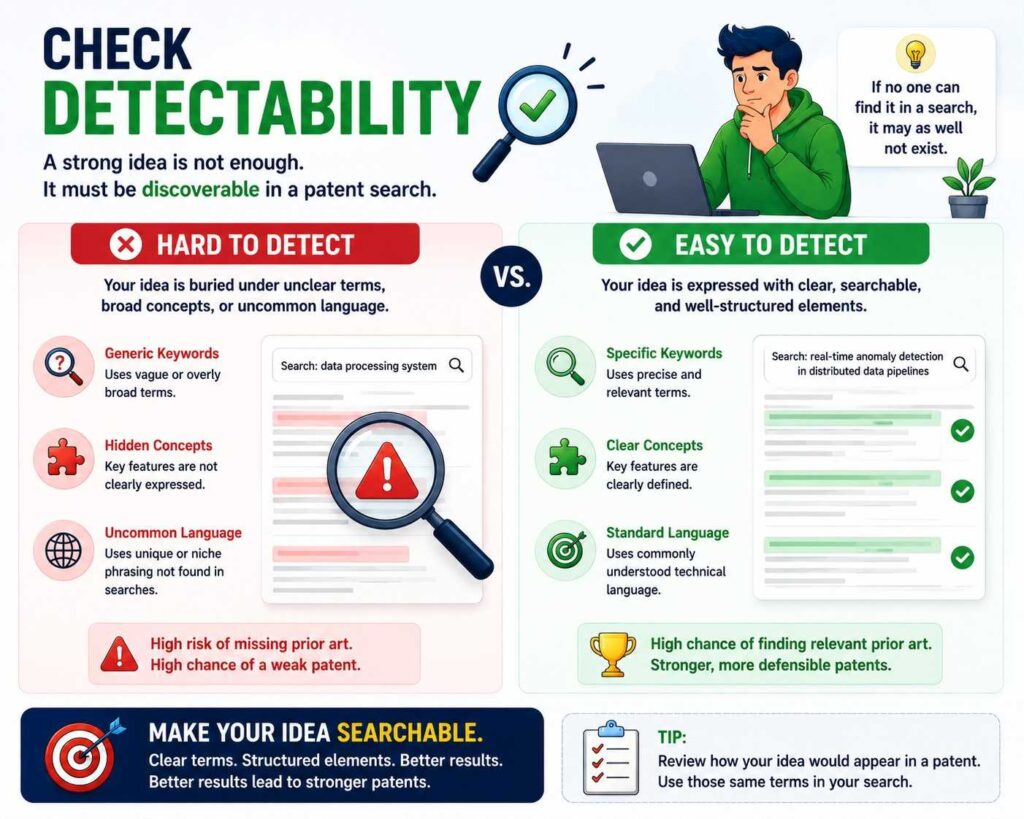
A narrow claim can be hard to enforce if you cannot tell whether others use it.
This is especially important for SaaS, AI, biotech manufacturing, and backend systems.
For example, a claim may require a hidden scoring weight. If competitors use it inside their servers, can you detect it?
A claim may require a model training step. Can you infer that from the product?
A claim may require an internal cell culture condition. Would anyone outside the lab know?
A claim may require a backend workflow threshold. Can customer behavior or API output reveal it?
Hard-to-detect claims are not useless, but they need strategy.
If a narrow claim covers something hidden, ask whether it is better as a trade secret. Or ask whether the claim can focus on a visible output, system behavior, audit trail, data structure, or control action that is easier to observe.
A claim that protects hidden value may still matter for investors, partners, and defensive use. But the business should understand the enforcement challenge.
Test Whether the Claim Covers the “Must-Have” Step
A narrow claim is stronger when it covers a must-have step.
A must-have step is something a competitor likely needs to achieve the same result.
For example:
If safe AI execution requires checking source support before action, that step may be must-have.
If false alert reduction requires adjusting confidence based on motion and contact quality, that step may be must-have.
If early battery swelling detection requires comparing pressure drift during matched charging windows, that step may be must-have.
If a diagnostic benefit depends on normalizing a marker ratio by inflammation score, that step may be must-have.
But if the claim covers a side feature that can be skipped, it may be weak.
Ask:
Can the product deliver the same promise without this step?
Would customers notice if this step were missing?
Would competitors need this step to match us?
If the answer is yes, the claim may still be valuable even if it is narrow.
Compare Claim Scope to Competitor Incentives
A claim is too narrow if it protects something competitors have no reason to copy.
For example, if the claim covers a special onboarding screen, but competitors win deals by copying your risk engine, the claim may not matter.
If the claim covers one optional report format, but the market values your data validation method, the claim may not protect the moat.
Look at competitor incentives.
What are competitors likely to copy because it helps win customers?
What would reduce their costs?
What would help them pass security review?
What would improve accuracy?
What would help them match your performance claims?
What would let them sell into the same enterprise accounts?
The claim should sit near those incentives.
A patent is stronger when it blocks a path competitors actually want to take.
Use Narrow Claims as Part of a Layered Strategy
A narrow claim is not always bad.
A narrow claim can be very useful when it protects a high-value implementation, supports a broader family, or serves as a fallback position.
The problem is not narrowness by itself.
The problem is narrowness without strategy.
A good filing may include broad claims aimed at the core concept, medium claims aimed at important variations, and narrow claims aimed at the exact commercial product.
This layered approach gives the application more ways to survive prior art.
The broad claim may face a fight. The medium claim may protect the main business value. The narrow claim may cover the product as shipped.
If the novelty search forced you to narrow, think in layers instead of one claim.
Ask:
What is the broadest safe idea?
What is the commercially important version?
What is the exact product version?
What backup versions should be included?
This makes narrowing a tool, not a surrender.
Decide With a Business Lens
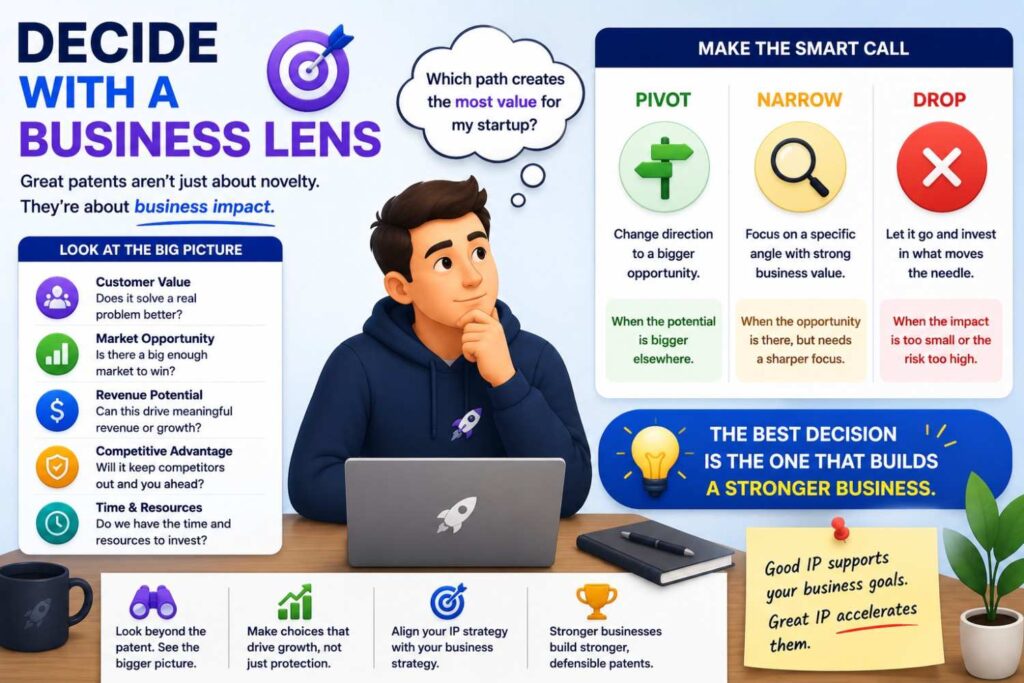
At the end, the question is not only legal.
It is business.
A remaining claim may be worth filing if it protects a core feature, is hard to design around, supports investor or partner value, covers the roadmap, and ties to a real technical result.
It may not be worth filing if it protects a minor detail, is hard to detect, is easy to avoid, has low customer value, or distracts from stronger inventions.
A simple decision note can help:
“The remaining claim is narrow, but it covers the core source-support check competitors would need to safely automate AI actions. It aligns with enterprise trust value and appears difficult to avoid without losing the product benefit. Recommend filing with layered backup claims.”
Or:
“The remaining claim is narrow and depends on an exact notification format that competitors can easily change. It does not protect the main customer value. Recommend dropping this claim angle and searching the backend validation method instead.”
That is the level of clarity a business needs.
A patent filing should not exist just because something can be claimed. It should exist because the claim can protect value.
Drop the Broad Claim, Not Always the Invention
Sometimes the right move is to drop the broad claim but continue with a better claim.
For example, drop “AI tool for legal review.”
Keep “source-linked claim support detection with attorney review routing.”
Drop “robot collision avoidance.”
Keep “pre-visual blind-corner risk control using sound direction and map geometry.”
Drop “battery safety monitor.”
Keep “matched-window pressure drift scoring during charging.”
Drop “diagnostic marker for disease.”
Keep “inflammation-normalized marker ratio for a defined patient subgroup.”
This is the difference between quitting and focusing.
A novelty search may kill the broad story but reveal the real invention.
Drop the Patent, Keep the Trade Secret
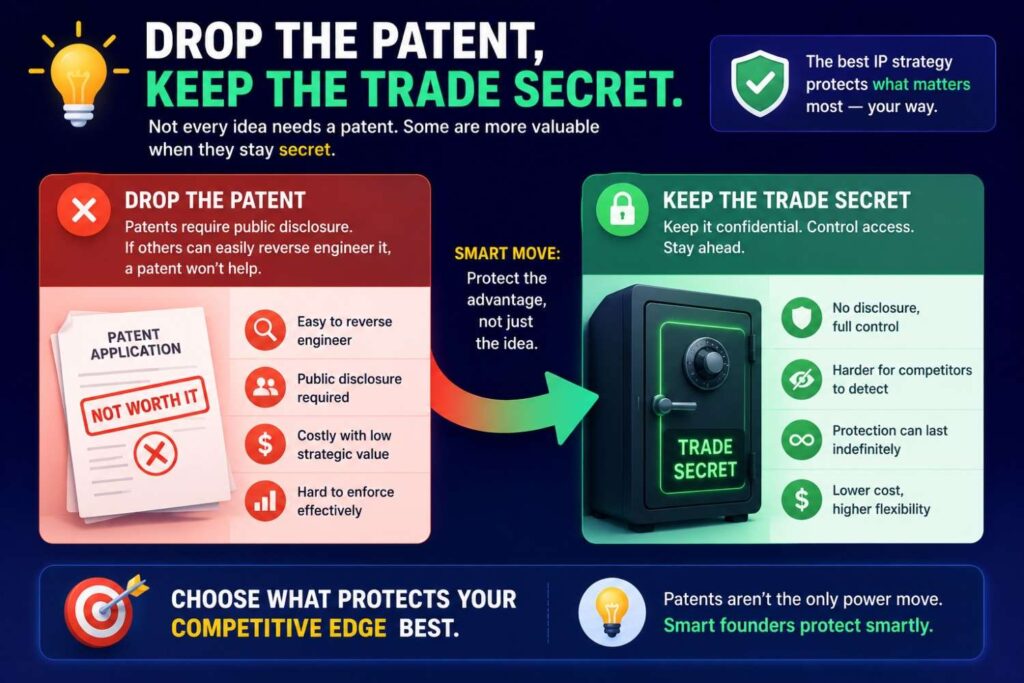
Sometimes the search shows that patent claims would be narrow, but the method is hidden and valuable.
That may point toward trade secret protection.
For example:
A backend ranking formula.
A manufacturing parameter.
A model tuning process.
A cell culture condition.
A scoring weight.
A private data cleaning method.
A quality control step inside a factory.
If competitors cannot see it, test it, or reverse engineer it easily, secrecy may be worth discussing.
But trade secrets only work if you actually keep them secret.
That means access controls, employee agreements, vendor agreements, documentation, and internal process.
If the method will be shown in API docs, product behavior, publications, regulatory records, or customer outputs, patent protection may be better.
A novelty “no” should trigger a protection strategy discussion, not only a patent discussion.
Drop the Idea From the Patent Budget, Not From the Product
A feature can be great for customers and still not worth patenting.
That is important.
Not every valuable product feature is a valuable patent feature.
A feature may be old but still needed.
A feature may be obvious but still useful.
A feature may be a standard customer expectation.
A feature may create revenue but not patent leverage.
That is fine.
The product team should keep building what customers need.
The patent budget should focus on protectable technical advantages.
Do not confuse “not patentable” with “not worth building.”
They are different questions.
A novelty search helps with patent strategy. It does not decide product value by itself.
Search Again After a Pivot or Narrowing
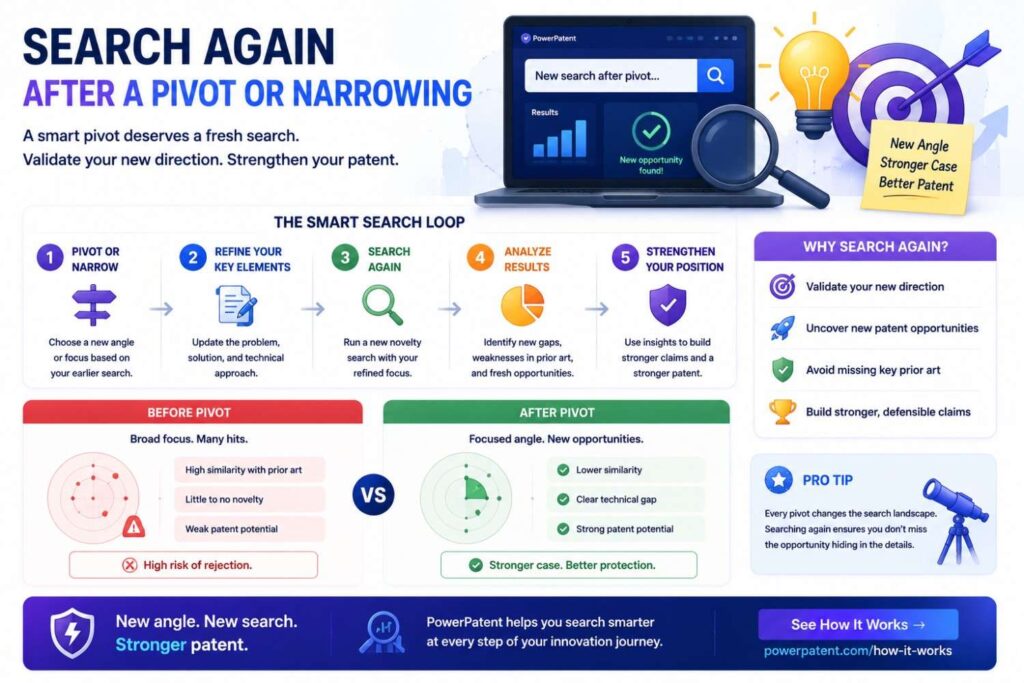
If you pivot or narrow, search again.
Do not assume the new angle is safe.
The first search may have focused on the broad product idea. The new claim may use different words and live in a different field.
For example, after pivoting from “AI compliance automation” to “tenant-safe audit packet generation,” you need to search tenant-safe reports, field-level redaction, compliance evidence exports, data minimization, and audit artifacts.
After pivoting from “battery safety” to “matched charging window pressure drift,” you need to search pressure drift, charging windows, charge-rate normalization, cell expansion, and fast-charge false alarms.
After pivoting from “AI answer review” to “source-trust conflict review,” you need to search source trust, citation support, evidence scoring, model confidence conflict, and human review triggers.
A new claim angle deserves a new search pass.
Otherwise, you may file another weak version.
Use the Negative Search to Improve the Patent Application
A negative novelty search can make your filing stronger.
It tells you what not to overclaim.
It tells you what details need support.
It tells you which alternatives to include.
It tells you where the examiner may focus.
It tells you how to frame the technical problem.
It tells you what prior art approaches existed.
It tells you what technical result matters.
For example, if prior art shows fixed thresholds, your application should explain why fixed thresholds fail and how your dynamic threshold helps.
If prior art shows model confidence review, your application should explain why source trust catches a different failure mode.
If prior art shows a known marker, your application should explain the marker combination, normalization, subgroup, or threshold that creates the improvement.
The search is not just a gate. It is drafting fuel.
Turn the “No” Into a Decision Record
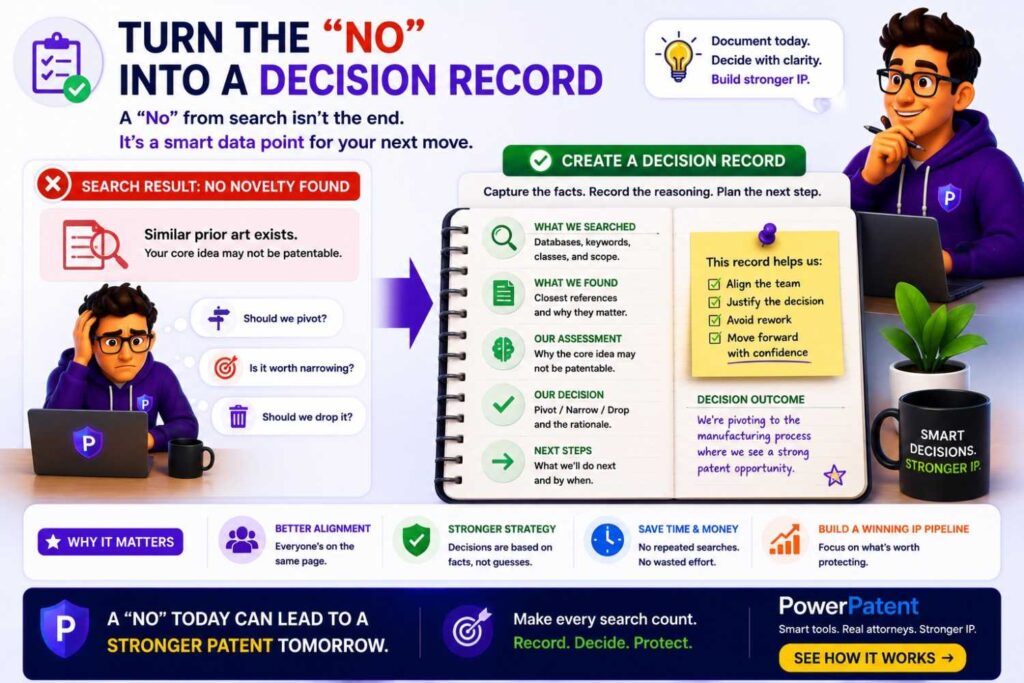
Write down the decision.
Do not leave it in Slack or memory.
A useful decision record includes:
What invention was searched.
What prior art blocked the broad idea.
What elements were shown.
What elements were missing.
Whether the team chose to pivot, narrow, drop, or search more.
Why the decision was made.
What should be filed, if anything.
What should be kept secret, if anything.
What public disclosure timing matters.
This record helps later.
It helps during drafting.
It helps during prosecution.
It helps when investors ask about IP.
It helps when new team members join.
It helps avoid repeating the same debate three months later.
How to Talk to Investors When a Search Says “No”
Investors do not expect every broad idea to be patentable.
They do expect you to understand your moat.
Do not say:
“Our search failed.”
Say:
“The broad category is crowded, so we shifted the filing focus to the technical step that drives our advantage.”
For example:
“The broad AI workflow automation space is crowded. Our search showed that filing on generic automation would be weak. We are focusing instead on pre-execution validation of AI actions against permission, policy, and source support. That is the trust layer enterprise customers care about.”
That sounds strategic.
Another example:
“The broad wearable monitoring space is crowded. We are not filing on generic alerts. We are focusing on the signal confidence method that reduces false alerts during motion.”
This shows discipline.
It shows you are not filing random patents.
It shows your IP strategy is tied to product value.
PowerPatent helps founders create this clarity by connecting invention capture, prior art review, and attorney-guided filing strategy. See how PowerPatent works.
How to Talk to Engineers When a Search Says “No”
Engineers may feel discouraged when prior art appears.
They may think their work was not original.
Be careful.
A novelty “no” does not mean the engineering work was not hard or valuable.
It means the patent focus may need to change.
Bring engineers into the next step.
Ask:
What did the prior art not solve?
What was hard in our version?
What failed before we got this working?
What part improved performance?
What edge case did we handle?
What part would be hard for competitors to copy?
Engineers often know the pivot point.
They may say:
“The prior art uses fixed thresholds. Our real innovation is the adaptive threshold.”
Or:
“The reference has review, but not the source-confidence conflict rule.”
Or:
“The old device has the same sensor, but our placement avoids heat drift.”
That is where the next filing angle may live.
How to Talk to Patent Counsel When a Search Says “No”
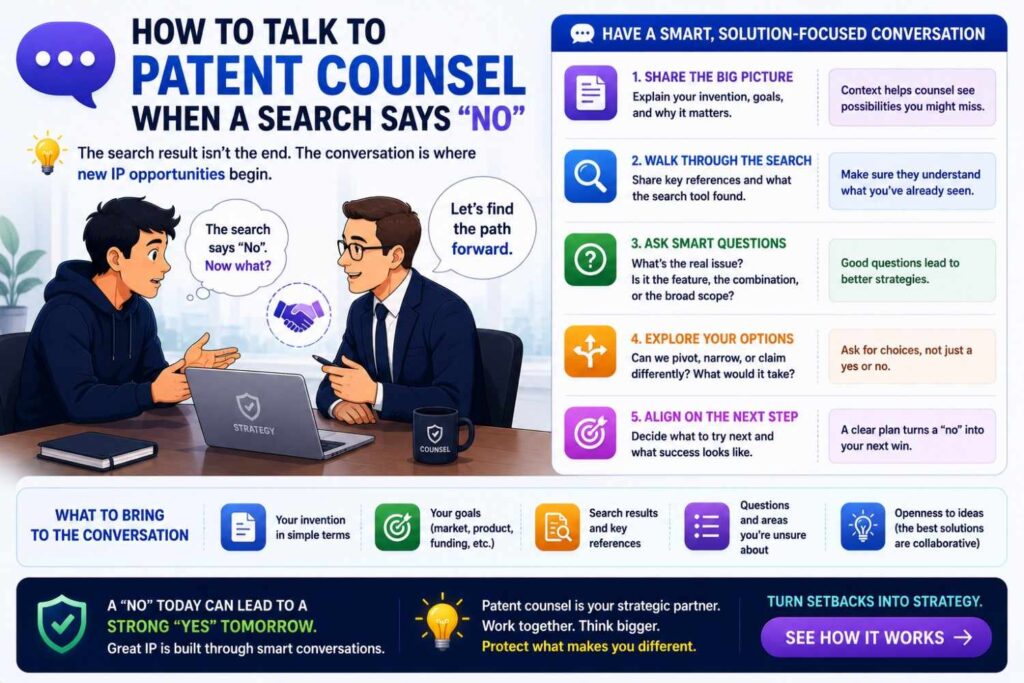
When a novelty search turns up close prior art, do not just forward the reference to your patent counsel with a worried note.
A message like “Is this bad?” does not give counsel enough to work with.
A better approach is to give your attorney a clear business and technical picture. Show what you wanted to protect, what the search found, what the prior art appears to show, what may still be different, and what decision the company needs to make next.
The goal is not to convince counsel that the invention is patentable. The goal is to help counsel make a faster, sharper, and more useful call.
Bring the Business Question First
Patent counsel can give better advice when they know the decision behind the question.
Do not only ask:
“Can we still patent this?”
Ask a more useful business question:
“Should we still file before launch, or should we shift the filing to another technical feature?”
“Is the remaining claim likely to protect something competitors would need to copy?”
“Should we narrow this claim, pivot to the backend method, or keep this feature as a trade secret?”
“Does this prior art affect our investor-facing IP story?”
“Do we have enough support for a continuation or backup claim?”
This frames the legal review around business action.
Patent advice is most valuable when it helps the company decide what to do next. Filing, narrowing, pivoting, delaying, dropping, or searching more are different choices. Counsel needs to know which choice is on the table.
Send an Invention Snapshot, Not Just a Link
A close prior art link by itself is not enough.
Send a short invention snapshot with it.
That snapshot should explain the invention in plain words, the technical problem, the current claim idea, the product feature it maps to, and why the feature matters to the company.
For example:
“Our current filing idea is a SaaS workflow system that validates AI-generated actions before execution. The customer value is safer automation for enterprise users. The key technical step is checking the proposed AI action against permission scope, customer policy, and source-data support before allowing it to run.”
Now counsel knows what they are evaluating.
This is much stronger than sending a patent link and saying, “This looks close.”
A clear invention snapshot saves time, reduces back-and-forth, and helps counsel focus on the real claim angle.
Provide an Element Map
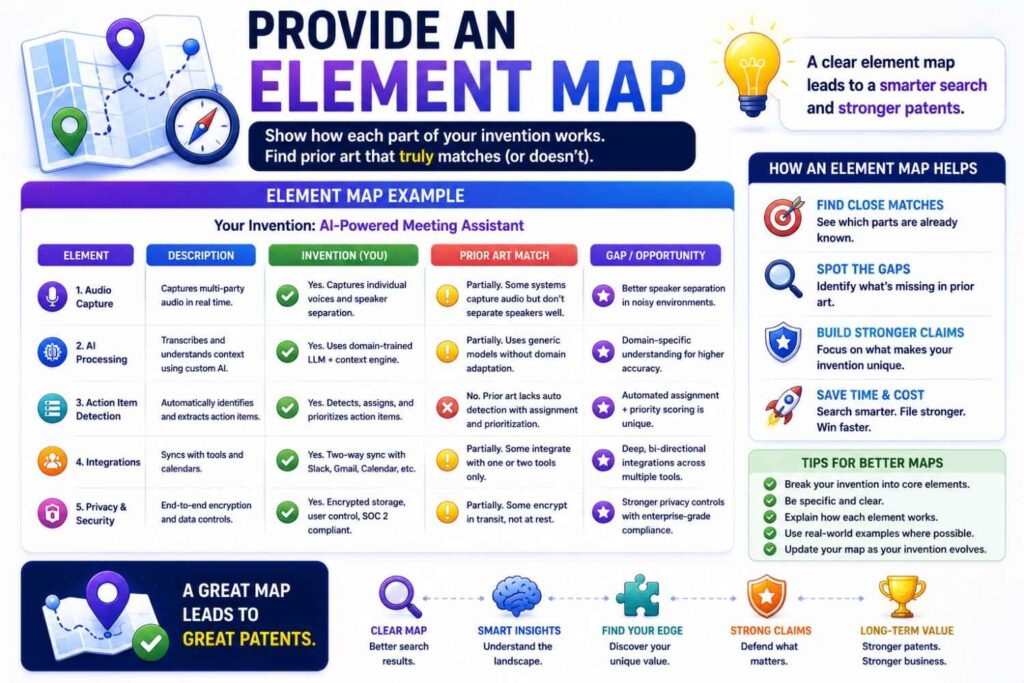
When a search says “no,” the most useful thing you can give counsel is an element map.
Break your invention into required parts. Then mark what the prior art appears to show.
For example:
The system generates an AI workflow action.
The system checks user permission.
The system checks customer policy.
The system checks source-data support.
The system allows, blocks, or routes the action.
The system records the decision.
Then add a short note for the reference:
“The reference appears to show AI task suggestions, permission checks, and audit logs. It does not clearly show source-data support validation before execution.”
This gives counsel a clean starting point.
It also prevents confusion between “the reference sounds similar” and “the reference teaches every claim element.”
For businesses, this is important because the element map can reveal whether the broad claim is dead, whether a narrower claim still matters, or whether the team should pivot to a different feature.
Highlight What You Think Is Still Different
Do not hide your theory of difference.
Tell counsel what you believe the prior art misses.
Use simple language.
For example:
“We think the gap is not AI task generation. The gap is pre-execution source-data validation.”
Or:
“We think the prior art uses fixed thresholds, while our method updates thresholds after confirmed false alerts.”
Or:
“We think the reference shows pressure sensors, but not matched charging windows.”
Or:
“We think the paper shows the biomarker alone, but not the inflammation-normalized ratio in low-volume plasma samples.”
This helps counsel test the right issue.
Your job is not to make the legal conclusion. Your job is to point to the technical difference that may still matter.
Explain Why the Difference Matters to the Business
Patent counsel also needs to know why the difference is worth protecting.
A technical gap may exist, but it may not be valuable.
So explain the business importance.
Does the difference reduce false alerts?
Lower cloud cost?
Improve safety?
Prevent unsafe AI actions?
Reduce clinician review time?
Improve diagnostic accuracy?
Make manufacturing easier?
Protect tenant data?
Support a product claim investors care about?
For example:
“This source-data validation step is important because enterprise customers will not allow AI actions to run unless we can prove the action is supported and authorized.”
Or:
“The matched charging window is important because it reduces false swelling alerts during fast charging, which is the main reason customers prefer our system.”
This helps counsel judge whether narrowing around that difference is worth it.
A claim that protects a small but business-critical step may be very useful. A claim that protects a random detail may not be.
Share the Timing Pressure
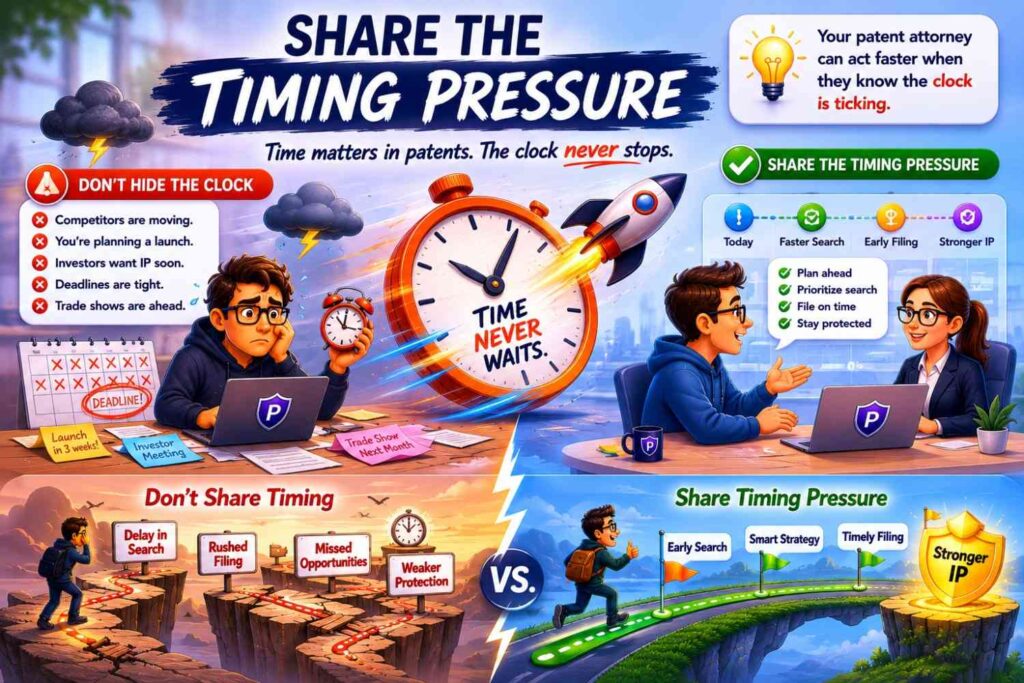
Timing changes the advice.
Tell counsel if a public disclosure is coming.
That may include a launch, demo, API docs, conference talk, investor deck, clinical trial record, white paper, GitHub release, partner meeting, or product manual.
Also mention any past disclosures.
Counsel needs to know:
What has already been shared?
When was it shared?
Was it public or confidential?
What will be shared soon?
What technical details will be disclosed?
For example:
“We plan to publish API docs in three weeks, and those docs will expose the source-validation status field and audit decision flow.”
That is very different from:
“This feature is internal and will not be visible for six months.”
A novelty “no” plus near-term disclosure may push the team toward a fast narrowed filing. If there is no disclosure pressure, the team may have time to search more, test more, or refine the invention.
Ask Counsel to Evaluate Filing Paths, Not Just Patentability
When prior art is close, do not ask for a simple yes or no.
Ask counsel to compare paths.
For example:
“Do you recommend narrowing the current claim around source-data support, pivoting to the audit packet workflow, or dropping this filing?”
“Would the feedback loop be a stronger claim angle than the initial scoring method?”
“Should the manufacturing method be filed separately?”
“Should we keep the backend scoring weights as trade secrets and file on the visible control workflow?”
This makes the conversation strategic.
A good patent decision is often not “file or do not file.” It may be “file on a different layer,” “file narrower before disclosure,” “add backup positions,” “split into two applications,” or “drop the broad idea and protect the hidden method another way.”
Bring Roadmap Context
Your current product is only part of the story.
Tell counsel what the roadmap includes if it is technically real.
For example:
“Today the workflow sends AI actions to human review. The roadmap replaces some review steps with a second model check.”
“Today the device uses pressure data. The next version adds strain data.”
“Today the diagnostic uses plasma. The next study will test saliva.”
“Today the cloud system blocks high-risk jobs. The roadmap adds isolated execution and automatic rollback.”
This matters because the prior art may block today’s broad idea, but a roadmap version may be stronger.
It also helps counsel decide what alternatives to include in the filing.
Do not invent vague future features just to sound broad. But if the team has real planned variants, share them.
Be Honest About Weaknesses
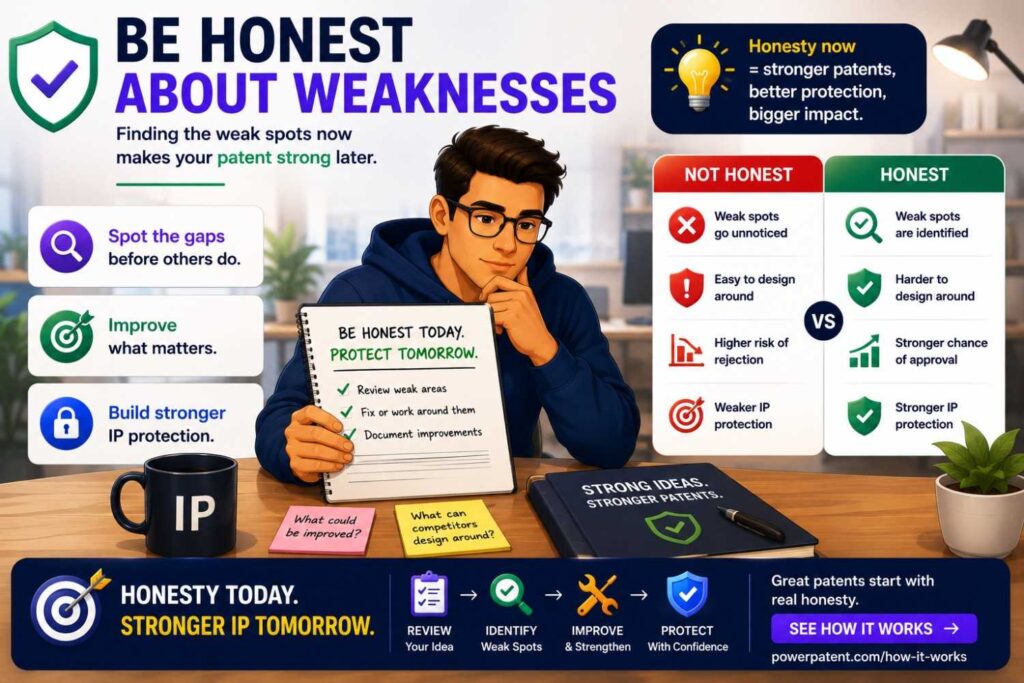
Do not try to sell your attorney.
If a reference is close, say it is close.
If you are unsure whether the reference shows a key element, say so.
If your product does not yet use a claimed feature, say so.
If the technical result is not proven, say so.
If a public disclosure already happened, say so.
Counsel can work with bad facts. Counsel cannot work well with hidden facts.
A clean, honest review may still lead to a strong pivot or narrow filing. A biased review can lead to a weak application that runs into problems later.
The point is not to win an argument. The point is to protect the company.
Ask What More Evidence Would Help
When a novelty search says “no,” supporting evidence can help shape the next move.
Ask counsel:
“What data would make this narrower claim stronger?”
“Would test results showing false-alert reduction help?”
“Would examples of failed old methods help?”
“Should we include benchmark data?”
“Do we need more technical detail before filing?”
“Would user workflow evidence help explain why this control step matters?”
For software, useful evidence may include logs, before-and-after metrics, error reduction, latency savings, compute cost reduction, or review-time reduction.
For hardware, it may include prototype tests, sensor readings, failure cases, calibration results, or safety data.
For biotech and MedTech, it may include assay results, sample data, marker performance, release profiles, stability results, or clinical workflow evidence.
You may not need perfect data to file. But knowing what evidence would help can make the application stronger.
Ask About Backup Claim Support
A close prior art reference may force narrower claims later.
So ask counsel whether the application can support backup positions.
For example:
“If the broad source-validation claim is challenged, should we include backup versions for source age, source type, reviewer outcome, and source confidence score?”
“If the broad matched-window claim is challenged, should we include backup windows based on charge rate, temperature, load, or cycle phase?”
“If the diagnostic ratio is challenged, should we include backup sample types, threshold ranges, and patient subgroups?”
This is critical.
A patent application should not depend on one claim path.
When a search says “no,” backup support becomes even more important.
Ask Whether to Split the Invention
Sometimes one product contains several inventions.
A negative search on one angle may not affect another.
Ask counsel whether the invention should be split.
For example:
A SaaS product may have separate inventions in AI action validation, tenant-safe audit packets, and field-level sync repair.
A robotics product may have separate inventions in blind-corner prediction, fleet routing, and charging dock alignment.
A MedTech product may have separate inventions in sensor placement, signal filtering, and clinician review workflow.
A biotech product may have separate inventions in marker panel, sample prep, and scoring rule.
If one angle is blocked, another may be worth filing.
Splitting can also help keep claims clearer.
The goal is to build a patent strategy around the portfolio, not force every idea into one filing.
Ask About Patent Versus Trade Secret
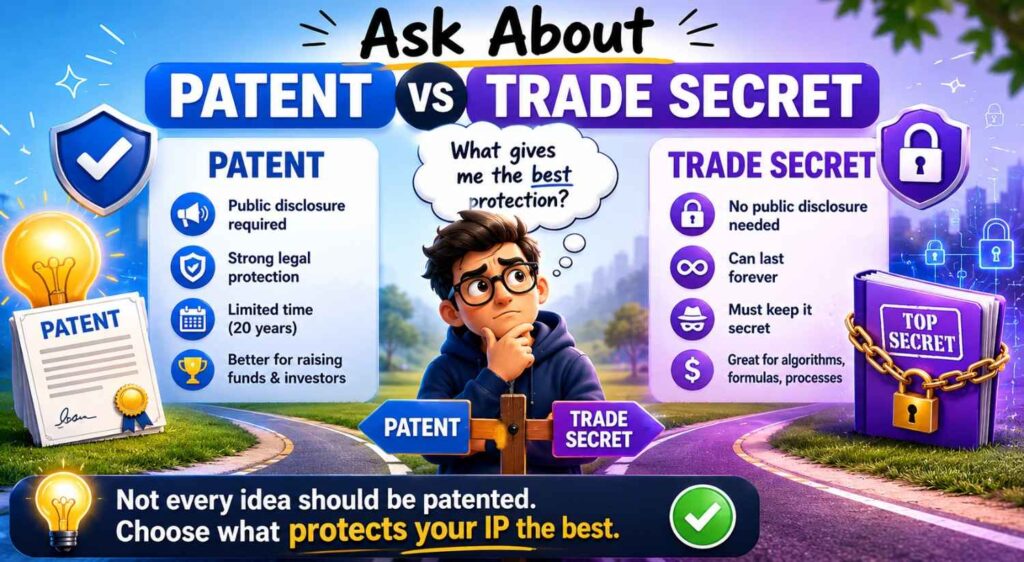
When prior art blocks the broad claim, the remaining difference may be hidden.
That raises a key question:
Should we patent it or keep it secret?
Ask counsel directly.
For example:
“The remaining difference is a backend scoring formula. Customers do not see it. Should we keep that as a trade secret and file instead on the visible action-control workflow?”
Or:
“The remaining difference is a manufacturing parameter. It is not visible from the product. Is trade secret protection stronger?”
Patent filing gives public disclosure in exchange for possible rights. Trade secrets depend on secrecy.
The best choice depends on visibility, reverse engineering risk, business value, and how likely others are to independently find the same method.
Prepare a Clear Decision Memo After the Call
After talking to counsel, write a short decision memo.
It should say:
What prior art was reviewed.
What claim idea was blocked or weakened.
What difference still appears promising.
What counsel recommended.
Whether the team will pivot, narrow, drop, search more, file now, file later, or treat something as secret.
What evidence or details are needed.
What public disclosure deadline matters.
This memo is valuable.
It keeps the team aligned. It helps product and engineering understand the decision. It helps executives and investors see that IP strategy is disciplined. It also prevents the same debate from happening again in a few months.
Use Counsel as a Strategy Partner, Not a Last-Minute Checker
The worst time to bring counsel in is after the launch page is live, the API docs are public, the pitch deck has been sent widely, and the patent idea has already been narrowed without legal input.
Bring counsel into the decision earlier.
Especially when:
The prior art is close.
The invention is core to the product.
A public disclosure is near.
The filing may support fundraising.
The product is in a crowded field.
The team is deciding between patent and trade secret.
The company may need a portfolio, not just one application.
PowerPatent helps founders work with patent professionals earlier and more clearly, so search results become business decisions instead of last-minute panic. See how PowerPatent works.
Use a Simple Message Template
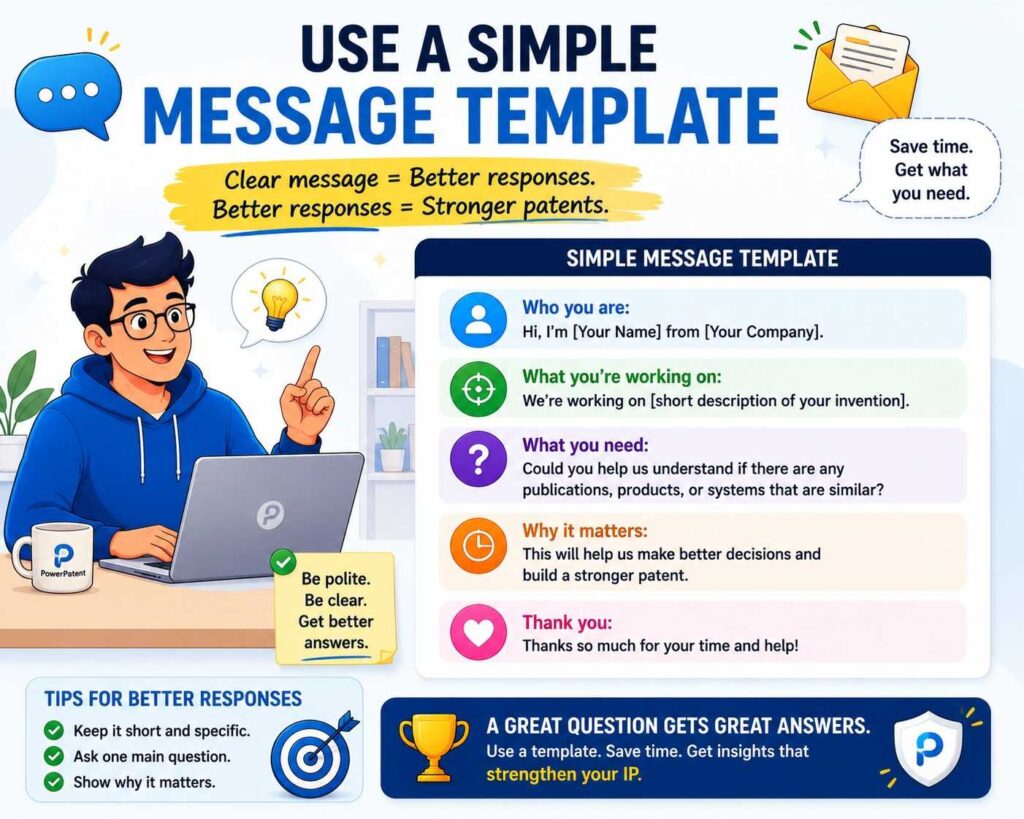
Here is a practical template founders can use when sending a negative search result to patent counsel:
“We searched [invention area] and found [reference]. Our current invention idea is [plain-English invention]. The reference appears to show [matched elements]. It does not clearly show [possible gap]. This gap matters because [business or technical result]. We have [public disclosure timing] coming up. We would like your view on whether to [narrow, pivot, drop, search more, file before disclosure, or consider trade secret]. We also want to know what backup claim support or technical evidence would make the filing stronger.”
This template keeps the conversation focused.
It gives counsel the facts.
It asks for action.
That is how founders get better patent advice when a novelty search says “no.”
How to Decide Between Pivot, Narrow, and Drop
Use a simple decision lens.
Pivot when another technical feature appears stronger than the blocked idea.
Narrow when the same invention area still has a meaningful, valuable difference.
Drop when the remaining difference is weak, low-value, easy to avoid, or better kept secret.
Ask these questions:
Does the prior art show the full invention?
What does it miss?
Does the missing part matter?
Is the missing part core to business value?
Can competitors avoid it easily?
Do we have enough detail to file?
Is public disclosure near?
Is there another stronger invention inside the product?
Would trade secret protection be better?
The answer does not need to be perfect.
But it should be reasoned.
Patent strategy is a series of informed decisions, not a search for certainty.
Example: SaaS Novelty Search Says No
Imagine a SaaS startup wants to patent “automated compliance evidence collection.”
The novelty search finds several platforms that collect evidence from cloud logs and map it to controls.
The broad idea is blocked.
Now what?
Do not file on generic evidence collection.
Look deeper.
The team explains that their system does something specific: it creates a tenant-scoped audit packet by removing unrelated fields from mixed-source evidence before export.
That may be the pivot.
Now the team searches:
tenant scoped audit packet
compliance evidence field redaction
cloud log control mapping data minimization
audit export tenant data isolation
If the search does not find the full method, the team may file around that privacy-safe packet generation workflow.
The broad claim died.
Example: AI Novelty Search Says No
An AI startup wants to patent “AI answer review.”
The search finds many systems that route low-confidence AI outputs to human review.
The broad idea is blocked.
Now the team looks at what makes its system different.
Their system routes answers to review when source trust is low, even if model confidence is high.
That is a narrower and more specific invention.
The team searches source trust, citation support, evidence score, model confidence conflict, hallucination control, and review routing.
If the gap holds, the filing can focus on source-trust conflict review.
This is better than claiming “AI review.”
It protects the failure mode that matters: confident but unsupported answers.
Example: Robotics Novelty Search Says No
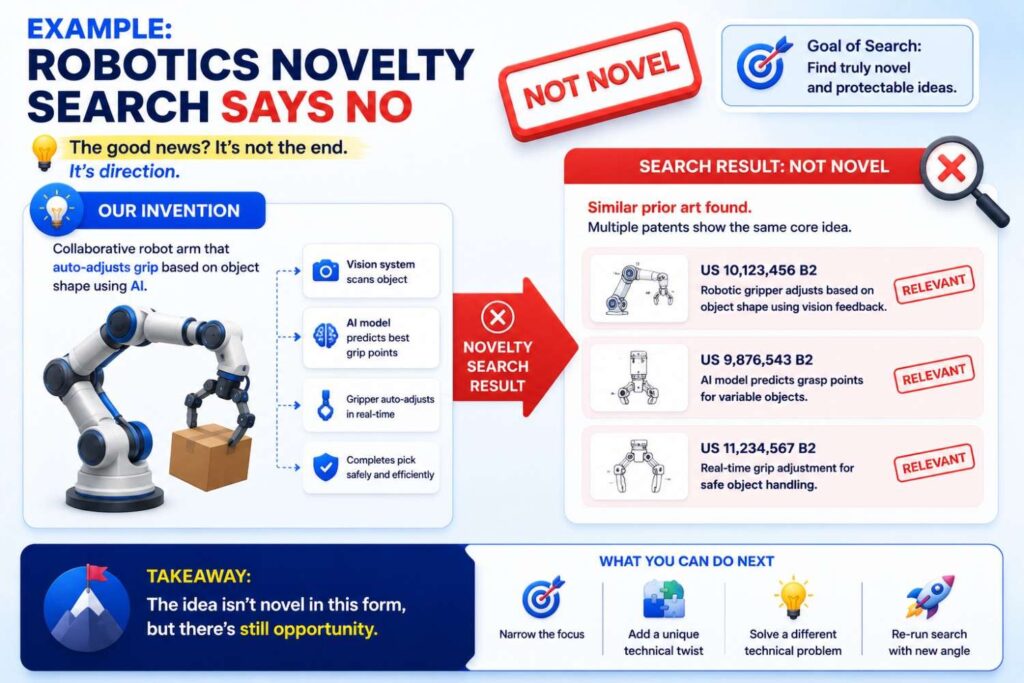
A robotics startup wants to patent “robot blind-corner safety.”
The search finds robots that slow near mapped blind corners.
The broad idea is blocked.
The team looks deeper.
Their robot does not just slow at every blind corner. It predicts crossing risk before visual detection using sound direction, map geometry, and recent traffic history.
That may be the narrower claim.
The technical result is that the robot slows when risk is likely, not just because a corner exists.
This may reduce unnecessary slowdowns while improving safety.
The filing focus shifts from “slow at blind corners” to “pre-visual hidden crossing prediction and control.”
That is a better patent angle.
Example: Biotech Novelty Search Says No
A biotech startup wants to patent a biomarker for early disease detection.
The search finds papers showing the marker is already linked to the disease.
The broad marker claim is blocked.
But the team has more.
Their test uses a ratio of two markers, adjusted by inflammation score, in low-volume plasma samples.
That may be the real invention.
The team searches marker ratio, inflammation normalization, plasma sample, early-stage patients, false positives, and related diseases.
If the full combination is not found, the filing may focus on the normalized marker pattern and patient subgroup.
The discovery was not enough.
The applied diagnostic method may still have room.
Example: Hardware Novelty Search Says No
A hardware startup wants to patent a battery swelling detector using pressure sensors.
The search finds pressure-based swelling detection.
The broad claim is blocked.
But the team’s system compares pressure drift during matched charging windows and adjusts the swelling score based on charge rate and temperature.
That may still be new.
The team narrows around timing and context.
The technical result is fewer false alerts during fast charging.
The filing focus moves from “pressure sensor detects swelling” to “matched-window pressure drift scoring.”
That is a stronger claim story.
Do Not File Just to Say You Filed
When a novelty search says no, some teams file anyway.
They want to tell investors they have a patent pending.
That can backfire.
A weak filing can waste money.
It can create false confidence.
It can fail during examination.
It can distract the team.
It can protect the wrong thing.
It can make later filings harder if the disclosure is thin or unfocused.
A patent pending label is not the goal.
A useful patent position is the goal.
If the search says the idea is blocked, do not force it.
Pivot, narrow, or drop with discipline.
When a “No” Is Actually Good News
A negative search can feel bad, but it can help your company.
It can save budget.
It can stop a weak filing.
It can reveal a better invention.
It can sharpen your product story.
It can show competitor activity.
It can guide R&D.
It can help decide what to keep secret.
It can prepare you for investor questions.
It can help your attorney draft better claims.
A “no” is not always the end.
Sometimes it is the first honest step toward a stronger patent.
Build a Repeatable Response to Negative Searches
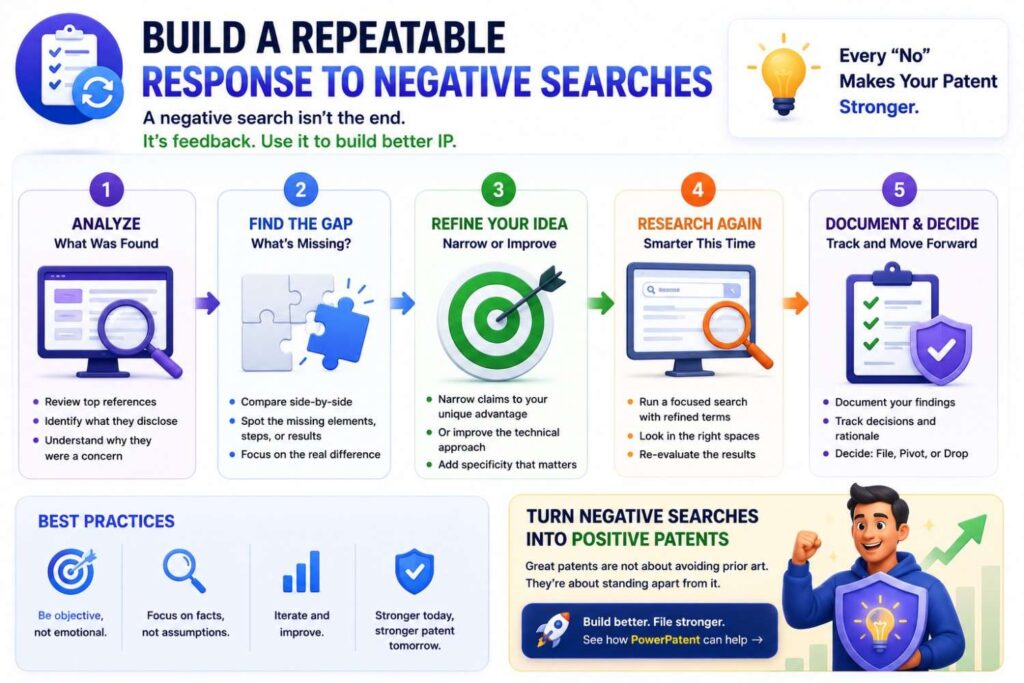
Do not handle every negative search from scratch.
Build a process.
When prior art blocks the first idea, do this:
Map the blocking reference.
Identify the missing elements.
Check whether missing elements matter.
Ask engineers what the prior art does not solve.
Look for backend, timing, condition, feedback, environment, and manufacturing angles.
Search the new angle.
Rank business value.
Decide pivot, narrow, drop, trade secret, or more search.
Record the decision.
That process keeps the team calm and focused.
It also prevents emotional decisions.
How PowerPatent Helps When the Search Says “No”
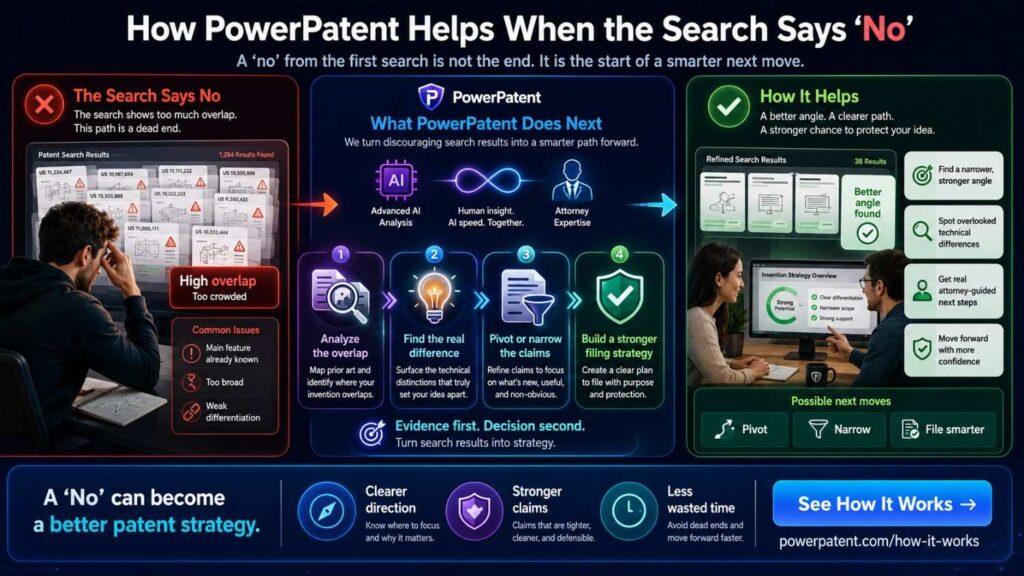
PowerPatent is built for real startup patent work.
Real patent work is not always clean.
Sometimes the first idea is too broad.
Sometimes prior art is close.
Sometimes the real invention is buried in engineering details.
Sometimes the right move is to file narrower.
Sometimes the right move is to pivot to another feature.
Sometimes the right move is to drop one idea and protect a stronger one.
PowerPatent helps teams capture invention details, compare search results, organize technical differences, and move toward attorney-reviewed filing decisions.
This helps founders avoid weak filings and protect what actually matters.
Final Takeaway
When a novelty search says “no,” do not panic.
And do not ignore it.
A negative search result is a signal. It tells you that the first claim idea may not work. Your job is to decide what comes next.
Pivot if another technical feature is stronger.
Narrow if a specific version still has real value.
Drop if the remaining claim is weak, easy to avoid, or not worth the cost.
Also consider trade secret protection when the method is hidden and valuable.
The best founders do not treat patents like trophies. They treat them like strategic tools.
A novelty search that says “no” can still lead to a better patent, a sharper product story, and a smarter IP plan.
And when you want help turning search results into the right filing decision, PowerPatent can help you move faster with smart software and real patent attorney oversight.
Leave a Reply