A strong patent rarely starts with fancy legal words. It starts with a clear story from the inventor. That is why good inventor intake matters so much. When the first step is done well, everything that follows gets better. The patent is easier to write, easier to support, and more likely to match what was actually built. It also helps avoid a very common problem: filing something that sounds polished on paper but misses the real value of the invention. Good intake brings out the hard-won details that make an idea worth protecting in the first place. It helps founders explain what the product does, why it is different, what problem it solves, what choices were made during building, and what parts competitors may try to copy later.
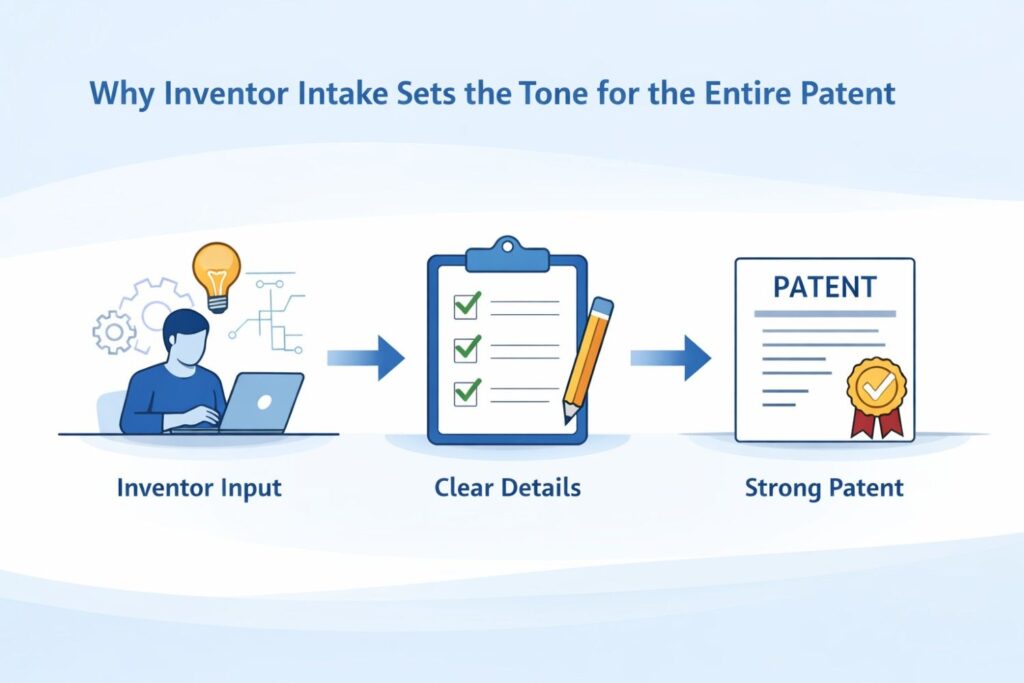
Why Inventor Intake Sets the Tone for the Entire Patent
The quality of a patent is shaped very early, often before a draft is ever written. The intake stage is where a business either captures the real value of an invention or starts losing it.
This is the moment when the company turns raw knowledge from the inventor into a clear record that can later support strong patent writing, smart claim strategy, and smoother review.
When this first step is handled with care, the rest of the patent process becomes more focused, faster, and far more useful to the business.
Inventor Intake Is Where Business Value First Becomes Visible
A patent is not just a document. It is a business tool. It can help protect product advantage, support fundraising, create leverage in partnerships, and make it harder for others to copy what your team built.
But none of that can happen if the intake process fails to uncover what is truly important.
Many businesses treat inventor intake like a form-filling task. That is a mistake.
A weak intake process often captures surface details but misses the deeper story. It may record what the product does, yet fail to explain why the team built it that way, what tradeoffs were solved, and what makes the approach hard to copy.
These missing details are often the very parts that make a patent more valuable.
A strong intake process helps a business identify the real center of the invention. It brings out the commercial edge, not just the technical description.
That gives everyone involved a stronger base for deciding what deserves protection now, what can wait, and how the filing should support company goals.
The First Conversation Often Decides the Strength of the Whole Record
The earliest inventor discussion has more weight than many teams realize. What gets said, captured, and clarified in that first stage often shapes everything that follows.
If the first pass is vague, later work becomes a rescue job. If the first pass is sharp, later work becomes refinement.
This is why businesses should not rush intake just to move faster on paper. Speed matters, but speed without clarity often creates more delays later.
Teams may need follow-up meetings, redrafts, or technical corrections because the original intake did not gather the right details. That slows filing and increases the risk of weak coverage.
A more strategic approach is to treat the first inventor session as a high-value working meeting. The goal is not to collect every fact in the world. The goal is to pull out the most important points while the ideas are still fresh.
Businesses that do this well usually find that patent drafting becomes cleaner and more aligned with what the company actually needs.
Good Intake Helps Separate the Core Idea From the Noise
Inventors often know their systems in great detail. That is a strength, but it can also create a challenge. Sometimes the intake stage becomes crowded with facts that are true but not central.
A business needs a process that helps separate supporting detail from the actual inventive step.
This matters because strong patent work depends on focus. If the intake record mixes critical insight with minor implementation facts, the drafting process can drift.
The result may be a patent application that describes a lot but protects very little in a meaningful way.
A better intake process asks questions that narrow in on the core. What changed compared to older methods? What problem kept failing until this approach was built?
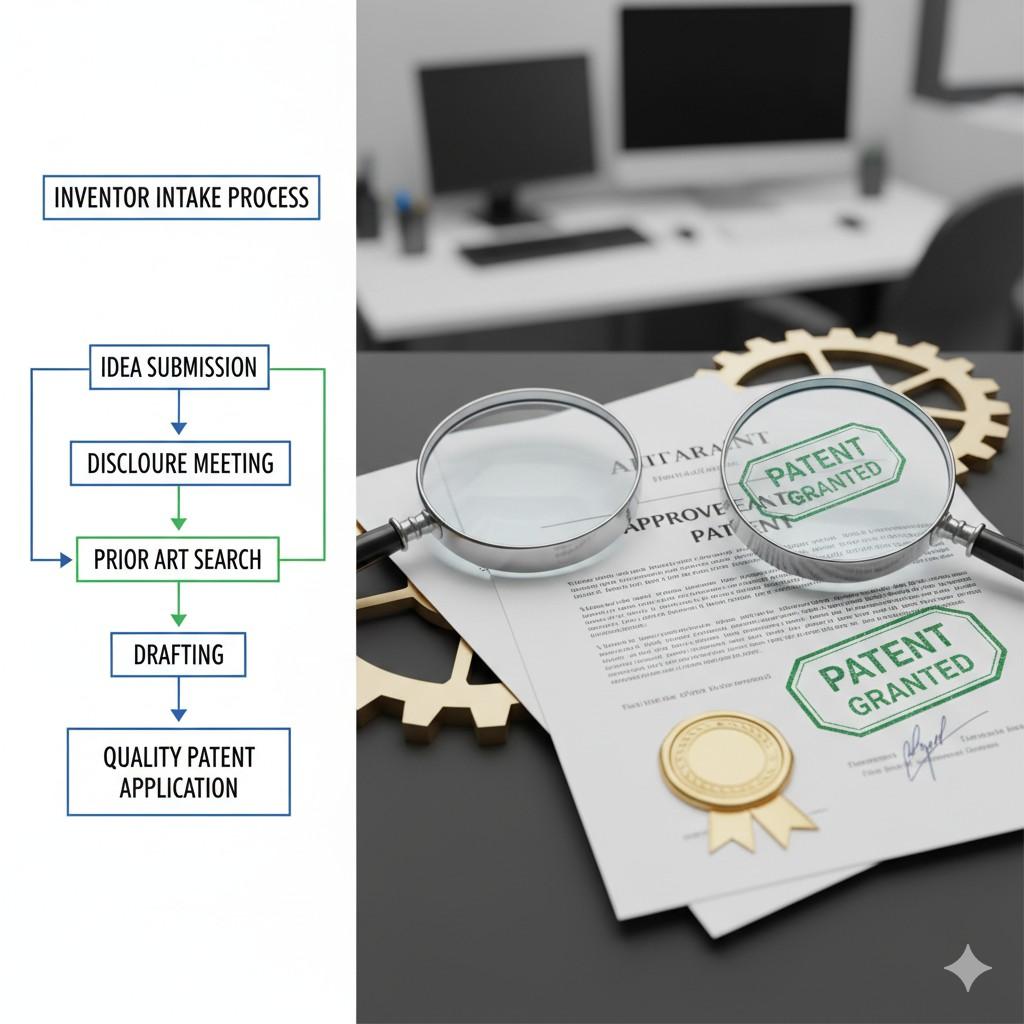
What part would a competitor likely try to imitate if the product started winning in the market? These kinds of questions help businesses move from technical description to strategic patent thinking.
Inventor Intake Shapes Claim Direction Before Claims Are Written
Many companies think claim strategy begins with the patent drafter. In reality, claim direction often begins during intake.
The facts gathered at that stage influence how broad or narrow the protection may become, what fallback positions exist, and how much room the business will have to adapt later.
If the intake process captures only one version of the invention, the resulting patent work may become too narrow. If the intake process explores variants, alternatives, technical options, and different use cases, the business creates more room for stronger protection.
This is especially important for startups and fast-moving technical teams, where the product may evolve quickly after the first filing.
One highly practical step is to ask inventors not only how the invention works today, but also how it could work in another form tomorrow.
That single shift in intake can reveal alternate designs that deserve to be captured early. For a business, this can mean broader protection and fewer regrets later.
Patent Quality Depends on the Precision of Early Inputs
Patent quality is not just about writing skill. It is also about input quality. Even a skilled patent professional can only work with what they receive.
If the intake is shallow, the patent may sound polished while still missing the best opportunities. If the intake is rich and precise, the final application is more likely to reflect the true invention in a useful way.
This is why businesses should think carefully about the kind of information they ask inventors to provide. General summaries are rarely enough.
The intake process should draw out specific decisions, performance gains, architecture choices, process improvements, and real-world use. These details often support stronger explanations and help show why the invention matters.
A useful business habit is to ask for examples rooted in actual development work. What was tried before this version?
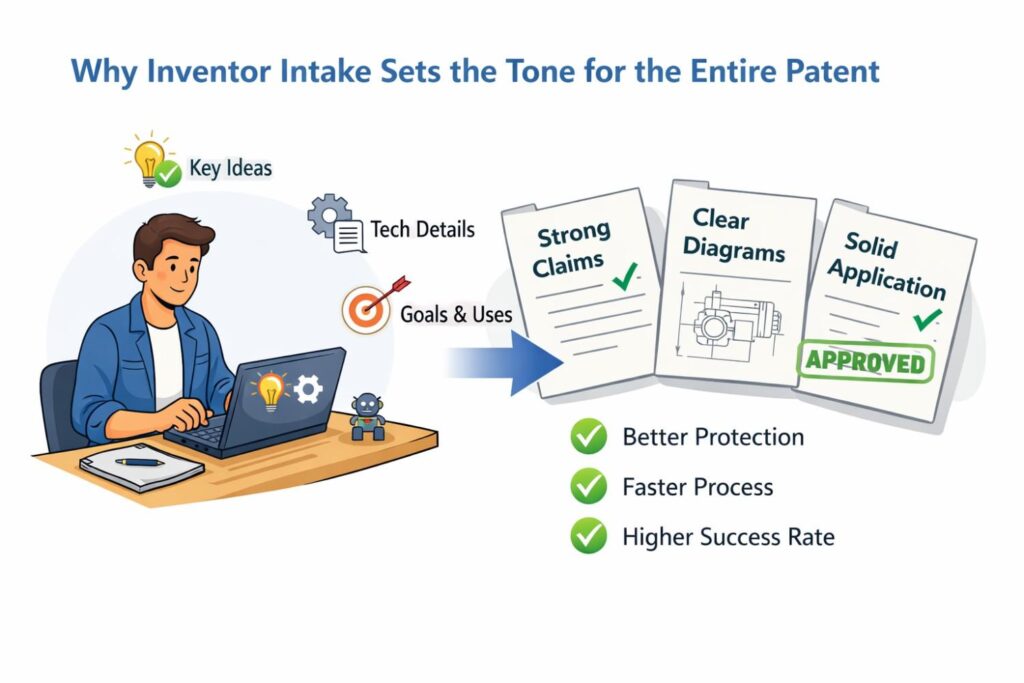
What did not work? What changed when the new method was introduced? Answers like these tend to produce sharper patent material than broad statements about innovation.
The Intake Process Can Reduce Expensive Rework Later
Poor intake creates hidden costs. They may not show up on day one, but they appear later in the form of missed details, repeated inventor interviews, confusion across teams, and draft revisions that could have been avoided.
For businesses trying to move quickly, these slowdowns add up.
A strong intake process reduces that waste by getting the right facts early. It also makes the work easier for inventors, who are often busy building products, fixing issues, and supporting growth.
When intake is structured well, inventors spend less time repeating themselves and more time giving useful input once in a way that can actually be used.
One effective approach is to build intake around natural inventor thinking rather than legal framing. Ask them to explain the old way, the problem, the change, the result, and the possible next versions.
That pattern is easy for technical teams to follow and tends to produce better source material for the patent process.
Good Intake Creates Alignment Between Product, Engineering, and IP Goals
Many businesses miss patent opportunities because intake happens in isolation.
The inventor may understand the technical breakthrough, but product leaders may understand the market impact better, and business leaders may see the competitive risk more clearly.
A strong intake process creates a bridge between these views.
This does not mean every intake meeting must be large or formal. It means the process should be designed so that technical detail and business value are both captured.
When those two things come together early, the company is in a much better position to file patents that support real business goals.
For example, an engineering team may describe a clever system improvement.
But during a more strategic intake, the business may realize that the real value lies in lower cost, faster speed, better reliability, or easier scaling.
Those commercial effects may influence how the invention is framed and what parts deserve the most attention in the patent application.
Early Intake Can Reveal Whether the Invention Is Ready to File
Not every invention should be filed the moment it is mentioned. Some are ready. Some need more work. Some are valuable but should be documented first and filed after one more product milestone.
A good intake process helps businesses make this call with more confidence.
Without strong intake, teams often guess. They file too early and miss key versions, or they wait too long and risk losing momentum. A more thoughtful intake process helps reveal the maturity of the invention.
It shows whether the concept is clear, whether there are enough working details, and whether the business understands what it wants to protect.
A very practical move here is to build intake around readiness signals. Can the inventor explain the technical difference clearly? Can the team describe at least one concrete implementation?

Can they identify the benefit in real-world terms? If the answer is yes, the business may be closer to filing than it thinks.
How Better Intake Leads to Stronger Patent Quality
Patent quality does not begin with drafting. It begins much earlier, at the point where the inventor shares what was built, why it matters, and how it works.
If that early intake is weak, the patent often ends up weak in quiet ways that are easy to miss at first. It may look polished, yet still fail to capture the best parts of the invention.
Better intake changes that. It gives the patent process stronger raw material, sharper direction, and a better chance of producing protection that actually fits the business.
Better Intake Produces Better Source Material
A patent can only be as strong as the facts behind it. When intake is done well, it captures more than a rough summary.
It brings out the design choices, the problem that had to be solved, the limits of older methods, and the real technical move that made the new approach work. These are the details that give substance to a patent.
This matters because patent quality depends on precision. General descriptions rarely create strong protection. A filing needs enough depth to explain what is new in a way that is clear and useful.
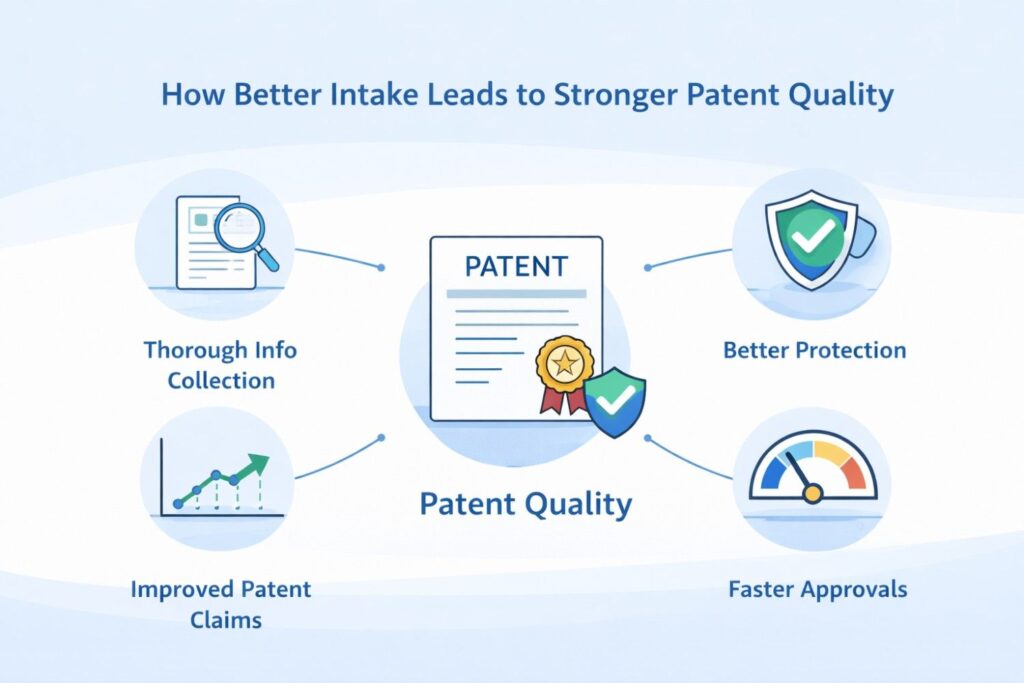
Good intake helps build that depth from the start. It gives the drafting process real substance instead of forcing the writer to fill in gaps later.
Strong Patents Come From Clear Technical Stories
A high-quality patent usually tells a clean story. It shows the problem, the old approach, the change, and the result.
That kind of story does not happen by accident. It usually begins during intake, when the inventor is guided to explain the invention in a clear and structured way.
Businesses often lose quality when intake stays too loose. The inventor may talk in fragments, jump between versions, or focus on side details that are true but not central.
A better intake process helps shape that information into a straight path. It does not oversimplify the invention. It helps reveal it.
One practical way to improve this is to ask inventors to explain the invention as if they were teaching a smart new engineer on the team. That often leads to clearer language, better logic, and fewer missing steps. It also helps surface what is actually important.
Better Intake Helps Capture the Real Inventive Step
One of the biggest risks in patent work is filing around the wrong thing. A team may describe the product well, yet fail to isolate the true inventive step inside it. This happens often when intake focuses on features rather than technical difference.
A better intake process keeps pushing toward the key question: what is the real change here that makes this different from what existed before? That is where patent quality often rises or falls.
If the answer is not clear at intake, the application may drift into broad marketing language or narrow implementation detail without fully protecting the heart of the invention.
A strong business habit is to ask inventors what part they would be most worried about a competitor copying. That question often cuts through noise and brings attention back to the real technical edge.
Good Intake Creates Better Claim Support
Patent quality is not only about how well the invention is described. It is also about whether the application gives enough support for strong claims. This is where good intake becomes especially valuable.
It helps gather examples, options, variants, and alternate ways the invention can be implemented.
Without that broader intake, the application may only support one narrow version of the idea.
That can limit flexibility later. It can also weaken the value of the patent if the market moves in a slightly different direction than expected.
Better intake helps avoid that trap by asking wider questions early. How else could this be built? What parts could be swapped out? What versions were considered during development?
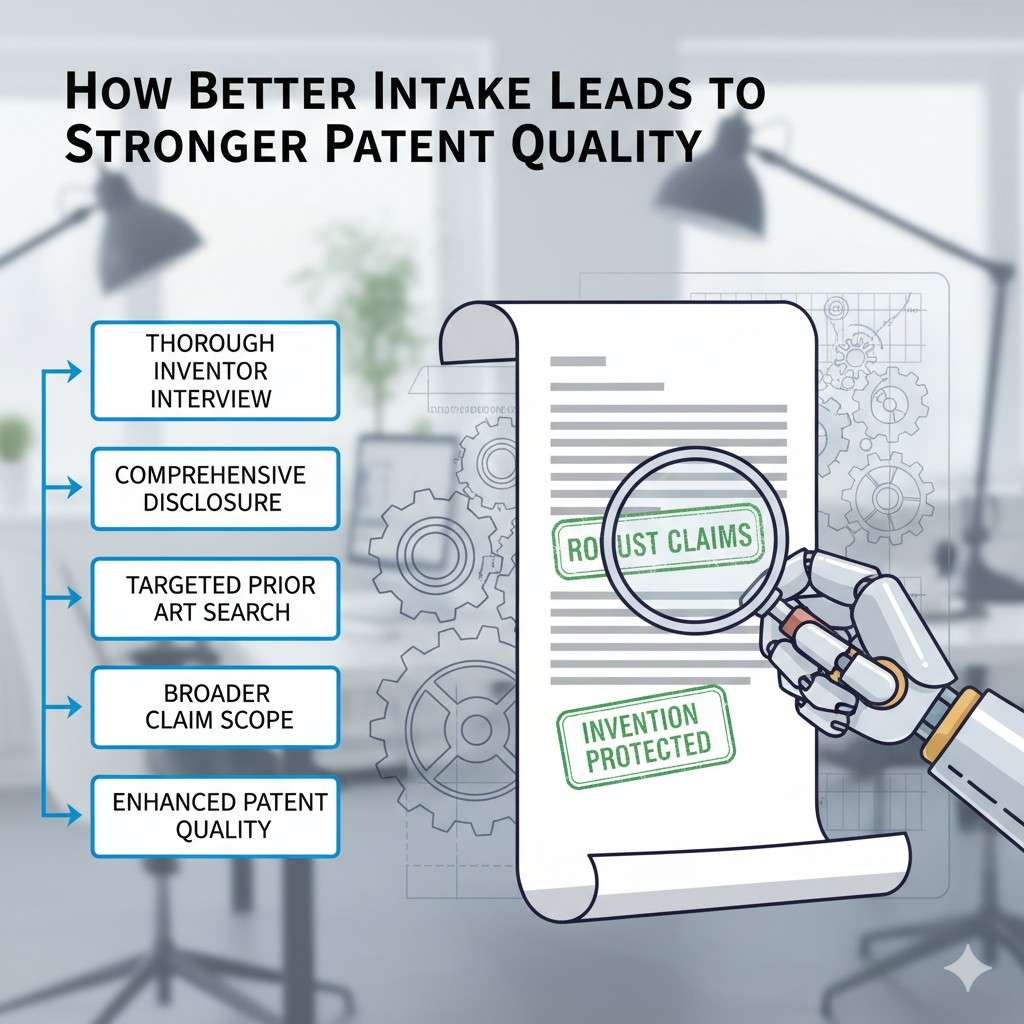
What use cases may come next? These answers create room. And room is often what makes a patent more useful over time.
Better Intake Improves Technical Accuracy
Poor technical accuracy can damage patent quality in subtle but serious ways. A small misunderstanding at intake can become a larger issue once it appears in a draft.
Then the inventor has to correct it, the filing timeline gets pushed, and trust in the process drops.
Good intake lowers that risk because it gives inventors a better chance to explain how things actually work.
It also creates a stronger record before legal drafting begins. That means fewer guessed details, fewer assumptions, and fewer corrections later.
For businesses, this is a major operational advantage. It keeps the patent process closer to the product reality. That matters not only for patent strength, but also for speed and internal confidence.
Teams are more likely to stay engaged when they feel the process reflects their real work.
Better Intake Helps Show Why the Invention Matters
A patent is stronger when it does not just describe a system, but also makes clear why that system matters. That point is often missed when intake is too focused on raw function.
Better intake goes one step further. It asks what the invention improved and why that improvement is meaningful.
This could be lower cost, faster processing, reduced memory use, better reliability, smoother scaling, less manual work, or a stronger user outcome.
These practical benefits help shape a more compelling and complete patent application. They also help the business connect the invention to product value.
A useful move here is to ask inventors what changed after the new method was introduced. Did speed improve? Did a failure rate drop? Did a process become simpler?
Even rough answers can help create a much stronger picture than a plain technical summary alone.
Better Intake Reduces Weak General Language
Weak patents often rely on vague phrases that sound fine at first but do little real work.
Terms like improved system, enhanced process, or better performance may seem helpful, yet they do not explain enough on their own. Better intake helps businesses avoid this problem by replacing general wording with real specifics.
When inventors are asked more thoughtful questions, they tend to share concrete facts. They explain what was hard, what changed, and how the new approach solved the problem.
That gives the patent process stronger language to work with. It also makes the final application feel grounded instead of abstract.
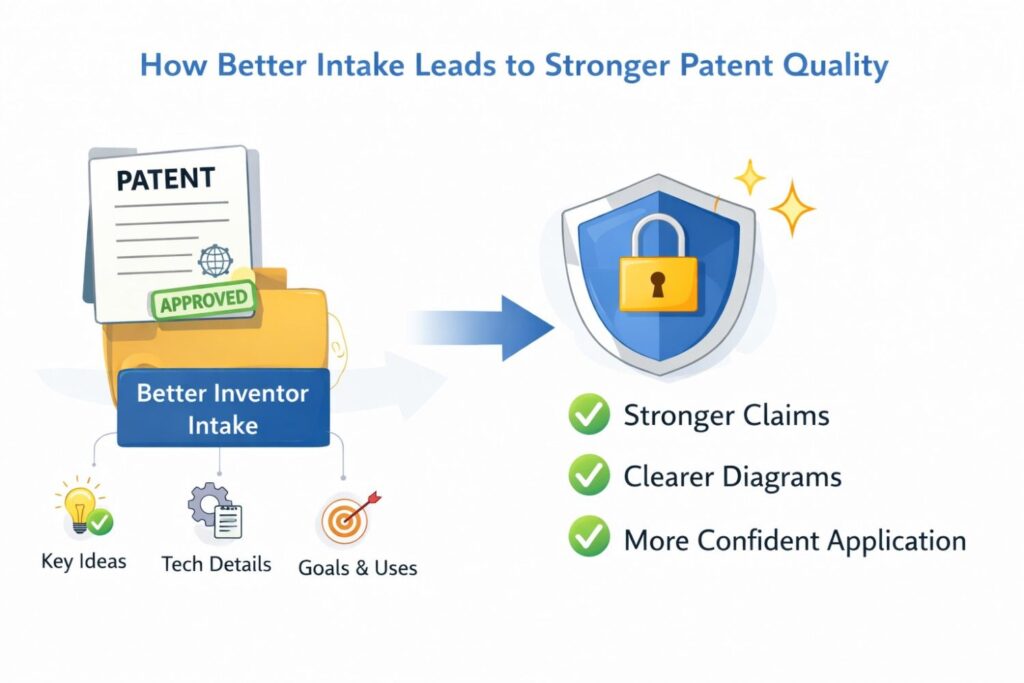
This is especially useful for deep tech companies, where the best patent value often sits in details that are easy to skip over unless someone asks the right follow-up questions.
Better Intake Reveals Fallback Positions Early
A high-quality patent does not depend on one perfect description. It often includes several layers of support. If one angle proves too broad, there are narrower paths.
If one version becomes less important, another may still matter. Better intake helps build these fallback positions early by exploring the invention from more than one angle.
That is strategically important for businesses. Patent review is rarely a straight line. The more carefully the invention is explored at intake, the more options the business may have later if the claim strategy needs to shift.
One way to make this more actionable is to ask inventors not only what version shipped, but also what close versions almost shipped. That can uncover strong backup material that would otherwise be lost.
Better Intake Helps Prevent Underclaiming
Many businesses do not just risk overclaiming. They also risk underclaiming. This happens when the intake process is too narrow and captures only the most visible part of the invention.
The filing then protects a small slice of the real value while leaving wider opportunities untouched.
Better intake helps prevent that by pushing beyond the obvious version. It looks for related workflows, technical branches, deployment contexts, and design choices that may deserve coverage.
This is not about making the patent artificially broad. It is about making sure the business does not leave real value behind.
A smart question here is whether the invention still matters if one part of the current product changes. If the answer is yes, the team should probably capture that broader concept during intake.
Better Intake Makes Review Cycles More Productive
Patent quality improves when review cycles are used to refine good material rather than fix weak foundations. Better intake supports that by delivering a more complete starting point.
The inventor can then spend review time improving the application instead of explaining basic facts that should have been captured earlier.
This improves both quality and efficiency. It also helps the team stay focused on strategic choices, such as what deserves emphasis, what variants should be included, and how closely the filing should align with the product roadmap.
For a business, that is a major gain. It means expert time is spent where it has the highest value, rather than on preventable cleanup.
Better Intake Makes It Easier to Match the Patent to Business Goals
A strong patent is not just technically correct. It also fits the business.
Better intake helps create that fit by making room for market context, product direction, and competitive concerns. It brings together the invention itself and the reason the company cares about protecting it.
That makes the resulting patent more useful. It is more likely to cover the part of the technology that matters most to growth, product differentiation, or future leverage.

Without this alignment, a business may end up with a technically valid filing that does little to support the company’s actual needs.
One highly useful practice is to include one short business question in every intake conversation: if this product succeeds, what part will matter most to protect? That simple question often changes the quality of the entire discussion.
Why Clear Early Details Can Improve Approval Odds
The path to patent approval is shaped much earlier than most teams think. It does not begin when an examiner reads the application.
It begins when the invention is first explained. If the early details are clear, the patent has a stronger foundation from the start.
If those details are thin, vague, or incomplete, the filing may struggle later even if the idea itself is strong. This is why businesses should treat early invention detail as a serious strategic asset.
Clear early input can make the patent easier to draft, easier to support, and easier to defend during review.
Clear Early Details Give the Patent a Strong Starting Position
A patent application is only as strong as the information behind it. When early details are clear, the application can be built on a stable base. The story of the invention becomes easier to explain.
The technical steps are easier to describe. The key difference from older methods becomes easier to show.
All of this matters because approval often depends on whether the application presents the invention in a way that is specific, coherent, and fully supported.
Businesses sometimes assume that a smart drafter can solve weak early input. In practice, that is risky. Strong writing can improve structure, but it cannot fully replace missing facts.
If important technical details are not captured early, the final application may leave gaps that become harder to fix later. That can create problems during review and make approval more difficult than it needs to be.
Approval Gets Harder When the Invention Sounds General
One common problem in patent filings is that the invention is described in broad terms too early and never becomes concrete enough.
The application may say the system improves performance or makes a process more efficient, but it may not clearly explain how. That weakens the filing. During review, broad claims without solid detail often invite more pushback.
Clear early details help prevent this. They force the invention out of general language and into real explanation.
They show what was changed, what the new process does, what parts work together, and why the result is different. This gives the application more weight. It becomes easier to show that the invention is not just a goal or an idea, but a real technical solution.
A useful business practice is to ask inventors for one worked example early in the process.
Even if the patent later covers more than that example, one concrete version helps anchor the application in something real. That often improves clarity across the entire filing.
Strong Early Detail Helps Distinguish the Invention From What Came Before
Approval often depends on difference. A patent examiner will look at older material and ask what is truly new here. If the early invention record is not clear on that point, the patent application may struggle to make a persuasive case.
It may describe a useful product, yet fail to show why the underlying approach is different enough to deserve protection.
This is where clear early detail becomes powerful.
It helps the business identify the true gap between the new invention and the older way of doing things. It gives the application a better chance to draw that contrast in a way that is credible and easy to follow.
Businesses can improve this by asking inventors to explain not just the invention itself, but also the failed path that came before it. What did the old method do poorly? What limit did the team keep hitting?
What changed in the new approach that solved that problem? These answers often produce the exact detail needed to support a stronger case during review.
Clear Inputs Help Avoid Internal Confusion Before Filing
Approval odds do not only depend on what happens outside the company. They also depend on whether the team itself is aligned before filing.
If engineering, product, and legal reviewers all understand the invention differently, that confusion can show up in the application.
Mixed language, inconsistent framing, and half-settled technical points can weaken the filing before it is ever submitted.
Clear early details help stop that drift. They create a shared understanding of what the invention is, how it works, and what part matters most.
This improves drafting quality and reduces the risk that the application will contain internal tension. A filing that reads as one unified technical story is easier to defend than one that feels stitched together from competing views.
A very practical step is to make sure early invention notes are reviewed by the people closest to the product before drafting begins. That is often enough to catch unclear terms, missing steps, or technical shortcuts that could later become review problems.
Clear Early Details Support Better Claim Framing
Claims are often where approval pressure shows up most clearly. If the claims are too broad for the support in the application, that can create trouble.
If they are too narrow, the business may get a patent that is approved but not especially useful. The quality of claim framing is closely tied to the quality of the early details gathered before drafting.
When early detail is strong, the patent process has more room to work. The application can support a wider range of claim positions because it includes more technical explanation, more examples, and more alternate paths.
That gives the business more flexibility during review. It also improves the odds that the claims can be adjusted without losing the heart of the invention.
For businesses, this means early detail is not just background material. It is part of the approval strategy. The more clearly the invention is described upfront, the more options the team may have later if the claims need to be refined.
Clear Detail Makes the Technical Story Easier to Believe
Patent approval is not about style alone, but credibility matters. An application that clearly explains the invention tends to feel more grounded.
It shows that the inventors understood the problem, built a real solution, and can describe the result in a way that makes sense. That can make a meaningful difference during review.
By contrast, a filing built from weak early detail may sound abstract or inflated. It may rely too much on outcome language without showing enough mechanism. That can make the invention look less concrete and more vulnerable to challenge.
One of the best ways to improve this is to capture the inventor’s real build story early. Not the polished version. The real one. What was tried first? What broke? What changed? What finally worked?
These details often carry a level of truth that strengthens the application in a way generic wording never can.
Early Detail Helps the Patent Explain More Than One Version
Approval becomes easier when the application is not trapped inside one narrow form of the invention. Clear early detail helps avoid that problem by revealing variants early enough to include them.
If the invention can be implemented in different ways, the application should ideally show that. This creates more support and more flexibility if the review process pushes the team away from one path.
Businesses often miss this because they only capture the version that shipped.
But the path to approval can benefit from knowing what nearly shipped, what else was tested, and what alternate structures could still deliver the same result. These early details can become valuable support later.
A strong business move is to ask inventors what parts of the invention are fixed and what parts could change without losing the core idea.
That one question can reveal useful variants that strengthen the filing and improve future review options.
Clear Early Details Reduce the Need for Guessing
Any time a patent application is built on assumptions rather than clear facts, risk goes up.
Someone may guess how a module works, simplify a process too much, or describe a feature in a way that sounds right but is not fully accurate. These errors are often unintentional, but they can still hurt the application.
Clear early details reduce that risk by replacing guesswork with direct input. They make it easier to describe the invention with confidence.
This improves technical accuracy and lowers the chance that the application will later need major correction. That matters because corrections made late are usually harder, slower, and less complete than clarity achieved early.

For businesses trying to scale a patent program, this is especially important. A process built on clear early detail is easier to repeat and trust. It reduces friction and raises the baseline quality of every filing.
Wrapping It Up
Good inventor intake is not a small step at the front of the patent process. It is the step that shapes all the others. When a business gets intake right, it becomes much easier to capture the real value of the invention, explain it with clarity, and turn it into a patent that actually protects what matters. Better intake improves patent quality because it gives the process stronger facts, better structure, and more useful technical depth. It can also improve approval odds because clear early details make the invention easier to understand, easier to support, and easier to distinguish from what came before.
Leave a Reply