
You built something real. Maybe it’s code. Maybe it’s a model. Maybe it’s a hardware system you’ve been testing at 2 a.m. But now you have a new problem: ideas are coming in faster than you can protect them. Engineers keep shipping. Features keep stacking. Improvements keep showing up in Slack threads and Notion docs. And every week someone says, “Should we patent this?”
Why Most Startups Waste Patent Opportunities (And Don’t Even Know It)
Most startups do not lose patent opportunities because they are careless. They lose them because they are busy.
They are building, shipping, fixing bugs, raising money, hiring, and trying to survive. Patents feel like something you “get to later.” But later often turns into never.
The waste does not happen in one big mistake. It happens in small daily moments. A feature ships without being documented. A key model improvement stays buried in Git commits.
A breakthrough architecture decision never gets written down in plain English. Months pass. Competitors catch up. And suddenly, what could have been protected is now public and harder to defend.
Let’s break down where this really goes wrong and how to fix it in a way that fits how startups actually work.
The Build-First, Protect-Later Trap
Most technical founders believe speed is everything. And they are right. Speed matters. But speed without protection can quietly reduce your long-term leverage.
When teams focus only on shipping, invention capture becomes reactive. You only think about patents when an investor asks, when a competitor files something, or when you are about to launch publicly.
At that point, key details may already be exposed.
A smarter move is to connect invention review directly to your build cycle. Every major sprint that changes architecture, models, or system behavior should trigger a short internal review.

Not a legal meeting. Just a structured check-in that asks, “Did we solve a hard technical problem here?”
That one habit can prevent months of lost opportunity.
Ideas Stay Stuck in Engineers’ Heads
One of the biggest leaks in early-stage companies is unspoken innovation. Engineers solve complex problems quietly.
They find new ways to reduce latency, improve training data flow, optimize compute usage, or redesign a backend pipeline. They do not always see these as patent-worthy. They see them as “just doing the job.”
If no one asks them the right questions, those solutions never get surfaced.
You need a simple internal habit: after any major technical milestone, have the engineer explain what was hard and how they solved it. Not in technical depth. Just in plain words. Record it. Capture it. Store it.
This creates a living bank of potential invention submissions. Without that capture step, your IP disappears into memory.
Fear of Complexity Slows Everything Down
Many founders avoid patent discussions because they assume the process will slow them down. They imagine weeks of meetings, heavy documents, and legal back-and-forth. So they postpone.
But postponing creates a bigger problem. When you wait too long, you end up rushing filings right before product launches or fundraising rounds. That rush leads to weak filings, shallow descriptions, and missed angles.
The smarter strategy is to treat invention capture as lightweight and ongoing. Do not wait until you “have time.”
Create a rhythm that fits inside product development. Even a 20-minute monthly review of technical changes can uncover high-value inventions early.
If you want to see how startups capture inventions without slowing engineering, you can explore how PowerPatent makes that process fast and structured here: https://powerpatent.com/how-it-works
Confusing Features with Inventions
Another hidden issue is misunderstanding what is actually patentable. Teams often think patents are only for brand-new products or massive breakthroughs. That is not true.
Many strong patents protect systems, processes, data flows, training methods, and infrastructure decisions. These are things startups change all the time.
If your team believes “this is just a feature” or “this is just an improvement,” you may be ignoring valuable protection opportunities.
You need a simple internal mindset shift. Do not ask, “Is this revolutionary?” Ask, “Did we solve a technical problem in a unique way?”
That question alone surfaces far more protectable work.
No Clear Owner of IP Strategy
In many startups, no one owns invention tracking. Engineering builds. Product plans. Leadership raises money. But no one is responsible for asking, “What should we protect this quarter?”
Without ownership, invention submissions become random. Some ideas get filed because a loud team member pushes for it. Others are ignored because no one champions them.
A strategic move is to assign a clear owner for invention intake. This does not need to be a full-time role. It can be a founder, CTO, or product lead. But someone must gather submissions, apply a scoring system, and make decisions.
Ownership creates consistency. Consistency creates protection.
Public Disclosure Happens Too Early
Startups love announcements. Launch threads. Demo days. Conference talks. Blog posts. These are powerful growth tools. But they can also kill patent rights if done before filing.
Often, teams do not even realize they are publicly disclosing core technical details. A demo video might reveal architecture decisions. A blog post might explain a novel training approach.
The fix is simple. Before any public technical release, run it through your internal invention review. Ask whether any part of what you are about to share should be protected first.
This habit protects you without stopping marketing momentum.
Investors Assume You’re Protecting What Matters
When investors ask about IP, many founders respond with, “We plan to file.” Or, “We have a few provisional drafts.” But behind the scenes, there is no clear system.
Savvy investors look for process, not just filings. They want to see that you have a method for identifying and prioritizing inventions.
If you cannot explain how you decide what to protect, that signals risk. It suggests your moat is accidental rather than intentional.
Building a scoring system is not just about patents. It signals maturity. It shows you are thinking long-term.
Reactive Filing Leads to Weak Patents
When startups file patents only in response to fear, such as seeing a competitor’s filing, the result is often rushed documentation. Key alternatives are not explored. Edge cases are not described. Variations are missed.
Strong patents require thoughtful framing. They need clear explanations of how the system works, what makes it different, and how it can evolve.
If you capture inventions early and score them consistently, you can file from a position of strength, not panic.
PowerPatent was built to support this exact process, combining structured software with real patent attorney oversight so founders can move fast without cutting corners.
You can see how that works here: https://powerpatent.com/how-it-works
Engineers Move On, and Knowledge Fades
Startups change quickly. People leave. Teams restructure. Priorities shift.
If invention capture depends on memory, you will lose critical details. An engineer who designed a unique distributed training framework may leave six months later. Without documented invention submissions, that knowledge leaves with them.
A scoring system forces documentation early. Even if you do not file immediately, you preserve the insight. That documentation can later support stronger patent drafting.
Short-Term Thinking Hides Long-Term Value
When cash is tight, founders often think only about immediate ROI. Filing fees feel like a cost, not an asset.
But patents are not about today’s revenue. They are about future leverage. They help in acquisition talks. They support higher valuation. They deter competitors.
The mistake is not choosing not to file everything. The mistake is not having a framework to identify which inventions could shape your long-term position.
That is why prioritization matters so much. You are not trying to patent every idea. You are trying to protect the ideas that create strategic advantage.
The Real Cost of Wasted Inventions
The cost of missed patent opportunities is rarely visible right away. You will not see a line item in your budget that says “Lost IP Value.”
Instead, the cost appears later. A competitor copies your core method. An acquirer discounts your valuation because you lack protection. A partnership falls through because your moat is weak.
Most startups do not realize they wasted opportunity until it is too late to fix.
The good news is this problem is solvable. With a simple scoring system, you can bring clarity to chaos. You can turn invention capture into a repeatable habit. And you can protect what truly matters without slowing down your team.

In the next section, we will build that scoring system step by step and show you how to apply it in a real startup environment.
The Simple Scoring System That Brings Clarity to Invention Decisions
Most founders do not struggle because they lack ideas. They struggle because they have too many.
Every sprint creates new technical work. Some of it feels important. Some of it feels small. Some of it might shape your entire product category. But without a filter, everything feels urgent. And when everything feels urgent, nothing gets the attention it deserves.
A scoring system solves this.
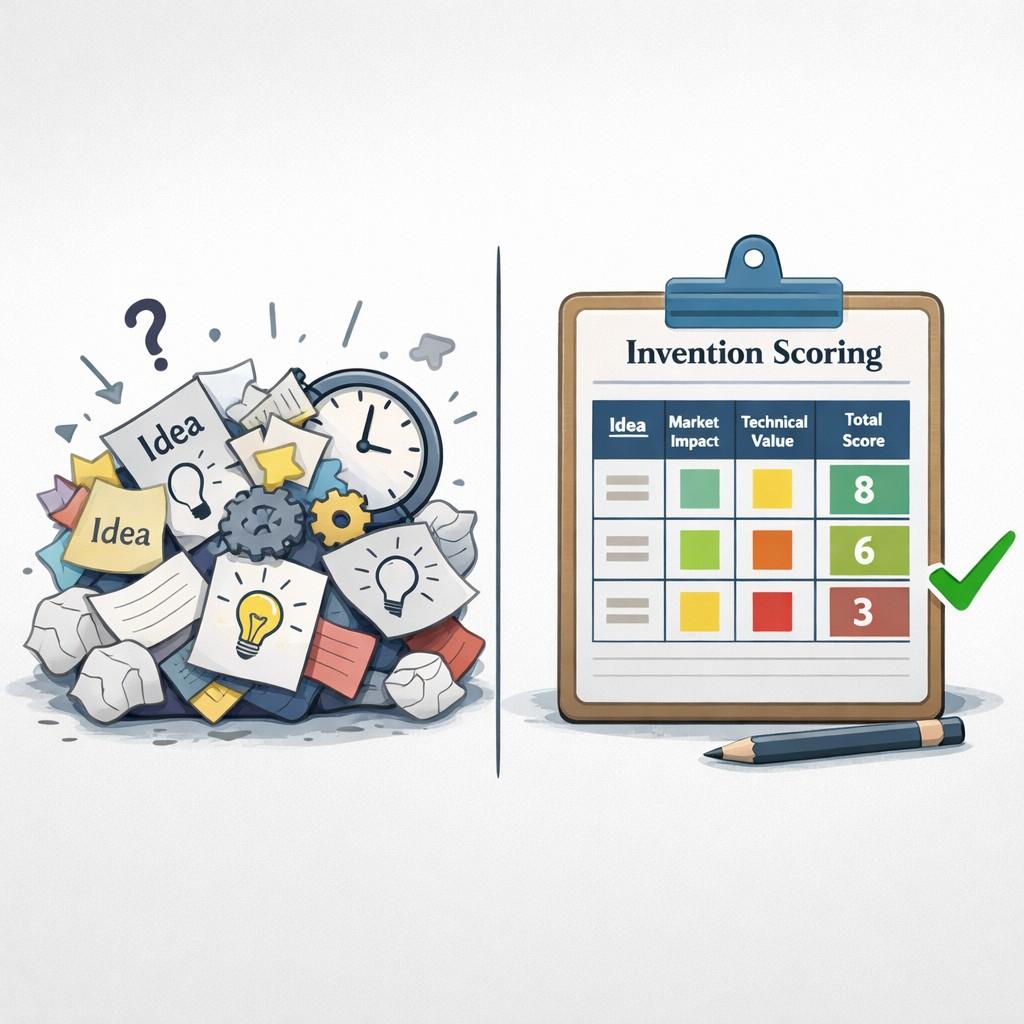
It removes emotion. It removes guesswork. It replaces debates with structure. Instead of asking, “Should we patent this?” you ask, “How does this score?”
That shift changes everything.
Let’s build a scoring system that works in the real world. Not a theory. Not a legal checklist. A practical framework your team can use in less than thirty minutes.
Start With One Clear Goal
Before you score anything, you need clarity on what you are optimizing for.
Are you building toward acquisition? Are you planning to dominate a narrow technical niche? Are you creating deep infrastructure that others will rely on?
Your scoring system must reflect your strategy. If you do not define this first, your scores will be random.
For example, if your long-term goal is to become core infrastructure in your space, inventions that protect system architecture and scalability should score higher than surface-level product features.

If your goal is licensing, then inventions that are broadly applicable across industries should receive more weight.
Take time to write one short paragraph that defines what winning looks like for your company. That paragraph becomes the lens for every score.
Focus on Technical Advantage, Not Just Features
A strong scoring system looks at whether an invention creates a technical edge that is hard to copy.
Many startups accidentally score based on excitement. If a feature feels impressive or visible to users, they assume it deserves protection.
But patents are not about flash. They are about defensibility.
When reviewing an invention submission, ask whether it solves a technical problem in a way that competitors would struggle to recreate without knowing your approach. If the answer is yes, that invention should score high on strategic value.
The more your system architecture, data processing, model optimization, or workflow automation differs from common methods, the more valuable it is to protect.
Measure Impact on Core Product Direction
Some inventions support small improvements. Others shape your entire roadmap.
Your scoring system should reward inventions that align with your core direction. If an invention touches the foundation of your product, it matters more than a temporary experiment.
To apply this, look at how many parts of your system rely on the invention. Does it affect performance across the board? Does it enable new capabilities that were not possible before?
If removing that invention would weaken your product significantly, it likely deserves a strong score.
Evaluate Long-Term Business Leverage
Not every technical breakthrough has equal business weight.
Some inventions create leverage in partnerships. Others strengthen your negotiation position in acquisition talks. Some act as barriers that stop new entrants from copying your core model.
Your scoring system should consider whether the invention increases your future options.
Think ahead three to five years. If your company succeeds, which technical pieces would you want fully protected? Those are the ones that deserve priority now.
This mindset helps you avoid filing patents on low-impact improvements while ignoring the real engine of your growth.
Consider Competitive Visibility
Another powerful factor is whether competitors can see what you are doing.
If your invention is fully exposed in your product behavior or public materials, competitors may reverse-engineer it. That increases the value of protection.
On the other hand, if the invention is deeply hidden in backend infrastructure and nearly impossible to observe, you might choose to prioritize differently.
Visibility increases risk. Higher risk often justifies higher priority.

When scoring, ask whether your competitors could detect this approach by using your product or reading your public content. If yes, that invention likely deserves faster action.
Assess Technical Depth and Uniqueness
A scoring system must separate routine engineering from real invention.
Routine improvements are important, but they may not justify patent effort. True invention usually involves a new structure, new flow, or new way of solving a known limitation.
When reviewing submissions, look for technical depth. Did the team overcome a constraint others struggle with? Did they combine known methods in a novel way? Did they introduce a system that changes performance in a meaningful way?
The stronger the uniqueness, the higher the score.
If you are unsure, this is where expert review matters. PowerPatent combines smart software with real patent attorney oversight so your team can validate whether something truly stands out.
You can explore that process here: https://powerpatent.com/how-it-works
Factor in Timing and Disclosure Risk
Timing is often overlooked.
If you are about to launch a feature publicly, speak at a conference, or publish a technical blog, any invention tied to that release should move up in priority.
Your scoring system should include urgency. An invention that will be disclosed soon needs faster filing decisions than one that remains internal.
Without this timing layer, teams often miss filing windows simply because they did not connect marketing plans with IP strategy.
Keep the Scoring Simple Enough to Use
The biggest mistake founders make when building scoring systems is overcomplication.
If your framework requires a two-hour meeting and a spreadsheet with fifteen variables, your team will ignore it.
Instead, limit your system to a small set of core factors. Strategic value. Technical uniqueness. Competitive exposure. Business leverage. Timing risk.
Assign each factor a simple numeric range. Keep it intuitive. You are not trying to predict the future perfectly. You are creating clarity.
The goal is not mathematical precision. The goal is consistent decision-making.
Turn Scores Into Clear Action Buckets
Once you score an invention, it must lead to action.
High-scoring inventions move directly into drafting and attorney review. Medium scores may require further technical refinement or market validation. Low scores get documented but not filed.
This creates momentum. Instead of debating endlessly, you follow the framework.
Over time, your team becomes faster at spotting high-value inventions early. The scoring process sharpens their awareness.
Build This Into Your Product Rhythm
The most powerful scoring systems are not separate from product development. They are part of it.
After major releases or architectural changes, run a quick scoring session. Capture submissions. Score them. Decide next steps.
This habit transforms patent strategy from reactive to proactive.
And when you combine this structured scoring with modern tools and real attorney oversight, the process becomes even smoother.

PowerPatent was designed to support founders who want speed and strength at the same time. You can see how it works here: https://powerpatent.com/how-it-works
Clarity removes stress. A scoring system removes doubt. And when you remove doubt, you protect what matters most.
How to Score Technical Ideas Without Slowing Down Product Development
Speed is oxygen for a startup.
If your patent process slows down engineering, it will die. Your team will ignore it. Product leaders will avoid it. Founders will postpone it. And your scoring system will become a forgotten document in a shared drive.
So the real challenge is not how to score ideas.
The real challenge is how to score ideas without interrupting build velocity.
You do not need more meetings. You do not need heavy forms. You do not need long legal calls.
You need a lightweight layer that runs alongside product development, not against it.
Here is how to do that in a way that feels natural to your team.
Make Invention Capture Part of the Sprint Rhythm
If invention scoring feels like a separate project, it will always lose to product deadlines.
The smarter move is to attach invention capture to something that already exists.
Every engineering team runs sprints. At the end of each sprint, there is usually a demo, review, or recap. That is the moment to insert a simple question: did we solve a hard technical problem here?
Not every sprint will produce patent-worthy material. That is fine. The goal is not volume. The goal is awareness.
When teams expect that technical breakthroughs will be discussed briefly at the end of each cycle, they begin to notice them more clearly.

This does not require an hour-long session. It can take ten minutes. One engineer explains what changed under the hood. If something sounds unique or strategically important, it moves into scoring.
That is it.
Separate Brainstorming From Scoring
One mistake companies make is mixing idea generation with evaluation.
Brainstorming should be open. Creative. Fast.
Scoring should be focused. Structured. Calm.
If you try to evaluate every idea in real time during a product meeting, it slows everything down. Engineers will feel judged. Product managers will feel distracted.
Instead, create a short follow-up window for scoring. For example, once a month, gather all captured invention notes and score them in one focused session.
This keeps product meetings clean while still ensuring nothing slips through.
Use Plain Language, Not Legal Language
The moment patent language enters the room, energy drops.
Engineers do not want to guess whether something meets a legal standard. They want to know whether their work matters.
So when scoring technical ideas, stay in product language.
Ask simple questions.
Did this change improve performance in a meaningful way?
Does it solve a problem competitors struggle with?
Would copying this be hard without knowing our approach?
Does this support our long-term strategy?
When you keep the conversation grounded in real engineering impact, scoring becomes a strategic discussion, not a legal one.
Later, once something scores high, legal refinement can happen with proper guidance.
This is where modern platforms make a huge difference. With PowerPatent, teams can document ideas in simple terms, and real patent attorneys help shape them into strong filings without dragging engineers into complex processes.
If you want to see how that works in practice, you can explore it here: https://powerpatent.com/how-it-works
Limit the Decision Group
Too many voices slow decisions.
You do not need the entire company involved in scoring. A small group is enough. Often this includes the CTO, one senior engineer, and one business leader.
Three thoughtful people can score effectively in under thirty minutes.
If you open scoring to a large group, discussions drift. Opinions compete. Meetings expand.
Keep it tight. Keep it fast.
Time-Box the Scoring Session
Speed comes from constraints.
Set a clear rule. Each invention submission gets five minutes of discussion. No more.
In those five minutes, review the summary, ask clarifying questions, assign scores for each factor, and move on.
If something requires deeper debate, flag it for separate review. Do not let one idea consume the entire session.
This rhythm builds momentum. Over time, your team will become skilled at quickly identifying which ideas truly matter.
Capture Just Enough Detail
Another reason scoring can slow teams down is over-documentation.
You do not need a twenty-page explanation before scoring. You need a short summary that explains the technical problem, the approach taken, and the result achieved.
Three short paragraphs are often enough.
If the idea scores high, you can expand later during drafting. But for prioritization, clarity matters more than depth.

Encourage engineers to write in plain English. Avoid jargon. The clearer the explanation, the faster the scoring.
Align Scoring With Roadmap Milestones
Your product roadmap already defines priorities.
Tie invention scoring to those same milestones.
When a major platform update is scheduled, review related inventions early. When entering a new market segment, evaluate whether new technical methods deserve protection.
This alignment ensures patent work supports product direction instead of competing with it.
It also prevents last-minute scrambles right before public launches.
Protect Focus During Critical Build Phases
There will be moments when the team is under extreme pressure. A major release. A funding deadline. A customer contract.
During these phases, scoring should not interrupt execution.
If needed, delay the scoring session by a week. The key is consistency over time, not rigid timing.
The system must serve the team, not control it.
When founders feel that IP processes respect product urgency, adoption remains strong.
Turn High Scores Into Fast Action
Speed matters most after scoring.
If an invention receives a strong score, move immediately. Schedule drafting. Capture deeper technical detail while it is fresh.
Delay creates friction. Engineers forget context. Energy fades.
With modern tools, this step can be smooth. PowerPatent allows teams to turn structured invention summaries into real patent drafts, reviewed by real attorneys, without long email chains or confusion.
It is built for founders who want protection without slowing down development. You can learn more here: https://powerpatent.com/how-it-works
Make Scoring a Competitive Advantage
Over time, something powerful happens.
Your engineers begin thinking in systems. They begin noticing when they create defensible value. They design with long-term protection in mind.
Scoring stops feeling like overhead. It becomes part of strategic thinking.
Instead of reacting to competitors, you shape the field.
And the key is balance. Not too heavy. Not too loose. Structured but fast.
You are not building a bureaucracy. You are building awareness.
When technical ideas are scored consistently and efficiently, your startup gains clarity. You protect what truly matters. And you keep shipping at full speed.

In the next section, we will look at how to turn high-scoring inventions into strong, defensible patents that actually hold weight in the real world.
Turning High-Scoring Inventions Into Strong, Defensible Patents
Scoring gives you clarity.
But clarity alone does not protect you.
The real value appears when a high-scoring invention turns into a patent that actually holds weight. A patent that blocks competitors. A patent that strengthens valuation. A patent that makes acquirers pay attention.
This is where many startups stumble.
They identify the right invention, but the execution is weak. The filing is rushed. The explanation is shallow. The scope is narrow. And years later, when it matters most, the patent does not provide real leverage.
Let’s talk about how to do this the right way.
Move Fast While the Details Are Fresh
Once an invention scores high, time matters.
Engineers forget details quickly. The exact trade-offs they considered. The failed experiments. The alternative paths they rejected. Those details are gold when drafting a strong patent.
Do not wait three months.
Schedule a focused session within days of scoring. Capture the technical depth while it is still clear in everyone’s mind.

This does not need to be painful. A guided session where the engineer explains the problem, the system architecture, the flow of data, and the unique decisions made is enough to build a strong base.
Speed here does not mean rushing blindly. It means preserving accuracy.
Go Beyond the First Version
A weak patent often describes only the current implementation.
A strong patent describes variations.
If your system works one way today, ask how it could work differently tomorrow. Could the model use a different training approach? Could the architecture run in a distributed setup? Could the data pipeline be adapted for another industry?
The goal is not to predict the future perfectly. The goal is to claim the broader idea behind the implementation.
When drafting, think in layers. The specific version you built is one example. The deeper concept is what deserves protection.
This is where attorney oversight becomes critical. Engineers think in terms of what works now. Patent professionals think in terms of how to expand and strengthen coverage.
PowerPatent blends structured invention capture with real attorney review so founders do not miss this step. You can see how that process works here: https://powerpatent.com/how-it-works
Explain the Technical Problem Clearly
Strong patents start with a clear problem statement.
Not marketing language. Not buzzwords.
A real technical limitation.
Was there latency in data processing? Was model accuracy unstable across edge cases? Did existing systems waste compute resources?
The more clearly you define the technical problem, the stronger your position becomes. It shows that your invention solves something specific and meaningful.
This also helps examiners understand why your approach matters.
Do not assume the problem is obvious. Spell it out.
Describe the System Like You Are Teaching It
One of the biggest weaknesses in startup patent filings is lack of clarity.
Engineers understand the system deeply, but they explain it in fragments. They jump steps. They assume knowledge.
When turning a high-scoring invention into a patent, slow down and walk through the system as if teaching someone new.
How does data enter the system?
How is it transformed?
What decision points exist?
What components interact?
This clarity strengthens the patent and reduces the risk of misinterpretation later.
It also makes enforcement easier if you ever need it.
Protect the Core, Not Just the Edges
It is tempting to file patents around visible features.
But features change. Interfaces evolve. Branding shifts.
Your core engine is what deserves the strongest protection.
If your competitive advantage comes from how your model selects training data, protect that. If your strength lies in how your system allocates compute dynamically, focus there.
A scoring system helps identify these core inventions. Now your job is to ensure the patent claims align with that core value.
This requires discipline. Do not get distracted by surface-level improvements when drafting.
Think About Competitor Behavior
A strong patent anticipates how competitors might try to work around it.
When drafting, ask yourself: if a competitor wanted to copy our result without copying our exact method, what would they change?
Then consider whether your patent can cover those variations.
This mindset strengthens defensibility. It shifts your thinking from documenting what you built to protecting the strategic space around it.

Without this step, patents can become easy to design around.
Avoid Narrow Claims That Box You In
Early-stage companies often evolve quickly.
If your patent is too narrow, it may only cover version one of your product. Two years later, your own system may sit outside your original claims.
To avoid this, draft with flexibility in mind. Protect the broader system architecture and logic, not just the specific configuration.
Again, this is where combining software tools with experienced patent attorneys creates an advantage. Structured input ensures technical accuracy. Legal expertise ensures breadth and strength.
PowerPatent was built specifically to bridge this gap for fast-moving startups. Learn more here: https://powerpatent.com/how-it-works
Align Patent Strategy With Business Milestones
Strong patents support business strategy.
If you are entering enterprise markets, patents that protect reliability, scalability, and security may carry weight.
If you are preparing for acquisition, patents that cover core infrastructure and proprietary methods increase valuation.
Do not treat patent drafting as isolated from company goals. Revisit your original scoring criteria. Confirm that the invention still aligns with your long-term strategy.
This keeps your portfolio intentional.
Maintain Internal Documentation Discipline
After filing, do not forget the invention.
Keep internal records that map patents to product components. Track which systems rely on which protected methods.
This helps during fundraising and due diligence. It also ensures your team understands what is protected and why it matters.
Over time, this builds a strong IP narrative. Not just scattered filings, but a story of technical leadership.
Build a Portfolio, Not Random Filings
One strong patent is good.
A connected portfolio is powerful.
When high-scoring inventions are consistently turned into well-crafted patents, patterns emerge. You begin protecting multiple layers of your technology stack.
Competitors see a wall, not a single barrier.
This happens when scoring is ongoing and drafting is disciplined.
It does not require filing dozens of patents blindly. It requires protecting the right inventions deeply and thoughtfully.
Turn Protection Into Confidence
The final benefit of doing this well is psychological.
When founders know their core technology is protected, decision-making becomes stronger. You can share more confidently with partners. You can speak openly with investors. You can negotiate from a position of strength.
Patents should not feel like paperwork. They should feel like armor.
And when you combine a clear scoring system with fast, structured drafting supported by real patent attorneys, you create that armor without slowing down your company.
If you are building deep tech, AI systems, complex software, or advanced hardware, you cannot afford random IP decisions. You need structure. You need speed. You need strength.

PowerPatent was designed to give startups all three. Explore how it works here: https://powerpatent.com/how-it-works
This completes the four core sections of the article.
Wrapping It Up
You do not need to patent everything. You do not need long debates. You do not need to slow down your engineers. What you need is clarity. A simple scoring system gives you that clarity. It helps you see which inventions shape your future and which ones are just small steps along the way. It removes emotion from the decision. It replaces random filing with intentional protection.
Leave a Reply