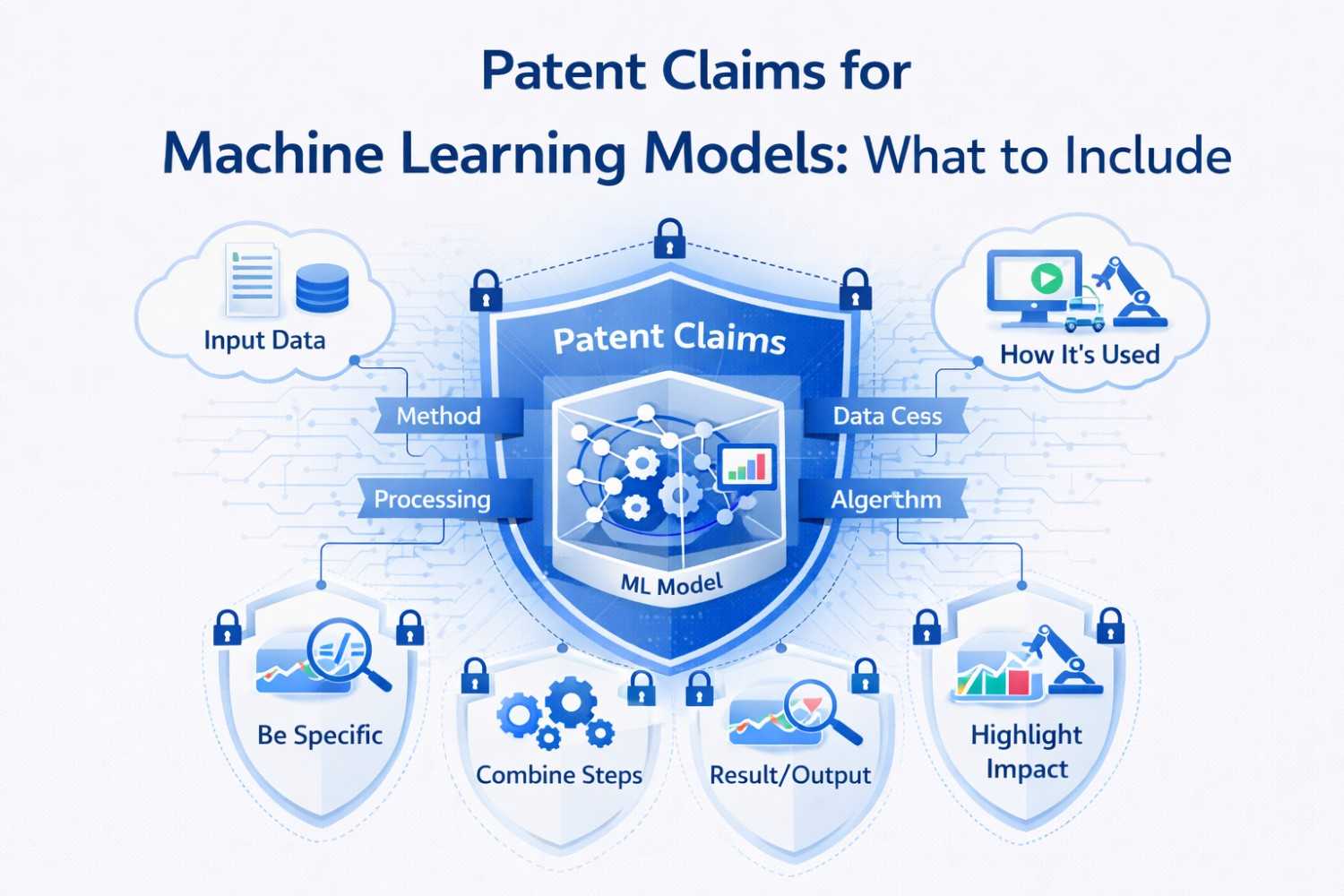
If you are building a machine learning product, your real value is often not just the model. It is the way your system takes in data, learns from it, makes decisions, improves over time, and creates results that others cannot easily copy. That is where patent claims matter. Many founders think a patent for AI is about saying, “we built a model.” It is not. That is far too broad, and it will not help much if someone challenges your patent later. Strong claims need to show what your machine learning system actually does, how it works in the real world, and why your approach is different in a useful way.
Why Patent Claims Matter More Than the Model Itself
When businesses think about protecting machine learning, they often look first at the model. That makes sense on the surface. The model feels like the heart of the product.
It is the thing that predicts, ranks, detects, classifies, or automates. But in patent strategy, that is usually not the best place to stop. A model by itself is rarely the full business advantage.
The stronger value often lives in how the model is used, how it fits into a larger system, and how it creates a result that matters in the market. That is why claims matter more than the model itself.
A patent does not win because the invention sounds advanced. It wins because the claims are written in a way that clearly captures the business value of the invention.
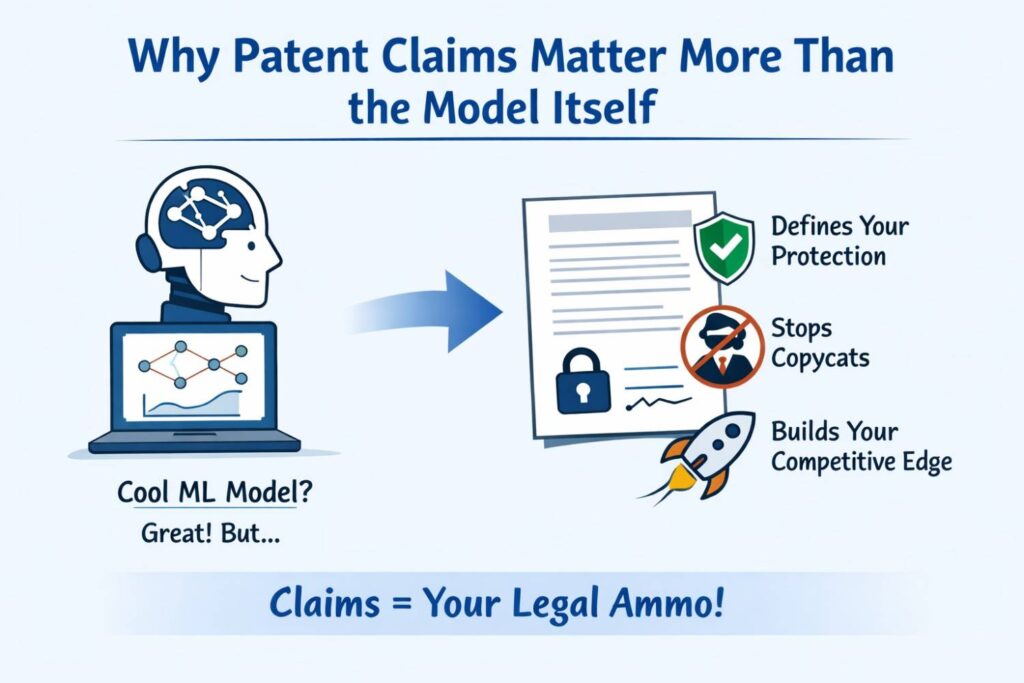
That means a company should not ask only, “Did we build a good model?” It should ask, “What exactly should no one else be allowed to do if they copy our approach?” That is a very different question. It is also the question that leads to stronger protection.
A Good Model Is Not Always a Defensible Business Asset
Most machine learning teams spend a huge amount of time improving accuracy, tuning performance, and testing new model designs. That work matters.
But from a business view, a good model alone is often easier to replace than founders first think.
A competitor may train on different data, use a different architecture, or reach a similar output through another path. If the patent story is too focused on the model in isolation, it can leave too much room for others to work around it.
This is why claims deserve more attention than model details alone. The patent should not just describe a technical object. It should define a protected zone around the practical value the business created.
That protected zone is what matters when investors review your IP, when a larger company enters your space, or when your team tries to build long-term leverage.
The Market Does Not Reward Novelty Alone
A business does not get paid simply because something is new. It gets paid because something useful solves a problem in a better way. Patent claims should follow that same logic.
They should reflect where the commercial advantage sits. That may be in how the system filters noisy inputs before inference. It may be in how predictions trigger a downstream action.
It may be in how training and deployment work together in a closed loop. The value often sits in the workflow, not just the algorithm.
When founders understand this early, they stop treating the patent like a science paper. They begin treating it like a business tool. That shift changes everything.
Claims Define What Competitors Cannot Safely Copy
A model may be impressive, but claims are what set the legal boundary. If you do not claim the right pieces, a competitor can study your product, build something close to it, and still stay outside your protection.
This happens more often than founders expect, especially when the original filing is too focused on general AI language and not focused enough on concrete technical steps.
A strong claim forces a competitor into a hard choice. Either they avoid your protected method, which may reduce their product quality or speed, or they risk stepping into your protected space.
That is what good patent drafting should do for a business. It should create pressure on copycats. It should not simply document what your engineers built at one point in time.
The Real Goal Is Coverage, Not Admiration
Many technical teams write about inventions in a way that seeks approval. They want the reader to see that the system is smart, advanced, and well designed.
That instinct is natural, but patents are not marketing decks and they are not research awards. The goal is not to impress. The goal is to cover the right ground.
Coverage means thinking ahead. If another company wanted the same outcome, what changes would they likely make to avoid direct copying? Would they swap one model type for another?
Would they move a step from training time to runtime? Would they use a different signal source? These are not side questions. These are core questions. They help shape claims that hold up under real business pressure.
The Best Claims Capture Business Leverage
Strong patent claims do not just follow the codebase. They follow the leverage point in the business.
That leverage point is where your product becomes hard to replace, hard to match, or hard to scale without your method.
Sometimes that leverage point is obvious. In other cases, it is buried inside an internal system design decision that does not seem exciting at first glance.
For example, a company may think its value sits in a prediction engine, when in fact the bigger advantage comes from how predictions are validated before action.
Another business may think the invention is in a ranking model, when the stronger story is really in how the ranking changes system behavior in real time under tight resource limits.
Claims matter because they let you lock onto the business leverage, not just the technical label.
Businesses Lose Protection When They Overfocus on the Buzzword
Machine learning is full of terms that sound important. Founders often lean on words like neural network, transformer, optimization, embeddings, or fine-tuning because those words feel current.
But the more a patent leans only on popular terms, the easier it may become for others to sidestep it by using different labels or slightly different technical choices.
A better strategy is to anchor the claims in the function and the result of the system. What is the machine learning component doing inside the larger process? What data does it transform?
What technical bottleneck does it reduce? What system action follows from its output? This approach leads to claims that remain useful even as model trends change.
Your Patent Should Outlive Your Current Stack
Machine learning systems move fast. The model you use today may not be the model you use a year from now.
Your infrastructure may change. Your training process may improve. Your feature pipeline may be rebuilt. If your patent claim is tied too tightly to one exact stack, it may age badly even while your business grows.
That is another reason claims matter more than the model itself. The right claims are broad enough to cover future versions of your product but specific enough to show a real invention.
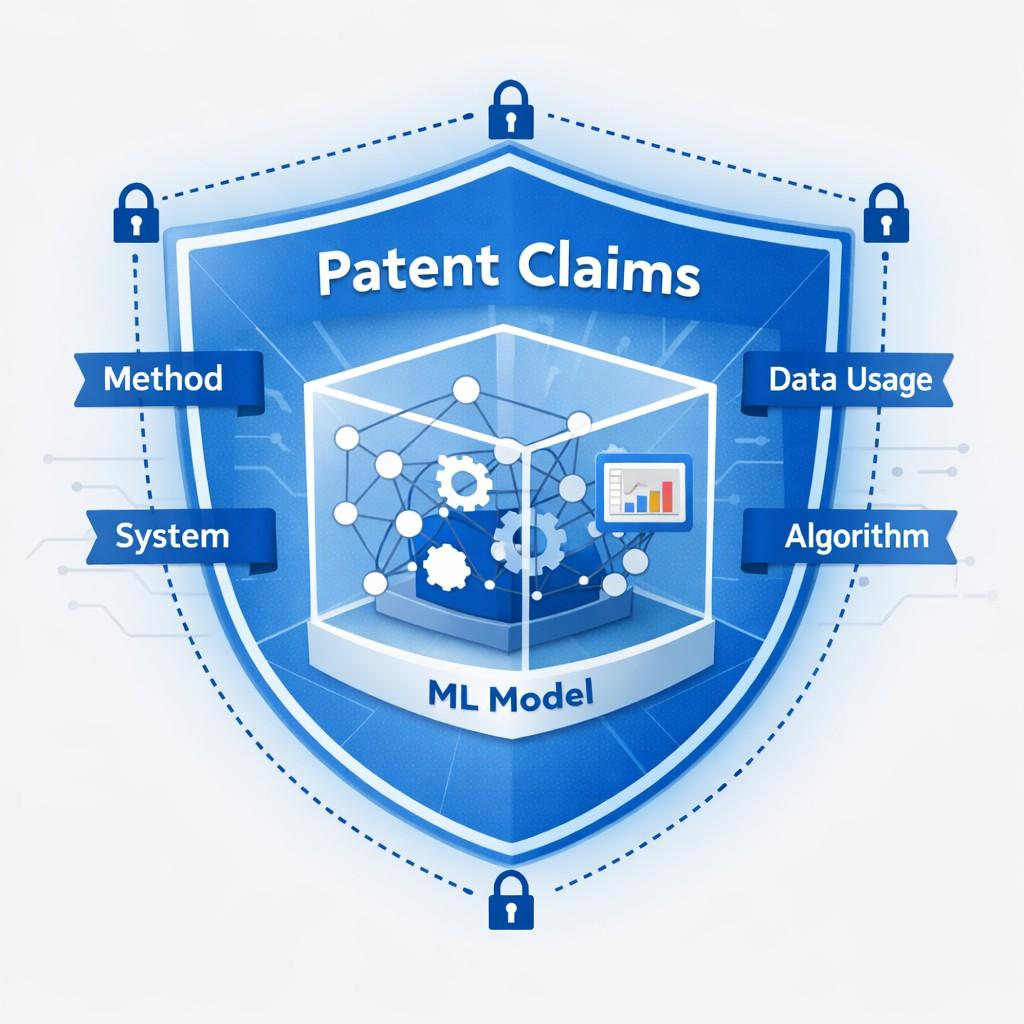
This is a strategic balance. It means describing the invention at the level where your advantage remains true even if the engineering details evolve.
Think in Terms of Technical Position, Not Temporary Implementation
A business should ask what stable idea sits underneath the current implementation. Is the real invention the use of confidence-weighted feedback to retrain a model in production conditions?
Is it the staged use of multiple model passes to reduce compute while keeping accuracy high?
Is it the rule for selecting training samples based on downstream system impact rather than raw data volume? These are the kinds of deeper positions that often deserve claim focus.
When a company files around that deeper position, it gets protection that can grow with the product instead of freezing it in an old version.
Claims Turn Product Insight Into Legal Strategy
Founders often know more than they realize about what should go into a claim. They know where the product almost broke. They know which design decision changed performance.
They know what made customers trust the output. They know what took months to get right. These insights are not just product stories. They are often clues to claim strategy.
The key is to translate those hard-won lessons into claim language. If your team discovered that a certain sequence of steps made the model useful in a real operating setting, that sequence may matter more than the model type.
If your system became valuable because it handled bad input data in a new way, that data handling method may be the stronger claim target. Good patent work begins when technical lessons are turned into legal structure.
What Investors and Acquirers Often Care About
A business audience does not always look at patents the way engineers do. Investors and acquirers usually want to know whether the company has protected something that matters to future revenue.
They want to see that the patent is not just about a lab idea. They want to see that it reaches into the product, the workflow, and the market position.
Claims are what make that visible. A patent with smart claims can show that the company thought clearly about where its moat sits.
It can show discipline. It can show that the company is not just building fast, but also building with long-term leverage in mind. That can strengthen diligence discussions in a way a vague AI filing simply cannot.
Weak Claims Can Create False Confidence
One of the biggest risks for a business is believing it is protected when it is not. A weak patent can look impressive from the outside. It can mention machine learning, data pipelines, and model outputs.
But if the claims are narrow, generic, or disconnected from the actual business edge, they may offer less protection than the company assumes.
That is why this work should be strategic from the start. Businesses should not treat filing as a box to check. They should treat it as a chance to identify and protect the exact engine of advantage inside the company.
What Parts of a Machine Learning Invention Belong in the Claims
When founders hear the word claims, they often think the answer is simple. They assume the claims should cover the model, the training method, and maybe the output. But that is usually too narrow.
A machine learning invention is almost never just the model sitting by itself. The real invention often lives across the full working system.
That is why claim strategy should begin with a wider view. You are not just protecting code or a model checkpoint.
You are protecting the technical method that makes your product useful, hard to copy, and commercially important. In many cases, the parts that belong in the claims are the same parts that made the product actually work in the real world.
The Claims Should Follow the Real Technical Advantage
A useful starting point is to stop asking what sounds advanced and start asking what created the real advantage.
A claim should not be built around what is easiest to describe. It should be built around what made the system meaningfully better, more reliable, faster, cheaper, or more usable.
A machine learning invention usually has several moving parts. Some matter because they are new. Some matter because they connect the model to a real operating environment.
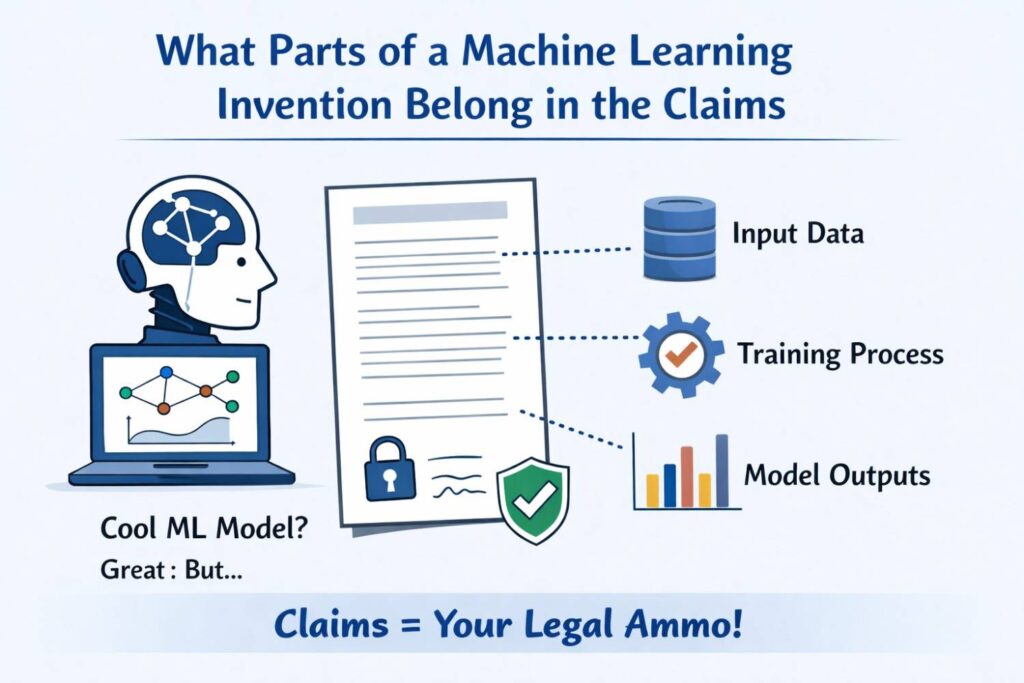
Some matter because they make the output dependable enough for customers to trust. The job of the claims is to capture the parts that create that edge.
The Input Side Often Belongs in the Claims
Many businesses focus so much on model behavior that they forget one of the most valuable pieces of the invention may happen before the model even runs. Input handling can be where the real technical value starts.
If your system chooses, filters, cleans, arranges, compresses, or transforms data in a new and useful way before inference or training, that may absolutely belong in the claims.
This matters because real-world data is often messy. The business that figures out how to take raw, noisy, incomplete, or badly structured information and turn it into useful model-ready input may have solved one of the hardest parts of the problem.
That solution can be more defensible than the model architecture itself.
Input selection can be the hidden invention
Sometimes the strongest invention is not how the model thinks, but what the model sees.
A company may discover that selecting certain slices of data, certain time windows, certain event types, or certain sources leads to a major gain in performance. That step may sound small, but if it changes the quality of the full system, it can be claim-worthy.
This is especially true when the input selection is tied to a technical reason and not just a business preference.
If your system filters input to reduce processing load, improve prediction quality, lower false positives, or speed up downstream action, that logic should be reviewed closely for claim value.
Preprocessing deserves more respect than many teams give it
Preprocessing is often treated like support work. In patent strategy, that can be a mistake.
If your system normalizes data in a special way, creates a structured representation that improves inference, or resolves conflicting signals before model use, those steps may be central to the invention.
A very practical business move is to ask your engineers which preprocessing step they would never want to give to a competitor. The answer is often more useful than asking them to describe the model in abstract terms.
Feature formation may be one of the strongest claim areas
After the raw input comes the question of what form the model actually receives.
Feature creation, signal extraction, embedding generation, sequence construction, and context assembly can all be major sources of technical differentiation. These parts often belong in the claims when they are tied to a concrete technical outcome.
What matters here is not fancy language. What matters is whether the system forms the input representation in a way that changes performance in a real and useful manner.
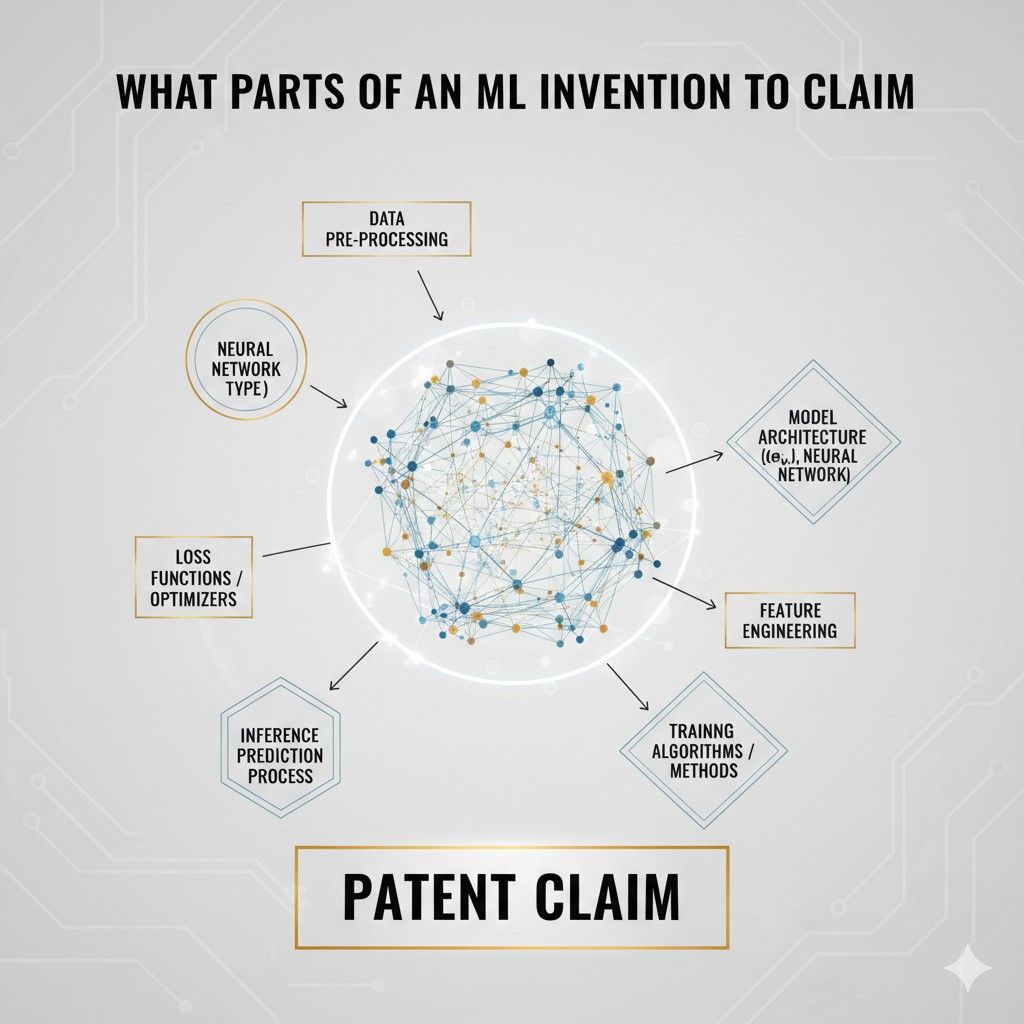
If your business found a way to create a better signal from imperfect data, that is often a core part of the invention.
The model can belong in the claims, but usually not by itself
The model still matters. In some cases, a model structure, training objective, or inference flow is absolutely central to the invention.
But most businesses make a mistake when they try to anchor the whole patent around the bare idea of a trained model doing a task.
That approach can become weak fast. Another company may use a different model family and still copy the real value of your system.
That is why the model often belongs in the claims as one part of a larger method rather than as the whole story.
Claim the role of the model inside the system
A stronger approach is to explain what the model does inside the operating flow. Does it score risk and trigger a machine action? Does it classify data and control resource allocation?
Does it generate a prediction that is validated by a second stage before execution? That role often matters more than the brand name of the model type.
When businesses claim the functional role of the model inside the larger system, they usually create stronger coverage. They also make it harder for a copycat to dodge the patent just by swapping technical labels.
The way the model is used may matter more than the way it is built
A practical rule is this: if a model is useful mainly because of where and how it is used, then the claim should focus there.
Businesses often gain more real protection by claiming the use pattern, the control flow, or the interaction between model output and system behavior than by dwelling on architecture alone.
That makes the patent more aligned with business value. It also gives the company more room to grow as models change over time.
Training methods may belong in the claims when they solve a real technical problem
Not every training step deserves claim space. But some do. If the way your system trains is part of what makes it workable, scalable, stable, or accurate in a difficult setting, that method may belong in the claims.
Training can be important when the invention lies in how examples are selected, labeled, weighted, updated, or reused. It can also matter when the system adapts to limited data, changing conditions, delayed feedback, or highly uneven data quality.
Focus on training choices that change the business outcome
A training detail becomes more interesting for claims when it leads to a meaningful business or technical result.
If it reduces retraining costs, speeds deployment, improves robustness, or keeps performance steady in changing conditions, it should be examined closely.
For business leaders, a useful internal question is not “Did we train it differently?” but “Which training choice made this product commercially viable?” That question often surfaces the best claim material.
Feedback loops can be powerful claim material
One of the most valuable areas in machine learning patents is the feedback loop. If your system takes results from the field and uses them in a specific way to improve future behavior, that can be very important.
The loop may involve correction signals, confidence thresholds, human review results, delayed labels, or downstream performance metrics.
What matters is not that a loop exists. Many systems have feedback.
What matters is the specific technical method for using feedback in a way that improves the system without creating instability or drift. That is where strong claim substance often lives.
Inference flow often belongs in the claims
What happens at runtime is often where commercial value is created. Inference flow includes when the model runs, how often it runs, what triggers it, how outputs are handled, and how system behavior changes in response.
These parts can be highly important in machine learning claims because they reflect the live operation of the invention.
For many businesses, this is where the product becomes real. A good prediction in a notebook is not the product. The product is the live system making useful decisions under real conditions. Claims should often reflect that reality.
Runtime decision logic can be more valuable than the prediction itself
A machine learning output is often only one step in a larger chain. The system may compare the output to thresholds, combine it with rule-based checks, choose among several actions, or decide whether to escalate to human review.
That logic can be deeply valuable, especially when it improves trust, speed, or risk control.
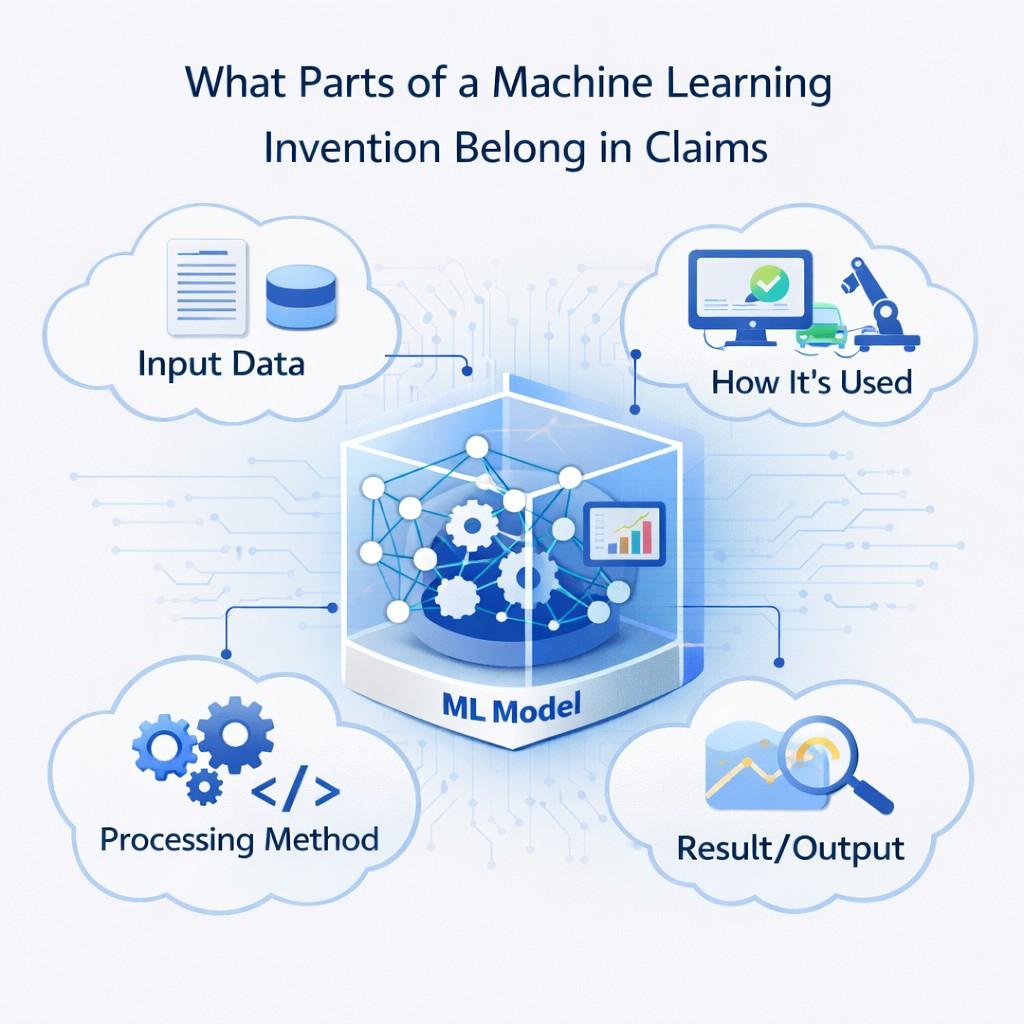
This is one of the most overlooked claim areas in AI products. Many businesses describe the model but leave out the action layer. In practice, the action layer is often where the real moat sits.
Multi-stage systems deserve close claim attention
If your product uses multiple passes, such as a lightweight first screen and a more detailed second stage, that structure may belong in the claims.
The same is true when different models are called in sequence based on confidence, cost, latency, or input type.
These multi-stage systems are often business-critical because they help balance accuracy and compute cost. That makes them especially valuable to claim.
A company that protects this structure may protect the real economics of the product, not just the abstract intelligence inside it.
Output handling often belongs in the claims
Businesses sometimes stop the claim story at the moment the model produces an output. That is too early. What happens next may be one of the most important parts of the invention.
Output handling can include post-processing, validation, ranking, filtering, explanation generation, formatting, storage decisions, system control, or human presentation.
If your machine learning system becomes useful because the output is turned into a trustworthy and usable result, then that handling may belong in the claims.
Post-processing can be where trust is created
A raw output is often not enough for users or downstream systems. It may need calibration, confidence scoring, grouping, smoothing, or conflict resolution.
If your product solved one of these problems in a distinct way, that solution may be central to the invention.
This matters a great deal for businesses selling into serious workflows. Customers often care less about model elegance and more about whether the result is stable and usable.
The patent should reflect the technical steps that create that trust.
Claims should often cover what happens after uncertainty is detected
Many machine learning products face uncertainty. The smart move is not pretending uncertainty does not exist. It is designing a technical way to handle it.
If your system routes uncertain outputs differently, requests extra data, triggers a fallback process, or adjusts later behavior based on confidence levels, those steps may deserve claim coverage.
This is especially strategic because uncertainty handling is often where high-value product choices sit. It is where the company turns an imperfect model into a reliable business system.
Human-in-the-loop elements may belong in the claims
Some founders avoid putting human review into the patent story because they worry it sounds less automated. That is usually the wrong instinct.
If the invention includes a specific way for human input to guide labeling, review, correction, exception handling, or model improvement, that can absolutely belong in the claims.
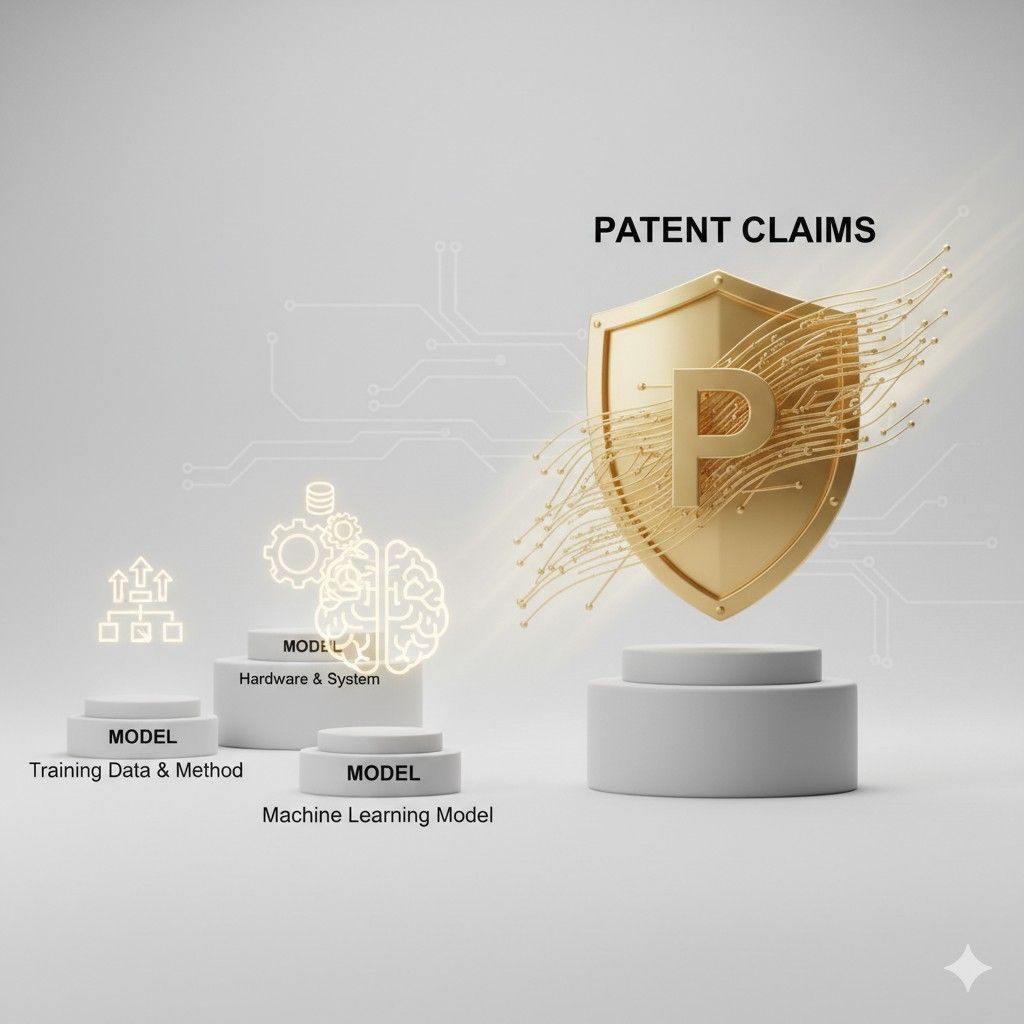
The key is to focus on the technical structure of the interaction. A general statement that a user can review results is not very useful. But a defined process in which selective human feedback is captured, scored, and fed back into the system in a controlled way may be highly valuable.
How to Describe Your AI System So It Is Harder to Copy
The way you describe your AI system can change the value of your patent in a very big way. Many companies spend years building something real, only to describe it in a way that is too thin, too generic, or too easy for others to work around. That is a costly mistake.
A weak description gives competitors room to step close to your invention without clearly stepping into your protected space.
The goal is not to make your system sound more complex than it is. The goal is to describe it with enough depth and structure that the real technical advantage becomes clear.
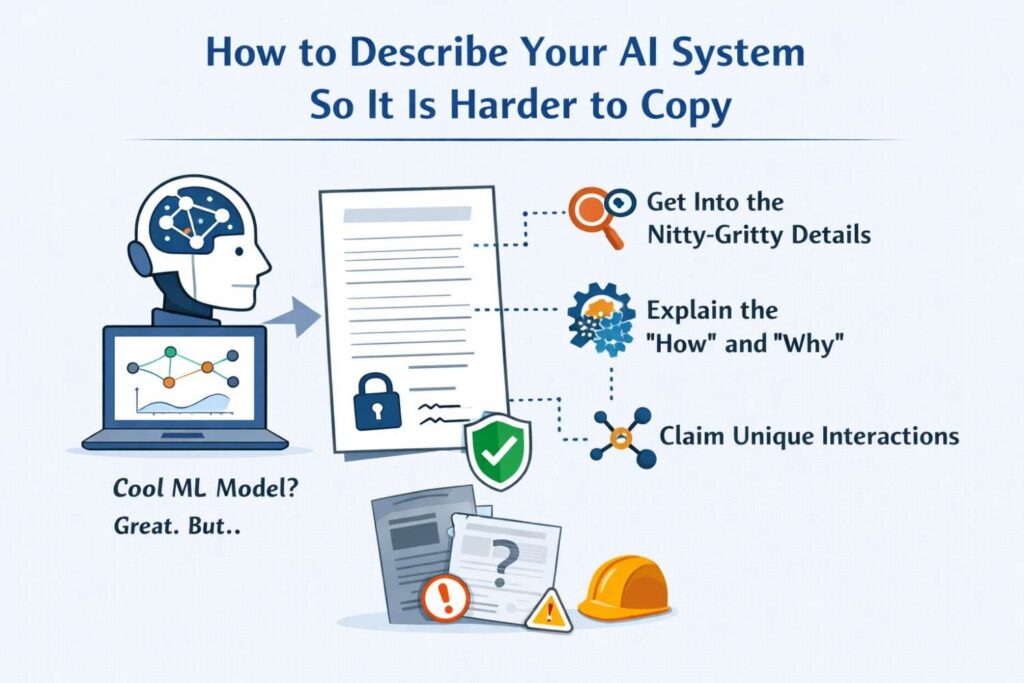
When you do that well, your patent becomes harder to design around. It also becomes more useful for the business, because it protects the real engine behind the product instead of just the surface idea.
Start by describing the system as a working machine, not a vague idea
A strong patent description should make the AI system feel like a real working system with clear parts, clear data flow, and clear technical purpose. It should not read like a slogan.
It should not sound like “an AI engine that improves outcomes” and stop there. That kind of language may sound polished, but it does very little to protect what you built.
A better approach is to describe how the system actually works from start to finish. Show what goes in, what happens to that input, how the model is used, how results are handled, and what technical action happens next.
When your description reflects the full working flow, it becomes much harder for someone else to claim that they are doing something totally different when they are really copying your method.
General words create weak walls
The more your description depends on broad words like analyze, process, optimize, classify, or predict without deeper detail, the more room a competitor has to shift language and argue they are outside your invention. Broad words alone are not enough.
They need support from real technical structure.
That does not mean you need to drown the patent in low-level code detail. It means you should explain what the system is doing in a way that ties each important step to a technical role.
A stronger wall comes from clear structure, not from fancy wording.
Describe the full flow, not just the model
Many founders describe their AI system as though the model is the whole product. In practice, that is almost never true.
The product usually includes data intake, data shaping, model execution, post-model handling, action logic, and feedback loops. If you leave those parts out, you leave open doors for others to walk through.
A better description shows the chain of operations that turns raw input into a useful result. This matters because competitors often do not need to copy your exact model.
They only need to copy the practical method that makes the model useful in the real world. If your patent tells the whole story, you are in a much better position.
Explain what problem each part solves
A system description becomes much stronger when each key part is tied to a concrete problem. This creates context. It helps show why the design matters.
It also makes the invention feel grounded in a real technical challenge instead of a loose set of software steps.
For example, do not just say that the system filters incoming data. Explain that the filtering reduces noisy signals that would otherwise trigger wrong predictions in a live production setting.
Do not just say that the system ranks outputs. Explain that ranking is used to control which results are passed to an automated action layer under strict latency limits. This kind of writing makes the description more useful and more defensible.
Technical function matters more than technical labels
It is tempting to lean on names like neural network, transformer, ensemble model, embedding layer, or agent framework.
Those labels may be part of the story, but they should not carry the whole description. Model names come and go. Technical function lasts longer.
A smarter description explains what role a component plays in the system and why that role matters. That creates a patent story that remains useful even when the exact stack changes later.
Show the points where your team made a hard choice
One of the best ways to make your AI system harder to copy is to describe the points where your team had to solve a real tradeoff. Those decision points often reveal where the invention actually lives.
Maybe your team had to balance speed against model depth. Maybe it had to decide when to trust a prediction and when to hold back. Maybe it had to choose which input signals were worth keeping under tight compute limits.
These moments matter because they show that your system is not just a standard use of AI. It is a set of technical choices designed to solve a real problem in a specific way.
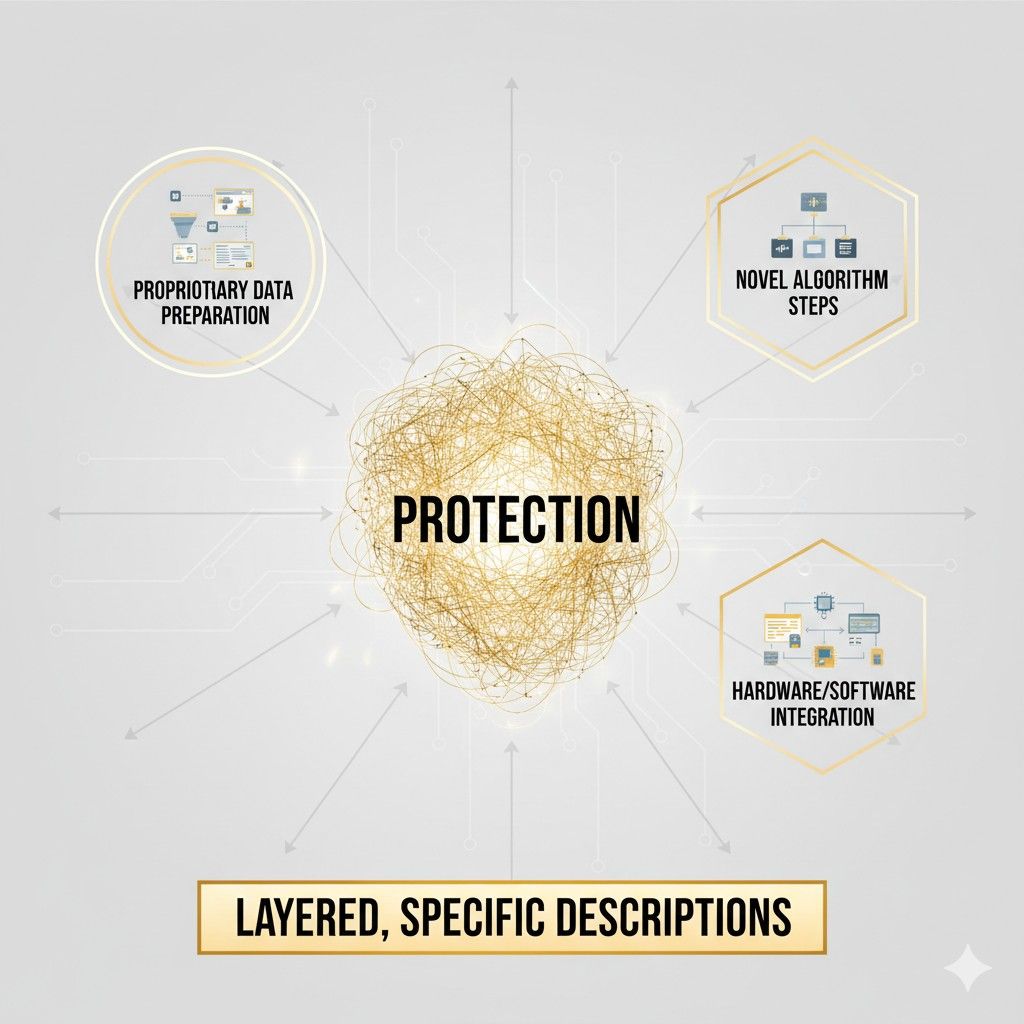
Competitors often face the same tradeoffs. If your patent captures how you solved them, it becomes much harder for them to copy your business result without stepping into similar territory.
Write about the system in layers
A strong way to describe an AI system is to move through it in layers. Start with the broad working flow.
Then move into the major components. Then explain the key interactions between those components. This creates flexibility. It gives the patent multiple ways to frame the invention.
If you only describe the system at one level, you may end up either too vague or too narrow.
But when you describe it in layers, you can protect the overall method as well as important sub-parts. That makes the filing stronger and more adaptable over time.
The top layer should show the business-relevant method
At the highest level, explain the system in a way that connects to the real product behavior. Show how the AI system supports the larger technical result the business delivers. This helps connect the patent to real commercial value.
That does not mean turning the patent into a pitch deck. It means showing that the invention is not just abstract computation. It is a machine-like process that does useful technical work in a real setting.
The middle layer should show major system parts
Once the broader flow is clear, describe the major parts of the system. This may include input preparation, representation building, model execution, result scoring, action triggering, and feedback handling.

Give each part a clear role and explain how the parts work together.
This is often where a competitor looking at your patent starts to feel boxed in. The system stops sounding like a generic AI idea and starts sounding like a real method with real boundaries.
The deeper layer should show the critical interactions
The most valuable part of the description is often the interaction between system parts. That is where the real invention often sits. A preprocessing step may matter because it changes how inference works.
A confidence score may matter because it controls whether the next system stage runs. A feedback signal may matter because it updates model behavior under certain conditions but not others.
When you describe those interactions clearly, you move from a simple component story to a defensible system story.
Describe alternatives on purpose
One of the smartest ways to make a patent harder to copy is to describe different ways the system can be implemented while keeping the same core idea. This is not filler.
This is strategy. It makes it harder for a competitor to dodge your patent by swapping one piece for another.
If the system can use different model types, different scoring methods, different data sources, or different trigger conditions while still following the same inventive concept, say so.
A patent becomes stronger when it shows the breadth of the invention without losing the core technical thread.
Variations help stop easy design-arounds
A competitor often looks for the easiest possible change that lets them say, “We do not infringe because our version uses a different component.” That is why alternative embodiments matter.
They help show that the invention is bigger than one exact implementation.
The best approach is not to add random variations. It is to describe realistic alternatives that still reflect the same technical insight. That keeps the patent grounded while making it much more difficult to work around.
Focus on the method that creates the result
Businesses often describe their AI system by talking about the output they get. That is only part of the story. The output matters, but the stronger patent description focuses on the method that creates that output.
A competitor may produce the same business result through a similar method but change a few labels.
If your patent description is built only around the end result, it may be easier for them to argue that their route is different. But if your description captures the process that creates the result, you are protecting the actual engine.
Make the data journey visible
A very effective way to describe an AI system is to follow the path of data through the system. Where does data come from. How is it selected. How is it cleaned. How is it shaped.
How is it passed to the model. How is the output checked. How does it affect later system behavior. When this journey is visible, the system feels concrete.
This also helps uncover parts of the invention that teams often overlook. Sometimes the strongest patent material is not in the model at all. It is in the way data is transformed before or after model use.
Do not treat data handling as background detail
Many teams think of data handling as setup work. But in real machine learning systems, data handling is often where much of the unique technical value sits.
If your business found a specific way to prepare or organize data so that the system works better in real conditions, that should be described with care.
A patent that ignores this may protect much less than the company thinks.
Describe control points, not just computation
Another way to make your AI system harder to copy is to highlight the control points in the flow. A control point is a place where the system decides what happens next.
It may decide whether to run another model, whether to trust a result, whether to ask for more input, whether to pass a result to automation, or whether to route the case for review.

These control points are often more valuable than raw prediction steps because they shape the real behavior of the product. They also reflect where a lot of practical engineering value lives. If your description captures those control points, you are protecting more of the real system logic.
Wrapping It Up
Patent claims for machine learning models are not just about naming the model, the training method, or the output. They are about protecting the real technical path that makes your product work in a way others cannot easily copy. That is the core idea that founders need to keep in mind.
Leave a Reply