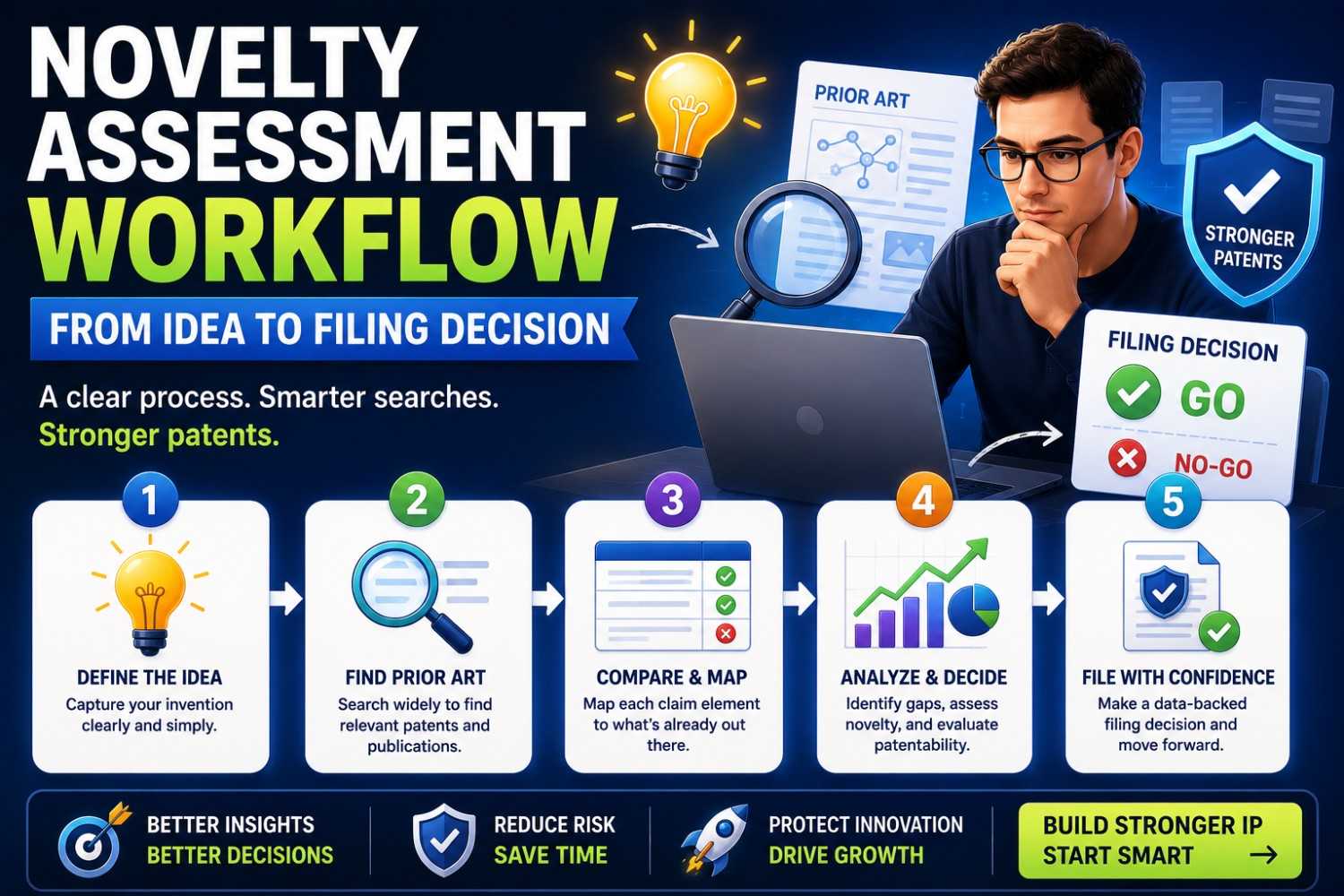
A new idea can feel exciting. It can also feel risky.
Before you file a patent, you need to know one thing: is your invention truly new enough to protect?
That is what a novelty assessment helps you answer. It turns a raw idea into a clear filing decision, without guessing, panic, or wasted patent spend.
PowerPatent helps founders, engineers, and inventors move from invention notes to better patent filings with smart software and real patent attorney oversight. See how PowerPatent works here.
What Novelty Really Means
Novelty means your invention has something new.
That sounds simple. But in patent work, “new” has a very specific meaning.
Your invention is not new if one earlier public source already shows every key part of what you want to claim. That earlier source can be a patent, a published patent application, a paper, a product page, a manual, a video, a public demo, a GitHub repo, a standards document, a thesis, or even your own public disclosure.
The key idea is this:
If the public could already learn the full invention before your filing date, the invention may not be novel.
Novelty does not ask whether your company is new. It does not ask whether your product is better. It does not ask whether you worked hard. It asks whether the specific invention you want to protect was already made public.
This is why founders need a workflow.
A founder may say, “No one does exactly what we do.”
That may be true. But patent novelty does not compare company stories. It compares claim elements.
A claim element is one required part of the invention.
If your invention has five key parts, and one old patent shows all five, novelty may be a problem. If the old patent shows only three, then novelty may still exist, though other issues may remain.
That is the heart of novelty assessment.
You break the invention into parts. You find what came before. You compare each part carefully. Then you decide whether to file, revise, search more, or pause.
This is not just a legal task. It is a smart startup task.
It helps you protect what matters before you spend money, pitch widely, launch publicly, or give competitors a roadmap.
Why Founders Should Assess Novelty Early
Many founders wait too long.
They build the product. They launch the product. They raise money. They publish technical posts. They speak at events. Then, months later, they ask whether they can patent the invention.
That is backwards.
Novelty should be checked early, while you still have options.
Early does not mean on day one when the idea is still vague. It means when your team can explain how the invention works and why it is different.
At that point, a novelty workflow can help you decide what to protect before public disclosure.
This matters because public disclosure can create risk. If you publish technical details before filing, you may limit your options. If a competitor files first, you may face a harder road. If a researcher posts a similar method, your claim space may shrink.
A novelty assessment helps you act before the window gets tight.
It also helps you avoid filing weak patents.
Not every idea deserves a patent filing. Some ideas are too close to old work. Some are easy to design around. Some are business ideas, not technical inventions. Some are better kept as trade secrets. Some need more development before filing.
A good workflow helps you tell the difference.
PowerPatent is built for this kind of founder reality. It helps teams capture invention details, organize the technical story, and move toward filing with real attorney oversight. Explore how PowerPatent helps teams file better patents faster.
The Big Mistake: Treating Novelty Like a Feeling
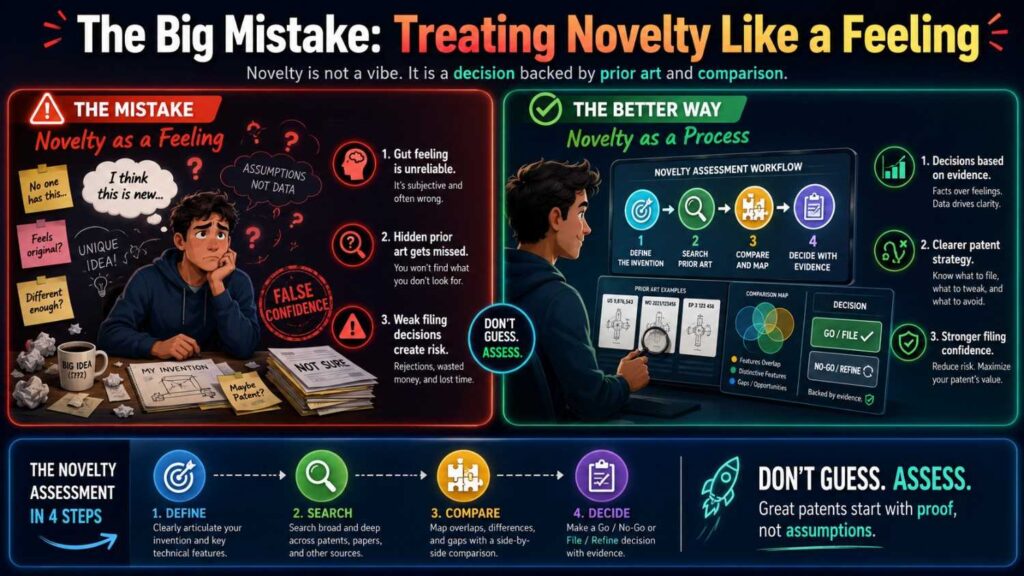
Novelty is not a feeling.
It is not “this seems new.”
It is not “we have not seen this in the market.”
It is not “our investors liked it.”
It is not “our competitor does not have this feature.”
Those things may matter for the business. But they are not enough for a patent decision.
A novelty assessment must be specific.
You need to know what the invention is, what parts are required, what prior art exists, and whether one prior art source shows all the required parts.
That means you cannot assess novelty from the product name alone.
“AI legal assistant” is not an invention.
“Battery health platform” is not an invention.
“Drone delivery system” is not an invention.
“Smart factory dashboard” is not an invention.
Those are product ideas or market labels. A patentable invention is usually deeper.
It may be a method for checking AI output against source support. It may be a way to detect battery swelling during matched charging windows. It may be a drone route adjustment method based on wind and battery discharge. It may be a factory alert system that groups warnings by shared sensor drift.
Novelty lives in the technical details.
So the first step is not searching.
The first step is defining the invention.
Step One: Write the Invention in One Plain Sentence
Before you search, write one sentence that explains the invention.
Keep it simple.
Use this shape:
“Our invention does [main action] by using [key technical method] so that [technical result] improves.”
For example:
“Our invention detects early battery swelling by comparing pressure drift during matched charging windows so that false alerts during fast charging are reduced.”
Or:
“Our invention checks AI-generated answers by comparing model confidence with source trust so that unsupported answers are sent to review before users see them.”
Or:
“Our invention routes support tickets by combining ticket text, error logs, software version, and recent configuration changes so that the system can ask one useful question before sending the ticket to a human.”
Or:
“Our invention predicts robot blind-corner risk by combining sound direction, map shape, and recent traffic history so that the robot slows before a hidden object appears.”
This sentence is not a final patent claim. It is a working invention statement.
It gives the team a clear starting point.
If you cannot write this sentence, your invention may still be too fuzzy. That is not a failure. It means you need to talk with the engineers, review the design, and find the real technical move.
Many startups discover that the product idea is broad, but the actual invention is narrow and strong.
That is good.
A narrow, clear invention can be much more valuable than a broad, vague one.
Step Two: Separate the Product From the Invention
A product can include many inventions.
It can also include many things that are not patentable.
A product has branding, user experience, pricing, workflows, integrations, dashboards, and business rules. Some of those may be important to customers. But patent novelty usually turns on the technical part.
So ask:
What did we build that solves a technical problem in a specific way?
For a software startup, the invention may be a data pipeline, a scoring method, a feedback loop, a model-checking step, a privacy-preserving process, or a resource-saving workflow.
For a hardware startup, the invention may be a sensor layout, a structure, a material interaction, a control loop, a calibration method, or a thermal path.
For an AI startup, the invention may be how data is selected, how prompts are built, how outputs are checked, how feedback updates the system, or how a model runs safely in a limited environment.
For a robotics startup, the invention may be sensing, path planning, control timing, collision prediction, human interaction, or multi-robot coordination.
The product is the house.
The invention is the beam that holds it up.
Novelty assessment works only when you know which beam you are testing.
Step Three: Explain the Technical Problem
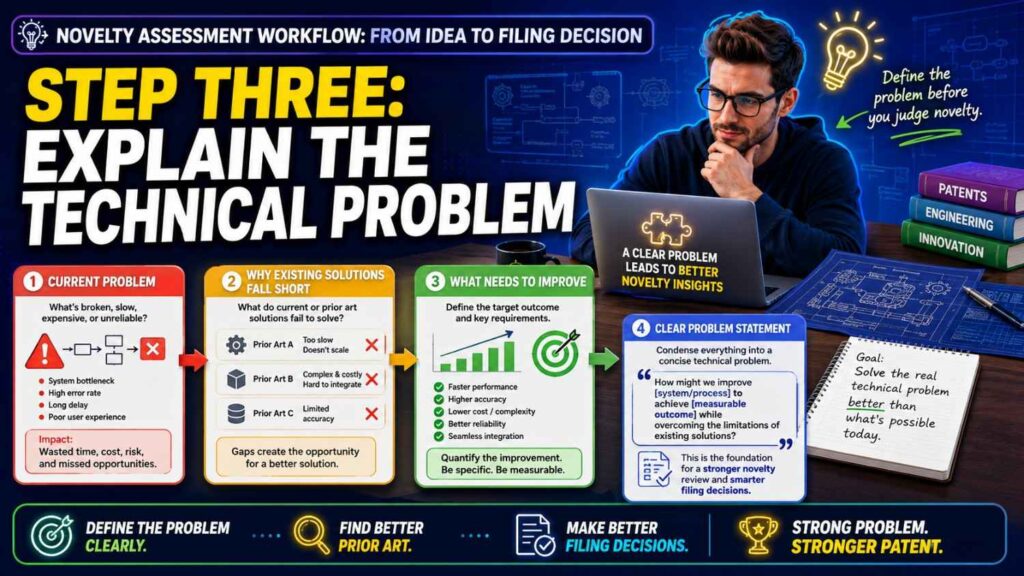
A strong novelty workflow starts with the problem.
Not the customer pain in broad terms. The technical problem.
For example, “doctors need faster notes” is a customer pain.
A technical problem may be:
“The system must summarize noisy patient data without missing key context and without showing unsupported model output.”
“Warehouses need safer robots” is a customer pain.
A technical problem may be:
“The robot cannot see around blind corners, but it must decide whether to slow before a person or forklift enters view.”
“Battery packs need better safety” is a customer pain.
A technical problem may be:
“Pressure readings rise during fast charging even when dangerous swelling is not happening, which causes false alarms.”
The technical problem points to the invention.
It also guides the search.
If you search only the customer pain, you get broad results. If you search the technical problem, you get closer art.
This step matters because prior art may use different product names but solve the same technical problem.
A patent examiner will not care that your app has a modern brand and a cleaner screen. The examiner will care whether the old art already solved the same technical problem in the same way.
So write the problem clearly.
Then write the old way people handled it, if you know.
Then write why the old way was not enough.
That sets up the novelty review.
Step Four: List the Required Parts of the Invention
Now break the invention into pieces.
These pieces are the parts that must be present for the invention to work.
Do not list every product feature. List the invention parts.
For example, take this invention statement:
“Our invention checks AI-generated answers by comparing model confidence with source trust so that unsupported answers are sent to review before users see them.”
The required parts may be:
The system generates an answer using a model.
The system creates a model confidence score.
The system creates a source-trust score.
The system compares model confidence with source trust.
The system sends an answer to review when source trust is low.
The system can send the answer to review even when model confidence is high.
The system blocks or delays display until review is complete.
Those are the novelty elements.
Now take the battery example:
The system measures pressure related to battery expansion.
The system tracks pressure drift across charging cycles.
The system compares drift during matched charging windows.
The matched windows are based on charge rate, temperature, or both.
The system adjusts a swelling score.
The system uses the score to trigger an alert or change charging behavior.
Now you have something to search and compare.
This step is powerful because it keeps you honest.
You are no longer asking, “Is our battery safety platform new?”
You are asking, “Has anyone already shown pressure drift comparison during matched charging windows with charge-rate or temperature adjustment?”
That is a much better question.
Step Five: Mark the Core Element
Not every element is equally important.
Some parts are ordinary. Some parts carry the invention.
A processor may be ordinary. A sensor may be ordinary. A database may be ordinary. A user screen may be ordinary. The core element is the special part that creates the technical difference.
In the AI answer-checking example, the core may be:
Review is triggered by low source trust even when model confidence is high.
In the battery example, the core may be:
Pressure drift is compared during matched charging windows to reduce false swelling alerts.
In the robot example, the core may be:
The robot acts before visual detection by using non-visual cues and map shape.
In the support ticket example, the core may be:
A middle-confidence range triggers one clarifying question before routing.
The core element is the part you should search hardest.
It is also the part your patent application should explain best.
Founders often focus on the visible feature because that is what customers see. But the patentable feature may be hidden inside the system.
PowerPatent helps teams pull out these hidden details from invention notes, diagrams, code, and engineering decisions so the filing can focus on the real technical edge. See how PowerPatent works.
Step Six: Build a Search Term Bank
Do not start with one search query.
Start with a bank of search terms.
You need different words for the same idea because prior art may use language you do not use.
Your team may say “source trust.” Prior art may say “document reliability,” “evidence score,” “provenance weight,” “citation support,” or “source confidence.”
Your team may say “battery swelling.” Prior art may say “cell expansion,” “deformation,” “bulging,” “mechanical strain,” or “pack pressure.”
Your team may say “blind-corner risk.” Prior art may say “occluded object prediction,” “non-line-of-sight detection,” “intersection safety,” or “hidden obstacle avoidance.”
Your team may say “middle-confidence handoff.” Prior art may say “uncertainty band,” “ambiguous classification,” “confidence interval,” or “human-in-the-loop routing.”
Search language matters.
A weak search uses only your own words.
A strong search uses problem words, solution words, technical object words, and result words.
For the battery example, problem words may include swelling, expansion, deformation, false alarm, pressure drift, and fast charging.
Solution words may include compare, normalize, adjust, match, compensate, score, detect, trigger, and control.
Technical object words may include battery pack, cell, pressure sensor, charge cycle, temperature, charge rate, and state of health.
Result words may include early detection, false positive reduction, safer charging, warning, and current reduction.
Mix and match.
You are not looking for one magic search. You are learning the language of the field.
Step Seven: Search Broadly First
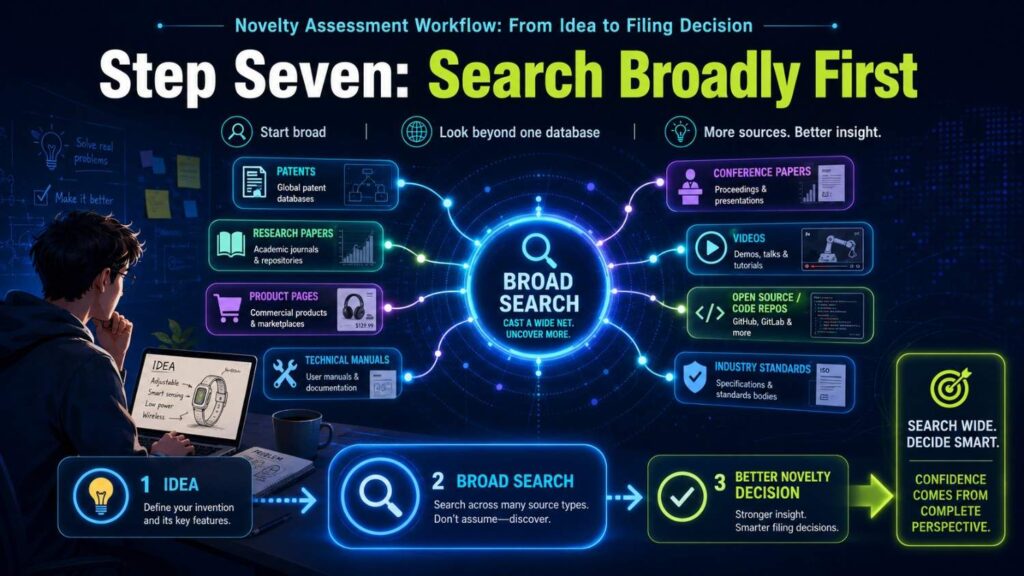
Start broad so you can see the field.
Use tools like Google Patents, USPTO Patent Public Search, Espacenet, and PATENTSCOPE for patent searching. Also search normal web results, research papers, GitHub, standards, manuals, product pages, and conference materials when relevant.
Do not rely only on patents.
In software and AI, important prior art may be in papers, code, documentation, or technical blogs.
In hardware, it may be in manuals, datasheets, standards, and product guides.
In robotics, it may be in conference videos, lab papers, and open-source simulation projects.
In biotech and medical tools, it may be in journal articles, protocols, trial records, and technical posters.
Novelty can be blocked by many kinds of public information.
At this stage, do not read everything deeply.
Collect likely references.
Look for results that use the same technical method, solve the same problem, or include your core element.
Save the title, link, date, owner or author, and short note.
Keep your notes clean.
A messy search creates a messy decision.
Step Eight: Search Narrowly Around the Core Element
After broad search, focus on the core.
This is where novelty assessment gets serious.
Search the exact technical move.
For the AI example, do not search only “AI answer review.”
Search:
model confidence source trust human review
AI output source reliability confidence score
generated answer citation support review trigger
LLM answer verification source confidence
high confidence low source trust review
For the battery example, do not search only “battery swelling sensor.”
Search:
battery pressure drift charging cycle
battery swelling pressure charge rate temperature
cell expansion matched charging window
battery deformation fast charge false alarm
pressure sensor battery expansion temperature compensation
For the robot example, do not search only “robot collision avoidance.”
Search:
robot blind corner sound direction map
non-line-of-sight obstacle prediction robot
occluded pedestrian robot warehouse sound
robot slows before visual detection hidden obstacle
warehouse robot traffic history collision prediction
These narrow searches help you find the closest art.
They also show whether your words are too new or too vague.
If you find nothing, do not assume victory. Try synonyms. Try older terms. Try related fields.
Novelty assessment rewards patience.
Step Nine: Search Competitors, Inventors, and Assignees
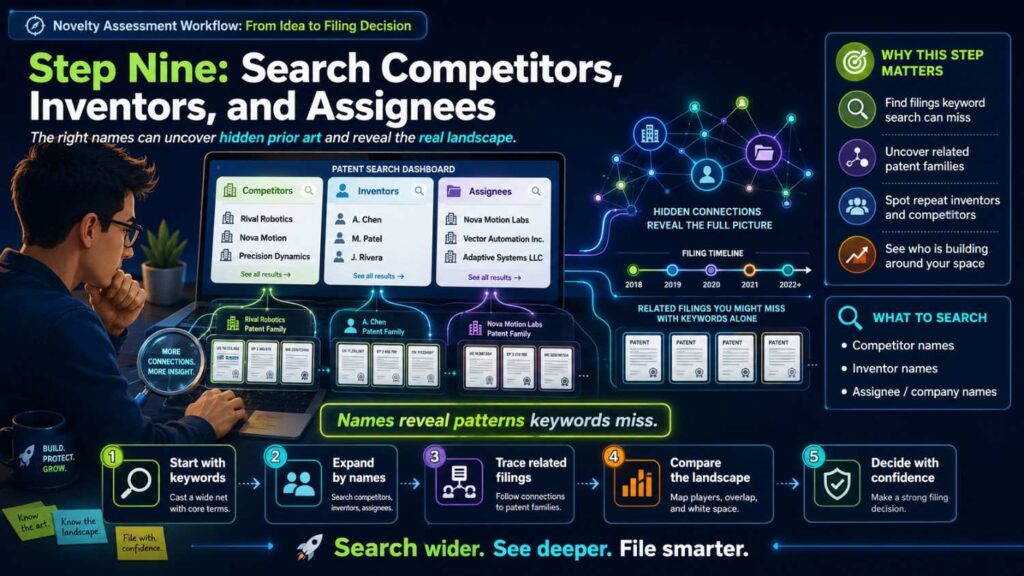
Competitor searching is useful, but it should not be your only search.
Search competitor company names.
Search founder names.
Search key engineer names.
Search old company names.
Search acquired company names.
Search product names.
Search university labs or spinouts in your field.
Search suppliers if your invention depends on hardware or materials.
Competitor patents can help you see where the market is going.
But do not assume competitor art is the closest art.
Sometimes the closest reference comes from a failed startup, a research lab, a foreign patent filing, or a company in a different industry.
Still, competitor searching gives useful business context.
If a competitor has filed around a nearby method, you may need to sharpen your claim focus.
If competitors are missing your technical edge, you may have a chance to build a stronger position.
This is where novelty and business strategy meet.
Step Ten: Follow Citations and Patent Families
When you find a close patent, do not stop.
Look at the patents it cites.
Look at the patents that cite it.
Look at related family members.
Look at continuation filings.
Look at foreign filings.
Look at the patent classification codes.
A close patent is a doorway into a whole area of prior art.
If five close patents all cite the same older reference, read that older reference.
If several close patents share the same classification, search within that class.
If a patent family has many related filings, check whether one version has broader details than another.
This step often reveals the strongest prior art.
Many founders miss it because they stop after the first page of results.
Do not stop too early.
A novelty assessment is only as good as the closest prior art you find.
Step Eleven: Read the Closest References Carefully
Now it is time to read.
Do not read every result deeply. Read the closest ones.
For each close patent, read the abstract, the main claims, the drawings, and the detailed description around your key terms.
For each paper, read the abstract, method, figures, examples, and results.
For each product page or manual, look for actual technical teaching, not marketing claims.
Ask what the reference really shows.
Does it show the same input?
Does it use the same timing?
Does it create the same score?
Does it trigger the same action?
Does it update the system in the same way?
Does it solve the same technical problem?
Does it create the same technical result?
Do not rely on titles.
A title can sound close and be different. A title can sound vague and hide a direct hit.
Read with a purpose.
You are not reading for fun. You are reading to compare elements.
Step Twelve: Build a Novelty Map
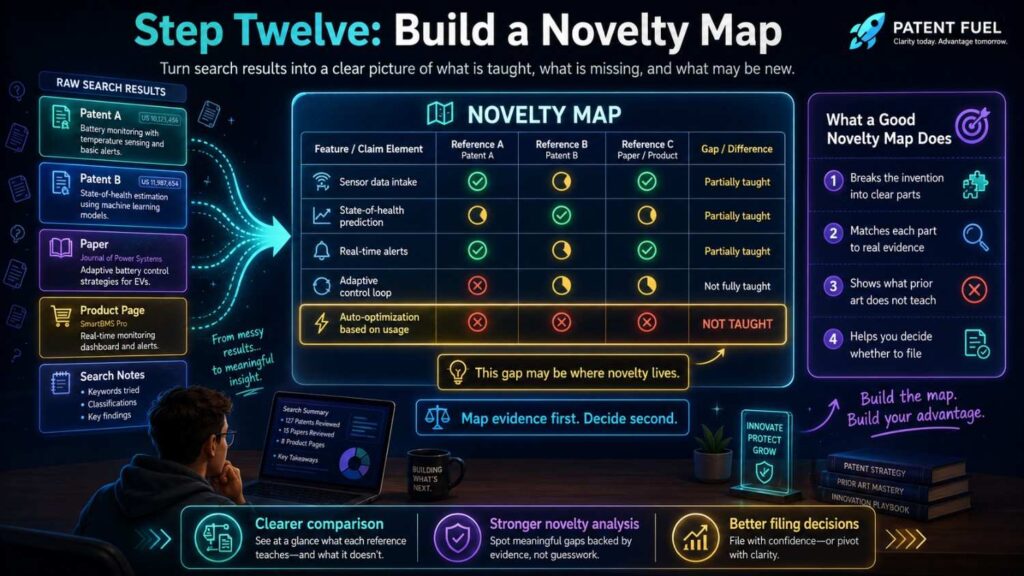
A novelty map is a simple table.
On the left, write the elements of your invention.
Across the top, write the closest prior art references.
In each box, write whether the reference shows the element.
Use plain labels:
Yes.
No.
Partial.
Unclear.
Then add a short note.
For example, for the AI answer-checking invention:
Element: Generates model answer.
Reference A: Yes. It uses a model to generate a response.
Reference B: No. It ranks documents but does not generate answers.
Reference C: Yes. It generates answers with citations.
Element: Creates model confidence score.
Reference A: Yes.
Reference B: No.
Reference C: Partial. It ranks answer quality but does not create a separate confidence score.
Element: Creates source-trust score.
Reference A: No.
Reference B: Yes. It ranks document reliability.
Reference C: Partial. It checks citation presence but not source trust.
Element: Sends answer to review when source trust is low even if model confidence is high.
Reference A: No. Review is based on low model confidence.
Reference B: No. No generated answer review.
Reference C: No. It displays citation support but does not route to review based on source trust.
This map gives you clarity.
No single reference shows the full invention. But pieces exist. That may mean the invention has novelty but may face a separate question about whether the pieces would be easy to combine.
That is why novelty assessment is the first decision point, not the only one.
Step Thirteen: Check One Reference at a Time
Novelty is usually tested one reference at a time.
So do not mix references too early.
Ask:
Does Reference A show every required element?
Does Reference B show every required element?
Does Reference C show every required element?
If one reference shows every element, your working claim may lack novelty.
If no single reference shows every element, your working claim may be novel.
But keep the word “may” in mind. Patent work depends on exact claim language and facts.
At the founder workflow level, the one-reference test is the key novelty check.
Do not say, “The invention is old because one feature is in Reference A and another is in Reference B.”
That may be an obviousness issue, but it is not the same as novelty.
This distinction matters because it changes your decision.
If one reference shows all elements, you may need to revise the claim.
If multiple references show pieces, you may need to build a stronger story around why your combination is different and not an easy next step.
Step Fourteen: Identify the First Real Gap
The gap is the part the closest reference does not show.
A strong gap is specific and meaningful.
Weak gap:
“The prior art does not use our brand name.”
Strong gap:
“The prior art uses model confidence to trigger review, but does not use a separate source-trust score to trigger review when model confidence is high.”
Weak gap:
“The prior art does not have our dashboard.”
Strong gap:
“The prior art shows pressure alerts, but does not compare pressure drift during matched charging windows to reduce false alerts during fast charging.”
Weak gap:
“The prior art is not for warehouses.”
Strong gap:
“The prior art slows at blind corners based on map location only, but does not predict hidden crossing risk using sound direction and recent traffic history before visual detection.”
The gap should point to a technical difference.
It should also connect to a technical result.
A gap with no result may not be useful.
A gap that improves safety, speed, accuracy, power use, signal quality, compute cost, reliability, or control is much stronger.
Step Fifteen: Ask Whether the Gap Is Actually Required
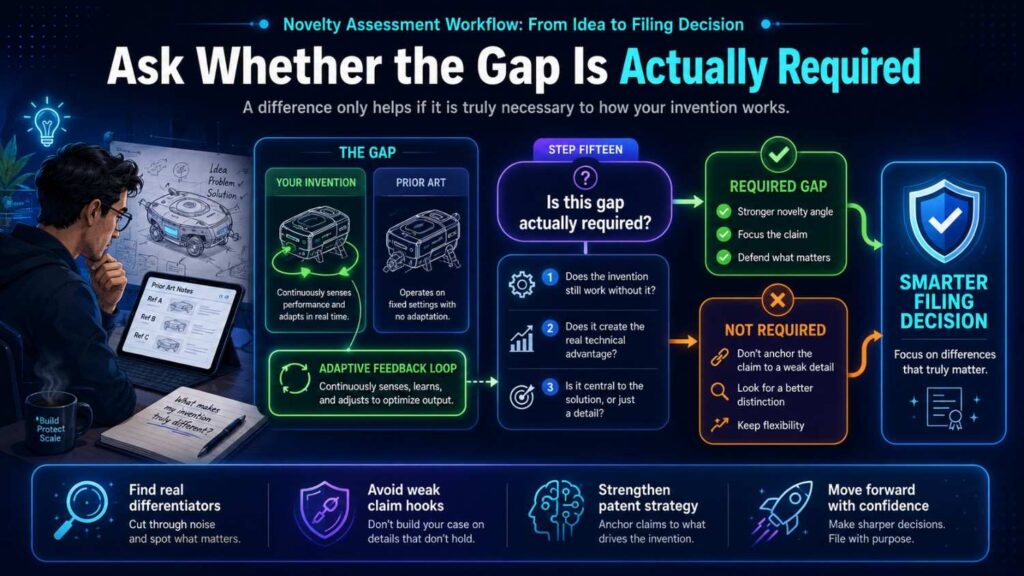
Sometimes founders identify a difference that is not essential.
For example, your product may use a blue warning light. Prior art uses a red warning light. That is a difference, but it may not matter.
Your system may store data in one cloud database. Prior art uses another. That may not matter unless the storage method creates a technical result.
Your model may use a certain framework. Prior art uses another. That may not matter unless the framework affects how the invention works.
So ask:
Is the gap required for the invention to work?
Does it create the benefit?
Would a competitor need this gap to copy the value?
Does it solve the technical problem?
Should it be in the claim?
If the answer is no, it may not be the right novelty anchor.
You want to anchor the claim on a meaningful technical difference, not a random product detail.
Step Sixteen: Refine the Invention Statement
After mapping, revise your working invention statement.
Your first version may be too broad.
For example:
“Our invention detects battery swelling using pressure data.”
The map may show that this is already known.
So refine:
“Our invention detects battery swelling by comparing pressure drift during matched charging windows and adjusting a swelling score based on charge rate and temperature.”
That is better.
Another example:
“Our invention reviews AI answers.”
Too broad.
Refined:
“Our invention routes AI-generated answers to review when source trust is low even if model confidence is high.”
Better.
Another example:
“Our invention helps robots avoid collisions.”
Too broad.
Refined:
“Our invention predicts blind-corner crossing risk before visual detection by combining sound direction, map shape, and recent traffic history.”
Better.
This is how novelty assessment improves the invention.
It does not just say yes or no. It helps you find the right claim focus.
Step Seventeen: Run the Novelty Map Again
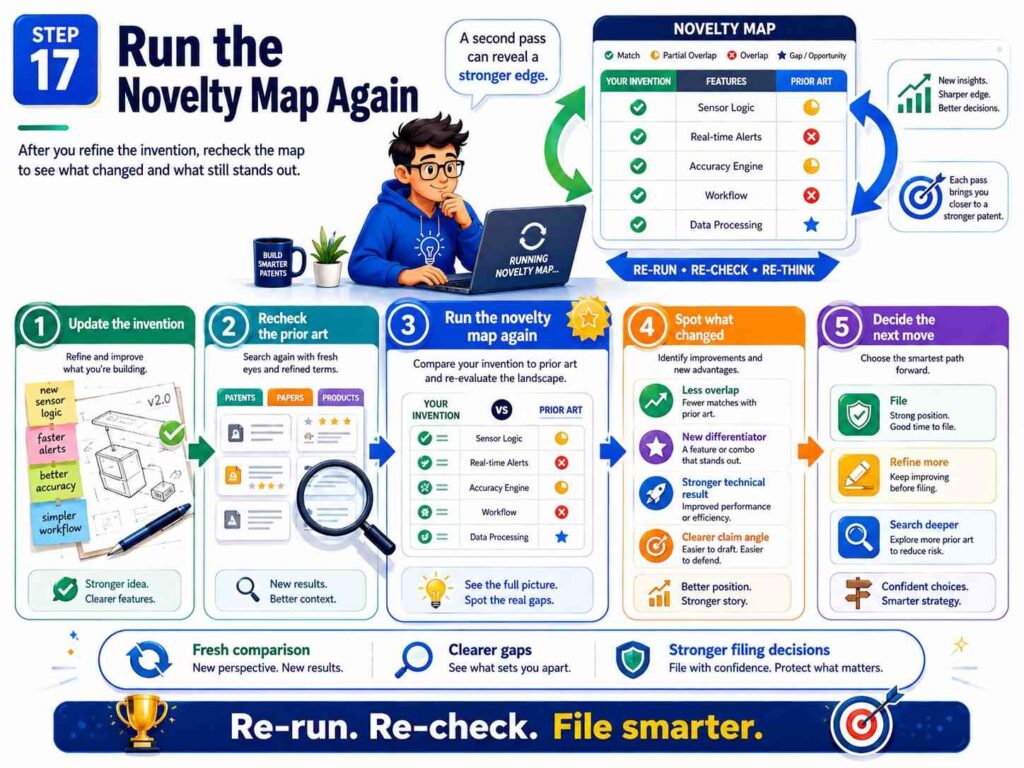
After you refine the invention statement, map again.
This second pass is important.
Your first map tested a broad idea. Your second map tests the sharper idea.
Ask:
Does one prior art reference show every element of the refined invention?
If no, your novelty position may be stronger.
If yes, refine again or look for another invention angle.
Do not keep adding random details until the claim becomes tiny.
Add only details that matter.
This is the balance.
You want the claim to be different from prior art, but still broad enough to protect business value.
If you add too many product-specific details, competitors can design around you.
If you add too few, prior art may block you.
A novelty workflow helps you find the middle.
Step Eighteen: Check Whether the Invention Is Still Valuable
A refined invention may be novel but not valuable.
That can happen.
For example, maybe the only new part is a very small UI detail.
Or a narrow setting no one cares about.
Or a feature competitors can easily avoid.
Or a backend choice that does not affect customer value.
Before filing, ask:
Would this claim cover something competitors would want to copy?
Does it protect a feature tied to our moat?
Does it matter to customers?
Does it support our product roadmap?
Can we detect if someone uses it?
Is it worth patent spend?
Novelty alone is not enough.
A patent should protect something meaningful.
A technically new but commercially useless claim may not be worth filing.
Founders need to make this call with both technical and business judgment.
Step Nineteen: Check Whether the Invention Is Enabled in Your Notes
A patent application must describe the invention well enough.
So before filing, check whether you can explain how it works.
Do you have diagrams?
Do you have a flow?
Do you know the inputs?
Do you know the outputs?
Do you know the timing?
Do you know the decision rules?
Do you know what happens after the decision?
Do you know alternatives?
Do you know the technical result?
Do you have examples?
If you cannot describe the invention clearly, you may need more invention capture before filing.
This is especially true for AI and software.
Saying “use AI to decide” is not enough.
You need to explain what data is used, what scores are made, what rules are applied, what happens when conditions are met, and how the system improves.
PowerPatent helps founders capture these details in a structured way, then adds attorney oversight so the filing is not built on vague notes. See how PowerPatent works.
Step Twenty: Decide Whether to File, Revise, Search More, or Pause
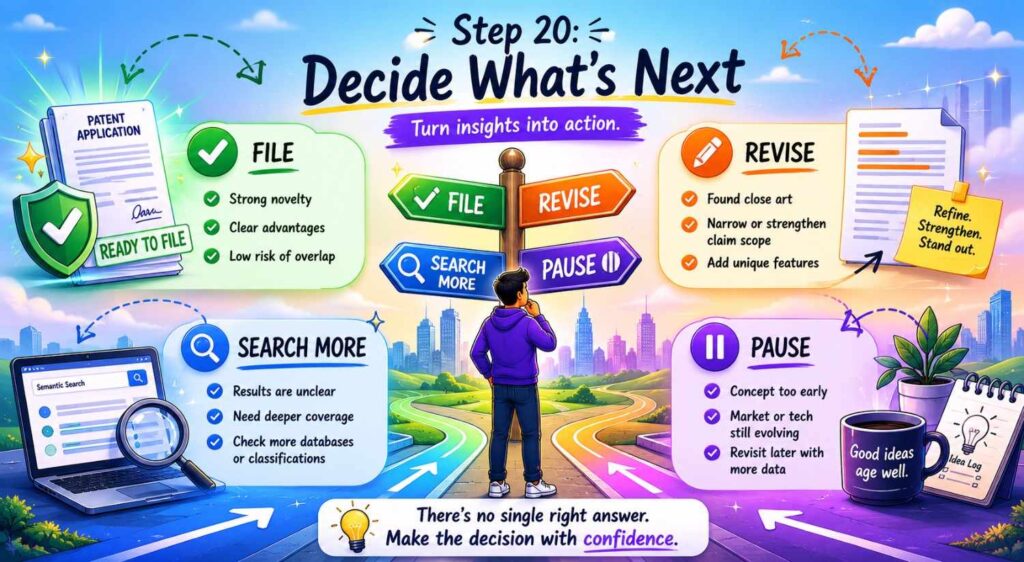
At the end of the novelty workflow, make a decision.
Do not leave the work unfinished.
There are four common outcomes.
The first outcome is file.
This makes sense when the invention appears novel, the gap is meaningful, the business value is high, and timing matters.
The second outcome is revise.
This makes sense when the broad idea is old, but a narrower technical method looks new and valuable.
The third outcome is search more.
This makes sense when results are unclear, the field is crowded, or the closest art has not been found.
The fourth outcome is pause.
This makes sense when the idea is not developed enough, the gap is weak, or the invention is not worth patent spend right now.
A good novelty assessment does not always end in a filing.
Sometimes it saves you from a bad filing.
Sometimes it shows you a better filing.
Sometimes it reveals a hidden invention.
That is why the workflow is worth doing.
How to Know When the Idea Is Ready for Novelty Review
Do not assess too early.
A loose idea is hard to search. You will waste time.
Do not assess too late.
A public launch or disclosure may limit options.
The right time is when your team can explain the invention in enough detail that someone else could understand how it works.
You do not need a perfect product.
You do need a real technical concept.
A good sign is when engineers can answer these questions:
What was hard?
What did we try first?
What failed?
What changed?
What data does the system use?
What step creates the result?
What is different from standard practice?
What would a competitor copy?
If the team can answer these, the idea is ready for novelty review.
Example Workflow: AI Answer Verification
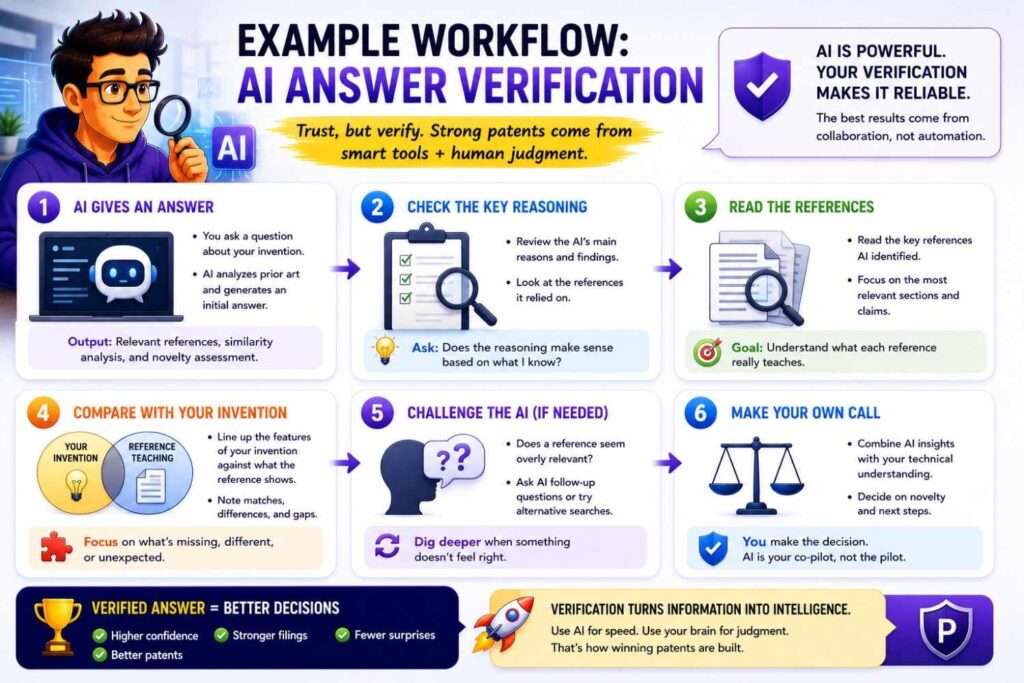
Let’s walk through a full example.
Imagine your startup builds an AI tool for technical research. It answers questions using internal documents.
At first, the idea sounds broad:
“An AI system that answers questions from documents.”
That is likely crowded.
So you define the technical problem:
The model can sound confident even when the source document is weak, outdated, or not tied to the answer.
Now you write the invention statement:
“Our invention checks AI-generated answers by comparing model confidence with source trust, then routes answers to review when source trust is low even if model confidence is high.”
You break it into elements.
The system generates an answer.
The system creates a model confidence score.
The system creates a source-trust score.
The system compares the two scores.
The system routes the answer to review when source trust is low.
The system can route high-confidence answers to review if source trust is low.
The system blocks or delays display until review.
Now you search.
You find prior art for model confidence scoring. You find prior art for document reliability ranking. You find prior art for human review of low-confidence outputs. You find prior art for citation-backed answers.
Now you map.
No single reference shows the full workflow. The closest reference routes low-confidence model answers to review. But it does not use source trust to override model confidence.
That is your gap.
Now ask whether the gap matters.
It does. High-confidence unsupported answers can be dangerous in technical work. Your system catches a different failure mode than low-confidence review systems.
Now refine the filing angle.
The filing should not focus on “AI answers from documents.” It should focus on the conflict between model confidence and source trust, and the review routing rule that handles that conflict.
That is a strong novelty workflow outcome.
It turns a broad, crowded idea into a sharper filing decision.
Example Workflow: Battery Swelling Detection
Imagine your startup builds a battery monitoring system.
At first, the idea is:
“A system that detects battery swelling.”
That is broad.
You define the technical problem:
Fast charging can cause temporary pressure changes that look like swelling, creating false alerts.
Now write the invention statement:
“Our invention detects swelling risk by comparing pressure drift during matched charging windows and adjusting the score based on charge rate and temperature.”
Break it into elements.
The system measures pressure.
The system tracks pressure drift.
The system defines charging windows.
The system matches windows based on charge rate or temperature.
The system adjusts a swelling score.
The system triggers an alert or charging change.
Now search.
You find patents that use pressure sensors for swelling. You find papers on battery expansion. You find battery health systems using temperature. You find charge-cycle comparison methods.
Now map.
One reference shows pressure-based swelling detection with fixed thresholds.
Another shows temperature-based battery health.
Another compares battery data across cycles but not pressure drift during matched windows.
No single reference shows your full method.
The closest art lacks matched charging windows and adjustment for charge rate.
Now ask whether the gap matters.
Yes. The gap reduces false alerts during fast charging while still supporting early warning.
Now make the filing decision.
If this feature is core to your product and timing is urgent, it may be worth filing around the matched-window pressure-drift method, with backup versions for other context signals and control outputs.
That is a clear decision.
Example Workflow: Support Ticket Routing
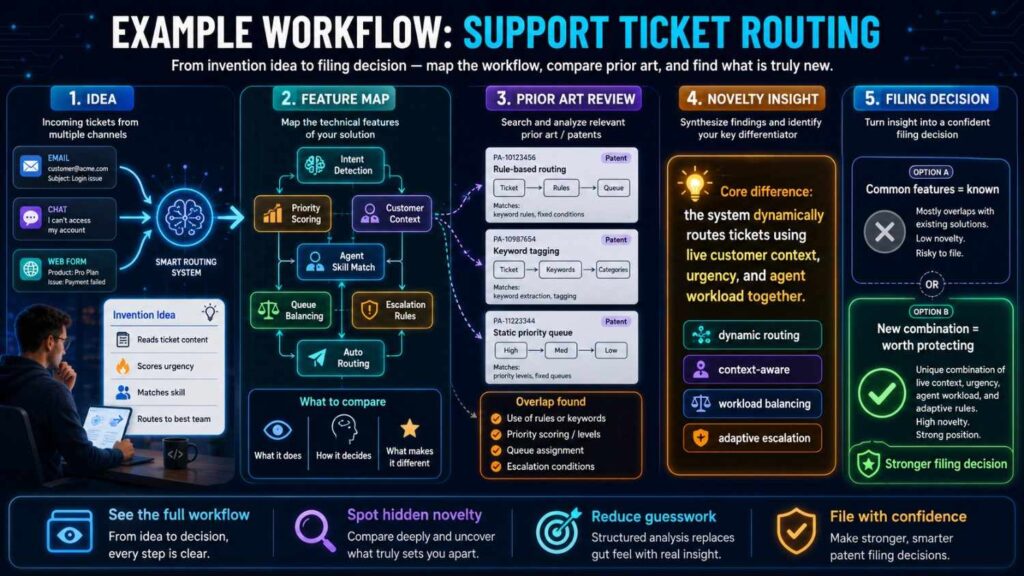
Imagine your startup builds AI support automation.
The broad idea:
“An AI tool that routes support tickets.”
Crowded.
Technical problem:
Text alone often misclassifies tickets because the same words can point to different causes depending on software version, logs, and recent configuration changes.
Invention statement:
“Our invention routes support tickets by creating a failure-pattern score from ticket text, error logs, software version, and recent configuration changes, then asking one clarifying question when the score falls in a middle-confidence range.”
Elements:
The system receives a support ticket.
The system uses ticket text.
The system uses error logs.
The system uses software version.
The system uses recent configuration changes.
The system creates a failure-pattern score.
The system defines a middle-confidence range.
The system asks one clarifying question before routing.
The system may update the pattern after confirmed resolution.
Search results show ticket classification using text, log-based fault detection, confidence-based routing, and chatbot questions.
Now map.
No single reference shows the full failure-pattern score with text, logs, version, and configuration changes plus the middle-confidence question.
The gap appears to be the specific decision flow.
Now ask whether the gap matters.
Yes. It can reduce wrong auto-responses and reduce unnecessary human handoffs.
Filing decision:
The broad idea is crowded, but the workflow may be worth filing if it is central to the product. The patent application should explain the score, the middle-confidence band, the clarifying question, and the confirmed-resolution update.
That is a good novelty outcome.
Example Workflow: Robot Blind-Corner Safety
Imagine your startup builds warehouse robots.
Broad idea:
“A robot that avoids collisions.”
Very crowded.
Technical problem:
The robot cannot see around a corner, but it needs to slow before a person or forklift enters view.
Invention statement:
“Our invention predicts blind-corner crossing risk before visual detection by combining sound direction, map geometry, and recent traffic history.”
Elements:
The robot has map data.
The map includes blind-corner geometry.
The robot receives sound direction data.
The robot uses recent traffic history.
The robot predicts crossing risk before visual detection.
The robot slows or changes path before reaching the crossing point.
Search results show robots slowing near corners, sound-based human detection, map-based routing, and traffic-aware scheduling.
Now map.
The prior art has pieces. But no single reference shows the full pre-visual crossing prediction using sound direction, map geometry, and recent traffic history.
The gap is the pre-visual prediction loop.
Now ask whether the gap matters.
Yes. It allows earlier control action before the robot can see the obstacle.
Filing decision:
This may support a filing focused on pre-visual crossing risk, not generic collision avoidance.
That is the power of a novelty workflow.
It finds the real invention inside a crowded space.
The Difference Between Novelty and “Not Obvious”
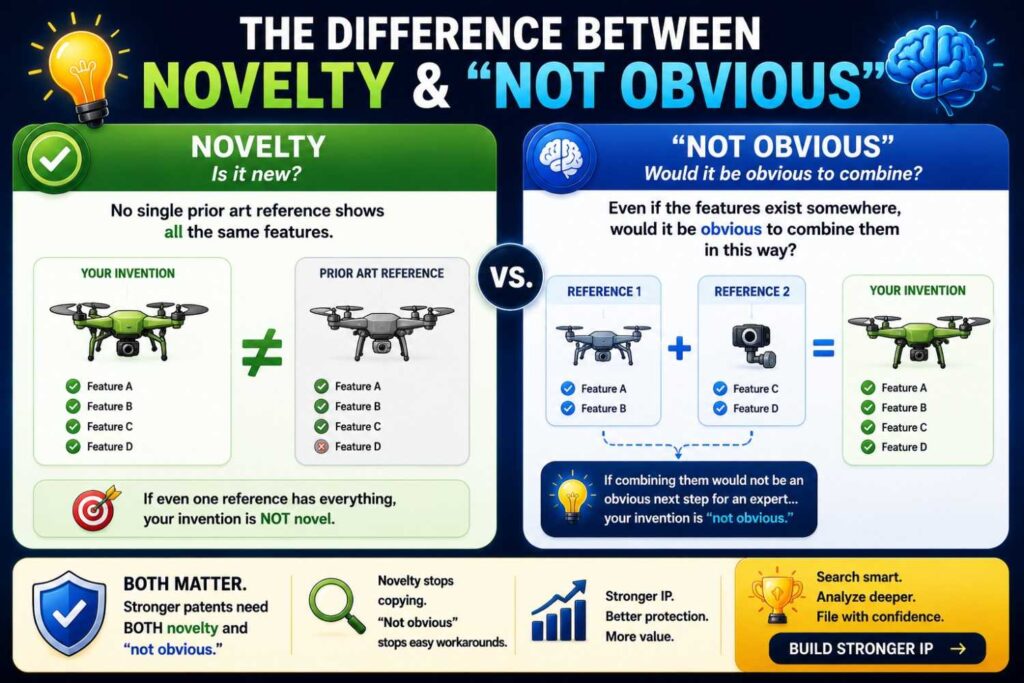
Novelty asks whether one prior art source shows every key part.
“Not obvious” asks a different question. It asks whether the invention would have been an easy next step based on what was already known.
A claim can be novel but still face an obviousness issue.
For example, no single reference may show your exact battery method. But one reference may show pressure sensing, another may show temperature adjustment, and another may show charge-cycle comparison. An examiner may ask whether combining them would have been obvious.
That is not the same as novelty.
Your novelty workflow should flag this.
After you find that no single reference shows all elements, ask:
Are the missing elements shown in other references?
Would someone have had a reason to combine them?
Do the references solve the same problem?
Would combining them produce the same result?
Would the combination create problems?
Does any reference point away from your method?
This helps you avoid overconfidence.
Novelty is the first gate. It is not the whole race.
Still, a strong novelty map gives you the base for the next analysis.
Do Not Panic When the Broad Idea Is Old
Most broad ideas are old.
That does not mean your invention is dead.
“Detecting battery problems” is old.
“AI reviewing documents” is old.
“Robots avoiding obstacles” is old.
“Routing support tickets” is old.
“Monitoring machine health” is old.
The question is not whether the broad field is new.
The question is whether your specific technical method is new.
Founders often panic when they see similar patents.
Do not panic.
Read closely.
Map the elements.
Find what is missing.
Ask whether the missing part matters.
You may discover that the old art covers the general problem, but not your solution.
That is common.
PowerPatent helps founders work through this without getting lost in fear or legal jargon. The goal is to turn invention details and search results into a filing plan that makes sense. Learn how PowerPatent works.
Do Not Celebrate Too Early When You Find Nothing
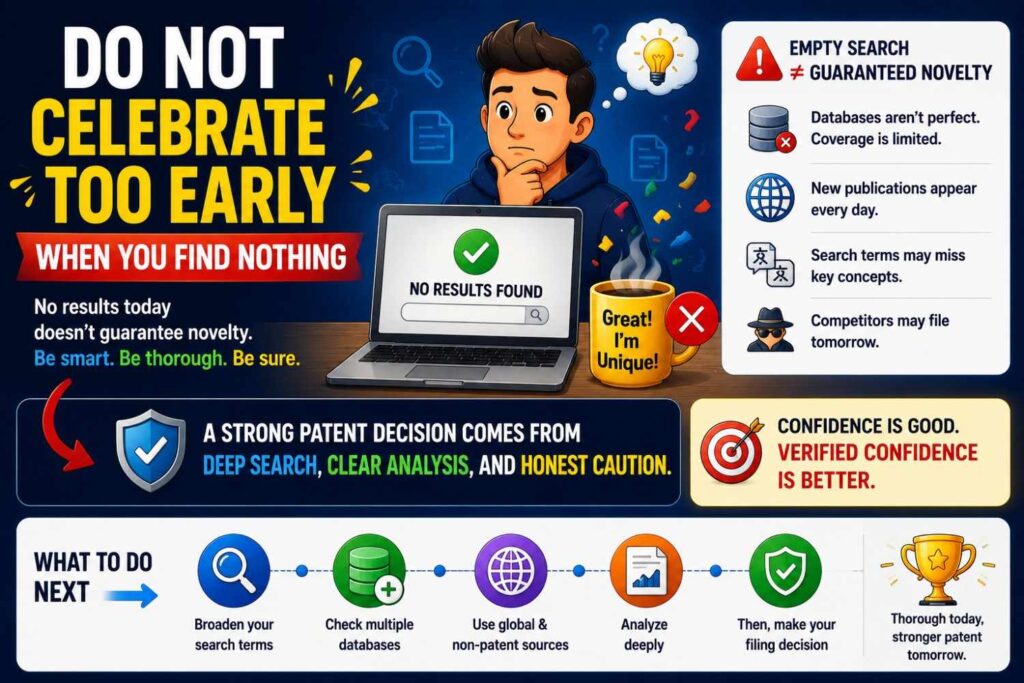
The opposite mistake is also common.
A founder searches for the exact product name, finds nothing, and thinks the invention is clear.
That is dangerous.
Prior art may use different words. It may come from another industry. It may be in another country. It may be in a paper, not a patent. It may be old. It may describe the function without using your market label.
If you find nothing, widen your search.
Use synonyms.
Search the technical problem.
Search the core element.
Search related fields.
Search patent classes.
Search citations.
Search non-patent sources.
No results may mean the invention is strong. Or it may mean the search was weak.
A good novelty workflow helps tell the difference.
How to Search Related Fields
Many inventions are new in one market but old in another.
A drone method may be similar to a self-driving car method.
A medical imaging method may be similar to factory defect detection.
A warehouse robot method may be similar to airport vehicle routing.
A battery scoring method may be similar to machine failure prediction.
An AI document verification method may be similar to search engine trust ranking.
Do not search only your product category.
Search the technical function.
If your invention predicts failure from noisy signals, search noisy signal failure prediction in other fields.
If your invention uses source trust to verify output, search trust scoring in search, knowledge graphs, and document review.
If your invention uses matched time windows, search matched windows in machinery, batteries, sensors, and health monitoring.
Patent examiners can look beyond your exact market when the technical problem is related.
You should too.
How to Record Search Results
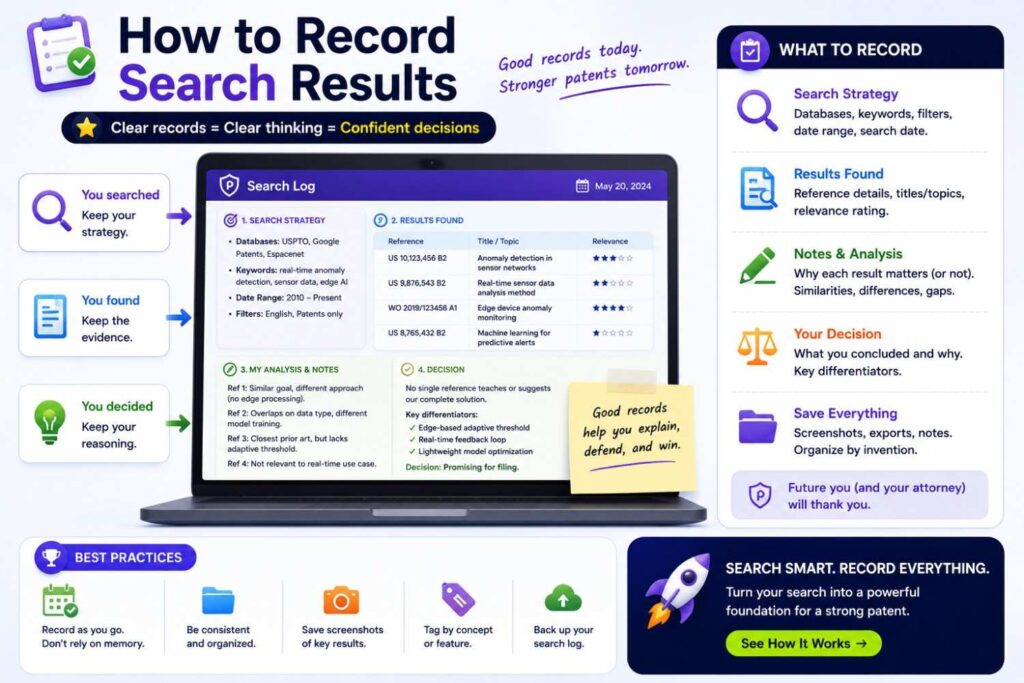
Keep simple notes.
For each reference, record:
Title.
Link.
Date.
Owner or author.
Why it looked relevant.
Which elements it shows.
Which elements it misses.
Short quote or source location if useful.
Do not paste huge blocks of text.
Do not write a full essay for each reference.
You want notes your team will actually use.
A good note sounds like this:
“Reference A uses pressure sensors to detect battery swelling and triggers an alert when pressure exceeds a fixed threshold. It does not appear to compare pressure drift during matched charging windows or adjust the swelling score based on charge rate.”
That is useful.
Another example:
“Paper B ranks document reliability and uses a source score, but it does not generate AI answers or route high-confidence answers to review based on low source trust.”
That note tells the story.
How to Handle Unclear References
Sometimes a reference is hard to read.
Maybe it is translated.
Maybe it is vague.
Maybe it uses broad terms.
Maybe the diagrams are confusing.
Do not force a yes or no.
Mark it unclear.
Then write why.
For example:
“Unclear. The reference mentions dynamic calibration, but it is not clear whether calibration is based on charge rate or temperature.”
Or:
“Unclear. The system routes answers to review, but the trigger appears to be model confidence, not source trust.”
Unclear references may need attorney review.
They may also need more searching.
Do not ignore them. Do not overstate them.
Treat them honestly.
How to Avoid False Gaps
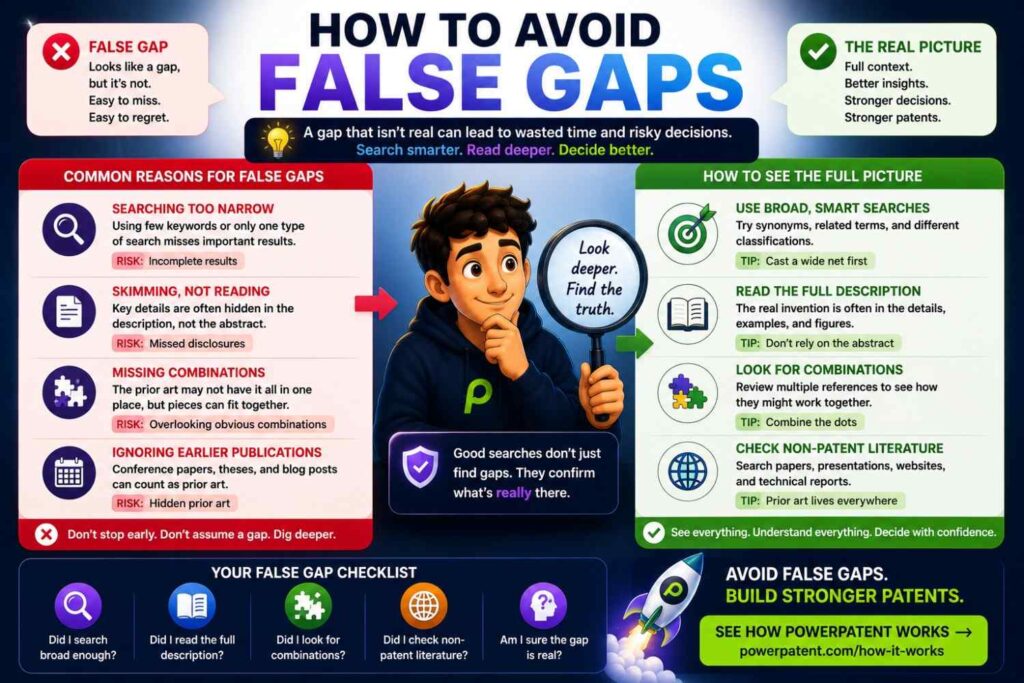
A false gap is a difference that looks important but is not.
For example:
Prior art uses a server. Your system uses the cloud.
That may not be a meaningful difference.
Prior art uses a mobile app. Your system uses a web app.
That may not matter.
Prior art uses a red alert icon. Your system uses a yellow alert icon.
That likely does not matter for a utility patent.
Prior art uses one database. Your system uses another.
That may not matter unless the database structure changes the technical result.
To avoid false gaps, connect each gap to the problem.
Ask:
Does this gap help solve the technical problem?
Does it change how the system works?
Does it improve a technical result?
Would a competitor care?
If not, keep looking.
The best gaps are not cosmetic. They are functional.
How to Find the Real Gap
The real gap often appears when you ask what old systems could not do.
Old systems could detect a problem but not predict it early.
Old systems used fixed thresholds but could not adapt to changing context.
Old systems trusted model confidence but missed unsupported high-confidence outputs.
Old systems routed tasks but did not ask a targeted clarifying question.
Old systems slowed robots at corners but did not predict hidden traffic before visibility.
Old systems measured a signal but could not separate real danger from harmless noise.
The real gap usually lives in a hard technical tradeoff.
Accuracy versus speed.
Safety versus false alarms.
Local processing versus power use.
Automation versus human review.
Broad detection versus specific control.
More data versus lower cost.
When your invention improves a tradeoff, you may have a strong novelty story.
Use Test Results If You Have Them
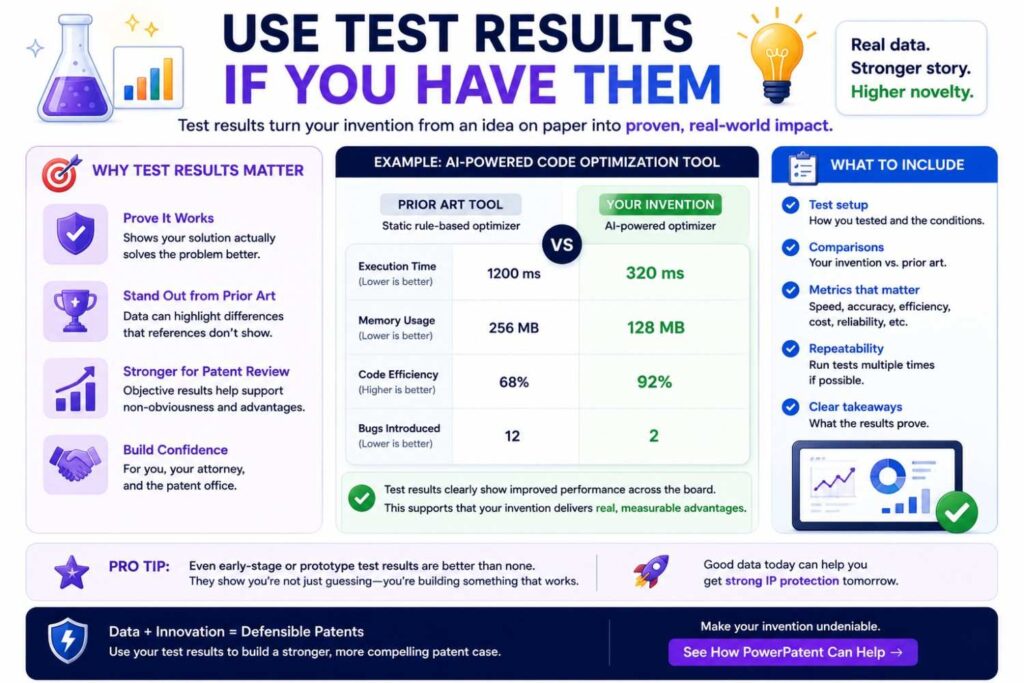
Test results can help explain why a difference matters.
They do not need to be perfect at the novelty stage.
But if you have data, capture it.
For example:
“Matched charging windows reduced false swelling alerts during fast charging in prototype testing.”
“Source-trust review caught unsupported high-confidence answers that model-confidence review missed.”
“Middle-confidence clarifying questions reduced human handoffs while keeping resolution accuracy stable.”
“Pre-visual blind-corner prediction caused the robot to slow earlier than camera-only detection.”
These results help show technical value.
They also help your patent team draft a better application.
Be honest. Do not exaggerate. Do not claim more than the data supports.
But do not leave useful technical results buried in Slack, notebooks, or test logs.
Novelty Assessment for Provisional Filings
A provisional patent application can be useful when you need an early filing date.
But a provisional still needs substance.
Do not file a vague placeholder and assume you are safe.
A novelty assessment helps you make the provisional stronger.
If the broad idea is crowded, the provisional should describe the specific technical gap in detail.
Include the system flow, inputs, outputs, timing, decision rules, alternatives, examples, and technical results.
If the invention is the matched charging window, explain it.
If the invention is source-trust review, explain it.
If the invention is a middle-confidence question, explain it.
If the invention is pre-visual robot control, explain it.
A thin provisional may feel fast, but it may not support strong claims later.
PowerPatent helps founders move quickly without treating the provisional as an empty shell. See how PowerPatent supports faster, stronger patent filings.
Novelty Assessment for Non-Provisional Filings
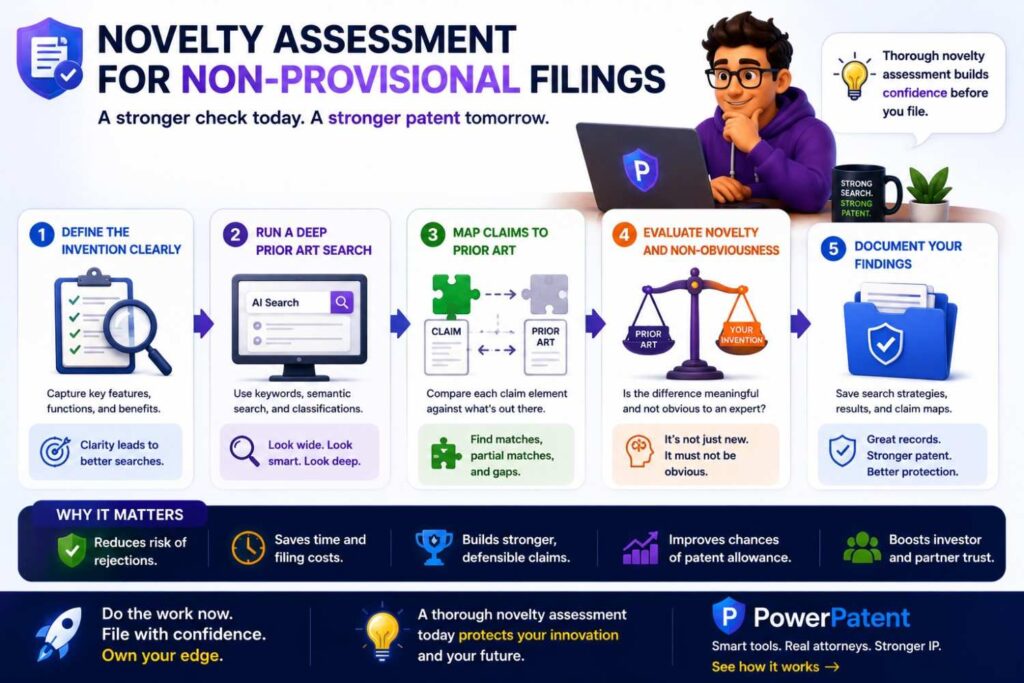
A non-provisional patent application will be examined.
That means the novelty work becomes even more important.
Before filing, your team should know the closest prior art and the strongest claim gap.
The application should explain the invention in enough detail to support both broad and fallback claims.
The claims should not blindly cover old ground.
The specification should include meaningful alternatives.
The technical result should be clear.
If the novelty map shows that the broad claim is risky, the filing should include narrower claim paths.
If the map shows that one element carries the invention, the application should describe that element deeply.
This is how novelty assessment turns into better drafting.
Novelty Assessment for AI and Software
AI and software novelty can be tricky because prior art often uses broad language.
Many references say “machine learning,” “confidence,” “automation,” “ranking,” “feedback,” or “workflow.”
Do not let those words alone decide novelty.
Look at the actual method.
For AI, ask:
What data is used?
How is the model output checked?
How is confidence created?
What triggers review?
How is feedback used?
What changes after feedback?
How does the system reduce errors, cost, delay, or risk?
For software, ask:
What is the data flow?
What decision is made?
What rule is applied?
What state changes?
What happens next time?
What technical result improves?
A software invention is stronger when it is more than “do a known business process on a computer.”
It should show a specific technical method.
Novelty assessment helps you find that method.
Novelty Assessment for Hardware
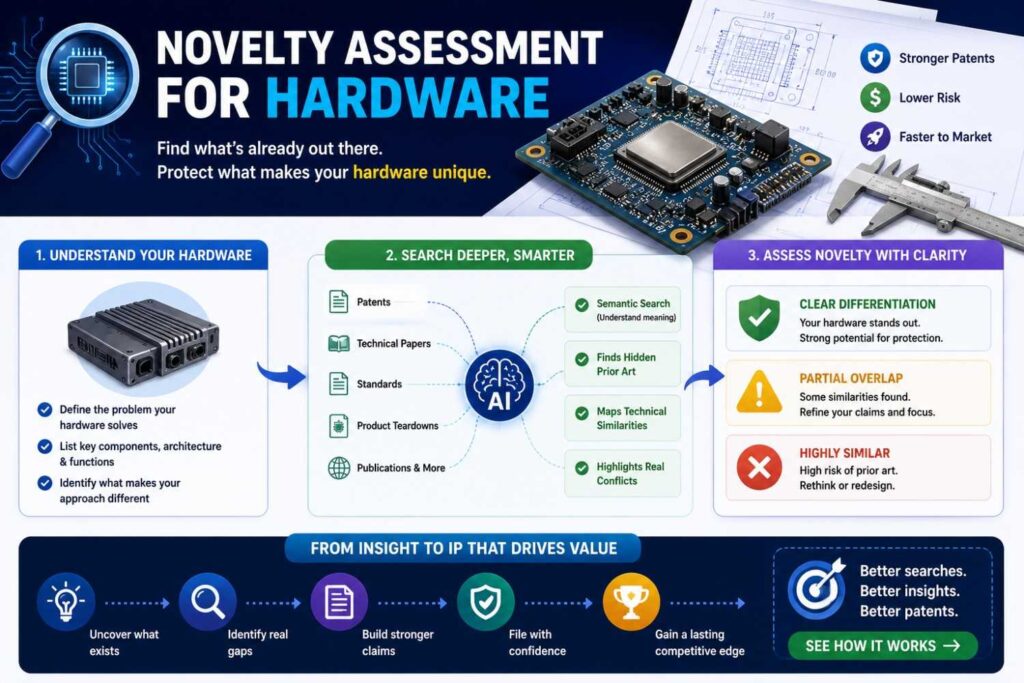
Hardware novelty often depends on structure, placement, and interaction.
Do not map only the part names.
A sensor may be old. But its placement may be new.
A housing may be old. But its internal channel may be new.
A controller may be old. But the control loop may be new.
A material may be old. But its use in a certain force path may be new.
For hardware, compare:
Shape.
Placement.
Connection.
Movement.
Signal path.
Force path.
Thermal path.
Fluid path.
Calibration.
Control response.
Assembly order.
A hardware novelty gap often becomes clear in drawings.
Sketch your design. Sketch the prior art. Mark differences.
Ask which difference creates the result.
That is the likely claim focus.
Novelty Assessment for Data Products
Data products can have patentable inventions, but the novelty must be technical.
Do not focus only on the fact that you have a dataset.
Focus on how the data is selected, transformed, structured, scored, checked, updated, or used to control a system.
For example:
A plain claim like “a database of startup patents” may be weak.
A stronger invention may be:
“A system that maps invention disclosures to claim elements, detects missing support, and routes unsupported claim elements for attorney review before filing.”
The novelty may be in the mapping, detection, and review workflow.
For data products, ask:
What is the special data structure?
How is data linked?
What rule uses the links?
What action is triggered?
What error is reduced?
What process becomes faster or more reliable?
That is where the invention may live.
Novelty Assessment for Inventions Based on Combinations
Many inventions combine known parts.
That is normal.
A novelty issue arises if one prior art source already shows the full combination.
If no single source shows the combination, novelty may exist.
But the combination may still face obviousness questions.
When assessing novelty for combinations, be precise.
Do not say, “All the parts are known, so it is not new.”
That is too simple.
Ask whether one source shows the same arrangement of parts working together in the same way.
For example, pressure sensors, temperature sensors, and charge-rate tracking may all be known. But a specific method of comparing pressure drift during matched charging windows and adjusting a swelling score may still be novel if no single reference shows it.
The invention is not the parts alone.
It may be the way the parts work together.
Novelty Assessment When You Have Multiple Versions
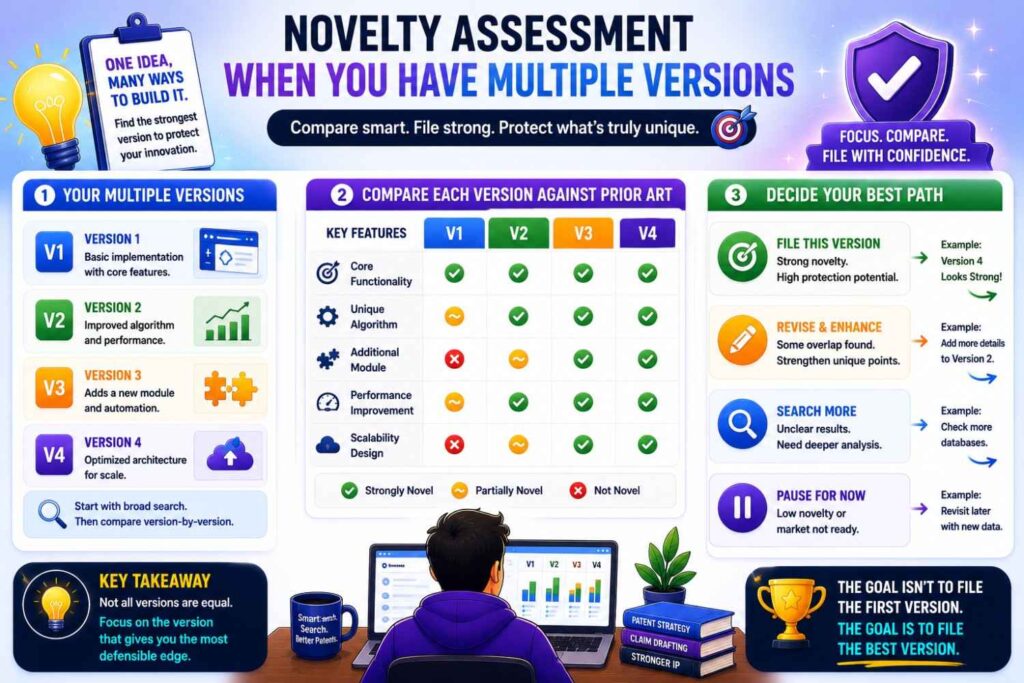
Startups often have several versions of an invention.
A current version.
A planned version.
A simpler version.
A premium version.
A local version.
A cloud version.
A hardware version.
A software-only version.
Assess novelty across the versions that matter.
Sometimes the current version is crowded, but a planned version is stronger.
Sometimes the broad version is risky, but a narrower version is clear.
Sometimes a fallback version should be disclosed in the application.
Do not file only for today’s prototype if the invention is broader.
But do not include fantasy features that the team cannot explain.
Good patent filings cover real technical alternatives.
A novelty workflow helps identify them.
Novelty Assessment Before a Launch
Before a public launch, novelty assessment is urgent.
You may be about to disclose the invention.
A launch page, demo video, blog post, technical talk, API docs, white paper, or open-source repo may reveal key details.
Before launch, ask:
What technical features will become public?
Are any of them worth patenting?
Have we assessed novelty?
Do we need to file first?
What can we safely disclose?
What should we hold back?
This does not mean you should hide everything. Startups need to sell, hire, raise, and build trust.
It means you should be deliberate.
PowerPatent helps founders act before important public moments, so IP does not become a last-minute scramble. See how PowerPatent works before launch.
Novelty Assessment Before Fundraising
Investors care about defensibility.
They may ask whether your patents protect the real product.
A novelty assessment helps you answer with confidence.
Instead of saying:
“We think our tech is unique.”
You can say:
“We mapped the closest prior art. The broad area is crowded, but the references we found do not show our source-trust review trigger for high-confidence AI outputs. That is the workflow our filing focuses on.”
That answer is clearer.
It sounds grounded.
It also avoids overclaiming.
You do not need to say no one has ever worked in the space. You can say what is different and why it matters.
That is much stronger.
Novelty Assessment Before an Acquisition
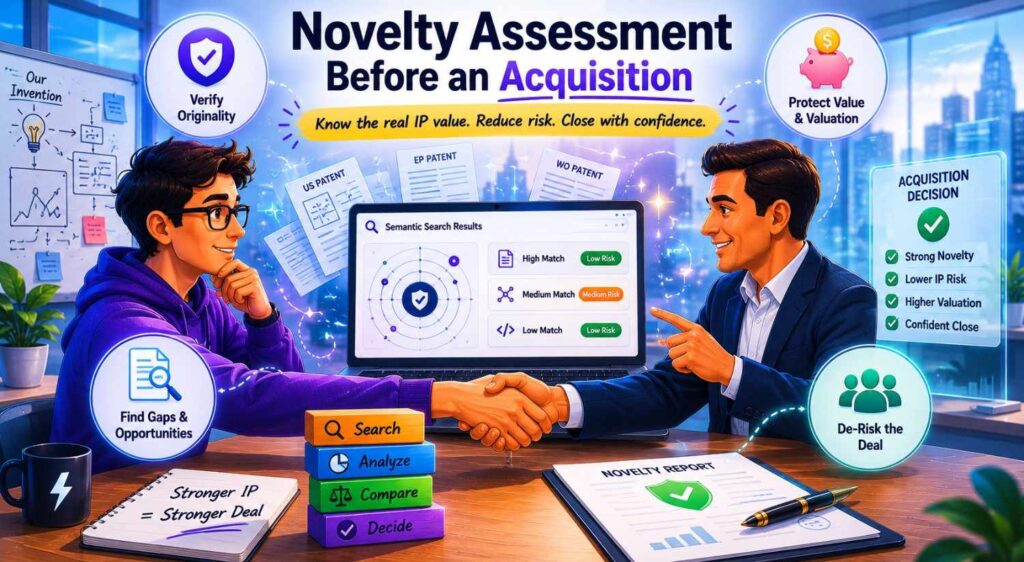
Buyers may look closely at IP.
They may ask what your patents cover, whether the claims are meaningful, and whether the filings match the product.
A novelty assessment helps you prepare.
It can show:
What the core invention is.
What prior art was considered.
What gap the filing targets.
What product feature the claims support.
What backup positions exist.
What risks remain.
This can support a better IP story during diligence.
It can also help you spot weak filings before a buyer does.
For a startup, this can matter a lot.
Novelty Assessment After an Office Action
Sometimes the patent examiner finds prior art after you file.
That is normal.
Do not panic.
Use the same workflow.
Break the rejected claim into elements.
Map the examiner’s reference.
Ask whether the reference really shows each element.
If it does, consider whether the claim can be amended.
If it does not, identify the missing feature clearly.
If the examiner combines references, move into an obviousness analysis.
The quality of your original application matters here.
If you described alternatives and technical results, your attorney may have more room to respond.
This is another reason novelty assessment before filing is so helpful.
It helps create a stronger application from the start.
Novelty Assessment and Continuation Strategy
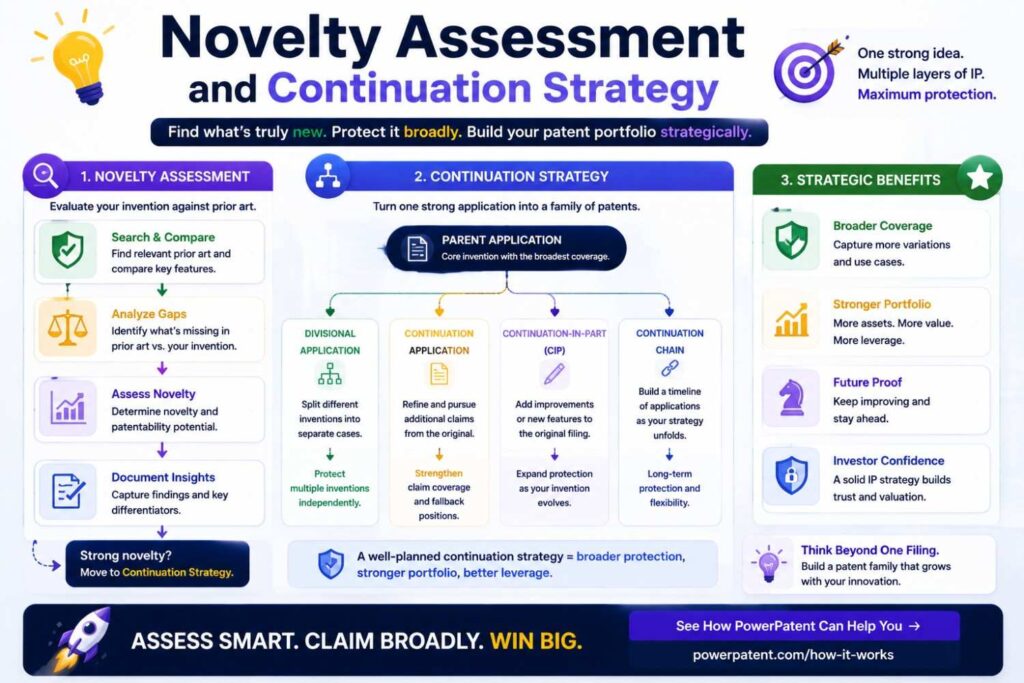
A continuation can let you pursue more claim angles from an earlier filing.
Novelty assessment helps decide which angles are worth pursuing.
Maybe your original filing covered a broad system.
Later, competitors copy a specific workflow.
You can assess novelty for that workflow and decide whether to file continuation claims.
Maybe the first claims were narrow, but the prior art map shows another path.
Maybe the market changes and a different feature becomes valuable.
A patent portfolio should evolve with the product.
Novelty assessment gives you a repeatable way to make those decisions.
Common Mistake: Searching Only Patents
Patents are important, but they are not the only prior art.
If you only search patents, you may miss papers, code, standards, product docs, videos, and manuals.
This is especially risky in fast-moving fields.
AI ideas may appear first in papers and GitHub repos.
Hardware ideas may appear in manuals or teardown posts.
Robotics ideas may appear in conference talks and lab videos.
Medical methods may appear in articles and protocols.
Energy systems may appear in technical reports.
Search where your field publishes.
A novelty workflow should match the real world.
Common Mistake: Searching Only Your Exact Words
Your words are not enough.
Your team may invent a catchy name for the feature. Prior art will not use that name.
Search by function.
Search by problem.
Search by result.
Search by older terms.
Search by formal patent words.
Search by related field terms.
If one search finds nothing, change the words.
Novelty assessment is partly a language exercise.
You are trying to find how other people described similar ideas before you.
Common Mistake: Reading Only the Abstract
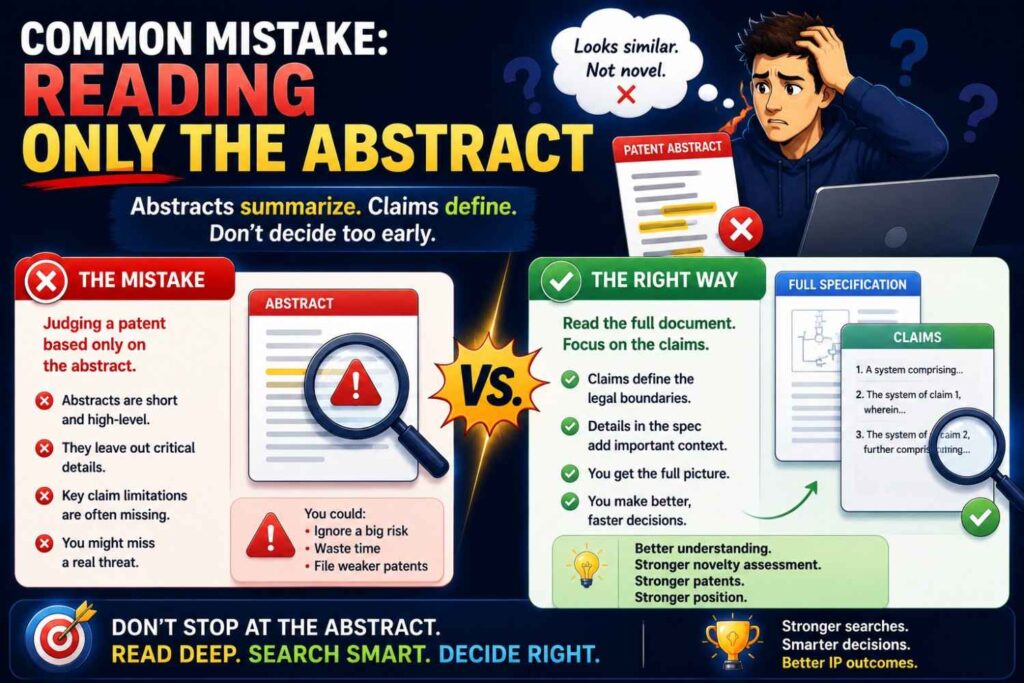
The abstract is useful, but it is not enough.
The relevant feature may be in a drawing, claim, example, or detailed description.
A patent with an abstract that sounds close may not teach your core element.
A patent with a boring abstract may contain a direct hit.
Read the parts that matter.
Search within the document for key terms.
Look at figures.
Look at examples.
Look at the claims.
Do not make a filing decision from the abstract alone.
Common Mistake: Overlooking Your Own Disclosure
Your own public disclosure can matter.
A blog post, demo, pitch deck, video, paper, public code release, or product documentation may reveal the invention.
Before filing, list what you have already shared publicly.
When was it shared?
Who saw it?
Was it under confidentiality?
What technical details were included?
This helps your patent team assess timing.
Do not hide prior disclosures because they feel inconvenient.
Your attorney needs the full picture.
Common Mistake: Confusing Market Novelty With Patent Novelty
A product can be new in the market but not novel for patent purposes.
Maybe no one sells it today, but an old patent described it.
Maybe a lab paper showed it years ago, but no company built it.
Maybe the technology was not commercial then, but it was public.
Patent novelty is about public knowledge, not market adoption.
This surprises founders.
A dead product can be prior art.
A failed research project can be prior art.
An old manual can be prior art.
A public thesis can be prior art.
Do not assume market absence means patent novelty.
Common Mistake: Giving Up Too Soon
The opposite problem is giving up after finding similar art.
Similar is not the same as identical.
A prior art reference may share the problem but not your solution.
It may share the sensor but not your timing.
It may share the model but not your review trigger.
It may share the workflow but not your feedback update.
It may share the output but not the input.
Map before you quit.
Many strong filings come from finding the precise difference after similar art appears.
Common Mistake: Filing Without a Decision Record
A novelty assessment should end with a short decision record.
Write down:
What invention was assessed.
What prior art was closest.
What element appears new.
Why that element matters.
What filing decision was made.
What open risks remain.
This record helps later.
It helps during drafting.
It helps during prosecution.
It helps during fundraising.
It helps when team members change.
It also helps you avoid repeating the same search months later.
Keep it simple, but write it down.
A Founder-Friendly Novelty Assessment Template
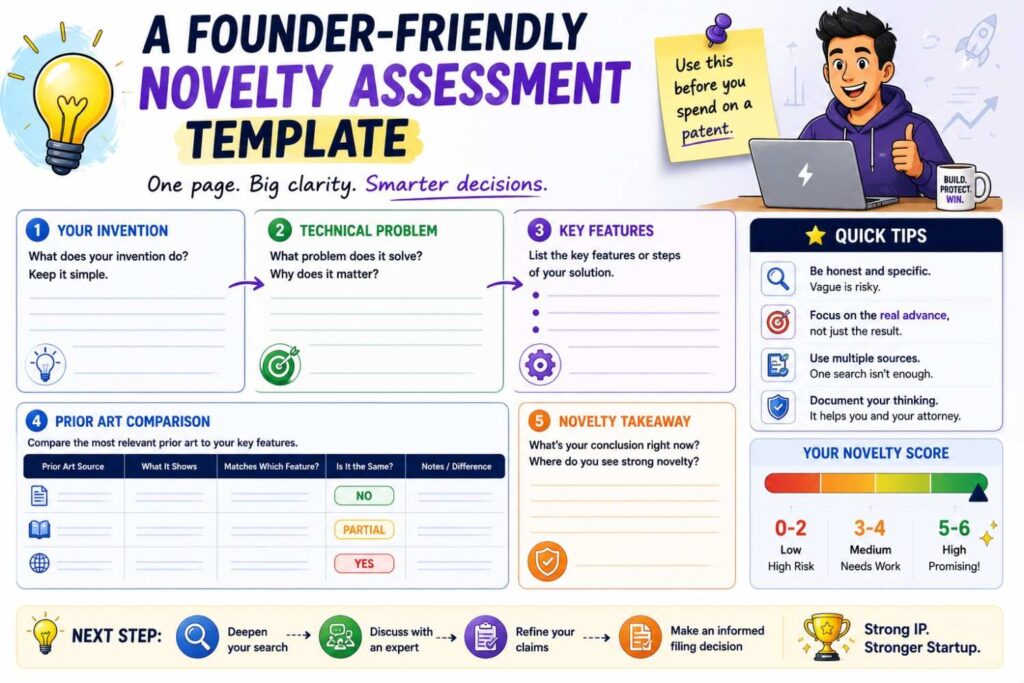
Use this structure.
Invention name:
One-sentence invention statement:
Technical problem:
Technical solution:
Technical result:
Core element:
Required elements:
Search terms used:
Closest prior art:
Element-by-element comparison:
Strongest gap:
Why the gap matters:
Business value:
Disclosure timing:
Recommendation:
Next steps:
This template is simple enough to use, but strong enough to guide a filing decision.
PowerPatent can help turn this kind of raw invention work into a more complete patent process, with attorney review where it matters. See how PowerPatent helps founders protect what they build.
What a Strong Novelty Finding Sounds Like
A strong novelty finding is clear and specific.
For example:
“The closest reference uses pressure sensors to detect battery swelling with a fixed threshold. It does not show comparing pressure drift during matched charging windows or adjusting the swelling score based on charge rate and temperature. This gap matters because fast charging can cause temporary expansion that creates false alerts. The filing should focus on matched-window pressure-drift scoring and include backup versions using other charging context signals.”
That is strong.
It names the closest art, the missing part, the reason it matters, and the filing focus.
Another example:
“The closest AI review references route low-confidence model outputs to human review. They do not show routing high-confidence outputs to review when source trust is low. The gap matters because unsupported answers can appear confident. The filing should focus on the conflict between model confidence and source trust.”
That is decision-ready.
What a Weak Novelty Finding Sounds Like
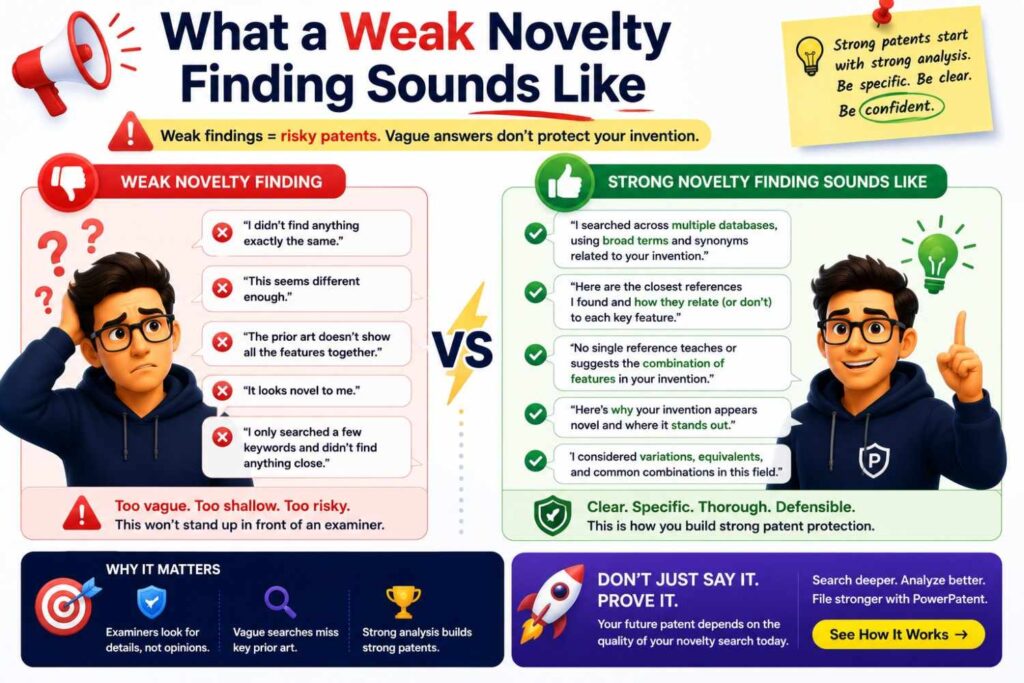
A weak novelty finding is vague.
For example:
“We searched and did not find anything exactly like us.”
That is not enough.
Or:
“Our product is different because it is easier to use.”
That may be true, but it does not show patent novelty.
Or:
“The prior art is old.”
Old prior art can still matter.
Or:
“The prior art is not in our market.”
Related-field art can still matter.
Or:
“The patent title is different.”
Titles are not enough.
A useful novelty finding must explain the technical comparison.
How PowerPatent Helps With the Workflow
Most founders do not have time to become patent experts.
They need a process that fits how startups build.
PowerPatent is designed for that.
It helps technical teams capture what they built, explain why it matters, and organize the details that patent attorneys need.
That includes invention notes, workflows, system diagrams, code-level insights, model behavior, prior art search results, and technical results.
Then real patent attorney oversight helps turn that material into a stronger filing path.
The value is speed plus judgment.
You keep building.
PowerPatent helps you avoid missing key invention details or rushing into a weak filing.
The Best Filing Decision Is Not Always “File Now”
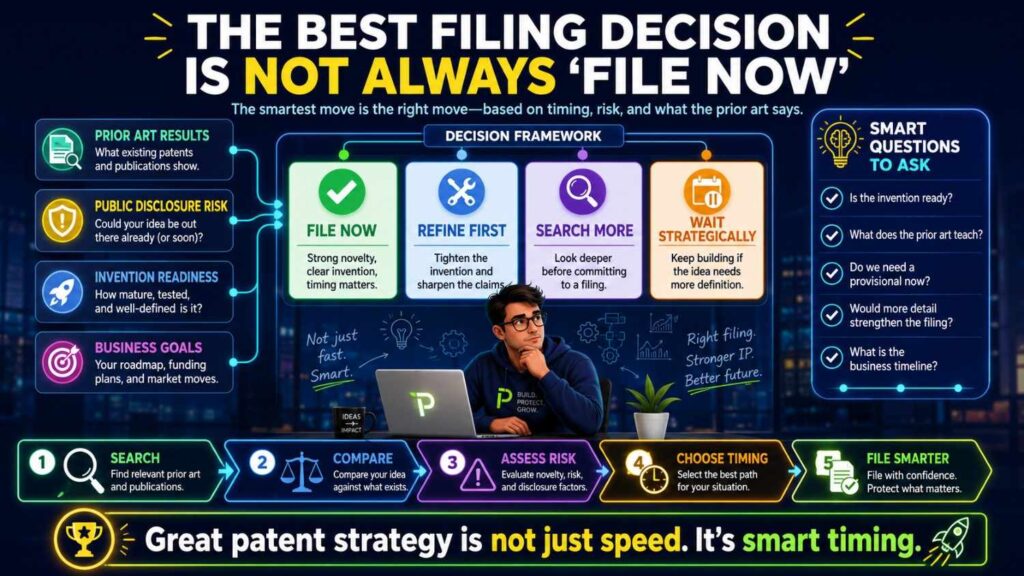
A good novelty workflow may tell you not to file.
That can be a good outcome.
Maybe the invention is too close to prior art.
Maybe the technical gap is weak.
Maybe the product value is low.
Maybe the feature will change soon.
Maybe the idea is better kept secret.
Maybe more testing is needed.
Maybe another invention inside the product is stronger.
Good patent strategy is not about filing everything.
It is about filing the right things.
The right filings protect the core technical edge of the company.
They support the roadmap.
They make copying harder.
They give investors and partners confidence.
They avoid wasting time on weak ideas.
Novelty assessment helps you make that call.
Build Novelty Review Into Your Product Process
Novelty assessment should not be a once-a-year event.
It should happen when your team solves hard technical problems.
During design reviews, ask:
Did we solve something in a new way?
During sprint reviews, ask:
Did we build a technical workflow competitors would copy?
During model reviews, ask:
Did we create a new way to check, train, route, or update?
During hardware testing, ask:
Did we find a structure, placement, or control loop that changed the result?
During launch planning, ask:
Are we about to disclose something worth filing?
This does not need to slow the team.
It can be lightweight.
Capture the invention. Assess novelty. Decide.
Repeat.
That is how startups build real IP without stopping product work.
The Human Side of Novelty Assessment
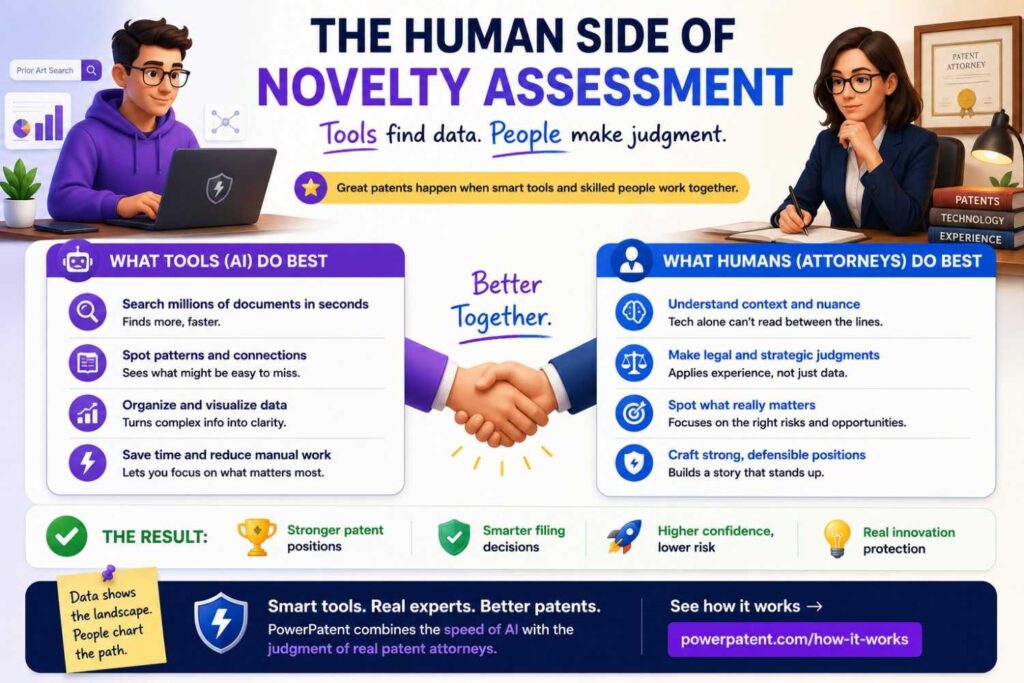
Patent work can feel cold and technical.
But at its core, it is about protecting human effort.
Your team spent months solving a problem. You tried things that failed. You found a better path. You built something that did not exist in that form before.
Novelty assessment honors that work by finding the real invention.
It turns scattered notes into a clear story.
It helps your team say:
This is what we solved.
This is how we solved it.
This is what others did before.
This is what we add.
This is why it matters.
That clarity is valuable even beyond patents.
It helps fundraising. It helps sales. It helps hiring. It helps partnerships. It helps the team understand its own edge.
Final Takeaway
A novelty assessment is how you move from idea to filing decision.
Start by defining the invention in plain words. Separate the product from the technical solution. Break the invention into required elements. Search broadly, then search around the core. Read the closest prior art. Map each element. Find the real gap. Tie that gap to a technical result. Then decide whether to file, revise, search more, or pause.
Do not rely on gut feel.
Do not panic when you find similar art.
Do not celebrate too early when you find nothing.
Use a workflow.
That is how founders turn invention work into smart patent decisions.
And when you are ready to protect what your team is building, PowerPatent can help you move faster with smart software and real patent attorney oversight.
Leave a Reply