Patents cost money, time, and focus.
Before you spend all three, you should know whether your invention has a real chance of being worth the effort.
That is where novelty scoring helps. It gives founders and engineers a clear way to judge an invention before filing, so you can protect the ideas that matter and avoid wasting budget on weak ones.
This guide shows you how to score invention novelty in a simple, practical, and business-smart way.
If you want help turning your invention into a stronger attorney-reviewed patent filing, PowerPatent helps founders combine smart software with real patent oversight. See how it works here: https://powerpatent.com/how-it-works
Why Novelty Scoring Matters Before You Spend on a Patent
A patent filing should not start with hope.
It should start with a clear view of the invention, the old work, and the business value.
Many founders skip this step. They feel the product is new, so they assume the invention is new. They hear users say the product is different, so they assume the patent will be strong. They see no direct competitor with the exact same feature, so they assume they are clear.
That is risky.
A product can be new in the market while the technical idea behind it is already known.
A feature can feel fresh to customers while older patents, papers, GitHub repos, product manuals, or demos already show the same technical path.
A broad category can be crowded, while a smaller improvement inside your product may be very strong.
Novelty scoring helps you see the difference.
It does not replace a patent attorney. It does not give a final legal answer. It gives you a practical way to decide what deserves deeper review.
For a startup, this is powerful.
You can use novelty scoring to decide which invention to file first. You can avoid spending money on weak ideas. You can spot the real technical edge. You can prepare better material for your patent team. You can move faster without filing blind.
That is the goal.
Not more paperwork.
Better choices.
What Invention Novelty Means in Plain English
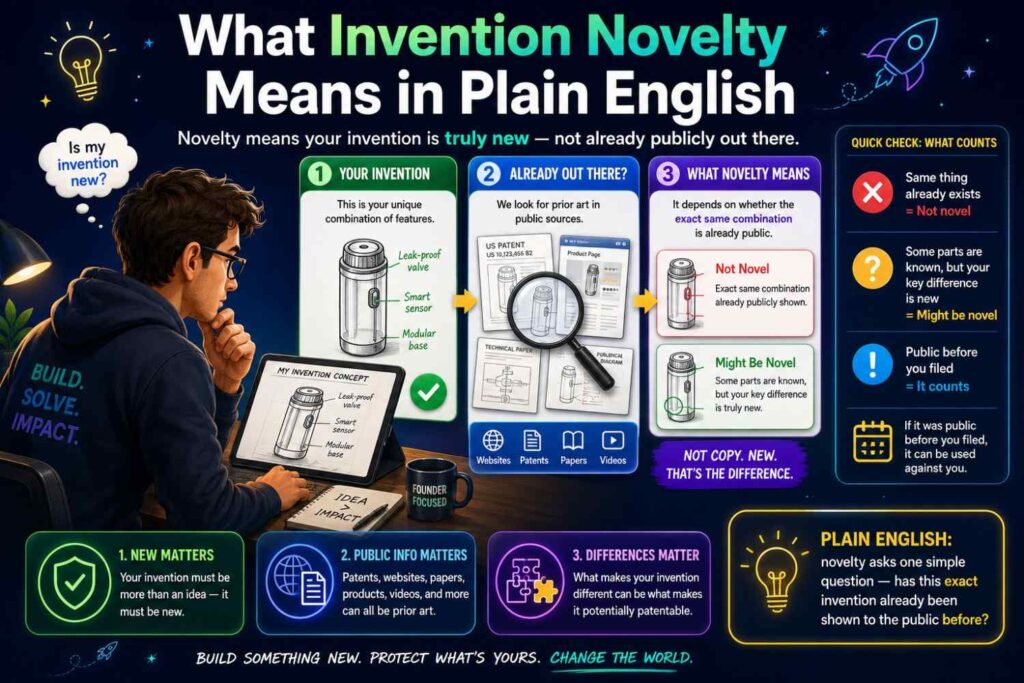
Novelty means your invention was not already shown before.
In patent terms, the question is often whether one earlier public source already describes the same invention.
That source can be a patent. It can also be a patent application, research paper, GitHub repo, YouTube demo, product page, manual, datasheet, technical standard, thesis, slide deck, API doc, blog post, or public code.
The key idea is simple.
If someone already publicly described the same thing before you filed, that old source can be a problem.
But novelty is not about whether your broad market category is new.
It is about whether your specific technical invention is new.
That distinction matters.
“AI for contract review” is not specific enough.
A more specific invention might be: “A system that suggests fallback clauses by comparing a draft clause to a company playbook and prior approved redlines while keeping each customer’s data separate.”
“Battery safety monitoring” is not specific enough.
A more specific invention might be: “A battery system that detects early cell failure by comparing gas sensor changes, pressure changes, and local temperature gradients before triggering a safety response.”
“Code review automation” is not specific enough.
A more specific invention might be: “A system that scores a pull request by matching changed files to past production incidents, mapping those files to service owners, estimating live customer impact, and routing review to an available expert.”
Novelty scoring should focus on the specific version.
Not the slogan.
Not the pitch.
The real invention.
Why a Simple Yes-or-No Test Is Not Enough
Founders often ask, “Is this patentable?”
That is a fair question, but it is too early if you have not assessed the invention.
A better first question is, “How strong does this invention look before we spend on a filing?”
Novelty scoring helps answer that.
It turns a fuzzy decision into a more structured one.
You are not saying, “This is definitely patentable.”
You are saying, “This idea looks strong enough to bring to counsel,” or “This idea looks weak unless we focus on a narrower feature,” or “This needs more technical detail before filing,” or “This may be better kept secret.”
That is a much more useful business decision.
A yes-or-no answer can hide nuance.
An invention may be weak at the broad level but strong at the narrow level.
An invention may be new but not important to the business.
An invention may be valuable but already public because your team launched too soon.
An invention may be technically strong but hard to detect if copied, which may affect whether patenting is the right move.
A scorecard helps you weigh these factors.
It gives you a way to compare ideas.
It helps you decide where to spend.
The Core Idea: Score Before You File
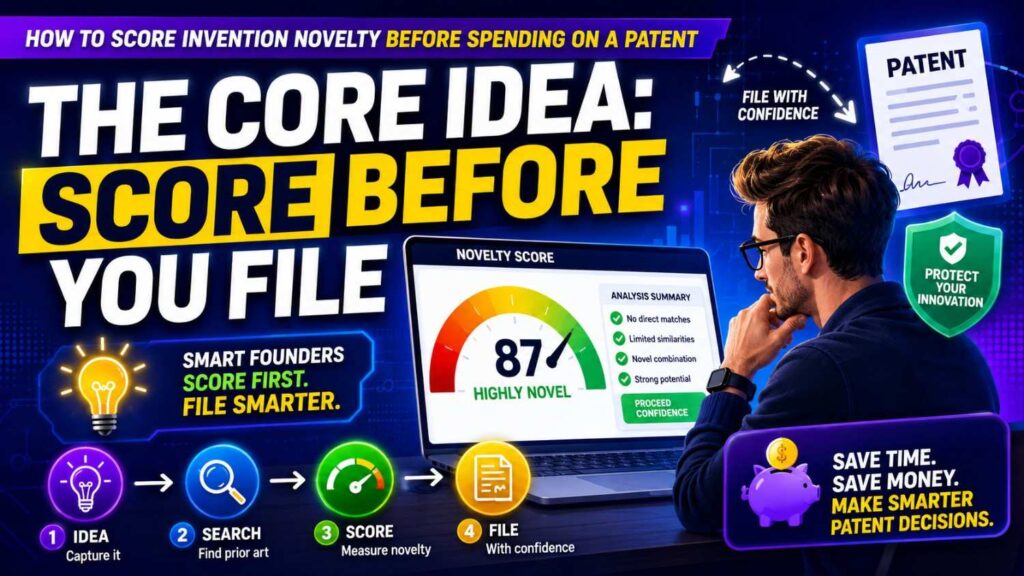
Scoring invention novelty is not about creating a perfect legal grade.
It is about making a smart pre-filing decision.
You want to know whether the invention looks worth deeper search, attorney review, and possible filing.
A practical novelty score should look at several things.
First, how clearly the invention is defined.
Second, how close the prior art appears.
Third, whether the specific feature combination looks different.
Fourth, whether the difference is technical, not just business or branding.
Fifth, whether the invention matters to the company.
Sixth, whether the invention is visible or easy to copy.
Seventh, whether enough detail exists to support a strong filing.
Eighth, whether there are public disclosure risks.
These factors together create a better picture.
An idea with high novelty but low business value may not be worth filing.
An idea with strong business value but weak novelty may need a narrower claim focus.
An idea with good novelty and strong value but thin technical detail may need more invention capture before filing.
An idea with strong novelty and clear copy risk may deserve fast action.
This is how founders should think.
Not “Can I file something?”
But “Should I spend patent budget on this invention now, and if so, what should the filing focus on?”
Scoring Turns Patent Spend Into a Business Choice
Patent spend should be treated like any other strategic spend.
You would not hire a team, build a product line, or enter a market without asking why it matters. Patent filings deserve the same discipline.
A novelty score gives the business a simple way to compare choices.
Should you file on the AI model, the data pipeline, the safety layer, the deployment method, or the user workflow?
Should you protect the first version now, or wait until the field test proves the stronger version?
Should you file before launch, or keep a hidden backend method as a trade secret?
These are not just legal questions. They are business questions.
Scoring helps the team bring the right facts into the room before money is spent.
Score the Invention, Not the Excitement Around It
Excitement is not evidence.
A feature may feel exciting because customers love it, investors ask about it, or the team worked hard to build it.
That does not always mean it is novel.
The scorecard slows the team down just enough to ask better questions.
What is the actual technical step?
What did we find in the prior art?
What is different from the closest source?
Is that difference important to the business?
Do we have enough detail to support a filing?
This is important because startups are naturally optimistic. That optimism is useful for building. But patent decisions need evidence.
A score helps separate team pride from patent strength.
Use Scoring to Choose the Right Filing Target
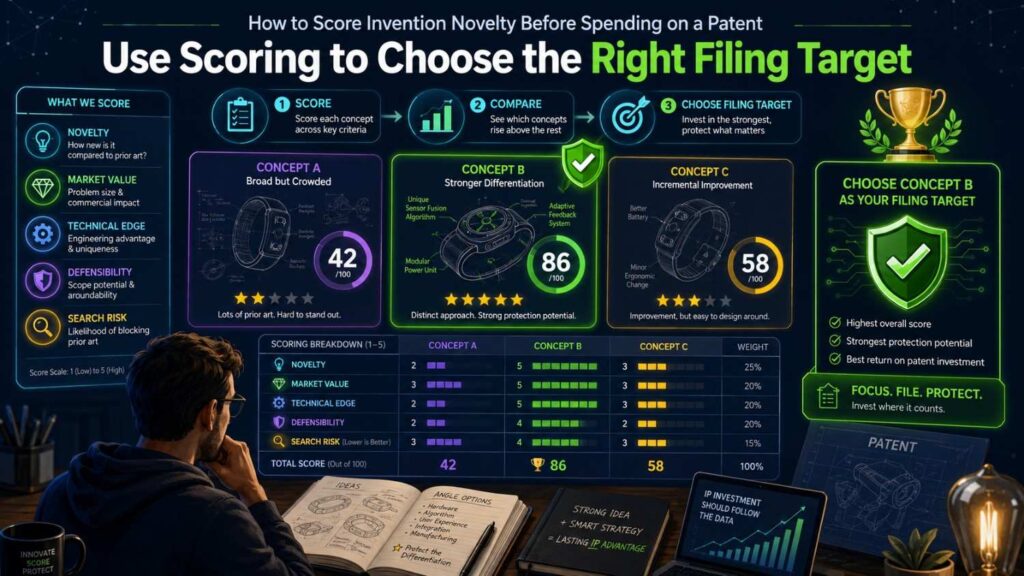
Most products contain more than one possible invention.
A single AI product may include a retrieval method, a ranking method, a safety rule, a feedback loop, a privacy layer, a workflow step, and a monitoring system.
A hardware product may include a sensor layout, a housing structure, a calibration method, a control loop, a manufacturing step, and a safety response.
If you file on the wrong part, you may spend money and still leave the real edge exposed.
Scoring helps reveal which part deserves attention first.
For example, the model may score low because similar models are public. But the customer-specific feedback loop may score high because it is tied to retention and not shown in the closest sources.
The visible dashboard may score low because it is easy to copy and broadly known. But the backend routing trigger may score high because it creates the real performance gain.
The first filing target should be the part with the strongest mix of novelty, business value, copy risk, and filing support.
Score Before the Attorney Meeting, Not After
Many teams wait until they speak with a patent attorney to organize the invention.
That can work, but it often wastes time.
A better approach is to score the invention before the meeting.
This does not replace legal review. It improves it.
When you bring a scorecard to counsel, the discussion becomes sharper.
You can show the invention summary, what was searched, what close sources were found, what looks different, what matters to customers, and what is about to be disclosed.
That gives the attorney better raw material.
Instead of spending the first meeting trying to decode a vague product pitch, the attorney can focus on claim strategy, risk, and filing options.
For startups, this saves time and helps control cost.
PowerPatent helps teams organize invention details before attorney review, so the filing process starts from a clearer place. Learn more here: https://powerpatent.com/how-it-works
Use Scoring to Find the “Now, Next, Later” List
Not every invention should move at the same speed.
Scoring helps you sort ideas into practical timing groups.
“Now” inventions are high-value, clear, likely copyable, and close to public disclosure. These should move toward attorney review quickly.
“Next” inventions look promising but need more search, more examples, or more engineering detail.
“Later” inventions may be useful but are not yet central to the business, not visible, or not ready.
This simple timing view helps founders avoid two bad habits.
The first bad habit is filing everything too early.
The second is waiting too long on the inventions that matter most.
A scoring process gives the team a reasoned way to act.
Look for the Filing Focus Hidden Inside a Low Score
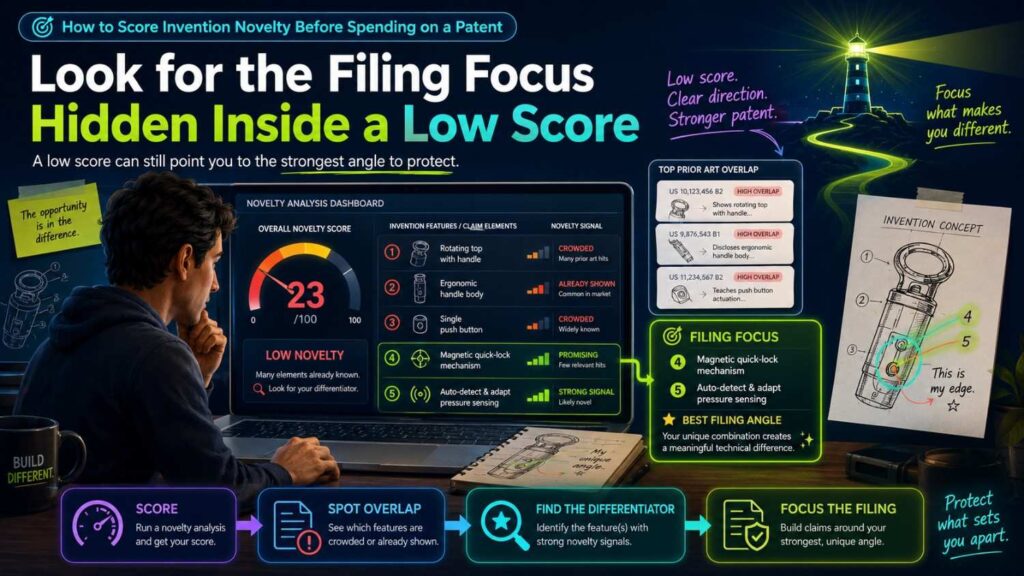
A low score does not always mean the product has no patent value.
It may mean the first version of the invention is too broad.
For example, “AI customer support automation” may score low because the field is crowded.
But when you break it down, one part may score high: routing urgent tickets based on customer impact, past incident similarity, and engineer availability.
That is the value of scoring.
It does not only judge ideas. It helps refine them.
If a broad idea scores low, ask what narrower part might score higher.
Is there a special data source?
A special trigger?
A special timing window?
A hard constraint?
A safety rule?
A feedback loop?
A control response?
That narrower piece may be the real filing target.
Make the Score Explainable
A number alone is not enough.
The reason behind the score matters more than the score itself.
If an invention gets a 4 on technical difference, write why.
If it gets a 2 on prior art distance, name the source that caused concern.
If it gets a 5 on business value, explain which customer need, revenue driver, or moat it supports.
If it gets a 3 on filing support, state what detail is missing.
This turns the scorecard into a decision record.
Later, when the team asks why one invention was filed and another was not, the answer is clear.
This also helps new team members, investors, or counsel understand the company’s IP thinking.
Use Scoring to Avoid Thin Filings
One of the biggest patent mistakes is filing before the invention is well described.
A thin filing may feel like protection, but it can create false comfort.
Scoring helps catch this early.
If an invention has strong novelty and high business value but weak filing support, the answer is not always “file now.”
The better answer may be “capture more detail fast, then file.”
That may mean gathering diagrams, data flows, examples, test results, model inputs, sensor placements, timing windows, fallback versions, or failure cases.
This is a key business point.
The filing decision is not only about whether the idea is good.
It is about whether the team can describe the idea well enough to make the filing useful.
Build a Minimum Evidence Package
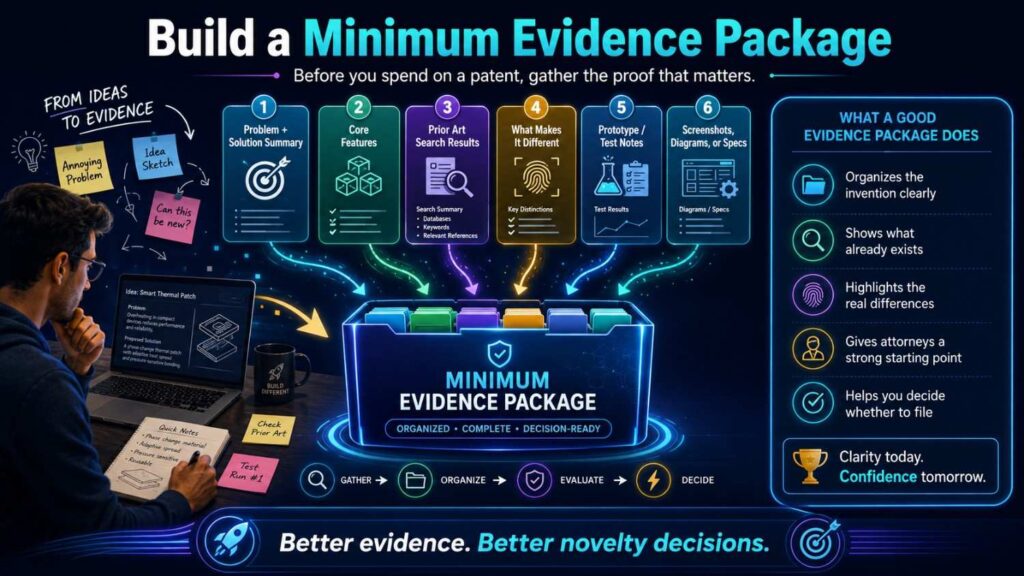
Before spending on a patent, create a small evidence package.
It should include the invention summary, the customer value, the technical steps, the closest prior art found, the likely difference, the public disclosure timeline, and the reason the invention matters to the business.
This package does not need to be long.
It needs to be clear.
A strong evidence package lets the team make a better decision and gives counsel a better start.
For a high-priority invention, add diagrams, examples, test data, and fallback versions.
For a medium-priority invention, add the missing details before rescoring.
For a low-priority invention, save the notes and move on.
This keeps the process practical.
The Best Score Is One That Leads to Action
A novelty score is only useful if it changes what you do.
After scoring, the team should choose one next step.
Move to attorney review.
Run a deeper prior art search.
Capture more technical detail.
Narrow the invention.
Rescore after testing.
Hold as a trade secret.
Do not pursue.
Without a next step, scoring becomes busywork.
With a next step, scoring becomes a decision engine.
That is the core idea.
Score before you file so your patent spend follows the strongest invention, at the right time, with the right focus.
A Simple Novelty Scorecard for Founders
A simple scorecard can help your team evaluate ideas before spending on a patent.
Use a 1 to 5 score for each factor.
A score of 1 means weak.
A score of 3 means mixed or unclear.
A score of 5 means strong.
You can score these areas:
Invention clarity.
Prior art distance.
Specific technical difference.
Feature combination strength.
Technical improvement.
Copy risk.
Disclosure readiness.
Filing support.
Attorney review priority.
You do not need a perfect number.
The score is a tool for conversation.
If your team gives an invention a low score on clarity, do not file yet. Capture more detail.
If the prior art distance score is low, look for a narrower invention.
If business value is low, save the patent budget for something more important.
If copy risk is high and the technical difference is strong, move quickly.
This scorecard helps you avoid emotional decisions.
Founders are optimistic. Engineers are proud of hard work. Product teams want to protect the roadmap. Investors may ask about IP. All of that creates pressure.
A scorecard brings the team back to facts.
Factor One: Invention Clarity
The first score is invention clarity.
Before you can judge novelty, you need to know what the invention is.
This sounds obvious, but it is often the biggest problem.
Many teams start with a broad phrase.
“AI for procurement.”
“Smart robotics.”
“Energy optimization.”
“Automated compliance.”
“Better diagnostics.”
Those phrases do not define an invention.
A clear invention description should explain the problem, setting, inputs, process, output, improvement, and hard constraint.
For example:
“The system flags risky invoices by comparing vendor history, purchase order terms, approval chain behavior, and payment timing, then routes only high-risk invoices to a reviewer.”
That is clear.
It tells you what the system uses, what it does, and what comes out.
Score invention clarity like this.
A score of 1 means the idea is only a product pitch.
A score of 2 means the idea has a broad feature but no real technical detail.
A score of 3 means the team can describe the system, but key steps or inputs are unclear.
A score of 4 means the invention has clear inputs, steps, outputs, and improvement.
A score of 5 means the invention is clear, specific, and supported by diagrams, examples, or working details.
If clarity is below 4, pause before spending on a patent.
You may still have a good invention, but you have not captured it well enough.
PowerPatent helps founders and engineers capture invention details in a structured way so the patent process starts from the real technical edge. See how it works here: https://powerpatent.com/how-it-works
How to Improve the Invention Clarity Score
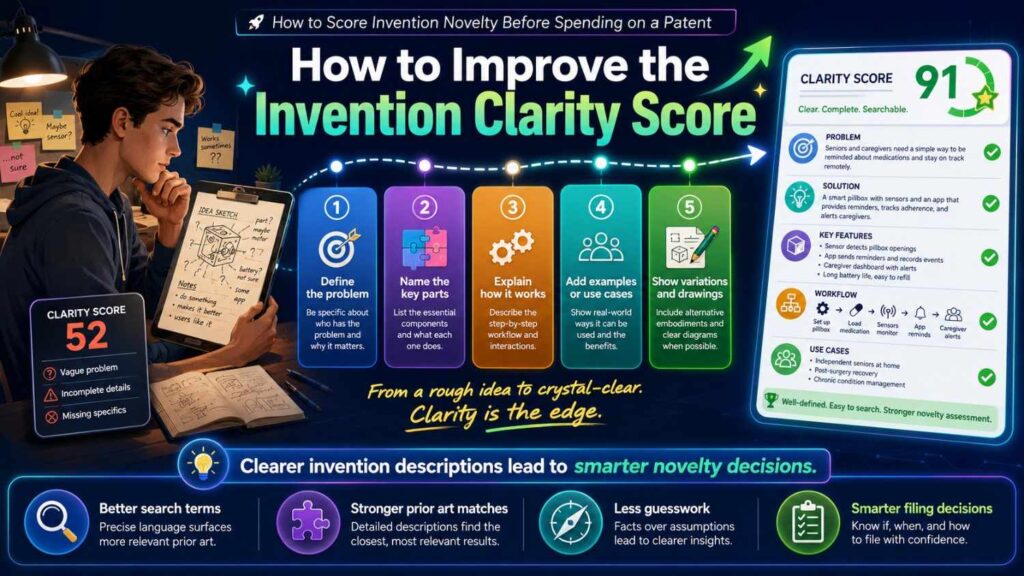
If the clarity score is low, do not rush to search.
Fix the description first.
Ask the engineering team what was hard.
Ask what failed before the final version worked.
Ask what data sources or physical parts are essential.
Ask what happens step by step.
Ask what output is produced.
Ask what changes because of that output.
Ask what is faster, safer, cheaper, more accurate, or more reliable.
Ask what a competitor would need to copy to get the same result.
Then rewrite the invention in plain words.
Avoid fluffy terms like smart, seamless, AI-powered, next-gen, robust, or intelligent unless you explain what they mean technically.
A better description is not longer for the sake of being longer.
It is sharper.
It gives the search something real to target.
A good test is this: can someone who understands the field tell what is technically happening?
If yes, your clarity score improves.
If no, keep working.
Factor Two: Prior Art Distance
Prior art distance means how far your invention appears to be from the closest old work.
This is one of the most important scores.
If a prior source shows nearly the same invention, the score is low.
If prior sources show only broad background but not your key features, the score is higher.
To score prior art distance, you need at least a basic search.
Search patents and non-patent sources.
Use keywords and semantic search.
Search the problem, inputs, output, process, improvement, and constraint.
Look for the closest source, not just the first source.
Then compare.
A score of 1 means one source appears to show the same key invention.
A score of 2 means one source shows most key features and the missing part may be minor.
A score of 3 means sources show several pieces, but not the full combination.
A score of 4 means sources show the broad field, but not your specific technical approach.
A score of 5 means the search found only distant background and no close technical match.
Be careful with a score of 5.
It should not mean “we searched one phrase and found nothing.”
It should mean you searched thoughtfully and still found no close art.
The score is only as good as the search.
How to Search Before Scoring Prior Art Distance
Start with your clear invention description.
Then create search paths.
Search the broad category.
Search the specific method.
Search each input.
Search key input combinations.
Search the decision rule.
Search the trigger.
Search the output.
Search the improvement.
Search the hard constraint.
Search older terms.
Search adjacent fields.
Search competitor materials.
Search product docs, GitHub, papers, YouTube, manuals, and standards when relevant.
This does not need to be endless.
For early scoring, a focused search can be enough.
For core inventions, you should go deeper and get professional review.
The mistake is searching only the product phrase.
If your invention is code review risk routing, do not search only “AI code review.” Search pull request risk, change impact analysis, incident similarity, reviewer recommendation, service ownership, deployment risk, and production incident prediction.
If your invention is battery safety, do not search only “battery monitor.” Search thermal runaway detection, vent gas sensing, electrolyte vapor, pressure-based fault detection, temperature gradient, sensor fusion, and false alarm reduction.
Better search leads to a better score.
Factor Three: Specific Technical Difference
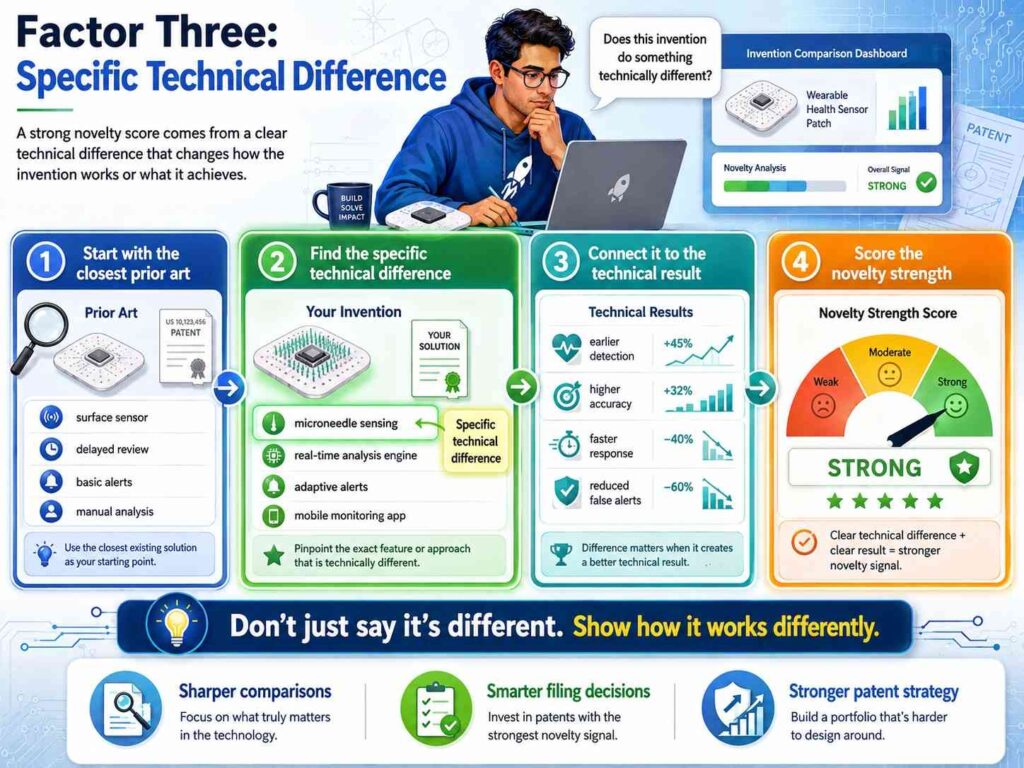
This score asks whether your invention has a clear technical difference over the closest art.
Not a branding difference.
Not a user-interface slogan.
Not a business model difference.
A technical difference.
For example, “we do it for dentists instead of lawyers” may not be enough by itself.
But “we use patient-specific imaging artifacts to adjust a detection threshold in real time” may be technical.
“we use AI” is not enough.
But “we block generated answers when source confidence and user permission fail a combined rule” is more technical.
“we make battery safety smarter” is not enough.
But “we compare gas rate of change with local temperature gradient within a time window before triggering isolation” is technical.
Score this factor like this.
A score of 1 means no clear technical difference has been identified.
A score of 2 means the difference is mostly business, branding, or market setting.
A score of 3 means there is a possible technical difference, but it is vague or not well supported.
A score of 4 means the technical difference is clear and tied to the system operation.
A score of 5 means the technical difference is clear, specific, useful, and supported by examples or test results.
This score is crucial.
A patent filing should focus on a technical edge.
If you cannot name that edge, you may not be ready to file.
How to Find the Technical Difference
Compare your invention to the closest prior art feature by feature.
Ask what the old source shows.
Ask what it does not show.
Ask what your system does differently.
Ask whether that difference changes how the system works.
Ask whether the difference improves speed, safety, accuracy, reliability, cost, power, privacy, or control.
Ask whether the difference is required to get the customer value.
Sometimes the difference is in the inputs.
Sometimes it is in the order of steps.
Sometimes it is in the trigger.
Sometimes it is in the feedback loop.
Sometimes it is in the time window.
Sometimes it is in the physical placement.
Sometimes it is in what the system refuses to do.
Sometimes it is in the way a human approval step is used.
Do not assume the difference is the feature customers see.
The strongest difference may be hidden under the hood.
Engineers often know it.
Ask them.
Factor Four: Feature Combination Strength
Many inventions are combinations.
The individual parts may be known, but the specific combination may be new.
This is common in software, AI, hardware, robotics, medical devices, and control systems.
For example, file ownership may be known. Incident history may be known. Reviewer recommendation may be known. But using incident similarity, live customer impact, service ownership, and reviewer availability together to route code review may be less common.
Gas sensing may be known. Temperature monitoring may be known. Pressure sensing may be known. But comparing gas rate, pressure change, and local temperature gradient in a specific window may be different.
Clause extraction may be known. Risk scoring may be known. Redline suggestions may be known. But learning from approved redlines while keeping customer data separated may be different.
Score feature combination strength like this.
A score of 1 means the exact combination appears in one prior source.
A score of 2 means the combination is mostly shown or seems like a simple grouping of known parts.
A score of 3 means the parts are known, but the combination may have a specific twist.
A score of 4 means the combination appears meaningfully different and tied to a technical result.
A score of 5 means the combination is unusual, specific, and appears central to the performance gain.
This score should be discussed with patent counsel because combination issues can be subtle.
But founders can still use it to decide what deserves review.
How to Score a Combination Without Fooling Yourself
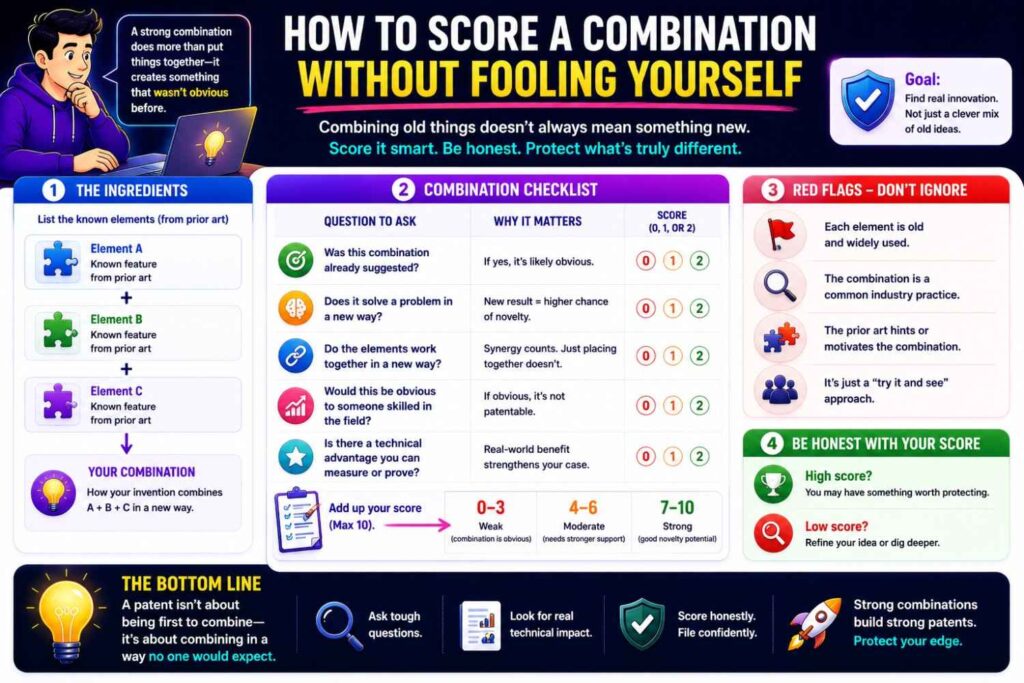
Do not say “our combination is new” just because no source uses your exact product name.
Ask whether one source shows the full combination.
Then ask whether multiple sources show the pieces.
If many sources show the pieces in similar settings, the score may be lower.
If the pieces come from very different fields and your combination solves a specific constraint, the score may be higher.
Ask why the combination matters.
Does it produce a better result?
Does it solve a hard problem?
Does it work under a constraint?
Does it reduce false positives?
Does it enable real-time control?
Does it reduce manual review?
Does it make the system safer?
A combination is stronger when it is not just a pile of features.
It should have a reason.
It should create a technical effect.
That reason should be described in the filing.
Factor Five: Technical Improvement
A strong invention usually improves something technical.
It may improve speed, memory use, safety, accuracy, reliability, privacy, power use, latency, bandwidth, fault detection, calibration, control, yield, or data quality.
The improvement should not be only “users like it more.”
User value matters, but patent strength often depends on technical substance.
Score technical improvement like this.
A score of 1 means no clear technical improvement is identified.
A score of 2 means the improvement is mainly business or user convenience.
A score of 3 means there may be a technical improvement, but it is not well explained.
A score of 4 means the improvement is clear and tied to the invention’s steps.
A score of 5 means the improvement is clear, important, and supported by data, examples, tests, or engineering explanation.
For example, “faster review” is helpful, but explain how.
Does the system reduce manual steps?
Does it rank only high-risk items?
Does it route to the right expert sooner?
Does it avoid running expensive checks on low-risk items?
Does it reduce model calls?
Does it use cached context?
The more technical the explanation, the stronger the score.
How to Document Technical Improvement
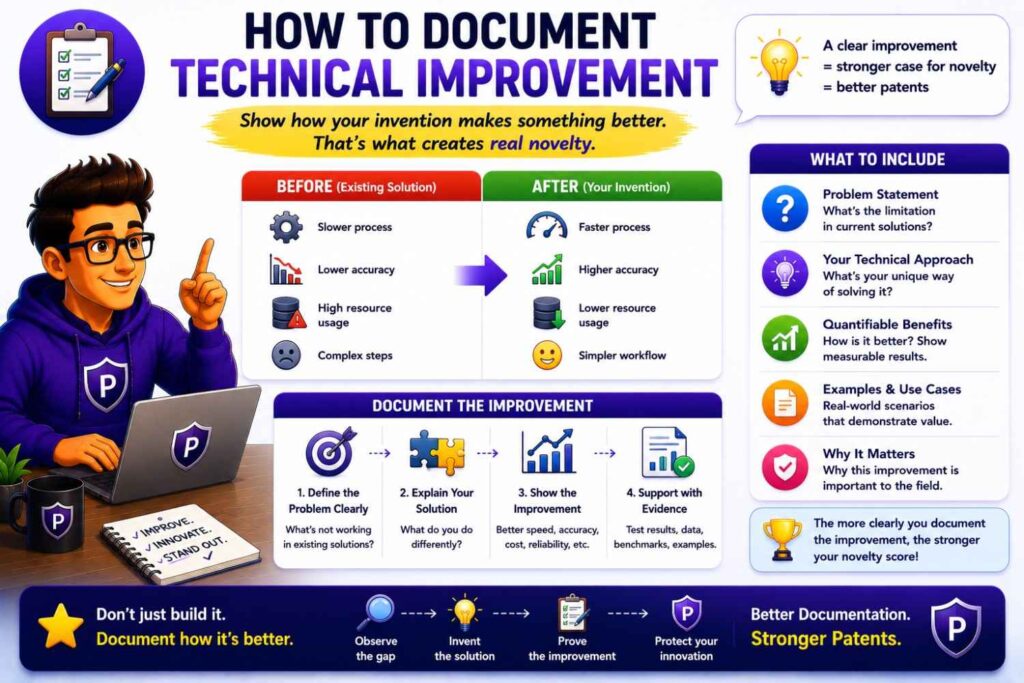
If you want to raise the technical improvement score, gather evidence.
You do not always need perfect test data before filing, but you need a clear story.
Capture before-and-after behavior.
Capture examples.
Capture architecture diagrams.
Capture system logs.
Capture test results.
Capture edge cases.
Capture failure modes.
Capture why the old approach failed.
Capture how the new method fixes it.
For AI tools, show how the new data flow improves accuracy, safety, privacy, or latency.
For hardware, show how the structure changes heat, signal quality, durability, safety, or manufacturing.
For robotics, show how the method improves recovery, timing, safety, or success rate.
For cybersecurity, show how the system reduces false positives, speeds response, or blocks risk more precisely.
This evidence helps novelty scoring and patent drafting.
Factor Six: Business Value
Novelty alone is not enough.
An invention may be new but not worth filing.
Business value asks whether the invention matters to the company.
Does it protect a core product feature?
Does it help win customers?
Does it support pricing?
Does it reduce churn?
Does it create a moat?
Does it matter to investors?
Does it support partnerships?
Would a competitor want to copy it?
Does it tie to the roadmap?
Score business value like this.
A score of 1 means the invention is minor or not tied to business strategy.
A score of 2 means the invention is useful but not central.
A score of 3 means the invention supports a feature but may not be a strong moat.
A score of 4 means the invention is important to product value or differentiation.
A score of 5 means the invention protects a core advantage, revenue driver, or defensible technical edge.
This score matters because patent budgets are finite.
You should not file everything.
You should file what protects the business.
How to Connect Novelty to Business Value
To score business value well, involve product and sales teams.
Ask what customers care about.
Ask what feature gets mentioned in demos.
Ask what competitors lack.
Ask what supports premium pricing.
Ask what would hurt if copied.
Ask what investors ask about.
Ask what buyers would value in diligence.
Then connect those answers to the technical invention.
For example, customers may care about “fewer false alerts.” The technical invention may be motion-and-position based alert suppression.
Customers may care about “trustworthy AI answers.” The technical invention may be permission-aware source verification before answer generation.
Customers may care about “fewer outages.” The technical invention may be pull request risk routing using incident similarity and traffic impact.
Business value and technical novelty should meet.
That is where strong patent strategy lives.
Factor Seven: Copy Risk
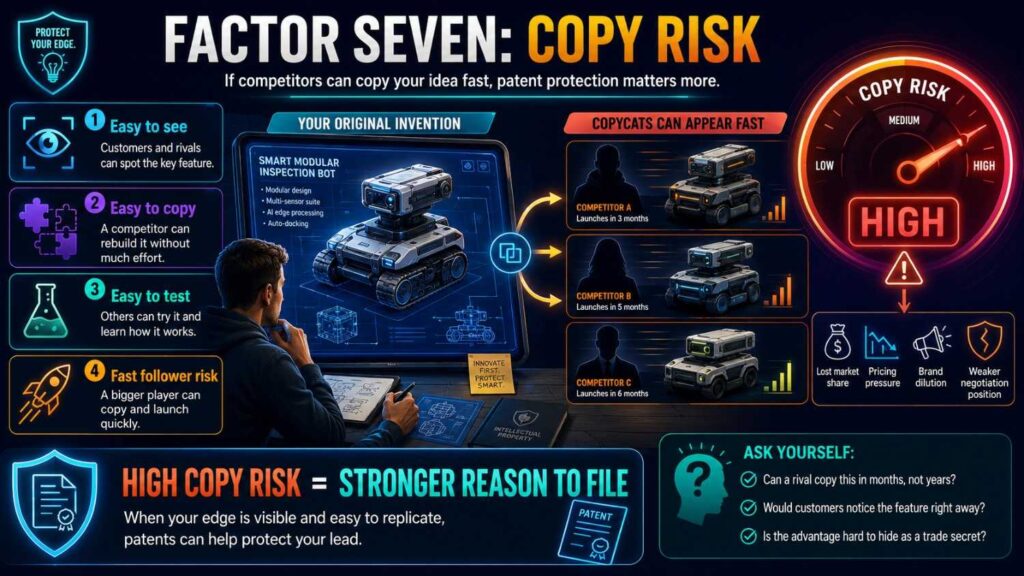
Copy risk asks how likely competitors are to copy the invention.
A valuable invention may not need patent protection if it is hidden and hard to reverse engineer.
A visible feature that competitors can copy may deserve stronger patent attention.
Score copy risk like this.
A score of 1 means the invention is hidden, hard to detect, and hard to reverse engineer.
A score of 2 means the invention is mostly internal and not easy to copy.
A score of 3 means competitors could copy it with effort.
A score of 4 means the feature is visible or likely to be copied.
A score of 5 means the feature is visible, valuable, and easy for competitors to imitate once seen.
High copy risk can increase filing priority.
But if copy risk is low because the invention is secret and hard to detect, trade secret protection may be worth discussing.
This is not a simple rule.
Some hidden inventions still deserve patents.
Some visible features may not be worth filing if novelty is weak.
But copy risk should be part of the score.
Patent or Trade Secret? Use the Score to Decide
A patent requires disclosure.
A trade secret requires secrecy.
If your invention is easy to see from the product, a trade secret may not protect much.
If your invention is hidden deep in backend systems and hard to reverse engineer, trade secret protection may be useful.
Ask these questions.
Will customers see the feature?
Will docs reveal it?
Will APIs expose it?
Will demos show it?
Will competitors infer it from output behavior?
Will employees, partners, or vendors need to know it?
Will regulation or publication force disclosure?
Can you keep it secret in practice?
If the invention is visible and valuable, patent filing may be more attractive.
If it is hidden and secrecy can be maintained, discuss trade secret strategy with counsel.
Novelty scoring should not push every invention toward filing.
It should help choose the right protection path.
Factor Eight: Disclosure Readiness
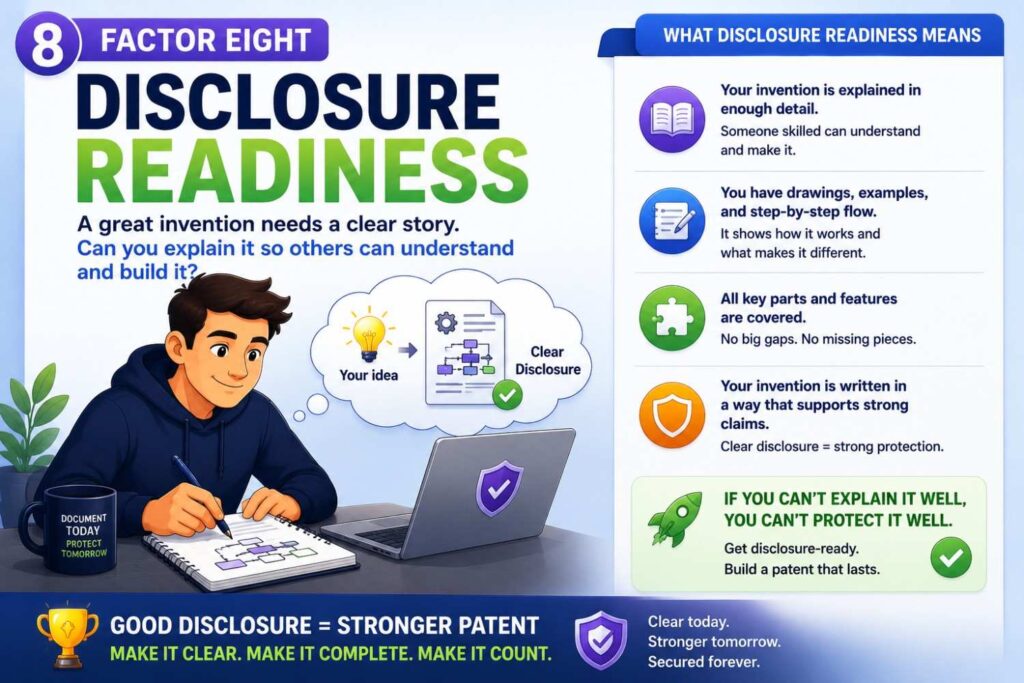
Disclosure readiness asks whether your team is about to make the invention public or already has.
This can affect filing urgency.
Public disclosure can include launch pages, blog posts, GitHub repos, product docs, API docs, demos, videos, conference talks, papers, pitch materials, customer decks, manuals, or standards submissions.
Score disclosure readiness like this.
A score of 1 means the invention has already been widely disclosed and timing risk may be serious.
A score of 2 means some technical details may already be public.
A score of 3 means disclosure is planned but not immediate.
A score of 4 means disclosure is upcoming and can still be managed.
A score of 5 means the invention is not yet public and the team can file before disclosure if needed.
This score is about urgency and risk.
If a launch is coming soon and the invention is important, move quickly.
If details are already public, talk to counsel.
Do not assume it is too late.
Do not assume it is fine.
Get advice.
PowerPatent helps founders move faster before public disclosure so important inventions are not missed. Start here: https://powerpatent.com/how-it-works
How to Audit Your Own Public Disclosures
Before scoring disclosure readiness, review what your team has shared.
Search your website.
Search your docs.
Search your blog.
Search your GitHub.
Search your YouTube videos.
Search your conference talks.
Search your sales decks.
Search your product demos.
Search your API docs.
Search support articles.
Search release notes.
Ask engineers what code is public.
Ask marketing what launch content is planned.
Ask sales what has been sent to prospects.
Ask product what will be shown in demos.
This audit can be quick, but it matters.
Your own disclosures can affect patent strategy.
A smart founder checks before filing, not after.
Factor Nine: Filing Support
Filing support asks whether you have enough technical detail to support a strong application.
An invention can score high on novelty but still be weakly supported.
That is a problem.
A patent filing needs enough detail.
It should describe how the invention works, not just what it does.
It should include examples, alternatives, data flows, diagrams, system architecture, triggers, thresholds, timing, inputs, outputs, and variations when relevant.
Score filing support like this.
A score of 1 means there is only an idea or pitch.
A score of 2 means there is a feature description but little technical detail.
A score of 3 means there is some technical detail, but gaps remain.
A score of 4 means the invention is well documented with clear steps and examples.
A score of 5 means the invention has strong support, diagrams, examples, variations, and engineering detail.
If filing support is low, do not rush.
Capture more detail first.
A thin filing can create false comfort.
A stronger filing gives your attorney more room.
What Details to Capture Before Filing
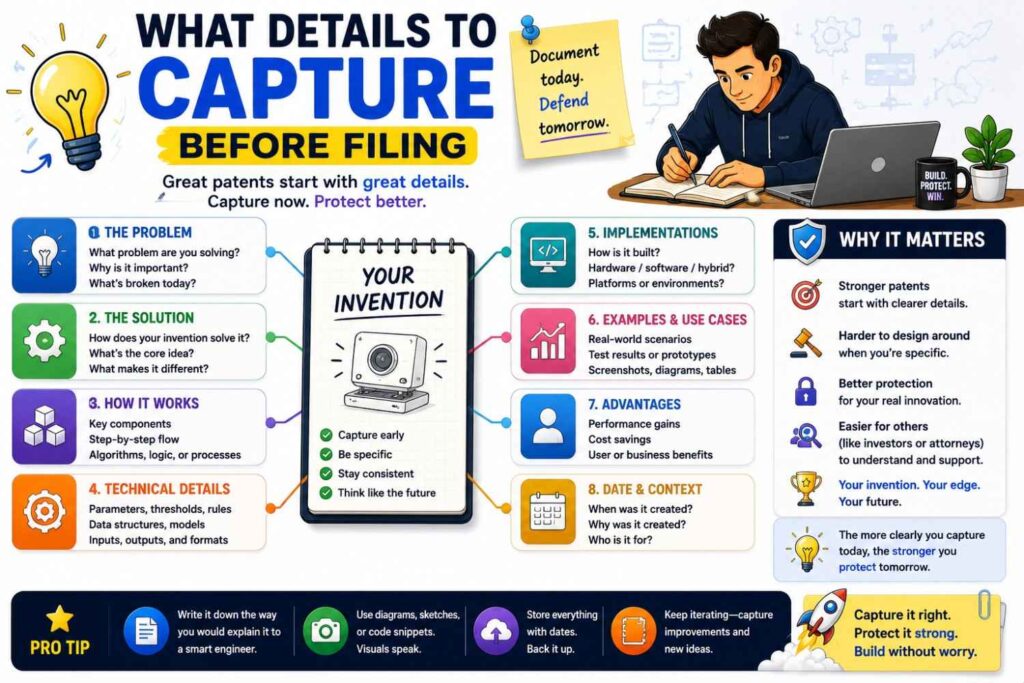
Capture the system architecture.
Capture the data flow.
Capture key steps.
Capture decision rules.
Capture thresholds or scoring logic when safe to disclose to counsel.
Capture timing windows.
Capture hardware layouts.
Capture sensor placement.
Capture model inputs and outputs.
Capture feedback loops.
Capture examples.
Capture alternative versions.
Capture failure modes.
Capture why the invention improves the old approach.
Capture what parts are optional.
Capture what parts are essential.
This detail can make the filing stronger.
It can also help your patent attorney draft fallback positions.
PowerPatent is built to help technical teams capture these details without turning the process into a burden. Learn more here: https://powerpatent.com/how-it-works
Factor Ten: Attorney Review Priority
The final score is attorney review priority.
This is the combined business call.
You look at all the earlier factors and decide how urgently this invention should go to a patent professional.
A score of 1 means no action now.
A score of 2 means keep watching or improve the idea.
A score of 3 means review later or bundle with other ideas.
A score of 4 means bring to counsel soon.
A score of 5 means urgent attorney review before disclosure or major business event.
An invention may deserve high attorney priority if it has strong technical difference, high business value, high copy risk, and upcoming disclosure.
Even if prior art distance is uncertain, attorney review may be urgent if the invention is core.
On the other hand, an idea with moderate novelty but low business value may wait.
This score helps founders allocate attention.
Not every invention needs the same response.
How to Calculate an Overall Novelty Readiness Score
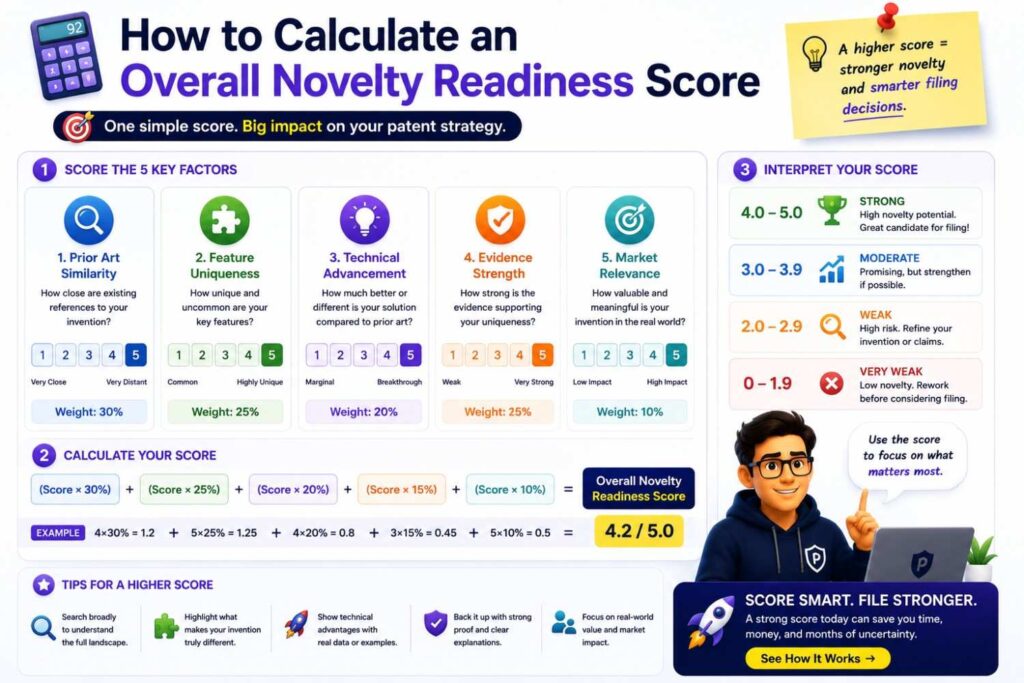
You can add the ten scores together.
The maximum is 50.
A score above 40 usually means the invention is strong enough for serious attorney review and possible filing.
A score from 30 to 40 means the invention may be promising but needs targeted review, deeper search, or more detail.
A score from 20 to 30 means the team should be careful. There may be a real invention, but the filing focus is unclear or the business value may not justify cost.
A score below 20 usually means do not spend on a patent yet unless there is a special reason.
Do not treat the number as a legal answer.
Treat it as a decision aid.
The notes behind the score matter more than the total.
For example, a score of 42 with low disclosure readiness may need urgent action.
A score of 38 with high business value and uncertain prior art may deserve attorney review.
A score of 45 with low filing support may need more technical capture before filing.
The number starts the conversation.
It does not end it.
A Practical Scoring Example: AI Contract Review
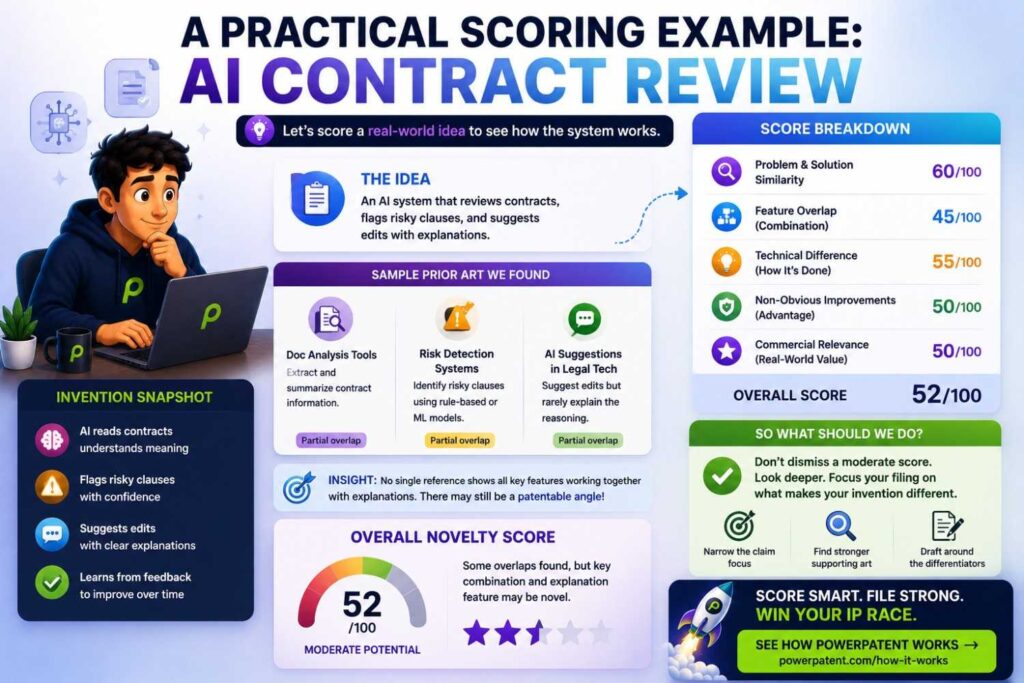
Imagine your startup built an AI contract review tool.
The broad pitch is simple.
It reviews contracts with AI.
But the actual invention is more specific.
It compares draft clauses to a company playbook, selects fallback language from prior approved redlines, and updates customer-specific suggestions while keeping customer data separated.
Now score it.
Invention clarity may be 4 if the team can explain the workflow.
Prior art distance may be 3 because clause extraction, risk scoring, and redline suggestions are known, but the exact customer-separated learning method is not yet found.
Specific technical difference may be 4 if the data separation and approved-redline feedback are clear.
Feature combination strength may be 4 if the combination of playbook rules, approved redlines, and customer-separated learning appears meaningful.
Technical improvement may be 4 if the team can show faster review with safer customer-specific suggestions.
Business value may be 5 if this feature drives enterprise adoption.
Copy risk may be 4 if competitors can imitate the workflow once shown.
Disclosure readiness may be 3 if a product launch is planned soon.
Filing support may be 3 if more examples and diagrams are needed.
Attorney review priority may be 5 because the feature is core and disclosure is near.
Total score: 39.
This is not a final legal answer.
But it tells the team what to do.
Bring it to counsel soon. Capture more examples. Search customer-separated learning and approved-redline feedback more deeply. Consider filing before launch.
That is useful.
A Practical Scoring Example: Battery Safety System
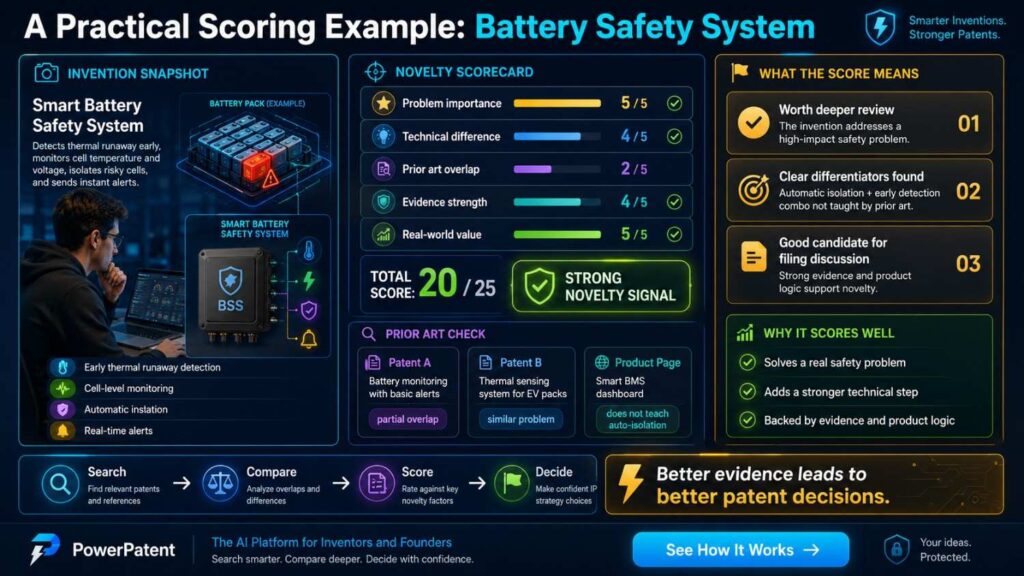
Imagine your company built a battery fault detection system.
It uses gas sensing, pressure sensing, and local temperature gradients to detect early cell failure and reduce false alarms.
Invention clarity may be 5 if the signal flow is well documented.
Prior art distance may be 3 because battery safety is crowded, and gas sensing and temperature monitoring are known.
Specific technical difference may be 4 if the comparison logic and timing window are clear.
Feature combination strength may be 4 if no source shows gas rate, pressure change, and local temperature gradient in the same trigger.
Technical improvement may be 5 if test data shows earlier detection with fewer false alarms.
Business value may be 5 if safety is core to the product.
Copy risk may be 3 if some parts are visible but internal logic is harder to observe.
Disclosure readiness may be 4 if the system has not been launched yet.
Filing support may be 5 if diagrams, test data, and examples exist.
Attorney review priority may be 5.
Total score: 43.
This looks like a strong candidate for attorney review.
The search should focus on the exact signal relationship, time window, and safety response.
The filing should describe fallback positions around different sensor combinations and thresholds.
A Practical Scoring Example: Code Review Risk Routing
Imagine your tool scores pull requests and routes review to the right expert.
It uses changed files, service ownership, past production incidents, dependency maps, live traffic impact, and reviewer availability.
Invention clarity may be 4.
Prior art distance may be 3 because reviewer recommendation, defect prediction, and change impact analysis are known.
Specific technical difference may be 4 if incident similarity and live customer impact drive the routing.
Feature combination strength may be 4 if the full combination is not found.
Technical improvement may be 4 if the team can show faster review or fewer incidents.
Business value may be 5 if reliability is a core product promise.
Copy risk may be 4 because competitors can copy the workflow once it is shown in docs.
Disclosure readiness may be 4 if the feature is still private but launch is near.
Filing support may be 3 if the team needs more diagrams and examples.
Attorney review priority may be 5.
Total score: 40.
This is a strong review candidate.
Before filing, the team should deepen search around incident-aware code review, service ownership routing, and deployment risk scoring.
It should also capture the scoring flow, data sources, and routing triggers.
A Practical Scoring Example: Low-Value Internal Tool
Now imagine your team built a small internal dashboard.
It helps employees see project status by pulling data from several existing tools.
The dashboard is useful, but not core to the product.
Invention clarity may be 3.
Prior art distance may be 2 because many dashboards combine project data.
Specific technical difference may be 2 if there is no special technical method.
Feature combination strength may be 2.
Technical improvement may be 2.
Business value may be 1 because it is not part of the product or moat.
Copy risk may be 1 because competitors will not see it.
Disclosure readiness may be 5 because it is not public.
Filing support may be 2.
Attorney review priority may be 1.
Total score: 21.
This likely should not be a patent spend right now.
The team may keep it internal.
If the tool later becomes a product feature with a unique technical method, score it again.
A Practical Scoring Example: AI Answer Guardrail
Imagine your company built an AI assistant for enterprise users.
The assistant answers questions only when it can find approved source documents and confirm that the user has permission to access those sources.
If source confidence is low or permission fails, it blocks the answer and routes the question for review.
Invention clarity may be 5.
Prior art distance may be 3 because retrieval, citations, and policy checks are known, but the combined permission-and-confidence block may not be found.
Specific technical difference may be 4.
Feature combination strength may be 4.
Technical improvement may be 4 if it reduces unsafe or unsupported answers.
Business value may be 5 if trust and compliance drive sales.
Copy risk may be 5 because competitors can market similar guardrails.
Disclosure readiness may be 4 if it will appear in product docs soon.
Filing support may be 4 if the workflow and examples are documented.
Attorney review priority may be 5.
Total score: 43.
This looks like a high-priority patent review candidate.
The filing focus may be source confidence plus permission-based answer blocking, with fallback positions around audit logging, routing, and approved document selection.
How to Use the Score Across a Portfolio
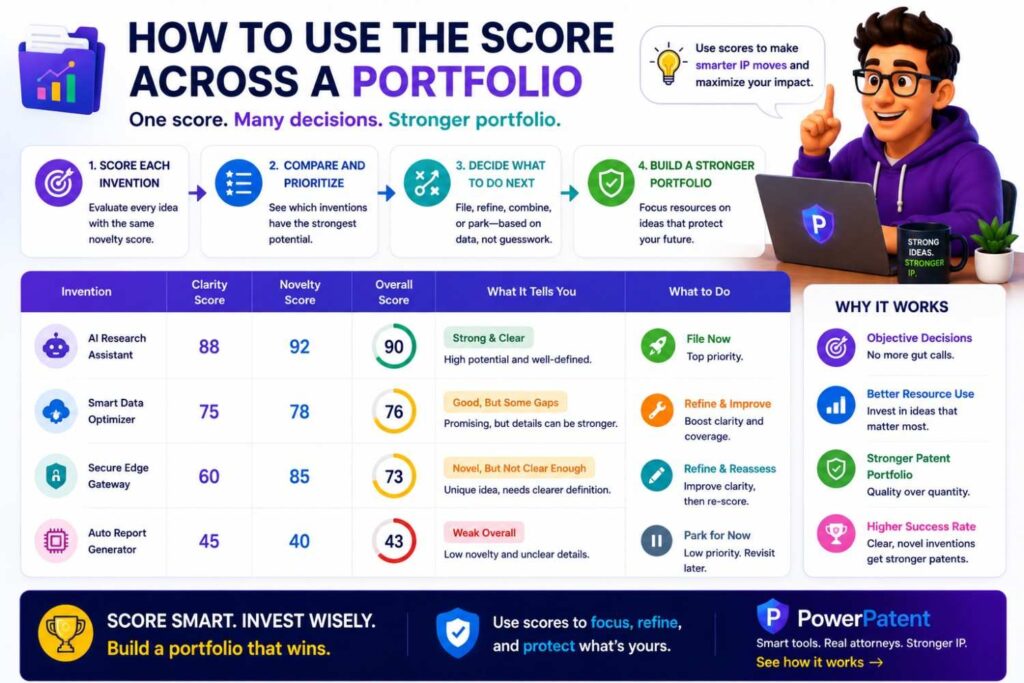
The scorecard becomes even more useful when you have many ideas.
Most startups do not have just one invention.
They have a product full of possible inventions.
A model training method.
A deployment method.
A user feedback loop.
A data pipeline.
A hardware structure.
A safety control.
A calibration method.
A workflow automation.
A privacy boundary.
A monitoring method.
Score each one.
Then compare.
Which ideas have high novelty and high business value?
Which ideas have high copy risk?
Which ideas are about to be disclosed?
Which ideas need more technical capture?
Which ideas are weak and should wait?
This helps build a patent roadmap.
You can file the strongest ideas first.
You can revisit medium-scoring ideas later.
You can avoid low-value filings.
This is how a startup turns scattered ideas into an IP strategy.
How Often Should You Score Inventions?
Score inventions when they first appear.
Score again when the product changes.
Score before public launch.
Score before fundraising.
Score before major customer demos.
Score when a competitor launches something similar.
Score when engineers solve a hard technical problem.
Score when a feature becomes core to the roadmap.
Invention scoring should not be a one-time event.
Products evolve.
A low-score idea may become valuable later.
A vague idea may become clear after testing.
A hidden backend method may become a visible product feature.
A small workaround may become the core moat.
Build scoring into the company rhythm.
It does not need to slow you down.
It helps you spot IP early.
Treat Scoring Like a Product Health Check
The best teams do not treat invention scoring as a rare legal task.
They treat it like a product health check.
Just as you review roadmap risk, customer feedback, uptime, churn, and revenue, you should review invention strength at key points in the company’s life.
This does not mean every small feature needs a deep patent review.
It means your team should have a simple habit for spotting ideas that may deserve protection.
A good rule is this: if a feature took real technical effort, creates clear customer value, or would hurt if copied, score it.
That keeps the process focused.
You are not trying to patent every clever thing.
You are trying to catch the inventions that support the business.
Score at the Moment of Technical Breakthrough
One of the best times to score an invention is right after the team solves a hard problem.
This is when the details are fresh.
Engineers still remember what failed. They remember what changed. They remember which data source mattered, which threshold worked, which control loop became stable, or which workflow finally reduced errors.
That memory fades fast.
If you wait three months, the team may only remember the finished product, not the inventive path that got there.
So create a simple trigger.
When an engineer says, “We finally got it working,” that is a scoring moment.
Ask what was hard, why the old approach failed, what changed, and what result improved.
Then give the invention a first-pass score.
It may not be ready to file yet, but you have captured the seed.
That seed can become a strong patent later.
Score Before the Feature Becomes Public
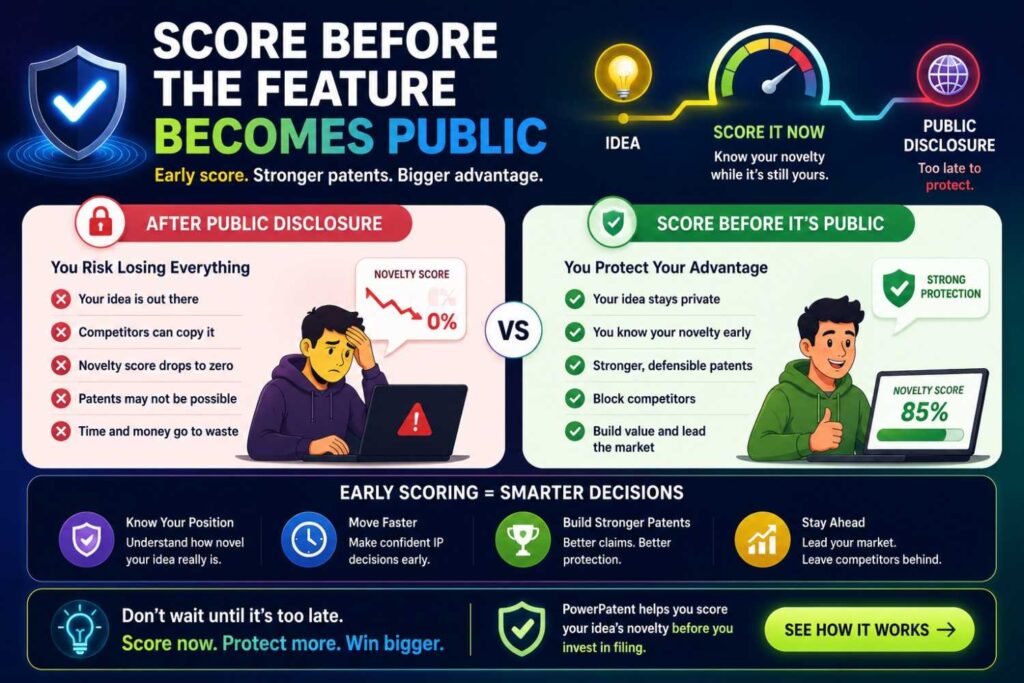
A public launch is an obvious scoring moment.
Before you publish a product page, demo video, help doc, API page, GitHub repo, white paper, case study, or conference talk, ask whether the feature includes a technical invention.
If it does, score it before the disclosure.
This is not about blocking marketing.
It is about giving the company options.
Once technical details are public, your choices may narrow. Filing before disclosure is often cleaner than trying to fix things later.
A practical habit is to add an IP check to the launch checklist.
Before launch, product and engineering should answer one question: are we about to show how a technical feature works?
If the answer is yes, run a quick score.
If the score is high, bring it to patent counsel right away.
PowerPatent helps founders move quickly before public disclosure, so strong inventions do not get lost in the rush to launch. See how it works here: https://powerpatent.com/how-it-works
Score When a Feature Moves From Nice-to-Have to Core
Some inventions do not look important at first.
A backend script becomes a key automation.
A small routing rule becomes the reason customers renew.
A sensor filter becomes the reason the device works in the field.
A manual review shortcut becomes the main AI workflow.
When a feature moves from nice-to-have to core, score it again.
The business value may have changed.
The copy risk may have changed.
The disclosure risk may have changed.
The technical detail may be clearer.
This is why one score is not enough.
A score is a snapshot.
When the business role of the feature changes, the score should change too.
Score During Roadmap Planning
Roadmap planning is a strong time to review inventions.
Most teams already ask what they will build next.
Add one more question: what are we building that may become defensible IP?
This helps founders protect future value, not just past work.
During roadmap planning, score major upcoming technical bets.
If a planned feature has high business value and high copy risk, you can prepare earlier.
You can capture invention details as the team builds.
You can search prior art before launch pressure hits.
You can file before the market sees the feature.
This is much better than discovering patent value after the feature is already public.
Score Before Fundraising and Strategic Partnerships
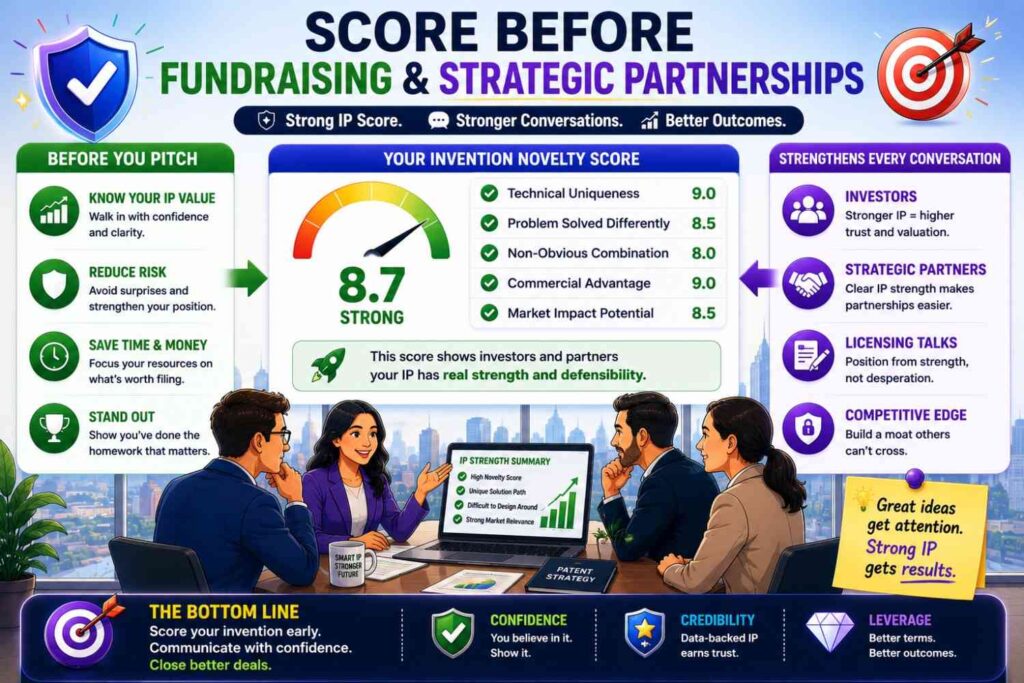
Fundraising is another key moment.
Investors may ask what makes your company hard to copy.
Partners may ask how your technology is protected.
A buyer or strategic partner may look closely at your IP story.
Before these conversations, review your highest-value inventions and score them.
This helps you avoid vague claims like “we have AI patents coming.”
It lets you speak with more control.
You can say your team has identified specific technical inventions, reviewed the prior art landscape, and is focusing filings on the parts that matter most.
That sounds stronger because it is stronger.
It shows that your patent strategy is tied to the business, not just paperwork.
Score When Competitors Move
A competitor launch can change the importance of an invention.
If a competitor releases a similar feature, score your related invention again.
Ask what they disclosed.
Ask whether your method is different.
Ask whether your feature is now more important to protect.
Ask whether your public materials show too much.
Ask whether you need to file quickly on an improvement.
Competitor activity can also reveal new prior art.
Their docs, videos, product pages, release notes, and engineering blogs may show useful details.
Use those materials to update your scoring.
Do not react emotionally.
React with a clear score and a filing decision.
Score After Customer Pilots
Customer pilots often reveal the real invention.
A feature may work in the lab but fail in the field.
Then your team creates a fix.
That fix may be more valuable than the original idea.
For example, a sensor product may need a new calibration method after field testing.
An AI tool may need a human approval rule after enterprise users reject fully automatic output.
A robotics system may need a recovery sequence after customer sites reveal new failure modes.
These pilot-driven fixes are often strong patent candidates because they solve real-world constraints.
After each major pilot, ask what technical changes were made because of customer use.
Score those changes.
They may be the moat.
Score After Major Architecture Changes
A major architecture change can create new patent value.
Maybe the system moves from cloud to edge.
Maybe a model is split across devices.
Maybe a data pipeline is redesigned for privacy.
Maybe a sensor loop becomes local instead of remote.
Maybe a workflow moves from manual approval to conditional automation.
These architecture changes can be important because they often solve hard constraints.
When architecture changes, score the invention again.
The old score may no longer reflect the real technical edge.
A feature that once looked common may become much stronger when it works under a new constraint.
Score on a Regular Quarterly Rhythm
In addition to event-based scoring, set a regular rhythm.
Quarterly is often enough for startups.
Once per quarter, review the inventions captured since the last review.
Look at new product features, engineering breakthroughs, customer pilot fixes, competitor changes, public disclosure plans, and roadmap shifts.
Score anything that looks important.
Then sort the ideas into simple buckets.
File review now.
Search more.
Capture more detail.
Watch for later.
Do not pursue.
This turns invention scoring into a lightweight operating habit.
It prevents last-minute panic.
It also helps the company build a stronger patent portfolio over time.
Use Different Depths for Different Moments
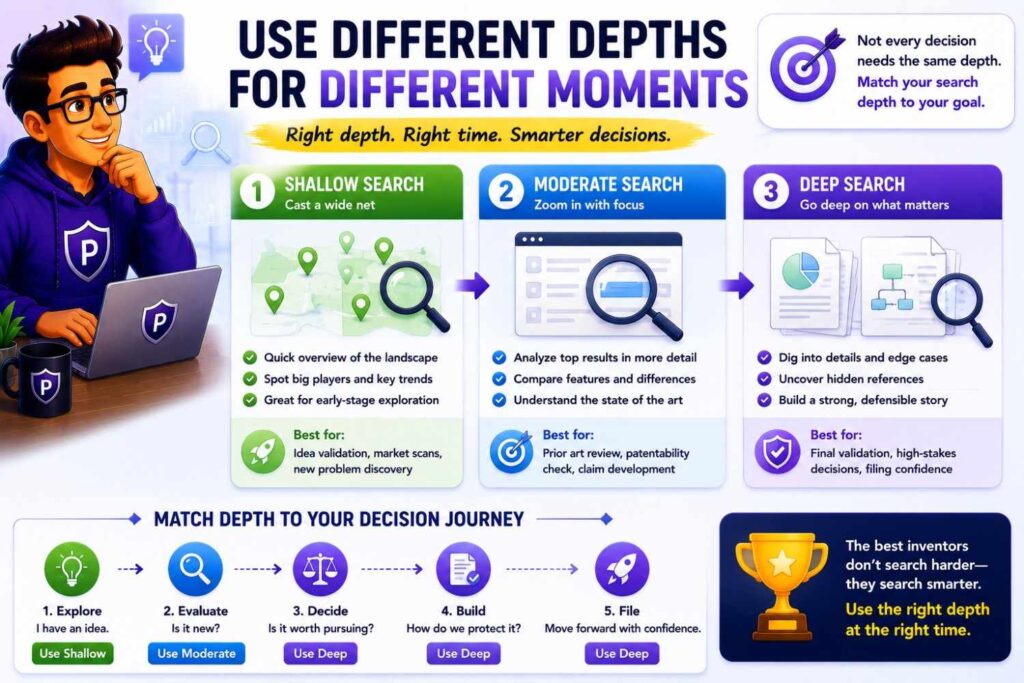
Not every scoring moment needs the same depth.
A first-pass score can be quick.
It may take only enough time to capture the invention and flag whether it deserves more review.
A pre-launch score should be deeper because disclosure risk is higher.
A core platform invention should get deeper search and attorney review.
A minor internal tool may only need a light score.
This is how you keep the process from slowing the team down.
Match the depth to the risk.
High business value, high copy risk, and near-term disclosure mean deeper scoring.
Low business value and low copy risk mean lighter scoring.
Make Rescoring Part of the Decision Process
A score should lead to action.
If an invention scores in the middle, set a rescoring trigger.
For example, rescore after the next customer pilot, after test data is ready, after the feature enters the roadmap, after a prior art search is done, or before launch.
Do not let medium-score ideas drift forever.
They are often where strong IP hides.
The goal is to move each idea toward a decision: file, improve, search more, keep secret, or drop.
A clear rescoring trigger keeps the process alive without creating busywork.
Build a Simple Invention Scoring Calendar
Businesses can make this very practical.
Create a simple calendar tied to company events.
At sprint reviews, capture possible inventions.
At roadmap reviews, score high-value planned features.
Before launch, rescore anything public-facing.
Before fundraising, review core IP candidates.
After pilots, score field-driven technical fixes.
After competitor launches, review related inventions.
Once per quarter, clean up the backlog.
This turns patent thinking into a business system.
It keeps IP close to product and engineering.
It also helps founders spend patent budget with more confidence.
Who Should Be in the Scoring Meeting?
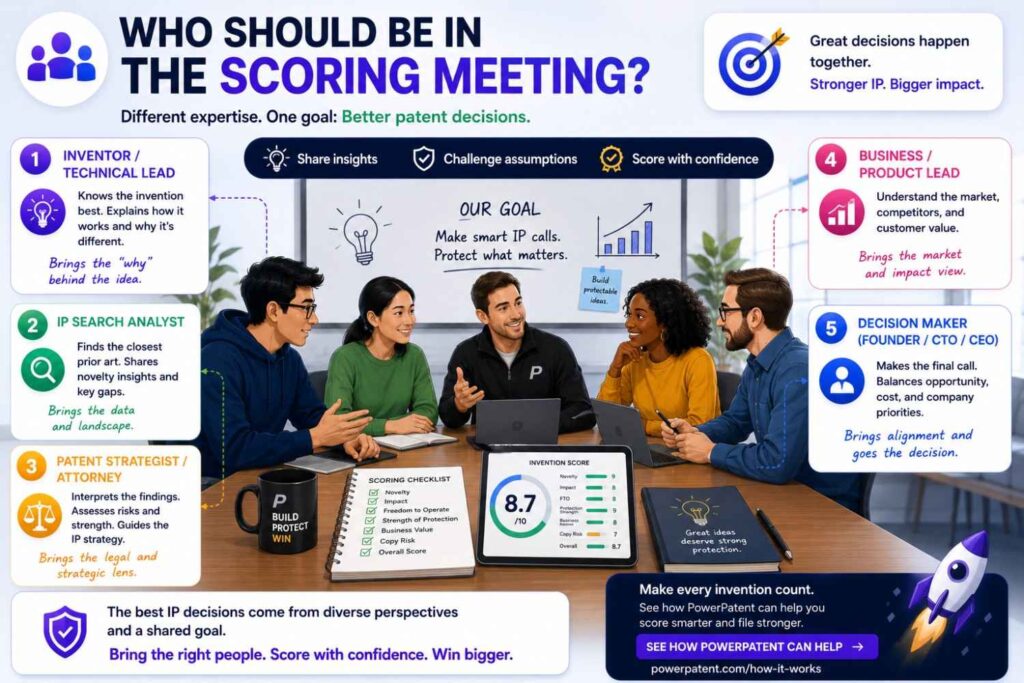
The best scoring happens when several views come together.
You want a founder or business lead.
You want an engineer who knows how the system works.
You want a product person who knows customer value.
You may want a patent professional for important inventions.
Each person sees something different.
The founder sees strategy.
The engineer sees technical difference.
The product lead sees market value.
The patent professional sees claim risk.
Do not make the scoring meeting long.
Keep it focused.
Start with the invention summary.
Review the search results.
Score each factor.
Write down disagreements.
Decide next steps.
The value is not only the final number.
The value is the conversation.
How AI Can Help Score Novelty
AI can help with scoring, but it should not decide alone.
AI can help turn a product pitch into an invention summary.
It can suggest search terms.
It can find synonyms and older words.
It can summarize prior art.
It can compare features.
It can draft source notes.
It can create a first-pass score.
It can point out missing information.
It can suggest what to ask engineers.
But AI may miss details.
It may misunderstand a source.
It may overstate confidence.
It may not know business value.
It may not know what is public or private.
So use AI as a scoring assistant.
Let humans review the score.
Let patent counsel guide filing decisions.
PowerPatent uses smart software and real patent oversight to help founders move faster without relying on blind automation. See how it works here: https://powerpatent.com/how-it-works
What to Do With a High Score
A high score does not mean “file anything.”
It means move to serious review.
If the invention scores high, gather technical details.
Collect diagrams.
Collect examples.
Collect test data if available.
Collect prior art notes.
Create a feature map.
Review public disclosure timing.
Talk to patent counsel.
Decide claim focus and fallback positions.
If disclosure is near, move quickly.
A high score is a signal to act.
Do not let high-scoring inventions sit in a backlog until after launch.
That is how startups lose options.
What to Do With a Medium Score
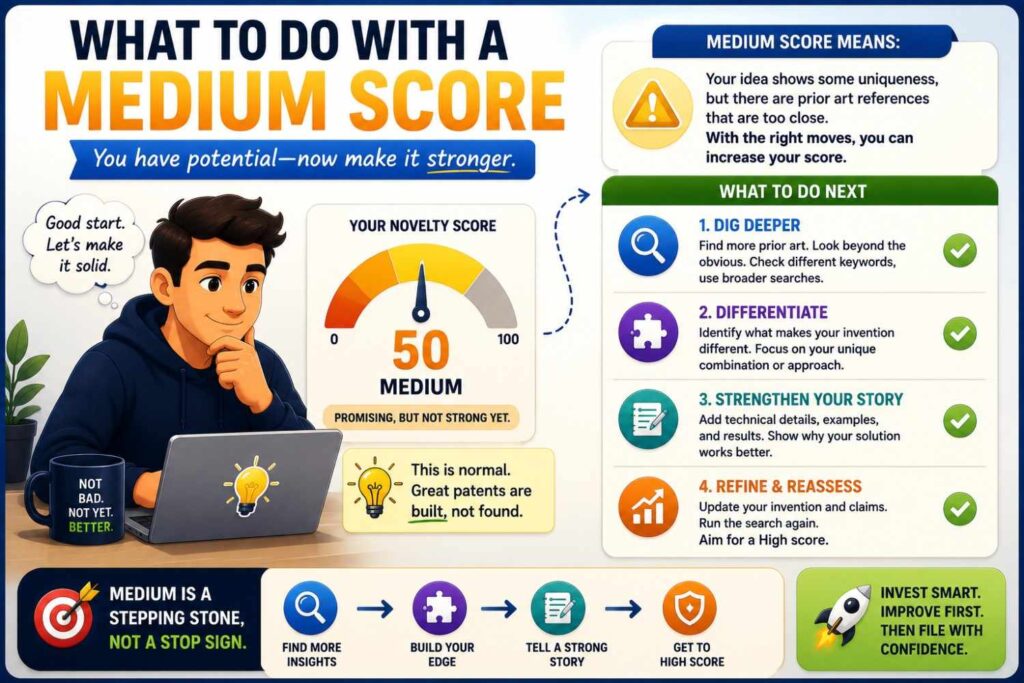
A medium score means the invention may be promising, but something is missing.
Maybe technical detail is thin.
Maybe business value is unclear.
Maybe copy risk is low.
Maybe the feature is not ready.
Do not ignore medium-score inventions.
Decide what would raise the score.
More search?
More technical capture?
More evidence of improvement?
A narrower claim focus?
Better business alignment?
A clearer disclosure timeline?
Assign the next step.
Then revisit.
Many strong patents begin as medium-score ideas that become clearer after engineering work.
What to Do With a Low Score
A low score usually means do not spend on a patent now.
But do not throw the idea away automatically.
Ask why the score is low.
If clarity is low, capture more detail.
If prior art is too close, find a narrower improvement.
If business value is low, park the idea.
If filing support is low, document more.
If copy risk is low, consider trade secret protection.
A low score can still teach you something.
It helps avoid waste.
It also helps focus resources on stronger inventions.
Red Flags in a Novelty Score
Some score patterns should make you pause.
High business value but low technical difference means the product matters, but the patent focus may be weak.
High novelty but low business value means the idea may be interesting but not worth filing.
High copy risk but low prior art distance means competitors may copy, but patent claims may be hard.
High clarity but low filing support means the idea is understood but not documented enough.
High disclosure urgency but low attorney review priority means the team may be underestimating risk.
Low prior art distance with high enthusiasm means emotion may be driving the decision.
These patterns are useful.
They show where to dig.
Green Flags in a Novelty Score
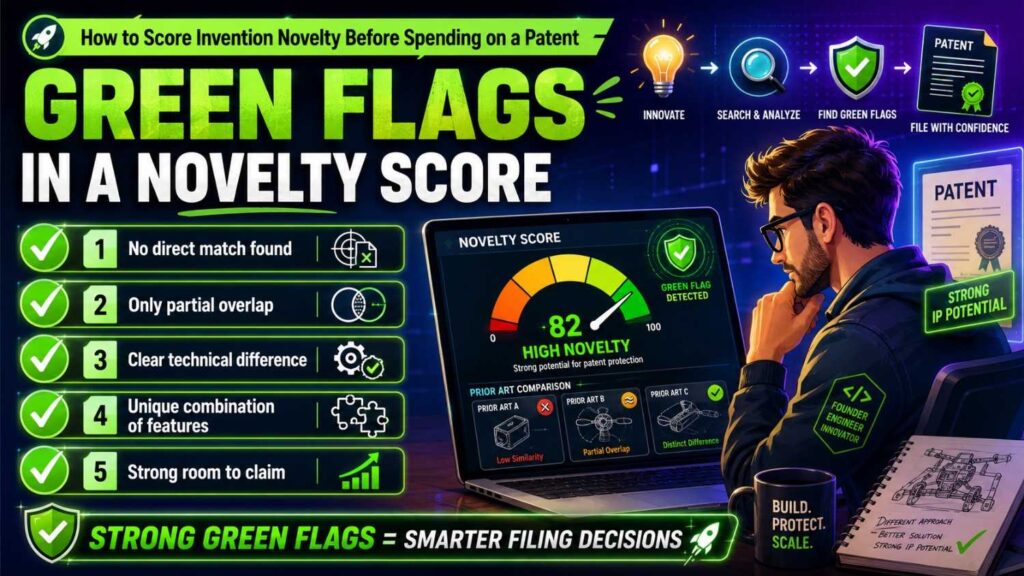
Some patterns suggest a strong candidate.
Clear invention.
No very close prior art found after a thoughtful search.
Specific technical difference.
Meaningful feature combination.
Technical improvement tied to customer value.
High business importance.
High copy risk.
Good filing support.
Upcoming disclosure.
Strong attorney review priority.
When several of these are present, move quickly.
That is the kind of invention a startup should not leave unprotected.
Common Mistake: Scoring Too Early Without Details
Do not score a slogan.
Score an invention.
If the team cannot explain inputs, steps, outputs, and improvement, the score will be fake.
Before scoring, capture the invention.
A score based on vague information creates false confidence.
The first step is always clarity.
Common Mistake: Scoring Only Novelty and Ignoring Business Value
A new idea is not always worth patenting.
Patent strategy is business strategy.
If an invention does not protect revenue, roadmap, market position, customer value, or future leverage, it may not deserve budget.
Score business value honestly.
This keeps the portfolio focused.
Common Mistake: Ignoring Public Disclosure Timing
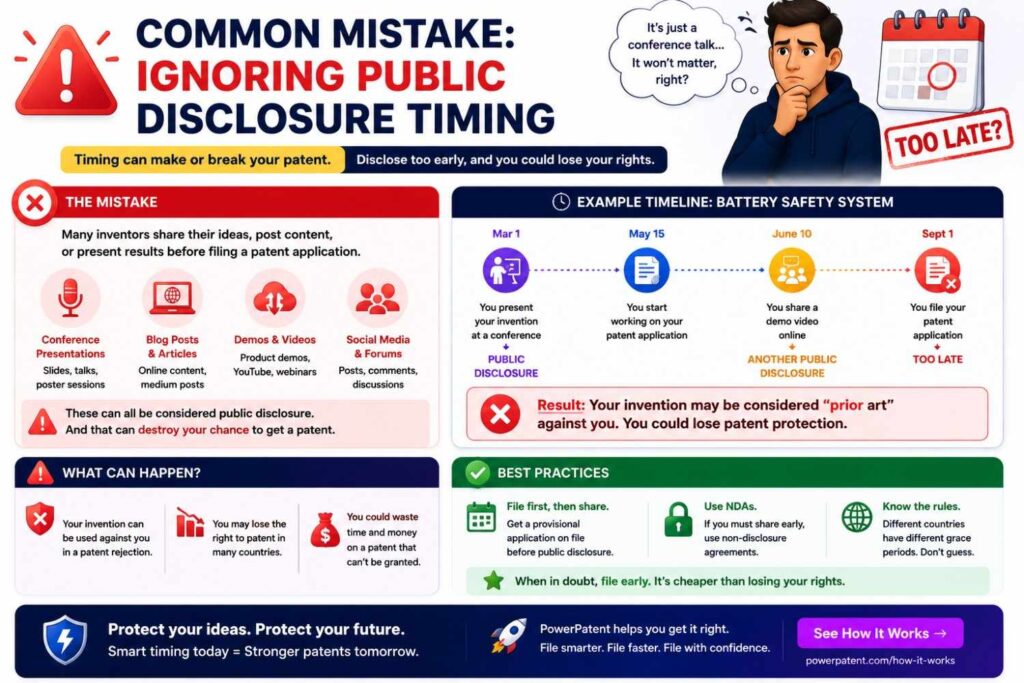
A great invention can become harder to protect if the team waits too long.
If a launch, paper, demo, doc release, or GitHub push is coming, score disclosure readiness.
Do not treat timing as an afterthought.
Patent decisions should happen before public disclosure when possible.
Common Mistake: Letting the Loudest Person Decide
Founders, engineers, and product leaders may disagree.
That is normal.
Do not let the loudest voice decide the score.
Use evidence.
Use prior art.
Use customer value.
Use technical detail.
Use attorney input.
The scorecard creates a shared language.
It helps the team make a decision based on facts, not personality.
A Simple Team Exercise for Scoring an Invention
Set aside a short working session.
Bring any search results.
Bring an engineer, a product lead, and a founder.
Start by asking the engineer to explain what was hard.
Ask the product lead to explain why customers care.
Ask the founder to explain why the invention matters to the business.
Then score each factor from 1 to 5.
Write down why.
If the team disagrees, write down the disagreement.
End with one decision.
File review now.
Search more.
Capture more detail.
Wait.
Do not file.
Keep as trade secret.
The meeting should produce action.
Not just discussion.
How PowerPatent Fits Into Novelty Scoring
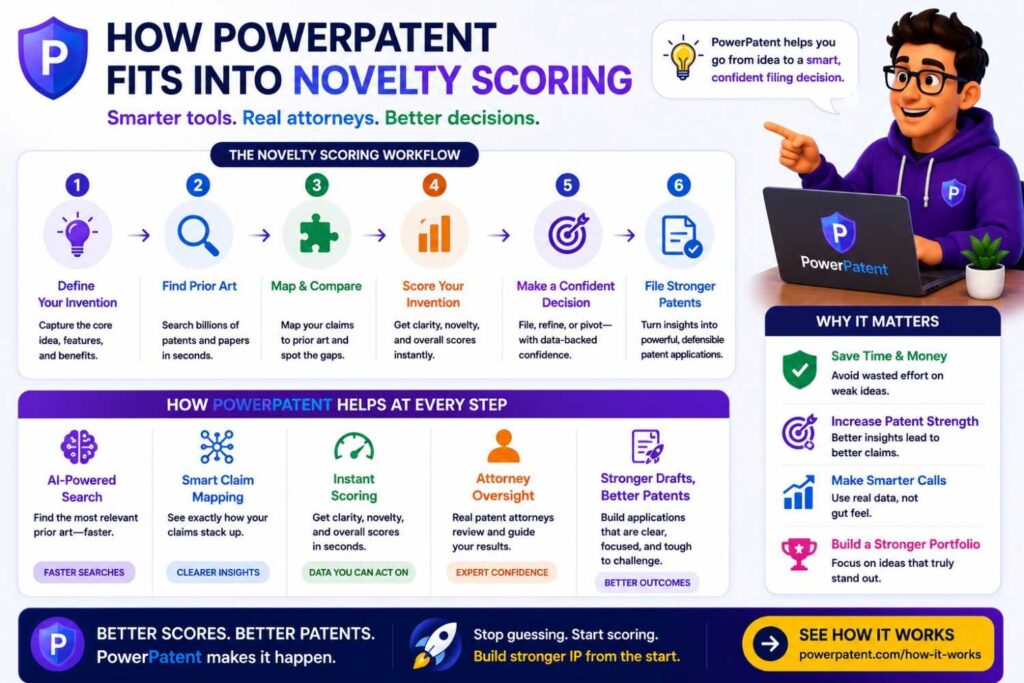
PowerPatent helps founders turn technical ideas into stronger patent decisions.
It gives teams a better way to capture inventions, organize details, support search, and work toward attorney-reviewed filings.
This matters because scoring invention novelty requires both speed and judgment.
You need software to move fast.
You need structure to avoid missing key details.
You need attorney oversight to make real filing decisions.
PowerPatent brings those pieces together.
Instead of guessing which ideas are worth filing, founders can move through a clearer process.
Capture the invention.
Review the old work.
Score the strength.
Decide the next step.
File with real attorney oversight when the invention is worth protecting.
If you are building something hard and want to protect it without old-school friction, see how PowerPatent works here: https://powerpatent.com/how-it-works
The Bottom Line
You should not spend on a patent just because an idea sounds new.
You should score it first.
A good novelty score looks at clarity, prior art distance, technical difference, feature combination, technical improvement, business value, copy risk, disclosure timing, filing support, and attorney review priority.
This gives founders a better way to decide what to file, what to refine, what to search more deeply, what to keep secret, and what to skip.
The point is not to replace patent counsel.
The point is to show up to counsel with better facts.
That saves time.
It saves money.
It leads to stronger filings.
It helps protect the real technical edge.
If your team is building something worth protecting, PowerPatent can help you move from idea to attorney-reviewed patent filing with more confidence. Learn more here: https://powerpatent.com/how-it-works
Closing Thought
A patent budget is a strategy tool.
Spend it where it matters.
Not on every idea.
Not on every feature.
Not on broad claims that ignore prior art.
Spend it on inventions with clear technical difference, strong business value, and enough detail to support a real filing.
Novelty scoring helps you find those inventions.
It gives your team a simple way to slow down just enough to make a better decision.
That small pause can save a lot of money.
It can also help you protect the thing that truly makes your company hard to copy.
Find the edge.
Score it.
Then protect it with care.
Leave a Reply