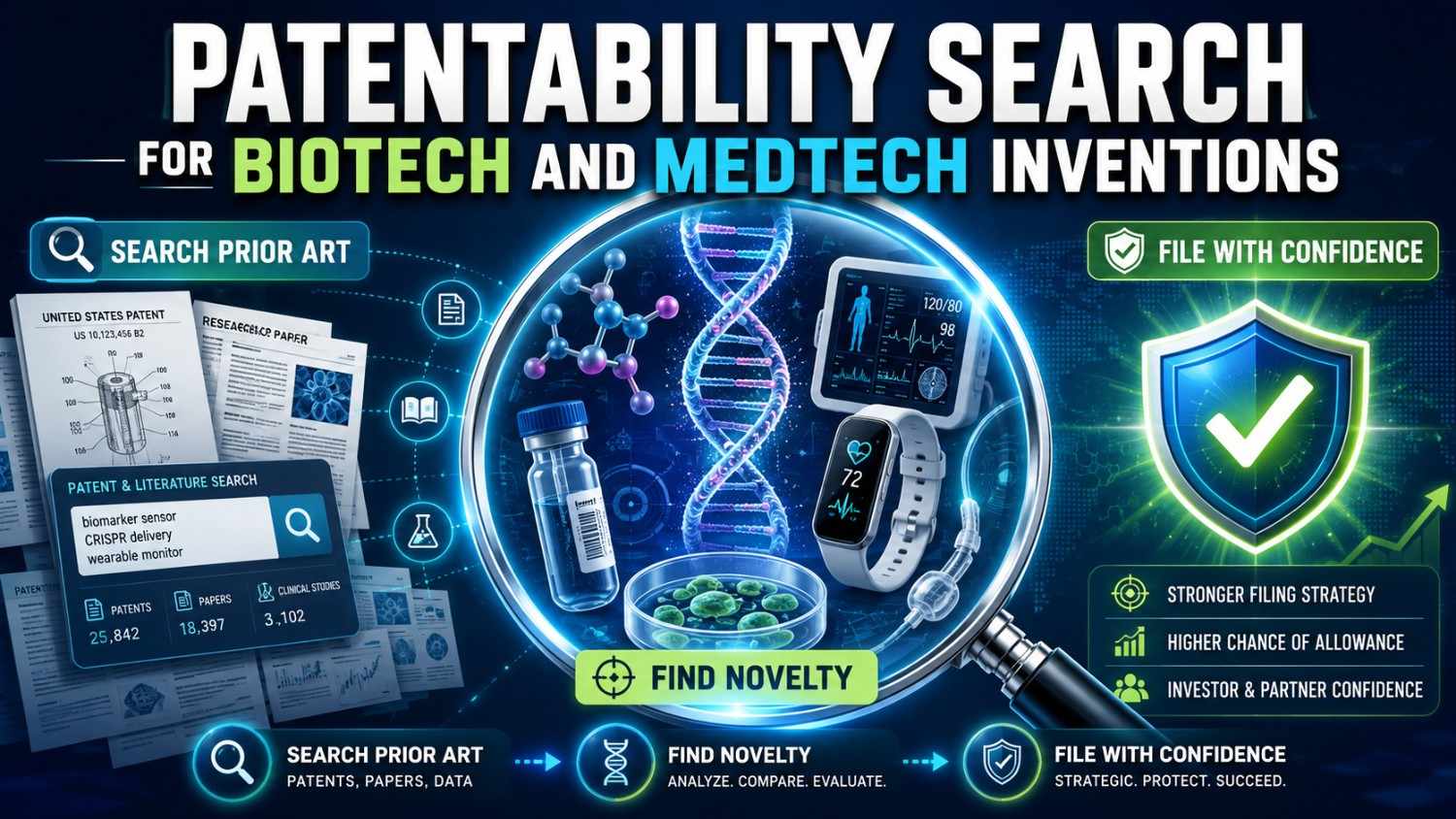
Biotech and MedTech inventions can change lives. But before you file a patent, you need to know what came before.
A patentability search helps you find the closest prior art, see what is truly different, and decide whether your invention is ready for a filing.
PowerPatent helps founders, scientists, engineers, and inventors turn complex technical work into stronger patent filings with smart software and real patent attorney oversight. See how PowerPatent works here.
What a Patentability Search Means in Biotech and MedTech
A patentability search is a search for earlier public information that may be close to your invention.
That earlier information is called prior art.
In biotech and MedTech, prior art can be broad. It can be a patent, a published patent application, a journal paper, a clinical trial record, a regulatory filing, a product manual, a protocol, a thesis, a conference poster, a reagent catalog, a sequence database entry, a device instruction guide, a lab method, a standards document, or a public product page.
This is why a biotech or MedTech search must go beyond a quick patent search.
A drug delivery invention may have prior art in medical devices, materials science, formulation chemistry, and clinical protocols.
A diagnostic invention may have prior art in biomarkers, assays, sample prep, imaging, software, lab automation, and published studies.
A surgical tool may have prior art in robotics, endoscopy, implants, imaging, and mechanical design.
A wearable health device may have prior art in sensors, signal processing, consumer wearables, hospital monitors, and disease-specific studies.
A gene therapy invention may have prior art in vectors, promoters, payloads, delivery routes, dosing, immune response, target tissue, and animal models.
The search needs to follow the science.
It also needs to follow the product.
A patentability search is not about proving your company is new. It is about comparing the exact invention against what the world already knows.
That is where good patent strategy starts.
Why Biotech and MedTech Searches Are Different
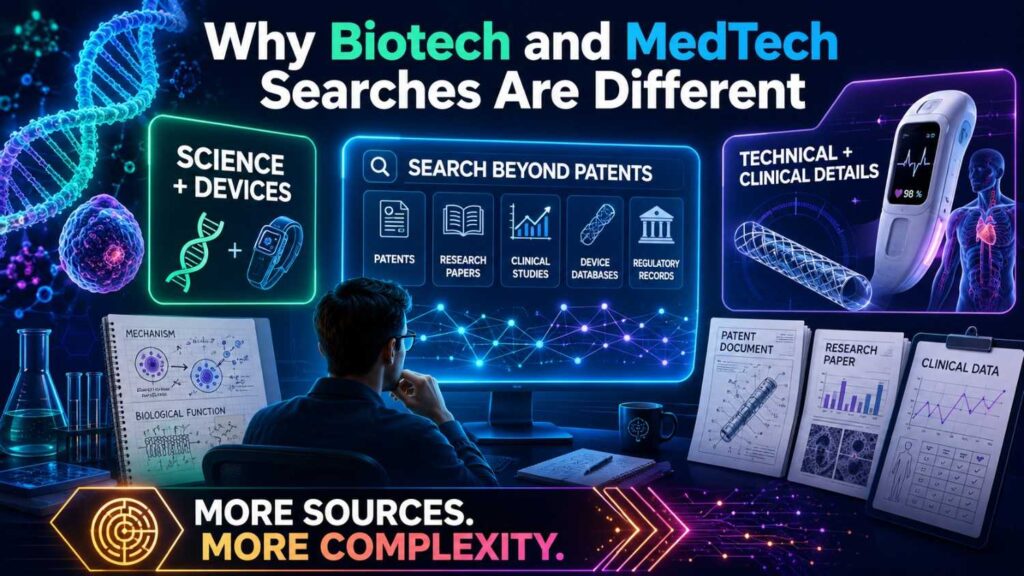
Biotech and MedTech inventions sit at the edge of many fields.
A single invention may include biology, chemistry, hardware, software, data, manufacturing, clinical workflow, and patient use.
That makes searching harder.
A new diagnostic may depend on a biomarker, a sample prep step, a detection method, a scoring rule, and a clinical decision threshold.
A new device may depend on a sensor, a body-contact material, a placement method, a control algorithm, and a user workflow.
A new therapeutic may depend on a molecule, target, formulation, dose, delivery route, patient group, and treatment schedule.
A new MedTech software tool may depend on imaging, signal processing, AI, medical rules, workflow timing, and clinician review.
If you search only one part, you may miss close prior art.
For example, a wearable invention may seem new as a product. But the core sensor method may already be described in a hospital monitor patent.
A diagnostic workflow may feel new in a startup product. But the biomarker combination may already appear in a paper.
A drug delivery method may look new in one disease. But the same delivery route may be taught in another disease area.
A surgical robot feature may feel unique. But a similar control method may exist in industrial robotics.
This is why the best search begins with a clear invention map.
You need to know what you are really protecting before you can search well.
Start With the Invention, Not the Company Story
Founders often describe biotech and MedTech inventions in broad terms.
“We built a better cancer test.”
“We made a smart insulin device.”
“We use AI to read medical images.”
“We created a new wound healing product.”
“We developed a gene therapy platform.”
“We made a surgical robot safer.”
These are useful business statements. But they are not enough for patentability search.
A patentability search needs the technical invention.
A better statement sounds like this:
“Our invention detects early cancer risk by measuring three protein markers from a small blood sample, normalizing the marker levels based on inflammation score, and generating a risk result only when two marker patterns change together.”
Or:
“Our invention controls insulin delivery by using glucose trend, meal timing, and user-specific insulin response history to adjust a micro-dose before a predicted glucose spike.”
Or:
“Our invention improves ultrasound image review by detecting image quality failures, asking the operator for one missing view, and routing only uncertain cases to clinician review.”
Or:
“Our invention improves wound healing by using a layered dressing that releases an antimicrobial agent only when wound pH rises above a set range.”
Or:
“Our invention delivers a gene payload to a target tissue using a vector design and dosing schedule that lowers immune response while keeping expression above a treatment threshold.”
These statements are searchable.
They name the technical method.
They point to the prior art.
They help the patent team understand what may be protectable.
PowerPatent helps teams turn raw science, device details, lab notes, model outputs, and invention records into a clear patent path with real attorney oversight. See how PowerPatent helps founders file better patents faster.
Separate the Discovery From the Invention
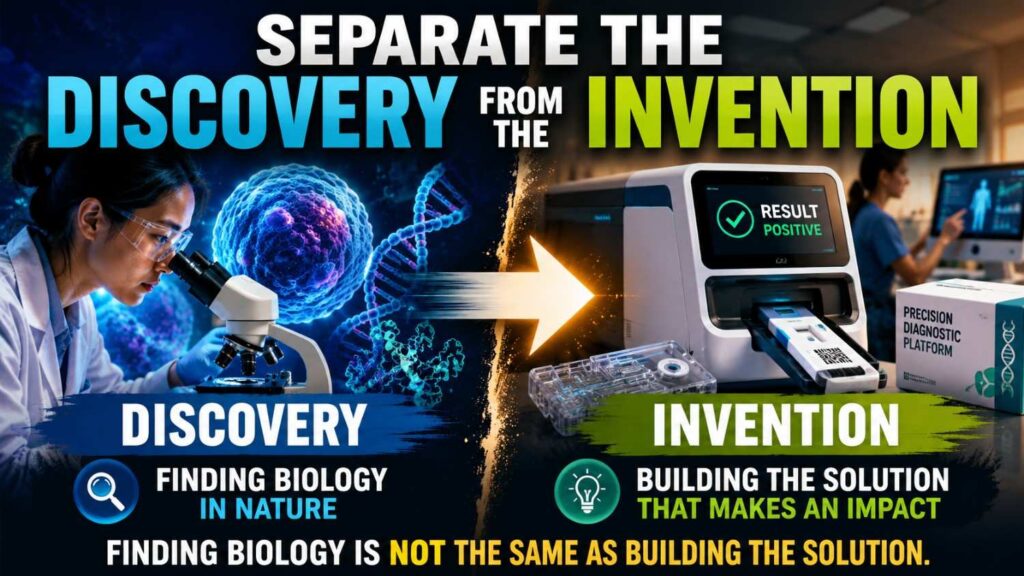
In biotech, discovery and invention can feel the same. They are not always the same.
A discovery may be that a biomarker is linked to a disease.
An invention may be a specific test that uses that biomarker in a new way.
A discovery may be that a molecule binds to a target.
An invention may be a therapeutic composition, dose, formulation, or treatment method based on that binding.
A discovery may be that a sensor can read a body signal.
An invention may be a device structure, signal processing method, or clinical alert workflow that uses that signal.
A discovery may be that an AI model can predict risk.
An invention may be a medical workflow that cleans images, checks model confidence, routes uncertain results to a clinician, and updates future thresholds.
This distinction matters.
Search the discovery, but also search the applied invention.
A broad biomarker link may already be known. But your sample prep, marker panel, scoring method, or patient subgroup may be different.
A therapeutic target may already be known. But your molecule, delivery route, formulation, dosing schedule, or combination therapy may be new.
A sensor may already exist. But your placement, calibration, signal correction, or clinical response may be different.
Do not stop at the discovery.
Find the technical step that turns the discovery into a product.
Define the Technical Problem
Every strong patentability search begins with the problem.
Not just the patient need. Not just the market need. The technical problem.
For example, “patients need earlier diagnosis” is important, but it is broad.
A technical problem may be:
“Existing tests produce false positives when inflammation is high.”
“Small blood samples do not provide enough signal for a reliable marker panel.”
“Wearable motion artifacts make the heart signal unreliable during exercise.”
“Catheter placement is hard to confirm without extra imaging.”
“Current drug release is too fast in the first hour and too weak later.”
“Gene therapy expression drops below useful levels after immune response rises.”
“AI image tools fail when scan quality is poor, but users may not know which view is missing.”
This problem statement guides the search.
If the problem is false positives from inflammation, search that.
If the problem is sample volume, search that.
If the problem is motion artifact, search that.
If the problem is drug release timing, search that.
If the problem is immune response, search that.
The problem helps you find prior art that uses different product names but solves the same technical issue.
Break the Invention Into Searchable Parts
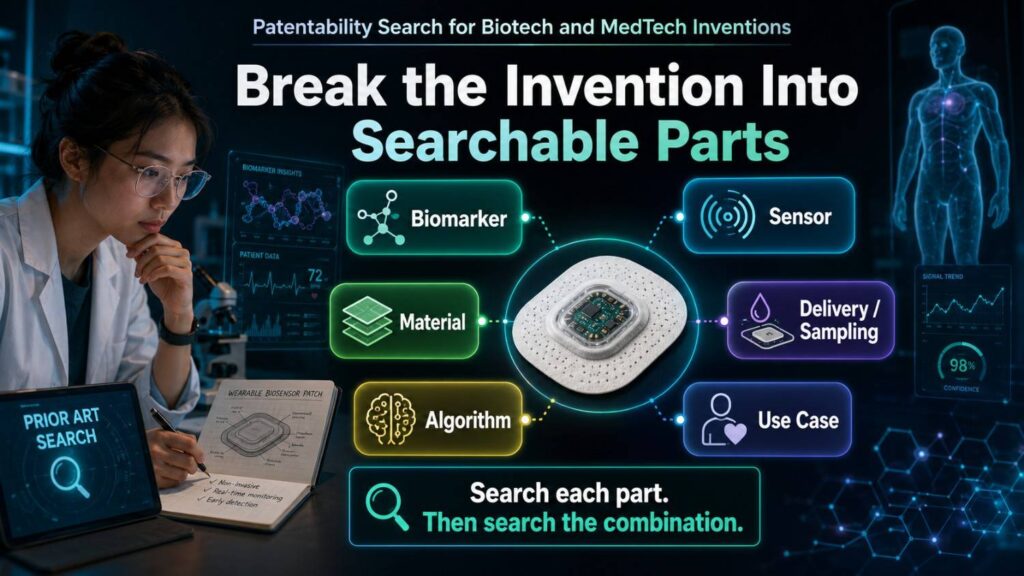
Biotech and MedTech inventions often have many layers.
To search well, break the invention into parts.
For a diagnostic invention, the parts may include sample type, target marker, sample prep, detection method, normalization step, scoring rule, threshold, output, and clinical use.
For a therapeutic invention, the parts may include active agent, target, formulation, dose, route, schedule, patient group, combination, release profile, and treatment result.
For a medical device, the parts may include structure, material, sensor, placement, signal path, control logic, user step, safety feature, and body interaction.
For a MedTech software invention, the parts may include input data, preprocessing, model step, confidence score, clinical rule, output, review trigger, and feedback loop.
For a surgical robot, the parts may include tool shape, joint movement, imaging input, force feedback, safe zone, control mode, and surgeon override.
This breakdown turns a vague search into a precise one.
Instead of searching “diabetes device,” you search “glucose trend meal timing insulin response microdose prediction.”
Instead of searching “wound dressing,” you search “pH triggered antimicrobial release layered hydrogel dressing.”
Instead of searching “AI radiology,” you search “image quality check missing view clinician review confidence score ultrasound.”
That is how you find closer prior art.
Identify the Core Element
Not every part is the invention.
Some parts may be standard.
A blood sample may be standard. A known marker may be standard. A sensor may be standard. A model may be standard. A catheter tube may be standard. A polymer may be standard.
The core element is the part that creates the new result.
For a diagnostic, the core may be the marker combination, the normalization method, or the scoring threshold.
For a therapeutic, the core may be the molecule, formulation, dose range, delivery route, or patient subgroup.
For a device, the core may be sensor placement, material layer, safety lock, feedback control, or body-contact structure.
For MedTech software, the core may be the review trigger, model confidence check, signal cleaning method, or clinical workflow timing.
For a surgical robot, the core may be a movement constraint or force feedback response.
Search the core element deeply.
That is often where the filing decision turns.
Search Patents, But Do Not Stop There
Patent databases are a key part of the search.
Use tools that cover different patent sources. The USPTO Patent Public Search tool is a web-based search application for patents and patent application publications and gives enhanced access to prior art. Google Patents lets users search and read patent text from around the world and includes non-patent literature in its index. Espacenet provides access to worldwide patent information, and WIPO’s PATENTSCOPE lets users search PCT applications and national patent collections.
These tools help you search across patent publications, families, inventors, assignees, and classifications.
But biotech and MedTech prior art often appears outside patents.
A journal article may teach a biomarker panel.
A clinical trial record may show a drug dose or patient group.
A product manual may show a medical device workflow.
A regulatory summary may describe device function.
A conference abstract may disclose early data.
A thesis may show a protocol.
A supplier catalog may list a reagent, kit, or device component.
A standards document may describe a test method.
A sequence database may disclose a nucleic acid or protein sequence.
So search broadly.
A patent-only search can miss the reference that matters most.
Search Scientific Literature
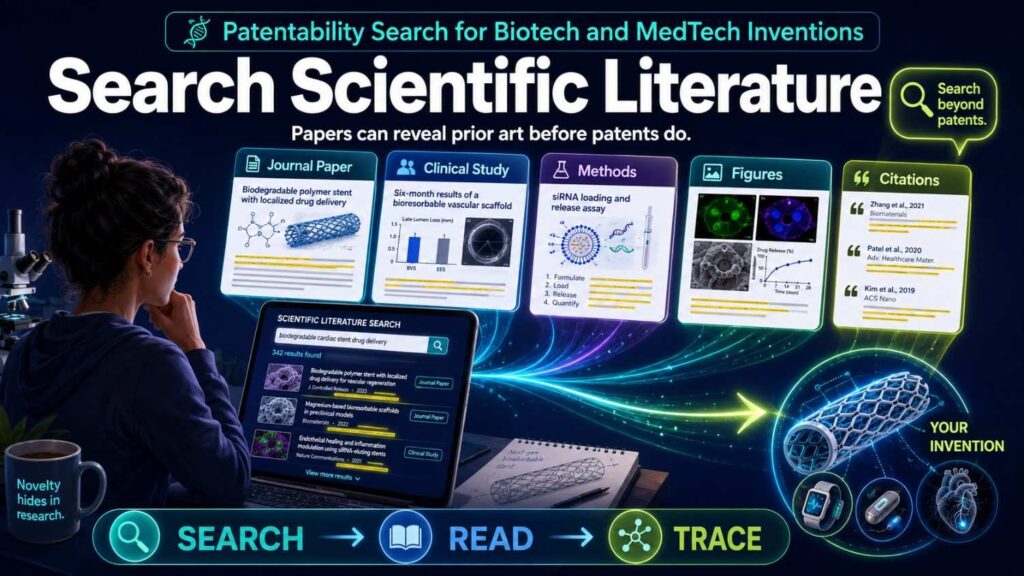
For biotech and MedTech, scientific literature is often central.
Search journal articles, preprints, conference abstracts, posters, theses, reviews, and methods papers.
Do not search only the disease name.
Search the marker, pathway, assay, sample type, tissue, cell type, formulation, vector, device mechanism, and clinical endpoint.
For a diagnostic test, search:
biomarker name
disease name
sample type
assay type
normalization method
marker panel
risk score
sensitivity
specificity
false positive
clinical threshold
For a therapy, search:
target
active agent
mechanism
dose
route
formulation
release profile
patient subgroup
combination therapy
adverse effect
animal model
clinical endpoint
For a medical device, search:
body site
sensor type
material
placement
signal processing
workflow
calibration
safety response
clinical use
Do not rely on one database or one term.
Science uses many names for the same idea.
Gene names can change. Protein names can vary. Disease terms can shift. Device names can differ by field. Assay names may be broad or specific.
Use synonyms.
Search Clinical Trial Records
Clinical trial records can be important prior art clues.
They may show a target condition, treatment, dose, route, patient group, endpoint, device use, or diagnostic workflow.
ClinicalTrials.gov is a searchable registry and results database of clinical studies from the United States and around the world, and NIH describes it as providing information such as trial purpose, who may participate, locations, and contacts.
Clinical trial records may not always disclose every technical detail. But they can point to publications, sponsors, interventions, endpoints, and patient groups.
For a therapy search, look for:
active agent
target disease
dose range
administration route
schedule
combination treatment
inclusion criteria
exclusion criteria
endpoint
sponsor
study dates
For a device search, look for:
device name
clinical use
patient group
workflow
endpoint
safety measures
operator steps
monitoring method
For a diagnostic search, look for:
biomarker
sample type
test method
risk score
cutoff
clinical endpoint
patient group
Clinical trial records can help you find companies and researchers active in the space.
They can also reveal whether a supposedly new use has already been tested publicly.
Search Regulatory Materials and Product Labels
MedTech and biotech products often leave public records.
Regulatory materials may describe intended use, device operation, performance data, safety warnings, patient group, dosing, or clinical workflow.
Product labels can also be useful.
For a drug or biologic, public labeling may show indications, dosing, route, patient group, formulation, contraindications, and safety data.
For devices, manuals and instructions for use may show how the device is placed, calibrated, operated, cleaned, and monitored.
For diagnostics, package inserts may show sample type, reagents, assay steps, controls, thresholds, and result interpretation.
These sources can be very practical.
They may not sound like “prior art,” but they can teach technical details.
Search:
product name
instructions for use
IFU
user manual
package insert
operator manual
510(k) summary
label
assay protocol
reagent kit
clinical performance
Do not ignore them.
A manual can be closer than a patent.
Search Protocols and Methods
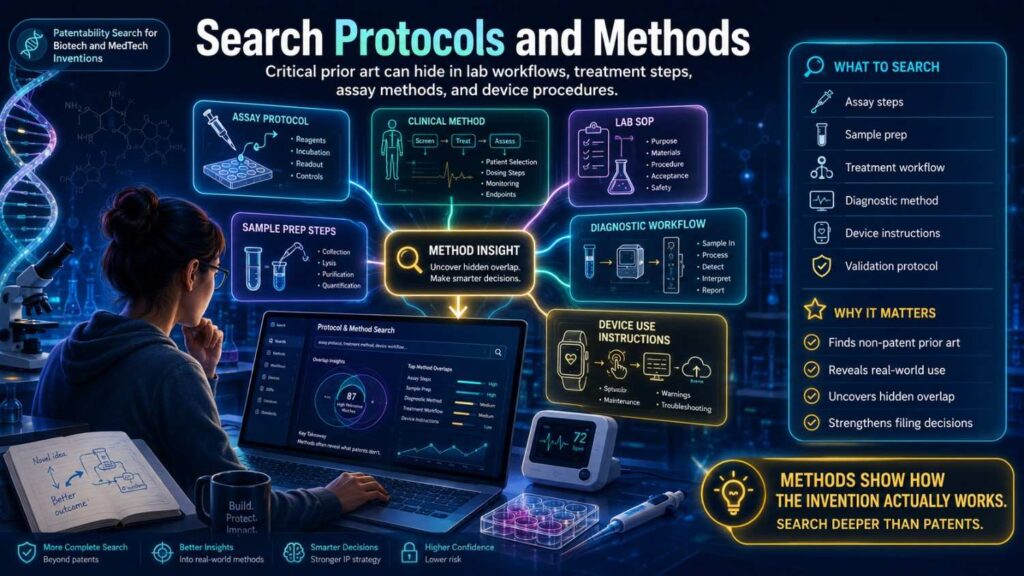
Biotech inventions often depend on methods.
A protocol may describe sample prep, extraction, amplification, staining, sequencing, culture, purification, delivery, or analysis.
Search protocols when your invention includes lab steps.
For example:
sample preparation plasma biomarker assay
cell isolation protocol marker panel
CRISPR delivery protocol target tissue
hydrogel drug release protocol wound pH
PCR primer assay detection threshold
single-cell sequencing sample prep disease marker
A protocol can show that a step was already known.
It can also show where your method differs.
Maybe the old protocol uses a large sample. Yours uses a small sample.
Maybe the old protocol needs cold storage. Yours is stable at room temperature.
Maybe the old assay takes hours. Yours runs faster.
Maybe the old method uses one marker. Yours uses a marker pattern.
Maybe the old device requires manual calibration. Yours self-calibrates.
Search the method carefully.
Search Sequences and Biological Materials
If your invention involves a sequence, antibody, peptide, protein, nucleic acid, guide RNA, vector, cell line, or biological material, search beyond normal text.
Sequence-based searching may be needed.
A text search may miss a sequence that is disclosed under another name.
Search sequence databases, patent sequence listings, papers, and product catalogs.
For antibody inventions, search target, epitope, binding region, sequence, function, species, disease use, and assay.
For nucleic acid inventions, search target gene, variant, guide sequence, promoter, vector, delivery method, and expression result.
For cell therapy, search cell type, modification, target antigen, culture method, activation method, dose, route, and patient group.
For microbiome inventions, search strain, composition, gene marker, metabolite, condition, formulation, and delivery.
Biological prior art can be exact or close.
Small sequence changes may matter, but they must be assessed carefully.
This is an area where attorney and scientific expert input is especially important.
Search Materials and Formulations
Many biotech and MedTech inventions are about materials.
A dressing material.
A hydrogel.
A coating.
A polymer.
A scaffold.
A nanoparticle.
A depot formulation.
A stent coating.
A capsule shell.
A sensor membrane.
A drug release layer.
Search both the material and the function.
For example:
pH responsive hydrogel antimicrobial release
biodegradable polymer drug release wound dressing
nanoparticle delivery target tissue immune response
stent coating controlled release anti-inflammatory
sensor membrane glucose diffusion stability
implant coating infection prevention release profile
The same material may be used in a different field.
A hydrogel used in wound care may have prior art in drug delivery.
A coating used in implants may have prior art in catheters.
A scaffold used in tissue engineering may have prior art in dental or orthopedic devices.
Search by material behavior, not only product category.
Search Devices by Body Interaction
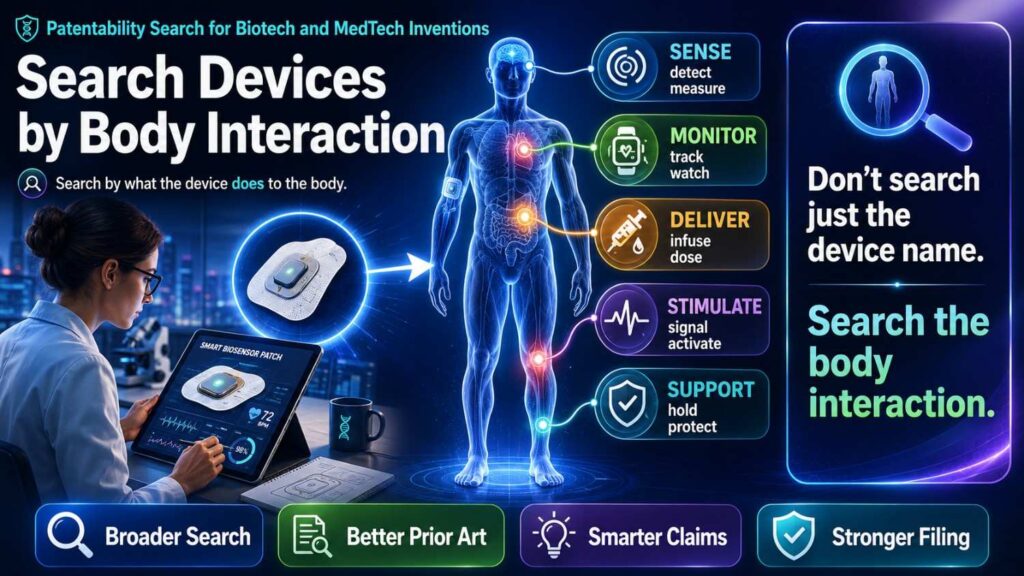
MedTech devices work with the body.
That body interaction is often where the invention lives.
Does the device touch tissue?
Enter a vessel?
Expand inside a cavity?
Measure pressure?
Deliver fluid?
Seal a wound?
Guide a needle?
Hold an implant?
Sense motion?
Stimulate a nerve?
Filter blood?
Heat tissue?
Cool tissue?
Image tissue?
Search the body interaction.
For example:
catheter tip pressure sensing vessel wall
implant expansion controlled force tissue
needle guide ultrasound alignment
wearable sensor skin motion artifact correction
wound dressing pH triggered release
nerve stimulation electrode placement feedback
The same device type can differ greatly based on how it interacts with tissue.
A catheter is not just a tube. The invention may be tip shape, material, sensor position, flow path, steering, coating, or placement feedback.
A wearable is not just a sensor. The invention may be skin contact, motion artifact reduction, calibration, signal fusion, or alert timing.
Search those details.
Search MedTech Software and AI Carefully
MedTech software and AI inventions need a mixed search.
They may involve medical data, models, clinical workflows, and safety controls.
Search papers and patents. Also search product docs, regulatory summaries, clinical workflows, and medical standards.
A broad phrase like “AI radiology” is not enough.
Search the technical method.
For example:
ultrasound image quality missing view clinician review
radiology AI confidence score triage workflow
ECG artifact correction wearable sensor motion
clinical decision support risk score override
medical image segmentation uncertainty human review
patient monitoring false alarm reduction dynamic threshold
If the invention uses AI, do not search only the model type.
Search the pipeline.
What data enters?
How is it cleaned?
What does the model output?
How is confidence measured?
What clinical rule is applied?
When is a clinician asked to review?
What happens if the input quality is poor?
What feedback changes future results?
The patentable part may be the workflow around the model, not the model alone.
Search Diagnostic Inventions by the Full Test
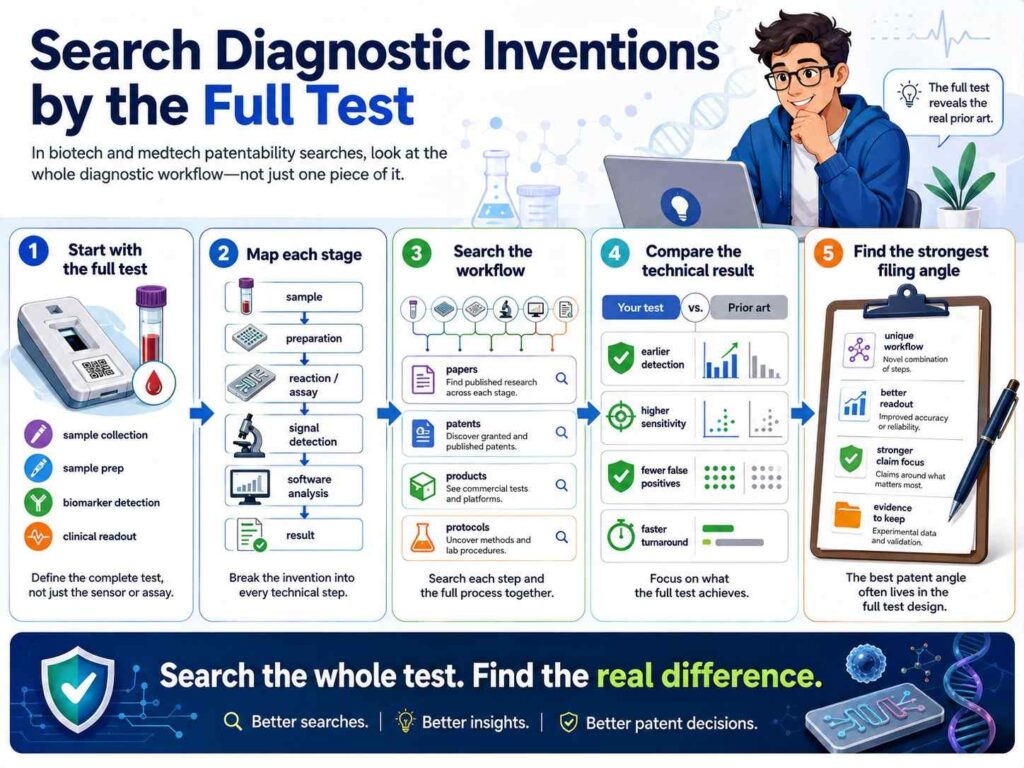
Diagnostics are often more than one marker.
A diagnostic invention may include sample type, sample prep, marker detection, normalization, scoring, threshold, and output.
Search each layer.
For example, if your invention is a blood test using three markers and an inflammation adjustment, search:
each marker alone
marker combinations
the disease
the sample type
inflammation normalization
risk scoring
cutoff thresholds
false positive reduction
assay platform
clinical subgroup
Do not assume the panel is new just because your exact product is new.
A marker may be known in a paper. Another may be known in a patent. A third may be known in a trial. The combination may still be worth exploring, but you need to know the landscape.
Also search related diseases.
A marker panel used for one condition may be close prior art for another if the biology overlaps.
Search the clinical context and the biology.
Search Therapeutic Inventions by Use and Form
A therapeutic invention can be a compound, composition, formulation, method of treatment, dose, route, patient group, combination, or delivery system.
Search all relevant forms.
If your invention is a known drug in a new use, search the drug, target, disease, pathway, dose, and patient group.
If your invention is a new formulation, search the active agent, excipients, release profile, stability, route, and delivery system.
If your invention is a biologic, search target, binding region, sequence, function, disease, and dosing.
If your invention is a gene therapy, search vector, promoter, payload, tissue, route, immune response, expression level, and dose.
If your invention is a cell therapy, search cell type, modification, target, culture method, dose, route, and patient population.
A therapy patentability search must be precise.
The difference may be a narrow but valuable treatment window.
It may be a patient subgroup.
It may be a dosing schedule.
It may be a formulation that changes release.
It may be a combination that improves response or reduces side effects.
Search the science behind the treatment, not just the product name.
Search MedTech Hardware by Structure and Workflow
Medical devices often combine a physical structure with a clinical workflow.
A device may be patentable because of how it is shaped, placed, controlled, cleaned, sterilized, adjusted, or used.
Search structure and use together.
For example:
catheter steering tip sensor placement
surgical guide alignment imaging feedback
implant insertion tool controlled force
wearable patch adhesive sensor motion artifact
infusion pump occlusion detection pressure ripple
needle placement depth feedback ultrasound
device prior art may be in manuals, surgical guides, training videos, patents, and clinical papers.
Look at drawings.
Look at instructions.
Look at product photos.
Look at how the clinician uses the device.
A small physical difference can matter if it changes safety, placement accuracy, signal quality, or ease of use.
Search by Clinical Workflow
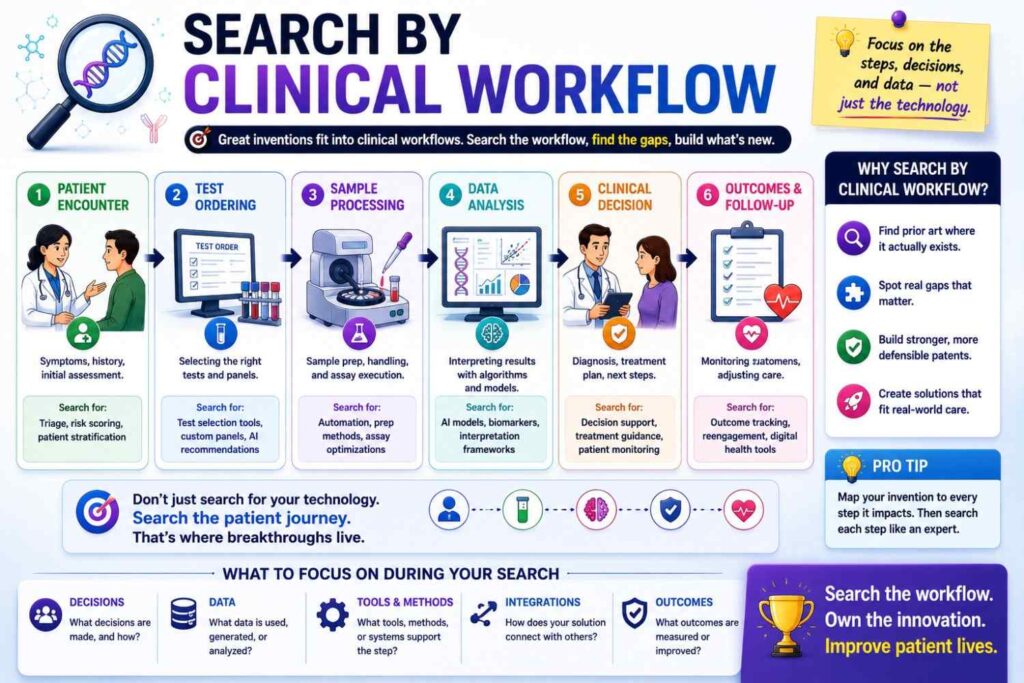
Some MedTech inventions are workflow inventions.
A device or software tool may be new because of when and how it fits into care.
For example:
A screening test may route high-risk patients to follow-up imaging.
A monitoring system may alert only when two signals change together.
A surgical tool may request confirmation before crossing a safe zone.
An AI tool may send only uncertain images to a clinician.
A home device may adjust instructions based on patient response.
Search the workflow.
Use terms like:
triage
screening
follow-up
risk score
clinical decision support
alert threshold
care pathway
review workflow
operator prompt
patient monitoring
remote monitoring
escalation
false alarm reduction
But be careful.
Pure business or administrative workflow may be weak for patent purposes. The strongest MedTech workflow inventions usually include a technical data process, device action, clinical signal, safety control, or measurement improvement.
Search and frame the technical part.
Search by Patient Group
Biotech and MedTech inventions may be tied to a patient group.
A treatment may work for a subgroup.
A diagnostic may be more accurate in a certain population.
A device may be designed for a specific anatomy.
An AI tool may target a specific disease stage.
Search patient groups carefully.
For example:
pediatric
elderly
pregnant
diabetic
immunocompromised
post-surgical
early-stage
advanced disease
therapy-resistant
biomarker-positive
mutation-specific
comorbidity
Patient subgroup can matter if it changes the technical or clinical result.
But do not assume a subgroup is new just because it is useful.
Search whether that subgroup has already been studied.
Clinical trial records, papers, and patents may all disclose patient groups.
Search by Dose, Range, and Timing
Dosing and timing can be central in biotech.
A known active agent may be used in a new dose range.
A treatment may work with a different schedule.
A device may deliver a pulse instead of steady flow.
A diagnostic may measure a marker at a specific time after treatment.
A gene therapy may require a pre-treatment or immune suppression timing.
Search dose and timing.
Use terms like:
dose
dose range
low dose
high dose
microdose
loading dose
maintenance dose
schedule
once daily
weekly
pulsed
sustained release
delayed release
time window
post-treatment
pre-treatment
combination timing
For devices, use:
delivery rate
pulse
duty cycle
infusion profile
release profile
sampling interval
monitoring window
alert delay
Timing differences can create real value.
They can improve safety, reduce side effects, improve signal quality, or make treatment easier.
Search Biomarkers by Pattern, Not Just Name
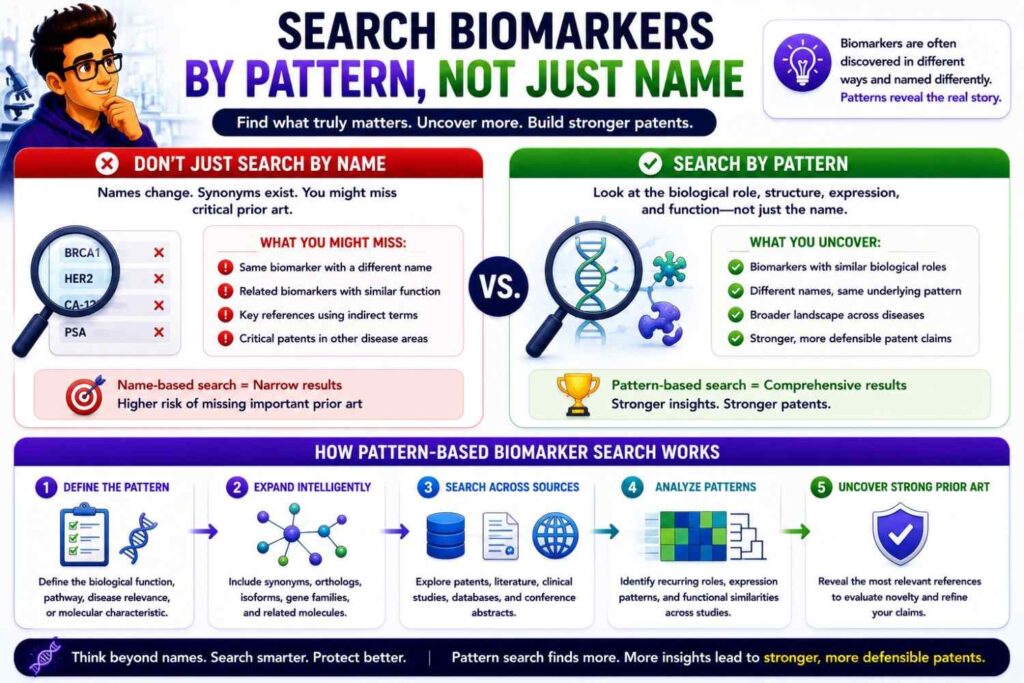
A biomarker invention may not be one marker.
It may be a pattern.
A ratio.
A change over time.
A response to treatment.
A combination with clinical data.
A normalization rule.
A threshold based on patient context.
Search beyond the marker name.
For example:
marker A marker B ratio disease
biomarker panel inflammation normalization
longitudinal biomarker change risk score
baseline adjusted biomarker response
multi-marker diagnostic score false positive
biomarker threshold patient subgroup
If the invention uses a marker pattern, search the pattern.
If it uses a change from baseline, search longitudinal terms.
If it uses a ratio, search ratio.
If it uses a marker plus imaging, search both.
If it uses a marker plus patient history, search combined scoring.
The patentable part may be how markers are used together.
Search Assay Conditions
Assay conditions can matter.
Temperature.
pH.
Buffer.
Reagent concentration.
Incubation time.
Wash steps.
Amplification cycles.
Detection wavelength.
Capture reagent.
Control sample.
Sample volume.
Signal cutoff.
These details can affect accuracy, speed, stability, and cost.
If your invention improves an assay, search the conditions.
For example:
low volume plasma assay marker detection
room temperature stable reagent diagnostic
rapid wash step immunoassay sensitivity
pH condition biomarker binding assay
multiplex assay marker panel cutoff
Do not assume the marker alone is the invention.
The assay process may be stronger.
Search Manufacturing and Quality Control
Biotech and MedTech inventions often include manufacturing improvements.
A formulation process.
A sterilization method.
A cell culture step.
A purification method.
A coating process.
A device assembly step.
A quality control test.
A stability method.
A packaging method.
These can be valuable.
Search:
manufacturing
sterilization
purification
cell culture
quality control
stability
lyophilization
coating process
release testing
batch consistency
fill finish
packaging
storage condition
shelf life
For a startup, manufacturing inventions can be strategic because they may lower cost, improve yield, reduce failure, or make scale possible.
Do not overlook them.
Many strong biotech and MedTech patents protect how a product is made, not only what the product is.
Search Safety and Risk Controls
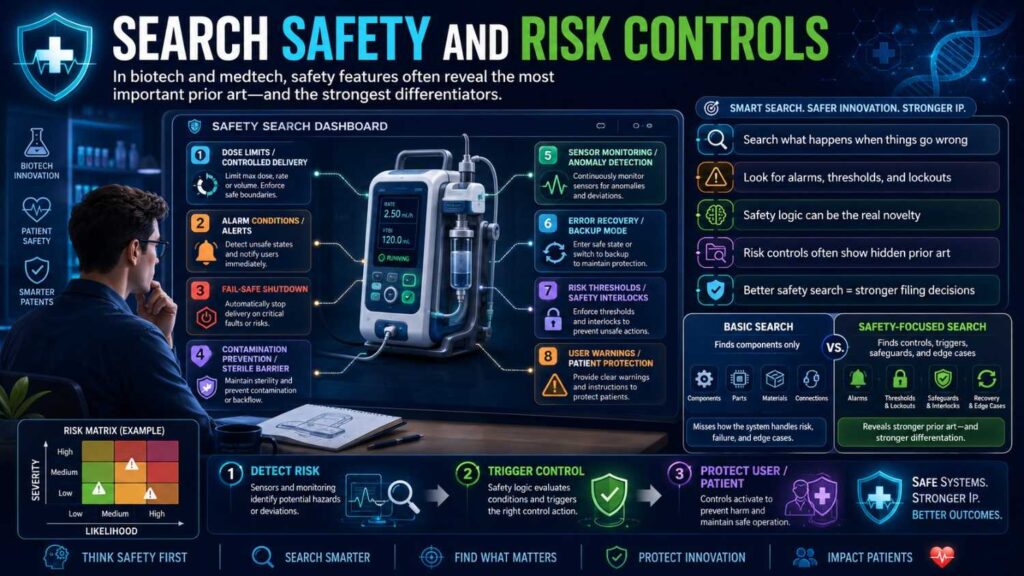
Biotech and MedTech products live in high-stakes settings.
Safety controls can be inventive.
A device may detect unsafe placement.
A pump may detect occlusion early.
An AI system may block low-quality scans.
A drug formulation may reduce burst release.
A gene therapy method may reduce immune response.
A diagnostic may reduce false positives in a high-risk subgroup.
Search safety controls.
Use terms like:
adverse event
risk reduction
false positive
false negative
occlusion detection
placement confirmation
dose limiting
immune response
toxicity
safety lockout
alarm reduction
quality check
fail-safe
clinician review
Safety inventions are stronger when tied to a specific technical method.
“Safer device” is vague.
“Device reduces false occlusion alarms by comparing pressure ripple during matched pump cycles” is specific.
Search the Closest Prior Art by Element
Once you find references, compare them carefully.
Do not say, “This paper looks close.”
Break your invention into elements.
For a diagnostic:
Sample type.
Marker set.
Sample prep.
Assay method.
Normalization step.
Risk score.
Threshold.
Output.
Clinical use.
For a drug formulation:
Active agent.
Carrier.
Release profile.
Dose.
Route.
Stability condition.
Patient group.
Treatment result.
For a medical device:
Structure.
Material.
Sensor placement.
Body interaction.
Signal processing.
Control response.
Safety feature.
Use method.
For MedTech AI:
Input data.
Preprocessing.
Model output.
Confidence score.
Clinical rule.
Review trigger.
Feedback update.
Now compare one reference at a time.
Does one reference show every element?
If yes, novelty may be a problem.
If no, identify what is missing.
Then ask whether the missing part matters.
Find the Strongest Gap
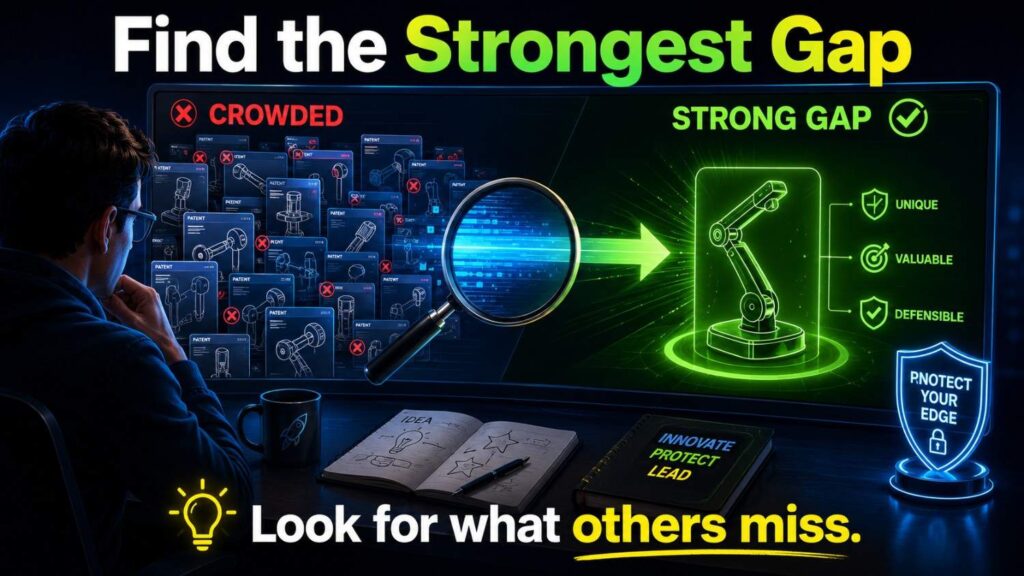
The strongest gap is the missing part that creates the value.
It may be a marker combination.
A sample prep step.
A formulation range.
A release profile.
A device structure.
A sensor location.
A signal correction method.
A clinical review trigger.
A patient subgroup.
A dosing window.
A safety lockout.
A manufacturing step.
A gap matters when it improves a technical or clinical result.
For example:
The prior art shows the marker, but not the marker ratio adjusted for inflammation.
The prior art shows the drug, but not the slow-release formulation that reduces peak toxicity.
The prior art shows the sensor, but not the skin-contact structure that reduces motion artifacts.
The prior art shows AI image classification, but not the image quality check that asks the operator for a missing view before model review.
The prior art shows catheter pressure sensing, but not the tip placement that detects wall contact before tissue damage.
That is where filing strategy starts.
Do Not Confuse Similar Science With the Same Invention
A prior art paper may be scientifically related but not disclose your invention.
For example, a paper may say a biomarker is associated with disease. That does not always teach your specific diagnostic test.
A paper may show a drug target. That does not always teach your molecule, dose, formulation, or patient group.
A device patent may show a sensor. That does not always teach your placement or workflow.
An AI paper may show image classification. That does not always teach your clinical review path.
Do not dismiss related art. But do not overread it.
Ask what it actually teaches.
Does it disclose the same elements?
Does it show the same result?
Does it teach the same use?
Does it give enough detail?
Does it solve the same problem?
Careful comparison keeps the search honest.
Do Not Ignore Different Fields
Biotech and MedTech inventions often borrow from nearby fields.
A wound dressing material may be known in food packaging.
A sensor membrane may be known in industrial sensing.
A surgical robot control method may be known in manufacturing robots.
A diagnostic normalization method may be known in another disease.
A drug delivery vehicle may be known in vaccines or oncology.
A wearable signal correction method may be known in sports devices.
Search related fields.
If your invention solves a technical problem that appears elsewhere, prior art may exist there.
This does not mean your invention is unpatentable.
It means your claim strategy must explain the specific use, adaptation, and result.
Handle Combination Inventions Carefully
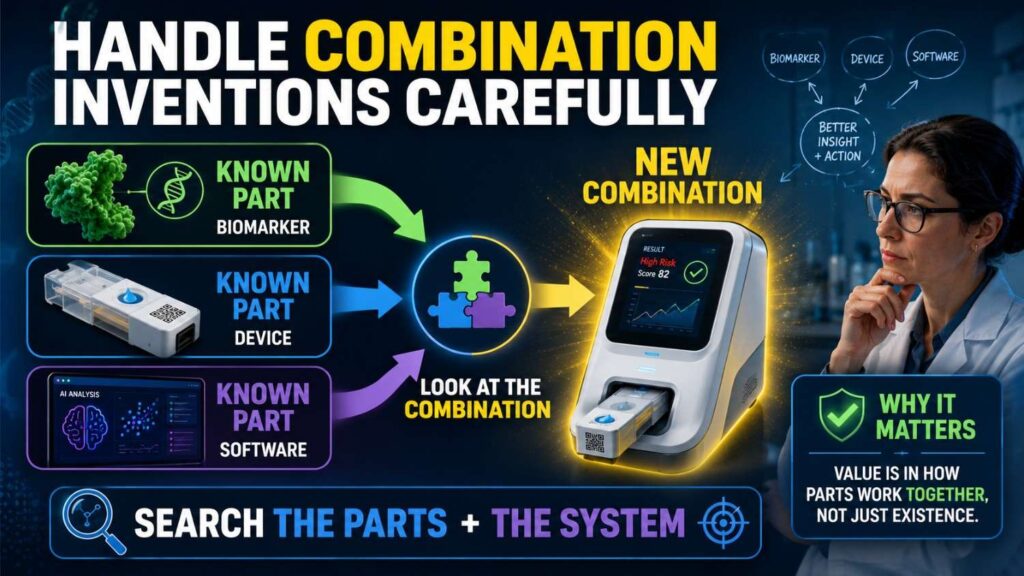
Many biotech and MedTech inventions combine known pieces.
A known marker plus a known assay.
A known drug plus a known carrier.
A known sensor plus a new placement.
A known imaging method plus a new review workflow.
A known device plus a new safety control.
A combination can still be valuable.
For novelty, ask whether one reference shows the full combination.
For obviousness, ask whether the combination would have been an easy next step.
Important questions include:
Did prior art suggest combining the pieces?
Did the pieces solve the same problem?
Would the combination have been expected to work?
Did old systems avoid the path?
Did the combination create an unexpected result?
Did it solve a long-standing problem?
Did it improve safety, accuracy, stability, or delivery?
These questions are especially important in biotech, where small changes can have big effects.
A patent attorney with field experience can help assess this.
Watch for Dates
Dates matter.
Record publication dates, filing dates, priority dates, clinical trial dates, conference dates, product launch dates, and public disclosure dates.
A patent granted recently may have been filed years ago.
A clinical trial record may have been posted before a paper.
A conference abstract may predate a journal article.
A product manual may have older versions.
Your own pitch deck, demo, poster, preprint, or trial registration may also matter.
Keep a clean date record.
This helps your patent team assess what may count as prior art.
Search Your Own Public Disclosures
Biotech and MedTech teams often publish or present early.
Conference abstracts.
Posters.
Investor decks.
Grant summaries.
Clinical trial registrations.
Preprints.
Product pages.
Regulatory submissions.
Public protocols.
Partner announcements.
Founder talks.
University publications.
These may reveal the invention.
Before filing, list what has already been shared.
Was it public?
Was it under confidentiality?
What details were disclosed?
When did it happen?
Where was it posted?
Do not hide this from your patent team.
Timing can affect filing options.
PowerPatent helps teams organize invention and disclosure information so patent counsel can make better filing decisions. See how PowerPatent works.
Search Before Key Public Events
Biotech and MedTech teams often face public events before they feel ready.
A conference poster.
A clinical trial registration.
A grant publication.
A product demo.
A regulatory milestone.
A pilot with a hospital.
A press release.
A journal submission.
A fundraising deck.
Before those events, run a patentability search.
Ask:
What will become public?
Does it reveal the technical edge?
Have we filed on the core invention?
Do we need to file before the event?
What details should stay private?
This does not mean slowing the company.
It means protecting value before it leaves the building.
Patentability Search Before a Provisional Filing
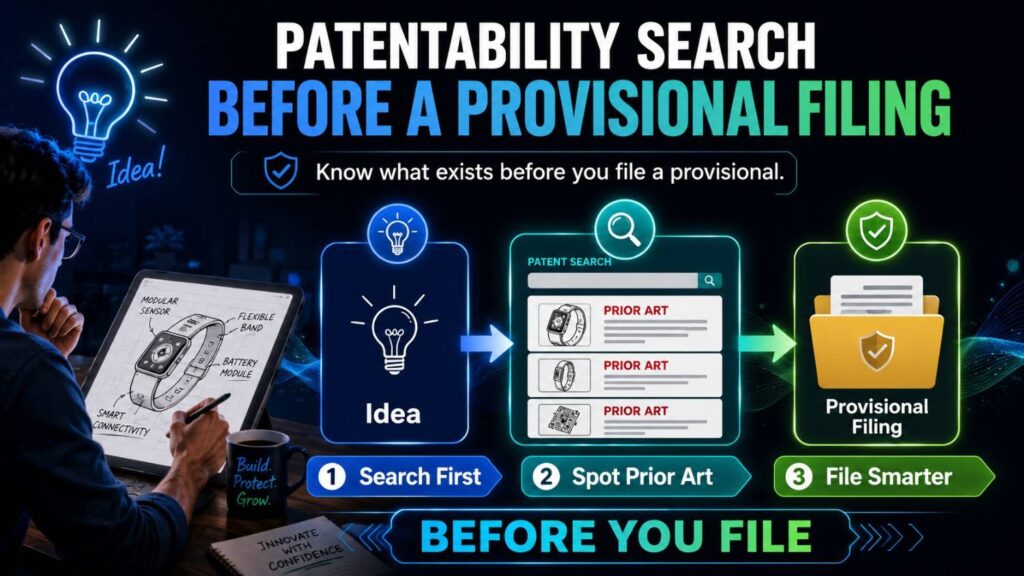
A provisional patent application can help secure an early filing date.
But it should be detailed.
For biotech and MedTech, a thin provisional can be risky.
If the broad idea is crowded, the provisional must describe the specific difference.
For a diagnostic, include marker details, sample type, assay steps, scoring rules, thresholds, and examples.
For a therapeutic, include active agents, formulations, dose ranges, routes, patient groups, mechanisms, and results.
For a device, include drawings, structures, materials, sensor placement, control logic, and use methods.
For software or AI, include data inputs, model flow, preprocessing, confidence, review, feedback, and clinical output.
If the search shows the core gap, describe it well.
Do not file vague language like “AI diagnoses disease” or “device improves treatment.”
Explain how.
PowerPatent helps founders move fast while still capturing the technical details needed for stronger filings. Learn how PowerPatent supports better patent filings.
Patentability Search Before a Non-Provisional Filing
A non-provisional application will be examined.
That means prior art matters.
Before filing, know the closest references.
Know what they teach.
Know what they miss.
Know which claim angle is strongest.
The application should support broad claims and backup claims.
If the search shows the marker panel is the key, describe panel versions.
If the formulation is key, describe ranges and alternatives.
If the sensor placement is key, include drawings and variants.
If the workflow is key, describe steps and decision points.
If the safety control is key, explain triggers and outcomes.
A strong non-provisional filing should be built around the actual gap, not a broad product summary.
Patentability Search for Diagnostics
Diagnostic inventions need careful searching because papers often disclose markers before products exist.
Search disease terms, marker names, sample types, assay methods, panels, thresholds, normalization, and patient groups.
Also search related diseases and biological pathways.
A diagnostic invention may be new because of:
A marker combination.
A sample prep method.
A way to normalize signal.
A risk score.
A threshold for a subgroup.
A longitudinal change.
A point-of-care workflow.
A device-assisted readout.
A false-positive reduction method.
For example, do not only search “early kidney disease test.”
Search:
urine biomarker panel kidney injury risk score
creatinine normalized biomarker inflammation false positive
longitudinal marker change kidney disease diagnosis
point of care assay kidney injury marker threshold
This kind of search is much more likely to find close art.
Patentability Search for Therapeutics
Therapeutic inventions may be searched by molecule, target, mechanism, use, dose, route, formulation, patient group, and treatment result.
If the active agent is new, search structure, sequence, class, analogs, target binding, and function.
If the active agent is known, search new use, dose, combination, formulation, and subgroup.
If the invention is a formulation, search carrier, release, stability, route, and excipients.
If it is a method of treatment, search disease, pathway, biomarkers, responders, dosing, and outcomes.
Do not assume a known drug cannot support patent protection in a new technical use or formulation.
But be precise.
The search must find whether the specific use, dose, group, or formulation was already taught.
Patentability Search for Medical Devices
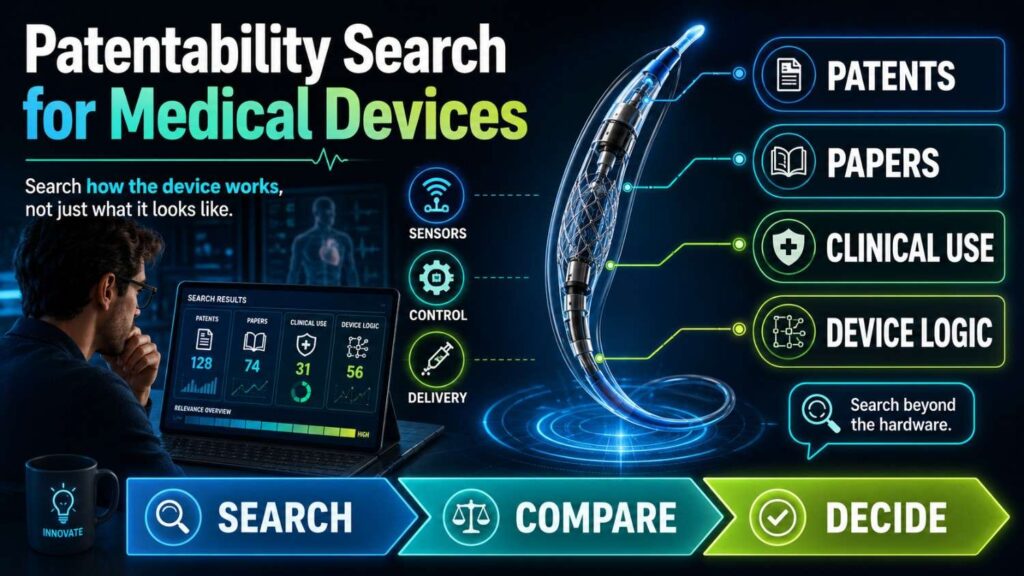
Medical device searches should focus on structure, use, safety, and body interaction.
Search patents, manuals, IFUs, product pages, regulatory summaries, surgical guides, and videos.
Look for:
Device shape.
Material.
Contact surface.
Placement method.
Sensor location.
Signal path.
Control response.
Sterilization.
Cleaning.
Safety lockout.
Clinical workflow.
A device invention may be a small part with a big effect.
A notch that guides placement.
A coating that changes tissue response.
A sensor location that reduces false readings.
A shape that limits unsafe insertion.
A valve that prevents backflow.
A controller that detects occlusion early.
Search those details.
Patentability Search for Digital Health and MedTech AI
Digital health and MedTech AI inventions combine software and care.
Search both medical literature and software prior art.
A digital health invention may include sensors, patient data, risk scoring, alerts, clinician review, patient coaching, and feedback.
A MedTech AI invention may include imaging, signal processing, model confidence, quality checks, triage, clinical workflow, and review.
Search:
medical condition
input data
sensor type
artifact correction
risk score
alert threshold
clinician review
patient subgroup
model confidence
quality check
triage
workflow
feedback
The key may be how the system avoids errors.
For example:
A wearable may reduce false alerts by combining motion data and heart signal quality.
An AI imaging tool may ask for a missing view before sending a result to review.
A remote monitoring tool may escalate only when a trend and symptom pattern change together.
Search the technical safety and workflow controls.
Patentability Search for Wearables
Wearable inventions sit between hardware, software, sensors, and human behavior.
Search:
sensor placement
skin contact
adhesive
motion artifact
signal quality
calibration
baseline
patient activity
alert threshold
battery life
wireless transmission
comfort
water resistance
clinical signal
Wearable inventions often turn on signal quality.
The sensor may be known, but your invention may reduce noise, improve contact, adapt thresholds, or combine signals in a new way.
Search the body location and the artifact problem.
For example:
wrist sensor motion artifact heart rate
wearable patch sweat sensor temperature compensation
skin contact pressure wearable ECG signal quality
wearable hydration risk recovery window baseline
A wearable patent search should include consumer devices, medical devices, sports devices, and clinical monitors.
Patentability Search for Implants
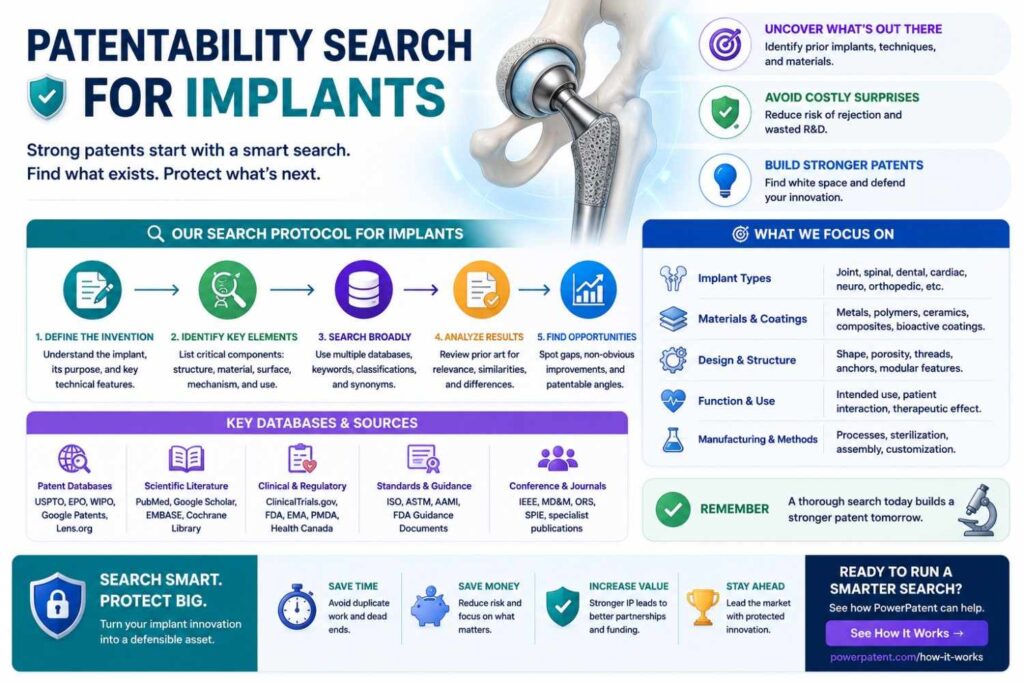
Implant inventions require searching structure, material, placement, tissue interaction, delivery, coating, release, imaging, and long-term behavior.
Search:
implant material
surface coating
tissue ingrowth
controlled release
deployment tool
expansion
fixation
resorption
infection prevention
imaging marker
placement guide
migration prevention
load bearing
Implant prior art may come from orthopedic, cardiovascular, dental, neuro, ophthalmic, and soft tissue devices.
Do not search only your exact implant category.
Search the function.
If your implant prevents migration, search migration prevention across devices.
If it releases drug, search controlled release implants.
If it expands, search expandable implants in related anatomy.
If it has a coating, search coating function.
Patentability Search for Surgical Tools and Robots
Surgical tools and robots often involve mechanics, imaging, control, safety, and workflow.
Search:
instrument tip
force feedback
safe zone
motion constraint
surgeon control
robotic arm
end effector
image guidance
tool tracking
tissue contact
haptic feedback
remote operation
sterile interface
trocar
catheter steering
Surgical robotics prior art may come from medical robots and industrial robots.
Search both.
The invention may be in a tool shape, a control boundary, a force limit, a feedback signal, an imaging alignment, or a surgeon override workflow.
Look at drawings and videos.
Physical motion matters.
Patentability Search for Lab Automation
Lab automation inventions can be strong because they improve speed, reliability, or sample handling.
Search:
sample handling
pipetting
microfluidics
well plate
cartridge
reagent mixing
barcode tracking
robotic arm
liquid handling
contamination prevention
assay automation
sample prep
workflow
quality control
The invention may be a cartridge design, fluid path, mixing step, contamination barrier, sample tracking method, or robotic protocol.
Do not search only the biological assay.
Search the automation method too.
Patentability Search for Microfluidics
Microfluidic inventions involve channels, valves, flow, droplets, chambers, pressure, capillary action, materials, and detection.
Search:
microfluidic channel
droplet generation
fluidic valve
capillary flow
sample mixing
cell sorting
on-chip assay
lab on chip
fluid control
reagent storage
bubble removal
flow rate
detection chamber
Microfluidic prior art can be dense.
Look at drawings.
Small channel shapes and flow paths can matter.
Search both the device structure and the assay use.
Patentability Search for Drug Delivery
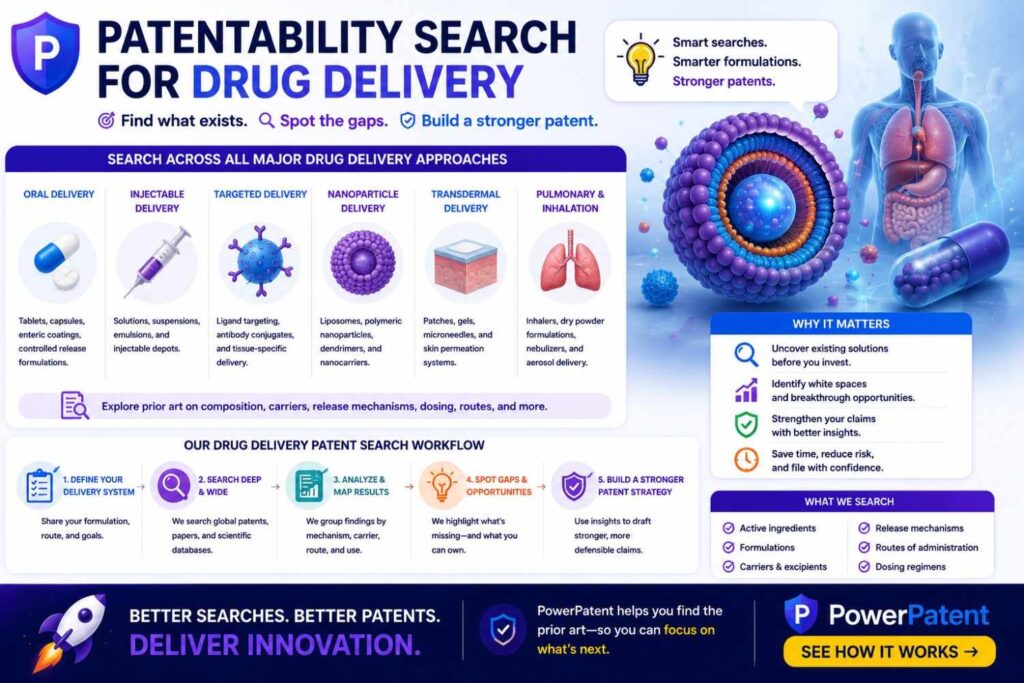
Drug delivery inventions can involve formulation, device, route, release profile, targeting, timing, and patient use.
Search:
controlled release
sustained release
delayed release
implantable delivery
transdermal patch
microneedle
nanoparticle
liposome
hydrogel
depot
infusion pump
inhaler
targeted delivery
release trigger
Drug delivery prior art can come from many therapeutic areas.
Search the carrier and release mechanism broadly.
A pH-triggered release method in oncology may be relevant to wound care.
A nanoparticle delivery system in vaccines may be relevant to gene therapy.
A transdermal delivery structure may be relevant to hormone therapy or pain management.
Search by mechanism, not only disease.
Patentability Search for Gene and Cell Therapy
Gene and cell therapy searches are complex.
They may involve target, sequence, vector, promoter, delivery route, dose, immune response, cell type, culture method, editing method, and patient group.
Search:
target gene
payload
vector
promoter
guide RNA
editing system
AAV
lentiviral
lipid nanoparticle
delivery route
immune response
expression level
cell therapy
CAR
T cell
stem cell
culture condition
activation
dose
patient subgroup
Search sequences and functional elements.
Search papers, patents, clinical trials, and databases.
Small differences may matter, but the field is crowded and technical.
This is an area where expert patent counsel is especially important.
Patentability Search for Biomaterials
Biomaterials may be used in implants, wound care, tissue engineering, drug delivery, diagnostics, and devices.
Search:
hydrogel
scaffold
polymer
biodegradable
bioabsorbable
coating
surface treatment
porosity
mechanical strength
tissue ingrowth
drug release
antimicrobial
adhesion
elasticity
pH responsive
temperature responsive
Search material plus function.
A material may be known. The new use, structure, or behavior may be the invention.
For example:
A known hydrogel may be used in a new layered dressing with pH-triggered release.
A known polymer may be formed into a scaffold with a new pore structure.
A known coating may reduce infection on a specific device.
Search broadly across uses.
Use Search Results to Shape Claim Strategy
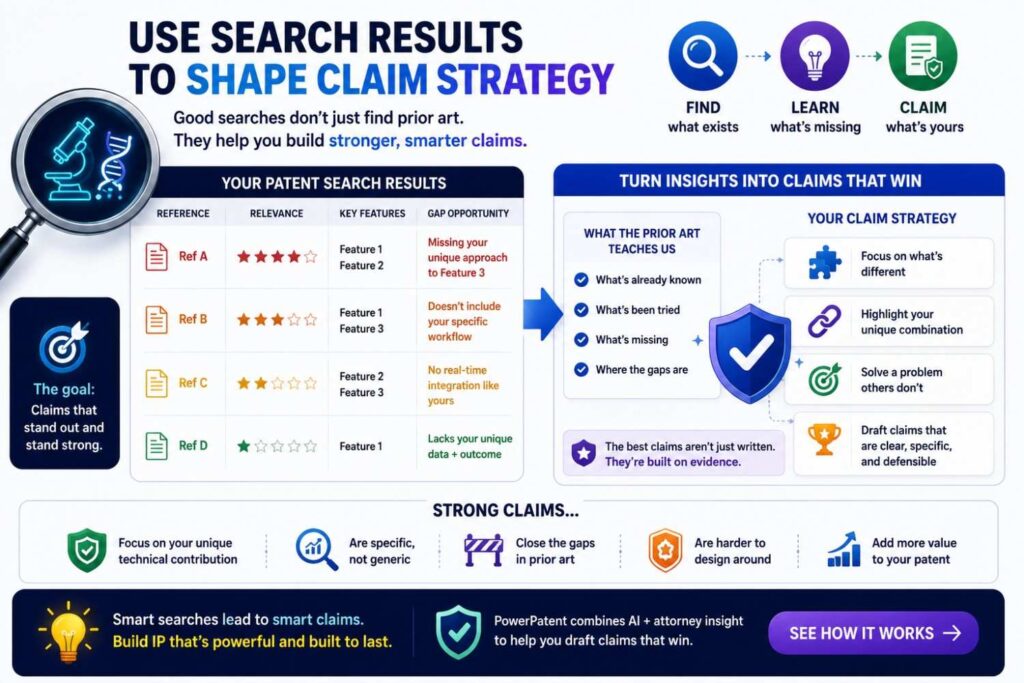
A search is not useful unless it leads to strategy.
After reviewing prior art, ask:
What broad idea is crowded?
What technical feature appears different?
What references are closest?
What should the filing focus on?
What backup versions should be described?
What data or examples are needed?
What should be kept secret?
What should be searched more?
For example:
The broad idea of a wound dressing with antimicrobial release may be crowded.
But pH-triggered release from a specific layer structure may be stronger.
The broad idea of AI image review may be crowded.
But the missing-view prompt before review may be stronger.
The broad idea of a biomarker test may be crowded.
But an inflammation-normalized marker ratio may be stronger.
The broad idea of a catheter sensor may be crowded.
But a tip sensor placement that detects wall contact before damage may be stronger.
Search should sharpen the filing.
Decide Whether to File, Refine, Search More, or Pause
At the end of the search, make a decision.
You may file if the invention appears different, valuable, and ready.
You may refine if the broad idea is crowded but a specific technical method looks strong.
You may search more if the closest art is unclear.
You may pause if the invention is not developed enough, not valuable enough, or too close to old work.
A good patentability search does not always end in filing.
Sometimes it saves budget.
Sometimes it reveals a stronger filing angle.
Sometimes it shows that a manufacturing method is more valuable than the product feature.
Sometimes it tells you to gather more data first.
That is a good outcome.
What a Strong Biotech Search Finding Sounds Like
A strong finding is specific.
For example:
“The broad idea of using Marker A for Disease X is known. The closest papers show Marker A alone and Marker B in a related disease. We did not find one reference that uses the Marker A to Marker B ratio normalized by inflammation score in plasma samples to reduce false positives in early-stage patients. Recommend filing around the normalized marker pattern, with backup claims covering alternative sample types and threshold ranges.”
That is useful.
Another example:
“The broad idea of pH-responsive wound dressings is crowded. The closest references show pH-triggered antimicrobial release, but not the layered structure that separates the sensing layer from the drug layer to delay release until sustained pH elevation. Recommend filing around the layer design and release timing.”
That is decision-ready.
What a Strong MedTech Search Finding Sounds Like
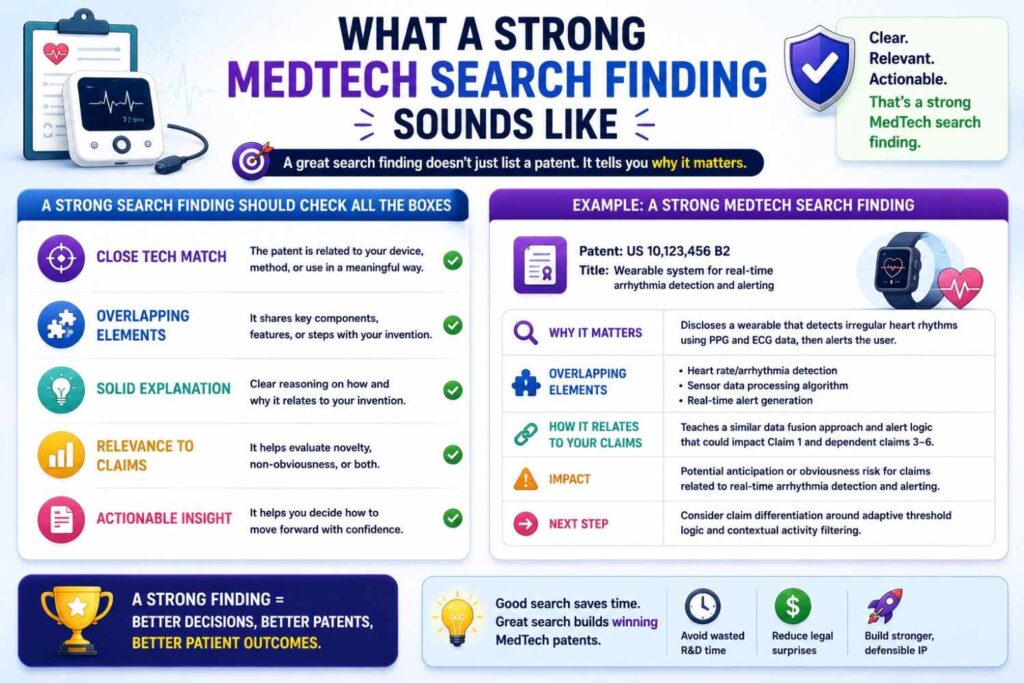
A strong MedTech finding may sound like this:
“The broad idea of wearable ECG monitoring is crowded. The closest references show motion artifact filtering and adhesive patches. We did not find one reference that adjusts signal confidence based on skin-contact pressure and user motion state before triggering an arrhythmia alert. This gap matters because it may reduce false alerts during movement. Recommend filing around the signal confidence and alert control workflow.”
Or:
“The broad idea of AI ultrasound review is crowded. The closest references classify images and provide confidence scores. We did not find one that detects a missing required view, prompts the operator to capture that view, and only then routes the study to model review or clinician review. Recommend filing around the quality-gated workflow.”
These findings are strong because they name the crowded area, the closest art, the missing step, the result, and the filing path.
What a Weak Search Finding Sounds Like
A weak finding says:
“No exact match found.”
Or:
“Our device is unique.”
Or:
“This disease area is new.”
Or:
“There are many patents, so we should not file.”
Or:
“The paper is not our exact product, so it does not matter.”
These statements are not enough.
A useful search finding must explain what was searched, what was found, what the closest art teaches, what it misses, why the gap matters, and what decision follows.
Use Search to Build a Patent Portfolio
Biotech and MedTech startups often need more than one patent.
A diagnostic company may file on markers, sample prep, scoring, device readout, and clinical workflow.
A therapeutic company may file on composition, formulation, method of treatment, dose, combination, and patient subgroup.
A device company may file on structure, sensor placement, control logic, safety, manufacturing, and use method.
A digital health company may file on signal processing, model workflow, review triggers, feedback loops, and care pathway controls.
A portfolio should reflect the real business moat.
Search helps decide which filings matter first.
PowerPatent helps teams organize invention details across product, science, and engineering so portfolio decisions are easier to make. See how PowerPatent works.
Use Search to Decide What to Keep Secret
Not every invention should be patented.
Some details may be better kept as trade secrets.
For example:
A manufacturing parameter that cannot be reverse engineered.
A cell culture condition used only inside your lab.
A quality control method hidden from customers.
A model tuning process that is not visible from the product.
A supplier process that is confidential.
Patent filing requires disclosure. Trade secrets require secrecy.
If a feature is easy to reverse engineer or likely to be independently developed, patent filing may make more sense.
If a feature is hard to see and valuable, secrecy may be worth discussing.
Search helps you decide what belongs in the patent and what may stay private.
Use Search Before Partnering
Biotech and MedTech companies often partner early.
With hospitals.
Universities.
Pharma companies.
Device makers.
Labs.
Manufacturers.
Data partners.
Clinical sites.
Before sharing technical details, run a patentability search and consider filing.
Also make sure confidentiality and ownership are clear.
A partner meeting can move fast. Technical details can be shared casually. But those details may be the heart of your invention.
Protect the core before broad disclosure.
Use Search Before Grants and Publications
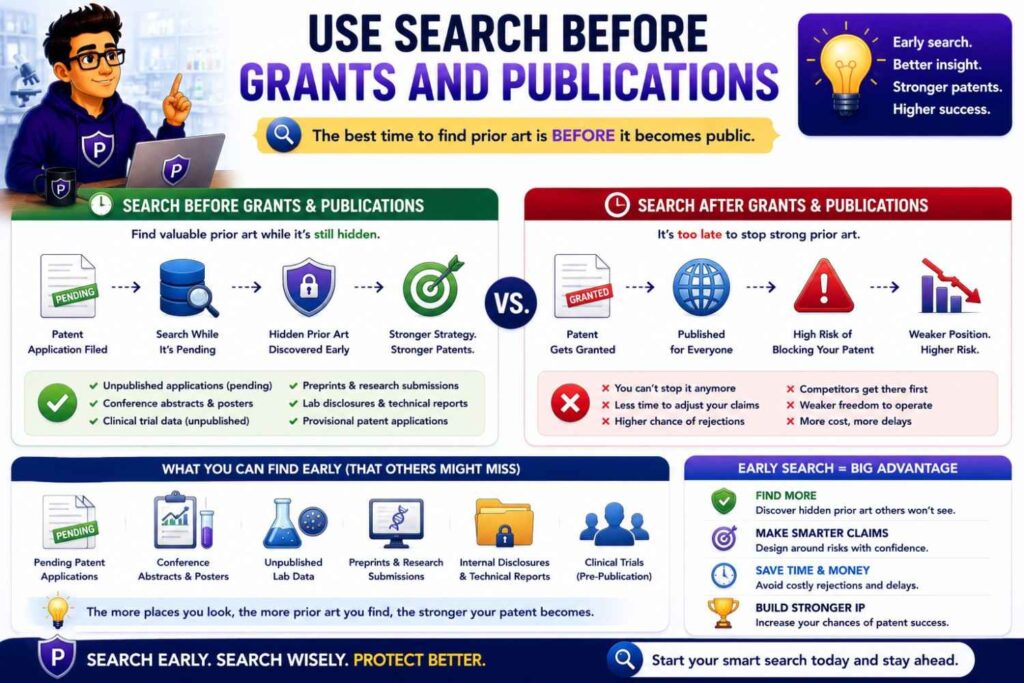
Academic founders and biotech teams often publish.
Publication can help credibility, hiring, funding, and science.
But it can also reveal patentable details.
Before submitting a paper, abstract, poster, grant summary, thesis, preprint, or conference deck, ask:
Does this disclose a marker panel?
A sequence?
A dosing method?
A formulation?
A device structure?
A clinical workflow?
A model pipeline?
A manufacturing step?
A surprising result?
If yes, talk to your patent team before publication.
PowerPatent helps founders move quickly before public science events, so patent protection does not get left behind. See how PowerPatent works.
Use Search Before Clinical Trials
Clinical trial planning can create public disclosures.
Trial records may reveal intervention, patient group, dosing, endpoints, and study design.
Before registering or announcing a trial, assess what inventions may be disclosed.
Search the key treatment method, diagnostic method, device workflow, dosing schedule, and patient group.
Then decide whether to file before the trial details become public.
This is especially important when the trial design itself reflects the invention.
The Best Searches Include Scientists, Engineers, and Patent Counsel
A biotech or MedTech search should not be done in a silo.
Scientists know the biology.
Engineers know the device.
Clinicians know the workflow.
Product leaders know what users need.
Founders know the business moat.
Patent attorneys know how to frame claims.
Bring these views together.
A scientist may know that the marker is old but the normalization method is new.
An engineer may know that the sensor location solved the real problem.
A clinician may know that the workflow timing is what makes the tool usable.
A founder may know that a manufacturing method is the cost advantage.
A patent attorney can help decide what to claim and how.
The best search is both technical and strategic.
Make Search a Business Tool
A patentability search is not only a legal step. For biotech and MedTech companies, it can become a business planning tool.
Used well, it helps the team decide where to invest, what to file, what to keep private, what to test next, and how to tell a stronger story to investors, partners, and buyers.
The best search does not end with “we found prior art” or “we did not find prior art.”
It ends with a business decision.
Use Search to Find the Real Commercial Edge
A biotech or MedTech product may have many technical parts, but not all of them create company value.
A diagnostic company may have a sample prep method, a marker panel, a risk score, a software dashboard, and a clinical workflow. A device company may have a sensor, a housing, a material layer, a calibration method, and a safety alert. A therapeutic company may have a molecule, formulation, dose, route, and patient subgroup.
The search should help answer a hard question:
Which part of this invention would a competitor most want to copy?
That is the part to study deeply.
A feature may be new but not important. Another feature may be narrow but highly valuable because it drives accuracy, lowers cost, reduces false alerts, improves patient safety, or makes the product easier to use in a clinic.
For example, a wearable company may think the sensor is the main invention. But the search may show that similar sensors are common. The real edge may be the way the system filters motion noise before sending an alert.
A diagnostic company may think the biomarker is the main invention. But the search may show the marker is known. The real edge may be the normalization rule that makes the test useful in patients with inflammation.
A MedTech AI company may think the model is the invention. But the search may show many similar models. The real edge may be the workflow that catches low-quality scans before the model gives an answer.
That is a business insight, not just a patent insight.
Turn Search Results Into R&D Priorities
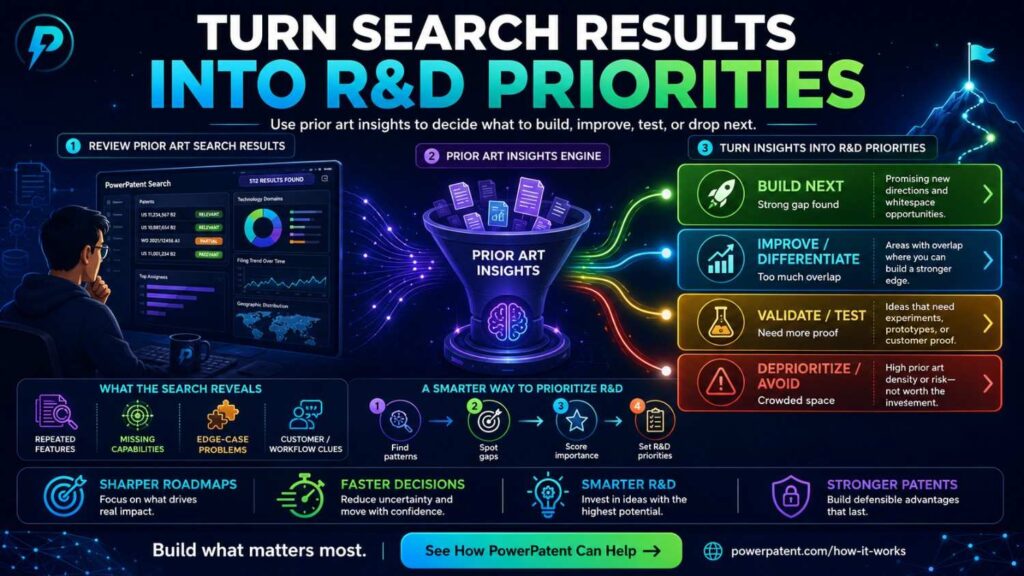
A good search can guide the next experiment.
If the prior art is crowded around one feature, do not keep spending all your effort there unless you have a clear improvement. Shift attention to the part that still has room.
For example, if many papers already show a biomarker for the same disease, your R&D focus may move toward a better sample type, a stronger marker combination, a faster assay, a lower sample volume, or a more useful clinical threshold.
If many patents already cover a drug carrier, your team may focus on release timing, stability, patient group, or combination treatment.
If many devices already use the same sensor, your team may focus on placement, calibration, body-contact design, false alert reduction, or clinician workflow.
Search can also show what data is missing.
Maybe the gap is promising, but you need evidence that it works. Maybe you need comparison data against the known method. Maybe you need results in a patient subgroup. Maybe you need stability data. Maybe you need usability data from a clinical setting.
This is where patent strategy and R&D strategy should meet.
Do not treat prior art as a wall. Treat it as a map.
Protect the Feature That Moves the Business Metric
Every biotech or MedTech company has a key business metric.
For a diagnostic, it may be accuracy, time to result, sample volume, false positive rate, false negative rate, cost per test, or ease of use.
For a device, it may be safety, reliability, procedure time, signal quality, comfort, manufacturing yield, or reduced training.
For a therapeutic, it may be dose, response rate, safety profile, delivery, stability, durability, or patient selection.
A patentability search should connect the invention to that metric.
Ask:
What feature improves the metric buyers care about?
If your test wins because it uses less sample, search and protect the low-volume method.
If your device wins because it reduces false alarms, search and protect the signal confidence or alert control method.
If your formulation wins because it lowers peak toxicity, search and protect the release profile and dosing logic.
If your AI tool wins because it reduces clinician review burden, search and protect the triage workflow.
This keeps patents tied to real business value.
A patent that protects a nice technical detail may be useful. A patent that protects the reason customers choose you is much stronger.
Use Search to Shape Investor Messaging
Investors do not need to read every search result.
But they do need to believe your moat is real.
A strong patentability search helps you explain that moat in a simple, credible way.
Instead of saying:
“We have a patent pending on our diagnostic platform.”
Say:
“The broad marker space is active, but our search showed that the closest references do not use our inflammation-adjusted marker ratio in low-volume plasma samples. That is the part tied to our lower false-positive rate, and it is the focus of our filing.”
Instead of saying:
“We use AI for imaging.”
Say:
“The AI imaging space is crowded, so our filing focuses on the quality-gated workflow. The system detects a missing view, asks the operator to capture it, and routes the case only after the input is usable. That workflow supports our reliability claim.”
This kind of message is stronger because it is specific. It shows you know the field. It also avoids overclaiming.
Investors hear a lot of vague IP claims. A search-backed story stands out.
Use Search to Improve Partner and Licensing Talks
Biotech and MedTech companies often partner early.
A diagnostic company may work with a lab. A device company may work with a hospital. A therapeutic company may work with a pharma partner. A MedTech AI company may work with an imaging center or health system.
A patentability search can help you enter those talks with more control.
Before sharing technical details, search the key invention and decide whether to file. Then use the search results to clarify what you own, what is still open, and what should stay confidential.
This matters because partnerships can blur lines.
A partner may contribute clinical data, workflow feedback, manufacturing help, or design input. Those contributions may be valuable. They may also create ownership questions if inventions are made during the partnership.
A search-backed invention record helps show what your team had before the partner discussion.
That can protect leverage.
Before a partner meeting, prepare a simple internal note:
What invention are we sharing?
What prior art did we search?
What appears to be our technical gap?
Have we filed or should we file first?
What details should remain confidential?
What new partner input could create new inventions?
That simple step can prevent painful issues later.
PowerPatent helps founders capture invention records early, so partner talks do not happen before the core technical work is organized. See how PowerPatent works.
Use Search to Avoid Filing in Crowded Dead Zones

Some areas are so crowded that broad patent claims may be hard to get.
That does not mean you cannot file anything. But it does mean you should be careful.
Search helps you avoid spending patent budget in crowded dead zones.
A crowded dead zone is an area where many references already cover the broad idea, and your difference is too small or too easy to avoid.
For example, “using AI to detect disease from images” is likely crowded.
“Using a wearable sensor to monitor heart rate” is crowded.
“Using a biomarker to detect cancer” may be crowded.
“Using a hydrogel for wound healing” may be crowded.
But inside those areas, there may still be valuable white space.
The white space may be a specific quality-control workflow, marker combination, patient subgroup, release trigger, dosing schedule, sensor placement, or false-alert reduction method.
The business move is not to give up. It is to stop filing broad, weak claims and focus on the part that still has room.
Use Search to Build a Filing Order
Most startups cannot file everything at once.
A patentability search can help rank filings.
File first on inventions that are core, likely to be copied, close to public disclosure, and supported by enough technical detail.
File later on inventions that are promising but still need more data.
Pause on inventions that are weak, easy to design around, or not tied to the roadmap.
A simple filing order can look like this:
The first filing protects the core product feature that drives value.
The second filing protects the manufacturing or assay method that makes the product scalable.
The third filing protects the next-generation workflow or patient subgroup.
The fourth filing protects a companion software or AI layer.
This order should come from business value, prior art risk, and timing.
Without a search, teams often file based on whoever shouted loudest or whichever idea felt newest. That can waste money.
With a search, filing becomes a planned business move.
Use Search to Support Pricing and Reimbursement Strategy
For many biotech and MedTech products, the business does not work unless someone pays for it.
That may mean hospitals, insurers, labs, pharma partners, patients, or health systems.
A patentability search can help support the value story behind pricing and reimbursement.
If your invention reduces false positives, that may reduce unnecessary follow-up tests.
If it reduces procedure time, that may improve clinic throughput.
If it catches risk earlier, that may reduce costly complications.
If it lowers sample volume, that may enable easier testing.
If it reduces clinician review burden, that may save labor.
If it improves adherence, that may support better outcomes.
Search helps identify whether that value-driving feature is truly yours to protect.
This matters because payers and buyers care about outcomes and cost. A patent that protects the technical feature behind those outcomes can strengthen the business case.
Use Search to Spot Acquisition Value Early
Acquirers often look for protected technical advantages.
They do not only ask whether you have patents. They ask whether those patents cover what makes the product valuable.
A patentability search helps you build that story early.
It can show that your patent filings map to the key value drivers:
The diagnostic score that improves accuracy.
The device structure that lowers complications.
The formulation that improves stability.
The workflow that reduces review time.
The manufacturing method that lowers cost.
The patient subgroup that improves response.
If your search shows those areas are open enough to pursue, file around them before they become public or before diligence begins.
Do not wait until acquisition talks to discover that your filings protect the wrong thing.
Use Search to Guide Data Generation
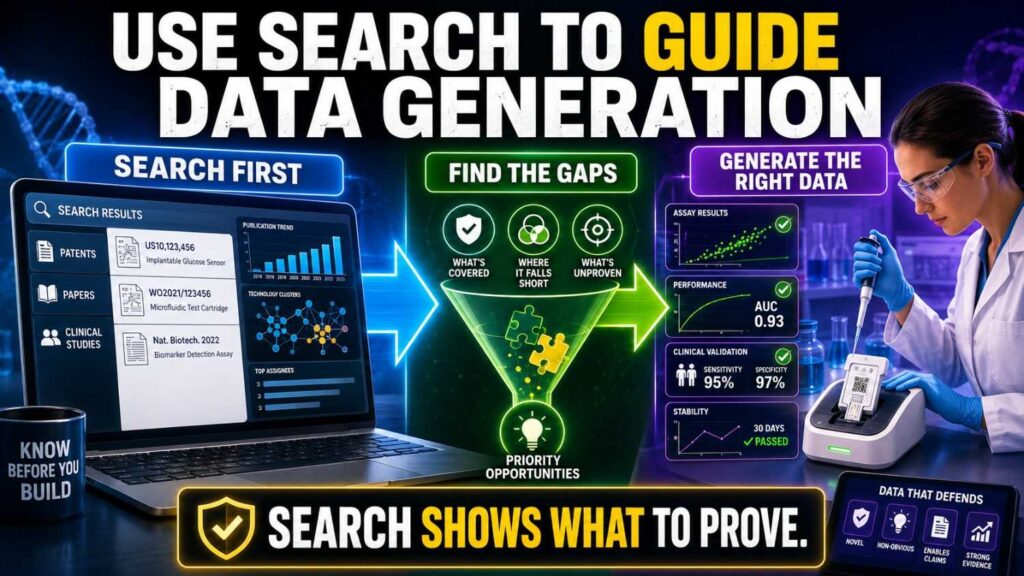
Patent filings in biotech and MedTech often become stronger when backed by useful data.
Search can tell you what data would matter most.
If prior art shows a known marker, generate data showing why your marker combination is better.
If prior art shows a known formulation, generate data showing your release profile, stability, or safety advantage.
If prior art shows a known sensor, generate data showing your placement reduces artifacts or false alarms.
If prior art shows a known AI model, generate data showing your workflow improves reliability or reduces clinician burden.
This does not mean you need perfect clinical data before every filing. But it means your experiments should support the patent story.
A useful question is:
What result would make our difference hard to ignore?
Then design tests around that.
Use Search to Create a Stronger Board-Level IP Plan
Boards need clear IP strategy, not vague updates.
A patentability search can support a sharper board discussion.
Instead of reporting:
“We filed two patents this quarter.”
A better report says:
“We searched three invention areas. The diagnostic marker space is crowded, so we are focusing claims on the inflammation-adjusted score. The device sensor placement appears more open and is close to public disclosure, so we are filing that first. The manufacturing method looks valuable but hard to reverse engineer, so we are reviewing trade secret treatment.”
That is a strategic IP update.
It shows discipline.
It shows patent budget is tied to company value.
It also helps the board understand risk.
Use Search to Choose Between Patent and Trade Secret
Search can help decide whether to file or keep something secret.
If the prior art is crowded and the claim would be narrow, but the method is hidden and hard to reverse engineer, trade secret protection may be worth considering.
If the feature will be visible in the product, disclosed in labeling, published in a trial, or easy to test, patent filing may be better.
For example, a diagnostic scoring rule may become visible through clinical validation or product documentation. A patent may help.
A cell culture parameter used only inside your lab may be hard to detect from outside. Trade secret may be considered.
A device structure visible in a teardown may be better suited for patent filing.
A manufacturing quality-control step that stays inside your factory may be a trade secret candidate.
The search helps you see whether the patent path has room. The product and disclosure plan help you decide whether secrecy is realistic.
Use Search to Reduce Wasted Legal Spend
A search helps spend money where it matters.
Before drafting a full application, use the search to answer:
Is the broad idea already known?
Is there a meaningful technical gap?
Is the gap tied to business value?
Do we have enough data or detail?
Is public disclosure near?
Is this better as a patent or trade secret?
This prevents filing on weak ideas.
It also helps avoid thin applications that later cannot support strong claims.
For startups, this is important. Patent spend should help the company become more defensible, not just create paperwork.
Use Search to Align Science, Product, and Legal Teams
Biotech and MedTech teams often work in silos.
Scientists focus on data. Engineers focus on devices. Product teams focus on users. Regulatory teams focus on approvals. Legal teams focus on filings.
A search can bring these groups together.
When the team reviews prior art, everyone sees the same map.
Scientists can explain the biological difference.
Engineers can explain the device or workflow difference.
Clinicians can explain why the timing or use case matters.
Product leaders can explain customer value.
Patent counsel can explain claim strategy.
This reduces confusion and helps the company file around the true moat.
One practical habit is to hold a short “search-to-decision” meeting before each major filing. The goal is not to debate every reference. The goal is to agree on the invention, the closest prior art, the gap, the business value, and the filing path.
Use Search to Create Stronger Competitive Intelligence
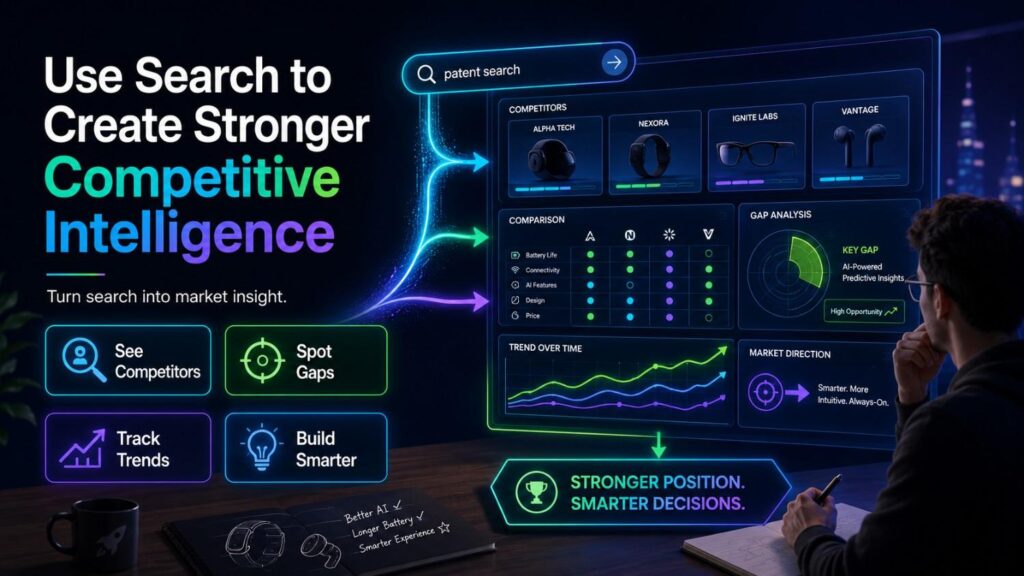
Patentability search can also show where competitors are moving.
You may discover that a competitor is filing around a patient subgroup, a delivery route, a device workflow, or a manufacturing step.
That can help you decide where to move next.
It may show white space.
It may show risk.
It may show a partnership target.
It may show a crowded area to avoid.
It may show that a large company is validating the same market.
This information can help product strategy, fundraising, hiring, and business development.
Do not treat search results as one-time legal files. Use them as market signals.
Use Search to Strengthen the Product Roadmap
A good search may reveal that today’s invention is protectable, but tomorrow’s version is even stronger.
For example, your current diagnostic uses a marker panel. The search shows that marker panels are crowded, but your planned longitudinal scoring method may be more unique.
Your current device uses a known sensor. The search shows the sensor is old, but your planned self-calibration method may be stronger.
Your current AI tool classifies images. The search shows classification is crowded, but your planned quality-gated workflow may be more defensible.
This can help the company prioritize roadmap features that support both customer value and IP strength.
That does not mean building only for patents. It means recognizing when technical roadmap choices can also improve defensibility.
Use Search to Prepare for Diligence Before It Starts
By the time diligence begins, it may be too late to fix weak filings.
Use search earlier.
Before a major financing, partnership, or acquisition process, review the patent portfolio against the closest prior art.
Ask:
Do our filings cover the product’s key value driver?
Do the claims match what customers care about?
Do we have pending applications that can be adjusted?
Did we file before key disclosures?
Are there inventions we should file before diligence?
Are there weak areas we should explain honestly?
This preparation can prevent surprises.
It also helps the company tell a cleaner story.
Turn the Search Into an Action Plan
The most important output of a business-focused search is an action plan.
That action plan should be short and clear.
It should say what to file, what to test, what to keep secret, what to monitor, and what to revisit later.
A strong action plan might sound like this:
“The broad wound dressing space is crowded. File around the sustained pH-triggered release layer because it is tied to our infection-control claim. Generate more release-profile data against the closest reference. Keep the manufacturing coating parameter confidential for now. Monitor two competitors filing in pH-responsive materials. Revisit claims after the next animal study.”
That is much better than a pile of search results.
It gives the business a path.
PowerPatent helps teams turn invention details and search findings into filing decisions with smart software and real patent attorney oversight, so the work leads to action instead of confusion. See how PowerPatent works.
How PowerPatent Helps Biotech and MedTech Teams
Biotech and MedTech teams need patent workflows that can handle complexity.
The invention may be in a biomarker panel.
A formulation.
A dose.
A device structure.
A sensor placement.
A clinical decision rule.
A manufacturing step.
A test result.
PowerPatent helps teams capture these details and move them into a stronger patent process, with real attorney oversight.
Instead of starting from a vague product summary, PowerPatent helps organize the actual invention story.
What was built.
What problem it solved.
What prior art looks close.
What technical gap matters.
What should be filed.
That helps founders move faster and avoid costly mistakes.
A Practical Search Workflow for Biotech and MedTech
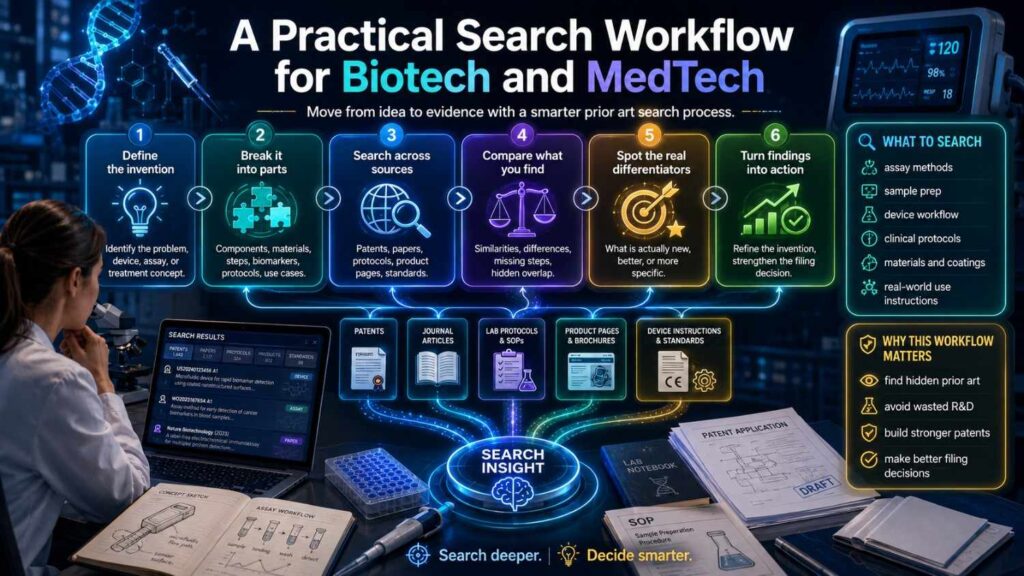
Start with a plain-English invention statement.
Name the technical problem.
Break the invention into elements.
Identify the core element.
Build search terms using scientific names, synonyms, older terms, product terms, and clinical terms.
Search patents.
Search papers.
Search clinical trial records.
Search product manuals and labels.
Search protocols and methods.
Search regulatory materials.
Search sequence or material databases when relevant.
Search competitors, labs, inventors, sponsors, suppliers, and partners.
Follow citations from close papers and patents.
Map each close reference against your invention elements.
Find the strongest gap.
Tie the gap to a technical or clinical result.
Decide whether to file, refine, search more, pause, or keep some details secret.
That is the workflow.
It turns research into a filing decision.
A Founder-Friendly Search Template
Use this template when your team finds a possible biotech or MedTech invention.
Invention name:
Plain-English invention statement:
Product or program:
Technical problem:
Technical solution:
Core element:
Sample type, patient group, device part, molecule, or workflow:
Key elements:
Search terms:
Patent search results:
Paper search results:
Clinical trial search results:
Product or regulatory search results:
Closest prior art:
What the closest art teaches:
What it does not teach:
Strongest gap:
Why the gap matters:
Data supporting the gap:
Public disclosure risk:
Recommended decision:
This template keeps the work focused.
It also gives your patent team a much better starting point.
Final Takeaway
A patentability search for biotech and MedTech inventions must follow the science, the product, and the real clinical use.
Do not search only the product name.
Search the marker, molecule, sample, assay, formulation, dose, device structure, sensor placement, clinical workflow, patient group, safety control, manufacturing method, and technical result.
Look across patents, papers, clinical trial records, protocols, product manuals, labels, regulatory materials, databases, and related fields.
Then compare the closest prior art element by element.
Find the real gap.
Tie that gap to a useful result.
Then decide whether to file, refine, search more, pause, or protect some details as trade secrets.
For biotech and MedTech founders, this is how you protect what took years of science, engineering, and courage to build.
And when you are ready to turn lab notes, device details, clinical workflows, data, and invention ideas into stronger patent filings, PowerPatent can help you move faster with smart software and real patent attorney oversight.
Leave a Reply