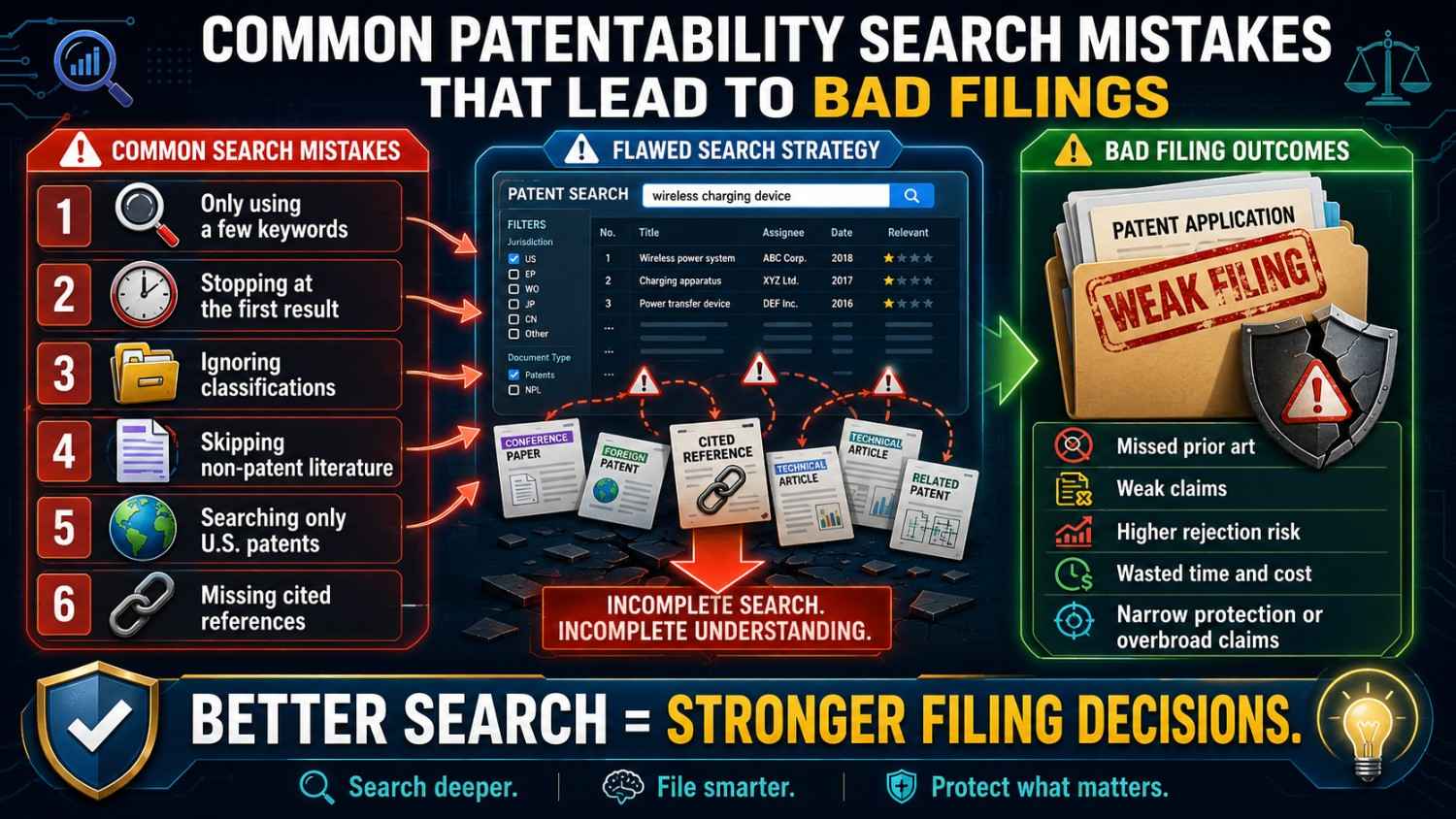
A bad patent filing often starts before the patent is even written.
It starts with a weak search.
A patentability search is supposed to help you see what came before, find your real invention, and decide what to file. But when the search is too shallow, too broad, too late, or focused on the wrong thing, it can lead your team straight into a weak patent application.
This guide breaks down the most common mistakes founders, engineers, and inventors make during patentability search, and how to avoid them.
PowerPatent helps startups turn invention notes, search results, product details, code, models, and technical work into stronger patent filings with smart software and real patent attorney oversight. See how PowerPatent works here.
Mistake 1: Searching the Product Name Instead of the Invention
Many founders begin with the product name.
They search the brand, the category, or the words they use in sales.
That may feel natural. It is also one of the fastest ways to miss close prior art.
A patent does not protect your brand story. It protects a technical invention. If you search only the product name, you may search the wrong thing.
For example, a founder may search “AI sales assistant” and find lots of broad tools. But the actual invention may be a method that ranks sales call objections, maps them to proof points, and updates the next-call prompt based on later conversion.
Those are very different searches.
Another founder may search “smart warehouse robot.” But the invention may be a blind-corner safety method that uses sound direction, map geometry, and traffic history to slow before an object is visible.
Another founder may search “battery safety platform.” But the invention may be a pressure drift method that compares matched charging windows to reduce false swelling alerts.
The product name gives you the market.
The invention gives you the search.
Before searching, write one plain sentence:
“Our invention does [main action] by using [technical method] so that [technical result] improves.”
That sentence should guide the search.
A weak search asks, “Is there a product like ours?”
A strong search asks, “Has anyone already taught this technical method?”
That shift can save you from a bad filing.
Mistake 2: Treating a Market Gap Like a Patent Gap
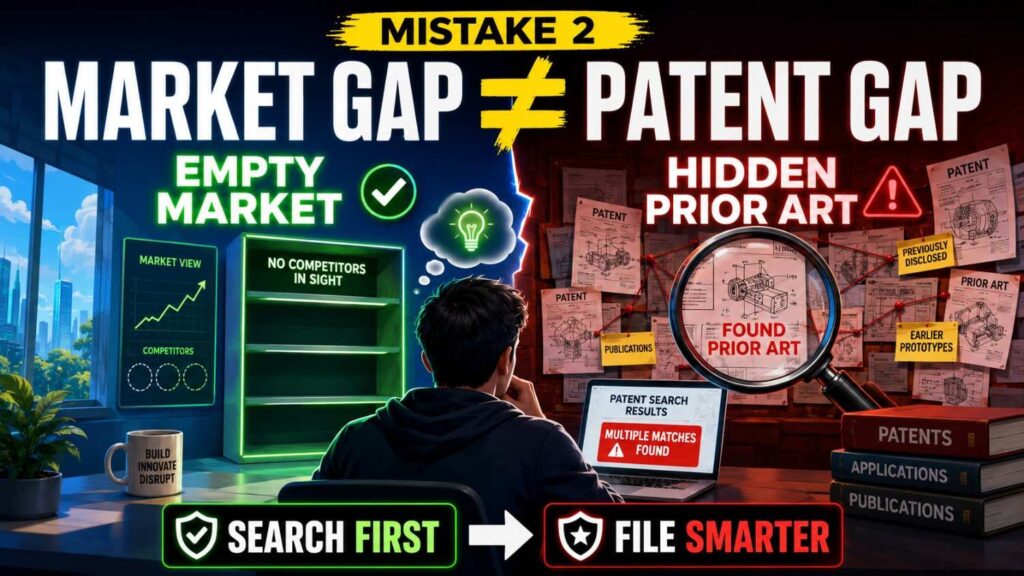
A market gap is not the same as a patent gap.
Your product may be the first one customers have seen. That does not mean the invention is new for patent purposes.
A prior patent, paper, manual, or public technical document may describe the idea even if no one turned it into a successful product.
This surprises founders.
They say, “No one sells this.”
That may be true. But patents care about what was made public, not only what was sold.
A failed startup can create prior art.
A university paper can create prior art.
An old product manual can create prior art.
A conference poster can create prior art.
An open-source repo can create prior art.
A thesis can create prior art.
A standards document can create prior art.
Market absence is useful business information, but it is not enough for patentability.
A good search asks whether the invention was publicly taught, not whether it won the market.
If you skip this distinction, you may file a patent that looks exciting in a pitch deck but runs into old technical references during examination.
That creates cost, delay, and frustration.
The fix is simple: search both the market and the method.
Search competitors and products, yes. But also search patents, papers, open-source projects, manuals, standards, technical blogs, videos, and old documents that describe how the method works.
Mistake 3: Searching Too Broadly and Giving Up
Broad searches create noise.
A founder searches “AI document review” and sees thousands of results. Then the team says, “This space is too crowded. We cannot patent anything.”
That conclusion may be wrong.
The broad space may be crowded, but the specific technical method may still be open.
“AI document review” is too broad.
A better search might be:
“generated answer source support review trigger”
“document clause extraction missing support detection”
“model confidence source trust human review”
“obligation mapping source text verification”
These searches look for the invention, not the market.
The same applies in hardware.
“Robot gripper” is too broad.
“soft object gripper slip deformation pressure control” is better.
In SaaS:
“compliance automation” is too broad.
“tenant scoped evidence packet field redaction audit control” is better.
In biotech:
“cancer test” is too broad.
“inflammation normalized biomarker ratio plasma early stage risk score” is better.
A broad search is a starting point, not the decision.
Use it to learn the field. Then narrow down to the technical feature that matters.
Do not let broad noise kill a good filing opportunity too early.
Mistake 4: Searching Too Narrowly and Missing Close Art
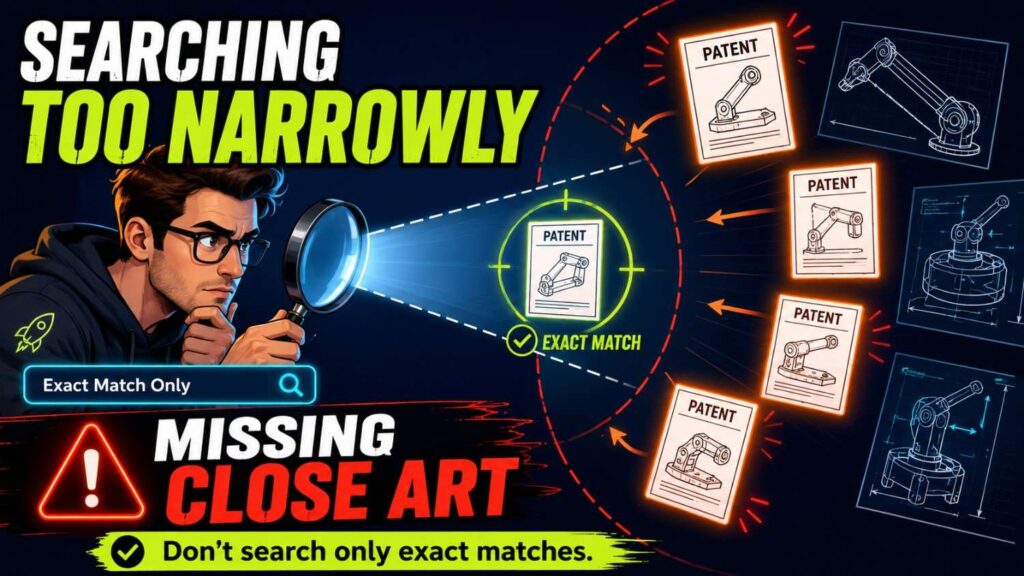
The opposite mistake is also dangerous.
Some teams search only exact words.
They use their product language, their internal feature name, or their own phrase for the invention.
When nothing appears, they assume the invention is clear.
That is risky.
Other people may use different words.
You may say “source trust.” Prior art may say “document reliability,” “evidence score,” “citation support,” “reference confidence,” or “provenance weight.”
You may say “field-level replay.” Prior art may say “attribute-specific event reconstruction,” “record repair,” “change log recovery,” or “data sync reconciliation.”
You may say “battery swelling.” Prior art may say “cell expansion,” “mechanical deformation,” “bulging,” “pressure increase,” or “pack strain.”
You may say “blind-corner robot safety.” Prior art may say “occluded object prediction,” “non-line-of-sight obstacle detection,” or “intersection risk control.”
A narrow search can give false comfort.
The fix is to build a search term bank before you search.
Include product words, technical words, old words, formal patent words, problem words, solution words, and result words.
For each key feature, write at least five alternate terms.
Then search combinations.
The goal is not to search your language. The goal is to search the language of the whole field.
Mistake 5: Ignoring Non-Patent Prior Art
Many teams search only patents.
That is a serious mistake, especially in software, AI, biotech, MedTech, SaaS, and robotics.
Prior art can live outside patent databases.
For AI, it may be in papers, GitHub repos, model cards, benchmarks, technical blogs, conference talks, or product docs.
For SaaS, it may be in API docs, help centers, release notes, open-source projects, standards, or cloud architecture posts.
For hardware and robotics, it may be in product manuals, datasheets, supplier catalogs, demo videos, teardown posts, research papers, or standards.
For biotech and MedTech, it may be in journal articles, clinical trial records, protocols, product labels, IFUs, reagent catalogs, sequence databases, or conference abstracts.
A patent examiner may find non-patent art.
A competitor may find it too.
If your search ignores it, your filing may be built on a false sense of safety.
The fix is to search where your field actually publishes.
If engineers in your field publish code, search code.
If scientists publish papers, search papers.
If device companies publish manuals, search manuals.
If cloud companies publish docs, search docs.
If standards bodies shape the field, search standards.
A patentability search should reflect the real technical world, not only the patent world.
Mistake 6: Reading Only Titles and Abstracts
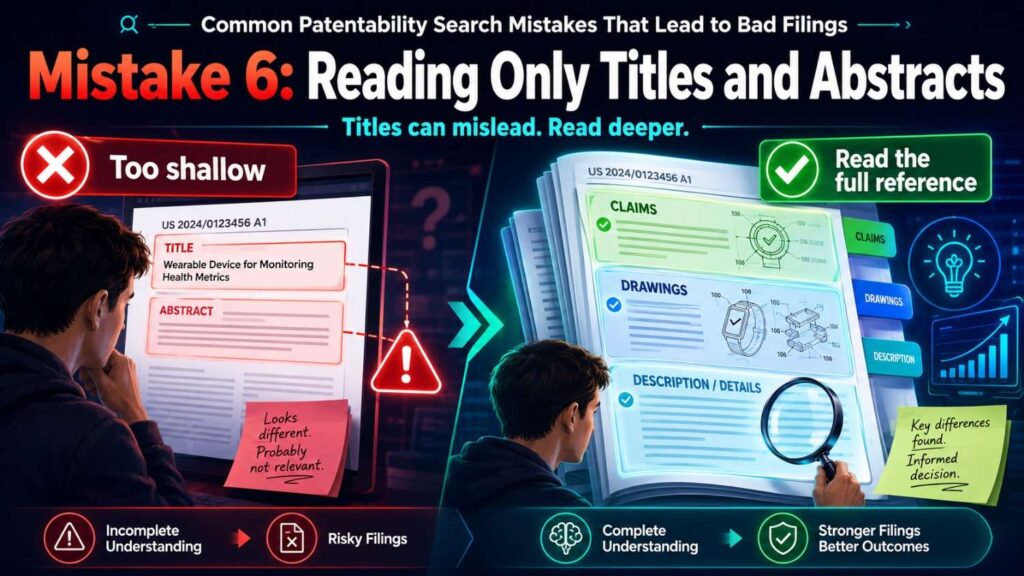
Patent titles are often useless.
A patent called “System and Method for Data Processing” may contain a very specific AI workflow.
A patent called “Medical Device” may disclose a sensor placement very close to yours.
A patent called “Workflow Automation System” may include the same approval trigger your SaaS platform uses.
The abstract can help, but it is not enough.
Important details may be in the claims, drawings, examples, flowcharts, or detailed description.
If you stop at titles and abstracts, you may miss direct hits.
You may also panic over references that sound broad but are actually narrow.
The fix is to read close references with a clear structure.
First, read the abstract to understand the theme.
Then read the claims to see what the patent focuses on.
Then look at the drawings and flowcharts.
Then search inside the document for your key terms.
Then read the paragraphs around those terms.
Then ask what the reference actually teaches.
Does it show your input?
Your timing?
Your trigger?
Your control step?
Your feedback loop?
Your sensor placement?
Your scoring method?
Your technical result?
Bad filings often come from shallow reading.
Strong filings come from careful comparison.
Mistake 7: Comparing by Vibe Instead of Elements
“This feels close.”
“That seems different.”
“This looks similar.”
Those statements are not enough.
Patentability search needs element-by-element comparison.
An element is a key part of the invention.
If your invention is an AI workflow action validator, the elements may be:
The system generates an AI action.
The system checks user permission.
The system checks customer policy.
The system checks source-data support.
The system allows, blocks, or routes the action.
The system records the decision.
Now compare each reference against each element.
Does Reference A show AI-generated actions? Yes.
Does it check permission? Yes.
Does it check customer policy? No.
Does it check source-data support? No.
Does it record the decision? Maybe.
Now you have useful insight.
The reference is close, but it may not show the full invention.
Without element mapping, teams either overreact or underreact.
They may give up because a reference “looks close.”
Or they may file too broadly because no reference “feels exact.”
The fix is to build a simple claim map.
List your elements.
List close references.
Mark each element as yes, no, partial, or unclear.
Add short notes.
This turns search results into a decision.
PowerPatent helps founders and technical teams organize invention details and search results so the patent process starts with clarity, not guesswork. See how PowerPatent works.
Mistake 8: Mixing References Too Early
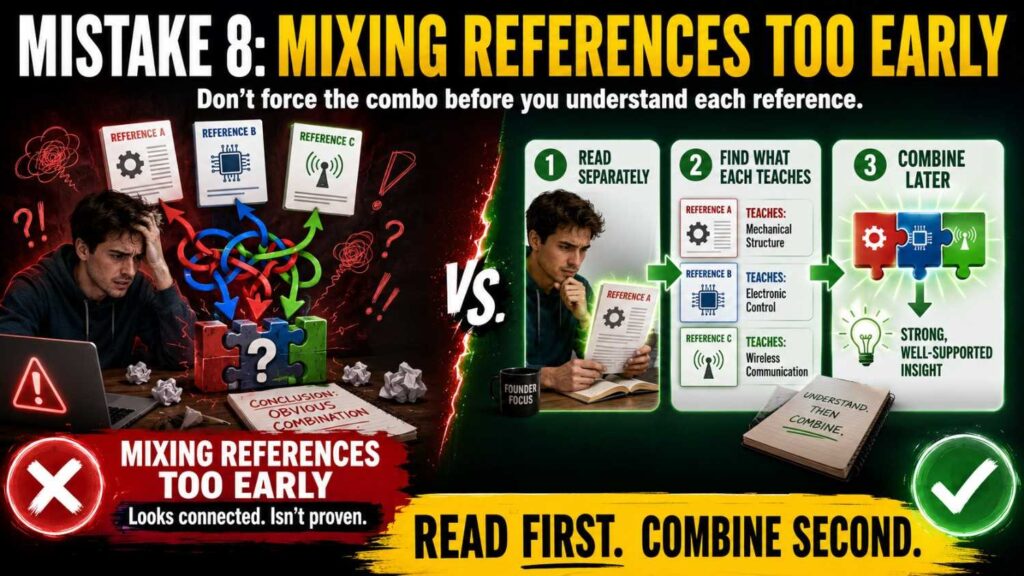
Many teams blend all prior art together too soon.
They find one reference with a sensor, another with a score, another with a feedback loop, and another with a dashboard.
Then they say, “Everything is already known.”
Maybe. But maybe not.
For novelty, the first question is whether one reference shows every key part of your invention.
Do not mix references for that first check.
Ask:
Does Reference A show the full invention?
Does Reference B show the full invention?
Does Reference C show the full invention?
If no single reference shows all elements, your invention may still be novel.
Then you can ask the next question: would it have been an easy step to combine references?
That is a different analysis.
This matters because many inventions are combinations.
A combination can still be valuable if the specific arrangement solves a technical problem in a new way.
If you mix references too early, you may give up on an invention that still deserves filing.
If you ignore combinations entirely, you may overestimate patent strength.
The right order is:
First, compare one reference at a time.
Then, analyze likely combinations.
That keeps the decision clean.
Mistake 9: Ignoring Obviousness Risk
Some teams stop once they find no exact match.
That is not enough.
A claim can be new but still look too easy based on prior art.
For example, no single reference may show your SaaS platform’s full workflow. But one reference may show AI-generated actions, another may show policy approval, and another may show audit logging.
An examiner may ask whether combining those steps would have been obvious.
This does not mean your invention is dead.
It means you need to explain why your combination matters.
Did it solve a problem old systems missed?
Did it create a technical result?
Did old systems avoid this path?
Did the combination require a special trigger, timing, data structure, or control step?
Did it reduce errors, cost, latency, false alerts, unsafe actions, or data exposure?
A search that ignores obviousness risk may lead to a filing that gets stuck later.
The fix is to look at combinations after the one-reference novelty pass.
Ask whether the missing element is shown elsewhere.
Then ask whether combining it with the closest reference would make sense.
If the combination is natural and predictable, refine the claim.
If the combination is not natural, document why.
That reasoning can help your patent team.
Mistake 10: Treating Every Difference as Important
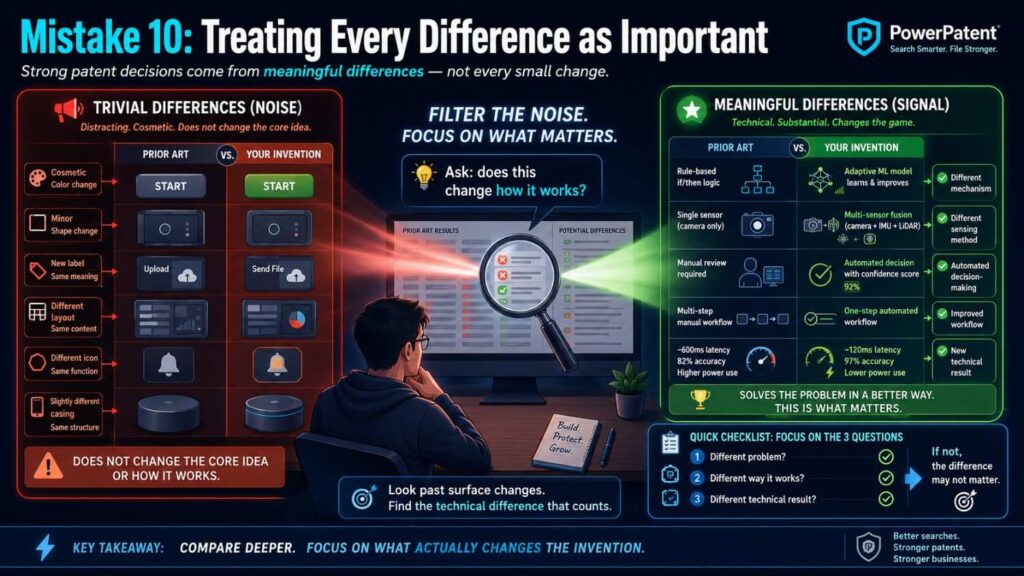
Not every difference matters.
A prior art system may use a red button and your system uses a blue one.
A prior art app may use one cloud provider and yours uses another.
A prior art platform may use a web app and yours uses a mobile app.
A prior art workflow may send an email and yours sends a Slack message.
These differences may not support a strong patent by themselves.
A useful difference should be technical and meaningful.
It should change how the system works or improve a technical result.
A strong difference may reduce compute cost, improve signal quality, reduce false positives, increase safety, improve routing, protect privacy, prevent data leakage, improve reliability, or enable a new control action.
For example:
Weak difference:
“Our dashboard has a better layout.”
Stronger difference:
“Our system groups alerts by shared root cause before display, reducing duplicate alerts and review load.”
Weak difference:
“Our app uses AI.”
Stronger difference:
“Our system blocks AI-generated workflow actions when source-data support is low, even if the model confidence is high.”
Weak difference:
“Our wearable has a new screen.”
Stronger difference:
“Our wearable adjusts alert confidence based on skin-contact pressure and motion state to reduce false alerts during movement.”
The fix is to tie every difference to a result.
Ask:
Why does this difference matter?
What problem does it solve?
Would a competitor need it?
Would a customer care?
Can we explain the technical result?
If not, it may not be the right patent focus.
Mistake 11: Filing on the Surface Feature
Bad filings often focus on what the user sees.
A dashboard.
A button.
A report.
A chatbot.
A notification.
A wearable screen.
A device shell.
A product category.
But the invention may be behind the scenes.
The dashboard may be ordinary. The data grouping method may be new.
The chatbot may be ordinary. The source-verification workflow may be new.
The report may be ordinary. The tenant-safe evidence generation may be new.
The wearable screen may be ordinary. The signal correction method may be new.
The device shell may be ordinary. The sensor placement may be new.
If the search focuses on surface features, the filing may miss the real value.
The fix is to ask what happens before the user sees the feature.
What data was collected?
What was filtered?
What was compared?
What score was created?
What rule was applied?
What action was blocked or allowed?
What was stored for next time?
What changed because of feedback?
The patent should protect the mechanism that creates value, not just the visible output.
Mistake 12: Ignoring the Engineering Story
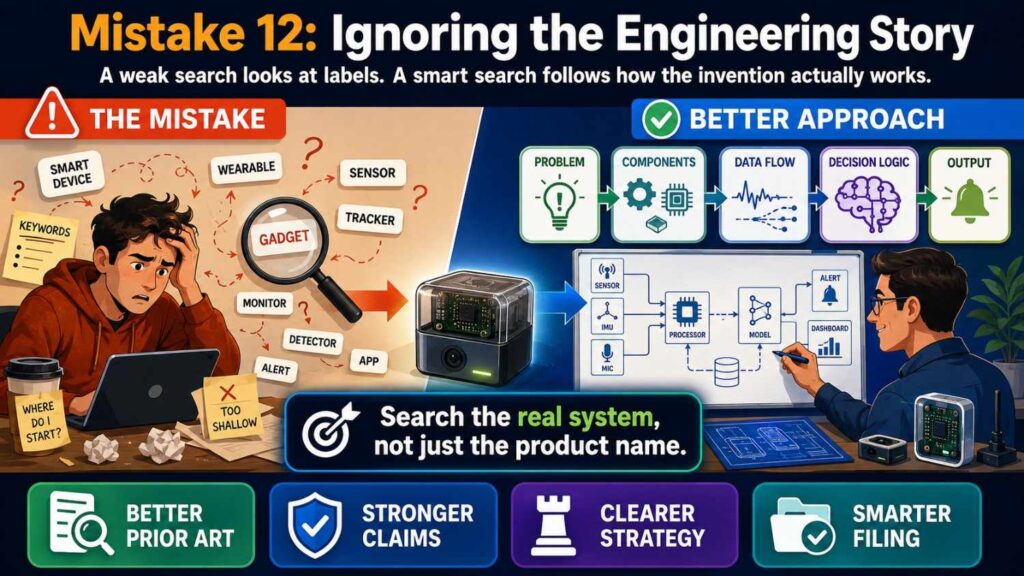
The best patent search terms often come from engineers.
Engineers know what failed.
They know what was hard.
They know which workaround finally worked.
They know which part reduced cost.
They know which sensor had to move.
They know which threshold stopped false alerts.
They know which model output could not be trusted.
They know which retry logic saved customer data.
If the search is run only from a founder pitch or product brief, it may miss the invention.
For example, the pitch says:
“Our platform automates compliance.”
The engineer says:
“The hard part was generating an audit packet without including unrelated tenant data.”
That second sentence is the search path.
The pitch says:
“Our robot avoids blind corners.”
The engineer says:
“The important part is slowing before visual detection by combining sound direction with map geometry.”
That is the search path.
The pitch says:
“Our AI gives better answers.”
The engineer says:
“The system routes high-confidence answers to review when source trust is low.”
That is the search path.
The fix is to interview builders before searching.
Ask:
What broke?
What did we try first?
What did we change?
What result improved?
What would a competitor copy?
What is hidden from users but central to performance?
Those answers should drive the search.
Mistake 13: Ignoring Old Prior Art
New products often use old ideas in new contexts.
That does not mean the product has no patentable invention. But old art can still matter.
A modern AI workflow may face prior art from old rule-based systems.
A cloud sync product may face prior art from old distributed databases.
A robot may face prior art from industrial automation.
A wearable may face prior art from hospital monitors.
A MedTech AI system may face prior art from older clinical decision support tools.
A SaaS compliance tool may face prior art from older audit software.
If you search only recent buzzwords, you may miss the old foundation.
The fix is to search older functional terms.
For AI, search older “expert system,” “rule-based,” “classification,” “decision support,” and “workflow routing” terms.
For SaaS, search “client-server,” “enterprise software,” “workflow engine,” “access control,” and “data synchronization.”
For robotics, search “automated guided vehicle,” “manipulator,” “end effector,” and “motion control.”
For biotech and MedTech, search older disease names, assay terms, device classes, and protocol names.
Old art can narrow your claim. It can also help show what your invention truly adds.
Mistake 14: Ignoring Foreign Prior Art
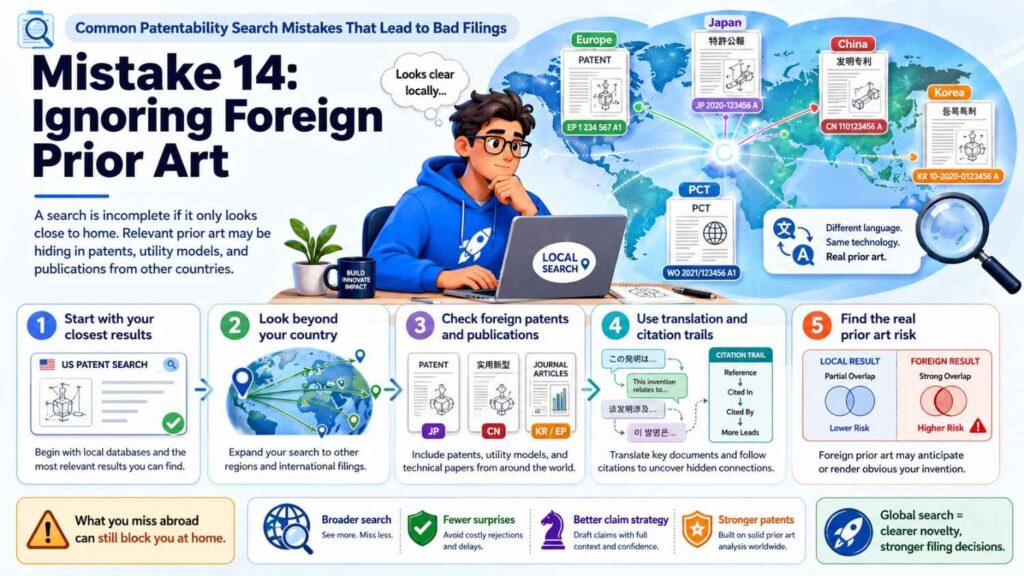
Prior art is not limited to your home country.
A foreign patent publication, thesis, paper, product manual, or technical document can matter.
This is especially important in hardware, robotics, biotech, batteries, telecom, AI, semiconductors, and medical devices.
A close reference may be in Japan, Korea, China, Germany, Europe, India, or another region.
Machine translations are not perfect, but they can still reveal important details.
If you search only U.S. patents or only English terms, your view may be too narrow.
The fix is to use global patent tools and search international patent families.
When you find a close U.S. patent, look for foreign family members.
When you find a close foreign patent, save the translated version and share it with your patent team.
Search assignees globally.
Search technical terms that may translate differently.
A global product needs a global prior art mindset.
Mistake 15: Forgetting Dates
Dates matter in patentability search.
A reference published before your filing date may matter. A reference published after your filing date may be less relevant for patentability, though it can still teach you about the field.
For patents, the grant date is not enough. Look at filing date, publication date, and priority date.
A patent granted recently may have been filed many years ago.
For papers, check preprint dates and publication dates.
For GitHub, check commit dates.
For product docs, check release notes, archive dates, or changelogs when available.
For clinical trials, check posting and study dates.
For your own disclosures, record when and where you shared details.
Bad filings can happen when teams misunderstand timing.
They may ignore an old reference because the patent granted recently.
They may file after their own public disclosure without telling counsel.
They may treat a current product page as if it always existed in that form.
The fix is to record dates in your search notes.
For each close reference, capture the publication date, filing or priority date if patent-related, and any uncertainty.
Do not rely on memory.
Mistake 16: Ignoring Your Own Public Disclosure
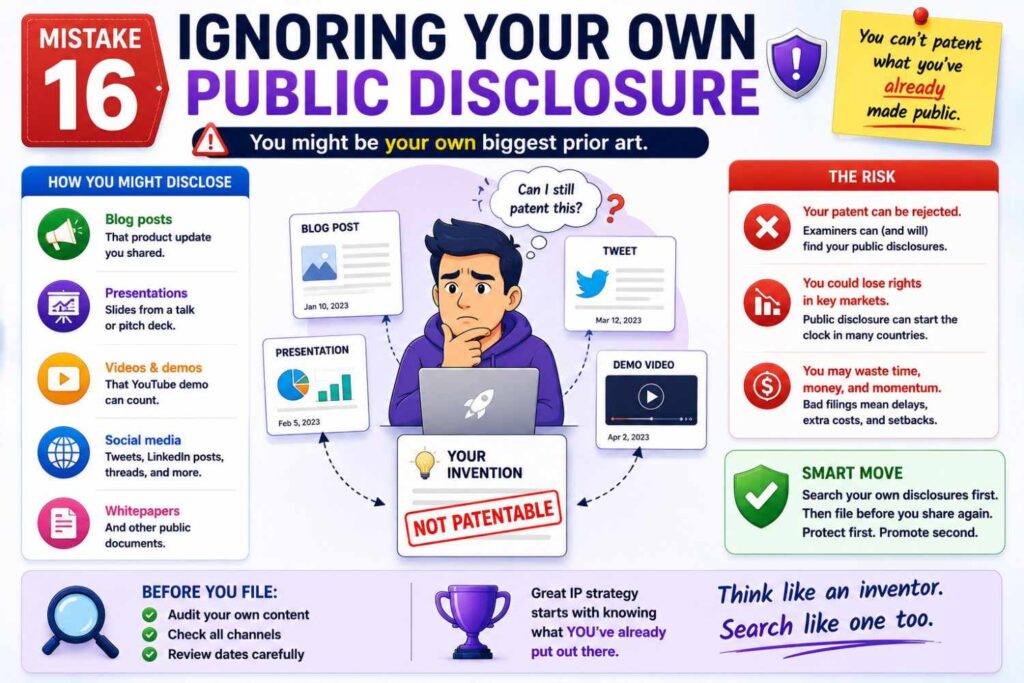
Your own public work can create patent risk.
A launch page.
A demo video.
A blog post.
An API doc.
A GitHub repo.
A conference talk.
A pitch deck without confidentiality.
A research poster.
A clinical trial record.
A product manual.
A webinar.
A sales deck.
These may disclose the invention.
Many founders forget this.
They think only competitor prior art matters.
But your own disclosure may affect filing options, especially outside the United States.
The fix is to build a disclosure log.
Record what was shared, when, where, with whom, and whether it was confidential.
Before filing, tell your patent team about all public disclosures.
Do not hide them because they feel inconvenient.
A good patent strategy needs the full timeline.
PowerPatent helps founders organize invention details and timing so filing decisions can be made with fewer surprises. See how PowerPatent works.
Mistake 17: Filing Before the Invention Is Clear
Some teams file too early.
They have a broad idea but not enough technical detail.
The patent application ends up thin.
It says what the product should do, but not how it does it.
This can create problems later.
If the application does not describe the real invention, it may not support strong claims.
If it lacks alternatives, it may be hard to adjust.
If it does not explain the technical result, it may be less persuasive.
A rushed filing may feel safe, but it can create false comfort.
The fix is not to wait forever. It is to capture enough detail.
Before filing, make sure you can explain:
The technical problem.
The system parts.
The inputs.
The steps.
The decision rules.
The outputs.
The feedback loop, if any.
The alternatives.
The technical result.
The closest prior art.
The difference.
You do not need a finished product in every case. But you need a real invention.
PowerPatent is designed to help teams capture this detail quickly without turning the process into a slow legal maze. Learn how PowerPatent helps founders move faster with better invention capture.
Mistake 18: Waiting Until After Launch
Other teams wait too long.
They launch, publish docs, open source code, release a white paper, speak at a conference, and then ask about patents.
By then, options may be harder.
This is common in SaaS and AI because teams move quickly.
It is also common in biotech and MedTech because teams publish, present, or register trials.
It is common in hardware because teams demo prototypes, post videos, or attend trade shows.
The fix is to run a patentability search before key public events.
Before launch, ask:
Are we revealing the technical method?
Before publishing API docs, ask:
Do the docs expose the workflow, fields, scores, or triggers?
Before a conference, ask:
Does the talk disclose the invention?
Before open source, ask:
Does the repo show the core method?
Before a product demo, ask:
Can viewers infer the control loop or structure?
If yes, search and consider filing first.
This does not mean slowing growth. It means protecting value before it leaves the building.
Mistake 19: Not Searching the Roadmap
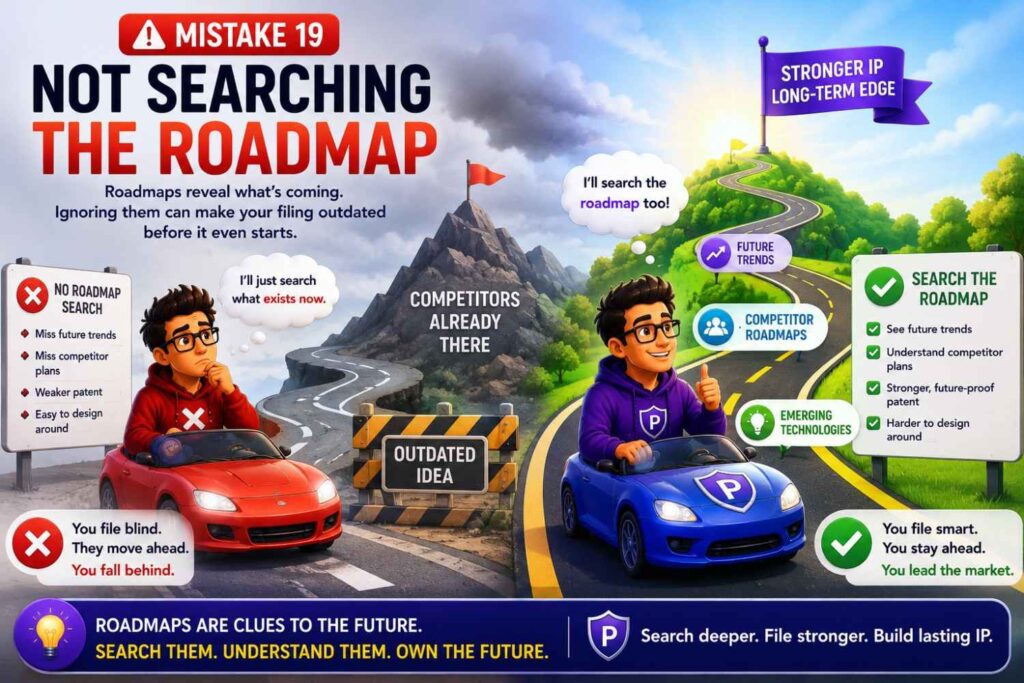
A patentability search should not only look at today’s feature.
Startups evolve fast.
Sometimes the current feature is crowded, but the next version is stronger.
A SaaS platform today may collect compliance evidence. The roadmap may add tenant-safe audit packet generation.
An AI tool today may generate answers. The roadmap may add source-trust review and policy validation.
A robot today may stop at blind corners. The roadmap may add pre-visual risk prediction and fleet warnings.
A diagnostic today may use a marker panel. The roadmap may add longitudinal scoring and patient subgroup thresholds.
If the roadmap is real and technically understood, search it.
This helps you file around where the business is going, not only where it is now.
The fix is to include product and engineering roadmap items in invention reviews.
Ask:
What version is shipping now?
What version is already designed?
What version is being tested?
What technical alternatives should be disclosed?
What should be searched before we commit?
A strong filing can support future product growth when the invention is described well.
Mistake 20: Filing Around a Feature That Is Easy to Design Around
Some patent filings are technically new but commercially weak.
They protect a detail competitors can avoid without losing much value.
For example, a claim may require a specific notification channel, exact threshold number, exact UI layout, or exact sensor brand.
If a competitor can change one detail and still get the benefit, the patent may not be very useful.
A patentability search should help identify what competitors would actually need to copy.
Ask:
What part creates the customer value?
Can competitors avoid it easily?
Is this feature central or optional?
Is it visible enough to detect copying?
Is it tied to the technical result?
A strong filing should focus on the part that is hard to avoid if someone wants the same result.
For example, “send a Slack message” may be easy to avoid.
“Route AI-generated actions to review when source support is low” may be harder to avoid if that is what makes the system safe.
“Use sensor X” may be easy to avoid.
“Adjust alert confidence based on contact pressure and motion state” may be harder to avoid if it solves false alerts.
Search should support claim strategy, not just novelty.
Mistake 21: Ignoring Business Value
A feature can be patentable and still not worth filing.
That sounds harsh, but it is true.
Patent budget is limited. Founder time is limited. Attorney time is limited.
A good search should support business decisions.
Ask:
Does this invention protect the core product?
Does it support revenue?
Does it matter to customers?
Would competitors copy it?
Does it support fundraising?
Does it support partnerships?
Does it support acquisition value?
Does it align with the roadmap?
If not, filing may not be the best use of budget.
A bad filing protects something nobody cares about.
A strong filing protects a technical feature tied to business value.
The search should help you rank inventions.
Core and strong: consider filing.
Core but crowded: refine the claim angle.
Promising but unclear: search more.
Hidden and hard to reverse engineer: consider trade secret strategy.
Weak or low-value: save budget.
That is how patent work becomes strategy.
Mistake 22: Not Deciding Between Patent and Trade Secret
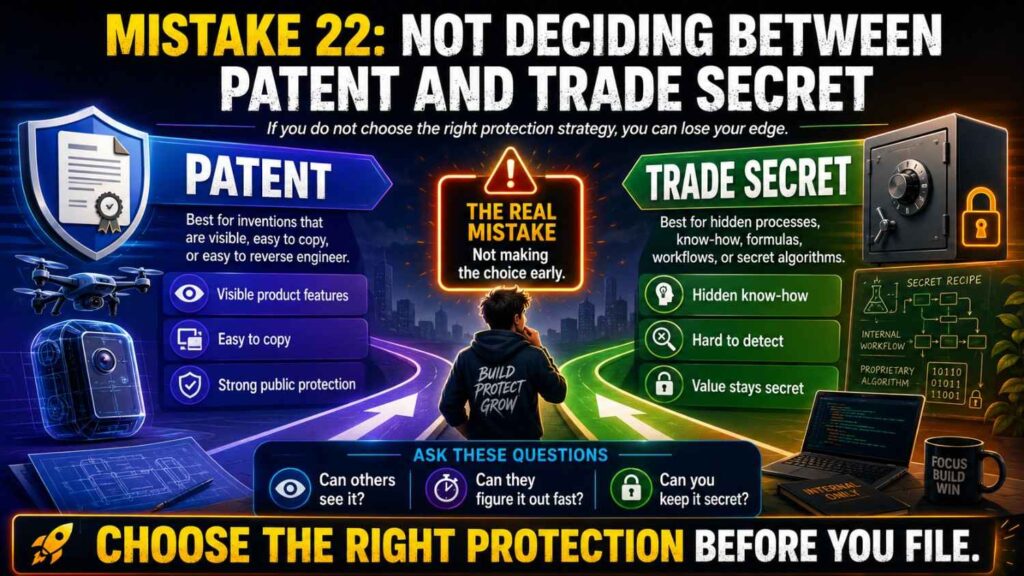
Not every technical advantage should be patented.
A patent requires disclosure.
A trade secret requires secrecy.
A backend model tuning method, manufacturing parameter, internal ranking formula, cell culture condition, or private quality-control step may be hard for competitors to see.
If it is valuable and not easily reverse engineered, trade secret protection may be worth discussing.
On the other hand, if the feature is visible in the product, shown in API docs, disclosed in a publication, easy to test, or likely to be independently developed, patent filing may make more sense.
Bad filings happen when teams patent things that should stay secret, or keep secret things that will soon become public.
The fix is to ask two questions after the search:
Is there patent space worth pursuing?
Can we realistically keep this secret?
Then decide with counsel.
PowerPatent helps teams organize invention details so patent and trade secret decisions can be made more clearly. See how PowerPatent works.
Mistake 23: Assuming a Provisional Can Be Vague
A provisional patent application can be useful. But it is not magic.
A vague provisional can create false comfort.
If it does not describe the invention well, it may not support strong claims later.
Some teams file a thin provisional that says:
“Use AI to automate compliance.”
“Use sensors to monitor health.”
“Use a robot to avoid obstacles.”
“Use biomarkers to detect disease.”
Those statements are too broad.
A stronger provisional explains the actual method.
For AI compliance, it describes evidence mapping, policy checks, source validation, review routing, and audit logs.
For health sensors, it describes sensor placement, signal correction, thresholds, and alerts.
For robotics, it describes sensing, prediction, path control, timing, and safety response.
For diagnostics, it describes sample type, markers, assay steps, scoring, thresholds, and patient groups.
A patentability search helps you know what detail matters.
If the broad idea is crowded, the provisional should focus on the technical gap.
Do not file a placeholder when you need a real invention record.
Mistake 24: Not Including Backup Positions
A patent application should not depend on one version of the invention.
Prior art may force claims to narrow.
If the application includes only one thin version, you may have little room to adjust.
A search helps identify backup positions.
For SaaS, backup positions may include different policy sources, review triggers, tenant rules, audit outputs, or data scoring methods.
For AI, backup positions may include different confidence scores, source trust inputs, feedback updates, model routing rules, or review paths.
For hardware, backup positions may include alternate sensor placements, materials, control actions, timing windows, or calibration steps.
For biotech, backup positions may include marker ranges, sample types, assay methods, patient subgroups, dose ranges, or formulation variants.
A bad filing describes only the current product.
A stronger filing describes real technical alternatives.
The fix is to use search results to ask:
If the broad claim is blocked, what narrower versions still matter?
Then make sure the application supports those versions.
Mistake 25: Not Following Citations
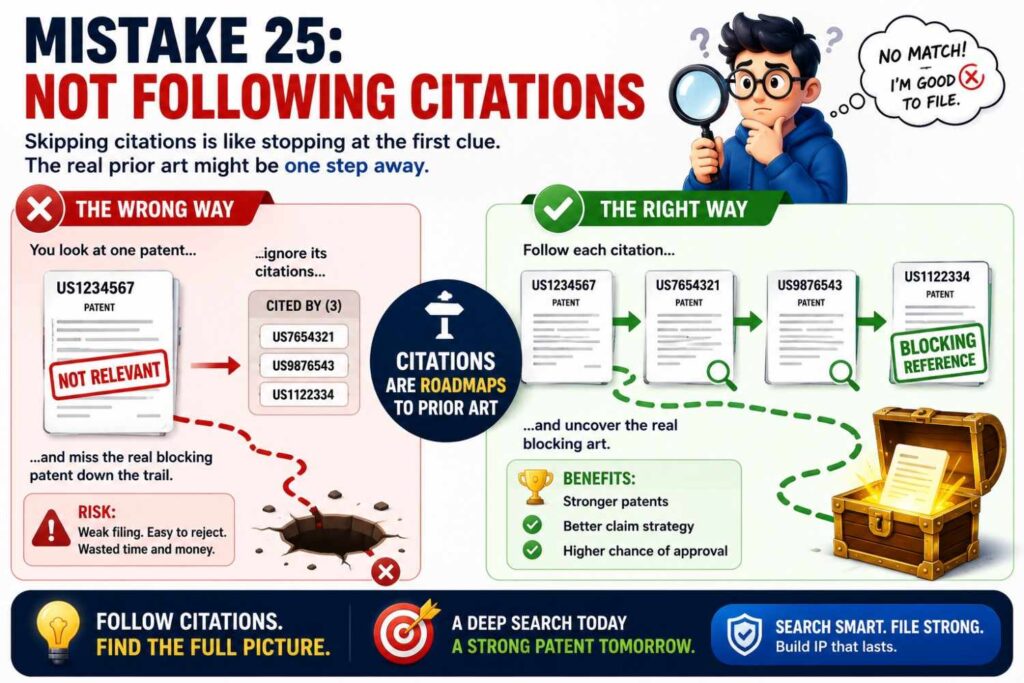
When you find a close patent or paper, do not stop.
Follow citations.
Look at what it cites.
Look at what cites it.
Look at related patent family members.
Look at continuation filings.
Look at the same inventors and assignees.
Close references often lead to closer references.
If you stop too early, you may miss the real prior art.
This is especially important in crowded fields.
AI, SaaS, robotics, biotech, semiconductors, medical devices, batteries, and cloud infrastructure all have deep citation trails.
The fix is to treat each close result as a doorway.
Open the references behind it.
Open the later documents that cite it.
See whether the same names repeat.
See whether the same patent classes repeat.
Search those classes with your key terms.
A search is not done when you find one close result.
It is done when you understand the cluster around the invention.
Mistake 26: Ignoring Patent Families
A patent family is a group of related patent applications filed in different countries or versions.
One family member may have broader claims.
Another may have better drawings.
Another may include translated text.
Another may have prosecution history.
Another may reveal continuation strategy.
If you look at only one family member, you may miss important details.
For example, a U.S. publication may have claims that look narrow, but a PCT application may describe broader versions.
A foreign family member may use different wording that helps you understand the invention.
A continuation may show how the owner is still pursuing the space.
The fix is to check related family members for close references.
Do not assume one patent document tells the whole story.
Mistake 27: Ignoring Standards and Regulations
Standards and regulatory materials can disclose technical methods.
This is important for cloud, security, telecom, medical devices, biotech, payments, AI safety, data privacy, batteries, and robotics.
A standard may describe a protocol, safety method, test process, data format, or compliance workflow.
A regulatory filing may describe device operation, clinical use, dosing, test methods, or performance.
If your invention touches a regulated or standardized area, search those documents.
Bad filings happen when a team claims a method already described in a standard or regulatory summary.
The fix is to include standards and regulatory searches when relevant.
Ask:
Does a standard define this process?
Does a regulatory record disclose this device use?
Does an industry guide teach this workflow?
Does a safety standard describe this control method?
If yes, map it.
Mistake 28: Not Searching Competitors Properly
Competitor searching is useful, but many teams do it poorly.
They search only the company name.
That misses acquired companies, old names, subsidiaries, founders, inventors, key engineers, product names, and related entities.
A competitor may have patents assigned to a parent company.
A founder may have filed before joining.
A university lab may have licensed work to them.
An acquired startup may hold key patents.
The fix is to build a competitor search profile.
Search:
Current company name.
Old company names.
Parent company.
Subsidiaries.
Acquired companies.
Founder names.
Key technical employee names.
Product names.
Assignee variations.
Partner names.
Lab names.
Then follow patent families and citations.
Competitor searching should show both risk and white space.
Mistake 29: Letting Fear Stop the Process

Finding close prior art can feel scary.
Founders may think, “We cannot patent anything.”
That is often too extreme.
Close art is normal.
A field with no prior art may be a field with no market.
The goal is not to find an empty world. The goal is to find your real contribution.
When you find close art, ask:
What does it show?
What does it miss?
Does it solve the same problem?
Does it use the same timing?
Does it create the same result?
Can we refine the claim?
Is another feature stronger?
Should we file narrower?
Should we gather more data?
Prior art is not the enemy.
It is the map.
The search may show that your first idea is weak. It may also reveal a stronger invention inside the product.
Do not stop at fear.
Map the difference.
Mistake 30: Letting Optimism Replace Analysis
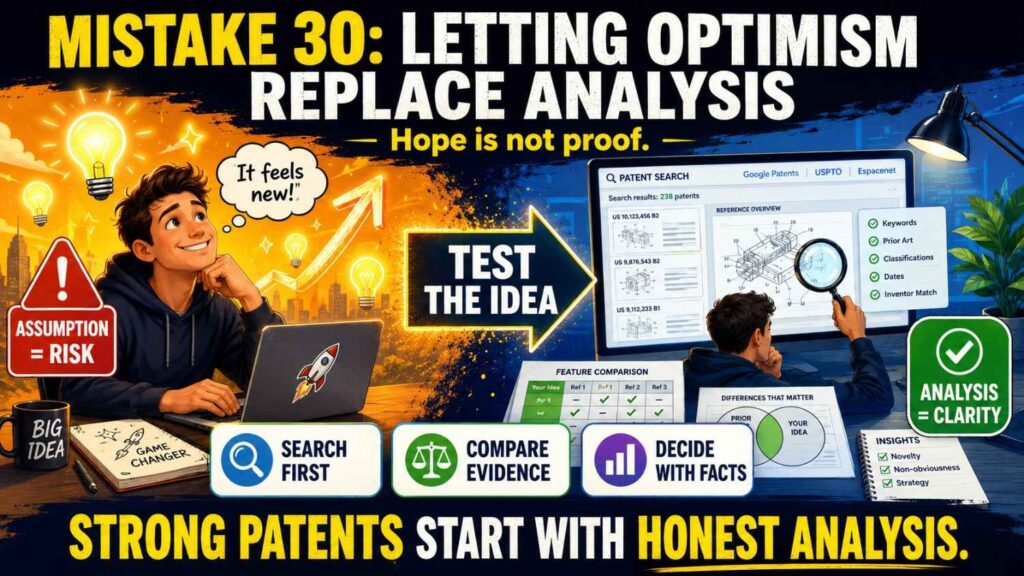
Some founders do the opposite.
They want the invention to be patentable so badly that they dismiss every close reference.
They say:
“That is not exactly us.”
“That is old.”
“That is a different market.”
“They did not commercialize it.”
“They do not use AI.”
“They do not have our UX.”
Those points may or may not matter.
Do not dismiss prior art without analysis.
A different market can still be relevant if the technical problem is similar.
Old art can still matter.
Non-commercial art can still matter.
A non-AI system can still teach the workflow.
A poor user experience can still disclose the technical method.
The fix is disciplined comparison.
Let the element map guide the conclusion.
Not fear.
Not optimism.
Facts.
Mistake 31: Not Involving a Patent Attorney Early Enough
A founder-led search can be very useful.
It helps the team understand the field and prepare better invention notes.
But patentability judgment requires legal and claim strategy experience.
A patent attorney can help decide what the prior art means, how claims should be framed, what details should be included, and how filing timing should be handled.
Bad filings often happen when teams search alone, draft alone, or wait too long to bring in counsel.
The fix is to involve attorney oversight before filing, especially when:
The invention is important.
The field is crowded.
Public disclosure is near.
Prior art is close.
The product is core to the company.
You are raising money.
You are entering partnerships.
You are preparing for launch.
PowerPatent combines smart software with real patent attorney oversight so founders do not have to choose between speed and quality. Learn how PowerPatent works.
Mistake 32: Giving the Attorney a Thin Invention Summary
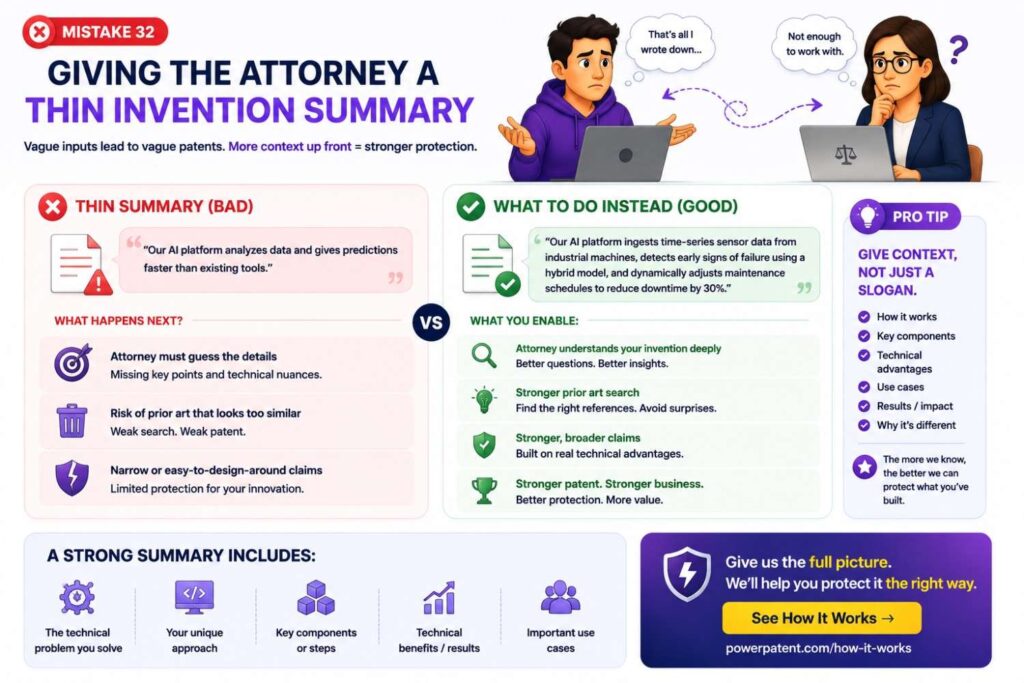
Even a good attorney needs good facts.
If you give your patent team only a vague summary, the filing may be vague.
A weak summary says:
“We use AI to automate support.”
A better summary says:
“The system creates a failure-pattern score from ticket text, error logs, software version, and recent configuration changes. It asks one clarifying question when confidence is in a middle range. It updates the failure pattern only after a confirmed fix.”
That gives the attorney something real.
A weak summary says:
“Our robot avoids collisions.”
A better summary says:
“The robot predicts blind-corner crossing risk before visual detection using sound direction, map geometry, and recent traffic history, then slows before reaching the predicted crossing point.”
The fix is to prepare invention notes before drafting.
Include:
Problem.
Old approach.
New method.
Inputs.
Steps.
Outputs.
Technical result.
Alternatives.
Search results.
Closest prior art.
Known public disclosures.
That can lead to a much stronger filing.
Mistake 33: Not Updating the Search as the Product Changes
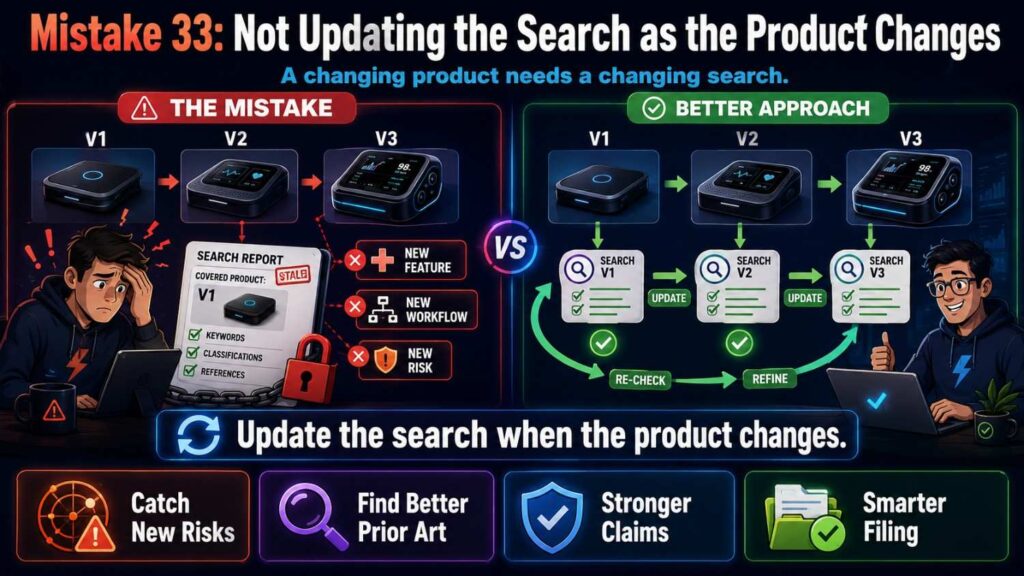
Startups change quickly.
A search done six months ago may no longer match the product.
Your AI workflow may have added source verification.
Your SaaS product may have added tenant-specific policy.
Your robot may have added a new sensor.
Your diagnostic may have changed marker thresholds.
Your device may have changed material or placement.
If the product changes, the patentability search may need to change too.
Bad filings happen when claims are based on an old version while the real product has moved on.
The fix is to revisit search before filing and before major claim decisions.
Ask:
Does the current product match the searched invention?
Have we added a stronger feature?
Have we removed a key element?
Has the roadmap changed?
Have new competitors published?
Have we disclosed anything publicly?
Search is not a one-time ritual. It should follow the invention.
Mistake 34: Not Turning Search Into a Decision
A search that ends with a pile of links is not useful.
The point is to make a decision.
At the end of the search, write a clear recommendation.
File.
Refine.
Search more.
Pause.
Keep secret.
Split into multiple filings.
Gather more data.
File before disclosure.
A good search summary says:
“The broad idea is crowded. The strongest gap is X. X matters because it improves Y. Recommend filing around X with backup claims for A, B, and C.”
Or:
“The closest reference appears to show all key elements of the current claim. Recommend shifting focus to the feedback loop or pausing this filing.”
Or:
“The search is inconclusive because close references use unclear language. Recommend attorney review before public disclosure.”
This turns research into action.
Without a decision, the search does not protect the business.
Mistake 35: Not Creating an IP Review Habit
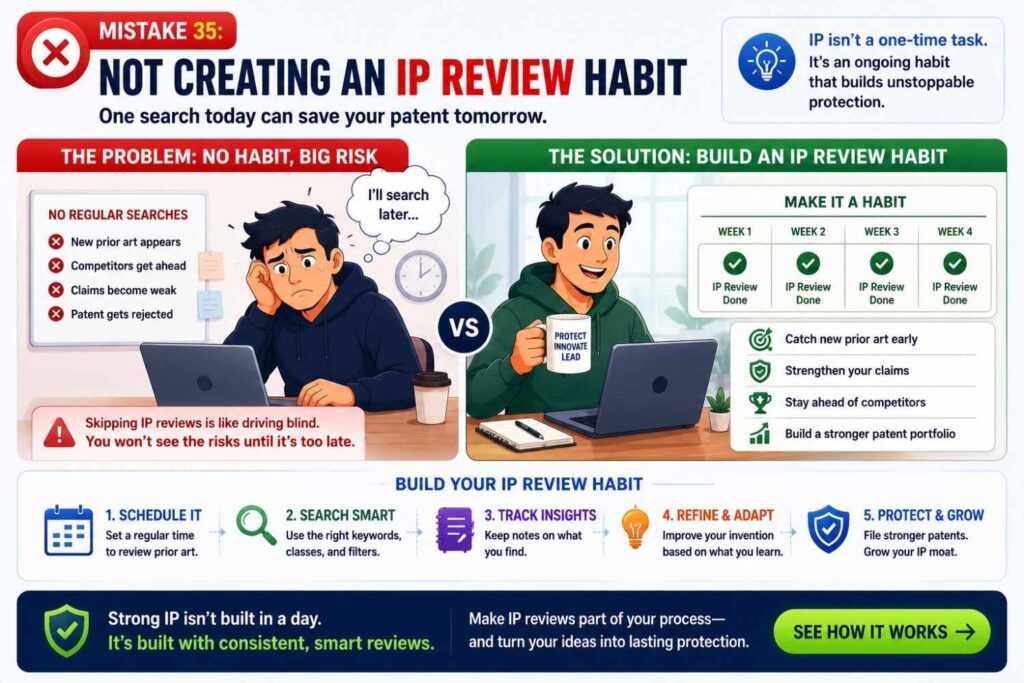
Patentability search should not happen only when someone says, “We need a patent.”
It should be part of the invention process.
When your team solves a hard technical problem, capture it.
When a model workflow improves accuracy, capture it.
When a robot handles a new edge case, capture it.
When a device becomes easier to manufacture, capture it.
When a SaaS system reduces manual review, capture it.
When a diagnostic test cuts false positives, capture it.
Then decide whether to search.
A simple review habit can save major value.
Ask during product or engineering reviews:
What did we build that was technically hard?
What failed before this?
What result improved?
Would competitors copy it?
Will we disclose it soon?
Should we search and file?
PowerPatent helps teams make invention capture and patent review more repeatable, so IP does not depend on last-minute memory. See how PowerPatent works.
A Simple Search Workflow That Avoids Bad Filings
A strong patentability search does not need to be slow, fancy, or painful. It does need to be disciplined.
The goal is not to collect every possible reference. The goal is to help the business make a better filing decision. That means the search should answer three simple questions:
What is the real invention?
What does the closest prior art already teach?
What should we do next?
When a team follows a clean workflow, patent search becomes much more than a legal task. It becomes a way to protect budget, sharpen the product story, and file around the technical edge that actually matters.
Start With a Filing Question, Not a Search Query
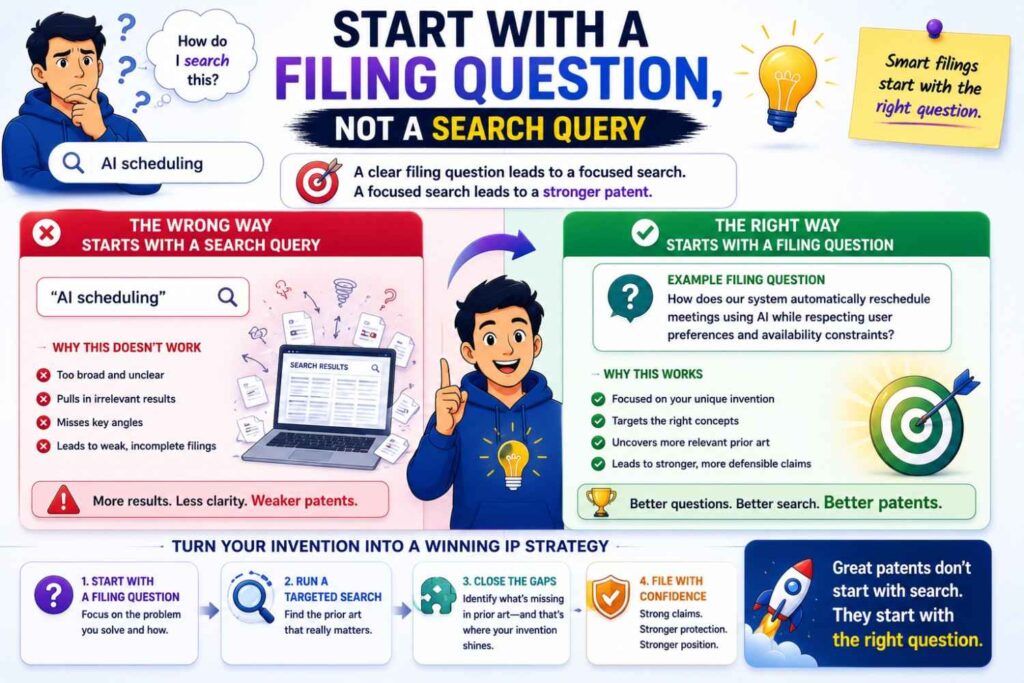
Do not begin by typing words into a search box.
Begin by asking what decision the business needs to make.
For example:
Should we file before launch?
Is this feature worth patent spend?
Is the broad idea already crowded?
Is the hidden backend method stronger than the visible product feature?
Should this be patented or kept secret?
Do we need more engineering detail before filing?
This keeps the search focused.
A team that starts with “let’s search AI compliance” will drown in results. A team that starts with “should we file on our tenant-safe audit packet generator before publishing the API docs?” will search with purpose.
That one shift saves time.
Create an Invention Snapshot
Before the search begins, write a short invention snapshot.
This should not be a marketing summary. It should be a technical business note.
A strong invention snapshot includes the problem, the old way, the new method, the key system steps, the technical result, and why customers care.
For example:
“Our system creates audit packets for enterprise customers. The old way pulls broad evidence from cloud logs and risks exposing unrelated tenant data. Our method maps each control to source evidence, removes unrelated fields, checks whether evidence is stale, and creates a tenant-scoped packet. This reduces review time and lowers data exposure risk.”
That snapshot gives the search direction.
It also helps the patent attorney later.
If the invention snapshot is vague, the search will be vague. If the snapshot is sharp, the search can be sharp.
Use a Two-Pass Search
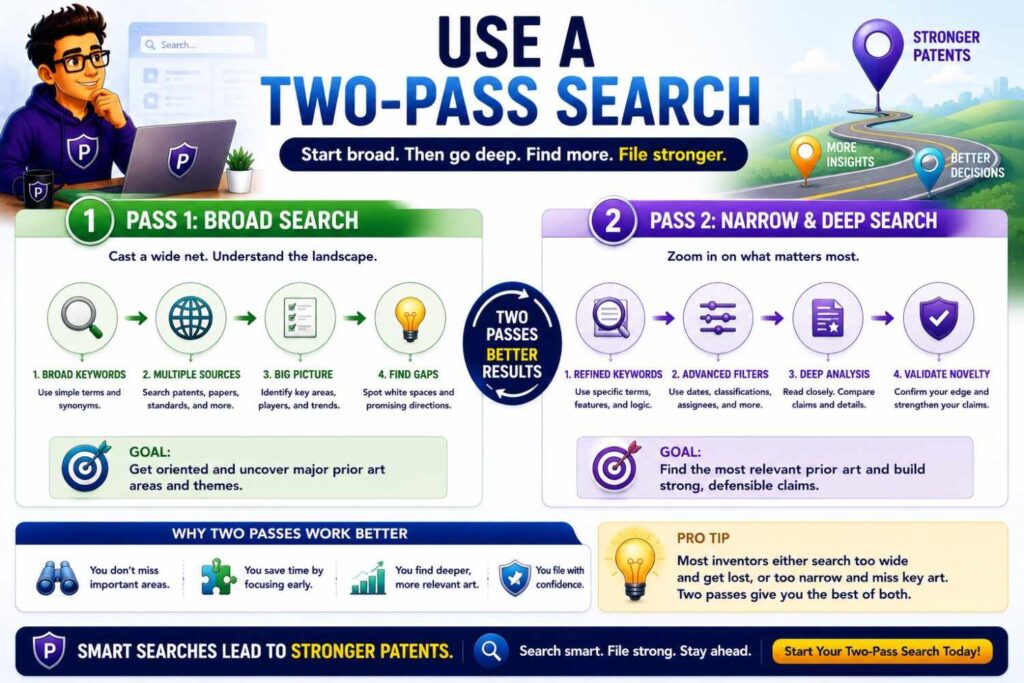
A good workflow uses two passes.
The first pass is for field awareness. It helps the team understand the broad landscape.
The second pass is for filing decisions. It focuses on the exact technical gap.
In the first pass, search the product category, competitors, broad technical terms, and related fields. This helps you learn the words others use.
In the second pass, search the specific method, trigger, data flow, control loop, scoring rule, sensor placement, assay step, or workflow that makes your invention different.
For example, the first pass may search “AI compliance automation.”
The second pass may search “tenant scoped evidence packet cloud log field redaction control mapping.”
The first pass shows the crowd.
The second pass finds the threat.
Both matter, but the second pass is what drives the filing decision.
Build a Search Term Ladder
A search term ladder helps avoid searches that are too broad or too narrow.
Start at the top with broad market terms. Then move down into technical terms. Then move deeper into exact mechanism terms.
For a SaaS invention, the ladder may look like this:
“Compliance automation”
“Cloud evidence mapping”
“Tenant-scoped audit evidence”
“Field-level redaction before audit packet generation”
“Stale evidence detection before control export”
The broad terms help you see the market. The deeper terms help you test patentability.
For a robotics invention, the ladder may move from “warehouse robot safety” to “blind-corner collision prediction” to “sound direction map geometry traffic history speed control.”
For a biotech invention, it may move from “cancer biomarker test” to “plasma marker panel risk score” to “inflammation-normalized marker ratio early-stage detection.”
This method prevents lazy searching.
It also helps teams document how they moved from market language to invention language.
Assign Each Search to a Business Risk
Every search should be tied to a business risk.
This keeps the work practical.
The risk may be launch risk, investor risk, competitor risk, claim risk, disclosure risk, or budget risk.
Launch risk means the company may disclose the invention soon.
Investor risk means the team needs a clear moat story.
Competitor risk means another company may already be close.
Claim risk means prior art may block the broad filing.
Disclosure risk means the team may have already shared key details.
Budget risk means the company may waste money filing on a weak idea.
When a search is tied to a risk, the output becomes more useful.
For example:
“We are searching the source-trust review workflow because it will appear in API docs next month.”
That is a clear business reason.
Or:
“We are searching the battery pressure drift method because it is the core feature investors are asking about.”
That is also clear.
A search without a business reason often becomes busywork.
Make One Person Own the Search Record
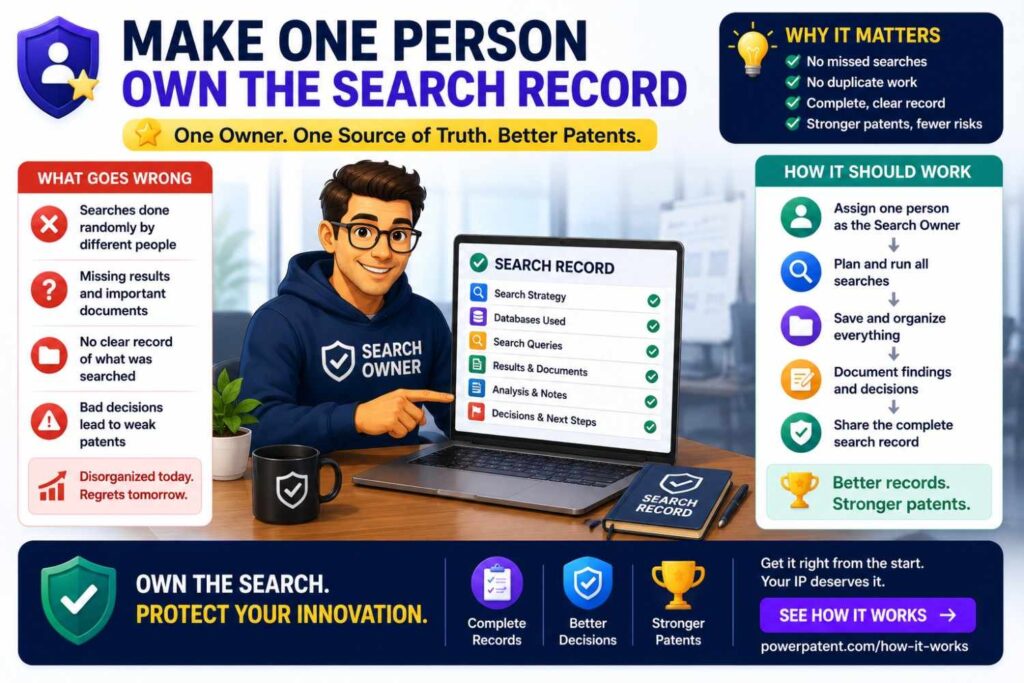
Search work can get messy fast.
Links end up in Slack. Notes sit in someone’s notebook. Screenshots live in a folder. Engineers remember close references but never write them down.
That creates risk.
Assign one owner for the search record.
This person does not need to be the only searcher. Engineers, founders, patent counsel, and product leads may all help. But one person should keep the record clean.
The search record should include the invention snapshot, search terms, sources searched, closest references, dates, element mapping, open questions, and filing recommendation.
This is not bureaucracy.
It is how you prevent repeated work and lost context.
Six months later, when an investor or attorney asks why you filed on one feature and not another, the search record gives the answer.
Use “Stop Rules” So the Search Does Not Drag Forever
A patentability search can always go deeper.
That does not mean it should.
Set practical stop rules.
For example, stop when the same close references keep appearing, new searches are mostly noise, the core technical gap has been tested across several term groups, and the team has enough information to make a filing decision.
But do not stop if every new search finds a new close reference.
Do not stop if the core feature has only been searched using one phrase.
Do not stop if the closest reference is unclear.
Do not stop if public disclosure is near and the filing angle is still fuzzy.
The goal is not perfect certainty. No search gives that.
The goal is enough clarity to act.
Run a “Closest Reference” Review Meeting
Once the search owner finds the closest references, hold a short review meeting.
Keep it focused.
The goal is not to review every search result. The goal is to decide what the closest art means for the filing.
Invite the people who know the invention: one founder or product lead, one engineer or scientist, and patent counsel when possible.
For each close reference, ask:
What does this reference teach?
What does it not teach?
Is our difference real?
Is our difference valuable?
Would a competitor need our difference?
Should we claim this feature, refine it, or shift focus?
This meeting can prevent bad filings.
It catches cases where the attorney was given a thin summary. It also catches cases where engineers know a deeper invention that was not in the first search.
Turn Prior Art Into Claim Boundaries

A search should help define claim boundaries.
Think of each close reference as a fence post. It shows where you probably should not claim too broadly.
Your job is to find the open space between the fence posts.
For example, prior art may show AI-generated workflow actions. Another reference may show policy checks. Another may show audit logs.
The open space may be source-data support verification before action execution.
That feature may become the claim boundary.
In another case, prior art may show wearable alerts and motion filtering. The open space may be adjusting alert confidence using both skin-contact pressure and motion state.
The search should help the team say:
“We should not claim the broad category. We should claim this technical control path.”
That is how search improves drafting.
Add Backup Positions Before Drafting Starts
A bad filing often has one thin idea.
A better filing has layers.
Once the search reveals the strongest gap, identify backup positions before drafting starts.
Ask:
If the broad claim is blocked, what narrower version still matters?
What alternate inputs can support the method?
What alternate outputs can the system trigger?
What different thresholds, scoring methods, sensors, sample types, or workflow paths should be described?
What versions are on the roadmap?
What versions would competitors likely use?
For a SaaS filing, backup positions might include different source-trust inputs, audit log formats, review triggers, tenant policy sources, and blocking actions.
For a hardware filing, they might include different sensor placements, control responses, calibration steps, and materials.
For a biotech filing, they might include sample types, marker ranges, assay steps, patient groups, dose ranges, and formulation variants.
These backups should be real, not made up.
The point is to give the patent application room to survive prior art and product changes.
Decide What Evidence Would Make the Filing Stronger
Before filing, ask what proof would help.
This does not always mean a formal study. It may be a test result, benchmark, prototype log, comparison table, failure analysis, or engineering note.
For example:
If the invention reduces false alerts, collect data showing false alert reduction.
If it lowers cloud cost, collect before-and-after compute usage.
If it improves signal quality, collect test logs.
If it reduces review time, collect workflow metrics.
If it improves assay performance, collect sensitivity, specificity, stability, or sample-volume data.
If it improves robot safety, collect timing or control response data.
This evidence helps the team explain why the invention matters.
It can also help the patent attorney write a stronger technical story.
The best time to gather this evidence is before drafting, not after the application is already filed.
Create a Filing Decision Matrix
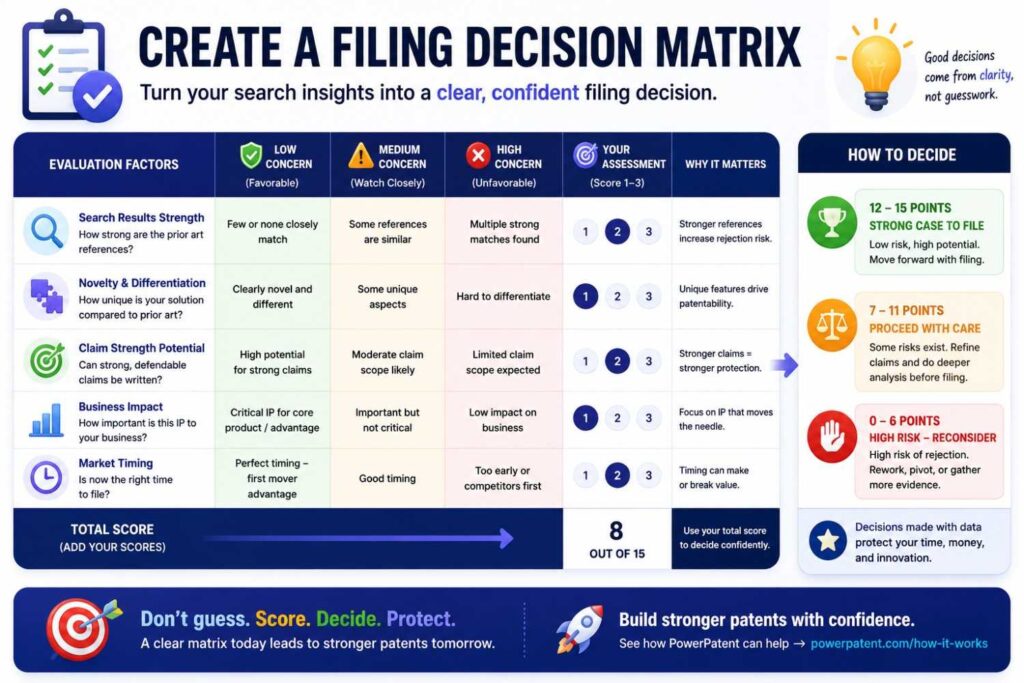
A simple decision matrix helps teams avoid emotional filing choices.
Score each invention area on business value, prior art risk, public disclosure timing, detectability, development readiness, and ease of design-around.
You do not need a fancy scoring system. A simple low, medium, high ranking can work.
An invention with high business value, low or medium prior art risk, near-term public disclosure, and strong technical detail should move toward filing.
An invention with low business value and high design-around risk may not be worth filing.
An invention that is valuable but hidden may need a patent-versus-trade-secret discussion.
An invention that is promising but lacks data may need more testing before a full filing.
This matrix helps founders spend patent budget like business capital.
Not every idea gets the same treatment.
Separate “File Now” From “File Later”
A search workflow should create timing decisions.
Some inventions need action now.
Others can wait.
File-now candidates often include inventions near public disclosure, core product features, investor-critical technology, competitor-sensitive features, or platform methods that are already well developed.
File-later candidates may include roadmap features that need more testing, ideas that are still changing, or improvements that are not yet central to the business.
The danger is treating all inventions as equal.
That leads either to over-filing or missed filings.
A better approach is to keep a live invention pipeline.
Each invention has a status:
Capture.
Search.
Needs more data.
Ready for filing.
Hold as trade secret candidate.
Do not pursue.
This turns patent work into a product-adjacent process, not a last-minute scramble.
Keep a “Do Not File Yet” List
A good workflow should also say what not to file.
That may sound negative, but it is a huge budget saver.
Some ideas are too broad. Some are too close to prior art. Some are not technically clear. Some are not tied to the business. Some are easy to design around. Some are better kept secret.
Write them down.
Do not let them keep coming back every quarter as fresh ideas.
For each “do not file yet” item, record the reason.
For example:
“Do not file yet. Current idea is a broad dashboard feature. Need more technical detail around root-cause grouping.”
Or:
“Do not file yet. Search found close prior art for the marker alone. Revisit after data on normalized marker ratio.”
Or:
“Do not file yet. Backend scoring method may be better kept as trade secret unless product docs will expose it.”
This creates discipline.
It also shows investors and boards that the company is not filing randomly.
Use Search to Prepare Better Attorney Input
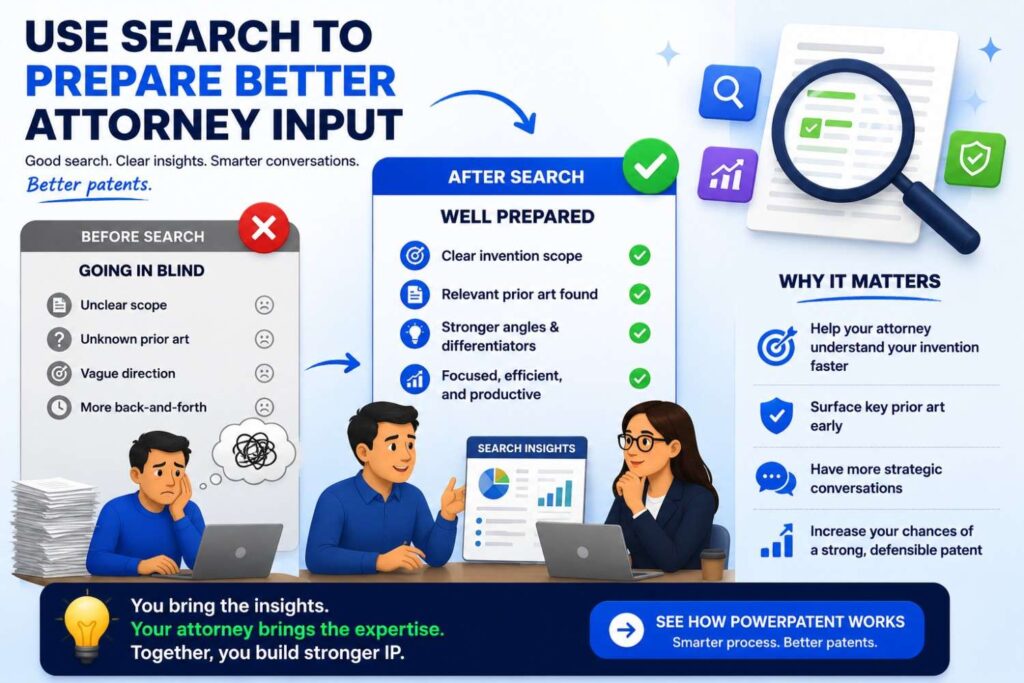
One of the biggest causes of bad filings is poor input.
The attorney cannot draft a strong application from a vague paragraph.
After the search workflow, prepare a clean attorney packet.
It should include the invention snapshot, diagrams or flows, key elements, closest prior art, strongest gap, technical result, backup positions, public disclosure timeline, and open questions.
Keep it concise but complete.
A strong attorney packet might say:
“The broad space of compliance automation is crowded. The closest reference collects evidence and maps it to controls. It does not appear to remove unrelated tenant data before audit packet generation. Our technical gap is tenant-scoped evidence packet creation using control-linked source mapping and field redaction. We have product docs planned in six weeks that may disclose the workflow. We recommend filing before docs go public.”
That gives counsel a serious starting point.
PowerPatent is built to help teams organize this kind of invention material so attorney review starts from real technical substance, not scattered notes. See how PowerPatent works.
Revisit the Search Before Final Filing
A search done at the start of drafting may not be enough.
Before filing, do one quick final review.
Ask:
Did the claims change?
Did the product change?
Did new prior art appear?
Did we add or remove a key feature?
Did public disclosure timing change?
Did the application include the backup positions we identified?
Does the filing still protect the business value?
This final check can catch misalignment.
Sometimes the drafted application drifts away from the real invention. Sometimes the product team changes the feature during drafting. Sometimes a late search finds a close reference.
A short final review can prevent a costly mistake.
Build the Workflow Into Company Rhythm
The best companies do not treat patent search as a one-off event.
They build it into normal company rhythm.
At product reviews, ask whether a new technical feature should be captured.
At engineering reviews, ask what hard problem was solved.
Before launches, ask whether technical details will become public.
Before investor updates, review whether filings match the moat story.
Before publishing docs, check whether workflows, APIs, or model behavior are exposed.
Before partnerships, decide whether the core invention should be filed first.
This makes patentability search part of company hygiene.
It does not need to slow the business.
It helps the business move with more control.
The Best Workflow Produces a Clear Recommendation
The final output should be a direct recommendation.
Not a pile of links.
Not a vague summary.
A strong recommendation sounds like this:
“File now on the source-data validation layer for AI workflow actions. The broad AI automation space is crowded, but the closest references do not appear to show pre-execution validation against permission scope, customer policy, and source support. Public API docs may disclose the method soon. Include backup claims for audit logs, review routing, policy types, and confidence scoring.”
Or:
“Do not file yet on the broad wearable alert feature. Prior art is crowded and current difference is unclear. Continue testing the skin-contact pressure and motion-state confidence method. Reassess after false-alert data is available.”
That is what the workflow is for.
It turns search into action.
And that is what helps companies avoid bad filings.
What a Strong Search Finding Looks Like
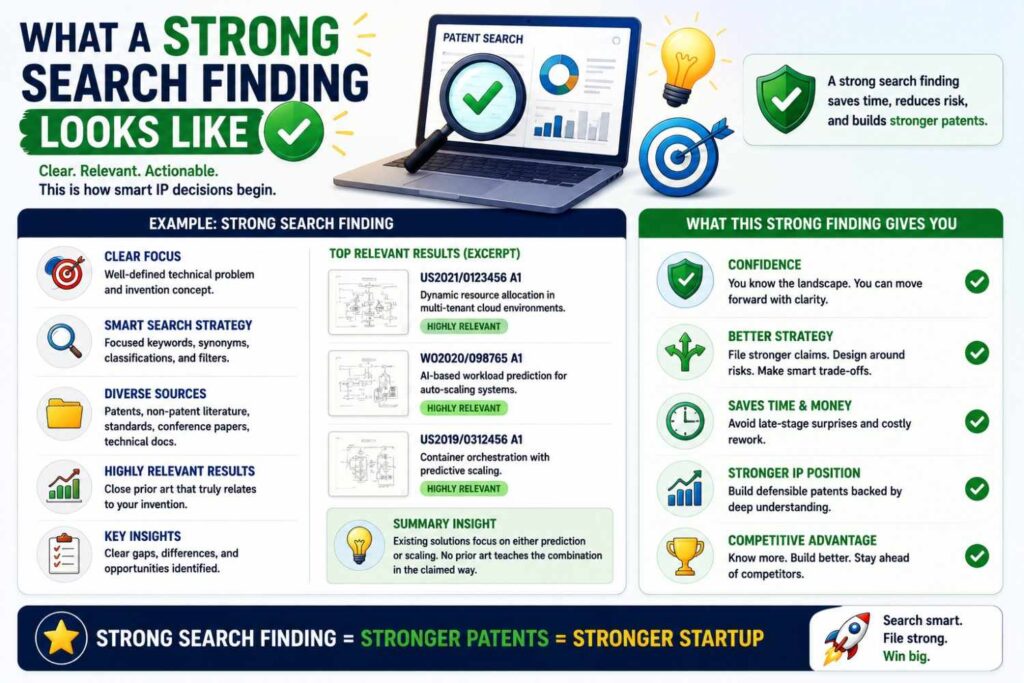
A strong search finding is specific. It does not just say what you found. It explains what the finding means for the business and for the filing.
A weak search finding says, “No exact match was found.”
A strong search finding says, “The broad idea is crowded, but the closest references do not show this specific technical step, and that step is tied to the value customers care about.”
That is a very different level of clarity.
For example:
“The broad idea of AI workflow automation is crowded. The closest references show AI-generated task suggestions and policy-based workflow approval. We did not find one reference that verifies an AI-generated action against permission scope, customer policy, and source-data support before allowing execution, while recording the decision in an audit log. This gap matters because it reduces unsafe automated actions in enterprise workflows. Recommend filing around the validation layer, with backup claims for different policy sources and review outcomes.”
That is useful because it gives the business a path.
It tells the team that the broad category is not the right filing angle. It names the closest prior art. It explains the missing part. It ties that missing part to a business and technical result. It also gives a filing recommendation.
That is what a search finding should do.
Another example:
“The broad idea of wearable heart monitoring is crowded. The closest references show motion artifact filtering and wearable alerts. We did not find one reference that adjusts alert confidence based on both skin-contact pressure and user motion state before triggering an arrhythmia alert. This gap matters because it may reduce false alerts during movement. Recommend filing around the signal confidence and alert control workflow.”
This is strong because it does not claim the whole wearable market. It focuses on the technical control step that may create the product advantage.
A strong search finding usually has five parts.
First, it names the broad field and admits whether that field is crowded.
Second, it identifies the closest prior art in plain words.
Third, it states what the closest prior art does not show.
Fourth, it explains why the missing part matters.
Fifth, it recommends what to do next.
That structure keeps everyone honest.
It also helps founders avoid two common traps. The first trap is fear. When the field looks crowded, founders may think there is nothing worth filing. The second trap is overconfidence. When no exact match appears, founders may think they can claim the whole category.
A strong search finding avoids both.
It says, “Here is the crowded space. Here is the open angle. Here is why it matters. Here is what we should do.”
For a SaaS product, a strong finding may sound like this:
“The broad idea of syncing customer records across SaaS tools is well known. The closest references show record-level sync and basic conflict resolution. We did not find one reference that uses field-level trust scores based on source system, user role, timestamp, and prior correction history to replay only missing changes after a failed sync. This gap matters because it may reduce data loss and prevent trusted fields from being overwritten. Recommend filing around field-level trust scoring and replay, with backup claims for tenant-specific validation rules.”
For a robotics product, it may sound like this:
“The broad idea of robot obstacle avoidance is crowded. The closest references show slowing near mapped blind corners and detecting visible objects with cameras. We did not find one reference that predicts hidden crossing risk before visual detection by combining sound direction, map geometry, and recent traffic history. This gap matters because the robot can slow before a person or forklift enters view. Recommend filing around pre-visual risk prediction and speed control, with backup claims for rerouting and fleet warnings.”
For a biotech product, it may sound like this:
“The broad idea of using Marker A for Disease X is known. The closest papers show Marker A alone and Marker B in related disease studies. We did not find one reference that uses a Marker A to Marker B ratio normalized by inflammation score in low-volume plasma samples for early-stage risk detection. This gap matters because it may reduce false positives in patients with high inflammation. Recommend filing around the normalized marker pattern, with backup claims for sample types, threshold ranges, and patient subgroups.”
Each example is calm, specific, and useful.
A strong search finding should never sound like a victory lap. It should not say, “We are totally clear.” No search can prove that. It should also not sound like panic. It should not say, “There is prior art, so we are done.”
The right tone is practical.
The search finding should help the company make a decision.
That decision may be to file now. It may be to refine the claim. It may be to search more. It may be to gather more data. It may be to pause. It may be to keep a hidden method as a trade secret.
The best findings also include timing.
For example:
“Public API docs planned for next month may disclose the source-validation workflow, so filing should be considered before publication.”
Or:
“The feature is still changing, and current test data does not yet show the false-alert reduction. Recommend gathering more support before filing a full application.”
This turns the finding into an action plan.
That is the real goal.
A strong search finding is not just a summary of prior art. It is a bridge between the search, the business, and the patent filing.
PowerPatent helps teams build that bridge by turning invention details, prior art notes, technical gaps, and attorney review into a clearer filing path. See how PowerPatent works.
What a Weak Search Finding Looks Like
A weak finding says:
“No exact match found.”
“Our product is different.”
“The prior art is old.”
“The competitor does not have this feature.”
“There are too many patents.”
“The UI is unique.”
“We searched Google and did not see anything.”
These statements do not support a strong filing.
They do not explain the closest art.
They do not show the missing element.
They do not tie the gap to a result.
They do not guide claim strategy.
A strong search finding should answer:
What was searched?
What was found?
What is closest?
What does it teach?
What does it miss?
Why does the missing part matter?
What should we do next?
How PowerPatent Helps Avoid Bad Filings
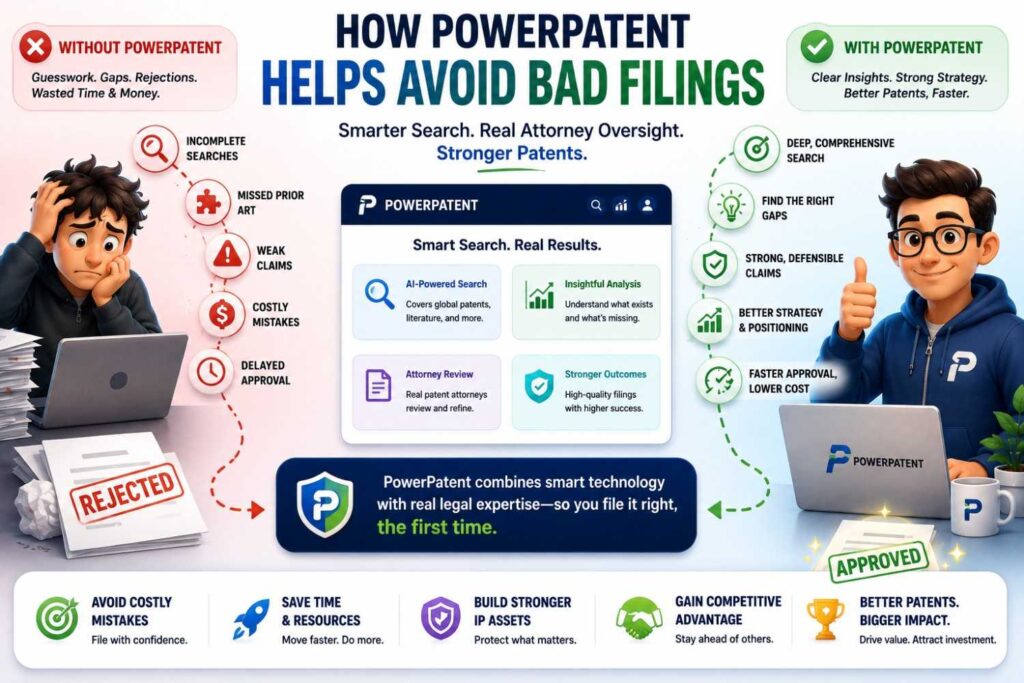
Bad filings are often caused by missing details.
The real invention is hidden in code, lab notes, CAD files, model workflows, test results, product docs, or engineer memory.
PowerPatent helps teams capture those details earlier.
It helps founders and inventors organize what was built, how it works, why it matters, and how it compares to prior art.
Then real patent attorney oversight helps turn that information into a stronger filing strategy.
This matters because startups cannot afford patents that only sound good.
They need filings that protect real technical value.
PowerPatent helps make the process faster, clearer, and more connected to the product.
Final Takeaway
Bad patent filings often come from bad search habits.
Searching the product name. Ignoring non-patent art. Reading only abstracts. Comparing by vibe. Mixing references too early. Ignoring obviousness. Filing on surface features. Waiting until after launch. Forgetting dates. Giving your attorney thin invention notes.
These mistakes are common.
They are also avoidable.
A better patentability search is specific, technical, honest, and tied to business value.
It finds the closest prior art. It maps the invention element by element. It shows the real gap. It explains why that gap matters. Then it leads to a clear filing decision.
That is how search becomes strategy.
And when you are ready to turn invention notes, search results, code, models, technical diagrams, lab work, product workflows, or engineering details into stronger patent filings, PowerPatent can help you move faster with smart software and real patent attorney oversight.
Leave a Reply