
When you are building a startup, patent work should not feel like a trap. But IDS timing is one place where smart founders can still get stuck. An IDS, or Information Disclosure Statement, is how you tell the USPTO about known information that may matter to your patent application. The USPTO has timing rules for when an IDS will be considered, and later filings can require extra steps, fees, or stronger care.
IDS timing should be handled before you touch the Office Action response
An Office Action response is not just about arguing with the examiner. It is also a control point. It is the moment when your team should pause, look at what has changed, and decide whether any new known information needs to be sent to the USPTO through an IDS.
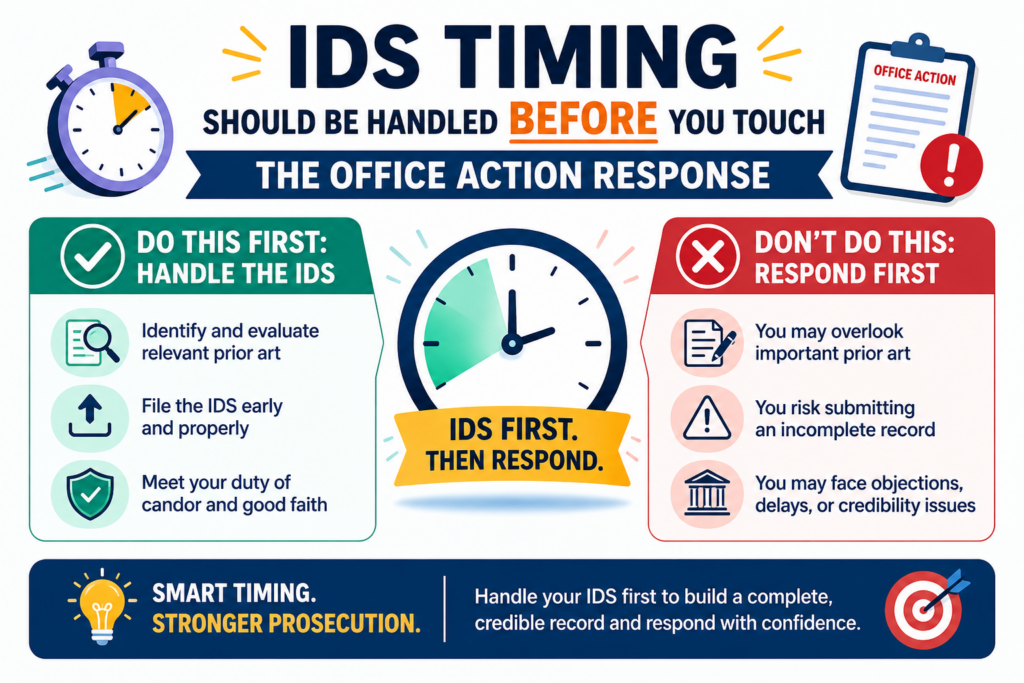
The USPTO explains that an IDS is the tool used to submit information that may be material to patentability in a nonprovisional application, and the examiner will consider it when it follows the content and timing rules.
For a startup, this matters because patent work often moves at the same time as product work, fundraising, customer talks, research, foreign filings, and competitor tracking.
New papers show up. A foreign search report lands. A founder remembers an old GitHub repo. A patent from a rival appears in a search. None of this should sit in someone’s inbox while the Office Action response is being drafted.
The response deadline is not the only deadline that matters
A common mistake is thinking, “We still have time to respond, so we still have time to deal with the IDS.” That can be true, but it is not always safe. IDS rules change based on where the application is in prosecution.
The USPTO ties IDS handling to key stages, including the early period before the first Office Action, the period before prosecution closes, the period after final action or allowance but before the issue fee, and the later period when withdrawal from issue may be needed.
That means the same reference can be simple to disclose in one window and painful to disclose in another.
The paper itself did not change. The timing changed. That is why IDS timing should be checked at the start of every response cycle, not at the end.
The cleanest IDS is usually the one filed early
Early filing gives your team more room. When an IDS is filed in the earliest window, such as within three months of filing a national application or before the first Office Action on the merits, the path is usually simpler than later windows.
After that early window, extra items such as a fee or a statement may be needed, depending on the stage. Once prosecution closes, the requirements become tighter.
This is why founders should treat IDS work like product hygiene. You do not wait until launch day to check whether the payment flow works.
You do not wait until allowance to ask whether the examiner saw the right art. You build a habit early, and then the habit protects you.
Your team should run an IDS check before writing arguments
Before you draft claim changes or make remarks, you want to know what information is now in play. A new reference can affect how you amend.
It can affect which feature you lean on. It can affect whether your argument sounds strong or weak. It can also change how your attorney views the safest path to allowance.
For example, suppose your AI startup gets a foreign search report in a related case. That report lists a paper that looks close to your model training flow.
If your team drafts the U.S. response without looking at that paper, you may build your argument around a feature that is not as special as you thought. If you check the IDS issue first, your response can be cleaner and smarter from the start.
The practical move is to make IDS review part of the response workflow
The best time to ask about new references is before the response strategy is locked. Ask the founder, the lead engineer, the patent owner, and anyone tracking foreign cases whether they have seen new papers, patents, Office
Actions, search reports, investor diligence notes, customer disclosures, or competitor materials that may matter. Then let a patent attorney decide what should be disclosed and how to handle timing.
This is one reason PowerPatent is built around smart software plus real attorney oversight. The software helps organize the moving pieces, while attorney review helps avoid risky guesses.
For founders who want speed without loose ends, that mix matters. You can see how that workflow works here: https://powerpatent.com/how-it-works
The biggest IDS pitfall is finding the right art too late
Late IDS problems often begin with a simple human delay. A founder sees a reference and thinks it may not matter. An engineer saves a paper but does not send it to counsel.
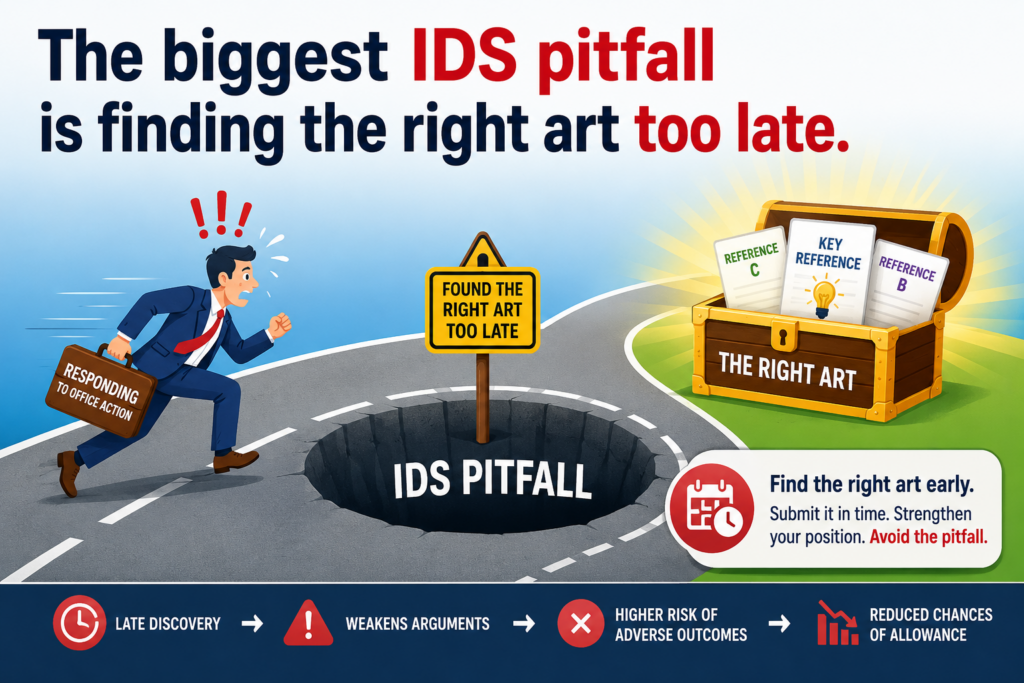
A foreign associate sends a search report, but it gets buried under product emails. By the time the team notices, the U.S. case may already be near final action, allowance, or issue fee payment.
That delay can create real friction. The USPTO rules say that if an IDS does not meet the required timing and content rules, it may be placed in the file but not considered by the Office.
The MPEP also notes that noncomplying IDS submissions can be placed in the application file without the information being considered on the merits.
A late IDS can slow the case when speed matters most
Startups often care about timing more than large companies do. You may need a patent allowed before a funding round, partnership, sale, grant, or market launch.
A late IDS can put pressure on that timeline because the examiner may need more process before considering the information.
In some cases, later timing can require both a statement and a fee. In harder cases, the team may need a continued examination path to make sure the information is considered.
This is not just paperwork. It can affect your business clock. A patent that was close to allowance can get pulled into more review. A response that was almost done can need a new strategy. A clean story for investors can become harder to explain.
The hard part is that late references often arrive from normal startup work
Late references do not always come from a formal patent search. They can come from customer diligence, investor questions, open-source review, an academic paper found by an engineer, or a new competitor filing.
They can also come from foreign patent activity. The USPTO’s IDS rules specifically address timing statements tied to foreign patent office communications and whether the information was known more than three months before filing the IDS.
This is why “we did not mean to miss it” is not a strategy. Fast teams need a simple intake habit. Any time someone sees something that looks close to the invention, it should go into the patent review lane.
Not because every item must be filed, but because the decision should not depend on memory.
Founders should not decide materiality alone
A founder may look at a reference and say, “This is not the same as what we built.” That may be true. But IDS decisions are not only about exact matches.
They are about whether known information may matter to the examiner’s view of the claims. Sometimes a reference that feels far away to an engineer still matters because it teaches one key part of a claim.
The reverse can also happen. A reference may sound scary because the title is close, but after review it may not change much. The point is not to panic. The point is to route the item fast so the legal team can make a sound call.
The safest workflow is simple intake, fast review, and clear records
When a new reference appears, capture where it came from, when the team first saw it, who saw it, and why it may relate to the application. Keep the source document clean.
Do not rely on a screenshot if a full paper, patent, publication, or search report is available. If the item is not in English, flag that early because IDS content rules can require a clear explanation of the relevance of non-English information, and a translation may matter if one is available.
This is where a modern patent system helps. PowerPatent helps teams keep invention records, reference flow, drafting, and attorney review connected, so the IDS question does not become a last-minute scramble.
For busy technical teams, that can be the difference between calm prosecution and avoidable delay.
Your IDS clock starts when your team learns about the reference, not when the response is due
A clean IDS process starts with one simple idea. The clock does not care that your startup is busy. It does not care that the patent response is still being drafted.
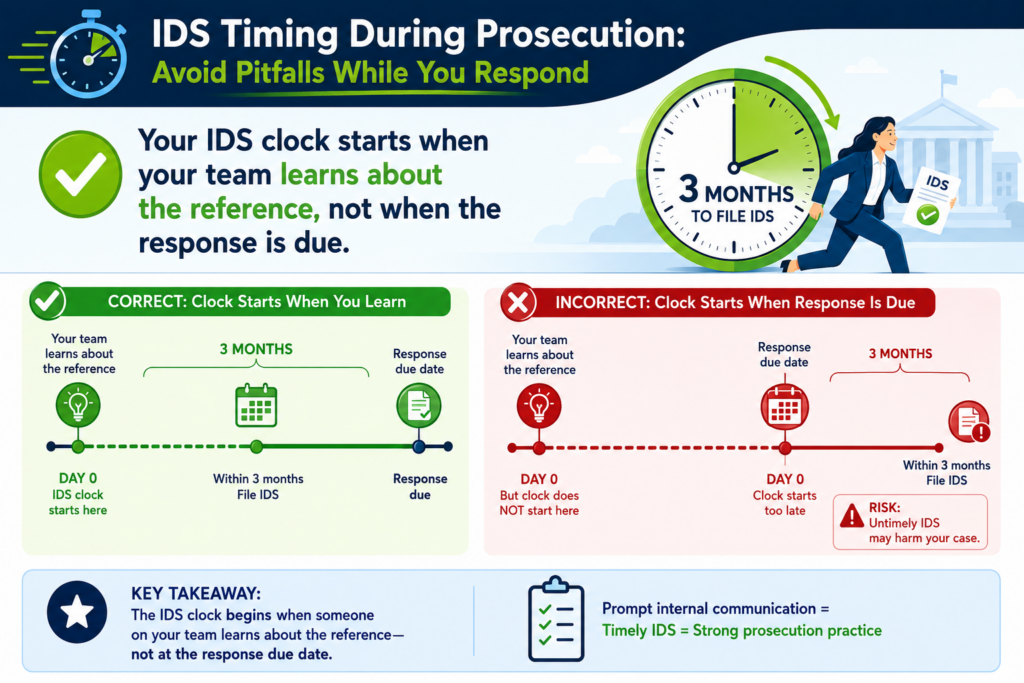
It does not care that the founder meant to forward the paper later. Once someone involved with the case learns about a reference that may matter, your team should treat that as a trigger.
The USPTO rules for IDS timing include stages where a statement may be needed.
One common statement path deals with whether the information was first cited in a foreign patent office communication, or whether it was first known to the person signing the statement, within a set three-month window before the IDS was filed.
That means the date your team learned about the item can matter a lot.
The three-month question can become the whole problem
Here is where founders get surprised. They think the issue is only whether the reference is “bad.” But sometimes the first issue is timing. When did someone first see it? Was it cited by a foreign patent office?
Was it in an email from foreign counsel? Was it found by an engineer months ago? Was it known before the response plan started?
These facts can shape the IDS path. If the reference was known too long ago, a simple statement may not be available.
If the case is late in prosecution, the team may need a fee, a statement, a request for continued examination, or another step. That is why the intake record matters. It is not busywork. It is how you protect options.
The right habit is to capture the first-known date every time
When a new reference comes in, your team should write down the date it was received, who received it, where it came from, and which patent case it may relate to.
This should happen before anyone starts debating whether the reference is close. The legal review can come next. The timing record should come first.
This is especially important for startups with related U.S. and foreign filings. A foreign search report may land in one matter while the U.S. case is in the middle of an Office Action response.
If that report lists new art, the team should not wait until the U.S. response is almost done. It should be reviewed right away so the response and IDS strategy work together.
A messy inbox can become a patent risk
Many IDS problems are not caused by bad intent. They are caused by scattered work. One engineer tracks papers. One founder talks to investors. One outside firm handles foreign cases.
One attorney handles the U.S. case. A competitor patent gets shared in Slack. A foreign report sits in an email thread. A founder assumes someone else sent it.
That setup is normal. It is also dangerous when no one owns the flow.
Your patent workflow should have one clear place for references
The best fix is not complex. Give your team one place to send possible references. It can be inside your patent platform, your matter folder, or your attorney workflow.
The key is that every item lands in the same review path. That way, your attorney can decide what should go into an IDS, when it should be filed, and whether the timing rules add extra steps.
PowerPatent helps teams keep this flow simple by connecting invention work, reference tracking, drafting, and attorney oversight in one cleaner process. That helps founders move fast without letting key documents hide in email. See how PowerPatent works.
Your Office Action response should not ignore new art that changes the story
An Office Action response is a chance to shape the examiner’s view of your invention. You may amend claims. You may explain why the cited art does not teach your key feature.
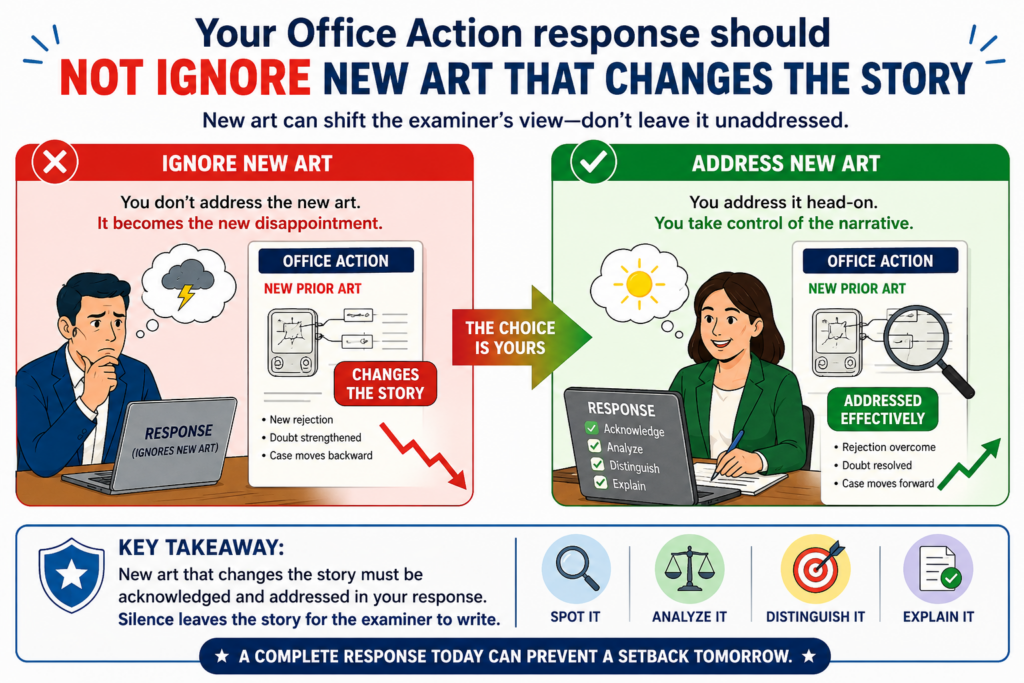
You may point to a real technical gain. But if new art appears before you file that response, your response should be built with that art in mind.
This does not mean every new reference changes the case. Many do not. But the team should know that before the response goes out.
Filing arguments first and checking the IDS later can create a weak record. It can also lead to rework if the new reference affects the exact point you argued.
Your claims and your IDS should tell the same clean story
Think of prosecution like a record of decisions. The examiner sees what you disclose, what you claim, and what you argue.
If your IDS adds new art after you have already argued around older art, the examiner may ask whether the new art changes the picture. Sometimes it does not. Sometimes it does.
For example, suppose your application claims a way to route model outputs based on confidence scores and user context. The examiner cites one reference about confidence scores.
Your team plans to argue that the old art does not use real-time user context. Then a new paper shows up that talks about user context in a related way. That paper may not block your patent. But your attorney should see it before the response is filed, because the best argument may need to shift.
Strong responses are built after the reference review, not before it
The practical rule is simple. Before filing a response, ask whether any new search reports, papers, patents, investor diligence notes, or foreign office actions have appeared since the last filing. Then review those items before finalizing claim changes.
This is how you avoid building your response on stale facts. It also helps your attorney draft remarks that are clear, careful, and less likely to create avoidable problems later.
A good response should move the case forward. It should not create a new clean-up job.
Late awareness can force hard choices
When new art appears close to a deadline, your team may face a hard choice. You may need to file the IDS with the response. You may need extra fees or statements, depending on the stage of the case.
You may need to adjust the claim plan. You may also need to decide whether more time is needed to respond well.
The USPTO explains that IDS submissions must meet the requirements of 37 CFR 1.97 and 1.98, including timing and content rules. If those rules are not met, the IDS may not be considered in the way the applicant expects.
The founder’s job is not to solve the rule issue alone
Founders do not need to memorize every IDS rule. That is not the best use of your time.
Your job is to make sure new information reaches the patent team fast. Your attorney’s job is to decide what to file, when to file it, and how it affects the response.
That split works well when the process is clean. It breaks when people wait, guess, or hold documents back because they are unsure. When in doubt, send it for review. Let the patent team decide the next step.
IDS content mistakes can hurt timing even when the reference is found early
Timing is not only about the date you file. It is also about whether the IDS is complete enough to be considered. A timely IDS can still create problems if the content is wrong, incomplete, or hard for the examiner to process.
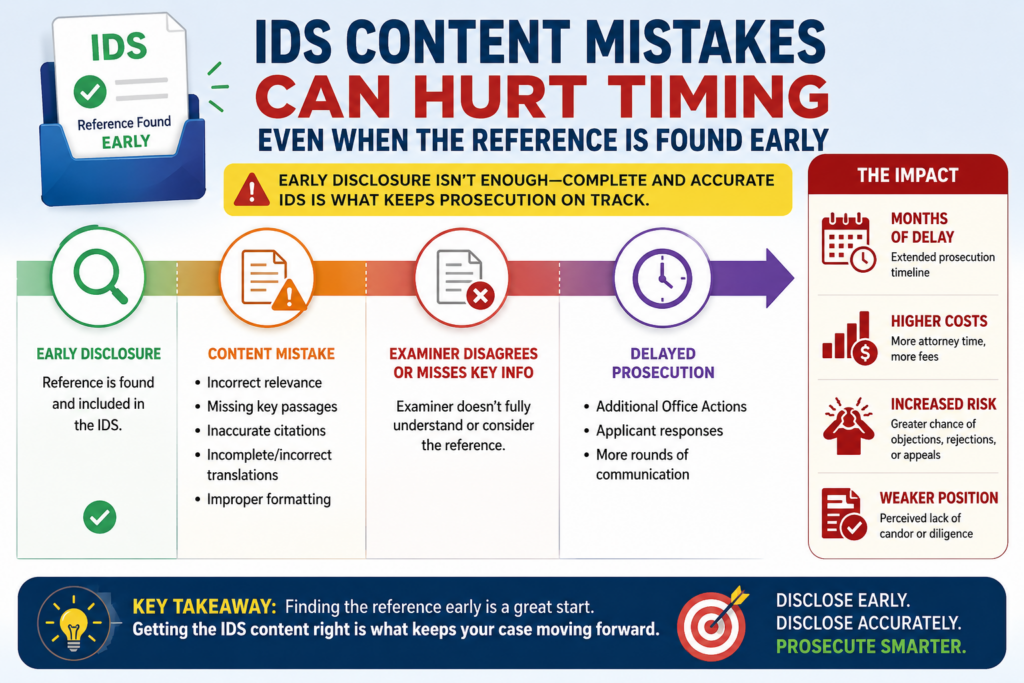
The USPTO’s IDS content rules require a proper list of the information being submitted. U.S. patents and U.S. patent application publications must be listed separately from other documents.
For non-English documents, certain translation information may be needed when an English translation is in the possession, custody, or control of the relevant person, or is readily available.
A bad citation can waste the benefit of early filing
Startups sometimes assume that an IDS is just a pile of documents. It is not. The examiner needs a usable list. The patent office needs the right forms or equivalent information.
The references need to be identified clearly. If the item is a paper, the details should help the examiner find and review the right document. If the item is a foreign patent publication, the citation should not be vague.
This matters because a sloppy IDS can lead to delays or non-compliance issues. Your team may think it “filed the art,” but if the filing does not meet the rules, the examiner may not treat it the way you hoped.
Clean source data makes the IDS easier to file and easier to trust
When your team sends a reference to counsel, send the best version you have. A full PDF is better than a screenshot. A complete patent publication number is better than a partial title.
A foreign search report should include the full communication if available, not just a pasted list of references. If someone has an English translation, that should be flagged.
This is a small discipline with a big payoff. It saves attorney time. It lowers the chance of a broken filing. It also helps your team keep a clear record of what was found, when it was found, and how it moved through review.
Large IDS filings now need even more care
There is another timing and process issue founders should know about. The USPTO has added IDS size fee and size assertion requirements for IDS filings under 37 CFR 1.97 on or after January 19, 2025.
The USPTO’s quick reference guide says these new requirements apply to IDS filings made on or after that date.
This does not mean founders should hide art or avoid disclosure. It means the team should avoid messy over-collection and last-minute dumps.
A careful IDS process is even more important when the list is large, because size, form, timing, and content all need to be handled correctly.
The better move is steady disclosure, not panic filing
The worst IDS pattern is waiting until late prosecution and then dumping a huge stack of references into the case without a clear process.
That can slow review. It can raise cost. It can distract from the main claim story. It can also make the team feel like prosecution is out of control.
A better pattern is steady review. When new references appear, route them. When related cases receive search reports, check them.
When the response cycle starts, run the IDS check before drafting. When the case approaches allowance, do one more careful review so the team is not surprised after the issue fee.
PowerPatent is built for founders who want that kind of control without getting buried in legal admin.
The platform helps turn technical work into strong patent filings with smart tools and real attorney review, so you can keep building while the patent process stays organized. Explore the PowerPatent workflow.
The final Office Action stage is where IDS timing starts to feel tight
A final Office Action does not mean the case is over. It does mean the room to move is smaller. When an IDS issue appears around this stage, your team needs to slow down just enough to avoid a bad filing choice.
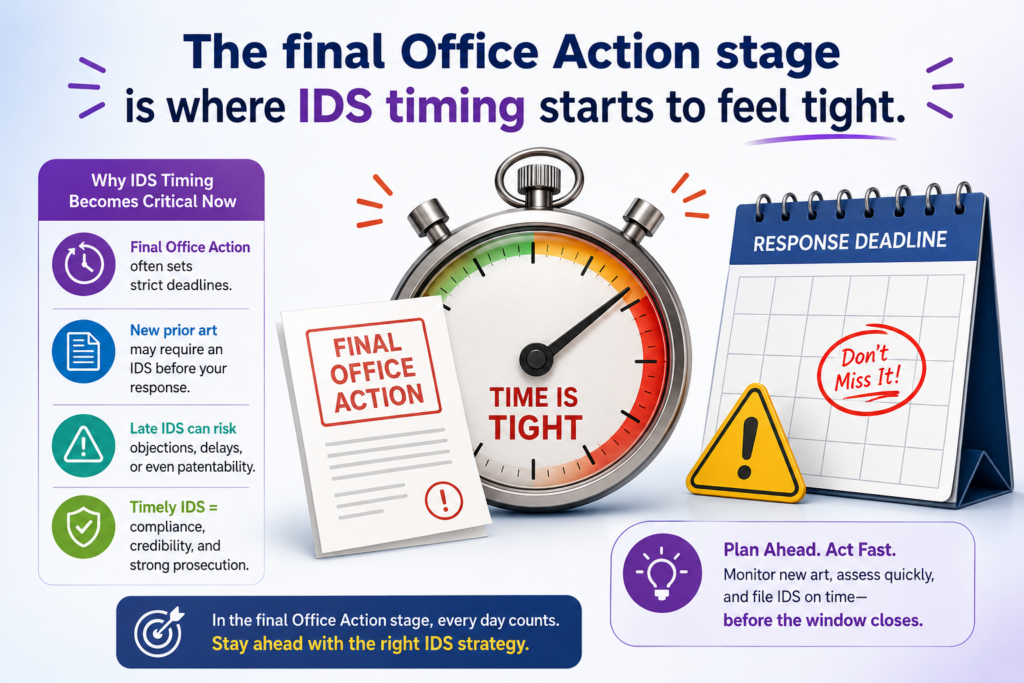
The USPTO’s IDS rules do not treat every stage of prosecution the same way, and the MPEP explains that 37 CFR 1.97 controls when an IDS will be considered as a matter of right and when a fee or certification may be needed.
Late art should be reviewed before you decide how to respond after final
After final, founders often want one thing: get the case allowed. That is fair. You have a business to build, investors to update, and a product roadmap that does not stop for patent rules.
But if new art shows up after a final Office Action, the fastest move is not always the safest move.
The first question is whether the new art changes the response plan. The second question is whether the IDS can still be handled in the current stage without forcing more steps.
The third question is whether the claims should be amended, argued, appealed, or handled through continued examination. These are not founder-only calls. They are prosecution strategy calls.
The danger is filing a response that does not match the full record
A weak response after final can waste time. A rushed IDS can do the same. If your team files arguments that ignore a reference now known to the team, the next step may become harder.
If your team files an IDS without checking timing and content rules, the examiner may not consider it the way you expected.
The USPTO’s IDS section says an IDS filed under 37 CFR 1.97 must also meet the content rules of 37 CFR 1.98, including a proper list of patents, publications, applications, or other submitted information.
The better move is to treat new art as part of the after-final strategy. You do not want two separate tracks, where one person drafts claim arguments while another person quietly deals with the IDS. Those tracks need to meet before anything is filed.
A final rejection can make a small timing mistake feel expensive
When prosecution is still early, a new reference can often be handled with less stress. Near final rejection, the same reference may force harder choices.
Your team may need to think about whether to keep fighting with the current claims, adjust claim scope, file an IDS with the needed fee or statement, or use a request for continued examination so the examiner can review the new record in a cleaner way.
The key point is not that one path is always right. The key point is that timing changes the cost of each path.
A reference found early can be part of normal prosecution. A reference found late can change the budget, the calendar, and the next response.
The practical habit is to run a final-stage IDS check before the response plan is set
Before your team answers a final Office Action, ask whether anything new has appeared since the last USPTO filing. Check foreign reports, search reports, patent alerts, product diligence files, technical papers, founder notes, and attorney emails.
Then ask your patent team whether any of it should be disclosed now and whether it affects claim strategy.
This is exactly where PowerPatent gives founders more control. It helps connect the work your engineers are doing with the patent review your attorneys need to perform.
That makes it easier to respond with confidence instead of guessing under pressure. You can see the workflow on PowerPatent’s how-it-works page.
Notice of Allowance is not the time to get relaxed about IDS review
A Notice of Allowance feels good. It means the examiner is ready to allow the case. For a founder, it can feel like the finish line.
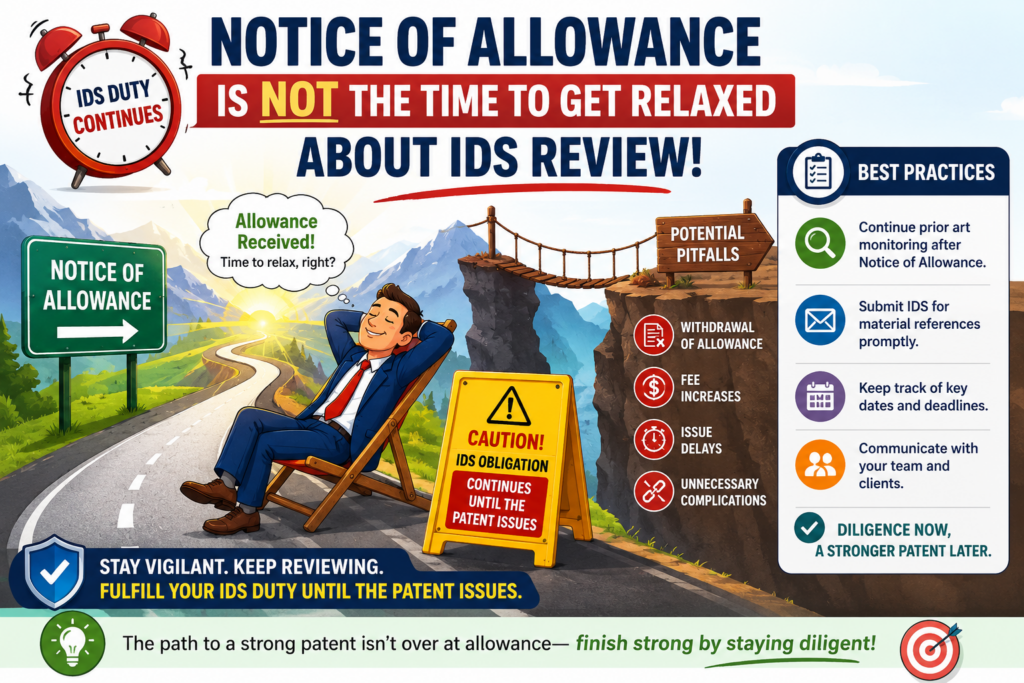
But IDS timing can still matter after allowance, and this is where careless teams can create last-minute stress.
The USPTO’s timing framework for IDS practice depends on the stage of prosecution, including whether prosecution is still open, whether allowance has happened, and whether the issue fee has been paid.
The MPEP explains that an IDS may require different treatment depending on when it is filed under 37 CFR 1.97.
Allowance should trigger one more clean review of known references
When a case is allowed, your team should ask one more simple question before paying the issue fee. Has anything new come in that may need to be disclosed? This is not a time to panic. It is a time to check the record.
This matters because startup patent work rarely happens in a quiet room. Your U.S. case may get allowed while a foreign case is still being searched. A new paper may come out while the issue fee is being prepared.
A partner may share prior work during a diligence call. A competitor patent may publish. Any of those items could be harmless, but they should still be routed for attorney review.
The issue fee can turn delay into a much harder problem
Once the case moves closer to issuance, the room to fix IDS issues can shrink. If important information is found after allowance but before issue, your patent team may need to decide whether and how to get that information considered.
In some cases, this can involve extra steps that founders did not expect. This is why the review should happen before the issue fee becomes the main task.
The mistake is treating the issue fee like a simple bill. It is more than that. It is a gate. Before you walk through it, your team should make sure the file history is in good shape and the known-reference review is complete.
A clean allowance process makes the patent stronger for business use
A patent is not only a legal document. For a startup, it is also a trust signal. Investors, buyers, partners, and acquirers may look at how the patent was handled.
They may ask whether key prior art was disclosed. They may review the file history. They may want to know whether related foreign reports were handled properly.
A clean IDS process helps answer those questions with less friction. It shows that your team was not just chasing allowance. It shows that your team cared about building a durable record.
The best time to prepare for diligence is before anyone asks for it
Diligence is hard when you build the record backward. It is easier when your team keeps a simple, clear prosecution trail from the start.
That means known references are routed quickly, timing is tracked, attorney decisions are documented, and IDS filings are handled before they become urgent.
PowerPatent helps founders build that kind of trail without slowing down the company. The platform is made for technical teams that want strong patents without turning the whole company into a legal admin shop.
Learn how PowerPatent helps founders move faster with attorney-backed software on PowerPatent’s how-it-works page.
Foreign search reports can create IDS pressure before your team feels ready
Foreign search reports are one of the most common sources of IDS timing issues. They often arrive from a related patent case outside the United States.
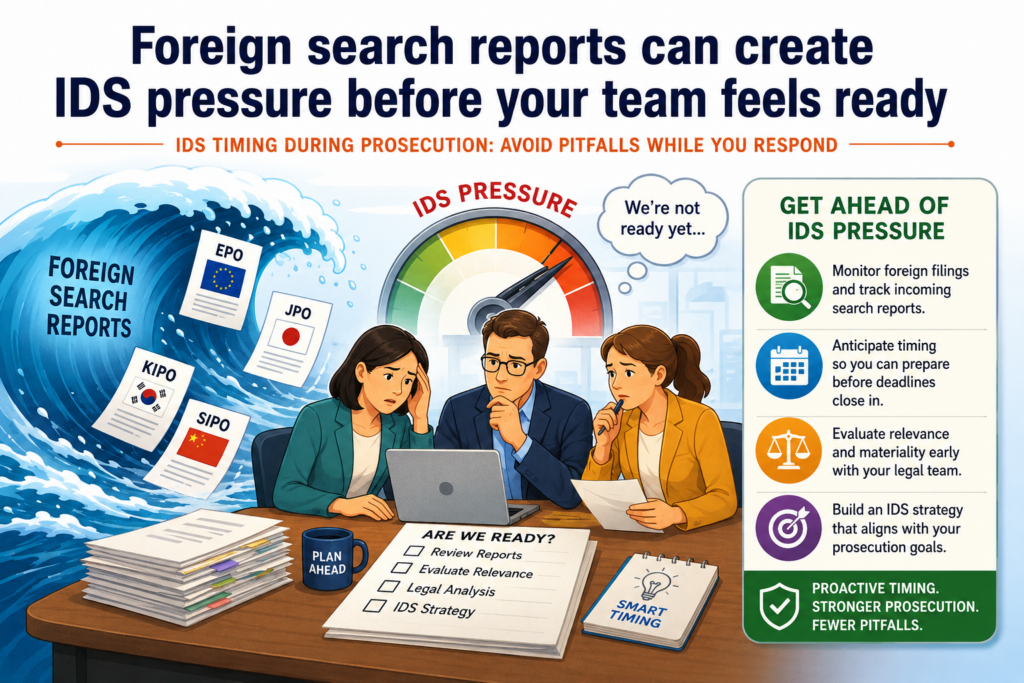
They may cite patents, papers, or other materials that the U.S. examiner has not seen. They may also arrive while your U.S. case is in the middle of an Office Action response, after final rejection, or close to allowance.
The USPTO’s IDS rules recognize timing statements tied to information first cited in a communication from a foreign patent office in a counterpart foreign application.
The rules also address whether information was first known within the relevant three-month period before the IDS was filed.
Do not let foreign counsel emails sit outside the U.S. response plan
A common startup problem is split ownership. One firm or team handles the U.S. case. Another handles Europe, China, Japan, Korea, Canada, or another filing.
The foreign report comes in, but no one connects it to the live U.S. response. Everyone assumes someone else is watching the timing.
That is how easy IDS problems begin. The foreign search report may be important. It may also be routine. But the U.S. patent team needs to see it fast enough to decide what to do.
Waiting until the response is almost due can force rushed judgment. Waiting until after allowance can create even more stress.
The foreign report should be treated as a same-day routing item
When a foreign search report arrives, send it to the U.S. patent team the same day or as soon as possible. Do not wait to translate every item before alerting counsel.
Do not hold it because you are unsure if the cited references matter. Do not assume the foreign attorney has already handled the U.S. IDS issue unless that workflow has been clearly set.
The report itself can start the review. Your patent team can decide what needs to be filed, whether any translations are needed, and how the timing rules apply. The earlier they know, the more choices they have.
Related cases should share reference flow in a controlled way
Patent families can get messy. One invention may have a U.S. case, a PCT case, several foreign national phase cases, and continuation applications. Each case may move at a different speed.
Each office may cite different art. If your team does not have a shared reference process, one case can know something that another case never sees.
That is risky because the U.S. case may need IDS attention based on what happens elsewhere. It is also inefficient because attorneys may waste time reconstructing the history from old emails.
The better process is to track references by patent family, not just by single case
When a new reference appears in any related case, your team should connect it to the full patent family.
That does not mean every reference is automatically filed everywhere without review. It means the team can see the full picture before making filing decisions.
This is where software can make a real difference. A founder should not have to dig through ten email threads to answer a simple question about foreign art.
A cleaner system lets the team see what came in, when it came in, which case it relates to, and whether attorney review has happened.
PowerPatent was built for this kind of modern patent work. It helps turn invention details, related filings, and attorney review into one smoother flow, so founders can protect what they are building without drowning in process. See how that works on PowerPatent’s how-it-works page.
Claim changes can make IDS timing more important than it looked at first
When you respond to an Office Action, you may change the claims. That change can shift what matters. A reference that looked less important before the amendment may become more important after the amendment.
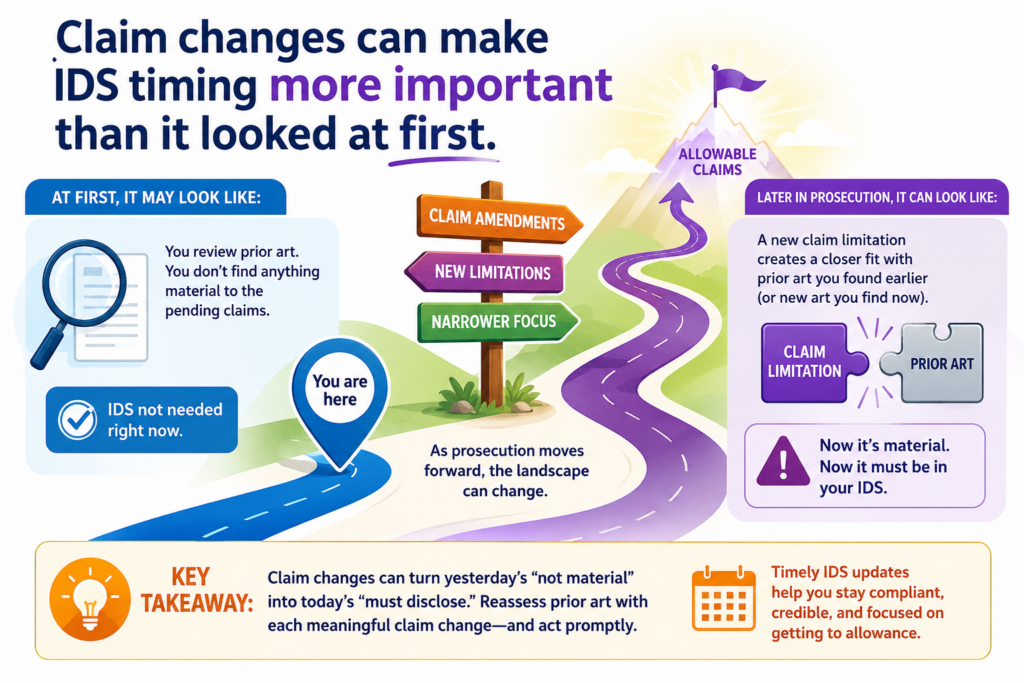
This is why IDS review should happen while the response is being shaped, not after the response is already written.
The USPTO’s IDS rules focus on having information considered during the pendency of the application when the IDS meets the timing and content rules.
In plain words, the Office has a process for when and how the examiner will consider the information you submit. If your claim plan changes, the way your team thinks about known information should change too.
A narrow claim can make an old reference newly relevant
Founders often think of prior art as a fixed problem. Either a reference matters or it does not. But claim scope changes the picture. If you narrow a claim to focus on one technical step, then a reference that teaches that step may need fresh attention.
If you move the claim toward a specific data flow, control method, model behavior, hardware link, or user action, the team should check whether any known reference touches that new center of gravity.
This is not about fear. It is about control. Strong prosecution means your claim edits, your arguments, and your IDS work all move together. If they do not, the record can start to look patched together.
The right question is whether the new claim story changes the reference review
Before a response is filed, your attorney should know what claim changes are being made and what references are already known. The team should ask whether the amendment makes any old paper, patent, product note, search result, or foreign-cited document more important than it first seemed.
For example, a broad claim about using machine learning for device control may be amended to focus on a specific sensor feedback loop. A reference about general AI control may not be the biggest issue anymore.
A smaller paper about that sensor loop may now matter more. That is why IDS timing and claim drafting cannot live in separate rooms.
Arguments can create trouble when they ignore known information
A response often explains why the examiner’s cited art does not teach the invention. That argument should be written with care.
If your team knows about another reference that is closer to the feature being argued, the attorney needs to see it before the words are filed.
This matters because the file history may be read later by investors, licensees, competitors, or a court. A clean record makes it easier to explain what happened.
A messy record can invite questions about why certain information was handled late or why the response was written the way it was.
A strong response is honest, focused, and built on the full picture
The best patent responses do not try to win with clever wording. They win by making a clear, supportable point. They show what the invention does, why the cited art falls short, and why the claim language is right for the real technical edge.
PowerPatent helps founders get to that kind of response faster because the platform is designed to connect invention details, prosecution work, and attorney review.
That way, the team is not scrambling to rebuild the facts right before a deadline. See how that works here: https://powerpatent.com/how-it-works
Large IDS filings should be handled with care because volume changes the workflow
Some startups end up with large IDS filings because they file in many countries, run many searches, track competitors, or have a fast-moving technical field.
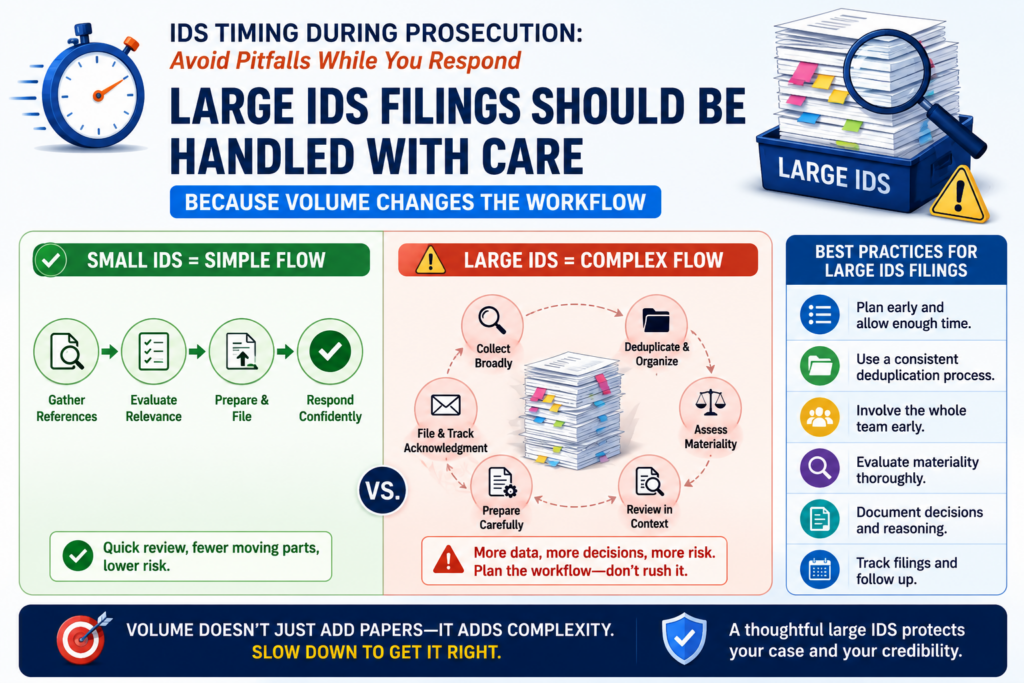
This is common in AI, robotics, chips, clean tech, medical devices, cybersecurity, and other deep tech areas. Large reference sets are not automatically bad, but they do need a cleaner process.
The USPTO’s 2025 IDS quick reference guide states that IDS size fee and size assertion requirements apply to IDS filings under 37 CFR 1.97 made on or after January 19, 2025. That means large IDS practice now has another process layer that teams must watch.
A reference dump is not the same as a smart IDS process
A weak team waits, collects everything in a messy folder, and files a large IDS late in prosecution. A stronger team builds a steady flow. New items are captured as they appear.
Related foreign case documents are routed quickly. Attorney review happens before the response strategy is frozen. The IDS is then handled as part of prosecution, not as a panic event.
This is especially important now because the rules include size-related fee and assertion requirements for IDS filings.
The current eCFR version of 37 CFR 1.97 says an IDS must meet the applicable timing path and be accompanied by any applicable IDS size fee under 37 CFR 1.17(v).
The goal is not fewer disclosures but better control
Founders should not hear “large IDS” and think the answer is to hide references. That is the wrong lesson. The better lesson is to run a clean system.
You want the right information reviewed at the right time, with the right records, and with a clear understanding of how it affects the response.
A bloated, late, poorly labeled IDS can slow the case and raise cost. A timely, well-organized IDS can help the examiner see the right record while keeping prosecution moving. The difference is not luck. It is process.
Large IDS files can also distract from the invention story
When the file contains many references, the response still needs to stay sharp. The examiner is focused on whether the claims are allowable.
Your attorney needs to keep the argument centered on the real technical difference. If the team spends all its energy cleaning up a large IDS at the last minute, the response can suffer.
That is a business problem too. A rushed response can lead to narrower claims than needed, weaker remarks, more rounds with the examiner, or extra cost. For a startup, that can mean slower patent progress at the exact time the company needs leverage.
A steady review rhythm protects both speed and claim quality
The best rhythm is simple. Do not let references pile up. Do not let foreign reports sit. Do not treat IDS review as a filing-day chore. Bring it into the normal patent workflow so the attorney can work with full context.
PowerPatent is built for this kind of founder-friendly patent work. It helps technical teams move from invention capture to attorney-backed patent action without losing control of details that matter later.
For a founder trying to protect a fast-moving product, that can save time, money, and stress. Learn more here: https://powerpatent.com/how-it-works
The best IDS response system is simple enough for busy engineers to use
A good IDS workflow does not need to feel like a legal maze. In fact, the simpler it is, the more likely your team will use it. Engineers do not want to stop building just to fill out complex forms.
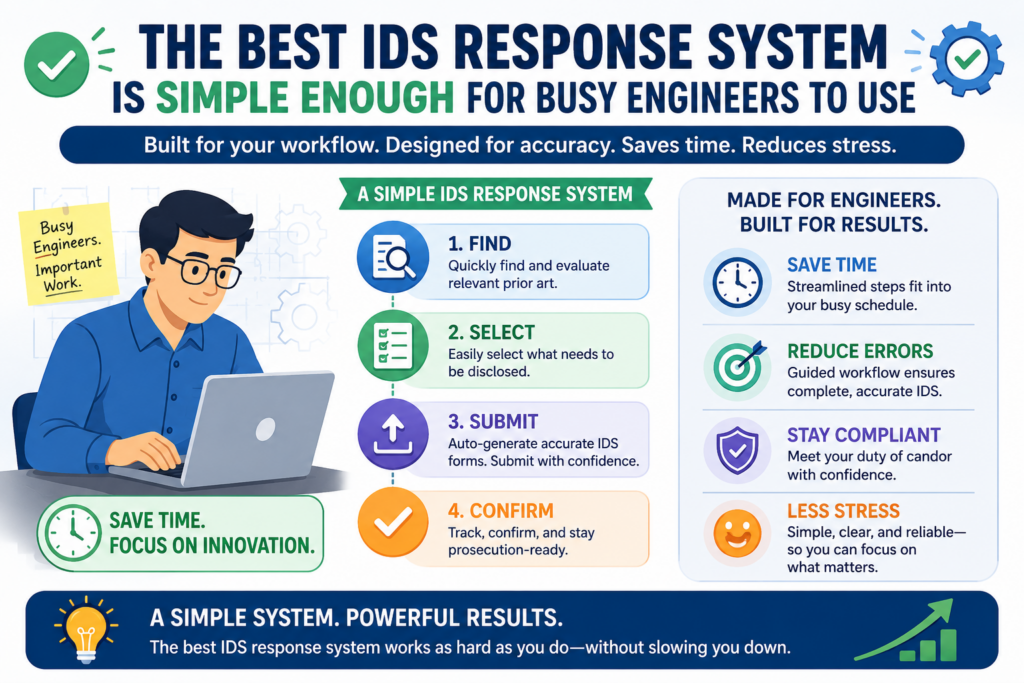
Founders do not want to chase old emails. Patent counsel does not want to guess when a reference was first seen.
The process should make it easy for anyone on the team to flag a possible reference, add basic context, and move it to attorney review. That is how you catch issues early, protect timing options, and keep the Office Action response on track.
Every startup should have one clear rule for possible prior art
The rule should be easy to remember. When someone sees something that may relate to a pending patent application, they should send it to the patent review channel right away.
They do not need to decide if it is material. They do not need to compare claim charts. They do not need to know the IDS timing windows. They just need to route it.
This works because it puts the right job in the right hands. Engineers find technical information.
Founders spot business and market information. Attorneys decide what matters for the patent file and how to handle the USPTO rules.
The intake note should capture the facts that timing depends on
When the item is sent for review, the note should explain when it was found, who found it, where it came from, and which patent family it may relate to.
It should also say whether it came from a foreign patent office, a competitor watch, a customer, an investor, an academic search, an internal review, or another source.
Those small facts can be very useful later. IDS timing rules can turn on where the information came from and when it became known.
For example, 37 CFR 1.97 includes timing paths that may require a statement, a fee, or both depending on the stage of prosecution, and the rules treat the period before final action differently from the period after final action or allowance but before issue fee payment.
The response owner and the IDS owner should not work in isolation
In some patent workflows, one person drafts the Office Action response while another handles the IDS. That can work only if they stay closely aligned.
If they do not, the claims may move in one direction while the IDS review points to a different concern.
This is why the IDS check should happen before the response is final. The response owner should know what new references are being reviewed. The IDS owner should know what claim amendments and arguments are being planned. Both sides should talk before filing.
The final response review should include an IDS checkpoint
Before the response is filed, the team should confirm that known new references have been routed, timing has been checked, and the response strategy still makes sense.
This does not need to be a long meeting. It does need to be a real checkpoint.
For founders, this habit gives peace of mind. You are not just filing words to meet a deadline. You are building a stronger patent record.
You are reducing surprises. You are making it easier to explain the patent later in diligence, fundraising, licensing, or acquisition talks.
PowerPatent helps make that habit easier by pairing smart patent software with real attorney oversight. The result is a process that fits how startups actually work: fast, technical, and focused on the product.
To see how PowerPatent helps founders file better patents without slowing down, visit https://powerpatent.com/how-it-works
Your IDS process should fit inside your response calendar from day one
When an Office Action arrives, most teams look at the response date first. That is natural. The deadline controls the work. But the response date should not be the only date on the calendar.
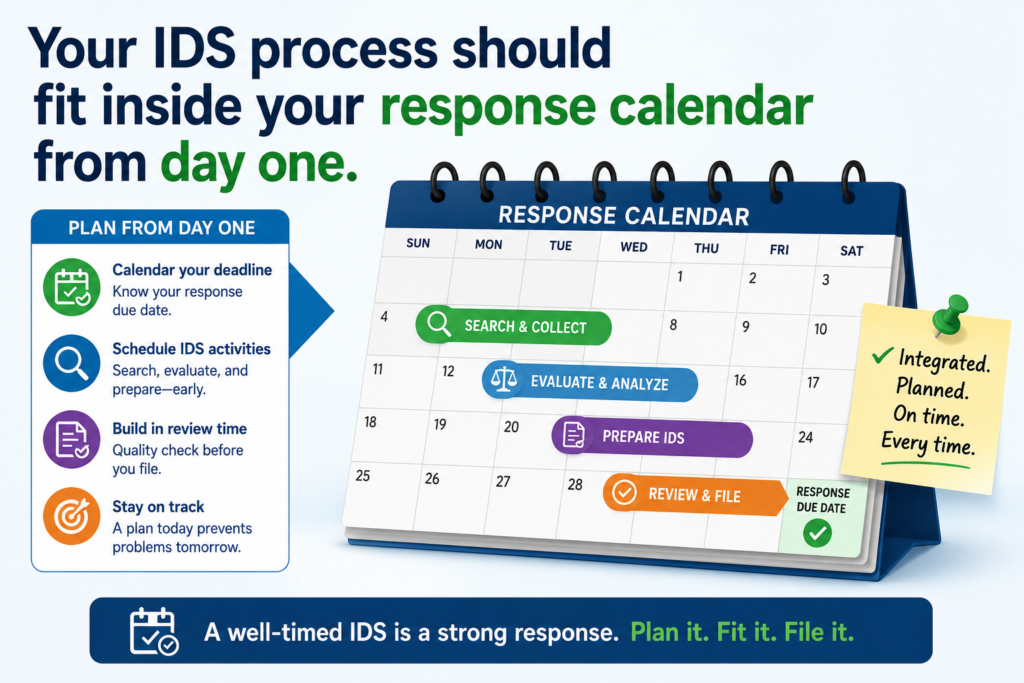
Your IDS review needs its own place in that same plan, because the USPTO treats IDS timing as part of whether the information will be considered, and the rules can require a fee or statement depending on when the IDS is filed. The USPTO also says information should be submitted promptly.
A founder does not need to manage every patent rule by hand. But a founder does need to make sure the team has a clean process.
If IDS review is left until the final week, the team may rush the response, rush the reference review, or miss the chance to shape the claim strategy around the full record. That is the exact kind of avoidable mistake that makes patent work feel slow and painful.
The response plan should start with a reference check before claim edits begin
A strong response calendar starts with a simple first step. Before anyone gets deep into claim changes or arguments, the team should check whether any new information has appeared since the last USPTO filing.
That check should include foreign search reports, competitor patents, technical papers, customer materials, investor diligence notes, old invention records, and anything found by engineers during product work.
This does not mean every item will be filed in an IDS. It means every item should be reviewed by the right person.
Founders and engineers should not have to decide whether a reference is legally important. Their job is to surface it early. The patent team’s job is to decide how it affects the case.
The best response calendar has an IDS checkpoint before final review
A practical response calendar should include an IDS check near the start and another one before filing.
The first check helps shape the response. The second check catches anything that came in while the response was being drafted. That small habit can prevent a painful last-minute surprise.
This is especially helpful for technical startups because new information can appear fast. A paper may publish. A foreign report may arrive. A customer may mention a known system.
An engineer may find a close GitHub project. None of these should create panic, but each one should move through a clear review path.
Late checks make the attorney work harder and the business wait longer
When the IDS review happens too late, everything gets tighter. The attorney may need to compare new references against claims that have already been revised. The response may need to be rewritten.
The team may need to decide whether timing rules require extra steps. In some cases, the new art may change which claim features should be used to move the case forward.
That is why the early reference check is not a formality. It protects the quality of the response. It gives the attorney time to think. It gives the founder a clearer view of the path ahead.
It also helps avoid a messy file history that could raise questions later during fundraising, licensing, or acquisition review.
The startup advantage comes from speed with control
Fast does not mean loose. The best patent teams move quickly because they keep the facts organized. They do not wait until the deadline to learn what the team knows.
They build a workflow where references are captured early, routed cleanly, and checked before the response is filed.
PowerPatent is built for founders who need that kind of speed with control. The platform helps connect invention details, prosecution work, and real attorney oversight, so the patent process does not slow the company down.
You can see how PowerPatent helps teams move from invention to stronger patent action here: https://powerpatent.com/how-it-works
The duty to disclose should be treated as a team habit, not a legal slogan
Many founders hear about disclosure duties and instantly tune out. It sounds like legal language. It sounds far away from product work. But in day-to-day startup life, the idea is simple.
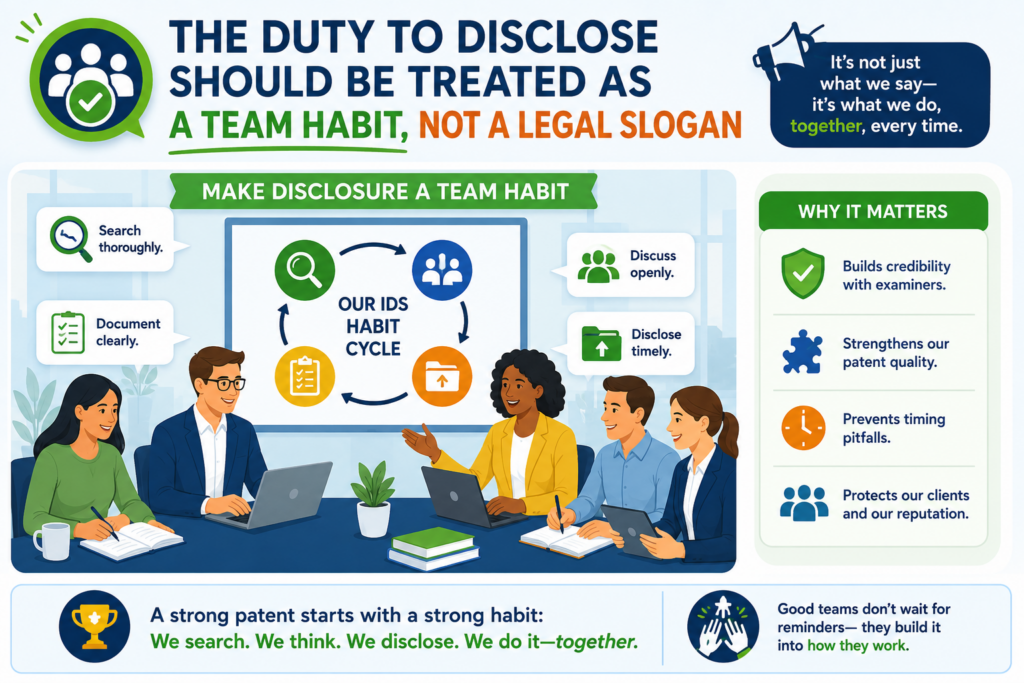
When your team knows about information that may matter to a pending patent case, it should get to the patent team fast.
The USPTO’s IDS rules explain how information is submitted for consideration, including the need for a list of patents, publications, applications, or other information.
They also explain that U.S. patents and U.S. patent application publications must be listed separately from other documents. This is not something founders should try to handle alone, but it is something founders should make easy for the team to support.
Engineers should not be asked to make legal calls before sharing references
A common mistake is making the intake step too hard. If an engineer thinks they must decide whether a paper is “material,” they may delay. If a founder thinks a competitor patent is not close enough, they may not send it.
If an operations lead gets a foreign report and does not know what it means, it may sit in an inbox.
The better rule is simple. Share first. Let counsel decide. This keeps the team from making legal calls in the dark.
It also makes the whole process less scary because no one has to be perfect. They only need to route possible information to the right place.
The right culture rewards early sharing instead of perfect filtering
Founders should make it clear that no one gets in trouble for sending a reference that turns out not to matter. That is far better than missing one that does matter. The patent team can filter. The startup team should surface.
This matters most in deep tech companies where the people closest to the invention are often the people most likely to see important art. Engineers read papers. Product leads study competitors.
Founders sit in diligence calls. Research teams review old systems. Those touchpoints can produce useful information, but only if the company has a habit of moving it into the patent workflow.
A simple team habit can protect the patent years later
The value of a clean IDS habit may not show up right away. It may show up years later when an investor asks about the patent family. It may show up during a sale of the company.
It may show up when a competitor studies the file history. It may show up when your team needs to explain why a certain reference was handled when it was handled.
A clean record gives better answers. It shows that your company had a careful process. It shows that the patent was not rushed through without attention to known information. It helps turn the patent from a filed document into a stronger business asset.
The founder’s job is to make the right action easy
A founder should not need to teach the whole company patent law. That would be a waste of time. The better move is to build a simple path. When someone sees a possible reference, they know where to send it.
When the patent team receives it, they can track when it came in and how it was handled. When a response is due, the attorney can see the full picture.
PowerPatent helps make that path easier. It gives technical teams a more organized way to turn invention work and prosecution needs into attorney-reviewed patent action.
That means less guessing, less chasing, and fewer last-minute surprises. See how the process works here: https://powerpatent.com/how-it-works
The issue fee stage should include a final IDS safety check before payment
The issue fee stage can feel like a victory lap. The examiner has allowed the case. The team is excited. The founder wants the patent to issue. But this is not the time to switch off.
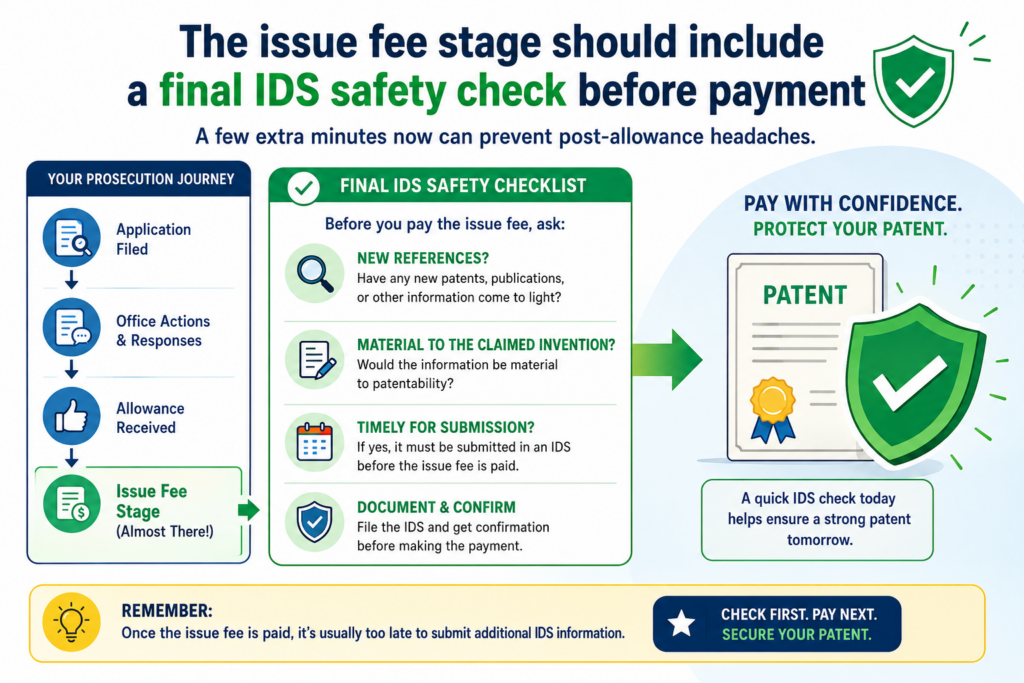
Before the issue fee is paid, the team should run one last IDS safety check to confirm whether any known information still needs attorney review.
This is important because IDS timing rules change as prosecution moves forward. The USPTO’s IDS guidance is built around the stage of the application, and later filings can involve tighter requirements.
The point is not to scare founders. The point is to stop a simple timing miss from turning into a costly delay.
Allowance should trigger a calm review, not a rushed celebration
When a Notice of Allowance arrives, the team should pause and ask what has happened since the last filing. Did a foreign office cite new references?
Did a continuation or related case receive a search report? Did an engineer find a close paper? Did a competitor patent publish? Did a diligence review uncover older work?
These questions do not need to slow the company down. They just need to be asked before the issue fee is treated like a routine invoice.
Once the case moves closer to issuance, fixing a missed IDS issue can become harder and more expensive. A short review at the allowance stage is much easier than a scramble after the fact.
The issue fee should be treated as a gate, not just a bill
The issue fee is a business moment. Paying it moves the case toward an issued patent.
Before crossing that gate, your team should make sure the file is clean, the known references have been checked, and the attorney is comfortable with the record.
This final check is especially important when the company has related cases in other countries. Foreign search reports may arrive on a different schedule than the U.S. allowance.
If the team is not watching that flow, a key document can show up at the worst possible time. The fix is not complex. Connect the foreign case flow to the U.S. case flow before the issue fee decision is made.
A final IDS check can make investor and buyer questions easier to answer
Investors and buyers often care about patents, but they care even more when the patent protects something core to the business. They may ask how the case was handled. They may review the file history.
They may look for prior art problems. They may ask whether foreign search results were disclosed in the United States.
A clean IDS process helps the company answer with confidence. It shows that the patent did not just get allowed by chance. It shows that the team handled known information in an organized way and kept the record clear before issuance.
Better process today can protect valuation tomorrow
Patent mistakes often feel small when they happen. A missed email. A delayed report. A reference saved for later.
But during diligence, small mistakes can feel much bigger because the company is trying to prove that its IP is strong. That is why a clean IDS process is not just a legal task. It is part of building company value.
PowerPatent helps founders protect that value by combining smart software with real attorney oversight. The goal is simple: help you file and prosecute better patents without slowing your team down or leaving important steps to chance.
To see how PowerPatent helps startups build a stronger patent process, visit https://powerpatent.com/how-it-works
Continuation strategy should include IDS timing before the next case is filed
A continuation can be a smart move when your first case is still alive and you want to pursue more claim coverage. Many startups use continuations to protect new product angles, new customer uses, new model versions, new hardware layouts, or broader platform ideas.
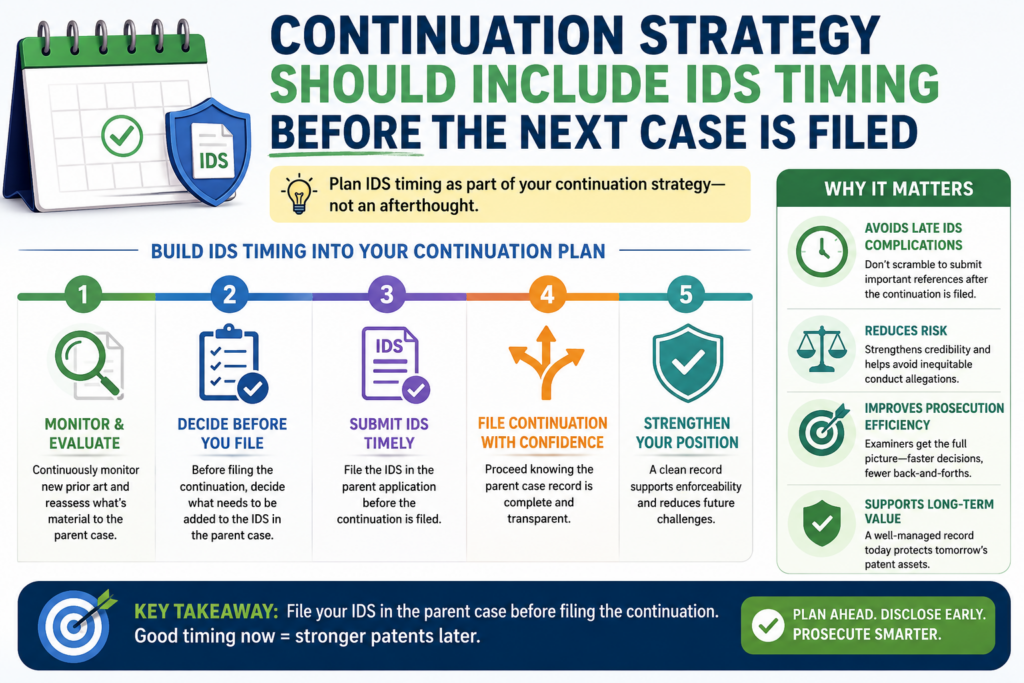
But continuations also create a new timing issue. The references known in the parent case do not stop mattering just because a new child case is filed.
The eCFR states that an IDS must meet the timing path under 37 CFR 1.97 and the content rules under 37 CFR 1.98 to be considered by the Office during the pendency of the application.
It also now points to any applicable IDS size fee under 37 CFR 1.17(v), which matters when a family has many disclosed items over time.
A continuation should not begin with a blind copy of the old file
It is tempting to treat a continuation as a repeat task. The parent case had an IDS. The team already disclosed a set of references.
The new case is related. So the startup may assume the same reference set can be copied over and the rest can be handled later.
That is not the best way to think about it. A continuation often has different claims. Different claims can make different references more important.
A reference that was not central in the parent case may become more relevant in the continuation because the new claims focus on a different part of the invention.
The better question is what the new claims are trying to protect
Before filing or responding in a continuation, the team should ask what the new claim story is. Is the continuation about a data pipeline, a model training step, an edge device, a feedback loop, a user interface, a chip layout, a robotic movement pattern, or a security control? Once that focus is clear, the known references should be checked against that focus.
This does not mean the founder needs to make a legal call. It means the founder should help the attorney understand the product and the claim goal.
When the attorney knows both the known art and the business reason for the continuation, the IDS and response plan can be much sharper.
Related cases can make reference tracking harder unless one person owns the flow
Patent families can grow quickly. A startup may start with one provisional, file a nonprovisional, enter the PCT, move into several countries, file a continuation, and then file another continuation after the product grows.
Each case can produce its own search results, Office Actions, cited art, and claim changes.
Without a clean workflow, references can get trapped in separate folders. One case may have a foreign report.
Another may have a U.S. Office Action. A continuation may have new claims. If no one connects the dots, the IDS timing issue may not be spotted until a response is nearly due.
A family-level view helps the attorney protect the right scope
The best process is to track references across the patent family, not just inside one case. That gives your patent team a better view of what has been cited, where it came from, when it was received, and whether it may matter to the pending claims.
PowerPatent helps make that easier by giving founders a more organized way to move from invention detail to attorney-reviewed patent action.
This matters when your startup is growing fast and the patent family is growing with it. You can see how PowerPatent works here.
IDS timing should be part of your investor diligence story before anyone asks
Investors do not only care that you filed a patent. They care whether the patent has a real chance of protecting something valuable.
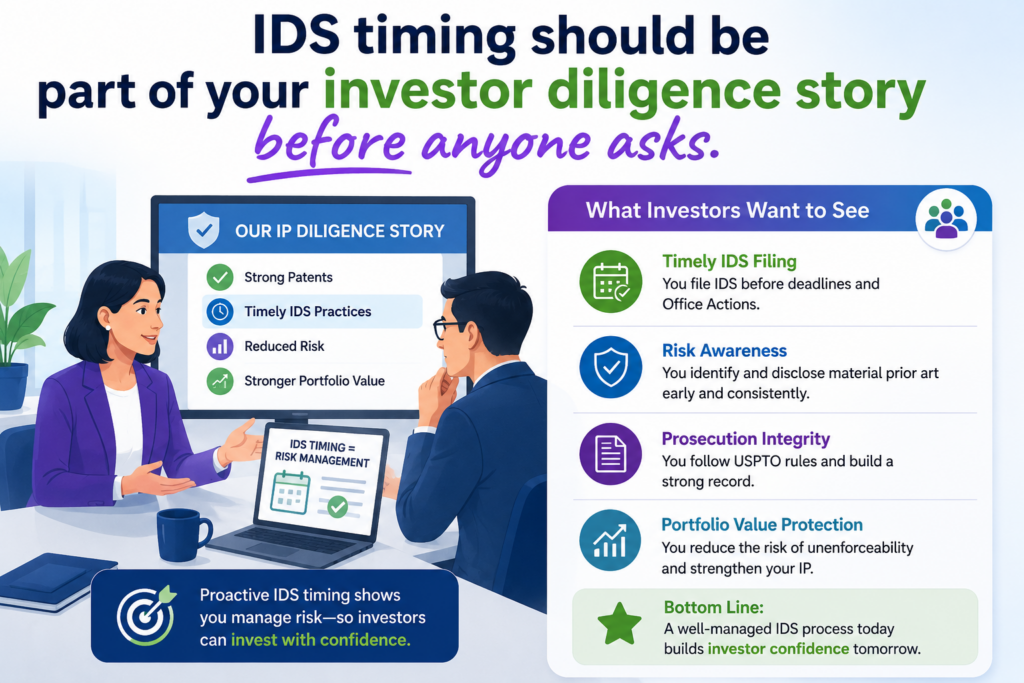
When a patent is important to the company, diligence can go deeper. Investors may look at the claims, the file history, the references cited, the status of related cases, and whether the company had a careful process.
This is why IDS timing is not just a patent office issue. It is a business issue. The USPTO explains that an IDS is used to submit information the applicant wants the Office to consider during prosecution of a nonprovisional application, and it must follow 37 CFR 1.97 and 37 CFR 1.98.
A clean IDS record can help show that your company handled known information in an organized way.
A messy IDS history can create hard questions at the worst time
Imagine you are in a Series A diligence process. The investor likes the product, the team, and the market. Then their counsel asks why a foreign search report was disclosed late in the U.S. case.
Or they ask whether a key competitor patent was known before a response was filed. Or they ask why a large IDS showed up right before allowance.
Those questions do not always mean something is wrong. But they can slow diligence. They can create doubt.
They can force the founder to search old emails and reconstruct what happened months or years earlier. That is not where you want to spend energy during a fundraise.
The best diligence answer is a clean record, not a long explanation
A strong answer sounds simple because the process was simple. The team had a place for references. New items were routed to counsel. Dates were tracked.
Foreign reports were sent to the U.S. team. IDS filings were handled with the response calendar. Attorney review was part of the workflow.
That kind of answer helps investors trust the process. It does not guarantee a patent will be broad, and it does not remove every risk. But it shows that the company treated its IP like a serious asset, not an afterthought.
Patent strength is partly about the claims and partly about the process
Founders often think patent value is only about claim wording. Claim wording matters a lot. But the process behind the claims also matters.
A clean prosecution history can make the patent easier to understand, easier to diligence, and easier to explain.
If the record shows that known references were handled carefully, the company has a stronger story.
If the record looks rushed or scattered, the company may need extra legal work to explain what happened. That can cost money and time at a moment when both are tight.
The founder’s move is to build diligence readiness into normal patent work
Do not wait for an investor to ask before you clean up the story. Build the story as you prosecute. Keep reference intake simple. Track when key documents arrived.
Make IDS review part of each response. Make the issue fee stage a final safety check. Keep foreign search reports connected to the U.S. case.
This is where PowerPatent fits the way modern startups work. It helps founders protect what they are building through smart software and real attorney oversight, so the patent record grows with the company instead of becoming a pile of scattered files. See how PowerPatent helps founders move faster.
IDS timing gets easier when your team knows what to send and what not to decide
The goal is not to turn your engineers into patent lawyers. That would slow everyone down and create more risk. The goal is to make the first step easy.
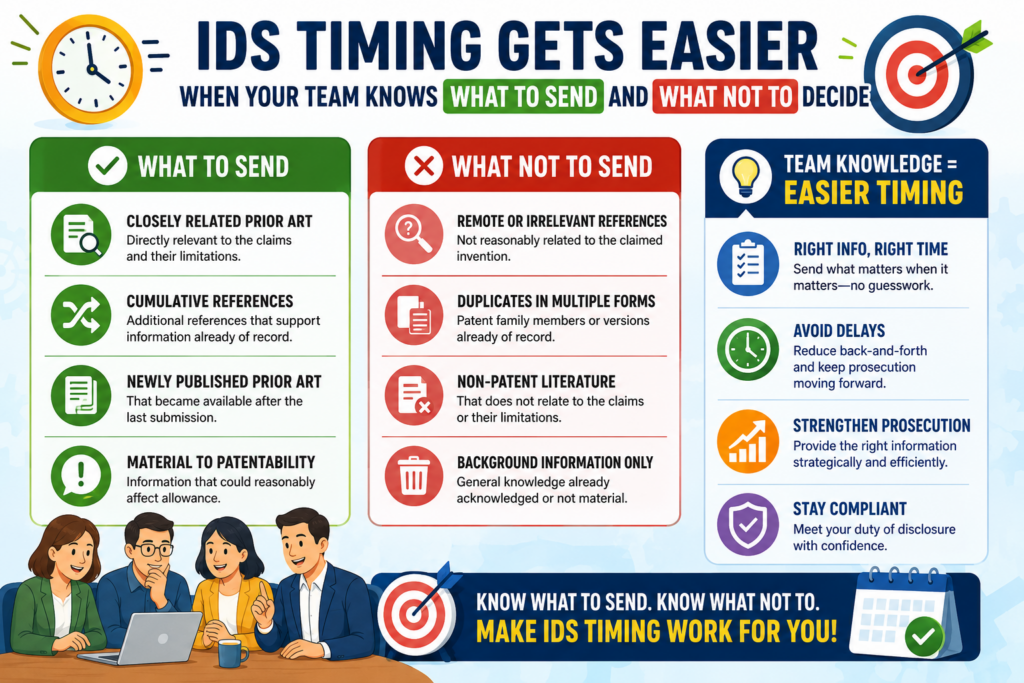
When someone on the team sees a paper, patent, product page, GitHub project, search report, or technical note that may relate to a pending patent case, they should send it to the patent review path.
The USPTO’s IDS content rule under 37 CFR 1.98 requires a list of patents, publications, applications, or other information submitted for consideration.
It also requires U.S. patents and U.S. patent application publications to be listed in a separate section from other documents.
That is lawyer work. Your internal team’s job is much simpler. Surface the item early and give enough context to review it.
Your team should send context, not legal conclusions
A founder may be tempted to write, “This is not relevant,” before sending a paper to counsel. An engineer may write, “This does not use our exact method.”
A product lead may write, “This is just a competitor feature.” Those notes can be helpful as technical background, but they should not replace attorney review.
The better note is factual. Say where the item came from. Say when it was found. Say who found it. Say which product, feature, or patent family it may relate to.
Say whether it came from a foreign patent office, a search report, a customer, a competitor review, or internal research. That is the kind of context that helps counsel act quickly.
The team should avoid sitting on references while trying to decide if they matter
The worst delay often happens before counsel ever sees the item. Someone tries to make a judgment call. Someone asks another engineer.
Someone waits for a cleaner copy. Someone plans to bring it up at the next meeting. By then, the timing window may be tighter.
The safer habit is to send first and let the review happen in the right place. If the reference turns out not to affect the case, fine. That is a good result. If it does matter, the team has protected more options by moving early.
The best IDS workflow removes shame from over-sharing
Startups move fast. People miss things when the system makes sharing feel hard. If your team thinks every reference submission creates a legal fire drill, people will hesitate.
If your team thinks every submission will be judged, people will filter too much. That is not what you want.
A healthy workflow makes early sharing normal. It treats possible references as inputs, not emergencies.
The attorney reviews them, decides what belongs in an IDS, and connects that decision to the response plan. The team keeps building.
PowerPatent helps make the right action easier for technical teams
PowerPatent is designed for founders and engineers who want strong patents without the old slow process.
The platform helps capture invention details, organize patent work, and bring real attorneys into the loop where their judgment matters most.
That combination is especially useful for IDS timing because the problem is rarely one big legal question. It is usually many small timing and workflow questions.
What came in? When did it arrive? Who saw it? Which case does it touch? Is a response being prepared? Is the case near allowance? Has a foreign office cited something new?
When those questions are easier to answer, prosecution gets cleaner. Your team can respond faster, avoid preventable mistakes, and keep the patent record aligned with the invention story.
To see how PowerPatent helps startups file and manage stronger patents, visit PowerPatent’s how-it-works page.
A clean IDS record should make your Office Action response easier to defend later
An Office Action response is not only written for the examiner in front of you. It may also be read later by investors, buyers, partners, competitors, or another attorney who wants to understand how the patent was handled.
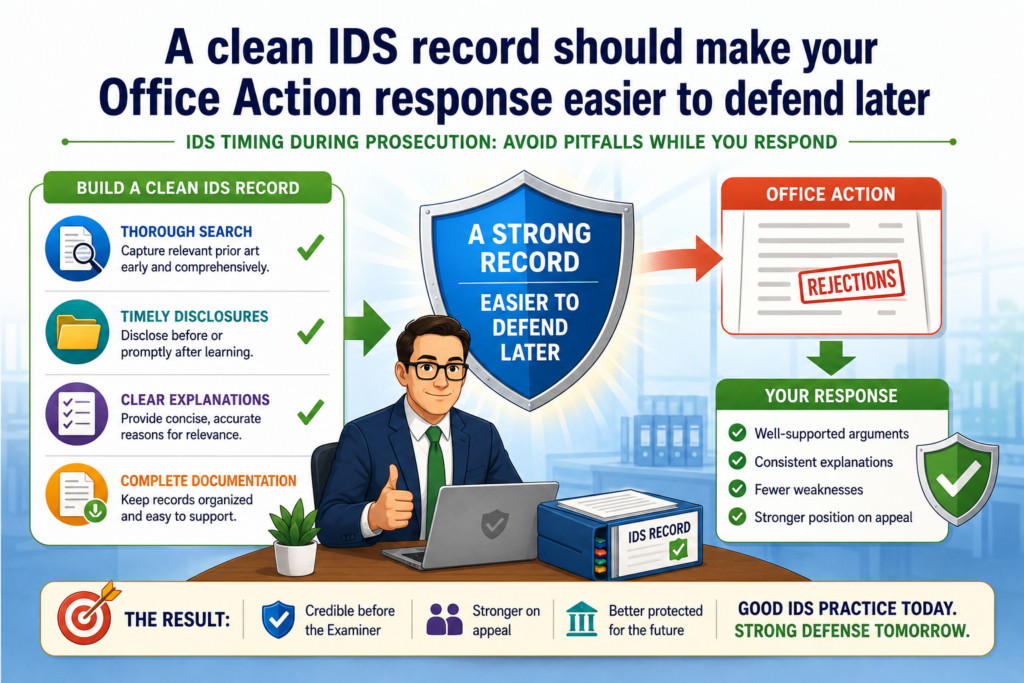
That is why IDS timing should be treated as part of the written story of the case.
The USPTO’s rule says an IDS must meet the timing path under 37 CFR 1.97 and the content rules under 37 CFR 1.98 to be considered during the life of the application.
The current rule also points to any applicable IDS size fee under 37 CFR 1.17(v), which means timing, content, and size can all matter in the same filing.
Your response should not look like it was drafted in a vacuum
When a team files an Office Action response, the remarks should fit the facts known at that time.
If the team later files an IDS with art that was already known before the response, the file history may invite questions. That does not always mean something went wrong, but it can make the story harder to explain.
For founders, the goal is not to create a perfect record in some abstract legal sense. The goal is to create a record that makes sense.
The response should show that the team understood the invention, understood the examiner’s concerns, and handled known information with care.
The better file history is built by checking references before the response is signed
Before the final response is approved, someone should confirm that new references have been routed to the patent team.
This should include foreign search reports, newly found papers, cited patents from related cases, competitor materials, and anything that came up while the response was being prepared.
That check should happen before the attorney signs off on the filing. Once the response is filed, changing the story can be harder.
It is far better to catch a reference early, think about it once, and file a response that lines up with the full record.
A strong response should stay focused even when IDS work is happening nearby
IDS review should not make the response messy. A good response still needs a clear point. It should explain why the claims are allowable, why the examiner’s cited art does not cover the invention, and why any claim changes are supported by the real technical work.
This is where founder input matters. The attorney may understand the rules, but the founder and engineers understand the product.
If the claims are being shaped around a feature that drives real customer value, the patent team should know that. If a new reference changes how that feature should be described, the team should know that too.
PowerPatent helps keep the patent story tied to the product story
PowerPatent is built for startups that do not want patent work to drift away from the real invention.
The platform helps collect technical details, organize the prosecution workflow, and bring real attorney review into the process so the response, claims, and IDS work are not handled as disconnected tasks.
That matters because strong patents are not made by paperwork alone. They come from clear invention capture, smart claim strategy, clean disclosure habits, and careful attorney judgment. You can see how PowerPatent brings those pieces together here: https://powerpatent.com/how-it-works
IDS timing should be reviewed whenever your claim strategy changes during prosecution
Claim strategy can change quickly during prosecution. You may start with broad claims and then move toward a specific product feature.
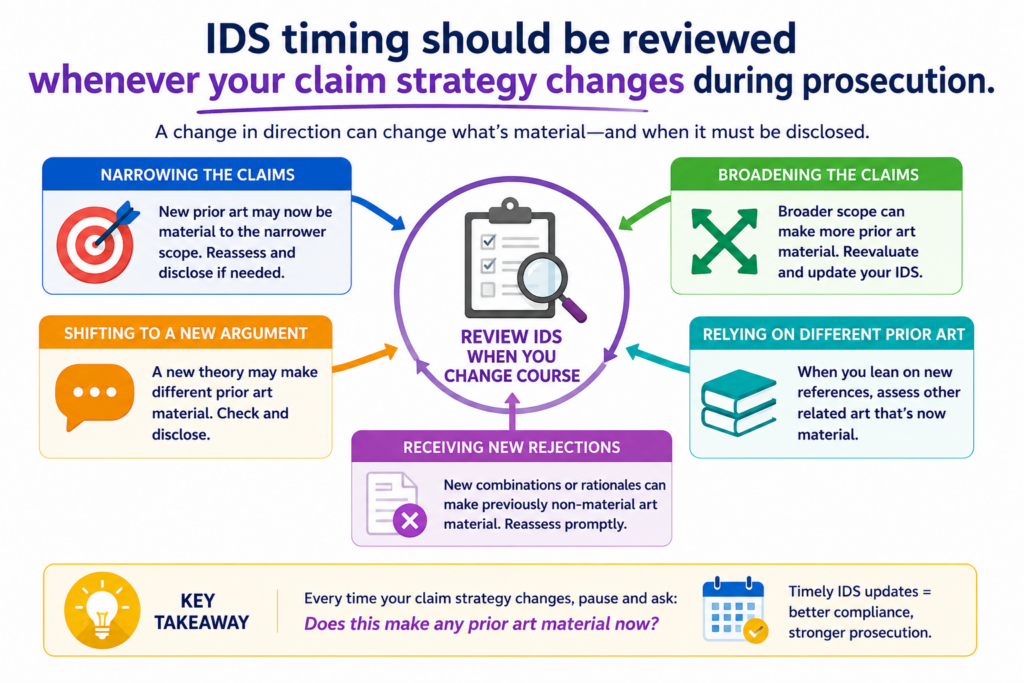
You may decide to focus on speed, accuracy, security, data handling, device control, model behavior, or a system link that the examiner has not fully understood. Each of those moves can change what known information matters most.
The USPTO’s IDS rules are not built around your internal product roadmap. They are built around whether the information is submitted in a way that meets the Office’s timing and content requirements.
The MPEP explains that an IDS must comply with the content requirements of 37 CFR 1.98 and the procedural requirements of 37 CFR 1.97 for the information to be considered.
A new claim focus can make a quiet reference more important
A reference may seem minor when the claims are broad. Later, after an amendment, that same reference may matter more.
This is common in deep tech cases because the strongest patent path often becomes clearer only after the examiner shows how they are reading the old art.
For example, an AI startup may start with claims about a full model workflow. After an Office Action, the team may shift toward a special feedback step that improves real-time output.
A paper that once looked like background noise may now touch that feedback step. That paper may not kill the claim, but it should be reviewed before the response goes out.
The claim meeting should include a reference question before edits are locked
When the team discusses claim changes, the attorney should ask whether any known references map to the new claim focus. The founder should explain what makes the feature technically different.
The engineer should flag papers, systems, or old work that seem close. Then the attorney can decide how to handle the IDS and how to write the response.
This keeps the amendment from becoming a blind turn. It also helps avoid the painful moment where a response is nearly done and someone says, “Wait, there is a paper that talks about something like this.”
Your attorney needs the business reason behind the claim change
A claim amendment should not be only a legal move. It should also protect the business. If the startup cares most about a core data pipeline, then the claims should not drift toward a narrow side feature that competitors can avoid.
If the product’s value comes from a specific model deployment flow, the response should not focus only on generic software language.
IDS timing connects to this because references can push claim strategy in better or worse directions. The team needs to know which features are worth fighting for and which references may affect that fight.
The best prosecution strategy joins legal judgment with founder judgment
Founders should not try to handle IDS rules alone, but they should stay close to the claim story. A strong attorney can work faster and smarter when the founder explains what the product does, what customers care about, and what competitors should not be able to copy.
PowerPatent gives founders a better way to stay involved without getting buried in legal work. It helps turn technical detail into a patent workflow that real attorneys can review and shape.
That is how you keep prosecution practical, fast, and tied to the company’s moat. Learn more here: https://powerpatent.com/how-it-works
New IDS size rules make clean reference tracking even more important
Large IDS filings have always required care. Now they need even more planning.
The USPTO’s quick reference guide says the IDS size fee rule and related assertion requirements became effective on January 19, 2025, and apply to IDS filings under 37 CFR 1.97 made on or after that date.
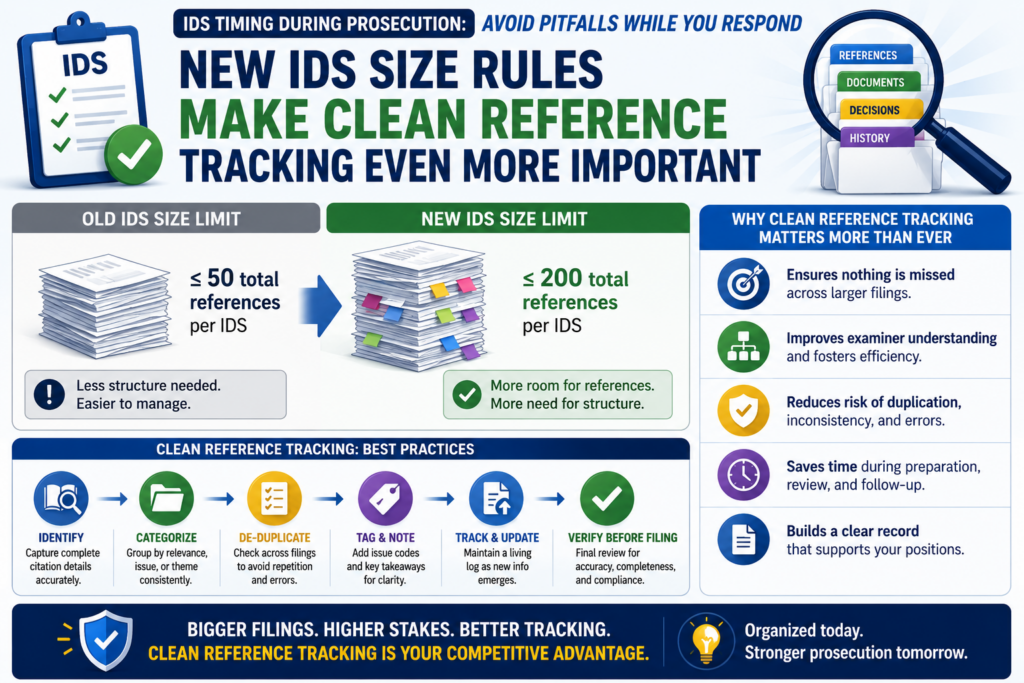
This is a major reason to avoid chaotic reference handling. The answer is not to disclose less than you should. The answer is to track references better, file at the right time, and avoid last-minute piles that create extra cost and process pressure.
A growing patent family can create a growing IDS count
Startups in active fields often collect many references over time. Search reports arrive. Foreign offices cite new documents.
Continuations add new claim angles. Competitor filings appear. Engineers find papers. The reference count can grow quietly until the team suddenly faces a larger IDS than expected.
That can create two problems at once. First, the attorney must still decide what should be disclosed and how it affects the response.
Second, the filing must be checked against the current IDS fee and assertion requirements. When this happens close to a response deadline, the process can feel much heavier than it needed to be.
The reference count should be watched before it becomes a filing-day surprise
A good patent workflow should track what has already been cited by the applicant in the application and what new items are being considered.
This helps the team understand whether a future IDS may trigger size-related requirements. It also helps avoid duplicate work and confused records.
The current eCFR text for 37 CFR 1.97 says an IDS must satisfy one of the rule’s timing paths and be accompanied by any applicable IDS size fee under 37 CFR 1.17(v). That makes reference tracking more than a filing detail. It becomes part of prosecution planning.
Clean tracking helps founders control cost without cutting corners
No founder wants a patent budget to grow because of messy admin. At the same time, no founder should try to save money by ignoring references that should be reviewed. The smart path is to reduce waste, not reduce care.
That means routing references early, grouping related information clearly, avoiding duplicates when possible, watching foreign case flow, and checking IDS needs before every response. These simple habits make it easier for the attorney to do the right work at the right time.
PowerPatent helps turn reference chaos into a cleaner prosecution process
PowerPatent was built because founders need patents that move at startup speed without losing the care that strong IP requires. Smart software helps organize the moving parts.
Real attorney oversight helps make the hard calls. Together, that gives technical teams a cleaner way to protect what they are building.
For IDS timing, that mix is especially useful. The software can help keep the record from becoming scattered.
The attorney can decide what should be filed, when it should be filed, and how it should shape the response. See how PowerPatent helps founders build a better patent process here: https://powerpatent.com/how-it-works
Conclusion
IDS timing is not a side task during prosecution. It is part of how you protect the strength, speed, and value of your patent. When your team checks new references early, routes foreign reports quickly, reviews claim changes with care, and treats allowance as a final safety gate, you avoid many costly traps.
The goal is simple: keep the record clean while you keep building. PowerPatent helps founders do that with smart software and real attorney oversight, so patent work stays clear, fast, and useful. See how it works here: https://powerpatent.com/how-it-works
Leave a Reply