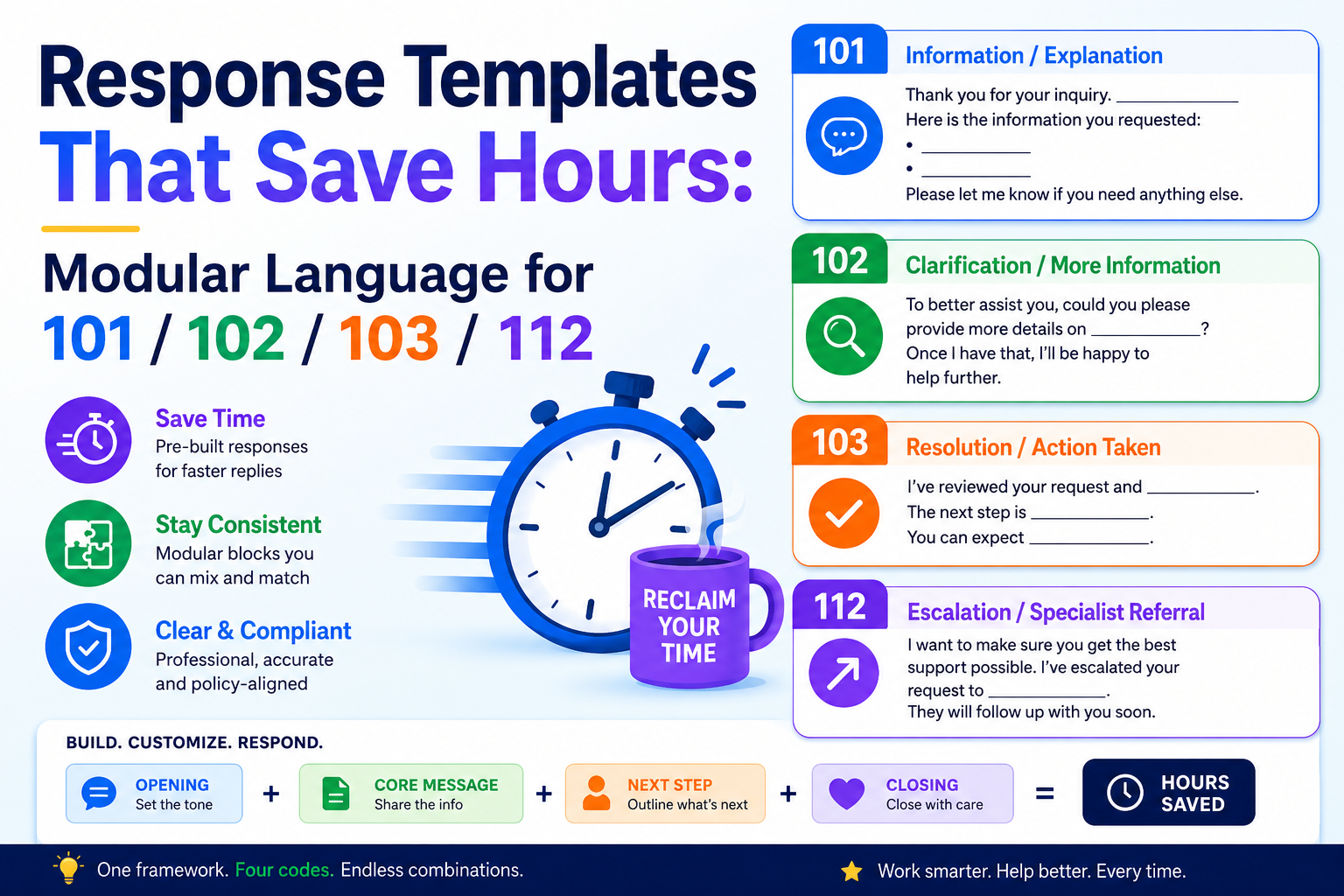
A patent office response can eat your whole week if you start from a blank page. You read the rejection. You reread it. You hunt for the right words. Then you try to explain why the invention is new, useful, clear, and not obvious without sounding weak, vague, or too narrow.
Start with a response map before you touch the wording
A strong office action response starts before the first sentence is written. The real work is not typing. The real work is sorting the rejection into parts you can answer one by one.
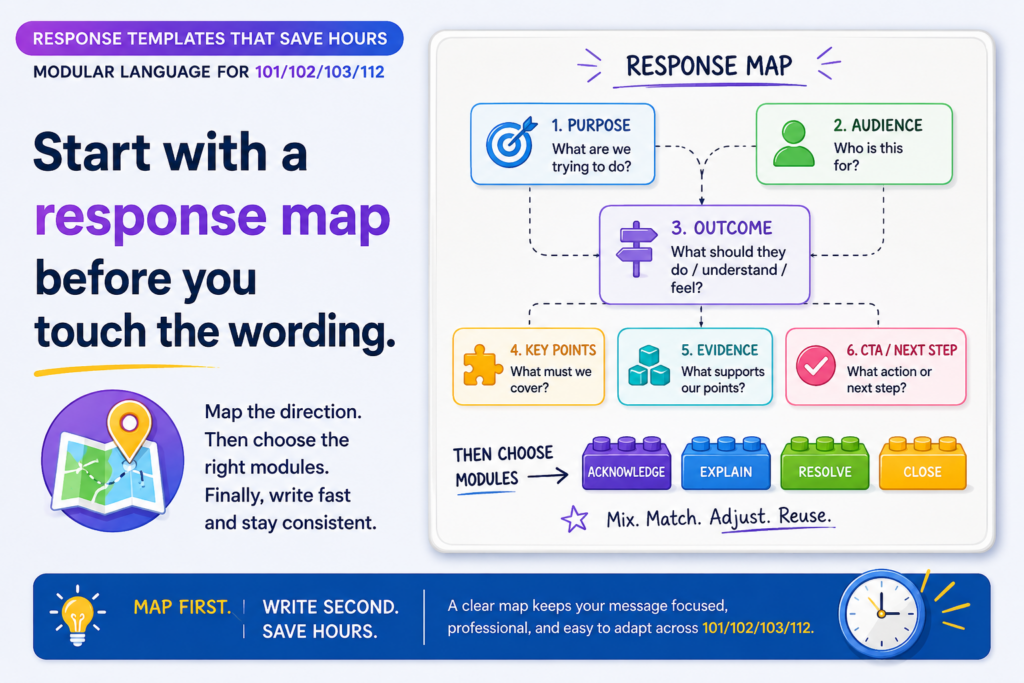
This is where many teams lose hours. They treat the response like a blank essay, when it should feel more like a build plan.
A good response map keeps your argument from drifting
When an examiner rejects claims under 101, 102, 103, or 112, the rejection often looks larger than it is. There may be long text, several cited passages, and many claim numbers.
But under all that, the examiner is usually saying one clear thing. The invention is not the right kind of subject matter. Or it was already shown. Or it would have been obvious. Or the claim language is unclear or unsupported.
Your first job is to find that core point. Then you write a short map that says what you will fix, what you will argue, and what you will leave alone.
This map protects your time because it keeps the response from becoming a long defense of everything in the application.
The map should name the issue, the claim feature, and the answer
A useful map can be written in plain words. For example, you might write: “The 101 issue is aimed at claim 1.
The answer is that the claim is not just a result. It recites a specific data process that improves how the system works.” That one sentence can guide the full response.
For a 102 rejection, the map may say: “The cited reference does not teach the claimed trigger rule, because the reference only starts the process after manual user input.”
For a 103 rejection, it may say: “The combination does not explain why a skilled person would move the timing step from the server to the device.” For a 112 rejection, it may say: “The term is supported by the example in the spec, and we can add clearer wording if needed.”
That is the power of modular language. You are not writing from fear. You are building from a clear path. PowerPatent helps founders do this faster by turning invention details into structured patent work with smart software and real attorney review. You can see the workflow here: https://powerpatent.com/how-it-works
Use a simple opening template that frames the response cleanly
The opening of the response should not be dramatic. It should not sound defensive.
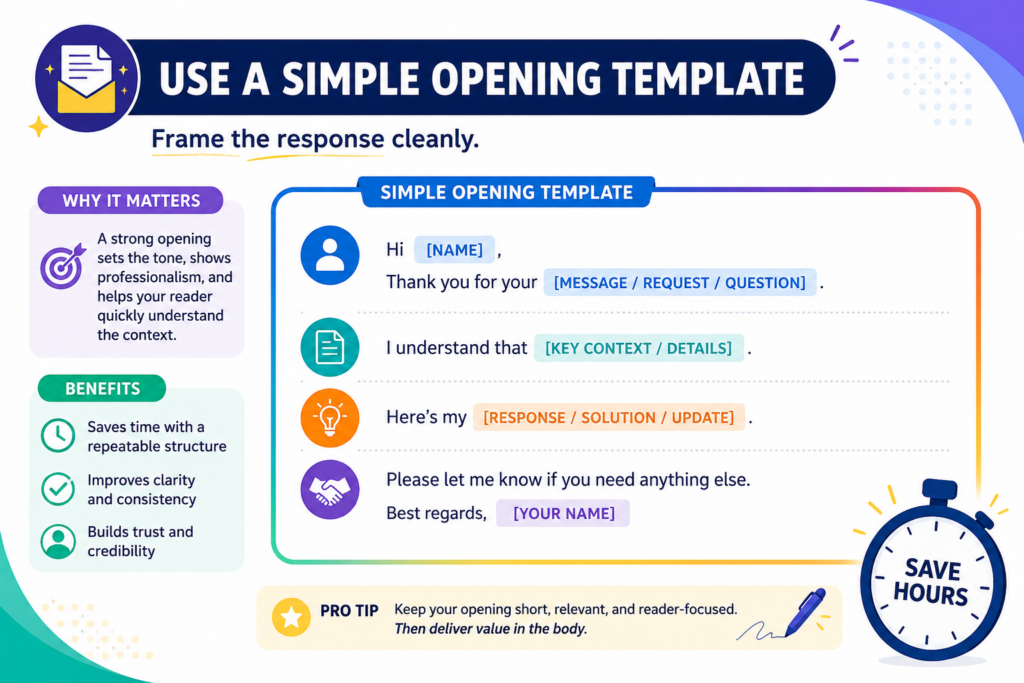
It should tell the examiner what changed, what is being argued, and why the claims should move forward. A clean opening saves time because it sets the tone for the rest of the paper.
The best opening sounds calm, direct, and useful
Many weak responses start with too much background. They retell the whole invention. They praise the technology. They explain the market.
That may feel helpful, but it often hides the point. The examiner needs to see the path from rejection to allowance as clearly as possible.
A strong opening can follow a simple pattern. It thanks the examiner, identifies the claim changes, and states that the claims are now in condition for further review. The wording should be respectful and firm.
A modular opening should leave room for both amendment and argument
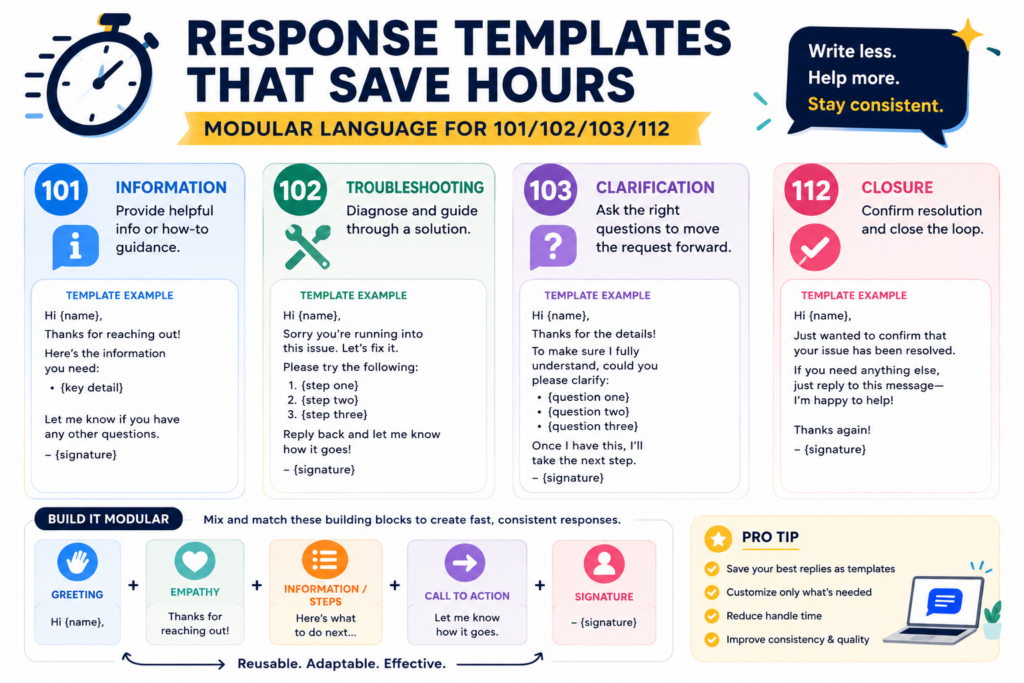
Here is a flexible version that can be adapted:
“Applicant thanks the Examiner for the review of the application. In response, the claims have been amended to clarify the claimed features and to better distinguish the invention from the cited art.
As explained below, the pending claims are directed to specific technical features that are neither taught nor suggested by the cited references and are fully supported by the application as filed.”
This kind of opening works because it does not overpromise. It gives you room to address 101, 102, 103, and 112 without locking you into a narrow story too early. It also uses normal words.
That matters. Clear writing is easier for the examiner to follow, easier for the attorney to refine, and easier for the founder to understand.
For startup teams, this also reduces back-and-forth. When the first draft is clean, the legal review gets faster.
That is one reason PowerPatent pairs AI tools with real attorney oversight, so the work moves quickly without leaving important choices unchecked. Learn how PowerPatent helps teams file with more confidence here: https://powerpatent.com/how-it-works
Build your 101 response around the real-world improvement
A 101 rejection is often the most frustrating one for founders because it can feel abstract. The company may have built real software, real models, real systems, or real hardware.
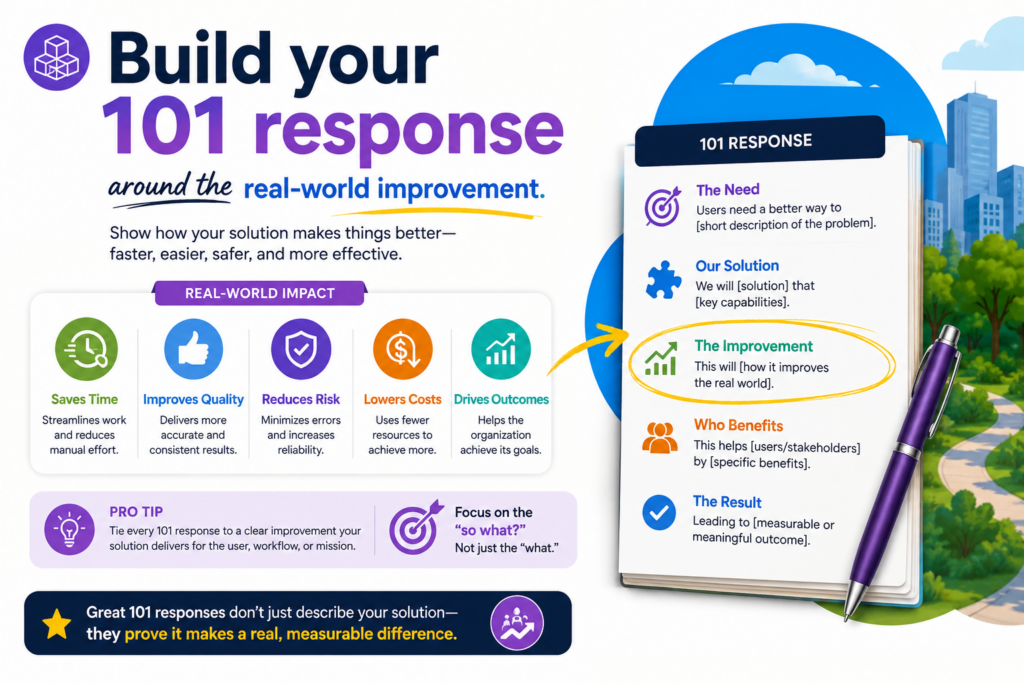
Then the rejection says the claim is directed to an abstract idea. The response should not argue that the invention is important in a broad way. It should show that the claim solves a real technical problem with specific steps.
The mistake is saying the invention is not abstract without proving why
A weak 101 response often says, “The claims are not abstract because they are tied to a computer.” That is usually not enough.
Many inventions use computers. The stronger answer is to explain what the computer does differently because of the claimed features.
The response should point to the exact claim language that improves the system. Maybe the claim reduces delay. Maybe it changes how data is grouped.
Maybe it improves model output. Maybe it prevents a bad state in a device. Maybe it makes a network action more secure. The key is to connect the claim to a practical improvement.
A useful 101 template ties the claim to a specific system change
Here is modular language that can be adapted:
“The pending claims are not directed merely to a desired result. Instead, the claims recite a specific way of achieving that result through defined processing steps.
In particular, claim 1 requires receiving the input data, applying the claimed rule to identify a condition, and causing the system to perform the recited action based on that condition. These features describe how the system operates, not just what the system is intended to accomplish.”
This template works because it shifts the focus from outcome to method. It tells the examiner that the claim does not just say “do it better.” It shows how the invention does it.
You can also add a stronger improvement sentence when the facts support it:
“These claimed features improve operation of the system by reducing unnecessary processing before the action is triggered and by causing the system to respond only when the claimed condition is met.”
That sentence is simple, but it does heavy work. It points to a real system benefit. It also keeps the response grounded in the claim language.
For technical founders, this is often where the patent story becomes much clearer. The invention is not just an idea. It is a way the system behaves.
Use 101 language that avoids sounding too broad
A 101 response can become risky when it tries to cover too much. The goal is not to say that every version of the business idea is patentable.
The goal is to show that the claims, as written or amended, recite a concrete technical solution. That difference matters.
Narrow enough to be credible does not mean narrow enough to be weak
Founders often worry that a focused argument will shrink the patent. That can happen if the response is careless.
But a focused argument is not the same as a narrow patent. The right response explains the value of the claimed features without giving away more than needed.
For example, do not say that the invention only works with one model type unless that is truly needed.
Do not say that the improvement only applies to one industry unless the claim requires it. Do not turn a flexible invention into a small one just to answer a rejection.
The best 101 template uses the claim language as the guardrail
A safe and useful template may read:
“The claims are directed to a specific implementation of the described technology. The response does not rest on the mere use of generic computer components.
Rather, the claims define particular operations that control how data is processed and how the system responds. When read as a whole, the claims provide a practical application of the recited features.”
This language is helpful because it stays close to the claim. It does not make sweeping statements. It also avoids turning the response into a long policy debate about software patents.
When useful, you can add:
“The Examiner’s characterization of the claims does not give full weight to the recited sequence of operations.
The claimed process is not simply collecting and using information. It requires the claimed condition to be detected and used in the specific manner recited.”
This is the kind of language that saves hours because it can be reused across many software and AI cases. It still needs attorney review. It still needs facts. But it gives the team a strong base instead of a blank page.
If your team is building in AI, robotics, chips, clean tech, data systems, or deep software, this kind of structure can make a big difference.
PowerPatent helps turn technical work into clear patent language with software plus real attorney oversight. See the process here: https://powerpatent.com/how-it-works
For 102, make the missing feature impossible to miss
A 102 rejection says the examiner believes one earlier reference already shows the claimed invention.
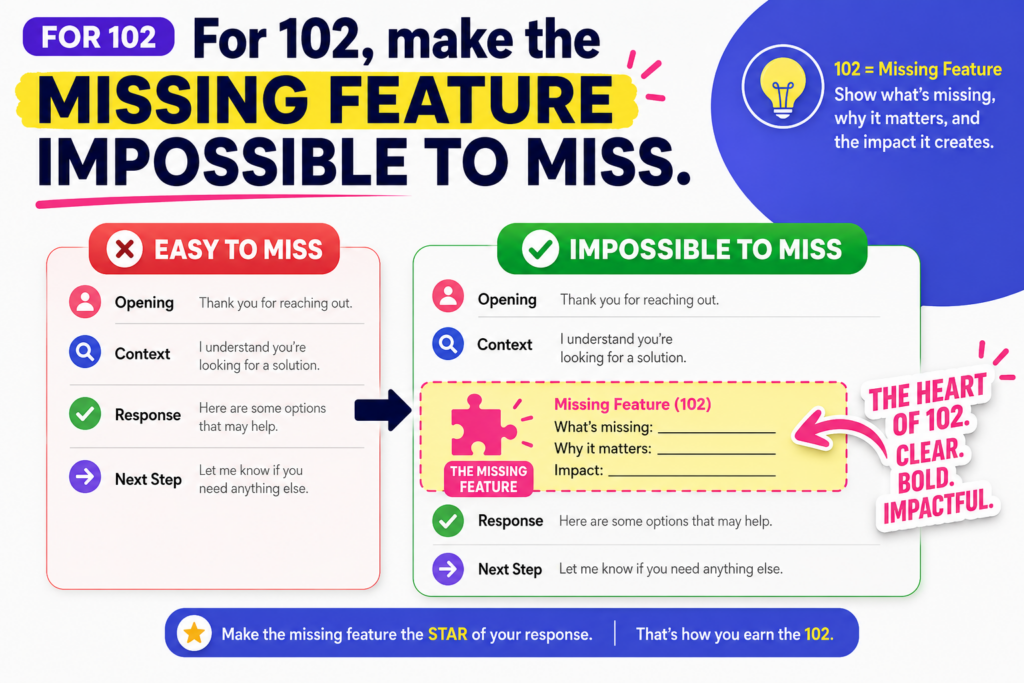
The answer should be sharp. You do not need to explain every difference between your invention and the reference. You need to show at least one claim feature that is missing from that single reference.
The strongest 102 response is built around one clean gap
Many teams waste time by arguing ten small differences. That can make the response look scattered. A better approach is to find the cleanest missing feature and build the response around it.
The missing feature should be something actually recited in the claim, not just something from the product or the founder’s pitch deck.
Start by reading the claim like a checklist. Then read the cited reference passage. Ask one simple question: where does the reference show this exact feature? If the answer is not clear, that is where the response begins.
A 102 template should compare the claim and the cited passage in plain words
A strong template can read:
“The cited reference does not disclose every feature of claim 1. In particular, claim 1 requires [claimed feature]. The Office Action appears to rely on [cited portion] for this feature.
However, that portion describes [what the reference actually says], which is different from the claimed [feature]. Because the cited reference does not teach this required claim element, it does not anticipate claim 1.”
This template is simple, but it is powerful. It gives the examiner a direct comparison. It does not insult the examiner. It does not overstate the case. It shows the gap and explains why the gap matters.
For example, if your claim requires automatic model retraining after a confidence score drops below a threshold, but the cited reference only shows manual review, the response should say that clearly.
The missing point is not “better AI.” The missing point is the automatic trigger tied to the confidence score. That is the claim feature that matters.
This is also where good drafting up front saves a lot of pain later. If the claim was written with clear technical hooks, the 102 response is much easier to build.
PowerPatent helps founders capture those hooks early, before key details get lost in rushed drafting. You can explore the workflow here: https://powerpatent.com/how-it-works
For 102, do not argue the whole invention when one claim part wins
A 102 rejection can tempt you to defend the full story of the invention. That feels natural because founders know why the whole thing matters. But an office action response is not a product demo.
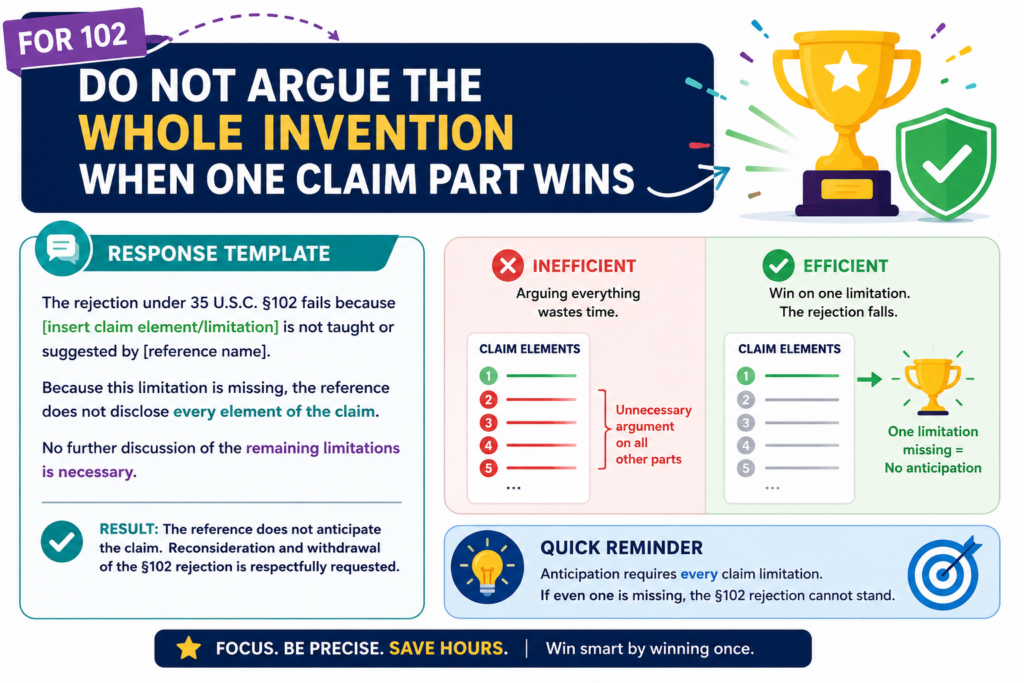
It is a focused answer to a specific rejection. If the examiner says one reference shows every part of the claim, your job is to show that it does not.
The cleanest path is to isolate one required claim element
The best 102 argument often turns on one small but important claim feature. That feature may not sound exciting on its own.
It could be a timing rule, a data format, a control signal, a model input, a sensor state, or a handoff between two systems. But if the claim requires it and the reference does not show it, the rejection has a problem.
This is where modular language saves time. You do not need to invent a new response style each time. You need a clear pattern that compares the claim to the cited teaching.
The pattern should be direct enough that the examiner can see the missing piece without hunting for it.
The missing feature should be named in the same words used by the claim
A useful 102 response can say:
“The Office Action has not identified where the cited reference discloses the claimed [feature]. Claim 1 requires [claim language]. The cited portion instead describes [reference language or concept].
That disclosure is not the same as the claimed feature because [short reason]. As a result, the reference does not disclose all elements of claim 1.”
This template works because it keeps the argument locked to the claim. It does not drift into business value. It does not rely on broad praise. It simply says what the claim requires, what the reference shows, and why those two things are not the same.
For example, a claim may require “automatically updating a routing rule based on a detected device failure.” The reference may show a user changing a route after seeing an alert. Those are not the same.
The key difference is not that your system is smarter. The key difference is that the claim requires automatic rule updating based on detected failure, while the reference only shows manual change after user review.
That kind of answer is easier to review, easier to refine, and easier to defend. It also helps founders see what matters in the claim.
When teams use PowerPatent, the goal is to capture these kinds of technical details early, so the response later has real support instead of guesswork. You can see how PowerPatent helps teams move from invention details to stronger patent work here: https://powerpatent.com/how-it-works
Use 103 templates that attack the reason to combine, not just the pieces
A 103 rejection says the invention may not be shown in one single reference, but the examiner believes a person could combine multiple references to reach the claim.
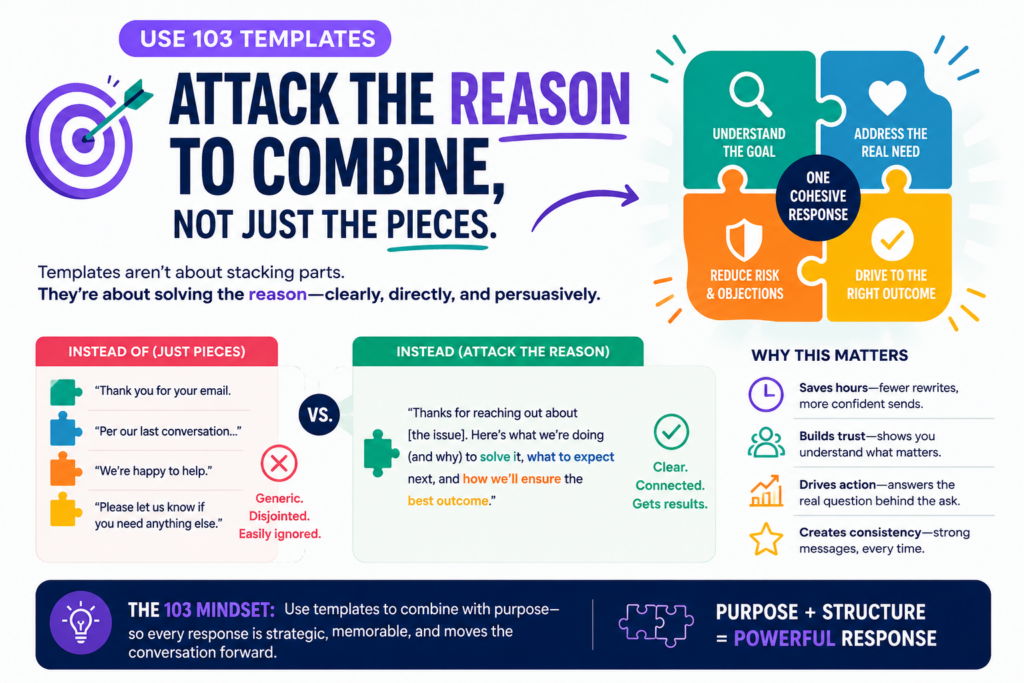
This is where many responses become too long. Teams spend pages explaining that the references are different. But different alone is not always enough. The stronger question is why someone would combine them in the claimed way.
A good 103 response focuses on the bridge between the references
Think of a 103 rejection like a bridge. One reference is on one side. Another reference is on the other side. The examiner must explain why a skilled person would cross from one to the other and arrive at the claimed invention. If that bridge is weak, the response should point to the gap.
The response should not merely say, “Reference A does not teach this, and Reference B does not teach that.” That can help, but it may not finish the job.
The stronger answer explains that the proposed combination would not lead to the claimed structure, process, or result without using the application as a roadmap.
The best 103 language shows why the proposed change is not natural
A useful 103 template can say:
“The Office Action relies on a combination of [Reference A] and [Reference B]. However, the cited portions do not provide a reason to modify [Reference A] in the manner required by claim 1. [Reference A] describes [what it does]. [Reference B] describes [what it does].
The Office Action does not explain why a skilled person would change [specific feature of Reference A] to include [claimed feature] as recited in claim 1.”
This template helps because it does not just deny the rejection. It makes the examiner face the exact modification. It asks a fair question: why would someone make this change?
Here is another version for cases where the proposed combination changes the basic operation of the first reference:
“The proposed modification would change how [Reference A] performs its stated process. [Reference A] relies on [existing operation], while claim 1 requires [claimed operation].
Replacing or altering that operation in the proposed way would not be a simple use of known parts. It would change the way the system of [Reference A] functions.”
This is useful in software, AI, hardware, and device cases. A small change in where data is processed, when a model is updated, or how a signal is generated can change the whole system. The response should make that clear.
For founders, this is an important lesson. The value of the invention often lives in the “why this way” part. PowerPatent helps teams pull that out early, with smart software that helps organize the invention and real patent attorneys who check the legal path. See how it works here: https://powerpatent.com/how-it-works
In 103 responses, show why the claim is more than a simple swap
Examiners often use 103 when each claim part seems known by itself. This can be frustrating because almost every invention uses some known parts. A startup does not build from magic.
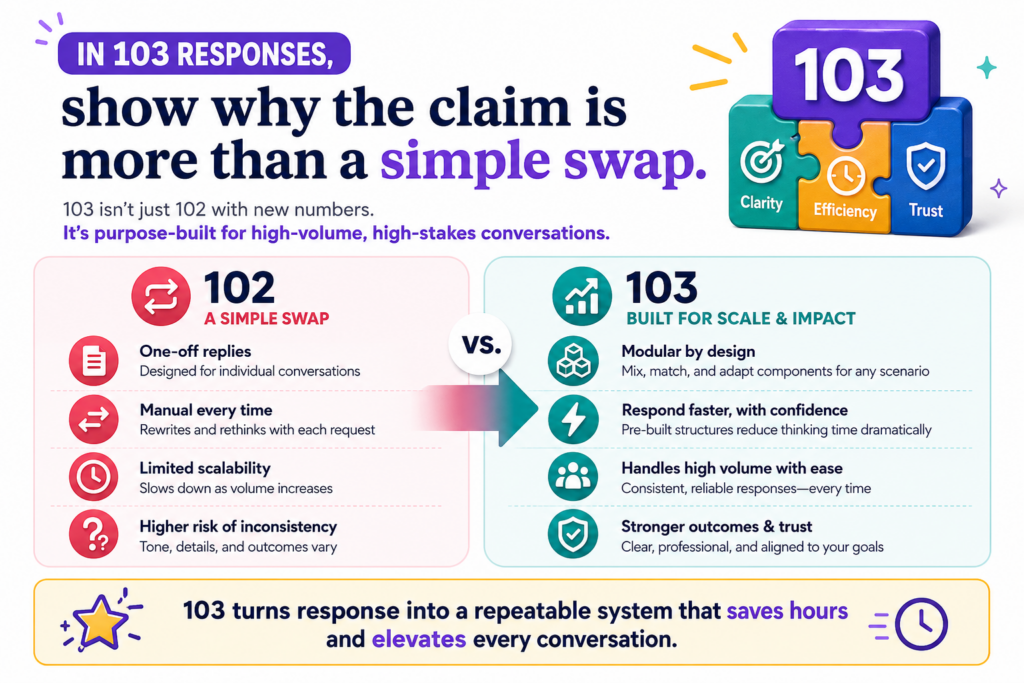
It builds from code, chips, models, sensors, APIs, tools, and systems that already exist. The patent point is often the way those parts are arranged, timed, controlled, or connected.
The response should explain the claimed relationship between the parts
A weak 103 response says, “The prior art does not teach the invention as a whole.” That may be true, but it is too broad. A stronger response explains the relationship that the claim creates.
Maybe one step depends on a threshold from another step. Maybe a model output controls a physical action. Maybe one device changes behavior based on a state detected somewhere else. Maybe the order of steps is the point.
That relationship is often what makes the invention hard to copy and easier to defend. The response should make that relationship visible.
A strong template should make the combination feel less automatic
A useful template can say:
“The rejection treats the claimed features as separate items that can be placed together. Claim 1, however, does not merely list independent parts.
The claim requires a specific relationship between those parts. In particular, [first claimed feature] is used to control [second claimed feature] in the manner recited. The cited references do not teach or suggest that relationship.”
This language is helpful because it reframes the issue. The invention is not just a pile of known tools. It is a specific working arrangement.
Another useful template can be used when the order matters:
“The proposed combination does not account for the required order of operations in claim 1. The claim requires [first step] before [second step], and the result of [first step] is used in [second step].
The cited references do not teach that sequence or explain why a skilled person would arrange the process in that manner.”
This kind of wording is very useful for AI and software claims. In those fields, the order and control flow can be the invention. A system that filters data before model input is not the same as a system that filters after output.
A device that changes state before a network call is not the same as a device that changes state after server approval.
This is why modular response language should never be empty boilerplate. The module gives the shape, but the facts do the work.
A good team fills the template with the real feature, the real gap, and the real reason the examiner’s combination does not reach the claim.
PowerPatent is built for this kind of work. It helps technical teams explain what they built in a structured way, then pairs that process with attorney oversight, so the final filing or response is not just fast but thoughtful. You can learn more here: https://powerpatent.com/how-it-works
Use 112 templates to make claim language clear without giving away scope
A 112 rejection usually means the examiner sees a problem with clarity, support, or how the claim is written. These issues can feel smaller than 101, 102, or 103, but they can still slow the case down.
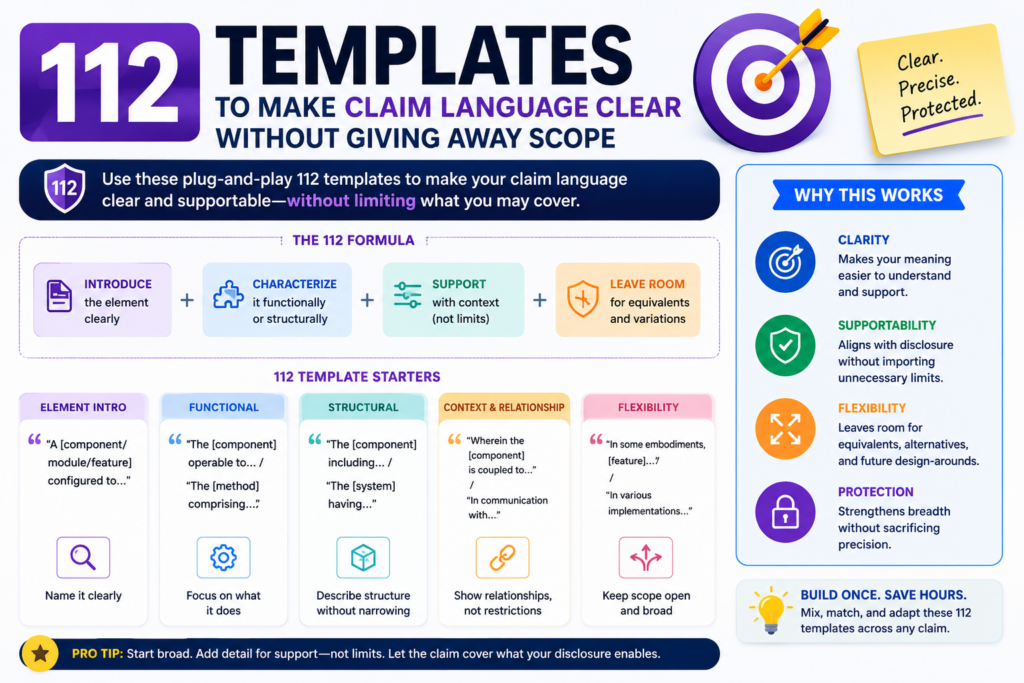
A good 112 response should be calm and practical. Sometimes the best move is to explain the support. Sometimes it is better to amend the claim. Often, the best response does both.
The goal is to remove doubt while keeping the invention broad enough
A common mistake is to overreact. Teams see a 112 rejection and add too much detail to the claim. That may fix the clarity issue, but it can also make the claim too narrow. The better approach is to find the smallest clear change that solves the problem.
Start by asking what the examiner does not understand. Is a term unclear? Is the relationship between steps uncertain? Is there a missing link between the claim and the written description?
Is the claim trying to cover a result without enough structure? Once the issue is clear, the response becomes much easier.
The safest 112 language ties the claim back to the original application
A useful template for written description support can say:
“The application as filed provides support for the recited feature. For example, the specification describes [supporting disclosure] in connection with [system, process, or example].
The amended claim language is consistent with that disclosure and clarifies the feature without adding new matter.”
This template does two important things. It points to support, and it makes clear that the amendment is not adding something new. That matters because new matter can create a bigger problem than the one you are trying to solve.
For clarity issues, a useful template can say:
“Applicant has amended claim 1 to clarify the meaning of [term or phrase]. The amendment is intended to make explicit what was already described in the application, namely that [plain explanation]. Accordingly, the claim now more clearly defines the scope of the invention.”
This wording is simple and respectful. It does not fight when a clean fix is better. It also avoids saying the old claim was bad. It frames the change as a clarification.
For founders, 112 issues are a reminder that patents are not only about big ideas. They are also about clean language. The right words protect the right thing. The wrong words can create delays, confusion, or weak coverage.
PowerPatent helps teams avoid these traps by combining smart drafting tools with real attorney review, so key details are captured and checked before they become expensive problems. See the process here: https://powerpatent.com/how-it-works
Turn 112 clarity problems into clean claim fixes
A 112 clarity issue can feel annoying because it may not attack the heart of the invention. Still, it can block progress if it is not handled with care. The best response is not loud. It is precise.
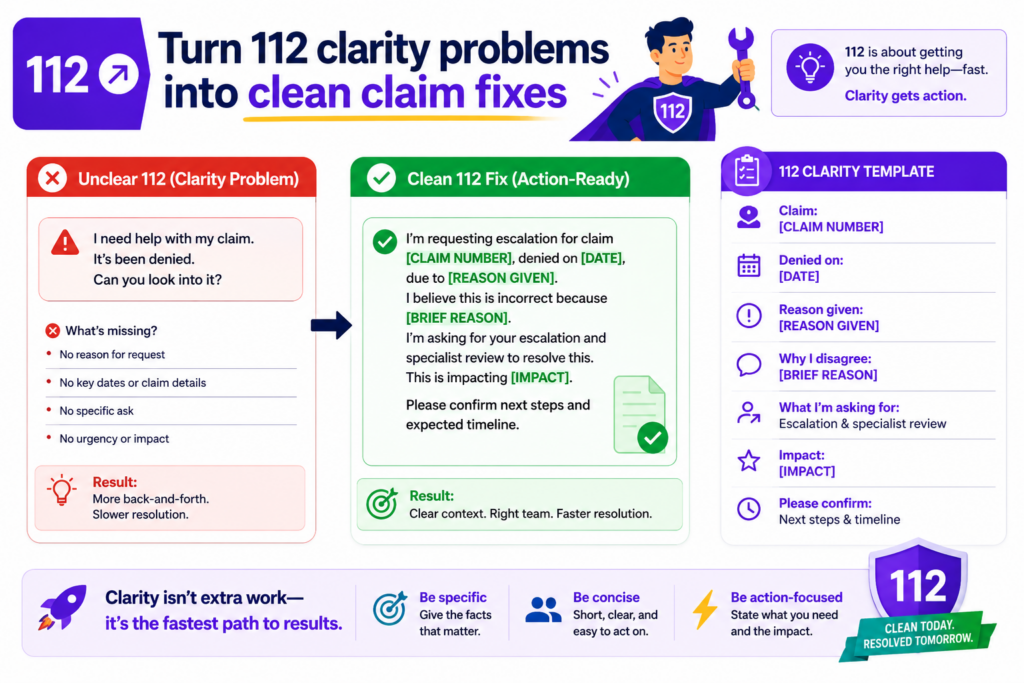
You want the examiner to see that the claim now says what it means, and that the meaning was already supported in the application.
A clarity fix should answer the examiner without rebuilding the claim
When an examiner says a term is unclear, the team may want to rewrite the whole claim. That is usually too much. A better move is to find the smallest phrase that caused the issue and repair only that part.
For example, a claim may say “the score” when the claim has two different scores. The fix may be as simple as changing the phrase to “the risk score” or “the confidence score.” That kind of change can remove doubt without shrinking the claim in a harmful way.
A strong template explains that the change is a clarification, not a retreat
Here is a useful response block:
“Claim 1 has been amended to clarify that the recited score refers to the risk score generated by the model. This change is consistent with the application as filed, which describes generating the risk score based on the received input data and using that risk score to control the later system action.
The amendment clarifies the claim language and does not add new matter.”
That kind of language does three jobs at once. It tells the examiner what changed. It points back to support. It also avoids making the change sound like a major surrender.
For founders, this is a smart habit. Do not treat every office action as a fight. Some issues are better solved by clean edits. The trick is knowing which edits help and which edits hurt.
That is where attorney oversight matters. PowerPatent helps technical teams move faster while still getting that review, so patent work does not become a guessing game. You can see how the process works here: https://powerpatent.com/how-it-works
Use modular claim amendment language to show purpose without overexplaining
Amendments are often the center of a response. They can move a case forward, but they can also create future risk if the wording is sloppy. Every amendment should have a reason.
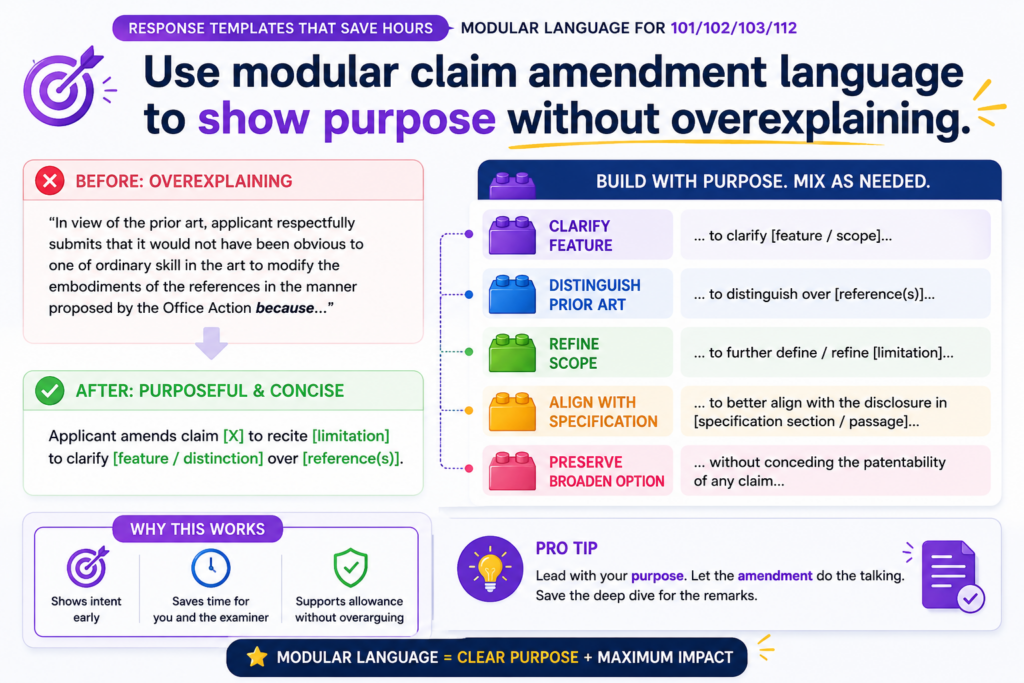
The response should explain that reason in plain words without turning the whole file into a long defense memo.
The best amendment language tells the examiner exactly why the claim changed
A claim amendment should not look random. The examiner should understand why new words were added and how they address the rejection.
This does not mean you need to write a long story. It means you should tie the amendment to the issue.
If the rejection is based on a missing technical detail, the amendment should make that technical detail clear. If the rejection is based on a broad reading of the claim, the amendment should guide the examiner toward the right reading.
If the rejection says a reference shows a feature, the amendment may sharpen the feature so the gap is easier to see.
A clean amendment template can reduce review time across the whole team
A useful block can read:
“Claim 1 has been amended to further clarify that [amended feature]. This amendment highlights the specific manner in which the system performs the claimed operation. As amended, claim 1 requires [plain explanation of the feature], which is not taught or suggested by the cited references.”
This template is helpful because it connects the amendment to the argument. It does not make the examiner guess why the claim changed. It also gives the attorney a clean base to refine.
Another strong version can be used when the amendment responds to a 101 issue:
“Claim 1 has been amended to make explicit the specific processing steps used by the system.
The claim now recites how the data is evaluated and how the system action is triggered based on that evaluation. These features show a concrete technical process rather than a mere desired result.”
This wording is simple, but it gives structure to the response. It helps show that the claim is not just claiming a goal. It claims a way to get there.
Startup teams often know the “how” in their heads, but that detail may not be clear in the claim. PowerPatent helps pull out those details early so claims can be written with stronger hooks from the start.
That saves time during filing and can also save time when an office action arrives. Learn more here: https://powerpatent.com/how-it-works
Create a reusable 101 response block for software and AI inventions
Software and AI inventions often get hit with 101 rejections because examiners may view them as data handling, math, or decision rules.
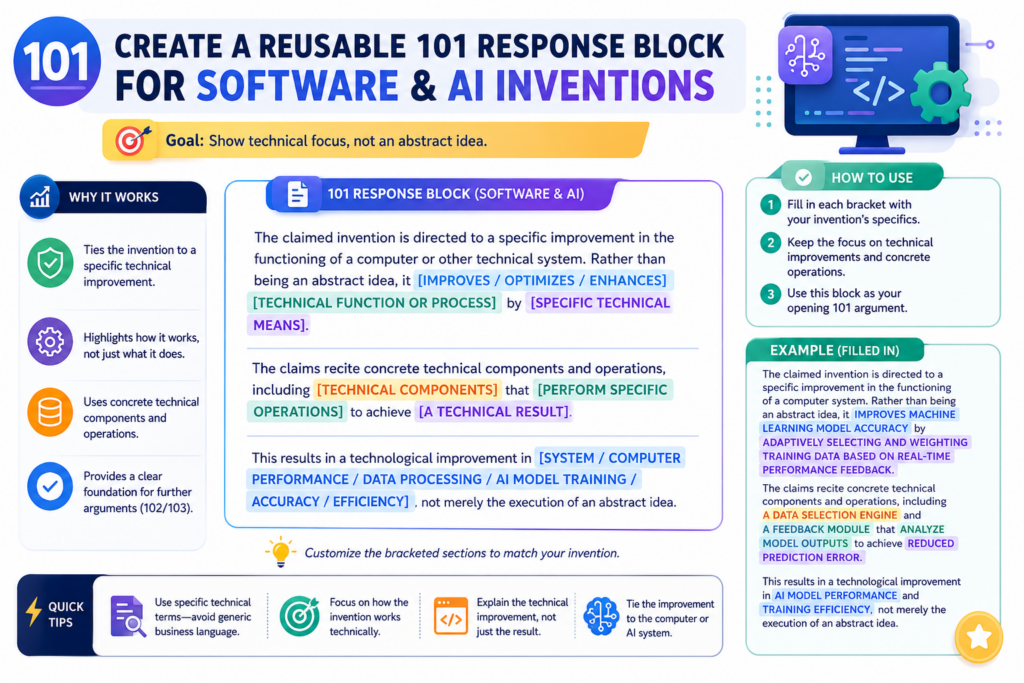
The response needs to make the technical side clear. It should show that the claim is not just about using information. It is about a specific system behavior that improves how the technology works.
The response should make the machine action easy to see
For software and AI, the most useful question is simple: what does the system do differently because of the claim? If the answer is only “it gives a better result,” the response may be weak.
If the answer is “it changes how the model is trained, how data is filtered, how signals are routed, how alerts are triggered, or how a device is controlled,” the response has a stronger base.
The key is to connect the claim to a real process. Do not just say the invention is technical. Show the technical steps.
A software-focused 101 template should point to control, timing, or data flow
A strong response block can say:
“The pending claims recite more than the use of a computer to perform a general task. Claim 1 defines a specific processing flow in which [first operation] is performed, [second operation] is performed based on the result of the first operation, and [system action] is triggered only when the claimed condition is met.
This claimed flow changes how the system processes data and controls the resulting action.”
This block works well because it gives the examiner something concrete. It shows a sequence. It shows dependency. It shows action. Those three things often matter in software and AI cases.
For an AI model case, the language might become:
“The claim does not merely recite applying a model to data. Instead, the claim requires generating a confidence value, comparing that value to the claimed threshold, and changing the later processing path based on the comparison.
The claimed features define how the system manages model output and controls later processing.”
That is much stronger than saying, “The invention uses artificial intelligence.” The examiner does not need a pitch. The examiner needs claim-based reasons.
This is also why founders should not wait until the office action to explain the invention clearly. Strong patent work starts when the system is first described.
PowerPatent helps founders turn code, models, workflows, and technical notes into clear patent material with smart software and real attorney oversight. See how PowerPatent works here: https://powerpatent.com/how-it-works
Create a reusable 103 response block for “common sense” rejections
A 103 rejection may rely on the idea that the claimed change would have been common sense.
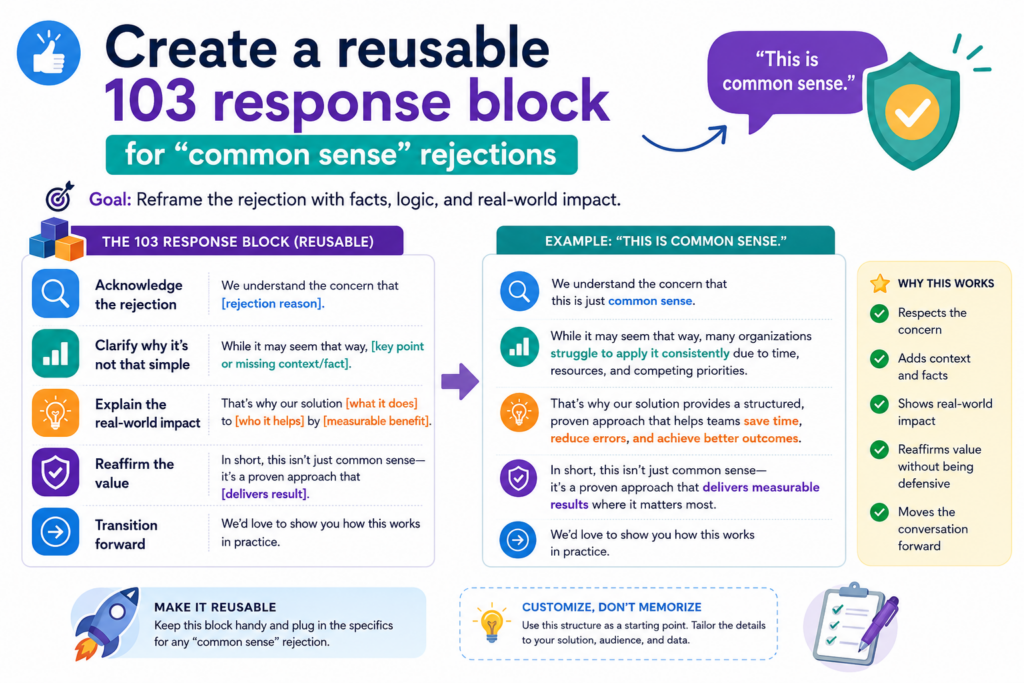
That can be hard to answer because “common sense” sounds broad. The response should stay calm and ask for a real link between the prior art and the claimed feature.
The answer should show why the claimed change is not just an obvious next step
The best response does not say common sense can never be used. That is too broad and not helpful. Instead, the response should explain why this particular change is not supported by the cited record.
If the examiner says it would have been obvious to add a feature, ask what problem the cited art was trying to solve. Ask whether the added feature helps that system.
Ask whether the change would alter how the system works. Ask whether the claim requires more than simply adding a known tool.
A practical template can push the rejection back to the actual facts
A strong response block can say:
“The Office Action states that it would have been obvious to include [claimed feature]. However, the cited references do not explain why a skilled person would have modified [primary reference] in that manner.
The proposed change is not a simple addition of a known feature. It would require changing how [primary reference] performs [operation], because claim 1 requires [specific relationship or sequence].”
This template is useful because it makes the rejection more specific. It moves the discussion away from broad labels and back to the actual system.
Here is a second version for cases where the examiner combines references but does not explain the reason well:
“The rejection identifies separate teachings from the cited references, but it does not provide a supported reason to combine those teachings in the claimed manner.
Claim 1 requires [claimed feature] to be used with [other claimed feature] in a specific way. The cited references do not show that relationship, and the Office Action does not explain why a skilled person would have created it.”
This kind of answer is often enough to sharpen the debate. It helps the examiner see that the claim is not just a set of parts. It is a working design with a specific flow.
For deep tech startups, this matters a lot. Many inventions are not new because every part is brand new. They are new because the team found a better way to connect the parts.
PowerPatent helps teams capture that better way before it gets lost in broad language. Explore the workflow here: https://powerpatent.com/how-it-works
Create a reusable 112 support block for features that are already in the application
A 112 support issue often shows up when the examiner thinks the claim says more than the application explains. This can happen even when the invention is fully real and well built.
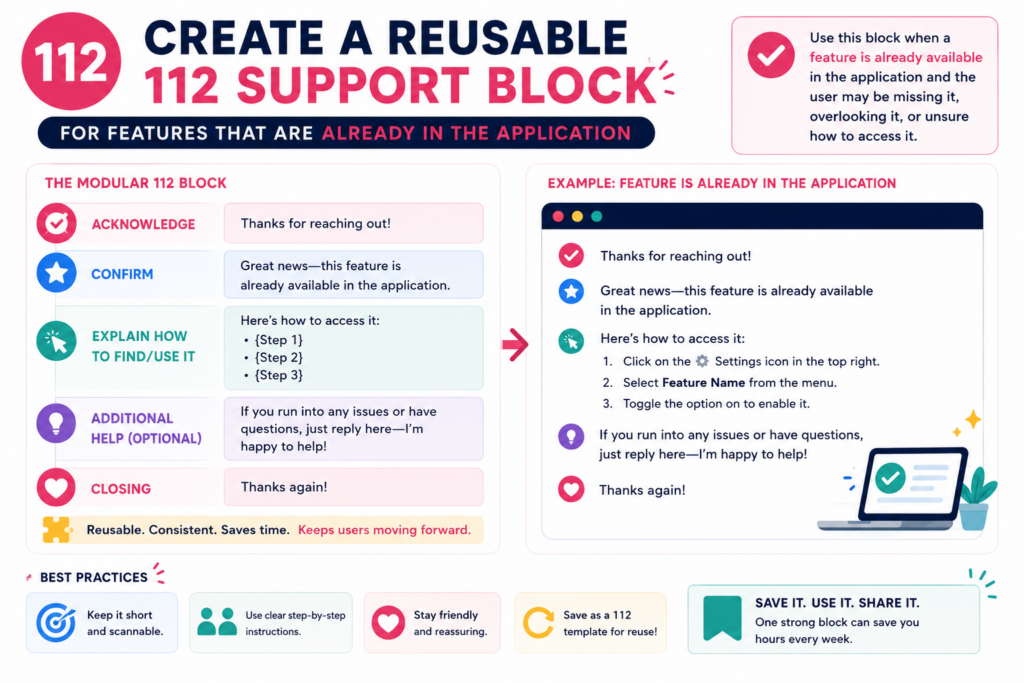
The problem is usually not the invention. The problem is the link between the claim words and the written description.
A good response should make that link easy to see. The goal is not to flood the examiner with every page of the application. The goal is to point to the part that supports the claim and explain the match in plain words.
The response should connect the claim feature to the original disclosure
The most useful 112 support response starts with the exact claim feature. Then it points to where the application describes that feature. Then it explains why the claim is not reaching beyond what was filed.
This is important because patent language can sound broader than the founder intended. A claim may say “generating a control output,” while the application describes several examples of how the control output is made.
The response should show that the claim is tied to those examples and that the meaning is already present in the original application.
A clear support template should make the record easy to follow
A strong template can say:
“Support for the recited feature is found in the application as filed. The specification describes [plain description of support] in connection with [system or example].
That disclosure explains that [claimed feature] is performed as part of the described process. Accordingly, the claim language is supported by the original disclosure.”
This language is simple and clean. It does not sound defensive. It does not overstate anything. It gives the examiner a direct path from the claim to the specification.
When an amendment is also made, the response can say:
“Claim 1 has been amended to more closely track the language and examples provided in the application as filed. The amendment clarifies that [feature] is performed by [component or process], as described in the original application.
The amendment therefore clarifies the claim while remaining fully supported by the original disclosure.”
This type of wording can save a team from over-editing. It also helps avoid the common mistake of adding shiny new detail that was not clearly in the original filing. That mistake can create new issues.
For founders, the lesson is clear. The best time to create support is before filing, not after rejection.
PowerPatent helps teams capture the real invention while the details are still fresh, then adds attorney review so those details are placed where they can actually help. See how it works here: https://powerpatent.com/how-it-works
Use examiner-friendly language without sounding weak
A strong response should be respectful, but not timid. It should help the examiner understand the invention without making the applicant sound unsure.
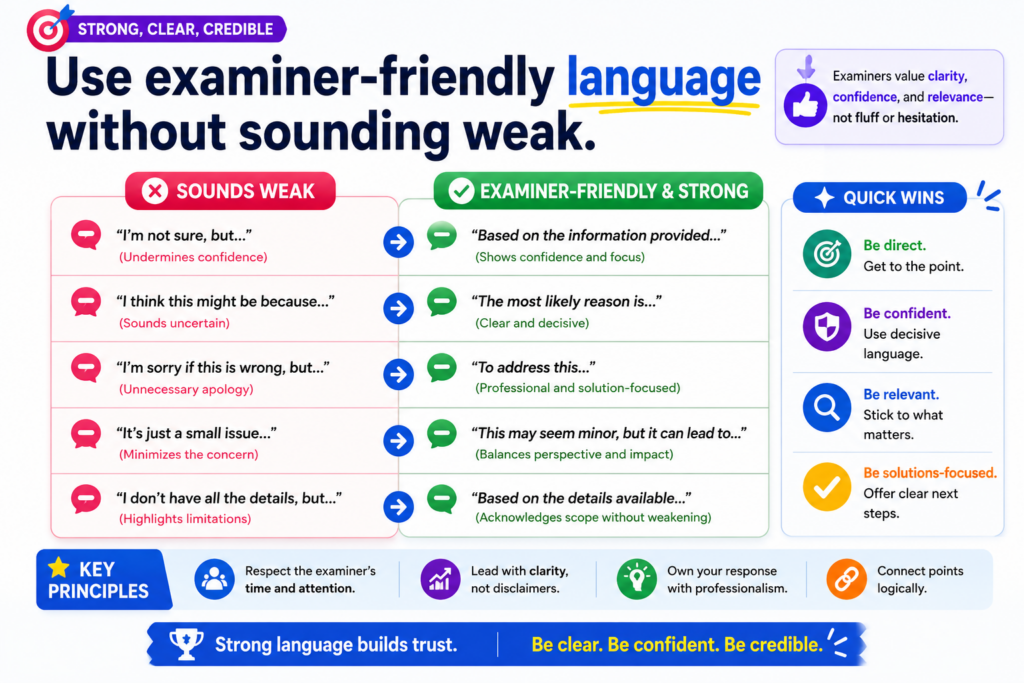
The tone matters because the response becomes part of the written record. It should be clear, steady, and useful.
Many teams write responses that sound either too soft or too aggressive. Too soft sounds like the applicant is asking for a favor. Too aggressive can make a small issue feel like a fight. The best tone is confident and practical.
The response should invite agreement by making the next step obvious
An examiner-friendly response does not mean giving up ground. It means making the argument easy to accept.
The examiner has limited time. If your response is hard to follow, even a good argument may not land. If the response is clean, the examiner can see the issue and move the case forward.
This is where modular language helps. It removes emotional wording. It gives the team repeatable language that is calm and clear.
The response should say what the claim requires, what the reference shows, and why the rejection does not fit. That is enough.
Strong wording can still be plain and respectful
A useful phrase is:
“Applicant respectfully submits that the cited reference does not disclose the claimed feature.”
That is firm without being sharp. It does not accuse the examiner of being wrong in a personal way. It focuses on the reference and the claim.
Another useful phrase is:
“The cited portion describes a different operation.”
This is often better than saying the examiner misunderstood the invention. It keeps the discussion on the evidence.
For 103, a clean phrase can be:
“The Office Action does not identify a supported reason to modify the primary reference in the claimed manner.”
This is direct. It places the issue where it belongs. The response is not saying the invention is great because the founder loves it. It is saying the rejection has not shown the required path.
For 112, a useful phrase can be:
“The amendment clarifies the scope of the claim and is consistent with the application as filed.”
This calms the issue. It tells the examiner that the applicant has cleaned up the language without adding something new.
Good response language should reduce friction. It should make the examiner’s job easier and the applicant’s position stronger at the same time. That is also the kind of balance PowerPatent is built to support.
Founders get speed and structure from smart software, while real patent attorneys help protect the strength of the filing. You can learn more here: https://powerpatent.com/how-it-works
Build a modular response library your team can actually use
A response template is only useful if the team can find it, trust it, and adapt it fast. A messy folder full of old responses is not a system.
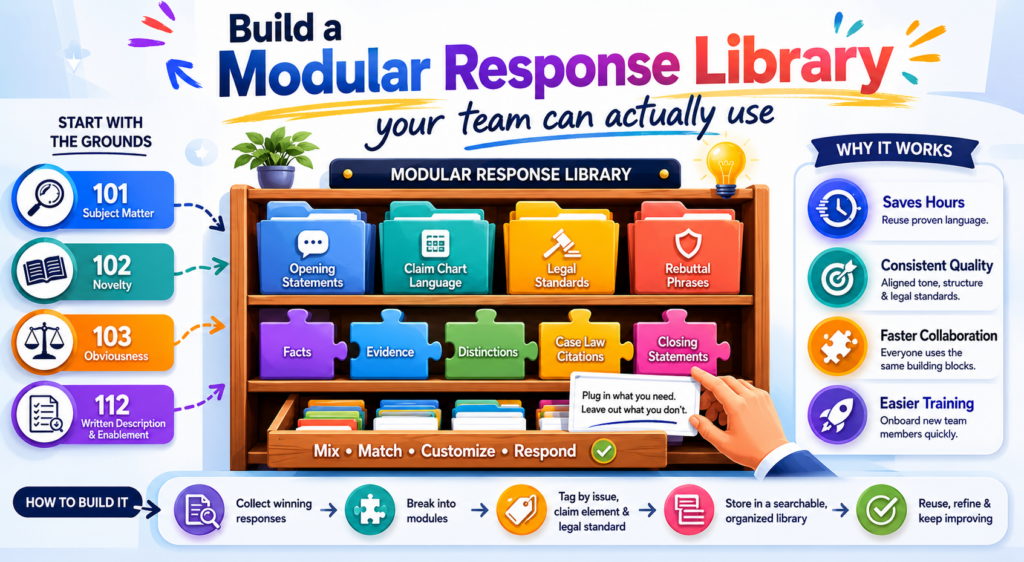
A real response library is organized by rejection type, claim issue, and use case. It should help a drafter move from problem to draft without digging through old files for an hour.
The goal is not to turn patent work into copy and paste. That would be dangerous. The goal is to create strong starting blocks that make careful work faster.
The library should be built around problems, not document names
Many teams save old responses by matter name or filing date. That may help with recordkeeping, but it does not help much when you need to draft. A better library is organized by the kind of issue you need to solve.
For example, the team should have 101 language for software workflows, model-based systems, device control, data filtering, and technical improvements.
It should have 102 language for missing elements, wrong timing, wrong actor, wrong data type, and wrong trigger.
It should have 103 language for weak combinations, changed operation, missing reason to combine, and claim relationships. It should have 112 language for clarity, written support, antecedent basis, and claim amendments.
The best templates include notes that tell the drafter when not to use them
A template without guardrails can create bad habits. Each block should include a plain note that explains when the language fits.
For example, a 102 missing-element block should only be used when one reference truly fails to teach a required claim feature.
A 103 no-reason-to-combine block should only be used when the examiner has not explained why the references would be combined in the claimed way.
The team should also mark the parts that must be customized. The claim feature must be real. The cited reference must be checked.
The technical effect must be supported. The response should never leave placeholder thinking inside polished words.
A strong library can also include short before-and-after examples. The “before” version shows the common weak argument. The “after” version shows a cleaner, claim-based response.
This helps junior team members learn faster and helps founders understand why the wording matters.
For a startup, this kind of system can save real time. It can also reduce stress because the team is not starting from zero each time an office action arrives.
PowerPatent brings this same idea into the patent process by helping founders structure invention details, generate stronger starting points, and work with real attorneys who review the output. See how PowerPatent helps teams protect what they build here: https://powerpatent.com/how-it-works
Make each template pass the “claim, cite, explain” test
Every useful response block should pass one simple test. It should state the claim feature, address the cited material, and explain the gap.
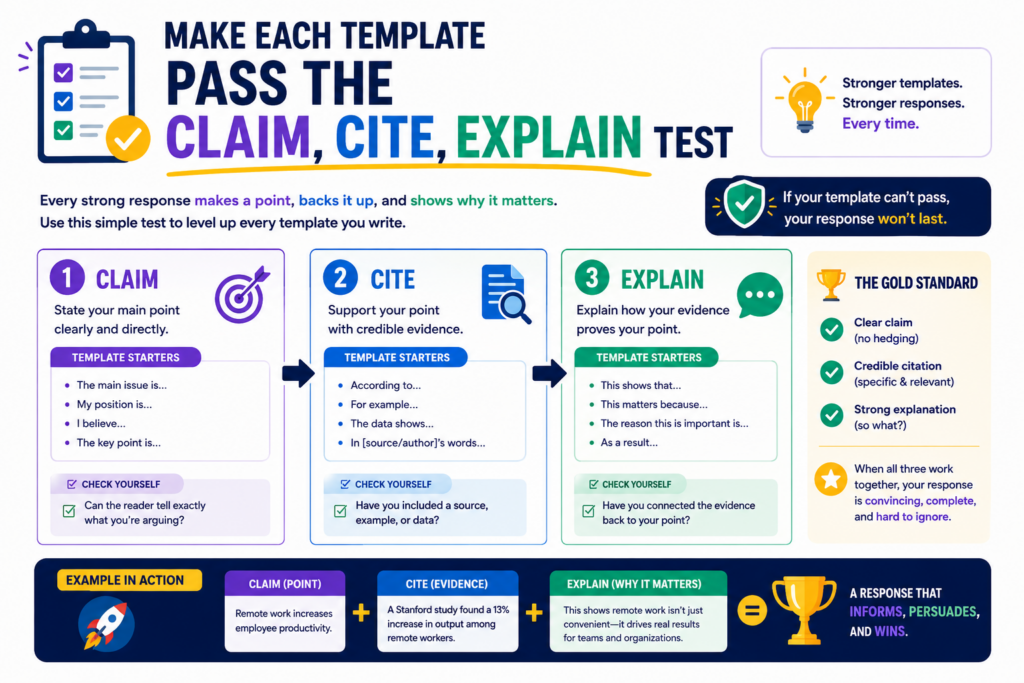
If any of those three pieces is missing, the response may sound polished but still fail to do the job.
This test is easy to remember and hard to fake. It forces the writer to stay tied to the actual rejection. It also helps prevent long, vague arguments that do not move the case forward.
The claim feature is the anchor of the response
The response should start with what the claim requires. Not what the product does. Not what the founder hoped to protect. Not what the market needs. The claim is the anchor.
If claim 1 requires “selecting a training data subset based on a detected drift value,” then the response should use that idea directly. It should not blur the feature into “better model training.”
Broad language may sound strong, but it often weakens the argument because it gives the examiner room to point to a broad teaching in the reference.
The cited material is the second part. The response should identify what the examiner relied on and describe it fairly. If the cited reference teaches a score, say that it teaches a score.
Then explain why that score is not the claimed drift value or why it is not used to select the training data subset.
The explanation is where the template becomes an argument
A strong block can say:
“Claim 1 requires selecting a training data subset based on a detected drift value. The Office Action appears to rely on the reference’s disclosure of ranking stored records.
That disclosure is different from the claimed feature. Ranking stored records does not teach detecting drift in model behavior and using the drift value to select training data for later model processing.”
This is the “claim, cite, explain” test in action. The claim feature is clear. The cited material is named. The gap is explained in plain words.
For a 103 rejection, the same structure can work:
“Claim 1 requires the drift value to control selection of the training data subset. The cited references discuss model training and stored data ranking, but the rejection does not explain why a skilled person would have used a drift value to control the claimed selection step.
The proposed combination therefore does not account for the specific relationship required by claim 1.”
That paragraph is not fancy. It does not need to be. It is useful because it is exact.
Founders often think strong patent work means using complex language. In reality, strong patent work often means using simple language that makes the technical point impossible to miss.
PowerPatent is built around that idea. It helps technical teams turn real invention details into clearer patent work, with software for speed and attorneys for judgment. Explore the process here: https://powerpatent.com/how-it-works
Build templates that help you amend without painting yourself into a corner
A response template should help you move the case forward, not trap the patent in a tiny box. This is why amendment language needs care.
When you add words to a claim, those words can help beat a rejection. But they can also limit what the claim covers later.
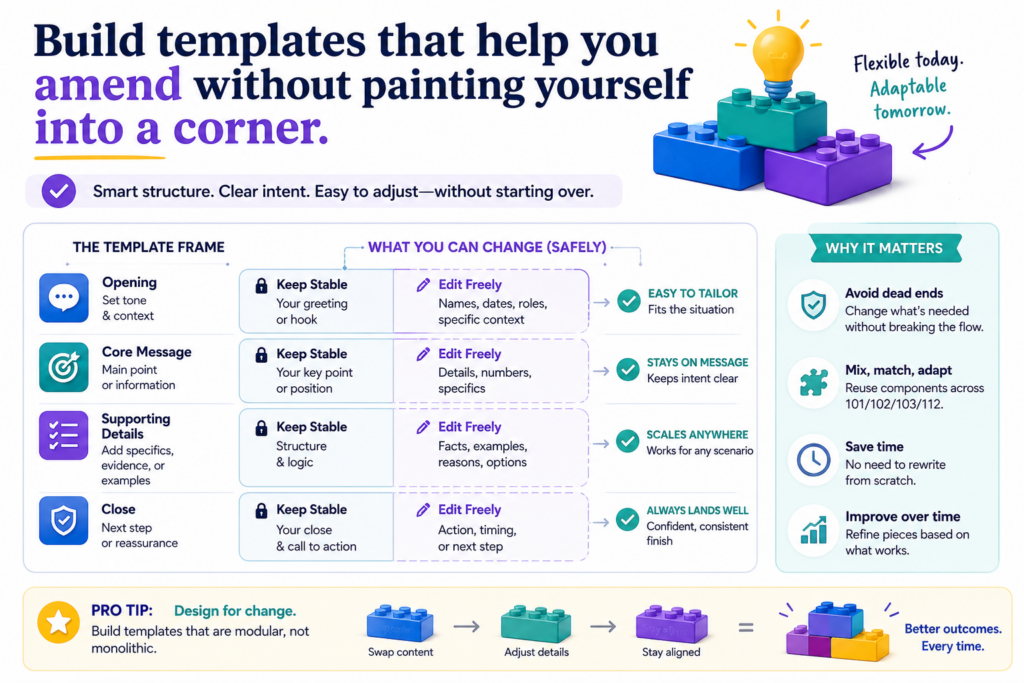
The goal is to add enough detail to solve the problem while keeping the claim useful for the business.
A rushed amendment often sounds good in the moment. It may get past one reference. But later, it may make the patent easier for a competitor to avoid. That is not a win.
A strong amendment should be based on the real invention, supported by the original application, and tied to the rejection in front of you.
The best amendment starts with the feature that matters most
Before adding language, ask what the rejection is actually missing. If the examiner is using a reference that lacks a trigger rule, do not add a full product workflow when the trigger rule is enough.
If the issue is timing, do not add a whole set of hardware limits unless timing is the real point. If the gap is the relationship between two steps, make that relationship clear.
This is where founders and engineers can be very helpful. They often know which details are core and which details are just one version.
The response should protect the core. It should not lock the patent to one demo, one customer setup, or one current product choice unless that choice is truly needed.
A safe amendment template should state the reason for the change in narrow terms
A useful block can say:
“Claim 1 has been amended to clarify the specific relationship between [first feature] and [second feature]. As amended, the claim requires [plain explanation].
This amendment addresses the rejection by making explicit the claimed relationship that is not disclosed or suggested by the cited references.”
This wording works because it explains the amendment without overselling it. It does not say the invention only works that way in every possible case. It says the claim now makes a specific relationship clear.
Another useful version can say:
“The amendment is directed to the feature at issue in the Office Action. In particular, the amended language clarifies that [feature] occurs in response to [condition], rather than merely as part of a general process. The cited references do not teach this claimed condition-based operation.”
That kind of language is especially helpful for software, AI, control systems, medical devices, robotics, and data tools.
Many strong inventions depend on when something happens, what causes it, and what changes because of it. Those are often better amendment targets than broad product labels.
PowerPatent helps teams capture these details earlier, so the attorney is not forced to rebuild the story during prosecution.
When the invention is organized from the start, amendments can be smarter and faster. You can see how PowerPatent works here: https://powerpatent.com/how-it-works
Use response language that protects the invention story for later
A patent response is not just a message to the examiner. It also becomes part of the history of the case. That means the words you use today can affect how the patent is read later.
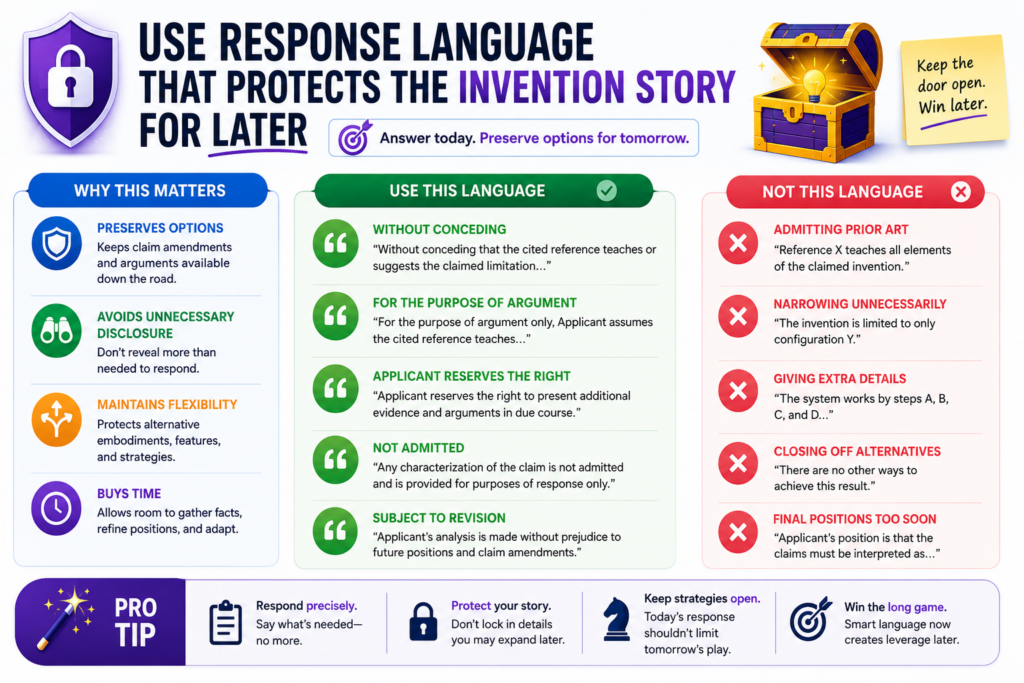
This does not mean you should write in fear. It means you should be clear, steady, and careful with broad statements.
One common mistake is saying too much. A team may want to explain every reason the invention is better. That can feel helpful, but extra comments may create unwanted limits. The response should answer the rejection, not write a full product manual.
Strong language should win the point without creating new problems
A good response uses exact wording. It does not say “the invention requires” when the point is only about one claim.
It does not say “the prior art never teaches” when the argument is only about one cited reference. It does not say “all embodiments require” when only the amended claim requires the feature.
These small choices matter. “Claim 1 requires” is often safer than “the invention requires.” “The cited reference does not disclose” is often better than “no prior system discloses.” “In the claimed arrangement” is often better than “in all cases.”
A careful template keeps the argument tied to the pending claims
A useful block can say:
“As presently claimed, claim 1 requires [feature]. The cited reference does not disclose that feature because [reason]. Applicant therefore respectfully submits that the rejection of claim 1 is not supported by the cited disclosure.”
This template is strong because it stays within the current claim. It does not make sweeping promises about every version of the technology. It also keeps the focus on the examiner’s evidence.
For a 103 rejection, the same careful style can read:
“The present response addresses the proposed combination as set forth in the Office Action. That combination does not teach or suggest the claimed arrangement because [reason].
In particular, the cited references do not provide a reason to modify [primary reference] to include [feature] in the manner required by claim 1.”
This keeps the argument clean. You are not saying no one could ever combine the references in any way. You are saying the rejection, as presented, does not reach the claim. That is the right level of focus.
For founders, this is one of the hardest parts of patent work. You want broad protection, but broad protection depends on careful words.
PowerPatent gives teams a more guided way to turn technical work into patent-ready material, then brings in real attorney oversight to help avoid costly wording mistakes. Explore the process here: https://powerpatent.com/how-it-works
Make dependent claim templates work harder for you
Dependent claims are often treated like backup. That is true, but they can do more than sit there.
A good response uses dependent claims to show fallback points, technical depth, and extra reasons the cited art falls short. When used well, they can help move a case forward without giving up the main claim too soon.
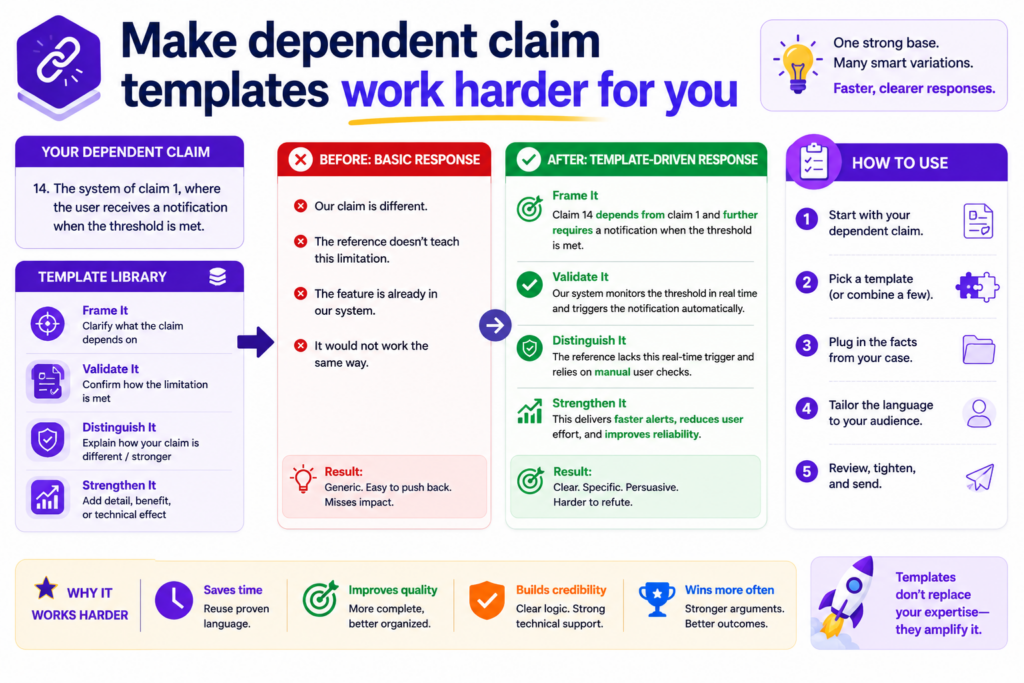
A dependent claim may cover a narrower version of the invention. It may add a specific rule, device, data type, threshold, model step, signal path, or control action.
If the examiner rejects all claims together, the response should not always let that pass. Sometimes the best move is to show why the dependent claims deserve separate attention.
A dependent claim response should not sound like a copy of the main claim response
If claim 1 is rejected under 103 and claims 2 through 10 are rejected in the same paragraph, there may be hidden opportunity.
The examiner may not have clearly shown where the extra features are taught. Your response can make that issue visible.
The key is to keep it short and useful. You do not need a long argument for every dependent claim. You need to point out the claims that add real technical weight. This can be especially helpful when the main claim is close, but a dependent claim has a stronger gap.
A strong dependent claim template should name the added feature and why it matters
A useful block can say:
“Claim 2 further requires [additional feature]. The Office Action does not identify where the cited references teach or suggest this additional requirement. The feature is not merely an optional detail. It further defines how [system, data, model, or device] operates in the claimed process.”
This works because it prevents the dependent claim from being swallowed by a broad rejection. It forces attention to the added feature.
Another version can say:
“Even if the cited references were applied to claim 1 as proposed, they still would not teach the added limitation of claim 2. Claim 2 requires [feature], and the cited references do not disclose [plain explanation of the missing point]. Accordingly, claim 2 is separately allowable for at least this reason.”
This language is useful because it keeps the dependent claim alive as a clear fallback. It also gives the examiner a path to allow something, which can be important in a hard case.
Founders should care about dependent claims because they often protect the real product detail. The broad claim may cover the big idea, but dependent claims can capture the special parts competitors are more likely to copy.
PowerPatent helps teams find those special parts early, so the patent does not miss the details that make the invention valuable. See how PowerPatent helps here: https://powerpatent.com/how-it-works
Conclusion:
A good patent response is not about sounding clever. It is about making the right point fast, with clean words, strong facts, and smart claim support. Modular language helps your team save hours because it turns common 101, 102, 103, and 112 problems into clear response paths. But templates still need judgment. The facts must fit.
The claim must be checked. The record must stay clean. PowerPatent helps founders do this with smart software and real attorney oversight, so your patent work moves faster without losing strength. See how it works here: https://powerpatent.com/how-it-works
Leave a Reply