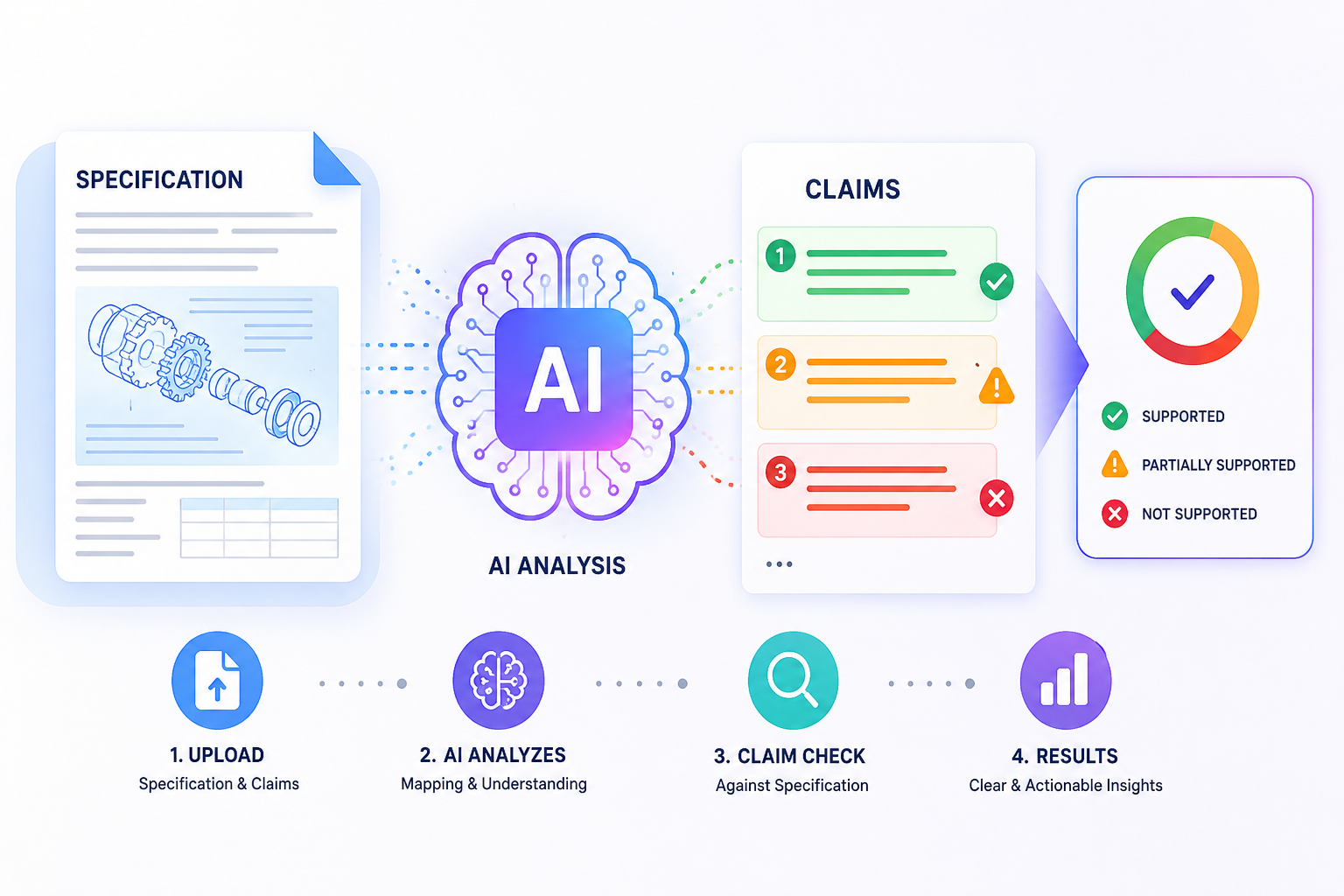
A patent can look strong on the outside and still have weak spots hiding inside. One of the biggest weak spots is a mismatch between the claims and the specification. The claims say what your invention protects. The specification explains how the invention works. If the claims reach too far, miss key details, or use words that are not supported, your patent can become easier to reject, attack, or work around.
Start by treating every claim as a promise the specification must clearly keep
A patent claim is not just a sentence. It is a promise. It says, “This is the part of the invention we want to protect.” The specification must then back up that promise with clear detail.
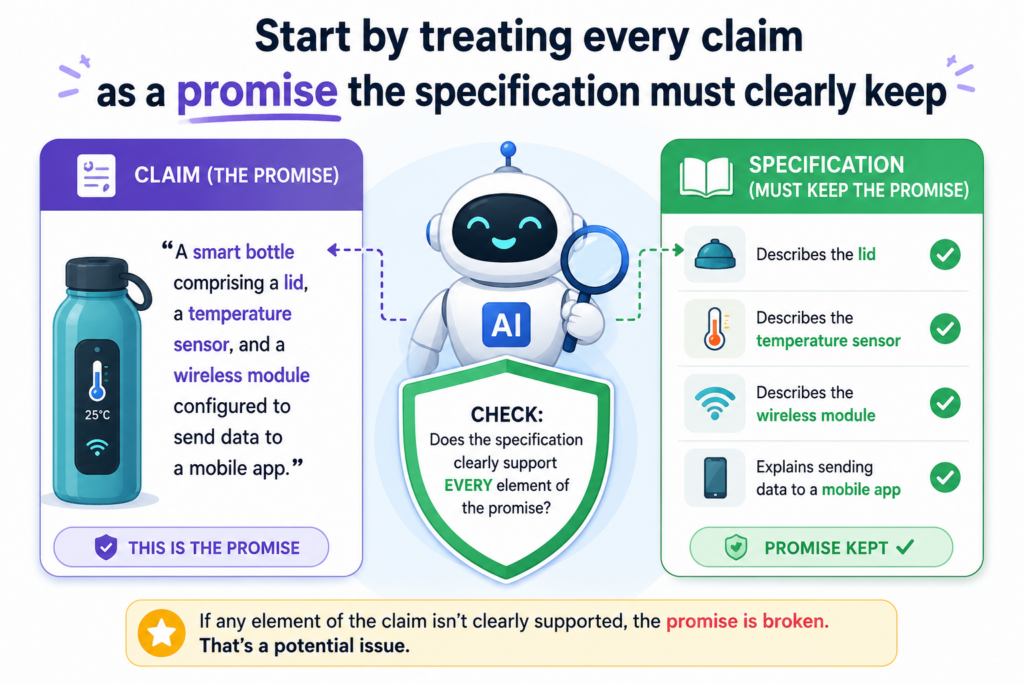
If the claim says the system can do something, the specification should explain how the system does it. If the claim names a part, the specification should show that part.
If the claim uses a broad word, the specification should give enough support so the word does not feel empty.
This is the first mindset shift when using AI to check patent claims. You are not asking AI to “read the patent.” You are asking it to compare each promise in the claims against the actual teaching in the specification.
That small shift makes the review much stronger.
Many founders and engineers draft patent ideas from the product side. They think in features, flows, models, sensors, APIs, training data, user steps, outputs, and business value.
That is natural. But patent claims work in a more careful way. They need support. They need clean links back to the written description.
They need enough detail so a reviewer can see that the inventor truly had the invention at the time of filing.
AI can help because it is very good at pattern matching across long text. It can find where a claim term appears in the specification. It can notice when a term appears only once.
It can flag when a claim uses one word but the specification uses a different word. It can also tell you when the specification describes a feature in a narrow way while the claim tries to cover it in a wider way.
The first AI pass should map each claim term to the exact place where it is supported
The most useful first step is simple. Give the AI your claims and your specification, then ask it to create a support map.
This means each claim element gets matched to the part of the specification that supports it. You are looking for clean proof that every part of every claim has a home in the draft.
For example, a claim may say, “a machine learning model configured to generate a risk score based on sensor data.”
The AI should find where the specification explains the machine learning model, the risk score, the sensor data, and how the model uses that data to create the score. If it can only find some of those pieces, that is a warning sign.
This is not about making the patent sound fancy. It is about making the draft safer. When a claim has no clear support, you may face a rejection.
Worse, the issue may come up later when the patent is challenged. By then, fixing the problem may be harder or impossible.
A good AI review should not just say, “supported” or “not supported.” That is too thin. It should show the exact text that supports the claim.
It should explain whether the support is direct, partial, broad, narrow, or missing. This gives the attorney and founder a real way to improve the draft.
A strong prompt asks AI to act like a careful claim reviewer, not like a creative writer
The quality of your AI output depends on the way you ask. Do not ask, “Are these claims okay?” That invites a soft answer.
Ask for a term-by-term review. Tell the AI to quote or point to the exact supporting language. Tell it not to guess. Tell it to flag weak support even when the idea seems clear.
A useful prompt might say: “Review each claim element against the specification.
For every element, identify the best supporting passage, explain whether support is strong or weak, and flag any term that is not clearly described. Do not rewrite the claims yet. Only identify support issues.”
That kind of prompt keeps the AI focused. It also stops it from jumping too soon into drafting mode.
This matters because claim checking is a review task before it is a writing task. First, you need to know where the problems are. Then you can decide how to fix them.
PowerPatent is built around this same idea. Smart software can help find the weak spots fast, while real patent attorneys make sure the final choices are sound.
That mix gives founders speed without leaving them alone with a risky draft. You can see how PowerPatent works here: https://powerpatent.com/how-it-works
Use AI to find missing support before the patent office finds it for you
Missing support is one of the most common claim problems. It happens when a claim includes something that the specification does not clearly explain.
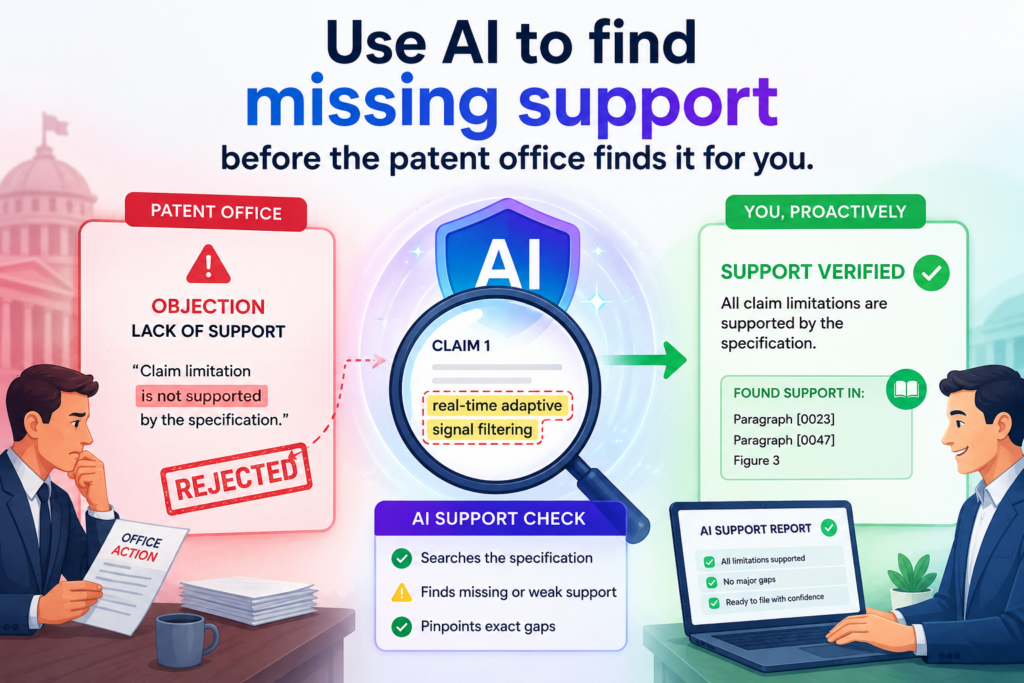
Sometimes the missing piece is a full feature. Other times it is just one word. Either way, it can cause trouble.
This is why AI should be used early, before the draft is filed. Once a patent application is filed, you cannot freely add new technical matter.
You can edit wording in many cases, but you usually cannot add brand-new invention detail that was not in the original filing.
That means the best time to catch missing support is before filing, while the draft can still be improved.
Founders often think the draft is safe because the invention is obvious to them. They know how the model works. They know what the data pipeline does.
They know why the device makes a certain decision. But the patent office only sees what is written. If the written draft skips a step, the reader may not give you credit for what was only in your head.
AI helps by forcing the draft to prove itself on the page.
A good AI review can highlight claim language that sounds unsupported.
It can spot words like “dynamic,” “adaptive,” “secure,” “optimized,” “real-time,” “automated,” or “context-aware” and ask whether the specification actually explains what those words mean in this invention.
These words are not bad. They can be useful. But they must be backed up by real detail.
Missing support often hides in words that feel normal to the engineering team
Engineers use short names all the time. A team might say “the scoring engine,” “the mapper,” “the safety layer,” or “the inference loop.”
Inside the company, everyone knows what those words mean. In a patent draft, those terms need clear support.
If the claim says “safety layer,” the specification should explain what the safety layer is, where it sits in the system, what input it receives, what output it creates, and how it changes the system’s behavior. If those details are missing, the term may be too vague.
AI can compare internal naming across the claims and specification. It can find when the claims use “safety layer” but the specification uses “filter module.”
That may be fine if the connection is clear. But if the draft never says those are the same thing, the reader may get confused.
This is a very practical issue. A patent draft should not make the examiner guess. It should guide the reader from the claims into the specification without friction.
The more friction there is, the more chances there are for rejection, delay, and cost.
The best AI review separates missing support from weak support
Not all support issues are equal. Some terms have no support at all. Others have support, but it is thin.
Some terms are supported only by a single example. Others are supported in the drawings but not explained in the text. AI should help you sort these into clear groups.
Missing support means the claim element cannot be found in any meaningful way. Weak support means the element appears, but the description may not be enough.
Narrow support means the specification describes only one version, while the claim tries to cover more. Confusing support means the idea is present, but the words do not match cleanly.
This difference matters because each problem needs a different fix.
If support is missing, the attorney may need to add detail before filing. If support is weak, the draft may need more examples or a clearer process.
If support is narrow, the claim may need to be tightened, or the specification may need broader language if the invention truly supports it. If support is confusing, the terms may need to be aligned.
This is where AI gives founders leverage. It does not make the legal call by itself. But it helps the team see the draft with fresh eyes. It turns a messy review into a clear working session.
PowerPatent helps founders avoid these slow, painful cleanups by bringing AI review and attorney oversight into the patent workflow from the start.
For technical teams, that means fewer surprises and more control. Learn more here: https://powerpatent.com/how-it-works
Check whether broad claim words are backed by enough real examples
Broad claims can be valuable. A narrow claim may protect only one version of your product. A broader claim may cover future versions, competitor changes, and new ways to use the same core idea.
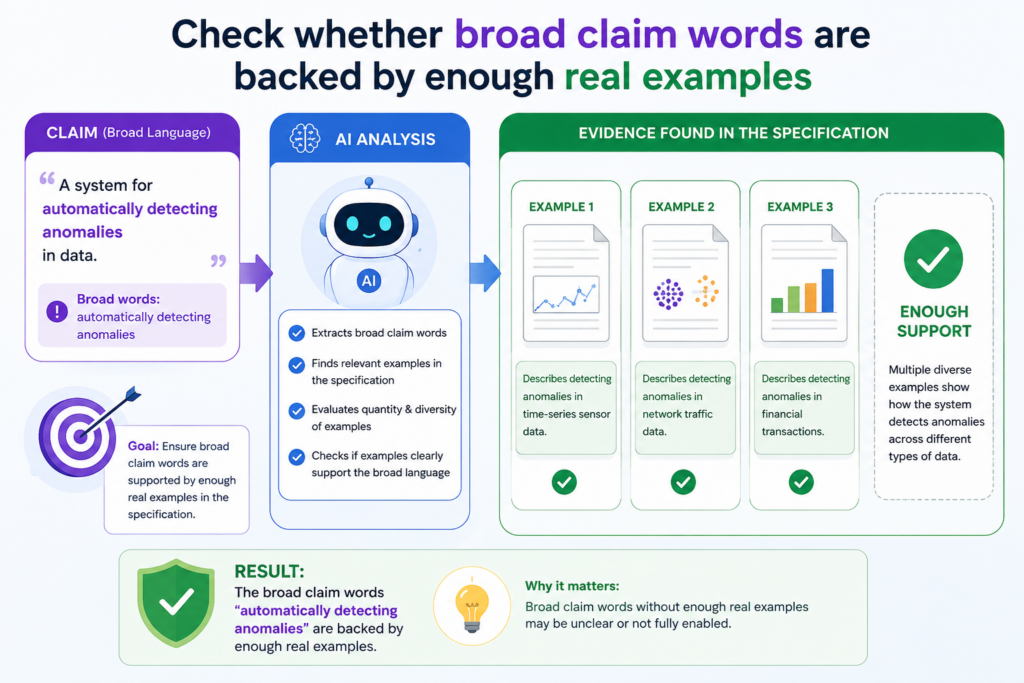
That is why founders often want broad claims. The goal is not only to protect what exists today. The goal is to protect the real invention behind it.
But broad words need care.
If a claim is broad and the specification is thin, the claim may look like a reach. It may seem like the inventor is trying to claim more than they actually taught.
AI can help spot that gap. It can show where the claims stretch beyond the examples in the specification.
For example, a claim may refer to “a data source.” That sounds broad. The specification may only describe a camera.
If the invention truly works with cameras, lidar, radar, temperature sensors, app data, or machine logs, the specification should say that. It should not leave the broader meaning to chance.
The same thing happens with software. A claim may say “a model.” The specification may only describe a neural network.
If the invention can work with a rules engine, a transformer model, a tree-based model, or a hybrid system, the specification should support that range. Otherwise, the broad word “model” may not be as strong as it looks.
AI can test whether the claim is wider than the written story
A helpful AI check is to ask whether each broad term is supported by multiple examples. One example may be enough in some cases, but a richer specification often gives stronger support.
The AI can scan the draft and tell you whether the specification gives only one version or several versions.
This is especially useful for startup patents because products change fast. The first product may use one stack, one model type, one sensor, one workflow, or one user interface.
Six months later, the company may change the architecture. A good patent draft should not be tied so tightly to the first build that it misses the bigger invention.
AI can help you ask the right questions before filing. Does the specification support cloud and edge versions? Does it support local and remote processing? Does it explain different data types?
Does it describe alternate user devices? Does it show more than one way to trigger the key step? Does it cover more than one output format? Does it explain what happens when the system fails, updates, retrains, or receives low-quality data?
These questions are not fluff. They are the difference between a patent that follows your company as it grows and a patent that only protects an early snapshot.
The goal is not to make claims huge but to make them honest and strong
Broad does not always mean better. A claim that is too broad may invite rejection. A claim that is broad without support may create risk. A claim that is broad but unclear may be easy to attack. The goal is balance.
AI can help by pointing out where the claim language may be broader than the specification. Then the team can choose the right fix. Sometimes the claim should be narrowed.
Sometimes the specification should be expanded before filing. Sometimes a dependent claim should be added to capture a key version. Sometimes the drawings need another example.
The right move depends on the invention and the filing plan. This is why attorney review still matters.
AI is powerful, but patents are strategic. A founder should not have to guess which claim scope is safe, useful, and worth fighting for.
With PowerPatent, the software helps surface these claim and specification issues earlier, while attorney oversight helps turn those findings into a stronger filing.
That gives founders the speed of AI with the judgment of real patent professionals. You can explore the process here: https://powerpatent.com/how-it-works
Use AI to catch claim terms that do not match the words in the specification
A patent draft can become weak even when the invention is strong. One common reason is simple word mismatch.
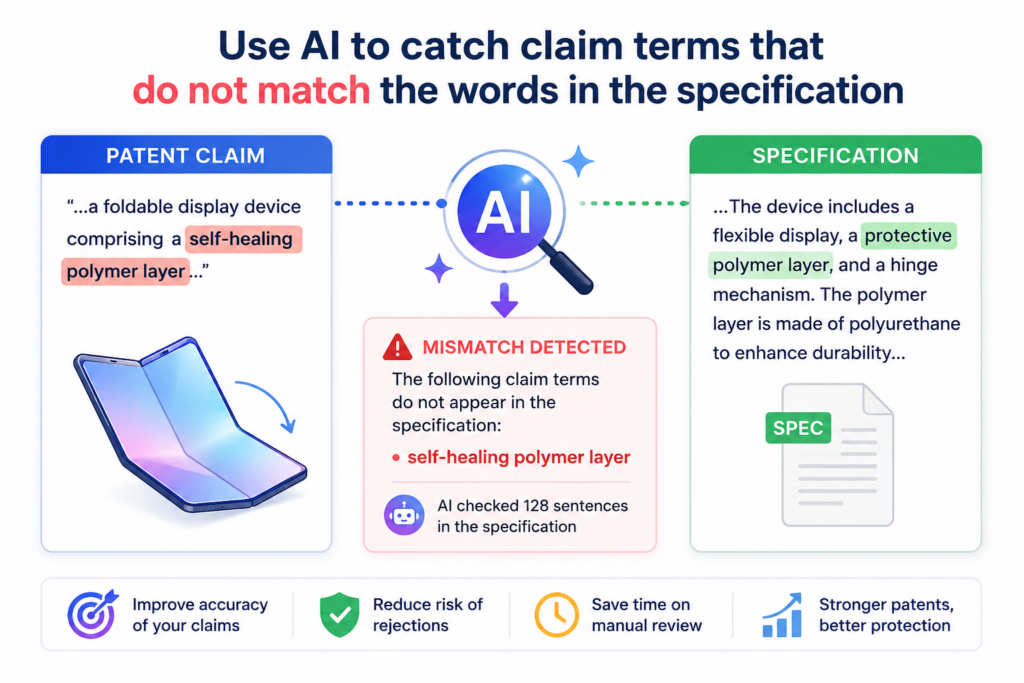
The claims use one word. The specification uses another word. The drawings may use a third word. Each word may point to the same idea, but the draft does not clearly say that. This creates avoidable confusion.
AI is very useful here because it can scan the full draft and compare the language across all parts. It can find claim terms that do not appear in the specification. It can find terms that appear only in the claims.
It can also find terms that appear in the specification but are not used in the claims. That last point matters because the specification may contain strong detail that never makes its way into the protection you are asking for.
For example, the claim may say “prediction module,” while the specification says “forecasting engine.” The founder may see no issue because both mean the same thing to the team.
But a patent reviewer may not read it that way. The reviewer may ask whether these are two different parts. A competitor may later argue that the claim term is unclear or not fully supported.
This does not mean every word must be identical. Good patent drafts often use both broad and narrow terms. But the relationship between those terms should be clear.
If “prediction module” is a broad term and “forecasting engine” is one example, the specification should explain that. If both mean the same thing, the draft should make that connection plain.
Clean wording makes the claim easier to defend and harder to twist
Patent language should not make the reader work too hard. When the claims and specification use clean, steady words, the whole draft feels stronger. The claim points to the invention.
The specification explains it. The drawings support it. The reader can move through the document without stopping to wonder what each term means.
AI can help create a term alignment table during review. The goal is not to make a pretty chart. The goal is to expose small cracks before they turn into real problems.
The AI can show the exact claim term, where it appears in the specification, what related words appear, and whether the draft clearly links them.
This is especially helpful for software and AI inventions because teams often change names while building. A feature might start as a “ranking model,” become a “scoring service,” and later get called a “decision engine.”
The product team knows the history. The patent draft may not. AI can catch those traces and help the attorney decide which words should stay, which should be linked, and which should be replaced.
The same issue shows up in hardware. A “locking member” in the claims may be called a “clip” in the drawings and a “retention tab” in the description.
That may be fine if the draft explains the relationship. But if it does not, the claim can feel loose.
Ask AI to flag unmatched terms, changed names, and hidden synonyms
A strong AI prompt should ask for more than exact matches. Exact word search is useful, but it is not enough. The AI should also look for close matches and likely synonyms.
It should say when a claim term is supported under a different name. It should also say when that different name may create confusion.
A useful review request might say: “Compare the terms used in the claims with the terms used in the specification and drawings. Identify any claim term that is not used in the specification.
Identify any specification term that seems to describe the same feature under a different name. Explain whether the connection is clear, weak, or missing.”
This kind of check often finds easy fixes. Sometimes the attorney only needs to add a short sentence that links terms.
Sometimes the claims should be edited to use the same words as the specification. Sometimes the specification should be updated so the broader claim term has direct support.
These are small fixes, but they can save real time. They can also make the patent feel more professional and more stable.
For a founder, that means less back-and-forth, fewer delays, and a better chance that the patent protects the real product.
PowerPatent helps technical teams catch these issues before filing, using smart AI review plus real attorney oversight.
That means your patent does not just sound good. It is checked for the kinds of details that matter when protection counts. See how it works here: https://powerpatent.com/how-it-works
Use AI to test whether the specification explains how each claimed step actually works
A claim often says what the invention does. The specification should explain how it does it. That difference is easy to miss.
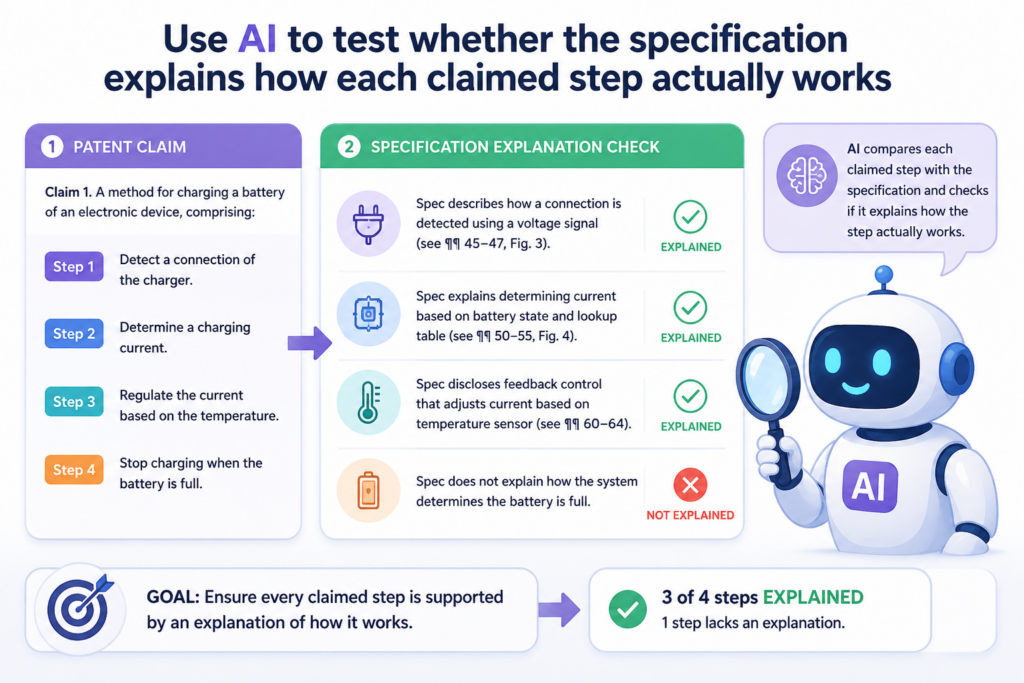
A draft may say the system “detects risk,” “updates a model,” “routes a request,” “selects an action,” or “generates a control signal.” Those phrases may sound clear. But the key question is whether the specification explains the process behind them.
AI can help by looking for “how” support. This is deeper than word matching. It asks whether the draft gives enough detail for a skilled reader to understand the claimed function.
If the claim says the system selects a recommended action, the specification should explain what data is used, how the action is selected, what rules or model outputs guide the selection, and what happens after the selection is made.
This matters a lot for AI, software, robotics, medical devices, clean tech systems, and other deep tech inventions.
The valuable part is often not just the output. It is the way the system gets there. If the draft only talks about results, the claims may feel thin.
For example, a claim might say that a model “detects an anomaly in real time.” That may be an important feature. But the specification should do more than repeat the phrase.
It should explain what data is received, how the data is processed, what makes something an anomaly, whether thresholds are used, whether the model compares current data to past data, and how quickly the system responds.
Good AI review should separate result language from process detail
Result language is wording that says what happens. Process detail explains how it happens. Both can have a place in a patent, but the specification should not rely only on results.
AI can flag places where the claim uses a functional phrase and the specification does not give enough working detail.
This is a powerful check because many drafts sound strong until you look closely. They may use polished words but skip the actual mechanism. AI can help reveal that gap.
It can say, “The claim says the system adapts the model, but the specification does not explain what triggers adaptation or what parameters are changed.” That kind of comment is useful because it points to a fix.
The fix may be simple. The team may already know the answer. The engineer may explain that the system updates weights after a feedback score crosses a threshold.
Or the product team may explain that the routing decision is based on latency, user role, and data type. Once that detail is added, the patent becomes stronger.
This is one of the best reasons to use AI early. It helps pull important detail out of the team before filing. A founder may not think a small technical step matters. A good review may show that it is the heart of the invention.
The strongest drafts make the path from input to output easy to follow
When using AI to check claim support, ask it to trace the claimed process from start to finish.
For each independent claim, the AI should identify the input, the first operation, the next operation, the output, and the stated result. Then it should check whether the specification explains each part in order.
This is helpful because many support problems are not missing words. They are missing links.
The specification may explain the input in one place and the output in another place, but never explain the bridge between them. The claim may depend on that bridge. Without it, the invention can feel incomplete.
A strong prompt might say: “For each claimed method or system function, trace the technical flow described in the specification.
Identify any step where the claim states a result but the specification does not explain the process used to achieve that result.”
This prompt works well for technical founders because it mirrors how engineers think. It turns a patent review into a system review. What comes in? What changes? What decides? What gets stored? What gets sent? What happens next?
PowerPatent is designed for this kind of founder-friendly patent workflow.
Instead of making you fight through confusing legal steps alone, it helps turn your technical work into clearer patent material, with attorney review layered in. That is a smarter way to protect what you are building. Learn more here: https://powerpatent.com/how-it-works
Use AI to find claim words that may be too vague for the specification as written
Some claim words sound useful because they are flexible. But flexible can become vague if the specification does not explain the meaning.
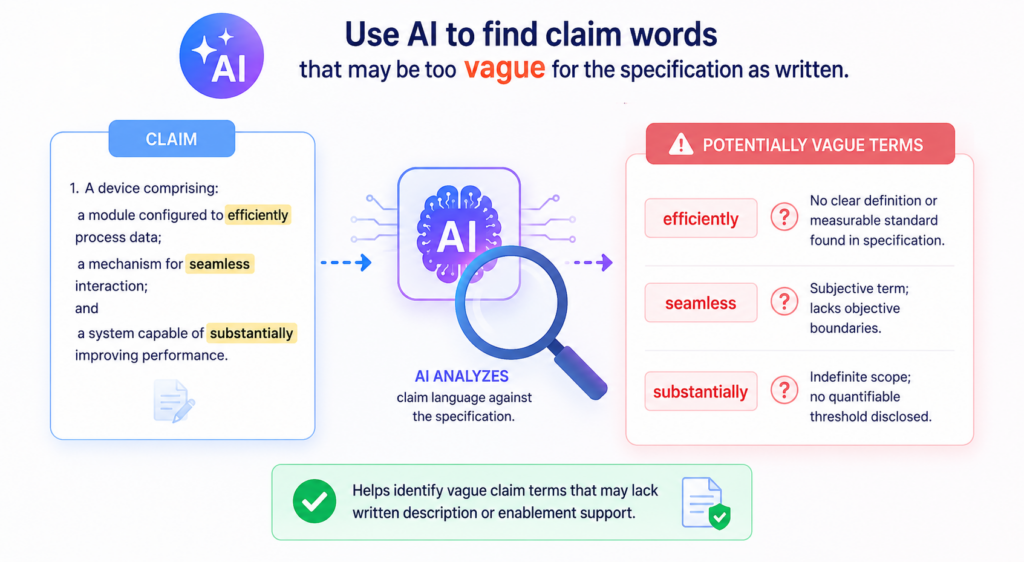
Words like “smart,” “efficient,” “optimized,” “secure,” “improved,” “automatic,” “dynamic,” “relevant,” and “personalized” can be dangerous when they stand alone. They may describe a benefit, but they do not always describe the invention.
AI can help by flagging these soft words. The goal is not to delete them all. The goal is to make sure each one has clear support.
If the claim says the system creates an “optimized schedule,” the specification should explain what optimized means in that context.
Is it faster? Cheaper? Safer? Lower power? Fewer conflicts? Higher accuracy? Better use of machines? The answer should be in the draft.
This is important because vague words leave room for doubt. A patent examiner may not know what the word means.
A competitor may argue that the word is unclear. A future buyer or investor may see the patent as weaker because the claim does not define the real edge.
Strong patents do not hide behind fancy words. They explain the invention in plain detail. AI can help remove the fog.
AI can turn soft claim words into clear review questions
The best way to use AI here is to ask it to find vague or result-based terms and convert them into questions for the inventor.
This makes the review practical. Instead of saying, “The term optimized is vague,” the AI can ask, “What value is being improved, how is it measured, and what process creates the improvement?”
That is a much better output. It gives the founder or engineer something to answer. It also helps the attorney add support in a way that matches the real invention.
For example, if the claim says “secure communication,” AI should ask what makes the communication secure. Is there encryption? Token exchange? Key rotation? Device pairing? Access control? Data masking?
A trusted execution space? A special way of splitting data before transmission? The specification should describe the actual security method.
If the claim says “personalized recommendation,” AI should ask what user data is used, how preferences are learned, how the system updates the profile, and how the recommendation changes based on that profile.
Without that detail, “personalized” may be more like marketing language than patent support.
Strong support replaces buzzwords with concrete technical meaning
A useful patent draft can still be simple. It does not need to be packed with hard words. But it does need concrete meaning.
AI should help you find places where the claim sounds like a product page instead of a technical invention.
Founders are often very good at explaining value. They say the product is faster, safer, smarter, easier, or more accurate.
That is great for customers. For patents, the draft also needs to explain what causes that value. What structure, step, model, data flow, device, rule, or control method creates the result?
This is where AI can make your team sharper. It can scan the claims for value words and ask for the technical reason behind each one. The founder can then add the real details. The attorney can shape those details into strong support.
A good prompt might say: “Identify any claim terms that are vague, subjective, or mainly describe a benefit.
For each term, explain what support the specification would need to make the term clearer and stronger.”
This kind of review helps keep the patent grounded. It turns broad words into clear invention detail. It also helps avoid a draft that sounds impressive but does not hold up under pressure.
PowerPatent helps founders protect real technical advantages, not just surface-level product claims.
With AI tools and attorney review working together, your team can find weak language early and turn it into stronger patent support. Start here: https://powerpatent.com/how-it-works
Use AI to check whether dependent claims add real support instead of repeating the same idea
Dependent claims are easy to overlook. Many founders focus on the first claim because it feels like the main prize. That makes sense. The first claim often sets the broad frame.
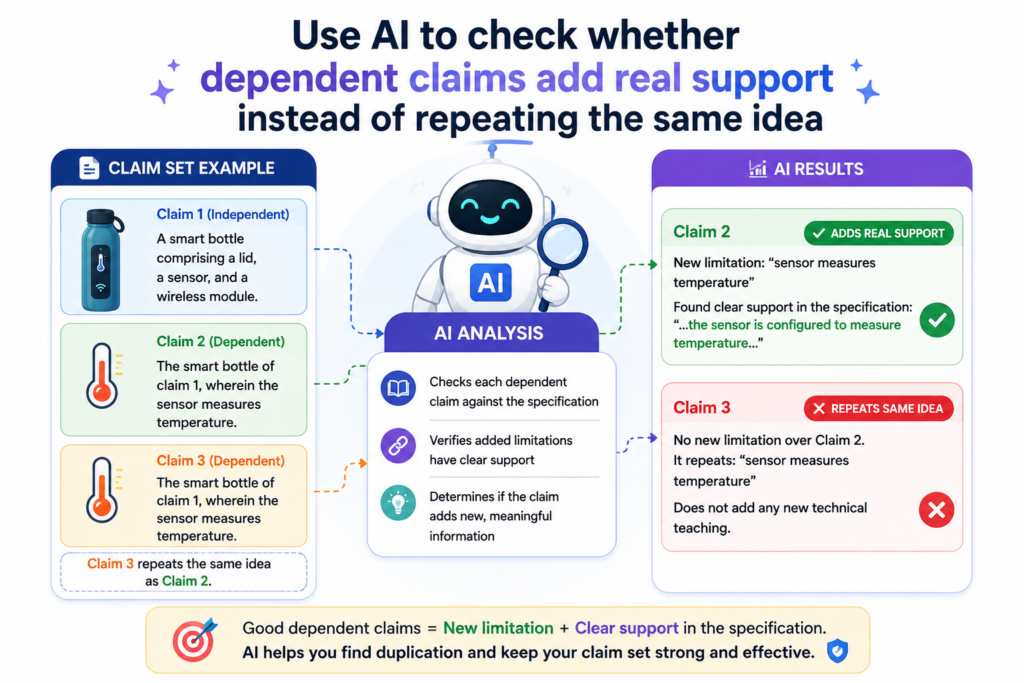
But dependent claims matter a lot because they give you backup paths. They can protect narrower versions of the invention. They can also help save value if the broad claim faces pushback.
AI can help you review dependent claims in a very practical way. The question is simple.
Does each dependent claim add a real detail that is clearly supported by the specification? Or does it just repeat what the main claim already says in slightly different words?
A weak dependent claim does not help much. It may look like extra protection, but it may not create a useful fallback.
A strong dependent claim adds a clear feature, a useful step, a special data type, a control rule, a model structure, a hardware part, a timing condition, a safety check, or another concrete detail that makes the invention more specific.
This matters because patent review is often a back-and-forth process. The broad claim may be challenged.
When that happens, strong dependent claims can give the attorney room to move without losing the heart of the invention. They are not filler. They are strategic backup.
AI can compare each dependent claim to the independent claim and explain what new feature is added. Then it can check whether that new feature appears in the specification. This is a simple check, but it can expose a lot.
A useful dependent claim should create a clear fallback that still has business value
The best dependent claims are not random details. They protect versions of the invention that matter to the company.
A startup should not add narrow claims only because they sound technical. The details should connect to the product, the roadmap, the moat, or the likely ways a competitor may copy the idea.
For example, an AI medical tool may have a broad claim about generating a health risk score. A dependent claim might add that the score is generated using image data and patient history.
Another might add that the system updates the score after a new lab result. Another might add that the system sends an alert only when the score crosses a threshold for a certain period. Each one adds a real point of protection.
AI can help test whether those fallbacks are supported. It can also ask whether the dependent claims cover enough of the important product versions.
Sometimes the specification describes a strong feature, but the claims never use it. That is a missed chance. AI can flag specification details that look claim-worthy but are not claimed.
This is very helpful for founders because the best patent value often lives in the small details.
The main idea may be broad, but the hard-to-copy edge may be a special data flow, model update step, sensor pairing, decision rule, or control loop. AI can help surface those details so the attorney can decide how to use them.
The AI should check both legal support and product relevance before the claims are filed
A dependent claim can be supported and still not be very useful. It may describe a feature that the company does not use, does not plan to use, and does not care about.
That does not always make it bad, but it should be a conscious choice. Patent drafting should support the business, not just fill pages.
A strong AI workflow can ask two questions at once. First, is the dependent claim supported by the specification? Second, does the dependent claim appear to protect a meaningful version of the invention?
AI cannot know your full business plan unless you provide it, but it can still flag claims that seem thin, repeated, or disconnected from the technical story.
A useful prompt might say: “For each dependent claim, identify the exact feature added beyond the independent claim.
Find support in the specification. Then explain whether the added feature appears to create a useful fallback or merely restates the same concept.”
This makes the review sharper. It helps avoid dependent claims that look busy but do not help much. It also helps founders see where the patent can be made stronger before filing.
PowerPatent helps teams turn raw invention details into claim sets that make sense for real startups.
The AI can help find gaps and overlaps, while attorney review helps shape those findings into stronger protection. You can see how PowerPatent supports this process here: https://powerpatent.com/how-it-works
Use AI to compare the claims with the drawings and figure descriptions
Drawings are not decoration. In many patent drafts, they are one of the clearest ways to show how the invention works.
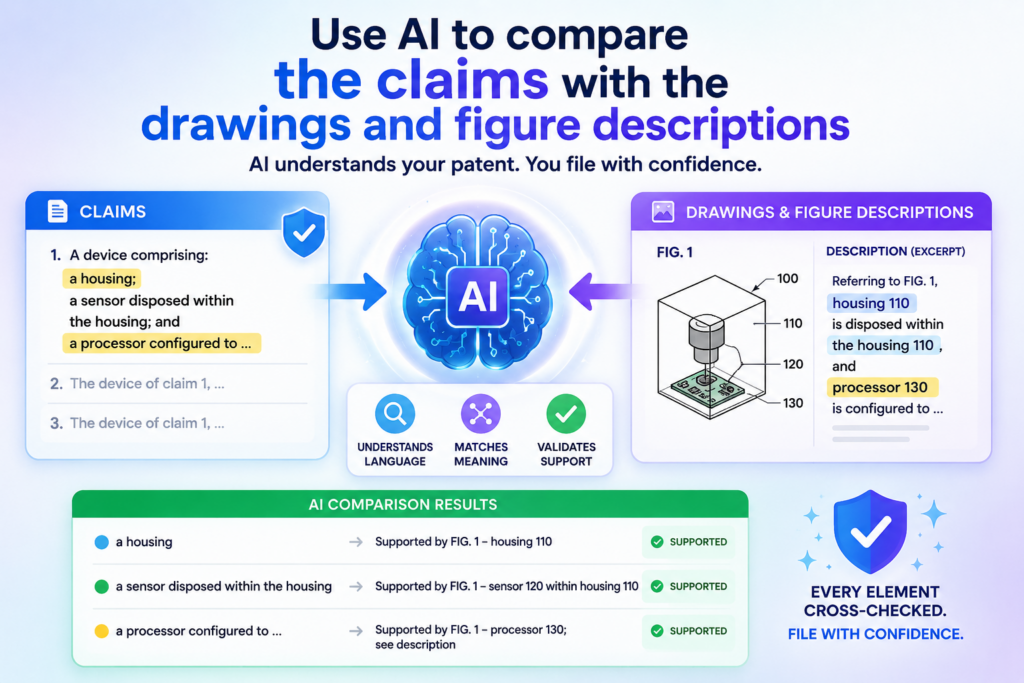
They can show the system parts, the method flow, the data path, the user device, the server, the model, the sensor, the controller, the interface, and the output.
If the claims name parts or steps that never appear in the drawings or figure descriptions, that may be a sign that the draft needs more work.
AI can help compare the claims against the drawing descriptions. This does not mean the AI needs to “see” the drawings in a human way, although image-aware tools can help.
Even a text-based AI review can compare the claims to the figure descriptions and reference numbers.
It can ask whether each claimed component appears in a figure, whether the figure description explains it, and whether the same names are used across the draft.
For technical founders, this check is very useful. A system may be clear in the team’s mind, but the patent drawings may lag behind the current design.
The claims may describe the new architecture, while the drawings still show an old version. Or the drawings may show a key feature, but the claims never mention it. Either mismatch can weaken the draft.
The goal is not to make the drawings crowded. The goal is to make sure the visual story supports the claim story.
AI can find when the figures tell a different story than the claims
A strong patent draft should feel consistent. The claims should say what is protected. The specification should explain it.
The drawings should help the reader see it. When those parts drift apart, the draft becomes harder to understand.
For example, a claim may describe a system with a local device, a remote server, and a machine learning model. But the figure may only show a mobile device and a database.
The specification may mention the model in text but never place it in the system diagram. That may not always be fatal, but it can create confusion. The reader may ask where the model runs, how it receives data, and how it sends results.
AI can flag these issues by creating a component map. It can list each claimed component and identify where that component appears in the figure descriptions. It can also find claimed steps that do not appear in flow diagrams.
If the method claim says the system receives data, filters data, generates a score, selects an action, and sends a control signal, the flow diagram should ideally reflect that path or at least the specification should make it clear.
This is especially important for AI and software patents because many inventions are invisible. There may be no physical part to point to.
The value is in the flow. The drawing can make that flow easier to understand. AI can help make sure that flow is not broken.
The best figure check asks whether a reader can follow the invention without guessing
When using AI to review drawings and claims, the right question is not just, “Do the words match?” The better question is, “Can a reader follow the invention from the figures to the claims without guessing?”
Ask AI to find missing links. Does the figure description explain how data moves from one block to another? Does it explain what each block does? Does it explain where the claimed decision is made? Does it show the output? Does it show optional paths when the dependent claims rely on them?
This kind of review can uncover simple fixes. Maybe a figure description needs one extra sentence.
Maybe a flowchart needs one more step. Maybe a reference number is used for two different things.
Maybe a part is shown in a figure but never named in the text. These are not glamorous issues, but they matter.
A useful prompt might say: “Compare each claim element with the figure descriptions. Identify any claimed element or step that is not shown or described in connection with a figure. Identify any figure feature that appears important but is not reflected in the claims.”
This gives the drafting team a clean way to tighten the patent before filing. It also helps founders feel more in control because they can see the invention as a connected system, not just a long legal document.
PowerPatent helps make this process easier by combining software review with attorney guidance.
That means your claims, specification, and drawings can be checked together, not treated like separate pieces. See how the workflow works here: https://powerpatent.com/how-it-works
Use AI to check whether the examples support the full claim scope
Examples are powerful because they show the invention in action. They make the patent feel real. They can explain how the system works in a real setting, with real inputs, real choices, and real outputs.
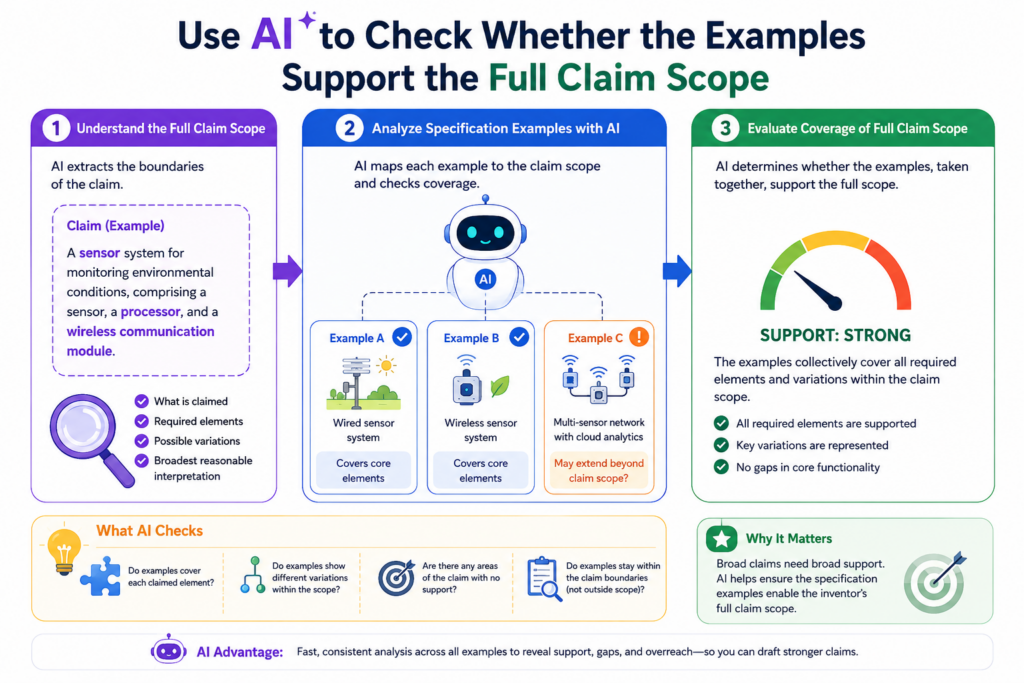
But examples can also create a hidden problem. If the claims are broad and the examples are narrow, the patent may feel uneven.
AI can help test that balance. It can compare the broad words in the claims with the examples in the specification. It can ask whether the examples support the full range of what the claims try to cover.
This is especially important when the invention can be used in many fields, with many data types, or across many device types.
For example, a claim may cover “sensor data.” The examples may only discuss heart rate data. That may leave questions. Does the invention also work with motion data, image data, sound data, pressure data, temperature data, or machine vibration data?
If yes, the specification should say so. It does not need to describe every possible data type in painful detail, but it should give enough support to make the broader claim feel earned.
The same issue shows up in AI model claims. A claim may cover “training a model using labeled data.” The examples may only describe one training set and one model type.
If the invention is meant to cover different training data, different models, or different update methods, the specification should support that range.
AI can spot when a claim covers more versions than the examples show
A good AI review should not assume that one example supports everything. It should ask whether the example is described as one version or as the only version. This difference matters.
If the specification says, “In one example, the system uses a camera,” that may leave room for other sensors if the draft also supports them.
But if the specification only talks about cameras and never mentions other sensor types, a broad claim to sensor data may be weaker. AI can help flag that gap.
This is useful because founders often know the invention is flexible. They may know the same system can work in finance, health, robotics, logistics, or energy.
But unless the draft says that in a supported way, the patent may not capture the full value.
AI can also find the opposite problem. Sometimes the specification has rich examples, but the claims are too narrow. The draft may describe edge processing, cloud processing, hybrid processing, and offline processing.
But the claim may only cover cloud processing. That may be a business miss if competitors can move the same invention to the edge and avoid the claim.
This is where AI becomes more than a grammar tool. It becomes a scope-checking tool. It helps the team see whether the claim scope matches the invention story.
The review should ask where the draft needs more examples and where the claims need better focus
The best outcome is not always broader claims. Sometimes the right answer is to add examples. Sometimes it is to narrow the claim.
Sometimes it is to add a dependent claim that captures a valuable example. Sometimes it is to explain that an example is only one possible version.
AI can help frame these choices. It can say, “The claim covers multiple data sources, but the specification gives only one example.”
It can also say, “The specification gives three useful versions, but only one is claimed.” That kind of feedback helps the attorney and founder decide the next move.
A useful prompt might say: “Compare the scope of each claim against the examples in the specification. Identify where the claim appears broader than the examples.
Identify where the examples disclose valuable features that are not claimed. Suggest questions the inventor should answer before filing.”
This prompt keeps the process tactical. It does not ask AI to make the final legal decision. It asks AI to find the places where human judgment is needed.
PowerPatent is built for founders who want this kind of practical patent help without the old slow process.
The platform helps you move from invention details to stronger patent filings with AI support and real attorney oversight. See how PowerPatent can help here: https://powerpatent.com/how-it-works
Use AI to check whether the claim order matches the story in the specification
A strong patent claim has a flow. It should feel like the invention is being built step by step. The parts should show up in a way that makes sense. The actions should happen in a clear order when order matters.
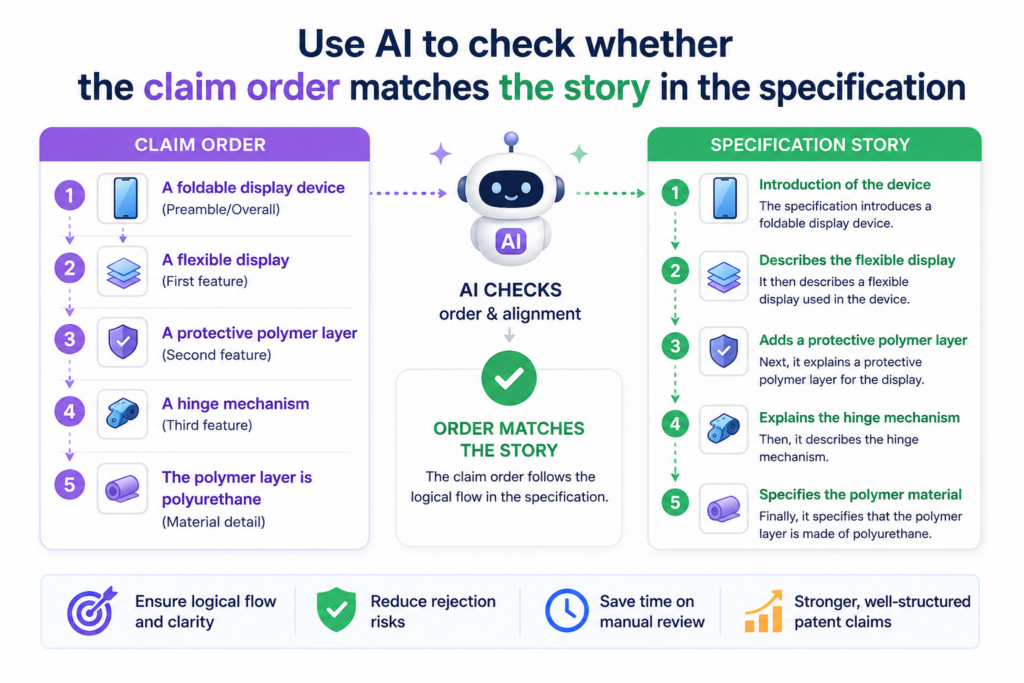
The output should come after the input. The decision should come after the data that supports the decision. The control action should come after the system knows what to control.
The specification should tell the same story.
AI can help check whether the claims and specification move in the same direction. This is more important than it sounds. A claim may be technically supported by the specification, but the story may still feel messy.
The claim may start with a model, then jump to an output, then mention training data, then return to a sensor.
The specification may explain the system in a different order. The pieces are there, but the reader has to work hard to connect them.
That is not ideal.
A good patent draft should reduce friction. It should help the reader understand the invention quickly. This does not mean the draft must be short. It means the draft must be clear.
If the claims and specification follow a similar path, the whole patent becomes easier to review, easier to defend, and easier to explain to investors, partners, or future buyers.
A claim should feel like a clean path from problem to solution
Many technical inventions solve a chain of small problems. The system receives messy data. It cleans the data. It finds a signal. It makes a choice. It sends an output. It updates itself.
That flow is often the heart of the invention. If the claim captures that flow in the wrong order, the claim may still be readable, but it may not show the real strength of the invention.
AI can trace the order of claim elements and compare it with the order used in the specification. It can ask whether the claimed system is introduced before its parts are explained.
It can check whether a step depends on another step that appears later. It can also find places where the specification teaches the key step in a hidden section instead of near the main flow.
This is very useful for founders because engineers often explain inventions out of order. They may start with the cool result, then explain the input, then explain the model, then explain the control logic.
That is normal in a product demo. But a patent draft works better when the reader can follow the build.
AI should flag order problems without forcing a fake order where none is needed
Not every claim needs a strict sequence. Some system parts can work at the same time. Some software steps can run in parallel.
Some AI models can process different data streams at once. A good AI review should not force a narrow order unless the invention requires it.
The better check is to ask whether the order is clear enough for the reader to understand what depends on what. If a step must happen first, the specification should support that.
If steps can happen in any order, the specification can say so. If steps can run at the same time, that should also be clear.
A strong prompt might say: “Compare the order of steps in each claim with the order described in the specification.
Identify any place where a claimed step appears before the information needed to perform it. Identify any place where the specification describes a different order and explain whether that creates confusion.”
This type of review can lead to simple but powerful fixes. The attorney may reorder a claim. The specification may add a short sentence that explains timing.
A figure may be updated to show parallel paths. A dependent claim may be added to protect a special sequence.
PowerPatent helps teams find these structure issues before they slow down the filing.
The platform brings AI review into the drafting process, then adds real attorney oversight so the final patent is not just fast, but also clear and strong. You can see how it works here: https://powerpatent.com/how-it-works
Use AI to find support gaps in alternative versions of the invention
Most good inventions have more than one version. A product may work on a phone, in the cloud, on a device, or inside a machine. A model may run before an event, during an event, or after an event.
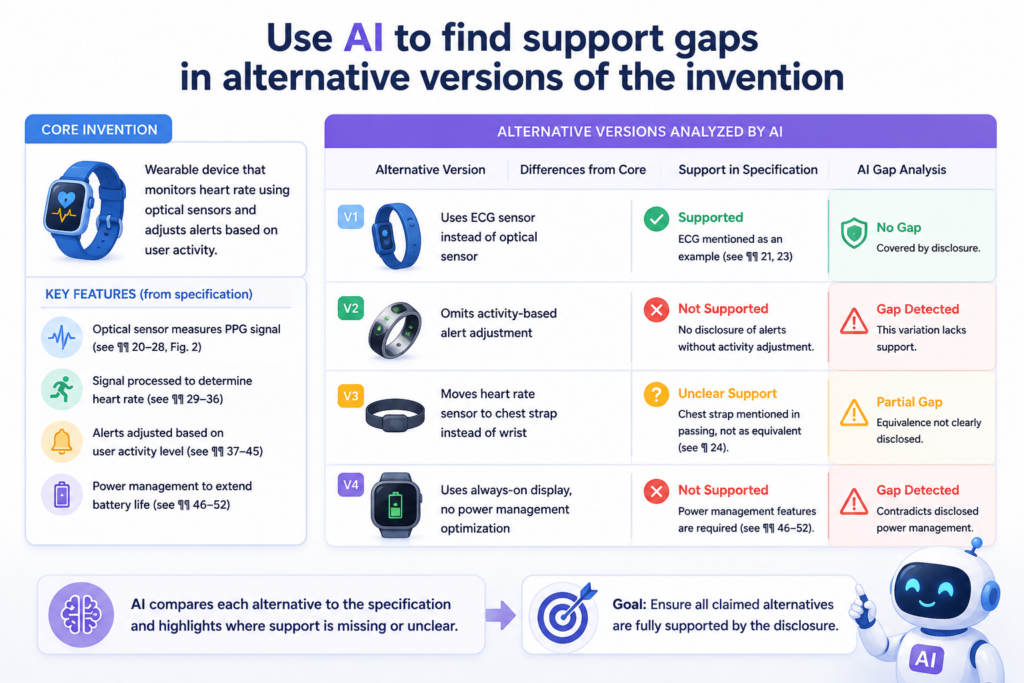
A sensor may be built into the product or connected from the outside. A user may be a person, a company, a machine, or another software system.
These different versions matter because startups change fast. The first build may not be the final build.
Your patent should not protect only the version you have today if the real invention can work in more than one way.
AI can help check whether the specification supports these alternative versions. This is often where hidden claim risk appears.
The claim may use broad words that suggest many versions, but the specification may describe only one. Or the specification may mention alternatives in passing but not explain them well enough.
For example, a claim may say that a system “receives input data from one or more devices.” That sounds broad. But the specification may only describe a mobile phone.
If the invention also works with wearables, robots, cameras, industrial sensors, or vehicle systems, the draft should support those versions before filing.
The best time to add alternative support is before the application is filed
This point is critical. Before filing, you can still add real technical detail to the specification.
After filing, adding new invention detail can become a serious problem. That is why AI review should happen early, while the draft is still flexible.
AI can scan the claims for broad phrases like “one or more,” “at least one,” “device,” “data source,” “model,” “network,” “processor,” “user interface,” or “control signal.”
Then it can check whether the specification gives enough examples or explanation to support that range.
This does not mean you should stuff the draft with every possible version. A patent should still be focused.
But where the invention truly supports more than one version, the specification should say so in a clear and useful way.
This is especially important for deep tech startups. Your company may pivot from one customer group to another. You may move from a cloud service to edge devices.
You may train one type of model now and a different type later. You may start with one hardware part and later use a cheaper or better part. If the patent only supports the first setup, you may lose protection around the bigger idea.
AI can help founders ask better questions about future product paths
A strong AI review should not only look backward at the draft. It should help the team think forward. It can ask what other versions are likely.
It can flag where the claims seem to cover future versions but the text does not yet explain them.
A useful prompt might say: “Identify each claim term that appears broad enough to cover multiple versions.
For each term, list the versions described in the specification and the versions that seem implied but not clearly supported. Then create inventor questions that would help strengthen the specification before filing.”
Those inventor questions are often gold. They may reveal details the team forgot to include. They may also show that the claim should be narrowed because the broader version is not really part of the invention.
The key is to avoid guessing. AI can suggest gaps, but the inventor and attorney must decide what is true, what is useful, and what should be filed.
That is why a combined workflow matters. AI can move fast. Attorneys can make the careful calls.
PowerPatent is built for this exact need. Founders can move quickly, capture more invention detail, and still have real patent attorneys involved.
That means your patent can support the product you have now and the stronger versions you may build next. Learn more here: https://powerpatent.com/how-it-works
Use AI to check whether the specification supports the claim’s point of novelty
Every patent claim should have a reason to exist. There should be something about it that makes the invention different and useful.
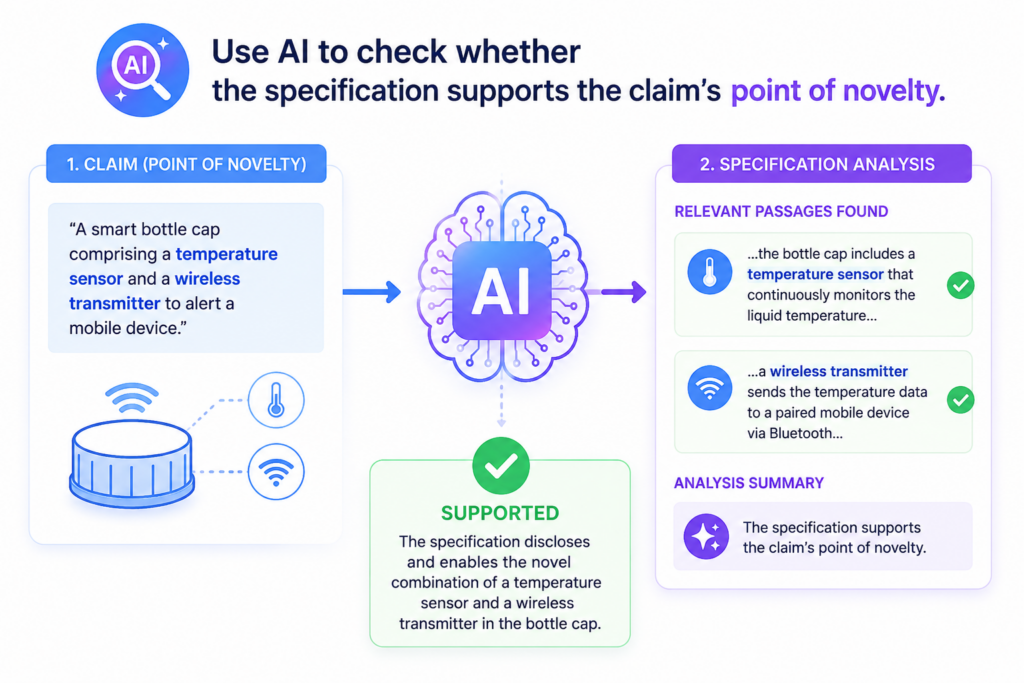
That point may be a special data flow, a model update method, a control rule, a hardware arrangement, a safety step, a training process, or a new way to combine known parts.
The specification must support that point with care.
This is where AI can be very helpful. It can identify the part of the claim that seems most important, then check whether the specification gives that part enough attention.
Many drafts explain the general system well but rush through the actual inventive feature. That is risky. The most important part of the claim should not feel like an afterthought.
For example, if the invention is about a better way to reduce false alerts, the specification should explain that method clearly. It should not only say the system “reduces false alerts.”
It should explain what causes the false alerts, what the system checks, how the system changes the alert decision, and what result comes from that change.
The same is true for AI inventions. If the core idea is a new way to use feedback to update a model, the specification should explain the feedback, the update trigger, the update process, and the effect of the update. The claim should not be broader than that support.
AI should look for the heart of the invention, not just matching words
A basic AI check may confirm that every claim word appears somewhere in the specification. That is useful, but not enough.
A stronger check asks whether the most important claim feature is explained deeply enough.
This is where the review becomes more strategic. AI can ask which element seems to drive the value of the invention.
It can compare that element with the background, examples, drawings, and detailed description. It can then flag whether the draft gives that feature strong support or only surface-level support.
This matters because a patent may be challenged at the exact point where it matters most. If the inventive step is thinly described, the whole filing can feel weak. A founder does not want the strongest business feature to have the weakest written support.
AI can also find when the specification spends too much time on ordinary parts and too little time on the key advance.
For example, the draft may spend many paragraphs explaining standard servers, networks, processors, and databases, but only one sentence explaining the special model pipeline.
That is backwards. The common parts may need some context, but the new part needs real care.
The strongest patent drafts make the key advance easy to find and easy to understand
A reader should not have to hunt for the invention. The specification should make the point of novelty clear without sounding like a sales pitch.
It should explain the problem, the old pain, the new approach, and the technical reason the new approach works.
A useful AI prompt might say: “Identify the likely point of novelty in each independent claim. Then review the specification to determine whether that feature is described with enough technical detail, examples, and connection to the problem being solved.
Flag any place where the most important feature is described less clearly than ordinary system parts.”
This kind of check can make the whole patent stronger. It helps the team focus effort where it matters most. It also helps avoid a common startup mistake: filing a draft that describes the product but fails to protect the true edge.
PowerPatent helps founders capture that edge with less stress. The software helps organize the invention and spot weak support, while real patent attorneys help shape the claims around what matters.
That is how you move faster without treating your IP like an afterthought. Explore the workflow here: https://powerpatent.com/how-it-works
Conclusion
Checking patent claims against the specification is not busy work. It is how you make sure your patent says what you mean, protects what matters, and stands on a stronger base. AI can help you find missing support, weak words, unclear terms, broad claims, thin examples, and gaps between the claims, drawings, and technical story.
But AI works best when paired with real attorney judgment. That is the PowerPatent advantage: smart software plus real patent oversight, built for founders who need speed and confidence. See how PowerPatent can help you file stronger patents here: https://powerpatent.com/how-it-works
Leave a Reply