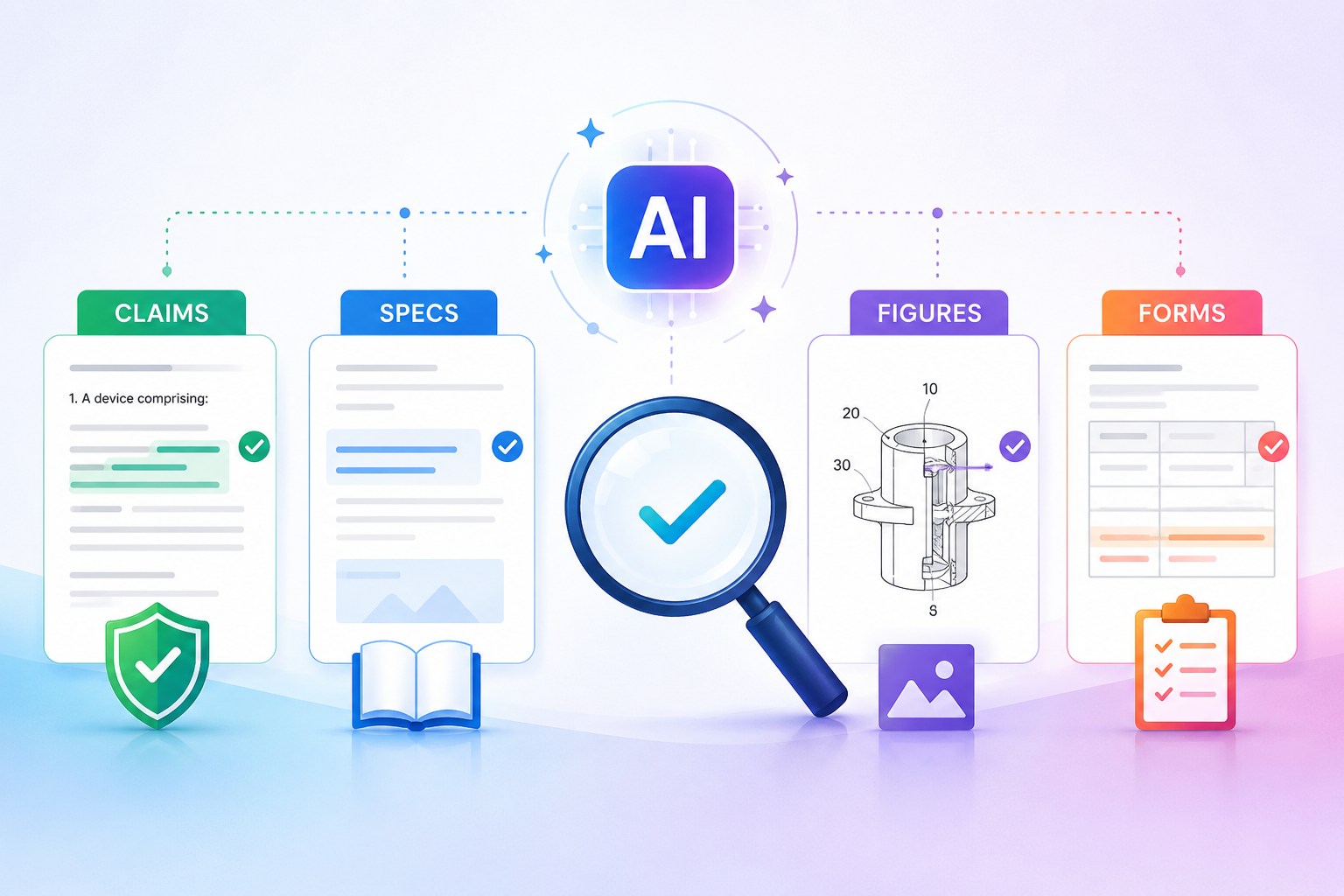
A patent can protect the heart of what your team is building. But one small mistake can slow things down, weaken your filing, or create stress later. That is why proofreading matters. PowerPatent brings smart AI tools together with real patent attorney oversight, so you can move faster without guessing. You can see how it works here: https://powerpatent.com/how-it-works
Why patent proofreading now needs AI and human review
A patent draft has many moving parts. The claims must match the full story in the spec. The figures must match the words.
The forms must match the names, dates, and filing details. When one part is off, the whole filing can get harder to trust.
This is why patent proofreading is not a small final task. It is a safety check. It helps make sure the invention is shown in a clear way, with fewer gaps and fewer weak spots.
For a startup, that matters because your patent is not just a paper. It can support funding, deals, hiring, and long-term company value.
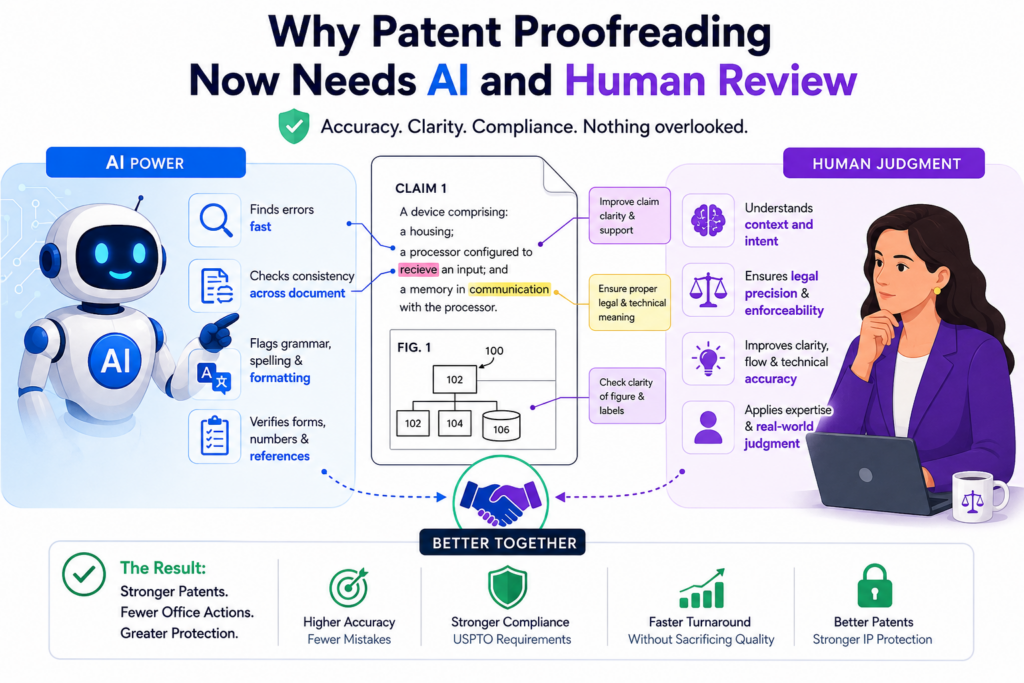
AI can make this review much faster. It can read across a long draft without getting tired. It can compare terms, catch repeated errors, point out missing labels, and flag places where the same idea is named two different ways.
But AI should not be the final judge. Patent work still needs human care, good judgment, and attorney review.
That is the real win. AI helps find issues early. A patent attorney helps decide what matters and how to fix it.
AI is strong at finding patterns that people miss when drafts get long
Most patent drafts are not short. A single draft may include claims, a long written description, many figures, figure labels, an abstract, background text, and forms. The longer the draft gets, the easier it is for small mistakes to hide.
For example, a draft may call something a “training engine” in the claims, a “model training module” in the spec, and a “learning unit” in the figures.
Each term may seem fine alone. But together, they may make the filing less clean. A reviewer may need to ask whether these are the same thing or different things.
AI can scan for this kind of mismatch fast. It can show where terms change. It can flag claim words that never appear in the spec.
It can notice figure numbers that are mentioned in one place but not shown in another. These checks are simple in concept, but painful to do by hand.
The goal is not to let AI replace careful patent work
The goal is to use AI like a sharp second set of eyes. It helps your team find issues before they become expensive. It also helps attorneys spend more time on strategy instead of spending hours hunting for basic mistakes.
This is where PowerPatent fits well for busy founders. You get smart software to speed up the draft and review process, plus real attorney oversight to help protect the quality of the work.
You can explore how PowerPatent helps teams move from invention to filing with more control here: https://powerpatent.com/how-it-works
How AI helps proofread patent claims before filing
Claims are the most important part of a patent application. They define what you are trying to protect.
If the claims are unclear, too narrow, too broad in the wrong way, or out of sync with the spec, the whole filing can suffer.
For many founders, claims feel strange because they do not read like normal writing. They are formal.
They use careful words. They often build one idea on top of another. This is why proofreading claims takes more than a normal grammar check.
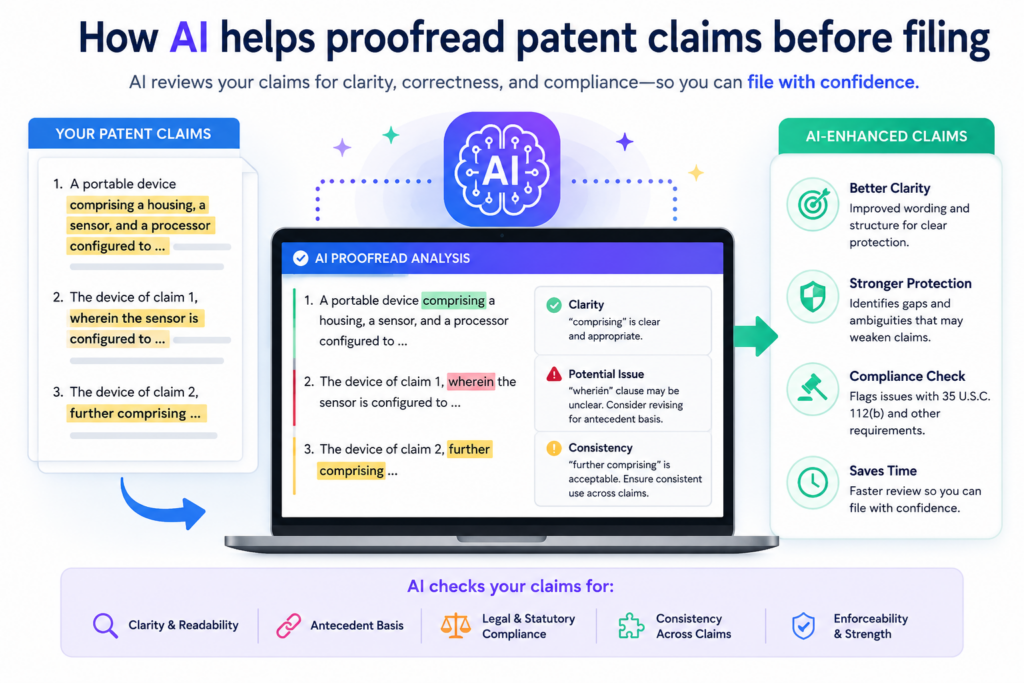
AI can help by checking whether the claims are clear, steady, and supported by the rest of the draft. It can also help spot terms that may confuse a reader.
This does not mean AI knows the best legal strategy. It means AI can help clean the surface so the deeper review is stronger.
The first claim check is whether each key term has support
A strong claim should not feel like it came out of nowhere. When a claim names a part, step, feature, or system element, the spec should explain it. The reader should be able to find the idea in the written description and see how it works.
AI can compare claim terms against the spec and figure descriptions. It can flag claim terms that appear only once.
It can point out words that are used in the claims but not explained in the body. It can also find places where the spec describes something important, but the claims never use it.
This is useful for founders because the invention often lives in the details. An engineer may know exactly what a “confidence scoring layer” does, but the draft may not explain it enough for a patent reader. AI can help expose that gap early.
A practical way to use AI is to make a claim term map
A claim term map is simple. It lines up each important claim term with the place where that term is explained in the spec and shown in the figures. If a term has no clear match, that is a warning sign.
This check can save time because it turns a messy review into a clear pass. You can see which terms are strong, which terms need more support, and which terms may need to be renamed.
It also helps founders talk with patent counsel in plain terms instead of guessing what is wrong.
PowerPatent is built for this kind of founder-friendly workflow. It helps turn technical work into cleaner patent material, with attorney review to help avoid risky gaps. You can see the process here: https://powerpatent.com/how-it-works
AI can also check whether the claims use steady language
Patent claims should not shift names without a reason. When a claim starts with one name for a part, it should keep that name steady unless the draft clearly means something new. A small naming shift can make the claim harder to read.
For example, a claim may introduce “a sensor module” and later say “the detection module.” If both names mean the same part, the claim may be confusing.
If they mean different parts, the draft should make that clear. AI can flag these changes so a person can review them.
This is one of the best uses of AI in patent proofreading because the task is about pattern matching. AI can scan every claim and find where terms drift.
It can also find missing references, repeated parts, or steps that appear in the wrong order.
Clean claims help speed up the human review
When claim wording is clean, the attorney can focus on the real question: what should the patent protect?
That is where human review matters most. The attorney can think about risk, scope, prior art, business goals, and future product changes.
AI helps remove noise. Human review adds judgment. Together, they help create a better filing process for startups that need speed without careless work.
How AI helps proofread the patent specification
The specification is the full written story of the invention. It explains what the invention is, how it works, and how someone could make or use it.
It gives support for the claims and helps show the invention in a complete way.
A weak spec can create trouble later. It may leave out a key step. It may describe one version but forget another version. It may use words that do not match the claims.
It may include old text from another draft that does not belong. These mistakes are common because patent specs often grow over many rounds.
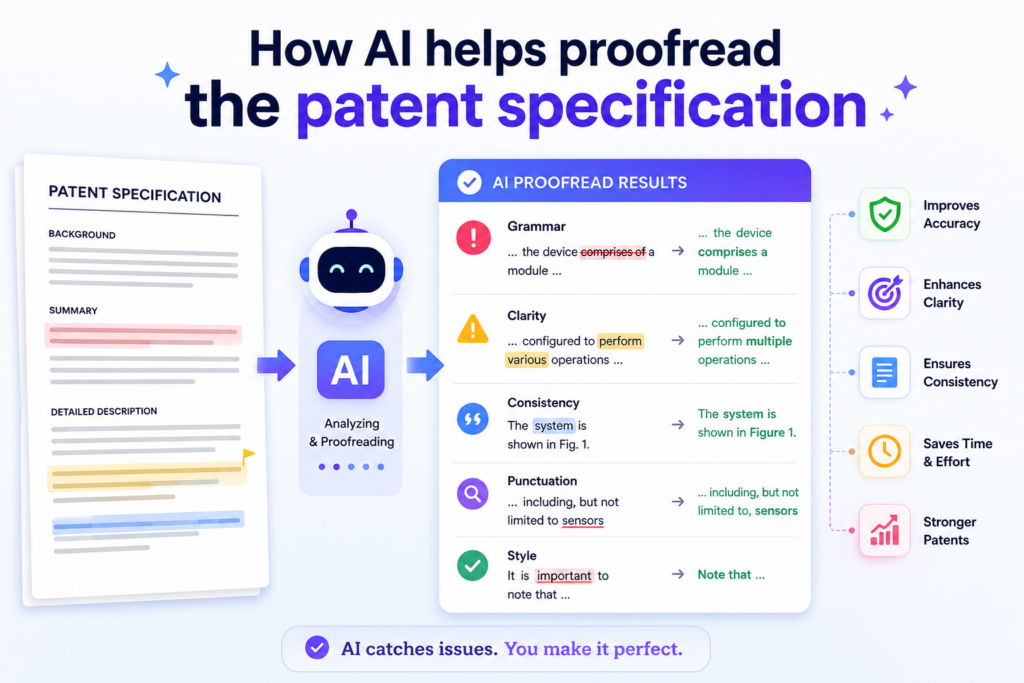
AI can help by reading the spec like a careful editor. It can check flow, terms, missing support, repeated text, and places where the draft sounds unclear. It can also help find gaps between the product story and the patent story.
The spec should explain the invention in a way that supports future value
A patent filing should not only cover what your product does today. It should also support the core idea behind what you are building.
That means the spec should describe more than one narrow version when possible. It should show options, variations, and different ways the invention may work.
AI can help find places where the spec is too thin. For example, the claims may mention a “machine learning model,” but the spec may not explain what kind of model, what inputs it can use, what outputs it can create, or how it fits into the full system. That may be a gap worth fixing.
For deep tech startups, this is very important. Your code, model, chip, device, workflow, or data system may change fast.
A patent draft that only describes one exact version may not age well. A better draft can explain the main idea with enough room for growth.
The best proofreading questions are simple but powerful
A founder can ask whether each part of the invention is named, explained, and connected. The draft should say what each part does.
It should say how the parts work together. It should show why the result is useful. It should avoid leaving the reader to guess.
AI can turn these questions into checks. It can scan the spec for thin sections. It can point out where a feature is named but not explained.
It can find places where the result is described, but the steps to reach that result are missing.
This is not just editing. It is risk control.
AI can catch copy-and-paste errors that are easy to overlook
Many patent drafts are built from invention notes, attorney edits, founder comments, older drafts, and technical files. That is normal. But it also means old language can sneak in.
A spec may mention a “mobile device” when the invention is actually a cloud system. It may refer to “Figure 7” when there are only six figures.
It may describe a user interface that was removed from the product months ago. These errors can make the filing look less polished and may create avoidable questions.
AI is very useful here because it can compare the full document against itself. It can search for terms that only appear once.
It can flag figure names that do not match. It can notice when the same step is described in two conflicting ways.
A clean spec helps your attorney give better feedback
When the spec is messy, review time gets pulled into cleanup. When the spec is clean, your attorney can focus on the strength of the invention story. That means better questions, better edits, and a stronger filing path.
PowerPatent helps founders move faster by combining AI-assisted drafting and review with real patent attorney oversight.
This gives your team a smoother way to protect what you are building without turning the process into a long back-and-forth mess. Learn how it works here: https://powerpatent.com/how-it-works
How AI helps proofread figures and drawing labels
Figures are often where small patent mistakes hide. The words may look fine, but the drawings may tell a slightly different story. A label may be missing. A number may be used twice.
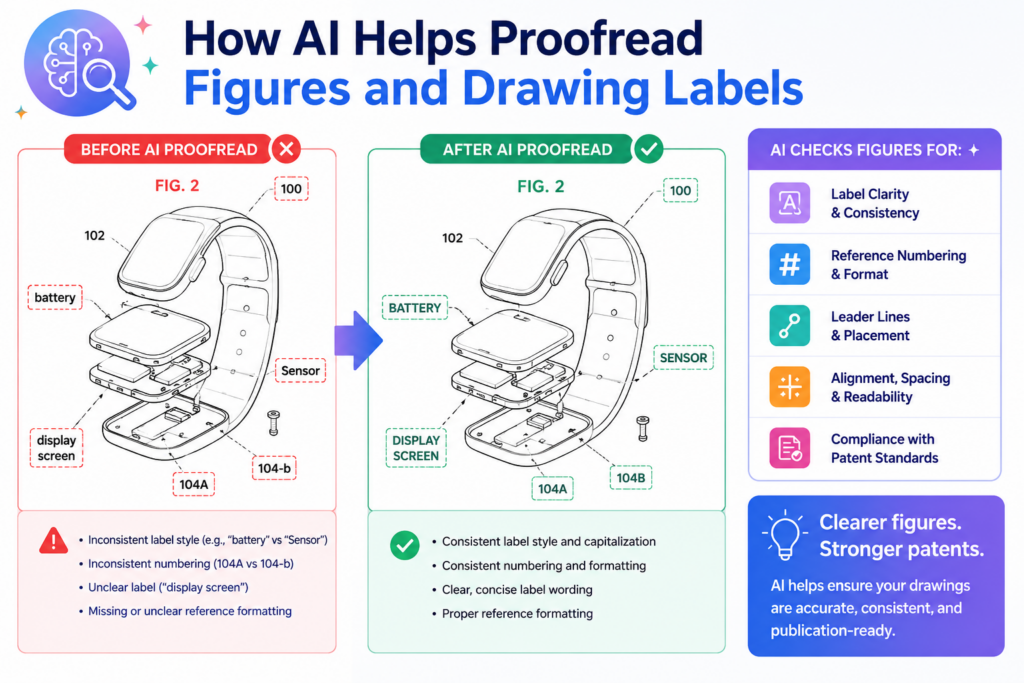
A part may appear in the figure but never be explained in the spec. Or the spec may discuss a part that never appears in the drawings.
This matters because figures help the reader understand the invention. They make complex systems easier to follow.
For software, AI, hardware, biotech tools, robotics, sensors, and data systems, figures can turn a hard idea into something clear.
AI can help check whether the figure text, labels, and written description line up. It can review figure callouts, compare them with the spec, and flag items that may need human attention.
The figure numbers should match the written description
A basic figure check asks whether every figure is named correctly and described in the right order. If the draft says “Figure 3 shows the training flow,” then Figure 3 should actually show that flow.
If the draft later says “as shown in Figure 4,” the reference should make sense.
These issues seem small, but they can slow review and make the draft harder to trust.
A patent examiner, investor, partner, or future buyer may not care about every tiny typo, but messy figures can make the whole filing feel less careful.
AI can quickly check whether every figure mentioned in the spec exists. It can also check whether figure titles are used in a steady way.
It can flag missing figure descriptions, repeated figure labels, and callout numbers that appear in the drawings but not in the text.
Figure proofreading is also about making the invention easier to understand
Good figures do more than satisfy a filing need. They teach.
They help the reader see the system, the process, the data flow, and the point of novelty. When the drawings are clear, the whole patent feels stronger.
For a founder, this is a big deal. You know your invention deeply, but others do not. Clear figures help bring people into the idea faster.
They also help your attorney see where the claim strategy may need more support.
AI can help find missing parts in system and flow diagrams
Many startup patents include system diagrams and flowcharts.
These drawings often have boxes, arrows, modules, devices, databases, models, processors, and user steps. When the invention changes, these diagrams can fall out of date.
AI can help compare the drawings against the written text. It can flag a module that appears in a figure but is never described.
It can find a step in a flowchart that is missing from the method description. It can notice when the spec says data goes from one part to another, but the figure arrows show a different path.
These checks are helpful because figure errors are not always obvious in normal reading. Your eyes may glide past a label because the diagram “looks right.”
AI does not read that way. It can treat each label as data and check whether it appears where it should.
Better figures can make attorney review much sharper
When the figures are clean, the attorney can ask better questions. Is the core system shown clearly? Are the key steps visible? Does the drawing support the claims? Are there other versions that should be shown before filing?
These are higher-value questions than “Why is this number missing?” AI can help remove the basic noise so the human review can focus on protection.
That is the kind of smarter workflow PowerPatent gives founders. You can see how the platform helps teams turn technical work into stronger patent filings here: https://powerpatent.com/how-it-works
How AI helps proofread patent forms before they cause delays
Patent forms look simple at first. They ask for names, dates, addresses, titles, signatures, filing details, and other basic facts. But simple does not mean low risk.
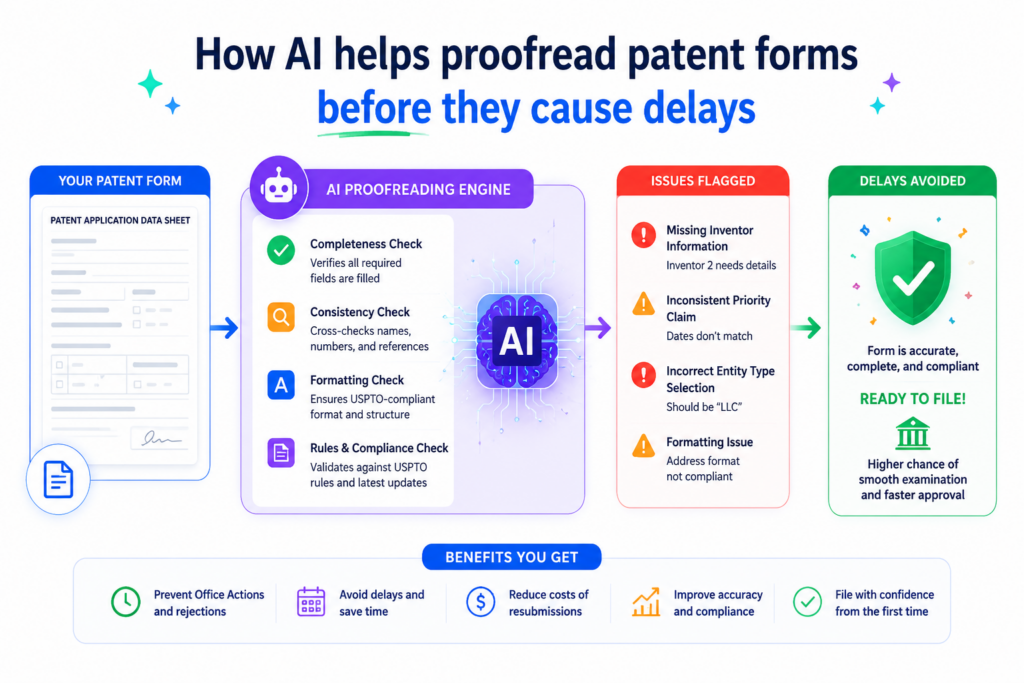
A form error can slow down a filing, create extra work, or force your team to fix something when you should be focused on building the company.
For founders, forms can feel like the boring part of the patent process. The invention is exciting. The claims are important. The figures show the real work. The forms feel like office work.
But the forms still matter because they connect the patent filing to the right people, the right company, and the right invention.
AI can help check these details before they turn into a problem. It can compare names across the draft, assignment papers, declaration papers, filing sheets, and internal records.
It can catch small mismatches, like one inventor using a middle initial in one place but not another. It can also flag cases where the company name changes from one form to the next.
Form proofreading starts with making sure the people and company details match
The first question is simple: are the right people named in the right way? That sounds easy, but startups move fast.
A founder may use a personal email in one place and a company email in another. A co-inventor may have changed jobs. A company may have formed under one legal name but used a shorter brand name in the patent draft.
AI can help compare every version of the name across the filing set.
It can look for spelling shifts, missing accents, old company names, wrong entity names, and small changes that a tired reviewer may miss. These are not deep legal issues on their own, but they can create friction.
The same check can help with invention titles. If the title on the patent application does not match the title on other papers, that may need a closer look. It may be harmless, or it may point to a larger mix-up.
Either way, finding it early is better.
Clean forms help keep the filing path smooth and calm
A clean filing gives your team fewer loose ends. It helps your attorney review the package with less back-and-forth.
It also helps your founders feel more in control because there are fewer small surprises near the filing date.
PowerPatent is built to make this kind of process less painful. It helps founders bring the technical story, draft content, and attorney review into one smoother flow.
When your team is ready to protect an invention without getting buried in paperwork, you can see how PowerPatent works here: https://powerpatent.com/how-it-works
AI can help catch date and priority issues that need human review
Dates matter in patent work. A draft may include an invention date in one note, a filing target date in another place, and a product launch date somewhere else.
AI can help find these dates and bring them into view, so the attorney can review what matters.
AI should not decide the legal meaning of those dates. That is human work. But AI can still help by making the date trail easier to see.
It can flag missing dates, inconsistent dates, or dates that appear in one document but not the rest of the filing package.
This is useful for startups because teams often work from many sources. A pitch deck may say one thing.
A lab notebook may say another. A product ticket may have a different date. AI can help pull these clues together for review.
AI is best when it helps the right person see the right issue sooner
The best use of AI is not to pretend every form question is simple.
The best use is to surface the issue early, in plain language, so the team can fix it with the right help. That keeps the process moving and helps avoid last-minute stress.
For a founder, this means more speed and less guessing. You do not need to become a patent paperwork expert. You need a clean system that helps you move from invention to filing with fewer gaps.
How AI helps check consistency across claims, specs, figures, and forms
The hardest patent errors are not always inside one section. They often happen between sections. The claims say one thing. The spec says it another way. The figures show a third version.
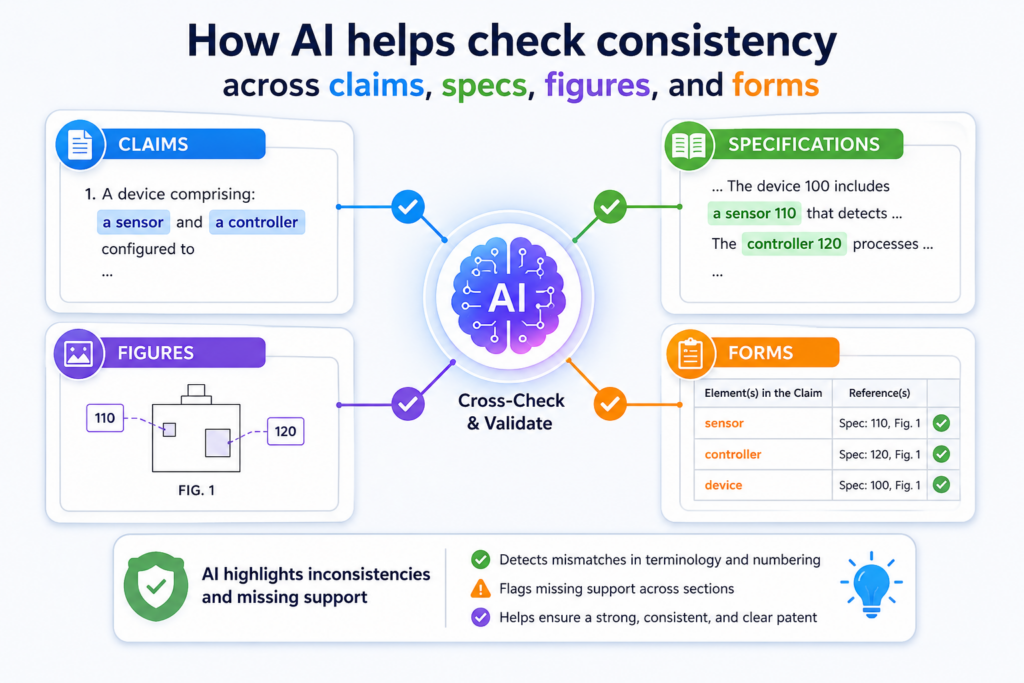
The forms use a title that does not match the main invention. Each piece may look fine alone, but together they may create confusion.
This is where AI can be very helpful. It can look across the whole filing set and find where the story changes. It can compare the same term across many pages.
It can check whether a figure label appears in the spec. It can point out when a claim uses a feature that the figures do not show or the written description does not explain well.
For founders, this matters because your invention is often moving while the patent draft is moving. Your engineers may update the system. Your model may change. Your product may shift. The patent draft can fall out of sync if no one checks the full package as one story.
A patent draft should read like one clear invention story
A good patent filing should feel connected. The claims, spec, figures, and forms should all point to the same core invention.
The words should not fight each other. The labels should not drift. The reader should not have to guess whether two names mean the same part.
AI can help create this kind of consistency check. It can build a simple view of the draft by showing important claim terms, where those terms appear in the spec, which figures support them, and whether the forms use matching title and inventor details. This makes the review easier to manage.
The real value is not only finding errors. It is helping the founder see the patent as a full system.
When the system is clean, the filing feels less risky. When the system is messy, the team can fix the right parts before the filing moves forward.
Cross-checking helps protect the draft from quiet drift
Quiet drift happens when small edits slowly pull the draft apart. One person changes a term in the claims. Another person updates the figure. A third person revises the spec. Nobody notices that the pieces no longer match.
AI can reduce that risk by checking the whole draft after each major change. It can flag terms that were renamed in one place but not another.
It can find old text that stayed behind after a product update. It can show where a new feature was added to the spec but not considered in the claims.
This matters because patent drafts often go through many rounds. Each round may improve one part while hurting another. A whole-document AI review can help catch that before it becomes a filing problem.
AI can help founders review patents without getting lost in the document
Most founders do not want to read every patent line like a lawyer.
They want to know whether the draft protects the invention, whether it is clear, and whether anything important is missing. AI can help turn a dense draft into a more usable review experience.
For example, AI can summarize where each main feature appears. It can show which figures support which claims. It can flag sections that may need more detail.
It can help translate formal patent language back into plain words, so founders can confirm whether the draft still matches the real product.
This is a major advantage for technical teams. Engineers can review the substance without being trapped by patent style.
They can say, “Yes, that is how the system works,” or “No, that part changed,” or “We should also cover this other version.”
Better founder review leads to better attorney review
When founders can give clearer feedback, attorneys can do stronger work. The attorney does not have to guess what changed or chase scattered comments. The founder can point to the exact part of the draft that needs attention.
PowerPatent is designed around that idea. It helps technical teams work with smart software and real patent attorneys in a more direct way.
That means fewer blind spots, fewer delays, and a cleaner path from invention notes to patent filing. You can learn more here: https://powerpatent.com/how-it-works
How AI helps catch missing support before it becomes a bigger issue
One of the most important proofreading checks is support. In simple terms, support means the patent draft should explain the things it is trying to claim.
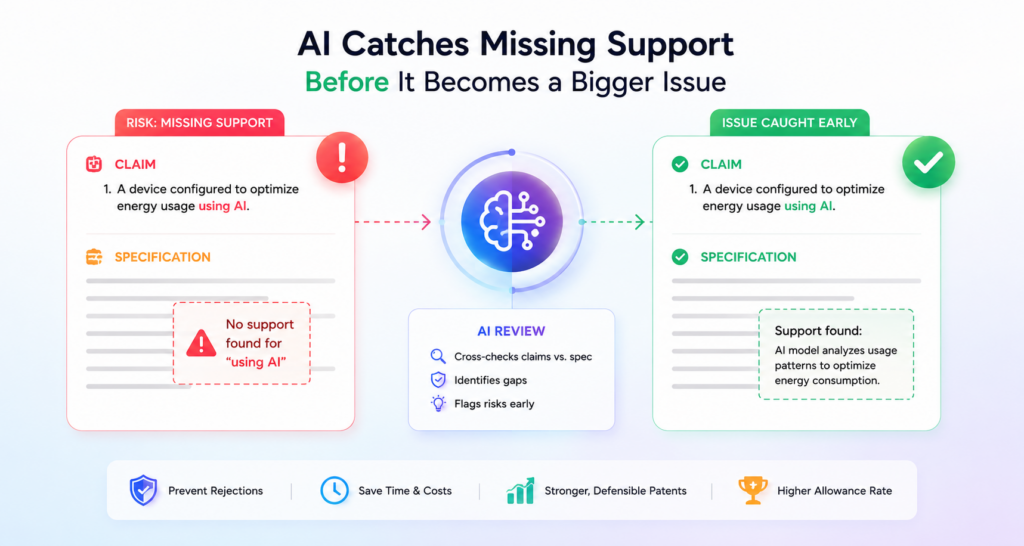
If a claim reaches for an idea, the spec should give enough detail to back it up. If the spec describes a key feature, the figures may need to help show it. The whole draft should work together.
Missing support can be hard to spot because the draft may sound polished. A sentence can be clean and still be too thin.
A claim can sound strong and still lack enough detail in the spec. A figure can look neat but still leave out the part that matters most.
AI can help by looking for weak links. It can find claim terms with little or no explanation.
It can point out features that appear late in the draft without context. It can flag broad language that may need more examples or more detail.
Support checks should focus on what makes the invention special
Not every detail has the same value. A patent draft should give special care to the parts that make the invention different. If your startup built a new way to train a model, the draft should explain that training flow.
If your team built a new sensor layout, the draft should describe the layout and why it helps. If your platform uses a new data pipeline, the draft should show how the data moves and what changes because of it.
AI can help identify the words and sections tied to the core invention. It can compare those points against the rest of the draft and ask whether the support looks thin.
This does not replace attorney judgment, but it gives the review a strong starting point.
For founders, this is very practical. You can look at the AI flags and ask whether the draft explains the real “why” behind the invention. That one question can lead to better text, better figures, and stronger claims.
Thin support is easier to fix before filing than after filing
Before filing, your team can still add detail, improve examples, clean up figures, and explain the invention more clearly.
After filing, your options may be more limited. That is why support review is so important before the application goes out the door.
AI helps by moving this review earlier in the process. Instead of waiting for a final legal review to catch every gap, the software can help your team see weak areas while there is still time to improve the draft.
AI can help find features that should be shown in more than one way
A strong patent draft often explains the invention from more than one angle.
It may describe the system, the process, the data flow, the user action, the model behavior, and the result. This helps the reader understand the invention fully.
AI can help find places where the draft only explains the invention in one narrow way. It can flag a feature that appears only in one sentence.
It can notice when a key step is shown in a figure but not explained in the text. It can point out when the spec gives one example but does not show other useful versions.
This matters for startups because your product will likely change. A draft that only covers today’s version may miss tomorrow’s version. A better draft can support the core idea while still staying clear and honest.
Support review should lead to better questions, not blind edits
The point is not to stuff the patent with extra words. More words do not always mean better protection. The point is to add the right detail in the right place, with help from someone who understands patent strategy.
That is why AI plus attorney oversight works so well. AI helps find possible gaps. The attorney helps decide what to add, what to remove, and what to keep tight.
PowerPatent brings these pieces together so founders can move faster while still getting real review. See how PowerPatent helps teams protect technical inventions here: https://powerpatent.com/how-it-works
AI can find claim errors before they turn into office action pain
Claims are where small words carry heavy weight. A missing word, a loose term, or a sudden name change can create confusion.
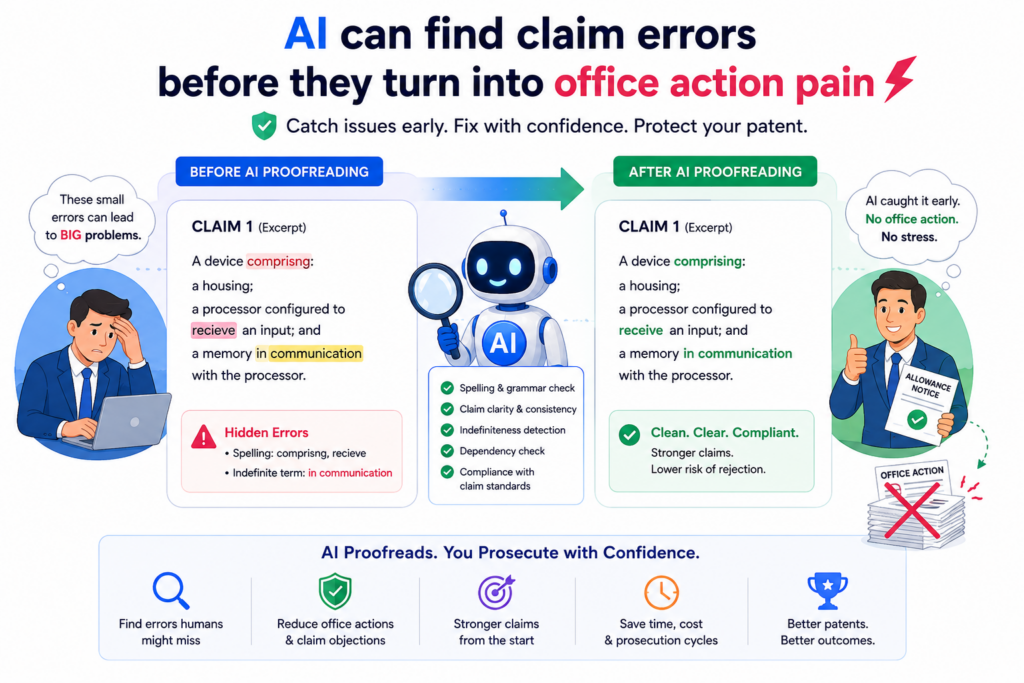
That confusion can show up later when the patent office reviews the filing. It can also show up when an investor, partner, buyer, or competitor reads the patent and tries to understand what is really protected.
For a startup, this is not just a writing issue. It is a business issue. Your claims should make the invention clear enough to support your edge. They should not make the reader work hard to guess what you meant.
AI can help by checking the claim set before filing. It can scan for terms that appear once and then disappear. It can find places where the claim starts with one part and later calls it something else.
It can notice when a step depends on another step that was never introduced. These are the kinds of errors that are easy to miss when everyone is rushing.
Claim proofreading should start with the words that define the invention
The most important claim words are the words that name the parts, steps, data, models, signals, devices, or actions that make the invention work. These words should be clear. They should also stay steady across the claim set.
For example, a claim may mention a “risk score,” while the spec says “trust value,” and the figure says “confidence output.”
Maybe all three mean the same thing. Maybe they do not. Either way, the draft needs to make that clear before filing.
AI can create a fast view of these terms. It can show each key term and where it appears. It can flag words that are used in the claims but missing from the spec. It can also show when two terms may be used for the same idea.
This gives the founder and attorney a cleaner place to start. Instead of reading the full draft line by line and hoping to catch every issue, they can focus on the terms that may cause trouble.
Clean claim words help your patent feel stronger and easier to defend
A clean claim is easier to understand. It is also easier to discuss.
When the words are steady, the attorney can focus on scope and strategy. The founder can focus on whether the claim matches the real invention.
This is where AI can remove noise from the review process. It does not decide what the claims should cover. It helps show where the draft may be unclear, thin, or out of sync. That makes the human review sharper.
If your team is building fast and wants to protect real technical work without getting buried in patent cleanup, PowerPatent can help.
It combines smart software with real patent attorney oversight, so you can move with more confidence. See how it works here: https://powerpatent.com/how-it-works
AI can help make the specification easier to read without making it weaker
A patent specification does not need to sound cold or confusing. It does need to be complete. It should explain the invention in a way that supports the claims and helps the reader understand how the invention works.
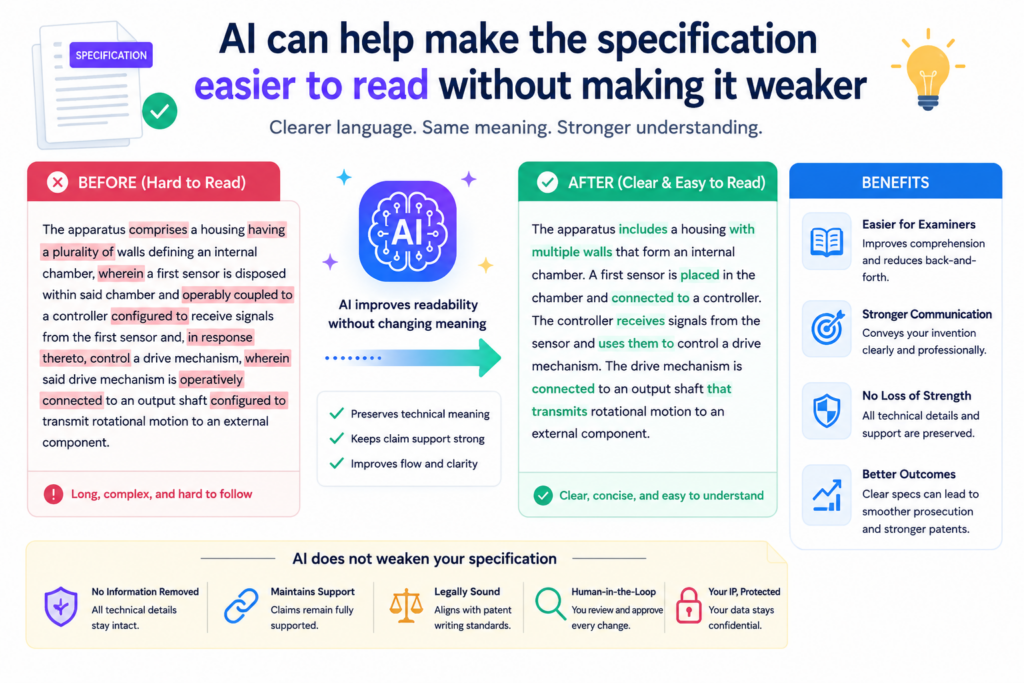
Many patent specs become hard to read because they try to say too much in a stiff way. Long sentences pile up.
The same idea appears in several places. Old product language gets mixed with new product language. A founder reads the draft and thinks, “This sounds close, but not quite like what we built.”
AI can help clean the spec without stripping out needed detail. It can find repeated text, unclear phrases, missing links, and places where a section jumps too fast.
It can also help turn engineer notes into clearer patent language while keeping the core idea intact.
The best spec review checks whether the story is easy to follow
A strong spec has a clear path. It introduces the problem. It explains the system. It shows how the parts work together.
It gives enough examples to support the invention. It connects the words to the figures. It does not make the reader guess.
AI can help check this path. It can flag places where a feature is named before it is explained.
It can point out sections where the same part is described in two different ways. It can find long paragraphs that hide important details.
This matters because a patent reader may not know your product. The spec must guide them. It should not assume they sat in your sprint meetings, read your code, or watched your demo.
A founder can use AI to ask a simple question: can a smart reader follow the invention from start to finish? When the answer is not clear, the draft needs work.
Clear writing does not mean shallow writing
Simple patent writing is not weak writing. In many cases, simple writing is stronger because it removes doubt.
It tells the reader what the invention does, how it does it, and why the result matters.
AI can help make the spec cleaner, but the final choices still need human review.
An attorney can decide where the draft needs more detail, where it needs less, and where the wording should stay broad enough to support the business goal.
PowerPatent helps founders avoid the old, slow process where patent drafts bounce around for weeks with unclear notes.
The platform helps your team move from technical idea to cleaner patent filing with attorney oversight built in. You can explore the process here: https://powerpatent.com/how-it-works
AI can help keep figures from telling a different story than the text
Figures are supposed to help the patent. But when they do not match the words, they can create confusion. A system diagram may show a module that the spec never explains.
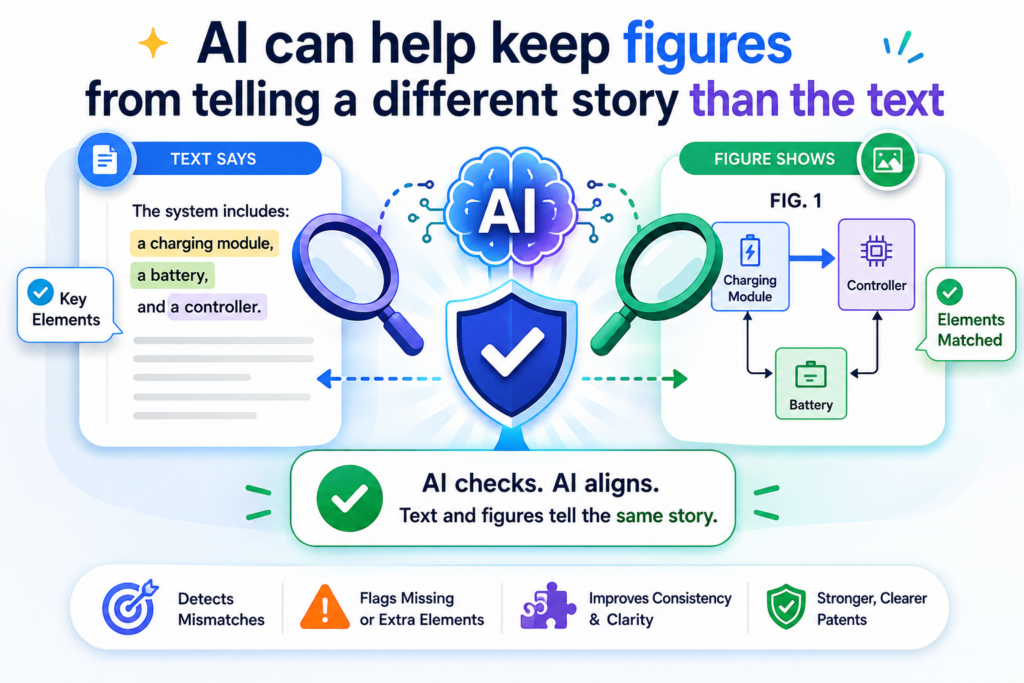
A flowchart may skip a step that appears in the claims. A label may use a different name than the written description. These issues can make the invention harder to understand.
For engineers and founders, figures often feel obvious because they know the system already. That is the trap. What feels obvious to the builder may not be obvious to a patent reader.
AI can help by comparing figure labels, written figure descriptions, claim terms, and spec sections.
It can find gaps between what is shown and what is said. It can also help spot numbering mistakes, missing callouts, and inconsistent names.
Figure proofreading should check both labels and meaning
It is not enough to check whether every number is present. The deeper question is whether the figure supports the invention story.
If the claim talks about a model update step, the figure should help show that step or the spec should explain it clearly. If the figure shows a data store, the spec should tell the reader what kind of data it holds and how it is used.
AI can help build a bridge between the figure and the text. It can show where each label appears in the spec.
It can point out labels that appear only in the drawing. It can flag figure references that seem missing or out of order.
This gives the founder a more useful review. Instead of staring at the drawings and asking whether they “look okay,” the team can ask whether the figures support the claims and make the invention easier to understand.
Better figures make hard technology feel easier to grasp
This is especially important for deep tech startups. If you are working on AI models, robotics, chips, biotech systems, security tools, sensors, or data platforms, your invention may not be easy to explain in words alone. Good figures can make the idea click.
AI can help make sure those figures are not just clean, but useful. It can push the team to connect each figure to the claims and spec. It can help reveal when a drawing is too thin or too crowded.
The best figure set does not try to impress the reader. It helps the reader understand. That is the goal. When the reader understands the invention, the whole patent has a better foundation.
AI can help find form mistakes that founders often miss
Patent forms can feel like the least exciting part of the process. But they can still create real delays.
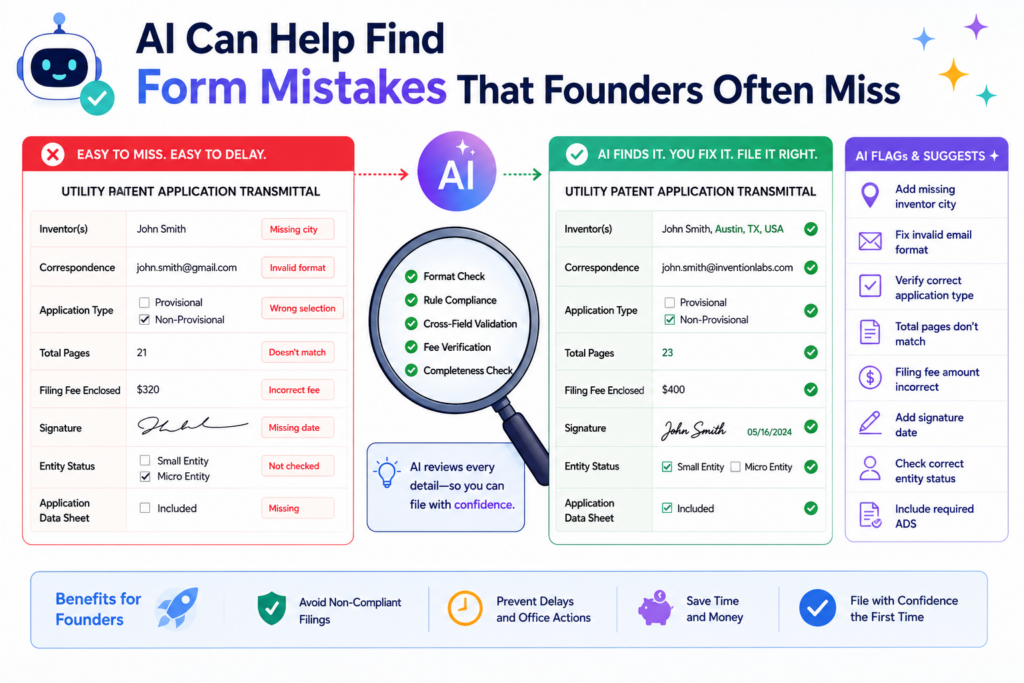
A wrong inventor name, a missing signature, a title mismatch, or an old company name can lead to extra work at the worst time.
Startups are especially exposed to these mistakes because company details change fast. A team may start with one company name and later form a new entity.
A founder may use a nickname in one place and a full legal name in another. An inventor may leave the company before filing. A draft may use the product name as the invention title, while the filing form uses a broader title.
AI can help check these items across the filing package. It can compare names, titles, dates, and document fields. It can flag differences before they create friction.
Forms should match the filing story, not just the filing fields
A patent form is not just a form. It is part of the full filing record. The details on that form should match the rest of the application.
The title should make sense. The listed people should be checked. The company name should be right. The dates should be reviewed.
AI can help by looking across the documents as one package. It can flag when the title on one document does not match another.
It can find when an inventor name is spelled two ways. It can point out when a company suffix is missing in one place.
These checks may sound basic, but they are valuable because they reduce drag. A founder does not want to lose time fixing paperwork after the team already did the hard work of drafting the application.
Form cleanup is a small step that protects the larger process
The best patent process feels calm near filing. Everyone knows what is being filed. The documents match. The attorney has reviewed the important issues. The founder is not chasing small corrections at the last moment.
AI helps create that calm by catching small problems early. It does not replace the attorney’s role. It helps prepare a cleaner package for attorney review.
This is one reason PowerPatent is useful for founders who want speed without chaos.
You can bring your invention details into a smarter workflow, clean up issues sooner, and get real patent attorney oversight before filing. Learn more here: https://powerpatent.com/how-it-works
AI can help founders review patents like builders, not lawyers
Most founders do not want to become patent experts. They want to protect what they are building and get back to building.
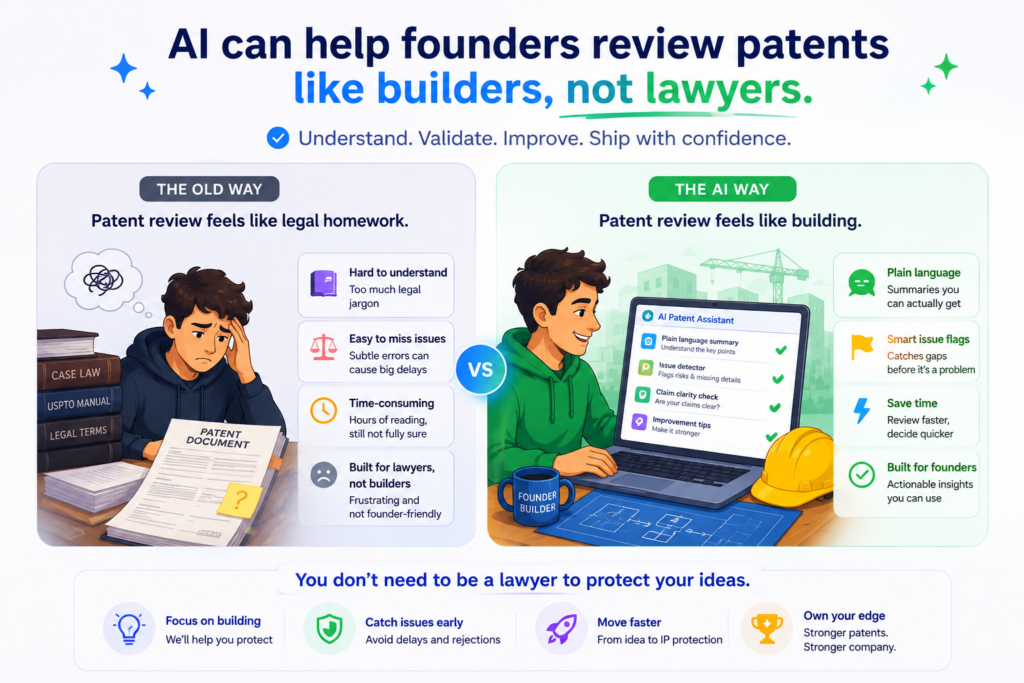
That is fair. But founders still need to review the patent draft because no one knows the invention better than the team that created it.
The problem is that patent drafts are not easy to read. They use formal claim language. They describe systems in a careful way.
They may include many versions of the invention. A founder can get lost before reaching the parts that matter most.
AI can help by turning the review into a builder-friendly process. It can show the main invention points in plain words. It can connect claim terms to product features.
It can point out where the draft may not match the current system. It can help the founder give better feedback without reading the whole document like a lawyer.
Founder review should focus on truth, gaps, and future versions
A founder does not need to edit every comma. The founder’s job is to make sure the draft is true to the invention.
Does it describe how the system works? Does it include the key feature that makes the product different? Does it miss a version the team may ship next quarter? Does it use names that the engineers would understand?
AI can help guide this review. It can summarize each claim in plain words. It can show the main parts of the spec.
It can ask whether each feature is still correct. It can flag sections that may be based on an old version of the product.
This turns review from a painful reading task into a focused check. The founder can spend energy where it matters most.
Better founder feedback leads to better patent work
When founders give clear feedback, attorneys can do better work. Instead of saying, “This feels off,” the founder can say, “The model is not trained that way anymore,” or “We should include the edge-device version,” or “The key part is the scoring loop, not just the dashboard.”
That kind of feedback is gold. It helps the attorney strengthen the draft in ways that match the real business.
PowerPatent helps make this easier. It gives technical teams a way to move faster, use smart AI tools, and still get attorney oversight where judgment matters most.
For founders who want stronger patents without the old slow process, this is a smarter path. See how PowerPatent works here: https://powerpatent.com/how-it-works
AI can help review patent language before it becomes too narrow
A patent draft can look clean and still be too narrow. This happens when the draft only describes the exact product version your team has today.
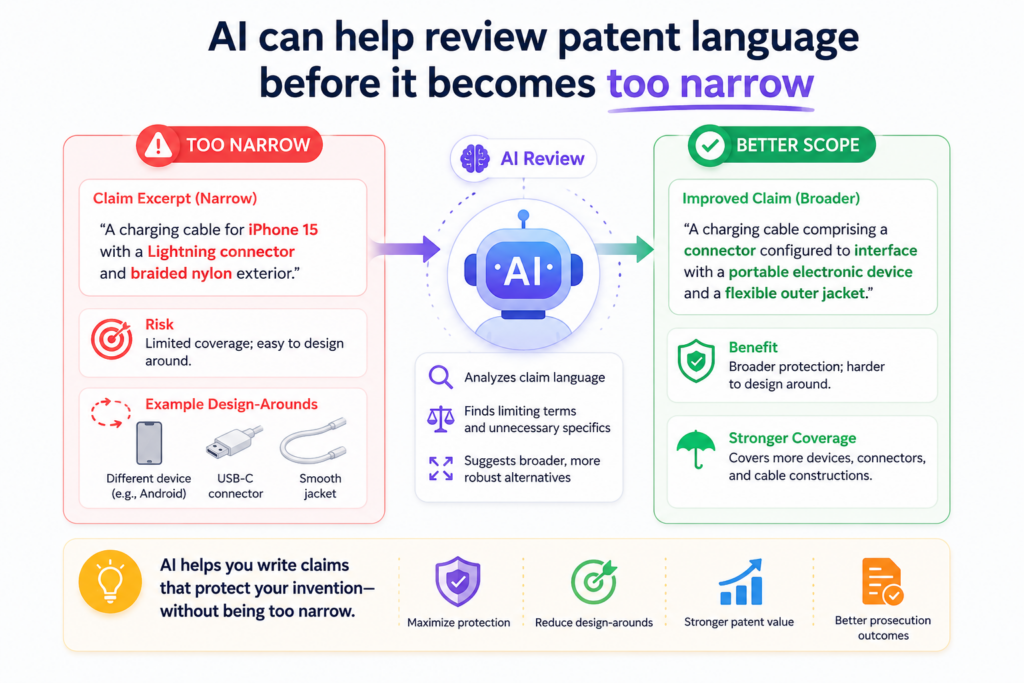
That may feel safe because it is true and easy to explain. But it can leave out other versions that your team may build later.
For a startup, this is a real risk. Your first version is rarely your final version. Your model may change. Your hardware may shrink.
Your workflow may move from the cloud to the edge. Your data source may expand. Your user flow may look different six months from now.
AI can help find language that may be too tied to one current setup. It can flag words that lock the invention to one device, one database, one model type, one user action, or one product screen.
Then a patent attorney can review whether the draft should include broader support or more versions.
AI can point out where the draft sounds like a product manual
A product manual explains what the product does today. A patent spec should often do more. It should explain the invention in a way that can support the core idea behind the product.
That does not mean making wild claims. It means showing the invention with enough care so the protection can grow with the company.
AI can scan for narrow wording. It may find that every example uses one type of sensor, even though other sensors could work. It may find that a claim names one kind of AI model, while the invention could work with several model types.
It may find that the spec only describes a phone app, even though the same system could run on a web app, server, device, or embedded system.
These checks help founders see where the patent draft may be boxed in. The founder can then work with counsel to decide what should be added, changed, or left alone.
Strong patent proofreading protects the invention beyond the first build
The first build proves the idea works. The patent filing should help protect the invention behind that build. That is where smart review matters.
AI can help spot narrow language early, but it should not make the final call. The final call should come from a patent attorney who understands the filing, the invention, and the business goal.
PowerPatent gives founders that mix of smart software and real attorney oversight, so teams can move faster without leaving key value on the table. See how it works here: https://powerpatent.com/how-it-works
AI can help find vague words that weaken the draft
Vague words are dangerous because they feel harmless. A draft may say a system is “smart,” “fast,” “better,” “optimized,” or “advanced.” These words sound good in marketing, but they may not explain much in a patent draft.
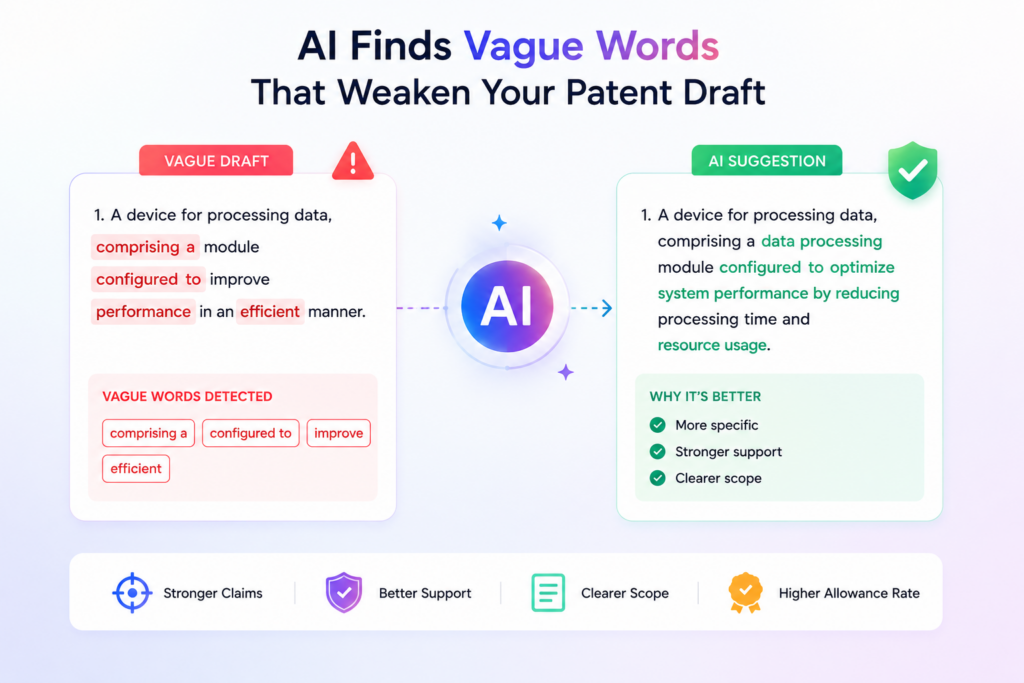
A patent should show what the invention does and how it does it.
If the draft says a process is “optimized,” the reader may ask what is being optimized, how it is changed, what input is used, what output is created, and what result is improved. If the draft says a model is “intelligent,” that may not tell the reader enough.
AI can help find these soft spots. It can flag vague words and ask whether the draft needs more detail. This is not about making the draft longer. It is about making the draft clearer.
Vague words should often be replaced with real actions and real parts
The best patent writing is not fancy. It is clear. Instead of saying a system “improves results,” the draft can explain that it changes a score, updates a model weight, selects a new route, filters bad data, reduces false alerts, or changes how a device responds.
AI can help by finding places where the draft says a result without explaining the steps. It can also point out where a sentence sounds good but does not teach much.
This gives the founder a simple way to improve the draft: replace weak claims of value with concrete system behavior.
For technical teams, this is often easy once the issue is visible. Engineers know what the system actually does.
They can explain the input, the logic, the output, and the result. The hard part is noticing where the draft failed to say it.
Clear patent wording helps the reader trust the invention story
When the wording is clear, the invention feels more real. The reader can follow the steps. The attorney can better assess the claims. The founder can confirm that the draft matches the technology.
This is one of the biggest gains from AI-assisted proofreading. It does not just catch typos. It helps reveal where the draft sounds impressive but lacks substance.
A cleaner draft gives the attorney better material to review and gives the founder more confidence before filing.
PowerPatent helps founders turn technical detail into patent-ready content without making the process feel heavy.
With AI tools and real attorney oversight, your team can protect what matters with more speed and less stress. Learn more here: https://powerpatent.com/how-it-works
AI can help compare the patent draft against the real product
A patent draft should match the invention, but startups change fast. The team may update the code after the first invention notes were written. The model may use a new training process.
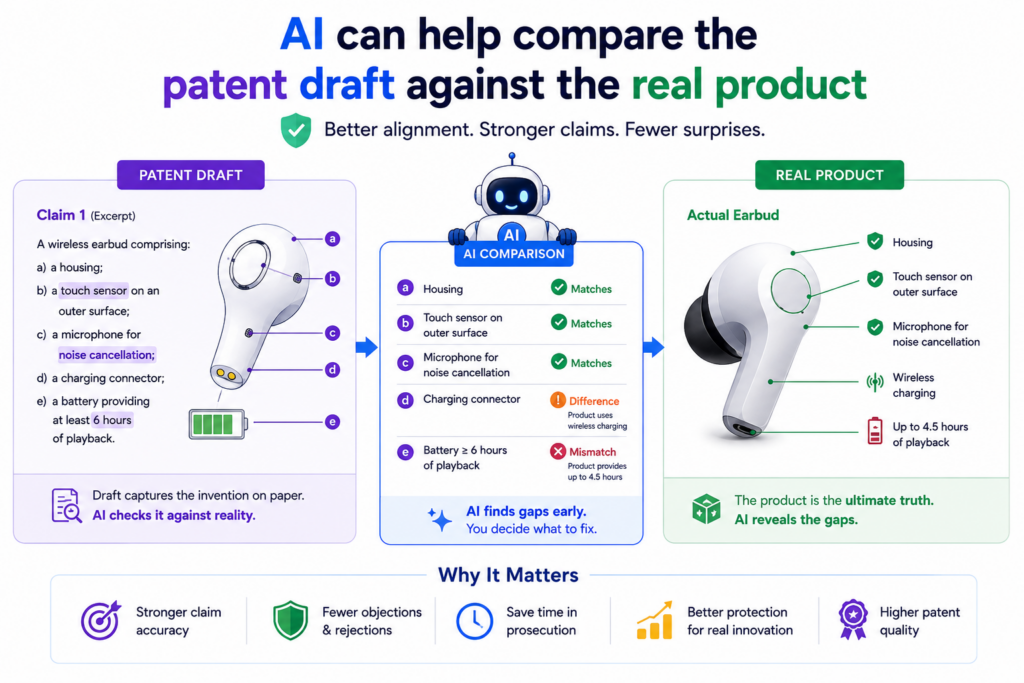
The hardware may get a new layout. The product may stop using a feature that still appears in the draft.
This is where AI can help close the gap between the patent draft and the real product.
It can compare invention notes, product docs, diagrams, tickets, model cards, design files, and draft patent text. It can flag places where the patent draft may be stale or incomplete.
This does not mean the patent should copy the product word for word. It should not. But it should reflect the real invention clearly enough that the filing is based on the truth of what the team built.
Product-to-patent review helps founders catch stale details
Stale details are easy to miss. A draft may still mention a dashboard that was removed. It may describe manual review even though the system now uses an automated scoring step.
It may say the model runs in the cloud, while the team has moved part of the process to a local device.
AI can help by marking these possible mismatches. It can show the founder where the patent story may not match the current technical story. That makes review more practical.
Instead of asking a founder to read a forty-page draft from top to bottom, AI can surface the parts that may need attention.
The founder can then say whether the draft is right, wrong, outdated, or missing a key version.
The best patent draft should cover the invention without copying every product detail
A patent filing should not be a product spec. Product specs change too often. The patent should focus on the invention and the useful ways it can be built.
That is why attorney oversight matters. AI can find mismatches, but the attorney helps decide whether the patent should be updated, broadened, narrowed, or left as is.
The goal is not to chase every product change. The goal is to protect the core technical value.
PowerPatent makes this process easier for technical founders because it helps bring invention details into a cleaner workflow.
The software helps organize and check the work, while real attorneys review the filing path. You can see how PowerPatent works here: https://powerpatent.com/how-it-works
AI can help proofread patent drafts for investor and diligence readiness
Patents often matter long before they are granted. They can show investors that your team is serious about protecting the technology.
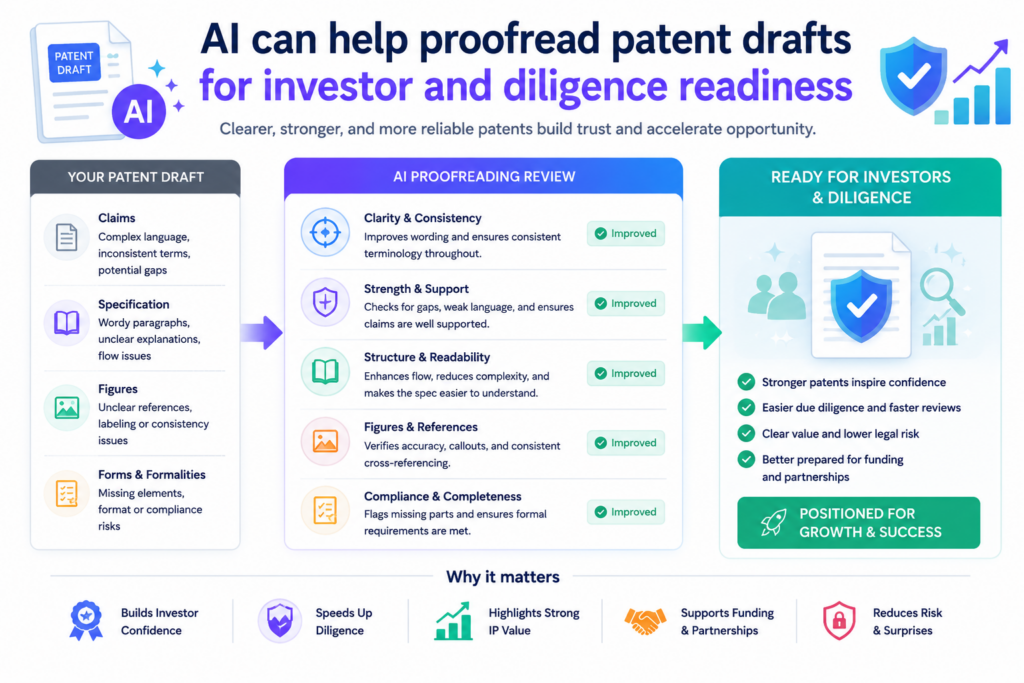
They can help in partner talks. They can support a stronger story during fundraising, diligence, licensing, or acquisition talks.
This does not mean a patent draft should be written like a pitch deck. It should still be a patent document.
But it should be clean, consistent, and easy enough to explain. A messy filing can create doubt. A clear filing can support trust.
AI can help by reviewing the draft from a diligence point of view. It can check whether the title, claims, spec, figures, and invention summary point to the same core value.
It can flag confusing terms, missing support, and old product names that may make the filing feel rushed.
A clean patent record makes your company look more organized
Investors and buyers do not only look at what you filed. They also look at how carefully you handled it.
If the documents are full of mismatches, missing details, and unclear language, that can raise questions. It may not kill a deal, but it can create friction.
AI can help reduce that friction by checking the draft before filing. It can find where the invention title sounds too narrow.
It can show where the claims do not seem to match the main business value. It can flag when figures are hard to follow or when the spec buries the key idea deep in the text.
This kind of review helps founders think beyond the filing date.
The patent may be read months or years later by people who were not there when the invention was made. The cleaner the draft, the easier it is for them to understand why it matters.
Patent proofreading is part of company-building, not just paperwork
A startup’s IP story is part of its business story. It shows what the team believes is valuable. It helps mark the technical edge. It can make the company feel more durable.
That is why proofreading should not be treated like a final spell check. It is a quality step. It helps make sure the invention story is clear before it becomes part of the company record.
PowerPatent helps founders build that record with more control. You get smart tools to move faster and real patent attorney oversight to help avoid careless mistakes.
When your company is ready to turn technical work into stronger patent filings, start here: https://powerpatent.com/how-it-works
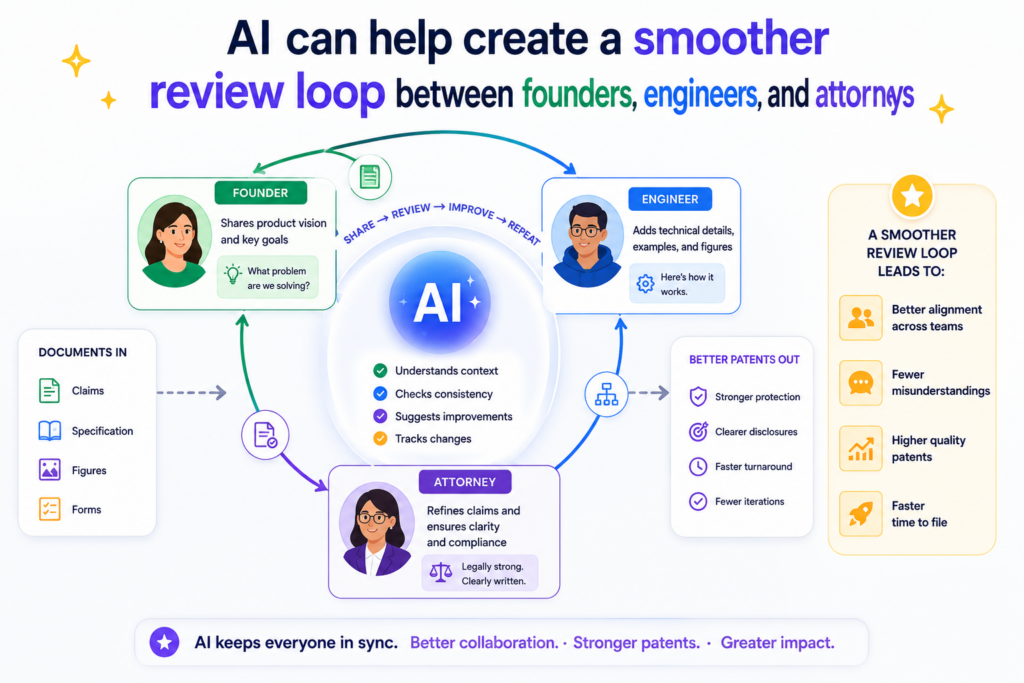
AI can help create a smoother review loop between founders, engineers, and attorneys
Patent drafting can get slow when feedback is unclear. The founder says one part feels wrong. The engineer says the system changed.
The attorney asks for more detail. Then comments spread across email, docs, chats, and calls. Soon, nobody knows which version is current.
AI can help make the review loop cleaner. It can organize comments, compare versions, track changed terms, and surface the parts that need a decision. This helps every person focus on their role.
The founder can confirm the business value. The engineer can confirm the technical truth. The attorney can shape the patent strategy.
AI can keep the draft organized enough so the team does not waste time chasing the same issue again and again.
A better review loop starts with clearer questions
Many patent reviews fail because the questions are too broad. Asking “Does this look good?” rarely helps. A better question is more direct.
Does this claim cover the key model update? Does this figure show the data path correctly? Does this section explain the edge-device version? Does this term match what the system actually uses?
AI can help create those focused questions. It can read the draft and point each reviewer to the section that needs their input.
It can help the engineer review only the technical parts that matter. It can help the founder check whether the filing supports the company’s near-term and long-term plans.
This saves time because each reviewer is no longer reading blind. They are checking specific issues with a clear purpose.
The fastest patent process is the one with fewer confused handoffs
Speed does not come from rushing. It comes from reducing confusion. When the draft is organized, comments are clear, and review issues are visible, the team moves faster with less risk.
AI can help create that speed, but the best results come when AI is paired with human review.
Patent attorneys still bring judgment, care, and strategy. Engineers still bring technical truth. Founders still bring business context.
PowerPatent is built for this modern way of working. It helps startup teams turn code, models, systems, and invention notes into stronger patent filings with smart software and attorney oversight in the loop.
You can see the workflow here: https://powerpatent.com/how-it-works
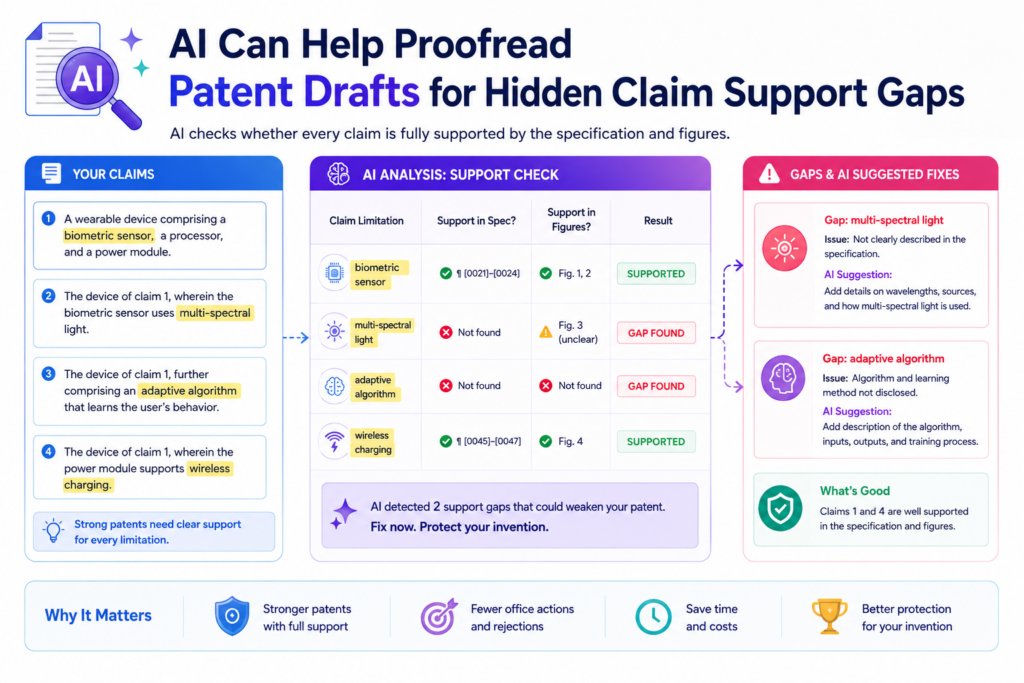
AI can help proofread patent drafts for hidden claim support gaps
A patent claim can sound strong, but still have a weak base if the spec does not explain it well. This is one of the easiest problems to miss because the claim may read cleanly.
The issue is not always grammar. The issue is whether the rest of the draft gives the claim enough ground to stand on.
For a startup, this matters because your claims are tied to your company’s edge.
If the claims talk about your key model, device, workflow, or data method, the spec should give enough detail to support that idea. If the spec is thin, the claim may face more pushback later.
AI can help by checking each claim against the body of the draft. It can look for claim terms that are not explained well.
It can find steps that appear in the claims but not in the process description. It can show where the spec may need more detail before the filing is reviewed by an attorney.
Claim support is about making sure the draft backs up what it asks for
A simple way to think about support is this: if the claim says the invention does something, the spec should teach how that thing happens.
It does not need to read like a textbook. But it should give enough detail so the reader can understand the invention without guessing.
AI can help map this out. It can find where each claim phrase appears in the spec. It can show whether the same idea is explained in the figures.
It can point out when a claim uses a word that never shows up anywhere else.
This kind of check is useful because patent drafts are long. A founder may think a feature is fully covered because it was discussed in a meeting or written in an invention note.
But if it did not make it into the draft, it may not help the filing.
AI makes support review faster, but the final call still needs judgment
Support is not just a word-matching task. A claim term may be supported even if the exact words are different.
A term may also be weak even if it appears many times. This is why attorney review matters.
AI can point to possible gaps. A patent attorney can decide whether the gap is real and how to fix it. That mix gives founders a faster and safer way to clean up the draft.
PowerPatent is built around this balance. The software helps find issues early, while real patent attorneys help guide the final filing work. You can see how PowerPatent helps technical teams protect inventions here: https://powerpatent.com/how-it-works
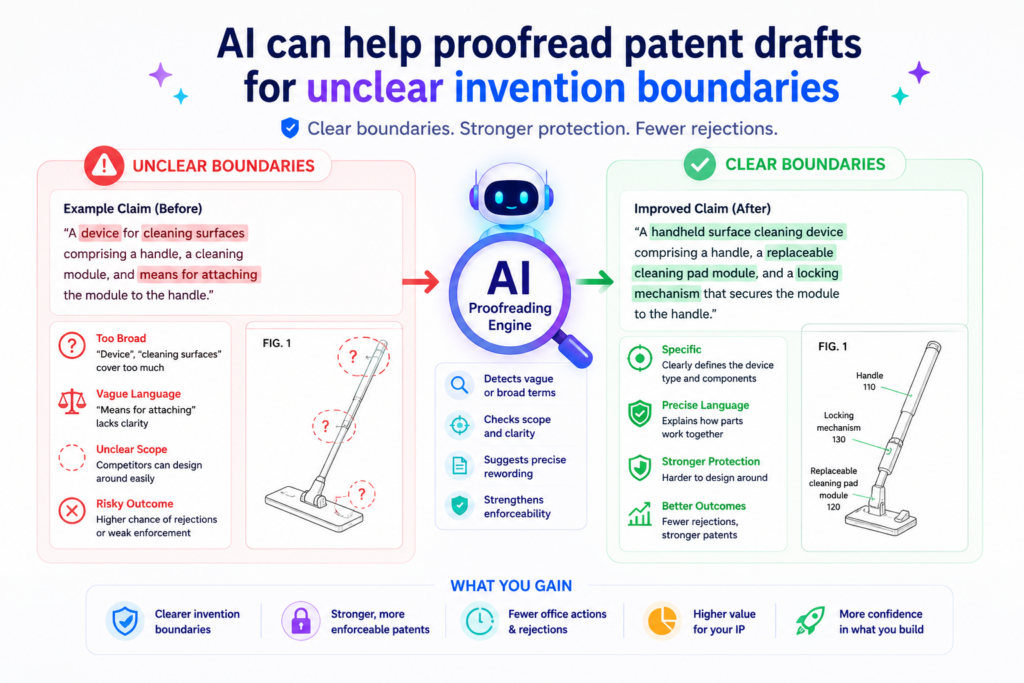
AI can help proofread patent drafts for unclear invention boundaries
A good patent draft should make the invention’s boundaries easier to see.
It should show what the invention is, what parts matter most, and how those parts work together. When the boundary is unclear, the draft can feel messy even if the writing is clean.
This often happens when a startup has many related ideas.
The team may have built a model, a data flow, a user interface, a scoring method, a device control process, and a backend system. All of these may connect. But the patent filing still needs a clear center.
AI can help by finding the main themes in the draft and checking whether the claims, spec, and figures point to the same invention.
It can flag sections that wander too far away. It can also flag parts that seem important but are not connected to the claims.
The patent draft should not make the reader hunt for the main idea
When a reader finishes the first few pages of a patent draft, they should have a basic sense of what the invention is about.
They may not know every detail yet, but they should know the center of the story. If the draft jumps from one feature to another without a clear thread, the reader may get lost.
AI can help test this. It can summarize the draft in plain words. If the summary misses the point, that is a warning sign.
It can also compare the summary of the claims with the summary of the spec. If those summaries feel like two different inventions, the draft may need cleanup.
This is a powerful check for founders because it shows whether the patent story matches the company story. If your real edge is a new way to reduce false alerts, but the draft reads like a general dashboard patent, something is off.
Clear boundaries help the attorney build a better protection plan
A patent attorney needs to know what the core invention is before shaping the claims. If the draft hides the main idea under too many side details, the review gets harder.
AI can help bring the main idea back into focus. It can show which sections support the core invention and which sections may be extra. Then the attorney can decide how to handle that material.
This is also where PowerPatent can save founders time. Instead of starting with a scattered pile of notes, teams can use smart tools to organize the invention and work with real attorneys to build a cleaner filing path.
You can explore the workflow here: https://powerpatent.com/how-it-works
AI can help proofread patents for figure label drift
Figure labels are small, but they do important work. They connect the drawing to the written text. When the labels drift, the patent becomes harder to follow.
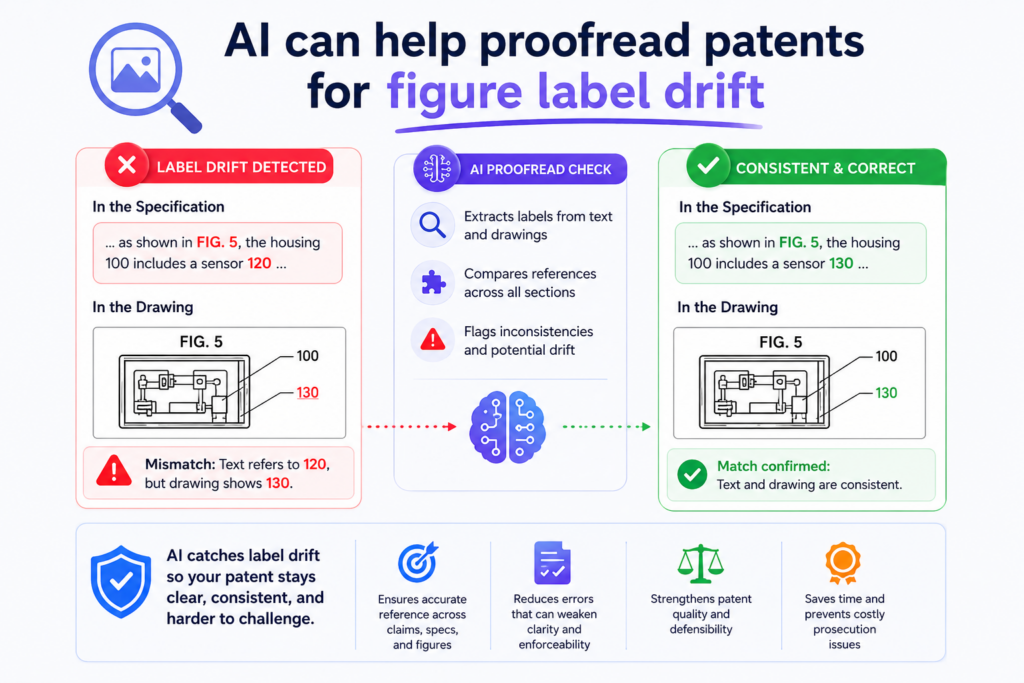
A module may be called one thing in the figure and another thing in the spec. A step may have a number in the flowchart but no matching explanation. A label may be used twice for two different parts.
These mistakes are common because figures often change during drafting. A founder may update the system diagram.
An engineer may rename a module. The attorney may add a new figure description. If no one checks the full set again, the labels can fall out of sync.
AI is very strong at this kind of proofreading. It can compare labels across figures, figure descriptions, claims, and the spec.
It can find where a label appears, where it disappears, and where it may not match the term used elsewhere.
Figure label review should connect every drawing part to the written story
A figure label should not sit alone. If a drawing shows a “model update engine,” the spec should explain what that engine does.
If the claims rely on that engine, the connection should be even clearer. If the label is not important, the team may need to decide whether it belongs in the figure at all.
AI can create a simple check by listing every figure label and matching it to the related text. This can reveal missing explanations. It can also show when a figure uses old product names that should be replaced.
For software and AI inventions, this is especially useful. Diagrams often include modules like “training service,” “feature extractor,” “routing layer,” “policy engine,” or “inference module.”
If those names shift across the draft, the reader may not know whether the parts are the same or different.
Clear figure labels make technical inventions easier to understand
The best figures reduce effort for the reader. They do not force the reader to decode the system. They make the invention easier to see.
AI can help clean the labels, but a human should still decide whether the figure is doing its job.
Sometimes a figure is accurate but too crowded. Sometimes a figure is simple but leaves out the core feature. An attorney can help decide which figures support the claims best.
PowerPatent helps founders get this kind of review without turning the process into a slow paperwork maze.
You can move from technical diagrams to cleaner patent-ready figures with software support and attorney oversight. Learn how it works here: https://powerpatent.com/how-it-works
Conclusion
AI patent proofreading gives founders a faster, cleaner way to catch problems before they slow a filing down. It helps check claims, specs, figures, and forms, but it works best when paired with real attorney review. That mix gives your team speed without blind trust in software alone.
It also helps engineers share better details, founders stay in control, and attorneys focus on stronger protection. Your invention deserves more than a rushed draft. With PowerPatent, founders can protect what they are building with confidence and less stress. Start here: https://powerpatent.com/how-it-works
Leave a Reply