A patent draft is not something you should rush out the door. Before filing, you want to slow down for one smart step: a clean QA review. This is where you check if the draft truly explains your invention, protects the real value, and avoids small mistakes that can cause big problems later.
Start by checking whether the draft protects the real business value
A patent draft should not only describe what you built. It should protect the part of the invention that gives your company an edge. This is the first QA check.
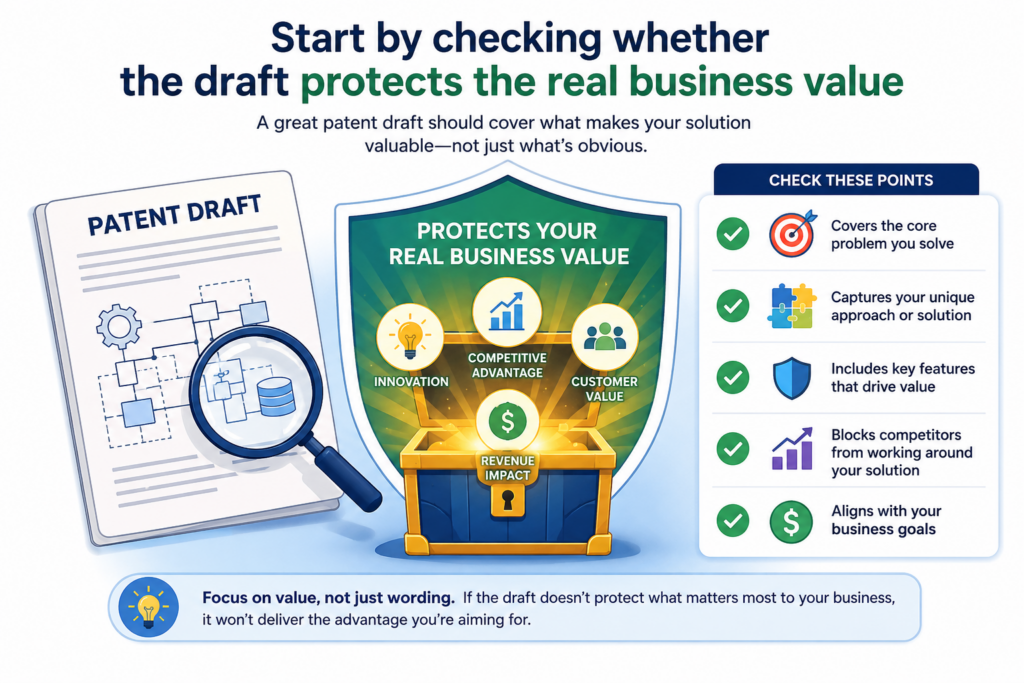
Before you worry about word choice, drawings, claims, or formatting, ask one clear question: does this draft protect the thing that makes this invention valuable?
That may sound simple, but this is where many weak patent drafts fail. They describe a product feature. They explain a screen. They talk about a workflow. But they do not protect the deeper idea that makes the system hard to copy.
For a startup, that can be a serious problem. You may file a patent that looks complete, but later learn that a competitor can make a small change and avoid it. That is not what you want.
A strong review starts by finding the core value.
The draft should make the heart of the invention easy to see
When you read the draft, you should be able to point to the main inventive idea without guessing. It should not be buried inside long text.
It should not only appear in one narrow example. It should show up across the title, summary, drawings, detailed description, and claims.
The heart of the invention is not always the finished product. It may be the way data moves through the system. It may be how a model is trained.
It may be how the software cuts compute cost. It may be how a device handles a signal. It may be how the system makes a choice faster, safer, or with less user input.
If the draft reads like a product manual, it may be too narrow. If it reads like a vague idea with no real steps, it may be too broad.
The sweet spot is clear, real, and tied to the technical thing that makes your invention work.
The best QA move is to write the invention in one plain sentence
Before filing, try this simple test. Write the invention in one sentence that a smart teammate could understand.
For example, you might say, “The invention helps a robot choose a safer path by updating risk scores as sensor data changes.”
Or, “The invention reduces cloud cost by deciding which model tasks should run locally and which should run on a server.”
Now compare that sentence with the draft.
If the draft does not clearly support that sentence, the draft needs more work. If the claims protect something far smaller than that sentence, the draft may be leaving value behind. If the draft protects something much wider but does not explain how it works, it may be too thin.
This one-sentence test is useful because it cuts through noise. Patent drafts can get long fast. A clean sentence keeps the team honest.
The draft should match what investors, buyers, or partners would care about
A patent is not just a file sitting in a database. It can become part of your startup story. It can help show that your team has built something real, hard to copy, and worth taking seriously.
That means the draft should match the part of your work that matters in the market.
If your main edge is speed, the draft should explain how the invention improves speed. If your edge is lower cost, the draft should show the cost-saving path.
If your edge is better model output, the draft should explain how the output improves and what technical steps help make that happen.
This does not mean the patent draft should sound like a sales deck. It should not. But it should clearly protect the technical reason behind the business win.
A founder should not finish reading the draft and think, “This protects a side feature, not the thing we care about.”
The review should look for missing links between the problem, the method, and the result
A good patent draft often has a simple flow. It explains the problem. It shows why old ways fall short. It explains the new method. Then it shows the result.
If any part of that chain is missing, the draft can feel weak.
For example, a draft may say that a system improves accuracy, but never explains what causes the improvement.
Or it may describe a method in detail, but never makes clear why the method matters. Or it may describe a problem in strong words, but give only a thin answer.
During QA, look for that full story.
The draft should not just say the invention is better. It should show how the invention creates the better result.
This is especially important for AI, software, robotics, hardware, biotech tools, and deep tech systems. These inventions often have many moving parts. The value may not be obvious unless the draft connects the pieces in a simple way.
PowerPatent helps technical teams catch these gaps early by combining smart drafting tools with review from real patent attorneys.
That gives founders more control without forcing them to slow down their product work. You can see the process here: https://powerpatent.com/how-it-works
Review the claims as if a competitor is trying to design around them
The claims are the part of the patent draft that matter most for protection. The rest of the draft explains the invention. The claims define what you are trying to protect.
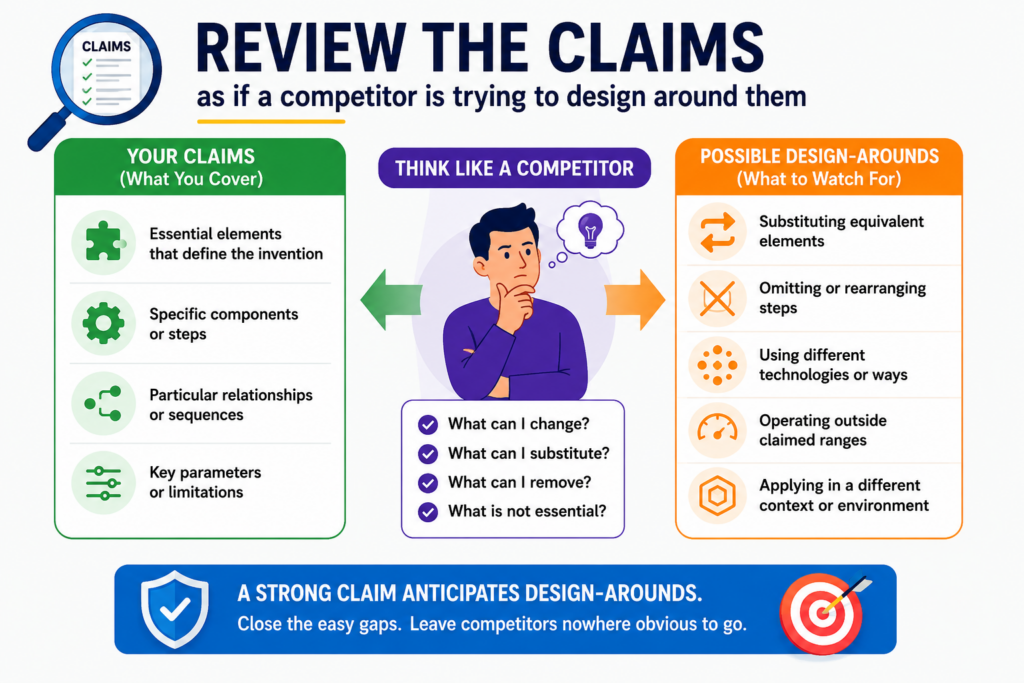
That is why your QA review should treat the claims with extra care. Do not read them like a normal article. Read them like a competitor who wants to copy your idea without getting caught.
That mindset changes everything.
A claim may look fine at first glance. It may sound technical. It may include many steps. But the real question is whether it protects the useful invention in a way that is hard to avoid.
The broadest claim should not be trapped inside one product version
Many startup patent drafts accidentally protect the first product version too tightly. This is natural. Your team knows the version you built.
Your code, demo, model, device, or workflow is fresh in your mind. So the draft often follows that exact version.
But a patent should usually think beyond the first build.
Your competitor may not copy your screen layout. They may not use the same database. They may not train the model in the same order. They may not use the same sensor. They may not call the steps by the same names.
So your broadest claim should focus on the core technical idea, not only the exact product setup.
This does not mean the claim should be vague. It still needs real structure. It still needs support in the description. But it should not be so tied to one example that a small change makes it useless.
A strong QA question is whether each claim word is needed
When reviewing a claim, look at every main word and ask whether it must be there.
If the claim says the system uses a “mobile device,” does the invention really need a mobile device? Could it also work on a laptop, server, robot, vehicle, or edge device?
If the claim says the model is a “neural network,” does the invention truly require that type of model? Could another model do the same job?
If the claim says the method has five steps in a fixed order, does the order matter? Or could the invention still work if steps happen in a different order?
Every extra word can become a door for competitors. Some words are needed. Some add clarity. Some help show how the invention works. But some words make the claim smaller for no good reason.
A good QA review does not delete words just to be broad. It checks whether the words match the real invention.
The dependent claims should protect useful fallbacks
Dependent claims are narrower claims that build on the main claim. Think of them as backup positions.
If the broad claim gets challenged, the dependent claims can help protect more specific versions of the invention. They can also help cover key product details, technical choices, and valuable improvements.
During QA, do not treat dependent claims as filler. They should be chosen with care.
Good dependent claims often cover the parts that make the invention work better in real life. That may include how data is cleaned, how a score is made, how a model is picked, how a device reacts, how users are grouped, how an alert is sent, how errors are reduced, or how a system changes based on feedback.
Each dependent claim should earn its place.
The dependent claims should map to real product and roadmap value
One useful review move is to compare the dependent claims against your current product and near-term roadmap.
If a feature is already important, it may deserve claim coverage. If a feature is planned and likely to matter, it may also deserve support. If a feature is only a random option with no clear value, it may not deserve much attention.
This is where founders and engineers should speak up.
Patent attorneys are trained to draft and protect inventions. But your product team knows which parts are central to the business. The best drafts come from both sides working together.
A founder may say, “That claim covers what we have now, but the next version will move this step to the edge device.” An engineer may say, “The real trick is not the scoring step. It is how we update the score when data gets noisy.”
Those comments can make the filing much stronger.
PowerPatent is built for this kind of teamwork. It helps teams bring code, notes, diagrams, and invention details into a cleaner process, while real patent attorneys help shape the final filing. Learn more here: https://powerpatent.com/how-it-works
Check whether the description gives enough support for future claim changes
The detailed description is the body of the patent draft.
It should explain the invention in enough detail that someone skilled in the area can understand how it works. But it also has another job that founders often miss.
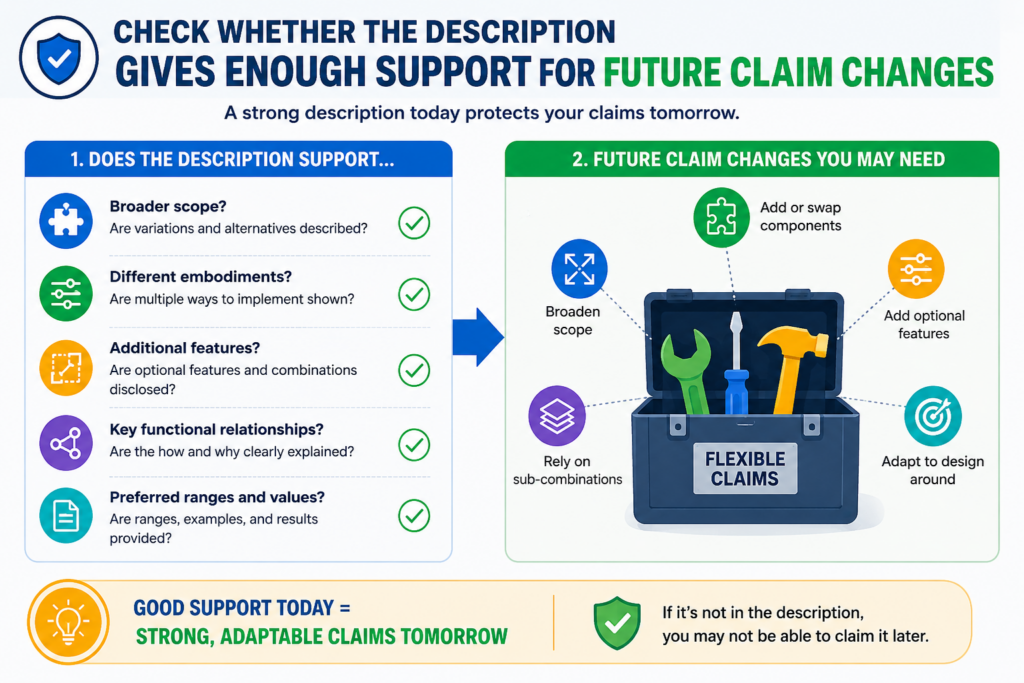
It should support claim changes later.
Patent filings often change during review. Claims may be edited. Some claim parts may be narrowed. New claim angles may become useful. If the original draft does not support those changes, your options may be limited.
That is why QA should not only ask, “Does the draft describe our product?”
It should also ask, “Does the draft give us room to protect the invention from different angles later?”
The draft should include more than one way to practice the invention
A strong patent draft does not rely on only one example.
If the invention can work in different systems, devices, setups, data flows, models, materials, networks, or user settings, the description should say so in a clear way.
This matters because your business may change. Your product may change. Your customer may change. Your best market may not be the first market you target.
A filing that only describes one version can become too narrow. It may protect yesterday’s demo but not tomorrow’s product.
A good description gives real examples while also showing variations. It explains the main version, then covers other ways the same idea can work.
The QA review should look for narrow words hiding in the description
Sometimes a draft becomes narrow without anyone noticing.
The description may say “the server performs the analysis” again and again, even though the analysis could happen on a phone, edge device, robot, vehicle, or local machine.
It may say “the user clicks a button,” even though the action could be automatic. It may say “the image is captured by a camera,” even though the input could come from a scanner, sensor, file, or stream.
These small phrases can matter.
During QA, look for words that lock the invention to one setup. Then ask whether that limit is true.
If it is true, keep it. If it is only one example, the draft should make that clear.
This is not about making the draft loose. It is about making sure the draft does not shrink the invention by accident.
The draft should explain the invention at different levels of detail
A useful patent draft often works like a zoom lens.
At one level, it explains the big idea. At another level, it explains the system parts. Then it explains steps. Then it gives examples. Then it may show options, edge cases, and results.
This layered style helps the draft support both broad and narrow claims.
For example, a software invention may first describe a system that receives data, processes it, and takes action. Then it may explain the modules that do the work.
Then it may describe a specific method. Then it may show how the method handles missing data, bad data, late data, or conflicting data.
That kind of depth gives the patent team more material to work with.
The draft should make technical choices feel intentional
Many inventions are not just about what happens. They are about why certain technical choices were made.
Why is data grouped before scoring? Why is a model selected before the input is cleaned? Why is a threshold updated over time? Why does the device switch modes? Why does the system use a local cache? Why does it send only part of the data to the cloud?
The draft should explain these choices in simple, clear terms.
This does not mean it needs long theory. It means the reader should understand the reason behind the design.
When technical choices are explained well, the invention feels more real. It also becomes easier to defend the draft as a true technical solution, not just a goal or wish.
Confirm that every key drawing matches the written draft
Drawings are not decoration. They help explain the invention. They also support the written text and claims. For many technical inventions, drawings make the draft much easier to understand.
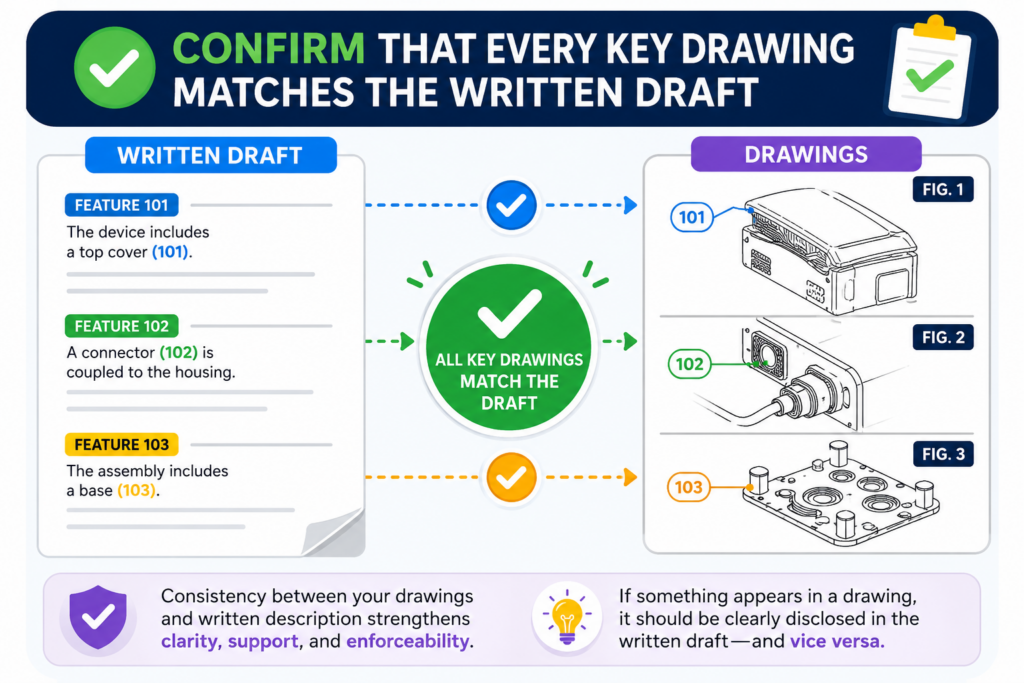
A QA review should compare the drawings with the written draft carefully. Do not assume they match. Drafts often change, but drawings are not always updated. That can create confusion.
A mismatch may seem small now, but it can cause trouble later.
Each drawing should tell a clear part of the invention story
A good drawing should have a job.
One drawing may show the system. Another may show the method. Another may show data flow. Another may show a device.
Another may show a model pipeline. Another may show a user interface. Another may show how parts work together over time.
When reviewing drawings, ask whether each one helps.
If a drawing is hard to follow, the text should explain it better. If a drawing shows a part that is never discussed, the text may need an update. If the written draft talks about an important feature but no drawing shows it, a new figure may help.
The QA review should trace each reference number back to the text
In many patent drafts, drawing parts have reference numbers. These numbers should match the written description.
This is a basic check, but it is easy to miss.
If the drawing labels a “processing module 120,” the text should use that label in a clear way. If the text mentions “sensor 140,” the drawing should show it. If the same number is used for two different things, that should be fixed.
Clean drawing labels make the draft easier to read. They also show care.
For deep tech inventions, this matters even more. Your system may have many parts. If the drawings and text do not line up, the draft can feel messy fast.
The drawings should not limit the invention by mistake
Drawings often show one example. That is fine.
But the draft should make clear that the drawings are examples unless a feature is truly required.
For example, a system drawing may show one server, one user device, and one database. But the invention may also work with many servers, many devices, distributed storage, edge compute, or local processing.
The text should not make the drawing look like the only possible setup unless that is intended.
The drawing review should include the people who built the system
Engineers can often spot drawing issues faster than anyone else.
They may notice that a data arrow points the wrong way. They may see that a model training step is placed after an inference step when it should be before.
They may catch that a device part is missing. They may know that the real system has a feedback loop that the drawing does not show.
This is why patent QA should not happen in a vacuum.
The best review pulls in the people closest to the invention, then uses attorney guidance to turn that input into a better filing.
PowerPatent helps make that process smoother, so founders and engineers can review the parts that matter without getting buried in patent busywork. See how PowerPatent works here: https://powerpatent.com/how-it-works
Make sure the problem is clear before the solution appears
A strong patent draft should not make the reader guess why the invention matters. Before the draft explains the new system, method, or device, it should set up the problem in simple terms.
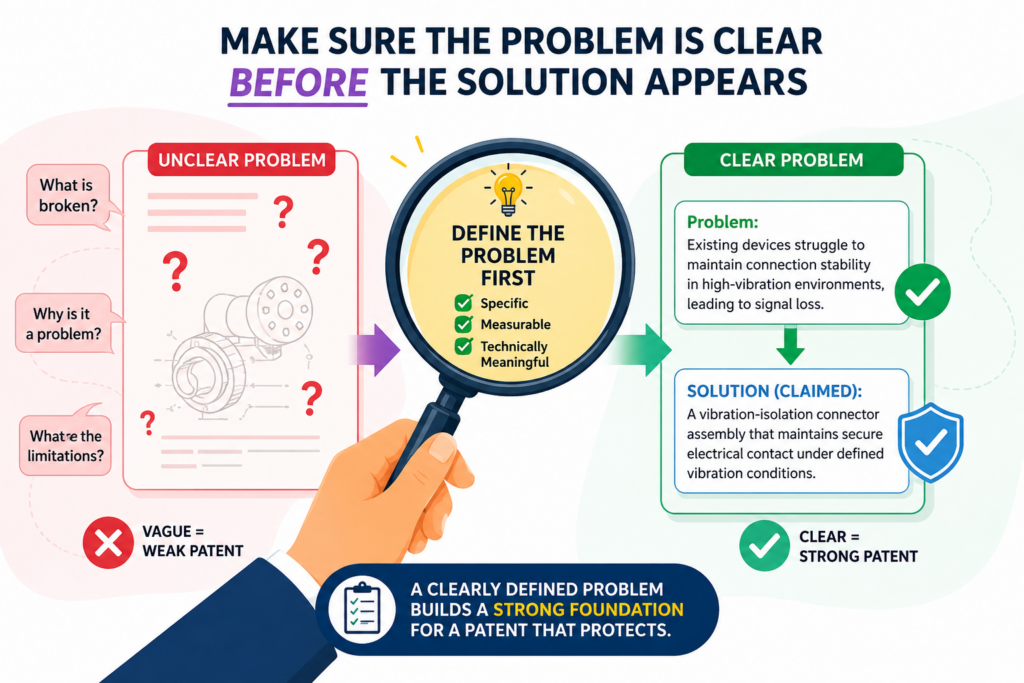
This does not mean the draft needs a long story. It does not need drama. It just needs a clear reason for the invention to exist.
When the problem is weak, the invention can look small. When the problem is clear, the solution feels more useful, more technical, and more worth protecting.
The draft should explain what was hard before your invention
Before filing, read the background and early parts of the draft with a sharp eye. Ask whether the old problem is described in a way that fits your real work.
For example, if your invention helps a machine learning system make better choices with poor data, the draft should not only say that “systems can be inaccurate.” That is too thin.
It should explain what makes the data hard to use. Maybe the data is late. Maybe it is noisy. Maybe it comes from many sources. Maybe it changes over time. Maybe the old system cannot adjust fast enough.
The better the draft explains the real pain, the better the invention can stand out.
The problem should not make your own invention sound obvious
This is a quiet but important QA check.
Sometimes a draft explains the problem in a way that makes the answer seem too easy. It may say that old systems failed to do one simple thing, and then the invention simply does that thing. That can make the draft feel weaker than it should.
A better draft shows the deeper technical issue. It explains why the old approach struggled and why your solution is not just a common fix.
For example, instead of saying that old systems “did not use real-time data,” the draft may explain that old systems could not use fast-changing data without adding delay, cost, or errors. That makes the invention feel more grounded.
The problem should match the claims and examples
The problem should not point in one direction while the claims point in another. If the draft says the main problem is speed, but the claims focus only on user display steps, something may be off.
If the draft says the problem is lower compute cost, but the examples never show how compute is reduced, the draft may need more support.
During QA, compare the problem statement with the main claim. Then compare both with the examples.
They do not need to use the same exact words. But they should feel connected.
A clean problem statement gives the attorney more room to work
Patent review often involves editing claim language, adding detail, and shaping the filing so it supports the strongest path forward. A clear problem statement helps that work.
It gives the draft a spine.
For startup teams, this is also helpful because it forces the team to name what actually matters. The invention may include many features, but the patent should focus on the parts that solve a real technical problem.
PowerPatent helps founders and engineers bring those details forward early, so the draft is not built from guesswork. You can see how the process works here: https://powerpatent.com/how-it-works
Check whether the draft explains how the invention works, not just what it does
A patent draft should not only describe the result. It should explain the path that gets to the result. This is one of the most important QA checks before filing.
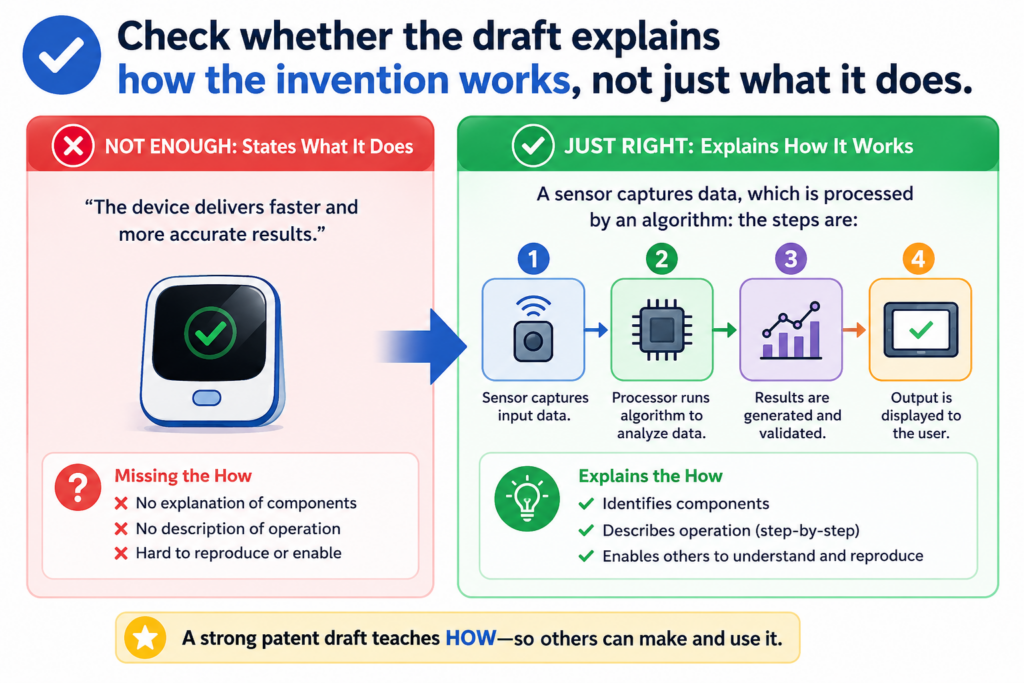
It is easy to write that a system “improves accuracy,” “reduces delay,” “detects risk,” “selects content,” or “optimizes performance.” But those words do not do much by themselves. The draft needs to show how the system gets there.
The reader should be able to follow the steps without reading your mind
When reviewing the draft, pretend the reader has not seen your code, demo, pitch deck, or product notes. The draft must stand on its own.
If the invention receives data, the draft should explain what kind of data may be used. If the system changes the data, the draft should explain how.
If a model makes a choice, the draft should explain what goes into that choice. If a device reacts, the draft should explain what triggers the reaction.
The point is not to overload the draft. The point is to remove mystery from the key parts.
The draft should avoid result-only language in the most important places
Result-only language is language that says what you want, but not how you get it.
For example, “the system selects the best route” may be too thin if the route selection is the invention.
The draft should explain how the route is scored, what inputs are used, how risks are compared, and what happens when conditions change.
The same issue shows up in AI drafts. Saying that a model “generates an improved output” is not enough if the improvement is the core idea.
The draft should explain what changes in the input, training, ranking, filtering, scoring, or feedback loop help create that better output.
A good QA move is to highlight every sentence that promises a result. Then check whether nearby text explains the real mechanism.
The draft should show the important decision points
Many strong inventions are built around smart decisions.
A system may decide when to update a model. It may decide which data to trust. It may decide when to send an alert.
It may decide whether to process data locally or in the cloud. It may decide how to group users, files, signals, images, parts, or events.
Those decisions should not be hidden.
The draft should explain what information is used to make the decision and what happens after the decision is made.
The review should test whether an engineer could rebuild the main idea
You do not need to publish every private detail or every line of code. But the draft should give enough detail for a skilled person in the field to understand the invention.
A helpful test is to ask whether an engineer could understand the main flow after reading the draft. They may not build your exact product, but they should understand the technical steps that make the invention work.
If the engineer keeps asking, “But how does it actually do that?” the draft needs more detail before filing.
Review the examples for depth, not just quantity
Examples make a patent draft stronger when they are chosen with care.
They show how the invention can work in real settings. They also help support narrower claims if the broad claims need to change later.
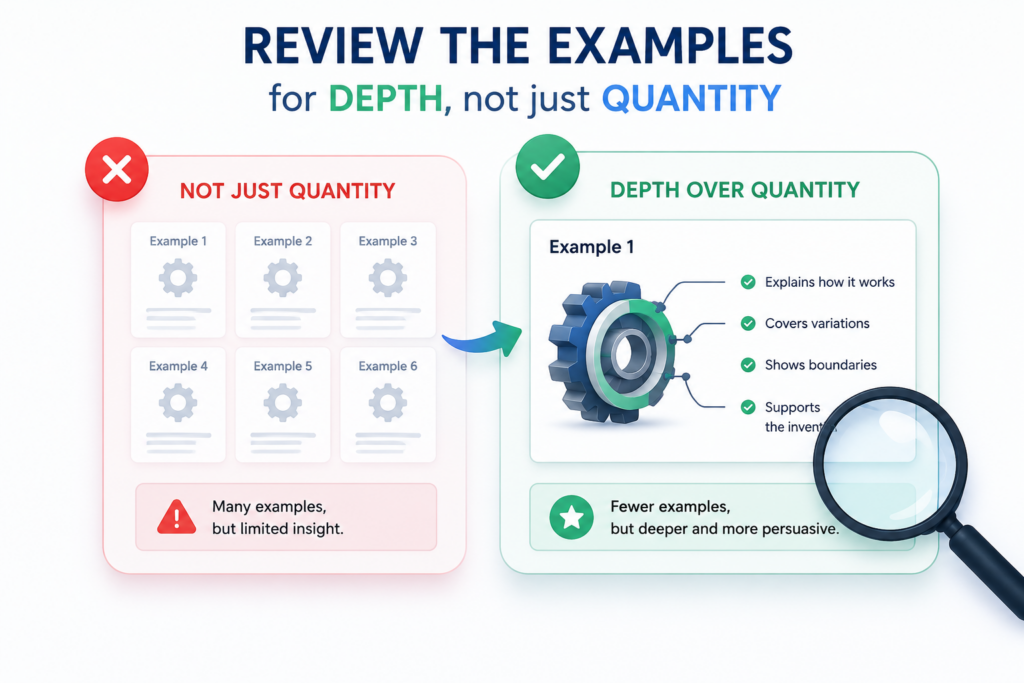
But examples should not be random. A long draft full of weak examples can still fail to protect the invention well. What matters is whether the examples add useful support.
The examples should cover the key use cases your business cares about
A startup should review examples with the business roadmap in mind.
If your first product serves hospitals, but your next market may be labs, the draft may need examples that support both settings.
If your software works for finance now but could later work for logistics, the draft may need language that keeps the door open. If your device is first used in factories but could later be used in vehicles, the draft should not lock the invention into only one place.
This is not about claiming everything in the world. It is about making sure the draft does not ignore obvious future uses that your team already sees.
Each example should teach something useful about the invention
An example should not only repeat the same point with different labels.
A good example can show a different input type, a different system setup, a different user action, a different timing flow, a different model choice, a different device state, or a different way the invention handles a hard case.
For example, if the invention improves sensor analysis, one example may show normal operation. Another may show what happens when the sensor signal is weak.
Another may show what happens when two signals conflict. Another may show how the system changes after feedback.
That kind of example gives the draft real depth.
The examples should support both broad and narrow protection
Strong examples do two jobs at once.
They support the broad idea by showing the invention can work in more than one way. They also support narrower backup positions by giving real detail.
This balance matters because patent claims can change during review. If a broad claim faces pushback, the team may need to move toward a more specific version. Good examples can make that easier.
A smart QA review looks for missing edge cases
Edge cases often reveal the real strength of an invention.
What happens when data is missing? What happens when a user gives conflicting input? What happens when a network drops? What happens when a device has low power?
What happens when the model is uncertain? What happens when a part fails? What happens when a threshold is crossed?
If your invention handles these moments in a new way, the draft should say so.
Founders often skip these details because they feel normal to the team. But these details may be the exact parts that show why the invention is valuable.
PowerPatent helps teams pull these hidden details out of notes, diagrams, code, and founder input, then shape them into a cleaner filing with attorney oversight. Learn more here: https://powerpatent.com/how-it-works
Check whether the draft uses terms in a steady and clear way
Clear terms make a patent draft easier to understand.
Messy terms create confusion. One part of the draft may call something a “score,” another part may call it a “rank,” another part may call it a “value,” and another part may call it a “confidence level.” Sometimes those words mean the same thing. Sometimes they do not.
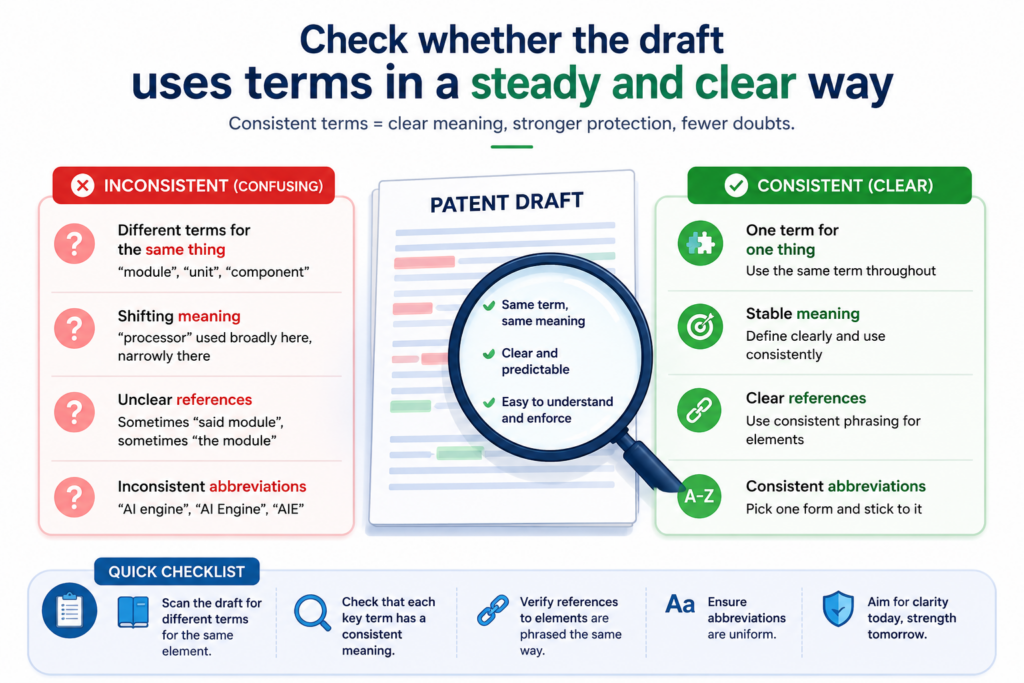
Before filing, the draft should be checked for steady language.
The same thing should not have too many names
When one feature has many names, the reader may wonder whether the draft means one thing or several different things.
This can weaken the draft. It can also make later review harder.
For example, if the same software part is called an “analysis engine,” “processing module,” “decision system,” and “risk unit,” the draft should make clear whether these are the same part or different parts.
Simple and steady language helps everyone. It helps the founder review the draft. It helps the attorney refine it. It helps future readers understand what was filed.
The glossary-style review can catch hidden confusion
A useful QA move is to create a simple term check while reading.
When a key term appears, ask what it means. Then check whether the draft uses that term the same way each time.
If “risk score” means a number from a model in one section, it should not mean a user rating in another section unless the draft clearly says so.
If “training data” means labeled examples in one place, it should not later mean live sensor data unless that shift is explained.
This kind of review may feel basic, but it catches real issues.
The draft should avoid words that are too narrow or too vague
Some words shrink the invention by accident. Other words make the draft feel unclear.
A narrow word may be something like “smartphone” when the invention works on many devices. A vague word may be something like “intelligent,” “advanced,” or “optimized” without any detail to support it.
The draft should use words that are plain, accurate, and flexible where needed.
Strong terms help the claims stay readable
Claims can be hard to read, but they should not be impossible to follow.
When the description uses clear terms, the claims can often be cleaner too. This helps the whole filing feel more organized.
A good patent draft does not try to sound complex. It tries to be precise.
That is an important difference.
For founders, this is worth caring about because unclear wording can create delays, extra review rounds, and weaker protection. A clean term review can save pain later.
Confirm that the draft does not reveal more than it needs to reveal
A patent filing must explain the invention well. But that does not mean it should dump every secret your company has.
Before filing, the team should check whether the draft includes details that are not needed for the patent and may be better kept private.
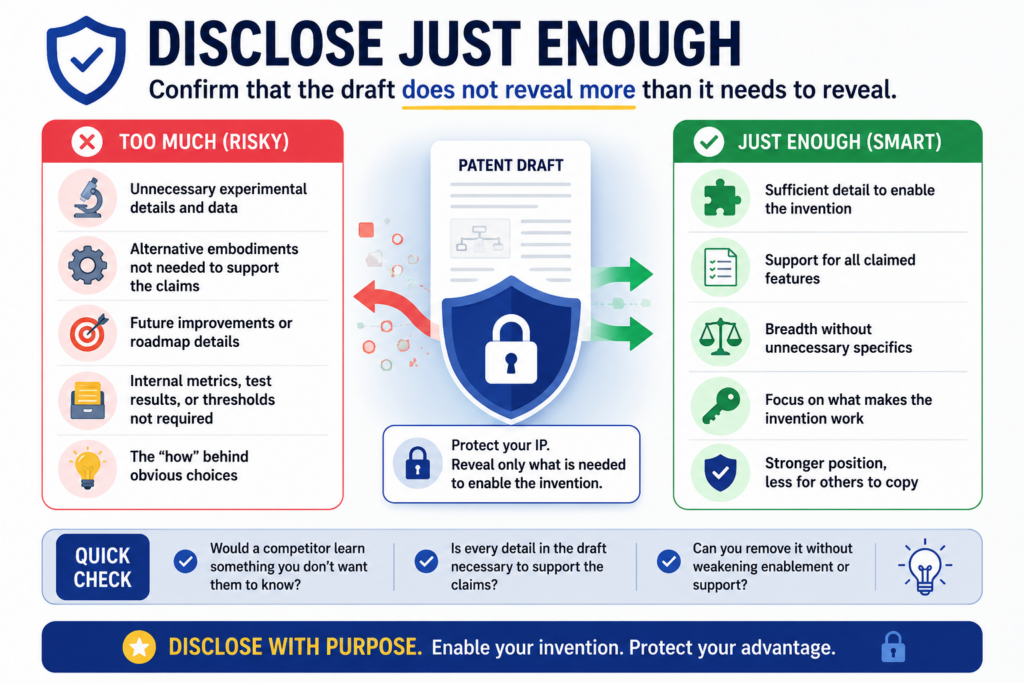
This is a careful balance. You need enough detail to support the filing. But you should not casually reveal trade secrets, private customer data, internal pricing logic, unreleased roadmap plans, or sensitive business plans unless they truly help the patent.
The draft should protect the invention without exposing unrelated secrets
Some technical details belong in the draft because they support the invention. Other details may not belong because they are not needed.
For example, if your invention is about a new way to process machine data, the draft may not need to reveal your exact customer list, internal revenue model, full production stack, vendor names, or secret performance targets.
If your invention is about model routing, the draft may need to explain how routing decisions are made.
But it may not need to include private model weights, exact training data records, or internal benchmarks that do not add patent value.
The QA review should separate patent value from private company knowledge
A simple review question can help here.
Does this detail help explain or protect the invention?
If the answer is yes, it may belong. If the answer is no, it may be noise or risk.
Founders sometimes think more detail always means a stronger patent. That is not always true. The right detail matters. Random detail can distract from the invention and reveal information that competitors do not need to see.
The draft should avoid customer-specific or product-specific limits unless they matter
Many startups build the first version of an invention for one customer, one industry, or one use case. The draft may reflect that early context too much.
That can cause two problems.
First, it can make the patent too narrow. Second, it can expose business details that are not needed.
If the invention works across many customer types, the draft should not read as if it only works for one named setting.
If the invention works with many data sources, the draft should not focus only on one customer data source unless that source is important to the invention.
A careful filing can support both protection and secrecy
This is where attorney oversight matters.
You do not want to strip the draft so much that it becomes weak. You also do not want to file a document that gives away more than needed.
PowerPatent gives founders a better way to manage this balance. Smart software helps capture the invention, while real patent attorneys help shape what should go into the filing and what should stay out. See how PowerPatent works here: https://powerpatent.com/how-it-works
Review the draft for missing invention variants before filing
A patent draft should not only cover the version you built today. It should also cover the smart versions your team can already see coming.
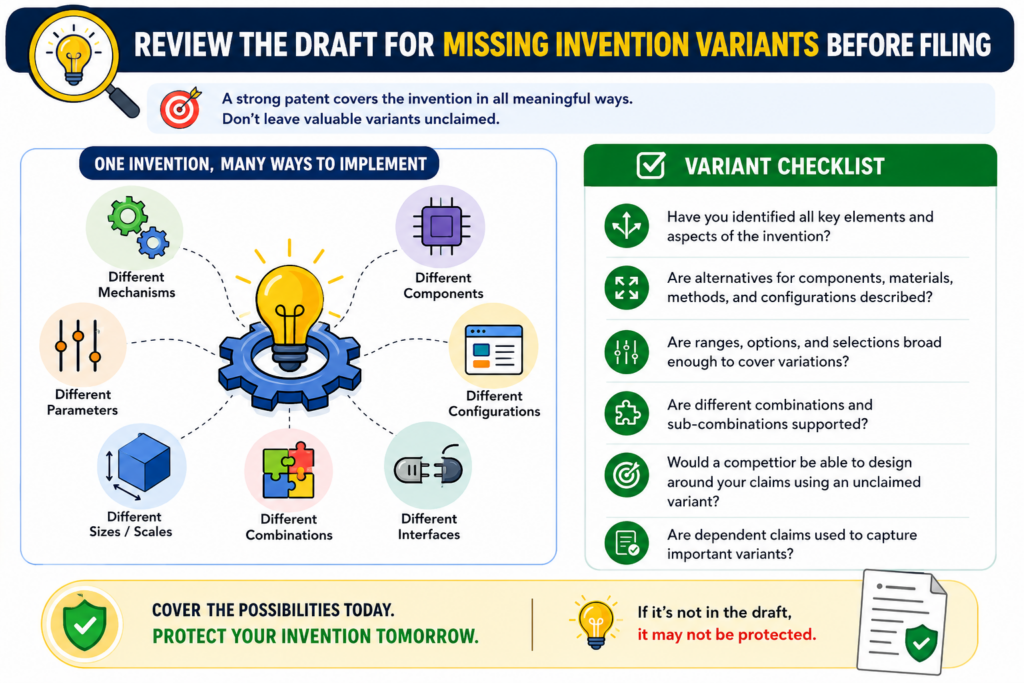
This matters because startups move fast. The first version may change after customer feedback. The model may change.
The workflow may change. The hardware may change. The data source may change. The product may move into a new market.
If your patent draft only protects the exact first version, you may lose room later.
The draft should cover the main ways the invention could change
Before filing, read the draft and ask how the invention could be built in another reasonable way.
Could the process run on a local device instead of a cloud system? Could the system use a different type of model? Could the input come from a sensor, file, stream, image, log, or user action? Could the same method work for another industry? Could the order of steps change?
These are not random guesses. They are practical checks based on how products evolve.
A good patent draft should not lock itself to one setup unless that setup is truly required.
The review should protect the idea without making it vague
There is a balance here.
You do not want the draft to be so narrow that a competitor can avoid it with a tiny change. But you also do not want the draft to become so broad that it stops teaching anything real.
The best draft gives clear examples, then explains other useful ways the invention can work. It protects the core idea while staying tied to real technical steps.
For example, if the invention uses a machine learning model to detect risk, the draft may explain one model in detail while also saying that other models may be used when they perform the same role.
If the invention uses a wearable sensor, the draft may describe that sensor while also supporting other devices that gather similar signal data.
The draft should include variants tied to the roadmap
Your product roadmap is a goldmine for patent QA.
A feature planned for next quarter may not be fully built yet, but the idea may already be clear enough to support in the draft. A future customer use case may reveal a broader angle.
A planned platform change may show that the invention should not be tied to one device or one data path.
This is why the patent review should include more than the person who wrote the draft.
Founders, engineers, product leads, and patent counsel each see different risks.
The best variant review asks what a fast follower would copy
Imagine a competitor sees your product six months after launch. They like the result, but they want to avoid your patent.
What would they change first?
They may move the processing step to another system. They may change the order of operations. They may swap one model for another. They may use different labels. They may automate a step that your product does with user input. They may remove a feature that is not central.
Your draft should be checked against these likely moves.
PowerPatent helps teams think through these angles before filing, with smart tools that collect invention details and real patent attorneys who help shape the final protection. You can explore that workflow here: https://powerpatent.com/how-it-works
Make sure the draft supports the full claim scope
Claims are only as strong as the draft that supports them.
A claim may sound powerful. It may cover the right business value. It may feel broad enough to matter. But if the detailed description does not support it, that claim can run into problems.
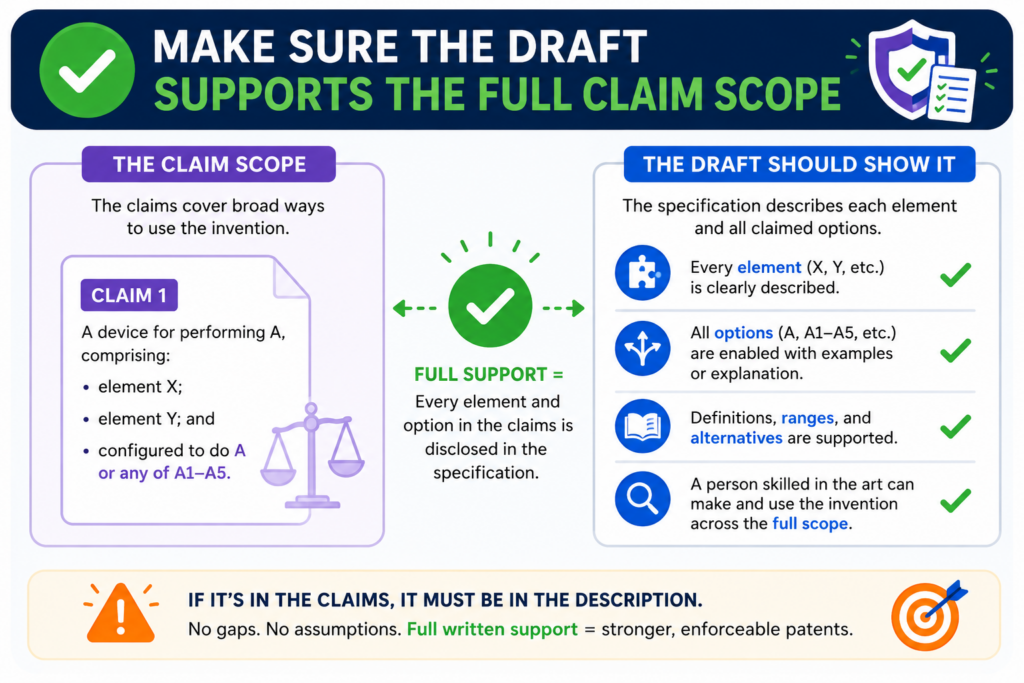
That is why QA must compare each claim with the written description.
This check is simple in idea but important in practice. The claim says what you want to protect. The description must show that you actually explain the invention well enough.
The broad claim should not reach beyond what the draft teaches
A broad claim is useful only when the draft backs it up.
For example, if a claim covers many kinds of devices, the description should not only describe one device in a narrow way.
If a claim covers many data sources, the description should explain at least enough variety to make that scope feel supported.
If a claim covers automated decisions, the draft should explain how those decisions are made.
The goal is not to stuff the draft with empty phrases. The goal is to give real support.
When the claim and description are out of balance, the filing may look weak.
The QA review should trace each major claim part into the description
A practical way to review support is to walk through the main claim piece by piece.
When the claim says the system receives a first input, find where the draft explains that input. When the claim says the system generates a score, find where the scoring method is described.
When the claim says the system changes an output based on the score, find where that change is explained.
If you cannot find support for a claim part, the draft needs attention.
This is especially important for software and AI inventions, where a few words can cover a lot of technical work.
A claim may say “selecting a model,” but the draft should explain what kind of selection can happen, what information is used, and why selection matters.
The narrow claims should also have clear support
Do not only check the broadest claim.
Dependent claims need support too. If a dependent claim adds a feature, the description should explain that feature in enough detail.
If it adds a special case, the draft should describe the special case. If it adds a technical benefit, the draft should support that benefit.
Weak support for dependent claims can reduce your backup options later.
The best support is clear, not bloated
Some teams respond to support concerns by adding huge blocks of text. That can create a new problem. Long, messy text may make the draft harder to read without making it stronger.
The better move is to add clear support where it matters.
Each important claim part should have enough explanation, enough context, and enough examples to make it understandable. The draft should feel full, but not crowded.
A strong patent draft is not judged by word count alone. It is judged by whether the right words are in the right places.
Check whether the draft handles AI, software, or data features with care
For many startups, the invention lives in software, models, data pipelines, automation, or cloud systems.
These inventions can be very valuable. They can also be easy to draft poorly if the patent only describes broad goals.
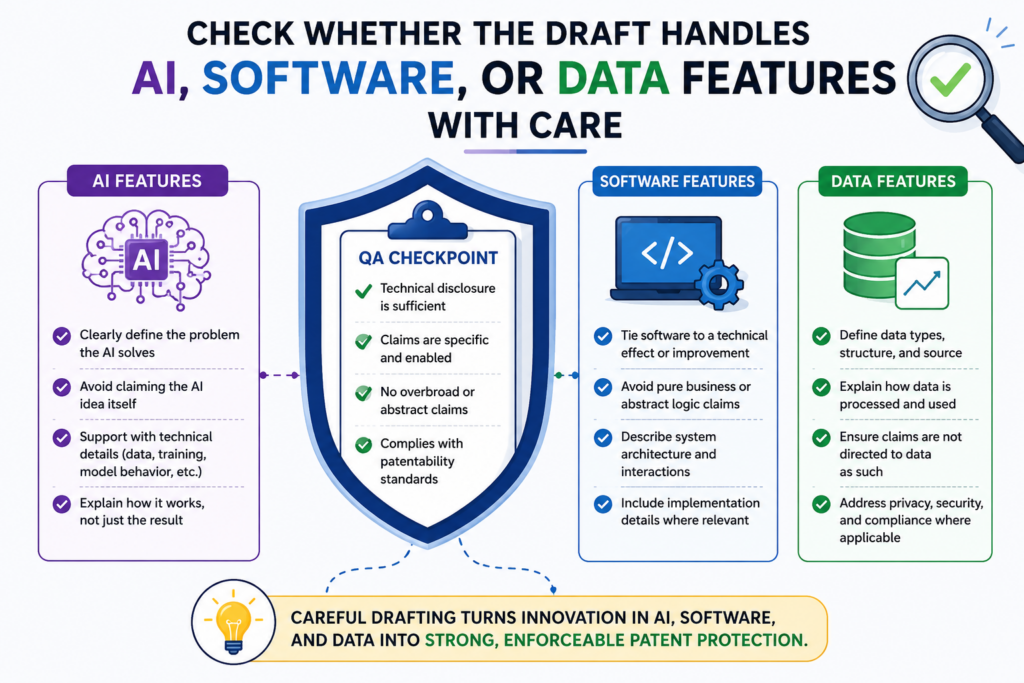
A strong QA review should make sure the draft explains the technical structure behind the result.
The draft should not treat the model like a magic box
If your invention uses AI, the draft should explain the role of the model in plain terms.
What does the model receive? What does it produce? How is the output used? Is the model trained, updated, selected, ranked, combined, filtered, or checked? Does the invention improve the input, the output, the feedback loop, the model choice, or the system around the model?
The model should not appear as a black box that simply creates a better answer.
That kind of draft can feel thin.
The QA review should identify the technical change around the model
Many AI inventions are not just “use a model to do a task.” The real invention may be how the system prepares data, how it chooses between models, how it reduces errors, how it uses human feedback, how it checks confidence, how it avoids unsafe output, or how it saves compute.
That technical change should be easy to find in the draft.
For example, if the invention routes tasks between a small model and a large model, the draft should explain how routing is decided.
If the invention improves training data, the draft should explain how data is selected, cleaned, weighted, or labeled. If the invention checks model output, the draft should explain what is checked and what happens next.
The draft should explain data flow with care
Software inventions often depend on data movement.
Data may be received, cleaned, grouped, changed, stored, scored, compared, sent, hidden, logged, or used to trigger action. If that flow is unclear, the invention may be hard to understand.
During QA, follow one piece of data from start to finish.
Where does it come from? What happens to it? What part of the system uses it? What output does it affect? Is it stored? Is it discarded? Is it sent to another device? Does it update a model or rule?
The draft should show why the data steps matter
A data step should not be included only because the product does it.
The draft should explain why the step matters to the invention. Maybe it reduces noise. Maybe it protects privacy.
Maybe it lowers compute load. Maybe it improves speed. Maybe it helps the system make a safer choice.
When the draft explains the reason behind the data step, the invention feels stronger and easier to defend.
PowerPatent is built for teams working in software, AI, data, robotics, and deep tech. It helps turn technical detail into a stronger draft without forcing founders to become patent experts. See how it works here: https://powerpatent.com/how-it-works
Review the draft for claim terms that may create avoidable limits
Words matter in patent claims.
One extra word can make a claim smaller than intended. One unclear word can create confusion. One product-specific word can tie the patent to the first version instead of the real invention.
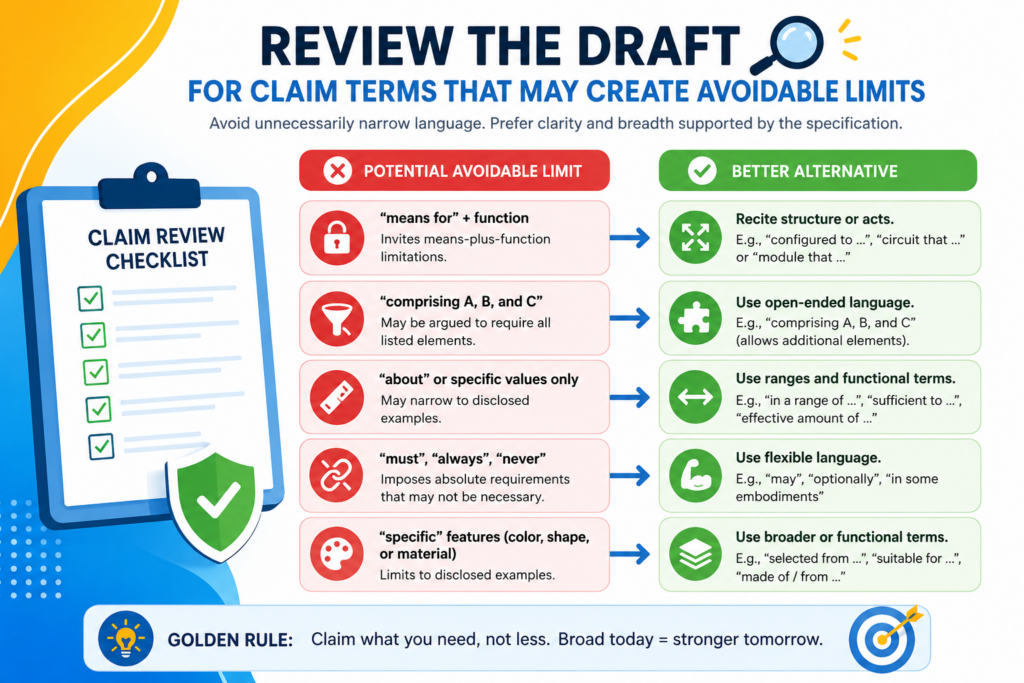
Before filing, review the claims for terms that may limit protection without adding value.
The claim should not include product branding or internal labels
Your product may have internal names for tools, modules, features, screens, agents, models, or workflows. Those names may be useful inside your company, but they often do not belong in claims.
A claim should usually describe what the part does, not what your team calls it.
For example, if your internal tool is called “SignalPilot,” the claim should likely describe a signal processing module, a routing engine, or another plain technical part instead of using the brand name.
Internal labels can confuse readers and narrow the filing in a strange way.
The QA review should replace company language with clear function language
A good draft uses words that a person outside your company can understand.
If a claim mentions an internal feature name, ask what that feature actually does. Does it receive data? Does it generate a score? Does it assign a task? Does it trigger an action? Does it update a rule? Does it select a model?
Then check whether the claim uses clear language around that function.
This makes the claim easier to read and harder to dodge.
The claim should avoid limits that are not central to the invention
Some claim limits are needed. Others are accidental.
If the invention is about routing model tasks, the claim may not need to say the user interface has three panels.
If the invention is about reducing sensor noise, the claim may not need to say the device is worn on the wrist unless that placement is important.
If the invention is about secure data sharing, the claim may not need to name one file format unless that format matters.
During QA, ask whether each limit helps define the invention or only describes the first product version.
The broadest claim should use the fewest needed limits
This does not mean the claim should be empty. A claim with too little structure may fail to capture the real invention.
The goal is to include enough limits to define the technical idea, while avoiding details that do not matter.
Think of the claim as a fence. If the fence is too small, competitors can stand just outside it. If the fence is too vague, it may not hold. A good claim puts the fence around the real invention, not around surface details.
This is one reason attorney review is so important before filing. Small wording choices can change the value of the filing.
Make sure the draft has enough detail for the figures and flowcharts
Flowcharts are powerful in patent drafts because they show how the invention works over time.
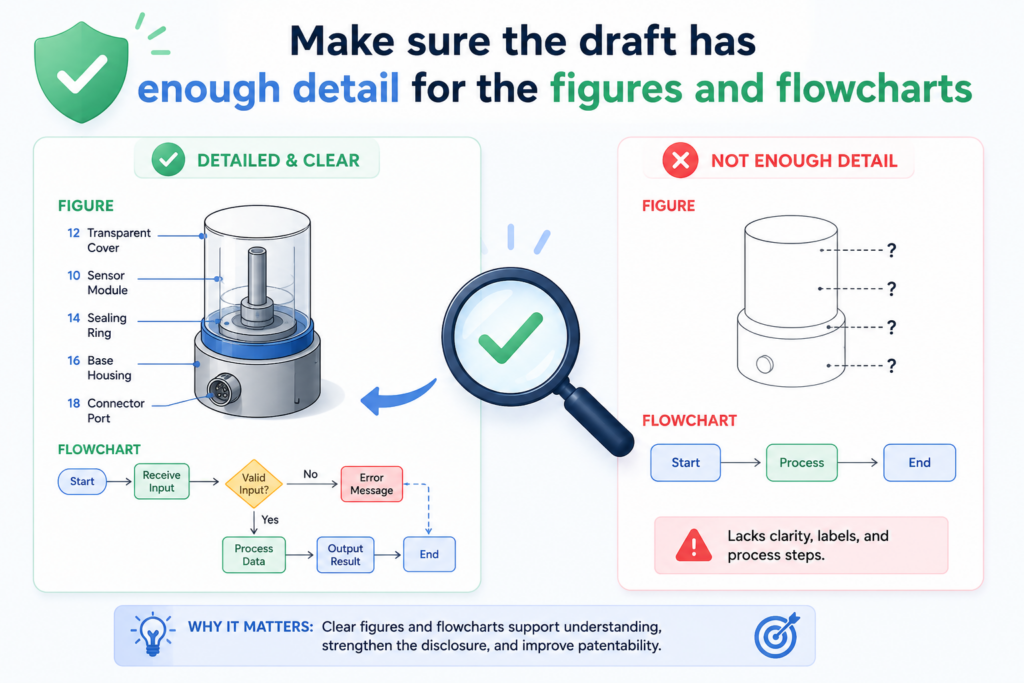
But a flowchart can also expose gaps.
If the flowchart shows steps that are not explained in the text, the draft may feel incomplete. If the text explains key steps that are missing from the flowchart, the reader may miss the invention.
If the flowchart skips decision points, the invention may look simpler than it really is.
Each flowchart step should be explained in plain language
Before filing, compare the flowchart with the detailed description.
If the flowchart says “process data,” the text should explain what processing may include.
If the flowchart says “generate score,” the text should explain what can go into the score. If the flowchart says “take action,” the text should explain possible actions.
A flowchart should not be a set of vague boxes.
It should guide the reader through the invention.
The review should check for missing decision branches
Many inventions have branches.
If a score is above a threshold, the system may act one way. If it is below the threshold, it may act another way.
If a model is confident, the system may use the output. If the model is not confident, the system may ask for more input, use another model, or send the case to a human.
These branches can be important.
A flowchart that only shows the happy path may leave out the most valuable part of the invention. Before filing, look for these decision points and make sure the draft explains them.
The figures should support both system claims and method claims
A patent draft may include different claim types, such as system claims and method claims. The figures should help support those angles.
A system figure may show parts like devices, servers, sensors, databases, models, and user terminals. A method figure may show steps. A data flow figure may show how information moves. Together, these figures can make the draft easier to understand.
The QA review should make sure the figures are not too thin
A thin figure may show only generic blocks, such as “computer,” “network,” and “database.” Sometimes that is useful, but for many inventions it is not enough.
If the invention depends on a special module, feedback loop, model selector, scoring engine, sensor interface, control layer, or privacy filter, the drawings should consider showing it.
The goal is not to draw every small part. The goal is to show the parts that matter.
PowerPatent helps teams organize invention details, diagrams, and technical notes so the patent draft can reflect the real system more clearly. You can learn more here: https://powerpatent.com/how-it-works
Check whether the draft explains the best mode of using the invention in a practical way
A patent draft should not feel like it was written far away from the real product.
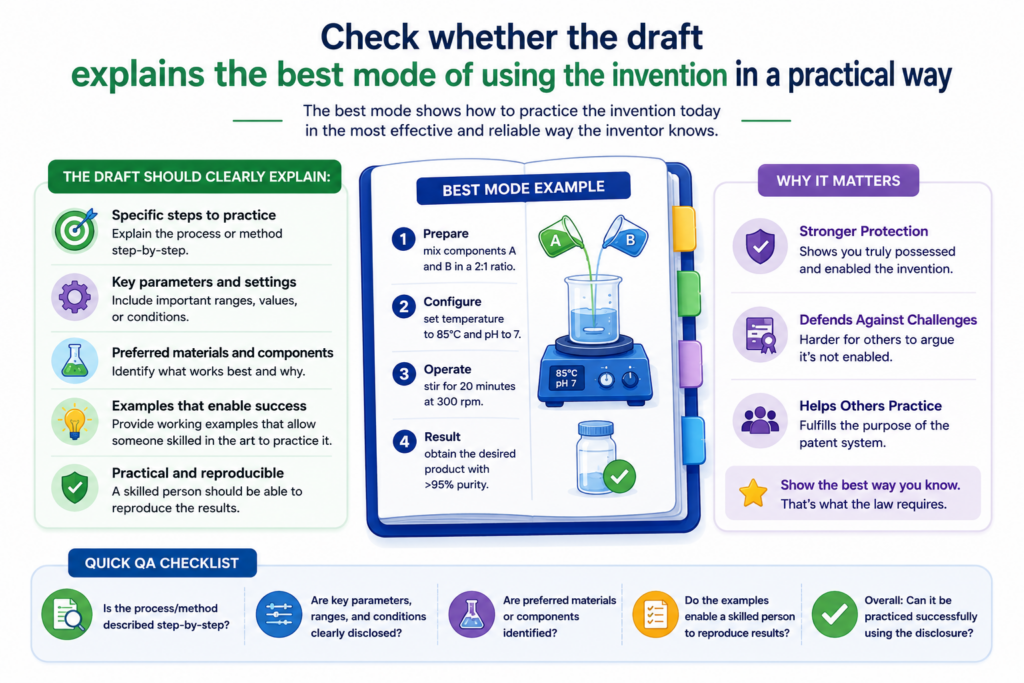
It should explain how the invention can be used in a practical setting, with enough detail to show that the team truly knows the invention and how it works.
This does not mean the draft must include every private build detail.
It does not mean you should reveal secret code, private weights, customer data, or internal business plans. But the draft should not be so thin that it sounds like a loose idea.
A strong draft shows the best practical way to use the invention at the time of filing, while still keeping the door open for other versions.
The main use case should feel real and complete
When you review the draft, look for the main use case. It should be easy to understand. The reader should know who or what uses the invention, what input goes into it, what the system does, and what result comes out.
For example, if the invention helps a robot avoid unsafe movement, the draft should show how the robot receives data, checks risk, chooses a path, and changes action.
If the invention helps a software tool route work between models, the draft should show how the task is received, how routing is decided, and how the output is handled.
The main use case should not feel like a half-built sketch. It should feel like a real working path.
The best practical version should not swallow the whole invention
A common mistake is to describe the best version so strongly that it starts to look like the only version.
This can happen when the draft says the system “must” use a certain model, device, sensor, screen, database, signal type, or user flow, even though those things are only part of the current product.
During QA, read every strong word with care. Words like “must,” “always,” “required,” and “only” should be used only when they are truly needed.
If a detail is just one useful version, the draft should say it that way. The best mode should be clear, but it should not trap the invention inside one product design.
The draft should make the invention feel built, not imagined
Investors, partners, and future buyers care about real technical depth. A patent draft can support that story when it shows the invention as something concrete.
The draft should not sound like a wish. It should not only say that the system “improves” something. It should explain what parts work together and why the result happens.
This matters most for deep tech startups. If your invention is in AI, chips, robotics, biotech tools, climate tech, security, medical devices, or advanced software, the value is often hidden inside the technical choices.
The draft should bring those choices forward in plain words.
The QA review should look for places where the draft skips the hard part
Every invention has a hard part. That hard part is often where the value lives.
Maybe the hard part is dealing with bad data. Maybe it is making a model run with less compute.
Maybe it is keeping a device stable in a harsh setting. Maybe it is sending less data while still getting a good result. Maybe it is making a system safe enough to trust.
If the draft skips over that hard part, the filing may miss the strongest story.
Before filing, mark the places where the draft moves too fast. Then ask whether the missing detail should be added.
PowerPatent helps founders and engineers capture these hard parts before they disappear into Slack threads, code comments, and product memory.
With smart software and real attorney review, teams can turn the best working version into a stronger filing. You can see how it works here: https://powerpatent.com/how-it-works
Review whether the draft avoids legal-sounding filler that adds no protection
A patent draft should be clear. It does not become stronger just because it sounds heavy, formal, or hard to read.
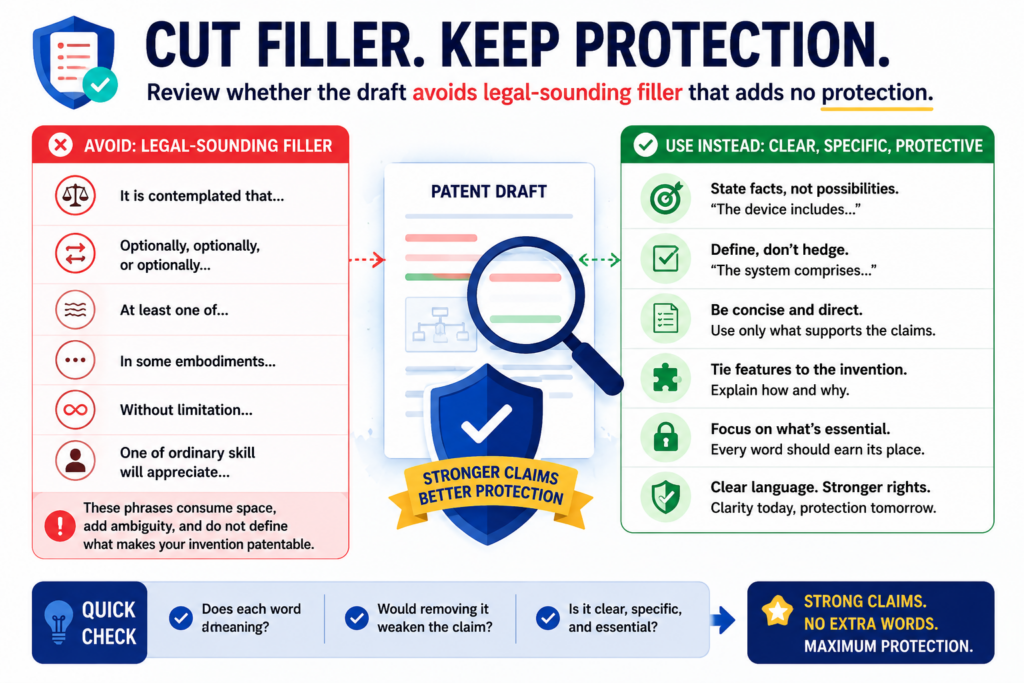
Many weak drafts use long legal-style phrases to hide thin thinking. That is not helpful. A strong draft can be formal and still be plain. It can be detailed and still be easy to follow.
Before filing, review the draft for words that sound important but do not explain anything.
The draft should replace vague praise with useful detail
Phrases like “highly efficient,” “robust,” “advanced,” “intelligent,” and “optimized” may sound good, but they often do not help unless the draft explains what they mean.
If the system is efficient, how is it efficient? Does it use less memory? Does it reduce network calls? Does it lower compute load? Does it avoid repeated steps? Does it process smaller data sets? Does it reduce human review?
If the output is better, what makes it better? Is it more accurate, faster, safer, more stable, easier to audit, or less costly?
The QA goal is not to remove every strong word. The goal is to make sure strong words are backed by real technical facts.
The reader should not need to guess what a benefit means
A benefit should be tied to the invention.
If the draft says the invention “improves performance,” the reader should understand what performance means in that context.
Performance could mean speed, accuracy, battery life, uptime, safety, memory use, signal quality, user effort, or many other things.
A clear draft names the benefit and connects it to the steps that create that benefit.
For example, a stronger draft may explain that the system reduces delay by processing only changed data instead of processing the full data set each time. That is much more useful than simply saying the system is efficient.
The draft should sound formal without sounding fake
Patent drafts can be formal. That is normal. But formal does not mean confusing.
A founder should be able to read the draft and understand the invention story. An engineer should be able to follow the technical flow. A patent attorney should be able to see how the claims are supported.
If the draft is full of long sentences that bury the point, it may need cleanup.
The best drafting style is plain, steady, and exact
Strong patent writing does not try to impress the reader with big words. It tries to protect the invention.
That means each sentence should do a job. It should explain a part, show a step, support a claim, describe a variation, or connect a result to the method.
If a sentence does none of those things, it may be filler.
Before filing, remove empty language or replace it with real detail. A cleaner draft is often easier to review, easier to amend, and easier to understand later.
This is one reason PowerPatent focuses on making patent work easier for technical teams. The goal is not to drown founders in old-school patent language.
The goal is to help them file stronger patents with less confusion. Learn more here: https://powerpatent.com/how-it-works
Make sure the draft tells the same invention story from start to finish
A patent draft has many parts, but they should not feel like separate documents. The title, background, summary, figures, detailed description, abstract, and claims should all point to the same core invention.
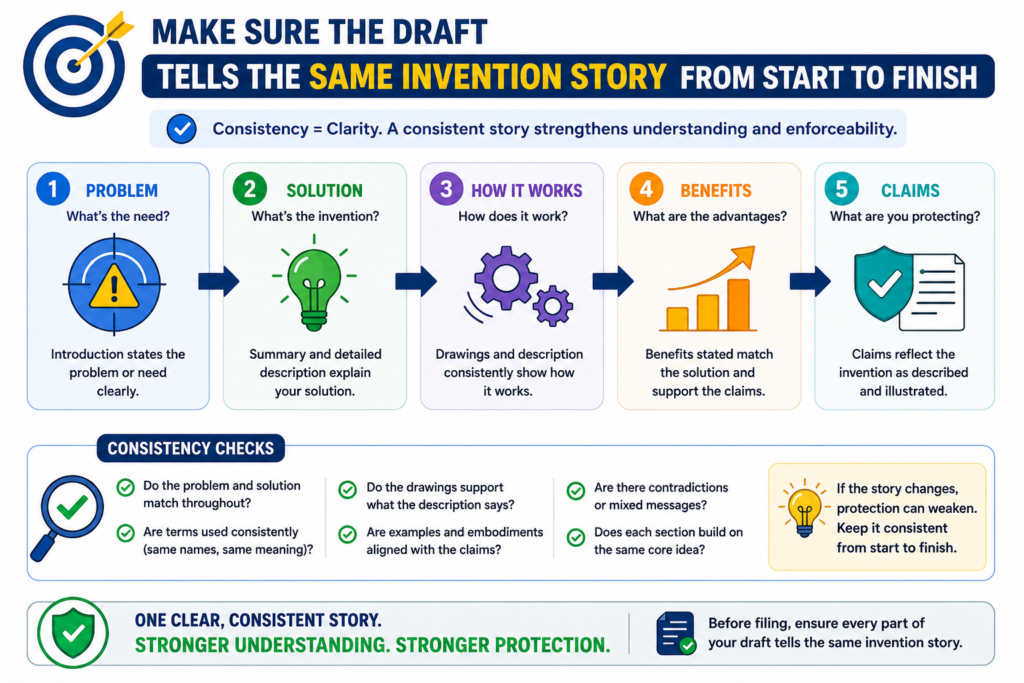
When those parts drift apart, the draft becomes weaker.
This can happen during drafting. A claim gets changed, but the summary does not. A drawing gets updated, but the description still refers to the old version.
A new feature is added, but the abstract never mentions it. These are normal drafting issues, but they should be fixed before filing.
The title should match the real invention without being too narrow
The title does not need to carry the full weight of the patent. But it should not point to the wrong thing.
If the invention is about model routing, the title should not make it sound like it is only about a user dashboard.
If the invention is about sensor data correction, the title should not make it sound like it is only about a wearable device unless the wearable device is central.
A good title is clear and broad enough to fit the invention.
It should not use marketing words. It should not use your brand name. It should not be so narrow that it shrinks the story before the reader reaches the claims.
The abstract should give a clean snapshot of the invention
The abstract is short, but it still matters. It should give a simple view of the invention without adding details that conflict with the claims.
During QA, compare the abstract to the broadest claim. They do not need to match word for word, but they should describe the same main concept.
If the abstract focuses on a small feature while the claim focuses on a larger system, the abstract may need revision.
If the abstract mentions a required part that the claim does not require, that may also need review.
The summary should not promise more than the draft supports
The summary often describes the invention in a broad way. That can be useful, but it must still be supported by the detailed description.
If the summary says the invention works across many device types, the description should support that. If the summary says the system can work in real time, the description should explain how real-time operation may happen.
If the summary says the method reduces cost, the description should connect cost reduction to real steps.
The detailed description should deliver what the early sections set up
Think of the early sections as a promise.
The background shows the problem. The summary gives the answer. The drawings show the structure. The detailed description proves the answer is real.
If the detailed description does not deliver, the draft may feel hollow.
A strong QA review reads the whole draft as one story. It checks whether the same invention appears again and again, with more detail each time.
Founders should care about this because consistency creates confidence. A clean draft tells the market, your team, future investors, and future buyers that the invention was handled with care.
Check whether the draft covers what happens before, during, and after the key step
Many patent drafts focus on the main action but ignore the setup and aftermath.
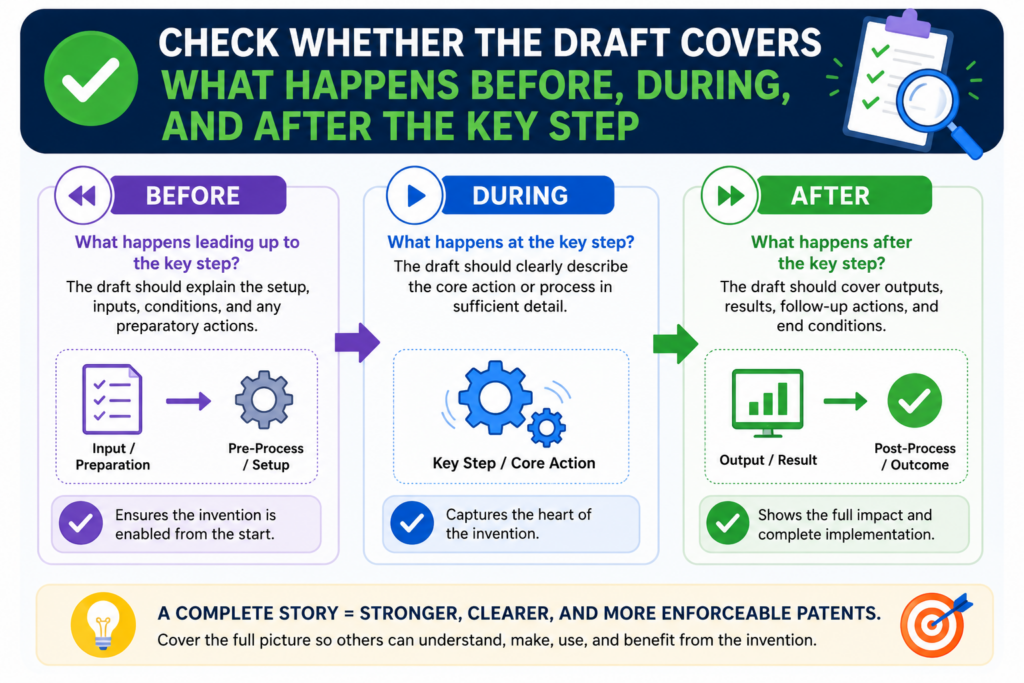
That can leave gaps.
The key step may be scoring data, selecting a model, changing a device state, training a system, generating an alert, filtering a signal, or assigning a task.
But the value of the invention often depends on what happens before and after that step.
A good QA review should check the full chain.
The draft should explain how the system gets ready to perform the key step
Before a system can act, it often needs preparation.
It may receive input. It may clean data. It may check permissions. It may load a model. It may measure a signal. It may define a threshold. It may gather context. It may identify a user, device, location, object, or event.
If this setup matters to the invention, the draft should explain it.
For example, if a system generates a risk score, the draft should explain where the input comes from and how the input is prepared.
If the system chooses a model, the draft should explain what information is used to make that choice.
The setup can be part of the invention, not just a lead-in
Do not assume the setup is boring.
Sometimes the setup is the real breakthrough. Maybe your system prepares data in a new way. Maybe it filters noise before analysis.
Maybe it groups inputs so the model can run faster. Maybe it checks trust before sharing data. Maybe it builds a local state before sending anything to the cloud.
During QA, ask whether the draft treats the setup as important enough.
If the setup creates the benefit, it should not be rushed.
The draft should explain what happens after the key step
The output of the invention should lead somewhere.
If the system creates a score, what does the score control? If the model creates a result, how is the result used?
If the device detects a condition, what action happens next? If a system routes a task, what happens after routing?
A draft that stops at the output may miss part of the protection.
The after-step may show the business value clearly
The action after the key step often connects the invention to real value.
A score may trigger a safety control. A routing choice may lower compute cost. A filtered signal may improve device stability. A model output may reduce human review. A selected workflow may help a user finish faster.
This is where the invention becomes useful.
The draft should make that usefulness clear without turning into a sales pitch. It should explain the technical result in plain words.
PowerPatent helps teams capture the full invention path, not just the shiny feature. That means the filing can better reflect how the product actually creates value. See the process here: https://powerpatent.com/how-it-works
The draft is ready for attorney review, not just founder review
A founder review is important. An engineer review is important. But before filing, the draft should also be ready for serious attorney review.
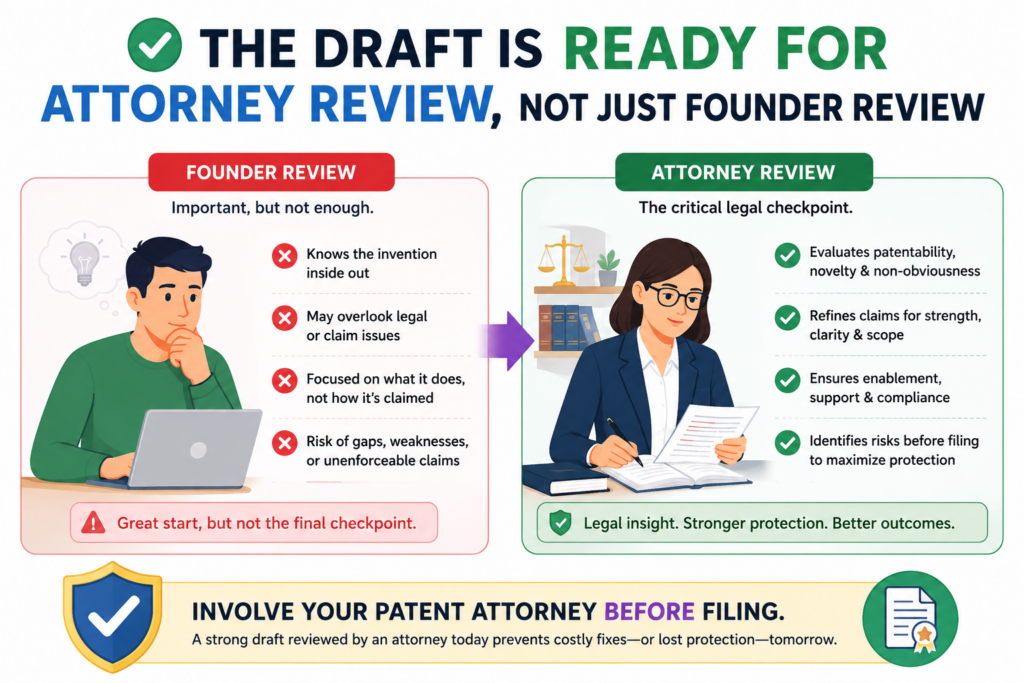
This does not mean the founder needs to become a patent expert. It means the draft should be organized enough, clear enough, and complete enough for a patent attorney to make it stronger without wasting time chasing missing basics.
The better the draft is before attorney review, the better the final filing can be.
The draft should include the right technical context for the attorney
A patent attorney can help shape protection, but they need the real invention details.
If the draft leaves out why the invention matters, what alternatives exist, what problems were hard, or what variants are planned, the attorney may not see the full picture.
Before attorney review, make sure the draft reflects the technical truth.
That includes the core idea, the main use case, the key steps, the best version, the important variants, the product roadmap, and the likely ways a competitor may try to copy the idea.
The attorney should not have to guess where the value is
A strong draft makes the value visible.
The attorney should be able to read it and understand which parts are central, which parts are examples, and which parts are optional. If everything is treated as equally important, the review becomes harder.
Founders can help by adding short notes that explain what the team believes is most valuable. Engineers can help by pointing out where the hard technical work really sits.
Those comments can guide the final edits.
The draft should be reviewed for filing risk before it goes out
Attorney review is not just about making the draft sound better. It is about checking whether the filing has risks that should be fixed before submission.
The attorney may look at claim scope, support, clarity, subject matter issues, drawing consistency, term use, and whether the draft reveals too much or too little.
This review can catch problems that a founder may not notice.
Smart software plus real attorney oversight is the right mix for startups
Startups need speed. But speed without care can create weak filings.
Old-school patent work can feel slow, costly, and hard to manage. Pure automation can miss judgment calls. The stronger path is a mix of smart software and real patent attorney oversight.
That is exactly where PowerPatent fits.
PowerPatent helps founders and engineers move faster, stay involved, and file with more confidence. The software helps organize the invention.
The attorney review helps protect the parts that matter. That means fewer blind spots, less back-and-forth, and a better shot at a filing that supports your business.
You can see how PowerPatent helps startups file better patents here: https://powerpatent.com/how-it-works
Run a final plain-English read before filing
The last QA step should be simple.
Read the draft like a smart person who has not lived inside your product for the last six months.
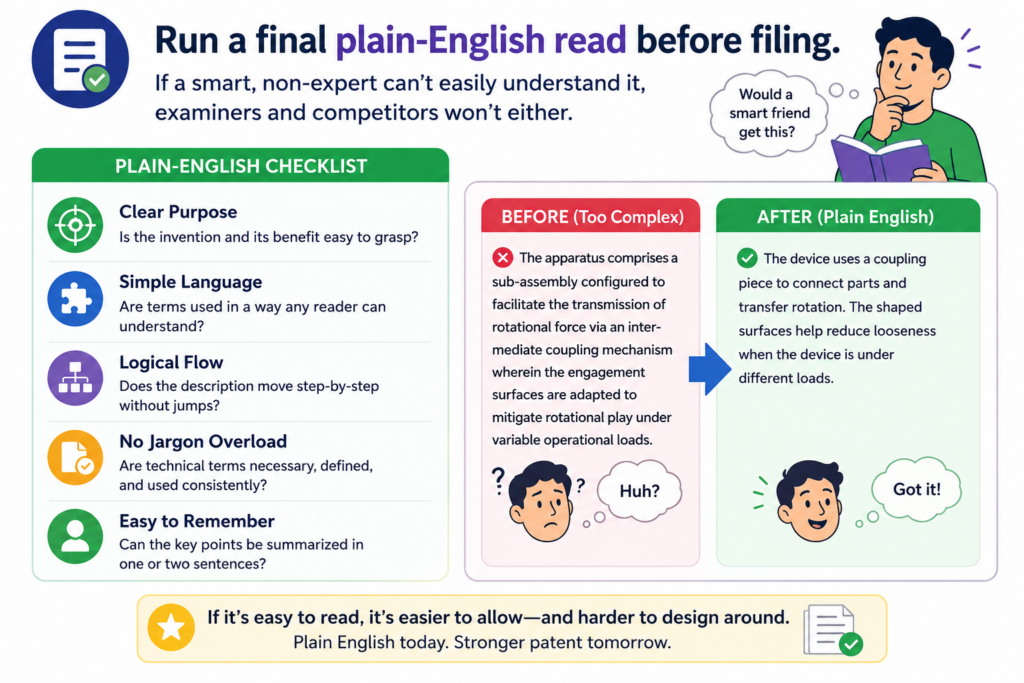
This plain-English review is not a replacement for attorney review. It is a final check to see whether the invention is clear, complete, and consistent.
If the draft cannot be explained in simple words, something may still be muddy.
The draft should answer the basic invention questions without strain
After reading the draft, you should be able to answer a few core questions in your own words.
What problem does the invention solve? What is the main technical idea? What parts are needed? What steps happen?
What makes this better than older ways? What versions are covered? What should a competitor not be able to copy?
You do not need to answer these questions in legal language. In fact, plain words are better for this review.
If you cannot answer them clearly, the draft may need one more pass.
A simple read can catch issues that a technical read misses
Technical experts often read for accuracy. Attorneys often read for protection. A plain-English read checks whether the story holds together.
This can catch confusing terms, missing links, sudden topic shifts, unclear examples, and claims that do not match the rest of the draft.
It can also catch a deeper issue: the draft may describe many things but fail to make the invention feel clear.
The final review should end with confidence, not confusion
Before filing, you should not feel like you are guessing.
You should understand what the draft is trying to protect. You should know why the claims matter.
You should see how the description supports them. You should feel that the drawings, examples, and technical details all point in the same direction.
A patent filing is too important to send out with avoidable confusion.
The best time to fix a patent draft is before it is filed
Once a filing is submitted, your options may be more limited. That is why this QA step matters so much.
Take the time to review the real business value, the claims, the examples, the terms, the drawings, the variants, the data flow, the support, and the final story.
This does not need to slow your startup down. With the right process, it can make filing faster because the team catches issues early instead of fighting them later.
PowerPatent helps make that possible. It gives founders a modern way to turn technical work into stronger patent filings, backed by smart software and real attorney oversight. Learn how it works here: https://powerpatent.com/how-it-works
Conclusion
A strong patent draft is not just a document. It is a shield for the work your team fought hard to build. Before filing, review the claims, drawings, examples, terms, data flow, variants, and business value with care. Make sure the draft protects the real invention, not just the first product version.
The best filings are clear, complete, and backed by smart judgment. PowerPatent helps founders move faster without flying blind, using smart software plus real attorney oversight. When you are ready to file better and avoid costly mistakes, see how it works here: https://powerpatent.com/how-it-works
Leave a Reply