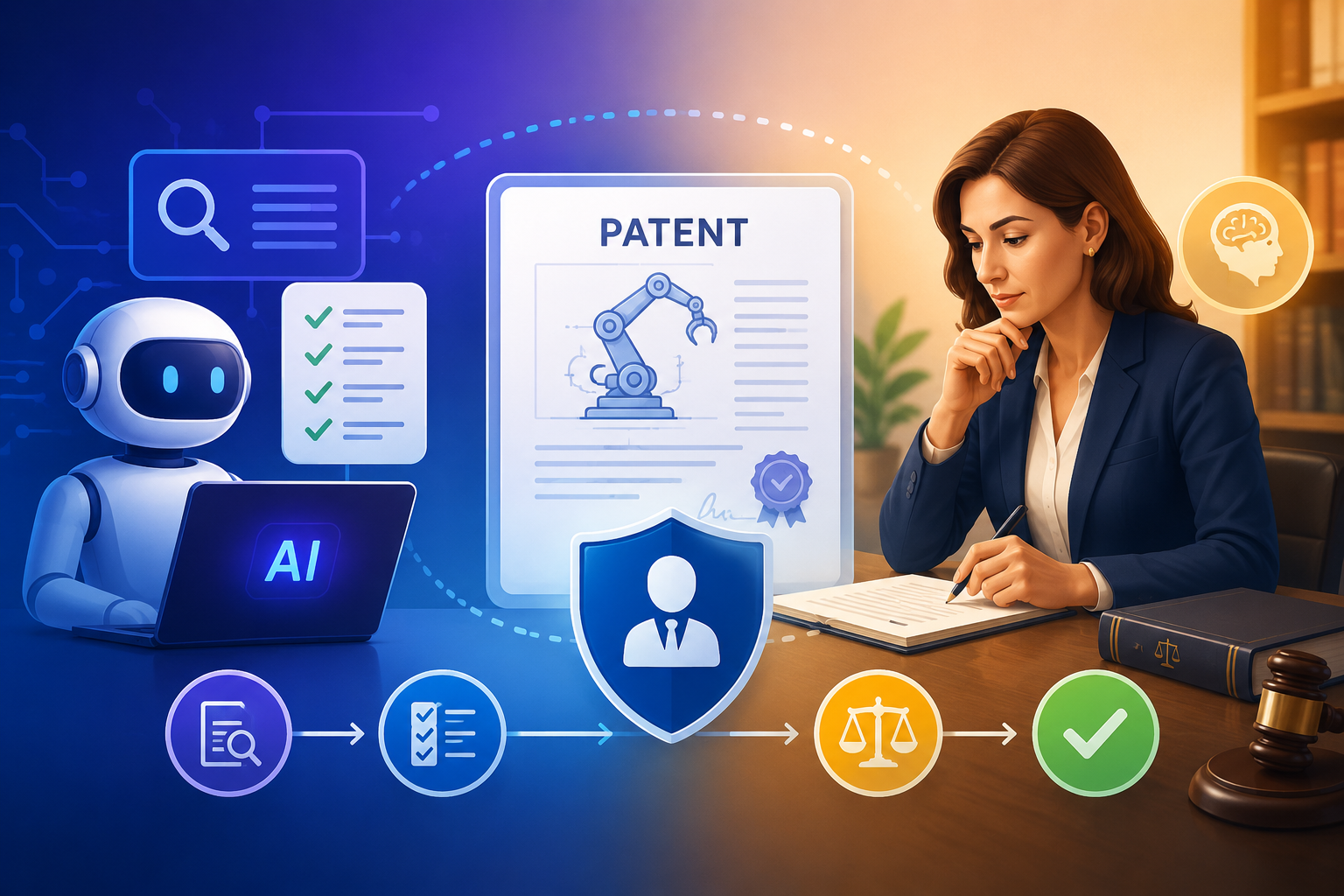
AI can move fast. It can read drafts, spot gaps, compare ideas, and help teams work with less friction. For founders, engineers, and inventors, that is a big win. Patent work has often felt slow, costly, and hard to understand. AI can change that.
Attorney Oversight Matters Because a Patent Is a Business Asset, Not Just a Technical File
A patent is not only a document. It is a shield around the thing your team worked hard to build. It can help protect your product, your market, your pricing power, and your future deals.
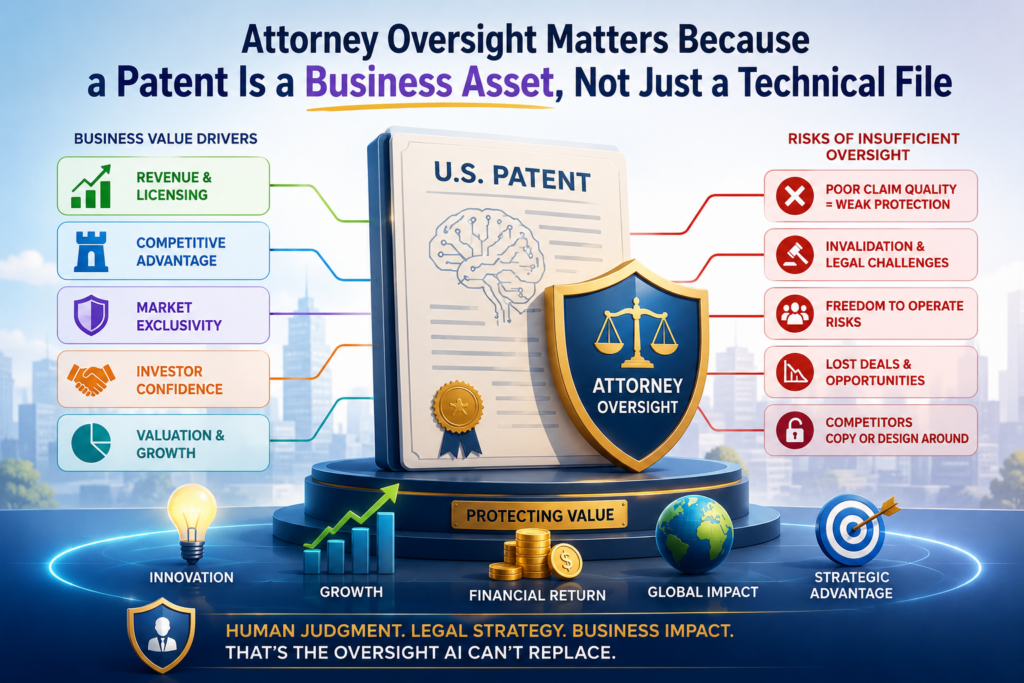
For a startup, that matters a lot because one weak patent filing can leave the best part of the company exposed.
AI can help review a patent draft with speed. It can scan text, find missing parts, compare terms, and suggest changes. That is useful. In fact, it can save founders a lot of time when used the right way.
But AI does not fully understand your business goal. It does not know which feature matters most to your next funding round. It does not know which part of your product a larger company may try to copy.
It does not know what tradeoff makes sense when you are moving fast but still need strong protection.
That is where attorney oversight becomes essential. A patent attorney is not just checking grammar or fixing claims. A good attorney is looking at the invention with a business lens, a risk lens, and a protection lens.
The attorney is asking what should be protected, what should be left out, what should be kept broad, and what must be made clear before filing.
The human role starts with knowing what the invention really is
Many founders think their invention is the whole product. That is common, but it is often not the best way to think about patents. A product may have many parts, but the patent should focus on the parts that create real value.
The important piece may be a method, a workflow, a model design, a data step, a control system, a sensor setup, or a way the software makes a better choice.
AI may be able to read a description and suggest what looks new. But a patent attorney can press deeper.
The attorney can ask why the feature works better, what problem it solves, what makes it hard to copy, and what a rival might build if they wanted the same result. Those questions matter because strong patents often come from clear thinking, not just long writing.
This is especially true for deep tech startups. In many cases, the invention is not easy to explain. It may sit inside code, a model, a lab process, or a system that only the engineering team fully understands.
AI can help turn raw notes into a cleaner draft, but the attorney helps turn the invention into a strong protection plan.
The safest review process keeps AI in the support seat and the attorney in the judgment seat
The best use of AI is not to replace the attorney. The best use is to help the attorney and founder move faster. AI can help gather details, organize drafts, check for missing explanations, and make review less painful.
The attorney then reviews the work, tests the logic, and makes the final call on what should be filed.
That balance matters because a patent review is full of choices. Some choices are technical. Some are legal. Some are strategic. A founder may want broad protection, but the draft also has to be clear and defensible.
A team may want to file fast, but speed should not mean skipping the key details that make the patent useful later.
This is why PowerPatent is built around smart software plus real attorney oversight. The software helps make the process faster and easier to manage.
The attorney review helps protect founders from mistakes that software alone may miss. You can see how this blend works here: https://powerpatent.com/how-it-works
AI Can Find Gaps, But Attorneys Decide Which Gaps Actually Matter
One of the most useful things AI can do in patent review is spot gaps. It can notice when a draft does not explain a step.
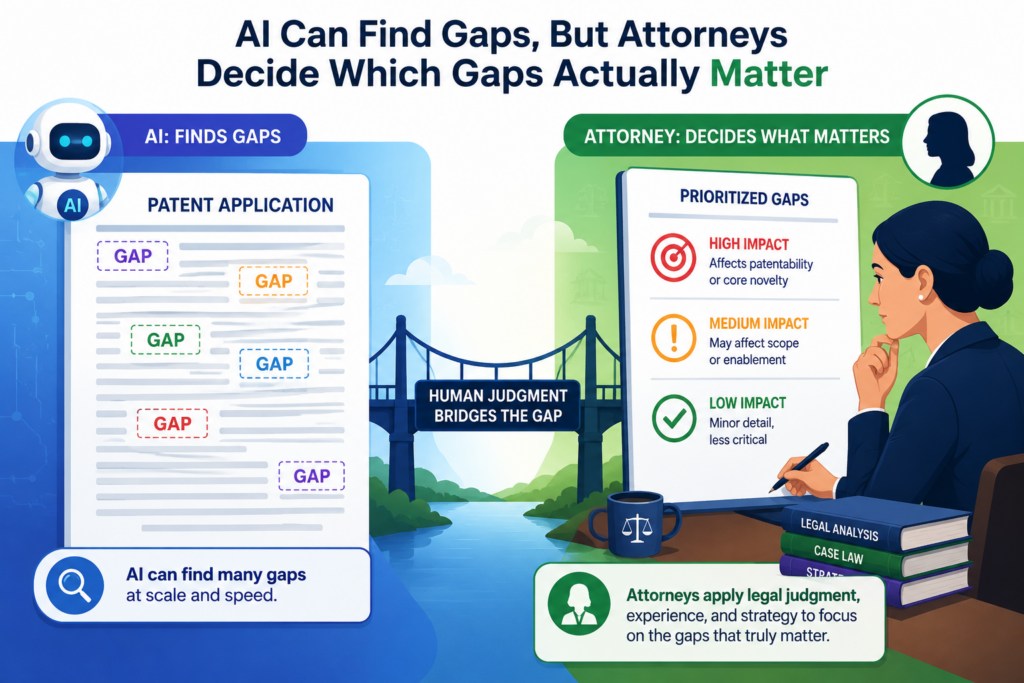
It can flag words that seem unclear. It can show where the invention description feels thin. It can also help compare different parts of the draft so the same idea is not described in conflicting ways.
That is valuable because patent drafts can become messy fast. Engineers often describe an invention in product terms. Founders often describe it in market terms.
Patent claims need a different kind of clarity. They need to describe the invention in a way that can stand up later. AI can help bring order to all of that raw input.
But not every gap has the same weight. Some gaps are small. Some are dangerous. Some could make the patent easier to design around. Some could make the invention look less complete than it really is.
AI may flag many things, but it cannot always know which issue is urgent, which issue is harmless, and which issue could weaken the company’s position.
That decision must stay human.
A real attorney can tell the difference between a wording issue and a protection issue
A wording issue is often easy to fix. Maybe a term is used two different ways. Maybe a sentence is too long.
Maybe a step needs a clearer link to the next step. AI can help catch this type of problem quickly.
A protection issue is deeper. It shows up when the draft does not protect the real invention. For example, the draft may focus too much on one product version and not enough on the core method.
It may describe a narrow setup when the company needs room to cover future versions. It may include details that are helpful for one use case but not needed for the broader idea.
This is where attorney judgment is critical. A patent attorney can look past the surface text and ask what the company is really trying to own.
That question is not simple. It depends on the product plan, the technical edge, the market, the likely competitors, and the stage of the company.
For a founder, this review can be the difference between a patent that sounds nice and a patent that actually helps.
A draft can be clean and still be weak. A draft can be long and still miss the heart of the invention. A draft can use the right words and still fail to protect the most valuable part of the system.
The best gap review turns engineering detail into business protection
A strong review does not only ask whether the patent draft has enough words. It asks whether the right ideas are present.
It asks whether the invention is explained from the right angle. It asks whether someone reading the patent can understand the value without needing the founder in the room.
That matters because patents are often used when the founder is not there to explain the backstory. Investors may review them.
Acquirers may review them. Partners may review them. Competitors may study them. In each case, the patent has to carry the weight on its own.
AI can make the review faster, but the attorney helps make it smarter. The attorney can decide whether a missing example should be added, whether a claim should be broader, whether a term needs support, or whether a technical detail should be moved into a better place. That is not busywork. That is how a patent becomes useful.
PowerPatent helps founders move through this process with less friction. Instead of tossing ideas into a slow and confusing process, founders can use software to organize the invention and then get real attorney review where it counts. To see the workflow in action, visit https://powerpatent.com/how-it-works
Human Review Is Needed Because AI Does Not Know Your Competitive Threats
A patent is strongest when it is built with the real world in mind. It should not only describe what your team built today.
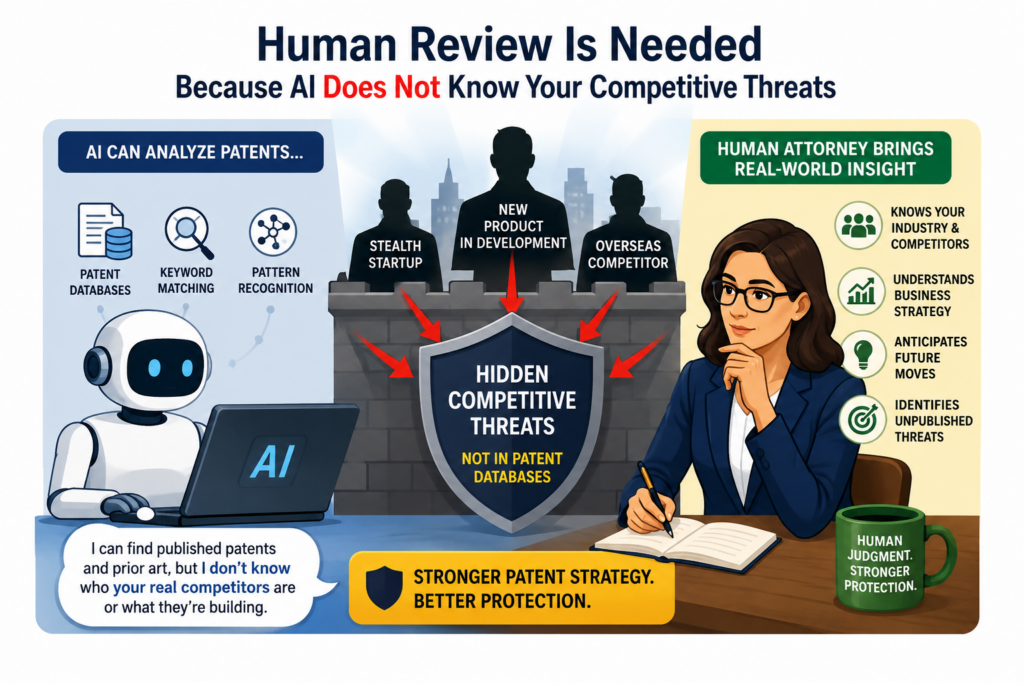
It should also think about what others may build tomorrow. This is where AI can help with research and drafting, but human review is still needed.
A competitor will not copy your product in the most obvious way. A smart competitor will try to get the same result while changing the details.
They may use a different model, a different data source, a different hardware layout, a different user flow, or a different back-end process. The patent review has to think through those paths before filing.
AI can suggest possible variations. It can help draft examples. It can surface related ideas. But it does not have founder-level context. It does not know which competitor is most likely to move into your space.
It does not know which feature your customers care about most. It does not know which part of the system took your team months to solve. It also does not know which parts you may build next quarter.
A patent attorney, working with the founder and technical team, can bring those points into the review. That is why attorney oversight is not a formality. It is part of the strategy.
The patent should protect the core idea, not only the first version
Most startups change fast. The first version of the product is rarely the final version. The model may change. The workflow may change. The system may move from one market to another.
The team may replace one part of the stack. A patent that only covers the first version may lose value as the company grows.
This is a common risk when AI review is used without human judgment. AI may treat the current draft as the full truth. It may polish what is already there instead of asking what is missing.
It may improve the language without widening the protection. That can feel productive, but it may not solve the real problem.
A human attorney can ask better questions. What parts of this system are fixed, and what parts may change? What is the deeper method behind the current feature?
What could be done with different inputs, outputs, devices, or model types? What should the patent cover so the company is not boxed into one early design?
Those questions matter because founders need protection that can grow with the company. A startup should not file a patent that becomes outdated as soon as the product improves.
The review should leave room for smart growth while still staying clear and honest about the invention.
Competitive thinking is where human judgment creates real patent value
A useful patent review should include a simple but powerful question: how would someone try to work around this? That question changes the whole review.
It forces the team to think beyond the product screen, the code path, or the lab setup. It moves the focus from “what did we build?” to “what should we stop others from taking?”
AI can help brainstorm possible workarounds, but an attorney can decide which ones matter and how to address them in the patent. The attorney can help avoid language that is too narrow.
The attorney can also help keep the patent from becoming so broad that it lacks support. That balance is hard. It takes judgment.
For example, a founder may describe an AI system using one type of model because that is what the team uses today. But the true invention may be the way the system chooses, ranks, filters, or acts on data.
If the patent focuses only on the model type, a competitor may use a different model and still copy the value. A human reviewer can spot that risk and help frame the invention in a stronger way.
This is why PowerPatent focuses on speed with oversight, not speed without care. Founders need a process that helps them move fast, but they also need the confidence that a real attorney is reviewing the substance.
That combination helps protect the business without pulling the team away from building.
Attorney Oversight Keeps the Patent From Becoming Too Narrow or Too Loose
A strong patent needs the right width. That sounds simple, but it is one of the hardest parts of patent work. A patent that is too narrow may not stop a competitor.
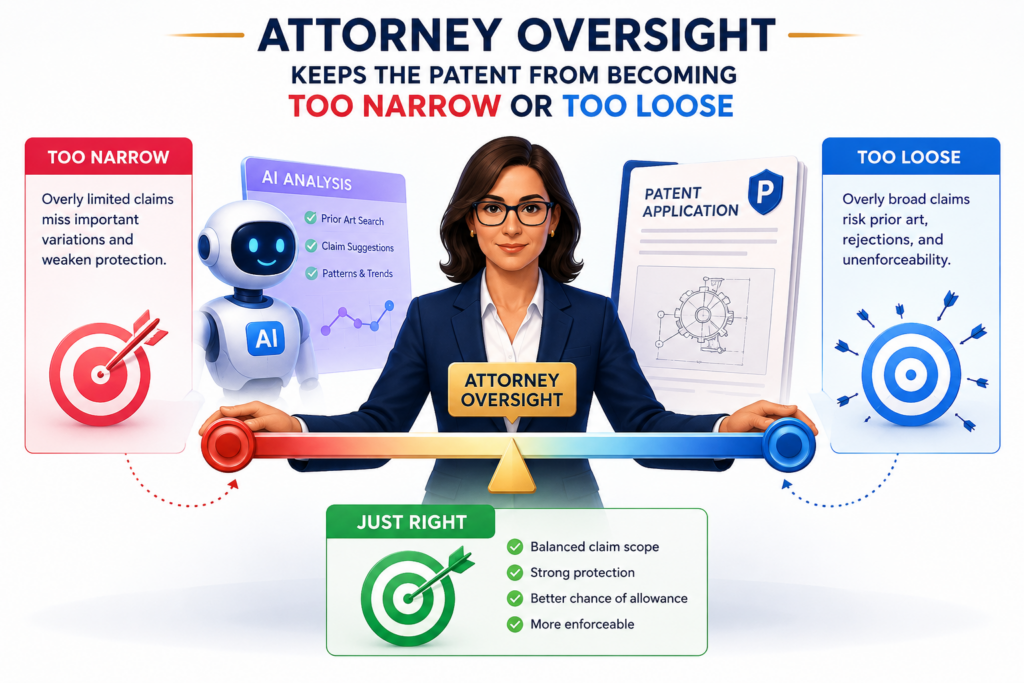
A patent that is too loose may not hold up when it matters. AI can help with drafting, but it cannot fully own this balance because this balance is not just a writing task. It is a judgment task.
For a founder, this is where things can get risky. You may look at a draft and think it sounds detailed, smart, and complete. The words may look polished. The claims may sound official.
But that does not mean the patent is aimed at the right target. A patent can describe your invention in great detail and still give away too much room to others. It can also try to cover too much and end up weaker because the support is not there.
That is why attorney review must stay human. A patent attorney can read the draft and ask whether the protection fits the business goal.
The attorney can decide when the language should be broader, when it should be tighter, and when the draft needs more support before filing. AI can suggest language. The attorney decides whether that language helps or hurts.
The real goal is to protect the value, not just describe the product
Many patent drafts start with the product as it exists today. That makes sense because the product is what the team knows best.
But the product is only one version of the invention. The deeper value may sit under the surface. It may be the way data moves through the system.
It may be how the software makes a choice. It may be how a device reacts to a signal. It may be how a model is trained, tuned, checked, or used inside a larger flow.
AI may describe the current version very well. But strong attorney oversight helps find the bigger shape of the invention. The attorney looks for the idea behind the feature.
That matters because a competitor may not copy your screen, your code, or your exact flow. They may copy the value in a slightly different form.
A narrow patent can make that easy. For example, a draft may say the system uses one kind of sensor, one kind of model, or one kind of database.
If that detail is not truly needed, it may limit the patent for no good reason. A competitor may swap that detail and still get the same result. A human attorney can catch this before it becomes a problem.
At the same time, the attorney must also stop the draft from reaching too far. A patent cannot just claim every possible version of a big idea without enough support.
That is where AI can be dangerous when used without review. It can make language sound broad and powerful, but broad words are not enough. The draft must show that the inventor had a real invention and could explain it clearly.
The best patent review checks both the words and the business risk behind the words
This is why claim scope should never be treated like a simple edit. It is not about making a sentence sound better.
It is about asking what the company needs to protect and what the patent can fairly support. That takes technical care, business thinking, and legal judgment at the same time.
A good attorney may ask the founder to explain what parts of the invention are required and what parts are only examples. That question can change the whole draft.
It can move a feature from the center of the claim into an example. It can help protect future versions. It can also keep the patent from being locked to one early design.
This kind of review is especially important for software, AI, robotics, health tech, climate tech, chips, sensors, and other deep tech work. These fields move fast.
Your product may change many times before the patent is even examined. The filing should not be so tied to the first build that it loses value as the company grows.
PowerPatent helps founders move quickly without leaving this kind of judgment behind. The software helps organize the invention and speed up review.
The attorney oversight helps make sure the patent is not just clean, but useful. See how the process works here: https://powerpatent.com/how-it-works
Attorney Oversight Helps Make the Patent Clear Enough to Stand on Its Own
A patent has to explain the invention in a way that holds up without you in the room. That is easy to forget. Founders often explain things live.
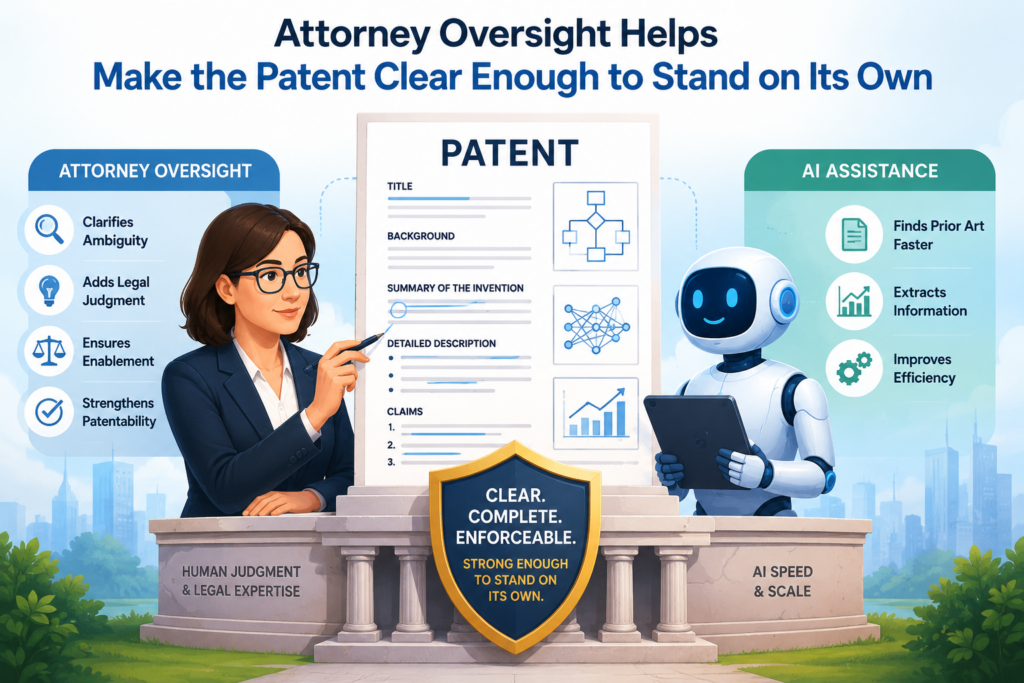
Engineers point to code, diagrams, test data, or product demos. In a patent, the document must carry the story by itself.
AI can help turn raw notes into readable text. It can expand short answers. It can clean up rough language. It can connect ideas that were spread across many files.
But clarity in a patent is not just about smooth writing. It is about making sure the reader can understand what the invention is, how it works, and why it is different.
That is a human review job. A patent attorney can see when the draft sounds good but still leaves out a key step. The attorney can tell when a term needs more support.
The attorney can spot when the description jumps from one idea to another too quickly. The attorney can also push the team to add the details that may matter later.
The patent should explain the invention like a strong technical story
A strong patent draft has a flow. It starts with the problem. It explains why the old way was not enough. It shows what the invention changes.
It gives enough detail so the invention feels real, not vague. It also shows different ways the idea can be used.
AI can help build that story, but it may not know which details are essential. It may treat every detail with the same weight.
It may add words that sound helpful but do not add real support. It may also miss small technical points that make the invention work.
A human attorney can slow down at the right places. That does not mean slowing down the company. It means slowing down the review where the risk is highest.
For example, the draft may say a model improves output quality. But how does it improve quality? What signal does it use? What step changes the output? What happens before and after that step? Those questions can turn a weak line into a stronger explanation.
This is important because a patent may be read years after filing. The product may look different by then. The team may have changed.
The market may have shifted. The patent still needs to make sense. It should not depend on memory, hidden context, or private notes.
Clear patents are easier to defend, explain, and use in business talks
Founders often think patents only matter during a lawsuit. In real startup life, patents can matter much earlier. They may come up during fundraising. They may come up in partner talks.
They may come up during a company sale. They may help show that the startup has built something real and hard to copy.
A clear patent is easier to explain in those moments. It helps the founder tell a stronger story. It helps investors see that the company took protection seriously.
It helps a buyer understand what the company may own. It also helps the attorney support the patent later if someone questions it.
This is why clarity is not a soft goal. It is part of protection. A vague patent can create doubt. A clear patent can create confidence.
AI can make a draft more readable, but readability alone is not enough. A draft can be easy to read and still leave out the best part of the invention.
Attorney oversight helps make sure the right story is being told. It also helps remove noise that does not serve the filing.
At PowerPatent, the goal is not to make founders fight through a slow, old process. The goal is to help them share their invention clearly, use smart software to reduce friction, and bring in real attorney review where it matters most.
That means better speed, better control, and a stronger path from idea to filing. Learn more here: https://powerpatent.com/how-it-works
Attorney Oversight Helps Protect What Should Not Be Said Too Early
Patent review is not only about what goes into the filing. It is also about what should stay out, at least for now. That is a very human call.
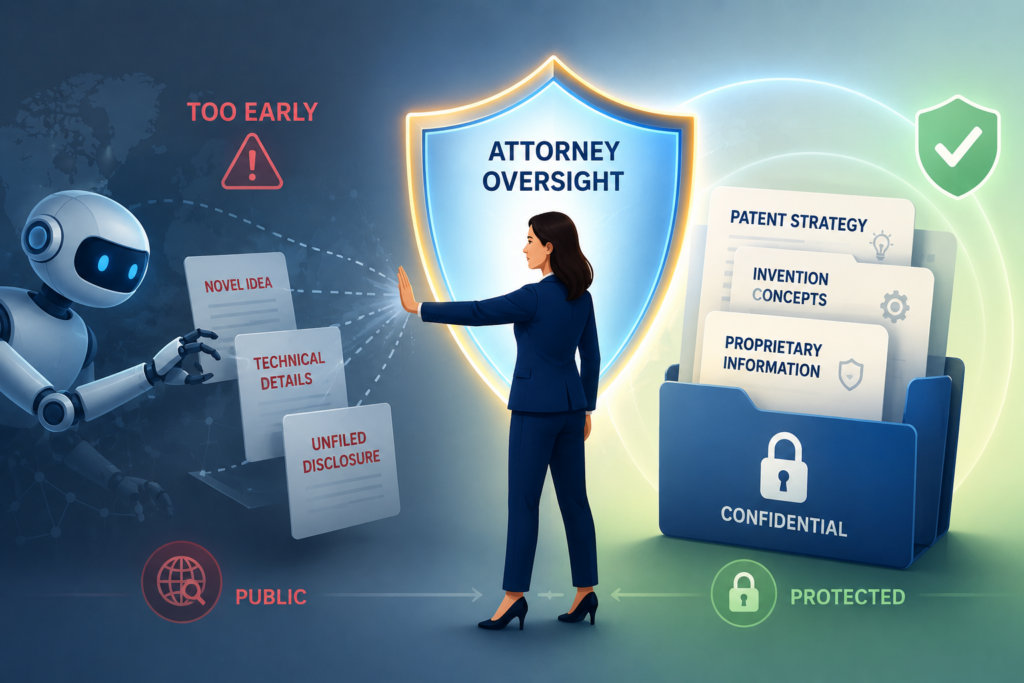
AI can help create more content, but more content is not always better. Sometimes the safest move is to be clear, focused, and careful.
Founders are often proud of what they are building, as they should be. They may want to share the full roadmap, all test results, all model details, all internal tradeoffs, and every future idea.
But a patent filing should be handled with care. It should support the invention without giving away more than needed. It should protect the business without exposing private plans that do not belong in that filing.
AI does not always know where that line is. It may take every note and turn it into patent text. It may include roadmap ideas that are not ready.
It may describe internal methods that the company would rather keep secret. It may add examples that sound useful but create extra risk. That is why attorney oversight matters.
Not every useful detail belongs in the patent
Some details make the patent stronger. Other details may narrow the patent, reveal too much, or distract from the core invention. The hard part is telling the difference.
A patent attorney can help decide which details support the claims and which details are not needed. This is not about hiding the invention.
A patent must be honest and complete enough to support what is being claimed. But that does not mean every private note belongs in the filing.
For example, a startup may have a special training process for an AI model. Some parts may be key to the invention and should be described.
Other parts may be internal tuning choices that are better kept as know-how. A founder may not know where to draw that line. AI cannot reliably draw it either. A human attorney can help the team make a cleaner decision.
The same is true for product plans. A patent may include useful variations to support broader protection. But it may not be wise to describe every future feature, market, or partner use case in detail.
Some roadmap items may not be ready. Some may change. Some may create questions the team does not need to invite.
Human review helps founders avoid turning a patent into a roadmap for competitors
A patent becomes public. That matters. Once it is published, competitors can read it. Investors can read it.
Big companies can read it. Future partners can read it. The filing should be strong, but it should not become a free playbook.
AI can help speed up drafting, but it can also make over-sharing easier. When a tool can turn rough notes into clean paragraphs, the draft can grow fast.
That can feel like progress. But a long draft is not always a better draft. The better question is whether each part helps protect the invention.
Attorney oversight helps keep the filing focused. The attorney can ask whether a detail supports the claim, whether it creates a limit, whether it reveals a trade secret, or whether it belongs in a later filing. These are not simple text edits. These are business decisions.
This is also where founders need a process that gives them control. They should not feel like their invention is being pushed into a black box. They should understand what is being filed and why.
PowerPatent is built to make that easier. The platform helps founders organize their invention and move faster, while attorney oversight helps protect the parts that should stay human. You can see the process here: https://powerpatent.com/how-it-works
Attorney Oversight Helps Catch Inventor and Ownership Issues Before They Become Expensive
A patent is tied to people and ownership. That can create problems when it is handled too late or too casually. In a startup, many people may touch an idea.

Founders, engineers, contractors, advisors, university labs, outside dev shops, and early partners may all play a role. Figuring out who invented what is not always simple.
AI can read names, notes, commits, and documents. It can help organize facts. It can show who worked on which part.
But it cannot make the final call on inventorship and ownership risk. That call needs human review because it can affect the value of the patent and the company.
This is one of the most important areas where attorney oversight must stay human. A mistake here can be painful. If the wrong people are named, the patent may face questions later.
If the company does not have clear rights, a funding round, deal, or sale can slow down. These problems are much easier to fix early than after a major investor or buyer finds them.
Founders need to know who actually contributed to the invention
Not everyone who worked on the product is an inventor for the patent. Not everyone who gave feedback is an inventor.
Not everyone who wrote code is automatically an inventor either. The key question is who helped create the claimed invention. That takes careful review.
AI may not understand that difference. It may treat contribution, employment, code work, and invention as the same thing.
They are not the same. A person may build a feature based on clear instructions without inventing the core idea.
Another person may suggest one key step that becomes central to the patent. A contractor may create part of the system that is later claimed. These facts matter.
A patent attorney can ask the right questions. Who came up with the core method? Who solved the hard technical problem? Who added the feature that makes the system different?
Who only tested, coded, or implemented what others designed? These questions can feel uncomfortable, but they protect the company.
This is also where clean records help. Founders should keep invention notes, design docs, meeting notes, and version history.
AI can help organize these materials, but attorney review helps decide what they mean.
Ownership review protects the company before investors or buyers ask hard questions
Inventorship is one side. Ownership is another. Even if the right inventors are named, the company also needs to make sure it owns or can use the rights.
This can involve employee agreements, contractor agreements, university rules, customer contracts, or joint development terms.
AI may be able to summarize documents, but it cannot replace attorney judgment. It may miss a clause that matters.
It may not understand how one agreement affects another. It may not see how a past relationship could create future risk. These issues need a human eye.
For startups, this is not a small matter. Investors care about whether the company owns its core technology.
Buyers care even more. A strong patent strategy can lose value if ownership is messy. Fixing that early gives founders more confidence.
PowerPatent helps founders avoid the feeling that patents are just forms and deadlines. The process is built around real protection, which includes the human checks that software alone should not handle.
Smart tools help move the work forward. Attorney oversight helps make sure the foundation is solid. Start exploring here: https://powerpatent.com/how-it-works
Attorney Oversight Helps Turn AI Output Into Filing-Ready Work
AI can produce a lot of text. That is useful, but it also creates a new problem. More text means more to review. More suggestions mean more choices.
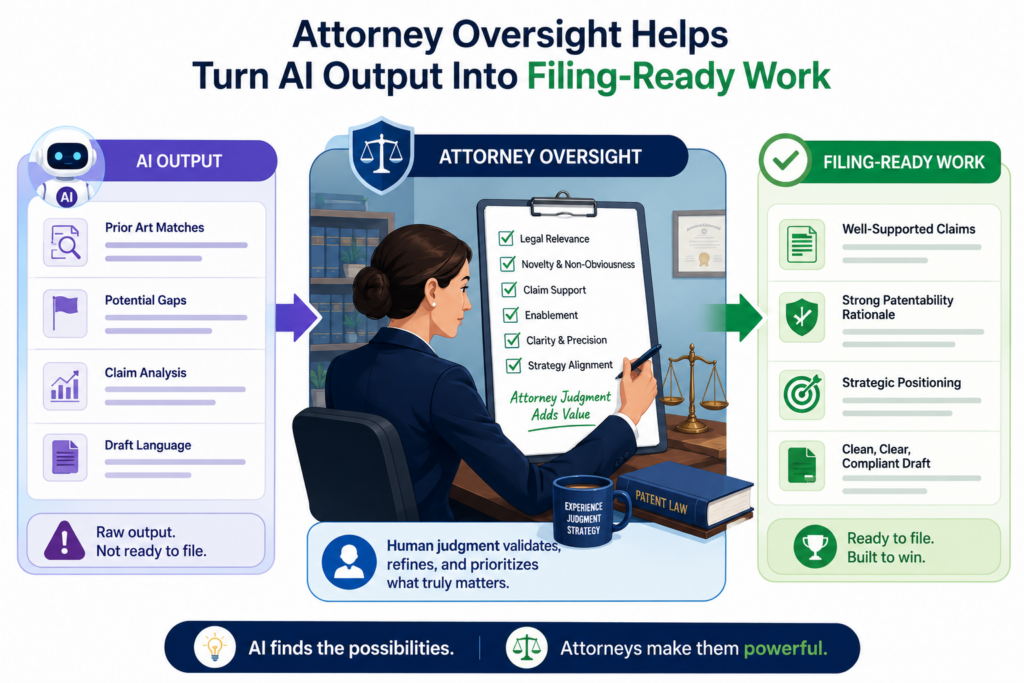
More drafts mean more chances for small issues to hide inside polished language. This is why AI output should not go straight into a patent filing without real review.
A founder may see a clean AI-generated draft and feel relieved. The draft may sound formal. It may include technical terms. It may look complete.
But patent work is not judged by how official it sounds. It is judged by whether it protects the invention and can support the claims.
Attorney oversight turns AI output into work that is ready for a serious filing decision. The attorney checks whether the draft is accurate, supported, clear, and aligned with the company’s goal.
The attorney can remove weak language, fix gaps, and reshape the claims. This is where the draft moves from “nice text” to real patent work.
AI can help build the draft, but the attorney must own the final review
There is nothing wrong with using AI to help prepare patent materials. In fact, founders should want better tools. The old way often forced teams to spend too much time in long email threads, unclear forms, and slow back-and-forth.
AI can make the process easier. It can help founders explain the invention faster. It can help attorneys review better inputs. It can reduce wasted time.
But final review is different. The final review is where someone must take responsibility for what goes into the filing. That person should be a real attorney, not a tool.
A patent filing needs careful choices. Are the claims aimed at the right invention? Does the description support those claims?
Are the examples helpful? Are the terms clear? Are there parts that conflict? Are there statements that could hurt the company later? These questions call for judgment.
AI can assist with many of these checks, but it should not be the last stop. AI may miss a subtle error because the sentence sounds right. It may repeat a term in a way that creates confusion.
It may include a feature from one version and imply that it is required in all versions. It may create a mismatch between the claims and the description.
Filing-ready means reviewed, tested, and aligned with the startup’s real plan
A filing-ready draft should not feel like a pile of generated text. It should feel like a focused protection plan. Every major part should have a reason to be there.
The claims should connect to the invention. The description should support the claims. The examples should add value. The language should be clear enough for future review.
This is where PowerPatent’s model is powerful. The software helps founders move faster and bring order to the invention process.
Attorney oversight helps make sure the output is not just fast, but sound. That matters because founders do not need more documents. They need better protection with less drag on the company.
For technical teams, this can be a major advantage. Instead of waiting weeks just to explain the invention, they can work through a more guided process.
Instead of wondering whether AI is making legal calls, they can rely on a model where attorneys stay involved. That balance helps founders keep building while still protecting what matters.
The best patent process does not make founders choose between speed and care. It gives them both.
That is what PowerPatent is working toward. See how the platform blends software and attorney review here: https://powerpatent.com/how-it-works
Attorney Oversight Helps Founders Make Better Filing Choices Under Pressure
Startups move under pressure. There is always a demo, a launch, a fundraise, a customer call, or a product deadline. Patent decisions often happen in the middle of all that.
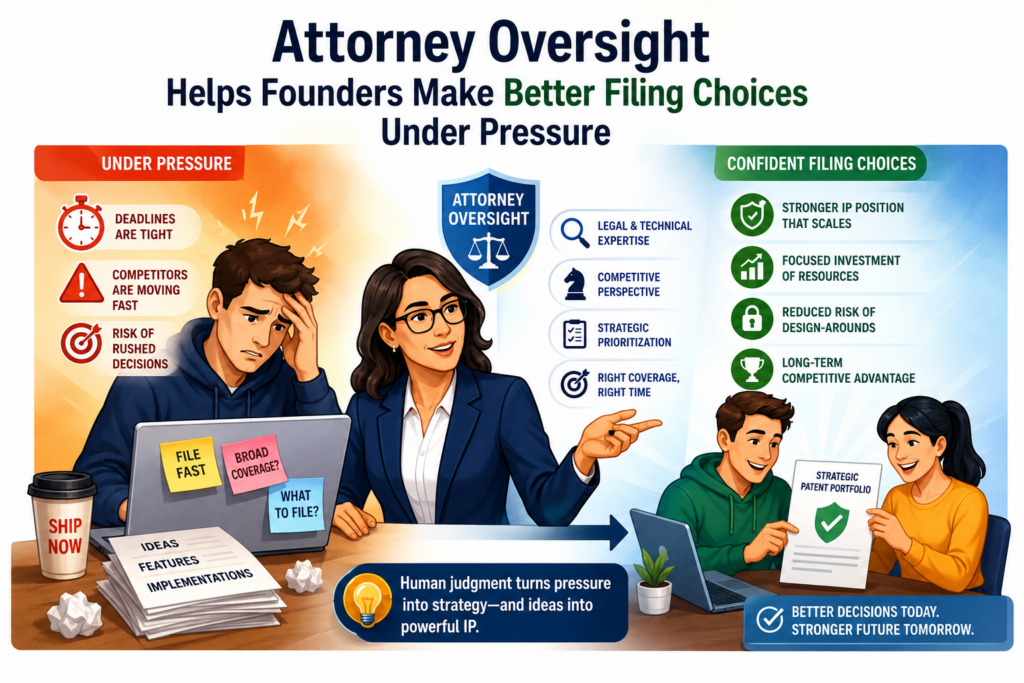
The team may need to file before a public release. The founder may need to show IP progress to investors. The company may need to protect a new feature before talking to a partner.
AI can help speed up the work, but pressure makes human judgment even more important. Fast decisions are not always bad. In startup life, speed matters. But fast patent decisions should still be smart.
A rushed filing that misses the core invention can create false comfort. A rushed filing that includes the wrong details can create future problems. A rushed filing that ignores ownership questions can become a deal issue later.
Attorney oversight helps founders move fast without acting blind. The attorney can help decide what should be filed now, what should be saved for later, and what needs more detail before it is safe to file.
That kind of guidance can save time, money, and stress.
A good attorney helps founders choose the right patent move for the stage of the company
Not every startup needs the same patent plan. An early company may need to protect one core invention before a pitch or launch. A later company may need a broader filing plan that covers several product lines.
A deep tech team may need filings around a platform, a model, a device, a workflow, and future improvements. The right move depends on the company’s stage and risk.
AI can help gather and sort information, but it does not know the full pressure around the decision. It does not know that the founder is talking to a strategic partner next week.
It does not know which feature investors keep asking about. It does not know whether the team is about to publish a paper, ship a beta, or enter a pilot.
A human attorney can ask those questions and help shape the filing plan. That does not mean making the process slow.
It means making the process smarter. The goal is to protect the highest-value parts first and avoid wasting time on filings that do not serve the company.
This can be especially helpful when the team has many ideas at once. AI may treat all invention notes as equal. An attorney can help rank them.
Which idea is most central to the product? Which one is easiest for others to copy? Which one supports the company’s long-term edge? Which one needs protection before public disclosure? These choices matter.
The right oversight gives founders confidence when the clock is moving fast
Founders do not need a patent process that adds fear. They need one that gives control. They need to know what is being protected, why it matters, and what the next step is.
Attorney oversight helps create that confidence because a real person is reviewing the hard parts.
This is the heart of human review in an AI-powered patent process. AI should remove friction. It should help collect details, organize ideas, and speed up drafts.
But the attorney should guide the choices that affect protection, risk, and business value.
PowerPatent is built around that idea. Founders get the benefit of smart software without being left alone with a tool.
They get a faster path, but with real attorney review built into the process. That makes patent work feel less like a burden and more like a smart part of building the company.
For founders who are moving fast, this matters. You can protect the work without losing weeks in confusion.
You can bring your invention into a guided system and still have human review where it counts. You can see how PowerPatent helps founders do that here: https://powerpatent.com/how-it-works
Attorney Oversight Helps Stop AI From Making Confident Mistakes
AI can sound very sure even when it is wrong. That is one of the biggest risks in patent review. A tool may write a clean sentence, use strong words, and make the draft feel complete.
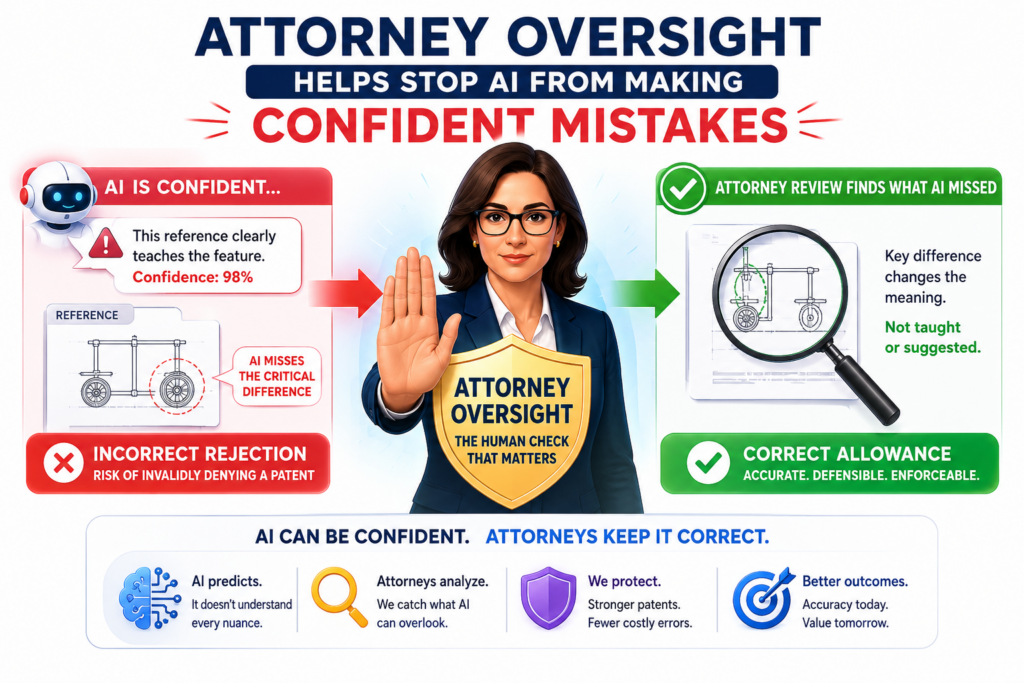
But the wording may still be off. The claim may not match the invention. A feature may be described in a way the engineers never meant. A key step may be added because it sounds logical, even though it is not part of the actual system.
That is dangerous because patent review is not a place where “close enough” is good enough. A small mistake can change the meaning of the filing. A wrong detail can narrow the patent.
A missing detail can weaken it. A made-up connection between parts can create confusion later. These problems may not be obvious when the draft is fresh. They may only show up during review, funding, a deal, or a dispute.
Attorney oversight is the guardrail. The attorney checks whether the draft says what the invention actually does. The attorney compares the language to the real technical flow.
The attorney asks the founder and engineering team to confirm facts before they become part of the filing. This matters because once a patent application is filed, the words start to carry weight.
AI can help founders move fast, but speed should not turn into blind trust. The right model is not “let AI draft and hope it is right.” The right model is “let AI help, then let a human expert review the important choices.”
AI can create smooth text that hides weak logic
A patent draft may look strong because it is long, polished, and full of technical words. That can create a false sense of safety.
Founders are busy. Engineers are busy. When a draft looks finished, it is tempting to move on.
But smooth text can hide weak logic. It can explain the invention in a way that feels clear but does not match the real system. It can use the same term in slightly different ways.
It can describe a result without explaining the step that creates the result. It can include a broad claim without enough support in the rest of the draft.
A human attorney can spot these hidden issues. The attorney is not just asking, “Does this read well?” The attorney is asking, “Will this help protect the invention?” That is a much higher bar.
This is why founders should be careful with any AI patent review process that does not include real attorney oversight.
AI can be a strong assistant, but it should not be treated like the final reviewer. A founder does not need a fancy draft. A founder needs a useful patent asset.
The final review should test every important statement against the real invention
A good attorney review should pressure-test the draft. It should check whether each major statement is true, clear, and useful. It should make sure the claims are supported by the description.
It should confirm that examples do not accidentally limit the invention. It should catch places where the draft says too much, too little, or the wrong thing.
This type of review is hard to automate because it depends on judgment. It also depends on context. A sentence that is fine in one patent may be risky in another.
A broad term may help in one case and hurt in another. A detail may be essential in one invention and unnecessary in another.
PowerPatent is built for this balance. Smart software helps collect and shape the invention faster. Real attorney oversight helps check the work before it becomes a serious filing.
That gives founders speed without giving up care. You can see how PowerPatent makes this easier here: https://powerpatent.com/how-it-works
Attorney Oversight Helps Founders Avoid Filing the Wrong Thing First
Startups often have more than one invention hiding inside the product. There may be a core engine, a user workflow, a data method, a model training process, a hardware design, a control system, or a way to connect many pieces together.
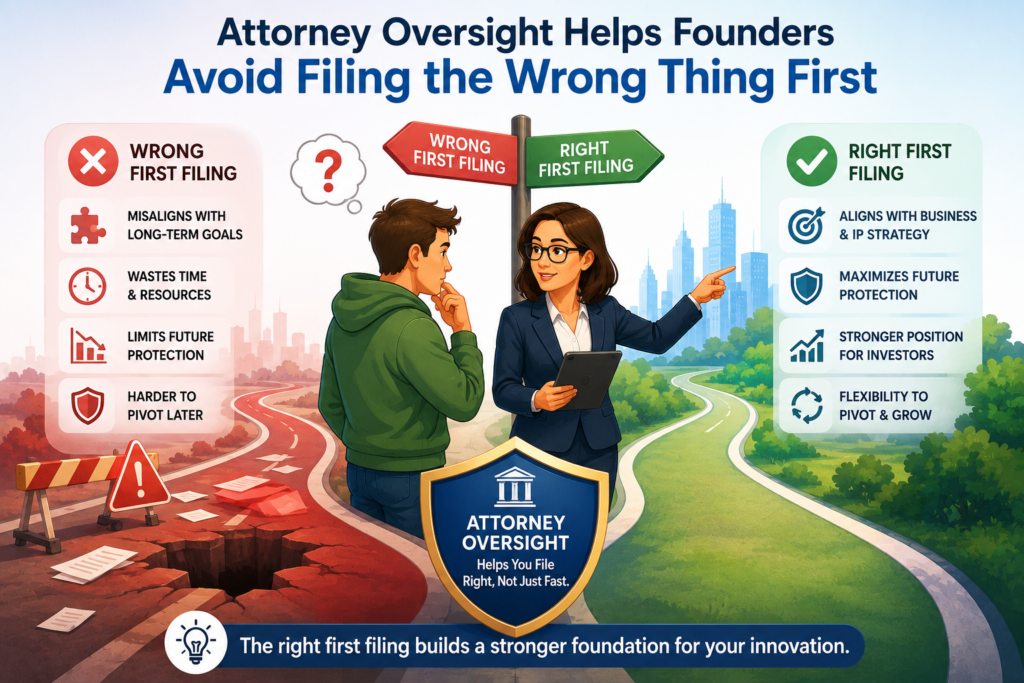
The hard part is not always finding something to patent. The hard part is choosing what to patent first.
AI can help list possible inventions. It can read notes and suggest themes. It can group ideas by feature or function. That is helpful, but it does not answer the deeper question: which filing will matter most to the company?
That choice must stay human. A real attorney can help the founder look at the product, the market, and the company’s near-term goals.
The attorney can help decide whether the first filing should protect the broad platform, the hardest technical step, the feature most likely to be copied, or the part investors care about most.
This matters because early patent budgets are not endless. Even when the process is faster and more affordable, founders still need focus.
Filing the wrong thing first can waste time and leave the real asset exposed. Filing the right thing first can create confidence before a launch, raise, partnership, or public demo.
The first filing should match the company’s highest-risk moment
A startup does not file patents in a vacuum. There is usually a reason to act. Maybe the team is about to publish a paper.
Maybe a demo is going live. Maybe a pilot customer will see the system. Maybe a large company is asking for technical details. Maybe a fundraise is coming and the founder wants to show a serious IP plan.
AI may not understand that moment. It may not know which event creates risk. It may not know what will be shown, shared, shipped, or discussed. It may treat all ideas as equal.
Attorney oversight brings the filing back to the real business situation. The attorney can ask what will become public, what is still private, what competitors may learn, and what the company needs to protect before that happens.
This is practical. It helps founders act with purpose instead of filing random ideas just because they can.
The best first filing is not always the flashiest idea. It is the one that protects the most important value at the right time.
A smart filing order can create a stronger patent path over time
Patent strategy is not only about one filing. It is often a path. The first filing may protect the core system. A later filing may protect an improvement.
Another may cover a new use case, model, device, or workflow. Done well, this can create a growing wall around the company’s edge.
AI can help track ideas and drafts across that path, but a human attorney should guide the order. The attorney can help avoid overlap, gaps, and rushed filings that do not fit together.
The attorney can also help founders avoid putting too much into one filing when separate filings may create cleaner protection.
This is very important for deep tech startups because the invention often keeps growing. The first version may prove the concept.
The second version may solve a hard scale problem. The third version may unlock a new market. A good patent plan should grow with that progress.
PowerPatent helps founders move from scattered ideas to a clearer filing path. The software helps capture invention details before they get lost.
Attorney oversight helps decide what should move forward first. For a founder, that means less guesswork and more control. Learn how the process works here: https://powerpatent.com/how-it-works
Attorney Oversight Helps Keep the Claims Connected to the Real Product
The claims are the heart of a patent. They define what the patent is trying to protect. For many founders, claims are also the hardest part to understand.
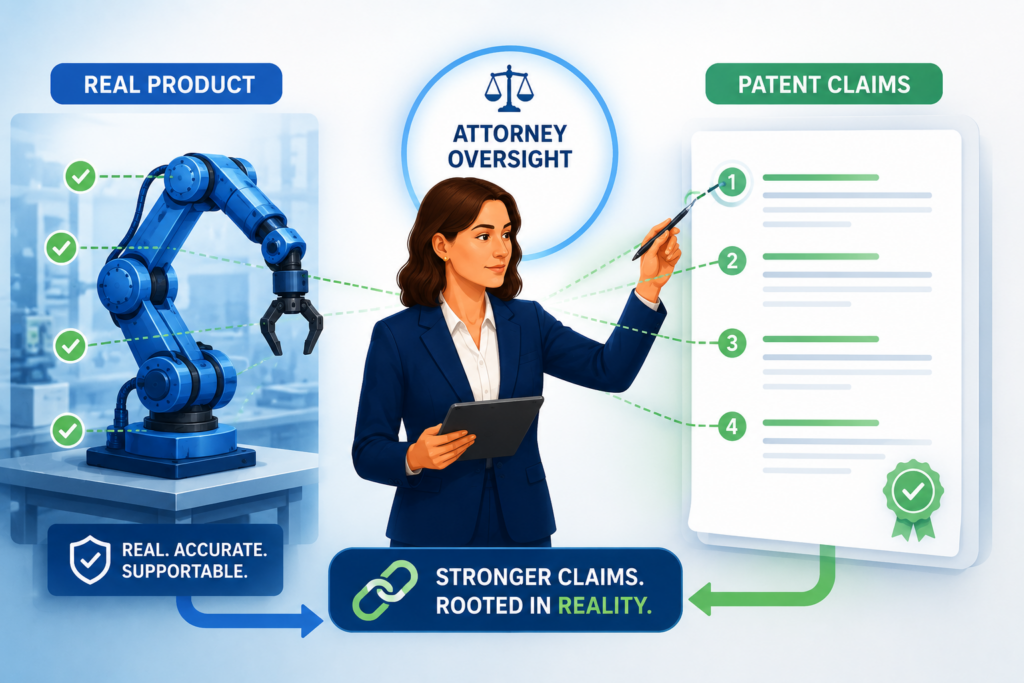
They can look strange, formal, and far removed from the product. That is one reason AI tools can seem so useful. They can draft claim-style language quickly.
But this is also where human review is most important. Claims are not just words. They are the fence around the invention. If the fence is in the wrong place, the patent may not protect what matters.
If the fence is too close to the current product, competitors may walk around it. If the fence is too far from the invention, the filing may not support it well.
An attorney must review the claims with care. The attorney checks whether the claims match the real product, the real invention, and the business goal. This is not something founders should leave to AI alone.
AI can help draft early claim ideas. It can suggest different angles. It can turn a technical flow into claim language. But the attorney decides whether those claims are accurate, useful, and supported.
Claims should protect the invention without trapping the company in one version
A startup product changes. That is normal. The first version may use one model, one interface, one device, one data source, or one deployment setup.
Later, the team may change all of that. If the claims are tied too tightly to the first version, the patent may lose power as the company grows.
Attorney oversight helps prevent this. A good attorney can look at a claim and ask whether each detail is truly needed.
If a detail is only an example, it may not belong in the broadest claim. If a step is central to the invention, it may need to stay. These choices affect how useful the patent may be later.
This is hard for AI because AI may not know which product details are temporary. It may treat the current build as the invention itself.
It may also include extra limits because they sound technical. That can make the claim feel more concrete, but it can also make it easier for others to avoid.
The goal is not to make every claim as broad as possible. The goal is to make the claims smart. They should cover the real inventive idea while staying tied to what the team can support.
Strong claim review turns technical detail into practical protection
A good claim review often starts with simple questions. What must happen for the invention to work? What could change without losing the benefit?
What would a competitor copy if they wanted the same result? What part of the system creates the real edge?
Those questions are simple to ask, but they require judgment to answer. That is why attorney oversight matters.
The attorney can work with the founder and engineering team to shape the claims around the value, not just the visible product.
This is where PowerPatent’s approach can help founders move faster without losing control. The software helps pull out technical detail and organize the invention.
Attorney oversight helps shape that detail into claims that make sense for the company. It is a better path than slow back-and-forth, and it is safer than trusting AI alone.
Founders do not need to become patent experts. They do need a process that helps them protect what they are building with confidence.
PowerPatent gives them that mix of smart tools and real attorney review. You can explore it here: https://powerpatent.com/how-it-works
Conclusion
AI can make patent review faster, cleaner, and easier for busy founders, but the final calls must stay human. A real attorney protects the strategy behind the invention, checks the risks, shapes the claims, and helps stop small errors from becoming big problems later.
The best path is not AI alone, and not slow old-school work either. It is smart software plus careful attorney oversight, working together so your ideas move fast and stay protected. That is what PowerPatent gives technical teams: speed, control, and confidence before competitors catch up. Learn how it works here: https://powerpatent.com/how-it-works
Leave a Reply