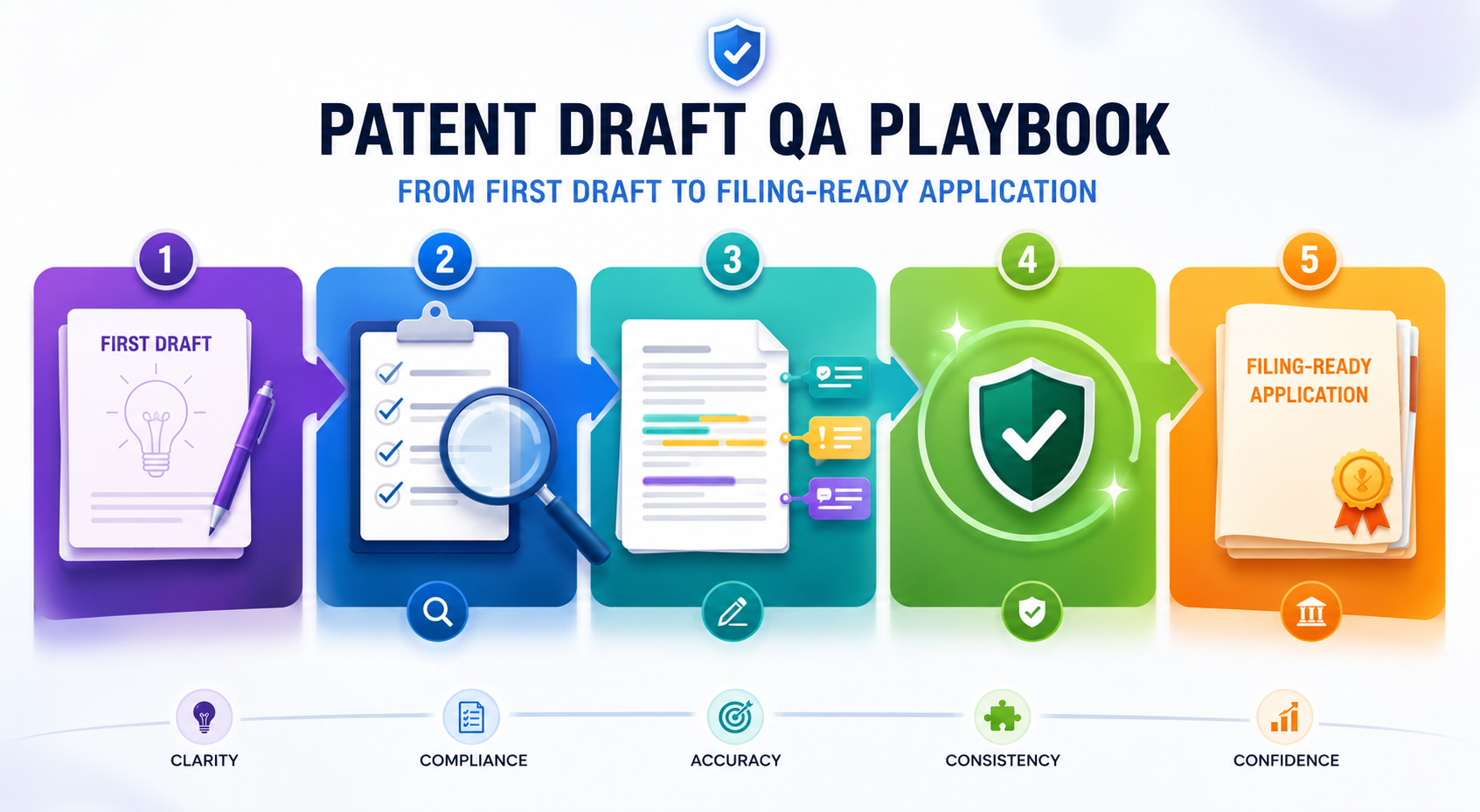
A patent draft is not ready just because it is long. It is ready when it clearly shows what you built, why it matters, how it works, and what needs to be protected. PowerPatent helps founders do this faster with smart software and real attorney oversight, so your team can move with more confidence. You can see how it works here: https://powerpatent.com/how-it-works
Start the QA pass by asking whether the draft protects the real business.
The first QA step is not grammar. It is not format. It is not checking if the draft sounds “patent-like.” The first step is asking a much sharper question: does this draft protect the thing that gives the company value?
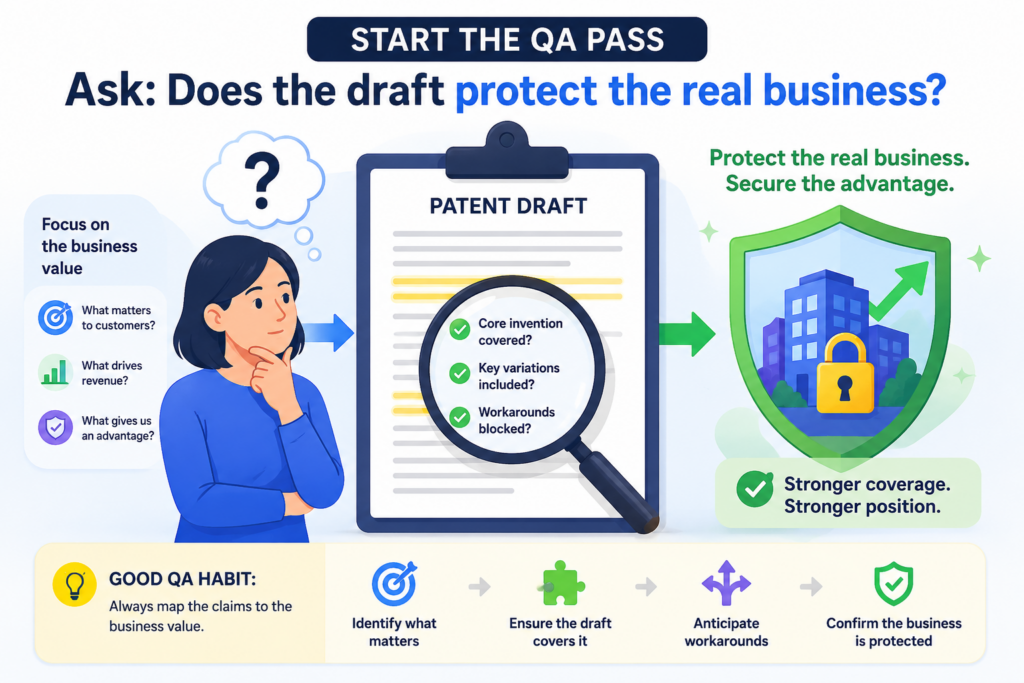
A patent draft can describe the invention and still miss the business point. That happens more often than founders think.
The draft may explain the product in a broad way, but leave out the one workflow, model step, data process, control rule, or system design that makes the product hard to copy.
When that happens, the patent may look fine on paper, but it may not help when a competitor builds something close.
This is why the first QA pass should start with the product, not the document. Pull up the real product notes. Look at the demo. Read the engineering docs. Talk to the people who built the system.
Then compare that real work against the patent draft. The goal is simple. The draft should match the invention as it is actually being built, sold, tested, or planned.
A strong patent draft should feel like it understands the heart of the invention. It should not feel like a loose summary written from far away.
If the invention is a machine learning tool, the draft should explain what the model does in the system, what inputs matter, what outputs are used, and what makes the process better.
If the invention is a device, the draft should explain the physical parts, how they connect, what changes during use, and what makes the design different.
If the invention is software, the draft should explain the flow in plain steps, but with enough detail that the real system is not watered down.
The best QA starts by naming the core invention in plain words.
Before you edit the draft, write one plain sentence that says what the invention really is. This sentence is not for the patent office. It is for you and your team. It keeps the QA process honest.
For example, a weak sentence might say, “The invention improves data processing.” That is too broad to help.
A stronger sentence might say, “The invention predicts equipment failure by comparing live sensor patterns against a changing risk model and then changing the control plan before failure happens.” That sentence gives you something real to test against the draft.
Once you have that plain sentence, read the draft again. Does the title point in the same direction? Does the background set up the same problem? Does the summary describe that same core idea?
Do the drawings show the same system? Do the claims protect that same value? If not, the draft may need more than light edits. It may need a stronger center.
This is where many teams lose time. They review each section by itself and miss the bigger problem.
The draft may have a good background, a decent summary, and a long description, but the pieces may not point to the same invention. A filing-ready draft should feel aligned. Every part should support the same protection goal.
The draft should protect what a competitor would want to copy.
A good QA question is this: what would a smart competitor copy if they saw your product working? They may not copy your whole platform. They may copy the key step that makes it faster.
They may copy the data pipeline that makes it more accurate. They may copy the way your system handles edge cases. They may copy the user flow that turns a hard task into a simple one.
Your draft should speak to that copy risk. It should not only describe the clean version of the product. It should also cover the parts that create leverage.
That might include the way data is selected, the way a model is trained, the way a device changes state, the way a signal is filtered, the way a user input triggers an action, or the way the system handles a failure mode.
This does not mean the draft should be packed with every tiny engineering choice. That can make the document heavy and hard to use.
It means the draft should include the details that show the invention has real shape. The reader should be able to see what makes it work and why it is not just a vague idea.
Founders often know these details, but they stay trapped in Slack threads, code comments, lab notes, or demo scripts. A strong QA process pulls those details into the patent draft before filing.
PowerPatent is built to help with this exact handoff, so technical teams can turn real invention details into stronger patent drafts with smart software and real attorney review. You can see the workflow here: https://powerpatent.com/how-it-works
Check the claims before you polish the rest of the draft.
The claims are the most important part of the patent application. They define what you are trying to protect.
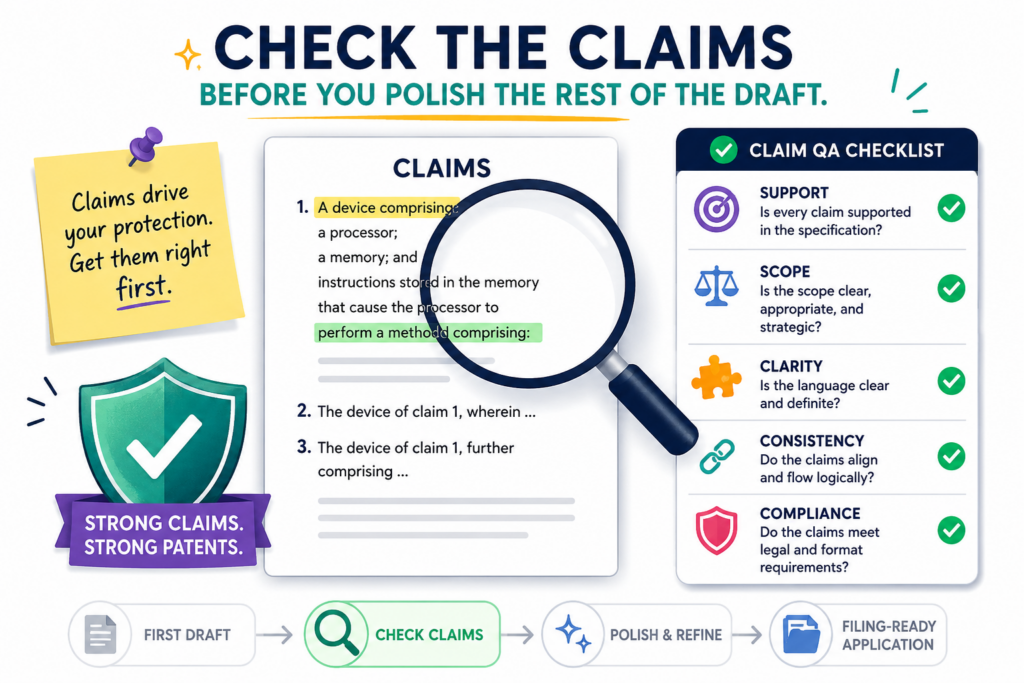
That means claim QA should happen early, not at the end. If the claims are weak, unclear, or aimed at the wrong thing, polishing the rest of the draft will not fix the real issue.
Think of the claims as the fence around the invention. The rest of the draft explains why the fence belongs there and what is inside it. If the fence is in the wrong place, the whole application can feel off.
You may have a great description, useful drawings, and strong examples, but the filing still may not protect the most valuable part of the company’s work.
A founder does not need to become a patent lawyer to review claims well. The best first move is to read the main claim in plain English and ask what it actually covers.
Do not read it like a legal document. Read it like a competitor would. Ask yourself what someone would need to do to fall inside the claim. Then ask what they could change to avoid it.
This is where weak claims show themselves. A claim may include too many extra steps, which makes it narrow. A competitor could skip one step and avoid the claim. A claim may focus on a feature that is not the true invention.
A claim may use words that sound broad but do not tie back to the real technical work. A claim may describe the product only as it exists today, even though the company plans to use the same idea in other forms later.
A strong claim should match the invention without trapping it in one product version.
Start by checking whether the main claim captures the core idea in a way that is useful beyond one demo or one build. Early startup products change fast. The UI changes.
The backend changes. The model changes. The hardware supplier changes. The customer use case changes. But the inventive idea may stay the same.
The patent draft should not be so tied to the first version that it becomes stale six months later. During QA, look for words that are too fixed. Does the claim require a certain device when the invention could work on many devices?
Does it require one kind of sensor when other sensors could work? Does it require one model type when the value is really in how the system uses model outputs? Does it lock the invention to one data source when the same idea works across many data sources?
At the same time, the claim cannot be so broad that it loses meaning. A claim that says the system “uses data to improve results” does not help much. It needs enough structure to show the real invention.
The art is in finding the middle. The claim should be broad enough to protect the business, but clear enough to stand on real technical ground.
This is why claim QA should involve both technical and patent review. Engineers know what is real. Attorneys know how claim language may be read later.
PowerPatent brings both sides together with AI tools and attorney oversight, helping founders move faster without giving up quality.
The process is designed for teams that want speed, but still care deeply about strong protection: https://powerpatent.com/how-it-works
The claim should be tested against real design-around moves.
A design-around is what a competitor does when they want the benefit of your invention without crossing your patent line.
During QA, you should pretend to be that competitor for a moment. This is not negative thinking. It is smart protection work.
Ask how someone could copy the result while changing the details. Could they use a different order of steps? Could they move the process from the device to the cloud? Could they replace one model with another model?
Could they use a different type of signal, rule, threshold, or interface? Could they split the work across two systems instead of one?
Now read the claim again. Does it still feel strong? Or does it fall apart when the product is changed in a simple way?
This exercise often reveals claim problems fast. Maybe the claim requires a mobile app, but the invention could work in a web dashboard. Maybe it requires a neural network, but the useful part is the feedback loop, not the model type.
Maybe it requires a human approval step, but future versions may be fully automated. These details matter because every extra required step can become an escape path.
The QA goal is not to make the claim endless. It is to make it clean. A clean claim protects the inventive shape without dragging in details that do not need to be there.
It avoids soft words that hide the point. It also avoids overloading the claim with product features that belong in the description instead.
When the claims are reviewed early, the rest of the draft becomes easier to fix. You know what the description must support. You know what examples matter.
You know which drawings are needed. You know where the draft is thin. That is why claim QA should not be saved for the final hour. It should guide the whole review.
Make sure the description teaches the invention like a clear build guide.
The description is where the draft proves that the invention is more than a nice idea. It should teach the reader how the invention works.
It should explain the system in enough detail that the claims feel supported. It should also give future room for the company as the product grows.
A weak description often sounds smooth but teaches very little. It may say the system “receives data,” “processes the data,” and “generates an output.” That may be true, but it is not enough.
Almost every software system receives data, processes it, and produces something. The QA question is what kind of data, what kind of processing, what kind of output, and why that flow matters.
A strong description feels concrete. It explains the parts of the system. It explains how the parts talk to each other. It explains what happens first, what happens next, and what changes because of the invention.
It includes examples that make the system easy to understand. It shows alternate ways to build the invention so the draft does not depend on one narrow version.
During QA, read the description from the point of view of a smart engineer who has never seen the product. Could that person understand the invention?
Could they explain the core flow back to you? Could they see the difference between your approach and a normal approach? If the answer is no, the description needs more work.
The description should close the gap between founder knowledge and filing language.
Founders and engineers often speak in shortcuts. They say things like “we normalize the input,” “we run the agent,” “we rank the results,” or “we update the controller.”
Inside the team, those words may be clear. In a patent draft, they may need more support.
QA should look for those shortcuts and unpack them. What does “normalize” mean in this system? What data changes? What stays the same? Why does that step help? What does the “agent” receive? What does it decide? What happens if the first result is poor? What does the controller update? What does the update change in the real world?
This does not mean the draft must expose trade secrets or include code. Most of the time, a patent draft should not include source code.
But it should explain the invention with enough care that the technical idea is real and complete. The reader should not have to guess how the system moves from input to useful output.
The best descriptions often include several versions of the invention. One version may be the current product. Another may be a future version. Another may be a lower-cost version.
Another may be a version that works in a different environment. This gives the draft more strength because it shows the invention is not limited to one setup.
The description should support each claim without sounding forced.
Once the claims are in good shape, the description must support them. This is a key QA pass. Read each claim phrase and find where the description explains it.
If a claim talks about a risk score, the description should explain how that score may be made, used, updated, or compared. If a claim talks about routing data, the description should explain what routing means in this system and why it matters.
If a claim talks about a device state, the description should explain the states and how the system moves between them.
When support is missing, the draft may look okay at first but become weaker later. A patent reviewer may ask what a phrase means. A competitor may argue the draft does not really teach the claimed idea.
An investor doing IP review may see that the claims and description do not line up. These issues are easier to fix before filing than after.
The fix is usually not to add a random sentence. The better fix is to add a clear explanation in the right place.
Good patent drafting is not about stuffing the document. It is about building a clean bridge between the invention, the examples, the drawings, and the claims.
You also want the description to avoid accidental limits. For example, saying “the system must use a camera” may be too narrow if other sensors can work.
Saying “the model is always trained daily” may be too narrow if training can happen hourly, weekly, or when new data arrives.
Saying “the user must approve the result” may be too narrow if some versions will act on their own. QA should catch these hard words and ask whether they are truly needed.
A filing-ready description gives the application depth. It helps the attorney defend the claims.
It helps the company explain the invention later. It also gives the startup more confidence that its hard work has been captured with care.
PowerPatent helps teams turn rough technical notes, invention details, and draft language into a more complete application path, backed by real patent attorneys who know what to look for.
For founders who want a faster and cleaner way to move from draft to filing, the process starts here: https://powerpatent.com/how-it-works
Check whether the drawings make the invention easy to understand.
A patent draft gets much stronger when the drawings tell the same story as the written text. The drawings do not need to look like a product launch graphic. They do not need color, polish, or design flair.
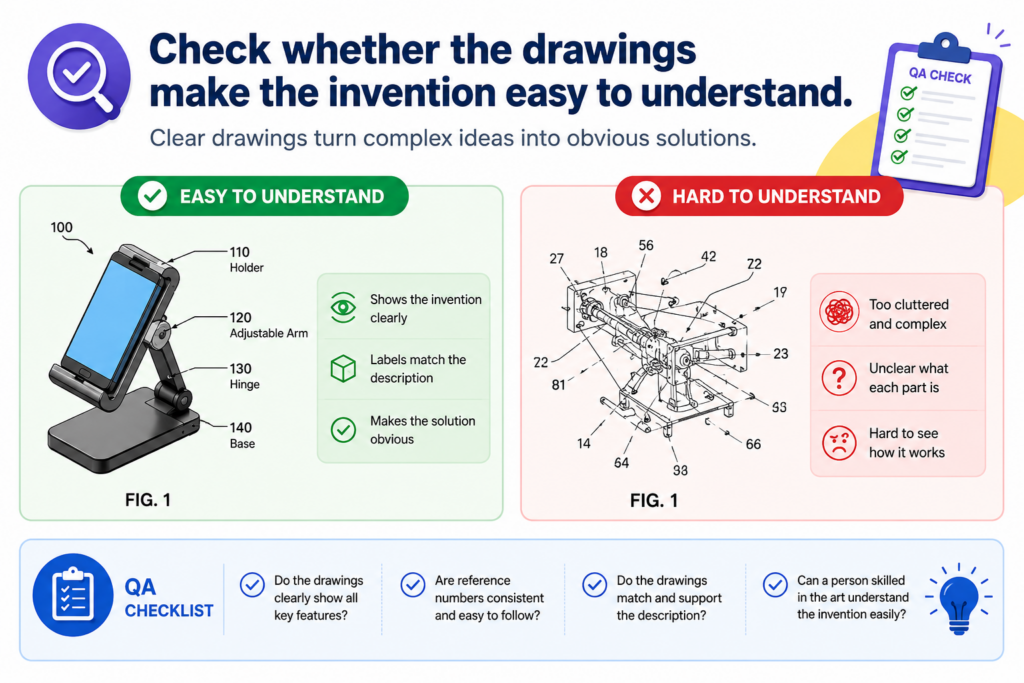
In most cases, simple is better. What matters is that the drawings help a reader understand the system, the flow, the parts, the data path, and the main change that makes the invention useful.
During QA, do not treat drawings as a side task. They are not decoration. They are part of the filing. A good drawing can make a hard idea feel clear in seconds. A poor drawing can make a good invention feel vague.
This is especially true for software, AI, robotics, hardware, chips, biotech tools, sensors, clean energy systems, and other deep tech inventions where the value may sit inside a process the buyer never sees.
The first drawing QA question is simple: could a smart person understand the invention faster by looking at the drawings? If the answer is no, the drawings need work. A drawing should not just show boxes with generic names like “processor,” “database,” and “user device.”
Those parts may be true, but they rarely show the invention. The drawing should show the parts that matter. It should show how data, signals, materials, commands, or actions move through the system.
For example, if the invention is about a smarter way to rank medical images for review, the drawing should show where images enter, how image data is checked, how the ranking happens, and what changes in the review flow.
If the invention is about a battery control method, the drawing should show the sensor inputs, the control logic, the battery state, and the action taken.
If the invention is about a robot arm that adapts to a moving object, the drawing should show the feedback loop, not only the robot body.
The drawings should match the claims and the description without creating confusion.
A strong QA pass compares each drawing against the claims and the description. This step catches many hidden problems. Sometimes the claims talk about three core parts, but the drawings show only two.
Sometimes the description explains a feedback loop, but the drawings only show a one-way flow.
Sometimes the drawing labels use one word, while the draft uses a different word for the same thing. Those small gaps can confuse the reader and weaken the draft.
The goal is not to make every page repeat the same language word for word. The goal is to make the whole draft feel like one clean system.
If the drawing calls something a “risk engine,” but the description calls it a “prediction module,” the draft should make clear that these are the same thing or should choose one name and use it with care.
If a drawing shows a “training system,” but the claims focus on “updating a model,” the description should connect those ideas in plain terms.
Drawings also help you spot missing versions of the invention. If every drawing shows the invention running on a cloud server, but the product may also work on a local device, that other version may need support in the text.
If every drawing shows one user, but the value appears when many users or machines are involved, the draft may need another figure or a stronger written example.
A filing-ready drawing set should remove guesswork, not add it.
Good patent drawings are calm. They do not overload the reader. They show the important parts and leave out noise. During QA, look for drawings that try to show too much at once.
When one figure has too many arrows, too many labels, and too many steps, it may hide the invention instead of revealing it. In that case, it may be better to split the story across two or three figures.
One drawing can show the system. Another can show the process. Another can show the data structure, user flow, device state, or control loop.
This layered approach helps the draft feel clean. It also gives the written text more places to point when explaining the invention.
The drawing labels should also be reviewed with care. Each number should point to the right part. Each label should be used in a steady way. The text should describe what the figure shows.
If the draft says “Figure 2 shows an example process,” Figure 2 should actually show that process in a way that makes sense. These may sound like small checks, but they matter. A rushed drawing set can make the final filing feel unfinished.
For founders, this is one place where speed and quality often clash. Teams want to file fast, but the drawings may be built from rough slides, whiteboard shots, or system diagrams that were never meant for patents.
PowerPatent helps turn invention details into cleaner draft assets with attorney oversight, so the filing can move quickly without feeling careless. You can explore that faster path here: https://powerpatent.com/how-it-works
Test the draft against the real product roadmap before filing.
A patent draft should not only protect what exists today. It should also leave room for where the invention is likely going next. Startups move fast. The first build may not be the version customers use next year.
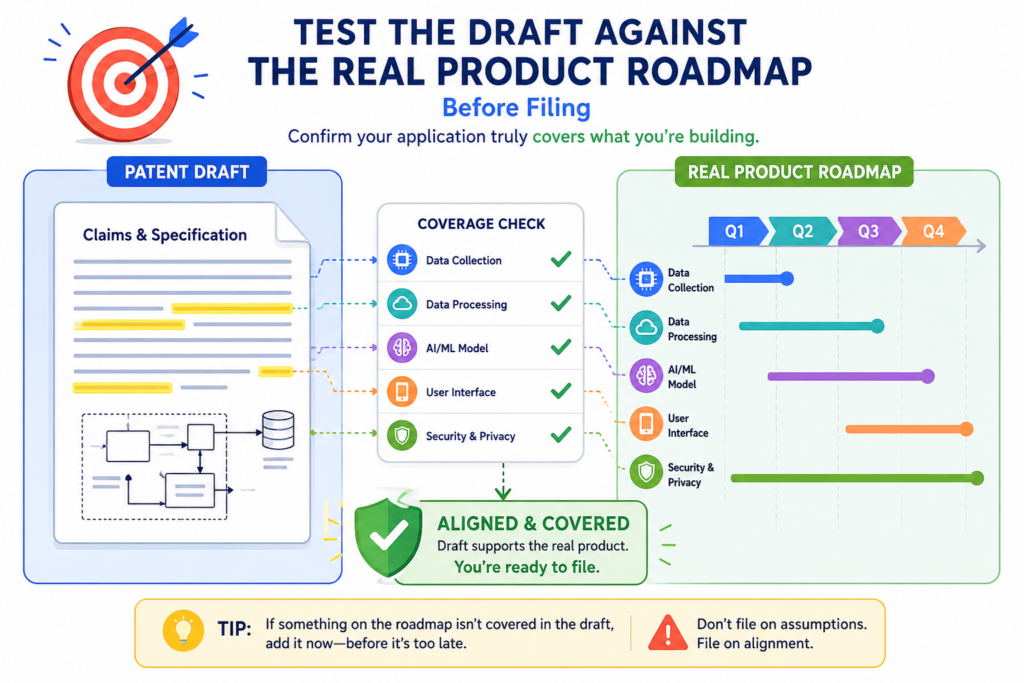
The demo may change after customer calls. The model may be retrained. The hardware may shrink. The user flow may shift from manual review to full automation. A good QA process checks whether the draft can grow with the company.
This does not mean the draft should become a wish list. It should not claim things the team did not invent. It should not make empty guesses.
But it should capture real planned versions, known options, and clear technical paths that are already tied to the invention.
If the team knows the system can run on-device instead of in the cloud, that should be considered. If the team knows the same method can apply to two types of data, the draft should not trap the invention in only one type unless there is a good reason.
Product roadmap QA is especially important for early-stage founders. At seed stage, the product may still be changing every week. The patent draft may have been based on a demo deck from two months ago.
Since then, the engineering team may have found a better workflow, removed a step, added a new control rule, or changed the data pipeline.
If those updates are not reflected in the draft, the application may protect yesterday’s product instead of the stronger version the company is actually building.
The roadmap review should focus on likely changes, not every dream idea.
The best QA question here is not, “What could this invention become in ten years?” That can lead to vague language and wasted time.
A better question is, “What changes are already likely based on our product plan, customer feedback, and engineering work?” This keeps the review grounded.
For example, a startup may know that the first version requires a human to approve the system output, but the next version will allow automatic action when confidence is high. That should be considered in the draft.
Another startup may know that the invention first works with factory sensor data, but the same method can also work with fleet vehicle data because the signal pattern is similar. That may deserve support.
A medical device startup may know that the current prototype uses one material, but another approved material can work too. The draft should not accidentally lock the invention to only one material unless that material is the key point.
A roadmap QA session should involve someone close to the product, someone close to the engineering work, and someone who understands patent strategy.
When those voices come together, the draft gets sharper. The team can separate details that are just current build choices from details that truly define the invention.
The draft should avoid words that make future versions harder to protect.
Many draft problems come from hard words that sound harmless. Words like “must,” “always,” “only,” “required,” and “the invention is” can create tight limits when they are not needed. During QA, search for these words with care. Sometimes they are correct. Often they are not.
For example, saying “the system always stores the result in a cloud database” may be too narrow if future versions can store results locally.
Saying “the user must select a training set” may be too narrow if the system can select data on its own. Saying “the invention requires a camera” may be too narrow if radar, lidar, or other sensors can also support the same idea.
This does not mean the draft should be loose. It means the draft should be precise.
A strong application explains the current version while also describing other valid ways to build the invention. That balance helps the patent remain useful as the company changes.
This is where PowerPatent’s mix of software and attorney review can help a founder move faster. The platform is designed to help teams capture not just the draft in front of them, but the real invention behind it.
That can reduce the risk of filing something too narrow, too late, or too far away from the business. See how the process works here: https://powerpatent.com/how-it-works
Review every example to make sure it proves the invention instead of padding the draft.
Examples can make a patent draft much stronger. They show how the invention works in real life. They make abstract ideas easier to follow.
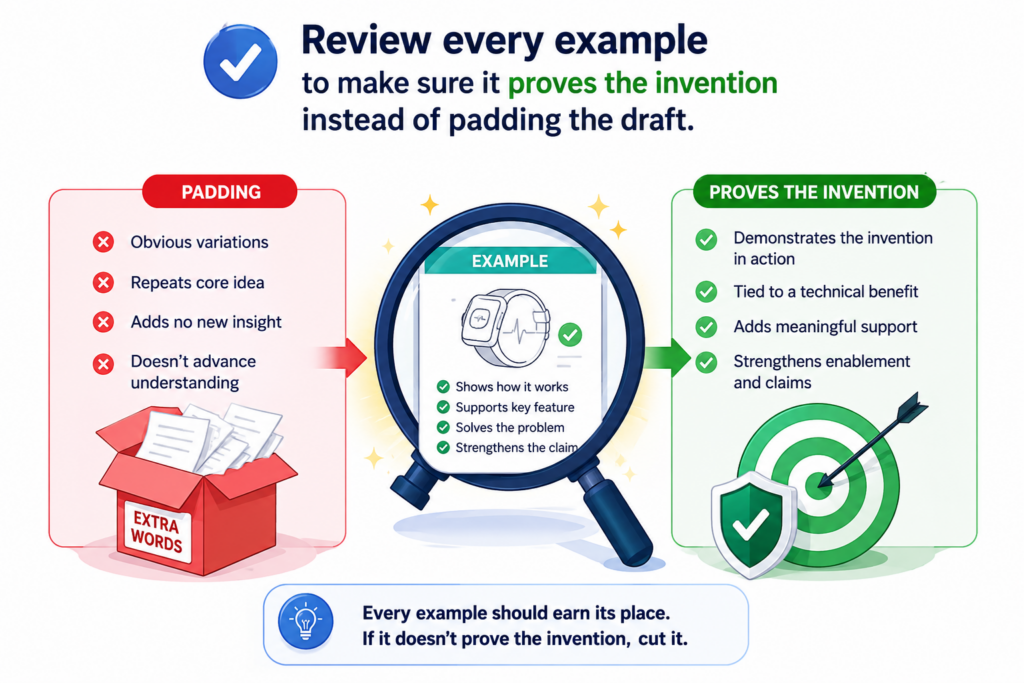
They help the reader see why the invention matters. But examples can also create trouble when they are thin, random, or disconnected from the claims.
A good example should not feel like filler. It should teach something useful. It should show a real version of the invention in action.
It should help explain a claim term, a system part, a process step, or a technical result. If an example does not do that, it may be taking up space without adding strength.
During QA, read each example slowly and ask what job it performs. Does it show the main system flow? Does it explain what happens when the input changes? Does it show how the system handles a hard case?
Does it show a different setup that still uses the same invention? Does it help support a claim that would otherwise feel too broad? If the answer is unclear, the example may need to be rewritten or removed.
In a strong patent draft, examples are not just stories. They are proof points. They show the invention has shape. They also help protect the company from being boxed into one version.
A draft with only one example may feel narrow. A draft with too many weak examples may feel messy. The goal is to include the right examples, not the most examples.
The best examples show normal use, edge cases, and alternate builds.
A normal-use example explains how the invention works when everything goes as planned. This is often the easiest example to write, and it is usually needed. But it should not be the only one.
Real systems face messy inputs, missing data, slow networks, odd user behavior, noisy signals, or physical limits. A strong draft often shows how the invention handles those cases.
For instance, if the invention is an AI system that routes customer support messages, the normal example may show how the system classifies a clear message.
A stronger draft may also explain what happens when the message is unclear, when the user sends mixed intent, when the model confidence is low, or when the system must ask for more information. Those details can show where the technical value lives.
If the invention is a hardware system, examples may show different operating states, different part layouts, or different materials.
If the invention is a biotech tool, examples may show different sample types, preparation steps, or signal outputs. If the invention is a fintech system, examples may show different transaction patterns, fraud signals, or user risk levels.
An example should not limit the invention by accident.
Examples are helpful, but they must be written with care. A founder may describe the current product in a very specific way because that is what exists today.
That can be useful, but the draft should make clear that the example is only one version unless it truly defines the invention.
During QA, look for example language that sounds too final. If an example says the system uses exactly five inputs, ask whether five is required. If it says the process occurs every ten seconds, ask whether that timing is essential.
If it says a device has three sensors, ask whether the invention can work with two or four. If it says the model is a transformer model, ask whether the model type is the key idea or just one way to build it.
This kind of review protects flexibility. It keeps the draft from giving away room the company may need later.
It also helps the attorney shape claims that are backed by real detail but not trapped by a single product version.
Examples are also a good place to make the draft more readable. Patent drafts do not need to sound cold or vague. They can be clear. They can walk through a situation step by step.
They can explain why a result is better. A clean example helps everyone, including the founder, the attorney, the examiner, and later investors who want to understand what the company has protected.
PowerPatent helps technical teams turn rough notes, demos, diagrams, and product thinking into stronger patent material.
That means examples can come from the real work your team already has, not from generic language made up after the fact. Learn how founders use PowerPatent here: https://powerpatent.com/how-it-works
Check the background and summary so they set up the invention without overexplaining.
The background and summary can seem less important than the claims and description, but they still deserve careful QA.
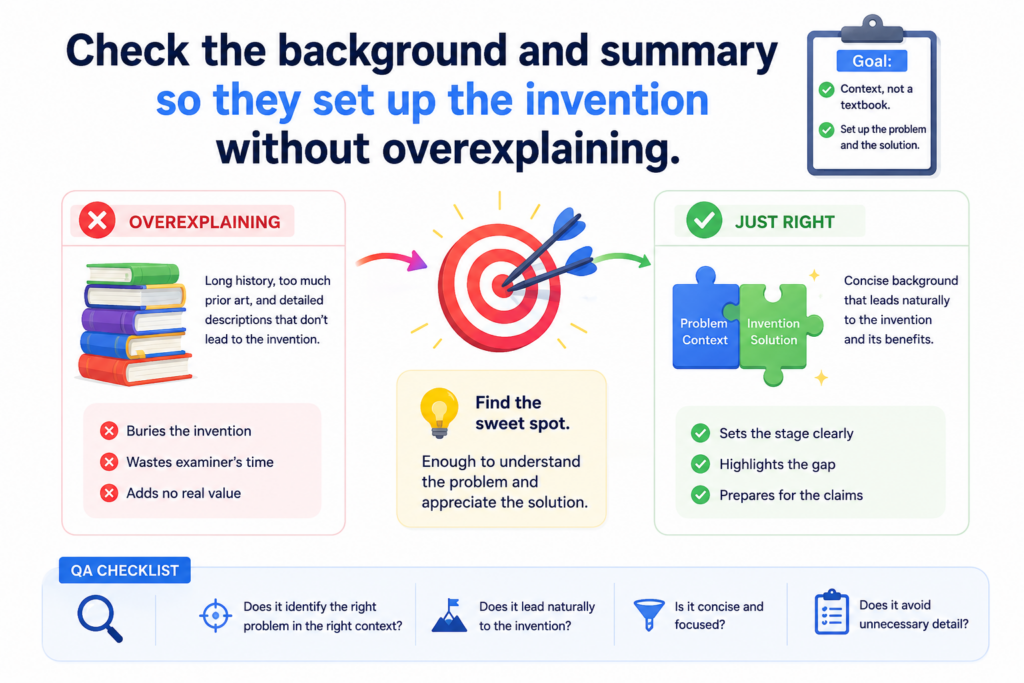
These sections shape how the reader sees the invention. They set the stage. They frame the problem. They create the first sense of why the invention matters.
A weak background often says too much or too little. If it says too much, it may create risk by making broad statements about the old market, old tools, or old systems.
If it says too little, the reader may not understand what problem the invention solves. The best background is clear, simple, and controlled.
It explains the problem enough to make the invention feel needed, but it does not turn into a long essay.
For startups, the background should avoid marketing claims that are hard to prove. Words like “revolutionary,” “industry-leading,” and “best-in-class” may work in a pitch deck, but they do not help a patent draft.
The background should stay focused on the technical problem. What was hard before? What was slow, costly, error-prone, limited, unsafe, or hard to scale? What gap does the invention address?
The summary should then point toward the invention in a clean way. It should not simply copy the claims with no context. It should not introduce new ideas that are missing from the rest of the draft.
It should act like a bridge between the problem and the detailed description. When done well, it helps the whole application feel organized.
The background should be useful but not loaded with risky claims.
During QA, read the background with a skeptical eye. Look for statements that may be too broad. For example, “Existing systems cannot detect failures in real time” may be risky if some systems can do that.
A safer and often more useful approach is to describe the problem in more measured words, such as saying that some systems may face delays, may rely on limited inputs, or may struggle in certain conditions.
This is not about being timid. It is about being smart. A patent draft should not create unnecessary arguments.
The background does not need to prove that the entire world was broken before the startup arrived. It only needs to set up the reason the invention is useful.
The background should also avoid admitting too much. Sometimes a draft says a known system already includes pieces that are actually part of the invention.
This can happen when a writer tries to sound helpful but does not understand the line between known work and new work. QA should catch this. If the background describes the startup’s key idea as if it already existed, that is a serious problem.
The summary should preview the invention with calm, clear language.
The summary should be easy to read. It should introduce the main system, method, device, or process in a way that matches the claims.
It can mention different versions, but it should not become a dumping ground for every possible feature. The reader should leave the summary with a clear sense of what the invention does.
One useful QA test is to read the title, background, summary, and first claim in order. They should feel connected. The title should point to the field. The background should frame the problem.
The summary should introduce the solution. The first claim should define the protection target. If those four parts feel like they came from four different documents, the draft needs alignment.
This section is also a good place to simplify language. A patent draft can be formal without being painful to read.
The summary can use plain words like “receives,” “compares,” “updates,” “controls,” “selects,” and “sends.” It does not need to hide behind thick phrases. Simple language often makes the invention stronger because the reader can see what is happening.
A clean background and summary make the rest of the draft easier to trust. They tell the reader, “This team knows what it built, knows why it matters, and can explain it clearly.” That kind of clarity helps founders, attorneys, investors, and partners move faster.
PowerPatent is built for founders who want that kind of clarity without getting stuck in slow back-and-forth.
With smart software and real attorney oversight, teams can move from invention notes to stronger drafts with less friction. See the process here: https://powerpatent.com/how-it-works
Audit the language so the draft stays broad, clear, and technically honest.
Patent draft QA is not just about adding more detail. It is also about cleaning the language. Words can widen protection, narrow it, or confuse it.
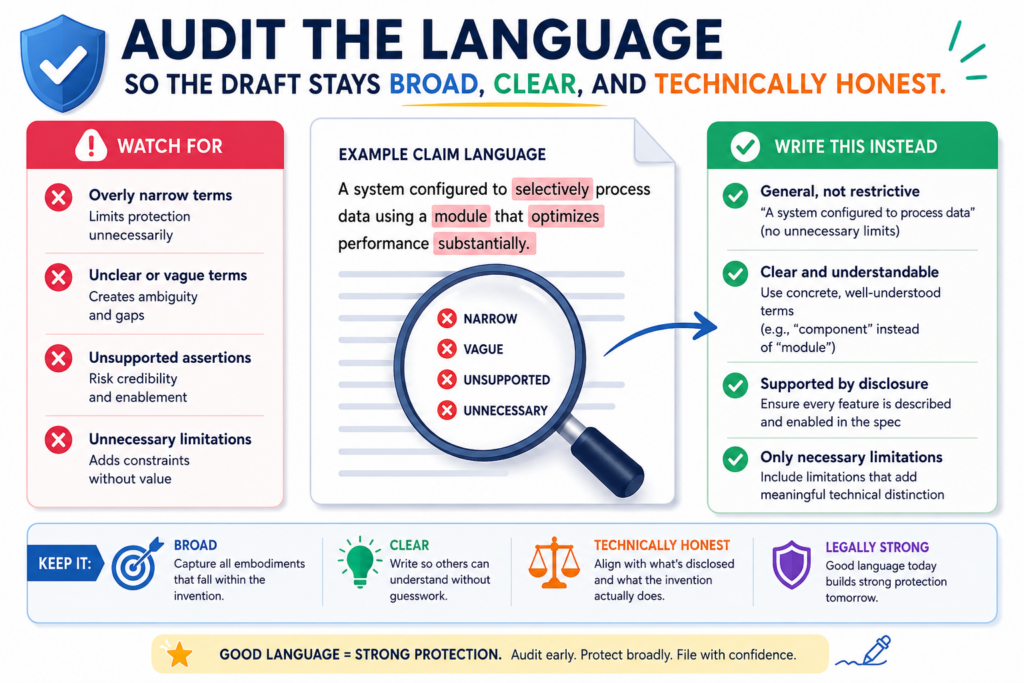
A single sentence can make the invention feel flexible. Another sentence can trap it in one version. That is why language review is a core part of getting a draft filing-ready.
The goal is not to make the draft sound fancy. Fancy writing is often the enemy of a good patent draft. The goal is to make every key term clear, steady, and useful. If the draft uses five names for the same thing, fix that.
If it uses one name for two different things, fix that too. If it uses vague words where the invention needs structure, add structure. If it uses narrow words where the invention needs room, loosen the language in a careful way.
This matters a lot for technical founders. Engineering teams often write in precise internal terms, but those terms may not be obvious outside the company. A phrase that is clear in your codebase may not be clear to a patent reviewer.
A product name may make sense to your sales team but should not be the main term in the patent draft. A model nickname may work inside the lab but not in a filing.
During QA, look for terms that carry the invention. These may include names for modules, data sets, states, rules, scores, signals, parts, outputs, and user actions.
Each key term should be used with care. The draft should explain what it means through context, examples, and structure.
The language should avoid both empty breadth and needless limits.
A common mistake is trying to make the draft broad by making it vague. That does not work. Saying “the system improves performance using data” is broad, but it is empty.
It does not show the invention. Strong breadth comes from explaining the real invention and then showing different ways it can be built.
Another mistake is making the draft too narrow by describing every current product detail as if it is required. This often happens when the first draft is written from a product spec. Product specs are useful, but they are not patent strategy.
A product spec may say the system uses one vendor, one interface, one model, one timing rule, or one storage format. The patent draft should ask which of those details are truly needed and which are just current choices.
Good QA finds the middle path. It keeps the real technical structure. It removes needless locks. It adds support for alternate forms. It keeps the invention honest and useful.
The draft should use simple words while still saying enough.
Simple language does not mean shallow language. In fact, simple words often force better thinking.
If you cannot explain what a module does in plain terms, the draft may be hiding confusion. If a sentence runs for half a page, the idea inside it may need to be broken into smaller parts.
During QA, rewrite long sentences where possible. Replace soft phrases with direct actions. Instead of saying “the system is configured to facilitate optimization of downstream decisioning,” the draft may say the system “selects a control action based on the updated score.” That is clearer. It gives the reader something real.
Also check for words that sound strong but do little. Words like “smart,” “advanced,” “robust,” and “seamless” may be fine for marketing, but they rarely help in a patent draft unless they are tied to a real technical feature. The draft should show how the system works, not just praise it.
A clean language audit makes the whole filing stronger. It helps claims read better. It helps the description teach better.
It helps examples land better. It also reduces the chance that someone later misunderstands what the team meant.
Founders do not need to do this alone. PowerPatent gives teams a way to bring invention details, software support, and attorney oversight into one faster workflow.
That means your draft can become cleaner and more filing-ready without pulling your engineers into endless document edits. Start here: https://powerpatent.com/how-it-works
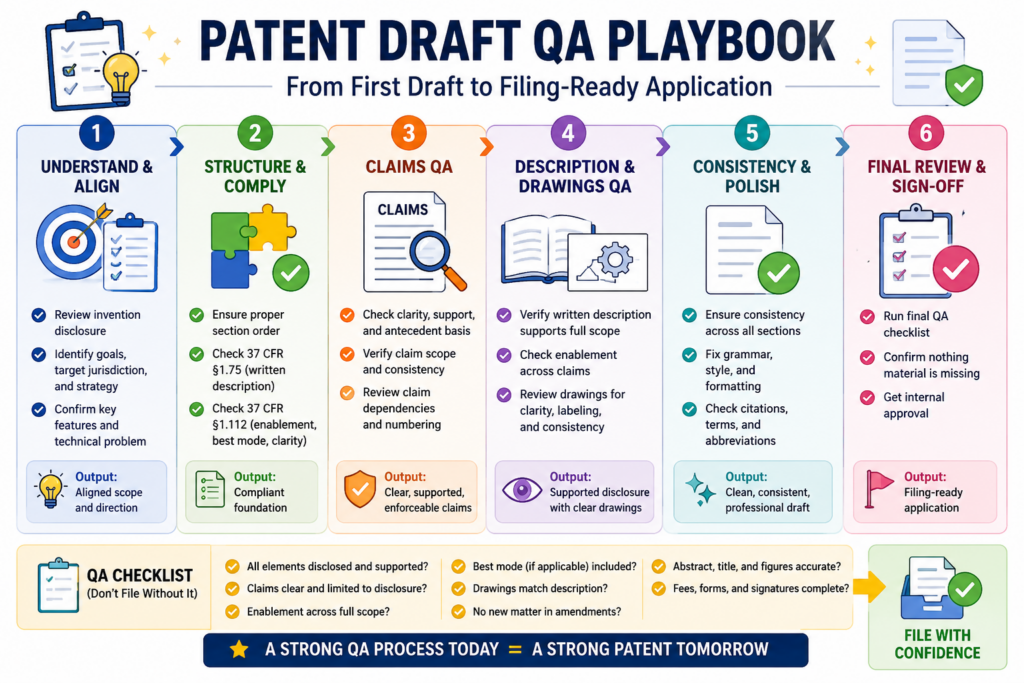
Run a final filing-readiness check that catches gaps before they cost time.
The final QA pass is where the draft becomes filing-ready. By this point, the claims should point to the real invention. The description should support the claims. The drawings should match the story.
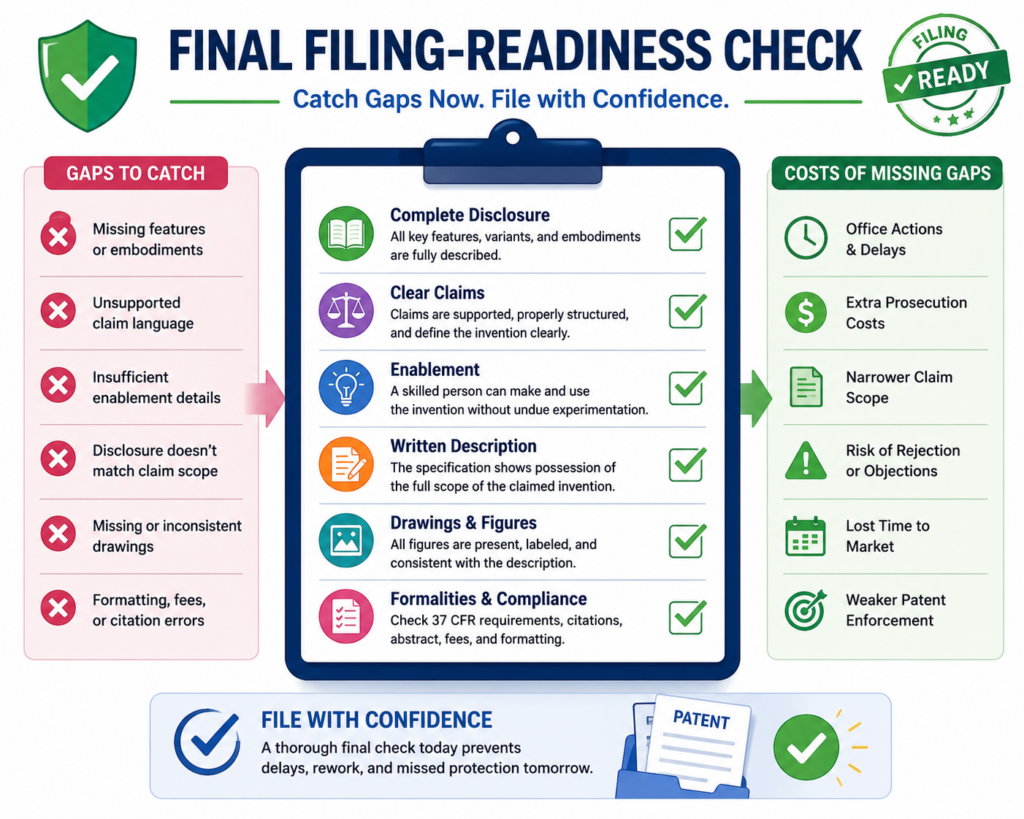
The examples should be useful. The language should be clear. Now the job is to look for gaps that could slow filing or create avoidable risk later.
This final pass should be calm and strict. Do not read the draft like the person who wrote it. Read it like someone who needs to rely on it. A founder may rely on it during fundraising.
An attorney may rely on it during patent review. A future buyer may rely on it during due diligence. A competitor may test it when deciding whether to copy. That is why filing-readiness is not about looking finished. It is about being strong enough to use.
Start by checking whether the draft has internal alignment. The title, abstract, background, summary, drawings, detailed description, examples, and claims should all point in the same direction.
They do not need to repeat each other. But they should not fight each other. If the claims focus on model updating, while the description mainly talks about user dashboards, something is off.
If the drawings show hardware but the claims only cover software steps, the connection should be clear.
Next, check whether the draft explains the invention at the right level. Too little detail can make the filing feel hollow.
Too much unrelated detail can bury the invention. A good final draft should feel complete but not bloated. Every main section should have a job.
The final QA pass should test whether the draft can survive real-world review.
A filing-ready draft should be able to handle basic pressure. Ask what an investor would think if they skimmed it. Ask what an engineer would think if they had to explain it.
Ask what a patent attorney would need to defend it. Ask what a competitor might look for when trying to work around it.
This pressure test often shows what normal editing misses. Maybe the draft never explains why the output is useful. Maybe it names a model but never explains what the model receives.
Maybe it shows a sensor but never explains what signal matters. Maybe it claims a control action but does not show what the action changes. These are the gaps that can weaken a filing even when the draft looks polished.
The final pass should also check timing and ownership facts. Make sure inventor names are correct. Make sure the team understands what was built before any public launch, demo, customer pitch, paper, or investor data room share.
Make sure the draft covers what should be filed now, not what can wait for a later filing. These are practical checks, and they matter.
A strong final draft should give the founder confidence, not more confusion.
The best sign of a filing-ready application is not that it sounds complex. It is that the right people can read it and say, “Yes, this captures what we built.” The founder should see the business value.
The engineer should see the technical truth. The attorney should see enough support to move forward. That shared confidence is the point of QA.
Before filing, the team should also make sure the final draft has no obvious loose ends. Figure numbers should match. Terms should stay steady. Claim phrases should be supported.
Examples should not contradict the claims. The abstract should not introduce a different invention. The summary should not overpromise. The description should not leave the main process half-explained.
This kind of careful review saves time. It reduces last-minute panic. It helps avoid expensive rework. It also gives the company a stronger base for future filings as the product grows.
PowerPatent was built to make this process easier for founders who cannot afford slow, messy patent work.
The platform helps turn real technical work into stronger patent applications with smart AI tools and real patent attorney oversight.
That means founders can move faster, stay closer to the invention, and file with more control. See how PowerPatent helps teams go from idea to filing-ready application here: https://powerpatent.com/how-it-works
Check whether the draft explains the problem in a way that makes the invention feel needed.
A strong patent draft does not start with the invention floating in space. It shows the problem the invention solves. This does not mean the draft needs a long story.
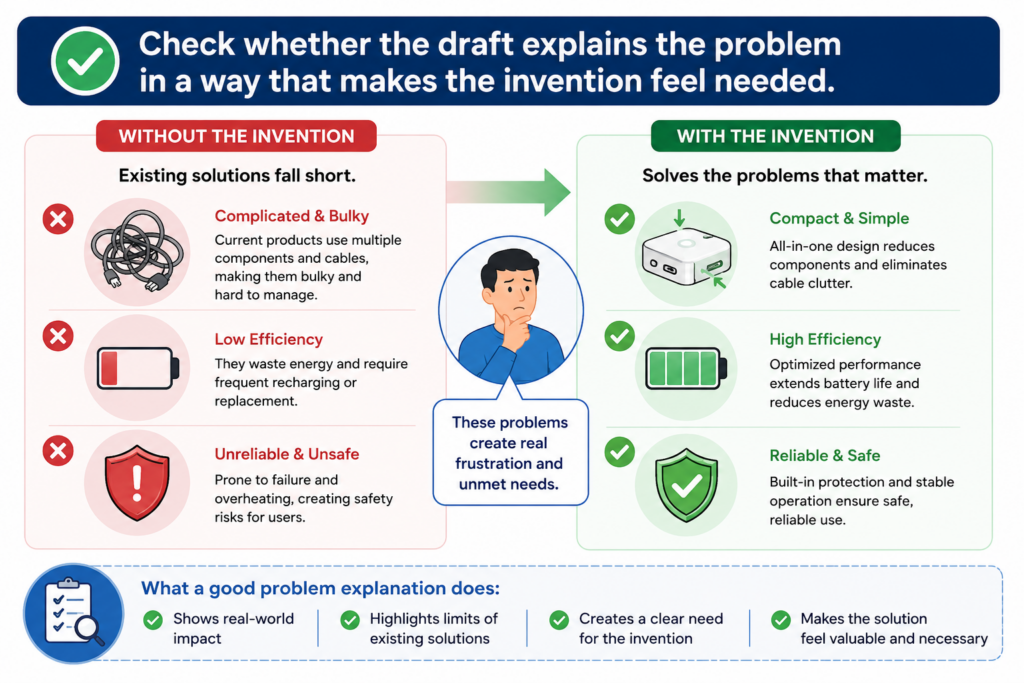
It does not need drama. It does not need sales language. But it should help the reader understand why the invention matters and why the old way was not enough.
This is important because many first drafts explain what the system does, but they do not explain why the system had to be built that way.
They describe parts, steps, and outputs, yet the reader is left asking, “Why does this matter?” That is a weak place to be. A filing-ready draft should make the value easy to see.
For a founder, this is also a business check. The patent should line up with the reason customers care. If customers care because the system is faster, the draft should explain what causes the speed gain.
If customers care because the system reduces errors, the draft should show where errors used to happen and how the invention reduces them.
If customers care because the product works in messy real-world conditions, the draft should describe those conditions and the technical response.
The problem should be clear without turning into a marketing pitch.
The problem section should stay grounded. It should not say the whole industry is broken unless that is true and useful. It should not attack every old system.
It should not make giant claims that are hard to support. Instead, it should focus on the technical pain that led to the invention.
For example, a draft about an AI quality control system should not only say that manual inspection is slow. It should explain what makes the inspection hard.
Maybe the image data has glare. Maybe defects are rare. Maybe normal products vary in shape. Maybe human review cannot keep up with production speed. Those details make the problem real.
A draft about a new energy storage control system should not only say that batteries can fail. It should explain what signals are hard to read, what changes too fast, or what old control rules miss.
A draft about a data privacy tool should not only say that data sharing is risky. It should explain where private data may leak, how permissions can become stale, or how normal access rules fail when teams move quickly.
The QA goal is to make the problem feel honest and specific. When the problem is clear, the invention feels earned. The reader can see why the system is built the way it is.
The draft should connect each pain point to a real part of the invention.
A common draft problem is a mismatch between the problem and the solution. The background may talk about speed, but the invention focuses on accuracy.
The draft may talk about cost, but the claims focus on security. The problem may describe hardware failure, while the description mostly explains a dashboard. These gaps make the application feel loose.
During QA, check each major pain point and ask where the invention answers it. If the draft says old systems were too slow, the description should show the step that saves time.
If it says old systems used too much power, the draft should explain how the invention reduces power use. If it says old systems missed edge cases, the examples should show how the new system handles those cases.
This is not fluff. This is structure. A clear problem-to-solution link helps the draft read better and feel stronger. It also helps a founder explain the patent later to investors, partners, or buyers.
This is one reason PowerPatent focuses on turning real invention details into a clearer application path.
The platform helps teams capture what was actually hard, what they built, and why it matters, with real attorney oversight built into the process. See how that works here: https://powerpatent.com/how-it-works
Review the invention from the user’s point of view, not only the system’s point of view.
Many patent drafts are written from the inside of the machine. They explain servers, models, sensors, processors, memory, signals, and data flows. That is useful, but it is not always enough.
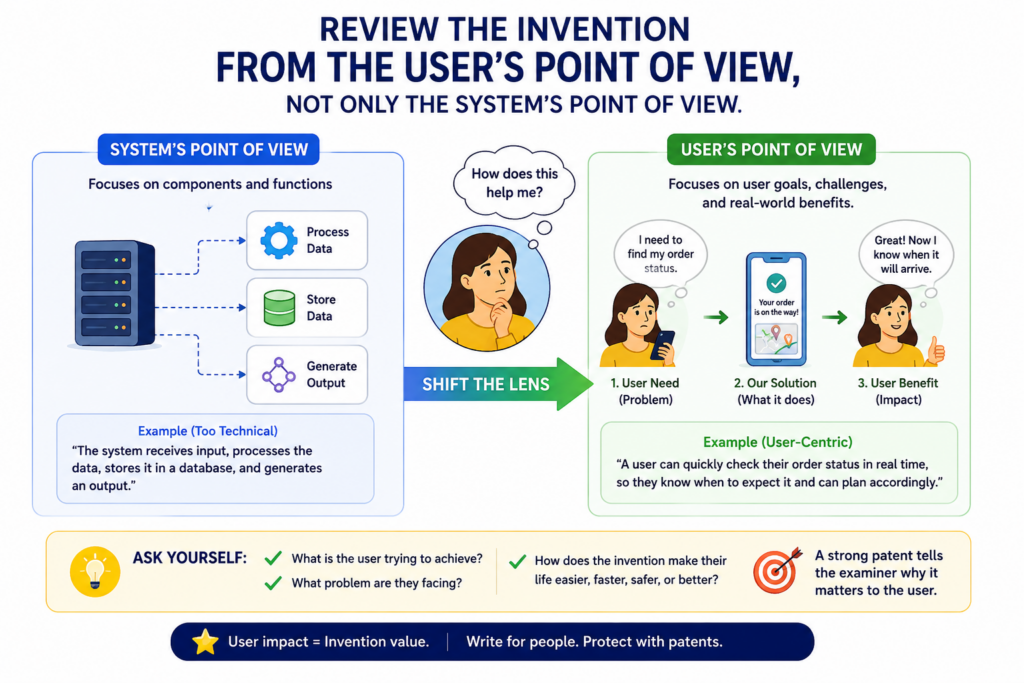
A strong draft also shows what changes for the user, operator, patient, technician, admin, driver, developer, or other person who interacts with the invention.
This does not mean the patent should become a user guide. It means the draft should make clear how the invention affects the real use case.
A system may be technically impressive, but the value often shows up when a person gets a better result, makes a faster choice, avoids a mistake, or trusts an output more.
During QA, ask who benefits from the invention and how. Does the system reduce a task from ten steps to three? Does it warn a user before damage happens? Does it guide a technician through a repair?
Does it help a doctor see which case needs review first? Does it let an engineer deploy a model with less manual cleanup? These details can make the draft clearer because they show the invention in action.
The user journey should support the technical story.
A patent draft should not only say that a user receives an output. It should explain what kind of output, why it is useful, and what may happen next. If the invention sends an alert, what does the alert mean?
If the invention shows a score, how is that score used? If the invention recommends an action, what does the user do with it? If the invention changes a setting automatically, what effect does that have?
This kind of detail helps the draft feel complete. It also prevents the invention from sounding like a black box. A reader should not have to guess how the output matters.
For example, imagine a startup has built a tool that helps factories detect machine wear. A weak draft may say the system generates a maintenance output.
A stronger draft may explain that the output identifies a machine part, ranks the urgency of repair, and changes the inspection schedule. That is still simple, but it is much more useful.
The same idea applies to software. A system that helps developers find bugs should not only say it displays a result.
It should explain whether the result ranks files, points to likely root causes, suggests tests, or updates a workflow. The user side helps show why the system is not just moving data around.
The draft should not let the interface hide the invention.
Sometimes a patent draft spends too much time on screens, buttons, menus, and dashboards. That can be a problem if the real invention is behind the interface.
During QA, ask whether the user-facing parts are helping explain the invention or distracting from it.
The interface may matter, especially if the invention is about a new way for users to control a system or review information. But many times, the interface is just one way to show the result.
If the draft focuses too much on one screen layout, it may narrow the invention without helping protection.
A better approach is to explain what information is shown, why it is shown, and how the user or system responds.
The draft can describe an example interface, but it should not act like that exact screen is always required unless the screen itself is the invention.
This user-view QA pass is practical. It helps the founder see whether the patent protects the experience customers care about.
It helps the engineer see whether the draft explains the true workflow. It helps the attorney connect technical features to real outcomes.
PowerPatent is built for this kind of founder-led clarity. It helps teams bring product context, engineering detail, and attorney review into one faster process, so the draft does not lose the user value along the way. You can learn more here: https://powerpatent.com/how-it-works
Check whether the draft captures the data story behind the invention.
For many modern startups, the invention lives in the data flow.
The product may look simple on the outside, but the real value comes from how data is gathered, cleaned, linked, ranked, filtered, scored, transformed, stored, or used to trigger action.
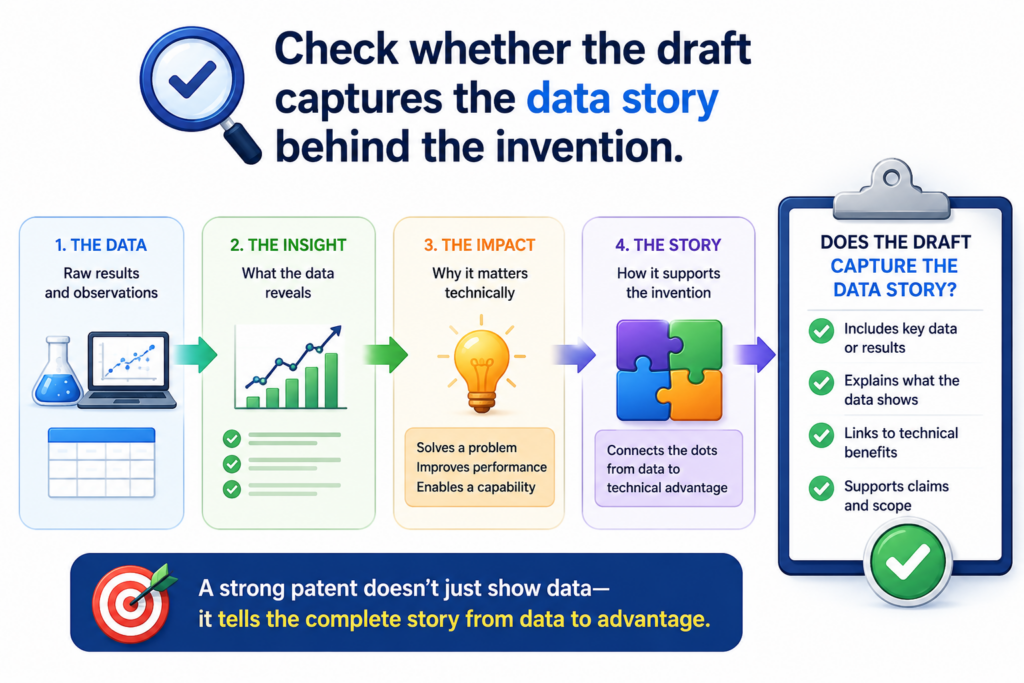
If the draft does not capture that data story, it may miss the heart of the invention.
This is especially true for AI, automation, robotics, fintech, health tech, climate tech, security, and developer tools. These products often depend on data that changes over time.
They may use live signals, past events, user actions, sensor streams, logs, images, text, lab results, device states, or outside feeds. The draft should explain the data that matters without drowning the reader in every field or table.
During QA, trace the data from start to finish. Where does it come from? What shape is it in when it enters the system? What checks happen before it is used? What is removed, changed, joined, or compared? What does the system create from it? What output or action depends on it?
A first draft may say “the system receives input data.” That is usually not enough. The better question is what makes this input data special in this invention.
Is it noisy? Is it sparse? Is it private? Is it time-sensitive? Is it gathered from many devices? Is it tied to a physical state? Is it updated after user feedback? These points often explain the real technical value.
The data flow should show what changes and why that change matters.
A useful data section does not just name data. It explains change. Raw data may become a feature set. A sensor stream may become a state estimate. A user action may become a training signal.
A log file may become a risk score. A model output may become a control instruction. The draft should show these changes in plain words.
This matters because many inventions are not about the data itself. They are about what the system does with the data. The invention may be a better way to select which data matters.
It may be a better way to update a model based on weak signals. It may be a better way to decide when a system should act and when it should wait.
During QA, look for missing bridges. If the draft jumps from raw input to final output with no clear middle, add detail. If it says the system “analyzes” the data, explain what analysis may include.
If it says the system “classifies” an event, explain what the classes mean and how the result is used. If it says the system “updates” a model, explain what may trigger the update and what changes after the update.
The draft should protect data choices that create the advantage.
Some data choices are ordinary. Others are valuable. QA should separate them. If the key idea is using a special mix of signals, the draft should say so.
If the key idea is ignoring certain noisy data, the draft should say so. If the key idea is using feedback from a downstream action to improve the next decision, the draft should explain that loop.
This is where founders often have gold hidden in plain sight. The team may have learned through trial and error that certain inputs work better than others. They may have found that a signal matters only under certain conditions.
They may have created a scoring method that handles missing data better than old methods. These details can be highly important, but they may never appear in a rough patent draft unless someone asks.
A strong data QA pass helps bring that know-how into the application in a safe and useful way. It does not mean dumping databases into the draft. It means explaining the data logic behind the invention so the claims have real support.
PowerPatent helps technical teams turn product notes, model details, diagrams, and founder knowledge into stronger patent drafts with attorney oversight.
For startups building around data-heavy inventions, that can be the difference between a vague filing and a draft that actually captures the hard work. Explore the process here: https://powerpatent.com/how-it-works
Conclusion
A patent draft becomes filing-ready when it clearly protects the real invention, supports the claims, explains the system, matches the roadmap, and removes weak words before they create risk. The best QA process is not a last-minute spell check. It is a focused review of business value, technical truth, claim strength, drawings, examples, and future growth.
For founders, this means more control, fewer delays, and stronger protection around what makes the company hard to copy. PowerPatent helps teams move through this faster with smart software and real attorney oversight. See how it works here: https://powerpatent.com/how-it-works
Leave a Reply