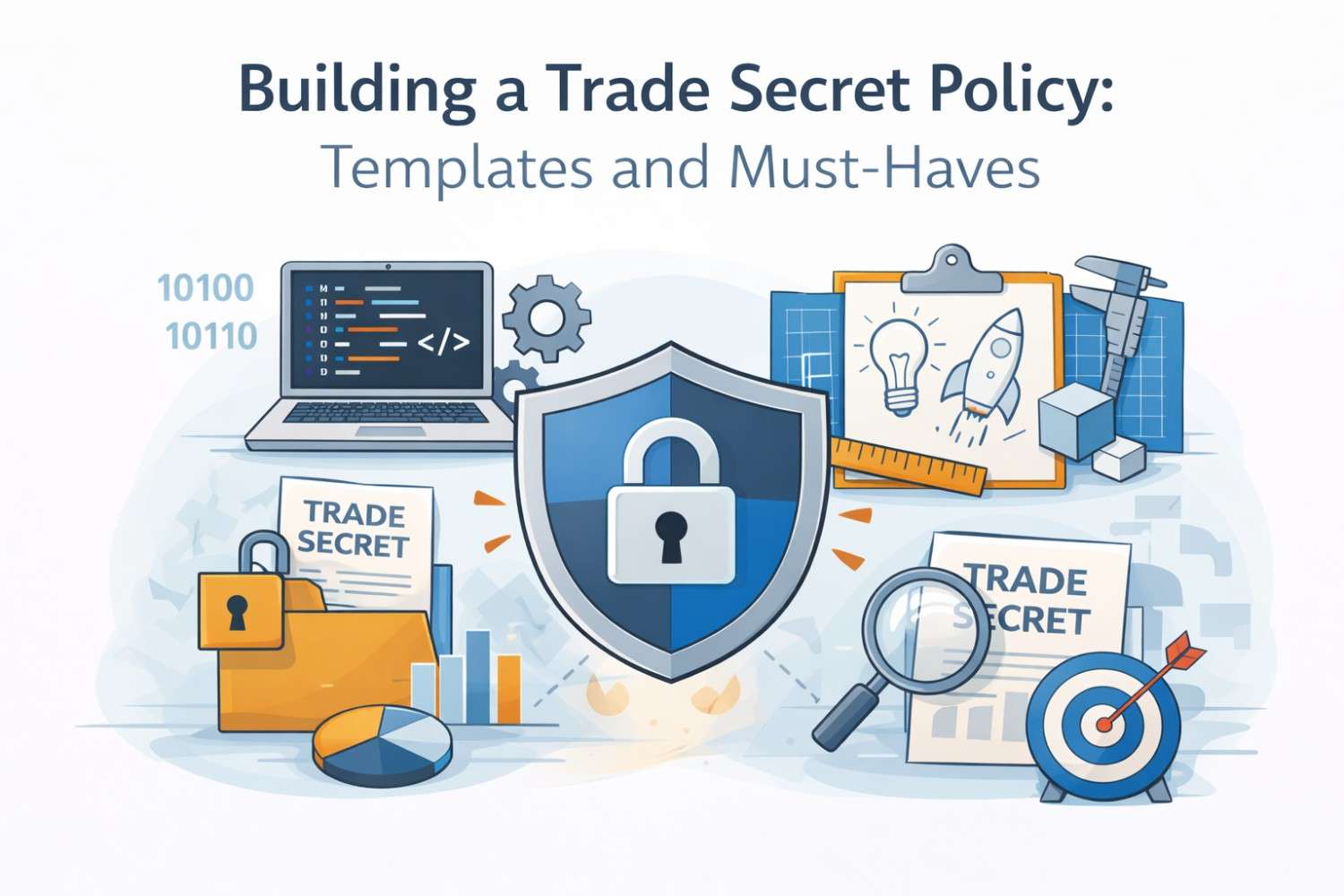
Every startup has something valuable that no one else should know. It might be how your system really works behind the scenes. It might be a model, a process, a dataset, or a clever workaround your team figured out at 2 a.m. That quiet edge is often more important than your logo or your pitch deck. That edge is a trade secret. Most founders know this in their gut. Very few protect it on purpose. A trade secret policy is not a boring legal document. It is a clear promise to your team, your investors, and your future self that the most important parts of your company will not walk out the door. It is how you turn “everyone knows not to share this” into something real, clear, and enforceable.
What Counts as a Trade Secret Inside a Startup
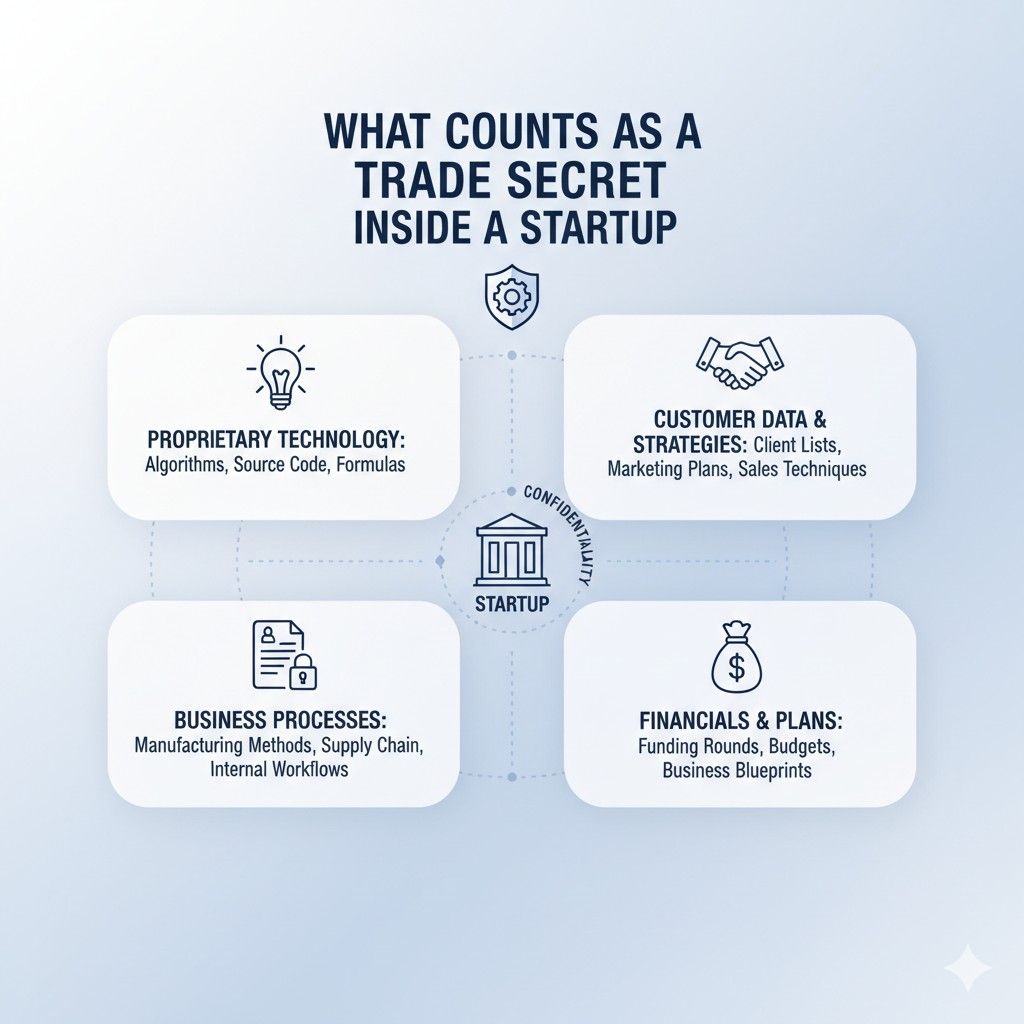
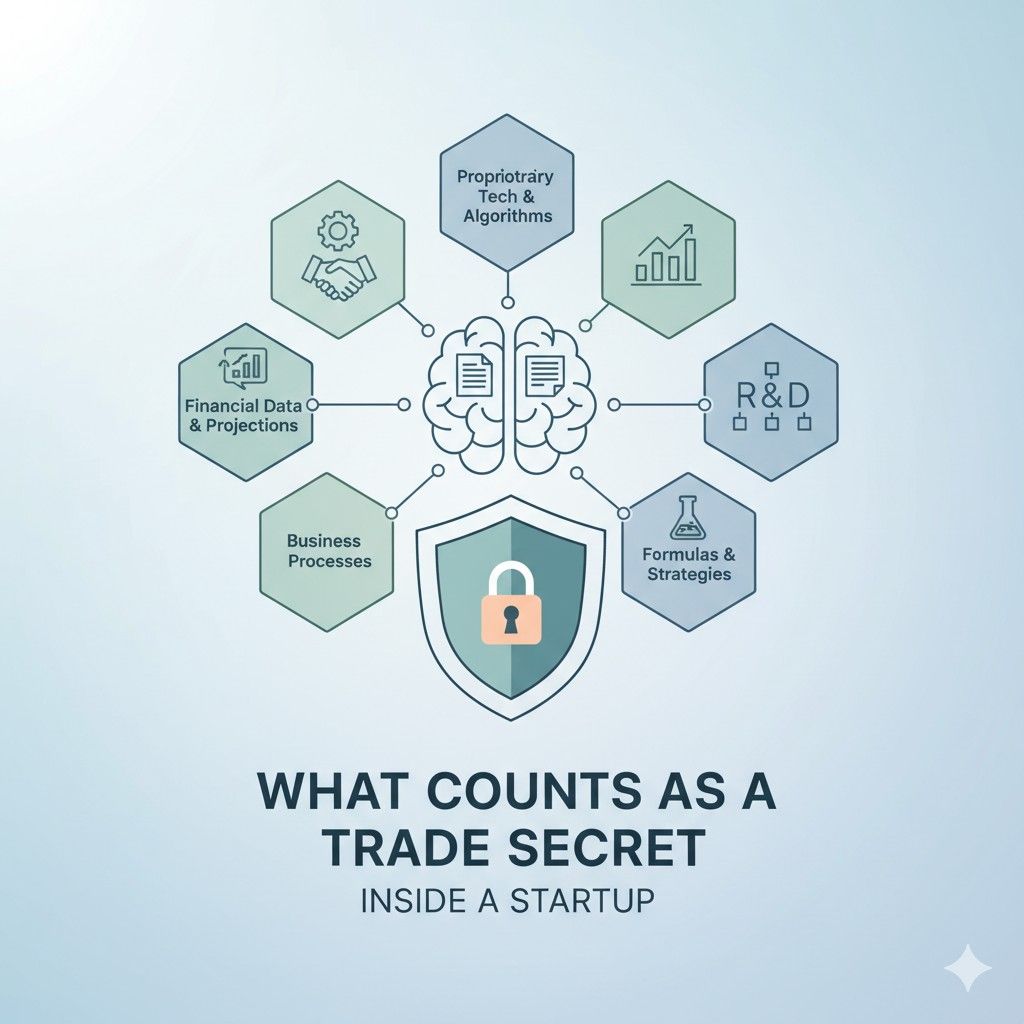
A trade secret is not just a formula locked in a vault. Inside a startup, trade secrets are often hiding in plain sight.
They live in everyday decisions, internal tools, half-finished ideas, and the quiet way your team solves problems better than anyone else.
This section is about learning how to see those things clearly, before someone else does.
Understanding what truly counts as a trade secret is the first step toward protecting it. If you cannot name it, you cannot protect it. And if you cannot protect it, you may lose it without even knowing it happened.
The Real Test of a Trade Secret
A trade secret is anything that gives your business an edge and is not known to the public.
That sounds simple, but founders often overthink it. You do not need something flashy or complex. You need something useful that would hurt if a competitor got it.
Ask yourself a very practical question. If a former employee joined a competitor tomorrow and brought this knowledge with them, would it help that competitor move faster, cheaper, or smarter?
If the answer is yes, you are likely looking at a trade secret.

This test works because it forces you to think in real-world terms, not legal theory. Trade secrets are about advantage, not perfection.
Internal Knowledge That Never Leaves the Company
Some of the most valuable trade secrets never appear in a product or a demo. They live only inside your team’s heads and internal systems.
This includes how your engineers debug certain issues, how your sales team handles objections that always come up, and how your leadership makes pricing or roadmap decisions.
These things may not feel like assets, but they are learned over time and through effort. That makes them valuable.
A strong trade secret policy should clearly say that internal know-how is protected, even if it is not written down in a single document.
Code That Is More Than Just Code
Founders often assume that all code is either protected by copyright or meant to be patented later. But in reality, much of your code should be treated as a trade secret, especially early on.
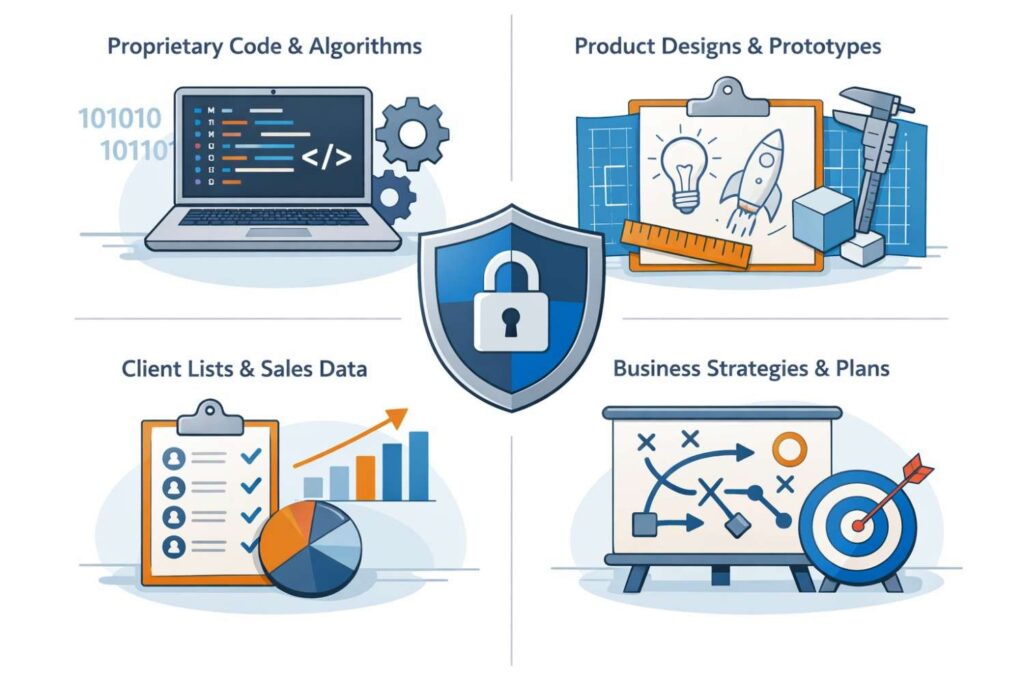
This includes algorithms, system architecture, internal tooling, automation scripts, and experimental features that never ship publicly.
Even the way different systems talk to each other can be a trade secret if it took time and insight to design.
The actionable move here is to clearly mark internal repositories and restrict access based on role, not convenience. Your policy should match that reality.
Data That Cannot Be Recreated Easily
Data is one of the most misunderstood trade secrets in startups. Raw data pulled from public sources is usually not a trade secret. But the cleaned, labeled, enriched, or structured version often is.
If your team spent months collecting, refining, or combining data in a way others cannot easily copy, that dataset is a trade secret. The same applies to training data for models, internal benchmarks, and performance metrics.
Your policy should treat this data as confidential even if parts of it came from public sources. What matters is the work done on top of it.
Processes That Save Time and Money
Every startup develops shortcuts. These are not hacks in a bad sense. They are smart ways of doing things better.
This might be a deployment flow that avoids downtime, a hiring process that filters better candidates, or a customer support playbook that solves issues in half the time.
These processes are trade secrets because they compress time and reduce mistakes.
An actionable step is to document these processes internally and label them as confidential. Documentation does not weaken trade secrets. It strengthens them.
Early Ideas That Never See the Light of Day
Not every idea becomes a feature. Not every experiment succeeds. But abandoned ideas can still be valuable trade secrets.
They show what does not work, what customers rejected, and which paths lead nowhere. Competitors would love to skip those lessons.
Your trade secret policy should make it clear that ideas discussed internally, even if not launched, are protected. This encourages open thinking without fear.
Customer and Partner Insights
Knowing who buys, why they buy, and how they decide is incredibly valuable. This includes customer lists, usage patterns, feedback trends, and partner terms.
Even if customer names are public, the insight behind those relationships is not. How you won them, what discounts were needed, and what almost killed the deal all count as trade secrets.
A practical move is to limit who can export or share this information and to clearly state in your policy that these insights belong to the company.
Financial Models and Forecast Logic
Revenue numbers alone are not always trade secrets. But how you forecast, price, and plan usually is.
Your assumptions, growth models, churn calculations, and budget logic show how you think about the business. A competitor with that knowledge gains a shortcut into your strategy.
Your trade secret policy should explicitly cover financial planning materials, even when shared with advisors or investors under controlled conditions.
The Difference Between Public and Private by Design
One of the most common mistakes is assuming something is a trade secret just because it feels important. The truth is simpler. If you treat something like it is secret, the law is more likely to agree with you.
That means access control, clear communication, and consistent behavior. If everyone can download it, forward it, or talk about it freely, it stops being a trade secret.
Your policy should reflect how the company actually behaves, and your behavior should reinforce the policy.
Making Trade Secrets Obvious to the Team
A trade secret policy only works if people understand it. This means using plain language and real examples from your own company.
Instead of vague terms, explain what kinds of information should never be shared and why. People protect what they understand.
A smart move is to review trade secrets during onboarding and again when roles change. This turns protection into a habit, not a rule.
How This Ties Into Long-Term IP Strategy
Trade secrets are not an alternative to patents. They are part of the same story.
Some things should stay secret forever. Some should be patented later. Knowing the difference early helps you avoid costly mistakes.
This is where tools like PowerPatent help founders think clearly about what to protect, when to protect it, and how to do both without slowing down. You can explore how that works at https://powerpatent.com/how-it-works.
Trade secrets are the quiet foundation of strong intellectual property. When you define them clearly, you give your startup something rare: protection that moves at startup speed.
Why Most Companies Lose Trade Secrets Without Realizing It
Most companies do not lose trade secrets because of bad actors or dramatic theft. They lose them slowly, quietly, and without intent. By the time anyone notices, the damage is already done and cannot be reversed.
This section is about awareness. When founders understand how trade secrets slip away in normal day-to-day work, they can stop the leaks early. The goal is not fear or control.
The goal is clarity and smart habits that protect what matters most.
Growth Without Guardrails
Startups move fast by design. New hires join quickly, tools get added overnight, and access is often granted with a single click. In the rush to grow, very few teams stop to ask who truly needs access to what.
Trade secrets are often lost when access grows faster than trust and structure.
Someone who needed information for a short project keeps it forever. Someone who changed roles still sees old files. Over time, sensitive knowledge spreads too widely to be protected.
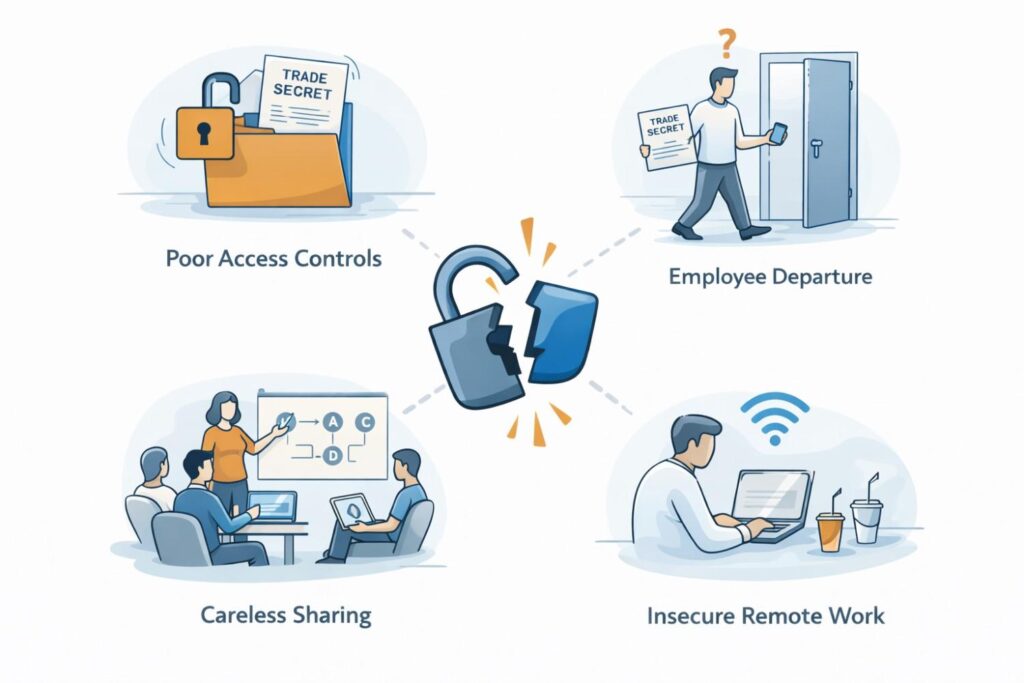
A strong policy forces regular check-ins on access. Not once a year, but whenever the company changes shape.
Conversations That Feel Too Casual
Founders love open cultures. Transparency builds trust. But there is a quiet line between open and careless.
Trade secrets are often shared in Slack threads, casual meetings, or friendly chats with outsiders. It feels harmless in the moment. It feels like building relationships. But once something is said, it cannot be unsaid.
The solution is not silence. It is awareness. Teams need to know which topics stay inside the company, no matter how friendly the setting feels.
Employees Who Leave With More Than Memories
Employee exits are one of the biggest risk points for trade secrets. Most employees do not mean harm. They simply take what they learned with them.
This includes mental models, workflows, documents saved to personal devices, and access that was never shut off. Without a clear exit process tied to your trade secret policy, knowledge walks out quietly.
An actionable move is to treat offboarding as seriously as onboarding. Remind departing employees what remains confidential and confirm access is fully closed.
Contractors and Vendors in the Blind Spot
Startups rely heavily on outside help. Designers, developers, marketers, and consultants often see deep parts of the business.
Trade secrets are lost when these relationships are treated as informal. No clear boundaries. No clear expectations. No reminder that what they see is not theirs to reuse.
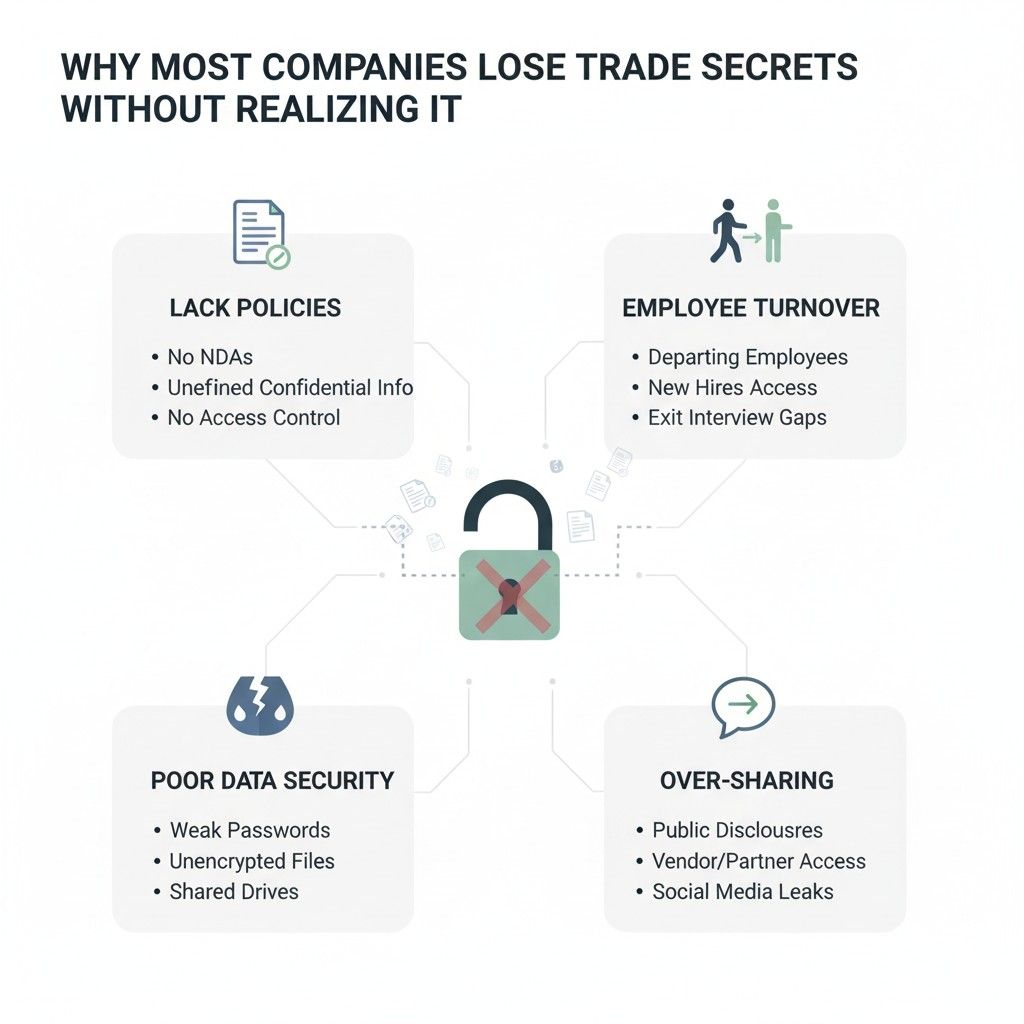
Your policy should clearly extend to anyone who touches sensitive information. Protection does not stop at payroll.
Documents That Are Never Labeled
One of the simplest reasons trade secrets are lost is that no one knows they are trade secrets.
Files are named casually. Folders are shared widely. Nothing signals importance or sensitivity. In a dispute later, it becomes hard to argue that something was meant to be protected.
Clear labels, limited sharing, and consistent language make a huge difference. They show intent. Intent matters.
Tools That Make Sharing Too Easy
Modern tools are built for speed and sharing. That is great for collaboration. It is dangerous for secrets.
Auto-sync, personal backups, and external integrations often copy sensitive information without anyone noticing. Once data spreads across tools, control disappears.
A trade secret policy should be paired with basic tool hygiene. Know where your information lives and who controls it.
Founders Who Assume Everyone Understands
Founders often assume that employees just know what should be kept secret. This assumption is costly.
People come from different backgrounds. What feels obvious to one person may not be obvious to another. Without clear guidance, people guess. Guessing leads to mistakes.
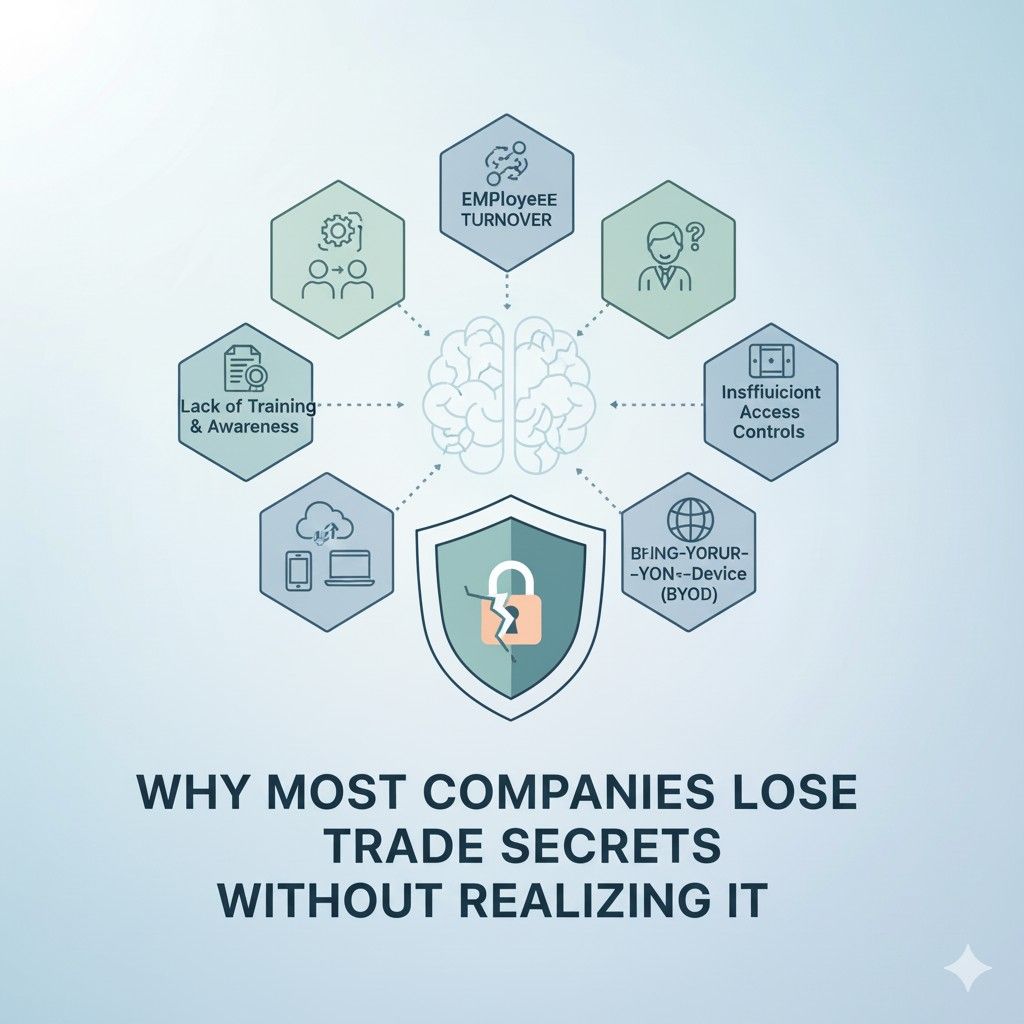
The fix is simple. Say it out loud. Write it down. Repeat it.
Waiting Too Long to Be Serious
Many startups think trade secret policies are for later, when the company is bigger. This delay creates risk.
Trade secrets are most fragile in the early days, when structure is light and habits are forming. Once something leaks, no policy can pull it back.
Starting early does not mean being heavy. It means being clear.
How Small Leaks Become Big Problems
One shared slide. One forwarded email. One reused idea. Trade secret loss rarely happens all at once.
Small leaks compound. They build a picture. Competitors do not need everything. They just need enough.
Strong policies stop small leaks before they connect.
Turning Awareness Into Action
Knowing the risks is not enough. The real work is turning this awareness into daily behavior.
This is where smart systems help founders move fast without losing control. PowerPatent helps teams think through protection early, before mistakes happen, and build habits that scale.
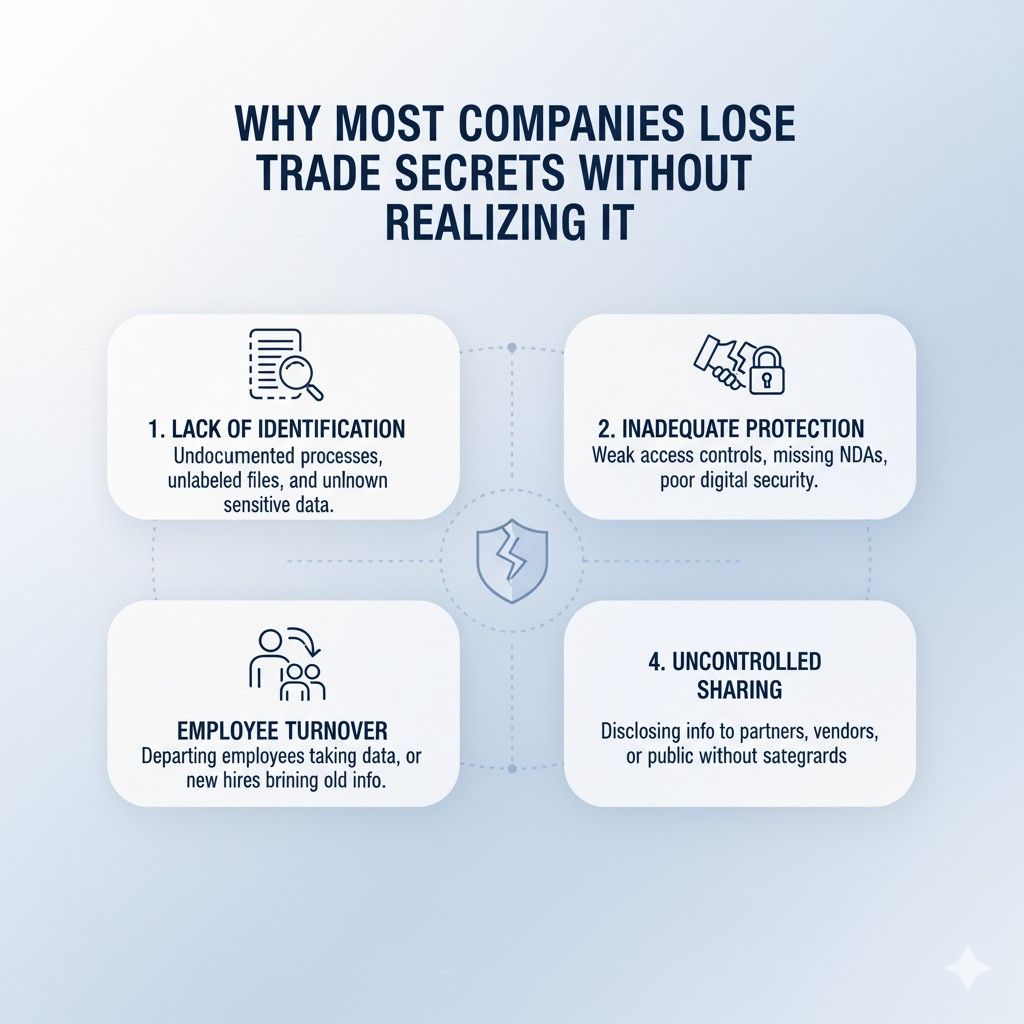
You can see how that works at https://powerpatent.com/how-it-works.
Trade secrets are not lost in dramatic moments. They are lost in normal ones. When you design for those moments, you stay protected without slowing down.
How a Trade Secret Policy Actually Protects Your Business
A trade secret policy is not about checking a box. It is about control. When done right, it quietly protects your company every single day without slowing anyone down.
When done wrong, it sits in a folder no one reads and helps no one when it matters.
This section explains how a trade secret policy works in real life. Not in theory. Not in courtrooms. But inside a growing startup with real people, real pressure, and very little time.
A Policy Creates Shared Understanding
The first job of a trade secret policy is not legal protection. It is alignment.
When everyone has the same understanding of what must stay inside the company, mistakes drop fast. People stop guessing. They stop assuming. They act with confidence.
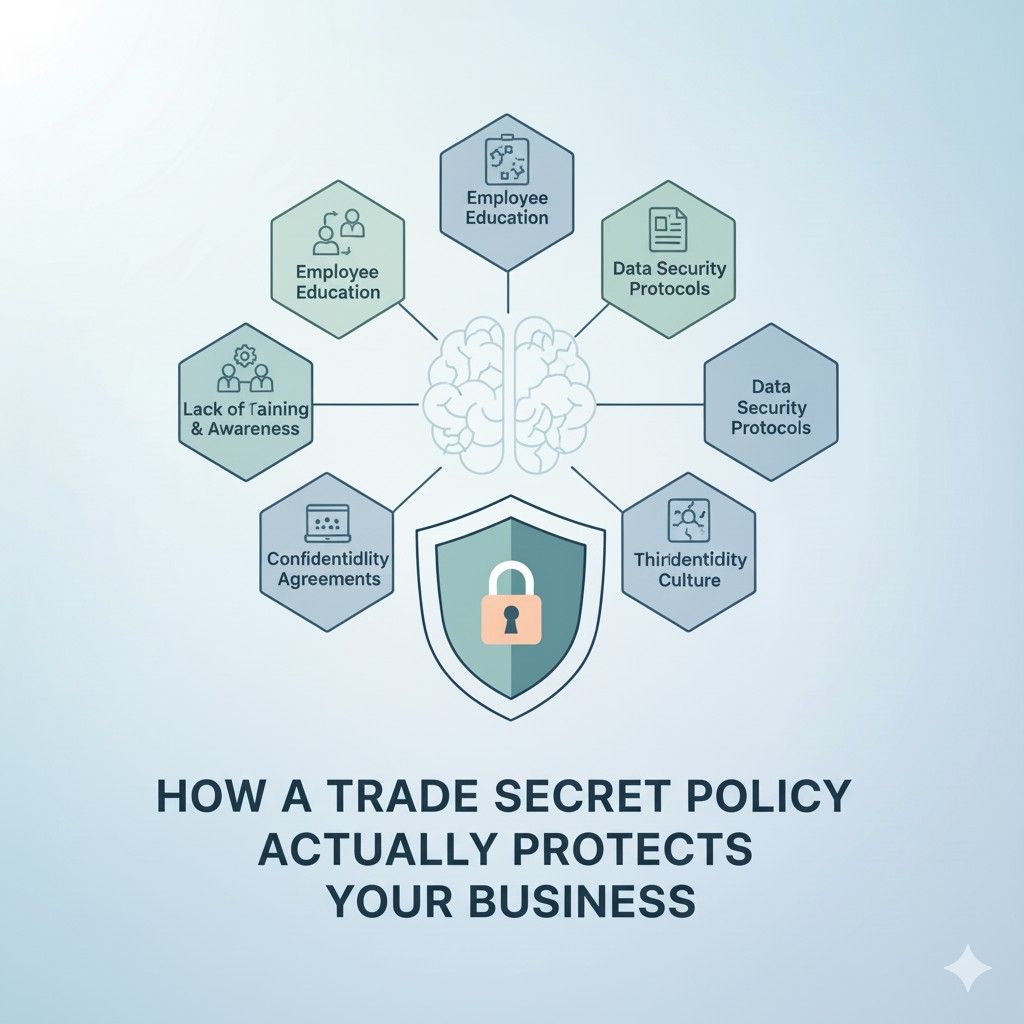
A good policy uses plain language and examples that feel familiar. It speaks the same way the company speaks. This makes protection part of the culture, not an external rule.
Clear Rules Reduce Risk Without Slowing Speed
Founders often fear that policies slow teams down. The opposite is usually true.
When rules are clear, people move faster. They do not pause to wonder what is allowed. They do not over-share just to be safe. They know the boundaries.
A strong trade secret policy removes friction by replacing uncertainty with clarity.
Protection Starts Before Problems Exist
Many companies write policies only after something goes wrong. By then, it is too late.
A policy written early shapes behavior from day one. It sets expectations before habits form. This is especially important during hiring, onboarding, and early growth.
Early protection is always cheaper and easier than fixing damage later.
The Policy Becomes a Daily Reference Point
A trade secret policy should not live only in HR systems. It should show up in real moments.
When someone asks if they can share something, the answer should point back to the policy.
When a new tool is added, the policy should guide how access is set up. When someone leaves, the policy should shape the exit process.
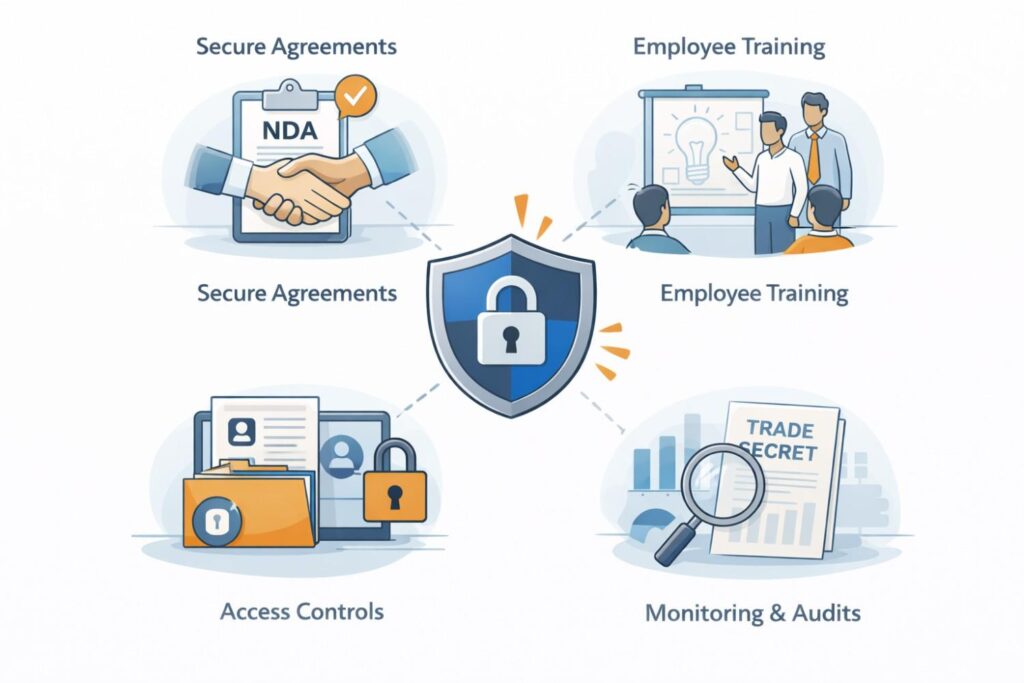
This turns the policy into a tool, not a document.
Strong Policies Support Hard Conversations
At some point, every founder faces a difficult situation. Someone shares too much. Someone wants to reuse an idea. Someone pushes a boundary.
A clear policy makes these conversations easier. It removes emotion and personal judgment. The discussion becomes about company standards, not individual behavior.
This protects relationships while still protecting the business.
Consistency Builds Legal Strength Over Time
Trade secret protection depends heavily on consistency. Courts look at how a company actually treats its information.
When a policy is followed in daily behavior, it strengthens your position automatically. You do not need to think about legal strategy. You are building it through habits.
This is why simple, usable policies outperform complex ones that no one follows.
The Policy Guides Tool and Access Decisions
Every startup uses dozens of tools. Each tool creates a new place where secrets can live or leak.
A good policy acts as a filter. It helps founders decide who gets access, how sharing works, and when restrictions are needed.
This prevents accidental exposure without adding layers of approval.
Employees Feel Trusted, Not Controlled
Good trade secret policies do not feel restrictive. They feel respectful.
They signal that the company values its work and trusts its people to protect it. When explained well, employees understand the why, not just the rule.
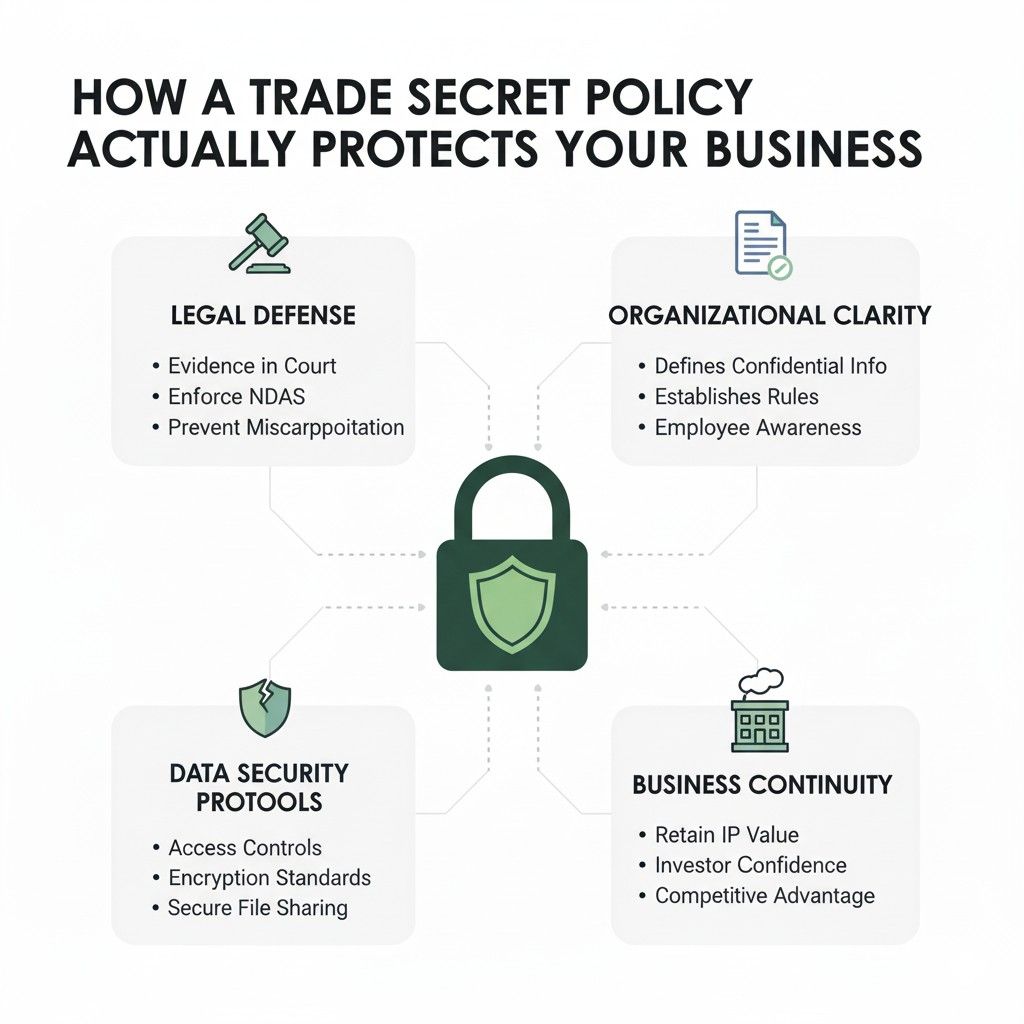
This builds ownership. Ownership leads to protection.
The Policy Scales as the Company Grows
What works at five people breaks at fifty. What works at fifty breaks at five hundred.
A strong trade secret policy is written with growth in mind. It is flexible enough to evolve while staying clear about core principles.
This allows founders to scale protection without rewriting everything each year.
Connecting Trade Secrets to Long-Term IP Decisions
Trade secrets are often the first layer of intellectual property. Over time, some of those secrets may become patents. Others should stay hidden forever.
A clear policy helps founders make those calls deliberately. It creates a map of what exists and why it matters.
This is where platforms like PowerPatent help founders connect day-to-day protection with long-term strategy. You can see how that works at https://powerpatent.com/how-it-works.
From Policy to Habit
The real power of a trade secret policy shows up when people stop thinking about it consciously. Protection becomes automatic.
People pause before sharing. They label documents correctly. They ask questions when unsure. Not because they are afraid, but because the system supports them.
That is when a policy has done its job.
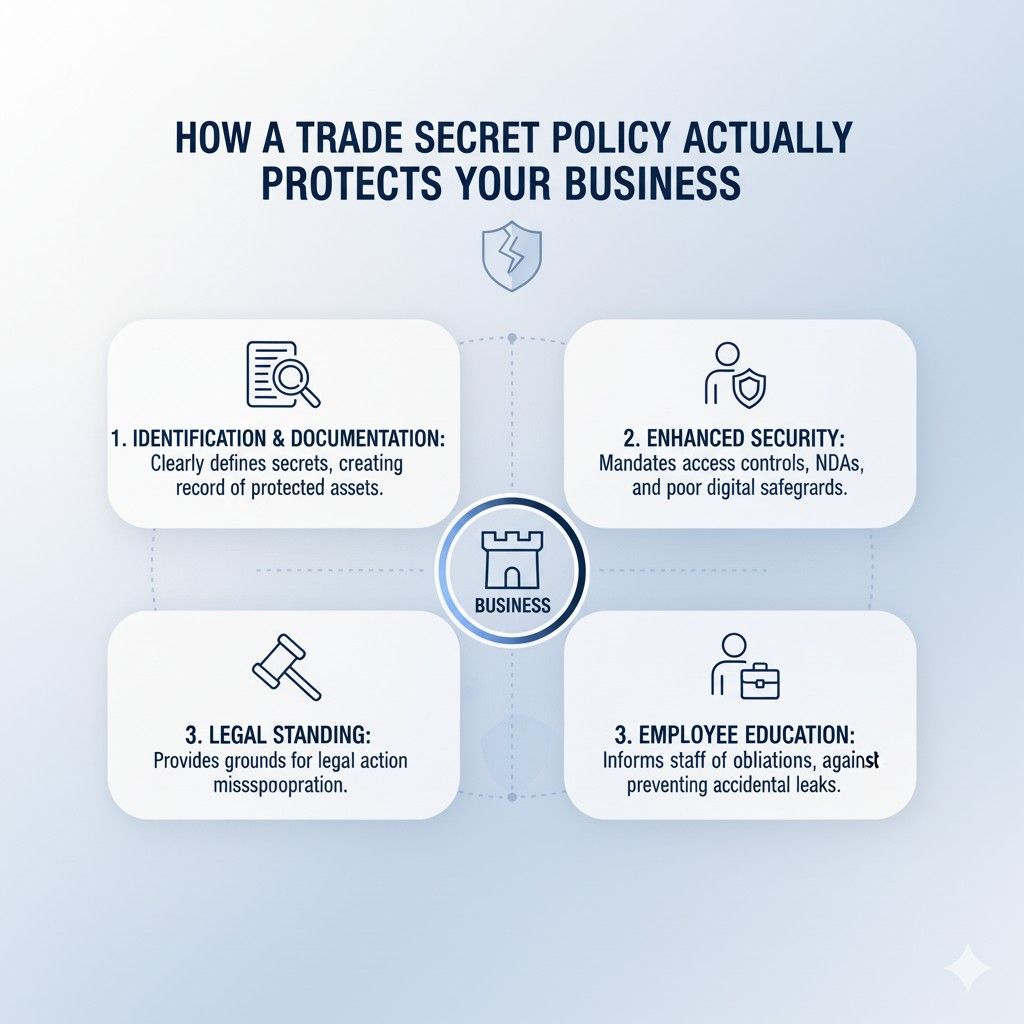
A trade secret policy is not about being careful. It is about being intentional. When you design it well, it protects your business quietly while you focus on building.
Wrapping It Up
Trade secrets are not an abstract idea or a legal trick. They are the living core of how your startup works, thinks, and wins. If you strip away the branding, the pitch decks, and the noise, what remains is a set of hard-earned insights and systems that make your company different. That is what you are protecting. A trade secret policy is simply the way you draw a clear line around that value. It tells your team what matters, tells partners what is off-limits, and tells the future version of your company that you took protection seriously from the start. It does not need to be long. It does not need complex language. It just needs to be real and followed.
Leave a Reply