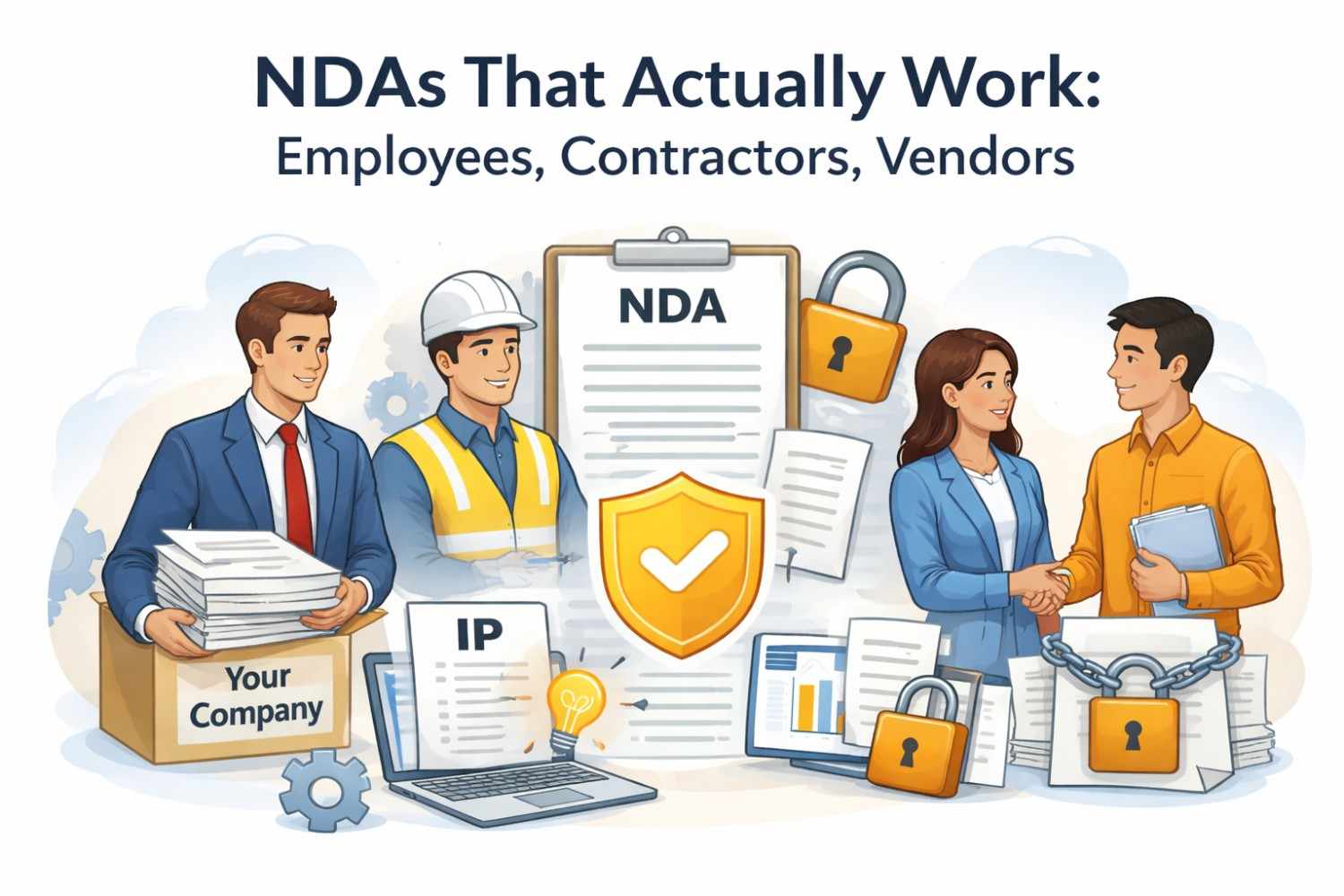
Most NDAs do not work. They look serious. They sound official. They get signed. Then something goes wrong, and suddenly the NDA means nothing. Your idea leaks. Your code walks out the door. Your vendor reuses your work for someone else. And you find out the hard way that the paper you relied on was weak from the start. This article is about fixing that. If you are building a startup, writing code, training models, or creating anything new, your ideas are your company. Not later. Not after funding. Right now. NDAs are supposed to protect those ideas. But most founders copy one from Google, send it over, and hope for the best. Hope is not a strategy.
Why Most NDAs Fail Before They Are Ever Used
NDAs usually fail long before anyone breaks them. They fail at the moment they are written, shared, or signed. Not because people are bad, but because the document does not match real life.
Founders often believe that once an NDA is signed, they are safe. That belief is what creates risk.
This section explains where NDAs break down and how to fix those weak points early, while it is still cheap and easy to do so.
The False Sense of Safety Problem
Most founders treat NDAs like insurance. Once it is signed, they stop thinking about it. They share more than they should. They skip hard conversations. They assume the paper will save them if things go wrong.
In reality, an NDA only works if it is clear, realistic, and tied to how work actually happens. If it is vague or copied from somewhere else, it becomes a false shield.
Courts do not enforce intent. They enforce words. If the words are weak, the protection is weak.
The first step is to stop thinking of NDAs as a checkbox. They are not a formality. They are a design choice.
Using Templates That Were Never Meant for You
One of the biggest reasons NDAs fail is because they are generic. Founders grab a template online and assume it covers everything. These templates are written for broad use, not for your product, your data, or your workflow.
A generic NDA does not know what makes your company special. It does not know whether your value lives in your code, your model weights, your training data, your roadmap, or your customer insights.
When an NDA does not clearly reflect what you care about, it becomes hard to enforce.
Actionable fix here is simple. Before sharing any NDA, read it and ask yourself if a stranger could understand what needs to stay secret. If the answer is no, the NDA is not ready.
Defining Confidential Information Too Narrow or Too Wide
Some NDAs fail because they try to protect everything. Others fail because they protect almost nothing. Both approaches cause problems.
When confidential information is defined too broadly, it becomes unrealistic. Courts often push back when everything is labeled secret, including things that are public or obvious. That weakens the whole agreement.
When the definition is too narrow, important assets fall outside the scope. Founders often forget to include things like product direction, internal metrics, or future plans. Those are often more valuable than the current code.
A strong NDA describes confidential information in plain language that matches how your company operates. It should be specific enough to show intent, but flexible enough to cover how ideas evolve over time.
Forgetting That Timing Matters
Many NDAs are signed too late. Founders start talking first and send the NDA after. By then, the damage is already done. If information is shared before the NDA is in place, it may not be protected at all.
Timing is part of strategy. An NDA should be signed before any meaningful discussion happens. That includes demos, pitch decks, architecture talks, and roadmap reviews.
If you are already sharing information freely and then asking for signatures, you are training people to ignore the document. That weakens its power later.
Assuming Everyone Has the Same Incentives
NDAs often fail because founders assume everyone is on the same page. Employees, contractors, and vendors all have different motivations. What feels obvious to you may not feel obvious to them.
An employee may think their work belongs to them because they wrote it. A contractor may think they can reuse patterns or ideas for other clients. A vendor may think they can talk about your project as a case study.
An NDA should remove assumptions. It should clearly state ownership, use limits, and expectations in words that leave little room for interpretation.
Writing NDAs That Do Not Match the Relationship
Another common failure happens when the NDA does not reflect the actual working relationship. A one-size-fits-all NDA used for everyone creates gaps.
Employees need clarity on inventions and ongoing duties. Contractors need clarity on ownership and reuse.
Vendors need clarity on access and limits. When the same document is used for all three, it usually fits none of them well.
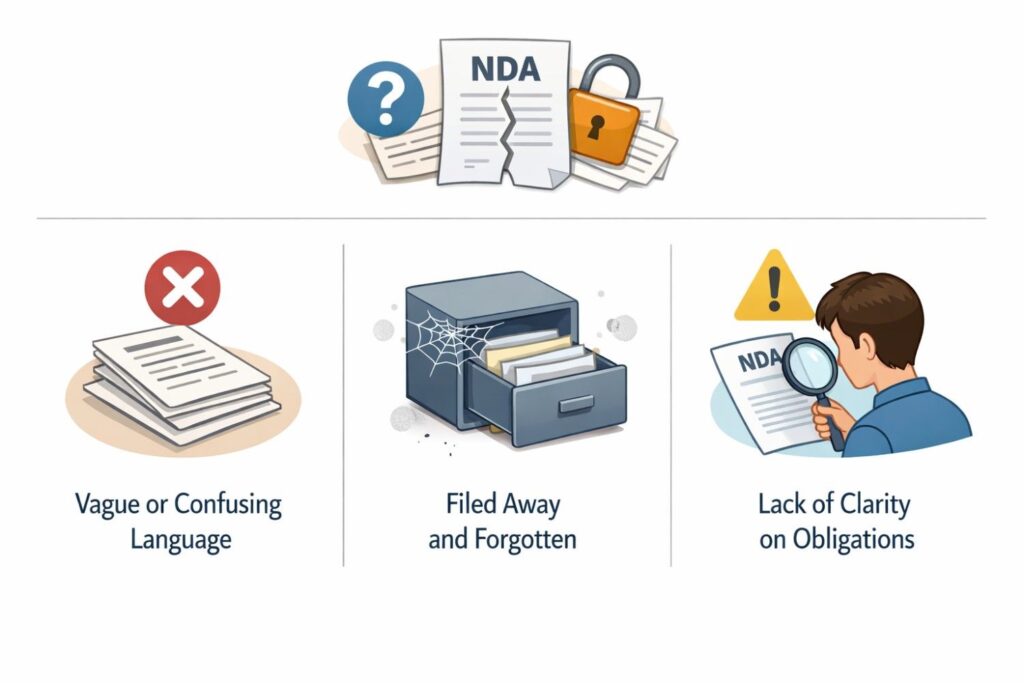
This does not mean you need dozens of documents. It means you need versions that reflect reality. Even small tweaks in language can make a big difference in how enforceable an NDA becomes.
Ignoring Where and How Enforcement Happens
Many founders never think about enforcement until it is too late. NDAs often fail because they do not specify where disputes are handled or which laws apply. That matters more than people realize.
If your contractor is overseas and your NDA assumes local enforcement, you may face delays or costs that make enforcement impossible. A strong NDA considers jurisdiction and practicality, not just theory.
You should be able to look at your NDA and realistically answer whether you would enforce it if needed. If the answer is no, the document needs work.
Not Aligning NDAs With Patent Strategy
This is a quiet but critical failure point. NDAs and patents are deeply connected. If confidential information becomes public too early, you can lose patent rights in some countries and weaken your position everywhere.
Founders often share details with employees, contractors, or vendors without thinking about patent timing. Later, when they try to file, they discover that the invention may no longer be considered new.
Smart companies use NDAs as part of their invention process. They control who sees what and when.
PowerPatent helps founders think this way by connecting real work with real protection, fast, so nothing slips through the cracks. You can see how that works at https://powerpatent.com/how-it-works.
Treating NDAs as Static Documents
Businesses change fast. Products evolve. Teams grow. NDAs often stay frozen while everything else moves. That creates risk.
An NDA written when you were a two-person team may not work when you are handling sensitive customer data or advanced models. Reviewing NDAs should be part of company maintenance, not a one-time task.
A simple habit helps here. Every time your product changes in a meaningful way, review who has access and whether your agreements still match reality.
The Cost of Waiting Until Something Breaks
Most founders only realize their NDA is weak when something goes wrong. By then, options are limited. Fixing problems early is cheaper, faster, and less stressful.
A strong NDA does not slow you down. It removes friction by setting clear rules upfront. It helps people work faster because they know the boundaries.
When NDAs are done right, they fade into the background. When they are done wrong, they become the center of a crisis.
This is why NDAs that actually work are designed with intention, not copied in a rush. They are part of building a serious company, just like writing clean code or protecting your inventions.
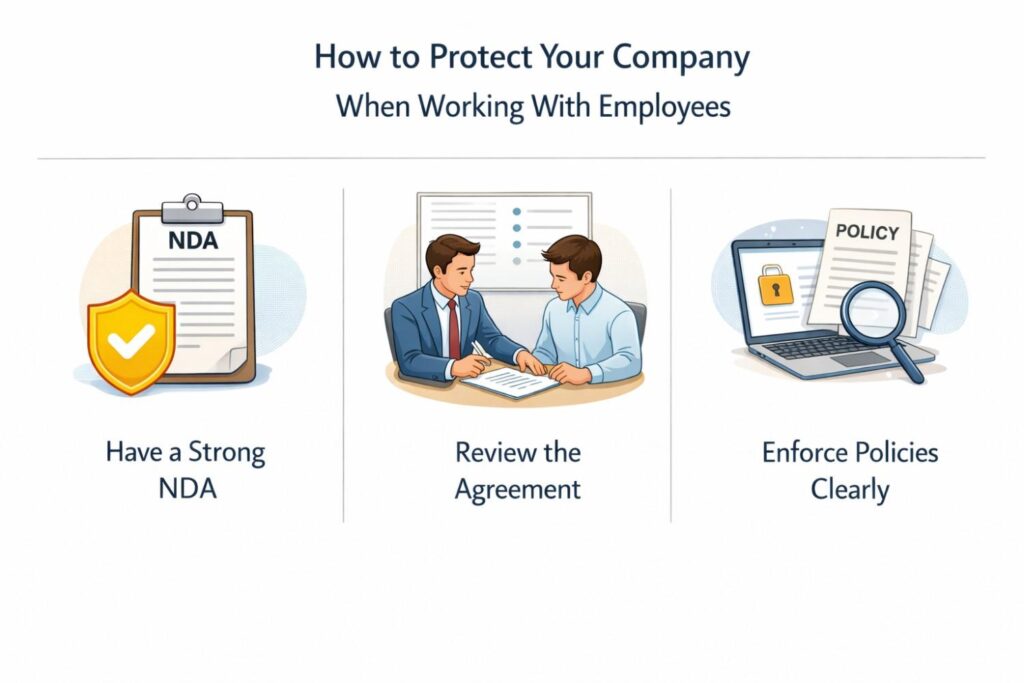
How to Protect Your Company When Working With Employees
Employees are the closest people to your ideas. They see the code as it grows. They hear the plans before they are polished. They know what is working and what is breaking.
That closeness is powerful, but it is also risky if boundaries are not clear from day one.
This section is about setting those boundaries in a way that feels fair, clear, and strong. Not defensive. Not awkward. Just solid.
Why Employee NDAs Are Different
An employee NDA is not just about secrecy. It is about ownership, trust, and alignment. Employees are not outsiders. They are part of the company. That changes how agreements should be written and explained.
Many founders make the mistake of using the same NDA they would use for a contractor. That often leaves gaps. Employees work daily, build long-term knowledge, and shape the product itself. The NDA must reflect that depth.

A good employee NDA makes it clear that ideas created as part of the job belong to the company, even if they evolve over time.
The Importance of Day-One Clarity
Timing matters more with employees than with anyone else. The NDA should be signed before the first line of work begins. Not after onboarding. Not after the first sprint. Before access is given.
This is not about mistrust. It is about setting expectations when everything is clean. When agreements are signed later, they can feel reactive or unfair.
Day-one clarity prevents future confusion. It also protects you if an employee leaves early or disputes arise about who owns what.
Explaining the NDA Without Making It Awkward
One reason employee NDAs fail is that founders never explain them. They send the document and move on. That leaves room for misunderstanding.
Taking a few minutes to explain why the NDA exists changes how it is perceived.
When employees understand that the goal is to protect the company and everyone’s work, not to trap them, they are more likely to respect it.
A simple explanation builds trust and reduces the chance of accidental leaks later.
Ownership of Work Done on the Job
This is one of the most common problem areas. Employees often assume that because they wrote something, it belongs to them. That assumption can create serious issues if the NDA is unclear.
A strong employee NDA clearly states that work created as part of employment belongs to the company. That includes improvements, variations, and ideas connected to the company’s business.
This clarity is especially important for engineers and researchers who may work on similar problems outside of work hours.
Handling Side Projects the Right Way
Side projects are common in startups. Ignoring them does not make the risk go away. A good NDA addresses them directly.
The goal is not to ban creativity. The goal is to prevent overlap that harms the company. Clear language helps employees understand what is allowed and what is not.
When side projects are addressed openly, disputes are less likely. Silence is what creates confusion.
Access Control Matters as Much as Paper
An NDA alone is not enough. If every employee can see everything, enforcement becomes harder. Courts often look at whether a company treated information as truly confidential.
Limiting access based on role strengthens your position. It shows that you took reasonable steps to protect your information, not just relied on paper.
This also helps internally by reducing noise and distraction.
What Happens When an Employee Leaves
Many NDAs fail at the exit stage. Employees leave, accounts stay open, laptops are not checked, and no reminder is given about ongoing obligations.
A clean exit process reinforces the NDA. Reminding employees that confidentiality continues after employment is not aggressive. It is professional.
This step is often skipped, but it is one of the easiest ways to reduce risk.
NDAs and Company Culture
Some founders worry that NDAs create a cold culture. In practice, unclear boundaries create more tension than clear ones.
When everyone knows the rules, they can focus on building. NDAs should support speed and confidence, not fear.
Strong companies treat protection as part of professionalism, not paranoia.
How Employee NDAs Support Patent Protection
Employees are often the source of inventions. If ownership and confidentiality are unclear, patent filings can become messy or delayed.
A strong NDA ensures that inventions are properly assigned and kept confidential until they are protected. This makes patent filing smoother and stronger.
PowerPatent helps founders capture these inventions as they happen and turn them into patents without slowing the team down. You can see how that works at https://powerpatent.com/how-it-works.
Reviewing NDAs as the Team Grows
What works for the first hire may not work for the tenth or the fiftieth. As roles become more specialized, NDAs should evolve.
Regular review keeps agreements aligned with reality. This does not mean constant rewrites. It means thoughtful updates when the business changes.
This habit prevents small gaps from becoming big problems.
The Real Goal of Employee NDAs
The goal is not control. It is continuity. You want the company to keep moving forward even when people come and go.
When NDAs are written clearly and used consistently, they fade into the background. That is the sign they are working.
Employees know where they stand. Founders sleep better. The company stays protected.
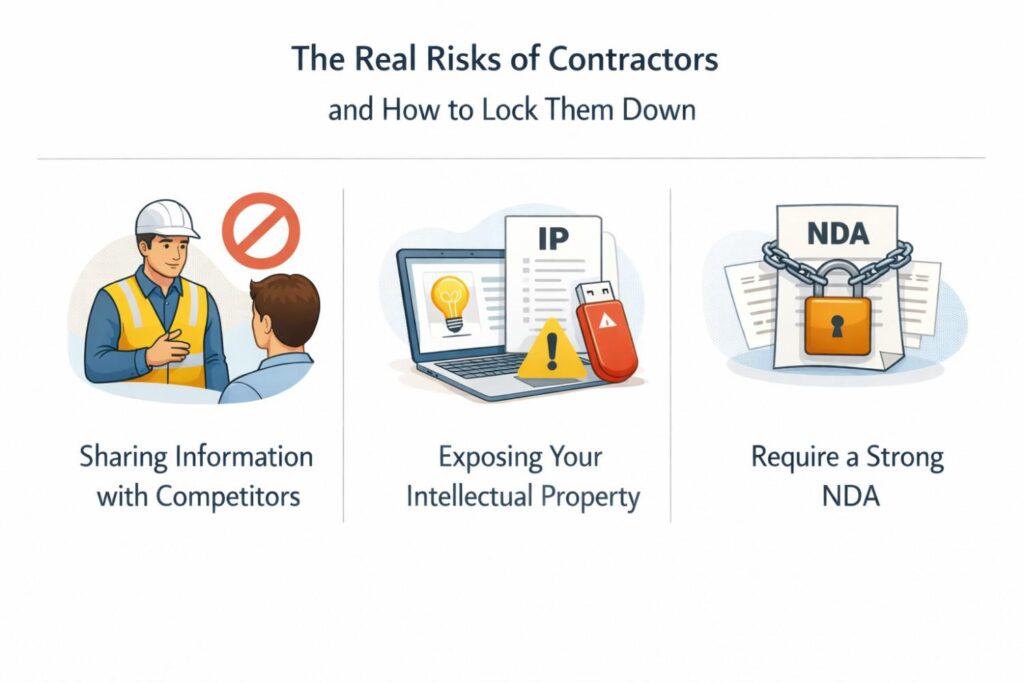
The Real Risks of Contractors and How to Lock Them Down
Contractors move fast. That is why founders love them. They help you build without long hiring cycles. They bring skills you do not have in-house yet. They fill gaps when speed matters more than structure.
That speed is also where the risk lives.
Contractors work with many clients. They switch projects often. They reuse patterns, habits, and sometimes ideas.
If your agreements are loose, your work can quietly blend into someone else’s product without anyone meaning harm.
This section shows how to protect your company when working with contractors, without slowing things down or creating tension.
Why Contractors Are the Most Common Leak Point
Contractors sit in a strange middle ground. They are not employees, but they are not fully external either. They often get deep access with very little oversight.
Many founders assume an NDA is enough. In reality, contractor risk is more about ownership and reuse than secrecy alone.

If your NDA does not clearly state who owns the work and how it can be used, you may pay for something you do not fully own.
The Ownership Gap That Hurts Startups
One of the biggest mistakes founders make is assuming that payment equals ownership. It does not.
Unless the agreement clearly states that work created by the contractor belongs to your company, the contractor may legally retain rights. This can create serious problems later, especially during fundraising or acquisition.
A strong contractor NDA makes ownership explicit. It removes doubt. It protects you when it matters most.
Reuse Is Not Always Obvious
Contractors often reuse code, frameworks, or ideas across projects. Sometimes this is efficient. Sometimes it is risky.
If reuse is not addressed, contractors may unintentionally share parts of your work elsewhere. Not because they are careless, but because boundaries were never set.
Clear language about what can and cannot be reused helps both sides. It sets fair expectations without accusations.
Access Should Match the Scope of Work
Many NDAs fail because contractors are given more access than they need. When everything is shared, everything becomes harder to protect.
Limiting access based on task strengthens your position. It also reduces the chance of accidental leaks.
This is not about distrust. It is about good design.
Contractors and Time Limits
Contractors often work for short periods. NDAs should reflect that reality while still protecting long-term value.
Confidentiality obligations should continue after the work ends. Many founders forget this, assuming protection ends with the contract.
A simple reminder at the end of the engagement reinforces expectations and closes the loop.
Working With Overseas Contractors
Global talent is a huge advantage, but it adds complexity. Enforcement across borders can be slow or impractical.
This does not mean you should avoid global contractors. It means your NDA should be realistic about enforcement and clarity.
Clear language, limited access, and strong ownership terms matter even more in these cases.
Contractors and Patent Risk
Contractors often contribute to inventions without realizing it. If their role is not documented properly, patent filings can become complicated.
A strong NDA ensures that inventions created during the engagement are assigned to your company and kept confidential until protected.
PowerPatent helps founders track these contributions and turn them into patents without legal chaos. You can see how that works at https://powerpatent.com/how-it-works.
Avoiding the Friendly Handshake Trap
Early-stage founders often rely on trust and speed. Handshakes feel easier than paperwork.
The problem is that memories fade and priorities change. What felt clear at the start can become blurry later.
An NDA protects the relationship as much as the company. It prevents misunderstandings that damage trust.
Aligning NDAs With How Contractors Actually Work
Contractors often work asynchronously, use their own tools, and manage their own workflows. NDAs should reflect this reality.
If the agreement assumes office hours or company equipment, it may not fit. Mismatch creates weak spots.
Reading your NDA from the contractor’s point of view helps reveal these gaps.
The Goal Is Clean Ownership, Not Control
The purpose of a contractor NDA is clarity. Who owns what. What stays private. What happens after the work ends.
When this is clear, contractors can work confidently. Founders can move fast. Everyone wins.

Strong NDAs do not slow startups down. They remove uncertainty.
Sharing With Vendors Without Giving Away Your Advantage
Vendors are often overlooked when it comes to risk. Founders focus on employees and contractors, but vendors quietly touch some of the most sensitive parts of the business.
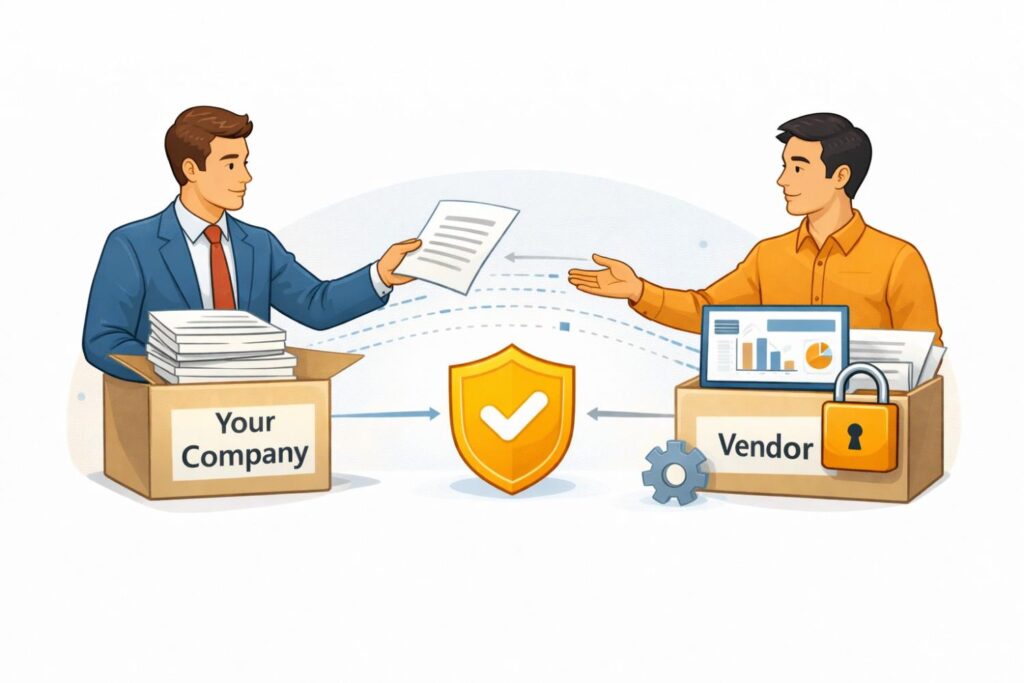
They may handle infrastructure, data, analytics, design, manufacturing, or customer operations. They are outside the company, yet deeply embedded in how it runs.
This section is about working with vendors in a way that keeps your advantage intact while still moving fast.
Why Vendor NDAs Are Often an Afterthought
Vendors are usually seen as tools, not partners. Founders assume large vendors have their own rules and that nothing can be changed. Smaller vendors are trusted because they seem harmless.
Both assumptions create risk.

Vendor NDAs often fail because they are rushed, ignored, or treated as unimportant. In reality, vendors can see more than almost anyone else.
The Quiet Exposure Problem
Vendors often gain access without much scrutiny. They get logins, dashboards, files, or samples. Over time, they learn how your business works.
If confidentiality is not clearly defined, this exposure becomes a liability. Even casual conversations can reveal strategy or weaknesses.
A strong NDA makes it clear that access does not equal permission to share or reuse information.
Case Studies and Marketing Traps
Many vendors want to talk about their work. They want logos, testimonials, and case studies. This is where NDAs often break down.
If this is not addressed, vendors may publicly reference your project without realizing the harm. Even vague mentions can reveal timing, direction, or scale.
Clear limits on publicity protect your advantage without blocking reasonable marketing later.
Data Handling Is Not Always Obvious
Vendors may process, store, or analyze your data. NDAs often mention confidentiality but fail to address how data is handled.
This creates risk around storage, backups, and access by vendor staff. If a breach happens, unclear terms make response harder.
Plain language about data use and limits strengthens protection and accountability.
Vendor Turnover Inside Their Own Teams
Even if you trust the vendor, their employees may change. New people may gain access without context.
NDAs should account for this reality by tying obligations to the vendor company, not just individuals.
This ensures continuity even as teams shift.
Short Projects Can Have Long Impact
Some vendor relationships are brief. That does not mean the risk ends when the project does.
Designs, specs, or data shared during a short engagement can influence future work. NDAs should reflect the lasting value of what was shared.
Ongoing confidentiality after the project ends is critical.
Vendors and Competitive Overlap
Some vendors work with your competitors. This is common and not always avoidable.
The risk comes from unclear boundaries. Without clear NDAs, ideas can bleed across projects unintentionally.
Clear separation protects everyone involved.
Aligning Vendor NDAs With Reality
Vendors often push back on heavy legal language. The goal is not complexity. It is clarity.
Simple, direct language is more likely to be understood and followed. This reduces friction and increases compliance.
An NDA that no one reads is useless.
Vendors and Patent Timing
Vendors may see inventions before they are protected. If confidentiality slips, patent rights can be weakened.
This is especially risky in hardware, biotech, and deep tech. NDAs should support your patent timeline, not undermine it.
PowerPatent helps founders manage this by aligning work, disclosure, and patent filing into one clear flow. You can see how that works at https://powerpatent.com/how-it-works.
Building Vendor Relationships With Confidence
Strong NDAs do not damage relationships. They strengthen them. Clear rules reduce awkward moments and misunderstandings.
When vendors know the boundaries, they can focus on delivering value.
The Real Purpose of Vendor NDAs
Vendor NDAs exist to protect your edge. Not to block collaboration. Not to slow progress.
When done right, they fade into the background while quietly doing their job.

That is what working protection looks like.
Wrapping It Up
NDAs are not about paperwork. They are about control. When NDAs fail, it is rarely because someone acted with bad intent. They fail because expectations were never clear, timing was off, or the document did not match how the business actually worked. That is why so many founders feel protected right up until the moment they are not. Employees, contractors, and vendors each bring a different kind of risk. Treating them the same creates gaps. Ignoring those gaps does not make them smaller. It just delays the moment when they surface.
Leave a Reply