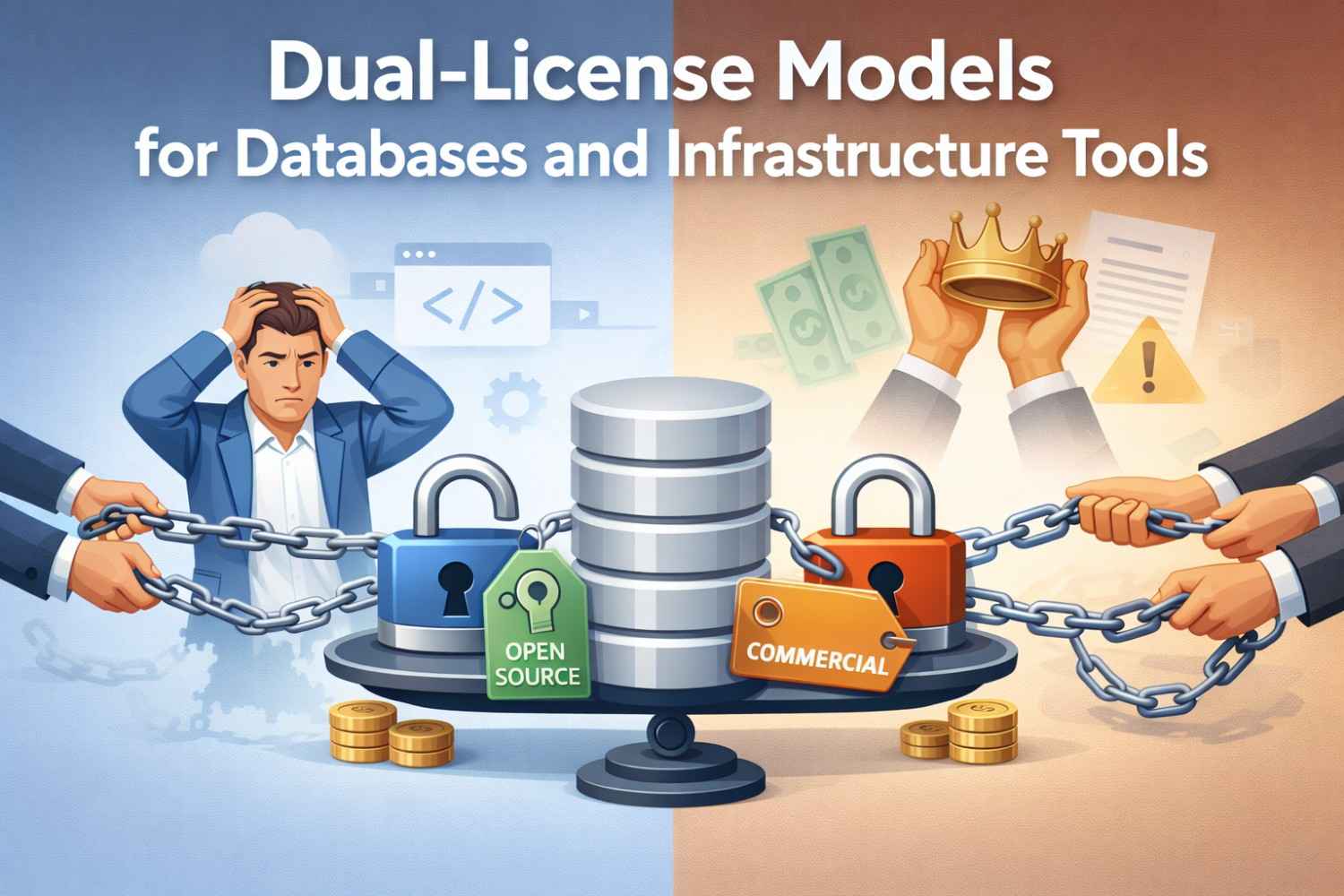
If you are building a database, a core backend tool, or deep infrastructure software, the license you choose can quietly decide your future. It can shape who uses your product, who pays you, who copies you, and how hard it is to protect what you built. Most founders realize this too late. This article exists so you do not.
At PowerPatent, we work with builders who create serious technical tools. The kind that runs inside other products. The kind that becomes hard to replace once adopted. These tools are powerful, but they are also easy to misuse if the business model is not locked down early. Dual-license models have become one of the most common ways founders try to balance growth with control. When done right, they can help you grow fast while still keeping leverage. When done wrong, they can give away the farm.
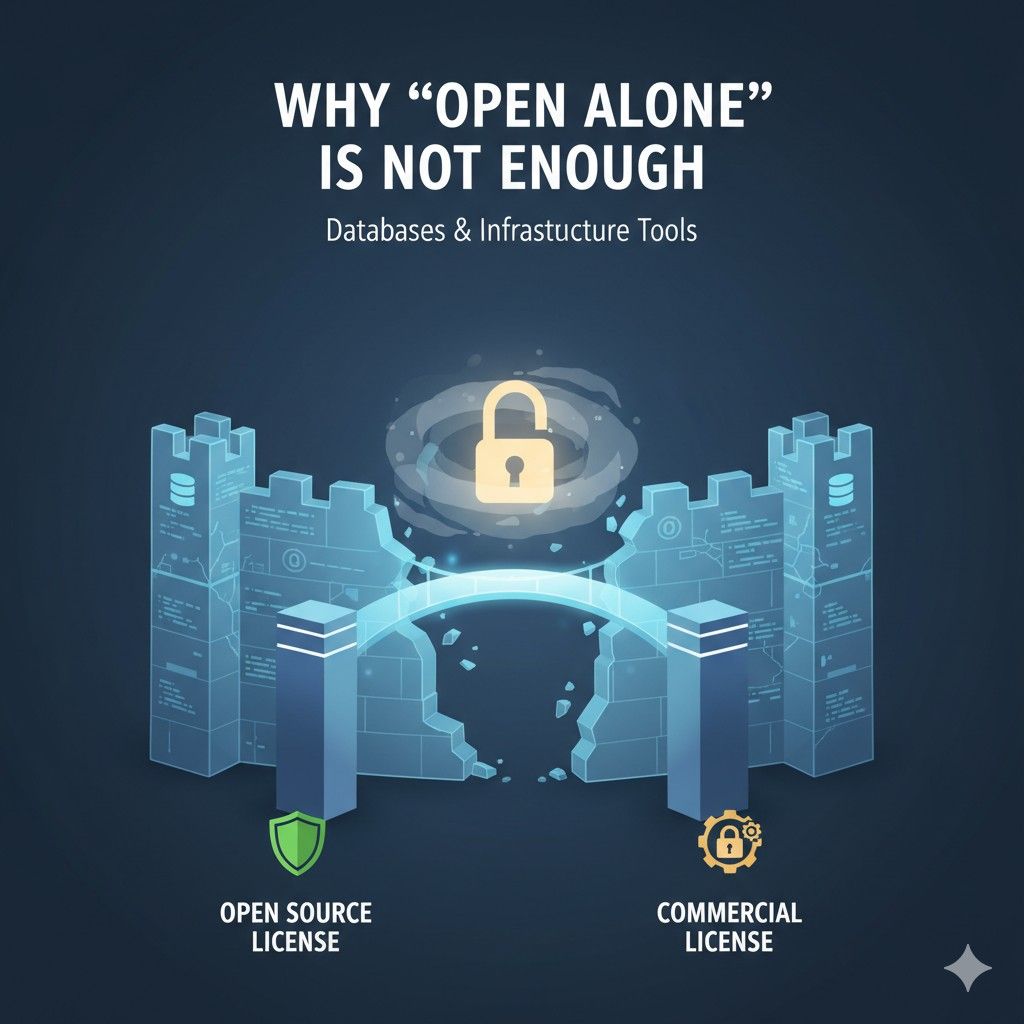
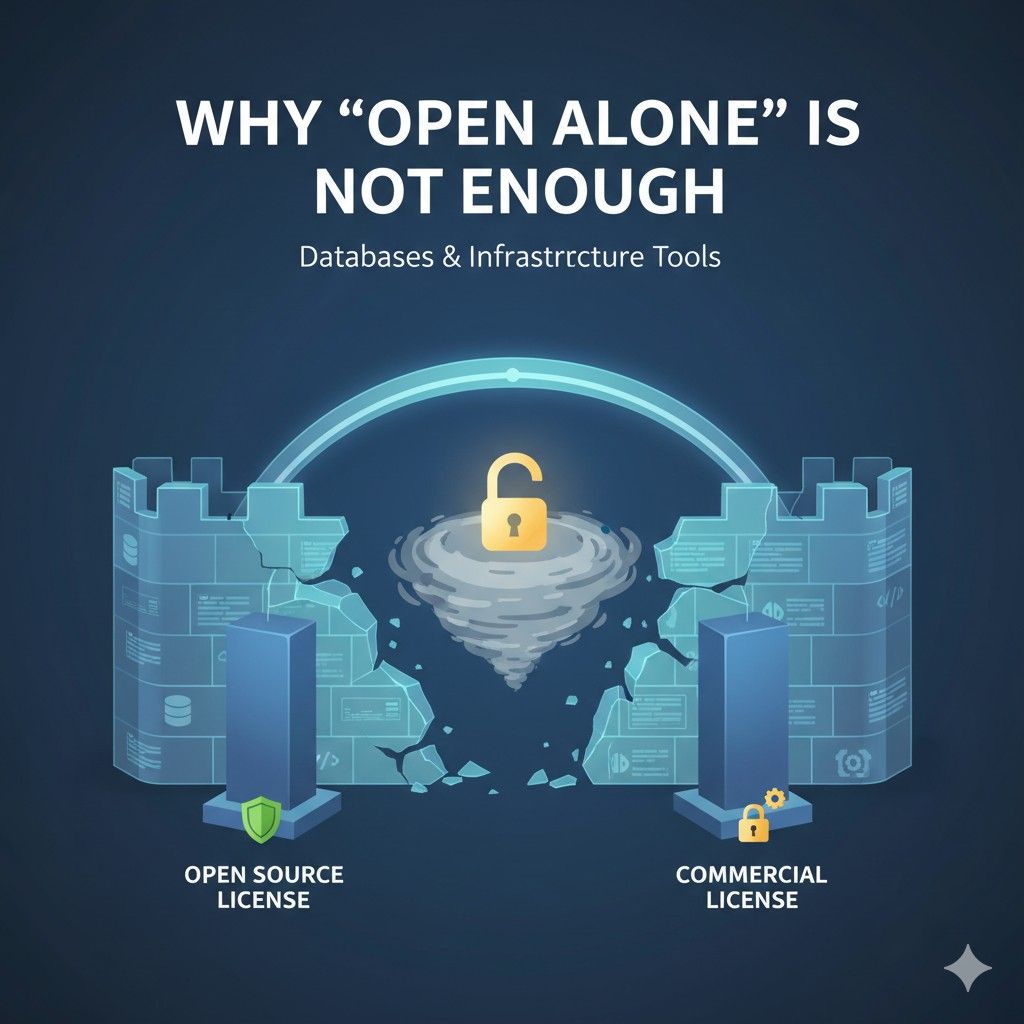
Why Open Alone Is Not Enough for Databases and Core Tools
Open sounds clean. It sounds fair. It sounds like the fastest way to win trust and adoption. For many founders building databases and infrastructure tools, open feels like the obvious choice.
You put the code out there, developers love you, usage grows, and somehow the business works itself out later. That story is nice, but it is rarely how things actually play out.
The reality is that databases and core tools sit at a very sensitive layer of the stack. Once someone depends on them, switching becomes painful. That creates huge value, but only if you still control how that value is captured.
Pure open models often give away that control far too early, long before a company is strong enough to defend itself.
The Infrastructure Trap Most Founders Walk Into
When you build infrastructure, you are not building a feature. You are building a foundation.
Other products rest on top of it. Teams ship revenue-generating software that depends on your work. This makes adoption sticky, but it also makes your product easy to absorb into someone else’s business.
Large companies understand this better than most founders. If your license allows them to use, modify, and resell your database or tool freely, they will.
They can wrap it with their own services, sell it at scale, and never pay you a dollar. This is not because they are evil. It is because the license allows it.
Many founders assume brand or community will protect them. In infrastructure, that protection is weak. Buyers care about stability, support, and pricing power.
If a large vendor can offer your product as part of a bundle, brand loyalty disappears fast.
Why Adoption Without Control Is a Dead End
Early adoption feels like progress. GitHub stars go up. Slack communities grow. People tweet about your tool. But if adoption is not paired with control, it does not turn into leverage.
Control means you decide how your product is used in production. Control means you decide who can sell it.
Control means you decide when and how money enters the picture. Pure open licenses remove most of that control on day one.
Founders often tell themselves they will “figure out monetization later.” The problem is that later comes when users already expect everything to be free.
Any attempt to tighten terms feels like a betrayal, even if the business cannot survive otherwise.
This is where many strong technical products stall. The technology works. The users love it. But the company cannot turn usage into a durable business.
Databases Are Not Libraries
One big mistake is treating databases and infrastructure tools like simple developer libraries. Libraries are swapped easily. Databases are not. Once data lives inside your system, the cost of leaving is high. That creates power.
If you give away that power through a permissive license, you are giving away your strongest advantage.
Cloud providers understand this deeply. They are happy to run your database as a managed service, undercut your pricing, and use their distribution to win customers.
Founders often realize this only after a cloud provider launches a competing hosted version. At that point, changing the license becomes messy and emotional. Users feel burned. Trust erodes. The internet does not forget.
Open Code Does Not Mean Open Business
There is a quiet but important difference between open code and an open business.
You can share source code and still keep business leverage. You can encourage contribution while protecting commercial value. Open alone is not enough, but open plus structure can work very well.
Dual-license models exist because founders needed a way to separate community use from commercial exploitation. They are a response to real pain, not a theoretical idea.
When done thoughtfully, they allow learning, experimentation, and trust without giving away the company.
This is also where early decisions matter most. Retrofitting structure after growth is always harder than building it in from the start.
The Investor Perspective Founders Often Miss
Investors look at infrastructure companies very differently than founders do. They ask quiet questions about defensibility.
They want to know what stops a bigger player from copying the product and selling it cheaper. If the answer is “community” or “goodwill,” that is rarely enough.
A pure open license with no backstop raises red flags. It signals that the company may struggle to enforce boundaries later. Dual licensing, when paired with patents or clear ownership, signals forethought and control.
This is why smart founders think about licensing and IP together, not separately. PowerPatent exists because too many companies wait until these questions are urgent instead of strategic.
If you want to see how that thinking works in practice, you can explore it here: https://powerpatent.com/how-it-works.
When Open Slows You Down Instead of Speeding You Up
Another uncomfortable truth is that pure open can slow down decision-making. When every change affects a broad public audience, roadmaps become political. Breaking changes become painful. Strong opinions pile up.
For early-stage infrastructure companies, speed matters more than consensus. You need room to evolve the product quickly based on real customer needs, not just loud voices.
Licensing structure gives you that room. It lets you prioritize paying users without shutting out experimentation.
This balance is hard, but it is possible. Companies that get it right treat openness as a tool, not a religion.
Actionable Thinking for Founders Building Core Tools
If you are early, the most important action is not picking a license blindly. It is understanding what you want to protect.
Ask yourself who could realistically make money from your product without you. That answer should shape your approach.
Another key move is aligning your technical roadmap with your business boundaries. If your core engine is the value, guard it. If extensions are the value, open the core and control the edges.
There is no single right answer, but there is always a wrong one: deciding by default.
Finally, document your intent early. Clear ownership, clear contribution rules, and clear paths to commercial use reduce friction later. They also make future changes feel like evolution, not betrayal.
This is also where patents quietly matter. Patents do not stop sharing. They stop extraction. They give you leverage when licenses alone are not enough. Founders who understand this early sleep better later.
If you want help thinking through this without drowning in legal noise, PowerPatent was built for exactly that.
You can see how founders use it to protect deep tech while still moving fast here: https://powerpatent.com/how-it-works.
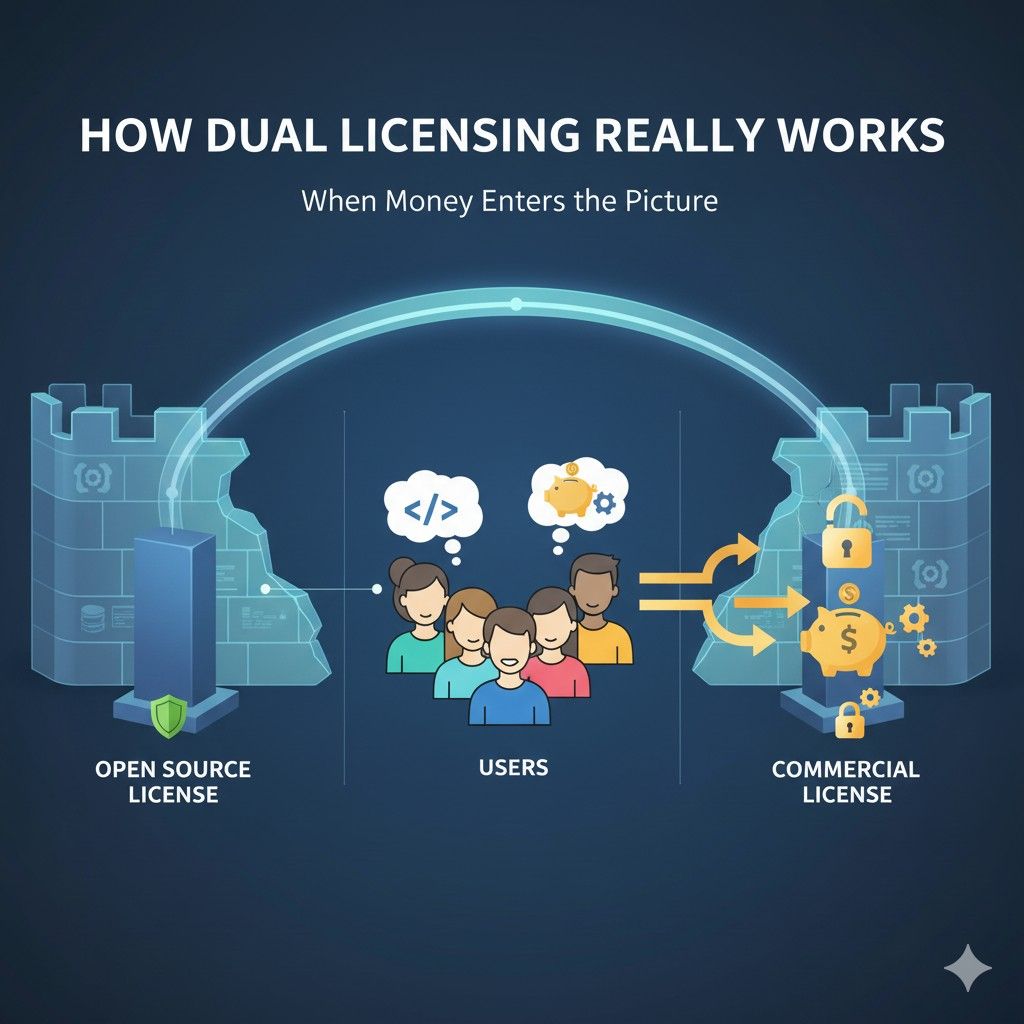
How Dual Licensing Really Works When Money Enters the Picture
Dual licensing sounds simple on the surface. One version is open. Another version is paid. But in practice, it is not a switch you flip. It is a system you design.
Money changes how users behave, how partners negotiate, and how competitors react. If you do not plan for that shift, dual licensing can create confusion instead of leverage.
This section explains how dual licensing actually plays out once real customers, real contracts, and real revenue show up. Not in theory, but in day-to-day company building.
The Moment Free Use Turns Into Real Value
In the early days, users often treat your database or tool as a toy. They test it. They benchmark it. They deploy it in side projects. This is healthy. It spreads awareness and improves the product.
The shift happens when the tool moves into production. That is when uptime matters. That is when data loss becomes a business risk. That is when legal teams start asking questions.
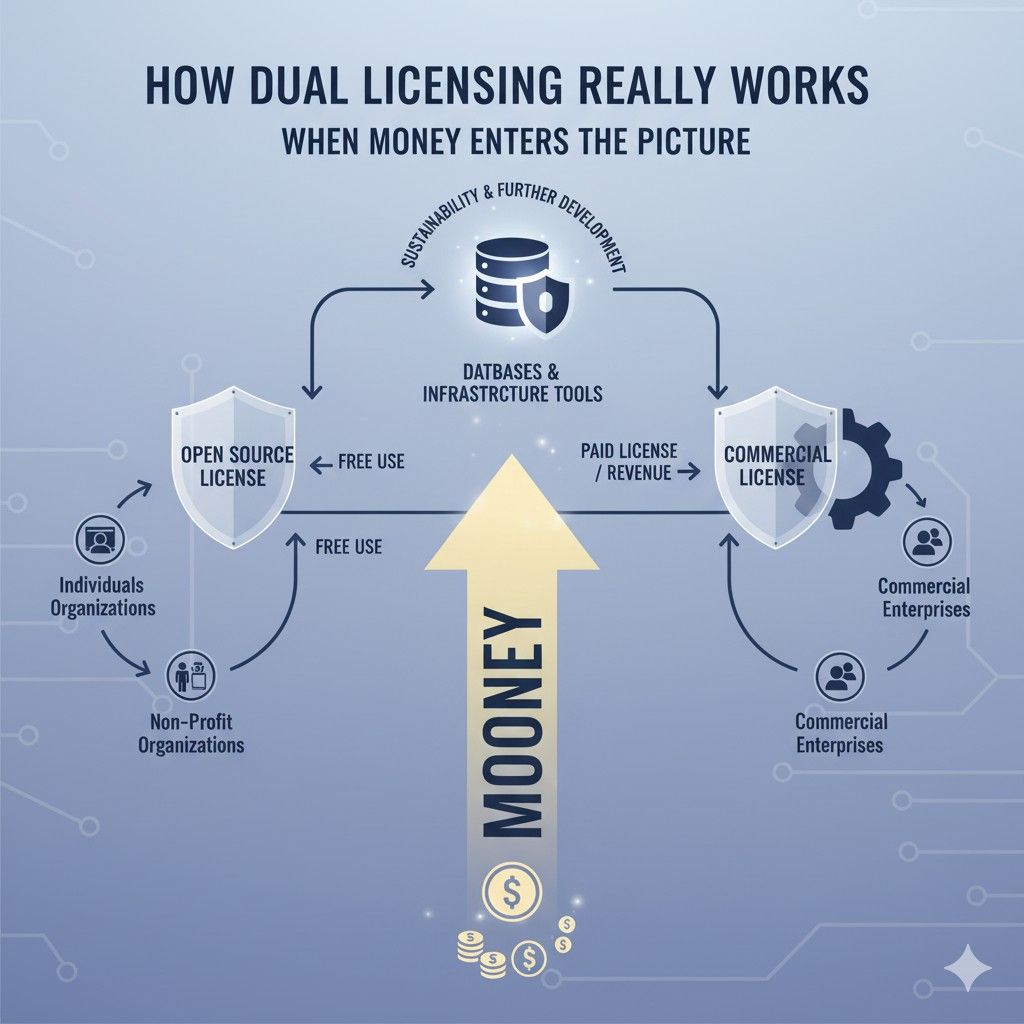
Dual licensing is designed to draw a clear line at that moment. Free use stays free when the risk is low. Paid use appears when the stakes rise. This boundary must feel natural, not forced.
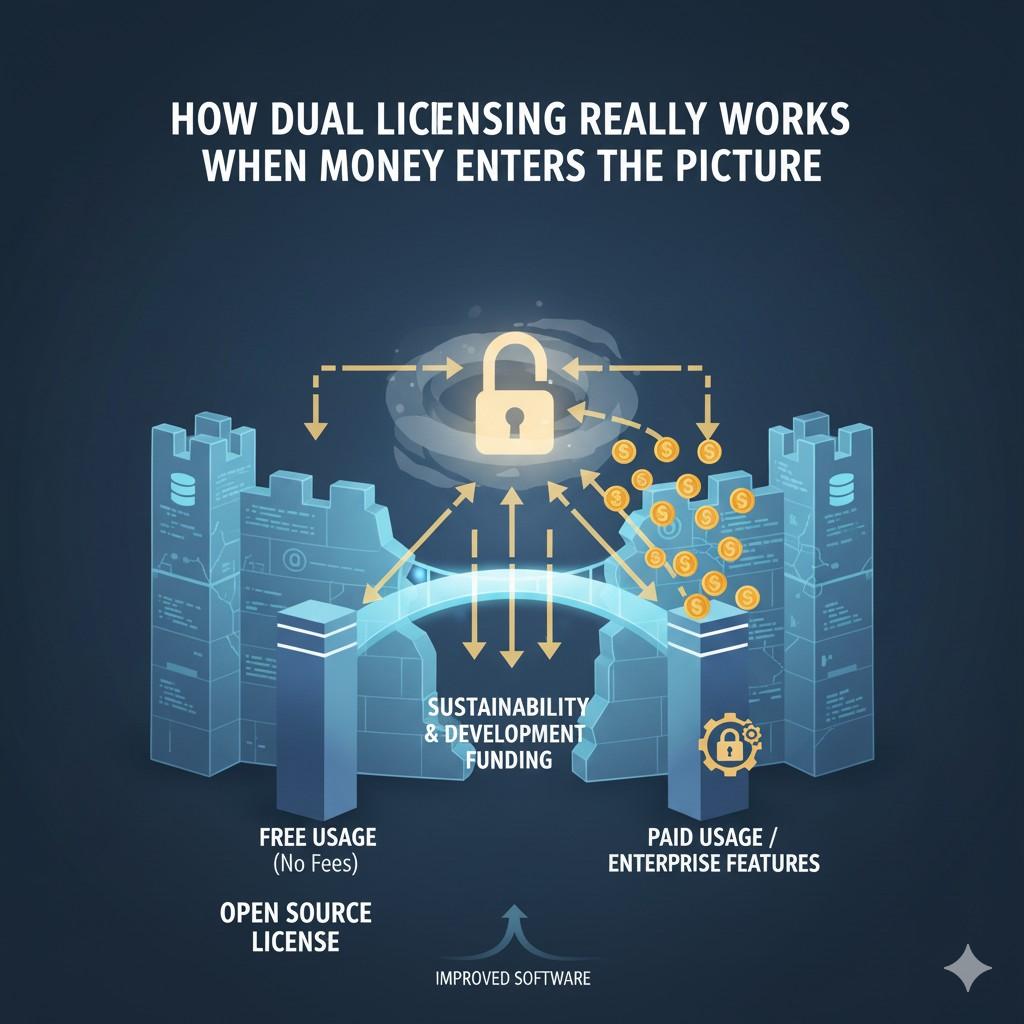
Founders who succeed here do one thing well. They define production use in a way that matches how customers already think. If your definition feels artificial, customers will push back. If it mirrors reality, they accept it.
Why Pricing Is Not the Center of the Model
Many founders focus too much on price and not enough on permission. Dual licensing is less about how much you charge and more about what you allow.
The paid license usually grants rights, not features. Rights to embed. Rights to resell. Rights to run as a managed service. These are valuable because they unlock business models, not because they unlock code.
When founders treat the paid license like a feature bundle, they miss the point. Competitors can replicate features. They cannot replicate permission if it is enforced cleanly.
This is also why clarity matters more than generosity. A cheap license with vague terms creates more friction than a clear license with firm boundaries.
Enterprise Buyers Care About Risk, Not Ideology
Enterprise customers do not care if your project is open source in spirit. They care about liability, support, and predictability.
Dual licensing gives them something concrete to sign. It tells their legal team exactly what they can and cannot do. It tells procurement how risk is handled. It tells engineering who to call when something breaks.
Founders sometimes worry that enterprises will reject anything that is not fully open. In practice, the opposite is often true. Enterprises are wary of tools with no clear owner or accountability.
A dual-license model signals maturity. It says there is a company standing behind the product, not just a repository.
The Silent Negotiation With Cloud Providers
One of the most important audiences for your license is one you may never speak to directly. Cloud providers read licenses closely. They look for gaps. They look for ambiguity.
If your license allows them to offer your database as a service without sharing revenue, they will. If it does not, they may still try, but you have leverage.
Dual licensing changes this negotiation even when no words are exchanged. It sets expectations. It draws boundaries. It forces large players to either partner, license, or walk away.
Founders who ignore this dynamic often wake up to find their product competing with a hosted version they do not control. At that point, the leverage is gone.
The Operational Cost of Getting It Wrong
Poorly designed dual-license models create daily friction. Sales teams struggle to explain terms. Users are unsure when they need to pay. Legal reviews drag on.
This friction does real damage. Deals slow down. Trust erodes. Support tickets increase.
The fix is not more complexity. It is alignment. The license must match how the product is actually used. If your database is mainly valuable when it holds critical data, anchor the paid license there.
If your tool becomes valuable when redistributed, anchor it there.
Every clause should map to a real behavior you want to allow or restrict.
Contribution Without Losing Control
One fear founders have is that dual licensing will scare away contributors. This happens when contribution rules are unclear or unfair.
Successful companies make contribution paths explicit. Contributors know what happens to their code. They know the company can commercialize it. They know why that tradeoff exists.
Transparency builds trust. Surprise destroys it.
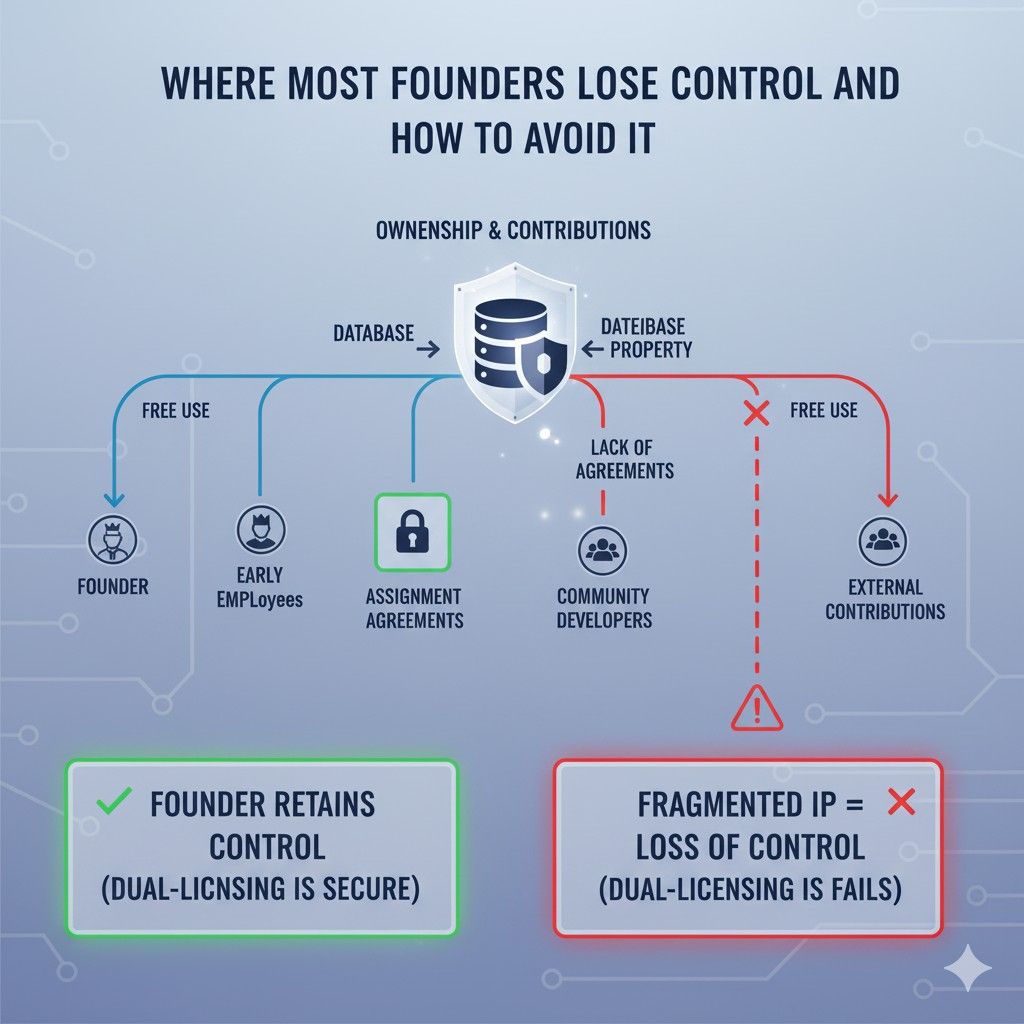
If you rely on community contributions, you must pair dual licensing with clean contribution agreements. This is not about legal muscle. It is about respect and predictability.
How Revenue Changes Product Decisions
Once money enters the picture, priorities shift. Paying users influence the roadmap. Support expectations rise. Stability becomes more important than novelty.
Dual licensing helps manage this tension. It allows you to support serious users deeply without abandoning experimentation. Free users still exist, but they are no longer the only voice.
Founders who do not separate these audiences often feel pulled in opposite directions. Dual licensing creates a healthy filter. It does not silence anyone, but it weights decisions toward sustainability.
The Role of Patents in Enforcing Dual Licensing
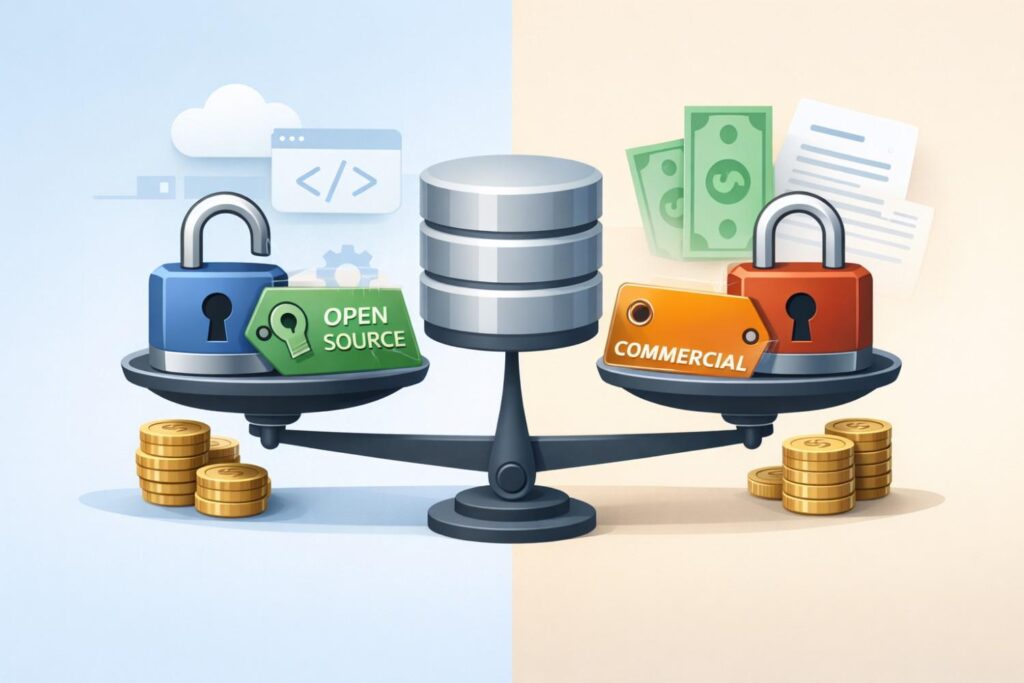
Licenses are contracts. They work best when backed by real leverage. Patents provide that leverage quietly.
If someone violates your license, a patent gives you options beyond contract enforcement. It gives you a second layer of defense. This matters most when dealing with large companies that are comfortable pushing boundaries.
This is why smart infrastructure companies think about patents early, even if they never plan to sue. The goal is deterrence, not conflict.
PowerPatent exists to make this step practical for technical founders. Instead of slowing you down, it helps you lock in protection while you keep building. You can see how this works here: https://powerpatent.com/how-it-works.
Actionable Guidance for Founders Implementing Dual Licensing
The most practical move you can make is to write down your red lines. Decide what uses you will never allow for free. Decide what uses you are happy to encourage. Everything else flows from that clarity.
Next, test your license language against real scenarios. Imagine a startup embedding your database. Imagine a cloud provider hosting it. Imagine a consultancy reselling it. If the outcome feels wrong in any case, adjust.
Finally, communicate early and often. Dual licensing works best when users understand it before they need it. Surprises cost goodwill. Clear expectations build long-term trust.
Money does not ruin open projects. Confusion does. Dual licensing, when designed with care, lets you grow, get paid, and stay in control at the same time.
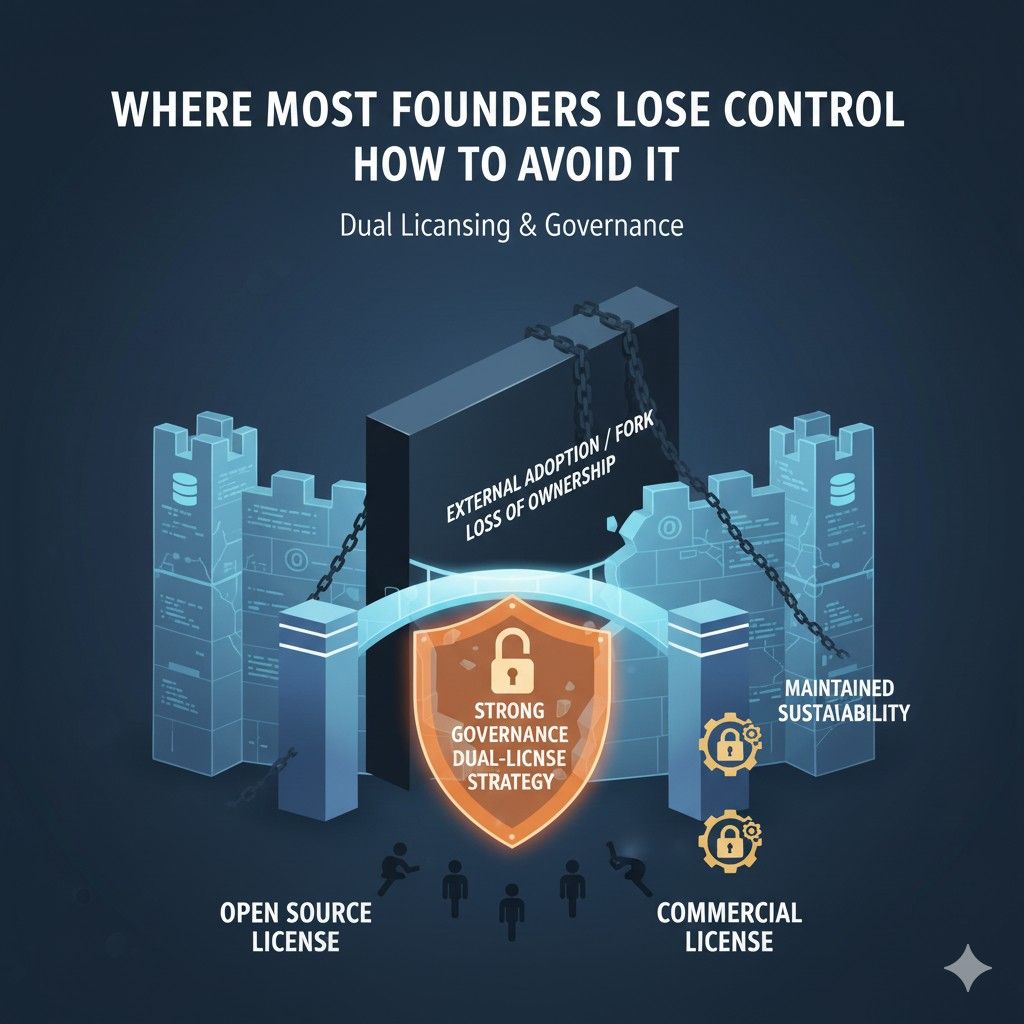
Where Most Founders Lose Control and How to Avoid It
Most founders do not lose control in one dramatic moment. It slips away quietly. A small decision here. A rushed choice there. By the time the problem is visible, fixing it is expensive, emotional, and sometimes impossible.
This section focuses on the exact places where control is usually lost when building databases and infrastructure tools, and how thoughtful founders avoid those traps early.
The Slow Drift From Intent to Reality
Every founder starts with an intent. You want wide adoption, but you also want a real business. Over time, that intent can drift if it is not anchored.
The drift often begins when early users push the product into production faster than expected. What was meant for testing becomes mission critical. Suddenly, companies depend on your tool, but the license still treats them like hobbyists.
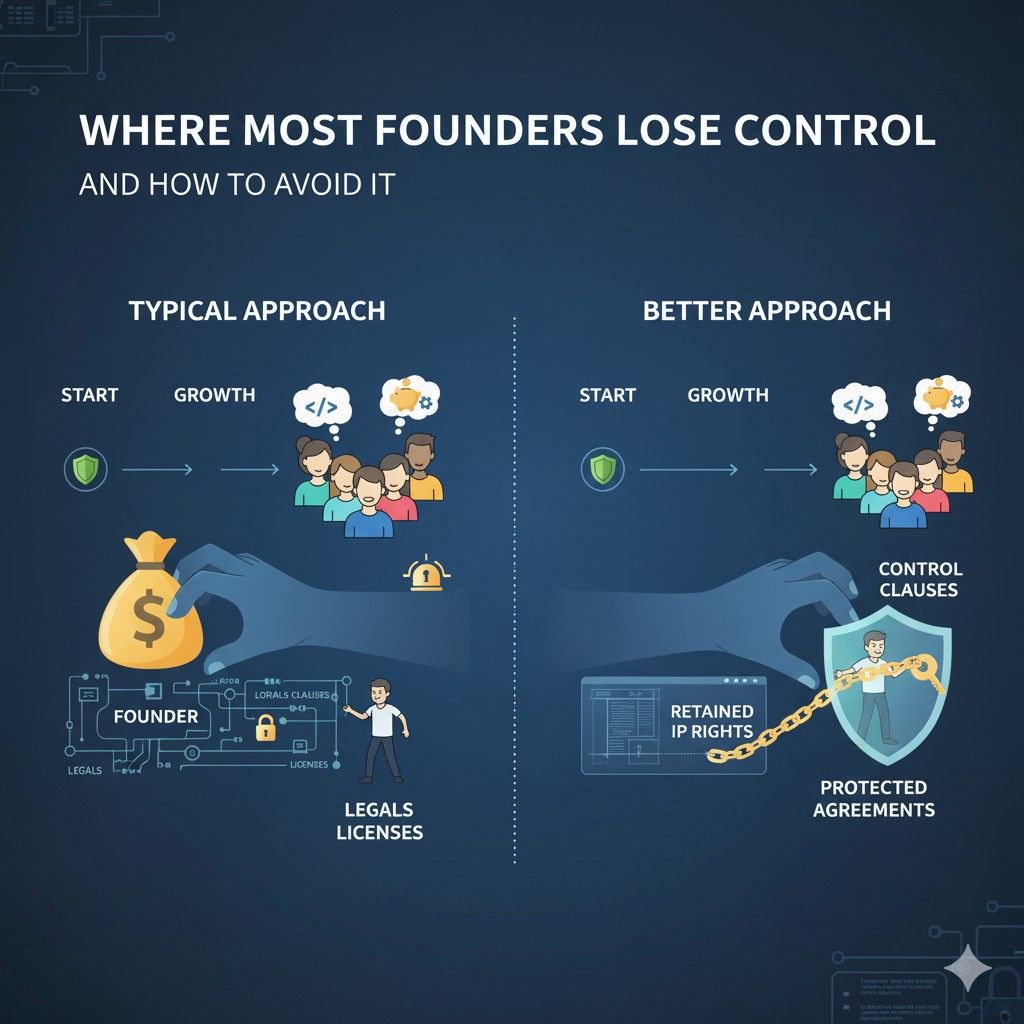
This gap creates pressure. Users expect stability and support. You feel responsible. But you have no formal leverage to charge or enforce boundaries. The fix is not confrontation. It is alignment.
Founders who avoid this trap review how their product is actually used every few months and adjust boundaries early, before dependency hardens.
Letting Community Momentum Override Business Sense
Community energy feels powerful. When people contribute code, write blogs, and advocate for your tool, it is tempting to say yes to everything.
The danger is confusing appreciation with obligation. You can value your community without handing over control of the business.
This becomes critical when community members ask for exceptions, special rights, or permanent free use in commercial settings. Each exception weakens your position and creates precedent.
Strong founders stay kind but firm. They explain the why behind decisions. They do not negotiate away the future for short-term praise.
The Hidden Cost of Vague Language
Ambiguity feels friendly. It avoids conflict. But in licensing, vague language is where control leaks out.
Phrases like “non-commercial use” or “internal use only” sound clear until someone interprets them differently. A company may claim their use is internal even if it supports a paid product.
A service provider may claim they are not reselling, only “helping clients deploy.”
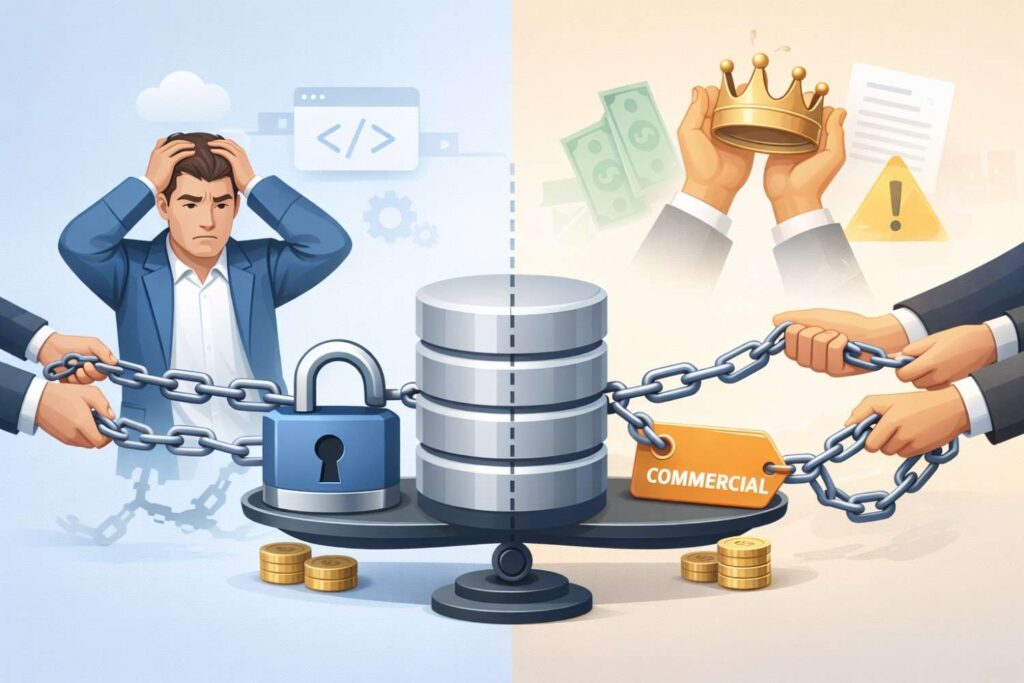
Clear language prevents these arguments before they start. It protects relationships as much as it protects revenue.
Founders who win here write terms as if they will be read by someone looking for loopholes, because eventually they will be.
Waiting Too Long to Protect the Core
Another common mistake is postponing protection because it feels premature. Founders tell themselves they are too early for patents, too small for enforcement, too busy to think about IP.
The truth is that early is when protection is cheapest and cleanest. Once code is widely distributed and deeply integrated, options narrow.
Patents are not about locking things down. They are about setting ownership clearly while the surface area is still small. They give you options later, even if you never use them aggressively.
This is why many deep tech founders work with PowerPatent early. It lets them capture what makes their system unique without slowing development. You can see how that works here: https://powerpatent.com/how-it-works.
Selling Support Instead of Selling Rights
Many infrastructure startups default to selling support because it feels safe. Support is tangible. It feels fair. But support alone is a weak moat.
Large companies can outspend you on support. Cloud providers can bundle support with hosting. Over time, support becomes a cost center instead of a growth engine.
Selling rights through licensing scales better. It aligns revenue with value creation. It protects against commoditization.
Founders who rely only on support often realize too late that they trained customers to expect everything else for free.
Misreading Early Enterprise Signals
Early enterprise interest is exciting. A big logo shows up. A serious conversation starts. It feels like validation.
This is also when founders are most vulnerable. In the rush to close a deal, they agree to terms that undermine the broader model. Custom exceptions creep in. Special pricing becomes permanent. License terms bend.
These early deals set patterns. Future customers ask for the same treatment. Sales teams assume flexibility is the norm.
Founders who keep control treat early enterprise deals as templates, not one-offs. They design terms they are proud to repeat.
The Belief That Enforcement Equals Aggression
Many founders avoid enforcing licenses because they fear backlash. They worry about being seen as hostile or anti-open.
Enforcement does not have to be aggressive. Most issues are resolved through conversation, not conflict. But you cannot have those conversations if you have no leverage.
Clear licenses and IP make enforcement calm and professional. They turn emotional debates into practical discussions.
Founders who avoid enforcement entirely often send the message that boundaries are optional. That message spreads quickly.
Building Without a Long-Term Map
Control is easier to maintain when you know where you are going. If your end goal is a hosted offering, your license should reflect that. If your goal is partnerships, your terms should support them.
Many founders license for today without thinking about tomorrow. When the strategy changes, the license becomes a constraint instead of a tool.
Strong teams revisit their model as the company evolves. They treat licensing as a living system, not a static document.
How to Stay in Control Without Slowing Down
The core principle is simple. Decide first, share second.
Decide what matters most to protect. Decide how you want to make money. Decide which users you want to empower for free. Then design everything else around those choices.
Do not wait for conflict to force clarity. Build clarity early and conflict becomes rare.
If you are building databases or infrastructure tools, this work is not optional. It is part of the product. And it is much easier to do with the right tools and guidance.
PowerPatent helps founders think through these decisions in plain language, with real outcomes in mind. It exists so control does not slip away while you are busy building. You can learn more here: https://powerpatent.com/how-it-works.
Wrapping It Up
Dual-license models are not about being strict or defensive. They are about being honest with yourself about the value you are creating and how easily that value can be taken if you are not careful. Databases and infrastructure tools sit at the center of real businesses. They hold data. They run systems. They create dependency. That power deserves structure.
Leave a Reply