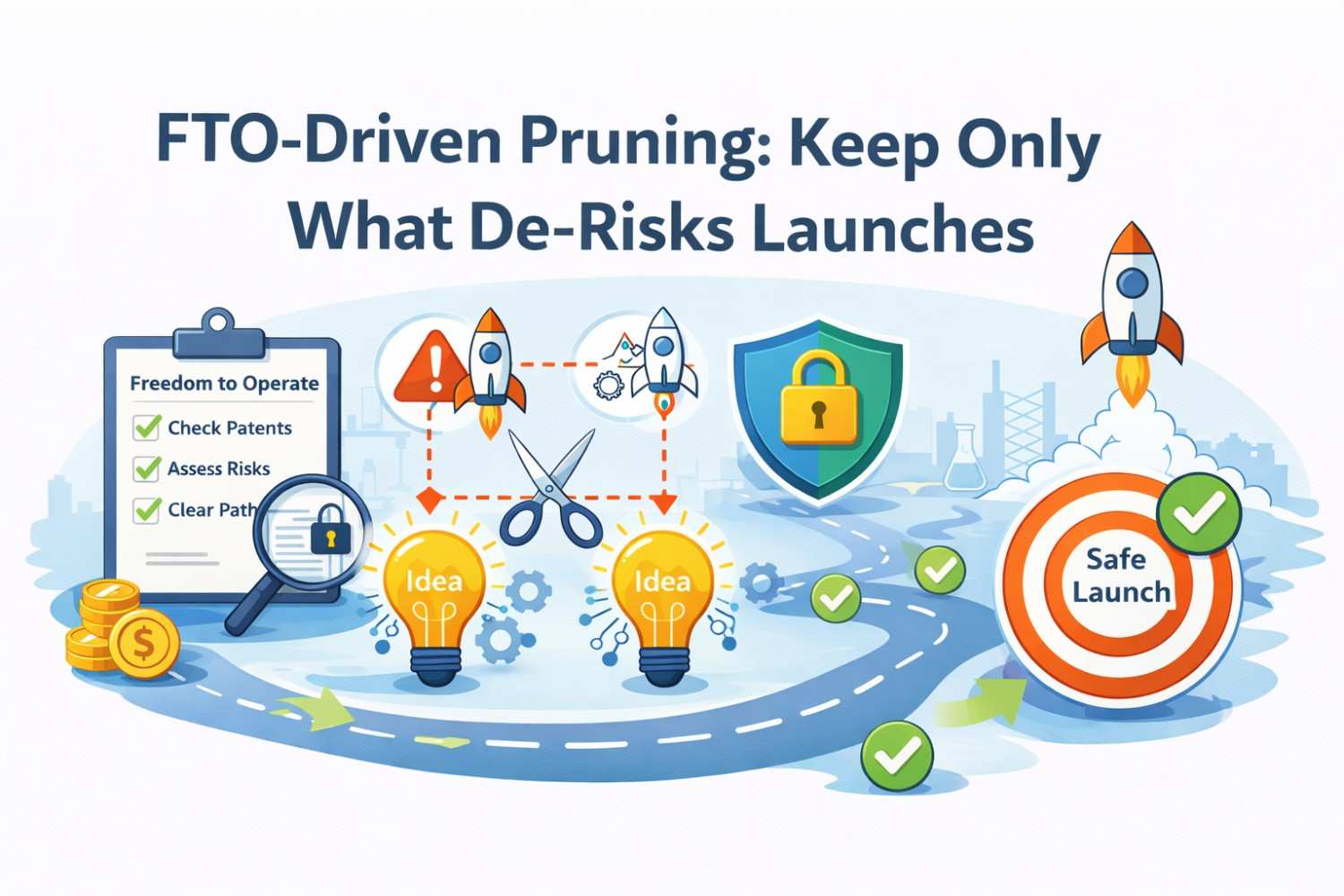
Launching a product without knowing your patent risk is like driving at night with your headlights off. You might be fine. Or you might hit something you never saw coming. FTO-driven pruning means you look at the patent landscape early, cut out what creates risk, and keep only what helps you launch with confidence. It is not about fear. It is about control. If you are building deep tech, AI, hardware, biotech, or anything hard to copy, this approach can save your company from painful surprises. And if you want to see how to turn that clarity into real protection, you can explore how PowerPatent works here: https://powerpatent.com/how-it-works
Why Freedom to Operate Should Guide Your Product Decisions From Day One
Most founders think about patents after they build something. That feels natural. You build first. You protect later. But that order can hurt you. Freedom to Operate, or FTO, is not about filing your own patent.
It is about making sure you are not stepping on someone else’s. If you wait too long, you may build your roadmap around a feature you cannot safely ship. That wastes time, money, and momentum.
When FTO guides your decisions from the start, you build with awareness. You choose paths that reduce risk. You shape your product in a way that avoids conflict.
That gives you speed, not friction. It gives you leverage, not fear. And when you combine this with smart patent protection of your own, you create a launch plan that is both bold and safe.
If you want to see how to do that with software and real attorney support, you can explore how PowerPatent works here: https://powerpatent.com/how-it-works
FTO Is a Product Strategy Tool, Not a Legal Check
Most teams treat FTO like a final exam. They build the product. They get close to launch. Then they ask a lawyer, “Are we safe?” That mindset is backwards.
FTO should sit next to your product roadmap from day one. It should influence what you build, how you build it, and even what you choose not to build.
When you review the patent space early, patterns appear. You start to see crowded zones where large companies have many claims. You also see white space where fewer patents exist. This is not just legal data. It is product insight.
If a specific method of processing data is covered by several active patents, you can choose a different technical approach before you write thousands of lines of code.

If a hardware design element is tightly protected, you can rethink the mechanism before you tool up manufacturing.
This changes your mindset. You are not reacting to risk. You are designing around it.
Designing Around Risk Is Faster Than Fighting It
Many founders believe that risk means future lawsuits. The truth is simpler. Risk often means delay.
Imagine you discover a blocking patent two weeks before launch. Now you must pause. You may need to rewrite core code. You may need to remove a feature that customers expect. Investors may ask hard questions.
All of that can be avoided if you map the space early.
Designing around patents is not about copying or avoiding innovation. It is about choosing a different technical path to achieve the same result.
In software, this might mean changing how you structure a model training pipeline. In hardware, it might mean adjusting the geometry of a component. In biotech, it could mean selecting a different formulation or process step.
The key is to ask one simple question early and often: Is this the only way to solve this problem?
When you build this question into product reviews, you reduce the chance of getting trapped later.
Aligning Engineering With Patent Awareness
Engineering teams move fast. That is a strength. But speed without awareness can create hidden exposure.
You do not need every engineer to become a patent expert. What you need is a simple feedback loop.
When a new core feature is proposed, pause for a short review of the patent landscape around that function. Not a deep legal memo. Just a focused look at what exists.
This small step can uncover issues early. If you see that a major competitor has multiple patents around a very specific method, you can guide your engineers to explore alternative methods.
This keeps creativity alive while lowering risk.
It also creates a culture of smart building. Your team begins to think in terms of differentiation. They start asking, “How can we do this in a way that is truly ours?”
That mindset not only avoids conflict. It also strengthens your own future patents.
If you want to turn your technical choices into strong, defensible filings without slowing your team down, take a look at how PowerPatent supports founders with both AI tools and real attorneys here: https://powerpatent.com/how-it-works
FTO as a Filter for Feature Prioritization
Every startup has more ideas than time. You cannot build everything. FTO can help you decide what makes sense to ship first.
When you evaluate new features, do not only ask about market demand or engineering effort. Also ask about patent density.
If one feature sits in a crowded space with many active patents, and another solves a similar user pain in a less crowded area, that second feature may be smarter to prioritize.
This does not mean you avoid competition. It means you launch where friction is lower. You generate revenue faster. You gain traction before entering more complex zones.
This approach protects runway. It protects morale. It protects focus.

Over time, you can return to high-risk features with a clearer strategy. Maybe you develop your own patents that give you leverage. Maybe you license technology. Maybe you invent a new approach.
But in the early days, clarity is power.
Preventing Investor Red Flags Before They Appear
Investors care about risk. They may not ask detailed patent questions at first, but serious diligence always comes later.
If you cannot clearly explain your FTO position, that can slow down funding. If you discover conflicts during diligence, deals can stall or collapse.
When FTO guides your product decisions from the start, you build a clean story. You can say, “We reviewed the landscape in this area. We intentionally designed around existing claims. Here is how our approach differs.”
That shows maturity. It shows foresight. It shows that you are not just building fast, but building smart.
It also increases confidence in your leadership. Investors want founders who anticipate problems, not just react to them.
Avoiding Emotional Attachment to Risky Features
Founders often fall in love with specific features. It is natural. You spent months building it. It feels like the heart of the product.
But if a feature creates real patent exposure, you need the discipline to rethink it.
When FTO is part of your early process, you reduce emotional shock later. Risky elements are identified before they become sacred.
This makes it easier to pivot at the idea stage instead of the launch stage.
Ask your team to document not only what a feature does, but why it must be done that way. If the answer is weak, that is a sign you can redesign it.
This practice strengthens both your product and your legal position.
Using FTO to Strengthen Your Own Patent Filings
FTO is not just defensive. It can shape offense.
When you study the patent landscape, you see gaps. You see what others have not claimed. You see edges of ideas that are underdeveloped.
Those insights can guide your own patent strategy. Instead of filing broad, vague claims, you can focus on areas where you truly stand apart.
This makes your patents more valuable. It also reduces the risk that your own application runs into existing claims.
At PowerPatent, we often see founders who build first and think about patents later.
When they combine FTO insights with structured patent drafting and real attorney review, the result is stronger protection with fewer surprises.
You can explore how that works in practice here: https://powerpatent.com/how-it-works
Making FTO Part of Your Weekly Rhythm
FTO should not be a one-time project. The patent landscape changes. New filings appear every week.
You do not need constant deep analysis. What you need is rhythm.
When you enter a new technical area, pause and review. When you plan a major product update, check again. When you consider expansion into a new market, reassess.
This habit keeps you ahead. It prevents last-minute panic. It allows you to build a product that is not only innovative, but launch-ready.
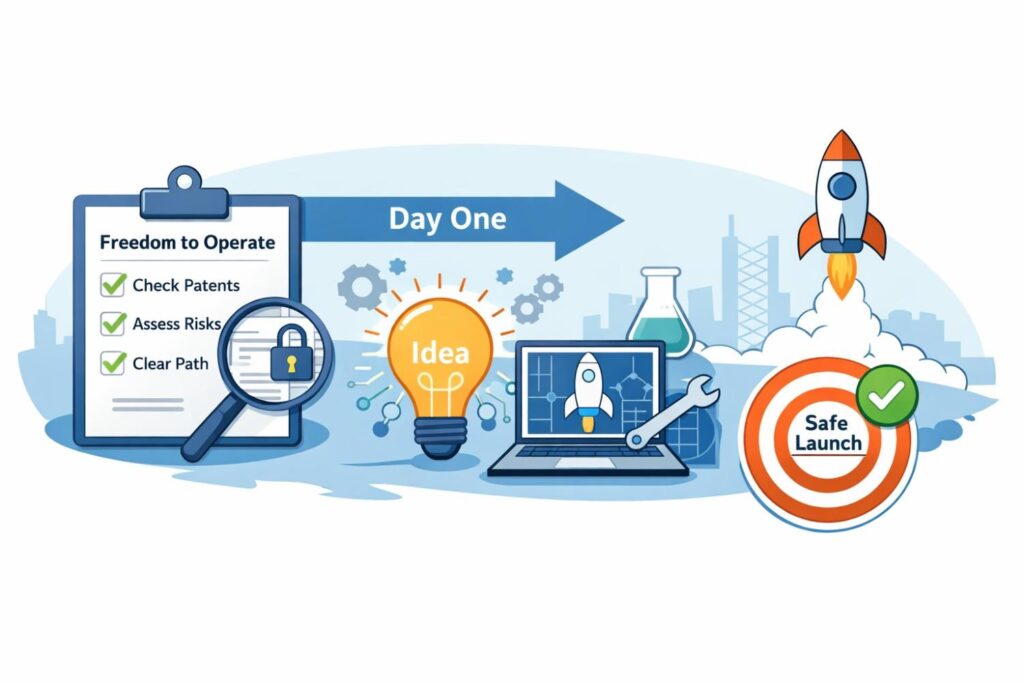
Freedom to Operate is not about slowing down. It is about clearing the road in front of you. When you make it part of your product DNA from day one, you stop guessing and start building with confidence.
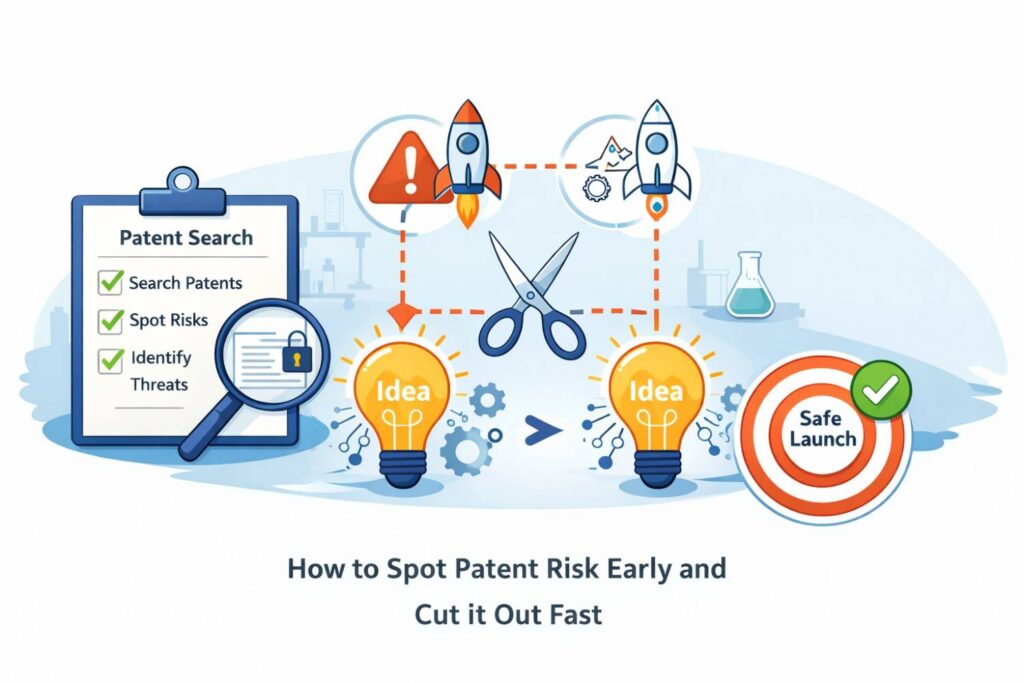
How to Spot Patent Risk Early and Cut It Out Fast
If you wait for a cease-and-desist letter to think about patent risk, you waited too long. The real advantage comes from seeing risk before it hardens into code, hardware, or customer promises.
Spotting patent risk early is not about running scared. It is about making small, smart edits while change is still cheap.
When you treat patent review as part of product discovery, you gain leverage. You are still shaping the idea. You are still flexible. That is the perfect moment to prune what creates exposure and double down on what is clean.
The goal is simple. See the risk. Understand it. Remove it before it grows roots.
Start With the Core Technical Move
Every product has a core move. It may be how you process data, how you compress signals, how you route traffic, how you train a model, or how you assemble parts. That core move is often where patent risk lives.
Do not begin with surface features. Begin with the engine. Ask what technical step makes your product work in a unique way. Then look outward.
Search for patents that describe similar methods. Focus on active patents. Read the claims slowly. You are not reading for storytelling. You are reading to see what they legally control.
If a claim says a system that performs steps A, B, and C in a specific order, and your system does the same three steps in the same order, that is a signal.
But here is the key insight. Small technical changes can matter. If you perform B before A, or if your C uses a different structure, that difference may be enough to step outside their claims.
The earlier you catch this, the easier it is to adjust.
Look for Narrow Claims That Box You In
Not all patents are broad. Many are narrow and very specific. These can still create risk if your design lines up too closely.
When reviewing patents in your space, pay attention to details that appear repeated. If multiple patents focus on a specific parameter, configuration, or threshold, that area may be tightly controlled.
For example, if several patents claim a method that triggers an action when a value crosses a defined limit, and your system does the same thing in the same way, that overlap matters.
Instead of copying the pattern, step back. Ask whether you can measure something else. Ask whether you can trigger the event differently. Ask whether you can redesign the logic.
These shifts may feel small. But small shifts made early prevent big rewrites later.
Separate Inspiration From Imitation
Founders study competitors. That is smart. You want to know what works. But copying technical approaches without understanding patent coverage is dangerous.
If a large company markets a feature heavily, there is a strong chance they have protected it. The more central the feature is to their brand, the more likely it is covered by patents.
When you see something impressive in the market, do not assume it is safe to replicate. Instead, treat it as a signal to investigate.
Review patents owned by that company in the relevant area. Look at what they claim. You may discover that the marketed feature is just one version of a broader idea.
Once you see the boundaries, you can design your own approach that solves the same customer problem in a new way. That is real innovation.
Map Risk to Your Roadmap
Patent risk is not equal across all features. Some parts of your product matter more than others.
Focus first on elements that are central to revenue, differentiation, and user value. If those parts carry risk, they deserve immediate attention.
On the other hand, if a minor backend optimization overlaps with a patent but can be replaced easily, that is less urgent.
Tie your FTO review directly to your roadmap. When a feature moves from idea to development, run a focused patent scan. When a feature moves from beta to launch, confirm that nothing major changed.
This approach avoids wasted effort. You are not reviewing everything at once. You are reviewing what matters most at the moment of decision.
Watch for Language That Matches Too Closely
Patent claims are built around words. If your technical documentation uses the same phrases as a patent claim, pause.
This does not mean you are infringing. But close language often reflects close structure.
When engineers describe a system, they tend to use precise terms. Compare those terms to claim language in relevant patents. If you see heavy overlap, dig deeper.
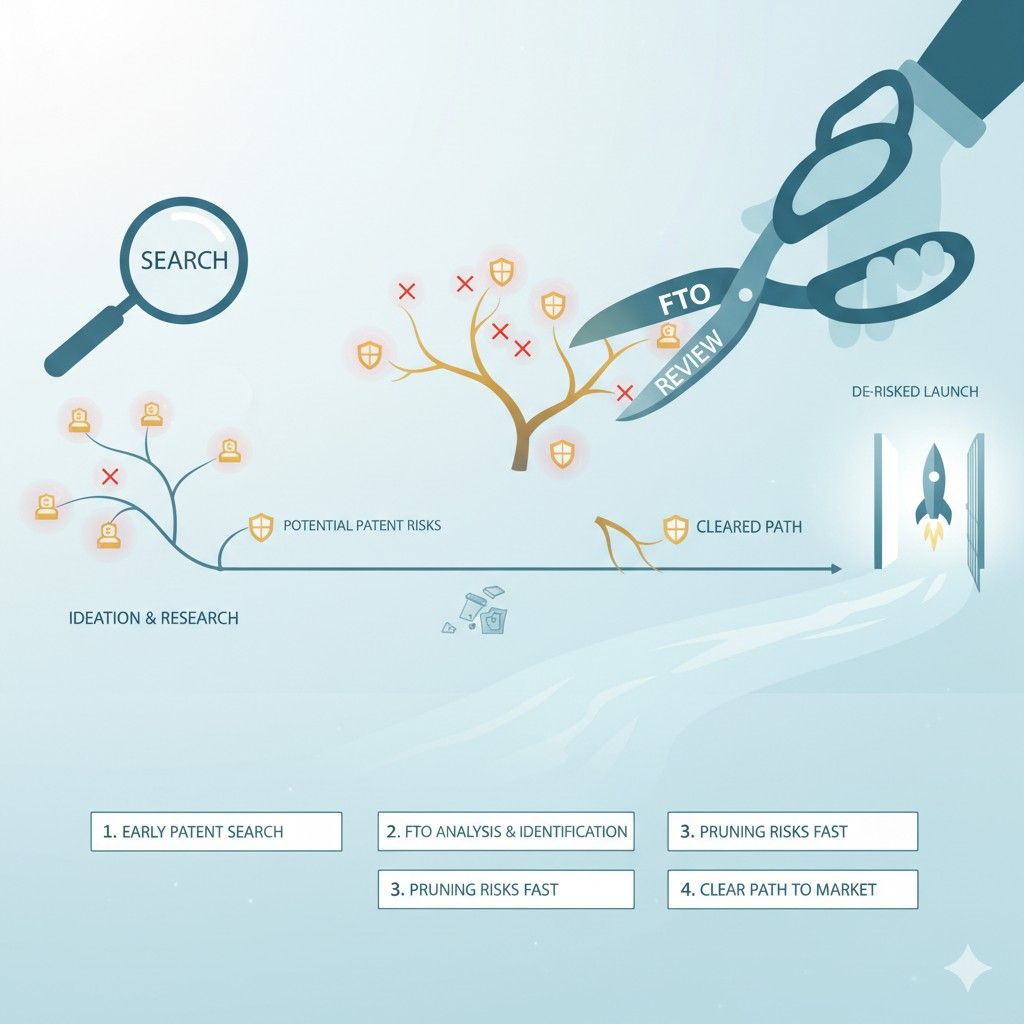
Sometimes the fix is simple. A different data flow. A different ordering of operations. A different input structure.
These changes may not alter user experience. But they can shift your position relative to existing claims.
Use Prototypes as Testing Grounds
Early prototypes are perfect for risk pruning. At that stage, nothing is locked in.
As you test technical options, review each path with a basic FTO lens. If one design seems clean and another seems crowded with patent overlap, choose the cleaner path.
This keeps your technical debt low. It also avoids investing heavily in code or tooling that may need to be scrapped.
Founders often think FTO slows experimentation. In truth, it sharpens it. You experiment with awareness. You test with boundaries in mind.
Bring in Real Review Before It Is Too Late
Search tools are helpful, but interpretation matters. Patent claims can look simple but hide traps in wording.
Before finalizing a core architecture, it is wise to have a structured review with someone who understands how claims are read in practice. That does not mean months of analysis.
It means targeted insight around your highest-risk areas.
At PowerPatent, founders use smart software to map their invention clearly, and then real patent attorneys review and guide the strategy.
That mix helps you spot issues early without slowing down the build cycle. You can see how that process works here: https://powerpatent.com/how-it-works
Cut Fast, Then Move Forward
Once you identify real risk, act quickly. Do not debate endlessly. Do not hope it goes away.
If a feature sits squarely within the scope of a strong, active patent, either redesign it or remove it.
Speed matters here. The longer you wait, the more teams build on top of that risky foundation. That makes change harder.
Pruning is not failure. It is discipline. You are choosing a safer path before customers ever see the risky one.
This habit builds a culture of smart execution. Your team learns that good ideas must also be safe ideas. Over time, this mindset becomes second nature.
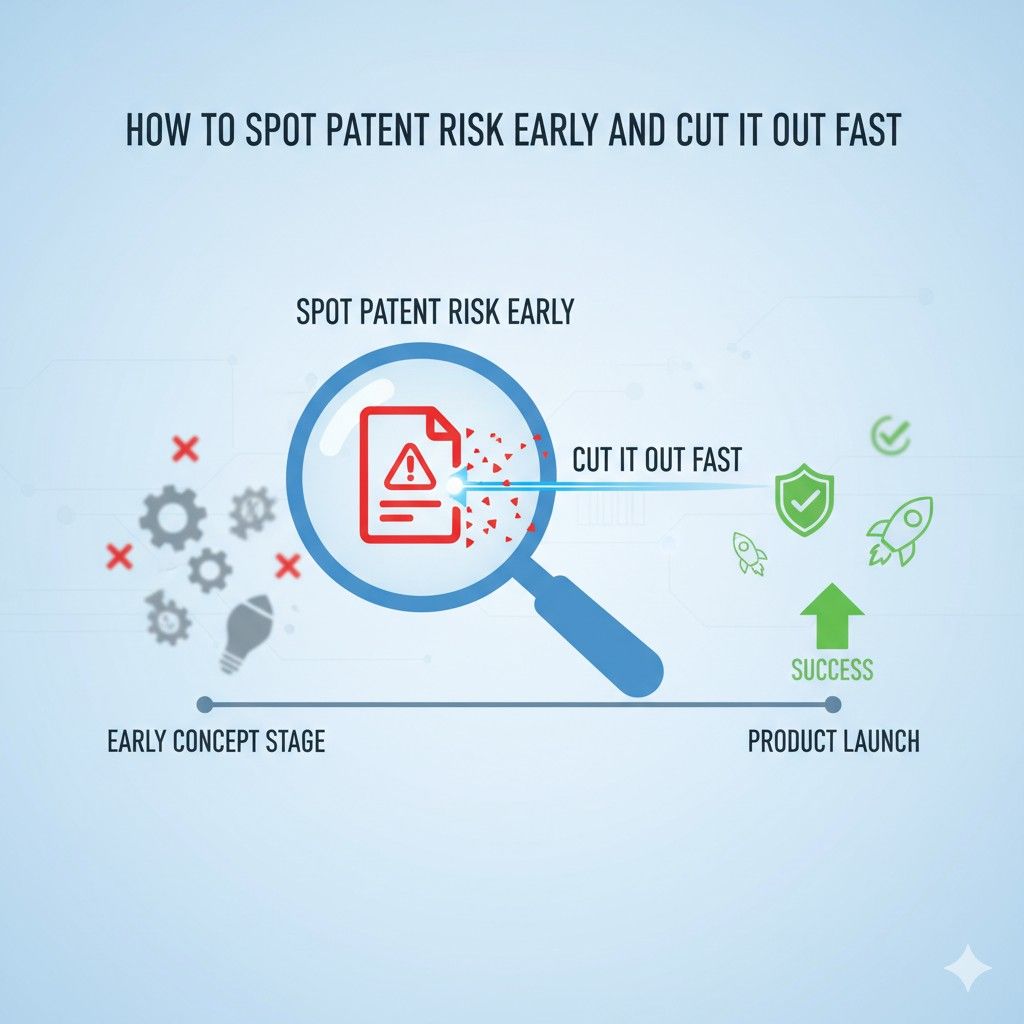
Spotting patent risk early is not about paranoia. It is about precision. You look carefully. You adjust quickly. You protect your launch before it ever faces the market.
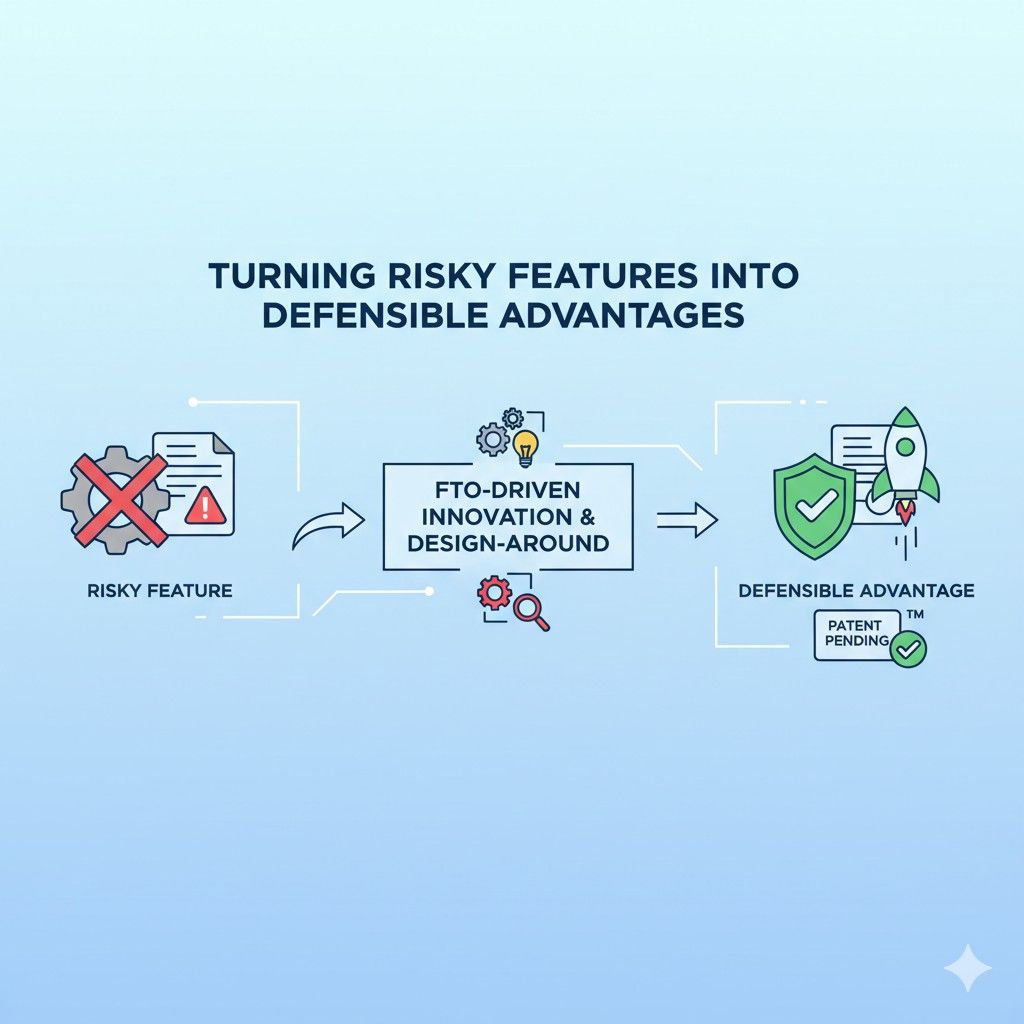
Turning Risky Features Into Defensible Advantages
Most founders think that when a feature looks risky from a patent view, the only answer is to delete it. Sometimes that is true. But often, there is a smarter move.
Instead of cutting the idea completely, you can reshape it. You can evolve it. You can turn a fragile feature into something strong and uniquely yours.
This is where FTO-driven pruning becomes powerful. You are not just removing risk. You are using risk as a signal. A signal that pushes you to design better, think deeper, and build something competitors cannot easily challenge.
When handled the right way, a risky feature can become the foundation of your strongest patent position.
Do Not Abandon the Problem, Rethink the Method
Customers care about outcomes. They do not care about the exact technical path you take to get there.
If a patent blocks a specific method, that does not mean the customer problem is off-limits. It only means that one approach is risky.
Start by separating the goal from the method. Write down what the feature truly achieves for the user. Faster results. Better accuracy. Lower cost. More security.
Now ask a different question. How else could we achieve that same outcome?
Push your engineers to explore alternate architectures. Change the data inputs.
Change the order of steps. Shift from centralized to distributed logic. Replace a rules-based engine with a model-based approach, or the other way around.
Often, the first design feels obvious because it is common in the market. But common designs are often the ones that are patented. The moment you force a rethink, new technical creativity emerges.
This is how risk turns into differentiation.
Move From Overlap to Distance
When you analyze a patent claim that creates concern, study what exactly makes it risky. Is it the combination of steps? Is it a specific threshold? Is it a hardware configuration?
Your goal is to create distance. Not tiny cosmetic changes, but meaningful structural differences.
If a claim requires three elements working together in a defined way, look for a way to remove or replace one element. If the claim depends on a particular data transformation, design a different transformation pipeline.
Think in terms of architecture, not decoration.
The more your system works differently at a core level, the stronger your position becomes. And that difference can later support your own patent filing.
Instead of saying, “We tried to avoid them,” you can say, “We built something fundamentally different.” That is a much stronger story to tell investors and partners.
If you want help turning those structural differences into clear, defensible patent filings, you can see how PowerPatent guides that process with software and real attorney review here: https://powerpatent.com/how-it-works
Use Constraints to Fuel Better Design
Constraints often feel limiting. In truth, they sharpen innovation.
When a patent blocks a specific route, you are forced to explore paths others may have ignored. That exploration can reveal more efficient, scalable, or elegant solutions.
For example, if a competitor’s patent controls a certain way of synchronizing systems, you may explore asynchronous models or probabilistic approaches.
In doing so, you might discover performance gains that the original patented method never achieved.
The constraint becomes a catalyst.
Teams that embrace this mindset stop viewing FTO as a defensive task. They see it as a design input. It guides them toward originality.
Over time, this builds a culture where engineers instinctively search for distinct approaches instead of defaulting to industry norms.
Turn Differentiation Into Patent Strength
Once you redesign a risky feature into something structurally different, do not stop there. Capture it. Protect it.
Document how your approach works. Identify the specific steps, components, and interactions that set it apart from existing patents.
Then file strategically.
When your design clearly avoids known claims and introduces new mechanisms, your patent application can be both narrower and stronger.
Narrower because it is grounded in what you actually built. Stronger because it is anchored in real differentiation.
This is how FTO and patent filing work together. FTO clears the minefield. Your own patents then mark your territory.
At PowerPatent, founders map their technical systems in simple, structured formats that make it easier to see these distinctions. Real attorneys then refine the claims to ensure they are solid and defensible.
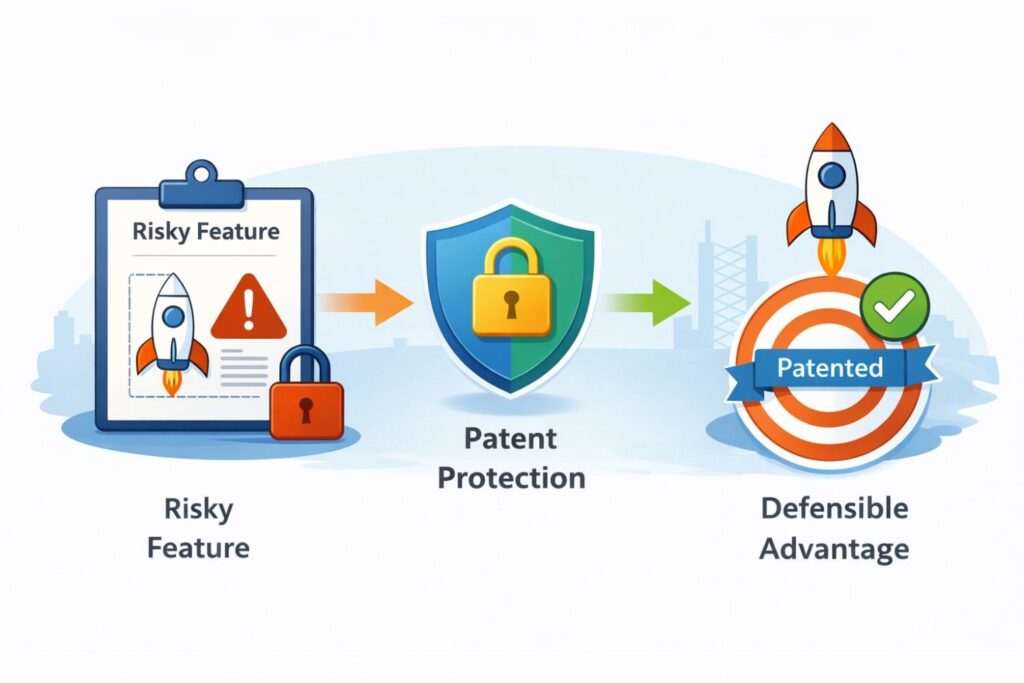
This combination helps you avoid vague filings that collapse under scrutiny. If you are serious about turning innovation into leverage, explore how it works here: https://powerpatent.com/how-it-works
Avoid Half Measures
One of the biggest mistakes founders make is making small tweaks that feel safe but are not.
Changing a variable name. Adjusting a minor parameter. Reordering trivial steps. These cosmetic edits rarely remove real risk if the core structure still matches the claim.
When you choose to redesign, commit fully.
Revisit the system diagram. Challenge assumptions. Ask whether the user interface can remain the same while the backend changes dramatically.
Deep changes early are far cheaper than surface changes late.
If you discover that a feature cannot be redesigned without heavy overlap, be honest about that too. In some cases, the right move is to pivot away from that feature entirely.
But that decision should come after serious exploration, not before it.
Build Internal Playbooks for Risk Conversion
As your company grows, you will encounter patent risk more than once. Do not treat each case as a fresh crisis.
Create a simple internal playbook. When a risk is identified, the team reviews the claims, maps your system against them, brainstorms alternate architectures, and evaluates the business impact of each path.
This repeatable process reduces stress. It turns what feels like a threat into a structured exercise.
Over time, your team becomes faster at converting risk into advantage. They stop fearing patents. They start reading them as signals.
That shift in mindset is powerful. It changes how you approach innovation.
Protect the Launch Before You Announce It
Many startups announce bold features publicly before fully assessing patent exposure. That can create unnecessary attention.
Before major releases, confirm that redesigned features truly stand apart from known claims. Make sure your documentation supports that distinction.
When you launch with confidence, you protect not only your product but your brand. You avoid public disputes that distract from growth.
FTO-driven pruning is not about shrinking ambition. It is about refining it. You keep what strengthens your launch. You reshape what creates danger. You remove what cannot be fixed.
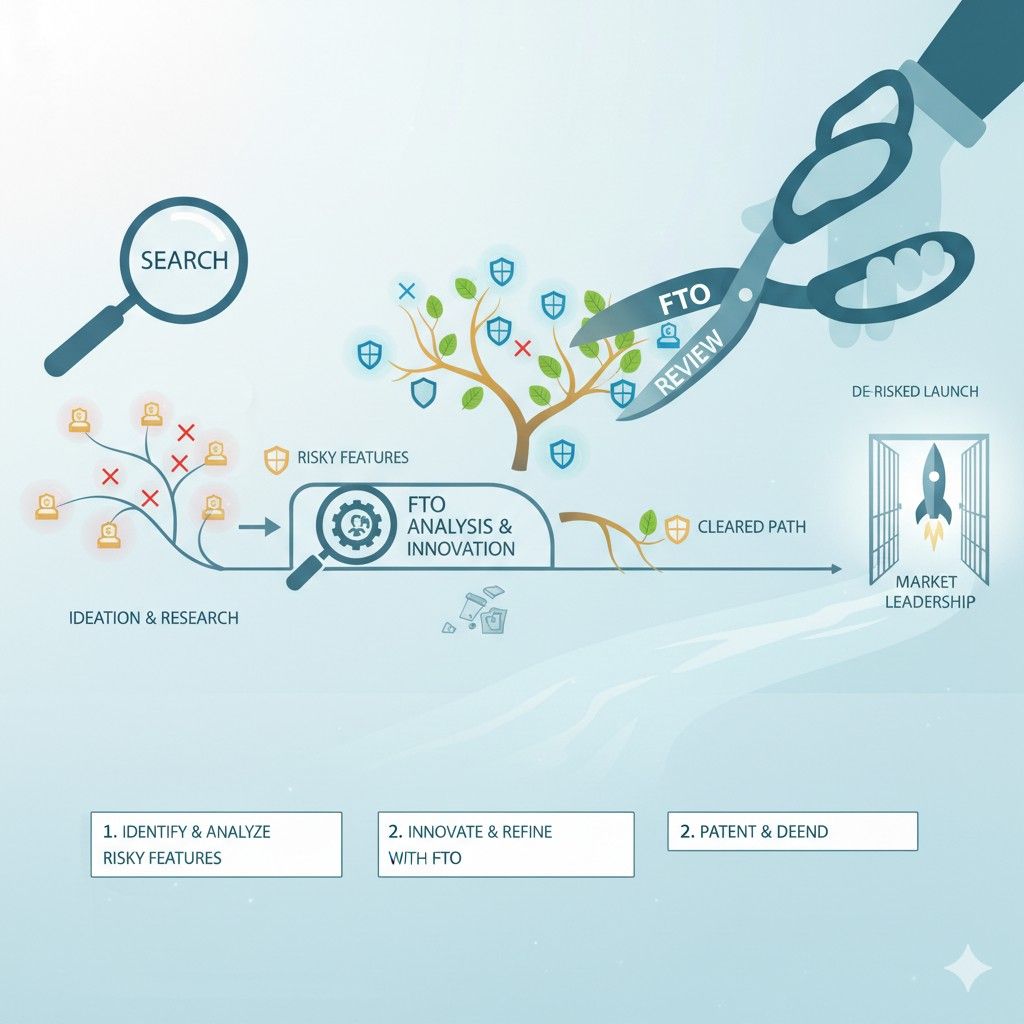
In doing so, you build a company that moves fast without stepping into traps. You launch not with hope, but with clarity.
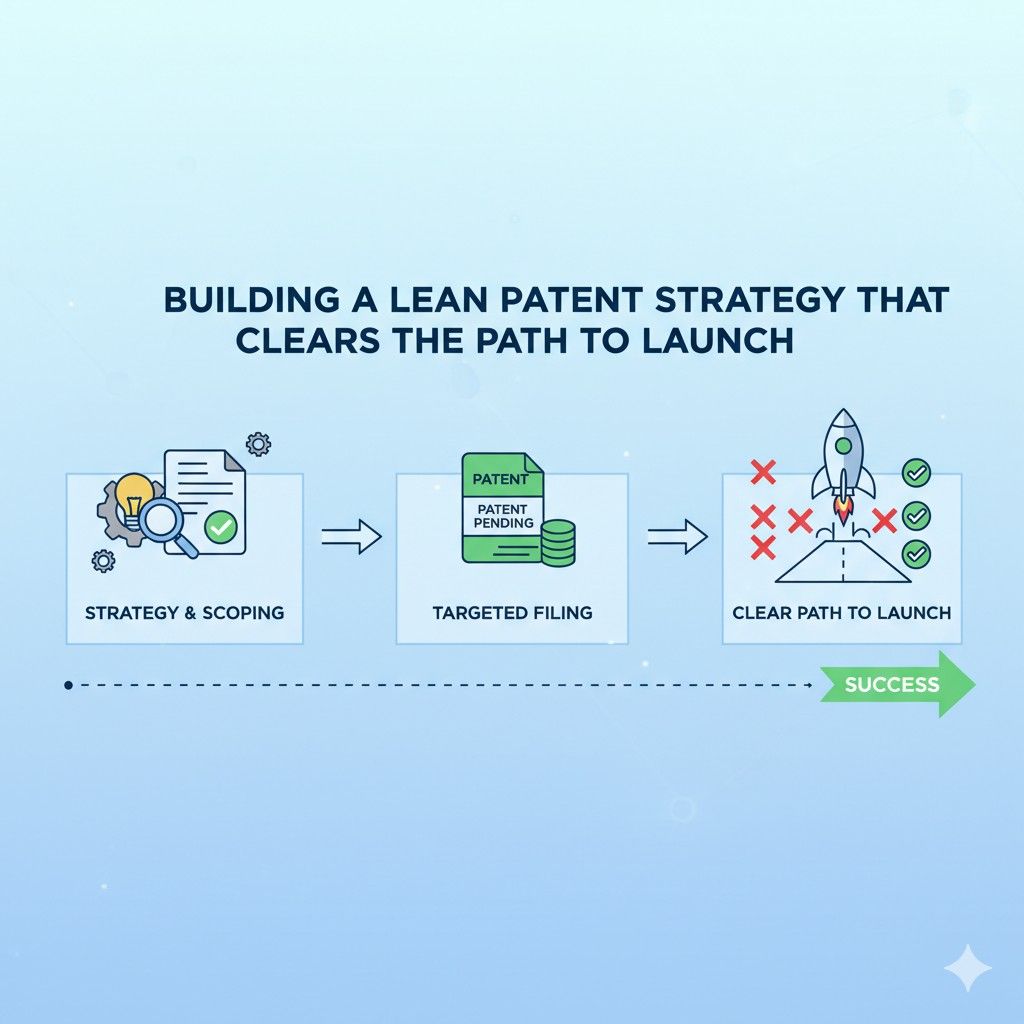
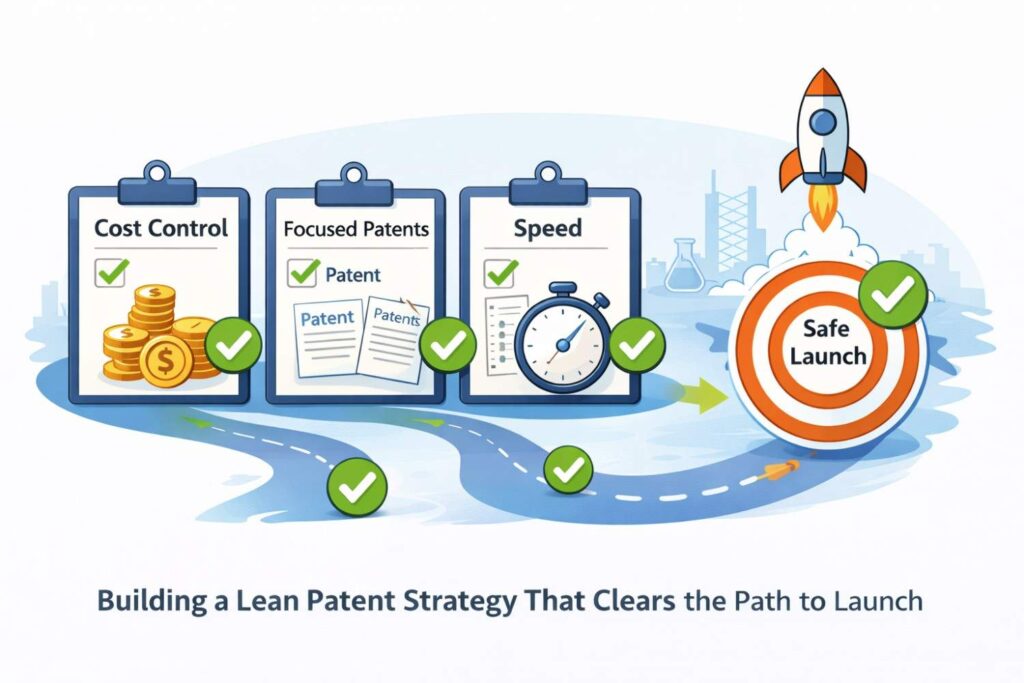
Building a Lean Patent Strategy That Clears the Path to Launch
Many founders think patents mean thick documents, long delays, and big legal bills. That old model slows teams down. But a lean patent strategy is different.
It supports your launch instead of blocking it. It works alongside your roadmap. It protects what matters most. And it stays focused on one goal: clearing the path so you can ship with confidence.
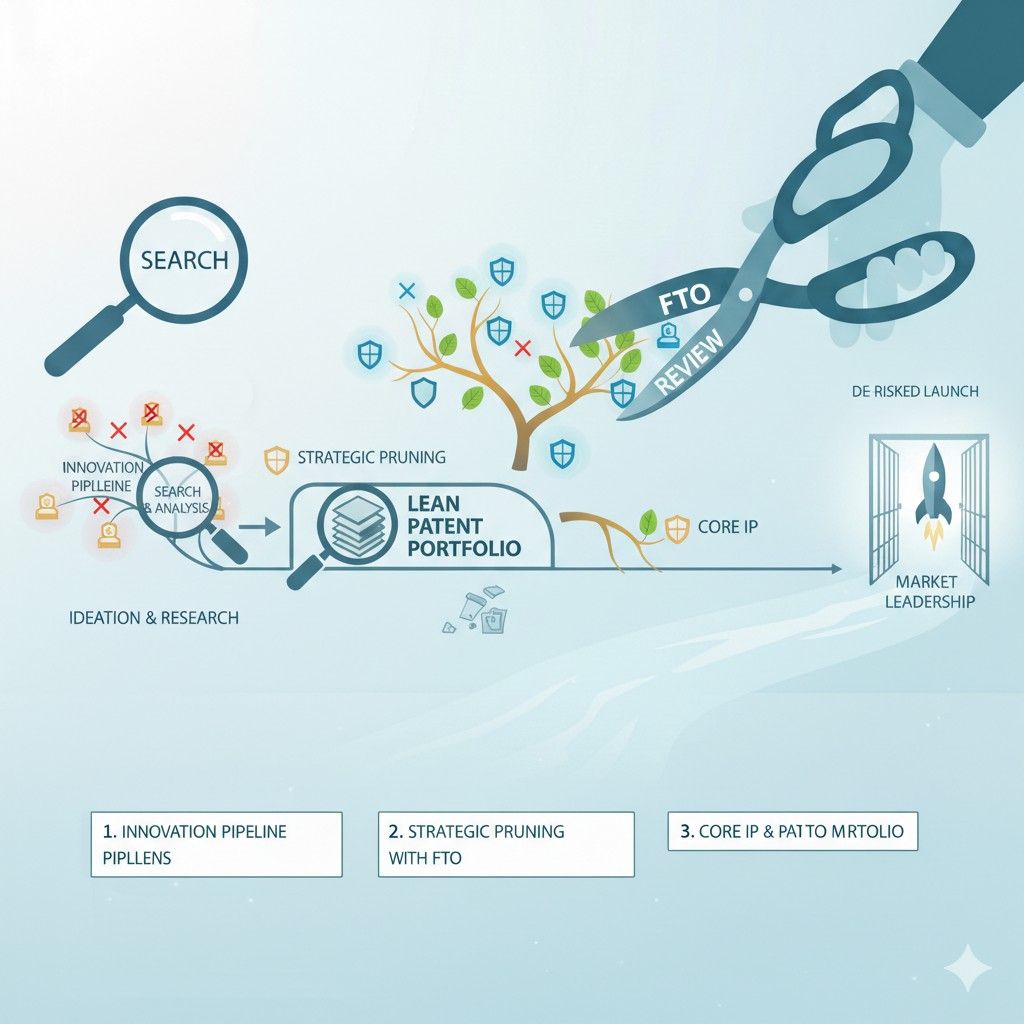
FTO-driven pruning tells you what to avoid. A lean patent strategy tells you what to claim.
When these two work together, you reduce risk on both sides. You are not stepping on others. And you are building walls around what is truly yours.
The result is simple. Fewer surprises. Stronger positioning. Faster launches.
Start With What Drives Revenue
Not every feature deserves a patent. Not every line of code needs protection. If you try to patent everything, you waste time and money.
Focus first on what drives revenue and differentiation. What makes customers choose you? What makes competitors nervous? What would hurt the most if someone copied it?
Those are the areas worth protecting.
When you align patent filings with business value, your strategy becomes lean by default. You are not filing for vanity. You are filing for leverage.
This approach also keeps your team focused. Engineers understand why certain systems need careful documentation. They see the link between their work and the company’s long-term power.
File Early, But File Smart
Speed matters. If you wait too long to file, you risk losing rights in many countries. But speed without clarity can create weak patents.
The answer is structured speed.
As soon as a core technical approach stabilizes and clearly differs from known patents, document it. Capture the architecture, the data flow, the unique steps.
Then move toward filing while the design is still fresh in the team’s mind.
Do not wait for perfection. Wait for clarity.
A well-prepared early filing can secure your priority date. Later, as the product evolves, you can file follow-up applications that build on that base.
This staged approach keeps protection aligned with real progress. It also spreads cost over time.
At PowerPatent, founders use guided workflows to turn complex systems into clear patent drafts quickly.
Real attorneys then refine and file them properly. That combination keeps momentum high without cutting corners. If you want to see how that process supports fast-moving teams, explore it here: https://powerpatent.com/how-it-works
Keep Claims Grounded in Reality
One common mistake is filing broad, abstract patents that do not match the actual product. These may look impressive at first, but they can collapse under challenge.
A lean strategy stays grounded. It protects real implementations. It describes how the system actually works.
This does not mean your claims must be narrow. It means they must be supported.
When your patent clearly reflects a working architecture, it becomes harder for others to attack it. It also becomes easier to enforce if needed.
And because your filing grew out of FTO-driven differentiation, it is less likely to run into prior patents during examination.
Align Patent Milestones With Product Milestones
Patents should not live in a separate universe from product development. Tie your filing timeline to product milestones.
When you complete a major architectural shift, evaluate whether it deserves a new filing. When you unlock a breakthrough in performance or efficiency, consider capturing it.
This rhythm keeps your portfolio alive. It grows as your product grows.
At the same time, avoid filing just because time has passed. Every application should connect to real strategic value.
This discipline keeps your portfolio lean and meaningful.
Use Patents as Signals in the Market
A thoughtful patent portfolio does more than reduce risk. It sends signals.
It shows investors that you think long term. It shows competitors that you are serious. It shows partners that you own your core technology.
When your patents are aligned with true differentiation, they become proof of depth. Not just paperwork.
This matters during fundraising, acquisition talks, and strategic partnerships. Clear, focused filings are easier to explain. They tie directly to product features and technical advantages.
Instead of vague claims about innovation, you can point to specific protected systems that support your business model.
Avoid Portfolio Bloat
More patents do not always mean more protection. A bloated portfolio filled with weak filings can create a false sense of security.
A lean strategy regularly reviews existing applications. Are they still aligned with the roadmap? Do they cover features that matter? Are there areas where follow-up filings are needed?
If a patent no longer connects to the core product, do not keep expanding around it. Stay focused.
This mindset saves resources. It also keeps your story clean.
Investors and acquirers prefer a tight portfolio that maps clearly to revenue drivers over a large pile of unrelated filings.
Integrate FTO Reviews Before Major Launches
Before each major launch, revisit both sides of your strategy.
Confirm that your current features still stand clear of known blocking patents. Confirm that your own key innovations are either filed or in process.
This double check reduces anxiety. It allows you to announce, market, and scale without looking over your shoulder.
When FTO-driven pruning and lean patent filing operate together, launch becomes smoother. You are not reacting to threats. You are moving forward with intention.
Build With Confidence, Not Caution
The ultimate goal is not to become cautious. It is to become confident.
When you know you have avoided major patent traps and protected your core technology, you can move faster. You can enter new markets with less fear. You can speak boldly about your innovation.
That confidence shows. Customers feel it. Investors respect it. Competitors notice it.
Patents should not be an afterthought. They should be a quiet force behind your growth.
If you are building something complex and valuable, do not leave your launch to chance. Combine early FTO insight with smart, attorney-backed filings. Clear the road. Mark your ground. Then move.
To see how PowerPatent helps founders do exactly that without slowing down, explore the full process here: https://powerpatent.com/how-it-works
Wrapping It Up
Launching a product is already hard. You are racing against time, cash, and competitors. The last thing you need is hidden patent risk waiting to surface at the worst possible moment. FTO-driven pruning changes the game. Instead of hoping nothing goes wrong, you take control early. You study the landscape. You cut what creates exposure. You redesign what can be improved. You keep only what clears the path forward.
Leave a Reply