Most strong patents start in messy places. A product spec. A slide deck. A design doc. A code note. A customer demo. A set of screenshots. A long file that only the engineering team fully understands.
AI Starts by Turning Product Documents Into a Clear Invention Map
Product documents are rarely neat. One team writes a product spec. Another team adds notes in a project tool. The CTO drops design choices into a slide deck. Engineers leave key details in code comments.
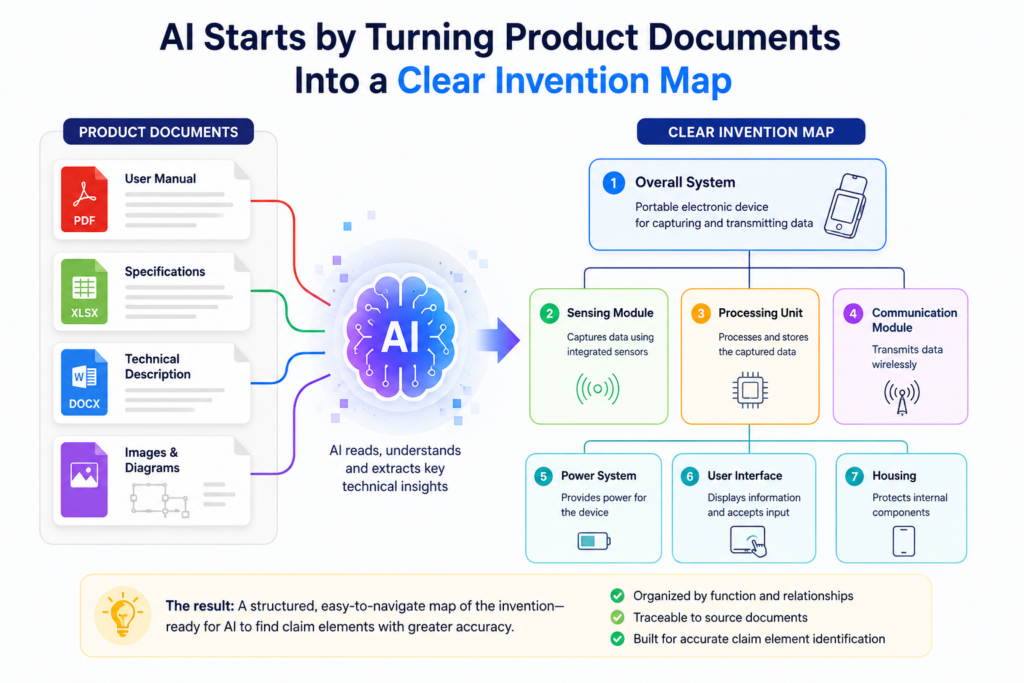
A founder explains the “why” in a demo script. Each file may hold part of the invention, but no single file tells the full story.
AI helps by pulling these scattered parts together. It reads the product material and looks for signals that explain what the product does, how it works, and what makes it useful.
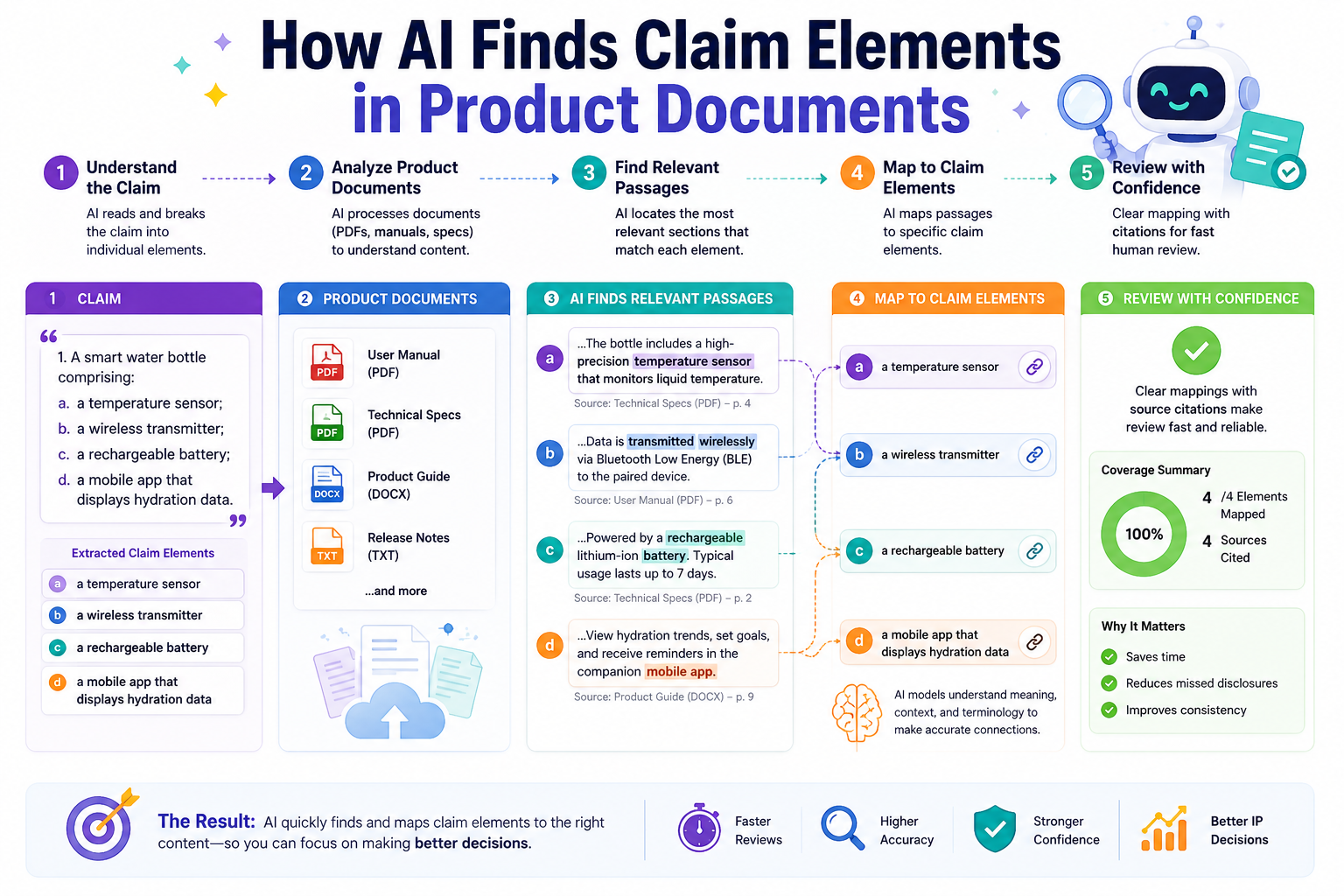
This is the first step in finding claim elements.
A claim element is one part of the invention that may appear in a patent claim. It might be a step, a system part, a data flow, a rule, a model action, a user action, or a result. In simple words, it is one piece of the thing you want to protect.
AI looks for the parts that explain how the product works
When AI reads product documents, it does not only look for fancy words. It looks for meaning. A sentence like “the system scores each event before sending an alert” can contain more than one useful part.
There is a system. There is an event. There is a scoring step. There is an alert. There may also be a rule that decides when the alert is sent.
A human may skim past this because it sounds normal. AI can slow it down and break it into parts. That makes it easier for a founder or attorney to see what might belong in a patent claim.
This matters because patents are not built from broad ideas alone. A broad idea like “AI for alerts” is not enough.
The stronger story is in the working parts. What data comes in? What happens to it? What decision is made? What changes after the decision? These are the pieces AI tries to find.
The best claim elements often hide in normal product language
Founders often think the invention is only the big idea. But many strong patent points live in small design choices.
A product document may say, “we reduce noise by grouping related signals before ranking them.” That may sound like plain product work. But it may also show a useful technical path.
AI can flag this type of line because it shows a real action. It does not just say the product is smart. It explains what the product does to create a better result.
This is where a tool like PowerPatent can help your team move faster. Instead of starting with a blank page, you can bring in your product notes and let smart software help surface the important pieces.
Then real patent attorneys review the work, shape the legal strategy, and help avoid mistakes. You can see how that process works here: https://powerpatent.com/how-it-works
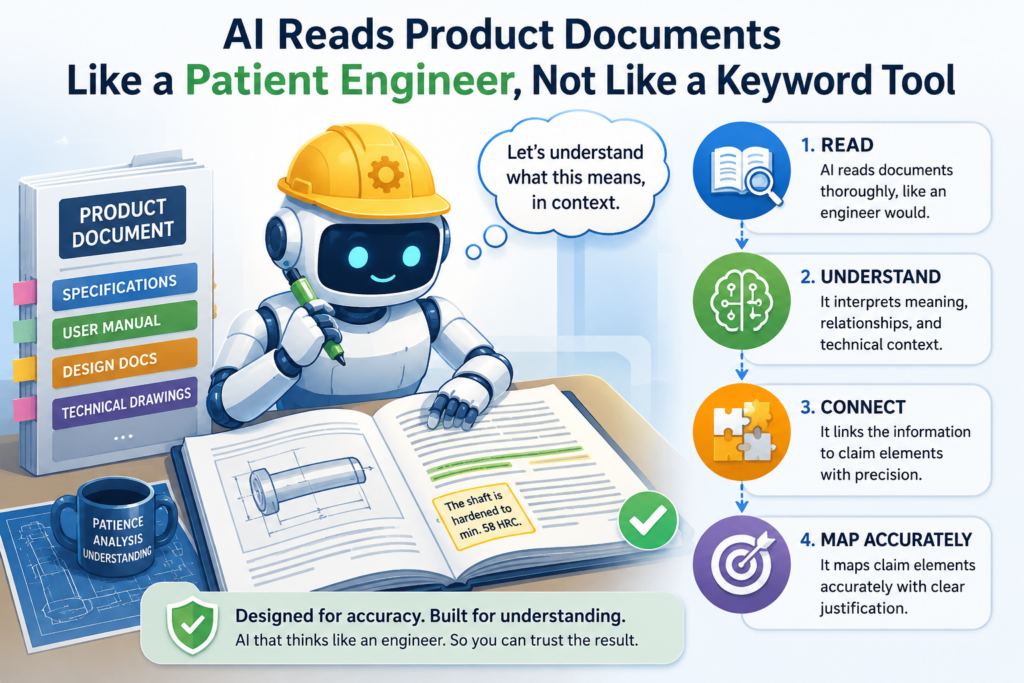
AI Reads Product Documents Like a Patient Engineer, Not Like a Keyword Tool
Old search tools look for exact words. That is helpful, but it is limited. If you search for “ranking,” you may miss “ordering,” “scoring,” “prioritizing,” or “sorting.”
If you search for “model,” you may miss “classifier,” “agent,” “embedding system,” or “prediction layer.”
AI is better because it can understand related meaning. It can see that different words may point to the same type of product action.
This is very useful when reading engineering documents, because teams do not always use the same terms across files.
One document may call something a “risk score.” Another may call it a “confidence value.”
A third may call it a “priority number.” A patent team needs to know whether these are the same thing, different things, or parts of a larger flow. AI can help connect those dots.
AI finds actions, inputs, outputs, and decision points
A good product document has many hidden patterns. There are inputs, like user data, sensor data, code changes, images, logs, prompts, or transactions.
There are actions, like training, filtering, ranking, matching, routing, splitting, combining, or updating. There are outputs, like alerts, reports, labels, control signals, dashboards, or new model states.
AI looks for these patterns because they often become claim elements.
A claim may describe a method that receives data, changes the data, applies a rule, and produces a result. Or it may describe a system with different parts that work together.
For example, a product spec may say the platform receives live code changes, compares the changes to known patterns, predicts which module may break, and gives the developer a repair path.
That one sentence has several possible claim elements. AI can pull out the receiving step, the comparison step, the prediction step, and the repair output.
Claim elements become clearer when the product flow is broken into plain steps
AI is useful because it can turn a dense product paragraph into a simple work flow. That does not mean the final patent claim should be simple in a careless way.
It means the team can first understand the invention in clear language before making legal choices.
This is important for founders because unclear invention stories create delay. If the patent attorney has to spend weeks asking what the product really does, the process slows down.
If the founder sends only a pitch deck, the patent may miss the real technical value. If the team files too late, a public launch or investor deck may create problems.
A better path is to use your product documents early. Let AI help find the pieces. Let a real attorney check what matters.
Then build a stronger patent plan while the product is still fresh in the team’s mind. PowerPatent is built for this kind of founder-friendly workflow, and you can explore it here: https://powerpatent.com/how-it-works
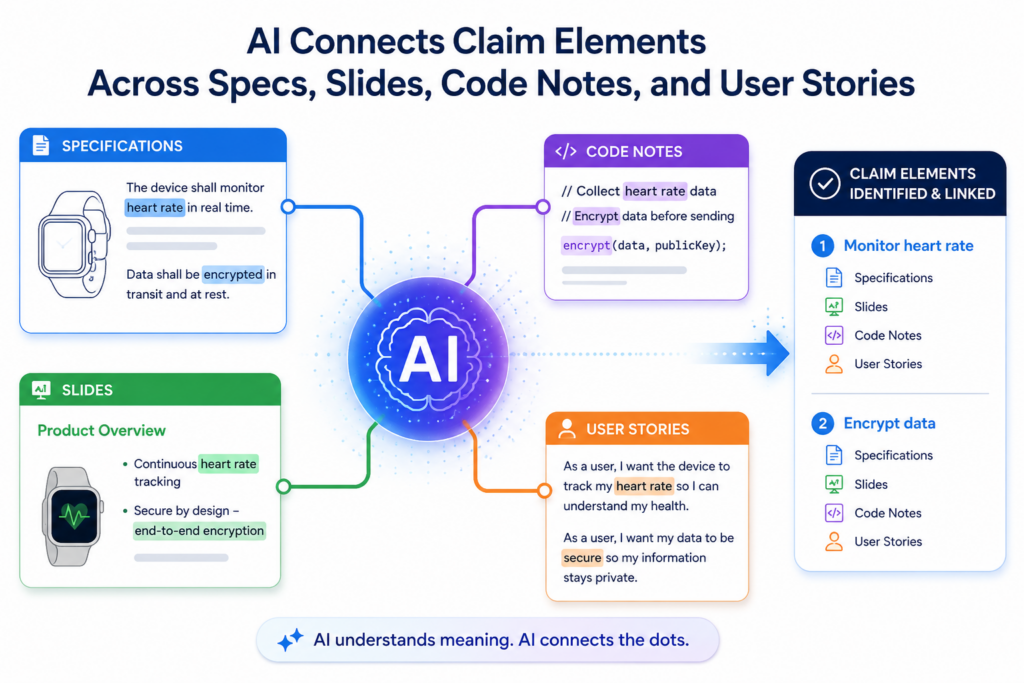
AI Connects Claim Elements Across Specs, Slides, Code Notes, and User Stories
The hard part is not only finding useful text. The hard part is connecting the same invention across many documents.
Product work moves fast. A design may start in a founder memo, change in an engineering ticket, show up in a demo, and later appear in a customer note.
AI can compare those documents and look for shared ideas. It can see when a feature described in a slide is also explained in a deeper way inside a technical spec.
It can notice when a user story describes the benefit, while a code note explains the system behavior that creates that benefit.
That connection is powerful. It helps turn scattered evidence into a more complete invention story.
AI can link the “what,” the “how,” and the “why”
A patent story often needs all three parts. The “what” is the product feature. The “how” is the technical way it works. The “why” is the benefit or problem solved.
Founders often explain the “why” very well. They know the pain. They know the customer need. Engineers often explain the “how” very well.
They know the model, data flow, rules, and system design. Product managers often explain the “what” very well. They know the feature behavior and user path.
AI can help bring these voices together. It might find that the founder memo says customers waste time reviewing false alerts. The product spec says the system groups signals by source, time, and similarity.
The engineering note says a model ranks each group before alerting the user. Together, these documents may show a stronger invention than any single document alone.
Strong patent drafts come from connected proof, not isolated notes
When claim elements are backed by multiple documents, the patent team can ask better questions. Is the grouping step new?
Is the ranking step different from common tools? Is the alert timing part of the value? Is there a feedback loop after the user acts? Does the system improve over time?
These questions help move the work from a vague product idea to a real invention shape. AI can help surface the raw material, but the human judgment still matters.
A patent attorney can decide which claim elements are worth pushing, which ones need more detail, and which ones may not help.
That blend is important. AI gives speed. Attorneys give judgment. Founders get more control because the process starts from their real product work, not from a long blank interview.
AI Helps Separate Useful Invention Details From Plain Product Noise
Product documents include a lot of noise. They may include launch plans, user feedback, brand words, market claims, meeting notes, sales goals, and rough ideas that never shipped.
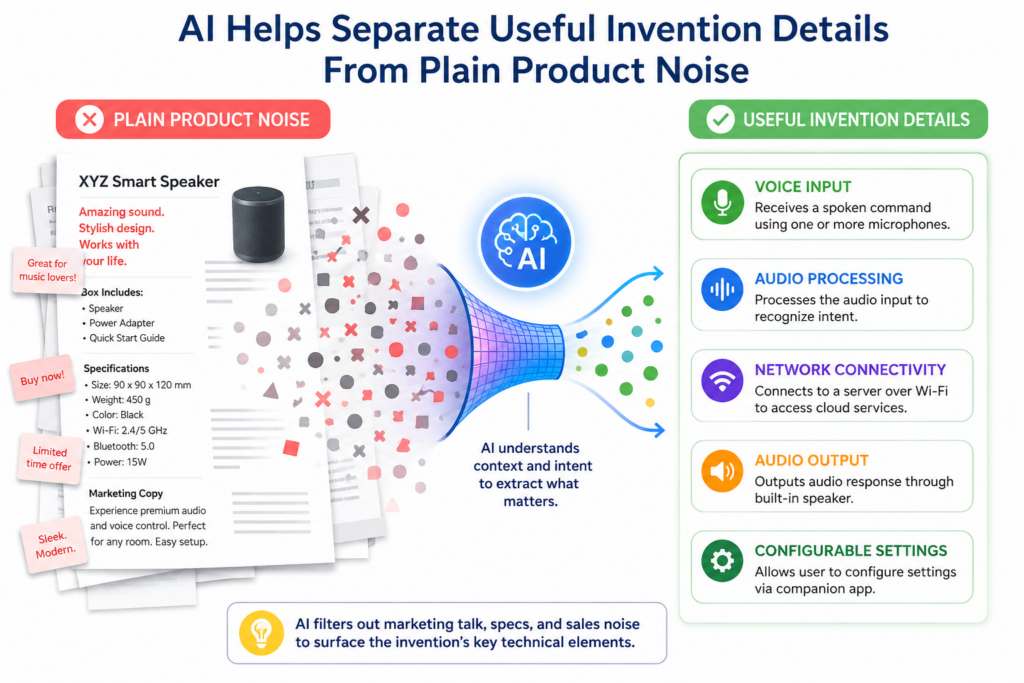
Not every sentence belongs in a patent draft. In fact, adding too much can make the invention harder to understand.
AI helps by sorting product content into more useful groups. It can help identify which parts describe technical behavior and which parts describe business goals. Both can matter, but they do not play the same role.
A line like “make onboarding feel magical” may be good for product direction, but it is not a strong claim element.
A line like “pre-fill setup fields by matching user account data to prior team templates” is much more useful. It explains an action the system performs.
AI can spot concrete system behavior inside broad product goals
Many startup documents start with big promises. Faster review. Better search. Smarter routing. Less manual work. Lower error rates. More trust. These are benefits, but they are not the full invention.
AI can look under the promise and search for the product behavior that creates it. If the document says “reduce manual review,” the useful question is how. Does the system remove duplicates?
Does it rank cases? Does it ask a model to explain confidence? Does it route only uncertain cases to humans? Does it learn from corrections?
These deeper details may become claim elements. They show the path from input to result. That path is what a patent team needs to understand.
A cleaner invention map helps founders file with more confidence
A clean invention map can save time. It can also help the founder feel less lost. Instead of sending a pile of documents and hoping the attorney finds the good parts, the team can start with a clearer view.
This does not mean founders need to become patent experts. They do not. They need a process that fits how they already work.
They need tools that can read the documents they already have. They need attorney help that is focused and practical.
That is the core value PowerPatent brings to technical teams. It helps turn real invention material into a patent-ready workflow with smart AI and real attorney oversight. For a deeper look, visit https://powerpatent.com/how-it-works
AI Turns Technical Language Into Patent-Ready Building Blocks
Engineering teams often write in short, dense language. That is normal. A design note may say, “cache embeddings after intent split.”
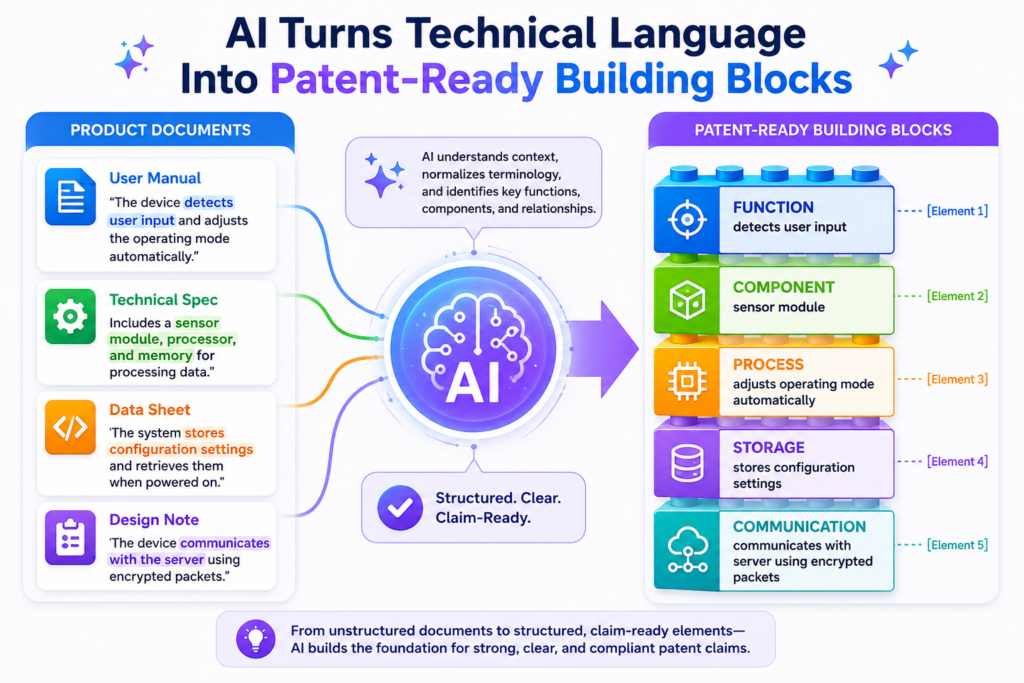
A model card may say, “fallback to rules when confidence drops.” A ticket may say, “merge duplicate clusters before review queue.”
These short phrases can hold important invention details, but they are not ready for a patent draft as written. AI can help expand them into clearer building blocks without changing the meaning.
For example, “fallback to rules when confidence drops” may become a more complete idea: the system measures confidence for a model output, compares the confidence to a set level, and uses a rule-based process when the confidence is too low. That gives the patent team more to work with.
AI helps make hidden steps visible
Engineers often skip steps because the steps feel obvious to them. They know the system receives data before it ranks data.
They know a model must be trained before it predicts. They know a user action may update a profile or trigger a background task.
But patents need enough detail to show the invention clearly. AI can ask the document, in effect, “What had to happen before this?” and “What happens after this?” It can infer likely steps, then mark them for human review.
That last part matters. AI should not invent facts. It should suggest possible missing pieces and let the founder or attorney confirm them. This keeps the process useful without letting guesses turn into mistakes.
The right workflow keeps speed from becoming risk
Speed is helpful only when it is controlled. A fast patent process that misses key details is not good. A slow process that drains the founder’s time is not good either.
The better path is guided speed. AI finds and organizes the possible claim elements. The founder checks whether they match the real product.
The attorney reviews the invention, asks sharper questions, and shapes the patent claims with care.
This is where PowerPatent’s model fits well for deep tech teams. It is not just software throwing words into a form.
It is software plus real patent attorney oversight, built to help founders move fast without losing the details that matter. Learn more here: https://powerpatent.com/how-it-works
AI Finds Claim Elements by Following the Path of Data Through the Product
Data flow is one of the best places to look for claim elements. In many modern products, the invention is not just a screen, a button, or a report.
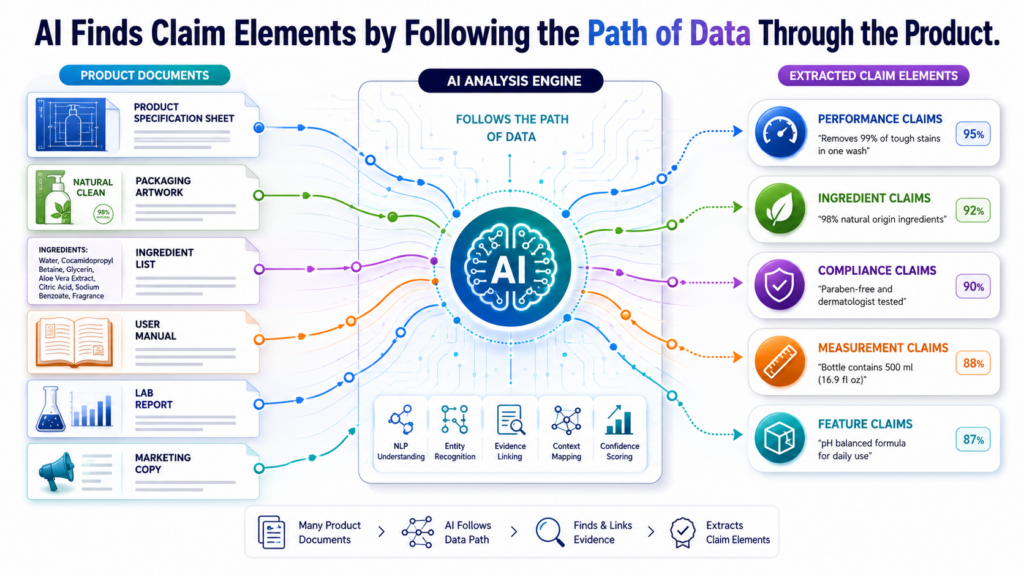
The real value is in how the system takes data in, changes it, checks it, combines it, and turns it into a useful result.
That is why AI often starts by tracking the path of data through the product documents.
It looks for where the data comes from, what form it takes, what happens to it, and what the system does after that. This can reveal the inner shape of the invention.
A founder may say, “Our product helps teams find risk faster.” That is a good business message, but it is not enough for a patent claim.
A stronger patent story may say the system receives event data, groups related events, scores each group, compares the score to a changing threshold, and sends a ranked action to a user. Now the invention has parts. Now the claim elements are easier to see.
AI looks for the first input because that often starts the claim story
Every useful product system usually starts with something coming in. It may be a file, a prompt, a sensor reading, a user request, a transaction, a code change, a message, a log, an image, or a stream of events.
AI can scan product documents for these incoming items and mark them as possible starting points.
This matters because patent claims often begin with a receiving step. The system receives data.
The system obtains a request. The system detects an event. These phrases sound simple, but they set the stage for the rest of the invention.
The input also helps define what kind of product is being protected. A system that receives medical images is different from a system that receives software logs.
A system that receives user prompts is different from one that receives machine signals. The input gives context, and context helps the patent team avoid vague claims.
When AI finds inputs across many files, it can also show which ones matter most.
If the same input appears in a product spec, a design note, and a demo script, it may be central to the invention. If it appears once in a rough idea doc and never again, it may be less important.
The strongest data path is the one that shows a real change
A patent claim becomes more useful when it shows that the system does something meaningful with the data. It should not stop at receiving information. It should explain the change.
AI looks for verbs that show action. The system filters, ranks, trains, matches, routes, updates, compresses, groups, labels, converts, predicts, or controls. These action words often point to claim elements because they show how the product works.
This is also where a founder can help the most. When AI marks a data path, the founder can ask a simple question: “Is this the part that makes our product different?” If yes, that path may deserve more attention. If no, it may only be background.
PowerPatent helps make this step more practical. Your team can bring in real product materials, use AI to surface key product actions, and then work with real patent attorneys to shape the strongest path into a patent plan. You can see how this works here: https://powerpatent.com/how-it-works
AI Spots Decision Points That May Become Strong Claim Elements
Many strong inventions include a decision point. The system checks something, compares something, chooses something, or changes direction based on a result.
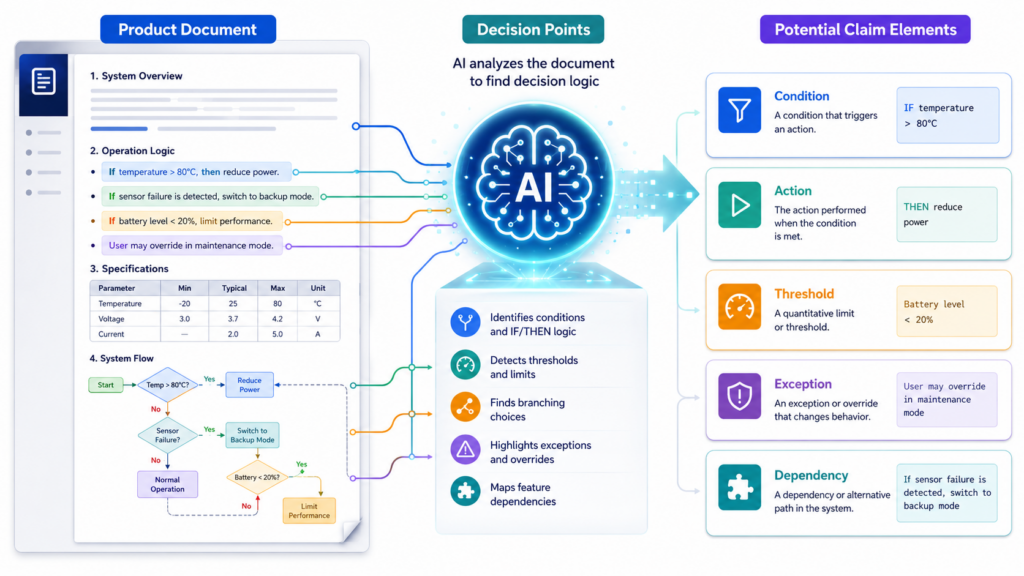
These decision points can be very important because they show intelligence inside the product.
A decision point may be simple. The system may compare a score to a threshold. It may choose one model instead of another.
It may route a task to a human when confidence is low. It may block an action when risk is high. It may change a user flow based on past behavior.
These moments matter because they often create the result the customer cares about. Less noise. Faster review. Better search. Safer action. Smarter routing. More useful output.
AI reads for “when,” “if,” and “based on” language inside product documents
Product teams often describe decision points in plain language. They write things like “if the user has already completed setup, skip this step” or “when the error rate rises, trigger a deeper review.” These phrases are easy to overlook, but they can be rich with invention detail.
AI can find this kind of language at scale. It can scan a large product document and pull out places where the system makes a choice.
It can then connect each choice to the data that caused it and the action that follows.
For example, a product note may say the system uses a model to score a case, but sends only uncertain cases to an expert. That may reveal several possible claim elements.
There is a model score. There is a confidence value. There is a rule for deciding uncertainty. There is a routing action. There may also be a feedback step after the expert responds.
A human may see that as a normal workflow. AI can turn it into a clear map of system behavior.
Good decision points help show why the product is not just a generic tool
Founders often worry that their product sounds too broad. They may say, “We use AI to help with review,” or “We automate the workflow.” Those phrases can feel weak because many companies say the same thing.
Decision points make the story sharper. They show exactly how the system acts.
They help explain why the product is not just using AI in a loose way. It is using a specific process to make a specific choice and produce a specific result.
This is why AI should not only pull out nouns. Nouns matter, but actions and choices often matter more. A “model,” a “database,” or a “dashboard” is not very clear by itself.
A model that changes its output path when confidence drops is much more useful. A database that stores feedback to change future ranking may be more important than the database alone.
A strong patent process should help founders see these points early. That is one reason PowerPatent focuses on turning invention material into a guided workflow, supported by smart software and real attorney review.
It helps teams protect the real logic inside the product, not just the surface feature. Learn more here: https://powerpatent.com/how-it-works
AI Helps Match Product Features to Possible Patent Claim Language
Once AI finds the product parts, it can help turn them into cleaner claim language.
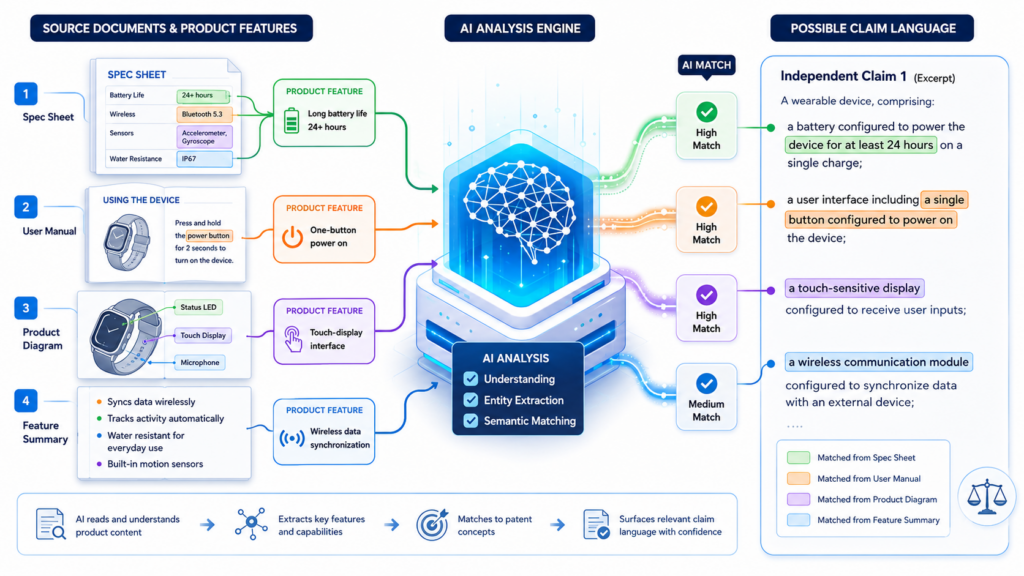
This does not mean the AI should write final claims on its own. Patent claims need careful attorney judgment. But AI can help create a first draft of the building blocks.
This is useful because product teams and patent teams often speak in different ways. A product team may say, “We show the user the next best action.”
A patent draft may need to describe how that next action is chosen. It may need to explain the data, the ranking step, the rule, and the output.
AI can bridge that gap. It can keep the meaning of the product feature while making the structure more useful for patent work.
AI can turn feature notes into clearer system steps
A feature note may say, “Smart inbox sorts urgent customer issues first.” That sounds simple and clear for a product team. But a patent team needs to know more. What counts as urgent? What data is used?
Does the system compare messages? Does it use user history? Does it update rankings after a user acts?
AI can help expand the feature into steps that are easier to review. It may identify that the system receives customer messages, extracts signals from each message, creates a priority score, ranks the messages based on that score, and changes the inbox view.
That expanded version is not the final claim. It is a working view. It gives the founder and attorney something concrete to discuss.
This is especially helpful when the invention sits inside software. Software products often have invisible value.
A user may see a clean screen, but the real invention may be in the backend logic, the timing, the model pipeline, the data structure, or the way the system learns from use.
Claim language should protect the invention without trapping it in one narrow version
One common mistake is describing the product too narrowly. A founder may explain the invention only as it exists in the current release. But startups change fast.
The first version may use one model, one database, one user flow, or one scoring method. Six months later, the product may work in a broader way.
AI can help by showing patterns across the documents. It may find that several examples all use the same deeper idea even though the surface details differ. That can help the patent team think about the invention at the right level.
For example, the current product may rank alerts using three signals. But the deeper idea may be selecting alerts based on a changing confidence score that improves after user feedback.
The attorney can decide how to claim that idea in a way that is clear, strong, and not needlessly tied to one early product setting.
That is the balance founders need. Too broad can be weak. Too narrow can miss future value. The right claim strategy needs both product truth and patent judgment.
PowerPatent helps teams get there faster by using AI to organize the invention and real attorneys to guide the final work.
That gives founders more confidence before they file and helps reduce the chance that important claim elements get missed. You can explore the process here: https://powerpatent.com/how-it-works
AI Can Compare Product Documents Against the Patent Draft to Find Gaps
AI is not only useful before the patent draft starts. It can also help after a draft exists. One of the best uses is gap checking.
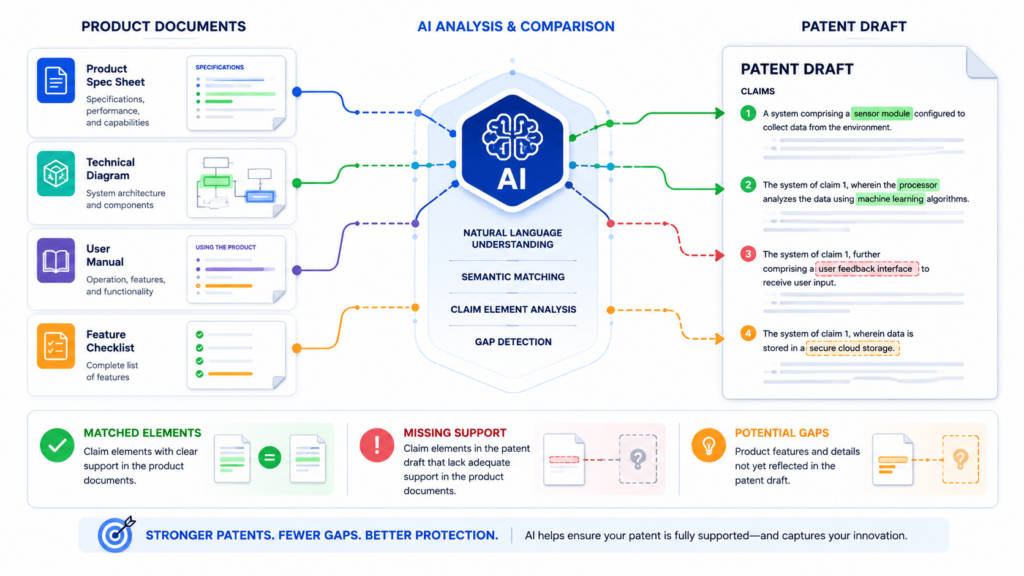
This means comparing the draft against the product documents to see whether important details were left out.
This matters because patent drafts can miss things. Not because anyone is careless, but because inventions are complex. A founder may explain one version in a call. The attorney may focus on one technical path.
The engineering docs may show another detail that makes the invention stronger. If that detail never makes it into the draft, the company may lose a chance to protect it.
AI can help by reading both sides. It can review the product material and the draft, then flag features, steps, or system parts that appear in the documents but not in the patent text.
AI helps founders ask better review questions before filing
Many founders do not know how to review a patent draft. The document looks formal. The claims look strange. The founder may not know what to check, so they focus on small word changes or skim the draft too quickly.
AI can make review easier by turning the patent draft into a plain-language map. It can show which product features are covered, which ones may be missing, and which claim elements match which parts of the product documents.
This gives founders a better way to review. Instead of asking, “Does this patent sound legal enough?” they can ask, “Does this draft cover the core product logic we actually built?” That is a much better question.
For example, if the product docs explain a feedback loop that updates future model rankings, but the draft only describes one-time ranking, AI may flag the missing loop.
The attorney can then decide whether to add it, claim it separately, or keep it as support for another claim path.
Gap checks can reduce painful surprises later
The worst time to discover a missing invention detail is after filing, after launch, or after a competitor starts moving close to your space.
By then, fixing the issue may be harder, slower, or sometimes not possible in the same clean way.
A gap check helps catch issues while there is still time. It does not replace attorney review, but it gives the review more structure. It also helps the founder take part without needing to learn patent law.
This is the kind of practical speed founders need. You should not have to choose between moving fast and being careful. With the right workflow, you can do both.
PowerPatent brings AI tools and real patent attorneys together so product documents can become stronger patent work without turning into a slow, confusing process.
AI Helps Founders Find the Real Invention Before the Patent Call
Many founders walk into a patent call with too much or too little. Some bring a broad idea and hope the attorney will pull the invention out of them.
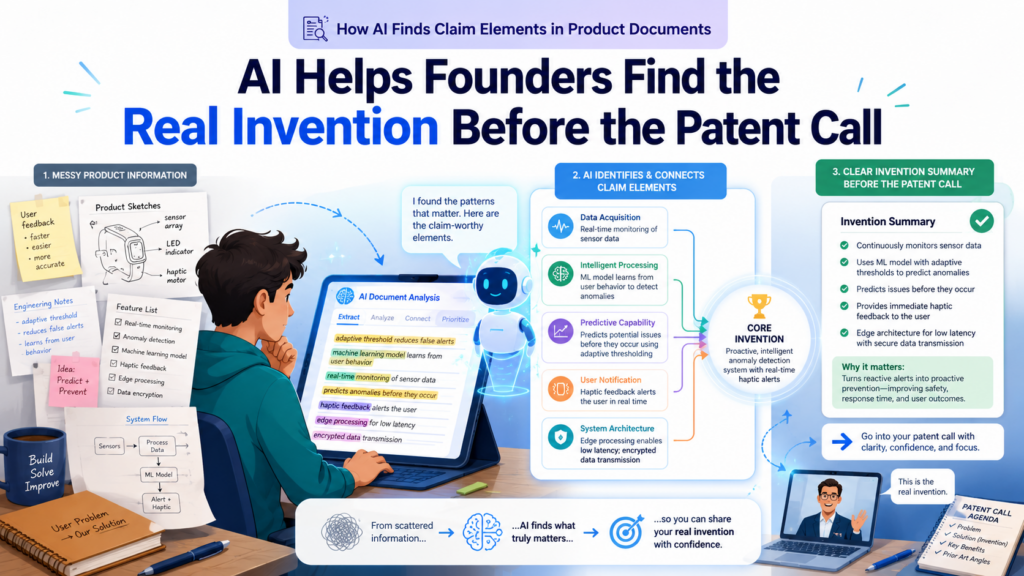
Others bring a huge pile of product notes, code details, and customer decks. Both paths can slow things down.
AI helps by giving the founder a better starting point. It can read the product documents before the call and find the parts that look like possible claim elements. This gives the team a clearer view of what may be worth discussing.
That does not mean AI decides what is patentable. It means AI helps prepare the room. The founder can see the invention in smaller pieces.
The attorney can spend more time on judgment and less time digging through messy documents.
AI makes the first attorney conversation sharper and more useful
A good patent call should not feel like a fishing trip. It should feel like a focused working session.
The founder should be able to explain what the product does, what the system receives, what the system changes, what the system outputs, and why that path is different from common tools.
AI can help create that map before the call starts. It can pull out the major product flows, the key decision points, the user actions, the model steps, and the system parts. Then the attorney can ask better questions.
For example, instead of asking, “What does the product do?” the attorney can ask, “Your document says the system changes the ranking after a reviewer corrects a result.
Is that feedback used right away, or does it update the next training cycle?” That is a much better question because it goes straight to the working logic.
This kind of prep can save founders from long delays. It can also reduce the risk that the attorney misses the best part of the product because it was buried in a spec or hidden in an engineering ticket.
Better prep helps protect the product while the team keeps building
Founders do not have extra time. They are hiring, shipping, selling, raising money, fixing bugs, and talking to customers. A patent process that demands too many long calls can become a burden.
AI can reduce that burden by doing the first layer of sorting. It can bring the useful invention parts closer to the surface. Then the founder and attorney can focus on the parts that truly matter.
This is one reason PowerPatent is built around smart software plus real attorney oversight. The software helps turn product material into a cleaner invention map.
The attorney helps decide what should be protected and how to move forward. That mix helps founders act earlier, with more confidence and less drag. See the process here: https://powerpatent.com/how-it-works
AI Finds Claim Elements by Looking for What the Product Does Differently
A patent should not be built around a generic feature. It should focus on what makes the invention different in a useful way.
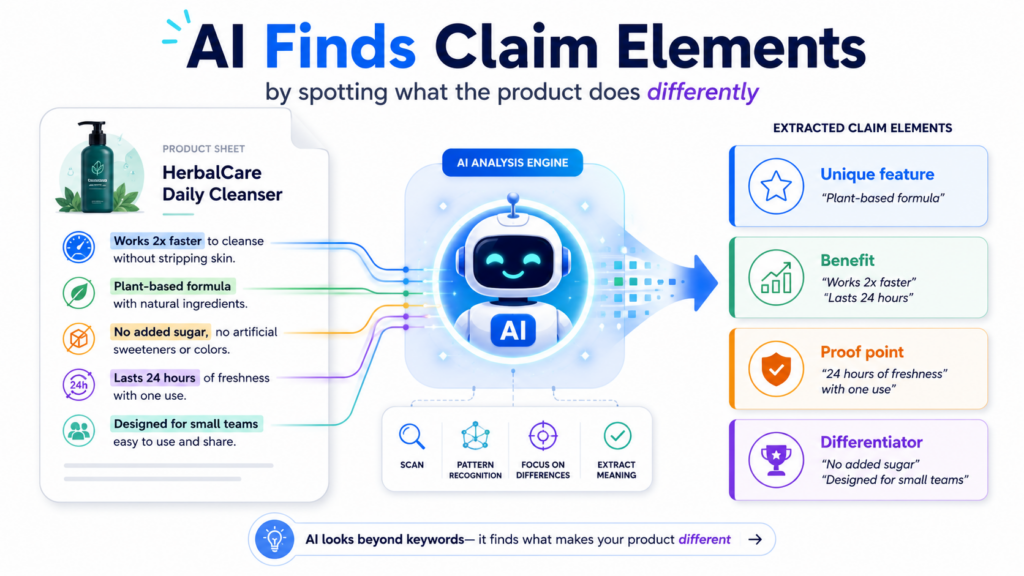
This is where product documents are very helpful, because teams often explain the reason behind a design choice.
A spec may say the product uses a special ranking flow because normal search returns too many weak results.
A design note may explain that the system waits for more context before sending an alert. A model note may explain that the system blends a rule-based check with a learned score to avoid bad outputs.
These details matter. They show what the team changed, why they changed it, and how the product works in a better way.
AI can compare normal product behavior with special product behavior
Most product documents include a mix of standard steps and special steps. Logging in, saving a user setting, showing a dashboard, or sending a basic message may be normal. But the way the system selects, changes, ranks, or responds may be special.
AI can help separate those layers. It can look for phrases that show contrast, such as “instead of,” “unlike,” “to avoid,” “before,” “after,” “only when,” and “based on.” These phrases often point to a design choice that may matter.
For example, a document may say the system does not send every detected issue to the user.
Instead, it groups related issues, checks the group against recent user actions, and only shows the issues that are likely to need attention.
That “instead” is important. It shows the product is not just detecting issues. It is deciding what deserves attention.
This can lead to stronger claim elements because the patent story becomes more than “we use AI.” It becomes “we use this flow to solve this specific product problem.”
The difference should be tied to a useful result
A product difference is strongest when it connects to a clear result. Faster setup. Fewer false alerts.
Better matching. Less manual review. Safer actions. Cleaner search. More accurate routing. These outcomes make the invention easier to understand.
AI can help link the special step to the result. It may find that the product groups signals before ranking them, and later in the same document the team says this reduces duplicate alerts.
That connection matters. It helps show why the claim element is not just a random technical detail.
Founders should look closely at these links. When AI finds a special step, ask what problem it solves. When it finds a result, ask what system action creates that result. The best invention stories often live where those two answers meet.
PowerPatent helps teams turn those answers into a smoother patent workflow. The goal is not to drown founders in legal detail.
The goal is to help them protect what is truly different about the product, with attorney guidance built into the process. Learn more here: https://powerpatent.com/how-it-works
AI Helps Turn User Stories Into Claim Elements Without Losing the Technical Core
User stories are great for building products, but they are not always enough for patent work.
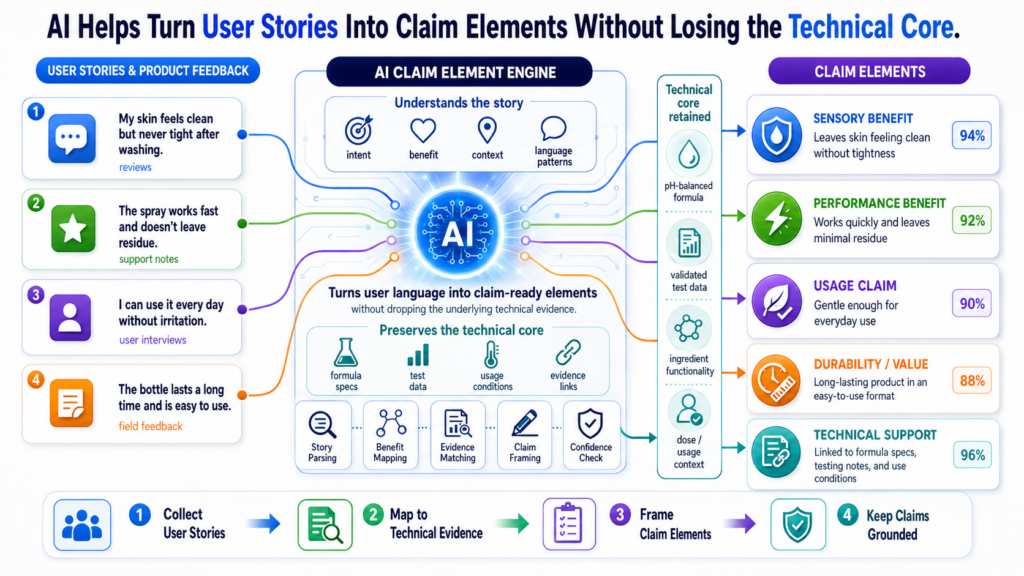
A user story may say, “As a manager, I want to see risky items first so I can act faster.” That is useful, but it does not explain how the system finds risk or decides what comes first.
AI can help by reading user stories and looking for the technical engine behind them. It can ask what the system must do to make the user story true. It can then pull out possible claim elements from the hidden product flow.
This is very useful for startups because many early product documents are written around user needs.
The technical details may be spread across tickets, comments, and design notes. AI can connect them.
AI can move from the user benefit back to the system action
A user benefit often points backward to a system action. If the user sees the best option first, the system must select or rank options.
If the user gets fewer bad alerts, the system must filter or group alerts. If the user receives a clear reason, the system must generate or retrieve an explanation.
AI can follow that trail. It can read the user-facing sentence and look nearby for the backend logic. It can also search other documents for the same feature name or related terms.
For example, a user story may mention “instant repair suggestions.” The engineering spec may explain that the system compares a code error to prior resolved errors, checks which fix worked, ranks fixes by context match, and returns the top repair path.
That gives the patent team much more than a user promise. It gives claim elements.
The founder can then review whether the AI found the real flow. This review matters because the patent should match the product truth. It should not turn a simple feature into something the product does not actually do.
User stories become stronger when tied to inputs, logic, and outputs
A user story becomes more useful for patent work when it is linked to three simple things. What data comes in.
What the system does with it. What result comes out. This does not need to be hard. It just needs to be clear.
AI can help create that clarity. It can take a user story and show the possible input, logic, and output. Then the attorney can decide which parts may support the claims.
This helps founders because it turns normal product work into patent fuel. You do not need to write special legal notes every time your team builds something.
You can use the product records you already have, then let the right workflow organize them.
That is a practical way to protect fast-moving software and AI products.
With PowerPatent, founders can bring the documents they already use, get help finding the invention story, and work with real patent attorneys to shape it into a stronger filing. Start here: https://powerpatent.com/how-it-works
AI Finds Missing Claim Elements by Looking for Broken Product Chains
A strong patent story usually has a complete chain. The system receives something, does something, makes a choice, creates an output, and may update something after that. When one link is missing, the claim story can feel weak or unclear.
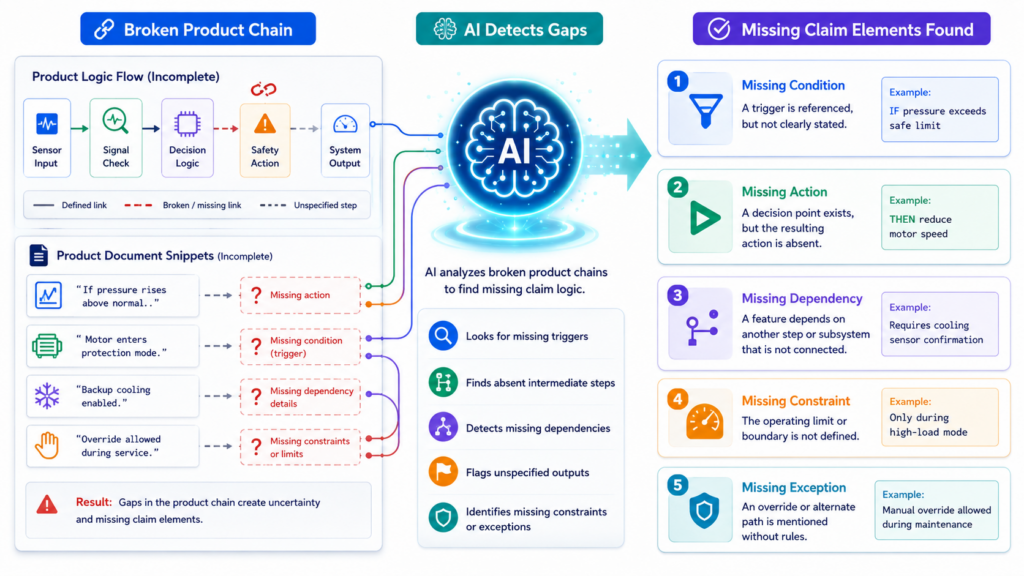
AI can help find these broken chains. It may see that a document describes an output but does not explain the input.
Or it may find a model step but no rule for how the model result is used. Or it may find user feedback but no update step.
This is valuable because missing links can create confusion. They can also lead to weaker drafts. A patent attorney can only work with the invention details that are found, shared, and confirmed.
AI can flag places where the product story jumps too fast
Product teams often write for speed. They may say, “The system generates a recommendation,” without explaining what data feeds the recommendation.
They may say, “The score is updated,” without saying what causes the update. They may say, “The user receives a filtered view,” without explaining how the filtering works.
These jumps are normal in internal documents. Everyone on the team may know what they mean. But a patent draft needs enough support to explain the invention clearly.
AI can flag these jumps and turn them into questions. What is being scored? What rule changes the score?
What data is used to filter the view? When does the system update the result? What happens after the user responds?
These questions are simple, but they are powerful. They help fill the gaps before drafting goes too far.
Gap questions help founders add detail without writing a patent themselves
Founders do not need to write formal patent language. They just need to answer the right product questions.
AI can help create those questions from the documents. That is much easier than asking a founder to explain the whole invention from memory.
For example, if AI sees that a system ranks tasks but does not know what changes the ranking, it can ask the founder to explain the ranking signals.
The founder may answer that the system uses deadline, user role, past action, and model confidence. That answer may open up new claim elements.
This is where a guided process is far better than a blank form. A blank form asks broad questions.
A guided process asks questions tied to your actual product. That saves time and helps capture the invention while the details are still fresh.
PowerPatent gives founders this kind of guided path. AI helps find the gaps and organize the invention, while real attorneys review the work and help turn it into a stronger patent filing.
That means less guessing, fewer missed details, and a smoother way to protect what you are building. Explore it here: https://powerpatent.com/how-it-works
AI Helps Find Claim Elements in Screenshots, Demos, and Product Walkthroughs
Some of the best invention details never make it into a formal product spec. They show up in screenshots, demo scripts, screen flows, and walkthrough notes.
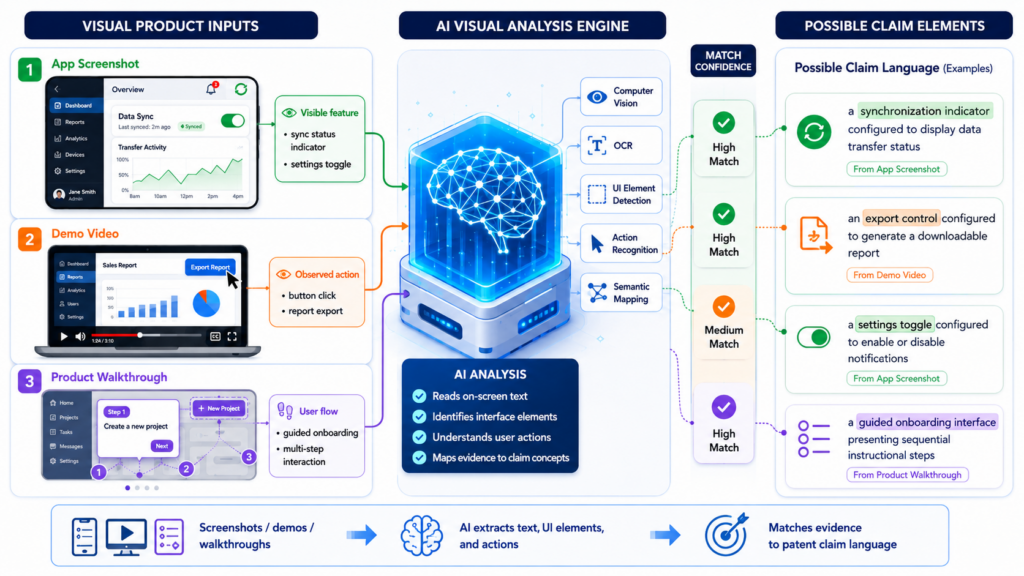
This is common in fast-moving startups because the product changes faster than the documents. A founder may explain a feature during a demo long before anyone writes a full spec for it.
AI can help by reading the text around these product views and connecting it to the larger system.
A screen may show a ranked result, a confidence label, a suggested next step, or a warning. Those visible parts may point to deeper system steps behind the scenes.
A screenshot alone may not prove how the system works, but it can raise the right questions. Why is this item first? How was this score made? What caused this warning to appear?
What did the system know before it suggested this action? These questions can lead to useful claim elements.
AI can connect what the user sees to what the system does
A product screen is the final stop in a longer journey. The user sees a clean result, but the system may have done many things before that result appeared.
It may have received data, removed duplicates, matched patterns, checked rules, used a model, ranked outputs, and selected one answer.
AI can look at the words on the screen and connect them back to the product documents. If the screen says “recommended action,” AI can search for the logic that creates that recommendation.
If the screen shows a “risk level,” AI can find where the risk score is explained. If the screen shows grouped items, AI can look for the grouping process.
This is helpful because founders often think of the product in terms of what users see. Patent work often needs to go deeper.
The goal is not only to protect a button or screen. The goal is to protect the useful system behavior that makes the button or screen valuable.
A founder can use this in a very practical way. Take the most important screens in your product and ask what system work happens before each screen appears.
Then check whether those steps are written down somewhere. If not, capture them before they fade from memory.
Screens can reveal invention value when paired with backend detail
A screen that says “high priority” may seem simple. But if the backend uses a special process to decide priority, that process may matter. Maybe the system weighs recent user behavior more than old behavior.
Maybe it changes priority based on team role. Maybe it uses feedback from past decisions. Maybe it waits until enough signals agree before it shows the result.
AI can help surface these links, but founders should confirm them. The product truth matters. A patent should not describe a dream version of the product unless that version is actually part of the invention plan and can be supported.
This is where PowerPatent can help teams work in a smarter way. You can bring in product documents, screenshots, flows, and related notes, then use AI to organize the possible invention pieces.
Real patent attorneys then review the material and help shape a stronger path. See how PowerPatent works here: https://powerpatent.com/how-it-works
AI Helps Find Claim Elements in Model Behavior and AI Product Logic
For AI startups, the invention often lives in the way the model is used, not just in the fact that a model exists. Many teams say they “use AI,” but that phrase is far too broad.
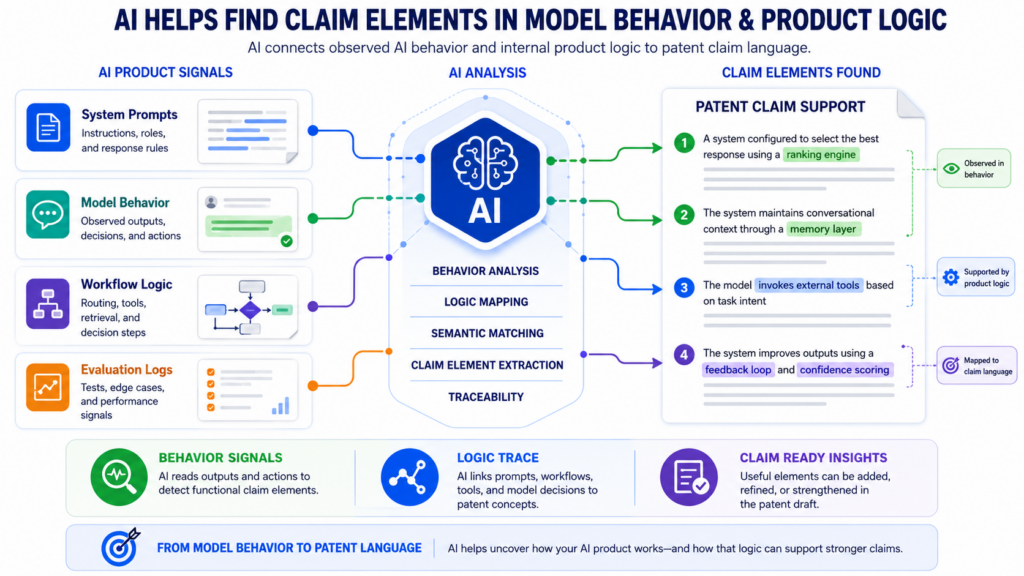
The useful details are in how the product gathers data, prepares it, sends it to a model, checks the output, and takes action after that.
AI can help read product documents for these model-related steps.
It can look for training flows, prompt flows, model selection, confidence checks, feedback loops, fallback rules, and human review steps. These details may become claim elements if they support the core invention.
This matters because many AI products look similar from the outside. A user enters something. The system returns an answer.
But behind that simple exchange, the product may have a unique process that creates a better result. That process is what the patent team needs to understand.
AI looks for how the product controls the model
A model is only one part of the system. The surrounding logic may be just as important.
The product may decide when to call the model, what context to send, which model to use, how to test the answer, when to reject the answer, and how to update future results.
AI can find these control points in product documents. It may notice that a system sends different prompts based on user role. It may find that a low-confidence output triggers a second review.
It may see that user corrections are stored and later used to change ranking. Each of these control points may be a possible claim element.
For example, a product note may say, “When the model is unsure, the system asks for more context before returning the answer.” That line may show more than a user experience choice.
It may show a technical flow where confidence is measured, missing context is found, a follow-up request is created, and the answer is delayed until enough context exists.
That is the kind of detail that can make an AI invention clearer.
The most useful AI claim elements often sit around the model, not inside it
Many founders assume the patent must focus on the model itself. Sometimes that is true. But often the stronger story is in the system around the model. How the data is chosen.
How the model result is checked. How the system handles weak answers. How human feedback is used. How the output changes a workflow.
This is good news for founders because many startups are not inventing a brand-new model from scratch.
They are building smart products that use models in clever ways. Those product workflows can still contain real invention value.
AI can help find these workflows because it can read across technical notes, product plans, and user stories.
It can show where the model fits into the larger product path. Then an attorney can decide what parts are worth protecting.
PowerPatent is built for this kind of work. It helps AI and software teams turn technical product logic into a clearer patent process, backed by real attorney oversight. You can learn more here: https://powerpatent.com/how-it-works
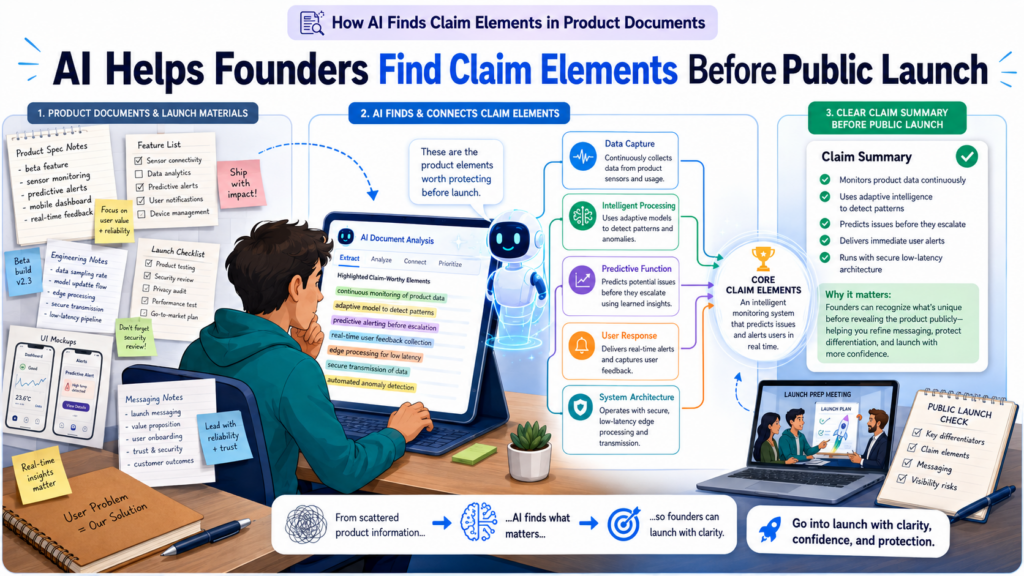
AI Helps Founders Find Claim Elements Before Public Launch
Timing matters. Many founders wait until a launch, investor raise, big customer meeting, or public demo before thinking about patents.
That can be risky. Once details are shared in public, options may become more limited. The safest path is to look for invention material before the product is widely shown.
AI can help because it makes early review easier. You do not need a perfect spec. You do not need a polished white paper.
You can start with the documents your team already has. AI can read drafts, tickets, notes, and decks to find possible claim elements while the product is still private.
This gives founders more room to act. It also helps the patent team understand the invention before the market starts reacting to it.
AI can scan launch materials for hidden invention disclosures
Launch materials often reveal more than founders realize. A website may describe a key workflow. A demo may show a special result.
A pitch deck may explain why the system beats old tools. A sales sheet may name the exact steps that create the product benefit.
AI can compare these materials with internal product documents. It can help identify which public-facing statements may disclose technical details.
It can also help the team decide what should be reviewed before the launch goes live.
This does not mean every marketing line needs a patent filing. It means founders should know when they are about to reveal something important.
If a launch page explains a unique product flow in plain English, that flow may deserve a patent review before publication.
A simple habit can help. Before a major launch, gather the product spec, demo script, website copy, and pitch deck.
Use AI to find the parts that explain how the product works, not just what the product promises. Then have those parts reviewed with a real patent attorney.
Early review can help avoid rushed filings and missed details
Rushing a patent filing at the last minute is stressful. The founder is busy with launch. The team is making final product changes.
The attorney may not have enough time to understand the invention deeply. Important details can get missed.
AI can reduce this pressure by helping the team start earlier. It can surface possible claim elements weeks or months before the launch date.
It can show which product flows need more detail. It can help the founder prepare answers before the attorney review.
This kind of early work can make the final filing stronger. It can also make the founder feel more in control. Instead of filing out of fear, the team files because it understands what it wants to protect.
PowerPatent helps founders move through this process with less friction. Smart software helps organize the invention, and real patent attorneys help guide the filing strategy.
That means you can keep building while still taking your IP seriously. Explore the process here: https://powerpatent.com/how-it-works
AI Helps Turn Founder Notes Into Clear Claim Elements
Founder notes are often raw, fast, and messy. They may live in a notes app, a memo, a voice transcript, a pitch outline, or a late-night message to the team.
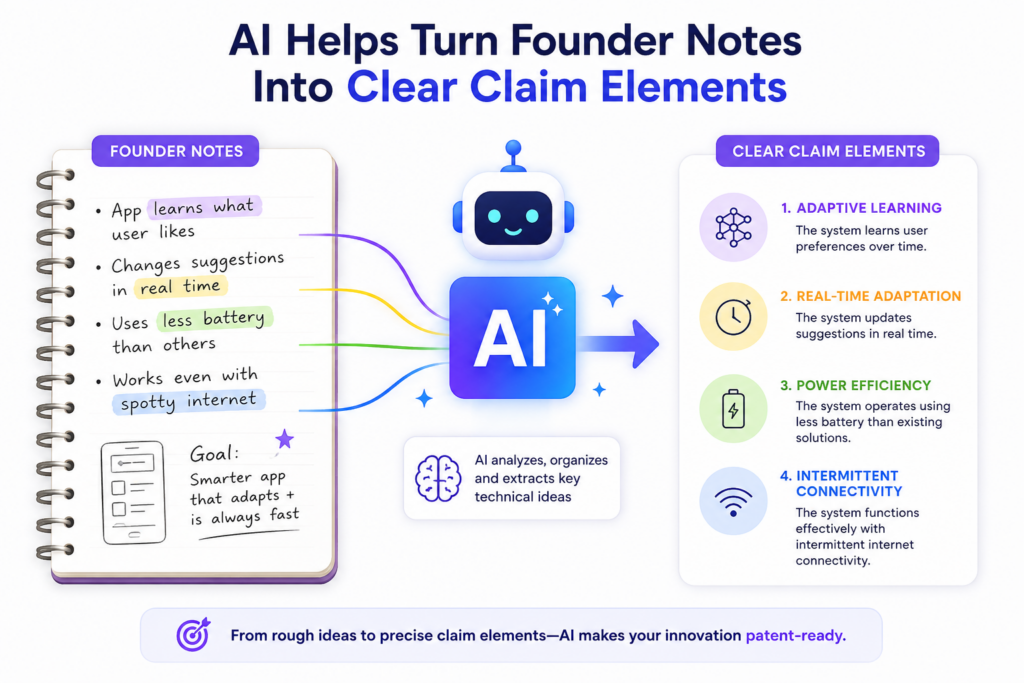
They may not sound technical at first. But they often explain the heart of the invention better than any formal document.
A founder might write, “The system should not just answer the user. It should know when the answer is not safe and ask for proof.” That sentence may not look like patent material, but it points to a useful system flow. There is an answer.
There is a safety check. There is a proof request. There may be a rule for deciding when proof is needed.
AI can read these notes and find the hidden structure. It can turn rough founder thinking into clearer product actions.
AI can pull system logic out of messy early ideas
Early invention notes often mix customer pain, product ideas, technical guesses, and future plans.
That is normal. Founders think in motion. They are not writing for a patent attorney. They are trying to build something that works.
AI can help by sorting those notes into invention pieces. It can find where the founder describes a problem, where they describe a system action, and where they describe the result. It can also find questions that need more detail.
For example, a founder note may say, “We should learn from every correction so the next review is faster.”
AI can turn that into a possible flow: the system receives a correction, stores it, updates a rule or model state, and changes a later review result. That gives the attorney a much better starting point.
This is not about making the founder sound more legal. It is about preserving the real insight before it gets buried under product work.
The founder’s first explanation may hold the sharpest invention story
As products grow, the core idea can get covered by features, edge cases, and roadmap noise.
The first clear explanation may be the most direct version of the invention. It may say exactly what old tools failed to do and what the new product does better.
AI can help recover that early signal. It can compare founder notes with later specs and show how the idea developed.
This can help the patent team understand not only what the product is today, but why the team built it this way.
Founders should not throw away rough notes. They can be useful. They may help explain the path from problem to invention. They may also help reveal claim elements that later documents assume but do not explain.
With PowerPatent, founders can use these real working materials as part of a smarter patent workflow.
The platform helps organize the invention story, while real attorneys help turn that story into a filing that is built with care. See how it works here: https://powerpatent.com/how-it-works
AI Helps Find Claim Elements in Code Comments and Engineering Tickets
Some of the most useful invention details are not in the polished product brief. They are in the places engineers write for each other.
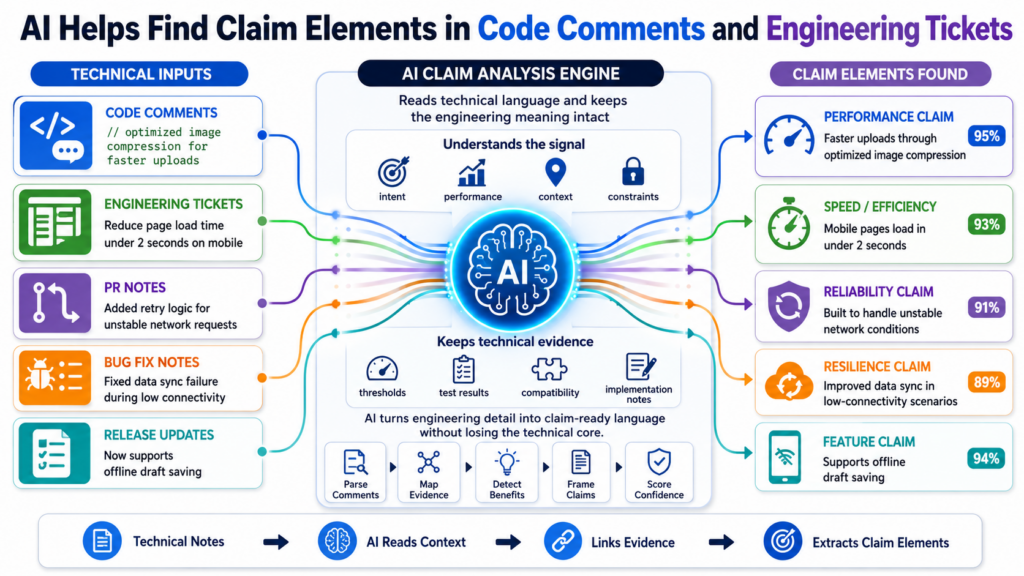
Code comments, pull request notes, bug reports, architecture tickets, and sprint tasks often explain the real reason a system works the way it does.
This matters because engineering documents are close to the truth. They show the hard choices. They show what broke, what changed, and what the team built to fix it.
A patent story becomes much stronger when it captures those real product choices instead of staying at the surface.
AI can read these engineering records and look for the working parts that may become claim elements.
It can find places where the system handles edge cases, changes a data path, improves speed, reduces errors, or makes a better decision.
These details may look small during development, but they can be very important when building a patent filing.
AI can spot invention value inside bug fixes and design changes
A bug fix may not sound like an invention. But sometimes a bug reveals a deeper product problem.
The fix may create a new way for the system to act. For example, a product may have sent too many alerts, ranked results poorly, or failed when data arrived in the wrong order.
The team may have solved that with a new filtering step, a new timing rule, or a better data grouping method.
AI can scan engineering tickets for these changes. It can look for lines that explain why the change was made and how the system now behaves. This can help the patent team see the product’s real technical growth.
A ticket that says “avoid duplicate review by merging related items before queue placement” may contain a useful claim element. It shows that the system does not simply receive items and show them to a user.
It groups related items first, then changes how the queue is built. That may support a stronger invention story if the grouping flow is tied to a real benefit.
Code notes can show the step that product specs leave out
Product specs often describe the happy path. Code comments often explain the hard path.
They may say what happens when data is missing, when confidence is low, when a user changes a decision, or when two system parts disagree. These moments can reveal the actual intelligence in the product.
AI can pull these moments into view. It can show the founder and attorney that the invention is not only the main feature. It may also be the way the product handles uncertainty, failure, scale, or change.
This is especially important for technical founders. You already have invention material inside the work your team is doing every day. The problem is that it is scattered and easy to miss.
PowerPatent helps teams bring those details into a clearer patent workflow with smart software and real attorney oversight. You can see how it works here: https://powerpatent.com/how-it-works
AI Helps Find Claim Elements by Watching How the Product Improves Over Time
Many modern products are not fixed. They learn from use, update settings, improve rankings, change workflows, or adjust outputs as more data comes in. This kind of change over time can be a strong place to look for claim elements.
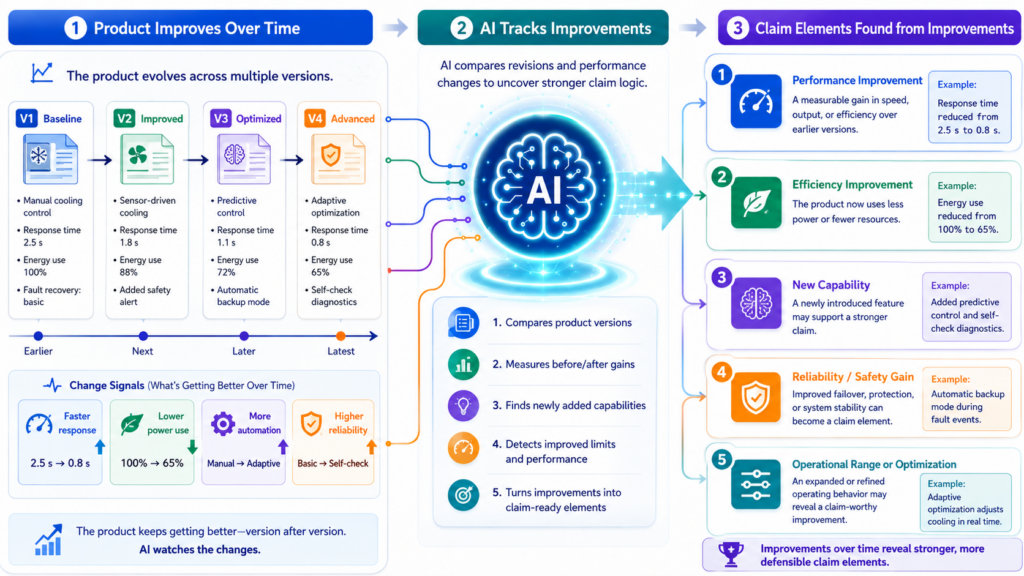
A simple product may do the same thing every time. A smarter product may watch what happens after each result and use that outcome to change the next result.
That feedback path can be very important. It shows that the invention may not be only the first output, but also the way the system gets better.
AI can find these time-based patterns in product documents.
It can look for words and ideas tied to updates, history, feedback, correction, retraining, tuning, reuse, versioning, and future ranking. These signals may point to claim elements that a founder could easily miss.
AI can connect user feedback to later system behavior
User feedback is often written as a product feature. A user approves a result, rejects a suggestion, edits a recommendation, marks an item as wrong, or chooses a better path. That may sound like normal app behavior. But the key question is what happens next.
If the system uses that feedback to change a future result, there may be a deeper invention story. AI can help find this link.
It can read a user story that says the user corrects an answer, then find an engineering note that says the correction changes future ranking. Together, those documents show a feedback loop.
A feedback loop can create several possible claim elements. The system receives feedback. The system stores the feedback with context. The system updates a rule, model, score, or profile.
The system changes a later output based on that update. The final claim strategy is for the attorney, but AI can help surface the pieces.
Time-based claim elements can protect more than a single product moment
A patent that only describes one output may miss the larger value of the product. If the product improves over time, the invention may live in the ongoing cycle.
That cycle may be harder for competitors to copy around because it covers the product’s deeper behavior.
For example, a system that only ranks tasks is one thing. A system that ranks tasks, learns from which tasks users handle first, and changes later ranking for similar teams is a richer story.
AI can help find that richer story by reading across product notes and looking for change over time.
Founders should pay close attention when AI finds feedback or update language. Ask what is being updated.
Ask what causes the update. Ask what later output changes because of it. Those answers may reveal some of the most valuable claim elements in the product.
PowerPatent helps make this easier by giving founders a more guided way to move from product work to patent work.
Smart AI helps organize the invention details, and real patent attorneys help decide what belongs in the filing. Learn more here: https://powerpatent.com/how-it-works
AI Helps Find Claim Elements by Separating Core Features From Optional Features
Product documents often include many features. Some are central to the invention. Others are helpful, but not critical. A patent process can slow down when everything feels equally important.
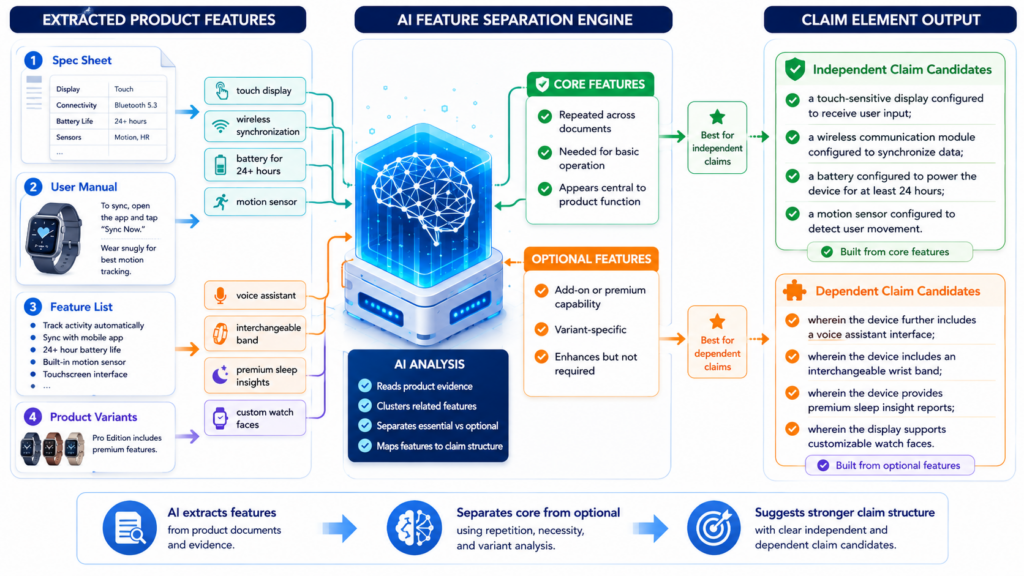
AI can help by sorting product features based on how often they appear, where they appear, and how they connect to the main product result.
A feature that appears in the core architecture, the main demo, the user story, and the customer value message may be central. A feature that appears only in a future roadmap note may be less urgent.
This sorting is useful because patent claims need focus. Trying to protect everything at once can make the invention story cloudy.
A clearer filing often starts with the product flow that creates the most important advantage.
AI can help show which claim elements carry the main value
A core claim element is not always the flashiest feature. It is the part that makes the product work in a meaningfully better way. It may be a hidden routing rule, a special scoring method, a data cleanup step, a model check, or a feedback loop.
AI can help find these high-value parts by looking at how the documents describe cause and effect.
If several documents say that a certain step reduces false results, speeds up review, or improves match quality, that step may deserve more attention.
For example, a product may have a beautiful dashboard, but the real value may be a backend process that groups related items before the dashboard appears.
The dashboard is useful, but the grouping step may be the stronger claim element because it creates the better result.
Optional features should support the story without taking it over
Optional features can still matter. They may support backup claims, future filings, or added detail in the patent description. But they should not distract from the main invention path.
AI can help label these features as possible supporting details. A founder and attorney can then decide what to include, what to save for later, and what to leave out. This keeps the filing sharper.
This is also where real attorney oversight matters. AI can organize and suggest. It can show patterns.
It can point to possible claim elements. But a patent attorney helps decide how to frame the invention so it has the best chance of being useful for the company.
PowerPatent combines both sides. Founders get software that helps find and organize invention material, plus real attorney review to guide the final filing.
That means less wasted time and a better chance of protecting the parts that truly matter. See the workflow here: https://powerpatent.com/how-it-works
Conclusion
AI helps founders find claim elements by reading the real product work behind the invention: specs, tickets, notes, screens, demos, code comments, and roadmaps. It turns messy material into a clearer map of inputs, actions, decisions, outputs, and feedback loops, so the patent process starts with facts, not guesswork.
The best results come when AI speed is paired with real attorney judgment. That is the PowerPatent path: smart software, careful review, and more control for technical teams. Protect the product you are building before the market catches up: https://powerpatent.com/how-it-works while your team keeps shipping fast.
Leave a Reply