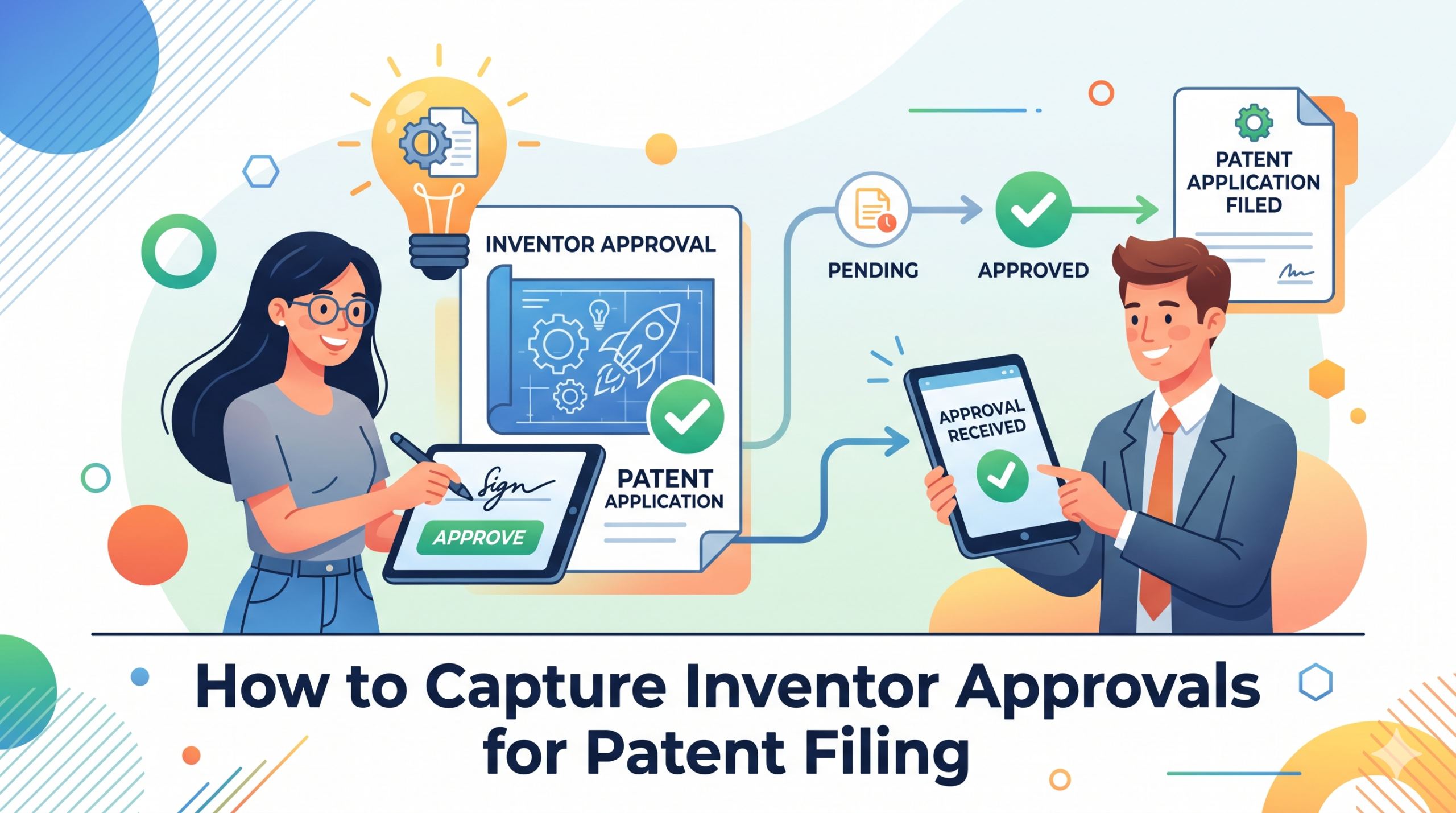
A patent filing can move fast, but one missing approval can slow everything down. In this guide, we will walk through how to capture inventor approvals in a way that is practical, fast, and founder-friendly.
Build Inventor Approval Into The Filing Plan From Day One
Inventor approval should not be the final step you remember the night before filing. That is when mistakes happen. That is when people rush.
That is when a founder sends a long email thread to three engineers and hopes everyone replies with “approved” before the deadline. That may work once. It is not a real system.
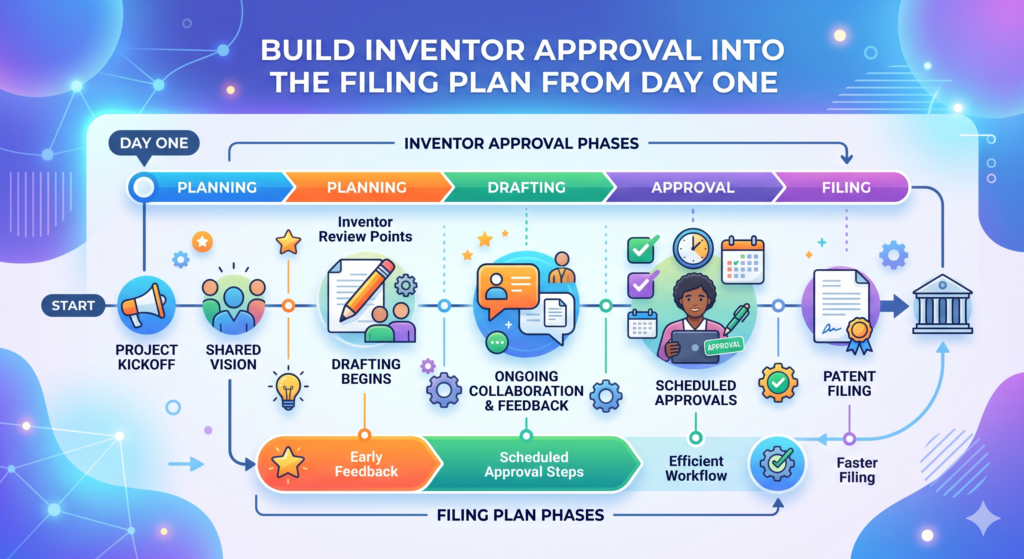
The better move is to treat inventor approval as part of the filing plan from the start. When your team decides that an invention is worth protecting, you should also decide how approval will be captured, who needs to review the draft, what they are approving, and when the approval must be complete. This keeps the process calm. It also gives inventors enough time to think clearly.
A strong patent process is not only about writing a good application. It is also about making sure the people who built the invention have had a fair chance to review it. They may catch missing details.
They may point out that one feature was described too narrowly. They may explain that the system works in another way too. These small fixes can make the filing stronger.
This is why approval should be planned before the draft is finished. If you wait until the end, inventor feedback can feel like a delay. If you plan for it early, inventor feedback becomes part of making the filing better.
The approval step should have a clear owner
Every patent filing needs one person who owns the approval process. This does not always have to be the founder. It can be the patent lead, product lead, engineering manager, outside counsel, or someone on the operations team. What matters is that one person is
clearly in charge of moving approvals forward.
Without an owner, everyone thinks someone else is handling it. The attorney may think the founder is getting approvals.
The founder may think the inventors already reviewed the draft. The inventors may think the draft is still being changed. This creates gaps.
The approval owner should know which invention is being filed, who the listed inventors are, where the latest draft lives, what version is ready for review, and what form of approval is needed.
This person should also keep a simple record of who approved, when they approved, and what exactly they approved.
Keep the approval owner close to the filing timeline
The approval owner should not be pulled in at the last second. They should know the target filing date early.
They should also know the internal review date, attorney review date, inventor review date, and final approval date.
This timeline matters because inventors often need more than one reminder. They may be coding, traveling, meeting customers, or handling a launch. A clean process gives them time without slowing down the filing.
For example, if the target filing date is Friday, the inventor review should not begin Thursday night. It should start several days earlier, with a clear message that explains what the inventor should check.
The owner should also leave room for questions. If an inventor spots a real issue, the team needs time to fix it.
This is where software can make a big difference. PowerPatent helps teams keep the work organized, so approvals do not live inside scattered messages and forgotten email chains.
When founders use a guided system backed by real patent attorney oversight, they can move faster without losing control. You can see how that works here: https://powerpatent.com/how-it-works
Define what approval actually means
One common mistake is asking inventors to “approve the patent” without explaining what that means.
Inventors may not know whether they are approving the legal wording, the technical facts, the drawings, the claims, or the full filing package. This can lead to weak review or confusion later.
The approval request should be plain and direct. It should tell the inventor that they are being asked to confirm that the draft correctly describes the parts of the invention they helped create, that the named inventors look right based on their understanding, and that they do not see any major technical errors.
This does not mean the inventor must act like a patent lawyer. They should not be expected to judge every legal phrase.
That is why attorney oversight matters. The inventor’s job is to check the technical story. The attorney’s job is to shape that story into a strong filing.
Make the inventor’s role simple and specific
Inventors are more likely to approve on time when the task feels clear. A vague request creates delay because the inventor does not know where to start. A clear request helps them move.
Instead of saying, “Please review and approve,” say something more useful in normal words. Tell them to check whether the draft describes the product flow correctly.
Ask them to look for missing system steps, wrong terms, missing model details, wrong data flow, incorrect examples, or anything that makes the invention sound smaller than it really is.
This helps the inventor review the application like an engineer, not like a lawyer. That is exactly what you want.
The best approval process gives each person a focused job. The founder confirms the business need and filing priority.
The attorney confirms the legal strategy. The inventor confirms the technical truth. When each person does their part, the filing becomes cleaner and stronger.
Lock the version before asking for approval
You should never ask inventors to approve a moving target. If the draft is still changing every few hours, approvals become weak.
An inventor may approve one version, while the final filing version says something else. That creates risk and confusion.
Before approval starts, the team should mark a review-ready version. This version should have a date, file name, or platform record that makes it clear what the inventor reviewed.
It does not need to be perfect, but it should be stable enough for real review.
If changes are made after inventor approval, the team should decide whether those changes are small or meaningful. Small edits, such as grammar fixes or formatting changes, may not need another full review.
But changes to how the invention works, what features are included, who invented the idea, or what the filing focuses on should be shown to the inventors again.
Version control protects the company later
Version control may sound boring, but it is one of the quiet habits that protects a company. Months or years later, someone may ask what the inventors approved before filing.
If your approval record only says “looks good” in an email thread, that may be hard to explain. If your record shows the exact draft, approval date, and approving inventor, the story is much cleaner.
This is not about creating extra work. It is about avoiding a mess later.
For startups, this matters a lot. Investors, buyers, partners, and future legal teams may all look at your patent process.
A clean approval trail shows that your company treats IP seriously. It shows that your filings were not rushed or random. It also gives founders more confidence when they talk about their patent position.
If your team is already moving fast, do not rely on memory. Build a simple approval path into the filing plan. That one habit can save hours of cleanup later.
Identify The Right Inventors Before You Ask For Approval
Inventor approval only works if the right people are involved. This sounds obvious, but it is one of the hardest parts of patent filing for fast-moving teams. In a startup, many people touch the product.

One engineer writes the first code. Another improves the model. A founder defines the core idea. A product person changes the workflow. A researcher tests a new method. A customer conversation sparks a key change.
Not every helpful person is an inventor for the patent. At the same time, leaving out a true inventor can create serious problems.
The goal is not to flatter the team or reward hard work. The goal is to name the people who helped create the claimed invention.
That is why inventor approval should begin with a careful inventor check. Before asking anyone to approve the filing, your team should understand who may have contributed to the actual inventive parts.
This is not always the same as who built the product, managed the team, funded the work, or wrote the final code.
For founders, this can feel uncomfortable because invention work is often shared. But the process does not need to be painful.
It just needs to be thoughtful. You want to ask the right questions early, while memories are fresh and everyone is still close to the work.
Start with the invention, not the org chart
The worst way to identify inventors is to start with job titles. The CEO is not automatically an inventor. The CTO is not automatically an inventor. The lead engineer is not automatically an inventor.
A junior engineer may be an inventor if they came up with a key technical idea. A founder may not be an inventor if they only gave business direction.
The better way is to start with the invention itself. What is the new thing being protected? What problem does it solve? What steps, systems, models, rules, workflows, or technical choices make it different? Once you know that, you can ask who helped create those parts.
This is where clear invention capture helps. If your team has notes from design meetings, product specs, commit history, model experiments, diagrams, or invention intake forms, use them. These records can help show how the idea formed and who contributed to what.
Ask contribution questions in plain English
You do not need to ask inventors legal questions. You need to ask human questions. Who came up with this part? Who suggested this approach? Who changed the system in a way that made it work better?
Who solved the hard technical issue? Who added the model step, data process, control rule, or architecture choice that the filing now describes?
These questions help separate general support from inventive contribution.
For example, someone who only followed instructions may not be an inventor. Someone who only tested the final product may not be an inventor.
Someone who only approved the budget may not be an inventor. But someone who created the key method that made the product faster, safer, more accurate, or more scalable may be an inventor.
This is why the inventor list should not be guessed. It should be checked.
PowerPatent is built for teams that need this kind of clarity without getting stuck in old, slow legal workflows.
The platform helps founders and technical teams turn invention details into a stronger patent process, with real patent attorneys involved where judgment matters. See how it works here: https://powerpatent.com/how-it-works
Do the inventor check before the final draft
Many teams wait too long to check inventorship. They write the application first, then ask, “Who should be listed?” That is risky because the claims and description may focus on parts created by people who were not included in the review. Or the draft may leave out a key feature created by someone who should have been involved.
The inventor check should happen before the final draft is locked.
That way, if you find that another person made a real contribution, you can bring them into the review process early. You can also make sure the draft includes the right technical details.
This is especially important when the invention came from a team effort. AI, robotics, biotech tools, chips, climate tech, developer tools, and deep software systems often involve many layers.
The final invention may include data flow, model design, hardware control, user workflow, security logic, training methods, edge processing, or system architecture. Different people may have shaped different layers.
Treat inventorship as a fact question, not a politics question
Inventorship should not be used as a reward. It should not be used to keep someone happy.
It should not be changed because someone is senior or because someone left the company. It should be based on what people actually contributed.
This is why it helps to keep the tone calm and factual. You are not asking who worked hardest. You are asking who helped create the invention being filed.
When people understand this, the process becomes less emotional. A person can be very important to the company and still not be an inventor on one filing.
Another person can have a small role in the company but still be a true inventor on a specific patent application.
Founders should be careful here. Guessing can create problems. Over-including people can be messy.
Under-including people can be worse. The safest path is to collect the facts, discuss them with your patent attorney, and make a reasoned decision.
Include possible inventors in the review when there is doubt
When you are not sure whether someone is an inventor, do not ignore them.
Bring the facts to your patent attorney and consider whether that person should review the draft or at least be asked about their contribution. It is easier to resolve these questions before filing than after filing.
A simple conversation can clear up a lot. Sometimes a person will say, “I built that part, but the approach came from someone else.”
Sometimes they will say, “I suggested that change during the design review.” Sometimes they will point to a document or message that helps explain the history.
This does not mean every possible contributor must approve the filing. It means your team should not make blind choices.
Keep a clean record of the inventor decision
Once the inventor list is set, keep a short record of how the decision was made.
This can be simple. It may include the invention title, the draft version, the listed inventors, the people consulted, and the reason the team believes those inventors contributed to the invention being filed.
This record should be stored with the patent file. It should not live only in someone’s memory.
A clean inventor record helps the company later. It also helps new team members understand what happened.
If a co-founder leaves, an engineer changes jobs, or the company raises funding, you do not want to rebuild the story from old chat logs.
The deeper point is simple. Patent filings are company assets. They should be handled with the same care as source code, cap tables, customer contracts, and fundraising records.
Capturing inventor approvals is not just an admin task. It is part of protecting ownership, trust, and future value.
Give Inventors The Right Draft To Review, Not A Pile Of Legal Text
Inventor approval fails when the review package is hard to understand. Many teams send the full patent draft as a dense document and expect engineers or founders to read every line with care.
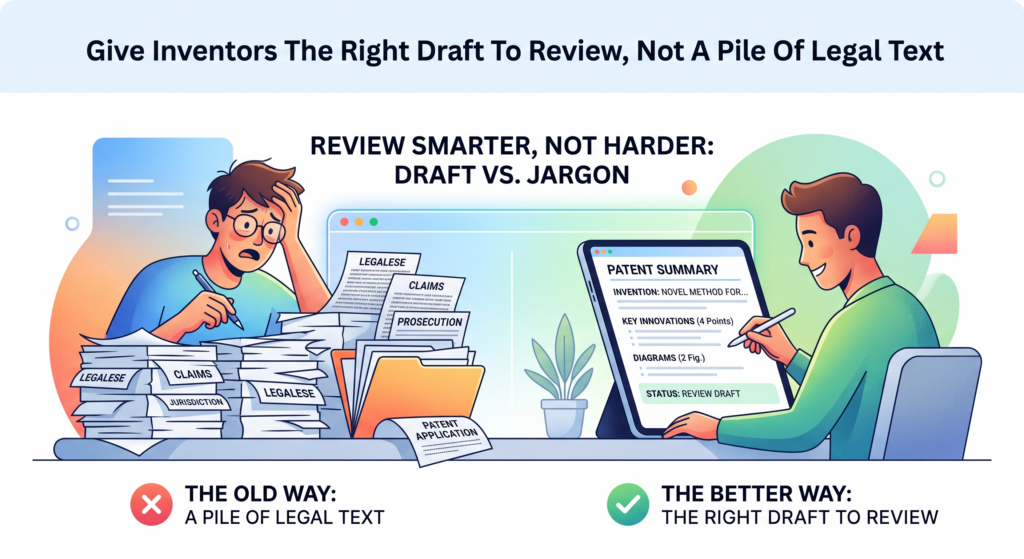
That is not how busy teams work. If the document feels heavy, vague, or too legal, the inventor may skim it. They may approve it without truly checking it. Or they may freeze because they do not know what they are supposed to review.
The goal is not to make inventors act like patent attorneys. The goal is to help them confirm the technical truth.
They should be able to see the invention, understand the scope, check the flow, and flag anything that feels wrong or missing. That only happens when the review package is clear.
A good review package has the final draft, but it also has a plain-English guide. This guide tells the inventor what matters most.
It explains which parts need careful review. It points them to the drawings, the key examples, the system flow, and the parts that describe what is new. This saves time and improves review quality.
The approval process should respect the inventor’s time. When you make the task easy to complete, you get better answers. When you make it hard, you get vague approvals that may not help the filing.
Send A Simple Summary Before The Full Draft
Before the inventor opens the full application, give them a short summary of what the patent is about.
This summary should be written in normal words. It should state the problem, the solution, the main parts of the invention, and why the filing matters.
This summary does not replace the draft. It helps the inventor read the draft with the right frame. Instead of starting cold, they know what they are looking at. They can quickly spot whether the filing matches the real invention.
For example, if the patent is about a machine learning system that improves fraud detection by changing how signals are weighted over time, the summary should say that.
It should not bury the point under long terms. The inventor needs to know, right away, what technical idea the application is trying to protect.
Once the summary is clear, the inventor can review the full draft with more focus. They can check whether the examples are right, whether the system steps are in the right order, whether the inputs and outputs make sense, and whether the draft leaves room for future versions of the product.
Show The Inventor What To Check First
Inventors should not have to guess where to spend their time. Tell them what to check first.
In most cases, the most important parts are the invention summary, the drawings, the detailed description, and any examples that show how the invention works.
The inventor should ask themselves whether the draft describes the real system. They should look for missing steps, wrong assumptions, weak examples, narrow wording, and details that could confuse someone later.
They should also look for places where the draft describes only one version of the product even though the invention can work in several ways.
This is a big point. A patent filing should not sound like it only covers today’s exact build if the invention is broader than that.
Startups change fast. Code changes. Models change. Hardware changes. Workflows change. The patent application should protect the core idea, not just one build from one sprint.
That does not mean the draft should be vague. It should be clear and detailed. But it should also be smart about future versions. Inventors are often the best people to catch this because they know what may change next.
Make Drawings Part Of The Approval Process
Many inventors understand the invention faster through drawings than through text.
A good drawing can show the system, the flow, the modules, the data path, or the decision process in a way that plain text cannot. That is why drawings should be part of the approval review, not a side item.
If the patent draft has drawings, the inventors should review them carefully. They should check whether the parts are named correctly, whether the arrows make sense, whether the flow matches the system, and whether the drawing leaves out any key step. A small drawing mistake can make the whole application harder to follow.
The drawing does not need to look like a product diagram. Patent drawings are often simple. But they should be accurate enough to support the story.
If the drawing shows a user device sending data straight to a model, but the real system has a filtering layer, that may matter. If the drawing skips an edge device, local memory, sensor layer, controller, or feedback loop, that may also matter.
Ask Inventors To Review The Story, Not Just The Parts
A patent application is not just a list of features. It is a story about a problem and a solution. Inventors should review that story.
They should ask whether the draft explains why the invention exists, how it works, and what makes it useful.
This matters because a filing can be technically correct but still weak. It may describe parts without showing why the setup is special.
It may list steps without explaining the benefit. It may show a workflow but miss the hard problem the team solved.
A strong draft should help a reader understand the insight behind the invention. It should make the invention feel real, useful, and different. Inventors can help sharpen this.
They can say, “The hard part was not collecting the data. The hard part was cleaning it in real time before the model saw it.” That kind of comment can improve the filing.
This is one reason PowerPatent is built around both smart software and real attorney oversight. The software helps organize the technical story.
The attorney helps shape that story into a filing that makes sense. For founders who want speed without chaos, that mix is powerful. You can see the process here: https://powerpatent.com/how-it-works
Do Not Hide The Claims From Inventors
Patent claims can be hard to read, but inventors should still see them.
The claims are the part that points to what the application is trying to protect. Even if the attorney owns the legal wording, the inventor can still catch technical problems.
The inventor does not need to edit claim language. They should review claims at a simple level. Do the claims point to the right invention?
Do they miss a key step? Do they include a step that is not always needed? Do they describe the system too narrowly? Do they focus on the wrong feature?
This review can be very useful. Sometimes the claims focus on a part that is easy to design around, while the real invention is somewhere else.
Sometimes the claims require a specific order of steps, but the invention works in other orders too. Sometimes the claims mention a named component that may change in the next product version.
Translate Claim Review Into Plain Questions
The best way to help inventors review claims is to turn the claims into plain questions. Ask them whether the claim covers the main technical idea. Ask whether a competitor could avoid the claim by making a small change.
Ask whether the claim requires something that the invention does not always need. Ask whether the claim misses the part that made the product work.
This makes claim review less scary. The inventor does not need to speak legal language. They just need to use their technical judgment.
This is where founders should slow down just enough to get it right. Filing fast is good. Filing blind is not. A clean inventor review can reveal gaps before they become expensive problems.
When the right draft, summary, drawings, and claims are reviewed together, approvals become more than a checkbox. They become a quality control step. That is the mindset startups need.
Use A Clear Approval Message That Leaves No Room For Confusion
The approval request itself matters more than most teams think. A weak message creates weak approvals. A strong message creates a clean record and helps inventors take the task seriously.
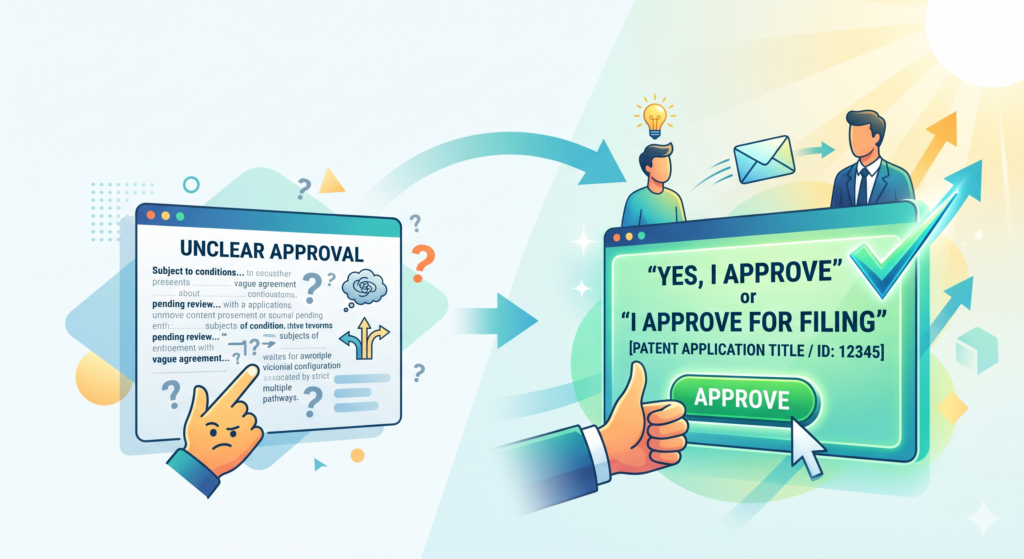
The message should be simple, direct, and complete. It should explain what is being reviewed, what the inventor should check, how they should approve, and when the approval is needed.
Many teams make the mistake of sending casual notes like, “Can you take a look?” or “Are we good to file?” These phrases feel easy, but they are not clear.
An inventor may read them as a quick gut check, not a formal approval. Later, if someone needs to show that the inventors reviewed the filing, that vague message may not be enough.
A better message says what the approval means. It tells the inventor that the attached or linked draft is the version planned for filing. It asks them to confirm that the technical content is accurate based on their contribution.
It asks them to flag any missing or wrong details before approval. It also tells them that attorney review is being handled separately, so they do not feel pressure to judge legal wording.
The key is to make approval easy but not careless. The inventor should know this is an important step. They should also know exactly how to complete it.
Put The Draft Version In The Approval Message
Every approval request should identify the exact draft being reviewed. This can be done with a file name, date, version number, platform link, or document ID. The point is simple. The company must know what the inventor approved.
Without version clarity, approval records become weak. An inventor may approve a draft on Monday, but the team may keep editing on Tuesday and file on Wednesday.
If the filed version is different, what did the approval really cover? That question can create confusion.
The approval message should make the version obvious. It should say that the inventor is reviewing a specific version of the patent application for a specific invention.
If the draft is stored in a platform, the platform should track that version. If it is sent as a file, the file name should include the invention name and date.
This small habit can prevent major cleanup later. It also shows that your company handles patent work with care.
Make The Approval Action Simple And Clear
Inventors should not have to wonder how to approve. Tell them the exact action to take. If you use a platform, tell them to click the approval button after review.
If you use email, ask them to reply with clear approval language. If your attorney provides a formal approval form, tell the inventor where to sign.
The approval action should be easy to track. A casual thumbs-up in chat may be fast, but it can be hard to manage. A clear approval response tied to the final draft is much better.
The approval text can be simple. The inventor can confirm that they reviewed the draft, that the technical description looks accurate based on their understanding, and that they approve moving forward with filing.
The exact wording should be guided by your attorney, but the idea should be clear.
Founders should avoid collecting approvals across too many places. Do not gather one approval by text, one by email, one in Slack, and one in a call note unless you have a strong way to store everything together. Scattered approvals create avoidable work.
Set A Real Deadline For Approval
Approval requests need a deadline. Without a deadline, review slips. Inventors get busy. The filing date gets closer. Then the team has to chase people at the worst possible time.
The deadline should be clear and reasonable. It should give inventors enough time to read the draft and ask questions. It should also leave enough time for the attorney or drafting team to make changes if needed.
The message should explain why the deadline matters. You do not need to pressure people. Just be clear.
Say that the team is targeting a filing date and needs inventor approvals before the final package can be filed. This helps inventors understand that their review is part of the path to protection.
For startups, timing can matter a lot. You may be filing before a launch, demo day, fundraise, customer pilot, public talk, paper release, or partner meeting.
When timing matters, approval delays can create risk. A clean deadline helps the team stay ahead.
Send Reminders That Help, Not Nag
Inventor reminders should be useful. A good reminder does not just say, “Please approve.” It repeats the key context, points back to the draft, and tells the inventor what to do. It should feel like help, not pressure.
If an inventor has not approved, there may be a reason. They may have questions. They may have found an issue.
They may not understand what is expected. The reminder should make it easy for them to respond.
A practical reminder might say that the filing is planned soon, that their approval is still needed, and that they should either approve the draft or flag any technical issue. This gives them a clear path.
The approval owner should track reminders. If someone is not responding, the owner should follow up through the best channel.
Some inventors respond faster to email. Others respond faster to a direct message. For important filings, a short call may be the fastest way to resolve questions.
Keep The Tone Serious But Founder-Friendly
The approval message should not sound scary. It should sound important. Inventors should feel respected, not trapped. The tone should be clear, calm, and professional.
This matters because patent work can feel strange to technical teams. Many engineers are not used to reviewing patent drafts.
They may worry that approval means they are taking on legal risk. They may think they need to understand every claim. They may delay because they are unsure.
A good message lowers that friction. It tells them that their role is to confirm technical accuracy. It also makes clear that patent counsel is handling the legal side. This helps inventors focus on what they know best.
Remove Fear By Explaining The Purpose
Inventors are more likely to give strong feedback when they understand why the review matters. Tell them that their approval helps make sure the filing reflects the real invention.
Tell them that their review can catch missing details before filing. Tell them that this protects the company’s work.
This is not just process talk. It connects the approval step to the bigger mission. The team is not filling out paperwork. The team is protecting what it built.
PowerPatent helps make this smoother by giving startups a more guided way to move from invention details to patent filing, while keeping real patent attorneys in the loop.
That means founders can avoid messy back-and-forth and still file with care. Learn more here: https://powerpatent.com/how-it-works
A strong approval message turns confusion into action. It gives inventors the right task, the right draft, and the right deadline. That is how approvals get done without drama.
Create A Review Workflow That Fits How Technical Teams Actually Work
A patent approval process should match the way your team already works. If your engineers live in product docs, code reviews, model notes, design tools, or project boards, the patent workflow should not feel like it came from another planet. The more the process fits the team, the faster approvals happen.
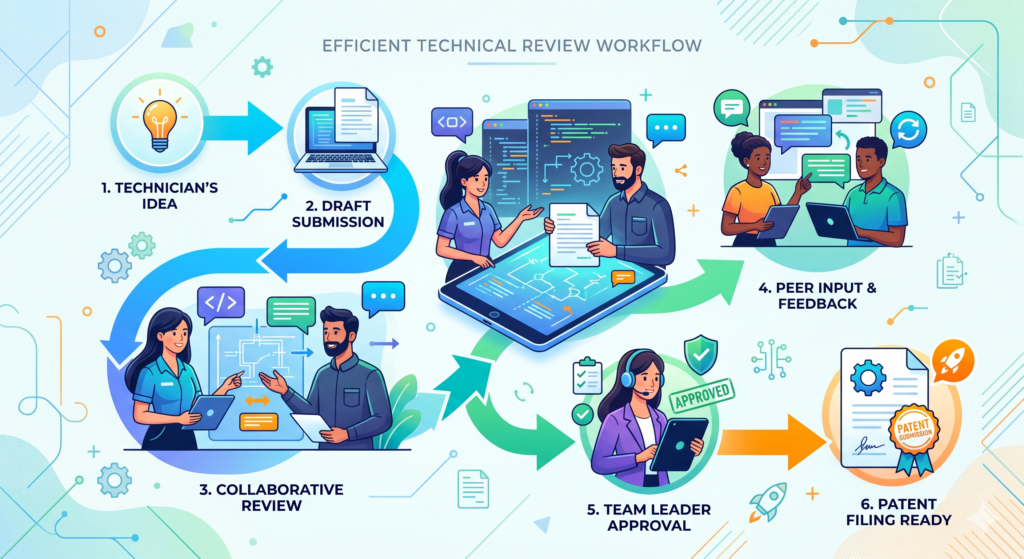
Old patent workflows often feel slow because they force technical people into legal-heavy steps. The founder gets a draft. The draft goes by email. Inventors leave comments in different formats.
Someone loses track of the latest version. The attorney asks follow-up questions. The team repeats the same explanation again. By the time everyone approves, the filing feels harder than it needed to be.
A better workflow is clear, simple, and built around the team’s normal speed. It gives inventors a place to review. It gives them simple prompts.
It keeps comments tied to the draft. It shows who has approved and who has not. It gives the founder one view of progress.
This is not about adding process for the sake of process. It is about removing friction. A strong workflow helps the team move fast without dropping important details.
Start With A Single Source Of Truth
The first rule is to keep the patent draft, comments, approvals, and status in one trusted place. When the review is spread across email threads, shared drives, chat tools, and calls, the approval process becomes hard to control.
People may review old files. Comments may be missed. Approvals may be hard to prove later.
A single source of truth solves this. It tells everyone where the current draft lives. It shows what version is under review. It keeps feedback close to the right document. It also gives the approval owner a clear way to track progress.
For a startup, this matters because the same people are often doing many jobs. The founder may be raising money.
The CTO may be shipping a major release. The engineers may be fixing urgent bugs. Nobody has time to hunt through old threads to find the latest patent draft.
Keep Comments Close To The Draft
Inventor comments should stay connected to the draft section they affect. If an inventor says, “This step is wrong,” the team should know exactly which step they mean. If they say, “We also support this through a second model,” that comment should be tied to the part of the draft where model operation is described.
When comments are separated from the draft, context gets lost. The drafting team may misunderstand the issue. The attorney may need another call. The filing may slow down.
A good workflow lets inventors comment in place or respond to focused questions. This keeps feedback precise. It also reduces the number of follow-up messages.
This is one area where PowerPatent can help. The platform is made for founders and technical teams that want a more organized way to turn invention details into filings, with smart tools and real attorney review working together. You can explore the workflow here: https://powerpatent.com/how-it-works
Match The Review Path To The Risk Level
Not every filing needs the same level of internal review. A simple continuation or narrow update may need a lighter inventor check.
A first filing on a core platform technology may need deeper review from several people. A filing before a major launch may need faster coordination and cleaner records.
The approval workflow should match the importance of the filing. If the patent covers a key part of the company’s moat, do not rush inventor review as a formality. Give the inventors time to think.
Ask deeper questions. Make sure the claims point to the right technical edge. Confirm that the filing does not leave out future product paths.
On the other hand, do not overbuild the process for every small filing. If the process is too heavy, teams will avoid it. The best system is flexible. It gives more attention to filings that matter most and keeps lower-risk work moving.
Use A Core Filing Review For Important Inventions
For important inventions, the team should do a focused internal review before final approval.
This is not a long meeting with everyone talking in circles. It is a tight review of the invention, the draft, the drawings, the claim focus, and the inventor list.
This review should answer a few key questions in plain words. Does the draft protect the real business edge? Does it cover the way the system works now? Does it also cover likely future versions?
Are the right inventors listed? Are there any technical gaps? Are there any public disclosure dates that make timing urgent?
These questions help the company file smarter. They also help the attorney understand what matters most to the business.
A core filing review is especially useful for AI, software, robotics, medical devices, semiconductors, clean energy, and other deep tech areas where a small technical detail can change the strength of the filing.
The inventor may see risk that the founder misses. The founder may see business value that the inventor does not mention. The attorney can then shape both views into a better filing.
Make Approval Visible To The Founder
Founders should not have to ask, “Did everyone approve?” The workflow should make that answer visible. The founder should be able to see who has reviewed the draft, who has approved, who has questions, and what is blocking the filing.
This visibility matters because patent filing is often tied to business timing. A company may need to file before talking to investors, showing a demo, publishing a paper, launching a feature, or signing a partner deal. If approvals are hidden in scattered messages, the founder cannot manage risk.
A clear status view helps the founder act early. If one inventor has not responded, the founder can help.
If a technical issue is blocking approval, the team can fix it. If all approvals are done, the filing can move forward with confidence.
Treat Approval Status Like A Launch Checklist
Startups already know how to run launch checklists. They check code, design, copy, analytics, support, security, and customer messages. Patent approval should be treated with the same care when the invention matters.
The approval status should not be vague. It should show whether each inventor has not started, is reviewing, has questions, requested changes, or approved. That kind of clarity prevents last-minute panic.
The point is not to create bureaucracy. The point is to make sure important work does not depend on memory. A patent filing can become a valuable company asset. It deserves a clean path.
A workflow that matches technical teams is not slow. It is faster because it removes confusion.
It lets inventors focus on the invention. It lets attorneys focus on strategy. It lets founders keep control.
Capture Approval In A Way That Creates A Clean Record
Inventor approval is only useful if the record is clear. A vague approval may feel fine in the moment, but it can become a problem later.
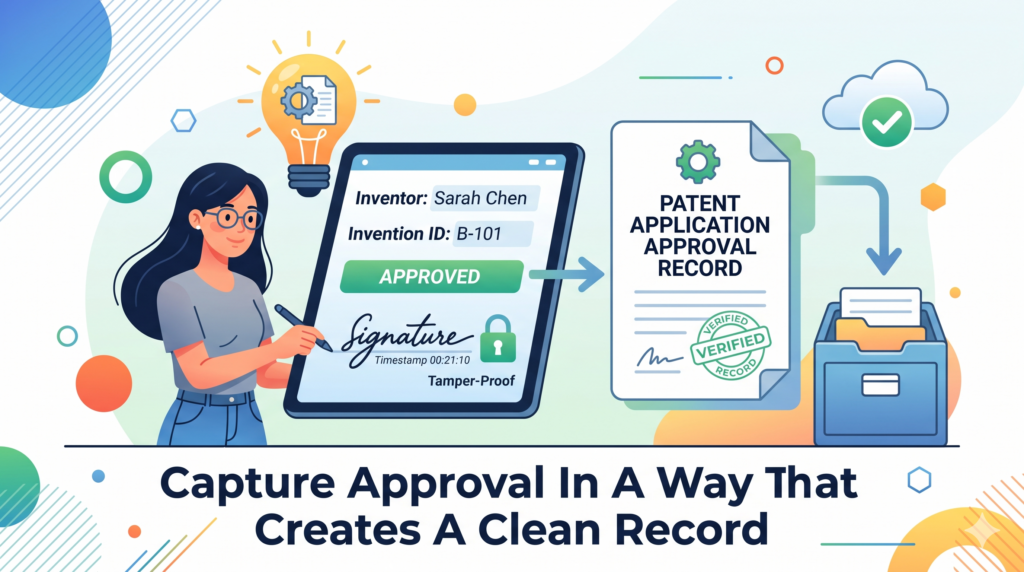
When your company grows, raises money, gets acquired, enters a dispute, or reviews its patent portfolio, people may need to know who approved what and when. If the answer is buried in old messages, the company has unnecessary risk.
A clean approval record does not need to be complex. It just needs to show the important facts.
It should show the invention being filed, the draft version, the inventor name, the approval date, the approval method, and whether the inventor raised any issues before approval.
This record should be stored with the patent file. It should not live only in one founder’s inbox. It should not depend on a former employee’s laptop. It should be easy for the company to find later.
The approval record is part of the story of the patent. It shows that the company took care before filing. It shows that the technical contributors had a chance to review. It helps prove that the filing was not random or rushed.
Use Written Approval Whenever Possible
Written approval is the safest default. A phone call can help resolve questions, but the final approval should still be captured in writing.
This can happen through a platform, an email response, a signed form, or another tracked system approved by counsel.
The written approval should be tied to a specific draft. This is the part many teams miss.
An approval that says “approved” is better than nothing, but an approval that says the inventor reviewed and approved a specific version is much stronger.
This is why platform-based approval can be useful. It can connect the approval to the exact draft and timestamp the action.
That reduces confusion later. It also saves the founder from building a manual tracking system.
Avoid Scattered Informal Approvals
Informal approvals can be tempting because they are fast. A thumbs-up emoji, a short chat reply, or a quick voice note may feel like enough. But these approvals can be hard to manage.
They may not show what was reviewed. They may not be easy to export. They may disappear if tools change or employees leave.
This does not mean every approval must be painful. It means the approval should be stored in a way the company can trust.
If an inventor approves in a chat because that is the fastest path, the approval owner should move that record into the patent file.
They should include the date, the inventor, the draft version, and the approval text. Better yet, the team should guide inventors to approve through a system that already captures those details.
PowerPatent helps teams avoid this kind of scattered process by giving founders a more structured path for patent work, supported by real patent attorneys.
Instead of chasing approvals across tools, teams can move with more control. See how PowerPatent works here: https://powerpatent.com/how-it-works
Record Changes Made After Approval
Sometimes a draft changes after inventors approve it. That is normal. The attorney may clean up the claims. The team may fix wording. A drawing may be adjusted.
A paragraph may be moved. Not every change needs a new inventor approval, but the company should know what changed.
The key question is whether the change affects technical substance. If the change only fixes grammar, formatting, or minor wording, it may not require another full review.
If the change changes how the invention works, adds a new embodiment, removes a key feature, changes the claim focus, or affects inventorship, the inventors should likely review again.
Your attorney should guide this decision. But from an operating view, the company should track meaningful changes after approval. That way, the final filed version can be explained.
Build A Final Filing Confirmation Step
Before filing, the approval owner should do a final confirmation. This does not need to be dramatic.
It is a simple check that the correct draft is being filed, inventor approvals are complete, any inventor comments were resolved, and no major technical changes were made after approval without review.
This final check can save the team from costly mistakes. It is like checking the runway before takeoff. Once the application is filed, fixing mistakes can be harder.
The final confirmation should also make sure the inventor names are correct, the company information is correct, assignment steps are underway if needed, and the filing deadline is still being met.
While some of these steps may be handled by counsel, the founder should still understand the status.
Patent work should not feel like a black box. Founders should know what is happening with the assets that may protect the company’s future.
Store The Approval Record With The Patent File
After filing, the approval record should be stored with the patent matter.
This includes the approved draft, the filed version, inventor approvals, comments, change notes, and filing receipt. Keeping these together makes future review much easier.
This matters because startup teams change. Employees leave. Attorneys change. Companies pivot. Investors ask questions.
Buyers run diligence. If your records are messy, someone may have to rebuild the filing history years later. That is painful and avoidable.
A clean record saves time. It also builds trust. When a buyer, investor, or board member sees that the company has organized patent records, it sends a signal. The company is not treating IP as an afterthought.
Make The Record Easy To Understand Later
The best record is not just complete. It is easy to understand. Someone who was not there should be able to open the file and see what happened.
They should know what invention was filed, who the inventors were, what version they approved, when approval happened, and whether any key issues came up.
This is the standard founders should aim for. Not perfection. Clarity.
Good records help companies move faster later. They reduce confusion during funding. They help counsel manage the portfolio.
They help new leaders understand the company’s IP position. They also give inventors confidence that their work was handled with care.
Capturing approval is not only about today’s filing. It is about building a company that can defend the value of what it creates.
Handle Missing, Late, Or Difficult Inventor Approvals Without Losing Control
Even with a strong process, inventor approvals can get stuck. An inventor may be traveling. Someone may have left the company.
A co-founder may be hard to reach. An engineer may disagree with part of the draft. A former employee may not want to help. A filing deadline may be close.
This is where founders need a calm process. Panic creates bad decisions. Ignoring the issue is worse.
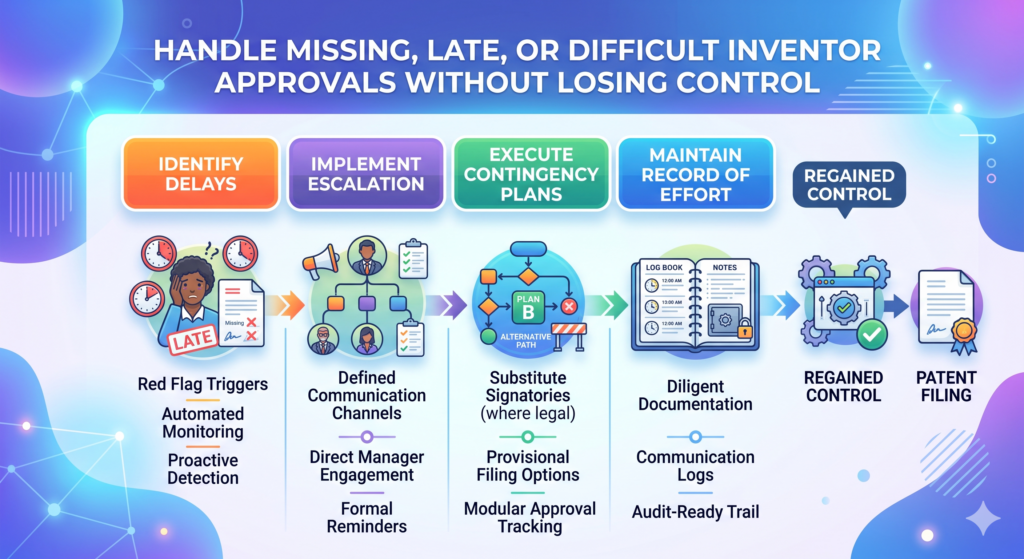
The right move is to understand the reason for the delay, document the facts, involve counsel, and keep the filing strategy moving.
A late approval does not always mean the filing must stop. But it does mean the team needs to be careful. Patent rules and signing requirements can depend on the facts, the country, the document, and the type of filing.
That is why legal counsel should guide the response. From the founder’s side, the job is to keep the facts clear and avoid making promises or guesses.
The most important thing is to not treat silence as approval. If an inventor has not reviewed the draft, do not pretend they did. Keep a record of outreach and continue working with your attorney on the right path.
Find Out Why Approval Is Missing
A missing approval is a symptom. Before solving it, find the cause. The inventor may not have seen the request. They may not understand what is needed.
They may have technical concerns. They may disagree with inventorship. They may be too busy. They may no longer be with the company. Each cause needs a different response.
If the issue is simple delay, a direct reminder may solve it. If the inventor has questions, a short call may be best.
If they found a technical error, the draft may need to be fixed. If they disagree with the inventor list, counsel should get involved quickly.
Do not assume bad intent. Many approval delays happen because the request was unclear or the inventor was overloaded.
Start by making the task easier. Give them the right draft, explain what they need to check, and ask for either approval or specific comments.
Use A Human Follow-Up For Important Filings
For important filings, do not rely only on automated reminders. A short human message can work better.
The founder, CTO, or approval owner can explain why the filing matters and why the inventor’s review is needed.
The tone should stay professional. Do not pressure the inventor to approve something they have not reviewed. Ask them to review and respond. If they have concerns, invite them to state the concerns clearly.
This protects the company and the inventor. It also helps uncover real issues. Sometimes a delayed approval leads to a better filing because the inventor finally points out a missing detail.
PowerPatent can help reduce these approval bottlenecks by making the process clearer from the start.
When inventors know what to review and founders can track status, fewer things fall through the cracks. Learn how PowerPatent supports faster patent workflows here: https://powerpatent.com/how-it-works
Be Careful With Former Employees
Former employees can make approvals harder. They may have moved on. They may not check company messages.
They may feel upset about the company. They may not want to spend time on old work. But if they are true inventors, their role still matters.
The best way to avoid this problem is to capture invention details and approvals while people are still with the company. Do not wait until after someone leaves.
When a key engineer gives notice, review pending inventions quickly. Make sure invention records, assignments, and approval steps are handled with counsel.
If the person has already left, stay calm and professional. Contact them through appropriate channels. Explain the request clearly.
Keep the message focused on the patent filing, not company history or personal issues. Give them the draft and ask for technical review.
Keep Outreach Records For Unresponsive Inventors
If an inventor does not respond, keep a record of outreach. Record when the company contacted them, how it contacted them, what was sent, and whether any response was received. This record may matter if counsel needs to decide the next step.
Do not create fake approvals. Do not backdate anything. Do not write that someone approved if they did not. Clean facts are always better than a messy shortcut.
Your attorney can advise on options when an inventor is unavailable or unwilling. The right path depends on the situation. The founder’s job is to provide facts and keep the process honest.
This is another reason to avoid last-minute approvals. The earlier you start, the more time you have to solve these issues without risking the filing date.
Resolve Technical Disagreements Before Filing When Possible
Sometimes an inventor does not approve because they think the draft is wrong. This should not be treated as a nuisance. It may be the most valuable feedback in the whole process.
The inventor may say the system flow is wrong. They may say a feature is described too narrowly.
They may say the draft gives credit to the wrong part of the product. They may say the invention is broader than the example. They may say the claims miss the key idea.
Take this seriously. Ask the inventor to explain the issue in simple terms. Have the drafting team or attorney review the concern. If the point is valid, update the draft. If the point is not adopted, explain why.
Separate Real Issues From Preference Edits
Not every inventor comment should change the draft. Some comments are style preferences. Some are product wording preferences.
Some are too narrow because the inventor is thinking only about the current build. Some may be useful for a product spec but not needed in the patent filing.
The approval owner and attorney should separate real technical errors from optional edits. This helps the filing stay on track.
The goal is not to make the patent draft read like an engineering design doc. The goal is to make it accurate, strong, and useful. Sometimes that means using broader language than an engineer would use in a code comment.
Sometimes it means describing alternatives that are not in the current product but are tied to the same invention.
A good attorney can explain this to the team. That explanation often helps inventors approve with more confidence.
Do Not Let Approval Problems Destroy Filing Timing
Some filings are time-sensitive. If there is an upcoming public disclosure, product launch, investor pitch, conference talk, customer demo, or publication, the filing date may matter.
Approval delays should be handled quickly so the team does not lose protection options.
This does not mean cutting corners. It means starting early, escalating clearly, and involving counsel as soon as there is a blocker. If approval is missing close to the filing date, the attorney needs to know the facts right away.
Founders should never assume that the filing can be delayed without cost. They should also never assume that missing approval can be ignored.
The right choice depends on the facts. That is why a clean process matters.
Build An Escalation Path Before You Need It
The best time to design an escalation path is before there is a problem. Decide who steps in if an inventor does not respond.
Decide when counsel should be alerted. Decide how urgent filings are handled. Decide where outreach records are stored.
This keeps the team calm when pressure rises. It also avoids emotional decisions.
For example, if an inventor has not responded within a set time, the approval owner can send a reminder.
If there is still no response, the founder or CTO can follow up. If there are technical concerns or continued silence, counsel can advise on next steps.
This kind of process is simple, but it is powerful. It helps the team protect the filing date while still respecting the inventor review.
Missing approvals are not rare. Strong teams plan for them. They do not panic. They do not fake certainty. They keep clean records, use clear messages, and get legal guidance when needed. That is how you stay in control.
Make Inventor Approval Part Of Your IP Culture, Not A One-Time Task
Inventor approval becomes much easier when your team sees patents as part of building, not as legal paperwork that appears at the end.

This is a culture choice. If patents are treated like a strange side project, inventors will delay review because the process feels far away from real work. If patents are part of the way the company protects new ideas, approval becomes normal.
For a startup, this culture does not need to be heavy. You do not need long meetings or complex forms.
You need a simple habit: when the team creates something new and useful, they capture the idea, discuss who contributed, and keep enough detail so a strong patent filing can be prepared later.
The best patent cultures are practical. They do not slow engineers down. They do not turn every product meeting into a legal review.
They simply make it easy to spot protectable ideas before they get lost in the rush of building. Then, when it is time to file, inventor approval is not a scramble. The team already knows the story.
This is especially important for deep tech startups. Your strongest inventions may not look like big “aha” moments. They may appear as small technical choices made during hard work.
A new way to process sensor data. A better model update method. A safer control loop. A faster chip layout step. A smarter way to route tasks across systems. These ideas can be very valuable, but they are easy to miss unless the team knows to capture them.
Teach Inventors What Good Approval Looks Like
Most inventors are never taught how to review a patent draft. They may be brilliant engineers, scientists, or founders, but patent review is not part of their normal training. So do not expect them to know what “approval” means without guidance.
Teach them that approval is not about checking every legal phrase. It is about making sure the draft tells the technical truth. It is about checking whether the invention is described clearly.
It is about spotting missing parts, wrong steps, weak examples, and narrow language that could hurt the filing later.
When inventors understand this, they review better. They also feel less fear. They stop thinking, “I do not understand patents, so I should wait.” Instead, they think, “I understand the system, so I can help make this accurate.”
A simple internal note can help. It can explain that inventors should review the invention summary, drawings, key examples, and claim focus.
It can also explain that the attorney will handle legal strategy. This gives inventors confidence and keeps them focused.
Use Past Reviews To Improve Future Reviews
Each filing teaches your team something. After a patent application is filed, take a few minutes to note what worked and what slowed things down. Maybe inventors needed more context before reviewing.
Maybe the drawings were hard to follow. Maybe the approval deadline was too tight. Maybe the founder had to chase the same person several times.
These lessons are valuable. Use them to improve the next filing.
A strong patent process gets better over time. The first filing may feel new. The third filing should feel smoother.
The tenth filing should feel like a normal company motion. That is how startups build an IP system that scales without creating drag.
This is one reason PowerPatent is helpful for growing teams. It gives founders a more guided way to manage invention capture, drafting, review, and attorney oversight, so the process can improve instead of becoming a messy pile of files and emails.
See how PowerPatent helps teams protect their work faster here: https://powerpatent.com/how-it-works
Connect Approval To The Business Goal
Inventors are more engaged when they understand why the filing matters. Do not ask them to approve a draft in a vacuum. Tell them what the patent is meant to support.
Is it protecting a core platform? Is it covering a key product feature before launch? Is it helping with investor confidence? Is it blocking easy copycats? Is it building long-term company value?
This does not mean sharing sensitive strategy with everyone. It means giving enough context so the approval feels important.
When an engineer knows that a filing protects the system they spent six months building, they are more likely to review with care.
When a founder knows the filing supports a fundraise, they are more likely to make time for approval. When a research lead knows the filing must happen before a paper or demo, they understand the timing.
Patent approval should not feel like an isolated task. It should feel like part of protecting the company’s future.
Make Inventors Feel Like Owners Of The Protection
Inventors should feel proud of the work being protected. They should also feel responsible for helping the company file the right way.
That does not mean placing legal burden on them. It means recognizing that their technical insight matters.
When you ask for approval, use language that respects their role. Tell them their review helps make the filing stronger.
Tell them their comments can prevent gaps before filing. Tell them the company is protecting the work the team created.
This tone matters. People care more when they feel their input is valued. They also give better feedback when they know the process is not just a rubber stamp.
A healthy IP culture is not built through fear. It is built through clarity, trust, and speed. Inventors should know that patents help the company protect what is hard to build.
Founders should know that approval is part of filing well. Attorneys should have the technical input they need to do strong work.
When those pieces come together, approval becomes a strength, not a bottleneck.
Use Plain-Language Approval Questions To Get Better Inventor Feedback
The quality of inventor approval depends on the quality of the questions you ask. If you ask vague questions, you get vague answers.

If you ask smart, simple questions, you get useful feedback. This is one of the easiest ways to improve your patent process.
Inventors are problem solvers. They are used to finding bugs, gaps, edge cases, and weak assumptions. But a patent draft may not look like the systems they normally review.
It may use broader language. It may describe alternatives. It may include examples that are not exactly the same as the current product. Without guidance, inventors may not know what matters.
Plain-language questions make the review easier. They turn the patent draft into something the inventor can evaluate.
They also help the attorney get better input. Instead of receiving a vague “looks fine,” the attorney gets comments tied to technical substance.
This is important because many patent drafts are improved by one or two sharp inventor comments. A missing system layer can be added. A broader variation can be included.
A future product path can be covered. A misleading phrase can be fixed. A weak example can be replaced with a stronger one.
Ask Whether The Draft Describes The Real Invention
The first question should always be about accuracy. Does the draft describe the invention as it really works? This sounds simple, but it catches many problems.
A draft may describe the old version of the system. It may miss a step that was added later. It may use the wrong name for a module.
It may say the model is trained in one way when the team now uses another method. It may describe the product flow from the user’s view but miss the backend process that makes the invention special.
Inventors should read with this question in mind. They should look for anything that feels technically wrong or incomplete. They should also flag areas where the draft sounds too specific if the invention can work in other ways.
The goal is not to make the draft match the product word for word. The goal is to make sure the patent filing captures the real technical idea and enough useful detail to support it.
Ask Whether A Competitor Could Easily Work Around The Draft
This is one of the most powerful questions you can ask an inventor. If a competitor read this filing, could they make a small change and avoid the core idea? Inventors are often very good at spotting this because they know the design space.
For example, the draft might describe one kind of database, but the invention works with many storage systems. It might describe one type of neural network, but the idea works with different model types.
It might describe one sensor setup, but the method works with many sensor inputs. It might describe one order of steps, but the system can perform the steps in another order.
These details matter. If the draft is too narrow, it may leave room for easy copycats. The attorney can address this, but the inventor’s technical view is key.
This does not mean the patent should claim everything under the sun. It means the filing should not accidentally limit the invention to one version when the invention is broader. A good approval review helps catch that before filing.
Ask What Is Missing From The Examples
Examples are often where patent drafts become stronger. They show how the invention works in real life. But examples can also be too thin. If the draft only includes a basic example, it may fail to show the full value of the invention.
Inventors should ask what examples are missing. Is there a better example from a real use case? Is there a hard edge case the invention solves?
Is there a performance gain worth explaining? Is there a safety improvement, cost saving, speed boost, or accuracy gain that should be described?
A good example can make the invention easier to understand. It can also help show why the invention matters.
For technical fields, examples can explain the difference between a normal approach and the team’s improved approach.
The inventor does not need to write polished language. They can simply explain the missing example in plain words. The drafting team and attorney can turn it into proper patent text.
Ask What May Change In The Product Later
A patent filing should support the company’s future, not just its present. That means inventors should think about likely changes.
What might change in the next version? What might be replaced? What might be automated? What might move from cloud to edge? What might become hardware instead of software, or software instead of hardware?
These future paths can matter. If the patent only describes the current build, the company may regret it later. Startups move fast. The best filings are written with enough flexibility to cover where the product may go.
Inventors often know these future paths before anyone else. They know which parts are temporary. They know which architecture choices are likely to change. They know which features are core and which are just current implementation details.
This is why inventor approval should not be a passive “yes.” It should invite forward-looking feedback.
PowerPatent helps founders capture these kinds of details early, so patent filings can better match the real invention and the future product path.
With smart software and real attorney oversight, teams can move fast without losing important technical context. Learn more here: https://powerpatent.com/how-it-works
Ask Whether The Inventor List Looks Right
Inventors should also be asked whether the listed inventors look right based on their understanding. This does not mean each inventor gets to decide the legal list alone. It means their input can reveal missing facts.
An inventor may know that another engineer created a key part. They may remember that a founder suggested the main approach.
They may explain that someone helped implement the system but did not create the inventive concept. These facts can help counsel make the right call.
This question should be handled carefully. It should be framed as a fact check, not a popularity vote. The goal is to identify who contributed to the invention being filed.
Ask This Before Emotions Enter The Process
Inventorship can become sensitive when people feel ignored or over-included. The best way to reduce emotion is to ask early and factually. Do not wait until the filing deadline. Do not ask only after someone complains. Make it a normal review question.
When people see that the company checks inventorship as part of the process, trust improves. Inventors know the company is trying to get it right. Founders have better facts. Attorneys can guide the decision.
Plain-language questions make inventor approval stronger because they turn review into action. They help inventors see what matters. They help teams catch problems. They help filings become more accurate and more strategic.
A better question leads to a better approval. A better approval leads to a better filing.
Time Inventor Approvals Around Launches, Fundraising, And Public Disclosures
Inventor approval is not only a legal workflow issue. It is also a timing issue. For startups, timing can make or break the value of a patent filing.
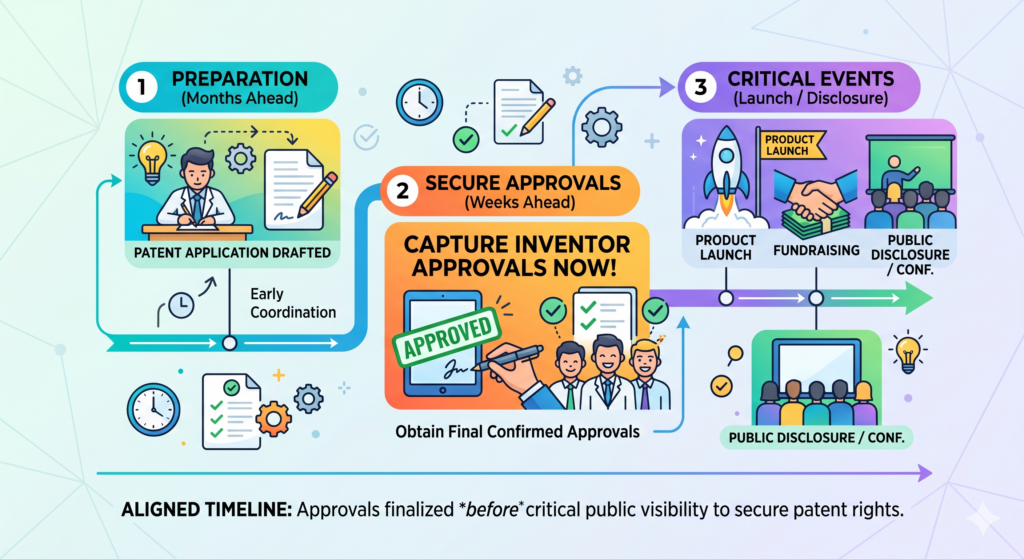
If your team plans to launch, publish, pitch, demo, open source, sell, or show the invention publicly, the filing timeline must be managed with care.
This is where many teams get into trouble. The product team moves toward launch. The founder prepares a pitch deck.
The research team submits a paper. The sales team schedules a customer demo. Then someone asks, “Have we filed the patent yet?” If inventor approvals have not started, the company may face a stressful race.
The approval process should be planned around business events. If the invention may be disclosed outside the company, the patent filing should be discussed before that happens.
Your attorney should guide timing. The founder should make sure approvals are not left to the final day.
A fast company needs a fast approval system. But speed should come from planning, not panic.
Map Patent Approval To Your Disclosure Calendar
Every startup should know when important invention details may become public.
This includes product launches, website updates, press releases, conference talks, investor decks, customer pilots, sales demos, academic papers, grant applications, open-source releases, and public videos.
These moments can affect filing strategy. The exact rules can depend on the country and the facts, so counsel should be involved.
But from an operating view, the lesson is clear. Do not let public disclosure sneak up on your patent team.
When a disclosure is coming, work backward. Decide when the filing must be ready. Then set dates for draft review, inventor comments, final edits, approvals, and filing. This makes approval part of the launch plan, not a last-minute blocker.
Treat Patent Review Like A Pre-Launch Gate
Before a major launch, teams usually check product readiness, security, messaging, analytics, support, and customer impact. Patent review should be one of those gates when the launch reveals new technical work.
This does not mean every small release needs a patent review. It means major invention-bearing releases should trigger a quick IP check.
If the release includes a new technical method, system, model, device, workflow, or performance gain, ask whether it should be protected before it goes public.
This habit can save a company from regret. Many founders only realize an invention was valuable after competitors notice it. By then, timing may be harder.
PowerPatent helps founders move earlier by making it easier to capture invention details and work toward filing with attorney oversight. That is useful when launches, demos, and fundraising timelines are moving fast. See how it works here: https://powerpatent.com/how-it-works
Align Approvals With Fundraising Needs
Patents can matter during fundraising because they show that the company is protecting important work.
Investors may ask what has been filed, what is pending, who owns the invention, and whether the company has a clear IP plan. If approvals are messy, the founder may not have a clean answer.
Before a raise, review the company’s important inventions. Check which filings are planned, which drafts are in progress, which approvals are missing, and which applications have already been filed. This helps the founder speak with confidence.
Inventor approval should not be delayed until an investor asks for proof. By then, the company may be under pressure. It is better to clean up approval records before diligence starts.
A strong approval trail can make the company look more mature. It shows that the team is not just inventing. It is protecting what it invents.
Do Not Let Fundraising Rush The Wrong Filing
Fundraising pressure can cause teams to file too quickly. A founder may want to say, “We filed patents,” before a major investor meeting.
That can be a good goal, but the filing still needs care. A rushed draft with weak inventor review may not help the company much.
The better path is to start early. Capture the invention. Get the right inventors involved. Prepare a strong draft.
Give inventors a clear review task. Get approvals tied to the right version. Then file with confidence.
A patent filing should support the fundraising story, not become a weak checkbox. Investors who understand deep tech care about quality. They want to know that the company’s protection matches the real technical edge.
Prepare For Customer And Partner Demos
Customer demos can create patent timing issues, especially when the demo reveals how the technology works. Many demos only show product output, not the underlying invention.
But some demos expose workflows, methods, system behavior, data processing, hardware design, or model performance in a way that may matter.
Before a major demo, ask what will be shown. Will the customer see the technical method? Will they receive documents?
Will they test the system? Will there be an agreement in place? Will the demo be recorded? Will the partner share the information with others?
These are questions for your business and legal team. But the approval lesson is simple. If a filing should happen before the demo, inventor approvals must be scheduled early.
Create A Fast Track For Urgent Business Events
Startups need a fast track for urgent filings. This does not mean skipping review. It means having a clear path when timing is tight.
A fast track may include a quick invention intake, attorney strategy call, focused draft, inventor review window, and rapid approval capture. The key is that everyone knows their role.
The founder handles priority. The inventors check technical accuracy. The attorney guides filing strategy. The approval owner tracks completion.
This kind of fast path works best when the company already has good habits. If invention records are clean and inventors understand approval, urgent filings become much less stressful.
Timing is one of the most strategic parts of patent work. A great invention can lose value if the filing process is handled too late. Clean inventor approvals help the company move before important events, not after them.
Use Attorney Oversight To Keep Approval Fast And Safe
Inventor approval should be simple, but it should not happen without legal guidance. Patents are business assets with legal rules behind them.
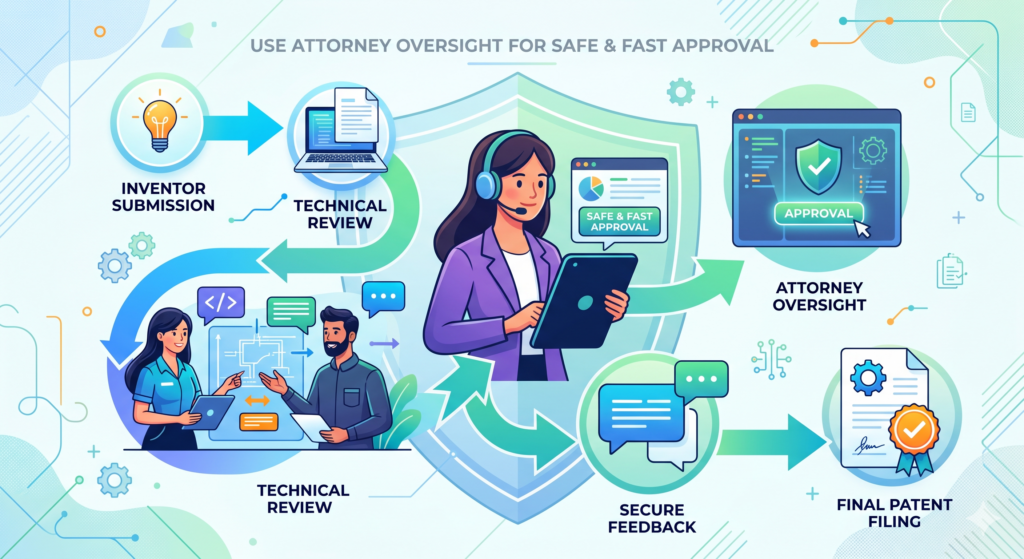
A founder-friendly process still needs attorney oversight, especially when inventorship, claim scope, public disclosure, assignment, or missing approvals are involved.
The best setup is not software alone and not old-school law firm delay. It is a smart mix. Software can organize the workflow, capture details, track versions, and collect approvals.
Attorneys can make judgment calls, shape the filing strategy, and handle the legal parts that should not be guessed.
This balance is important. Founders do not want to wait weeks for every small step. Inventors do not want to read confusing legal emails.
Attorneys do not want scattered technical notes. A guided process helps everyone do their part.
Inventor approval works best when the attorney is involved early enough to prevent mistakes, but the workflow is simple enough that the team can keep moving.
Let Attorneys Guide Inventorship Decisions
Inventorship is not something founders should guess. It can be tricky, especially when several people touched the product.
The attorney should help decide who should be listed based on the invention being claimed and the facts about contribution.
The founder and team can provide the facts. Who came up with which idea? Who solved which technical problem? Who only implemented instructions?
Who contributed to the specific concept being protected? The attorney can then guide the inventorship analysis.
This keeps the process fair and safer. It also helps avoid using inventorship as a reward system. Patent inventorship is not the same as job title, effort, ownership, or seniority. It is tied to contribution to the invention.
Give The Attorney Clean Facts, Not A Messy Story
Attorney oversight works much better when the team gives clean information. If the attorney receives a pile of random notes, old emails, half-finished diagrams, and unclear names, the process slows down.
If the team provides a clear invention summary, contributor notes, draft history, and key technical details, the attorney can move faster.
This is why invention capture and approval tracking matter. They do not replace the attorney. They help the attorney do better work with less friction.
PowerPatent is designed around this idea. It helps technical teams organize invention details through smart software, while real patent attorneys guide the important parts.
This gives founders speed, structure, and confidence. Learn more here: https://powerpatent.com/how-it-works
Use Counsel To Decide When Re-Approval Is Needed
Drafts often change after inventor review. Some changes are small. Some are important. The team should not guess whether inventors need to approve again. Counsel should help decide.
If changes affect the technical substance, claim focus, examples, drawings, or inventor list, re-review may be needed.
If changes are only grammar, formatting, or minor cleanup, counsel may say another full review is not needed. The facts matter.
This decision should be made before filing, not after. The approval owner should tell counsel what changed after approval. Counsel can then advise whether the approval record is still clean.
Make Re-Approval Easy When It Is Needed
When re-approval is needed, do not send the entire process back to zero unless necessary. Show inventors what changed.
Explain why the change matters. Ask them to review the updated portion or updated draft. Then capture approval tied to the new version.
This keeps the process fast and respectful. Inventors should not have to hunt through a long document again without guidance. They should know exactly what changed and what they need to check.
A clean re-approval step can prevent future confusion. It also shows that the company took care when the filing evolved.
Have Counsel Review Approval Language
Approval language should be plain, but it should still be appropriate. Your attorney can help set the wording your company uses when asking inventors to approve.
This wording may vary depending on the filing type, company process, and documents involved.
The goal is to make the approval clear without scaring inventors. It should say what they reviewed and what they are confirming. It should also avoid asking them to make legal statements they are not qualified to make.
Good approval language helps everyone. Inventors know what they are doing. Founders get a better record. Attorneys have a cleaner file.
Keep Legal Work In The Right Hands
Founders should not try to turn themselves into patent lawyers. Engineers should not be asked to judge legal scope alone. The best process gives each person the right job.
Inventors check technical truth. Founders set business priority. Software tracks workflow. Attorneys guide legal strategy. When these roles are clear, approvals move faster and filings are stronger.
This is the modern way to handle patent work. It removes the old friction without removing the judgment that matters.
Attorney oversight is not there to slow the company down. Done right, it helps the team move with less risk. It keeps the approval process clean, the filing strategy sound, and the founder in control.
Build A Repeatable Approval Playbook For Every Patent Filing
The biggest mistake startups make is treating every patent filing like a custom emergency. The first time, that may be understandable.
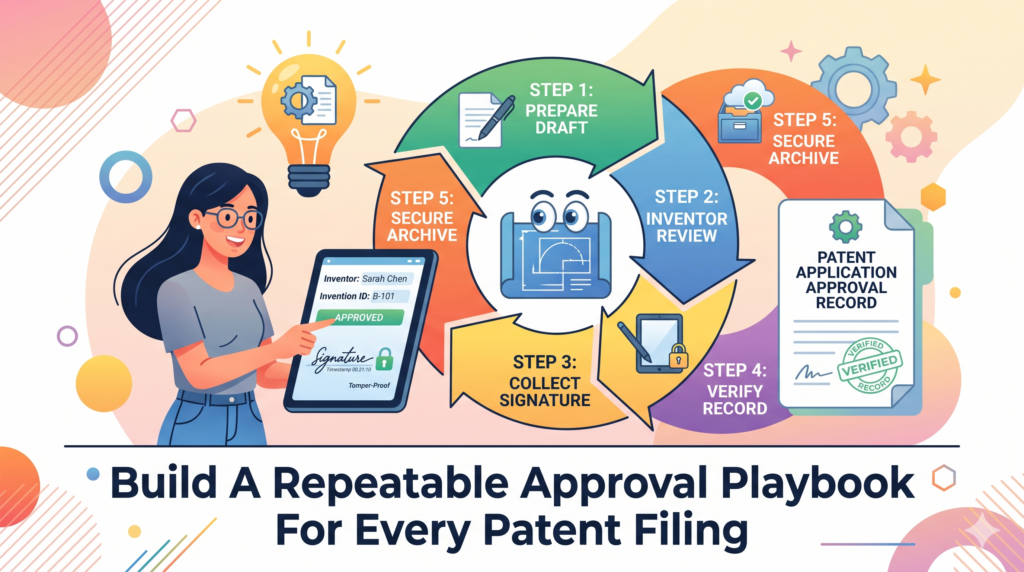
But after one or two filings, the company should have a playbook. A repeatable approval playbook saves time, lowers stress, and improves filing quality.
A playbook does not need to be long. It should be simple enough that the team actually uses it. It should explain when inventor approval starts, who owns it, what inventors receive, how they comment, how approval is captured, what happens if someone is late, and where records are stored.
Once this playbook exists, every filing gets easier. New inventors know what to expect. Founders know where things stand. Attorneys get better input. The company builds a stronger patent record over time.
A repeatable process is especially important when the company starts filing more often. One patent filing can be managed manually.
Ten filings cannot. As your portfolio grows, messy approvals become expensive. Clean process becomes a major advantage.
Standardize The Approval Package
Every filing should have a standard approval package. This package should include the review-ready draft, a plain-English summary, drawings, key review questions, the inventor list, the approval deadline, and clear instructions for approving or commenting.
The package should look familiar each time. Inventors should not have to learn a new process for every filing. Familiarity speeds things up.
The summary should explain the invention in simple words. The draft should be versioned. The drawings should be easy to open. The questions should point inventors to what matters. The approval action should be clear.
This standard package turns approval from a messy request into a guided review.
Keep The Playbook Short Enough To Use
A playbook that nobody reads is useless. Keep it short, direct, and action-focused. The goal is not to document every possible edge case. The goal is to make the normal path easy and the exception path clear.
The normal path should be simple. Draft is ready. Inventors receive package. Inventors review technical content. Comments are resolved. Inventors approve. Approval is stored. Filing moves forward.
The exception path should also be clear. If inventors disagree, counsel is involved. If someone is missing, outreach is documented. If the draft changes in a meaningful way, re-review is considered. If timing is urgent, the fast track begins.
This kind of playbook saves mental energy. The team does not need to reinvent the process every time.
Review The Playbook After Each Filing
After a filing is complete, spend a few minutes improving the playbook. Ask what slowed the team down. Ask what confused inventors.
Ask what comments came too late. Ask whether the approval record was easy to store. Ask whether the founder had enough visibility.
Small improvements compound. A better approval message saves time. A clearer summary improves feedback. A better deadline prevents rush. A cleaner status view reduces founder stress.
This is how patent operations become a strength. The company learns. The workflow improves. The portfolio becomes easier to manage.
Use The Playbook To Train New Team Members
As the company grows, new engineers, product leaders, researchers, and founders may join. They need to understand how the company handles inventions. The approval playbook can help train them.
This is not about turning every new hire into a patent expert. It is about teaching them that inventions should be captured, technical details matter, and approval is part of protecting the company’s work.
When people know the process early, they are less surprised later. They are also more likely to save useful notes, explain their contributions, and respond quickly during review.
A repeatable playbook makes patent work feel less mysterious. It turns it into a company habit.
Choose Tools That Make The Playbook Easier
A playbook is only as good as the system behind it. If your team still has to chase files, copy comments across tools, and manually track approvals in a spreadsheet, the process will break as volume grows.
Choose tools that make the playbook easier to follow. The right system should help capture invention details, manage drafts, track versions, collect approvals, and keep records in one place. It should also work well with attorney review.
This is where PowerPatent fits well for technical teams. It brings together smart software and real patent attorney oversight so founders can protect inventions without dealing with slow, confusing workflows.
Explore how PowerPatent helps startups file better patents faster here: https://powerpatent.com/how-it-works
Make The Process Easy Enough That People Do It
The best process is the one people actually follow. If approval takes too many steps, inventors will delay. If records are hard to store, people will forget.
If the founder cannot see status, they will chase manually. If counsel does not get clean input, drafting slows down.
A good playbook removes these problems. It makes the next right step obvious.
When inventor approval is repeatable, your company gains speed. When it is documented, your company gains trust. When it is guided by the right tools and attorneys, your company gains confidence.
That is the real goal. Not more paperwork. Better protection, with less drag.
Conclusion
Capturing inventor approvals is not just a filing step. It is how you protect the truth of the invention before it becomes a company asset. When you identify the right inventors, give them the right draft, ask clear review questions, track the exact version, and store clean approval records, you reduce risk and move faster with more confidence.
For founders, this means fewer delays, fewer surprises, and stronger patents that match what the team actually built. PowerPatent helps make this process simple with smart software and real attorney oversight. See how it works here: https://powerpatent.com/how-it-works
Leave a Reply