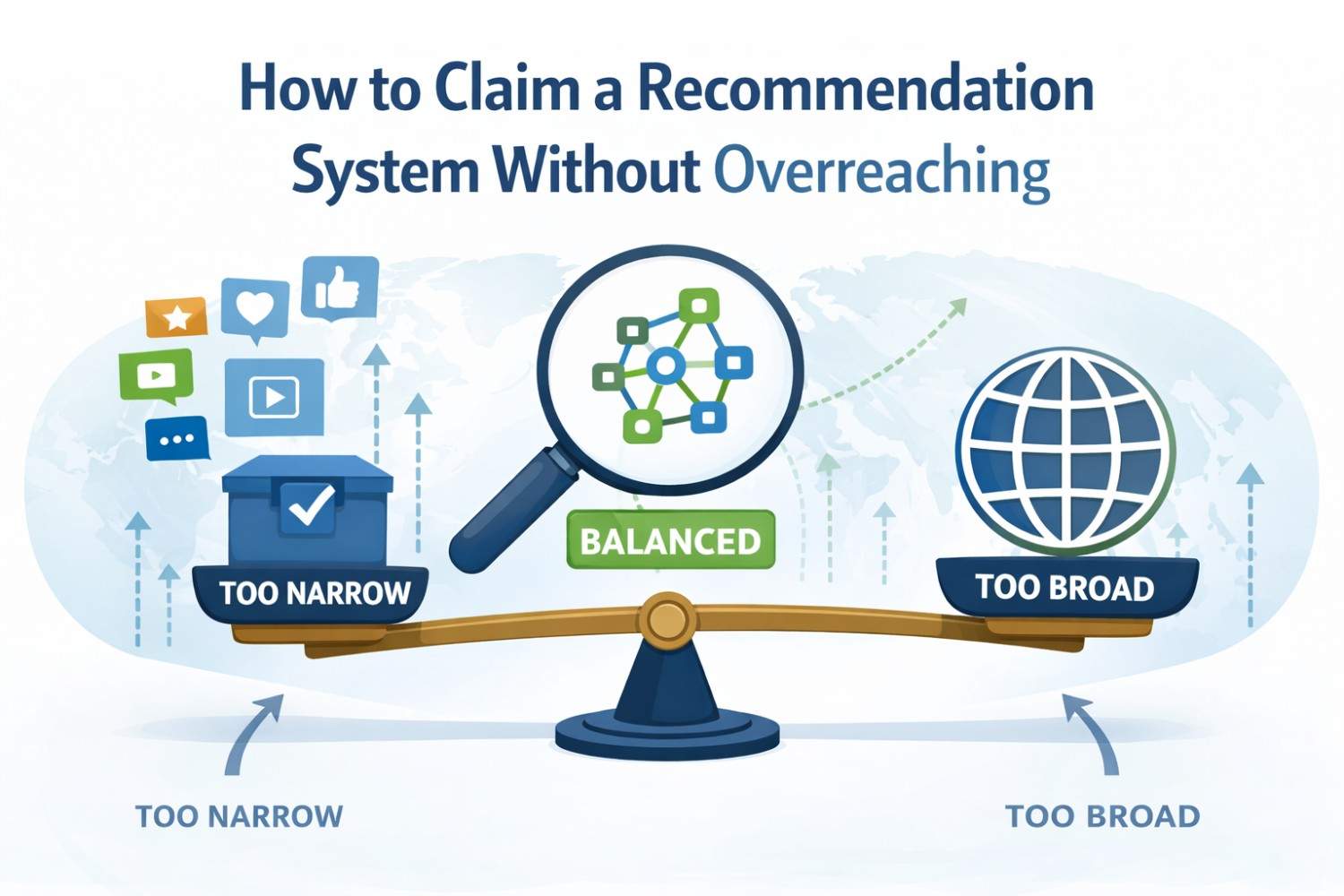
A recommendation system can look simple from the outside. A user clicks. A model learns. A screen shows the next product, video, song, article, or tool. It feels smooth. Almost obvious. But when it is time to protect that system in a patent, things get messy fast. This is where many founders make a costly mistake. They either claim the idea too broadly and end up with weak claims that are easy to reject, or they claim it too narrowly and leave room for copycats to walk around the patent. Both paths feel smart in the moment. Both can hurt later.
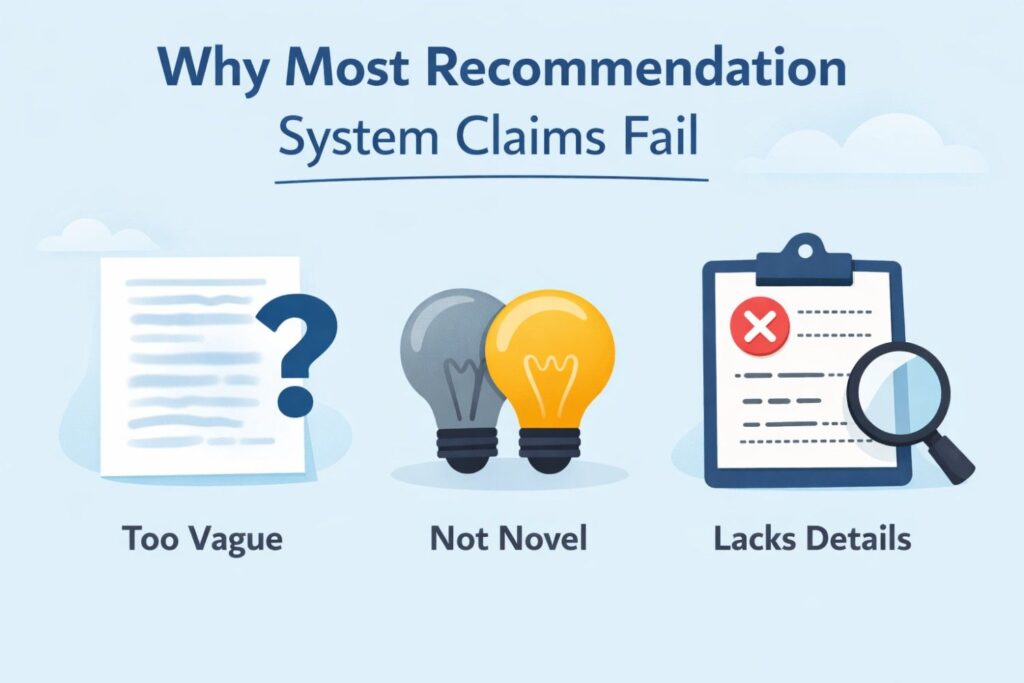
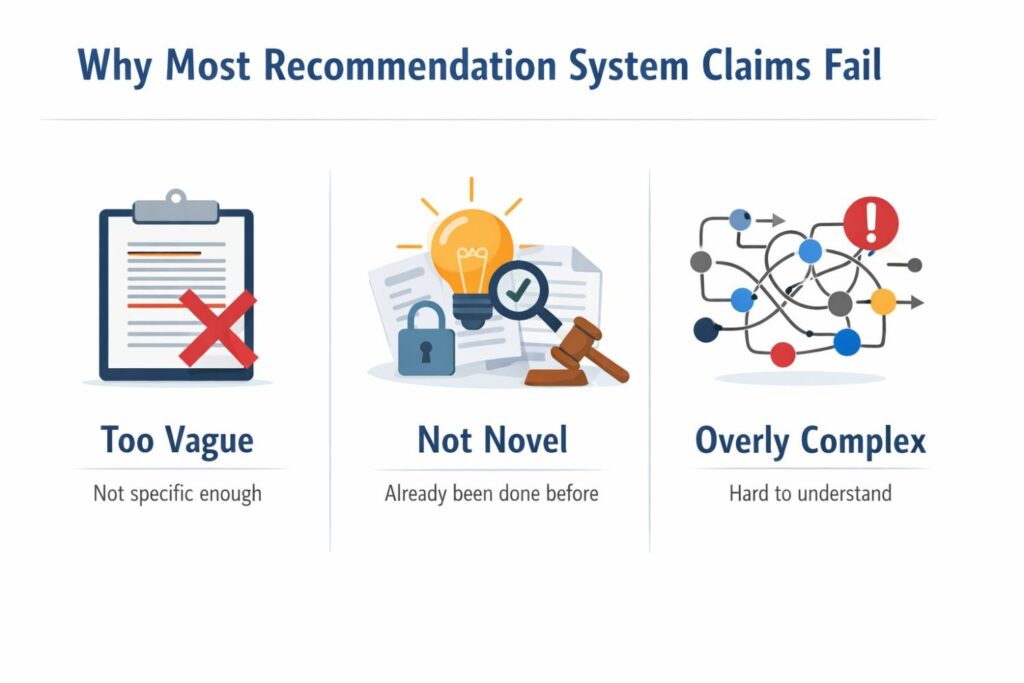
Why Most Recommendation System Claims Fail
Most recommendation system claims do not fail because the product is weak. They fail because the patent story is told in a way that sounds bigger than the real invention.
A business may have built something useful, fast, and hard to copy, but the claim language often does not match the true source of value. That gap is where trouble starts.
If the claim reads like a grab for every way to recommend anything to anyone, it becomes easy for an examiner to push back and easy for a competitor to design around later.
A strong claim does not try to own the whole market. It tries to lock onto the part of the market your system actually changed. That is what many teams miss.
They focus on the output, which is the recommendation itself, instead of the technical path that creates that output under real business limits like speed, sparse data, changing user taste, privacy rules, and ranking tradeoffs. When that happens, the claim looks thin even if the product is not.
The claim sounds like a business wish, not a technical system
A lot of recommendation claims fail because they read more like a product goal than an engineering method. Saying that a system “recommends relevant items to a user based on behavior” may sound useful, but it does not say enough about how the system actually works.
It describes the result people want, not the technical steps that make the result happen. Patent review tends to be hard on that kind of language because it feels abstract.
For a business, this matters far beyond filing. If your claim starts at the wish level, you lose leverage. You cannot point to a real technical boundary. Investors see less depth.
Competitors see more room. Internal teams also miss a chance to define what is truly special in the product.
What businesses should do instead
The smarter move is to tie the claim to the mechanism that solves a real technical problem. Maybe your system adjusts ranking weights based on session depth.
Maybe it merges graph signals with short-term user actions in a way that reduces stale results. Maybe it changes candidate generation when user history is too thin. That is the material that gives shape to a claim.
When founders sit down to map patentable value, they should ask one simple question: what specific thing did we build because off-the-shelf recommendation logic was not good enough for our use case?
The answer often points to the right claim center.
The claim is too broad to survive first contact
Overreach is one of the fastest ways to weaken a recommendation system patent. Teams often think broad means valuable. In practice, broad and vague are not the same thing.
A claim that tries to cover every recommendation engine across every industry usually creates more problems than protection.
It invites prior art issues, abstract idea problems, and constant fights over whether anything truly inventive is being claimed.
This is common in fast-moving startups because the team wants room to grow. That instinct is right. The mistake is trying to create room by stripping away the details that make the invention real.
When too much structure is removed, the claim loses its footing.
Broad enough to matter is not the same as broad enough to break
The goal is not to make the claim tiny. The goal is to find the widest version of your real technical contribution.
That usually means identifying the recurring pattern behind your system design and claiming that pattern with enough detail to show it is more than an idea.
For example, a company may not want to lock itself to “recommending videos” if the same engine can support jobs, tools, courses, or products. That is sensible.
But the claim still needs to say what kind of inputs are processed, what transformations occur, how candidate sets are formed or ranked, and what adaptation logic is used.
Breadth should come from a transferable technical pattern, not from empty generality.
The claim is too narrow to create business value
Some teams go the other way. After seeing how risky broad claims can be, they file claims that are tied too tightly to one screen, one feature flag, one training setup, or one product moment.
Those claims may look safe, but they can become easy for others to avoid. A rival only has to change one detail and the protection becomes weak.
This problem often shows up when a company patents the exact product flow it launched first, instead of the deeper system architecture that will matter over time.
The startup grows, the product changes, the model stack changes, and the claim no longer maps well to the business.
The right level of detail sits below the UI and above the codebase
Businesses should avoid making the claim depend on surface details unless those details are truly the invention.
A recommendation system usually has more durable value in the logic for collecting signals, building candidates, ranking them, updating the model, applying constraints, and learning from feedback.
Those layers tend to survive product redesigns better than front-end choices.
A practical way to test this is to ask whether the claim would still describe your moat if the product team changed the interface next quarter. If the answer is no, the claim may be too tied to the current version of the app.
The invention is framed around generic machine learning language
Recommendation systems often involve models, embeddings, classifiers, rankers, and prediction logic.
That can tempt teams to draft claims around phrases like “applying a machine learning model” or “using artificial intelligence to predict user preference.” The problem is that this language is now everywhere. By itself, it does not tell a reviewer what the invention actually adds.
For businesses, generic AI wording creates a false sense of coverage. It sounds modern, but it often hides the real engineering insight.
The claim then becomes easier to challenge because it seems to rely on common tools rather than a distinct system design.
The edge is usually in orchestration, not just the model
Many of the strongest recommendation inventions are not about inventing a new model from scratch.
They are about how signals are selected, how ranking stages interact, how feedback is filtered, how exploration is balanced against quality, or how the system works under strict response-time limits.
Those choices are technical and valuable. They should be described clearly.
A good business habit is to document the moments where the team had to make a non-obvious system decision.
Those moments often create the most claimable material. They reveal how the company turned a general tool into a specific technical advantage.
The claim ignores the hard problem the system actually solves
A recommendation engine that works in a slide deck is not the same as one that works in production.
Real systems face cold start, sparse events, heavy-tail inventory, changing user intent, duplicate content, delayed labels, privacy limits, and uneven data quality.
Claims fail when they skip over those production realities and describe the system as if it lives in a clean lab.
That is a missed chance. The hard production problem is often the heart of the invention. If your business solved one of those hard problems in a specific way, that is exactly what should anchor the patent strategy.
Patents get stronger when they connect to operational pain
Businesses should write down the practical pain that forced the team to build something new.
Did recommendation quality drop when user sessions were short? Did new inventory never get shown because the engine favored old winners? Did model updates lag so much that users kept seeing outdated suggestions? Did privacy constraints remove key signals?
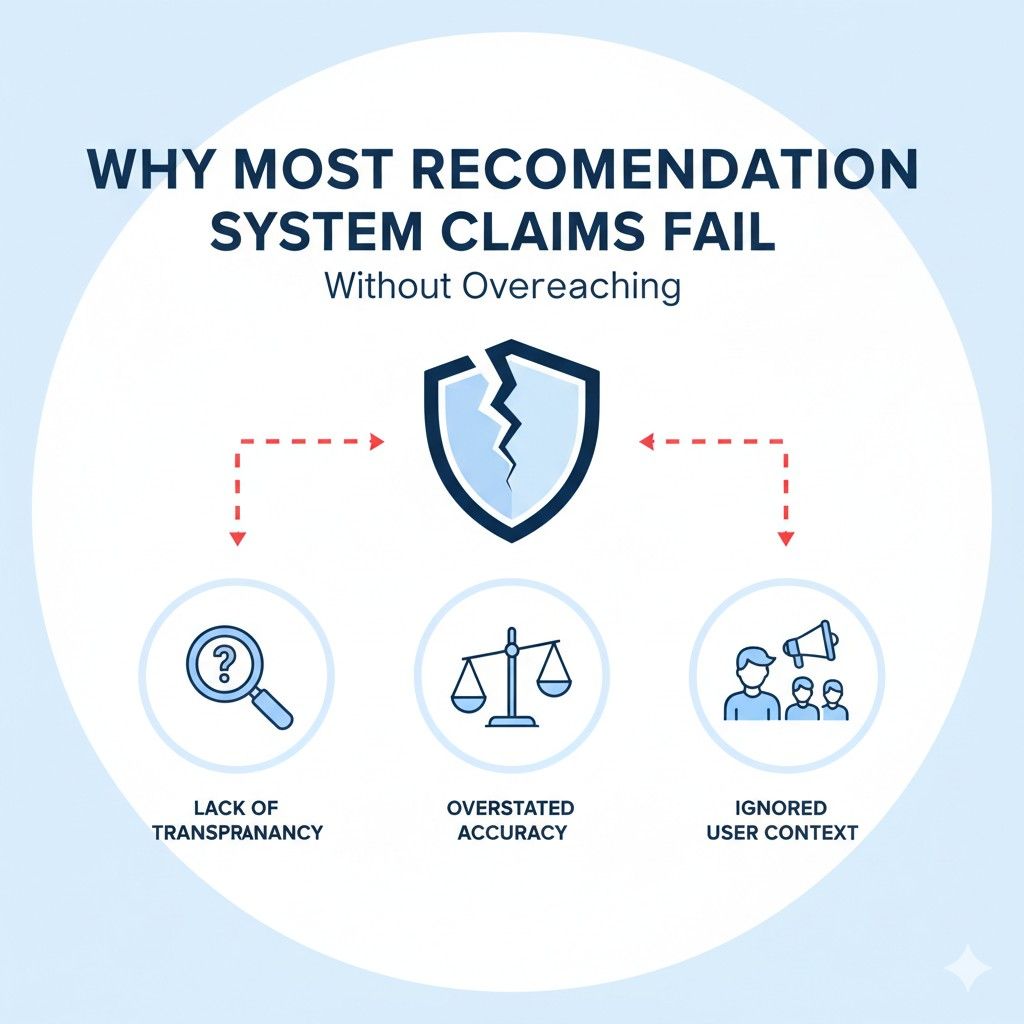
When the claim is shaped around a real technical pain point and a real system-level fix, it becomes more grounded. That makes it easier to explain, easier to defend, and more useful in a business conversation.
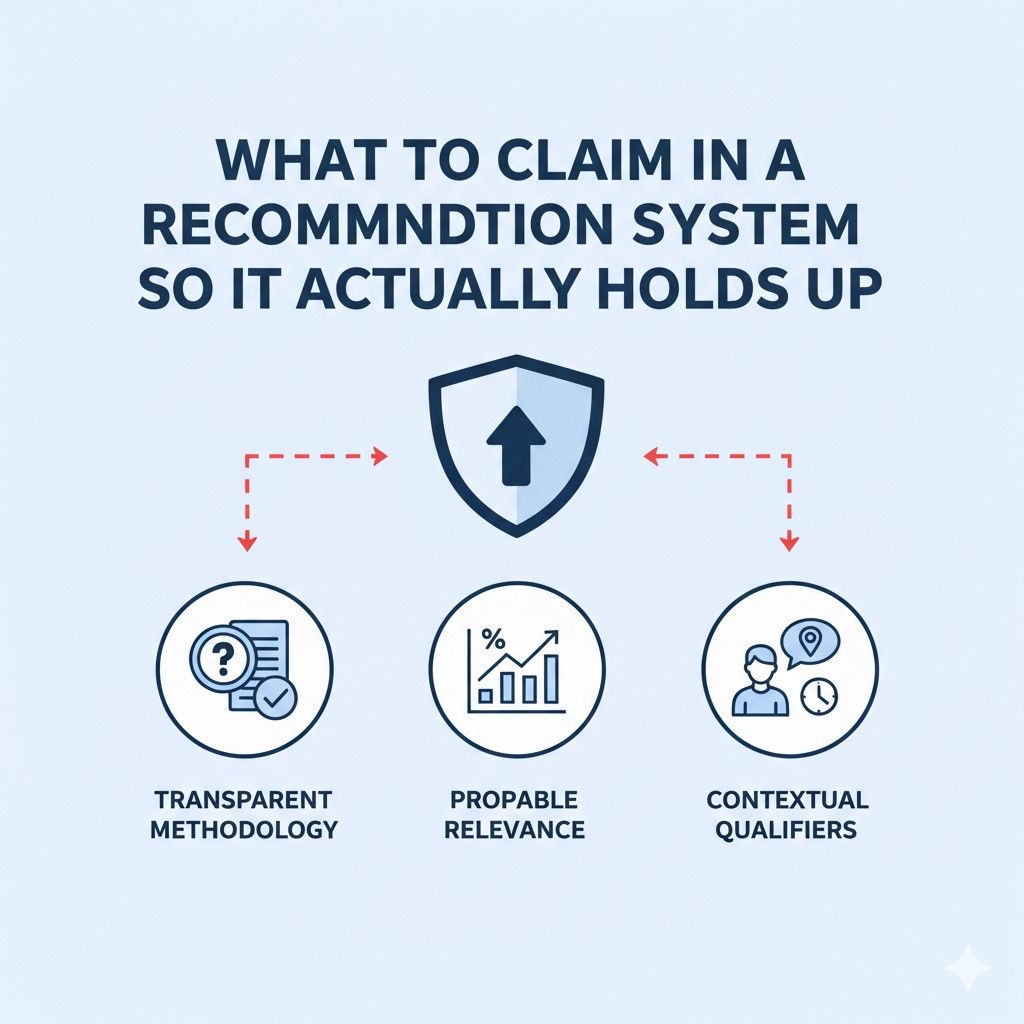
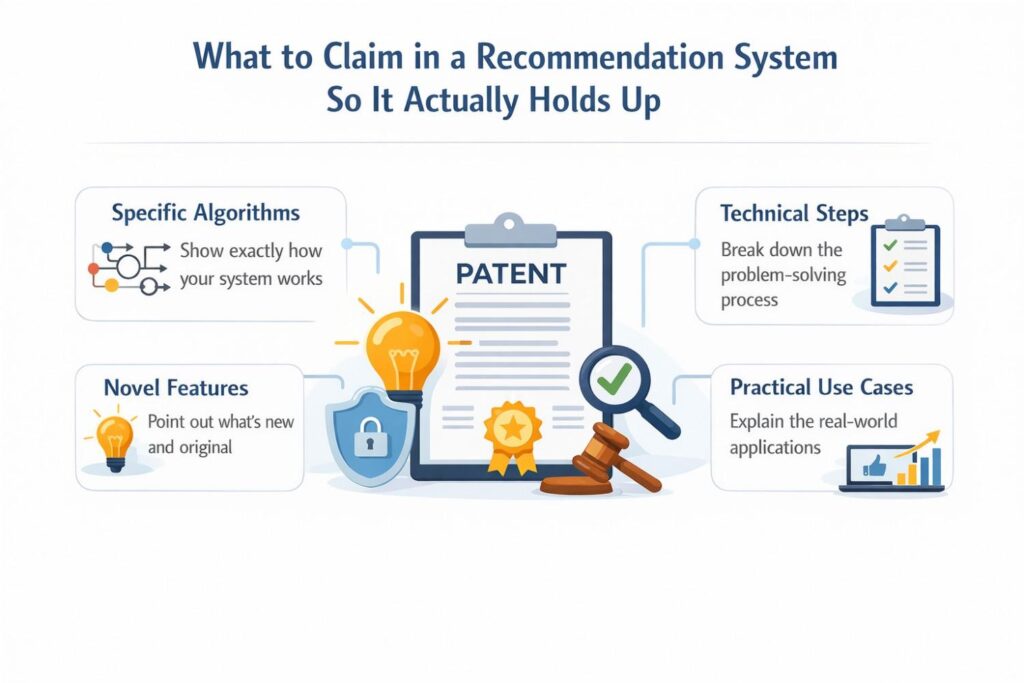
What to Claim in a Recommendation System So It Actually Holds Up
The strongest recommendation system claims do not start with the word recommendation. They start with the real technical work your team had to do to make the system perform in the real world.
That is the shift many companies need to make. A user seeing a useful suggestion is the visible result, but patent value usually sits deeper in the system. It sits in how the engine builds options, filters noise, reacts to weak data, updates scores, and delivers results under real limits.
If a business wants claims that last, it has to stop thinking like a product marketer for a moment and start thinking like a system builder. The right claim target is not the broad promise of “showing users what they may like.”
The right target is the exact design choice that made your system work better than what came before. That is what holds up. That is what gives a patent weight.
Claim the technical path, not just the final suggestion
A recommendation output is rarely the invention by itself. The valuable part is usually the path the system takes before that output appears.
When a patent claim only talks about presenting a recommended item, it leaves out the machinery that matters. That makes the claim easier to challenge and easier to work around.
A stronger approach is to anchor the claim in the sequence of system behavior that leads to the recommendation.
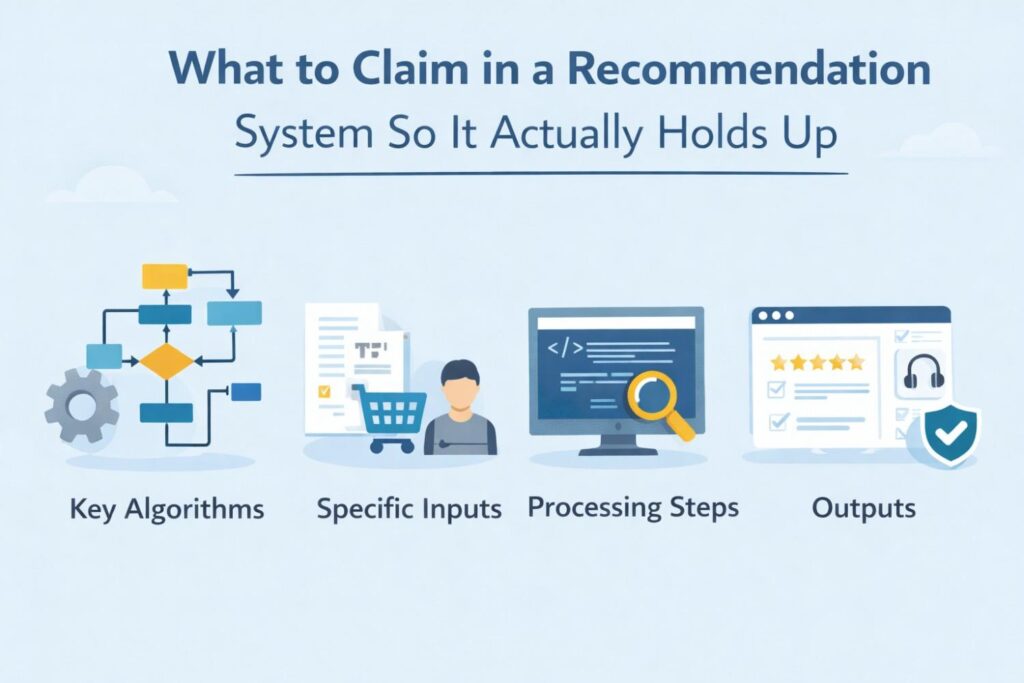
That might include receiving interaction signals, generating a user state, retrieving a candidate set, applying a ranking model, adjusting the rank with a business rule, and then updating future scoring based on downstream behavior.
When the claim captures that flow, it becomes more grounded and much harder to dismiss as a vague concept.
The durable value is often in the sequence
For businesses, this matters because product surfaces change all the time. A mobile app gets redesigned.
A dashboard gets rebuilt.
A feed turns into a search layer. But the system sequence that creates value often stays important across all those changes. If you claim the path instead of the screen, you protect something more durable.
A useful internal exercise is to describe your recommendation engine as a chain of decisions rather than as a feature.
Once the system is written that way, it becomes easier to see which parts deserve patent attention and which parts are just ordinary product wrapping.
Claim how the system handles imperfect data
Most recommendation engines do not operate on clean and complete data. They work with partial clicks, noisy events, missing user history, changing catalogs, delayed signals, and uneven labels.
This is not a side issue. It is often where the most important technical work happens. If your system became useful because it solved one of these hard data problems in a specific way, that should be part of what you claim.
Too many businesses focus on the happy path. They describe a system that works when the user has rich history and all items are well understood. That is not enough.
The stronger claim often comes from what the engine does when the data is weak, late, sparse, or unstable.
Sparse data handling can be core patent material
A recommendation engine that performs well with limited signals is often more valuable than one that performs well only in ideal conditions.
If your system uses fallback signals, group patterns, metadata relationships, or session-level inference when long-term user data is missing, that deserves attention.
The key is not just naming those inputs. The key is claiming the logic that decides when and how they are used.
This becomes especially important for startups entering new markets, launching new products, or serving low-frequency users.
A system that keeps working when data is thin creates real business advantage. That kind of advantage is often much more defensible than a generic claim about personalization.
Claim candidate generation when it solves a real scaling problem
Many teams jump straight to ranking because ranking sounds sophisticated. But in real recommendation systems, candidate generation can be one of the most important technical layers.
It is where the engine cuts a huge space down to a manageable set before deeper scoring happens. If your system has a distinctive way of selecting candidates under speed, memory, or relevance limits, that may be a very strong thing to claim.
This matters because businesses often win or lose at scale in the first retrieval step.
A weak candidate layer can bury good items before ranking even begins. A strong one can make the entire engine smarter, faster, and more efficient.
Retrieval choices can define the moat
If your company built a special retrieval method based on session context, graph structure, temporal patterns, or blended signal pools, that may be more patent-worthy than the final rank formula.
The reason is simple. Candidate generation shapes what the system is even allowed to consider. That is a major control point.
For business teams, this means the patent conversation should not be limited to the machine learning team alone.
The people building indexing, retrieval, pipeline orchestration, and low-latency serving may hold some of the most claimable insights in the whole product.
Claim ranking logic when it reflects a real technical tradeoff
Ranking is often where businesses try to do too much in one step. They want relevance, freshness, diversity, fairness, monetization, trust, and speed all at once.
If your team created a structured way to balance these forces, that can be highly claimable. The ranking layer becomes interesting when it does more than sort by a plain score.
What makes this hold up is not the idea of ranking itself. It is the technical way the engine manages competing objectives without collapsing quality or performance.
That is where many businesses create real novelty, even if they do not describe it clearly at first.
Balancing goals is stronger than naming goals
Saying the system ranks based on relevance and business objectives is too loose. A better claim would focus on the mechanism used to combine or sequence those forces.
Maybe the engine first produces a relevance order and then applies bounded adjustments to ensure freshness.
Maybe it uses confidence thresholds to decide when monetization weights can influence ranking. Maybe it applies category spacing rules to prevent repetition while preserving top intent.
These are stronger because they define a technical structure. They show the actual solution, not just the business desire.
For companies under pressure to grow revenue without hurting user trust, this part of the system often matters a great deal.
Claim update behavior, not just static scoring
A recommendation system that never changes is not much use in production. The strongest systems adapt. They react to new clicks, fresh content, changing interest, negative feedback, and live session behavior.
If your engine updates state or ranking in a distinctive way, that can be a powerful claim area.
This matters because adaptive behavior is often where competitors struggle. It is one thing to build a batch model that recommends yesterday’s winners. It is another to build a system that responds quickly without becoming unstable or noisy.
Real-time adaptation can carry real patent value
A business should look closely at how the system updates its understanding of user intent. Does it change weights within a session? Does it shift the source of candidate retrieval after a short burst of user behavior?
Does it suppress repeated content after a threshold? Does it use negative interaction as a stronger signal in certain contexts?
These are not minor tuning details when they change system behavior in a meaningful and repeatable way.
The right claim can capture how the engine becomes more useful over time, not just how it makes a single recommendation in isolation.
Claim the fallback path for cold start and low-confidence cases
Cold start is one of the oldest problems in recommendation systems, but it is still one of the richest places for practical invention. Every business faces some version of it.
New users arrive with no history. New items arrive with no engagement. New markets launch with thin data. Claims that ignore this often miss some of the best material.
What matters is not merely saying the system handles cold start. What matters is defining the exact logic the system uses when standard ranking confidence is not available. That is where the useful protection sits.
Low-confidence routing is often more valuable than the default flow
A smart recommendation engine does not pretend every score is equally reliable. It knows when confidence is weak and switches behavior accordingly.
If your system routes low-confidence cases into a different candidate pool, substitutes metadata-driven ranking, or uses a staged exploration policy, those system choices deserve close attention.
Businesses should think of fallback behavior as prime patent territory. It often reflects real engineering insight, especially in products where early user experience determines retention.
Protecting the normal flow is good. Protecting the system’s response when the normal flow fails is often even better.
Claim session-level intelligence if that is where your edge lives
Many recommendation engines rely heavily on long-term profiles. But some of the most effective systems today gain their edge from understanding what a user is trying to do right now.
Session-level behavior can reveal sudden intent shifts, short-term needs, and changes that historical profiles miss.
If your recommendation system is especially strong because it uses session context in a structured way, that is worth claiming.
This is important for businesses because present intent often drives conversion more than long-term preference.
A user’s last few actions can matter more than months of older behavior, especially in commerce, search-heavy products, and tools used for specific tasks.
Short-term intent deserves its own claim framing
If your engine builds a session representation, changes retrieval strategy during a session, or weights recent events based on timing or order, those are not just tuning choices.
They may define the actual performance advantage. The patent should reflect that.
A practical way to test this is to ask a simple business question: if you removed session-awareness, would your product lose a meaningful share of its recommendation quality?
If the answer is yes, then the system’s handling of short-term intent likely belongs near the center of your claim strategy.
Claim the interaction between stages, not only the stages themselves
Recommendation systems are often described as separate blocks. Retrieval does one thing. Ranking does another. Filtering does another.
But in stronger systems, the real value often comes from how those stages influence one another.
If your engine passes confidence values, behavioral signals, constraint flags, or exploration indicators between stages in a non-obvious way, that interaction can be worth claiming.
This is a powerful area because many generic systems have the same high-level stages. What they do not always have is your specific logic for how those stages work together. That interaction can be the real difference.
System handoffs are often where competitors struggle to copy
A competitor can imitate a broad system diagram without matching the important internal handoffs. That is why businesses should look hard at the data and control signals moving between stages.
Does the retrieval stage tag items with source-type indicators that alter downstream ranking? Does the ranker emit confidence measures that affect post-processing?
Does user feedback change not just scores but also candidate source selection later in the same session?
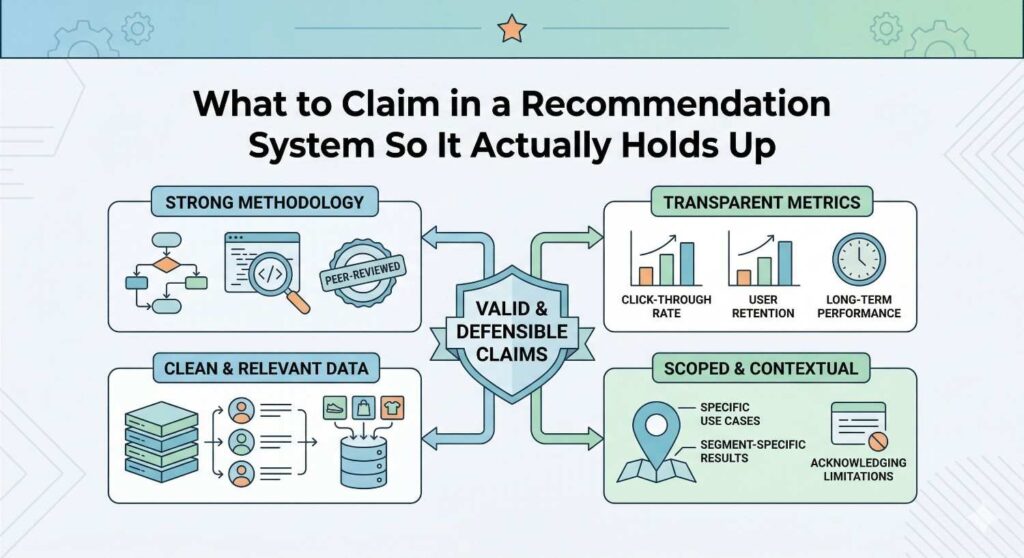
When those interactions drive better outcomes, they deserve strong patent attention. They describe a machine that is doing coordinated work, not just a set of separate modules placed side by side.
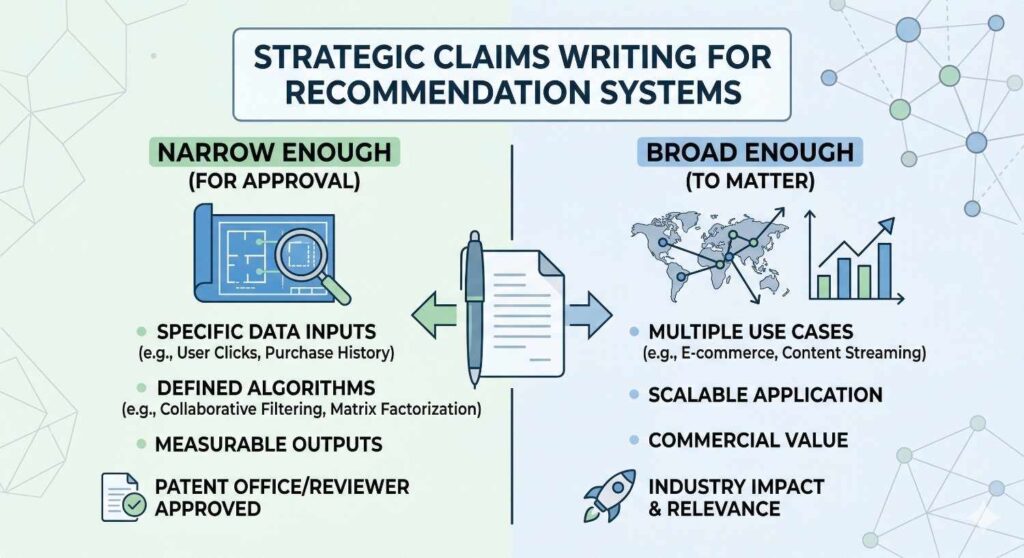
How to Write Narrow Enough to Get Approved but Broad Enough to Matter
This is the hardest part of claiming a recommendation system well. Most teams do not fail because they have nothing worth protecting. They fail because they choose the wrong level of detail.
They either claim the system so broadly that it sounds like a wish, or so tightly that it only covers one small version of the product. Neither outcome helps much.
A good claim needs shape. It needs enough detail to show there is a real technical invention, but enough room to stay useful as the product grows.
This is not just a drafting problem. It is a business strategy problem. If the claim is too wide, it can fall apart during review. If it is too narrow, a competitor can make small changes and walk around it.
The sweet spot sits in the middle. That is where the claim is specific about the system logic, but flexible about the exact product form. That is what companies should aim for if they want protection that actually supports growth.
Start with the technical core, not the biggest possible story
A lot of teams begin in the wrong place. They start by asking how much territory they can cover. That feels natural, especially for a startup that wants room to grow.
But it often leads to claims that read like a giant umbrella with no real structure. The better starting point is the technical core. That means the smallest true system idea that gave the product a real edge.
When you begin there, you can build outward in a disciplined way. You are no longer guessing at broad language. You are tracing the real invention from the inside out.
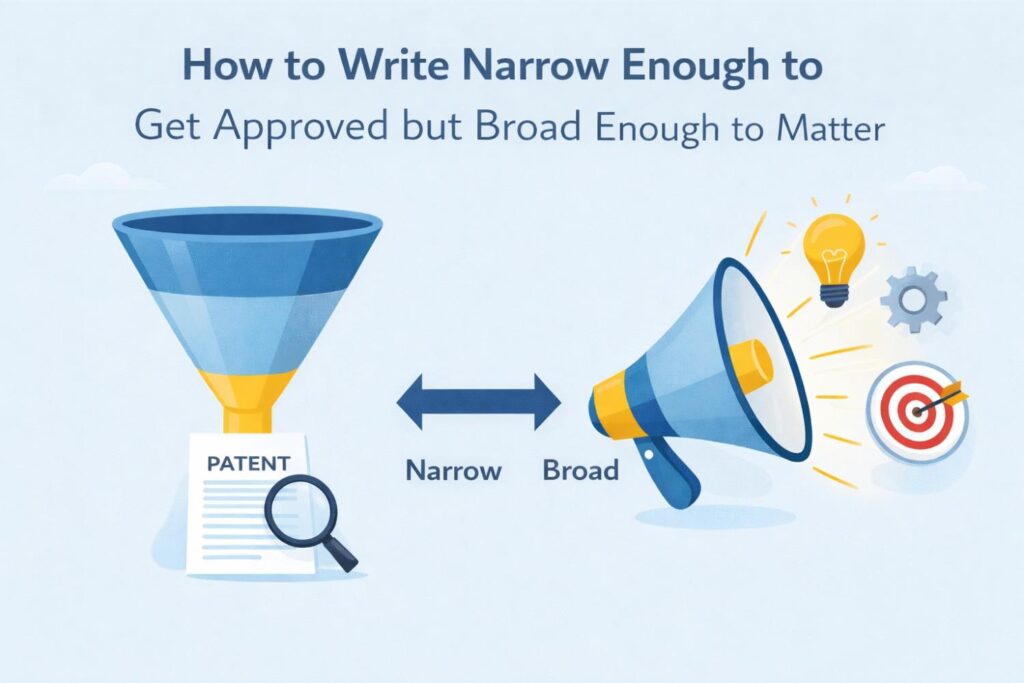
That makes the claim stronger because it starts with something concrete, not something inflated.
The right starting question
The best question is not, “How can we claim all recommendation systems like ours?” The best question is, “What exact system behavior did we create that made this work when standard methods were not good enough?” That answer usually contains the center of a solid claim.
A founder or product lead should be able to explain this in plain language. Maybe the system changes ranking logic when session intent shifts.
Maybe it handles weak user history by changing the source of candidate generation. Maybe it updates recommendations during a session without waiting for a full model refresh. That is where the real claim starts.
Write around the system behavior, not the product label
Words like recommendation engine, personalization layer, ranking system, or relevance model may help describe the category, but they do not carry the patent by themselves.
The claim becomes stronger when it is built around what the system actually does. A product label is too high level. A system behavior is more useful.
This matters because product labels age quickly. A company may shift from a feed to search, from content to commerce, from desktop to mobile, from one user flow to another.
But the core system behavior can still stay valuable across those changes. That is the layer worth protecting.
Behavior survives product changes better than branding does
A practical way to write at the right level is to describe the engine as a set of actions. The system receives certain signals, forms a representation, selects a candidate group, applies scoring logic, adjusts the output under defined conditions, and updates future outputs based on later signals.
That language is much more durable than tying the whole claim to a named feature or one visible screen.
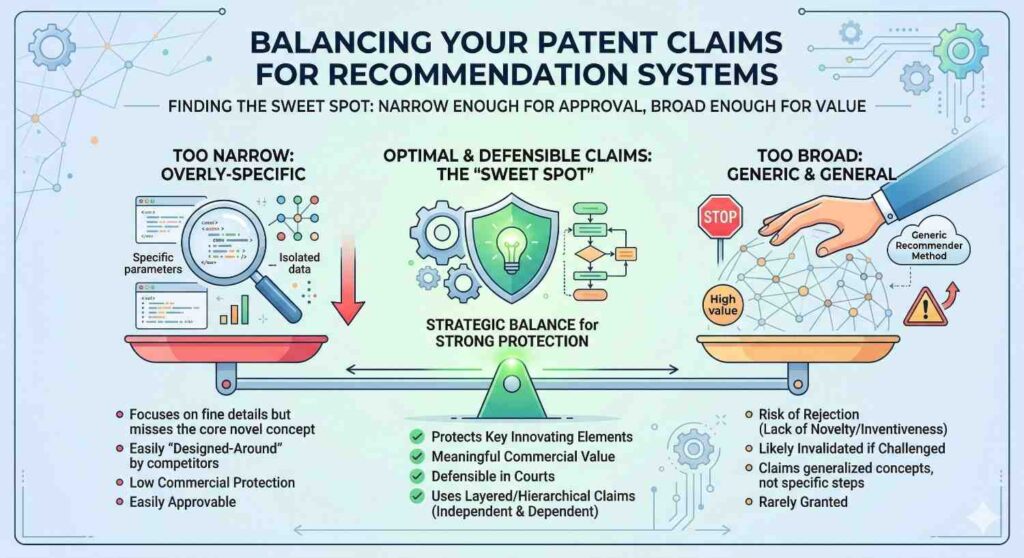
For businesses, this approach also makes the patent more flexible. It leaves room for the product team to change design and packaging without leaving the core protection behind.
Use enough detail to show a real machine is doing real work
One reason broad claims get rejected is that they do not show enough structure. They say the system recommends, predicts, or selects, but they do not explain how.
That creates the impression that the claim is just covering a result. The fix is not to drown the claim in tiny details. The fix is to include enough technical steps to show there is a real machine carrying out a real process.
That means the claim should reveal the logic path, not every implementation choice.
It should show what kind of data is received, what the system does with it, how decisions are made, and how outputs are generated or updated. That gives the claim backbone.
Detail should prove reality, not trap the claim
This is where many teams overcorrect. They hear that broad claims are weak, so they pour in every variable, threshold, and model type they used in one version of the system.
That can create the opposite problem. The claim becomes tied to one narrow implementation and loses wider value.
The better move is to include the level of detail that proves the invention is real and technical, while avoiding unnecessary specifics that are not central to the inventive idea. The claim should describe the engine’s logic with enough force to stand up, but not so much rigidity that it becomes brittle.
Keep the claim centered on the non-obvious part
Not every part of a recommendation system is equally important. Some steps are routine. Some are expected.
Some are where the real technical edge lives. The claim should spend its energy on the part that was not obvious. That is often where approval becomes more realistic and business value becomes stronger.
This matters because a recommendation system may include many familiar pieces. It may gather user events, score items, and present ranked results. None of that is special by itself.
What matters is the part where your team had to solve a hard problem in a distinct way. That is where the claim should tighten.
The hard part should get the most attention
A useful drafting habit is to identify the one step that made the product finally work. Not the broad workflow. Not the end result. The step that changed performance in a real way.
Maybe it was how cold start cases were routed. Maybe it was how multiple scoring objectives were balanced. Maybe it was how feedback was filtered before being used for updates.
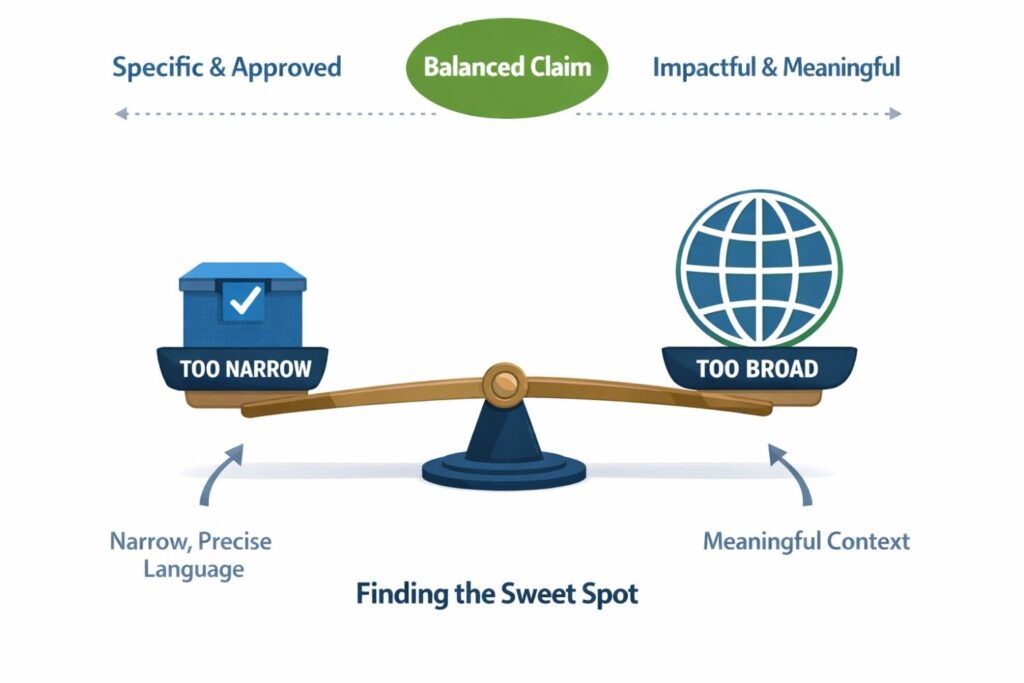
Once that step is clear, the claim can be built around it. Other steps can support it, but they should not bury it. That keeps the claim narrow enough to feel grounded while broad enough to stay commercially useful.
Avoid locking the claim to one exact model type unless that model type is the invention
Many businesses build recommendation systems using models that may change over time. Today it may be one ranking model. Later it may be another.
If the claim is tied too tightly to one model architecture without a good reason, the protection can age badly. A competitor can also sidestep the claim by swapping out the model type while keeping the same system idea.
This is why companies should be careful about making the model the main character unless the real invention truly lives there. In many cases, the better patent target is the system behavior around the model rather than the model label itself.
The model may change, but the system logic may stay valuable
A smart way to draft is to describe the model in functional terms where possible and place more emphasis on how it is used within the system.
The engine may apply a scoring process to a candidate set, adjust the scores using a second signal class, and update selection based on later user behavior. That leaves room for changes in the internals while still protecting the business logic that matters.
For a growing company, this approach is much safer. It gives the engineering team freedom to improve the stack without making the patent feel out of date.
Claim the pattern, not just the first version
Your first working implementation is important, but it is rarely the full business opportunity. If the claim only covers the first version of the product, it may miss the broader pattern that made the invention valuable.
The goal is to identify what stays true across multiple versions of the same system idea.
This is where the difference between narrow and over-narrow really matters. A claim can be grounded in the first version but written at the pattern level, so long as the pattern is still supported by the real system and not just imagined in hindsight.
A useful business test
Ask whether the core logic would still matter if the team rebuilt the product next year. If the answer is yes, then that logic may deserve broader treatment. If the answer is no, then it may be a product detail, not a claim center.
This simple test helps prevent wasted effort. It keeps the claim tied to the durable technical pattern rather than the launch version of the interface or the first exact pipeline design.
Wrapping It Up
Claiming a recommendation system well is not about sounding bigger than you are. It is about being clear about what you actually built and why it matters. That is where strong protection starts. A lot of companies lose their chance not because the system lacks value, but because they describe it in a way that is too loose, too inflated, or too tied to surface-level product language. The better move is to stay close to the real system logic that created the edge.
Leave a Reply