
“Real-time” sounds strong. It sounds fast. It sounds advanced. And that is exactly why so many patent drafts use it. But there is a problem. If you say your system works in “real time” and stop there, you may be saying almost nothing. That is where trouble starts. In a patent, broad words can help only when they are backed by clear meaning. If a key part of your invention depends on speed, timing, live response, low delay, or instant output, you cannot rely on a fuzzy label and hope it carries the claim. You need to show what “real-time” actually means in your system, how your system reaches it, what parts of the flow matter, and why that timing is tied to the technical result.
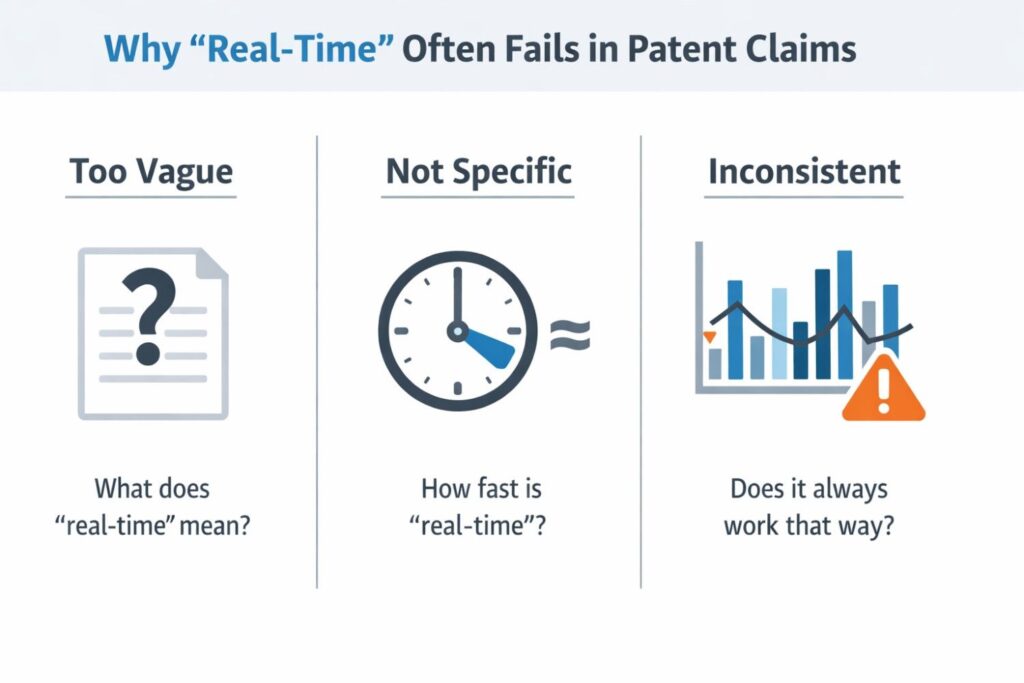
Why “Real-Time” Often Fails in Patent Claims
If “real-time” is important to your invention, it can feel natural to put that phrase right into the claim and move on.
Many teams do exactly that. The trouble is that patent language does not reward words that sound impressive unless those words carry a clear job.
When “real-time” is left open to guesswork, it can weaken the very part of the claim that was supposed to make the invention look strong. For a business, that is not a small drafting issue.
It can shape how easy the patent is to challenge, how hard it is to enforce, and how much value it holds when investors, buyers, or competitors take a close look.
The Phrase Sounds Precise Even When It Is Not
At first glance, “real-time” feels exact. It gives the impression that the system acts right away, with little or no delay. But in patent drafting, that feeling is not enough.
A word can sound sharp while still leaving too much room for debate. That gap between how the phrase sounds and what it really proves is one of the biggest reasons it causes trouble.
A business may think it has clearly claimed fast system behavior simply because it used modern language. But modern language is not the same as claim-ready language.
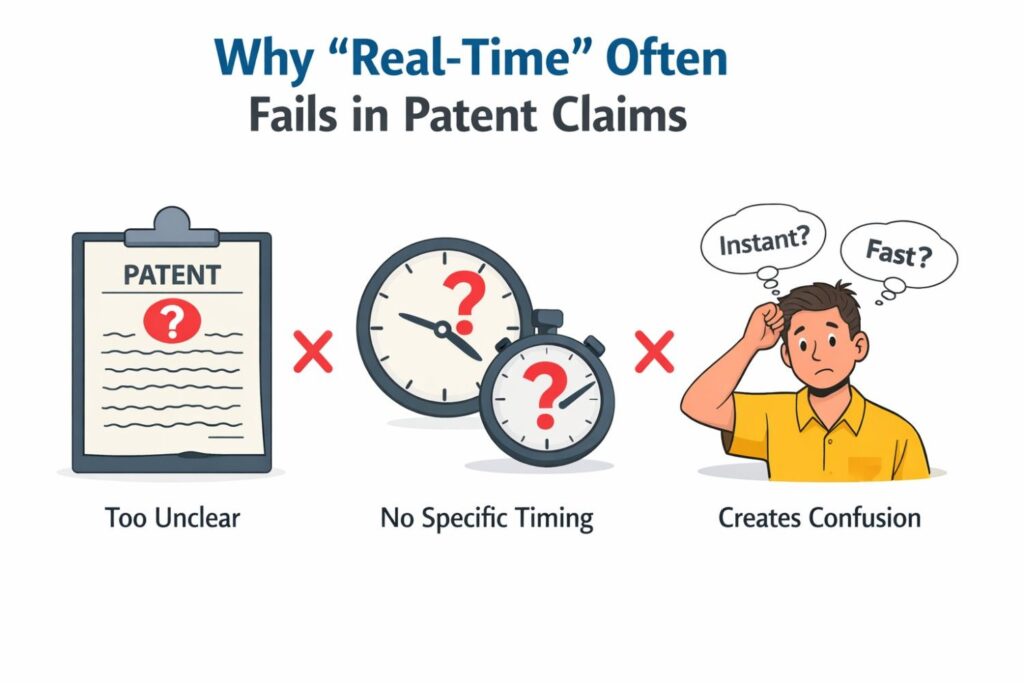
If two engineers can read “real-time” and imagine two different timing standards, that is already a warning sign. A patent examiner, a challenger, or a court can see the same problem and ask what the term actually covers.
The Risk Starts With Assumption
Many founders assume everyone knows what “real-time” means. In day-to-day business talk, that may be close enough. In patent claims, assumption is costly.
A claim must stand on its own words and on the support in the specification. If the reader has to fill in missing meaning, the claim is already losing strength.
This is where businesses often slip. The product team uses “real-time” in demos, sales pages, and internal docs. Then the same phrase travels into the patent draft without being tested.
No one stops to ask whether the timing is measured in milliseconds, in event cycles, before a threshold event, or simply faster than a prior process. That missing step creates avoidable weakness.
A Strong-Sounding Word Can Hide a Weak Core
Sometimes “real-time” is used because the drafting team wants the claim to sound advanced without locking the claim into a narrow number. That instinct is understandable, but it can backfire.
If the term becomes the main signal of technical value and yet remains undefined, the claim can look broad while actually being fragile.
That matters for business strategy. A fragile broad claim can create false confidence. It may look good in a filing report or investor update, but later it may not stand up when someone asks what the invention actually requires.
The Patent System Cares About Meaning, Not Marketing
Business teams often describe inventions the same way they describe products in the market. That is natural because the same invention lives in both places.
Still, the patent system asks a different question. It does not ask whether the wording sounds exciting. It asks whether the wording tells the reader what the invention is doing.
This is where “real-time” often fails. It is a very strong marketing phrase because it quickly signals value.
Customers hear it and think of speed, live updates, low delay, and better performance. Patent reviewers do not stop there. They want to know what the system is actually doing that earns the phrase.
Product Language and Claim Language Are Not the Same Thing
A company website can say “real-time fraud detection” and do its job well. The phrase tells buyers that the system acts quickly enough to be useful during a transaction.
But in a patent claim, that same phrase may leave major questions open. Does the detection happen before authorization? During message parsing? Within a fixed time budget? Without waiting for batch storage? Across all inputs or only some inputs?

Each of those possibilities points to a different invention shape. If the patent never says which one matters, the claim can become exposed. Businesses that understand this difference early tend to build stronger filing habits.
They stop copying product language into the patent record and start translating business value into technical detail.
The Missing Link Between Timing and Technical Result
The strongest patent claims do not just say something happens fast. They explain why the timing changes the result. That link is often missing when “real-time” is used loosely.
The claim may announce speed but fail to connect that speed to the system’s actual operation.
That lost connection can hurt in more ways than one. It can make the invention look more like a wish than a technical design.
It can also make it harder to argue that the timing feature is meaningful rather than decorative. For a business, that means a weaker story for protection, licensing, and competitive leverage.
Actionable Move for Teams Before Filing
Before any draft uses the words “real-time,” the team should force itself to complete one sentence in plain English: “This process must happen before _____ because otherwise _____.”
That simple exercise often exposes whether the timing is truly part of the invention or just part of the sales pitch.
If the team cannot finish that sentence clearly, it should not rely on “real-time” as a key claim concept yet.
It likely needs more technical framing first. This is one of the fastest ways for businesses to separate true patent-worthy timing features from general speed claims that will not carry much weight.
“Real-Time” Can Mean Different Things in Different Systems
Another reason the phrase often fails is that it changes meaning depending on the technology. In one system, “real-time” may mean handling streaming input continuously.
In another, it may mean reacting before a device state changes. In another, it may simply mean output appears with low enough delay that a human user sees it as immediate.
Patent problems grow when a claim uses one phrase to cover all these ideas without clarifying which one matters in that invention. What seems broad from a business angle may look muddy from a patent angle.
Human Perception Is Not the Same as Machine Timing
Many products use “real-time” to describe a user experience. The screen updates instantly. The dashboard refreshes live. The alert appears right away. But patents often need a deeper layer than user experience.
They need to explain what the machine is doing, not just how the outcome feels.
That is a key business insight. If your claim depends on timing, do not stop at the customer-facing effect. Go beneath it.
Show the trigger, the processing path, the condition being evaluated, and the output timing in relation to the event. That shift makes the invention harder to dismiss as simple presentation language.
When User-Facing Speed Misleads the Draft
A dashboard may look live even when its data refreshes every few seconds in grouped pulls. A control system may look instant to an operator even though the true technical value lies in a prediction model that acts before the next sensor cycle.
If the patent uses the customer-facing phrase without the deeper system detail, the claim may miss the real invention.
That is why businesses should review patent drafts with both technical and commercial teams in the room.
The commercial team knows what value the market sees. The technical team knows what actually makes that value possible. The patent language gets stronger when both views are translated into the same record.
Broad Timing Words Invite Easy Pushback
The more flexible a word is, the easier it is for someone else to push against it.
“Real-time” often invites that kind of pushback because the other side can argue that the claim is unclear, unsupported, or not meaningfully different from older systems that were also fast in some sense.
For a business, this is where the cost shows up. Weak clarity can lead to longer prosecution, more claim amendments, narrower outcomes, and less confidence later in enforcement.
Even if the patent eventually issues, the business may have spent time and money protecting language that still leaves open attacks.
A Competitor Can Reframe the Meaning
If the patent does not define what “real-time” means in context, a competitor may try to define it for you later.
They may say their product is not covered because their timing falls outside what they claim your term must mean. Or they may argue that old systems already met the same loose standard.
That kind of fight is avoidable when the application gives a grounded explanation of timing behavior. The more clearly the patent connects timing to structure, events, thresholds, and outputs, the less room others have to rewrite the meaning around your business interests.
Actionable Move for Businesses Building a Patent Portfolio
When timing matters across multiple products, businesses should not rely on a single generic “real-time” description everywhere. They should map the specific timing story for each product line or core system.
One invention may depend on event-driven response. Another may depend on bounded delay. Another may depend on processing before state transition.
When those separate timing stories are identified early, the company can file with much better precision. That creates a portfolio that reflects real technical differences, rather than repeating one vague phrase across every application.
Examiners Often Look Past Labels and Search for Mechanism
A common business mistake is thinking the label itself will carry patent weight. It usually does not. Examiners tend to look through high-level labels and search for the underlying mechanism. They want to know how the system achieves the stated result and what features make the result possible.
If the claim says “real-time” but the body of the application does not explain the operational path in a clear way, the phrase may be treated as empty or weak.
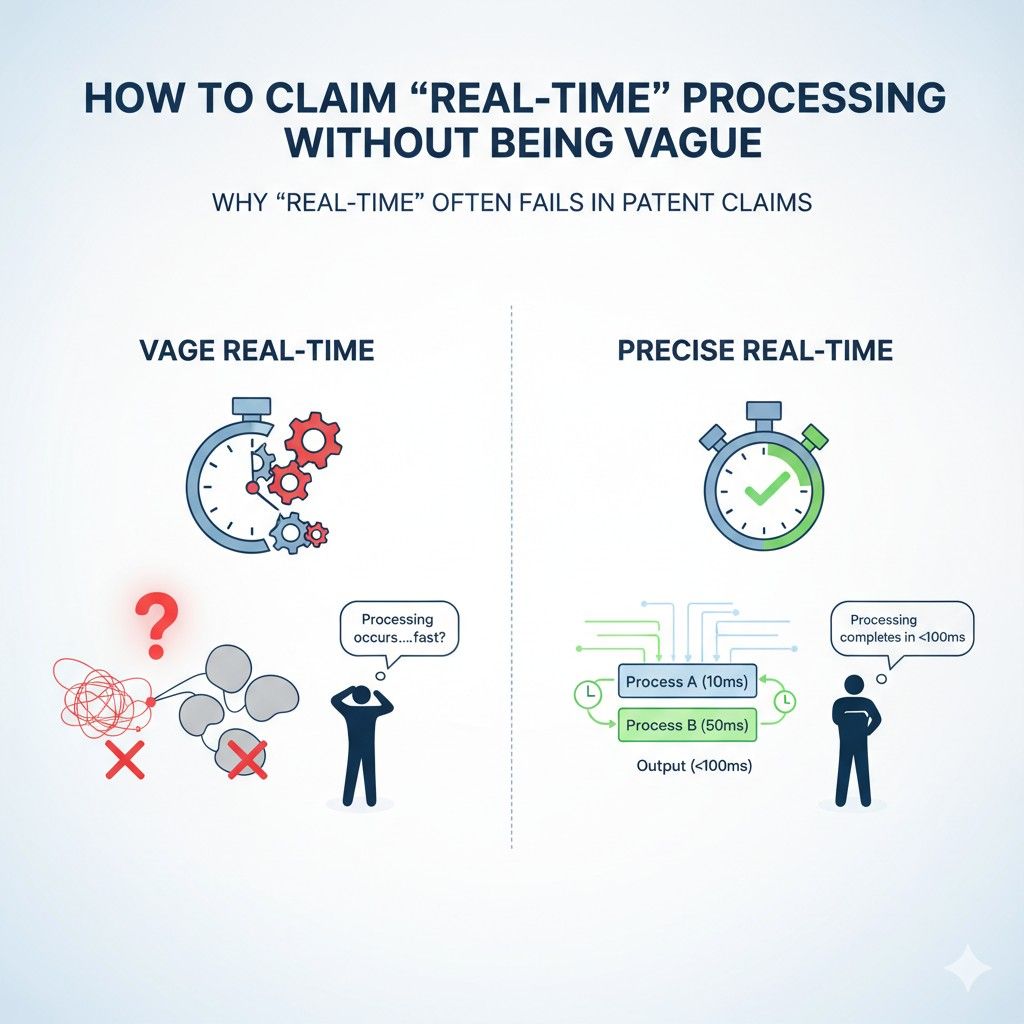
That does not mean timing language should never be used. It means timing language must be earned by support.
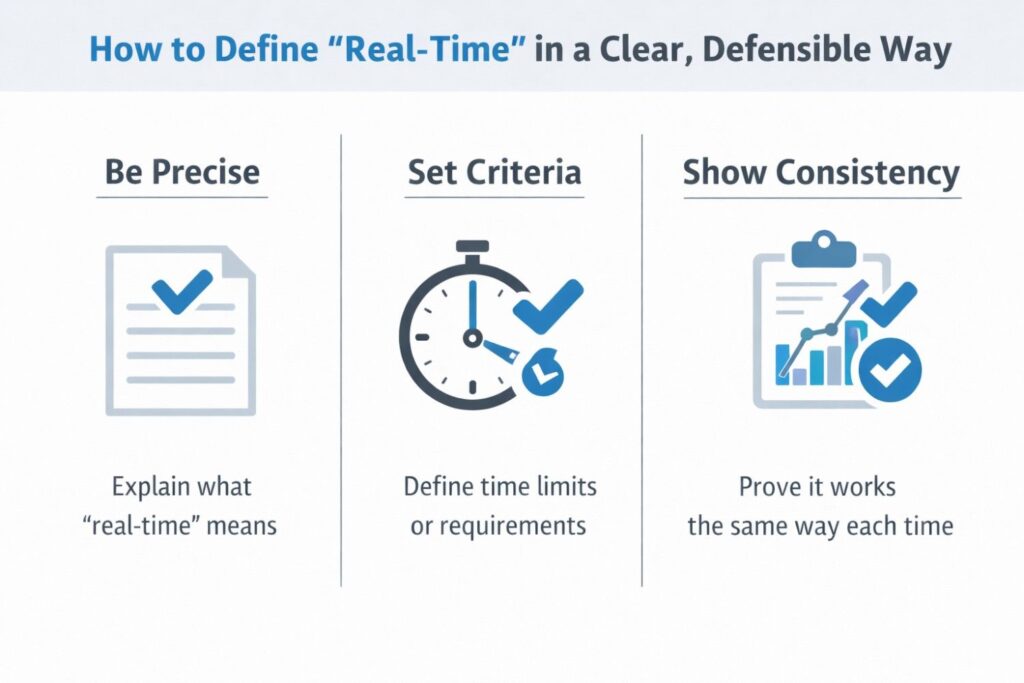
How to Define “Real-Time” in a Clear, Defensible Way
The phrase “real-time” becomes useful in a patent only when it stops acting like a label and starts acting like a defined part of the system.
That means the term must do real work. It should tell the reader what kind of timing matters, where that timing matters, and why the timing changes the technical result.
A clear definition does not make the claim weaker. In most cases, it makes the claim more credible, more flexible, and much harder to attack.
Start With the Job the Timing Must Do
The best way to define “real-time” is not to begin with a number. It is to begin with the job.
Ask what the timing must achieve inside the system. That question usually leads to a much better definition than trying to force a delay figure into the draft too early.
If a system must act before a transaction is approved, that is one kind of timing. If a control signal must be generated before the next sensor cycle, that is another. If a stream must be processed without waiting for full batch storage, that is another again.
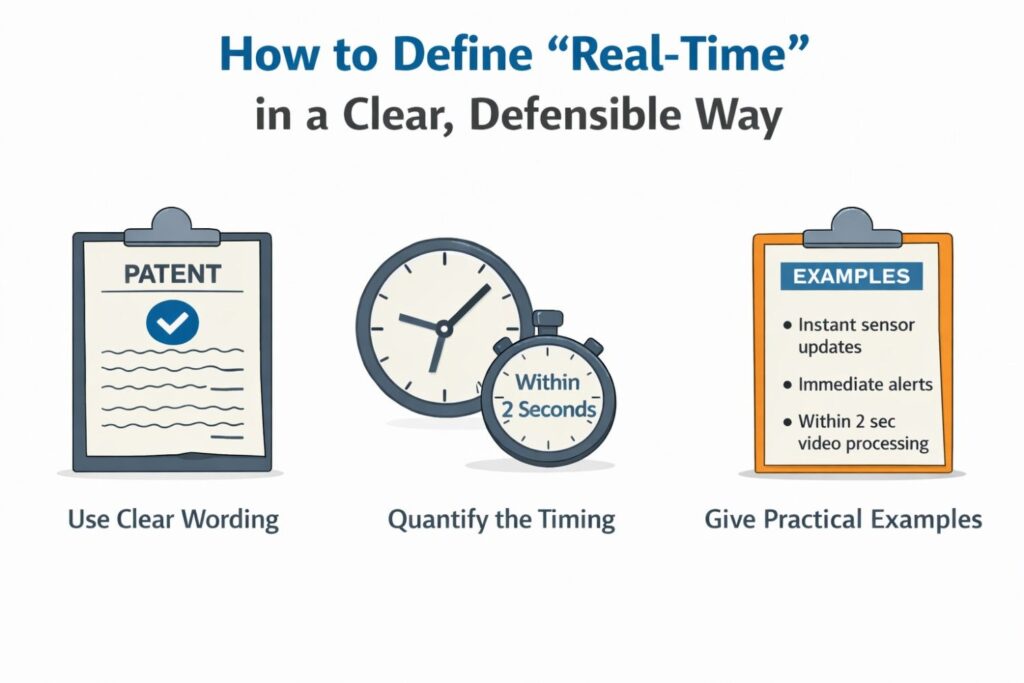
Each one can support the phrase “real-time,” but each one means something different. A patent gets stronger when it makes that difference plain.
Define the Need Before the Speed
When teams rush to define “real-time” as “fast” or “low latency,” they often miss the real point. The timing matters because something in the system breaks, degrades, or changes if the action comes too late. That is the part worth capturing.
A better internal drafting habit is to identify the consequence of delay before choosing any wording.
If the delay causes stale routing, missed threat prevention, unstable control, dropped session quality, or incorrect state selection, that consequence gives shape to the term. It turns “real-time” from a broad promise into a system rule.
Put the Reader on the Clock
A useful definition lets the reader understand when the timing window opens and when it closes.
That window may be very short or fairly wide. What matters is that the claim and the supporting text make the window understandable.
In practice, this means defining the event that starts the timing relationship and the result that must happen before the next condition occurs.
That framing helps the patent read like a technical design rather than a vague speed claim. It also gives the business a stronger position later if someone argues that the term has no real boundary.
Tie the Term to a Trigger Event
A claim becomes much clearer when “real-time” is anchored to a trigger. The trigger is the thing that causes the system to begin processing, updating, deciding, or outputting. Without that anchor, the phrase can drift into generality.
A trigger may be receipt of sensor input, detection of a state change, arrival of a transaction request, generation of a user event, or recognition of a threshold crossing.

Once that trigger is identified, the patent can describe what the system does in response and why the timing of that response matters.
The Trigger Makes the Definition Measurable
Even if the patent does not lock itself into a strict number, a trigger makes the timing relationship more concrete.
The reader can now ask a real question: what happens after the event arrives, and how soon must the system complete the next operation for the invention to work as intended?
That is a far better position than leaving “real-time” floating on its own. Businesses should push for this in every invention disclosure.
Instead of saying “the system processes data in real time,” the disclosure should say what event starts the process and what operation must follow in that event window.
Actionable Advice for Product and Engineering Teams
When your team is preparing material for a patent draft, capture one clear trigger event for each timing-sensitive flow. Do not just say the platform updates in real time.
Write down what causes the update to begin, what module responds, and what output must be produced before what next system event. That small step gives patent counsel much stronger material to work with.
It also helps separate core invention paths from secondary features. If one timing path is truly central to product value, it should stand out naturally when the team maps the trigger and response chain.
Define “Real-Time” Relative to the System, Not to Hype
A defensible definition usually depends on the system’s own operating context. The right meaning of “real-time” in one field may be completely wrong in another.
That is why good drafting avoids generic hype and instead grounds the term in the environment where the invention lives.
For one invention, “real-time” may mean before buffered accumulation reaches a threshold.
For another, it may mean during active session handling. For another, it may mean within a bounded interval that preserves output relevance. The patent does not need to act as if one universal meaning exists. It needs to explain the meaning that applies to this invention.
Context Is What Makes the Term Credible
A context-based definition feels more believable because it reflects how systems actually work.
Engineers do not build for abstract speed. They build for operating conditions, hardware limits, user needs, and technical goals. A patent should reflect that same reality.
This is especially important for businesses in crowded markets. If many competitors also talk about “real-time” features, your advantage will not come from using the phrase louder.
It will come from showing a clearer and more specific relationship between timing and operation. That is what helps your filing stand apart.
Avoid the Urge to Sound Universal
Founders sometimes want the patent to present the invention as solving “real-time” processing in a broad, industry-wide sense. That may feel appealing, but it often weakens the draft.
A better move is to define the timing in a way that is broad enough to cover real variations, yet still rooted in the actual system behavior.
That balance is where strong patent drafting lives. It does not come from grand language. It comes from careful language that still leaves room for different implementations.
Use Functional Boundaries With Care
One useful way to define “real-time” is through functional boundaries. In other words, describe the processing as occurring in time to preserve a function, prevent a failure, or maintain a required operating condition.
This can work very well when done with enough support.
For example, the relevant timing may be tied to keeping a machine stable, stopping unauthorized access before commitment, refreshing a model output before a control decision, or updating a state estimate before it becomes stale. These are functional boundaries because they tie timing to what the system must keep true.
The Boundary Should Not Feel Imagined
A functional boundary only helps when it feels grounded in the invention. If the application simply says the processing is fast enough to be useful, that is too soft.
But if it explains that the processing occurs before a state transition, before command issuance, during active data ingestion, or before data aging passes a threshold, the reader can see the real constraint.
This is why the specification matters so much. The claim may use compact language, but the application should support that language with examples, timing relationships, implementation detail, and consequences of delay. That support gives the boundary weight.
Support the Boundary in More Than One Way
A smart drafting move is to support the same “real-time” concept from several angles in the application. One paragraph can explain the event relationship.
Another can explain the technical result preserved by that relationship. Another can give an example timing window or operating condition. That layered support makes the term much more durable.
For a business, this matters because it gives more room later. If one way of framing the timing becomes less useful during examination, another supported framing may still remain available.
Decide Whether You Need Numbers
Not every strong definition of “real-time” needs a precise number in the claim. Still, many inventions benefit from at least some numerical support in the specification. The key is knowing when numbers help and when they trap you.
A number can make the timing more concrete. It can show that the team really understood the system and was not simply using a buzzword. But a number can also narrow the claim too early if it is used carelessly.
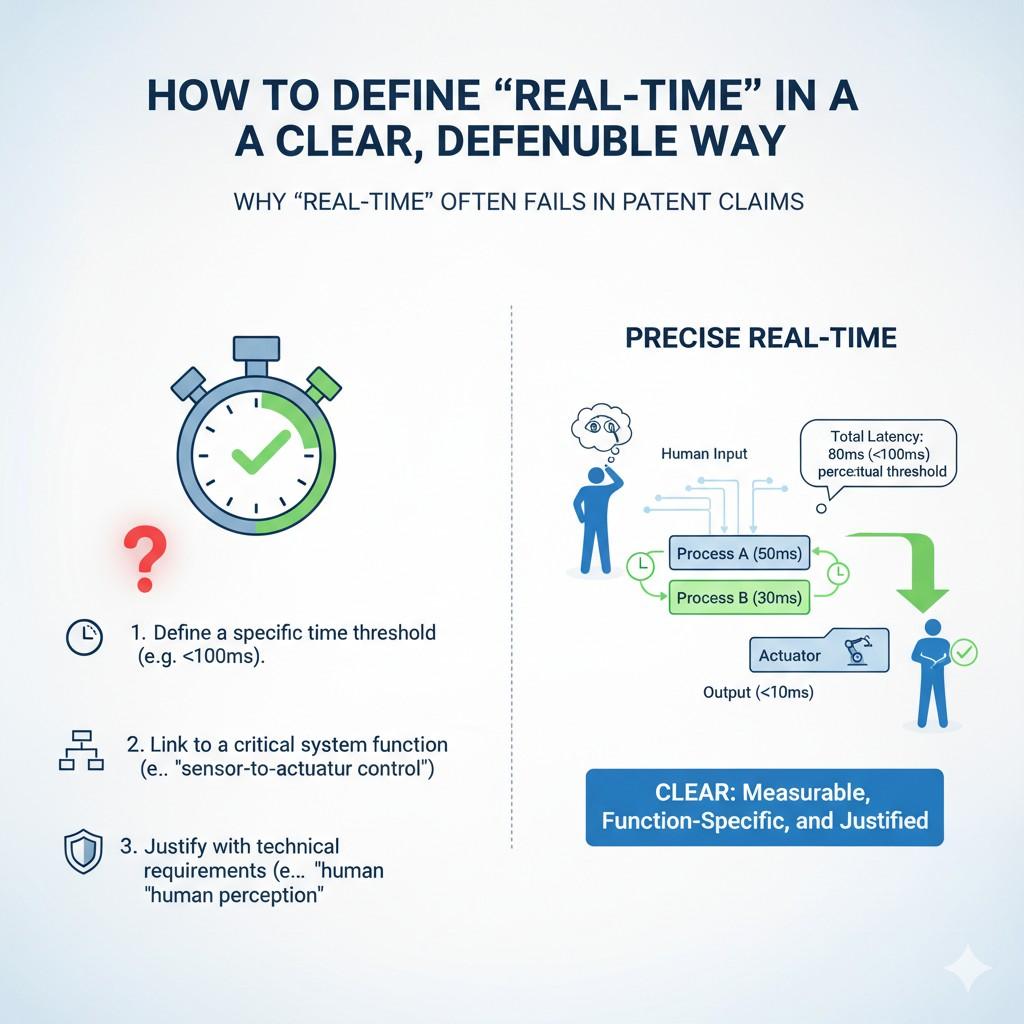
That is why businesses should treat timing values as support tools, not automatic claim language.
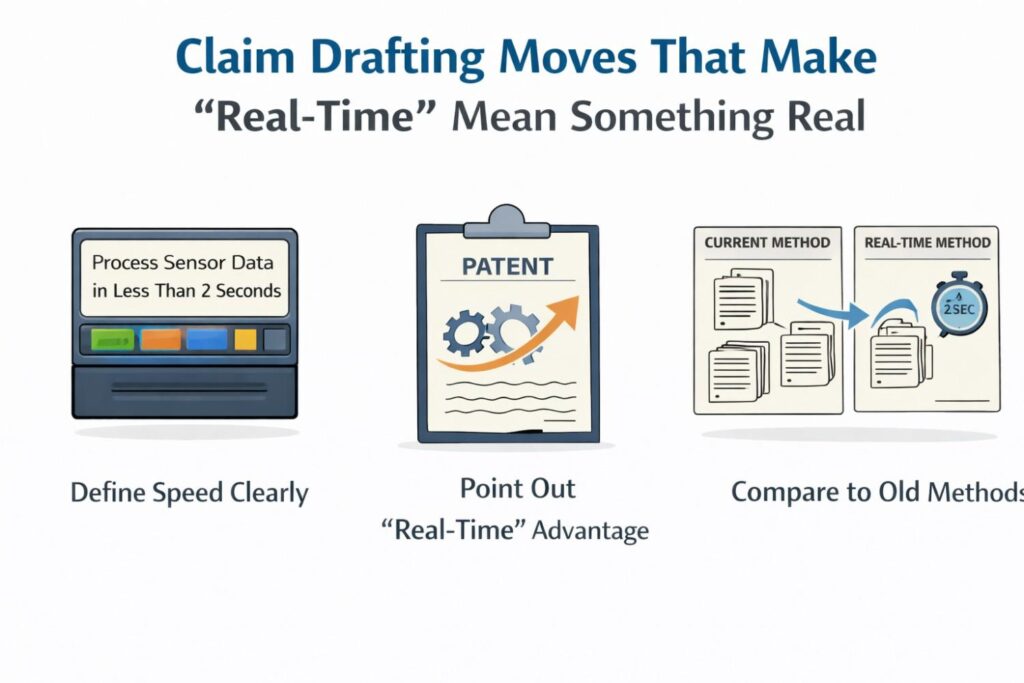
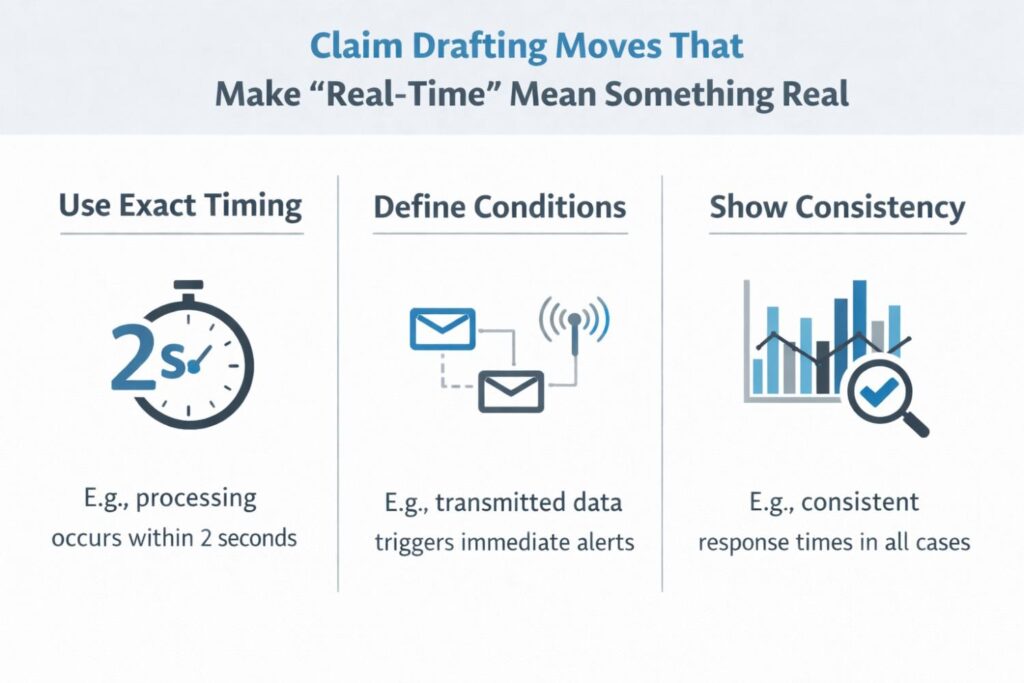
Claim Drafting Moves That Make “Real-Time” Mean Something Real
A patent claim should not ask the reader to guess what makes the invention special. If timing is part of the value, the claim has to show that value in a way that feels grounded, clear, and hard to dismiss.
This is where many teams get stuck.
They know their system does something fast, live, or with very little delay, but they do not know how to turn that fact into claim language that actually carries weight. The answer is not to use bigger words. The answer is to draft in a way that ties timing to real system behavior.
Start the Claim With the Technical Flow, Not the Label
A strong claim usually works better when it begins with what the system is doing, rather than with a broad label like “real-time.”
That means focusing first on receipt of input, evaluation of data, generation of output, updating of state, or execution of control. When that flow is clear, timing can be added in a way that feels earned.
If the claim opens with “a system for real-time processing,” the phrase may sound modern but still leave the reader unsure about what matters.
If the claim instead recites a system that receives an event, processes it under a defined condition, and produces an output before a later system action occurs, the meaning becomes much stronger. The flow gives the timing language something to attach to.
Put Action Before Description
A useful drafting habit is to make the claim show motion. Let the reader see the steps or functions that form the invention. Once the reader can follow that path, timing language becomes much more believable because it is no longer floating on its own.
This matters for business because a claim that follows system action is often easier to defend and easier to compare against competitor behavior.
Instead of arguing about what “real-time” might mean in the abstract, the company can point to a sequence of operations that gives the phrase real content.
Do Not Let the Claim Rely on the Buzzword
The danger is not in using the phrase “real-time” at all. The danger is letting the phrase carry more weight than the rest of the claim.
A well-drafted claim can still use the term, but only after the underlying operation has already been made clear.
That is a smart business move because it reduces dependence on wording that others can challenge as vague. The claim becomes stronger because the invention is expressed through behavior, not hype.
Tie Timing to a Defined Event Window
One of the best drafting moves is to place the timing requirement inside an event window. That means the claim shows when the relevant process begins and what must happen before some next event, threshold, or state transition. This makes the timing concrete without always forcing the claim into one exact number.
A phrase like “processing sensor data in real time” is weak by itself.
A phrase like “processing sensor data responsive to receipt of the sensor data and generating a control output before a next sensor acquisition cycle” tells the reader much more. The claim now has a clear timing relationship that maps to system behavior.
Event Windows Create Clearer Boundaries
Claims become more useful when they help others see where the line is. An event window helps create that line. It tells the reader that the timing is not just generally fast.
It is tied to a particular operational relationship in the system.
For a business, this is valuable because clear boundaries help with enforcement,licensing, and diligence.
If the claim identifies a timing window that matters to system function, it is easier to explain why a competitor’s design falls inside or outside that scope.
Use the Clock That Already Exists in the System
Most good inventions already have a clock of some kind, even if the engineers do not think of it that way at first. It may be a transaction decision point, a machine cycle, a streaming arrival pattern, a threshold event, a state change, or a user session step.
That existing system clock is often the best place to anchor claim timing.
This is a very actionable move for businesses. When reviewing a draft, ask where the natural clock lives in the product. Then ask whether the claim is using that clock or hiding behind a loose phrase instead.
Claim the Consequence of Timing, Not Just the Speed
A patent claim gets stronger when the timing requirement is linked to what that timing allows the system to do.
In other words, do not claim speed for its own sake. Claim the operation that becomes possible because the action occurs in time.
This is a major shift in drafting quality. A claim that says data is processed in real time may feel broad, but it often says little.
A claim that shows the system processing data in time to update a routing table before forwarding, or to block a transaction before commitment, or to adjust a machine state before instability develops, gives timing a technical role.
The Technical Result Makes the Claim More Credible
When the claim ties timing to result, it becomes easier for the reader to understand why the timing matters. That makes the invention look more like a designed system and less like an empty performance goal.
This is especially helpful for businesses building in crowded categories.
If many products claim fast performance, what matters is not merely that your system is fast. What matters is what your system can do because it acts within a certain timing relationship. That is the part worth protecting.
Draft Around the “Before” Relationship
One of the most useful claim drafting patterns is the “before” relationship. The claim can recite that a system performs an operation before a later event, state, command, transition, or threshold condition.
This drafting move often makes “real-time” far more meaningful without needing to rely on the phrase itself as heavily.
A simple internal drafting prompt helps here: before what? If the team cannot answer that clearly, the timing story may still be too soft for strong claims.
Use Structural Support to Back the Timing Language
Functional language alone is often not enough. A claim becomes stronger when timing is supported by structural or operational detail that helps explain how the system reaches the required behavior.
This does not mean every claim must be loaded with narrow hardware specifics. It means the claim should include enough substance that the timing does not feel magical.
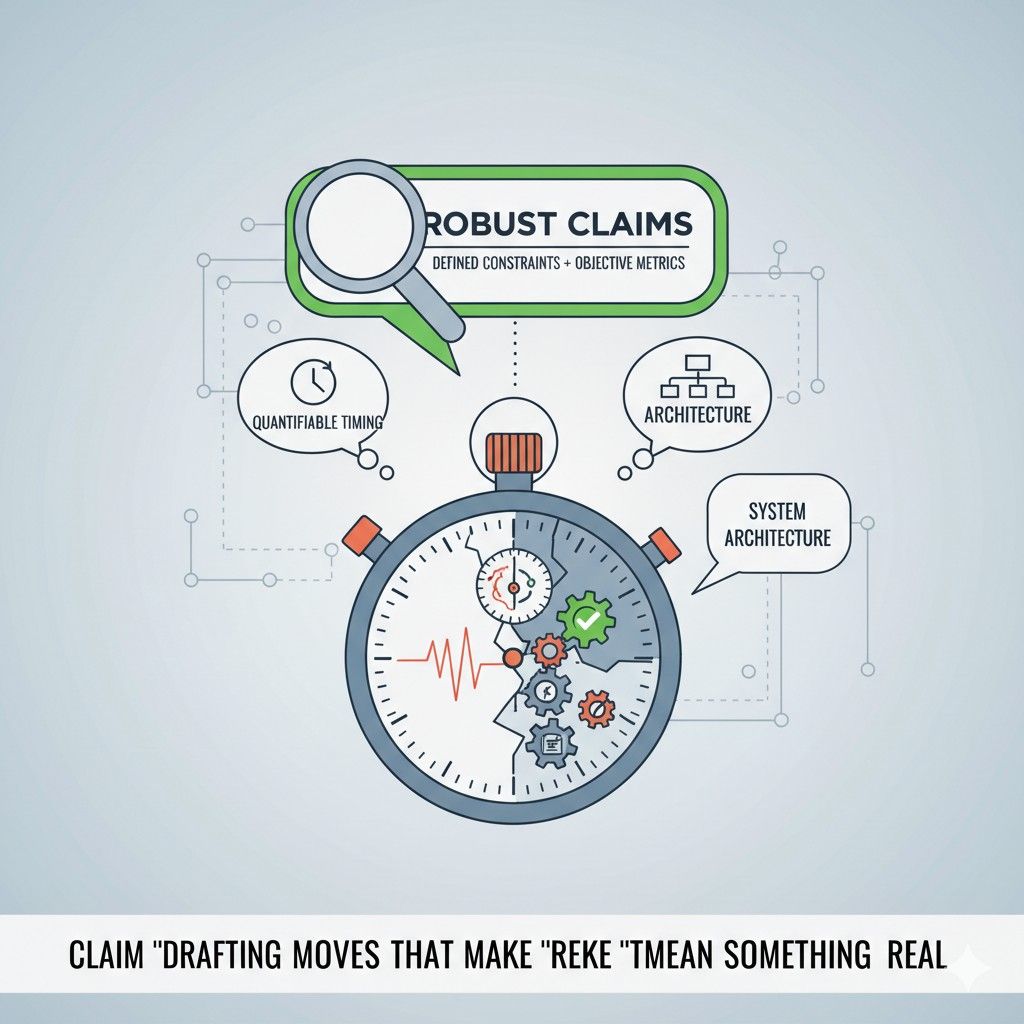
That support might come from selective data handling, parallel processing, priority logic, local buffering rules, precomputed states, streaming evaluation, or trigger-based execution. The exact form depends on the invention.
The point is to show that the timing result comes from something real in the system.
“Real-Time” Should Feel Engineered
A claim that only announces a timing outcome may sound like a wish. A claim that connects that outcome to actual system mechanics sounds more like engineering.
That difference matters a great deal when a patent is reviewed by an examiner or challenged later.
For businesses, this is a practical lesson. Patents gain value when they reflect what competitors would actually have to build.
If the timing result in your product depends on a specific design choice, that design choice should likely appear somewhere in the claim set or at least in the supporting disclosure.
Add Substance Without Trapping the Claim
There is a balance to strike. You want enough operational detail to make the timing requirement believable, but not so much that the claim becomes tied to one narrow embodiment unless that embodiment is the real edge.
The answer is often to place broader timing language in one claim and more specific enabling detail in dependent claims or parallel claims.
This gives the business more flexibility. It creates a claim ladder instead of a single all-or-nothing sentence.
Use Dependent Claims to Add Timing Precision
Dependent claims are one of the best tools for making “real-time” mean something real without overloading the main claim.
A broader independent claim can establish the key timing relationship, while dependent claims can add narrower forms such as example delay windows, event-driven triggers, continuous stream handling, priority queues, or bounded update intervals.
This is a very smart drafting move because it protects the business from two problems at once.
It avoids making the main claim too narrow too early, and it also avoids leaving the patent with no detailed fallback positions if broader language faces resistance.
A Good Claim Set Works in Layers
The strongest claim sets often move from general to specific. The top claim captures the core invention in a broad but supported way. The dependent claims then sharpen the meaning by adding timing details that may matter in certain commercial or technical settings.
That layered structure is not just legal technique. It is a business asset. It gives the company room to respond during prosecution and creates more ways to map the patent onto future products or competitor designs.
Build Dependent Claims Around Real Product Variations
A highly actionable drafting move is to write dependent claims that follow the actual ways the product might be built, shipped, or improved over time.
If one version uses streaming inference and another uses event-driven evaluation, both should be considered. If one deployment runs near the edge and another in a central service layer, the claims can reflect that too.
This helps the patent stay aligned with product evolution instead of freezing the invention at one early snapshot.
Use Alternative Phrasing Instead of Repeating “Real-Time”
Sometimes the strongest claim language does not use the phrase “real-time” in every claim at all. Repetition can make the draft sound thin if each use depends on the same undefined idea.
In many cases, stronger phrasing comes from describing the actual timing relationship directly.
That might mean saying the system processes input as received, updates a state responsive to event detection, generates an output within a bounded period, produces a result before execution of a next operation, or handles data without waiting for accumulation of a full batch.
These kinds of phrases often give the claim more substance than repeating “real-time” again and again.
Specific Timing Phrasing Often Reads Stronger
The reason this works is simple. Direct phrasing tells the reader what is happening. It replaces a broad label with an actual behavior. That makes the claim easier to understand and often harder to challenge.
For businesses, this is an important drafting lesson. A patent should not be judged by how many times it uses a fashionable phrase. It should be judged by how clearly it captures the behavior that creates the product edge.
Use the Phrase Sparingly and Purposefully
There is nothing wrong with using “real-time” where it genuinely helps. But it should appear where the application has already given it meaning. It should not be sprinkled everywhere as if repetition creates clarity. Usually it does the opposite.
A better strategy is to make the concept clear through system language, then use “real-time” as a supported summary rather than as the whole argument.
Draft Claims That Match How Infringement Would Be Proven
One of the smartest ways to make timing language useful is to think ahead to proof. If a business ever needs to point to a competitor’s product and show that it falls within the claim, what evidence would matter?
That question should shape claim drafting more often than many teams realize.
If the only timing language in the claim is a loose label, proving infringement may become harder.
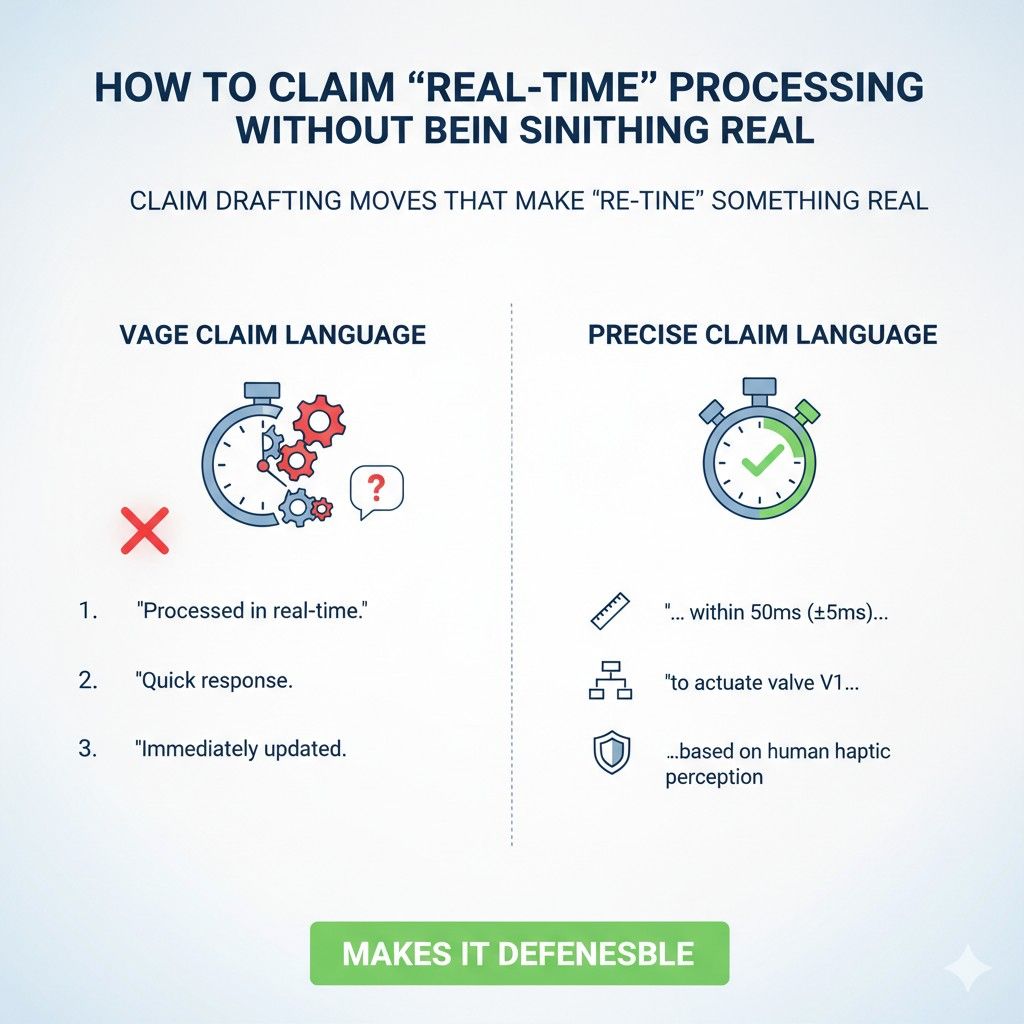
If the claim is tied to visible or inferable system behavior, such as event response before a transaction commit or output generation within a control loop, the path to proof may be much clearer.
Wrapping It Up
The goal is not to stuff the words “real-time” into a claim and hope they sound strong enough to carry the invention. The goal is to make the reader understand exactly what kind of timing matters, where it matters, and why that timing changes the technical result. That is what turns a vague phrase into a real part of the claim.
Leave a Reply