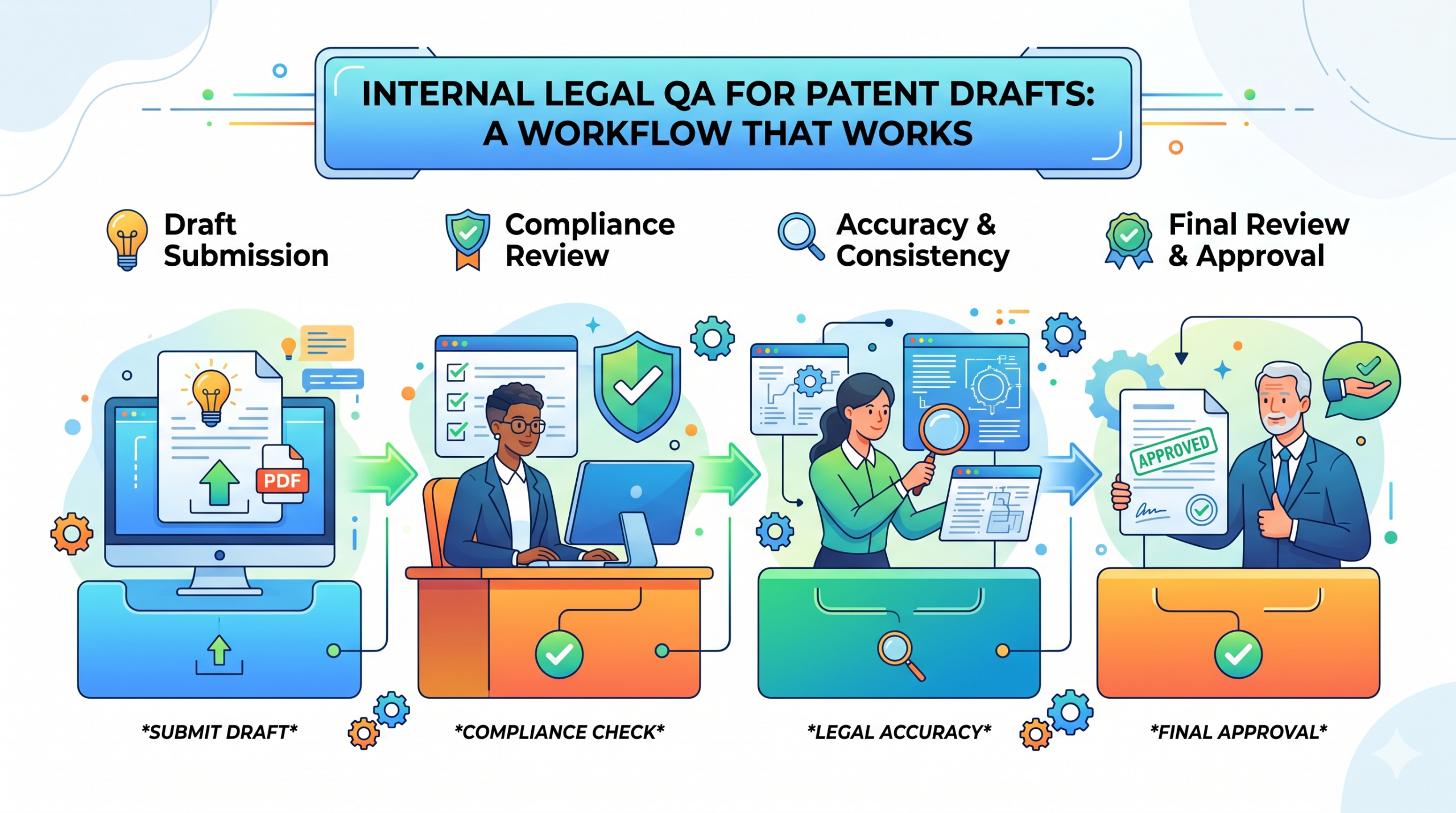
A patent draft can look clean and still be weak. That is the hard part. The words may sound smart. The drawings may look neat. The claims may feel broad. But if the draft does not explain the real invention, show how it works, and protect the right parts, it can fail when it matters most.
Your Legal QA Should Start Before the Draft Looks Done
A good internal legal QA process does not start after the patent draft is “finished.” That is too late.
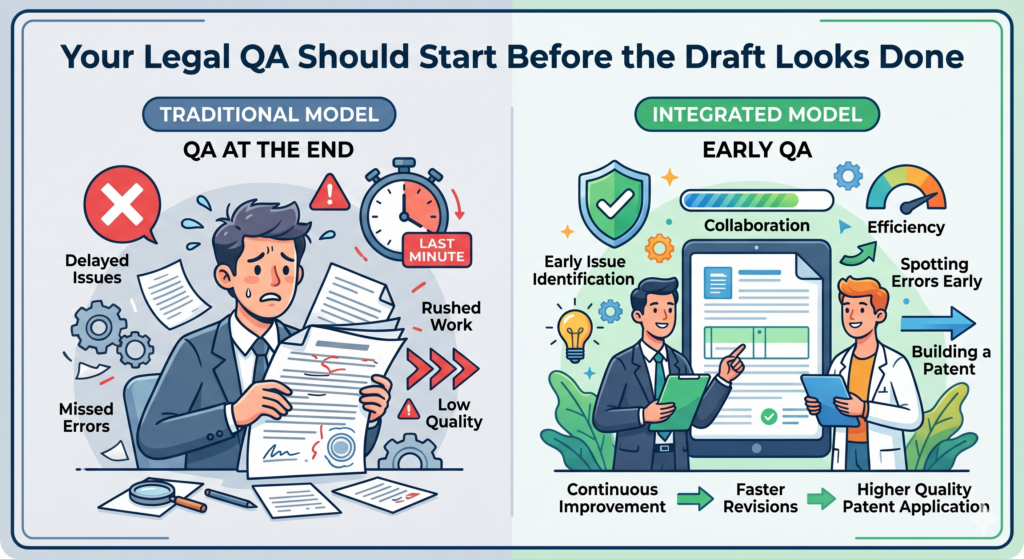
By then, people are tired, the team wants to move on, and small gaps are easier to miss. The better move is to check the draft while it is still easy to fix.
This is where many teams go wrong. They treat QA like a final spell check. They look for clean words, neat formatting, and obvious errors. That helps, but it does not protect the invention.
A patent draft is not just a document. It is a shield around the thing your team built. If the shield has holes, the clean words do not matter much.
At PowerPatent, we see this all the time with fast-moving teams. The invention is strong. The product is real. The engineers know the work inside and out.
But the first draft may not fully capture what makes the invention special. That is not because anyone failed. It happens because patent writing asks for a different kind of thinking.
You are not only describing what the product does today. You are also showing why it is different, how it works, what can change, and what should still be protected if a rival tries to copy the core idea in another way.
That is why legal QA should begin when the draft is rough enough to change but complete enough to review. You want the team to catch missing parts before the language gets locked in.
The best QA moment is when the draft is still flexible
The right time to begin is after the first full draft exists, but before the claims, drawings, and written details feel final. At this stage, your team can still ask simple but powerful questions.
Does the draft explain the real problem? Does it show the actual solution? Does it protect the part that gives the company value?
Does it include the technical details an engineer would expect? Does it avoid tying the invention to one narrow product version?
These questions are not hard. But they must be asked in a clear order. If they are asked late, the review becomes stressful. If they are asked early, the review becomes useful.
The goal is not to make the draft perfect in one pass. The goal is to make the draft stronger with each pass. That small mindset shift changes the whole process.
The first QA pass should look for missing invention substance
The first QA pass should not focus on grammar. It should focus on what is missing. This means your reviewer should read the draft like a smart rival would.
A rival is not looking for beautiful wording. A rival is looking for open space. They want to know what they can copy without getting too close.
Your internal QA should look for that same space.
If the draft only explains the product at a high level, it may need more depth. If it names features but does not explain how they work together, it may need stronger flow.
If it talks about results but not the steps that create those results, it may need more support. If it describes only one version, it may need wider examples.
This pass is not about being harsh. It is about protecting the company before the market teaches you a painful lesson.
A strong patent draft should help a reader understand what the invention is, why it matters, and how it can be built or used in more than one way. When your QA process checks for that early, the rest of the review becomes much easier.
This is also where PowerPatent can help teams move faster. The platform helps turn technical inputs into stronger patent work, while real patent attorneys help make sure the draft is not just complete, but useful.
Founders can see the workflow here: https://powerpatent.com/how-it-works
Every Patent Draft Needs One Clear Invention Story
A patent draft should not feel like a pile of parts. It should feel like a clear story about the invention.
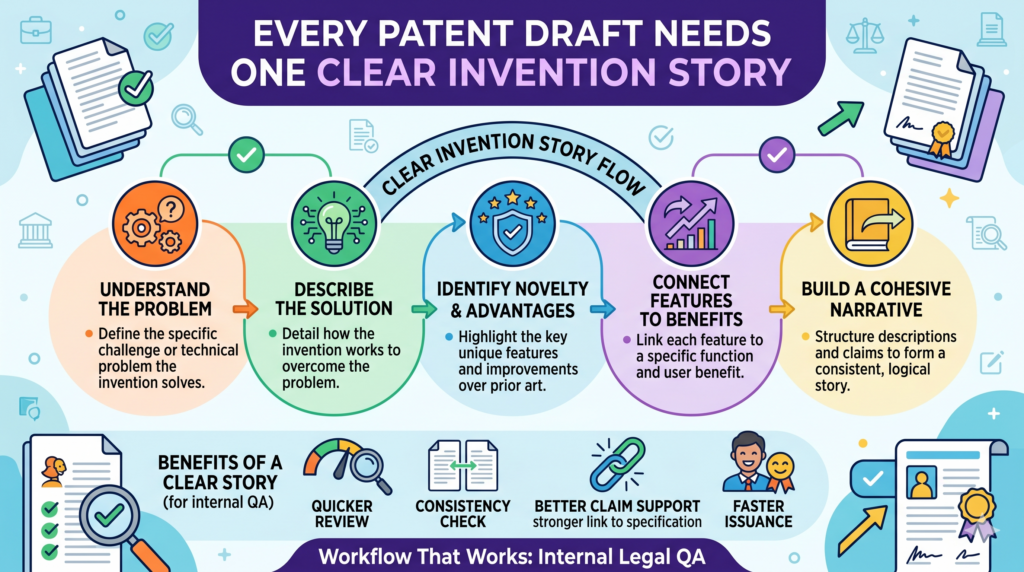
That story does not need drama. It needs order. It should show the problem, the old way, the gap, the new idea, and the reason the new idea matters.
This matters because a messy story makes the draft weaker. When the invention story is not clear, the claims may point in the wrong direction. The drawings may show the wrong focus.
The examples may spend too much time on side details. The final draft may protect what is easy to describe instead of what is most valuable.
Internal legal QA should force the team to slow down and ask one direct question: what is the invention really about?
That question sounds simple. In a startup, it is often hard. A product may have many features. A model may have many steps.
A system may include data flows, user actions, backend logic, training methods, ranking rules, hardware changes, or new ways to connect tools. Not every clever part deserves the same attention.
The draft must know what it is protecting.
Your QA team should test the draft against the business value
A strong patent draft should match the business value of the invention. If the company wins because of a better model pipeline, the draft should not spend most of its time on a user screen.
If the company wins because of a new sensor setup, the draft should not focus only on a generic app. If the company wins because of a control method, the draft should explain that method in plain detail.
This is where founders and engineers play a key role. Patent counsel can help shape the legal scope, but the team must explain where the value lives. The QA workflow should make room for that input.
A good review meeting should ask what a rival would copy first. It should ask what part took the most work to build.
It should ask what part customers care about. It should ask what part would hurt the business if another company used it.
Those answers help the patent draft aim at the right target.
The invention story should be simple enough to repeat
One strong test is this: can the founder explain the invention story in a few plain sentences after reading the draft?
If not, the draft may be too scattered.
This does not mean the draft should be short or shallow. It means the core idea should be easy to find. A reader should not have to dig through pages of vague text to understand what the invention improves.
The draft can still include deep technical detail, many examples, and careful claim support. But the main story should stay visible.
A clear invention story also helps the attorney improve the claims. Claims need support from the rest of the draft.
If the story is weak, the claims may either become too narrow or stretch beyond what the draft explains. Both are bad for startups. A narrow patent may be easy to avoid. An unsupported patent may create problems later.
When internal QA checks the invention story, it helps the whole document work as one piece.
PowerPatent is built for teams that want this kind of clarity without slowing down. It helps founders and technical teams organize invention details so attorney review can focus on strength, not guesswork.
You can explore the process here: https://powerpatent.com/how-it-works
The Claims Should Be Checked Before Everyone Falls in Love With Them
Claims are the part of the patent that define the protected space. They are also the part most teams find hardest to review.
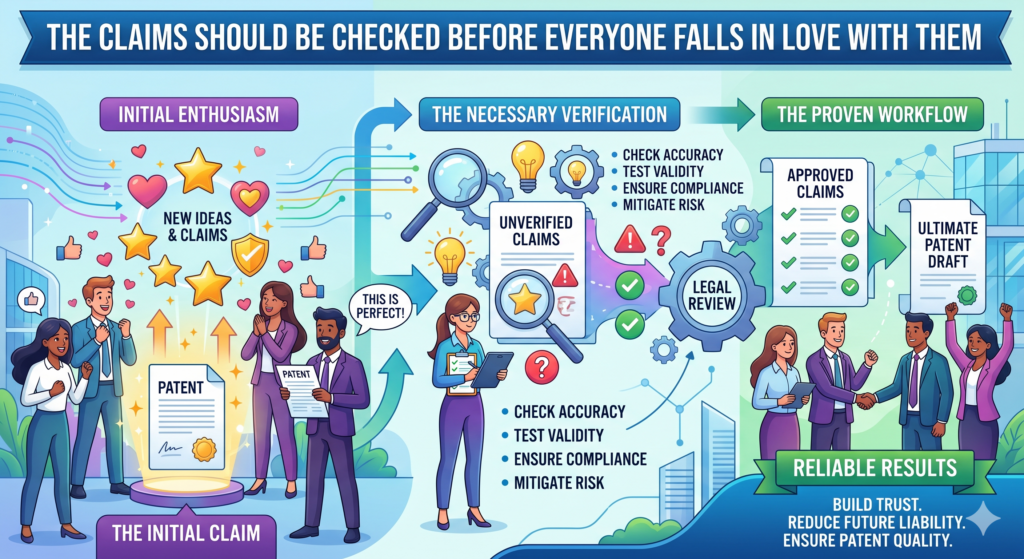
That is normal. Claims sound strange. They use a style that most engineers and founders do not use in daily work.
But internal QA cannot skip them.
The mistake is thinking only a lawyer can look at claims. A patent attorney should lead the legal work, of course.
But founders and engineers still need to check whether the claims point at the real invention. They do not need to rewrite legal language. They need to confirm that the claims are aimed at the right thing.
This is a practical review, not a law school exam.
A founder can ask whether the claim covers the product’s core value. An engineer can ask whether the technical steps are accurate.
A product lead can ask whether the claim is stuck on one current version when the roadmap already shows other forms. These checks are simple, but they can save the draft from becoming weak.
A claim QA pass should focus on scope, accuracy, and support
The first claim question is about scope. Is the claim broad enough to cover the real idea, not just one demo? A draft that only protects the exact first build may leave too much room for rivals.
If a competitor can change a small setting, swap a component, or move one step to another system and avoid the claim, the team should notice that early.
The second question is about accuracy. Does the claim describe what the system actually does? Sometimes a draft uses words that sound right but do not match the engineering work.
This can happen when the invention was explained too quickly, or when the draft uses broad terms without enough care.
The third question is about support. Does the rest of the draft explain what the claim says? A claim should not float alone. The written details, examples, and drawings should back it up.
If a claim says the system ranks, trains, filters, predicts, maps, routes, secures, compresses, or controls something, the draft should explain enough about how that happens.
The best claim review starts with plain English
Before the team debates exact claim wording, someone should restate each main claim in plain English. This is one of the fastest ways to find problems.
For example, the reviewer may say, “This claim seems to protect a system that takes sensor data, cleans it, compares it to a learned pattern, and changes a machine setting before a failure happens.”
Then the engineering team can respond. They may say yes, that is right. They may say the learned pattern is not the key part. They may say the timing logic is the real breakthrough. They may say the system does more than prevent failure.
That discussion is gold.
It turns claim review from a painful word game into a business and technical check. It helps the attorney see what matters.
It helps the founder see whether the patent is aligned with the company’s moat. It helps the engineer catch mistakes before filing.
Internal QA should not try to replace attorney judgment. It should give the attorney better facts, clearer feedback, and fewer hidden risks. That is how strong patent work gets done faster.
With PowerPatent, teams can bring invention notes, technical details, and attorney review into one smoother process. That means fewer blind spots and less wasted time. Start here: https://powerpatent.com/how-it-works
The Draft Must Show More Than One Way to Build the Idea
A patent draft that only describes one version of the invention may be too easy to design around.

This is a common problem for startups because the team is often focused on the product they are shipping now. That focus is good for building. But patent drafting needs a wider view.
The draft should cover the current version, but it should also show other ways the same idea can work.
This does not mean adding random guesses. It means thinking through real options that a skilled team would understand.
Could the method run in the cloud, on a device, or across both? Could the model use different input data? Could the system work with other sensors, user types, workflows, or hardware setups?
Could the steps happen in a different order? Could another company copy the benefit using a slightly different structure?
These are QA questions that matter.
Variation checks help stop narrow patents before they happen
A narrow patent draft can feel safe because it is specific. But if it is too specific in the wrong places, it may protect only one version of the product. That is not enough for a startup trying to build long-term value.
Internal QA should look for words that box the invention in for no good reason. Sometimes the draft names a specific tool when the invention does not depend on that tool.
Sometimes it names one data type when many data types could work. Sometimes it limits a process to one device, one setting, one user action, or one interface even though the core idea is broader.
These limits can be useful when they are planned. They are dangerous when they are accidental.
The reviewer should ask whether each detail is required or just one example. If it is required, the draft should make that clear.
If it is only an example, the draft should say or show that other options can work too.
A strong draft gives the attorney room to protect the real moat
The best drafts give patent counsel enough material to build smart claim layers. The broad ideas can be supported.
The useful fallbacks can be supported. The current product can be supported. Future versions can be supported when they are tied to the same invention.
This is not about making the draft bloated. It is about making it flexible.
For a deep tech startup, that flexibility can be very important. Your first product may not be your biggest product. Your first model may not be your best model.
Your first device may not be the one customers use at scale. If the patent draft only protects the first version, the company may outgrow its own filing.
That is a painful outcome. It is also avoidable.
A good internal QA workflow should include a variation pass before filing. This pass asks the team to name realistic changes that still use the same invention.
Those changes should then be checked against the draft. If the draft does not support them, the team can add detail before it is too late.
This is the kind of patent process modern founders need. It should be clear, fast, and guided by people who understand both invention and business value.
PowerPatent combines smart software with real attorney oversight so teams can move with more confidence. See how it works here: https://powerpatent.com/how-it-works
The QA Workflow Should Make Engineers Part of the Review Without Slowing Them Down
A patent draft often starts with the people who built the invention. That usually means engineers, product leads, data scientists, hardware builders, or technical founders.
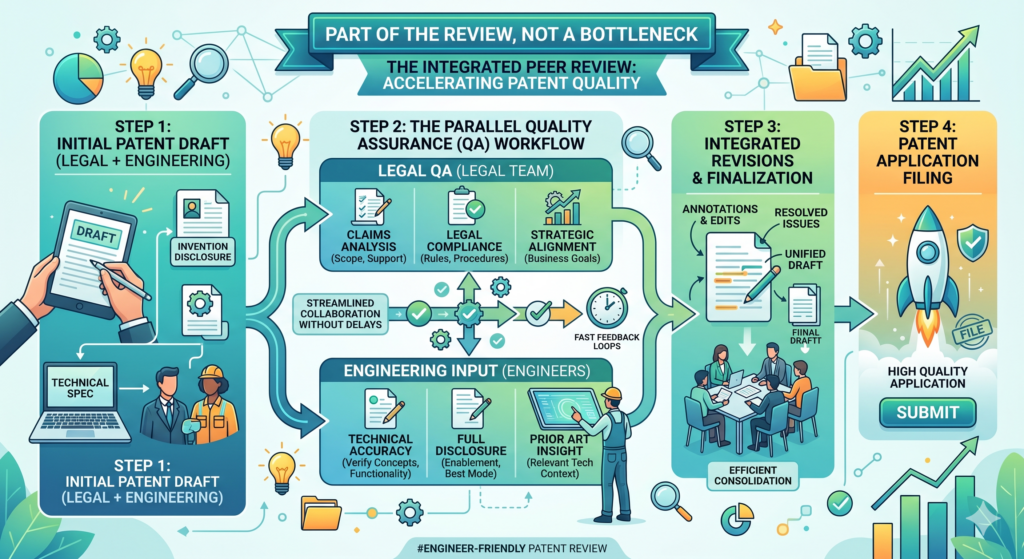
These people know the real work. They know what was hard. They know what changed after ten failed tries. They know which part looks simple now but took months to get right.
The problem is that most patent review workflows do not make it easy for them to help. The draft gets sent as a long document.
The comments are hard to place. The claims feel strange. The review becomes a chore. So the people with the best facts skim the draft, leave a few notes, and move on.
That is not enough.
Internal legal QA should make engineer review clear and light. Engineers should not be asked to act like lawyers.
They should be asked to check technical truth, missing steps, wrong terms, and places where the draft makes the invention sound narrower than it is.
The best engineer review asks for facts, not legal opinions
A strong QA process gives engineers a simple job. They should confirm what is accurate, flag what is wrong, and add what is missing.
They should not be forced to judge legal strength or rewrite claim language. That is the role of patent counsel.
This small change makes the review much better. It removes fear from the process. Engineers do not have to wonder if they are using the right legal words.
They only need to say, “This step happens before that step,” or “This part can run on the edge device,” or “This model can be replaced with another model and the system still works.”
Those notes are very valuable. They give the patent attorney raw material to improve the draft. They also help the founder see whether the patent is matching the actual product.
At PowerPatent, this is one of the big reasons software matters. When technical details are captured in a clean way, attorney review can move faster and with more confidence.
The goal is not to drown the team in process. The goal is to turn what the team already knows into stronger patent protection. You can see how PowerPatent helps here: https://powerpatent.com/how-it-works
The engineer pass should check what the draft says against what the system really does
The engineer pass should start with the invention flow. The reviewer should read the draft and ask whether the steps match the real system.
If the product collects data, cleans it, scores it, stores it, sends it, or uses it to control another part, the draft should show that flow in a way that makes sense.
This is where small errors can become big problems. A draft may say that the system trains a model when the live system only uses a trained model.
It may say that data is stored in one place when the architecture uses several locations. It may say that a user starts a process when the process actually starts on its own.
These details may seem small, but they affect the meaning of the draft. A rival may later argue that the patent only covers the wrong setup.
A reviewer may struggle to understand the invention. The company may lose time fixing problems that could have been caught earlier.
A good engineer QA pass prevents that. It turns the draft from a nice story into a true record of the invention.
The Draft Should Prove That the Team Knows the Problem Better Than Anyone Else
A strong patent draft does not just describe the invention. It also shows why the invention exists.
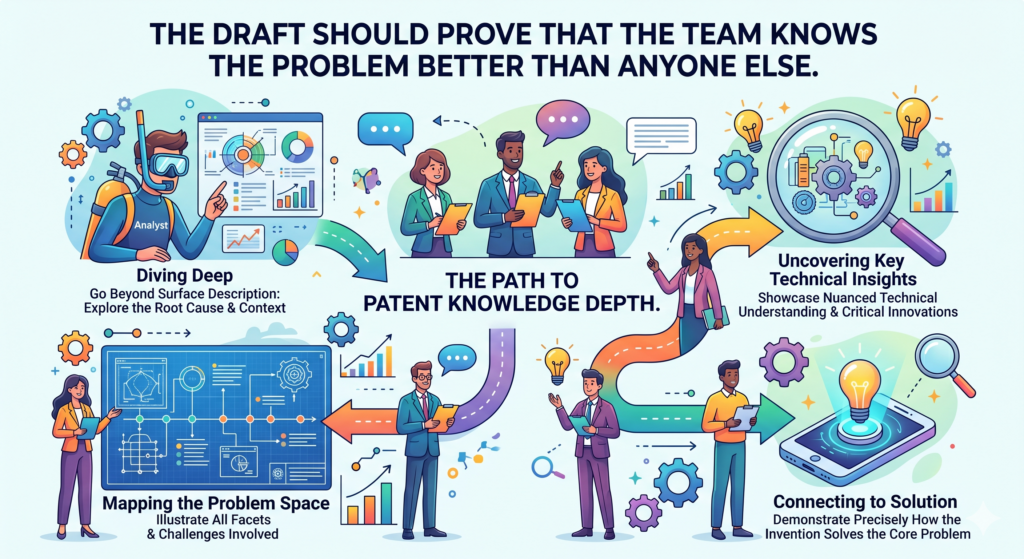
It should make the problem feel real. It should show what was broken, slow, costly, risky, or hard before the team solved it.
This matters because a weak problem section can make a strong invention look ordinary. If the draft says only that “there is a need for improvement,” it does not help much.
Every invention improves something. The draft should explain the pain in a direct and useful way.
For a startup, this part is often easy to improve because the team has lived the problem. They know what customers struggled with.
They know why older tools failed. They know what made the old process slow or costly. They know which workarounds were painful.
Internal legal QA should pull that knowledge into the draft.
The problem section should be specific without sounding like a sales page
A patent draft is not a pitch deck. It should not make huge claims or use hype. But it should still make the problem clear.
The reader should understand why the invention was needed and why the old way was not enough.
This can be done in plain words. The draft can explain that old systems used too much power, missed key signals, required manual review, had slow response times, wasted data, created false alerts, or failed when conditions changed.
The point is not to attack other products. The point is to show the technical gap the invention fills.
The QA reviewer should ask whether the draft explains the problem in a way that supports the invention.
If the problem is vague, the solution may feel vague too. If the problem is specific, the solution becomes easier to understand.
This is also where founders should be involved. A founder often knows the market pain better than anyone. They can explain why the invention matters to customers, why timing matters, and why the company chose this path.
The problem should connect directly to the solution
The problem section should not sit apart from the rest of the draft. It should point straight toward the invention. If the problem is slow detection, the solution should explain how the system detects faster.
If the problem is poor data quality, the solution should explain how the system improves the data. If the problem is wasted compute, the solution should explain how the system uses compute more wisely.
This connection is a major QA checkpoint.
When the problem and solution do not line up, the draft feels weak. It may describe one issue in the background and then claim a different idea later.
That can confuse the reader and weaken the story. A clear link helps the whole draft feel steady.
PowerPatent helps teams organize this kind of thinking before the draft becomes hard to change.
The platform guides inventors to explain the real problem, the real solution, and the technical details in a cleaner way, with real attorneys involved to shape the final result. Learn how it works here: https://powerpatent.com/how-it-works
The QA Review Should Look for Hidden Narrow Words That Shrink Protection
Some words can quietly make a patent draft smaller than it needs to be. These words may look harmless.
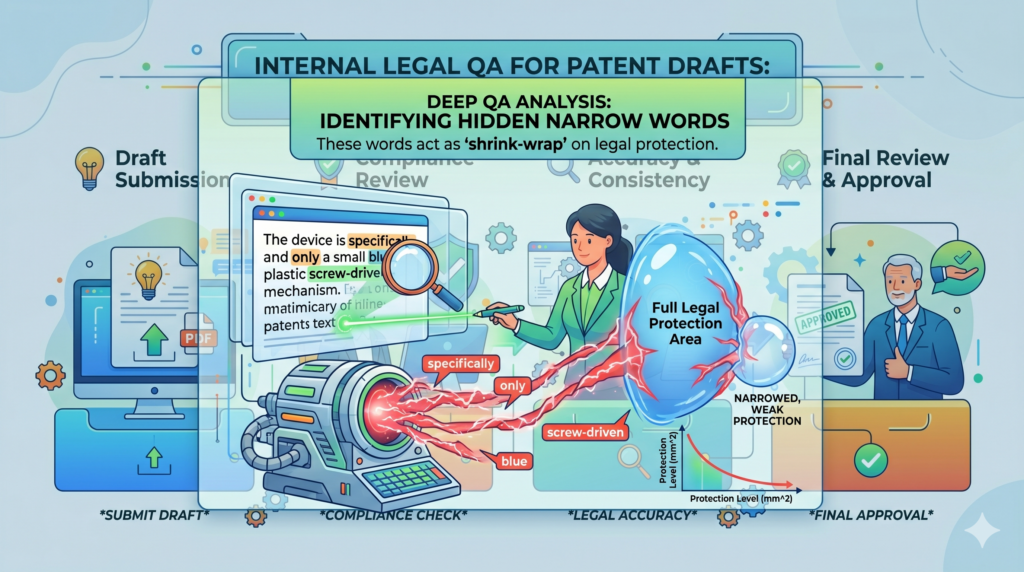
They may even sound clear. But if they lock the invention to one version, one tool, one setting, or one order of steps, they can create trouble later.
This is one of the most useful parts of internal legal QA. The team should read the draft and look for narrow words that were not meant to be narrow.
The goal is not to remove all detail. Detail is good. The goal is to make sure the detail is there for a reason.
A draft may say the system always uses a camera, even though other sensors can work. It may say the process happens on a mobile phone, even though it can happen on a server or machine controller.
It may say a human approves each step, even though some versions may be automatic. These choices should be checked.
Narrow words are safe only when they are planned
A narrow word is not always bad. Sometimes the invention really does require a certain part.
Sometimes the best claim path depends on a specific technical feature. Sometimes a narrow example gives useful support for a fallback position.
The problem is accidental narrowing.
This happens when the first product version controls the whole draft. The team describes what they built today, but the draft does not make room for what the invention could reasonably cover tomorrow.
That can leave the company with a patent draft that protects the first release but not the core idea behind it.
Internal QA should ask whether each narrow word is required. If the answer is yes, keep it and support it well.
If the answer is no, the draft should be adjusted so the current product is shown as one example, not the only version.
This is a simple review habit, but it can make a major difference.
The QA team should watch for words that sound absolute
Words like “must,” “always,” “only,” and “requires” should be handled with care. They may be right in some places. But when they are wrong, they can shrink the invention fast.
A better draft often uses language that shows examples without trapping the whole invention inside one example.
The attorney can decide the best wording, but the internal team can flag places where the draft sounds too fixed.
This does not mean the draft should become vague. A vague draft is not strong. The answer is not to remove useful detail. The answer is to separate required parts from optional parts.
For example, if a sensor is required, the draft should explain why. If the sensor is just one way to collect data, the draft should say that other data sources may be used.
If a machine learning model is central, the draft should show that. If the model type can change, the draft should make room for that.
This is how a draft becomes both clear and flexible.
The QA Process Should Check Whether the Drawings Carry the Same Story as the Words
Drawings are not decoration. They help explain the invention. In many patent drafts, the drawings are where the invention becomes easier to understand.
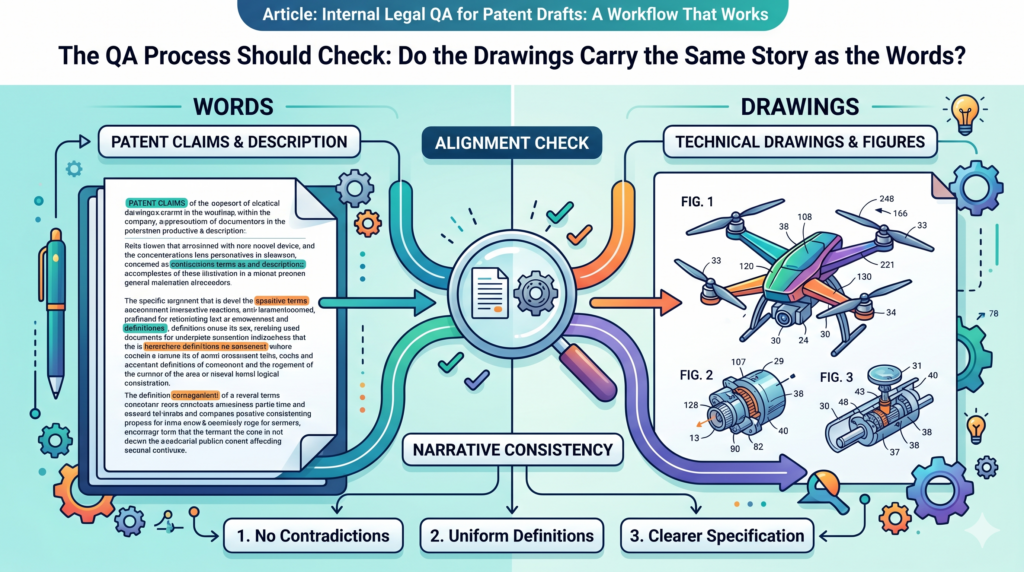
They show the system, the parts, the flow, and the steps in a way that plain text alone cannot always do.
But drawings can also create confusion if they do not match the written draft. A drawing may show a feature that the text never explains.
The text may describe a step that the flow chart skips. The claims may focus on one part, while the drawings make another part look central.
Internal legal QA should check that the drawings and words tell the same story.
A drawing review should start with the main invention flow
The first question is simple: can a reader understand the invention by looking at the drawings and then reading the draft?
If the answer is no, the drawings may need work. The goal is not to make them fancy. Patent drawings should be clear, not pretty.
They should help the reader follow the system from input to output, from problem to solution, or from one part to the next.
For software inventions, drawings may show data moving through modules, models, rules, engines, or devices.
For hardware inventions, drawings may show parts, connections, layers, positions, or operating states. For medical, robotics, climate, energy, or deep tech work, drawings may need to show both structure and action.
The QA reviewer should compare each drawing to the written details. Every important box, arrow, step, and label should make sense.
If the drawing shows something important, the draft should explain it. If the draft explains something important, the drawings should help support it when possible.
The drawings should not trap the invention in one product layout
Just like the written draft, drawings can become too narrow. A drawing may show one exact product setup. That is fine as an example, but the draft should make clear when the drawing is only one version.
This matters because startups change fast. A system that starts as one app may become an API.
A cloud workflow may move partly to edge devices. A hardware layout may change after testing. A user flow may shift when customers ask for a different setup.
The drawings should support the invention without making it look smaller than it is.
This is where attorney oversight is important. The internal team can flag whether drawings match the product and the roadmap.
Patent counsel can decide how to use those drawings in a way that supports strong claims. Together, the team can avoid both confusion and accidental limits.
PowerPatent gives founders a cleaner way to move from technical invention details to attorney-reviewed patent work.
That means drawings, claims, and written details can be checked as part of one connected workflow. See the process here: https://powerpatent.com/how-it-works
The Draft Should Include Enough Examples to Support Real Business Growth
Examples are where a patent draft becomes stronger and more useful. They show how the invention can work in real settings.
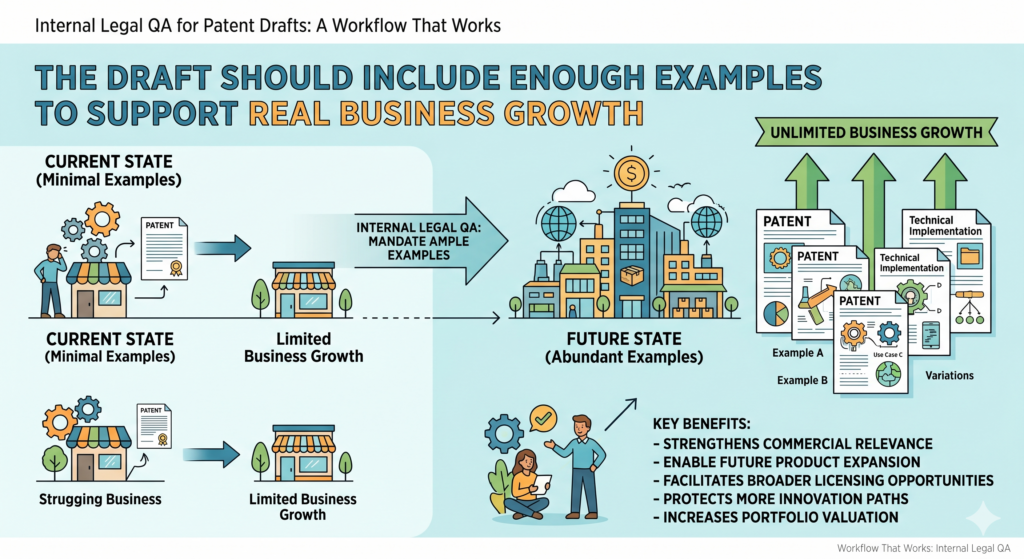
They help support different versions. They give the attorney more room to shape claims. They also help future readers understand that the invention is not limited to one narrow build.
Many startup drafts do not include enough examples. The team may assume the current product is obvious.
They may think extra examples are not needed. They may believe the draft is already long enough.
But length is not the point. Support is the point.
A good example can protect future value. It can show that the invention works with different inputs, users, machines, networks, models, materials, or control paths. It can help the draft cover where the company is going, not just where it is today.
Examples should be useful, not random
Internal QA should not ask the team to add examples just to make the draft longer. That creates clutter. Each example should serve a purpose.
A useful example shows a real way the invention may be used, changed, or built. It may cover a customer use case. It may cover a different device. It may cover a second data source.
It may cover a future product path that the team already expects. It may cover a fallback version in case the broadest claim is challenged later.
The review team should ask whether the examples reflect the real business path. If the company plans to sell into hospitals, factories, farms, labs, vehicles, energy systems, defense systems, or developer tools, the draft should support the relevant settings.
It does not need to name every possible market. But it should not be stuck in a tiny corner if the invention has wider use.
This is where patent QA becomes a business tool. It helps the company think about how its technical edge may grow.
The strongest examples come from the roadmap and the build history
A startup’s roadmap is a gold mine for patent examples. So is the build history. The roadmap shows where the invention may go next.
The build history shows other versions the team already tried, tested, changed, or rejected.
Internal QA should bring both into the review.
For example, the team may have started with one type of data but plans to support another. It may have built a manual version first and then moved to automation.
It may have tested several model types before choosing one. It may have designed a hardware part in three different shapes before finding the best one.
These details can help the draft. They show that the invention is not a thin idea. They show depth. They give the attorney more to work with. They also reduce the risk that the draft will miss important variations.
This is exactly why PowerPatent is built for technical teams that need speed without losing quality.
It helps capture invention details from the people who know them best, then brings in real attorney oversight so the final patent work is stronger and cleaner. Start here: https://powerpatent.com/how-it-works
The QA Workflow Should Check Whether the Draft Supports the Product Roadmap
A patent draft should not only protect what your team has already built. It should also support where the product is going next, as long as that future path is tied to the same invention.
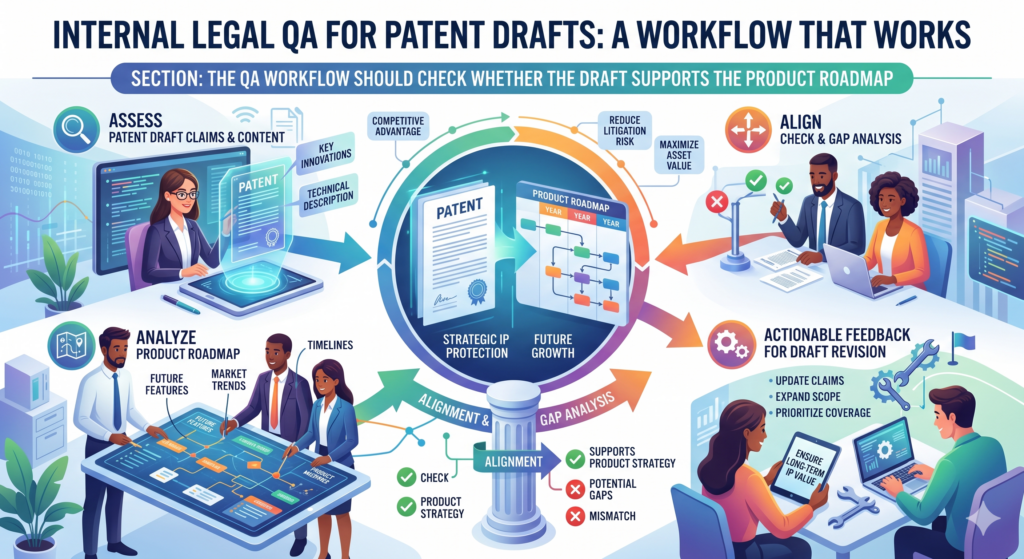
This is very important for startups because the first version of a product is rarely the final version.
A founder may file a patent draft based on the current build, then raise money, talk to customers, and shift the product within six months.
That shift may not change the core invention, but it may change how the invention is used. If the draft does not support those later forms, the company may end up with protection that feels outdated too soon.
Internal legal QA should connect the patent draft to the roadmap before filing. This does not mean the draft should claim ideas the team has not invented.
It means the team should make sure the draft covers real, expected versions of the same technical idea.
The roadmap review should focus on what is likely, not fantasy
A good roadmap review is grounded. It should not turn the patent draft into a wish list. It should ask what the team already knows may happen next.
Maybe the system will move from one customer type to another. Maybe the model will use more data sources. Maybe the product will shift from a dashboard to an API.
Maybe the first version runs in the cloud, but the next version runs partly on a device. Maybe the invention will support more sensors, more users, more workflows, or more machine types.
These are not random guesses. They are normal startup growth paths. If they are part of the same invention, the draft should support them where possible.
This is one reason PowerPatent is built around a better intake and review process.
When founders and engineers can capture product direction early, real patent attorneys can shape the draft with more care. You can see how that process works here: https://powerpatent.com/how-it-works
The roadmap should help the draft protect the company’s next move
The best patent drafts give the company room to grow. They do not freeze the invention inside the first launch. They help protect the core idea while still giving enough detail to show how it works.
During QA, the reviewer should ask whether the draft would still make sense if the product changed in a realistic way. If the answer is no, the team should find out why.
The problem may be narrow wording. It may be missing examples. It may be drawings that show only one product layout. It may be claims that focus on a side feature instead of the main value.
This review can save real money later. Filing a weak draft, then trying to patch the strategy with more filings after the product changes, can become costly and slow.
A better first draft does not solve every future need, but it gives the company a stronger base.
The QA Team Should Test the Draft Against a Smart Competitor
A patent draft should be reviewed as if a smart competitor is already looking for a way around it. This may sound harsh, but it is one of the most useful ways to review patent work.
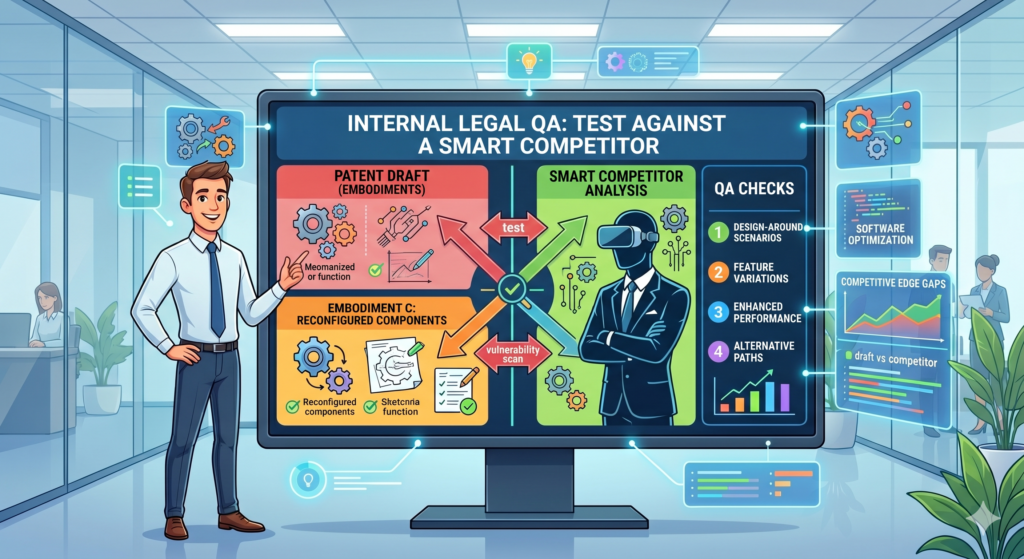
A competitor does not care how hard your team worked. They care where the edges are.
They ask what they can copy, change, remove, replace, or move without crossing the line. If your internal QA does not ask those questions first, someone else may ask them later.
This does not mean the team should become fearful. It means the team should be honest. A patent draft is stronger when it has been tested against real design-around paths before it is filed.
The competitor test should focus on easy changes a rival could make
A strong QA review asks how a rival might copy the value while changing the surface details. Could they use another model type? Could they move the processing to another device? Could they use a different data format?
Could they switch the order of steps? Could they replace a sensor, module, rule, or interface and still get the same benefit?
These questions help reveal whether the draft is protecting the invention or only the current product shape.
For example, a software startup may describe a workflow that uses a dashboard.
But if the real invention is the backend scoring method, a rival may offer the same scoring method through an API and avoid a draft that focuses too much on the dashboard.
A hardware startup may describe one part shape, while the real invention is how two parts interact. A rival may change the shape but keep the same interaction.
The QA team should catch these issues before filing.
The best competitor review creates better questions for the attorney
Internal QA should not try to solve every design-around issue alone. The point is to create better questions for patent counsel.
A founder might say, “I think a rival could copy the main value by replacing this step with a rule-based version.”
An engineer might say, “This module could be split across two systems and still work.” A product lead might say, “The customer would not care if the interface changed, as long as the output is the same.”
Those comments are highly useful. They help the attorney decide how to support broader claims, add examples, adjust language, or build fallback positions.
This is where PowerPatent’s mix of smart software and real attorney oversight becomes powerful.
The software helps gather the facts, and attorneys help turn those facts into stronger protection. See how PowerPatent helps teams move from invention to filing with more control here: https://powerpatent.com/how-it-works
The QA Review Should Confirm That the Draft Has Real Technical Depth
A patent draft should not sound like a product brochure. It should explain the invention with enough detail that a skilled reader can understand how it works.
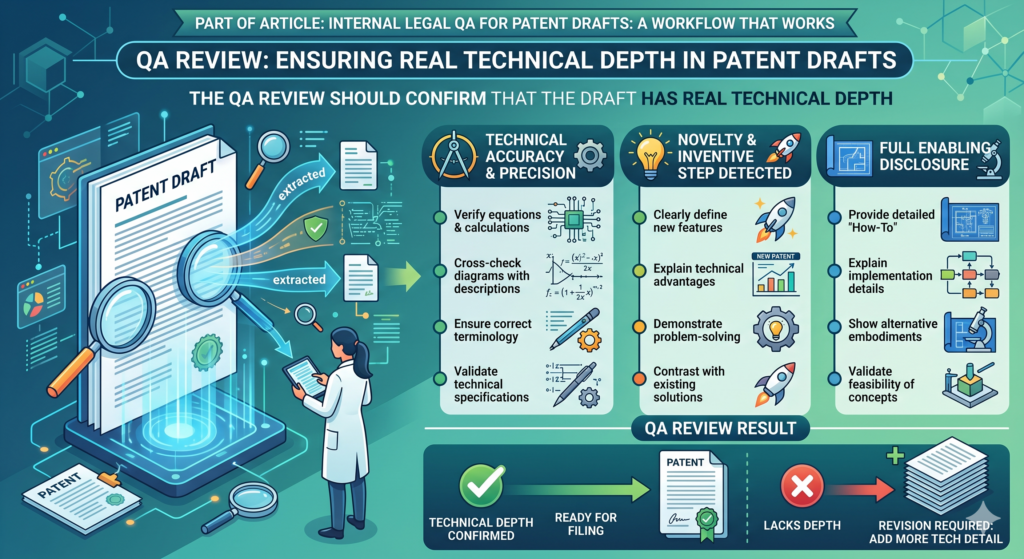
This is especially important for software, AI, robotics, hardware, biotech tools, energy systems, and other deep tech inventions.
Many weak drafts talk about what the invention does, but not how it does it. They say the system improves accuracy, saves time, reduces cost, or detects problems.
Those outcomes may be true, but they are not enough by themselves. The draft must show the technical path that creates the result.
Internal legal QA should look for places where the draft makes a big claim but gives thin support.
Technical depth should explain the steps, parts, and choices that matter
A useful patent draft explains the system in a way that feels real. It does not need to include every line of code or every tiny setting.
But it should show the important steps, the key parts, and the choices that make the invention work.
If the invention uses data, the draft should explain where the data comes from, how it is handled, and how it is used. If the invention uses a model, the draft should explain the role of the model and what changes because of it.
If the invention controls a machine, the draft should explain the signals, decisions, and actions. If the invention changes a physical structure, the draft should explain the structure and why it matters.
The QA reviewer should watch for vague words that hide the hard part. Words like “optimize,” “analyze,” “process,” “determine,” and “generate” can be useful, but only if the draft explains what they mean in context.
The draft should show the hard part without drowning the reader
Technical depth does not mean the draft should become unreadable. A strong patent draft can be detailed and still clear. The goal is to explain the hard part in simple, direct language.
The review team should ask whether the draft explains what the team actually invented, not just the result they wanted. If the team built a special way to clean noisy data, that should be shown.
If the team found a faster way to compare signals, that should be shown. If the team created a new arrangement of parts that lowers heat, saves power, or improves control, that should be shown.
This kind of detail helps the attorney write better claims. It also helps reduce the risk that the draft feels too broad, too thin, or too generic.
PowerPatent helps technical teams capture this depth without making the process painful.
Founders and engineers can share the real invention details, and attorney review helps turn them into a strong patent draft. Learn more here: https://powerpatent.com/how-it-works
The QA Workflow Should Catch Terms That Are Used in Mixed Ways
Words matter in a patent draft. A term that means one thing in one section should not mean something different in another section.
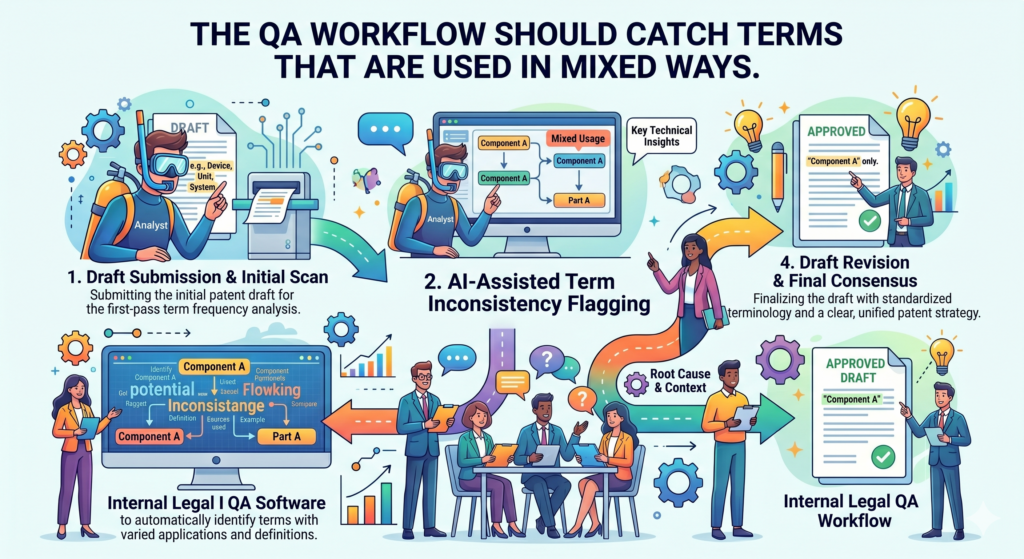
When terms drift, the draft can become confusing. In some cases, that confusion can weaken the protection.
This is common in fast drafts. The team may use “engine,” “module,” “model,” “processor,” “platform,” “controller,” “database,” or “profile” in different ways across the document.
One section may call something a “ranking engine,” while another calls the same thing a “selection module.” Sometimes that is fine. Often it creates doubt.
Internal legal QA should include a plain term check. The goal is to make sure important words are used with care.
Consistent terms make the invention easier to understand
A clear draft does not force the reader to guess whether two words mean the same thing.
If a system has a data cleaner, scoring model, control module, and alert engine, the draft should use those terms in a steady way. If the same part has more than one name, the draft should explain that clearly.
This is not just a writing issue. It affects claim support. If the claims use one term and the description uses another, the attorney may need to clean up the link.
If a drawing label does not match the text, the reader may wonder whether something is missing. If the examples use different names without explanation, the invention story can feel loose.
The QA reviewer should mark terms that feel unclear or mixed. This is simple work, but it has real value.
A shared glossary can prevent many draft problems
For complex inventions, the team should keep a short internal glossary during QA. This does not need to be formal or long. It can simply state what key terms mean inside the draft.
For example, the team may decide that “prediction engine” refers to a set of software steps that use sensor data to predict a machine state.
Or it may decide that “control signal” means any output used to change a device setting. Once the team agrees, the draft can stay steady.
This helps engineers review faster because they know what the words mean. It helps founders confirm the story. It helps attorneys shape the draft with less back-and-forth.
A patent draft should not be hard to follow because the team used five names for the same part. Internal QA can fix that before it becomes a bigger problem.
The QA Review Should Check Whether the Draft Is Ready for Attorney Judgment
Internal legal QA is not a replacement for a patent attorney. It is the work that helps attorney review become sharper, faster, and more useful. This distinction matters.
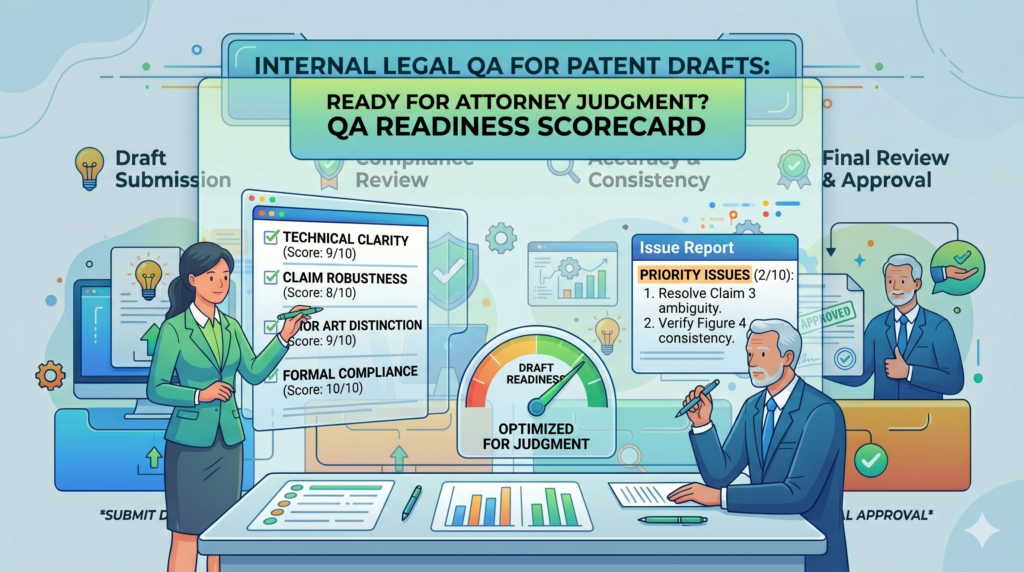
A startup should not expect founders or engineers to make legal calls alone. They should not be asked to decide final claim scope, filing strategy, or legal risk without counsel.
But they should prepare the draft so the attorney has the best facts, the clearest invention story, and the fewest hidden gaps.
That is the real purpose of internal QA.
A clean internal review makes attorney time more valuable
Attorney time should be spent on judgment, not chasing basic facts.
If the draft has unclear terms, missing examples, wrong technical steps, weak drawings, and a vague invention story, the attorney has to spend time untangling the basics. That slows everything down.
When internal QA is done well, the attorney can focus on higher-value work. They can test claim scope.
They can spot legal risk. They can improve support. They can shape the filing strategy. They can decide where broad language helps and where detail is needed.
This is better for the company. It creates a cleaner process, stronger work, and fewer painful surprises.
PowerPatent was built for this modern way of working. It helps startups combine the speed of smart software with the care of real patent attorneys, so teams can protect what they are building without getting buried in old-school process.
You can explore the workflow here: https://powerpatent.com/how-it-works
The final QA handoff should make the attorney’s job clear
Before attorney review, the internal team should hand off the draft with clear notes.
The notes should explain what the team thinks the core invention is, what parts are most valuable, what variations matter, what roadmap items should be supported, and what technical points need extra care.
This handoff does not need to be long. It needs to be useful. It should help the attorney see where to focus.
The founder should make sure the draft matches the business moat. The engineer should confirm the technical truth.
The product lead should confirm the likely future forms. The attorney should then use that input to improve the draft and guide the filing path.
This is how legal QA becomes a real workflow, not a last-minute scramble. It gives everyone a role. It keeps the process moving. It helps the company file with more confidence.
Your QA Workflow Should Catch Missing Data Flow Details Before Filing
A patent draft for software, AI, robotics, automation, or connected hardware often depends on data flow.
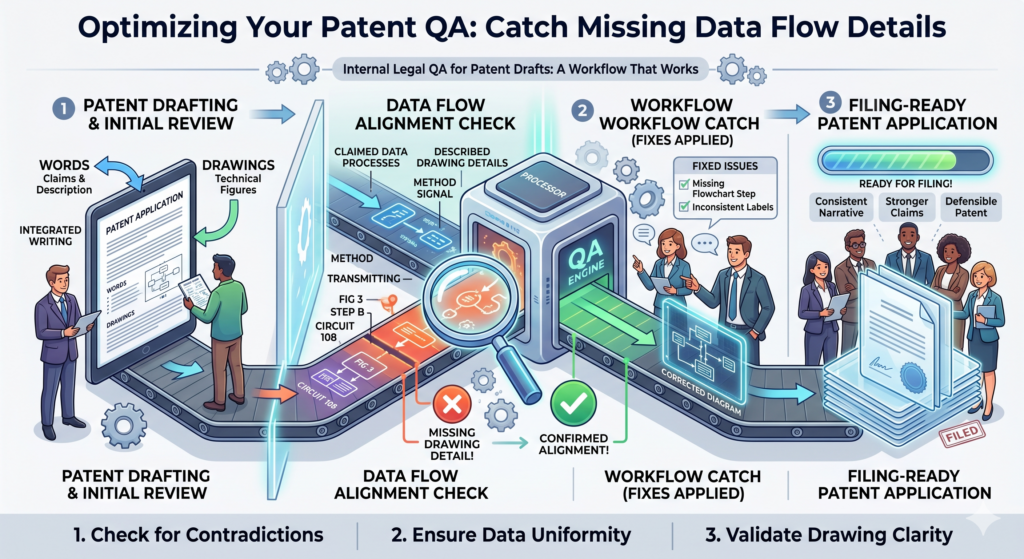
The invention may collect data, clean data, enrich data, compare data, score data, send data, store data, or use data to control something else. If the draft does not explain that flow clearly, the whole invention can feel weak.
This is one of the most common gaps in early drafts. The team knows how the system works, so they assume the flow is clear. But a reader does not have that inside knowledge.
They only have the draft. If the draft skips key data steps, the reader may not understand what makes the invention different.
Internal legal QA should treat data flow as a major checkpoint.
The reviewer should ask where the data starts, what happens to it, where it goes, and what changes because of it. This does not need to be complex. It needs to be clear.
A strong data flow review turns hidden engineering work into patent value
Many inventions look simple on the surface because the hard work happens in the background. A user may click one button.
A machine may adjust one setting. A model may return one score. But behind that simple action, the system may be doing a lot of smart work.
The patent draft should show that work where it matters. If the invention depends on how data is filtered, grouped, mapped, weighted, timed, or compared, the draft should say so.
If the system makes a better decision because of a special data path, that path should be explained.
This is not just technical cleanup. It can change the value of the patent. A draft that only says “the system analyzes data” may sound generic. A draft that explains the actual data path can show a real invention.
PowerPatent helps teams capture this kind of detail in a cleaner way, so attorney review starts with better invention facts and fewer blind spots.
You can see how the process works here: https://powerpatent.com/how-it-works
The data flow should match the claims, drawings, and examples
Data flow should not live in only one part of the draft. It should line up across the whole document. If the claims say the system receives sensor data and generates a control signal, the written details should explain those steps.
If the drawings show a data pipeline, the text should explain the key parts of that pipeline. If the examples mention a score, alert, or output, the draft should show how the system reaches it.
This is where QA often finds quiet gaps. The drawing may show a cleaning step, but the claims may skip it.
The text may explain a model output, but the drawing may not show where that output goes. The claims may use a term like “processed data,” but the draft may never explain what processing means.
These are fixable issues. They are much easier to fix before filing than after filing.
A useful QA habit is to trace one full data journey through the draft. Start with the first input. Follow it through the system.
Check what changes. Check what decision is made. Check what output is created. Then ask whether the draft makes that journey easy to follow.
Your QA Process Should Separate Product Features From Patentable Invention Points
A startup product can have many features. Not every feature is the invention. Some features are user-facing polish.
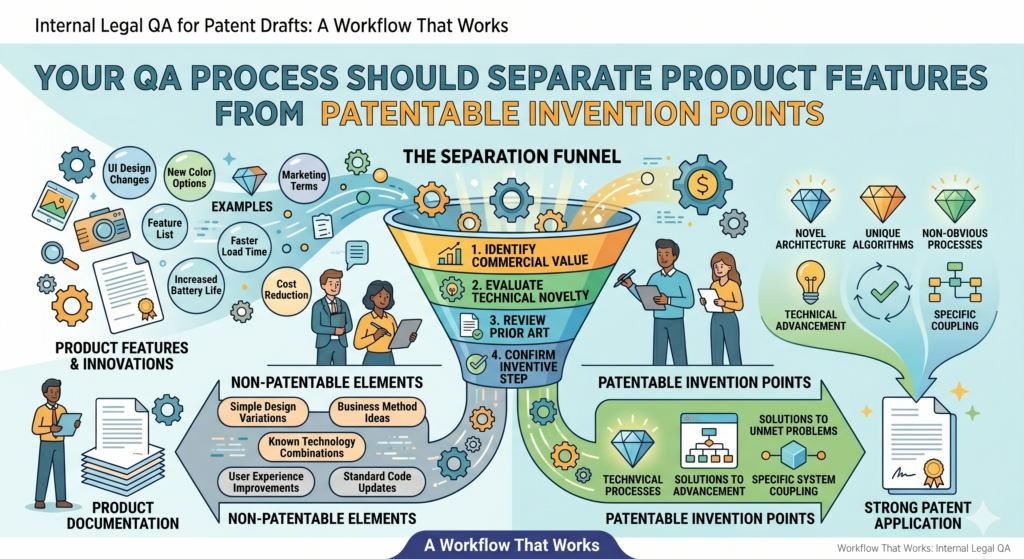
Some are standard tools. Some are normal product choices. Others are the hard technical ideas that may deserve patent focus.
Internal legal QA should help the team separate these things. This is not about judging legal patentability without an attorney.
It is about making sure the draft is not spending too much space on ordinary features while skipping the deeper invention.
This matters because patent drafts can get pulled toward what is easiest to see. A dashboard, screen, button, report, or user workflow may be simple to describe.
But the real value may live under the surface, inside a ranking method, control process, hardware layout, data pipeline, model training path, or security step.
The draft should not mistake the visible product for the full invention.
The review should ask what makes the product hard to copy
A good internal QA review asks what part would be hardest for another team to rebuild. That answer often points toward the invention.
It may not be the whole product. It may be one method, one system design, one control rule, one physical structure, or one way of using data.
The founder should also ask what part creates the business edge. If customers buy the product because it gives faster results, fewer false alarms, better control, lower compute cost, safer operation, or easier setup, the patent draft should explain the technical reason behind that benefit.
The product feature may be the customer-facing result. The invention point is often the way the team creates that result.
This is where PowerPatent can help. The platform guides technical teams to explain the real invention behind the product, then real patent attorneys help shape that into stronger patent work.
Explore the workflow here: https://powerpatent.com/how-it-works
The draft should not protect only the wrapper around the invention
A weak draft may focus on the wrapper. It may describe the user interface, the app flow, the report format, or the customer journey in great detail while giving very little attention to the technical engine underneath.
That can be risky. A competitor may copy the core value while using a different wrapper. They may skip the dashboard and use an API. They may replace the app with a device interface.
They may use a different report format. If the draft focused too much on the wrapper, the patent may not reach the most important copycat path.
This does not mean user-facing features never matter. Sometimes they do. The point is that QA should force the team to check whether the draft is focused on the right layer.
A better draft explains the invention at the layer where the value lives. It may still include screens, workflows, and user actions as examples. But it should not let those examples hide the deeper technical idea.
Your QA Workflow Should Review Claim Support Like a Safety Net
Claim support is the material in the draft that backs up what the claims say. It is the safety net under the claim set. If the claims reach for something the draft does not explain, the team may face problems later.
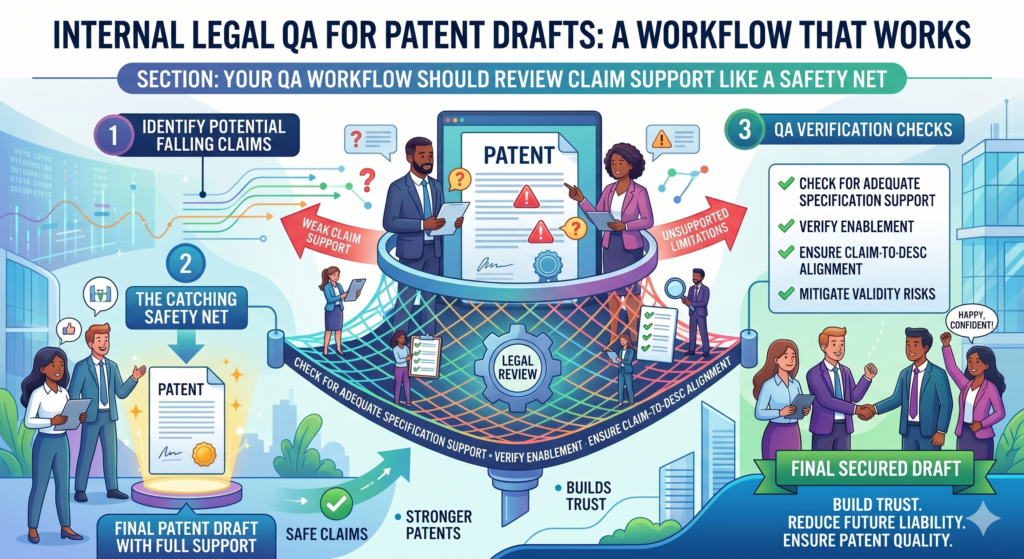
If the draft supports only a narrow version, the attorney may have less room to adjust claims during review.
Internal legal QA should look for this before filing. The team does not need to make final legal calls. But it can check whether the draft gives enough detail for the claim ideas the company cares about.
This is especially useful when the company wants broad protection. Broad claims need careful support.
The draft should explain the core idea in more than one way, show useful examples, and make clear which parts are required and which parts are optional.
The support review should connect each important claim idea back to the draft
A good QA pass asks whether each key claim idea appears in the written details. If the claim talks about a data filter, the draft should explain the filter.
If the claim talks about a control signal, the draft should explain how that signal is created or used. If the claim talks about a model, the draft should explain the model’s role in the system.
The reviewer should also check whether the draft supports broader wording. If the claim uses a broad term like “sensor,” but the draft only talks about one camera in one example, the attorney may need more support.
If the claim talks about “computing device,” but the draft only describes a phone, the team may need to explain other devices that can perform the same role.
This does not mean the draft should become vague. It means the draft should support both the main product and realistic variations.
Strong support gives the attorney more room to respond later
Patent review does not end when the draft is filed. During the patent office process, claims may need to change. The attorney may need to narrow, adjust, or clarify the claims.
A well-supported draft gives the attorney more room to do that without losing the heart of the invention.
This is why claim support matters so much. It is not only about the first version of the claims. It is about giving the company options later.
A thin draft can trap the team. If the examiner pushes back and the draft has little detail, the attorney may have fewer paths.
A rich draft gives more room to work. It can support backup positions, alternate versions, and clearer claim language.
PowerPatent helps teams build this stronger base from the start by combining guided invention capture with attorney review.
That makes it easier to file with confidence instead of hoping the draft has enough depth. You can learn more here: https://powerpatent.com/how-it-works
Your Internal Review Should Check for Overpromising and Loose Claims
A patent draft should be strong, but it should not overpromise.
It should not say the invention always works, solves every case, guarantees perfect results, or beats every old method unless the team can support that with care. Loose claims and broad promises can create trouble.
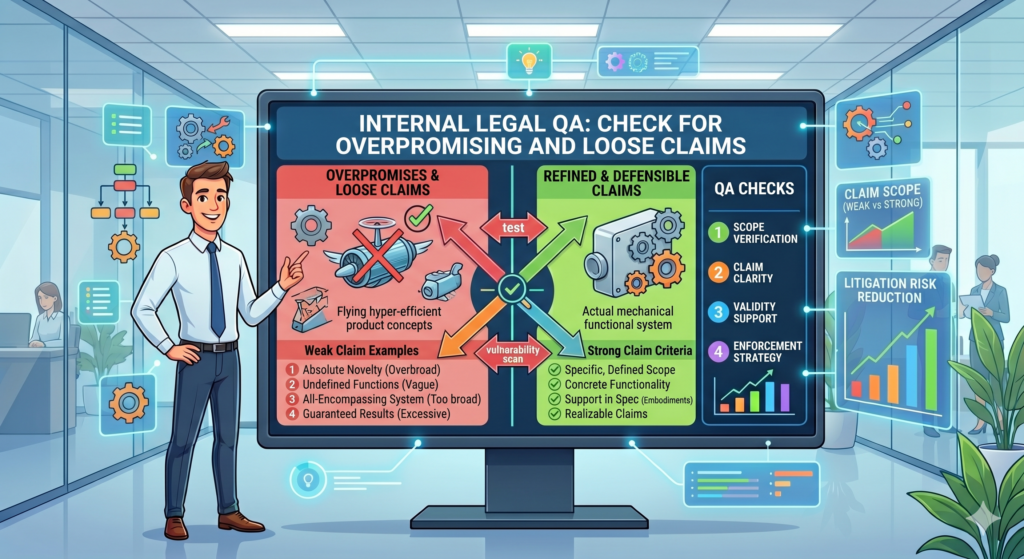
Startups are used to pitching. Patent drafts are different. They should be confident, but not hype-driven.
They should explain real benefits in a measured way. They should show what the invention can do without turning the draft into a sales page.
Internal legal QA should look for language that sounds bigger than the invention. This is not about making the draft timid. It is about making it durable.
A careful draft explains benefits without sounding careless
The draft can say the invention may improve speed, reduce waste, lower error rates, improve control, save power, or reduce manual work when that is true and tied to the technical design.
But it should avoid claims that sound absolute when the results depend on conditions.
For example, “reduces latency in certain settings” may be safer and more useful than saying the system “eliminates delay.” “Improves detection of selected events” may be better than saying it “detects all failures.”
The right wording depends on the invention and the legal strategy, so the attorney should guide the final language.
The internal team’s job is to flag places where the draft sounds like it is promising too much. Engineers are especially good at this because they know the limits of the system.
They know when performance depends on data quality, hardware setup, training inputs, network conditions, user behavior, or operating range.
Honest limits can make the draft stronger
It may feel strange, but clear limits can improve a patent draft. When the draft explains where and how the invention works, it can become more credible.
It can show the real technical setting instead of making broad claims that feel unsupported.
This does not mean the draft should reveal business secrets that do not belong in the filing. It also does not mean the company should shrink the invention for no reason.
It means the draft should be grounded in what the team actually built and understood.
A good QA workflow balances ambition and accuracy. The founder makes sure the draft protects the business goal.
The engineer makes sure the draft tells the technical truth. The attorney makes sure the language supports the legal strategy.
That balance is hard to get with a rushed process. PowerPatent helps teams bring the right details together earlier, with attorney oversight built in, so patent work can move quickly without becoming careless.
See how it works here: https://powerpatent.com/how-it-works
Your QA Workflow Should Create a Clear Red Flag System Before Final Review
A good internal legal QA process needs a way to handle red flags.
Without that, comments get scattered, important issues get buried, and the team may spend too much time on small edits while missing big risks.
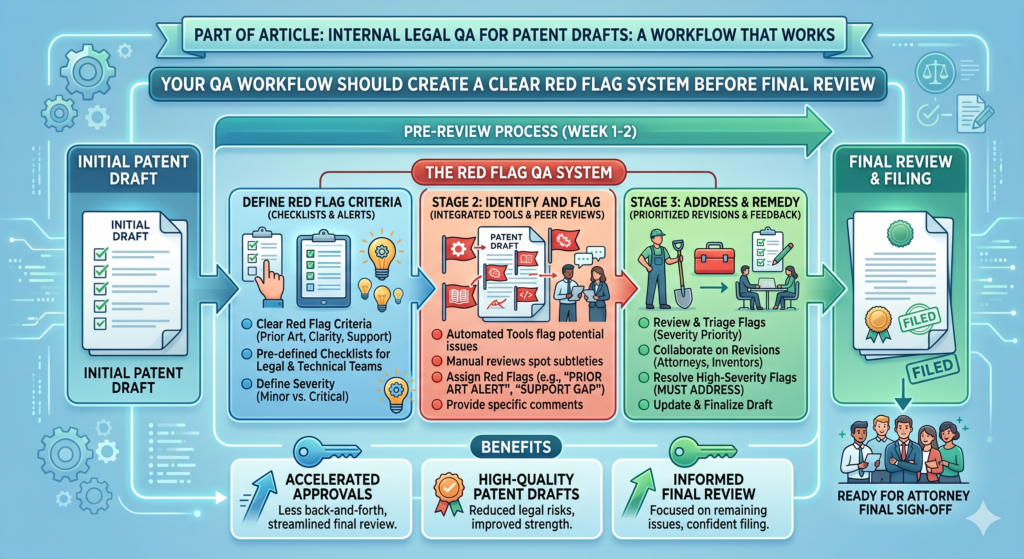
Red flags are not just typos. A typo can be fixed late. A real red flag is something that may affect the strength, accuracy, or scope of the patent draft.
It may be a missing technical step, a wrong claim focus, a narrow word, a mismatch between drawings and text, a weak example, or a roadmap gap.
The team should know how to spot these issues and raise them clearly.
Red flags should be sorted by impact, not by who noticed them first
In many teams, the loudest comment gets the most attention. That is not a good QA system. A better process sorts issues by impact.
A missing core invention detail should matter more than a style comment. A claim that focuses on the wrong feature should matter more than a sentence that sounds awkward.
A drawing mismatch should matter more than a small formatting issue. A roadmap gap should matter more than a preferred word choice.
This does not mean small edits do not matter. They do. But they should not distract from the issues that can change the value of the filing.
The QA lead should make sure the most important red flags get reviewed by the right person. Technical red flags should go to engineers.
Business value red flags should go to founders or product leads. Legal red flags should go to patent counsel.
A red flag note should explain the problem and the reason it matters
A useful red flag is not just a complaint. It should explain what seems wrong and why it matters.
For example, instead of saying, “This section is confusing,” a better note would say, “This section says the model trains in real time, but our system uses a pre-trained model during operation, so the draft may describe the wrong workflow.” That note gives the attorney and team something clear to fix.
Instead of saying, “Too narrow,” a better note would say, “This paragraph makes the camera sound required, but the same method can use radar or vibration data, so this may limit future versions.” That note connects the issue to protection.
This kind of clear feedback makes the whole workflow faster. It also makes attorney review more effective.
PowerPatent is built to help teams avoid messy, last-minute patent review. With smart software and real attorney oversight, founders can move from invention details to stronger filings with more order and less stress. Start here: https://powerpatent.com/how-it-works
Your QA Workflow Should Check Whether Every Drawing Label Is Explained
A patent drawing can look clean and still cause confusion. The issue is often not the drawing itself. The issue is the labels.
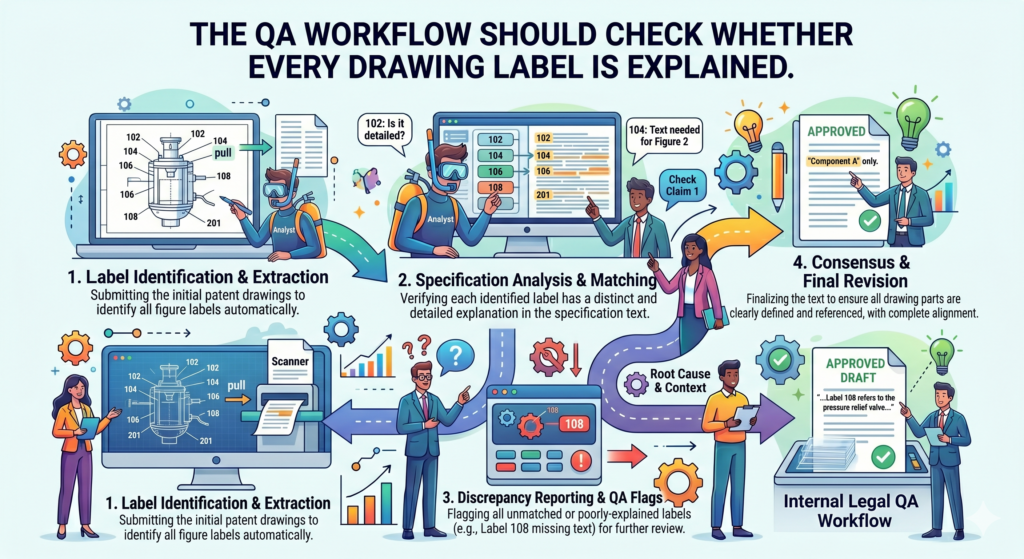
A box, arrow, part number, module name, or step marker may appear in the drawing, but the draft may never explain what it means. That creates a gap.
This is easy to miss because the team already knows the system. The engineer sees a label and fills in the blanks from memory.
The founder sees the same label and assumes it is clear. But the patent draft must stand on its own. A future reader should not need a team member in the room to explain it.
Internal legal QA should include a simple drawing label review. The reviewer should look at each figure and ask whether every important label is described in the text with enough detail.
The drawing labels should make the invention easier to follow
A drawing label should act like a guide. It should help the reader move through the invention without getting lost.
If the drawing shows a data source, processing module, model, control unit, sensor, user device, or output, the written draft should explain what that item does and how it fits into the invention.
This is not about adding long text for every small part. The goal is to explain the parts that matter. If a label is tied to the invention, it needs support.
If it is just a standard part, it may need only a short mention. The attorney can decide the final level of detail, but internal QA should flag anything that feels unclear.
A strong draft uses drawings and text together. The drawing gives the shape. The text gives the meaning. When those two pieces match, the reader can understand the invention faster.
A missing label explanation can signal a deeper draft gap
When a drawing label is not explained, it may point to a bigger issue. Maybe the draft skipped a key step. Maybe the claims focus on a part that the description barely supports.
Maybe the team added a drawing late but did not update the text. Maybe the invention story changed during drafting, but the figures did not change with it.
These issues are common in fast startup patent work. They are also fixable when caught early.
The QA reviewer should not ignore small mismatches. A drawing label that seems minor may be connected to a claim term or an example. If that link is weak, the attorney may need to strengthen it before filing.
PowerPatent helps teams keep these pieces connected by turning invention details into a more organized draft process, backed by real patent attorney oversight.
That means fewer loose ends and a cleaner path from idea to filing. See how it works here: https://powerpatent.com/how-it-works
Conclusion
Internal legal QA makes patent drafting less risky and more useful. It helps founders, engineers, product teams, and attorneys catch gaps before filing, so the draft protects the real invention, not just the first product version. A strong workflow checks the story, claims, drawings, examples, data flow, roadmap fit, and technical truth.
It also keeps review clear, fast, and focused. For startups, that means fewer surprises, less wasted time, and more confidence. PowerPatent brings smart software and real attorney oversight together, so teams can protect what they are building with speed and care, without old-school delays: https://powerpatent.com/how-it-works
Leave a Reply