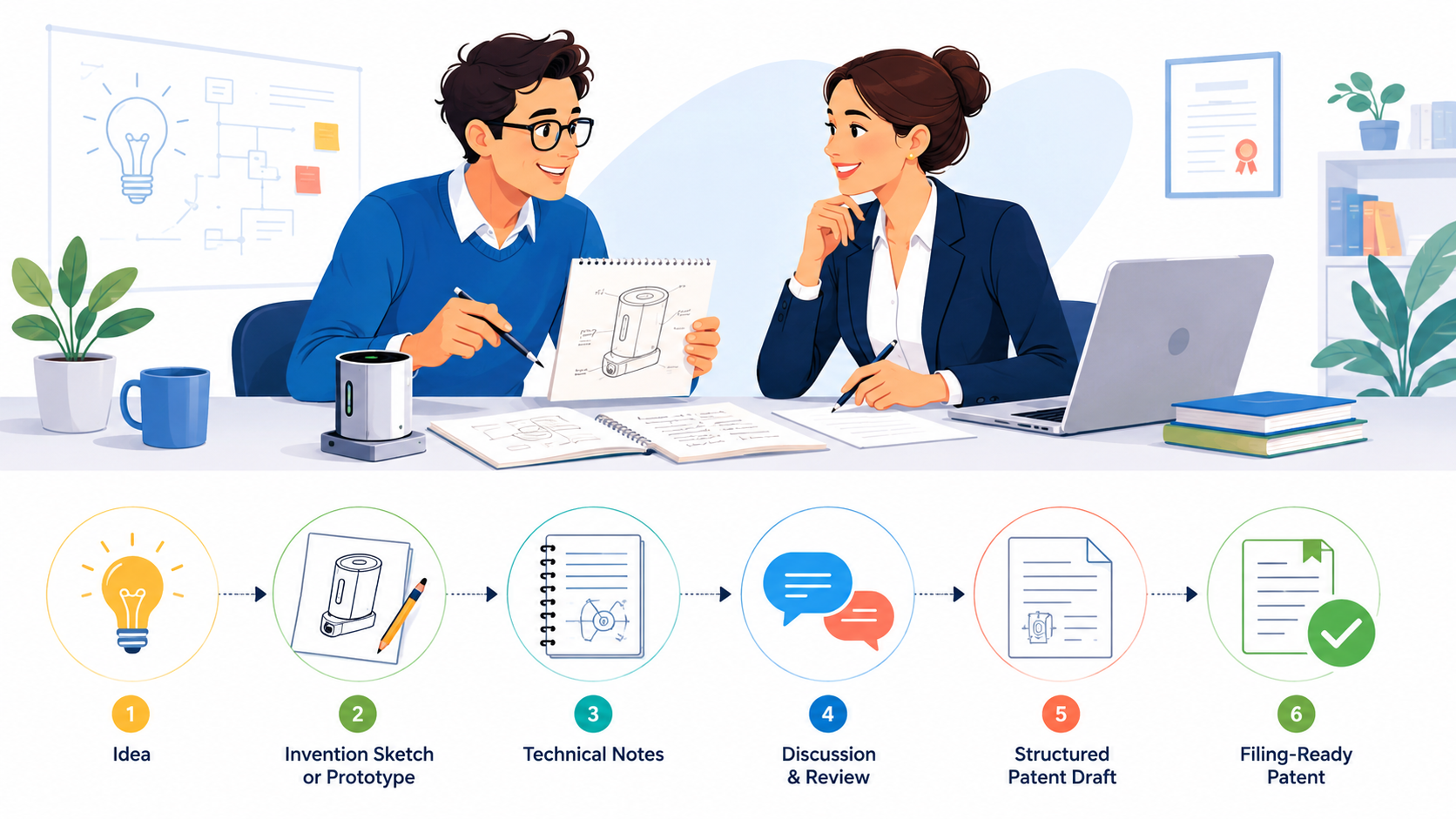
A strong patent does not start with legal words. It starts with a clear idea, a real problem, and a smart workflow that helps the inventor and attorney move fast without missing the details that matter. PowerPatent helps make this process smoother by combining smart software with real attorney oversight. You can see how the process works here: https://powerpatent.com/how-it-works
Build the Invention Story Before Anyone Starts Writing
The fastest patent workflow starts before the attorney writes a single formal sentence. It starts with the invention story.
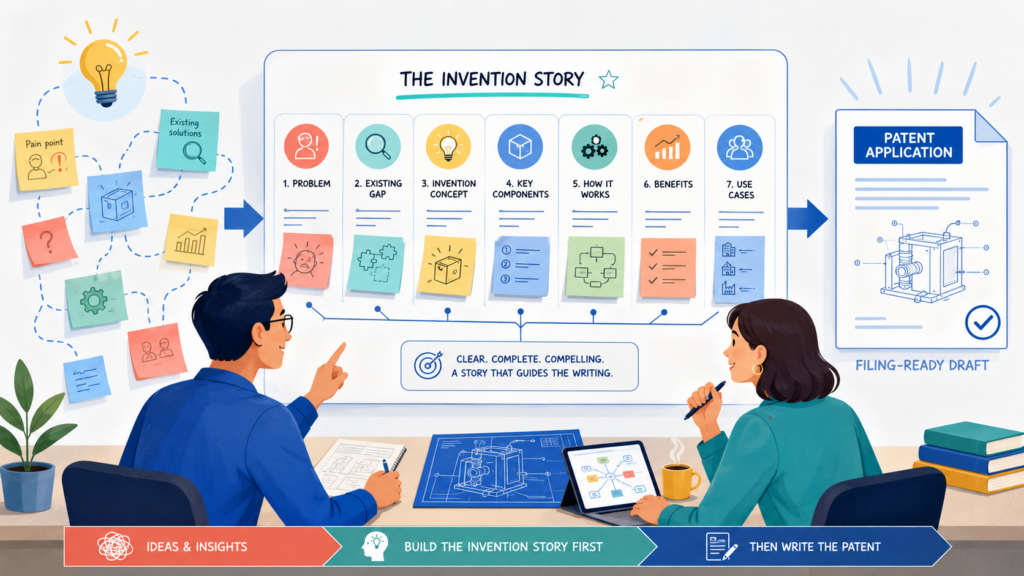
This is the plain-English version of what was built, why it matters, how it works, and why it is different from what people already do.
Many teams skip this step because they think the attorney will “figure it out.” That is a mistake. The attorney can help shape the patent, but the inventor holds the raw truth. The better that raw truth is shared, the stronger the filing can become.
A good invention story does not need fancy words. In fact, simple words are better. The goal is to help a smart person understand the invention quickly.
The inventor should be able to explain the problem in normal terms, then explain why the old way fails, then explain what the new system does better. This helps the attorney see the heart of the invention instead of guessing from scattered notes.
The inventor should explain the problem like a customer would describe it
A strong patent often begins with a painful problem. Not a vague problem, but a clear one. For example, “data moves too slowly” is weak.
“The system delays fraud review because each transaction has to wait for three separate checks before it can be scored” is much stronger. That kind of problem gives the attorney something real to work with.
The inventor should describe the problem as it happens in the real world. What breaks? Who feels the pain? What takes too long? What costs too much? What fails under load? What creates risk? What forces people to use clumsy workarounds? These answers help shape the background of the patent and guide the claims later.
This is also where founders should be careful not to hide the business reason behind the invention. A patent is not a pitch deck, but the business reason often points to the technical value.
If the invention helps a model run faster, cuts cloud cost, improves accuracy, reduces human review, protects private data, or lets a system work in a new setting, that should be clear from the start.
The attorney needs the “why now” behind the invention
The best invention stories include a simple reason why this idea matters now. Maybe a new model type made the old process too slow. Maybe customers started sending larger files.
Maybe edge devices became powerful enough to do work that used to happen only in the cloud. Maybe a new product flow created a fresh technical challenge.
This “why now” detail helps the attorney understand the setting around the invention. It also helps avoid a flat patent draft that reads like a generic system.
A strong draft should feel tied to a real technical change, not just a broad idea with legal wrapping.
For startup teams, this step should happen as early as possible. Do not wait until the product is fully launched.
Do not wait until every test is complete. Once the team has a clear technical path and can explain how the invention works, it is time to start organizing the story.
PowerPatent is built to help founders move through this stage without slowing down the team. You can see how the workflow works here: https://powerpatent.com/how-it-works
The inventor should separate the core idea from nice-to-have details
One reason patent drafts become messy is that inventors often share every detail at once. They include product features, customer settings, future roadmap items, test ideas, design choices, and random notes in the same pile. Some of that may be useful, but not all of it belongs at the center.
The inventor and attorney should work together to find the core idea. This is the part that must stay true even if the product changes. It is the engine of the invention. It is what makes the system work in a new or better way.
For example, a startup may build a tool that helps doctors review images. The product may include a dashboard, alerts, reports, user roles, and a payment flow.
Those things may matter to the business, but the patent-worthy idea may be the way the system pre-screens images, ranks uncertain cases, and routes them to different review paths based on confidence scores. That core should not get buried under product extras.
A filing-ready workflow protects the broad idea and the practical version
The attorney should not only capture the exact product version. That can make the patent too narrow. At the same time, the patent should not be so broad that it loses support.
The right move is to capture the main idea, then show practical versions that prove how it can work.
This is where the inventor’s input is vital. The inventor should explain what can change without breaking the invention. Can the model be swapped? Can the sensor be different? Can the order of steps change? Can the system work on a phone, server, browser, robot, vehicle, or chip? Can it work with different data types? These answers help the attorney write a patent that has room to grow with the company.
A founder should think of this as building a fence around the invention. The fence should not hug the first prototype too closely.
It should cover the real value the team created, while still being honest and clear about how the invention works.
Turn Raw Inventor Notes Into a Clean Patent Input Package
Raw notes are useful, but they are not enough. A patent attorney needs clean inputs that make the invention easy to understand and hard to miss.
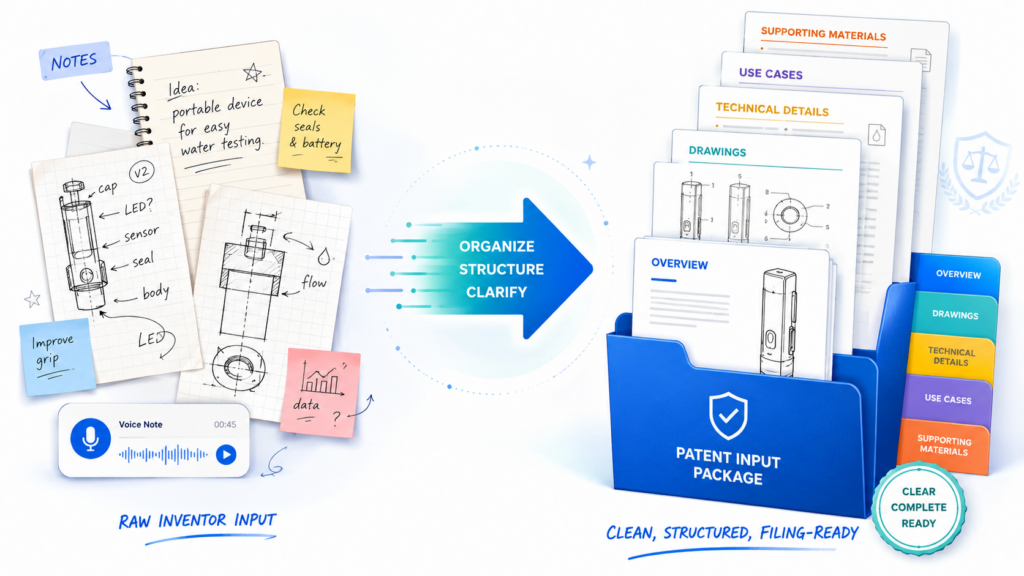
This does not mean the inventor needs to write a legal draft. It means the inventor should package the idea in a way that saves time, reduces back-and-forth, and gives the attorney strong material from the start.
A clean input package should feel like a guided tour. It should show the problem, the old way, the new way, the system parts, the steps, the key variations, and the proof that the idea works.
When this package is clear, the attorney can spend less time untangling the idea and more time building a strong patent strategy.
The best input package starts with the simplest working example
The first version should not try to explain every possible use case. It should begin with one simple example that shows the invention working from start to finish.
This example should be concrete. It should name the input, show what the system does, and explain the output.
For a software invention, the inventor might describe what data enters the system, what checks happen, what model or logic is used, what decision is made, and what action follows.
For a hardware invention, the inventor might explain what signal, force, heat, image, motion, or input is received, how the parts respond, and what result is produced.
This simple example becomes the anchor. Once the attorney understands it, the inventor can add other versions. Without that anchor, the discussion can drift.
The attorney should be able to replay the invention without guessing
A strong input package lets the attorney replay the invention step by step. The attorney should not have to guess what happens first, what happens next, what data is stored, where a decision is made, or why one path is chosen over another.
This does not require a perfect diagram, but it does require clear flow. For many teams, a plain workflow description is enough.
The inventor can write out what happens when the system starts, what triggers the invention, what processing occurs, what rules or models are used, what changes inside the system, and what final result the user or machine receives.
This is where PowerPatent can help reduce the pain of turning technical notes into patent-ready material.
It gives founders and teams a more structured way to move from invention details to attorney review, with smart software and real legal oversight working together. Learn more here: https://powerpatent.com/how-it-works
The input package should include what failed before the final version worked
Many inventors leave out failed attempts because they seem unimportant. That is often a lost chance.
Failed attempts can help reveal why the invention is smart. They show the attorney what the team learned and what technical path led to the final solution.
For example, maybe the team first tried to process all data in one batch, but that caused delays. Maybe it tried a single model, but the results were too noisy.
Maybe it tried cloud-only processing, but privacy rules or latency made that hard. Maybe it used a standard sensor layout, but the signal quality was poor.
These details help the attorney understand why the final design matters. They may also help show what makes the invention different from common approaches.
The strongest drafts often come from the messy middle
The “messy middle” is where real invention happens. It is the place between the first idea and the working version. It includes tradeoffs, tests, limits, design changes, and key choices.
Attorneys need this information because patents are not only about what the invention is. They are also about why this way of doing it matters.
Founders should not clean the story too much. It is better to share the rough path and let the attorney decide what belongs in the draft.
A small technical choice that felt obvious during building may become a key part of the patent. A workaround that felt like a hack may be the part that makes the system valuable.
Map the Invention Like a System, Not Like a Feature
A patent-ready workflow gets stronger when the team stops talking about the invention as a feature and starts mapping it as a system. A feature is what the user sees. A system is what makes the feature work.
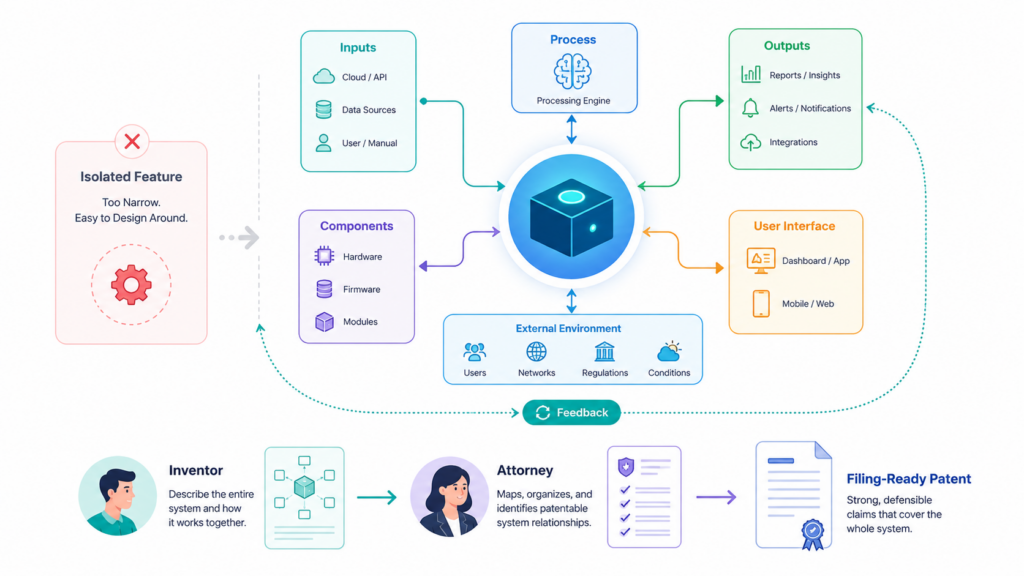
Patents often live deeper than the screen, the button, the dashboard, or the product name. They live in the flow of data, the timing of steps, the way choices are made, the way parts work together, and the way the invention solves a hard problem under real limits.
This matters because many founders describe their invention from the outside. They say, “Our app predicts customer churn,” or “Our device warns the user before failure,” or “Our platform finds the best design.”
Those statements may be true, but they are too thin for a strong patent workflow. The attorney needs to know what happens inside. What is received? What is changed? What is compared? What is trained? What is ranked? What is stored? What is sent? What is blocked? What is improved?
When the inventor maps the invention as a system, the attorney can see the moving parts. That makes the draft more useful. It also helps the attorney avoid writing claims that are too shallow, too narrow, or too tied to the current product screen.
Show the invention from input to output
A strong system map starts with the first meaningful input. This may be user data, sensor data, code, a prompt, a file, a signal, a stream, a request, a model output, a transaction, a test result, or a machine state. The inventor should explain where that input comes from and why it matters.
Then the inventor should walk through what the invention does to that input. This is where the useful detail lives.
The system may clean the data, split it into parts, compare it against a stored pattern, send it through a model, assign a score, choose a path, trigger a second check, change a setting, or create a new output. Each action should be explained in plain words.
The output should also be clear. The output may be a score, a warning, a changed control signal, a ranked list, a trained model, a safer action, a reduced data set, a new design, a filtered result, or a selected next step.
The attorney needs to understand not only what comes out, but why that output is better than what came before.
The most useful map includes the hidden steps
Inventors often forget to mention hidden steps because they feel normal to the team. This is where many strong patent details get lost.
Hidden steps may include fallback logic, checks for bad data, confidence scoring, model switching, caching, timing controls, privacy filters, error handling, rule selection, routing logic, or ways the system handles edge cases.
These details are not boring. They can be the difference between a weak draft and a strong one.
A product may look simple on the outside because the team did hard work behind the scenes. The patent workflow should bring that hard work into view.
For example, a user may only see a clean answer from an AI tool. But behind that answer, the system may break a task into parts, retrieve data from trusted sources, test the answer against rules, remove private data, score risk, and choose whether to show the answer or ask for review.
The visible feature is the answer. The invention may be the control system behind it.
This is why a good inventor-attorney workflow must go below the product surface. The attorney should ask about hidden logic, and the inventor should be ready to explain it without trying to sound legal. Simple, plain steps are enough.
Draw the system in words before drawing figures
Many teams think they need perfect patent drawings right away. They do not. A rough sketch can help, but the first job is to describe the system clearly in words.
Once the words are clear, the drawings become easier. If the words are unclear, the drawings often become confusing too.
The inventor should explain the main parts of the system. These parts may include a user device, server, database, model, sensor, controller, processor, memory, interface, cloud service, edge device, or external system. The names do not need to be formal at first. They only need to be clear.
Then the inventor should explain how these parts talk to each other. Does the device send data to a server? Does the server return a control action? Does the model run locally? Is the database updated after each result? Does the system learn from feedback? Does a human approve a step? Does a second system verify the first output?
The attorney turns the map into patent structure
Once the system is mapped, the attorney can turn it into patent structure. The system parts can become figures.
The process flow can become method steps. The different versions can become examples. The key improvements can shape the claims.
This is where PowerPatent can make the process feel less heavy. Instead of forcing founders to stare at a blank page, the platform helps organize technical details so real attorneys can review the invention with better context.
That means less wasted time, fewer missed details, and a clearer path to a filing-ready draft. See how it works here: https://powerpatent.com/how-it-works
A strong system map also helps when the product changes. Startups move fast. The first version may not be the version customers use six months later.
If the patent draft is built only around a feature, it may age poorly. If it is built around the deeper system, it has a better chance of staying useful as the company grows.
Find the Patentable Center Before Drafting Claims
Before the attorney writes claims, the team needs to find the patentable center. This is the part of the invention that deserves the most care. It is not always the coolest part of the product.
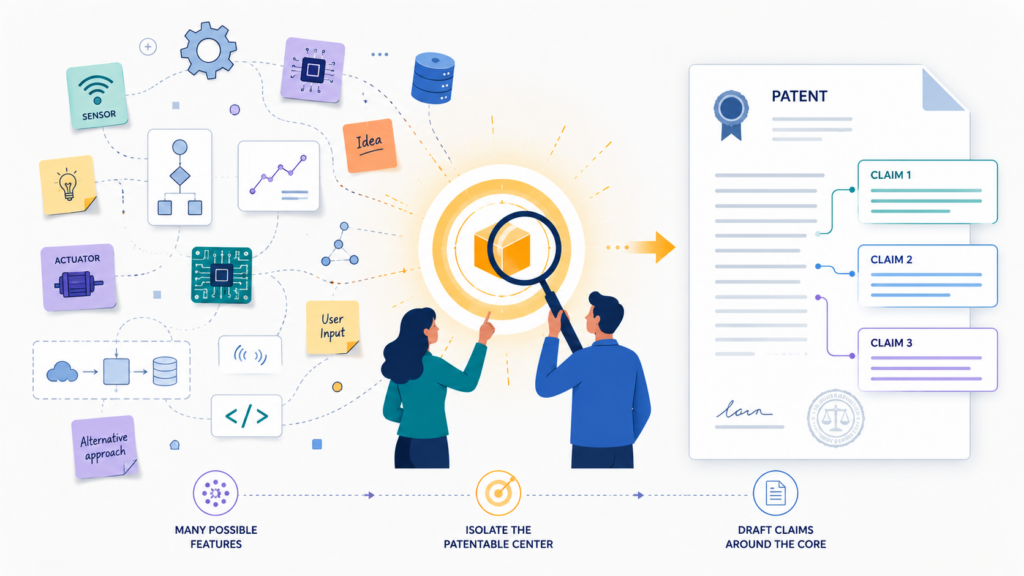
It is not always the part investors ask about. It is not always the part users notice first. It is the technical move that makes the new result possible.
Finding this center takes honest thinking. The inventor and attorney should ask what changed from the old way to the new way. They should ask what the system does that is not just a normal use of known tools.
They should ask where the real lift happened. They should ask what would be hard for another team to copy if they did not know the inside design.
This step is important because patents can get weak when they try to cover everything at once. A draft that treats every detail as equally important may fail to protect the real value.
A draft that focuses only on the product screen may miss the deeper engine. The goal is to find the core technical idea and build around it with care.
Look for the hard technical choice
Most strong inventions include at least one hard choice. The team had to choose one path over another because of speed, cost, accuracy, safety, privacy, memory, compute power, energy use, device size, signal quality, user trust, or system scale. That choice often points to the patentable center.
For example, a machine learning startup may have tested several ways to reduce false results. The patentable center may not be “using AI to detect risk.” That is too broad and too common.
The center may be the way the system uses a first fast model to sort easy cases, then sends uncertain cases through a second model with richer context, then updates a routing rule based on later outcomes.
That kind of detail gives the attorney something stronger. It shows a real technical setup. It also shows why the invention improves how the system works.
A strong center often solves a real limit
The attorney should ask what limit the team hit. Did the system fail when data volume grew? Did accuracy drop with noisy inputs? Did battery use rise too high? Did users lose trust because the output lacked context? Did the product need to work when the network was weak? Did the model need to protect private data while still giving useful results?
These limits matter because they show the invention was not just a nice idea. It was a response to a real technical barrier.
When the patent draft explains that barrier clearly, the invention becomes easier to understand and harder to dismiss as a generic concept.
The inventor should also explain why common fixes were not enough. This does not need to be a full market survey. It can be practical. The old approach was too slow. The standard model was too large.
The normal rule set broke with edge cases. Manual review did not scale. Cloud-only processing caused delay. Local-only processing lacked enough context. These simple points help shape the patent story.
Separate the center from the packaging
Startup products include a lot of packaging. Packaging is the app, dashboard, user flow, branding, reports, settings, and customer-facing polish. Some of it may matter, but much of it may not be the patentable center.
The attorney and inventor should peel away the packaging and ask what must be true for the invention to work. If the dashboard changes, does the invention still exist? If the report looks different, does the invention still exist? If the user presses a different button, does the invention still exist? If the model runs on another device, does the invention still exist?
This exercise helps prevent the filing from being trapped inside the first product design. The patent should protect the smart engine, not only the first wrapper around it.
The best claim strategy grows from the center outward
Once the center is clear, the attorney can write from the inside out. The broadest claims can focus on the core idea.
Narrower claims can add useful details, such as data types, model types, devices, fallback paths, training methods, routing rules, user actions, or system settings.
This creates layers. The broad layer protects the main idea. The deeper layers support specific versions. The examples show how the invention works in real life.
A well-built patent draft should not depend on one tiny product version. It should tell a bigger technical story with enough detail to be trusted.
PowerPatent is useful here because founders often know the invention deeply but do not know how to shape it for patent review.
The platform helps pull out the right details and pair them with attorney oversight, so the filing process is not just faster, but smarter. Learn more here: https://powerpatent.com/how-it-works
The patentable center is also useful for business planning. Once the team knows what it is trying to protect, it can make better choices about demos, fundraising, customer talks, open-source releases, partner meetings, and public launches.
The workflow becomes more than a legal task. It becomes part of how the company protects its edge.
Run a Prior Art Reality Check Without Killing Momentum
A prior art check is not about scaring the team. It is about seeing the field clearly before the draft gets too far.
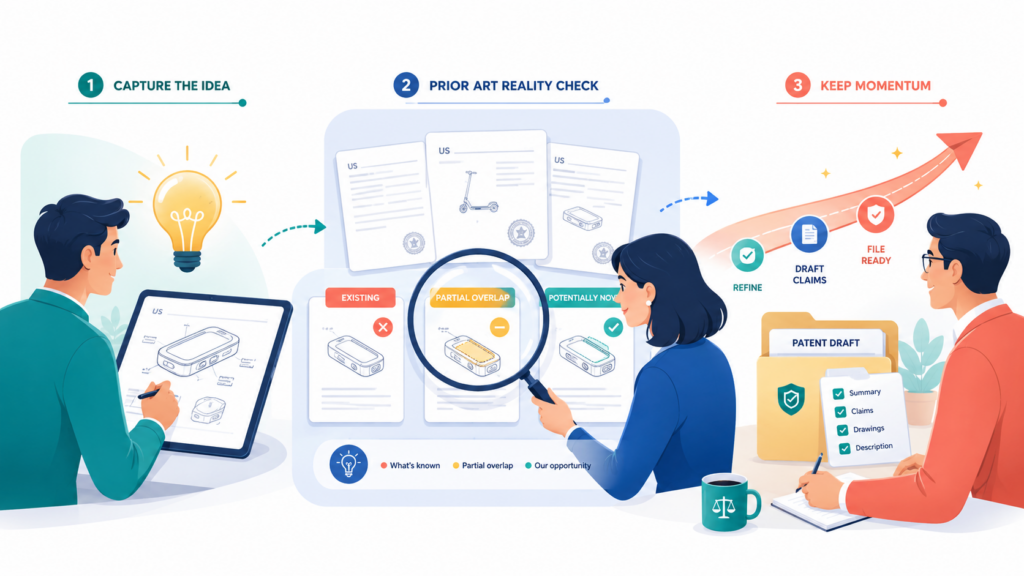
Prior art means public material that may show similar ideas, such as patents, papers, products, open-source projects, talks, manuals, blog posts, and technical docs.
The point is not to prove that the invention is perfect before filing. The point is to help the attorney draft with open eyes.
Many founders either ignore prior art or overreact to it. Ignoring it can lead to a weak filing that misses known work. Overreacting can lead to delay, doubt, and endless searching.
The better path is a focused reality check. The inventor and attorney should look for the closest known approaches, learn from them, and use that knowledge to sharpen the patent story.
This step should be practical. A startup does not need to pause product work for weeks. The goal is to find enough signal to draft smarter.
The attorney can guide the legal side, while the inventor can help spot technical differences that may not be obvious from keywords alone.
Search for the closest problem, not just the same words
A common mistake is searching only for the exact words the team uses. Startup teams often invent their own language. Customers may use different words. Older patents may use formal words.
Academic papers may use another set of terms. If the team searches only its own product language, it may miss the closest work.
The better move is to search around the problem. What are others trying to fix? What technical limit are they facing? What inputs and outputs are involved? What system setting is similar? What field has the same pain, even if the product looks different?
For example, a startup may call its invention “adaptive trust scoring.” Prior art may call similar work risk ranking, confidence weighting, anomaly scoring, dynamic authentication, fraud triage, or signal fusion. The words change, but the problem may be close.
The inventor should help translate between worlds
The attorney may find documents that look relevant but use strange language. The inventor should help translate them into plain terms.
Does the old work really do the same thing? Does it solve the same problem? Does it use the same data? Does it make the same decision? Does it improve the same system limit? Does it only look similar at a high level?
This inventor feedback is powerful. Sometimes a document looks scary at first but turns out to be different in a key way.
Other times, a document seems far away but actually teaches a similar flow. The attorney needs the inventor’s technical judgment to avoid both false fear and false confidence.
This is another place where a structured workflow helps. When the invention details are already organized, it is easier to compare the new approach against known work.
PowerPatent helps teams move through this kind of process with smart software and real attorney review, so founders do not have to manage the chaos alone. See the workflow here: https://powerpatent.com/how-it-works
Use prior art to sharpen the draft, not water it down
The goal of a prior art check is not to make the patent timid. It is to make the draft sharper.
When the team sees what others have done, the attorney can focus on what is truly different. This may lead to better examples, stronger wording, and clearer claim layers.
If prior art shows that one piece is common, the team can avoid pretending that piece is the whole invention. If prior art shows similar inputs, the draft can focus on the special processing steps.
If prior art shows similar models, the draft can focus on training, routing, deployment, feedback, or control logic. If prior art shows a similar output, the draft can explain how the system creates that output in a better way.
A good workflow captures the difference in plain words
The inventor should be able to say, in simple words, “They do this, but we do that.” This sentence is often the seed of a strong patent strategy. It does not need to sound legal. It needs to be clear.
For example, “They score each event after it happens, but we predict risk before the event by combining live sensor drift with past failure patterns.” Or, “They send all files to the cloud, but we split private parts from non-private parts and process them on different paths.”
Or, “They use one model for all users, but we switch models based on device state and confidence level.”
These differences help the attorney build a draft that is honest and focused. They also help founders explain their edge to investors, partners, and internal teams.
The best time to run this check is after the invention story is clear but before the draft is locked. Too early, and the team may not know what it is searching for.
Too late, and the draft may need heavy changes. Done at the right time, this step saves time and improves quality.
Create a Disclosure That Lets the Attorney Draft With Confidence
The invention disclosure is the bridge between the inventor’s mind and the attorney’s draft. It does not need to be perfect.

It does need to be complete enough that the attorney can understand the invention, ask smart follow-up questions, and start drafting without guessing.
A weak disclosure feels like a product blurb. It says the tool is faster, smarter, safer, or more automatic, but it does not explain how.
A strong disclosure shows the problem, the system, the steps, the key choices, the variations, the data, the results, and the parts that may change. It gives the attorney enough material to build a filing that is both clear and flexible.
This is where many teams lose time. The attorney asks for details. The inventor answers quickly between meetings. The answer creates three more questions. A week passes.
The draft starts late. The team gets frustrated. A better disclosure workflow prevents this by collecting the right information up front.
Write the disclosure like a handoff, not a school report
The inventor should not try to impress the attorney. The inventor should try to equip the attorney. That means the disclosure should be direct, plain, and useful. It should explain the invention as if the attorney must build a mental model from it.
The first job is to describe the invention in one clear paragraph. This paragraph should explain what the invention does, what problem it solves, and what result it creates.
It should not include legal phrases. It should not sound like a press release. It should sound like a clear technical handoff.
Then the disclosure should go deeper. It should explain the system parts, the flow of steps, and the key decision points.
It should include enough examples that the attorney can see how the idea works in real use. It should also explain what parts are required and what parts are optional.
A strong disclosure includes variations from the start
Variations are critical because startups change fast. The first product may use one model, one sensor, one cloud service, one data format, or one workflow.
Later versions may use something different. The disclosure should make room for those future changes when they are technically supported.
The inventor should explain other ways the invention could work. Could the data come from another source? Could the logic run on a server or a device? Could the system use a rule, a model, or both? Could the output be a command, score, alert, ranking, or report? Could the same method work in another field?
These variations help the attorney avoid writing a draft that is too narrow. They also help show that the invention is not just one hard-coded product version.
A good patent draft can cover the working example while also showing broader ways the idea may be used.
PowerPatent helps make this easier by guiding founders through the details attorneys need, then combining that structured input with real attorney oversight.
That means the inventor can stay focused on building while still giving the legal team stronger material. You can explore the process here: https://powerpatent.com/how-it-works
Include proof, even if the proof is early
Proof does not always mean final test results. It can be a working prototype, a small test, a simulation, a design review, a benchmark, a customer trial, or even a clear technical reason why the system should work.
The attorney needs to know what has been built, what has been tested, and what still exists as a planned version.
This helps in two ways. First, it gives the draft more detail. Second, it helps separate what is real from what is only a hope.
Patent filings can include future-looking examples, but they should still be grounded in a clear technical teaching.
The inventor should share results in plain terms. Did the system reduce delay? Did it use less memory? Did it improve accuracy? Did it cut review time? Did it lower false alerts? Did it work with messy data? Did it keep private data local? Did it recover from failure faster? Even early results can help the attorney understand the value of the invention.
The disclosure should capture tradeoffs, not hide them
Good inventions often involve tradeoffs. The system may gain speed but use more memory. It may improve privacy but need extra local processing.
It may reduce false alerts but require a second check. It may improve accuracy only after enough feedback is collected.
These tradeoffs should not be hidden. They help explain the design choices. They show that the invention lives in the real world, where every technical decision has a cost.
An attorney can use this context to draft a better explanation of why the invention matters.
A filing-ready disclosure gives the attorney confidence. It does not answer every possible question, but it gives enough structure that the next questions are sharp. That is the mark of a healthy inventor-attorney workflow.
Hold the Attorney Strategy Call Like a Working Session, Not a Status Meeting
The attorney strategy call is one of the most important parts of the workflow. It should not feel like a slow status meeting where everyone speaks in broad terms and leaves with vague next steps.
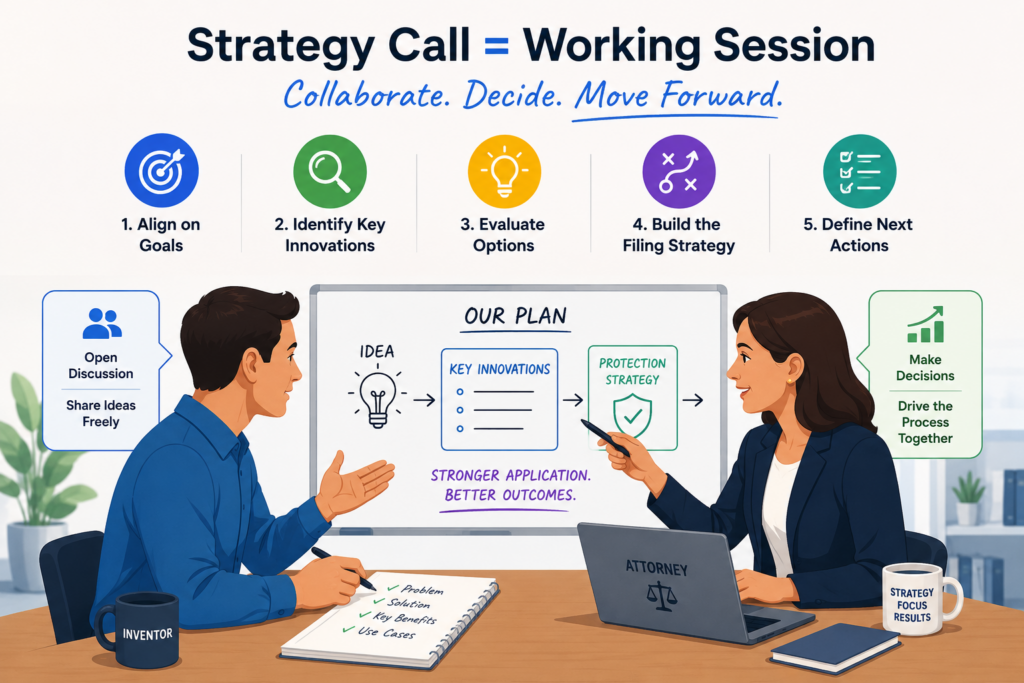
It should feel like a working session where the inventor and attorney pressure-test the invention, find the strongest angles, clear up weak spots, and agree on the filing path.
This call is where the draft begins to take shape. The attorney has reviewed the disclosure. The inventor has the technical details fresh in mind. Now both sides need to turn raw material into strategy.
What is the core invention? What should the first filing cover? What should be saved for later? What needs more detail? What public dates matter? What product changes are coming soon? What business goals should shape the filing?
A strong call can save many hours later. A weak call can lead to a draft that misses the point.
Start with the invention in one simple sentence
The first task is to force clarity. The attorney should ask the inventor to explain the invention in one simple sentence. Not a slogan. Not a legal claim. A plain sentence.
Something like, “The system routes uncertain model outputs to a second review path based on confidence and user impact.” Or, “The device changes its sensing mode based on early signs of signal drift.”
Or, “The platform splits private and non-private data before processing so useful results can be created without exposing sensitive parts.”
This sentence is not the full patent. It is the center of gravity. If the team cannot say the invention simply, the draft may become scattered. The call should keep working until the center is clear.
After that, the attorney should ask the inventor to walk through the invention from beginning to end. The attorney should interrupt when a step is vague. The inventor should explain why each step exists.
This is not about making the inventor defend the idea. It is about making sure the draft will not depend on guesses.
The best questions expose claim-worthy details
The attorney should ask questions that reveal useful details. What triggers the system? What input is used? What step changes the result? What happens when the input is bad? What makes the system faster? What makes it safer? What makes it more accurate? What happens in the edge case? What is done automatically? What is chosen based on a score? What is updated over time?
These questions help find claim-worthy details. Many inventors do not know which details matter for patents. They may think a small routing rule or fallback mode is boring. The attorney may see it as very important.
The inventor should also ask questions. What part seems strongest? What part needs more support? What might be too narrow? What might be too broad? What examples would help? What should be shown in drawings? What should the team avoid sharing publicly before filing?
PowerPatent helps make these attorney sessions more focused because the invention details are structured before review.
That gives the attorney a better starting point and gives founders more confidence that the right issues are being covered. See how PowerPatent supports this workflow here: https://powerpatent.com/how-it-works
Decide what belongs in this filing and what may become a later filing
Startups often have more than one invention hiding inside a product. The first filing should not try to cover everything if doing so makes the draft messy.
At the same time, the team should not leave out key material that supports the main idea.
The strategy call should sort this out. The attorney and inventor should decide what the first filing must cover to protect the core invention. They should also identify related ideas that may deserve future filings.
This is especially important for startups building fast in AI, robotics, chips, medical devices, energy, climate tech, cybersecurity, and developer tools.
For example, the current invention may be the way a model is deployed under tight compute limits. A related future filing may cover the way the model is trained using private customer data.
Another may cover a special feedback loop. Another may cover a device-level control method. Trying to force all of that into one filing may weaken the focus. Ignoring it may waste valuable IP.
The call should end with clear drafting choices
By the end of the call, the attorney should know the main claim direction, the important examples, the likely figures, the required follow-up details, and the timeline. The inventor should know what the attorney needs and why.
This does not mean every legal choice is final. Drafting always brings up new questions. But the team should leave with a shared view of the invention. They should not leave with confusion about what is being protected.
A strong strategy call also builds trust. The inventor feels heard. The attorney gets the depth needed to draft well. The company moves faster because the process is not stuck in vague back-and-forth.
Build the Draft Around Use Cases, Not Abstract Ideas
A strong patent draft should teach. It should help a reader understand how the invention works in real settings.
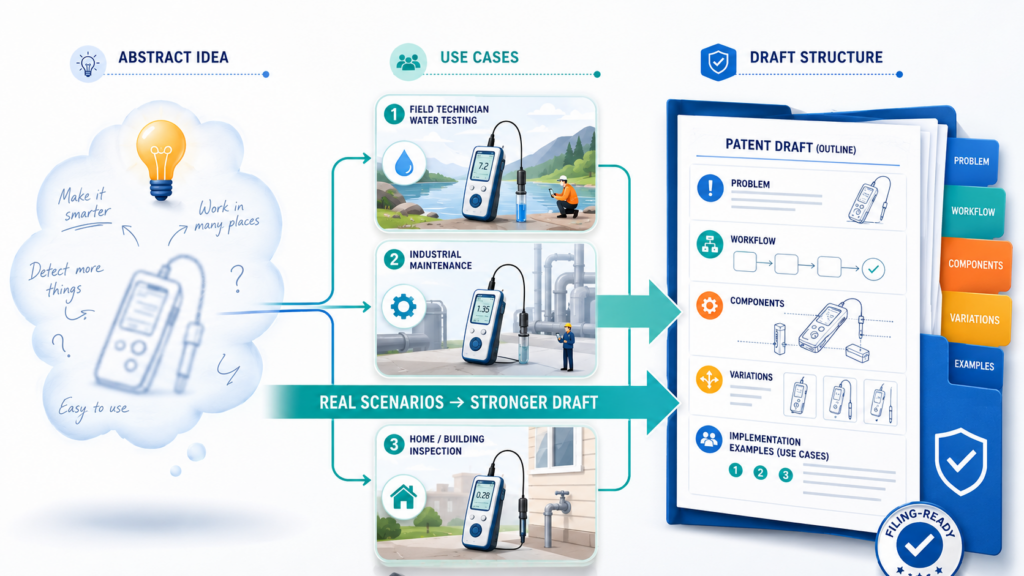
That is why use cases matter so much. They turn abstract ideas into concrete examples. They show why the invention exists, how it works, and where it creates value.
For founders and engineers, use cases are often easier to explain than formal patent language. That is good.
The attorney can translate the use cases into the right structure. The inventor’s job is to provide enough real-world detail so the draft has life.
A use case should not be a marketing story. It should be a technical scene. It should show a setting, an input, a problem, a system action, and a result.
When a draft includes strong use cases, it becomes easier to support broader claims and easier to show practical value.
Use cases should show the invention under pressure
The best use cases are not perfect demos. They show the invention solving a problem under pressure.
This may mean limited compute power, messy data, changing user behavior, low battery, weak network, high traffic, privacy limits, safety risk, noisy sensors, incomplete inputs, or time-sensitive decisions.
A system that works only in a clean demo may not be very interesting. A system that works when conditions are hard is more valuable. The attorney should know where the invention performs under stress.
For example, if the invention helps a robot move safely through a busy warehouse, the use case should not just say the robot avoids obstacles.
It should explain what happens when the sensor view is partly blocked, when people move unpredictably, when the floor layout changes, or when the robot must choose between slowing down and rerouting.
Strong use cases reveal the real value
Use cases help reveal why the invention matters. They show whether the value is speed, safety, privacy, lower cost, better accuracy, less manual work, smoother control, lower energy use, better scaling, or fewer failures. These benefits should be tied to technical steps, not just stated as outcomes.
For example, “the system is faster” is not enough. The draft should explain how the system becomes faster. Maybe it avoids full processing for low-risk inputs.
Maybe it stores a compact state instead of reprocessing raw data. Maybe it uses a local model first and sends only uncertain cases to the cloud. Maybe it updates a control signal before a full result is available.
That is the level of detail that helps the attorney write a stronger draft. It also helps the founder see the patent as a business asset, not just a legal file.
PowerPatent supports this by helping teams collect use cases and technical examples in a cleaner way before attorney review.
That makes it easier to turn founder knowledge into a filing-ready patent draft. You can see how it works here: https://powerpatent.com/how-it-works
Use several use cases to avoid a narrow filing
One use case is helpful, but several use cases can make the draft stronger. They show that the invention is not limited to one customer, one screen, one data type, or one product flow. The key is to choose use cases that are different in meaningful ways.
If the invention is a data processing method, one use case might involve live data and another might involve stored data. If the invention is a model control method, one use case might involve cloud processing and another might involve edge processing.
If the invention is a device, one use case might involve normal conditions and another might involve failure conditions.
These examples give the attorney more room to draft. They also help protect the company if the product changes.
The use cases should connect back to the same core idea
Even with several use cases, the draft should not feel scattered. Each use case should connect back to the same core invention. The reader should feel, “This is the same smart idea working in different settings.”
This is why the patentable center matters. Once the center is clear, the team can choose use cases that support it. Without that center, use cases may become a random collection of product stories.
A good attorney will use the examples to support the claims, not bury the claims under too much detail. A good inventor will explain the real cases without trying to write legal text. Together, they create a draft that is clear, useful, and built for growth.
Use cases are also valuable outside the patent. They help the team talk about the invention with investors, partners, and future hires.
They make the technical edge easier to explain. A strong patent workflow often improves the company’s own understanding of what it has built.
Turn Diagrams Into a Drafting Tool, Not Decoration
Patent drawings are not there to make the filing look nice. They are there to help explain the invention with less confusion. A good drawing can save pages of unclear text.
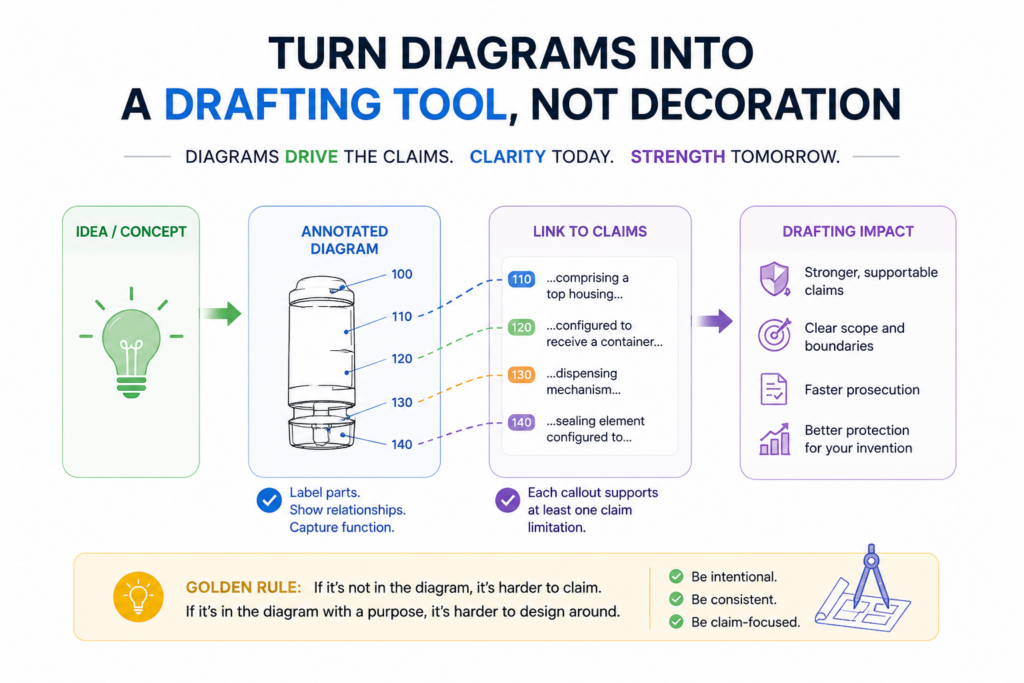
It can show how parts connect, how data moves, how steps happen, and how the invention changes from one version to another.
For an inventor-attorney workflow, drawings should start early enough to guide the draft, not late enough to become a cleanup task.
Many teams wait until the written draft is almost done before thinking about figures. That can work for simple inventions, but it often creates trouble for software, AI, hardware, robotics, and system-level inventions.
The draft may describe parts that are hard to see. The claims may refer to steps that do not match any figure. The inventor may notice missing logic only after the whole draft has been written. That leads to rework.
The better move is to use diagrams as thinking tools. The inventor does not need formal patent drawings at first.
A rough system sketch, a process flow, a data path, or a before-and-after view can be enough. The goal is to make the invention visible so the attorney can draft with better aim.
Start with the figure that explains the main idea fastest
The first figure should not try to show every detail. It should help a new reader understand the invention quickly. For many software and AI inventions, that figure is a system view.
It may show a user device, server, model, database, outside data source, decision engine, and output.
For a device invention, it may show the main physical parts and how they interact. For a process invention, it may show the main flow of steps.
This first figure becomes the map for the draft. It helps the attorney decide what parts need names.
It helps the inventor spot missing pieces. It also helps both sides test whether they are talking about the same invention.
A strong first figure answers a simple question: what are the main parts, and how does the invention move from input to useful result? If the figure cannot answer that, it may be too crowded, too vague, or focused on the wrong thing.
The attorney should use drawings to find weak spots
A drawing often exposes gaps that words hide. An inventor may say, “The system scores the event,” but the drawing forces the team to ask where the score is made, what data is used, where the score is stored, and what happens after the score changes. That is useful.
A drawing may also reveal that two parts need to be separated. For example, a model may not be the same as a rule engine.
A database may not be the same as a training store. A user interface may not be the same as a control layer. These distinctions can matter in the draft.
This is one reason PowerPatent helps founders organize invention material before attorney review.
When the system, steps, and examples are clearer, the figures become easier to shape and the attorney can spend more time on strategy instead of basic cleanup. You can see the workflow here: https://powerpatent.com/how-it-works
Use process figures to lock down the order of steps
A process figure is often the most useful drawing for software and AI inventions. It shows what happens first, what happens next, and how the system reaches a result.
This does not mean every claim must follow the exact order in the figure. But the figure gives the draft a clean base.
The inventor should explain whether the order of steps is fixed or flexible. This is very important. Some inventions depend on timing. A risk check may need to happen before a file leaves a device.
A control signal may need to update before a machine moves. A model selection step may need to happen before full processing begins. In other cases, steps can happen in a different order without changing the invention.
The attorney needs to know this because a filing can become too narrow if it locks in an order that is not required. It can also become unclear if it ignores timing that makes the invention work.
Good figures make future edits easier
A clean figure set also makes attorney review faster. When the draft says “training module,” “routing engine,” “confidence score,” or “local controller,” the reader can look at the figure and see where that part fits. This reduces confusion during review and helps the inventor give better comments.
Figures also help when a second patent filing is planned later. If the first filing clearly shows the system, later filings can build on related ideas with less friction. The company starts to build a patent story, not just a set of separate documents.
The key is not artistic beauty. The key is clarity. A simple box-and-arrow figure that explains the invention well is far more valuable than a polished image that hides the logic.
The best patent figures feel boring in the right way. They are clean, direct, and easy to follow.
Draft Claims From the Business Edge and the Technical Edge Together
Claims are the part of the patent that define the protection being sought. Founders do not need to write them alone, but they do need to help shape them. A patent claim that misses the company’s real edge can be a costly mistake.

It may describe something true, but not the thing competitors would copy. It may protect a small feature while leaving the deeper system open. It may focus on today’s product while ignoring where the roadmap is going.
The best claim workflow joins two views. The first is the technical edge. This is what the invention does differently inside the system. The second is the business edge.
This is why that difference matters to the company’s market, product, customers, and future value. When both views are used, the attorney can draft claims that are more useful.
This does not mean claims should sound like marketing. They should not. But business context helps the attorney understand what must be protected.
A claim strategy for a startup should not be built in a vacuum. It should support the company’s real plan.
The inventor should explain what a copycat would copy first
A simple way to shape claim strategy is to ask what a strong competitor would copy if the product started winning.
Would they copy the model pipeline? The data split? The sensor layout? The routing logic? The feedback loop? The device-control method? The privacy layer? The training method? The way the system reduces compute cost?
This question helps cut through noise. Not every feature deserves claim focus. Some features are easy to change.
Some are just product polish. Some are table stakes. The most valuable claims often aim at the part a competitor needs in order to get the same advantage.
The inventor should describe that copy risk in plain words. The attorney can then decide how to express it in claims. This is how a patent starts to match the real world.
The strongest claim path protects the engine, not just the interface
Many startup products are interface-heavy. They have dashboards, buttons, prompts, reports, views, and user flows.
These may matter, but the engine behind them often matters more. If the claim only covers the interface, a competitor may avoid it by changing the screen.
The attorney should ask what happens if the interface changes. Does the invention still work? If yes, the claims should likely focus deeper. They may focus on processing steps, system components, control logic, data structures, model behavior, or device actions.
This is where PowerPatent can help teams move faster with more confidence. By helping founders surface the technical edge and pairing it with real attorney oversight, the platform helps turn raw invention details into a filing-ready strategy. Learn more here: https://powerpatent.com/how-it-works
Claims should leave room for the startup to grow
A startup patent should not only protect the product as it exists today. It should support where the company is going next, as long as the filing has real technical support for those paths. This is why inventor input on roadmap matters.
The attorney should know which parts are likely to change. Will the model move from cloud to edge? Will the system support new data types? Will the product move from one industry to another? Will customers use it through an API instead of a dashboard? Will the device be smaller, cheaper, faster, or more automated? Will the system work with partners’ tools?
These details help the attorney avoid claims that become outdated too fast. They also help the attorney include examples that support future versions.
Narrow details should support broad strategy
A good claim set usually has layers. The broader claims aim at the main invention. The narrower claims add details that may be useful if the broad version faces pushback later. These narrower details are not wasted. They are fallback paths.
For example, a broad claim may focus on selecting a processing path based on a confidence score.
Narrower claims may add the type of score, the kind of model, the data source, the timing of the selection, the device where processing occurs, or the update rule used after feedback.
Founders should understand this layering because it makes review easier. When they see a narrow detail in the claims, they should not assume the whole patent is limited to that detail.
The attorney may be building backup positions. The founder’s job is to confirm whether those details are accurate, useful, and tied to real versions of the invention.
Good claim drafting is both careful and strategic. It should not chase buzzwords. It should not copy the pitch deck. It should protect the technical move that gives the company an edge.
Review the Draft Like an Inventor, Not Like a Lawyer
When the first patent draft comes back, many inventors freeze. The document looks formal. The language feels strange. The figures may have reference numbers.
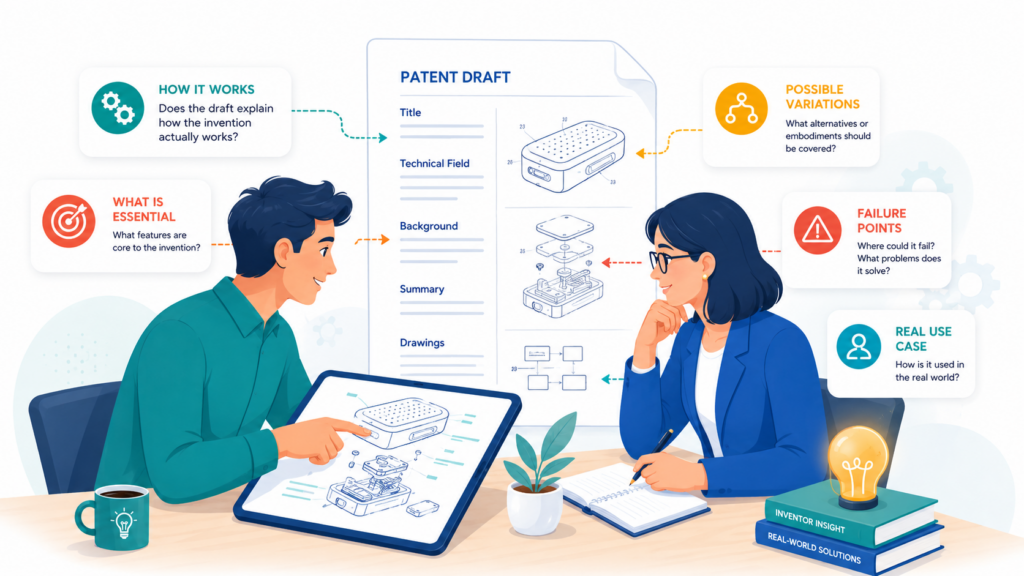
The claims may be hard to read. The inventor may think, “This is legal text, so I should not touch it.” That is exactly the wrong reaction.
The inventor’s review is one of the most important quality checks in the whole workflow. The attorney can write the legal draft, but the inventor must confirm that the invention is right.
The inventor should read the draft to find technical mistakes, missing steps, weak examples, wrong assumptions, and places where the text makes the invention sound narrower or different than it really is.
The inventor does not need to fix legal wording. The inventor needs to protect technical truth. A great review is not about sounding smart. It is about being clear and honest.
Read for accuracy before style
The first review pass should focus only on whether the draft is technically correct. The inventor should ignore awkward legal wording at first and ask simple questions.
Does this describe what we built? Are the parts named correctly? Are the steps in the right order when order matters? Are optional parts shown as optional? Are required parts shown as required? Are the examples real? Are the results accurate? Are the future versions possible?
This pass often finds important issues. Maybe the draft says the model is trained after deployment, but in the real system it is trained before deployment and updated later.
Maybe the draft says the server makes the decision, but the device makes the first decision locally. Maybe the draft says all data is sent to the cloud, but private data stays on the device. These details matter.
A small technical error can create big trouble later. It is much easier to fix it before filing than after filing.
The inventor should flag both wrong details and missing details
Inventors often only mark things that are wrong. They should also mark things that are missing. A missing fallback path, edge case, input type, deployment option, or variation can make the draft weaker than it needs to be.
For example, if the invention can run on an edge device as well as a server, that should be considered. If the system can use rules instead of a model in some versions, that may matter.
If the output can be a score, command, alert, or ranked list, those options may be useful. If the process can work with images, text, signals, or logs, the attorney should know.
PowerPatent is designed to reduce this kind of back-and-forth by helping structure invention details earlier, before the draft review stage.
That makes it easier for founders and attorneys to spot what belongs in the filing. See how the process works here: https://powerpatent.com/how-it-works
Review the claims with the copycat test
Claims may be hard to read, but the inventor should still review them with a practical lens. The copycat test is simple.
If another company copied the important part of the invention, would these claims seem aimed at that behavior? If the answer feels like no, the attorney should know.
This does not mean the inventor decides final claim wording. It means the inventor helps confirm whether the claims are pointed in the right direction.
A claim may be technically correct but commercially weak. It may cover a detail nobody would copy while missing the main engine. It may include a product-specific step that competitors could avoid.
The inventor should explain concerns in plain words. “A competitor could skip this dashboard and still use our routing method.” Or, “The key part is not the alert, it is how we decide when to trust the local model.”
Or, “This step makes it sound like all data must be stored, but our system can work with streaming data too.”
Good comments help the attorney improve the draft faster
The best comments are specific. Instead of saying “this section is confusing,” the inventor should say what is confusing and what the correct version is. Instead of saying “this is too narrow,” the inventor should explain which other version should be included. Instead of rewriting legal text, the inventor should give the attorney the technical facts needed to revise it.
This keeps the workflow moving. The attorney does not have to guess what the inventor meant. The inventor does not get trapped trying to write patent language. Each person does the work they are best at.
A strong draft review may feel slow for a moment, but it saves time later. It prevents filing a patent that the team does not fully trust. It also helps the inventor and attorney build a shared language for future filings.
Use Public Disclosure Dates as Hard Workflow Triggers
Public disclosure is one of the biggest timing risks in the patent process. A public disclosure can include a product launch, demo day, investor deck, conference talk, sales page, technical blog, open-source release, customer pilot, academic paper, app store listing, video, webinar, pitch competition, or even a public GitHub repo. For a startup, these events happen often and fast.
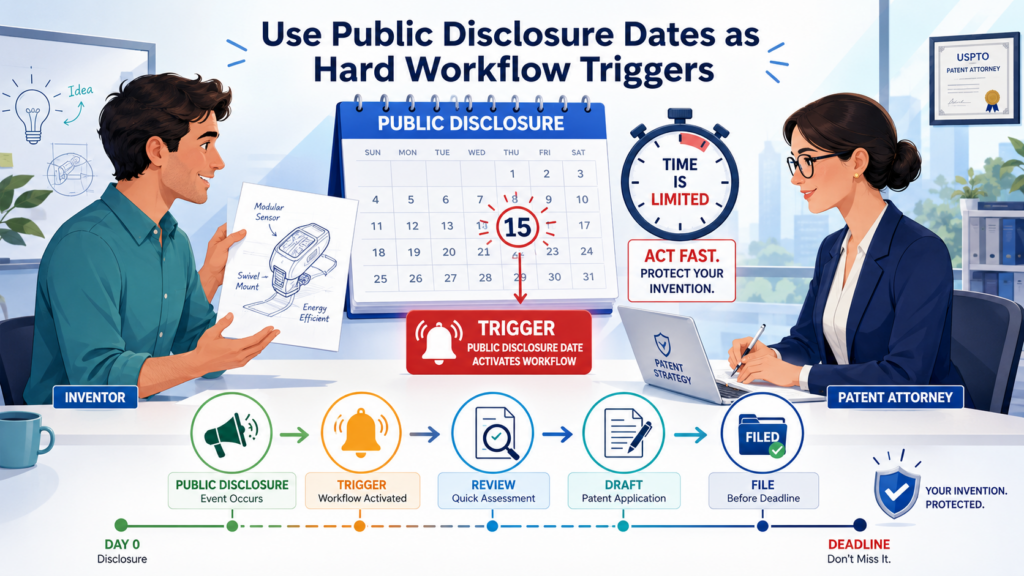
The workflow must treat these dates as serious triggers. The team should not wait until the night before launch to ask whether a patent filing is needed.
By then, the invention may be rushed, details may be missing, and the attorney may not have enough time to prepare the best filing.
A smart inventor-attorney workflow ties patent review to the company calendar.
When a team plans to show new technology outside the company, someone should ask whether the invention has been reviewed for filing. This should become a habit, not an emergency.
The product roadmap and patent roadmap should talk to each other
Most startups already track product milestones. They know when a feature will ship, when a customer pilot starts, when a demo is planned, and when a fundraising deck goes out. The patent workflow should sit close to that roadmap.
This does not mean every feature needs a patent filing. It means every important technical release should trigger a quick IP check.
What new invention is being shown? Has it already been filed? Is it only a small change? Is it a major technical step? Is it something competitors could learn from the public materials? Is the team planning to publish enough detail that others could copy the method?
These questions help the team act before the risk appears. They also help the attorney give better advice because the timing is clear.
Filing before disclosure gives the team more control
When possible, it is usually better to file before public disclosure. This gives the company more control over timing and content.
It also reduces panic. The team can launch, pitch, publish, or demo with more confidence because the filing is already in place.
Founders should not think of this as slowing down. A good workflow does the opposite. It lets the company move fast without stepping on its own work.
The key is to start early enough that the patent process runs beside the product process.
PowerPatent is built for founders who need this kind of speed and control. It helps turn invention details into a structured path for attorney review, so teams are not stuck choosing between building fast and protecting what matters. You can see how it works here: https://powerpatent.com/how-it-works
Internal disclosure should happen before external disclosure
Before the company tells the world, the inventor should tell the patent team. This internal disclosure can be simple.
It does not need to be a long report. It should explain what is new, why it matters, how it works, and when it may become public.
This gives the attorney a chance to triage. Some ideas may need immediate filing. Some may be added to an existing draft.
Some may be saved for later. Some may not be worth filing at all. The key is that the choice is made on purpose.
For larger teams, this can be built into engineering rituals. When a major technical design is approved, when a new model pipeline is ready, when a device passes a key test, or when a customer pilot begins, the team can ask whether an invention disclosure should be created.
Do not let sales speed outrun patent strategy
Sales teams move fast. That is good. But sales materials can reveal more than expected. A deck may explain the secret workflow.
A demo may show a key automation path. A white paper may describe a new model architecture. A customer call may include technical details that were not meant to be public.
The inventor-attorney workflow should help sales and product teams know what is safe to share before filing and what should be kept general. This is not about fear. It is about control.
The best startups do not treat patents as a last-minute legal chore. They treat them as part of the launch plan. When the filing path is clear, the company can speak with more confidence and avoid costly cleanup later.
Conclusion
A filing-ready patent is not made by magic. It is made by a clear workflow where the inventor shares the real story, the attorney shapes it with care, and the company moves with purpose. When ideas are captured early, explained simply, checked against the market, and reviewed with the right questions, patents become less scary and far more useful.
For founders, this means less delay, fewer missed details, and stronger protection for the work that makes the company special. PowerPatent brings smart software and real attorney oversight together to make this path easier. Start here: https://powerpatent.com/how-it-works
Leave a Reply