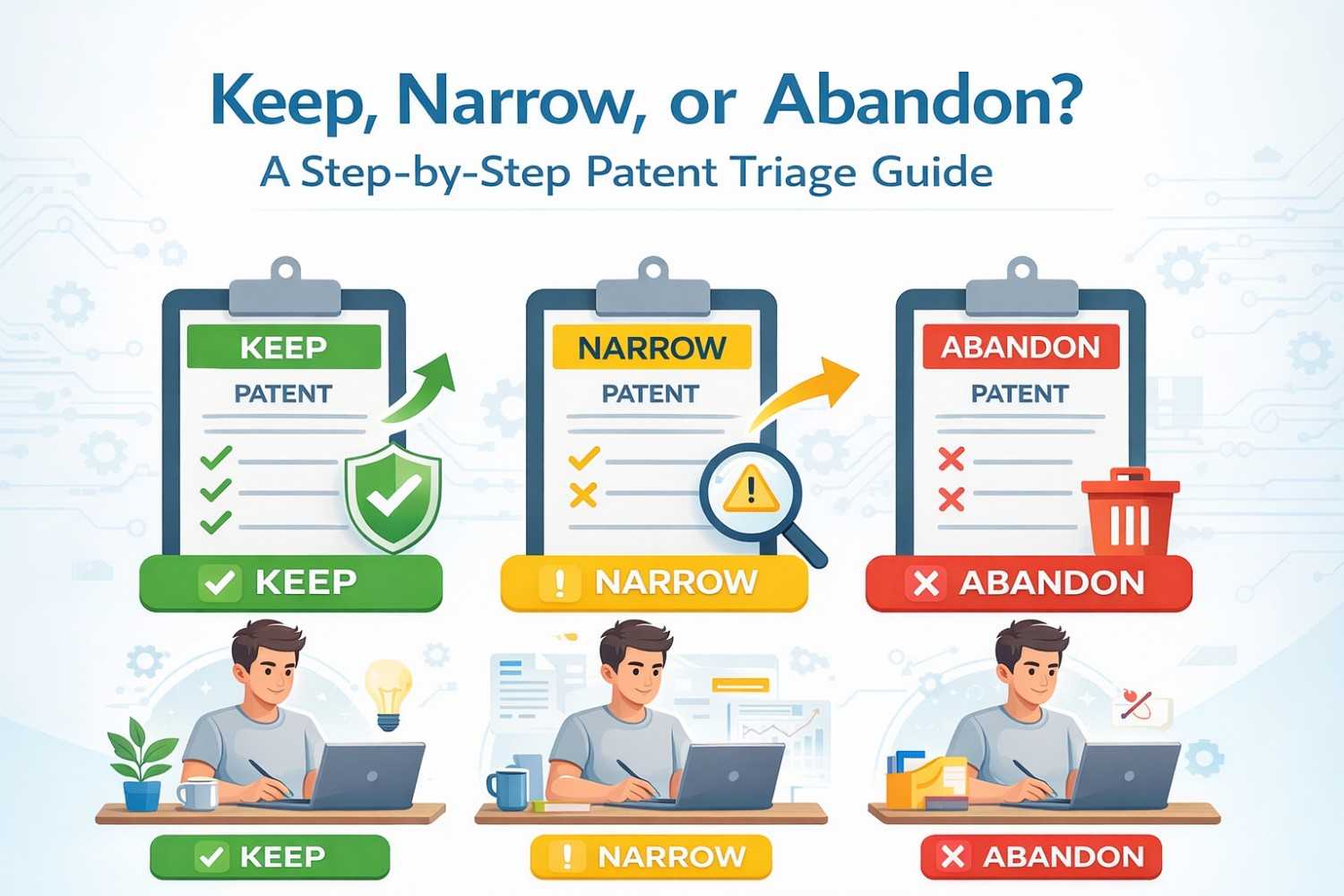
You filed a patent. Or maybe you are thinking about filing one. Now you are staring at it and asking a hard question: should I keep pushing this forward, narrow it down, or walk away? This is not just a legal choice. It is a business move. It affects your runway, your leverage with investors, your product roadmap, and your future exit. In this guide, I will walk you through a clear, simple way to decide what to do with each patent idea or application. No jargon. No confusion. Just a practical way to protect what matters and stop wasting time on what does not. And if at any point you want to see how to make this whole process faster and less painful, you can explore how PowerPatent works here: https://powerpatent.com/how-it-works.
Step 1: Is This Patent Tied to Real Business Value?
Before you spend another dollar or another hour on a patent, you need to pause and ask a very simple question: does this protect something that truly moves your business forward?
Not something that sounds smart. Not something that looks impressive in a pitch deck. Something that directly supports growth, revenue, leverage, or long-term control.
Many founders file patents because it feels like the right thing to do. It feels safe. It feels responsible. But smart founders treat patents like product features. If it does not serve the mission, it does not make the cut.
This section will help you see your patent through a pure business lens so you can make a confident decision.
Look at Your Core Product, Not Side Ideas
Your patent should protect the engine of your company, not the decoration.
If your startup vanished tomorrow and you had to explain to someone what made it special, what would you say? Would you talk about your core algorithm?
Your data pipeline? Your hardware design? Your model architecture? That is where your patent energy should go.
Too often, teams file patents on side features. Small tweaks. Nice-to-have tools. These feel innovative, but they are not what customers pay for. They are not what investors care about.
They are not what competitors are trying to copy.
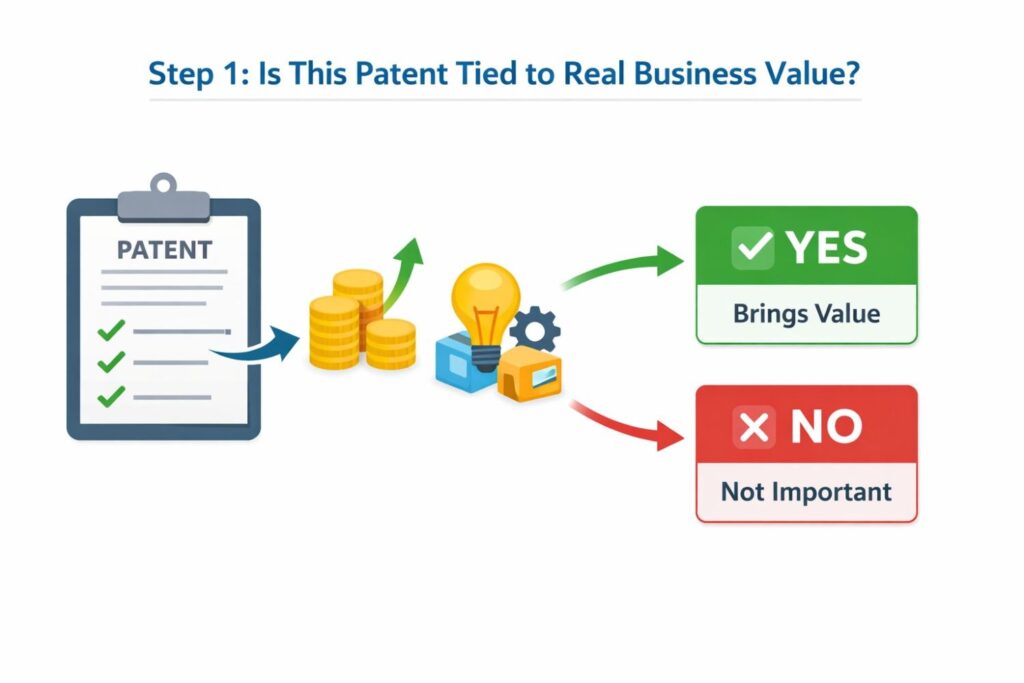
Take a hard look at your current application or idea. Does it protect the main thing customers buy from you? Or does it protect a small branch of the tree?
If it is the branch, you need to question whether this deserves long-term investment. If it is the trunk, then you are likely looking at something worth keeping and strengthening.
Map the Patent to Revenue
A patent that does not connect to money is often just an expensive trophy.
Pull up your revenue model. Look at how you make money today. Then look at how you plan to make money in the next two to three years. Does this patent protect something that directly supports that revenue?
For example, if your business runs on a subscription model powered by a unique optimization engine, your patent should focus on that engine.
If your business sells hardware with a breakthrough sensor design, that design should be the center of your protection.
If the patent covers something that does not influence pricing, conversion, retention, or differentiation, you should think twice.
One powerful exercise is this: imagine a competitor copies the exact thing described in your patent. Would that hurt your revenue? Would it slow your growth?
Would it reduce your valuation? If the answer is no, you may not need to keep pushing that patent forward.
Check Alignment with Your Long-Term Vision
Startups evolve. Roadmaps shift. Markets change.
A patent can take years to fully mature. So you must ask: will this invention still matter when we are three stages ahead?
Look at your product roadmap. Look at your next major releases. Look at where your team is investing time and engineering talent. Is the patent aligned with that future?
Or is it tied to an early version of your product that you are already moving past?
If the invention is tied to a direction you are abandoning, that is a strong signal. It may be time to narrow it heavily or even abandon it.
On the other hand, if this patent protects something that will remain central as you scale, that is a green light. That is a sign this asset grows with you.
Understand What Investors Actually Care About
Many founders believe patents impress investors by default. That is not true.
Investors care about defensibility. They care about whether you can hold your position in the market long enough to grow big.
When you review your patent, ask yourself: does this create a real barrier to entry? Or is it just a technical detail?
A patent tied to your core tech stack, your data processing flow, or your model training method can show strong defensibility. A patent tied to a minor interface detail usually does not.
Before you decide to keep investing in a patent, think about your next fundraising round. Imagine an investor asking, “How does this patent protect your moat?”
If you cannot answer that in one clear sentence, you may need to rethink your strategy.
This is where clarity matters. With the right guidance and smart software, you can shape your patent so it clearly protects what makes you hard to copy.
If you want to see how that works in practice, you can explore it here: https://powerpatent.com/how-it-works.
Test for Competitive Pressure
A patent becomes valuable when others want what you built.
Look at your competitors. Are they building similar features? Are they moving into your space? Are they hiring for roles that suggest they are working on similar tech?
If the answer is yes, and your patent covers that territory, that is strong business value. It means you are protecting something real.
If no one else seems to care about that technical area, it may not be a priority. That does not mean it has zero value. But it does mean you should weigh the cost carefully.
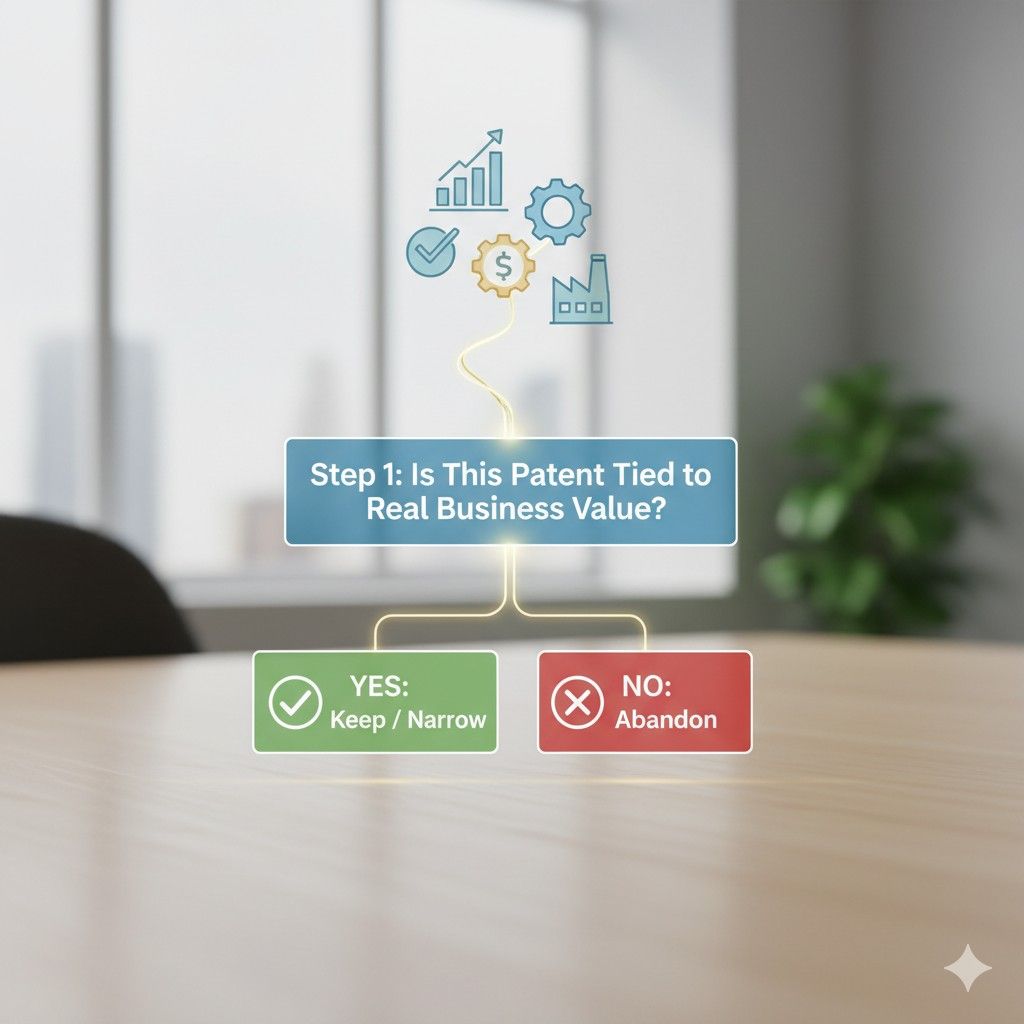
You can also look at the broader market. Is this problem growing? Are more companies entering this space? Is this technology becoming standard? If so, owning strong protection here could give you long-term leverage.
Tie the Patent to Strategic Control
Business value is not only about revenue. It is also about control.
Ask yourself: does this patent give us leverage in partnerships? Could it help in licensing deals? Could it block a large competitor from entering our niche?
If your patent protects a foundational method or system that others will likely need, that is powerful. It can become a negotiation tool. It can become a strategic asset during acquisition talks.
But if the patent protects something easy to design around, its control value drops. In that case, you may want to narrow it to focus on what is truly hard to replace.
Evaluate the Risk of Being Copied
Think about how easy it would be for someone to replicate your solution.
If your invention is easy to reverse engineer, a patent becomes more important. It may be your only real shield.
If your invention relies heavily on internal data, secret processes, or know-how that cannot be easily observed, you might rely more on trade secrets. In that case, filing and maintaining a broad patent may not always be the best use of funds.
This is a subtle but critical point. Business value comes from protection that matches the real risk. A patent that protects something already hidden may not bring as much return as one that guards a visible, high-risk feature.
Look at the Cost Through a Business Lens
Every patent decision is also a capital allocation decision.
Money spent on legal fees is money not spent on engineers, marketing, or product growth. That does not mean patents are not worth it. It means they must earn their place.
If this patent supports your core growth engine, it is likely worth the investment. If it does not, you should question whether the funds could generate more value elsewhere.
Smart founders treat patent budgets like product budgets. They invest where the upside is clear.
Pressure Test the Patent with Your Team
You do not have to decide alone.
Bring your CTO, product lead, and even your head of sales into the discussion. Explain what the patent covers in simple terms. Then ask them: if we lost this protection, what would happen?
Their answers will reveal a lot. If the room shrugs, that is a signal. If the room reacts strongly and explains real risks, that is also a signal.
Sometimes technical founders overvalue certain innovations because they are proud of them. There is nothing wrong with that. But business value must come first.
Focus on What Makes You Unique
At the end of the day, patents should protect uniqueness.
What is the one thing your company does differently from everyone else? The one thing that makes customers choose you?
If your patent covers that difference, it is likely tied to real business value. If it does not, you may need to rethink your focus.
When you are clear about what truly drives your advantage, patent decisions become much easier. You stop filing out of fear. You stop maintaining weak applications.
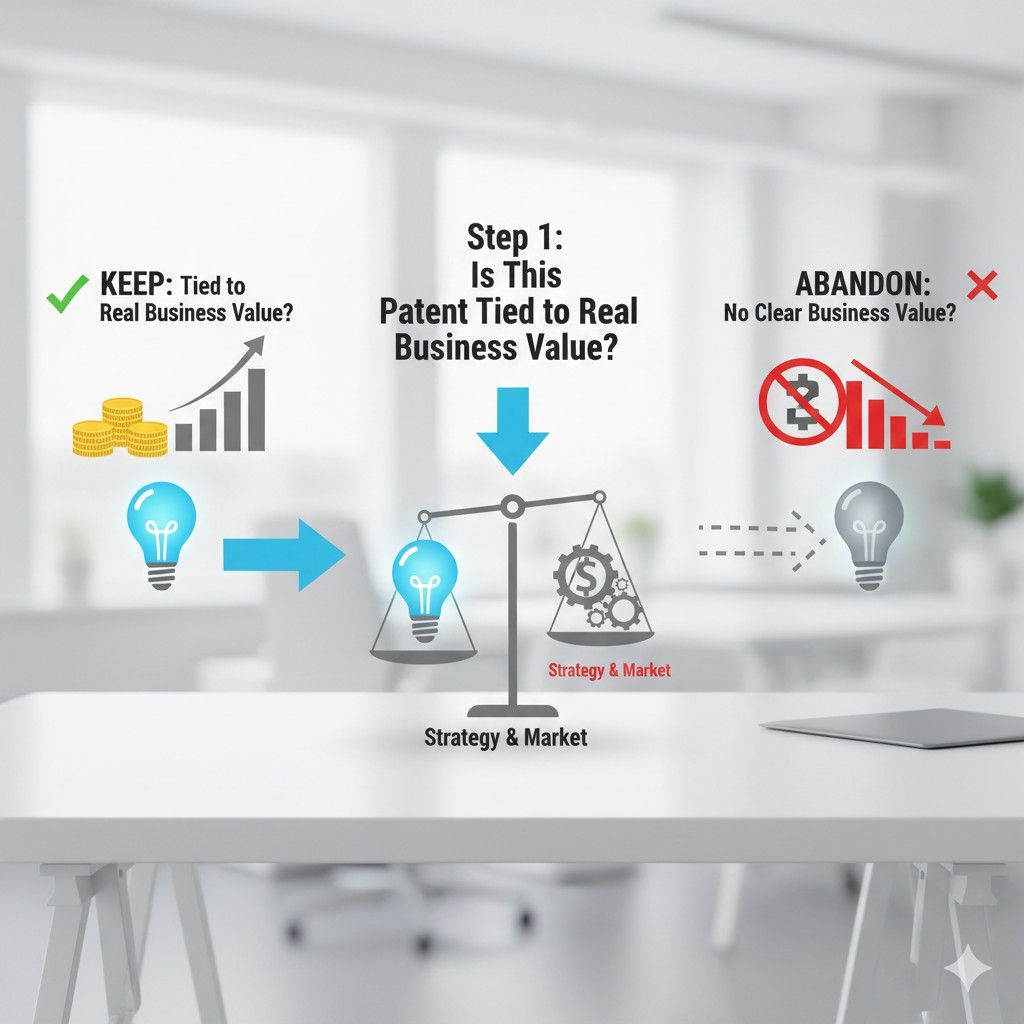
You start building a clean, focused portfolio that supports your mission.
And if you want help turning your core tech into strong, focused protection without slowing down your team, you can see how PowerPatent combines smart software with real attorney oversight to make that process simple and fast: https://powerpatent.com/how-it-works.
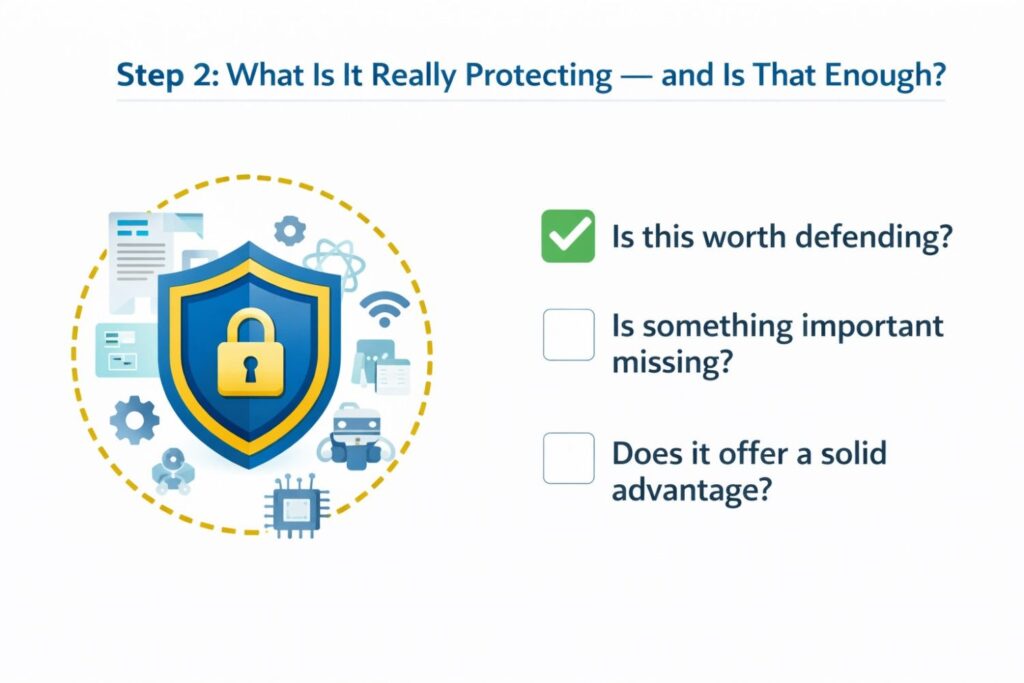
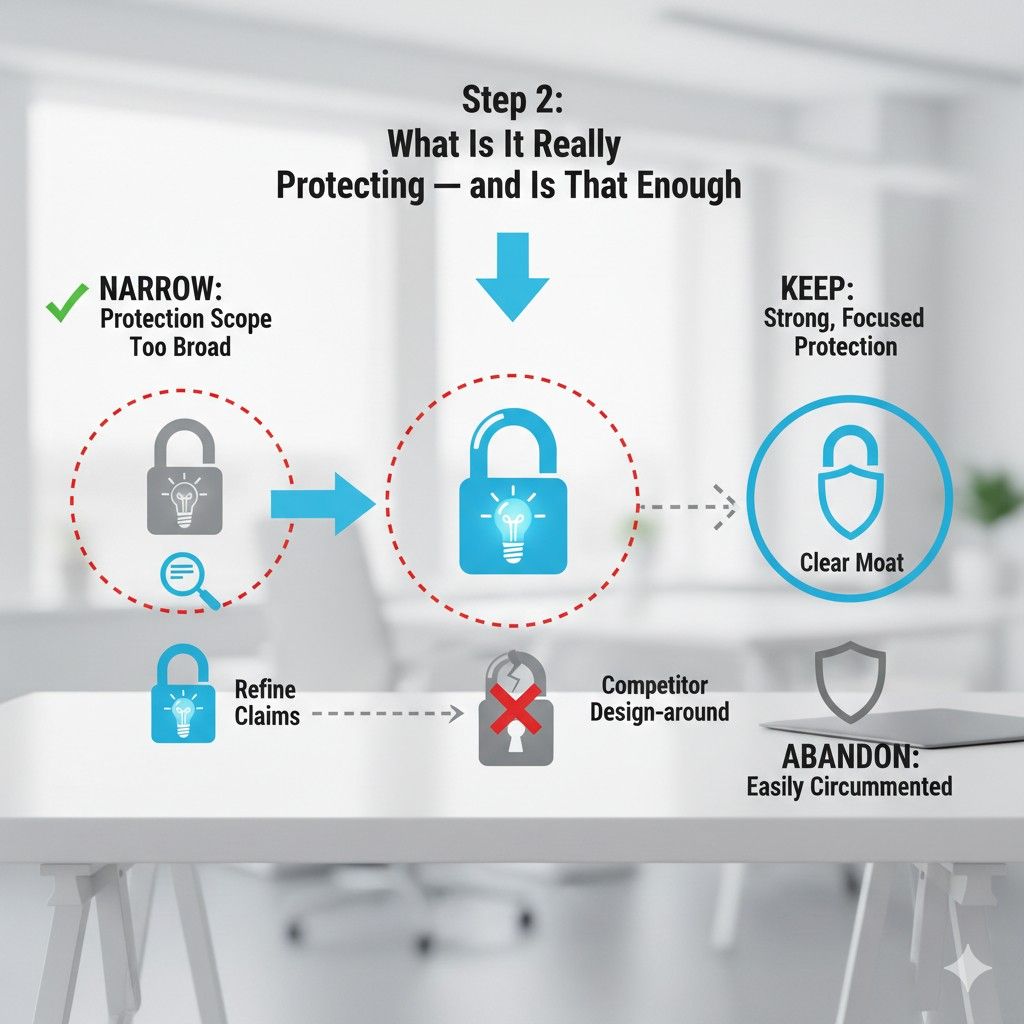
Step 2: What Is It Really Protecting — and Is That Enough?
Now that you have looked at business value, you need to zoom in on the patent itself.
Not the idea in your head. Not the pitch version. The actual claims. The real scope. The words on paper that define what you own.
This is where many founders get surprised. They think they protected the whole castle. In reality, they protected one window.
This step is about clarity. You must understand what your patent truly covers, how wide it reaches, and whether that protection is strong enough to matter in the real world.
Read the Claims Like a Competitor
The claims are the heart of your patent. They define the fence around your invention.
Instead of reading them as the inventor, read them as a competitor who wants to avoid them.
Imagine you are a well-funded startup trying to build something similar. Could you tweak one step and stay outside the fence? Could you swap one component and avoid infringement? Could you rearrange the order and slip past?
If the answer is yes, your patent may be too narrow.
This is not about ego. It is about survival. A patent that is easy to design around may not deliver real protection.
You want claims that cover the core logic, not just one specific example. You want them to protect the concept in a meaningful way, not just the first version you built.
Separate the Idea from the Wording
Many founders confuse the idea with the legal coverage.
You may have invented a powerful machine learning system that adapts in real time. But if your patent only describes one specific model structure with fixed steps, that is all you may actually own.
The gap between what you built and what the patent protects can be large.
Take time to ask: does this patent capture the principle behind the invention, or does it just describe one implementation?
If it only describes a narrow implementation, you may want to narrow it further and make it sharper. Or you may need to continue prosecution and adjust the claims to better match your true innovation.
This is where having real attorney oversight combined with software that understands your tech can make a huge difference. It helps ensure your patent reflects your invention, not just a rushed snapshot.
You can see how that works in practice here: https://powerpatent.com/how-it-works.
Check If the Claims Cover Your Current Product
Your product has likely evolved since the patent was first drafted.
Pull up your latest architecture diagram. Compare it to the patent claims. Do they still match?
If your product now works in a slightly different way, and the patent does not clearly cover that version, you have a risk. You may think you are protected when you are not.
This is common in fast-moving startups. You ship updates. You refine models. You change infrastructure. Meanwhile, your patent stays frozen in time.
If the gap is small, you may be able to adjust the claims during prosecution. If the gap is large, you may need to rethink whether to keep investing in that application.
Evaluate the Breadth Without Losing Strength
Broad patents sound powerful. But broad claims that are too vague often get rejected or become weak.
The goal is not to be as wide as possible. The goal is to be wide enough to protect the core concept, while still being clear and defensible.
Ask yourself: does this patent cover the general approach others would use to solve the same problem? Or does it lock into one very specific method?
If competitors would likely use a different technical path, your patent may not stop them.
At the same time, if the claims are so broad that they barely describe a concrete solution, they may not survive challenges.
You need balance. Strong patents protect the essential steps that make the system work, not every small detail.
Look for Gaps in Key Technical Steps
Break down your invention into its major components.
There is usually data input. Processing. Decision logic. Output. Feedback. Integration.
Now look at the claims. Do they clearly cover each major stage that gives your system its advantage?
If a key step is missing from the claims, that is a warning sign. A competitor could copy that critical element and adjust something minor to avoid your patent.
You want to make sure the unique steps that drive performance are explicitly protected.
This requires thinking like both an engineer and a strategist. You are not just describing how something works. You are identifying what truly makes it better.
Consider Future Variations
Your current product is version one.
What about version three? What about when you scale to new industries? What about when you move from on-premise to cloud, or from centralized models to edge devices?
Does the patent language allow for those future shifts?
If your claims are locked into one deployment environment or one data type, you may limit your future flexibility.
A strong patent grows with you. It protects the invention across variations that are reasonably expected as the company evolves.
If the current scope feels too tied to your early-stage setup, it may need refinement. Otherwise, you risk outgrowing your own protection.
Assess Enforcement Reality
Protection only matters if it can be enforced.
Ask yourself a simple question: if someone infringed this patent, would we be able to detect it?
For example, if your claims focus on internal model training steps that are never visible from the outside, it may be very hard to prove infringement.
On the other hand, if your patent covers observable system behavior or structural features that can be analyzed, enforcement becomes more practical.
This does not mean you should avoid protecting internal processes. But you should understand the enforcement challenge.
A patent that cannot realistically be enforced may have limited practical value.
Align Scope with Strategic Goals
Think about your exit strategy.
If you plan to be acquired by a larger company, your patent portfolio will be reviewed closely. Buyers will look at claim strength, coverage, and alignment with the product.
They will ask whether your patents protect technology that integrates into their ecosystem.
If your current application covers a niche corner that does not align with your broader positioning, it may not add much value during acquisition talks.
On the other hand, if it covers a foundational method that fits into larger platforms, that increases strategic appeal.
Your patent scope should not exist in isolation. It should support your long-term plan.
Decide If It Needs Narrowing or Strengthening
At this stage, you are not deciding whether to abandon yet. You are diagnosing.
If the patent protects the right business area but feels too broad and weak, you may need to narrow it to focus on the most defensible aspects.
If it protects the right core but misses key variations, you may need to strengthen it by adjusting claims.
If it protects something that no longer matches your product or strategy, that is when abandonment becomes a serious option.
The key is clarity. When you understand exactly what your patent covers and what it does not, decisions become less emotional and more strategic.

And when you combine that clarity with a platform that helps you draft, review, and refine patents with both smart AI tools and real attorneys, you move faster and avoid costly blind spots.
If you want to see how that can work for your team, explore it here: https://powerpatent.com/how-it-works.
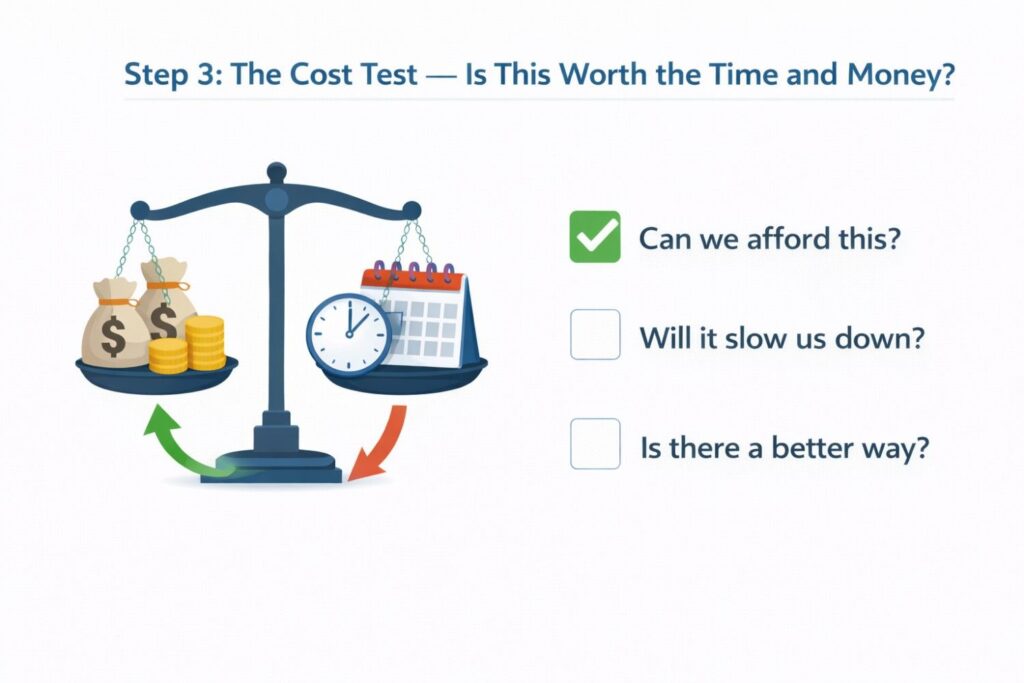
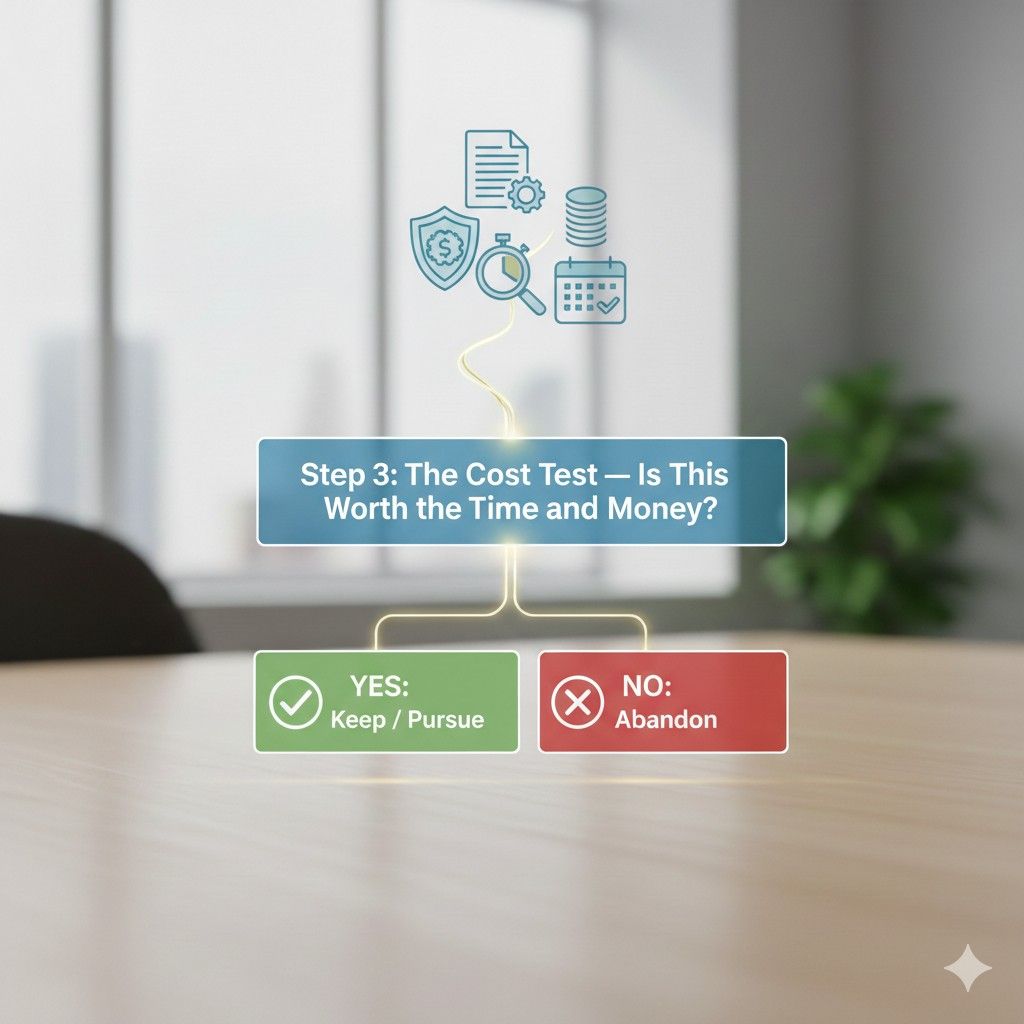
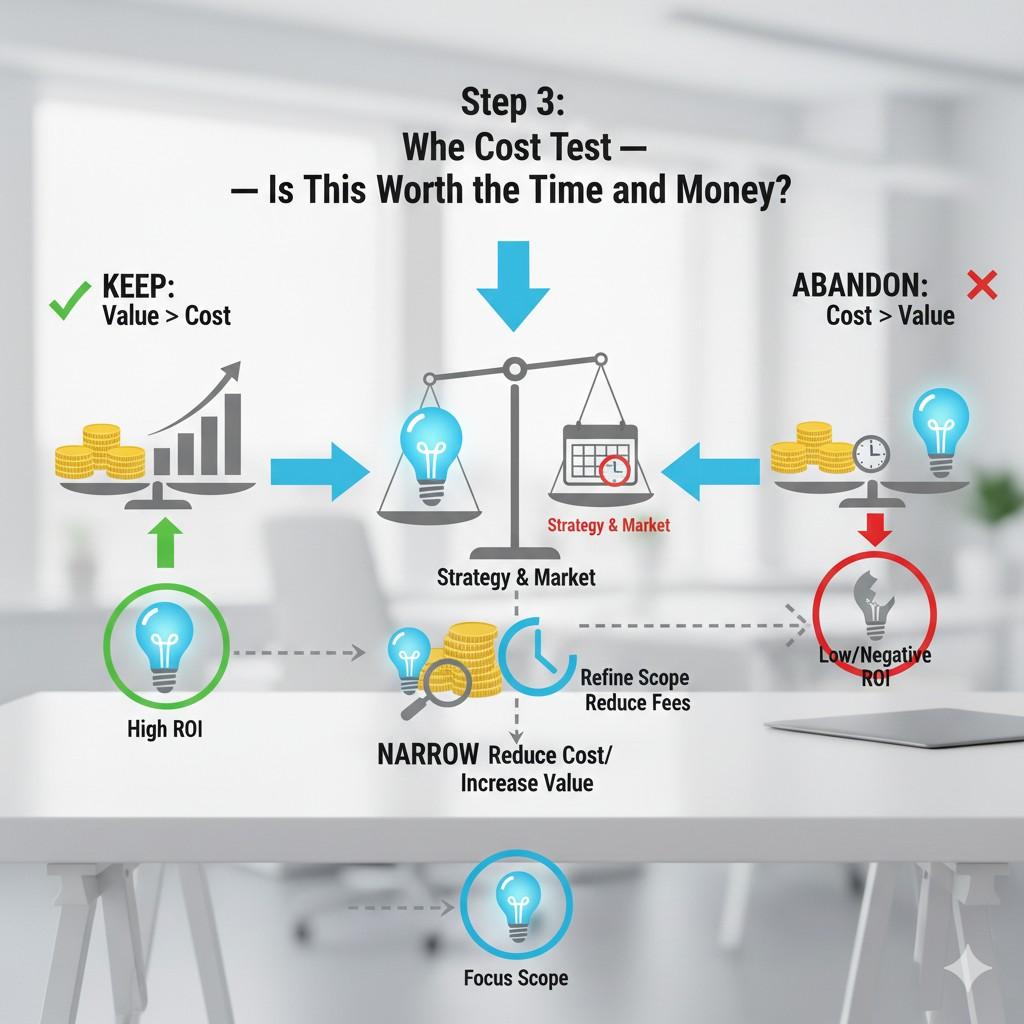
Step 3: The Cost Test — Is This Worth the Time and Money?
Now we get practical.
Even if a patent is tied to real business value. Even if the claims are strong and well-shaped. There is still one more filter you must apply.
Can your company afford to carry this forward right now?
Patents are not just legal assets. They are long-term financial commitments. Filing is only the start.
There are office actions, responses, amendments, issue fees, maintenance fees, and sometimes foreign filings. Each step takes money. Each step takes focus.
This is not about fear. It is about discipline.
You are building a company. Every dollar has a job. Every hour of leadership attention has a cost. So the real question becomes simple: is this patent one of the highest-return investments you can make with your current resources?
Think in Terms of Opportunity Cost
Money spent on patents cannot be spent somewhere else.
If you invest twenty thousand dollars into pushing a patent forward, what are you not doing? Are you delaying a key hire? Slowing down product development? Postponing marketing experiments?
This does not mean patents are a bad use of funds. It means they must compete with other growth levers.
Imagine you have limited runway. Which move gets you closer to traction or the next round? Strengthening your moat around a core algorithm? Or adding two new engineers who help you ship faster?
The right answer depends on your stage.
Early stage startups often need speed and proof more than paperwork. Growth stage startups often need defensibility and leverage.
So ask yourself honestly: at this moment, where does this patent rank among your top three growth priorities?
If it is not near the top, that tells you something.
Understand the Full Life Cycle Cost
Many founders only look at the immediate bill.
They see the cost to respond to the current office action. They see the next invoice. But they do not zoom out.
A patent can live for twenty years. During that time, there are recurring payments to keep it alive. If you plan to file in multiple countries, costs multiply fast.
Before deciding to keep pushing forward, model the long-term cost.
Ask yourself: if this patent issues, are we willing to maintain it for a decade or more? Do we see ourselves defending it? Licensing it? Using it in negotiations?
If you cannot see that future clearly, it may not justify the ongoing commitment.
Strong portfolios are focused. Weak portfolios grow by habit.
Evaluate the Stage of Prosecution
Where is this patent in the process?
If it is early and you have already received strong pushback from the examiner, continuing may require narrowing the claims significantly. That can reduce value.
If it is close to allowance and only minor changes are needed, the cost to finish may be reasonable compared to the benefit of having an issued patent.
Timing matters.
Abandoning something you have heavily invested in feels painful. But sunk cost is not strategy. What matters is the expected future value compared to the remaining cost.
Look forward, not backward.
Factor in Your Fundraising Timeline
If you plan to raise capital soon, having a pending or issued patent in a key area can strengthen your story.
Investors like signals of defensibility. They like seeing that you are thinking long-term.
But timing is critical.
If your patent will not meaningfully progress before your next raise, its short-term impact may be limited. In that case, pushing hard right now may not create immediate leverage.
On the other hand, if a well-timed filing or continuation can show expansion of your moat, that may support your narrative.
Map your patent spend to your fundraising milestones. Align the two.
Consider the Signal to Competitors
Patents also send a message.
When competitors see published applications in their space, they take note. It may cause them to adjust strategy. It may slow them down.
But only if the patent looks serious.
If your application is narrow or easy to work around, it may not create real pressure.
So ask yourself: does continuing this patent strengthen our visible position in the market? Or is it unlikely to change competitor behavior?
If it meaningfully strengthens your signal, that can justify cost.
If not, you may want to focus on fewer, stronger filings instead of many weak ones.
Balance Focus with Complexity
Every active patent requires management.
You need to track deadlines. Review drafts. Approve responses. Coordinate with counsel. Align claims with product changes.
This takes mental space.
If your team is small and already stretched thin, adding complexity may slow execution.
Some founders underestimate this burden. They file broadly and then struggle to manage the portfolio.
A lean strategy often works better. Fewer patents. Tighter scope. Strong alignment with product.
Quality over quantity.
Think About Licensing Potential
Not all patents are defensive. Some can generate revenue.
If this invention could be licensed to others, especially companies outside your core market, that increases its potential return.
But be realistic.
Licensing requires effort. It requires enforcement. It often requires scale.
If you do not see a clear path to licensing or strategic use, then the patent’s value must come from protecting your own product.
And if it does not clearly do that, the cost test becomes harder to pass.
Use Data, Not Emotion
It is easy to fall in love with your inventions.
You spent late nights building them. You solved hard problems. Filing a patent feels like recognition.
But business decisions must be rational.
Try this exercise. Write down the estimated remaining cost to bring this patent to issuance and maintain it for five years. Then write down the realistic business upside if it succeeds. Increased valuation. Reduced competitive risk. Licensing potential.
If the upside is vague and the cost is concrete, that tells you something.
If the upside is clear and meaningful, the investment may be justified.
Clarity removes stress.
Build a Repeatable Framework
Patent triage should not be random. It should follow a repeatable method.
Every time you receive an office action or face a renewal deadline, run the same questions. Business value. Scope strength. Cost versus return.
Over time, this creates discipline.
This is where having a system matters. When your patent process is organized, transparent, and connected to your product roadmap, decisions become faster and smarter.
PowerPatent was built with this in mind. It helps founders see their patents clearly, align them with real business goals, and move quickly with both AI support and real attorney guidance.
If you want to see how that can reduce waste and increase confidence, you can explore it here: https://powerpatent.com/how-it-works.
At this point, you should have clarity on value, scope, and cost.
Now comes the final step.
Step 4: Make the Call — Keep, Narrow, or Abandon with Confidence
This is where founders hesitate.
You have looked at business value. You have reviewed what the patent really protects. You have measured cost against return. Now you must decide.
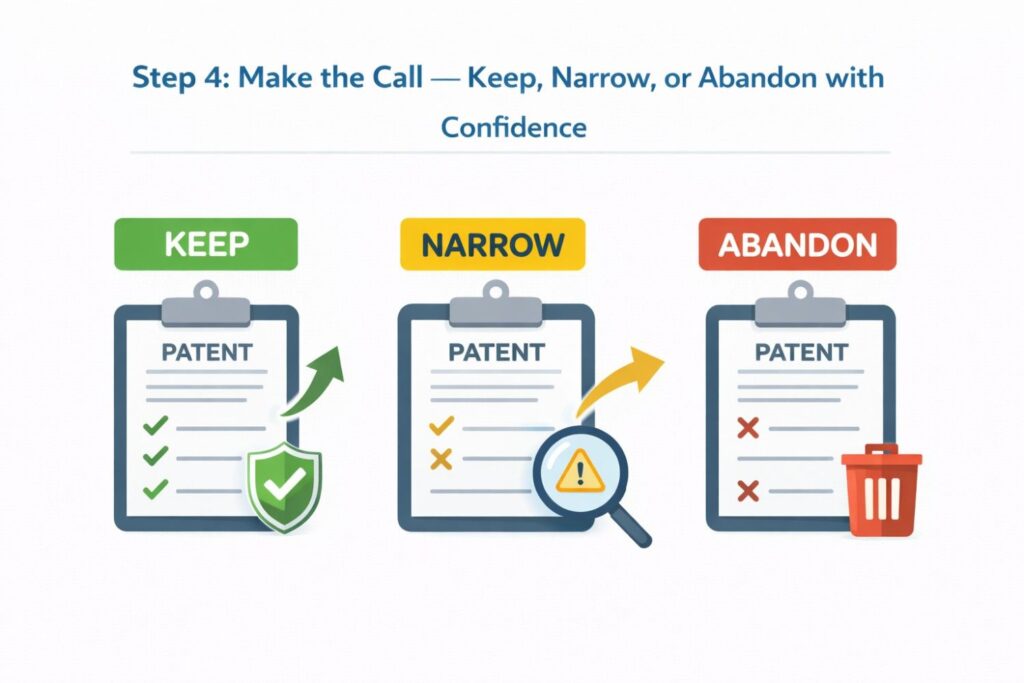
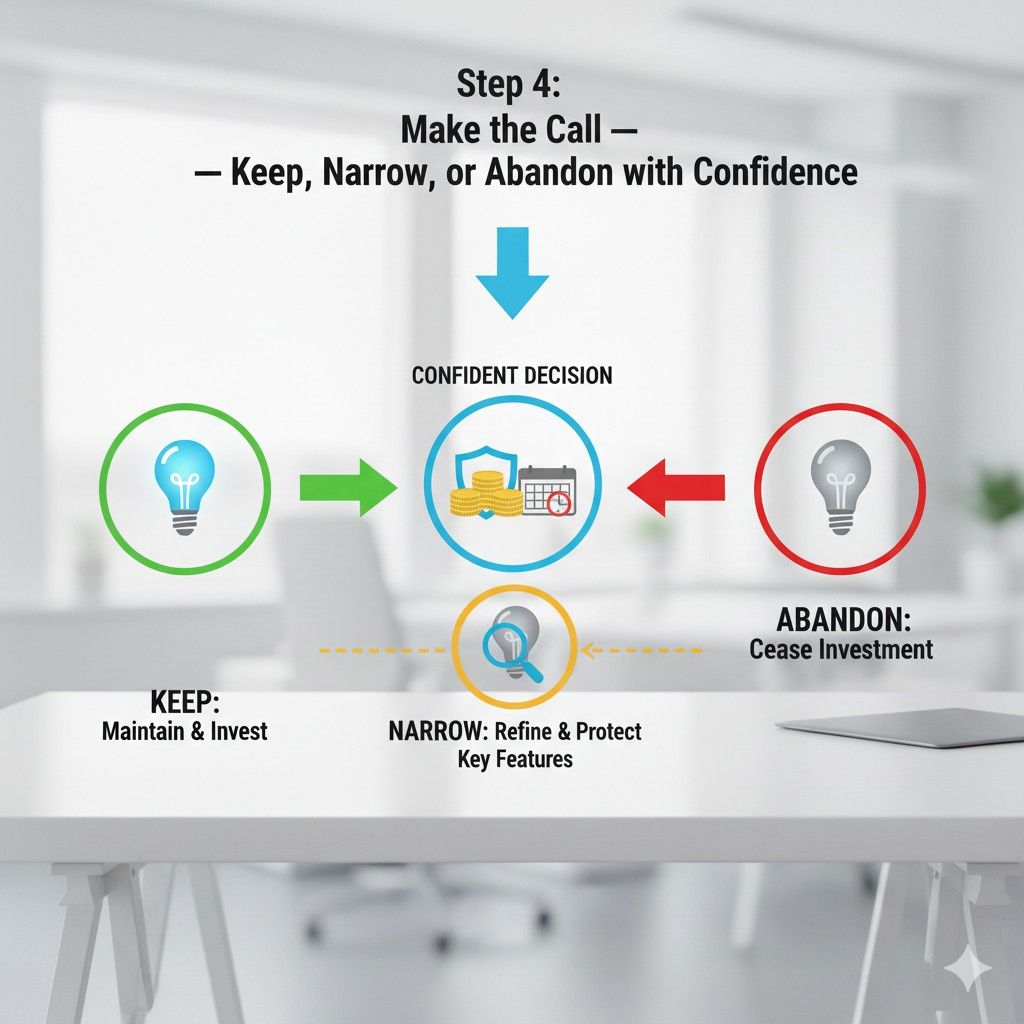
Keep pushing forward. Narrow and sharpen. Or walk away.
The worst choice is not abandoning. The worst choice is drifting. Paying fees without conviction. Responding to office actions out of habit. Letting patents run on autopilot.
Strong companies make clean decisions. They act with intention. This step is about doing exactly that.
When to Keep and Push Hard
If the patent protects your core advantage, aligns with your roadmap, and can create real leverage, the answer is simple. Keep it. But do not just maintain it. Strengthen it.
Pushing forward means being proactive.
Work with counsel to tighten the claims around what truly matters. Make sure the language reflects how your product actually works today, not how it worked two years ago.
Consider filing continuations if there are related aspects worth protecting. Think ahead about international coverage if your market is global.
Keeping a patent should feel like doubling down on a strategic asset, not babysitting paperwork.
When you choose to keep, you are saying this invention is part of our long-term foundation. Treat it that way.
When to Narrow with Precision
Sometimes the invention is valuable, but the current claims are too wide or too scattered.
This is where narrowing becomes smart strategy, not weakness.
Narrowing can increase the chance of allowance. It can create a focused, defensible patent around the exact technical edge that makes you different. It can reduce back-and-forth with the examiner and lower ongoing cost.
But narrowing must be deliberate.
Do not narrow randomly just to get it allowed. Narrow around the feature that drives performance, the step that competitors cannot easily replace, the mechanism that gives you a measurable advantage.
For example, if your system includes five modules but only one creates the real breakthrough, concentrate the claims there. Protect the beating heart, not the entire body.
A narrow but strong patent is often more valuable than a broad but fragile one.
When to Abandon Without Regret
Abandoning feels emotional. It can feel like failure.
It is not.
It is focus.
If the patent no longer aligns with your product direction, if the cost outweighs the likely return, or if the claims cannot be shaped into meaningful protection, letting go is a disciplined move.
The key is to make that decision consciously.
Before you abandon, ask one final question. Is there any core concept inside this application that is still valuable and worth pursuing in a different form? If yes, consider whether a continuation or new filing makes sense before closing the door.
If the answer is no, then close it cleanly.
Free up the capital. Free up the attention. Reallocate both to stronger assets.
Serious companies prune. They do not hoard.
Remove Emotion from the Decision
One of the biggest traps in patent strategy is attachment.
You remember the moment of invention. The whiteboard session. The breakthrough insight. The first working prototype.
But markets move. Products evolve. Strategy shifts.
The patent exists to serve the business, not the memory.
If you feel resistance to abandoning, write down the objective reasons to keep it. If those reasons are weak, that is your signal.

Decisions become easier when they are grounded in data and alignment, not pride.
Document the Reason Behind the Choice
Whatever you decide, record why.
Write a short internal memo. Explain the business value, the scope analysis, the cost review, and the final decision.
This does two things.
First, it creates clarity across the team. Everyone understands why you kept, narrowed, or abandoned.
Second, it builds a repeatable playbook. The next time you face a similar decision, you have a reference point.
Patent strategy should mature as your company matures. Documentation helps that growth.
Align the Decision with Your Growth Stage
A pre-seed startup may decide to abandon more aggressively to conserve cash and focus on speed.
A Series B company entering a competitive market may decide to keep and expand protection aggressively.
Neither is wrong. Context matters.
The mistake is copying another company’s strategy without considering your own stage.
Make sure your final call matches your runway, your traction, and your risk level.
Turn Decisions into Action
A decision without execution creates confusion.
If you choose to keep, schedule the next steps immediately. Review claims. Plan responses. Map timelines.
If you choose to narrow, coordinate with counsel and define the exact features to focus on.
If you choose to abandon, formally close the file and update your internal tracking.
Clean execution reinforces discipline.
This is where having the right infrastructure helps. When your patent workflow is organized, visible, and integrated with real attorney oversight, moving from analysis to action becomes smooth instead of stressful.
PowerPatent was designed to make these moments easier. You can review your inventions, shape strong claims, and make informed decisions without the delays and chaos that often come with traditional firms.
If you want to see how founders are doing this in a faster, clearer way, explore it here: https://powerpatent.com/how-it-works.
Build a Lean, Powerful Portfolio
When you complete this triage process across your patents, something powerful happens.
Your portfolio becomes focused.
Each patent left standing has a clear reason to exist. It protects real business value. It aligns with your roadmap. It justifies its cost.
This kind of portfolio sends a strong signal to investors, partners, and acquirers. It shows discipline. It shows strategy. It shows that you understand how to turn innovation into defensible assets.
And most importantly, it gives you confidence.
You are no longer guessing. You are not filing out of fear. You are not maintaining out of habit.
You are building protection that supports growth.
That is the goal.
Wrapping It Up
Patent strategy should never feel like fog. You should not feel confused about what you own. You should not feel unsure about why you are paying to maintain something. And you should never feel trapped by past filing decisions. When you run a clean triage process, everything sharpens.
Leave a Reply