You worked hard to build your invention. You wrote the code. You tested the model. You fixed the bugs at 2 a.m. Now you have a patent—or you are about to file one. But here’s the real question no one explains clearly: is this patent worth keeping over time? Every year, renewal fees show up. They do not care if you are busy fundraising or shipping product. You have to decide. Do you keep paying? Or do you let it go? This article will show you a very simple way to think about that choice using one clear idea: licensing potential versus renewal cost. If you are building deep tech and want strong, smart protection without wasting money, this will matter.
Before we go deeper, if you want to see how to file strong patents without the usual law firm drag, explore how PowerPatent works here: https://powerpatent.com/how-it-works
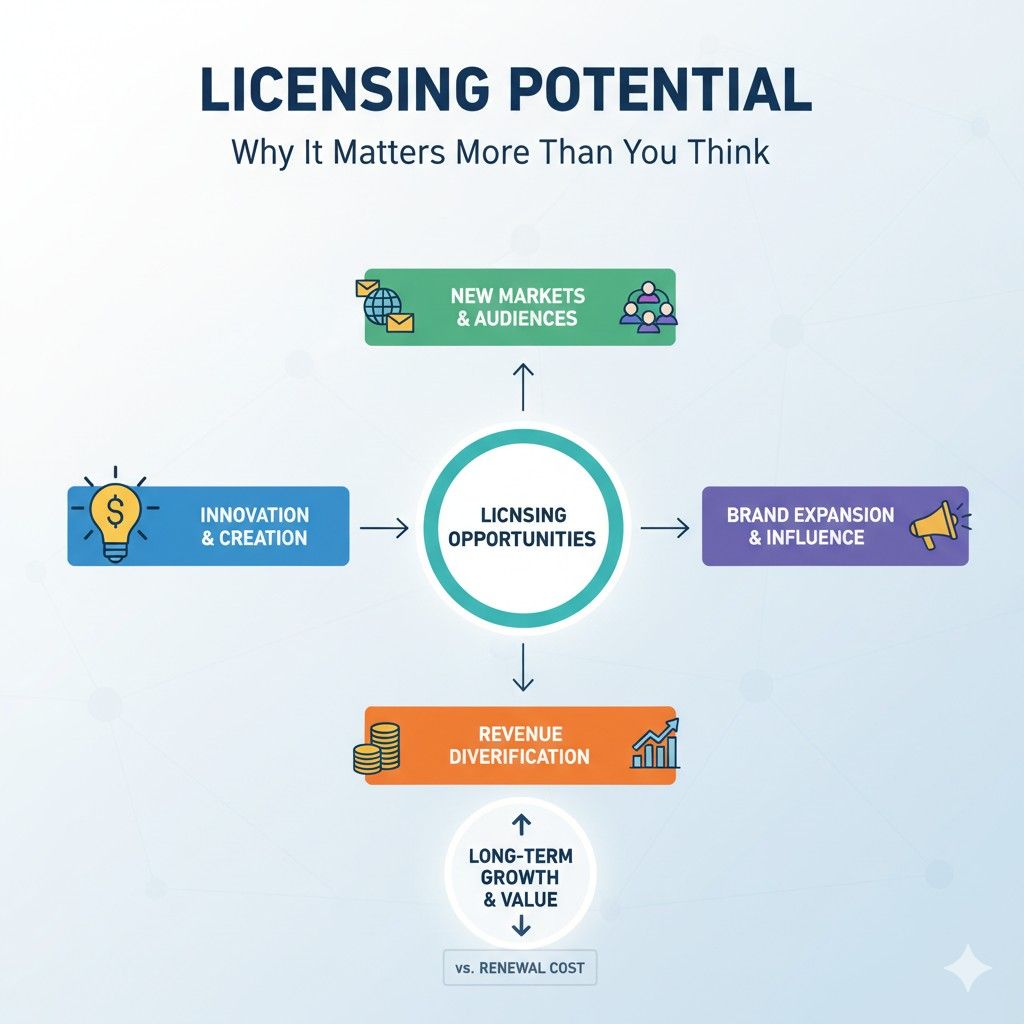
What Is Licensing Potential and Why It Matters More Than You Think
Licensing potential is not about what you hope your patent could earn one day. It is about how real, how likely, and how soon someone else would pay to use what you built.
This is the part most founders skip. They file the patent. They feel safe. Then they move on.
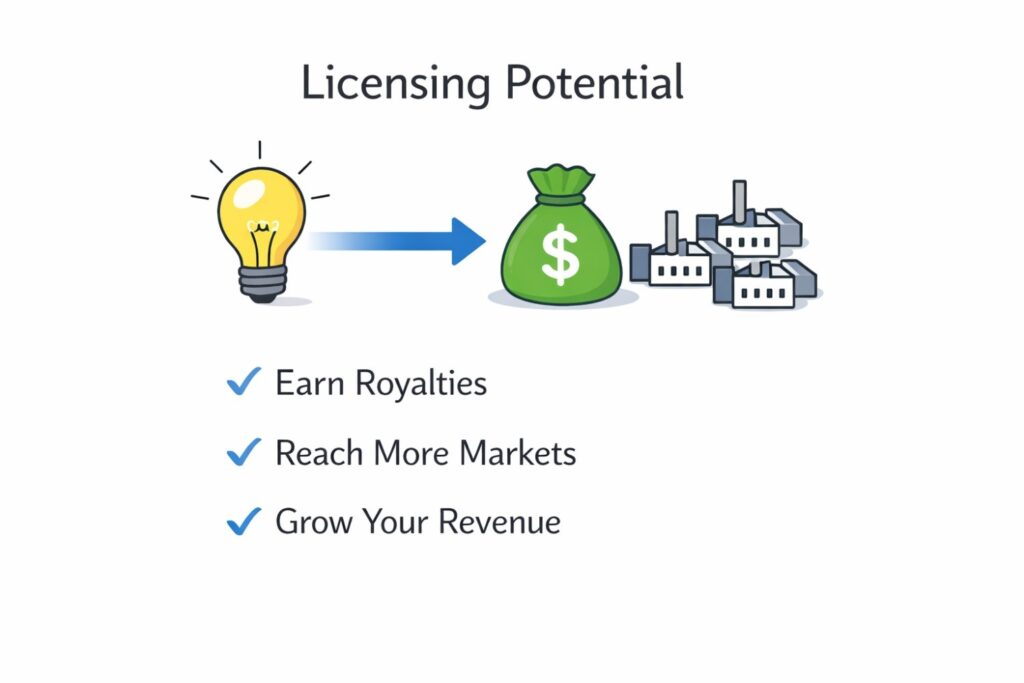
But a patent is not just a shield. It can also be a product. And like any product, it needs demand. If no one would ever pay to use it, then its value is limited to defense. If others would pay, it becomes a revenue engine.
Understanding this difference changes how you think about renewals. You stop seeing fees as a cost. You start seeing them as an investment tied to a real opportunity.
Licensing Potential Is About Market Pull, Not Personal Pride
It is easy to love your own invention. You know how hard it was to build. You know how clever the solution is. But licensing potential does not care about your effort. It cares about market pull.
Ask yourself a very direct question: if your biggest competitor could legally use your patented idea tomorrow, would they?
If the answer is yes, then you may be sitting on real licensing power. If the answer is no, then the patent may only serve as a defensive tool.
A smart move here is to map your patent to actual revenue streams in your industry. Look at companies that sell similar products. Study how they make money.
Then ask whether your patent covers a feature they depend on. If it does, you have leverage. If it only covers something minor that users barely notice, the licensing potential is weak.
At PowerPatent, we often help founders think about this before filing. When you understand licensing potential early, you draft claims that matter.
That makes renewals easier to justify later. If you want to see how that works in practice, take a look here: https://powerpatent.com/how-it-works
The Difference Between Defensive Value and Licensing Value
Not all patents are built for licensing. Some exist to stop lawsuits. Others exist to block competitors from copying core tech. That is defensive value. It is important, especially in crowded markets.
Licensing value is different. It means another company needs what you built to make money. And they would rather pay you than redesign their product. That is power.
You can test this by imagining a simple scenario. A company launches a product that overlaps with your patent. Would they have to change something major to avoid your claims? \
If yes, your patent has teeth. If they could swap in a small workaround in a week, your licensing power drops.
A strong licensing patent often covers something deep in the system. It might be in the model architecture, the training method, the hardware integration, or a key workflow that users rely on. It is not surface-level decoration. It is structural.
When you draft patents with this in mind, you are not just protecting an idea. You are planting flags in places others cannot easily avoid.
Timing Changes Licensing Potential
Licensing potential is not fixed. It grows and shrinks over time.
Early on, your patent may have low licensing value because the market is small. Few players exist. Revenue is limited. But as the space grows, your patent can become more valuable.
Suddenly, many companies operate in that field. If your claims are broad and well-written, each new player increases your leverage.
This is why long-term thinking matters. When you look at renewal fees, do not only look at today’s revenue. Look at where the market is heading.
A practical step you can take is to track funding rounds in your sector. If venture capital keeps flowing into companies that operate in the technical area your patent covers, that is a signal.
It means more companies may eventually need your technology. That increases licensing potential.
On the other hand, if the market is shrinking or being replaced by a new approach your patent does not cover, renewal may not make sense.
Real Licensing Starts With Claim Strategy
Licensing potential lives inside the claims of your patent. Not in the abstract. Not in the title. Not in the diagrams. In the claims.
If your claims are too narrow, companies can step around them. If they are too vague, they may not hold up. The sweet spot is strong and clear coverage over a meaningful technical advantage.
This is where many startups make costly mistakes. They rush to file. They use templates.
They focus on speed without thinking about future leverage. Years later, when renewal fees come due, they realize the patent does not cover what competitors actually use.
A smarter approach is to align claims with business strategy from day one. Ask what part of your system gives you an edge. Is it lower latency? Better accuracy?
Unique data processing? Then ensure your patent protects that edge in a way that competitors cannot easily design around.
At PowerPatent, we combine software tools with real patent attorneys who understand deep tech. That mix helps founders create patents with real licensing teeth, not just paperwork.
If you care about building assets that can drive revenue, not just sit in a drawer, you can explore the process here: https://powerpatent.com/how-it-works
Licensing Potential Is Strongest When It Connects to Revenue
A patent tied directly to revenue-generating features is far more valuable than one tied to experimental features.
Think about your own product. Which features do customers pay for? Which features drive upgrades or enterprise deals?
If your patent covers those features, it sits at the heart of value creation. That is where licensing potential lives.
You can do a simple internal exercise. Take your top three revenue drivers. Map each one to the patents that protect them. If you cannot draw a clear line from patent to revenue, that patent may have limited licensing strength.
This exercise also helps during renewal season. Instead of asking, “Is this patent interesting?” you ask, “Does this patent protect something customers pay for?” That is a far better filter.
Strong Documentation Makes Licensing Real
Licensing does not happen in theory. It happens in negotiations.
When you approach another company about licensing, or when they approach you, you need clear proof.
Proof that your patent covers what they are doing. Proof that your claims are valid. Proof that you invented first and documented properly.
If your records are messy, if your filings are weak, your licensing potential drops even if the idea is strong.
This is why process matters. Keeping clean invention disclosures. Tracking versions of your models. Saving technical notes. These habits increase your power later.
PowerPatent makes this easier by helping founders turn real technical work into structured patent filings backed by attorneys. When the foundation is strong, licensing discussions become serious.
Without that foundation, they fall apart.
Licensing Potential Can Be Quiet But Powerful
Not every strong patent leads to a public licensing deal. Sometimes its power is silent.
A competitor may see your patent and decide not to enter your space. Or they may choose to partner instead of compete. That silent shift still creates value.
It protects your market share and increases your startup’s leverage in fundraising or acquisition talks.
Investors often look at patents not only as shields but as strategic assets. If your portfolio shows clear licensing potential, it signals that your technology is hard to copy. That can improve valuation.
When renewal time comes, think beyond immediate cash. Think about strategic position. Does this patent help you control a space others want to enter? If yes, its licensing value may extend beyond simple royalty checks.
Turning Insight Into Action
Knowing about licensing potential is not enough. You must act on it.
Start by reviewing your current patents through a licensing lens. Do not look at them as technical trophies. Look at them as business tools.
Ask where competitors might feel pressure. Ask which parts of your claims map to industry standards or common workflows. Ask whether new players entering the space would need your approach.
If you are early and have not filed yet, design your filings with this future in mind. Think about who might license your technology in five years. Draft for that reality, not just today’s product version.
And if you are unsure whether your patents have real licensing strength, get clarity before renewal fees pile up. A smart review now can save tens of thousands later.
If you want a faster, cleaner way to build patents that actually support licensing strategy, not just compliance, explore how PowerPatent works: https://powerpatent.com/how-it-works

Licensing potential is not abstract. It is measurable. It is strategic. And when you understand it clearly, renewal decisions stop feeling emotional. They become simple business choices.
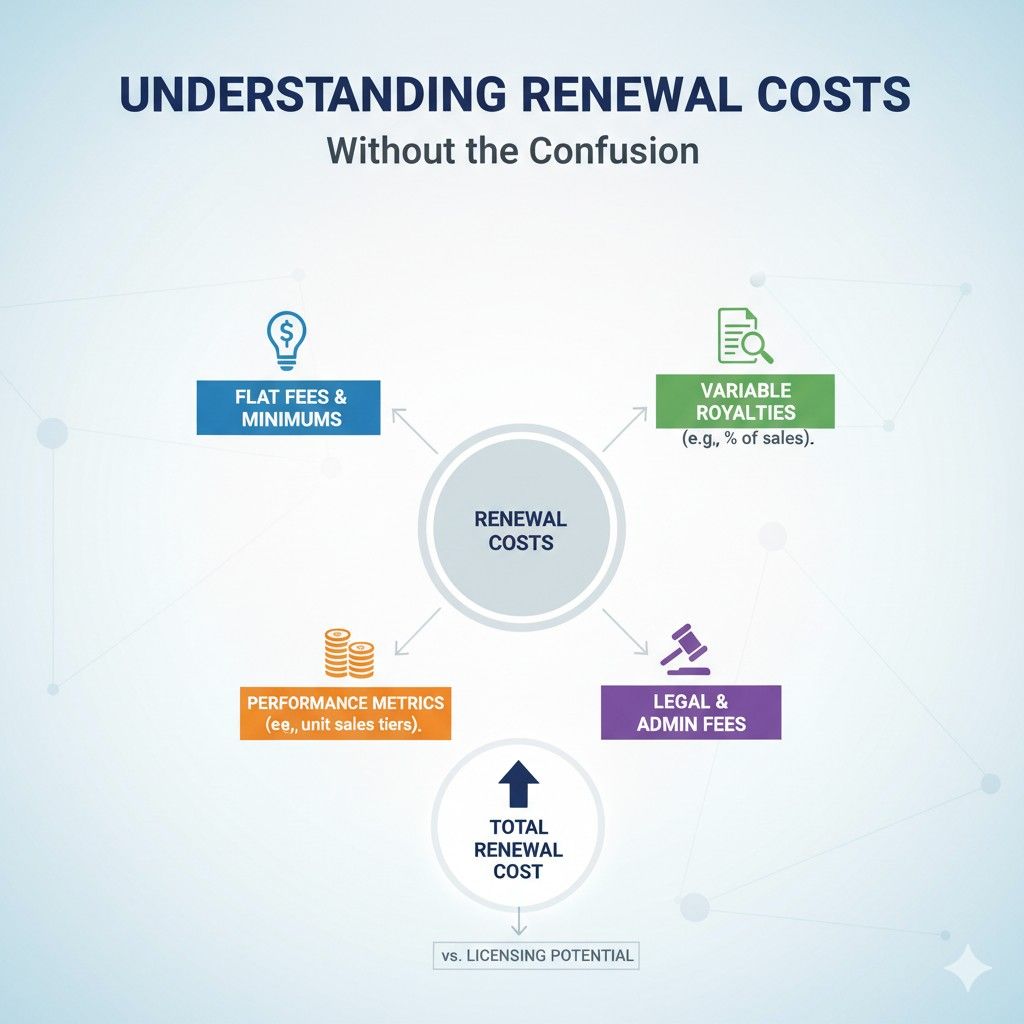
Understanding Renewal Costs Without the Confusion
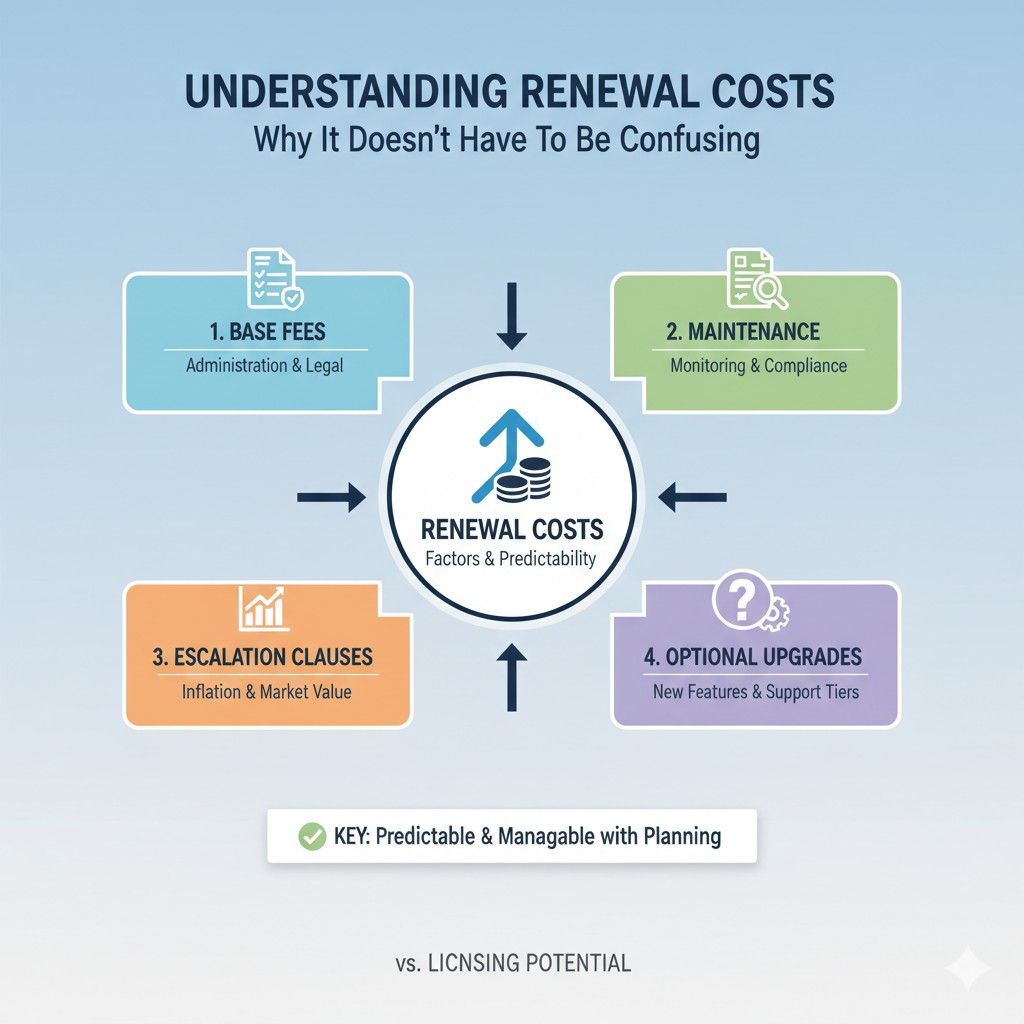
Renewal costs feel simple on the surface. You get a notice. You pay the fee. The patent stays alive. But beneath that surface, renewal decisions are tied to strategy, cash flow, growth plans, investor optics, and competitive pressure.
If you treat renewal as an automatic payment, you miss the bigger picture. If you treat it as an annoying expense, you may kill long-term leverage too early. The goal is not to blindly pay or blindly cut.
The goal is to understand what you are really buying each time you renew.
What You Are Actually Paying For
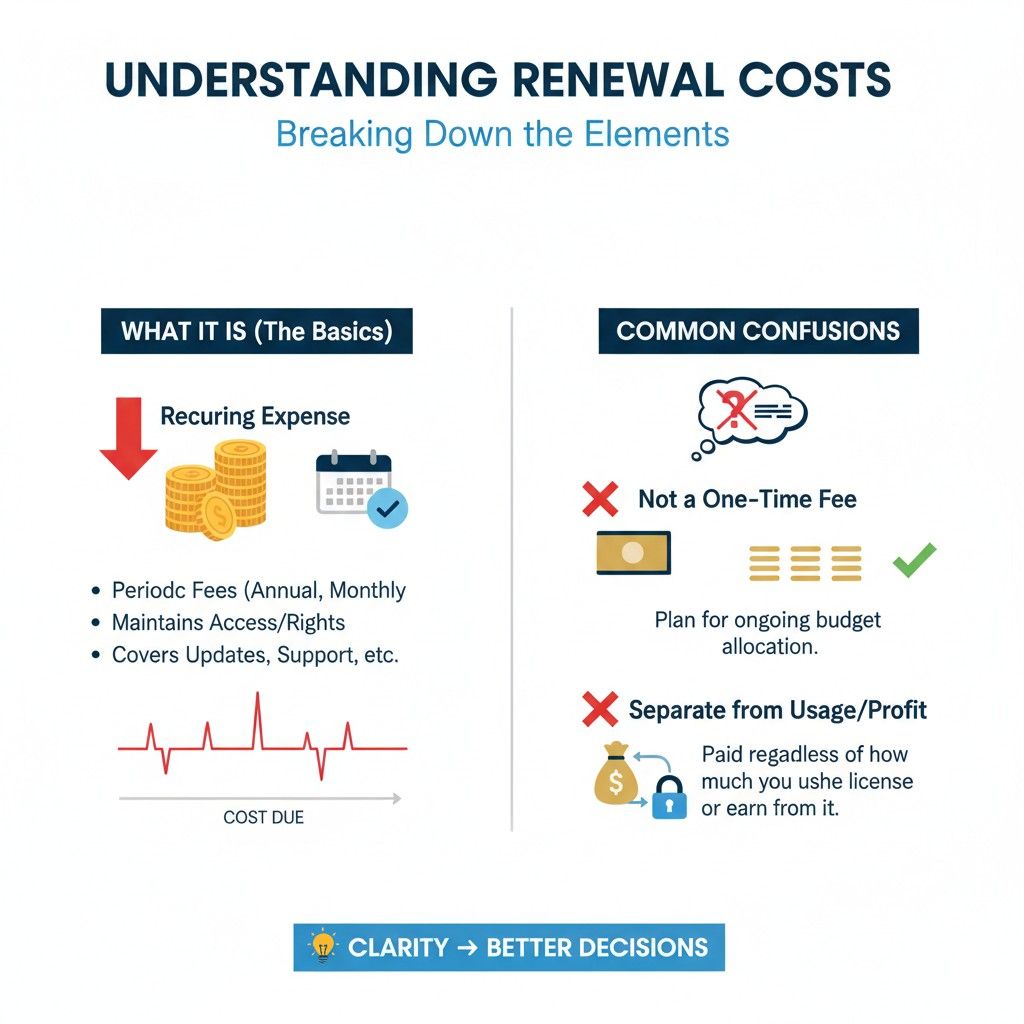
When you pay a renewal fee, you are not paying for paper. You are paying for time. Time where only you control that protected invention. Time where competitors must design around you or talk to you.
Time where you can enforce, license, or block.
Every renewal extends your exclusive position. That exclusivity is a business asset. The question is whether that exclusivity still has strategic weight.
A helpful way to think about it is this: if you stopped paying today and the patent expired, what would change tomorrow? Would competitors move fast into your space?
Would investors see less defensibility? Would a potential acquirer care less? If nothing would change, then the renewal may not carry strong value. If a lot would change, that renewal fee is small compared to what you protect.
Renewal Fees Increase Over Time for a Reason
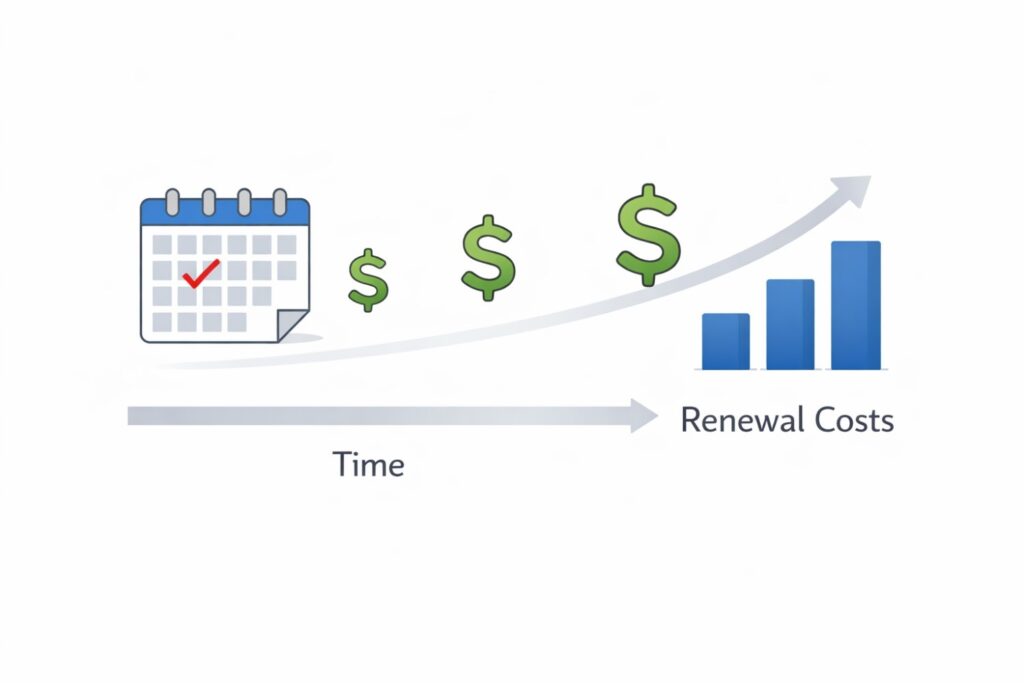
Most founders notice that renewal costs go up as the patent ages. Early payments are smaller.
Later ones are larger. That is not random. The system is designed this way because older patents have had more time to prove commercial value.
By year eight or twelve, you should have data. You should know whether the market adopted your approach. You should know whether competitors are active in that area.
You should know whether your own product still uses the patented method.
This rising fee structure forces a decision. It pushes you to ask, “Is this still important?” That pressure is healthy if you use it correctly. It becomes dangerous only when you ignore it and treat renewals like autopay rent.
At this stage in your company, especially if you are scaling deep tech, capital must be deployed with purpose.
Renewal fees compete with hiring engineers, running experiments, and expanding sales. That means each renewal must justify itself.
Renewal Cost Is Small Compared to Litigation Risk
Many founders underestimate the defensive role renewals play. A live patent is not just about going after others. It can protect you in cross-licensing talks or disputes.
Imagine a larger company claims you infringe their patent. If you hold strong patents in related areas, you have bargaining power. Even if you never sue, the existence of your patent portfolio changes negotiation dynamics.
Letting patents lapse weakens that position. You reduce your leverage. That may not matter in a calm market. It matters a lot in a competitive one.
Before deciding not to renew, review your competitive landscape. Are major players expanding?
Are new entrants funded and aggressive? If so, maintaining a defensive wall could be more valuable than the renewal cost itself.
The Hidden Cost of Keeping Everything
There is another side. Keeping every patent alive forever creates drag. It drains cash. It increases admin work. It can even create distraction during diligence if your portfolio is bloated with weak assets.
Investors and acquirers look for quality, not volume. A tight portfolio aligned with your core technology is stronger than a long list of random filings.
If you never prune, you end up funding protection for features you abandoned years ago. That money could support new filings tied to your current roadmap.
A disciplined review process matters. Each renewal cycle should include a short internal strategy session.
Bring in product leads. Bring in engineering. Ask whether the patented technology still exists in the live system. If it does not, renewal deserves scrutiny.
Renewal Decisions Should Match Product Roadmap
Your product evolves. Your patents should track that evolution.
If your roadmap shifted from one technical approach to another, patents covering the old approach may no longer deserve long-term funding.
On the other hand, if an old patent still covers a core engine that quietly powers everything, its value may have increased even if the user interface changed.
Tie renewal reviews directly to roadmap planning. When leadership meets to discuss the next two years of development, include a short IP alignment review. This keeps patent strategy connected to business reality.
PowerPatent helps founders maintain this alignment by making patents easier to manage and understand.
When your filings are structured clearly and tied to real technical components, renewal decisions become less emotional and more analytical. If you want to see how that works, you can explore it here: https://powerpatent.com/how-it-works
Cash Flow Timing and Renewal Strategy
Startups live on cash flow. Renewal fees may hit at moments when runway is tight. That timing pressure can push rushed decisions.
A smart tactic is to forecast renewal costs at least two years ahead. Build them into financial planning just like cloud costs or payroll. When you see them coming, they feel like strategy, not surprise.
You can also stage your portfolio. Not every invention must be filed in every country. International renewals multiply costs quickly. If a market is not commercially relevant, maintaining protection there may not make sense.
This does not mean cutting globally by default. It means aligning geography with revenue and growth targets. If you sell only in the United States and have no plans to expand to Europe, renewing European patents may not deliver return.
Strategic geography can reduce long-term burden without weakening your main defenses.
The Emotional Trap of Sunk Cost
One of the hardest parts of renewal decisions is emotional bias. You already spent money to file. You invested time writing disclosures. You remember the excitement of approval.
But past spending should not control future spending.
The only question that matters is forward value. If this patent did not exist today, would you file it now? If the answer is no, that is a strong signal.
Detach from history. Look ahead. Is the patent tied to current revenue, competitive pressure, or licensing potential? If not, freeing that budget may be the smart move.
Renewal as a Signal to the Market
Maintaining patents sends a signal. It tells the market you are serious about protecting your technology. It shows discipline. It signals that you see long-term value.
Letting patents lapse also sends a signal. Sometimes that is fine. Sometimes it suggests that the underlying tech was not central.
Think about how your portfolio appears during due diligence. A curated, active set of patents tied to your core innovation looks intentional. Random expirations without explanation can raise questions.
That does not mean renew everything blindly. It means manage renewals with a clear story. Be able to explain why each active patent exists and how it supports the business.
Bringing Clarity to the Chaos
Renewal costs are not just line items. They are checkpoints. They force you to re-evaluate strategy, market direction, and technical focus.
When founders treat patents as living business assets instead of static legal files, renewal decisions become clearer.
The key is integration. Your patent strategy must live next to product planning and revenue modeling. Not in a separate folder managed once a year.
PowerPatent was built to remove the friction that makes this hard. When software tools and real attorneys work together, founders gain visibility and control. That clarity makes renewal decisions faster and more confident.
If you want to build a patent portfolio that is easier to manage and aligned with growth, take a look at how it works: https://powerpatent.com/how-it-works
Renewal costs are real. But confusion around them is optional. With the right framework, each payment becomes a clear investment decision instead of a stressful guess.
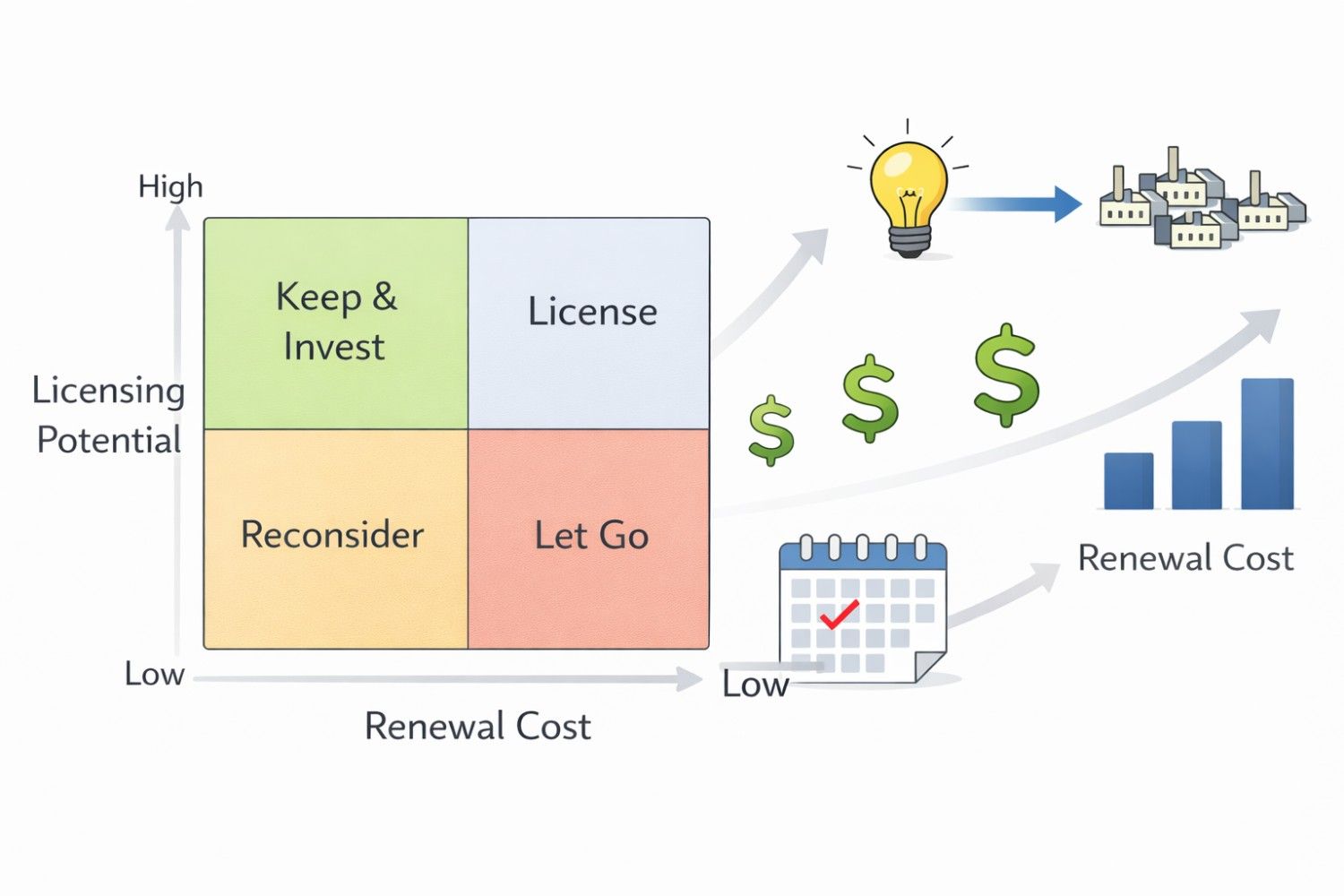
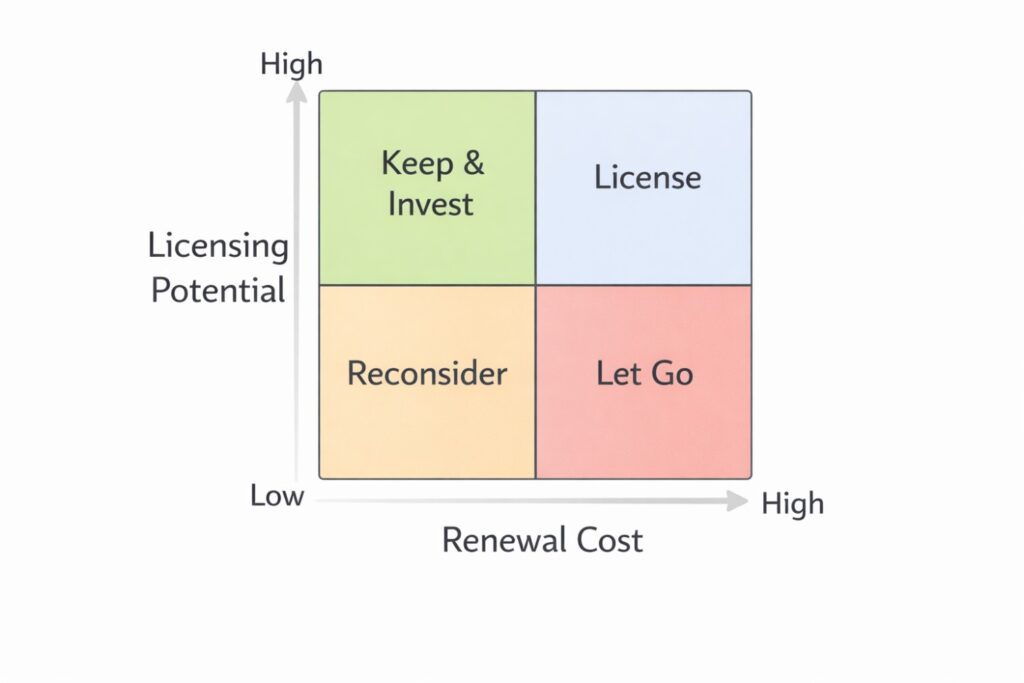
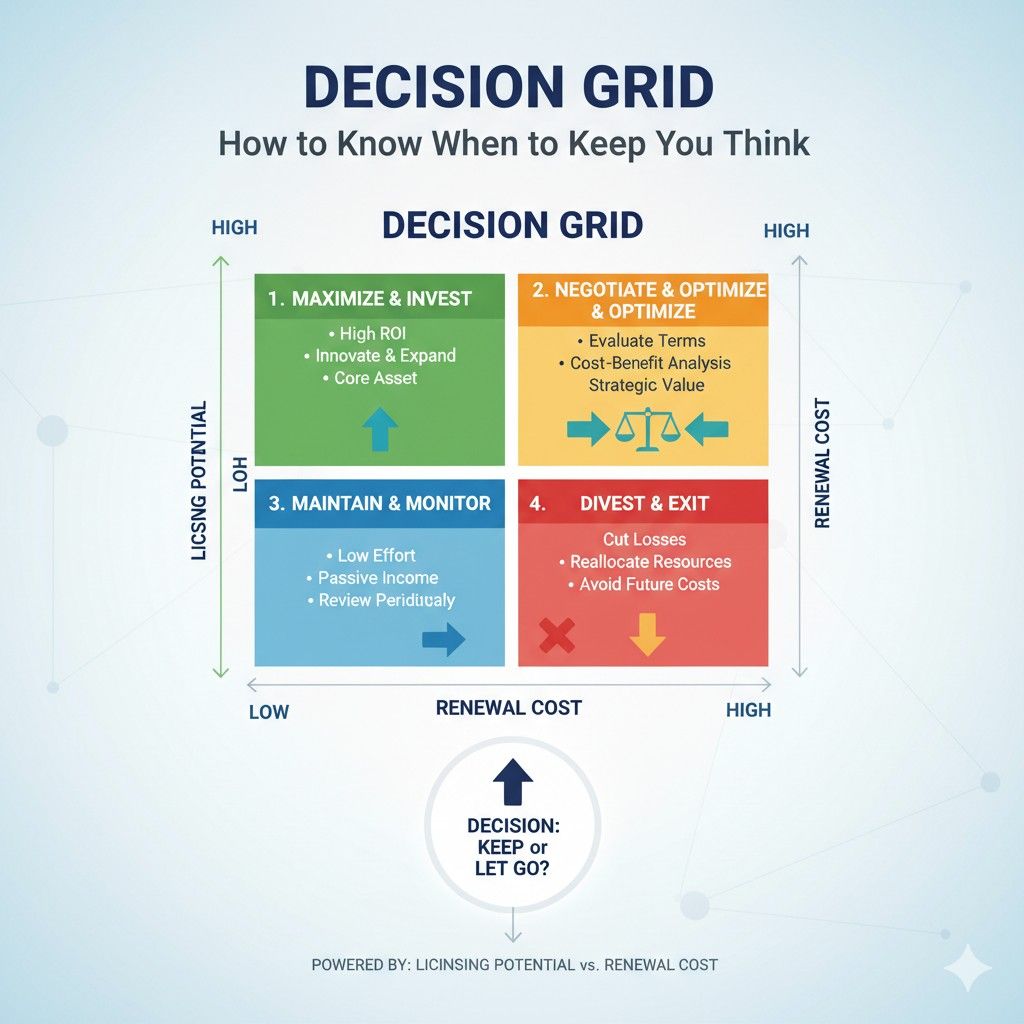
The Simple Decision Grid: How to Know When to Keep or Let Go
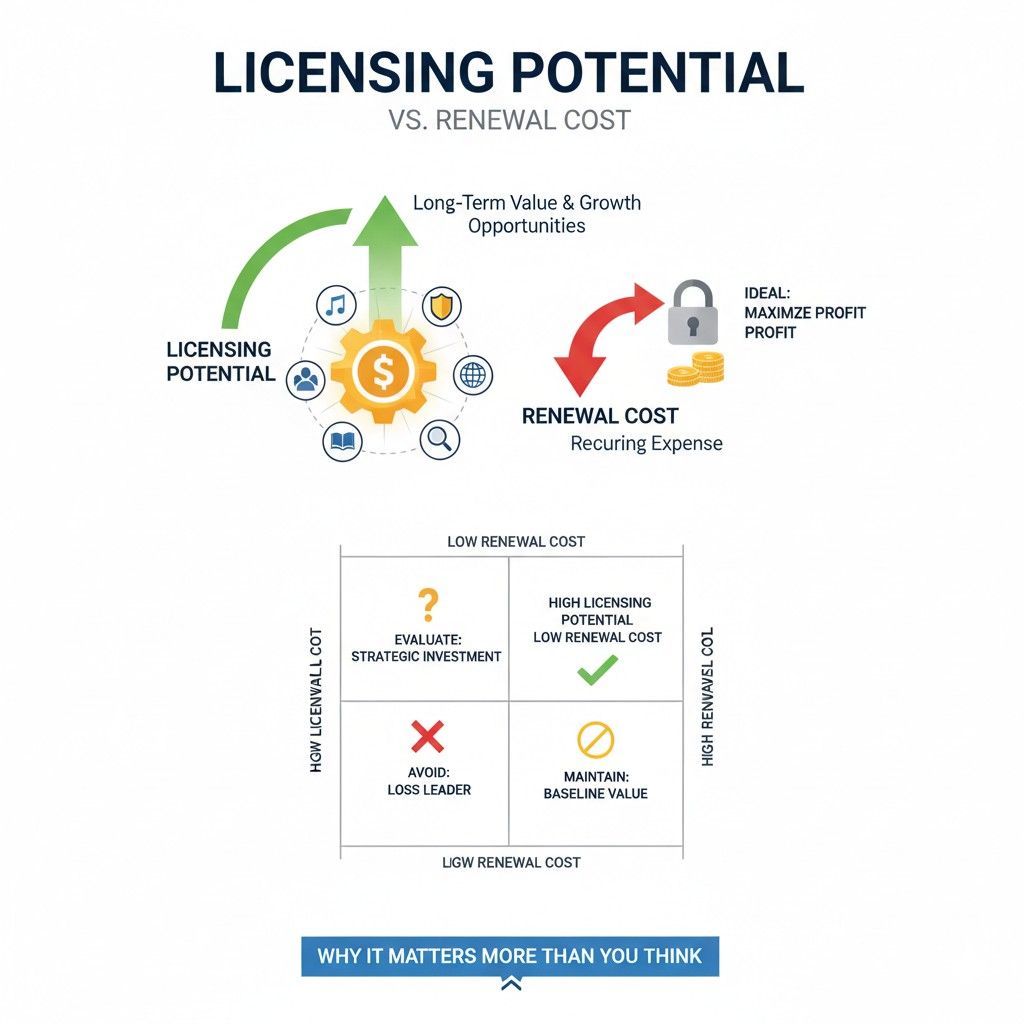
Now we bring everything together. Licensing potential tells you how much outside revenue or leverage a patent could create. Renewal cost tells you what it takes to keep that leverage alive.
The decision grid is where those two forces meet.
This grid is not a spreadsheet trick. It is a thinking tool. It forces a clear, calm look at business reality. No emotion. No pride. No fear. Just strategy.
When you place each patent into this grid, you stop guessing. You start choosing.
The Two Forces That Matter Most
The grid runs on two simple questions. First, how strong is the licensing or strategic leverage of this patent? Second, how heavy is the renewal burden compared to its forward value?
Every patent you own sits somewhere between high and low on both sides.
If licensing potential is high and renewal cost is reasonable compared to that value, the decision is easy. You keep it. You may even strengthen it with continuation filings or related protection.

If licensing potential is low and renewal cost is high relative to expected benefit, the answer may also be clear. You consider letting it go.
The hard cases live in the middle. That is where discipline matters.
Start With Brutal Honesty
Before placing a patent into the grid, remove emotion. Do not look at the filing date. Do not think about how hard the team worked. Look only at forward impact.
Ask whether this patent protects something that still exists in your live product or near-term roadmap. If the underlying system was replaced two years ago, licensing potential drops sharply.
Then ask whether competitors are active in the space this patent covers. If the industry moved away from that approach, leverage shrinks.
This is not about being negative. It is about being clear.
A powerful internal tactic is to assign a product leader and an engineering lead to review each patent together.
They should answer one question in writing: if this patent disappeared tomorrow, what would change in our business? Their answer will reveal its real weight.
When Licensing Potential Is High and Renewal Cost Is Low
This is the strongest position. These patents often protect core infrastructure, widely adopted methods, or critical workflows.
In this zone, renewal is not just defensive. It is strategic positioning.
You may also consider whether this patent can anchor a licensing conversation. If competitors are growing fast and using similar systems, you can prepare claim charts in advance.
You do not need to act aggressively. You simply need to understand your leverage.
Many startups wait until they are under pressure to evaluate licensing. That is reactive. A better move is to quietly map your strongest patents to market players long before conflict arises.
If you built your patents with care from the start, this mapping becomes easier.
That is one reason founders use PowerPatent. The platform helps tie technical substance directly to claims, which strengthens this high-potential quadrant. You can see how that process works here: https://powerpatent.com/how-it-works
When Licensing Potential Is High but Renewal Cost Feels Heavy
This is where mature strategy comes in.
Maybe the patent sits in multiple countries. Maybe fees are climbing in later years. Maybe cash is tight.
Instead of making a binary choice, refine the scope of protection.
You might maintain protection only in countries tied to revenue or manufacturing. You might drop coverage in regions where enforcement would not make business sense.
You can also analyze whether the patent supports fundraising or acquisition plans. If you are entering diligence within the next two years, keeping high-leverage patents alive may impact valuation far more than the renewal fee itself.
The key is proportional thinking. If a patent could unlock a major partnership or block a serious competitor, even a significant renewal fee can be justified.
When Licensing Potential Is Low but Renewal Cost Is Low
This quadrant tempts many founders. The fee seems small. It feels harmless to keep paying.
But small costs compound across a portfolio.
If a patent has little connection to current revenue, limited market adoption, and weak strategic role, even a modest renewal fee may not deserve ongoing funding.
This is where discipline creates strength. By pruning low-impact assets, you free budget and attention for new filings aligned with your present innovation.
Letting go of weak patents does not mean failure. It means focus.
When Both Licensing Potential and Strategic Value Are Low
This is the cleanest decision in the grid.
If a patent no longer aligns with product direction, covers outdated technology, and offers minimal competitive leverage, renewal becomes hard to justify.
Many startups avoid this conclusion because it feels like giving up an asset. In truth, it is capital allocation. Every dollar saved can support fresh protection around what you are building now.
Strong companies are not defined by how many patents they own. They are defined by how tightly those patents match real advantage.
Make the Grid a Living Process
The biggest mistake founders make is treating this grid as a one-time exercise. It should run annually.
Tie it to financial planning. Tie it to roadmap reviews. Tie it to board discussions.
Each year, reassess licensing potential. Markets change. Competitors pivot. Standards emerge. What was weak may become strong. What was central may fade.
Document your reasoning. Write down why you kept or dropped each patent. This record helps during diligence and keeps the process rational instead of reactive.
Align the Grid With Long-Term Vision
Your patent portfolio should mirror your long-term ambition.
If your goal is acquisition, strong patents around core technology increase negotiating power. If your goal is independence and scale, defensive breadth may matter more.
If your goal includes licensing revenue as a line of business, then patents with cross-industry relevance deserve priority.
The grid is not just about cost control. It is about shaping future leverage.
At PowerPatent, we believe founders should feel in control of this process. Patents should not be mysterious files managed by distant firms. They should be living strategic tools, built with clarity from day one.
When software and real attorneys work together, you gain visibility into what you own and why it matters. If you want that kind of control, explore how it works here: https://powerpatent.com/how-it-works
Turning Decisions Into Momentum
When you apply the decision grid honestly, something powerful happens. You stop viewing patents as background admin. You see them as strategic assets with measurable impact.
Renew the ones that protect true leverage. Strengthen the ones with growing licensing potential. Release the ones that no longer serve your direction.
This discipline builds a portfolio that investors respect, competitors notice, and acquirers value.
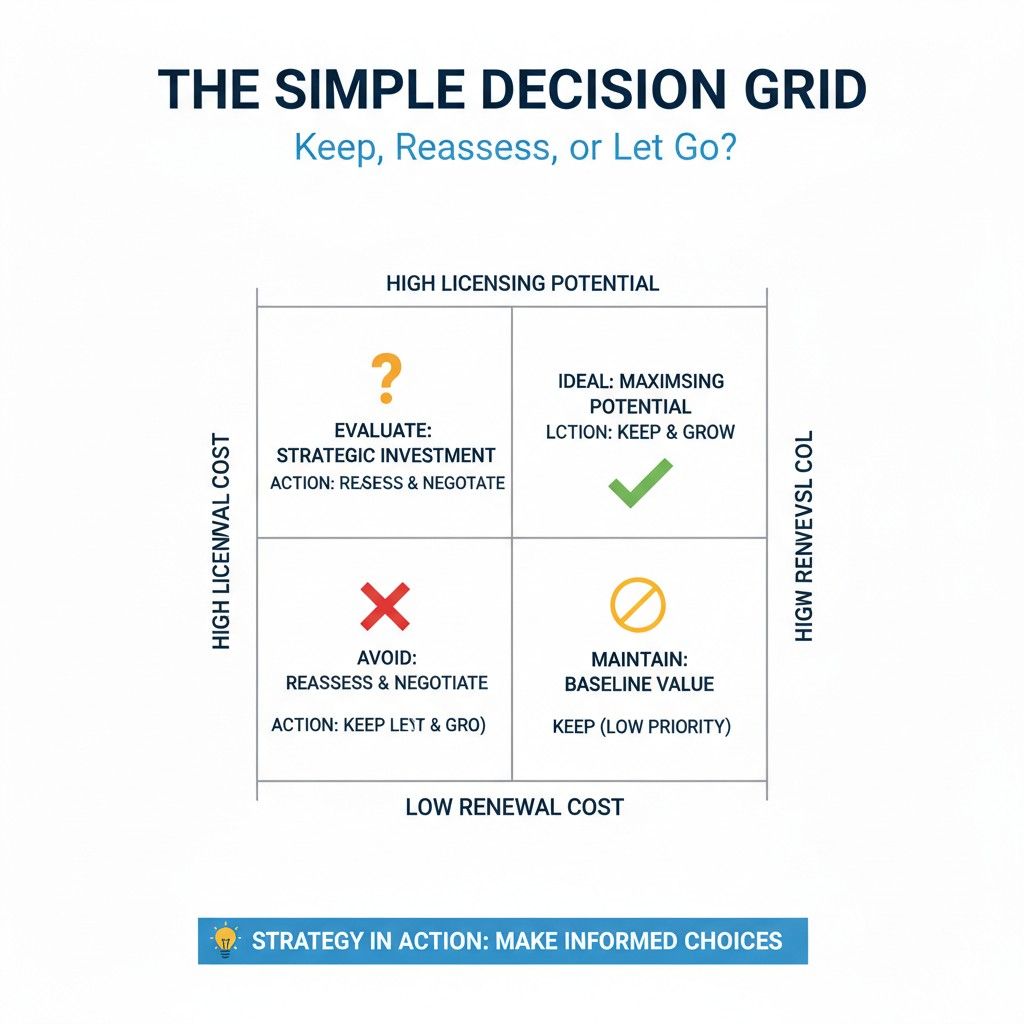
Licensing potential versus renewal cost is not a legal puzzle. It is a business choice. When you simplify it into a clear grid, you remove fear. You gain confidence.
And when your patent strategy moves in step with your product and growth plans, you build not just technology, but durable advantage.
Wrapping It Up
Renewal notices should never surprise you. They should confirm a decision you already made. When you understand licensing potential, renewal cost stops feeling random. It becomes a simple comparison between future leverage and present cash. That is it. No mystery. No drama. A patent is not valuable because it exists. It is valuable because it protects something others need, want, or cannot easily replace. If that protection still supports your revenue, your growth, or your negotiating power, renewal is a strategic move. If it does not, letting it expire can be just as strategic.
Leave a Reply