You are building something valuable. That value lives in your ideas, your code, your designs, your data, and the way all of it fits together. The moment you share any of that, even a small piece, you create risk. Not because people are bad, but because confusion is common and memory is weak. This is why marking and handling confidential information the right way matters more than most founders think.
This article is about clear, practical rules you can actually follow. No legal talk. No long theory. Just what works in the real world when you are moving fast, talking to investors, hiring contractors, sharing docs, pushing code, and trying to protect what makes your startup special.
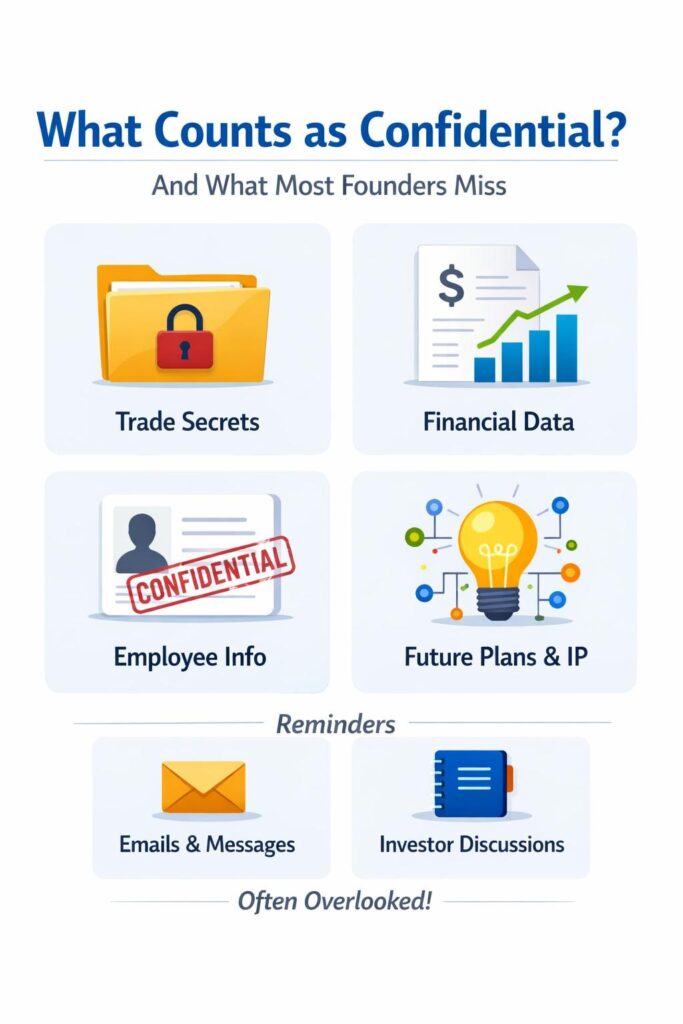
What Counts as Confidential (And What Most Founders Miss)
Most founders think they know what confidential information is. They usually point to source code, secret formulas, or unreleased product plans. That is a good start, but it is far from complete.
The real risk is not what you know is sensitive. The risk is what you forget to treat as sensitive while moving fast.
Confidential information is not a legal concept you look up once and move on from. It is a living part of how your business operates every single day.
If you get this wrong early, you often do not notice until you are raising money, filing patents, or dealing with a former contractor who suddenly remembers more than you wish they did.
This section is about widening your lens and tightening your habits so fewer things slip through the cracks.
The Obvious Stuff Everyone Thinks About
When people hear confidential information, they think of the crown jewels. Core algorithms. Training data. Hardware designs. Internal tools. These are clearly sensitive, and most teams are at least somewhat careful with them.
The problem is that founders often stop here. They assume that as long as the main code repo is private and the product is not publicly launched, they are safe. That assumption creates blind spots that can quietly cause damage.
A good mental shift is this: anything that helps someone understand how you win, or how you plan to win, deserves careful handling. That includes things that feel incomplete, messy, or not fully formed yet.
If you are building something that you may want to patent later, this becomes even more important. Early disclosures, even casual ones, can weaken your position.
This is one reason PowerPatent encourages founders to think about protection early, not after everything is already shared. You can see how that works in practice here: https://powerpatent.com/how-it-works
The Quiet Value in Half-Finished Ideas
Many founders underestimate the value of ideas that are still rough. A slide with a concept sketch.
A Notion page with thoughts about future features. A whiteboard photo shared in Slack. These things feel harmless because they are not production-ready.
In reality, these early artifacts often reveal the most about how you think. They show direction, intent, and strategy. For a competitor or a future employee with mixed incentives, this context can be more useful than polished code.
The practical rule is simple. If a document explains why you are building something, not just what it does, treat it as confidential by default.
That means marking it clearly, limiting who can access it, and being intentional about where it lives.
Internal Numbers That Tell a Story
Financial data is an obvious category, but many teams only protect formal reports. They forget about rough models, back-of-the-envelope forecasts, or notes about pricing experiments.
These numbers tell a story about your business health and your thinking. They show what you believe matters. They also influence negotiations in ways you may not expect if they leak or are misunderstood.
A good habit is to assume that any number tied to growth, cost, pricing, or runway deserves careful handling.
Even a screenshot of a spreadsheet shared casually can create confusion or risk if it travels outside its intended audience.
When sharing numbers with advisors, contractors, or early partners, slow down for one extra minute. Ask yourself if this person needs this level of detail to do their job. If not, share less or summarize at a higher level.
Conversations That Count as Disclosure
Confidential information is not limited to files and folders. Spoken words matter just as much. Founders often reveal sensitive details during sales calls, investor chats, or networking events without realizing it.
It feels natural to explain what makes your product special. The line gets crossed when you explain how it works under the hood or why certain decisions were made. These details add up quickly.
A practical approach is to practice a clean, high-level explanation of your product that does not rely on secrets. This is not about being vague. It is about being disciplined.
The more you repeat this habit, the easier it becomes to protect deeper details for the right moments and the right people.
Access Is Part of the Definition
One of the most missed ideas is that information becomes confidential not just by content, but by access. If only a few people see something, it carries more risk if it spreads.
Shared drives, project tools, and chat platforms often grow messy over time. Old contractors still have access. Interns can see strategic docs. Temporary permissions never get cleaned up.
Make it normal to review access when roles change or projects end. This does not require complex systems. It requires attention.
When access is tight and intentional, confidentiality becomes easier to maintain without constant policing.
Context Can Be More Sensitive Than Data
A single data point may not be sensitive on its own. Combined with context, it often is. A feature name paired with a timeline. A customer quote paired with internal notes. A technical constraint paired with a workaround.
Founders often share context to be helpful. The risk is that context reveals priorities, weaknesses, or future moves. Once shared, you cannot control how it is interpreted or reused.
Before sharing context-heavy explanations, pause and ask what problem you are solving by sharing it. If the benefit is small, the risk may not be worth it.
Why This Matters More Than You Think
Handling confidential information well is not about paranoia. It is about clarity. When you are clear about what is confidential, everyone around you behaves better. Expectations are set. Mistakes are reduced. Trust increases.
It also makes later steps much easier. When you decide to file patents, raise a serious round, or enter a partnership, your history matters. Clean handling signals professionalism and foresight.
This is exactly where the right tools and guidance help. PowerPatent was built to help founders protect what they are building while staying fast and focused.

If you want to see how that works without slowing down your startup, take a look here: https://powerpatent.com/how-it-works
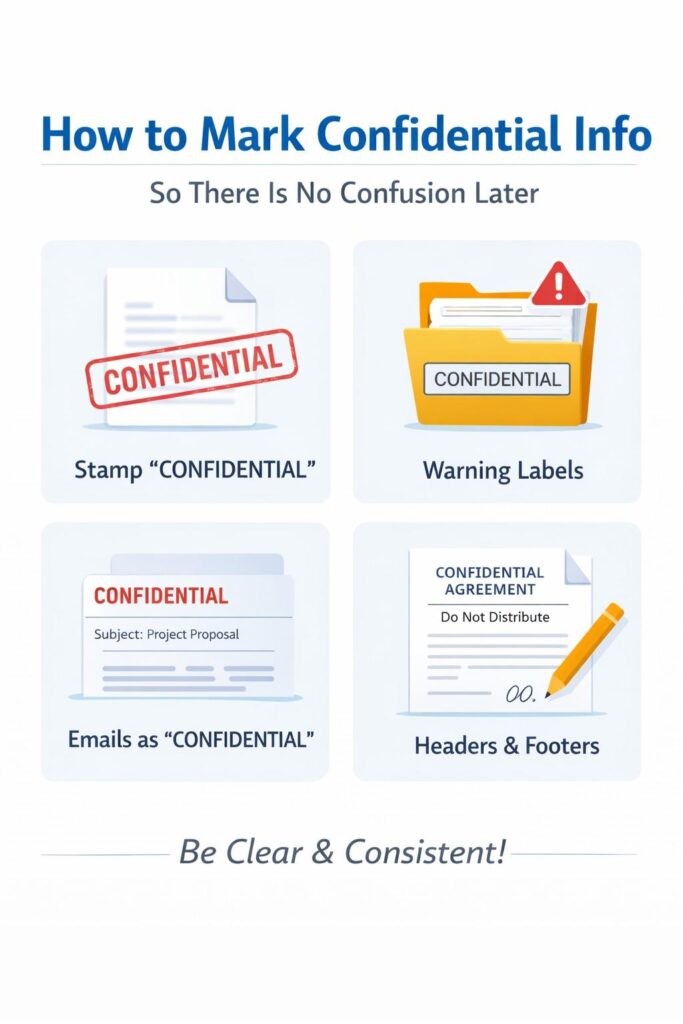
How to Mark Confidential Info So There Is No Confusion Later
Marking confidential information sounds simple, yet this is where most teams fail. They assume intent is enough.
They believe that because something feels private, others will treat it that way. In fast-moving companies, assumptions create gaps, and gaps create risk.
Clear marking is not about formality. It is about removing doubt. When something is marked well, no one has to guess how to treat it.
That clarity protects you even when memories fade, people change roles, or documents travel farther than expected.
This section focuses on how to mark information in ways that actually work in daily business, not just in theory.
Why Memory Is Not a System
Founders often rely on shared understanding. They believe everyone knows which docs are sensitive and which are not. This works for a week, sometimes a month, but it always breaks down.
People are busy. New hires join. Contractors rotate in and out. Old files get reopened months later. When nothing is clearly marked, people make their own calls. Those calls are usually wrong.
Marking confidential information turns memory into a system. It replaces assumptions with signals that travel with the information itself. That is what protects you over time.
The Power of Plain Language Labels
One of the biggest mistakes teams make is overthinking labels. They search for perfect wording or worry about sounding too formal. In reality, simple language works best.
Words like “Confidential,” “Internal Only,” or “Not for Sharing” are clear to everyone. They do not require training. They do not rely on policy documents that no one reads.
The key is consistency. When the same words appear across slides, docs, and shared folders, people learn to respect them. Inconsistent labeling creates doubt. Doubt leads to mistakes.
Where Marking Matters Most
Many teams mark the title page of a document and stop there. That helps, but it is not enough. Information gets copied, screenshotted, and pasted into new places.
Marking matters most at natural break points. Headers, footers, file names, and opening slides are all moments where a reader resets their attention. Seeing a clear marker at these points reinforces expectations.
For shared decks, a small note in the footer on every slide quietly does a lot of work. For docs, a short line at the top sets the tone before content is even read.
File Names Are Silent Messengers
File names travel far. They get forwarded, downloaded, and stored in places you will never see. A file name without context loses all protection the moment it leaves your system.
Adding a short marker to the file name itself helps prevent accidental sharing. It also signals importance when someone is scanning their downloads folder weeks later.
This habit feels small, but it pays off over time. It is one of the easiest ways to reduce risk without slowing anyone down.
Marking in Shared Tools and Platforms
Modern teams live in tools like Google Docs, Notion, Figma, Slack, and project trackers. Each platform handles visibility differently, which can create false comfort.
Just because a doc lives in a private workspace does not mean it is clearly marked. People copy content between tools all the time. When they do, original permissions often disappear.
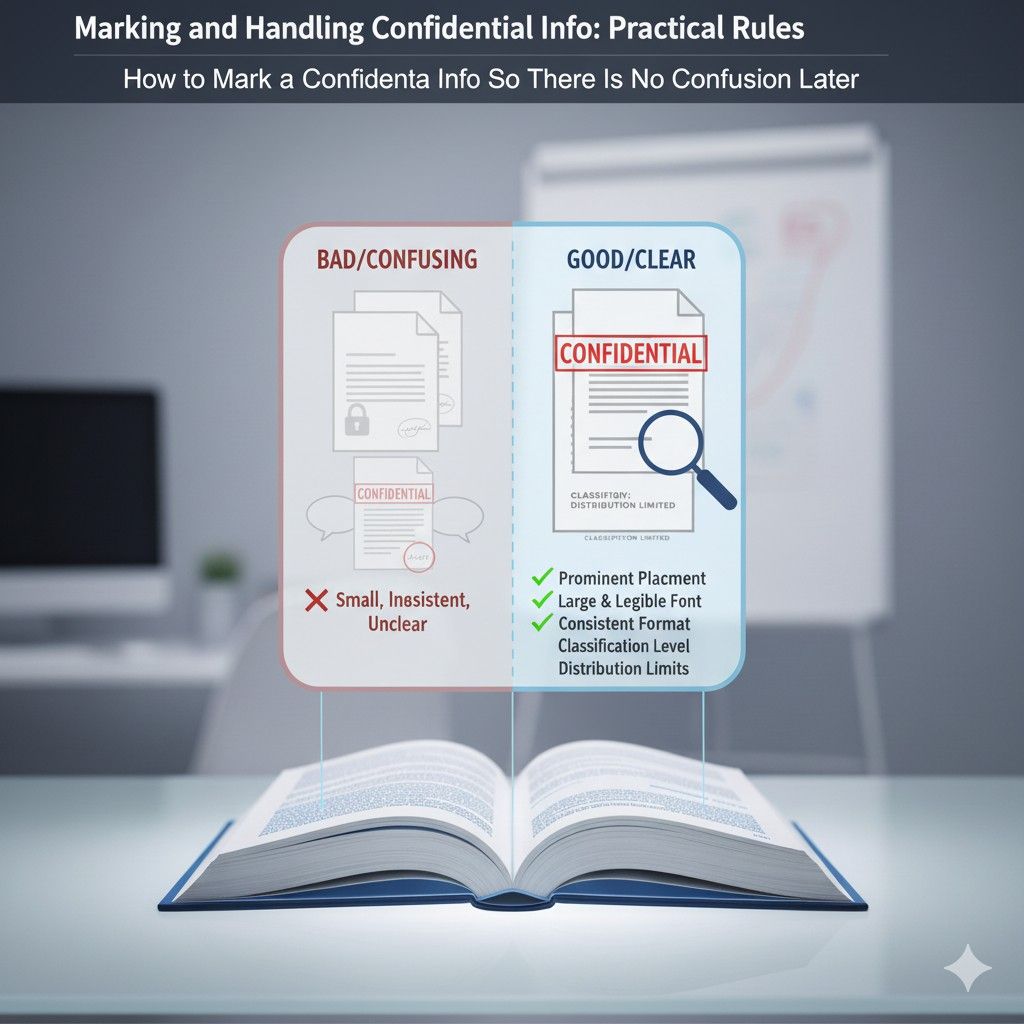
A good practice is to include a clear note near the top of sensitive pages, even inside internal tools. This way, when content is copied or exported, the message goes with it.
Code and Technical Artifacts Need Signals Too
Engineers often assume code speaks for itself. They rely on repo permissions and access control. While those matter, they do not replace clear signals.
Comments at the top of key files, readme notes, or repo descriptions can communicate expectations quickly. They remind contributors and reviewers that the work inside has value beyond the task at hand.
This is especially useful when working with external developers or open-source adjacent projects where boundaries can blur if not clearly stated.
Marking Early, Not Just When It Feels Important
Many founders wait until something feels “final” before marking it confidential. By then, it may have already been shared in rough form.
Early marking creates a habit. It trains the team to think carefully from the start. It also makes it easier to relax later if something becomes public by design.
Starting strict and loosening intentionally is far safer than starting loose and trying to tighten later.
Avoiding Over-Marketing Without Losing Clarity
There is a fear that marking too much will make people ignore labels. This only happens when everything is marked the same way with no thought.
The solution is not fewer labels, but clearer intent. Use simple language and apply it where it matters. Over time, patterns emerge. People learn what requires care and what does not.
When marking is thoughtful, not automatic, it earns respect instead of fatigue.
How Marking Supports Long-Term Protection
Clear marking does more than prevent accidents. It creates a record of intent. It shows that you treated information as valuable from the beginning.
This matters later when you are filing patents, negotiating deals, or resolving disputes. A history of clear handling strengthens your position without extra effort.
This is part of building a company with confidence. Tools like PowerPatent are designed to support this mindset by helping founders capture and protect innovation early, before confusion sets in.

If you want to see how that works in real life, you can explore it here: https://powerpatent.com/how-it-works
That covers how to mark confidential information so there is no confusion later.
How to Share Sensitive Info Without Losing Control
Sharing is unavoidable. If you are building a real business, you will share sensitive information every week. With investors. With advisors. With early customers.
With vendors. With new hires. The goal is not to stop sharing. The goal is to share in a way that keeps you in control.
Most leaks and misunderstandings do not come from bad intent. They come from unclear boundaries. When people do not know how far information can travel, they default to what feels normal to them. That is where founders get hurt.
This section is about staying open enough to move fast while staying protected enough to avoid regret.
Start With Purpose, Not Politeness
Founders often share information to be polite or helpful. They want to answer questions fully. They want to build trust quickly. This instinct is good, but it needs structure.
Before sharing anything sensitive, pause and ask why you are sharing it. What decision does it help? What action does it enable? If there is no clear purpose, sharing more detail rarely helps.
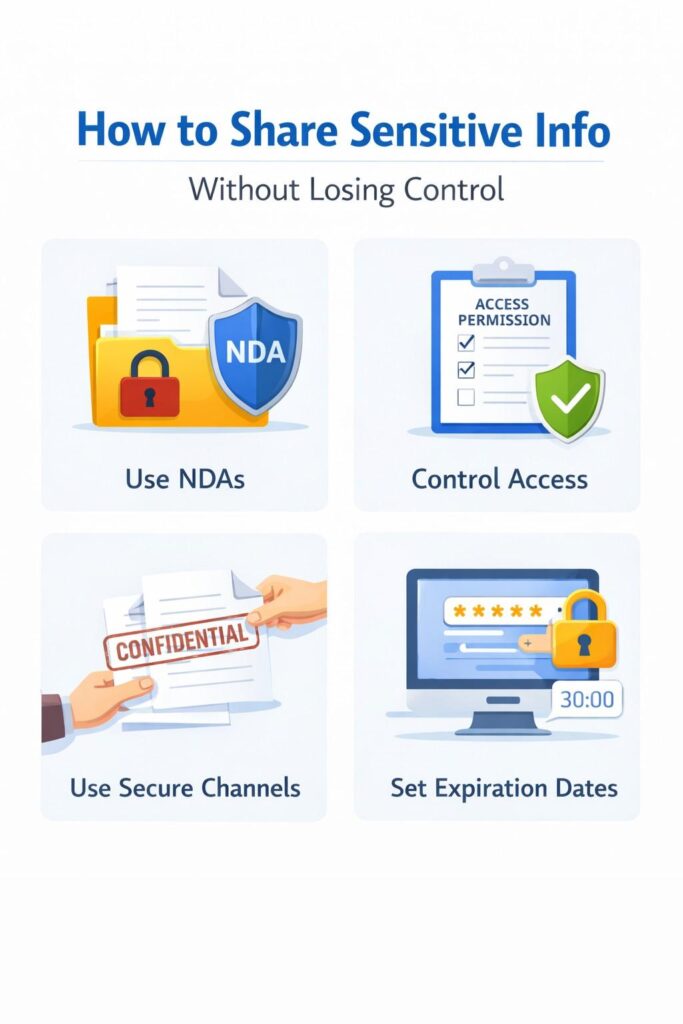
Purpose creates a natural limit. When you know why you are sharing, you can decide how much is truly needed. This alone reduces oversharing more than any policy ever will.
Match the Detail to the Relationship
Not every relationship deserves the same depth. A long-term advisor is different from a first intro call. A signed partner is different from a potential one.
Founders often treat early conversations like deep collaborations. They reveal inner thinking before trust has time to form. This is where control slips.
A practical approach is to earn depth over time. Start high level. Share outcomes, not mechanics.
As the relationship grows and commitments become real, you can open up more. This staged sharing protects you without damaging rapport.
Control the Frame Before the Content
How you frame information matters as much as what you share. A simple sentence before you start can change everything.
Saying that something is sensitive and shared for a specific reason sets expectations. It signals respect for the information and for the listener. It also makes it easier for them to handle it correctly.
This does not require legal language. Plain words work. What matters is that the frame comes first, not as an afterthought.
Use Summaries Instead of Raw Materials
Raw materials are dangerous. Full docs, full code access, full datasets. Once shared, they are hard to pull back.
Whenever possible, share summaries. Explain results instead of giving spreadsheets. Show screenshots instead of live dashboards. Describe architecture instead of handing over repos.
Summaries give you control. They let you communicate value without exposing every detail. They also reduce the risk of misunderstanding by focusing attention on what matters most.
One-Time Views Are Your Friend
Not everything needs to live forever in someone else’s system. Sometimes information is only needed in the moment.
Screen sharing instead of sending files. Walking through a doc live instead of emailing it. These small choices dramatically reduce long-term risk.
Once the conversation ends, the information does not linger. This is especially useful for early investor talks or exploratory partnerships.
Be Careful With Convenience Tools
Modern tools make sharing easy. A link, a click, and access is granted. That convenience is also the danger.
Links get forwarded. Permissions get forgotten. Old access stays open long after it is needed.
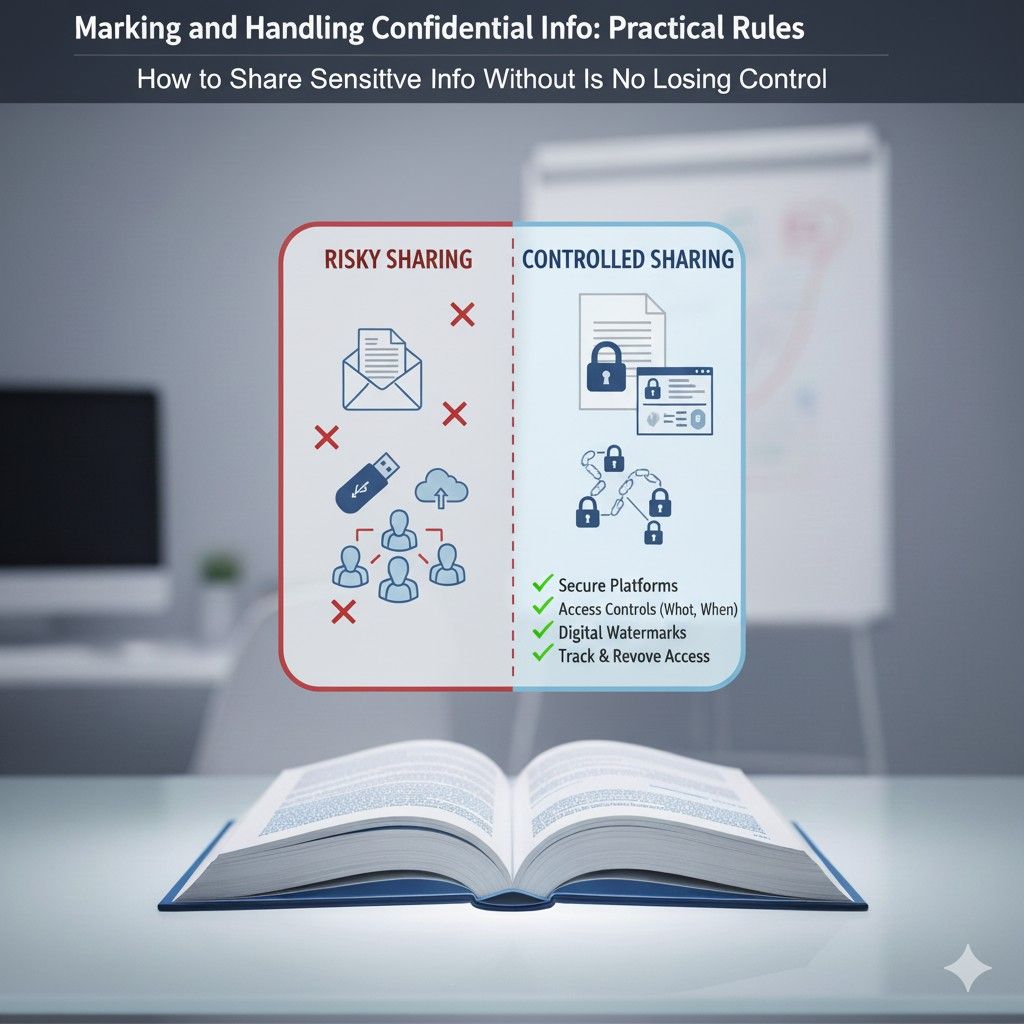
Make it normal to set expiration dates, limit access, and review sharing settings. This is not about mistrust. It is about hygiene. Clean systems prevent accidental leaks without constant monitoring.
Contractors and Temporary Help Need Extra Care
Short-term collaborators often see more than you realize. They jump into systems quickly. They copy what they need to work fast. When the project ends, that copied knowledge does not disappear.
Be intentional about what they see. Give access only to what is required. Share context slowly. Remove access promptly when work ends.
This discipline protects both sides. It reduces confusion and sets clear professional boundaries.
Verbal Sharing Is Still Sharing
Many founders think written sharing is the main risk. In reality, spoken words travel just as far.
People talk. They summarize conversations. They share stories. If you say something sensitive, assume it may be repeated.
This does not mean staying silent. It means choosing words carefully. Practice explaining your work in layers, so you can stop before reaching sensitive ground unless it is truly needed.
Why This Makes You Look More Professional
Some founders worry that being careful will make them seem guarded or difficult. In practice, the opposite is true.
Clear boundaries signal maturity. They show that you value what you are building. Serious investors and partners respect this. They expect it.
When you share thoughtfully, people trust that when you do open up, it matters.
Sharing and Future Protection
Everything you share today affects your options tomorrow. Especially when it comes to patents and defensibility.
Early, uncontrolled disclosure can limit what you can protect later. Controlled, intentional sharing keeps doors open.
This is why PowerPatent helps founders think about protection alongside building, not after the fact. The goal is to move fast without leaving value on the table.
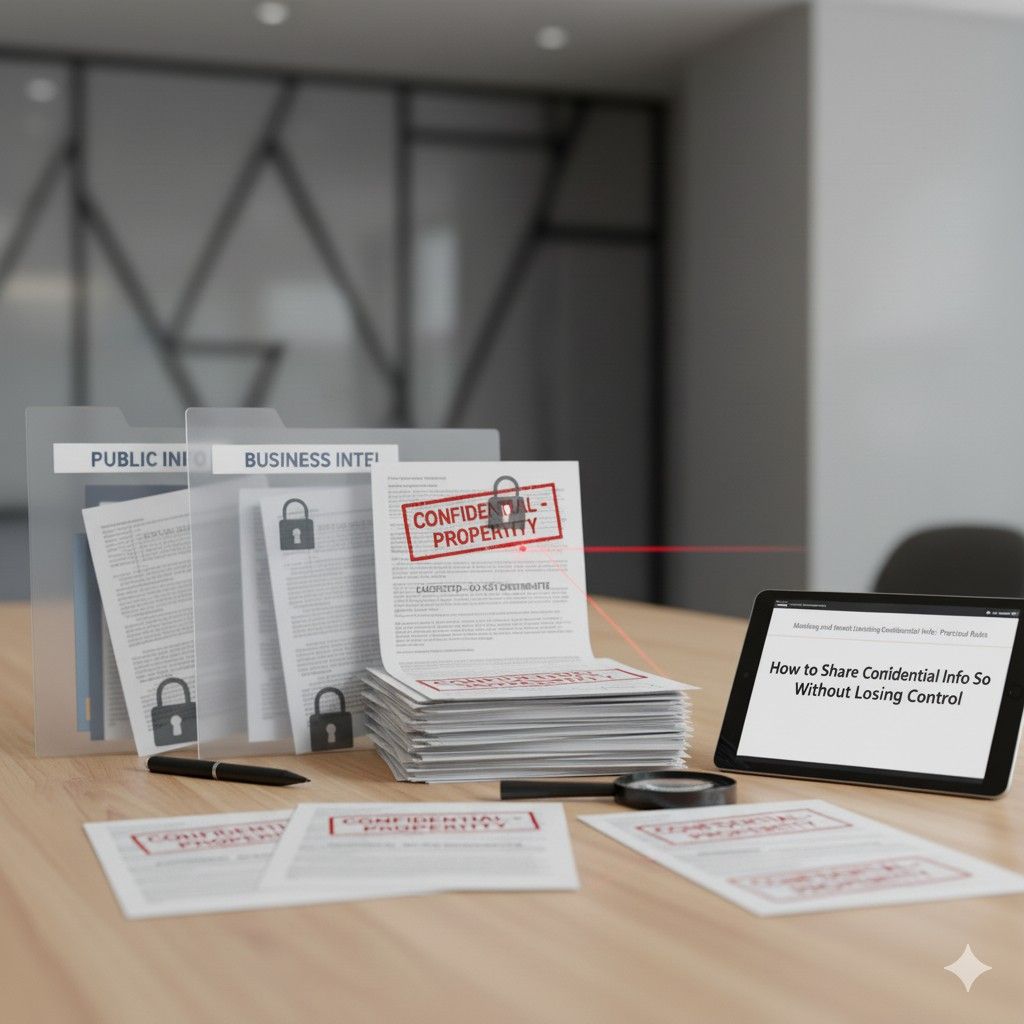
If you want to see how that approach works, you can explore it here: https://powerpatent.com/how-it-works
That covers how to share sensitive information without losing control.
Daily Habits That Keep Your Startup’s Secrets Safe
Confidentiality does not live in policies or one-time decisions. It lives in daily behavior. The way you open a doc. The way you answer a question. The way you onboard someone new.
These small moments shape whether sensitive information stays protected or slowly leaks out over time.
Most problems do not come from a single big mistake. They come from dozens of small habits that felt harmless in the moment. This section focuses on practical daily behaviors that quietly but powerfully protect your business.
Treat Confidentiality as a Culture, Not a Rule
Founders set the tone. If you are casual with sensitive information, your team will be too. If you are clear and consistent, others will follow without being told.
Culture forms through repetition. When people see you pause before sharing, label documents clearly, and explain boundaries calmly, they learn what is normal. Over time, this becomes self-reinforcing.
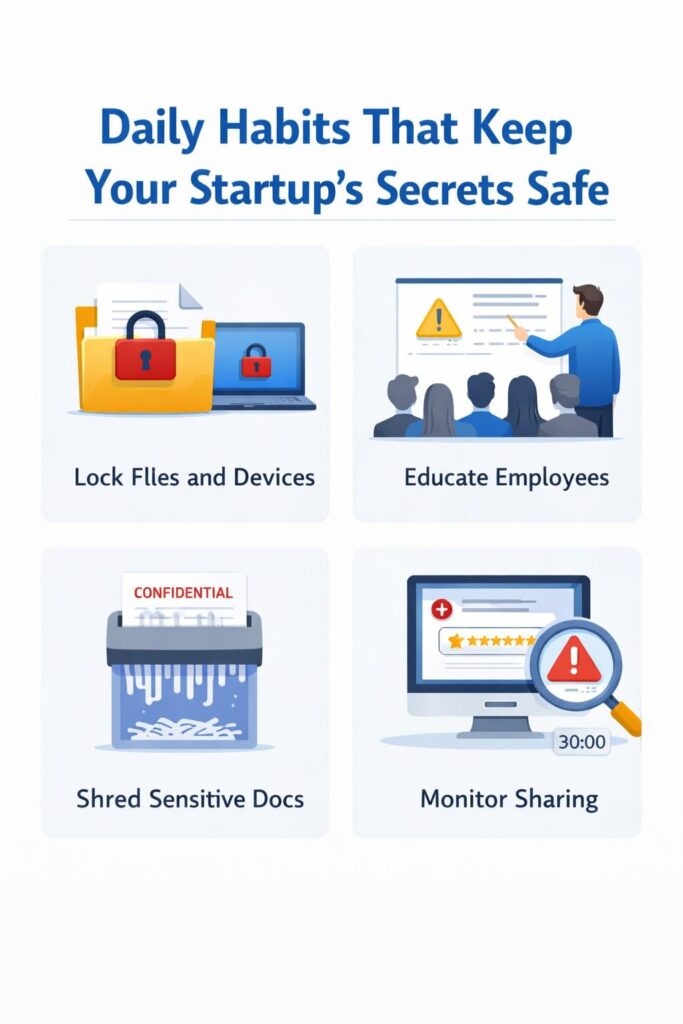
You do not need to give speeches about confidentiality. You need to model it in small, visible ways every day.
Slow Down the First Share of the Day
The first time you share something sets a pattern. Once information is out, it tends to spread.
A useful habit is to slow down just a little before the first share of any new document, idea, or dataset. Ask yourself who truly needs this and in what form. That extra minute often prevents weeks of cleanup later.
This habit becomes easier with practice. It stops feeling like friction and starts feeling like control.
Keep Workspaces Clean and Intentional
Messy systems leak information. Old docs mixed with new ones. Public folders with private content. Shared drives that grew without structure.
Set aside regular time to clean up. Archive what is no longer needed. Move sensitive material to clearly marked locations. Remove access that no longer makes sense.
This is not busywork. Clean spaces reduce accidental exposure and make correct behavior the default.
Make Onboarding a Moment of Alignment
When someone new joins, they learn how things work by watching, not reading policies. Their first week matters more than any later reminder.
Be explicit early. Explain what kinds of information are sensitive and why. Show them how you mark and share things. Answer questions openly.
This does not require legal training. It requires clarity and consistency. When people understand the reasoning, they are far more likely to follow it.
Normalize Asking “Can I Share This?”
One of the healthiest habits a team can have is asking before sharing. Not because people are unsure, but because they care.
As a founder, reward this behavior. Thank people for checking. Answer without judgment. This builds trust and reduces fear of speaking up.

Over time, fewer mistakes happen because uncertainty is surfaced early instead of hidden.
Be Careful With Casual Screens and Spaces
Confidential information often leaks in casual settings. A laptop open in a cafe. A screen shared with one extra tab visible. A demo run from a live system instead of a safe copy.
Train yourself to notice these moments. Close tabs. Use demo accounts. Be aware of who can see your screen or hear your conversation.
These habits feel small, but they add up. Awareness is the first layer of protection.
Separate Thinking From Broadcasting
Founders think out loud. This is a strength, but it can also be risky.
Internal brainstorming is different from external communication. Mixing the two can expose unfinished ideas, doubts, or strategies that were never meant to travel.
A helpful habit is to separate spaces for thinking and sharing. Keep rough thoughts in private places. Share only what has been shaped for the audience and purpose.
This protects your thinking without limiting creativity.
Review Before You Forward
Forwarding is dangerous because it feels harmless. One click and the context is gone.
Before forwarding any document or message, scan it quickly. Check for markers. Check for sensitive details. Ask whether the recipient truly needs the full content.
This habit takes seconds and prevents most accidental leaks.
Build the Habit of Closure
Projects end. Relationships change. Access lingers.
Make closure a habit. When a project wraps up, review what was shared and who still has access. Clean up permissions. Archive materials.
Closure signals professionalism. It also keeps your information footprint smaller and safer over time.
Why These Habits Pay Off Later
Daily habits compound. Months later, when you are raising a serious round, filing patents, or negotiating partnerships, your past behavior matters.
Clean handling shows that you value what you build. It makes due diligence smoother. It strengthens your position without extra effort.
This is exactly the mindset PowerPatent is built around. Helping founders protect innovation early, naturally, and without slowing down.

If you want to see how this fits into your workflow, you can explore it here: https://powerpatent.com/how-it-works
This completes the core sections of the article.
Wrapping It Up
Confidential information is not something you deal with once and forget. It is something you handle every day, often without realizing it. The way you mark documents, the way you talk about your work, and the way you share details all shape how protected your business really is.
What makes this tricky is that nothing about confidentiality feels urgent in the moment. The damage usually shows up later. During a fundraising round when questions get harder. During a patent filing when past disclosures matter. During a partnership discussion when leverage suddenly feels thinner than it should.
Leave a Reply