Distributed systems and microservices run much of the modern software world. They power fintech apps, cloud platforms, developer tools, AI systems, health tech products, logistics networks, and large-scale enterprise software. They help startups move fast, scale with less friction, and build products in parts instead of one giant block. But when it comes to patents, these systems create a real challenge.
How to Write Patent Claims for Distributed Systems and Microservices
Writing patent claims for distributed systems and microservices takes more care than writing claims for a simple software feature. The reason is easy to see. In a modern system, the value usually does not sit in one place.
It lives in the way many services work together, how they pass work, how they recover from failure, and how they keep the product fast, stable, and safe.
A business that wants strong protection needs claims that match that reality. The goal is not to describe every line of code. The goal is to capture the system design choices that make the product hard to copy and worth defending.
Start with the business risk, not the code
Before a company writes a single claim, it should know what real business risk it is trying to block. That simple step changes everything. Too many teams begin with technical detail and end with weak protection.
A better path is to ask what a rival would copy first if they wanted the same result without spending the same years of effort.
If the answer is your request routing model, your event handling logic, your cross-service failover approach, or your method for keeping state in sync across many services, that is where claim drafting should begin.
This business-first view helps the claim stay tied to value. It keeps the patent focused on the part of the platform that supports revenue, scale, trust, cost savings, or user experience.
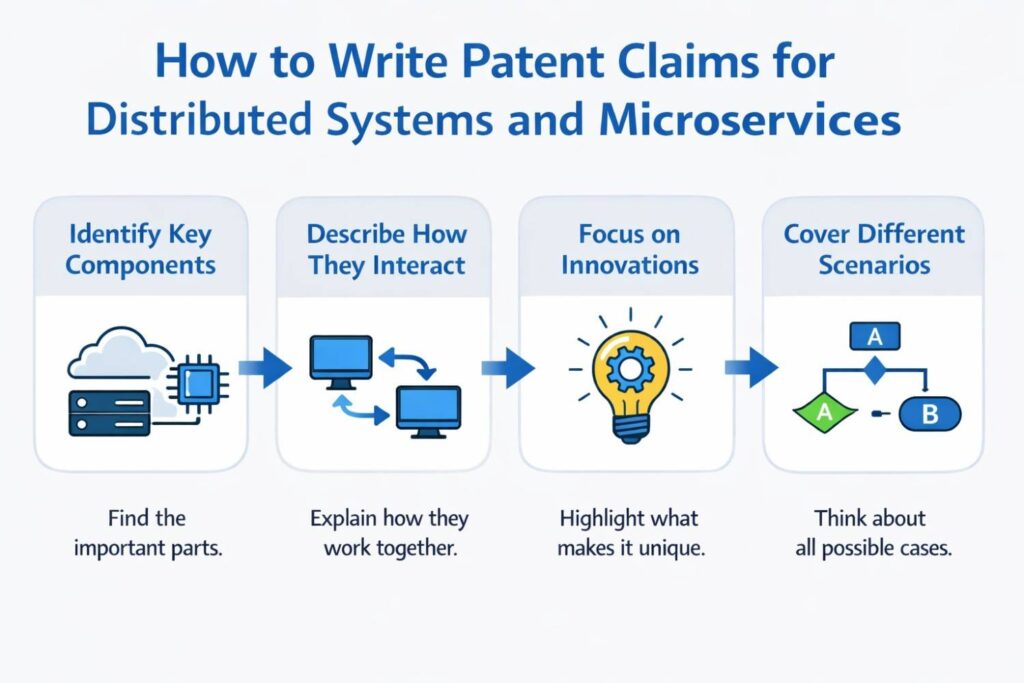
A claim should not just sound technical. It should protect the technical choice that matters most to the business.
Find the real invention inside the architecture
Many founders think their invention is the whole system. In practice, a patent claim works better when it points to the special move inside the system. The invention is often not “a microservices platform” or “a distributed data service.”
Those labels are too broad and too plain. The invention is more likely the exact way a service decides where work goes, how it reacts when a node becomes unhealthy, how it handles partial failure, or how it keeps actions in the correct order across separate services.
This is where companies need to slow down and look deeper. If two teams both use service discovery, that does not mean both teams built the same invention.
If two products both use event queues, that also proves very little. The key question is how your system uses those tools in a way that solves a technical problem better than standard practice. Good claim writing starts when the company can point to that difference in simple words.
Describe the problem in system terms
A strong claim usually comes from a clear problem statement. Not a vague business problem, but a system problem.
That means the company should explain what breaks, what slows down, what becomes inaccurate, or what becomes unsafe in older designs.
A useful framing might sound like this: when a request depends on several services and one service lags, the system may create duplicate work, stale data, or failed user actions.
Or it may sound like this: when service instances change often, static routing rules waste compute power and reduce response quality. Once the problem is stated this way, the claim can focus on the technical steps that solve it.
That makes the patent stronger because it shows that the invention is not a general idea. It is a concrete system solution to a concrete system problem.
Why this matters to businesses
A business should care about this because patents are not judged only by how clever they sound. They are judged by whether they clearly define a technical solution.
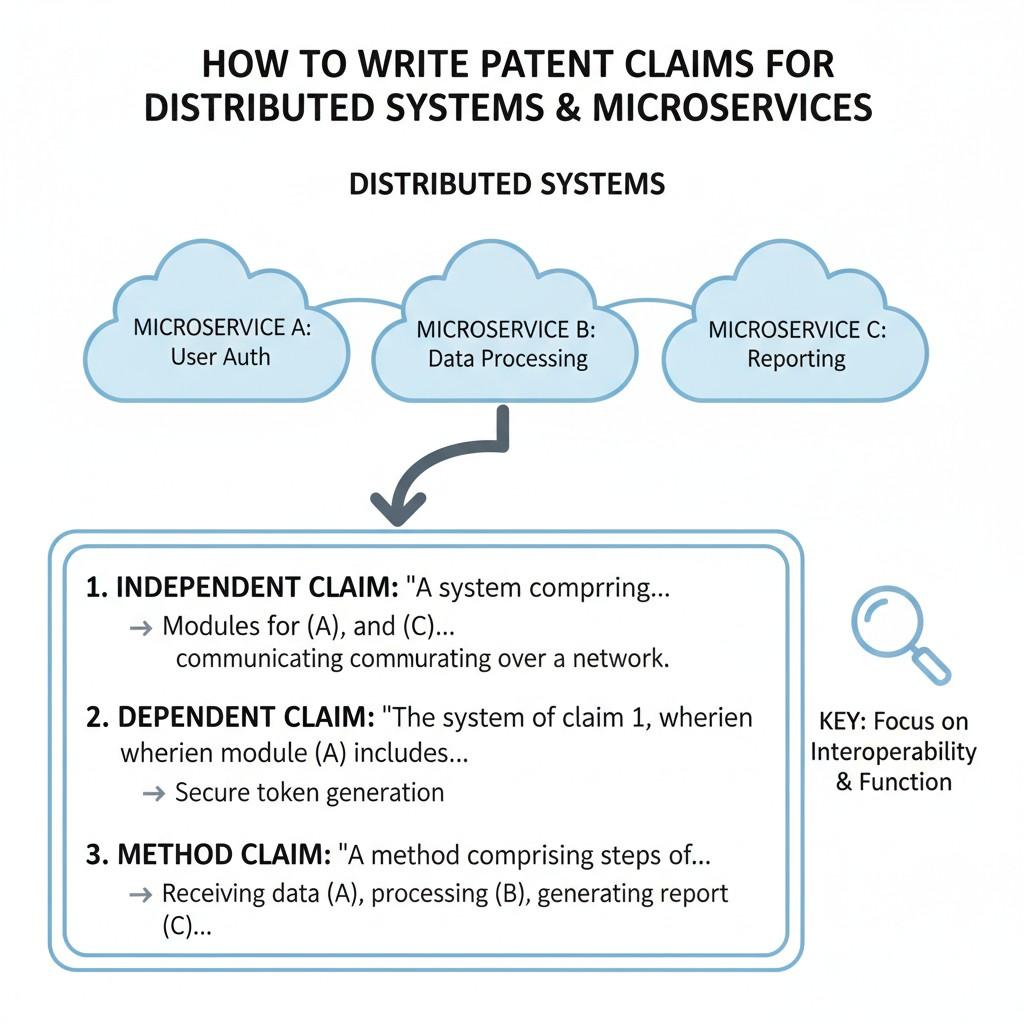
When a company can tie its claim to a system-level problem and a system-level fix, the claim becomes easier to defend and easier to understand later during growth, fundraising, licensing, or acquisition talks.
Separate infrastructure from invention
Many distributed products sit on standard tools. They may use containers, queues, gateways, service meshes, cloud storage, and common orchestration layers. That is normal.
But a patent claim should not lean too hard on those basic building blocks unless the novelty is truly there. Simply saying that a process happens in containers across networked services will not get a business very far.
The smarter move is to separate what is standard from what is special. Standard parts form the stage. The invention is the behavior on that stage. Maybe your platform watches service health in a new way and shifts work before user impact appears.
Maybe it breaks a large request into smaller jobs and reassembles them with a timing rule that reduces failure spread.
Maybe it uses a coordination model that lowers duplicate execution while still keeping latency low. These are the kinds of details that deserve claim focus because they create technical advantage without depending on generic cloud language.
Write claims around behavior, not labels
A common mistake in software patents is relying on labels instead of actions. Words like coordinator, broker, manager, dispatcher, monitor, and controller can be useful, but they are not enough by themselves.
A claim becomes much stronger when each named part is tied to a clear action.
That means instead of stopping at “a routing service,” the claim should explain what the routing service actually does.
Does it receive a request, check a health state, compare service load across regions, select a target instance based on a freshness rule, and send the request with retry logic tied to failure type?
That sequence is useful because it turns a vague role into a real process. In patent work, behavior is where the value lives.
A practical drafting habit
One helpful habit is to test each claim element with a simple question: if the label were removed, would the action still be clear? If the answer is no, the claim likely needs more substance.
Businesses should train technical teams to describe system parts by what they do, not just what they are called in the codebase.
Claim the interaction between services
Microservices rarely create value in isolation. The hard work usually happens at the boundaries between services.
That is where requests move, data changes state, retries happen, permissions get checked, and failures spread or get contained. For that reason, businesses should spend extra time on interaction claims.
An interaction claim can focus on the order of events across services, the conditions that trigger one service to call another, the way state is passed or validated, or the control logic that prevents bad outcomes when separate services act at different times.
These cross-service moves are often easy for rivals to copy once they see the product working. That is exactly why they deserve serious claim attention.
Capture timing rules and decision rules
In distributed systems, timing is often part of the invention. The same is true for decision rules.
Two systems may use the same services and still behave very differently because one checks conditions at a better moment or applies a smarter rule before moving work forward.
If your system delays an action until a consistency signal arrives, that can matter. If it routes work only after comparing local node state with an external event stream, that can matter too.
If it retries with different paths based on the type of service failure, that may be one of the most important parts of the invention. Businesses should look for these timing and decision points because they often represent real engineering thought and real defensible value.
Where founders often miss the value
Founders often describe outcomes first. They say the system is faster, more stable, or more scalable.
Those points matter, but claims need the mechanism. The strategic move is to ask what rule or timing choice caused that better result. That answer often becomes the strongest part of the claim.
Do not hide the claim inside the data flow diagram
Many engineering teams are great at drawing system diagrams. They can show services, queues, databases, clients, regions, and interfaces clearly. But a diagram alone does not create a strong claim. A patent claim needs the logic that lives inside the arrows.
A company should treat diagrams as a starting point, not the final story. Each arrow should be questioned. What triggers that message? What condition controls the transfer?
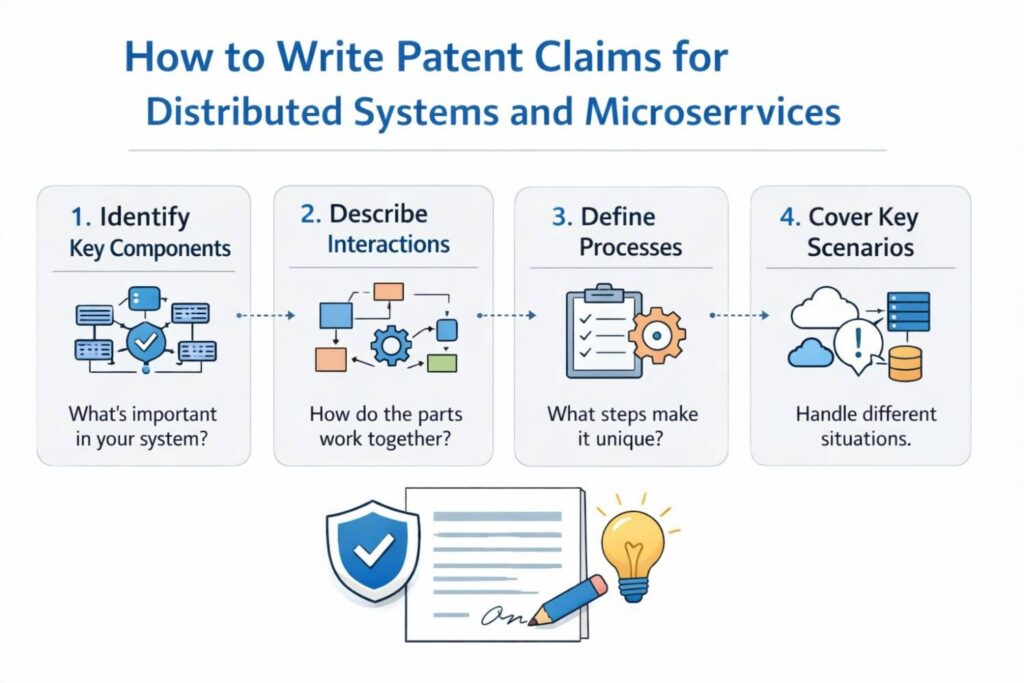
What is checked before the next step? What happens if the target service is stale, overloaded, or missing?
What state is created, updated, or confirmed? These questions pull the invention out of the picture and into claim language that can actually protect the system.
Use failure handling as a claim source
One of the richest places to find patentable material in distributed systems is failure handling. Modern systems fail in small ways all the time. Services time out. Nodes vanish. Messages arrive twice.
Dependencies respond late. State becomes uneven across locations. Teams that build good systems create smart ways to survive these events without breaking the user experience.
Why failure logic creates real protection
Competitors can copy visible features faster than they can copy deep resilience design.
A patent that covers the hidden control logic behind fault recovery may protect the part of the system that took the most real engineering effort. That is strategic protection, not surface protection.
Include more than one claim angle
A business should not rely on one framing alone. The same invention can often be described from different angles, and that is useful. One claim may focus on request handling.
Another may focus on state coordination. Another may focus on a recovery path after failure. Another may focus on how system health data changes later routing decisions.
This matters because competitors rarely copy a system in the exact same shape. They may move pieces around while keeping the same core advantage.
If the patent only claims one narrow view, they may sidestep it. But if the filing captures the invention through several valid technical frames, the protection becomes harder to avoid.
This is one of the most practical steps a business can take to improve long-term patent value.
Think like a rival who wants to design around you
A very useful exercise is to pretend you are the competitor. You want the same technical win, but you want to avoid the patent. What would you change?
Would you move the logic to another service? Would you replace a central coordinator with a distributed rule? Would you change the event trigger but keep the same system outcome?
When a company runs this test early, it often sees weak spots in its claims. That does not mean the invention is weak. It means the wording may be too tied to one implementation.
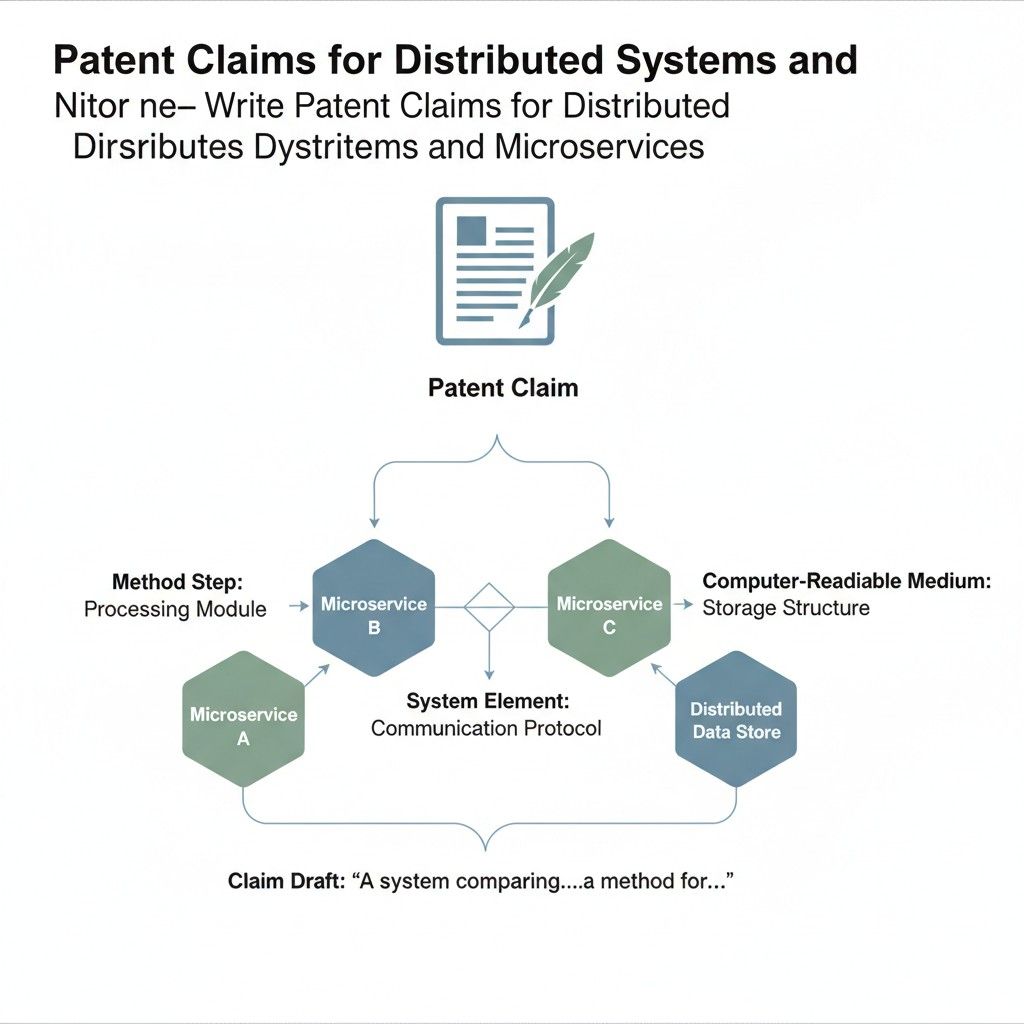
Strategic claim drafting does not just describe what your team built first. It also protects the core idea against obvious workarounds that preserve the same technical advantage.
A founder-level way to test claim strength
Ask this simple question: if a fast-moving rival changed service names, moved one step into a queue consumer, and split one component into two, would the claim still read on their product? If the answer is no, the claim may be too narrow for real business use.
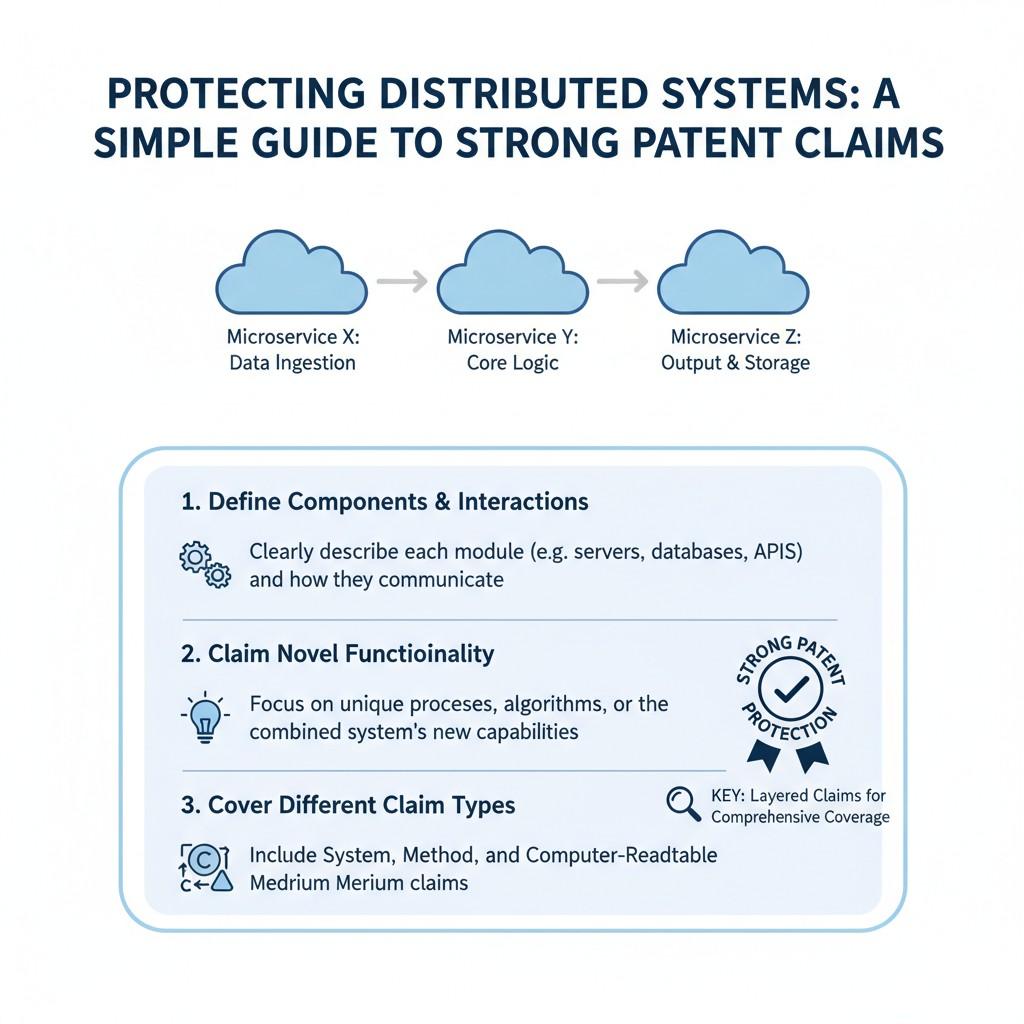
Protecting Distributed Systems: A Simple Guide to Strong Patent Claims
Protecting a distributed system is not the same as protecting a simple app feature.
The real value is often hidden in the way services work together, how they share state, how they recover from failure, and how they keep the system stable when traffic, data, and users all grow at once. That is why patent claims in this space need more care.
A good claim should not just describe software in a general way. It should protect the technical choices that give the business an edge.
Start with the part competitors would copy first
Before drafting claims, a company should step back and look at the system through a business lens. This matters because the strongest claims usually protect the part of the product that creates the most leverage, not the part that is easiest to describe.
If a competitor studied your platform and tried to build a lookalike, they would not start with your basic interface. They would go after the system logic that makes the product fast, dependable, and hard to replace.
A helpful way to think about this is to ask what part of the system gives customers the result they pay for. In one business, that may be the way requests are routed across services during peak load.
In another, it may be the way events are processed without losing order. In another, it may be the way failures are isolated so one bad service does not bring down the full workflow.
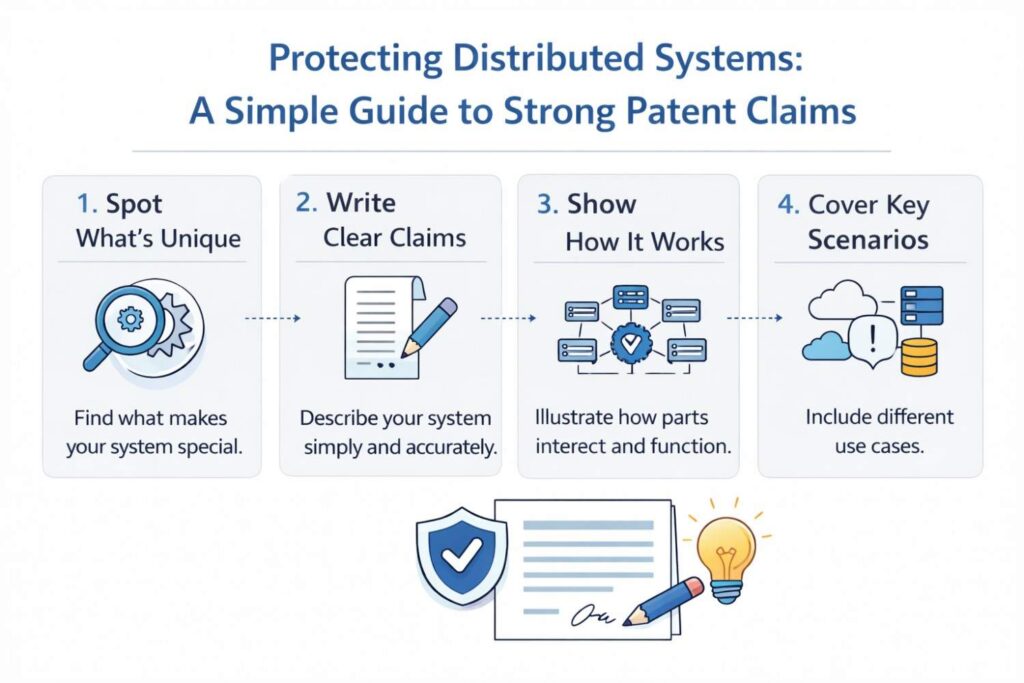
That is where good claim work should begin. A patent should protect the engine, not just the paint.
Look for the hidden source of business value
Many companies spend too much time describing visible features and not enough time protecting hidden system behavior. In distributed systems, the hidden behavior is often the real moat.
Customers may never see it directly, but they feel it every time the product stays online, responds quickly, and handles work without errors.
That means founders and engineering leaders should ask a simple question early: what system behavior would hurt the business most if a rival copied it next month? The answer often points straight to the strongest claim target.
Focus on technical advantage, not just technical detail
Distributed systems contain many moving parts. There may be message queues, edge nodes, service registries, gateways, schedulers, data stores, caches, and monitoring layers.
But strong patent claims do not come from naming every part of the stack. They come from showing how the system uses those parts in a way that creates a real technical advantage.
This is an important shift in thinking. A claim should not read like a cloud architecture diagram turned into text. It should read like a clear explanation of what the system does differently and why that difference matters.
If your platform reduces duplicate execution, improves reliability during partial failure, keeps data more accurate across services, or makes routing smarter under changing network conditions, that is what needs to come through.
Do not confuse complexity with invention
A large architecture is not always a patentable one. Some systems are complex simply because modern software is complex.
What matters is whether your team made a special design choice that solved a real technical problem in a better way.
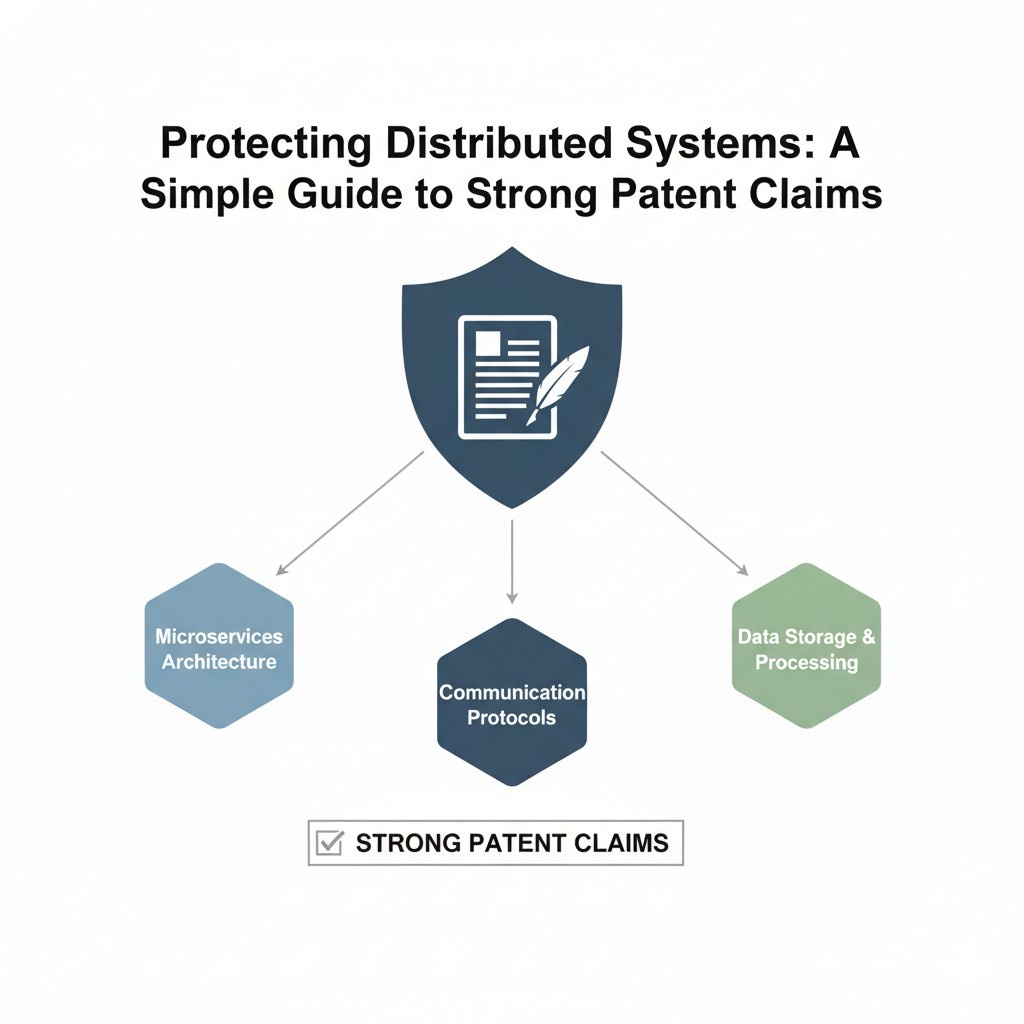
Businesses should train themselves to separate “there are many parts” from “there is a real invention here.” That discipline leads to cleaner claims and better protection.
Define the problem in plain system language
The strongest claims often begin with a very clear statement of the technical problem. That problem should be described in system terms, not in vague business language.
Instead of saying the invention improves user experience, it is much stronger to explain that prior designs create stale state, duplicate jobs, broken transaction chains, or slow recovery when a service fails.
This matters because patent claims become easier to defend when they are clearly tied to a technical challenge.
A reviewer, investor, or future buyer should be able to understand what was going wrong in older approaches and what your system does to fix it. That creates a much stronger story around the patent and around the business itself.
A simple way to frame the problem
One useful method is to describe the system problem as a before-and-after story.
Before your approach, requests may fail in a certain condition, data may drift across services, or retries may trigger unwanted duplicate actions. After your approach, the system follows a new control path that prevents that result.
That kind of framing helps companies move from abstract thinking to claim-ready logic.
Protect the coordination logic between services
In microservices and distributed systems, the invention often lives in the connection points, not in the services alone. A single service may do something ordinary on its own.
The value appears when one service triggers another, when state moves across boundaries, or when the system decides what to do next based on events coming from different places.
That means businesses should look closely at coordination logic. How does one service know when to wait, when to act, and when to stop another service from doing duplicate work?
How does the system decide which service instance should handle the next task? How does it maintain trust in the workflow when timing is uneven across nodes? These are not side details. In many products, this is the heart of the invention.
Why coordination logic is so valuable
Coordination logic is often hard to rebuild from scratch. A rival may copy a feature quickly, but it takes much more effort to copy the internal rules that keep distributed work correct under load and failure.
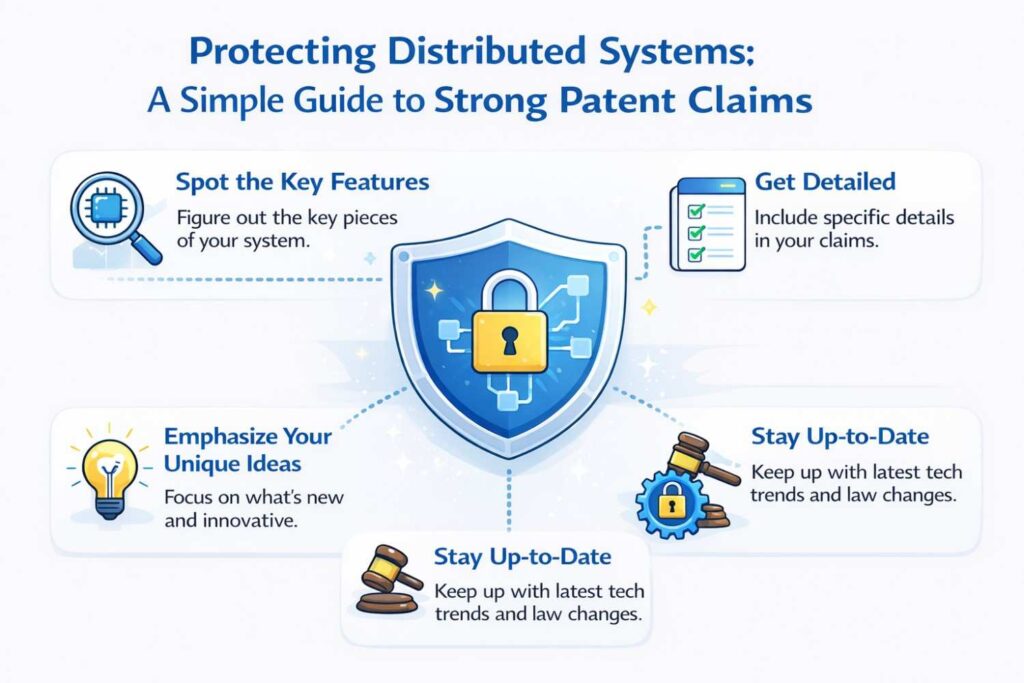
That is why these rules often deserve patent focus.
Write around actions and rules, not component names
One of the easiest mistakes in patent drafting is leaning too hard on labels. A claim may mention a controller, scheduler, manager, broker, or coordinator, but those names alone do not explain the invention.
The real power comes from the actions each part takes and the rules it follows.
A better claim explains what happens. It shows that a service receives a request, checks a condition, compares current state against a policy, selects a target path, forwards work, detects a failure signal, and changes later behavior based on that signal.
This kind of action-based drafting is much more useful because it protects the method, not just the vocabulary used inside the codebase.
Test whether the action is clear
A practical test is to remove the component names and see if the technical behavior still makes sense. If the answer is yes, the claim probably captures real substance. If the answer is no, the claim may be too dependent on labels and not strong enough yet.
Turn failure handling into patent strength
Many of the best inventions in distributed systems show up when things go wrong. That may sound strange at first, but it is true.
Modern systems are built to deal with service outages, retry storms, stale reads, dropped messages, and uneven node health.
The teams that solve these problems well often create the most valuable technical designs in the whole company.
This is why failure handling deserves serious attention when writing patent claims. A system may detect a partial failure in a special way, prevent error spread across services, restore work from a saved state, or reassign tasks while preserving correct ordering. Those are real technical solutions.
They are also often hard for competitors to reproduce quickly.
Protect what keeps the system alive
Businesses sometimes overlook resilience because it is not always visible in a product demo. But resilience is often the reason enterprise buyers trust a platform and stay with it.
If your distributed system keeps working in conditions where other systems break, that is not just good engineering. It may be valuable patent material.
Capture timing decisions that shape system behavior
In distributed systems, timing is often part of the invention. The order of events matters. The moment when a service checks state matters. The way a retry is delayed or redirected matters.
Two systems can use many of the same tools and still perform very differently because one applies smarter timing rules.
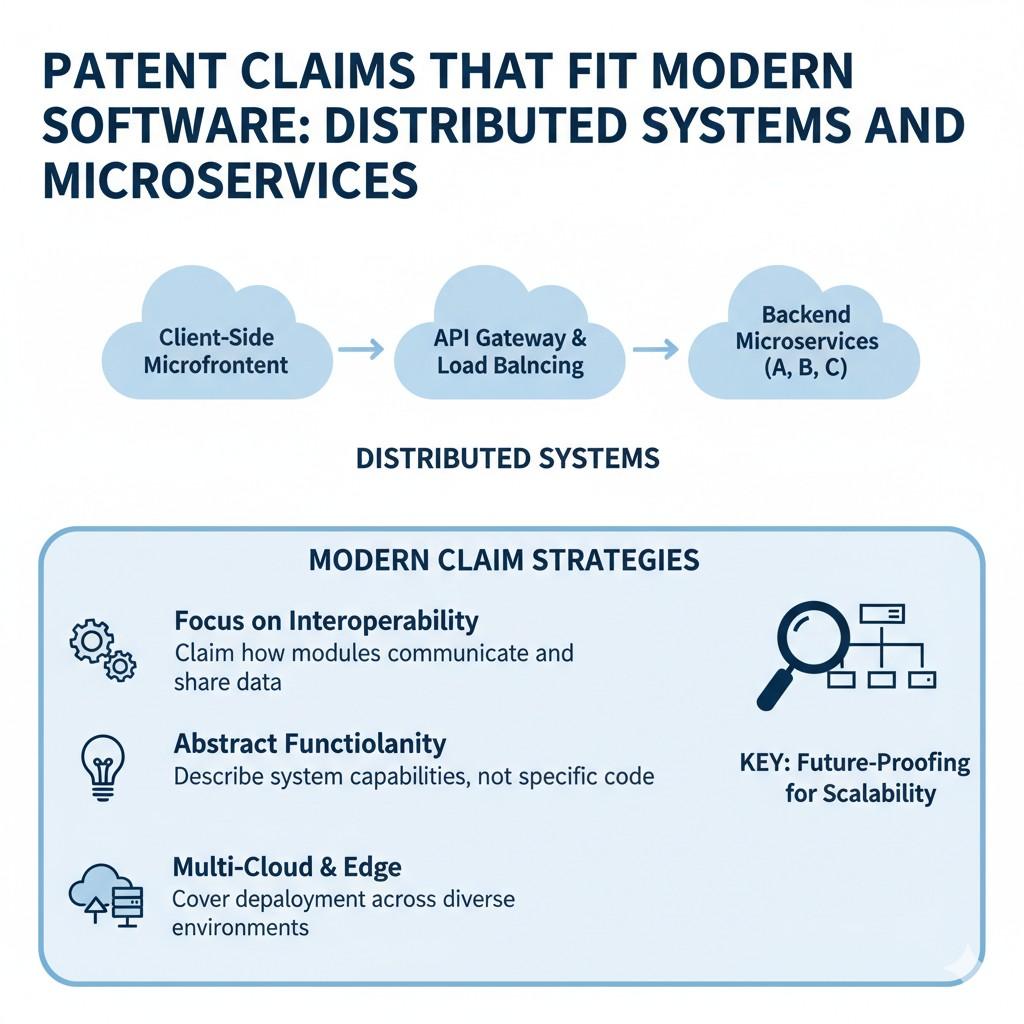
Patent Claims That Fit Modern Software: Distributed Systems and Microservices
Modern software does not live in one place anymore. It runs across services, regions, queues, APIs, workers, and shared data layers. One user action may trigger many separate parts of a system before the job is done. That is why patent claims for modern software need a different approach.
A company cannot rely on old ways of describing software as one fixed process inside one machine. It needs claims that match how real systems are built today.
For businesses working with distributed systems and microservices, the goal is simple. Protect the system logic that makes the product work better, scale faster, and stay harder to copy.
Modern software needs modern claim thinking
Software patents become weak when they are written as if the product were a single feature running in a simple environment. That is not how strong technical companies build anymore.
Today, many valuable products depend on separate services working together under changing conditions. Requests move between layers. State changes in stages. Failures happen in one place and recovery happens in another.
Because of that, patent claims need to reflect real system behavior. A claim should not just say that a server processes a request.

It should explain how the system reacts across services, how one service affects another, and how the platform reaches a useful result even when the environment is changing.
This is what makes a claim fit modern software instead of sounding stuck in the past.
Why old framing misses new value
Many older-style software claims focus too much on one module doing one task.
That often misses the real invention in a distributed product. In modern platforms, the value often comes from coordination, state control, event timing, and recovery logic. When those parts are ignored, the patent may miss the business-critical edge.
The best claim target is rarely the most visible feature
Many founders first think about patenting what users can see. That is understandable, but it is often the wrong place to begin. In distributed systems, the most valuable invention is often hidden from the customer.
Users may see a dashboard, a response, or a completed workflow. What they do not see is the hard system design that makes that result possible.
That hidden system behavior is often where the strongest claim lives. It may be the way services keep data aligned without blocking the full workflow.
It may be the way the platform routes work around unhealthy nodes before the user notices a problem.
It may be the way the system preserves order across asynchronous events. These internal technical moves may be the real reason customers trust the product and stay with it.
Protect the part that drives trust
Businesses should focus on the part of the system that customers depend on even if they never see it directly.
Reliability, consistency, response quality, cost control, and safe scaling often come from deep system logic. That is the logic worth protecting.
Fit the claim to how the system actually creates value
A good patent claim should match the way the company wins in the market. That sounds simple, but many businesses skip this step. They describe technical parts without clearly tying them to the advantage those parts create.
A stronger approach is to ask what technical behavior supports the product promise. If your company promises faster execution, what system method creates that speed?
If your company promises stable performance at scale, what coordination logic makes that possible? If your company promises accurate results across distributed services, what state management method protects that accuracy?
Once the business sees the technical source of its value, claim drafting becomes much sharper.
A patent should support the revenue story
When a patent maps closely to the technical reason customers buy, it becomes more useful in business settings.
It is easier to explain in diligence, easier to position with investors, and easier to connect to long-term product strength.
Microservices change where invention lives
In a monolithic product, much of the invention may sit inside one code path. In microservices, invention often moves into the spaces between services. The service itself may be ordinary.
The way it interacts with other services may be where the real novelty appears.
That is why businesses need to pay close attention to service boundaries. What causes one service to call another? What information is passed? What validation happens before the next step?
What happens if one service is delayed, unavailable, or returns stale data? These questions often uncover the design logic that deserves protection.
The boundary is often the moat
In many modern platforms, the hardest work is not happening inside one component. It is happening at the handoff points.
Those handoff rules often become the true moat because they are the part that took the most real thought to get right.
Distributed systems make timing part of the invention
In modern software, timing is often not just an implementation detail. It may be central to the invention. The order of operations, the delay before retry, the moment when state is checked, and the condition that triggers fallback behavior can all shape system performance and system correctness.
This matters for patent claims because timing choices often separate a basic system from a valuable one.
Two products can use similar services and similar data flows yet perform very differently because one platform makes better timing decisions.
If your system waits for a particular consistency signal, reroutes work only after a certain health pattern appears, or commits downstream actions in response to a sequence of events, those timing rules may be highly important.
Timing explains why the system works under pressure
A founder may say the platform is stable under load. The deeper question is why. Often the answer sits in timing logic.
That logic should not stay buried inside architecture notes. It should be part of the patent strategy.
Claims should follow behavior, not branding
Engineering teams often use internal names for services, managers, coordinators, brokers, routers, or engines. Those labels may be useful inside the company, but they do not define the invention by themselves.
The claim becomes much stronger when it focuses on the behavior instead of the internal name.
This means the patent should explain what the system does in real terms.
A service may receive a request, compare node health information, select a processing path, update a state record, and trigger a downstream action based on a threshold rule.
That kind of language protects the technical method in a more lasting way. It also makes the patent more flexible if the product changes later.
Good claims survive refactoring
Modern software changes fast. Teams rename services, split them, merge them, and move logic between layers.
Claims built around function and behavior tend to stay useful through those changes. Claims built around labels often become too narrow too quickly.
Event-driven systems deserve special care in claims
Many distributed platforms now rely on events instead of direct sequential calls.
That creates real opportunity, but it also creates drafting risk. A weak claim may say only that an event triggers a later action. That is usually not enough. The valuable part is often the rule around the event.
A stronger claim may explain how events are filtered, ordered, verified, replayed, grouped, or used to update later service behavior.

It may explain what happens when two events conflict or when the expected event never arrives. In event-driven systems, the invention often sits in how the system handles uncertainty without losing control.
Events matter because uncertainty matters
The more a system depends on asynchronous flows, the more important it becomes to protect how uncertainty is handled. That is where much of the real engineering value sits.
Failure handling is not a side topic
Modern software is built with the expectation that parts will fail. Services time out. Containers restart. Messages are delayed. Dependencies return bad data. Networks become uneven.
In distributed systems, the way a platform handles these failures may be one of its most valuable technical assets.
This is why companies should treat failure handling as a main source of claim strength.
If your platform detects partial failure in a new way, contains damage before it spreads, rebuilds correct state after interruption, or routes around bad dependencies while preserving workflow quality, that is major patent material. It is often harder to copy than front-end features and often more central to the business.
Hidden resilience can be the biggest asset
Many founders underestimate how much value sits in resilience. Customers may call it reliability, uptime, trust, or stability. Underneath those words is often a set of technical rules that deserves strong protection.
Strong claims separate the standard stack from the real invention
Most modern systems rely on common tools. They may use cloud orchestration, service meshes, queues, caches, registries, and standard storage patterns.
That is normal. But using standard tools does not make the invention disappear. It just means the business has to separate the stage from the performance.
The claim should make clear what is ordinary background and what is the unique system behavior. Maybe the system uses ordinary queues but applies a new sequencing rule across services.
Maybe it uses standard node health checks but combines them with workload freshness in a new routing method.
Maybe it uses normal data stores but applies a special state confirmation path before downstream processing. Those distinctions matter because they show where the actual technical advantage lives.
Do not waste claim space on obvious infrastructure
A patent becomes more strategic when it spends less time on common setup and more time on the decision logic, coordination flow, and state control that truly create value.
Wrapping It Up
Modern software needs patent claims that match the way modern systems are really built. If your product runs on distributed services, event flows, shared state, retries, routing logic, and failure recovery, your patent should protect those moving parts in a clear and useful way. The goal is not to describe everything. The goal is to protect the system choices that make your product work better and make it harder for others to copy.
Leave a Reply