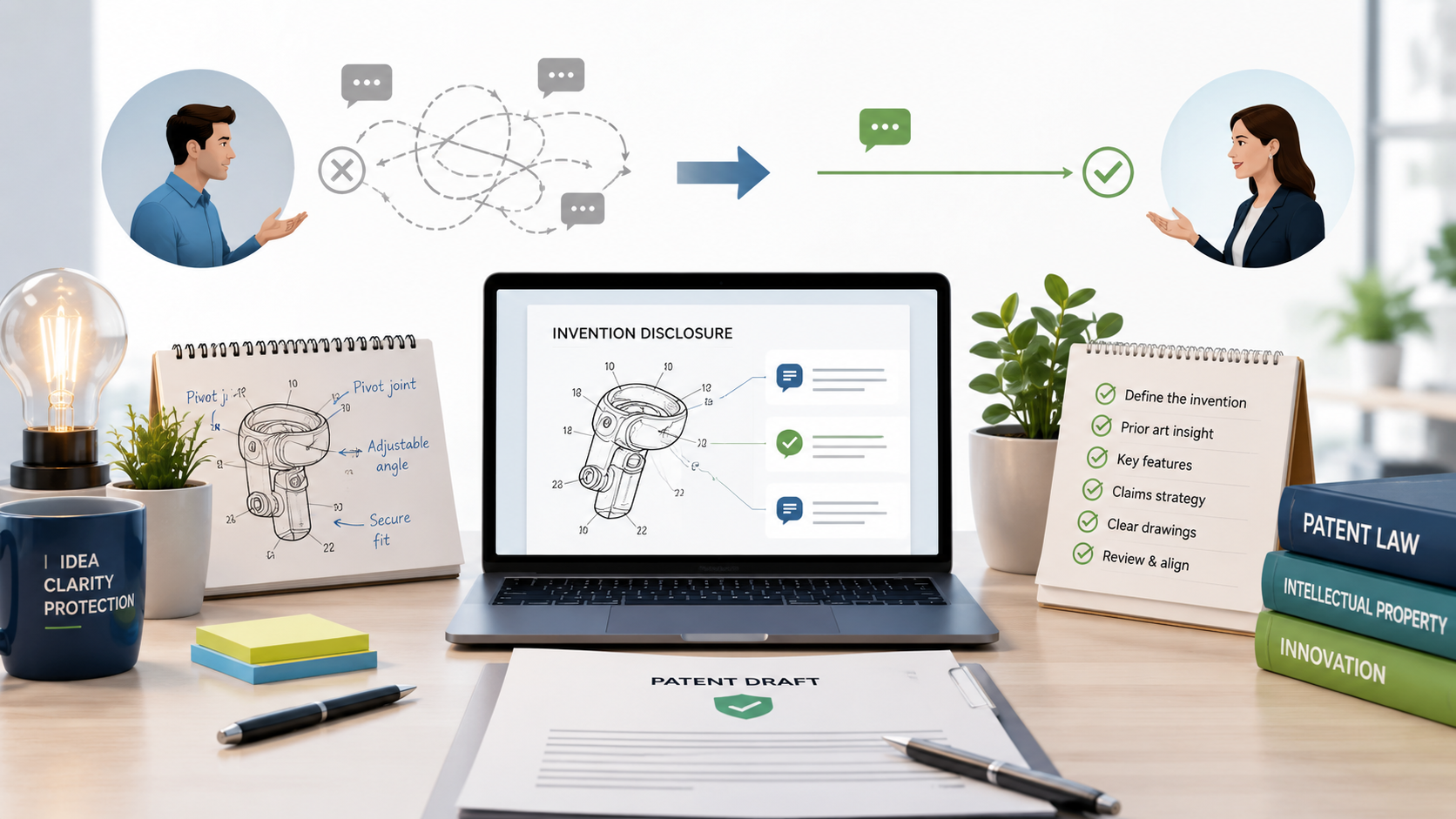
Patent drafting should not feel like a long game of email ping-pong. Yet for many founders, engineers, and inventors, that is exactly what happens. The attorney asks for more details. The team sends notes. The attorney asks again. Someone shares a diagram. Someone else corrects it. A key feature gets missed. The draft comes back looking too broad, too narrow, or too hard to read. Weeks pass. Momentum drops.
Start With the Real Invention, Not the Product Name
A strong patent draft starts with a clear view of the invention. That sounds simple, but this is where most delays begin.
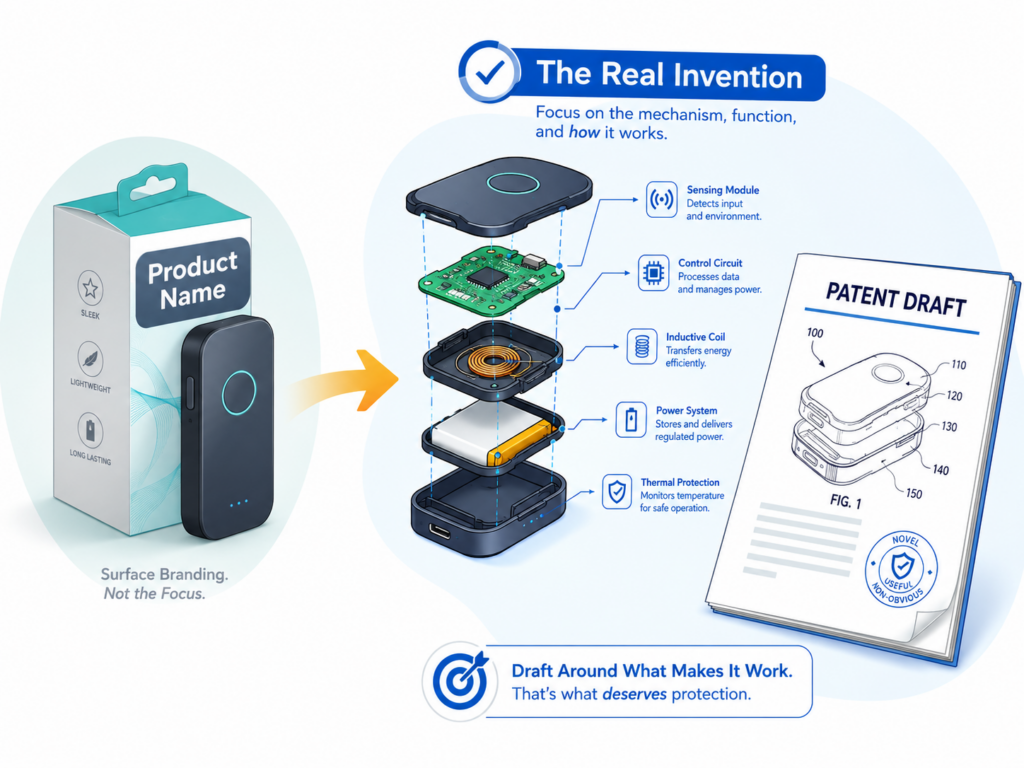
Many teams start by saying, “We built an AI tool for X,” or “Our platform helps users do Y.” That may be true, but it is not enough for a patent draft.
A product is the full thing users see. An invention is the special part inside the product that solves a hard problem in a new way.
This difference matters a lot. If your patent team only hears the product story, they may draft around the wrong thing. They may focus on the user interface when the real value is in the model pipeline.
They may focus on the business workflow when the real edge is in how data is cleaned, ranked, stored, trained, matched, or acted on. That creates back-and-forth because the first draft does not protect the core idea.
So before drafting starts, slow down for a moment and name the real invention in plain words.
The first job is to separate the invention from the whole product
Founders often know their product deeply, but that can make the invention harder to explain. You are too close to it.
You see the full system, the roadmap, the market, the customer pain, the backend, the front end, the data layer, and the business goal all at once.
Your patent team needs something cleaner.
They need to know the one part of the system that would make a smart competitor say, “That is clever. We should copy that.”
That part may be small. It may be hidden from the user. It may live inside code, logic, training data, automation rules, sensor steps, ranking steps, hardware timing, or a control loop. But if that part creates the edge, it should be brought forward early.
For example, a founder may say, “We built a tool that helps doctors review patient notes faster.” That is the product story.
The invention may be, “The system detects missing context in a patient note, pulls related data from earlier records, ranks the most likely missing facts, and shows only the facts that change the next decision.” That second version gives the patent drafter something real to work with.
It also cuts down on questions later.
The simple test is to ask what would still matter if the screen changed
A useful way to find the invention is to ignore the surface for a moment. Pretend the app name changed.
Pretend the buttons changed. Pretend the dashboard changed. Pretend the customer changed from doctors to lawyers, engineers, or finance teams.
What part would still be valuable?
That is often the invention.
If the same core method could work across many use cases, your patent team should know that from the start. Otherwise, the draft may get trapped inside your first market.
This is one of the most common causes of heavy revision. The founder reads the first draft and says, “Wait, this should not only cover hospitals. It could also work in insurance, research, and compliance.”
That is a fair point. But it is much better to say that before drafting begins.
At PowerPatent, this is one reason we help founders organize the invention before the legal writing starts. The goal is not to make you speak like a patent attorney.
The goal is to help your team explain the core idea clearly, so the draft protects what matters. You can see how that works here: https://powerpatent.com/how-it-works
A clear invention statement saves many rounds of edits
A good invention statement is short, but it should carry weight. It should explain the problem, the special action, and the result.
For example, instead of saying, “Our system automates data review,” say, “Our system finds conflicts between two data sources, scores which conflict is most likely to matter, and triggers the next step only when the score passes a set level.”
That sentence gives the drafter structure. It shows the input, the action, the rule, and the output. It also hints at what may be patent-worthy.
The better your invention statement, the fewer follow-up questions you get. Your attorney does not need to guess what makes the system special.
Your engineers do not need to explain the same thing three times. Your draft does not need to be torn apart later because the wrong part was placed in the center.
The best invention statement is plain enough for a smart outsider
Do not try to sound technical just to sound serious. Simple words usually work better.
A strong patent draft still needs depth. But depth does not mean fog. Your first explanation should be easy for a smart person outside your company to follow. If the plain version makes sense, the technical version can be built on top of it.
This is especially true for software, AI, robotics, chips, medical devices, clean tech, and deep tech systems.
The tech may be complex, but the invention story should still be clear. A good draft grows from a simple spine.
That spine is usually this: here is the problem, here is why old ways are not enough, here is what our system does differently, and here is the better result.
When you give that to your patent team early, the draft moves faster. The first version is closer. The claims make more sense.
The figures are easier to plan. The examples are stronger. Most of all, the review process feels less painful.
Build the Patent Draft Around the Problem Your Invention Solves
The problem is not background noise. It is the reason your invention exists.
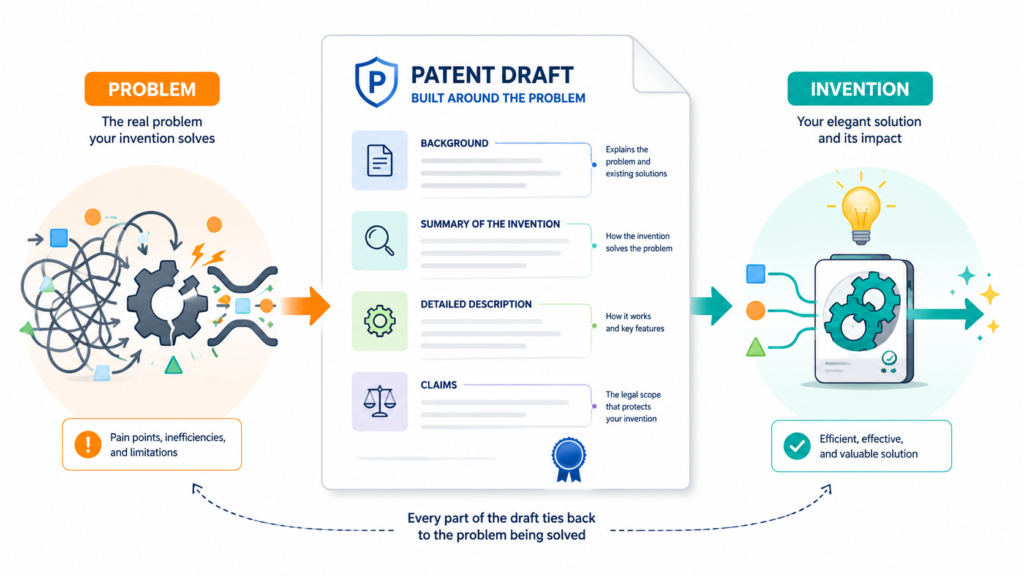
Many patent drafts take too long because the problem is weak, vague, or missing. The founder says what the product does, but not why it needed to be built that way.
The attorney then has to ask more questions. Why was this hard? What failed before? What made the old approach slow, risky, expensive, or less accurate? What changed because of your design?
When those answers are missing, the draft can feel flat. It may describe features, but it does not show the force behind the invention.
That leads to back-and-forth because the team has to add meaning after the draft is already written.
A better way is to make the problem clear before drafting starts.
The problem should be narrow enough to shape the draft
A broad problem like “data is messy” is not very helpful. It may be true, but it does not guide the patent draft.
A better problem would be, “Data arrives from different sources in different formats, and the system cannot decide which version to trust without slowing down the workflow.”
That is more useful because it points toward the invention.
The same idea applies across technical fields. “Robots are hard to control” is too broad. “A robot arm loses accuracy when payload weight changes during motion” is much better.
“AI models are hard to train” is too broad. “The model overfits when rare events appear in small clusters inside noisy training data” is much better.
The narrower problem gives the patent team a stronger starting point. It helps them understand why your steps matter. It helps them write a draft that does not sound like a generic product brochure.
A strong problem statement makes the solution look more valuable
When the problem is clear, the invention feels more real.
Imagine reading a draft that says, “The system ranks items and displays a result.” That sounds ordinary.
Now imagine the draft first explains that prior systems ranked items too slowly because they recalculated every item after each small input change.
Then the draft explains that your system updates only the affected parts of the ranking tree while keeping the rest stable.
Now the invention has shape.
The reader understands why the system matters. The attorney understands where to focus. The engineers can confirm the key steps. The claims can be drafted with more care. The whole process becomes cleaner.
This is not about adding drama. It is about giving the draft a reason to exist.
The best problem statements come from real build pain
Founders often underuse the most useful source of patent detail: the pain they felt while building.
The best invention clues often show up in Slack threads, design notes, bug reports, test logs, customer calls, model results, lab records, and engineering tradeoffs. These are gold because they show the real reason the invention took work.
Maybe the first version was too slow. Maybe it used too much memory. Maybe the model gave good results in normal cases but failed at edge cases. Maybe the hardware worked in the lab but not in the field.
Maybe the old workflow needed too many human checks. Maybe the system had to make a decision with missing data.
These details help your patent team draft with less guessing.
The drafting team should know what almost did not work
One of the best ways to reduce back-and-forth is to share what failed.
This may feel strange. Many founders want to show the clean final version only. But failed paths are often very useful. They show why your chosen path was not obvious. They show what tradeoffs you made. They show why the final design matters.
For example, you may have tried a simple threshold first, but it created too many false alerts. Then you tried a fixed model, but it could not adapt to each user.
Then you built a feedback loop that changes the threshold based on recent user actions. That story helps the patent team understand the real invention.
Without that story, they may draft only the final feature. With that story, they can draft the deeper method.
This is where PowerPatent can help founders move faster. Instead of forcing your team to write a perfect invention memo from scratch, PowerPatent helps turn raw technical material into a clearer patent story, with attorney review layered in.
That means less confusion, fewer missed details, and a smoother path from idea to filed application. You can learn more here: https://powerpatent.com/how-it-works
The problem should connect directly to the result
A patent draft works best when the problem and result match.
If the problem is slow processing, the result should show faster processing. If the problem is poor accuracy, the result should show better accuracy.
If the problem is too much manual work, the result should show less manual work. If the problem is bad control under changing conditions, the result should show more stable control.
This may sound basic, but many drafts break this link. They describe a problem in one place and a different benefit in another place. That creates review comments because the story feels uneven.
A clean problem-to-result path keeps everyone aligned.
Every major feature should earn its place in the draft
When a draft includes too many features that do not connect to the main problem, reviewers get tired.
The founder starts asking why certain details are included. The attorney asks which features are important. The engineers get pulled back in to sort the core from the extra.
This can be avoided by asking one simple question before drafting: does this feature help solve the main problem?
If the answer is yes, it likely belongs near the center of the draft. If the answer is no, it may still be useful as an optional detail, but it should not take over the story.
This is how you reduce back-and-forth. You do not try to include everything with equal weight. You build the draft around the problem, then place each feature where it belongs.
Capture the Invention Before Anyone Starts Drafting Claims
Claims are the hardest part of a patent application. They define what you are trying to protect. But claims become much harder to draft when the invention is still fuzzy.
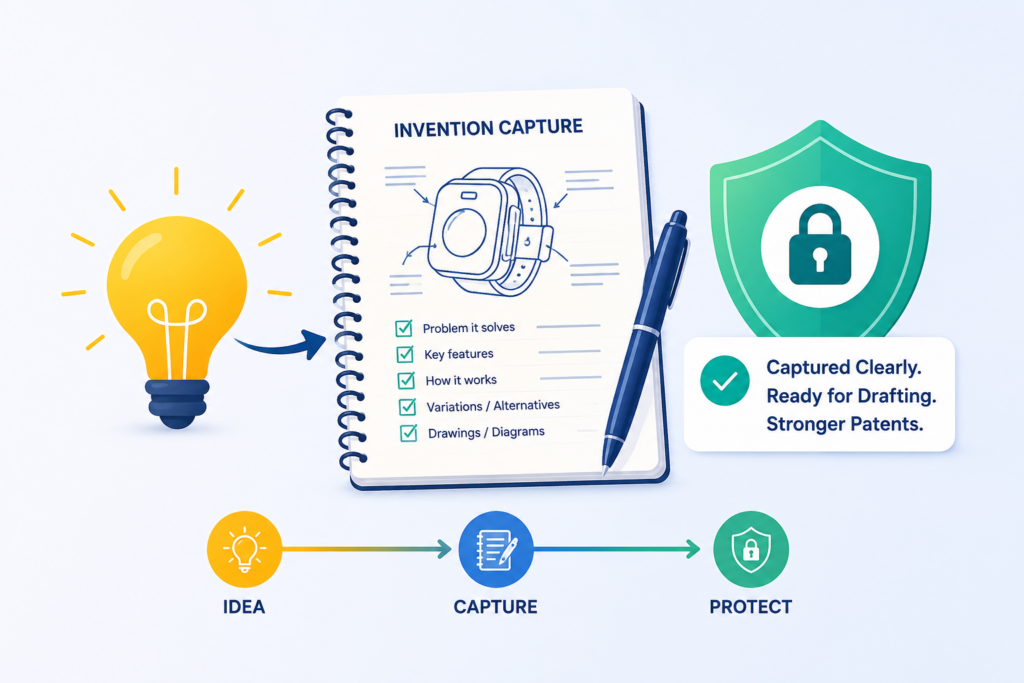
This is one of the biggest reasons patent drafting gets stuck.
A founder sends a quick product summary. The attorney starts drafting. Then, once the claims come back, the founder realizes the draft does not match the real value of the invention.
The claims may be too tied to the current product. They may miss the deeper method. They may focus on a feature that was easy to explain but not truly important. Then the team has to step backward.
The better move is to capture the invention before claim drafting begins.
This does not mean the founder needs to write claims. That is not the founder’s job. It means the founder should give the patent team a clean map of the invention, so the claims can be built on the right base.
What your patent team needs before claims begin
Before claims are drafted, your patent team should know what the system receives, what it changes, what decision it makes, what output it creates, and what result improves. These are simple points, but they shape the whole application.
For software and AI inventions, this often means showing the data flow. What comes in? What gets filtered? What gets scored? What gets trained? What gets updated? What gets shown or triggered?
For hardware inventions, this often means showing the parts and their relationship. What moves? What senses? What controls? What connects? What changes under different conditions?
For biotech, clean tech, medical devices, robotics, or advanced manufacturing, this may mean showing the process path from input to final result.
The point is not to overload your attorney with every detail. The point is to make sure the core path is clear.
When this path is clear before drafting begins, the first claim set is usually closer to what the founder expects.
Claims should grow from the invention path, not from marketing copy
Marketing copy is built to sell the product. Claims are built to protect the invention.
That is why marketing pages often make weak claim inputs. They speak in broad promises. They say things like “faster insights,” “smarter automation,” “seamless workflow,” or “AI-powered decisions.”
Those words may help customers understand the value, but they do not tell a patent drafter how the invention works.
A drafter needs the steps behind the promise.
Instead of “smarter automation,” explain how the automation decides what to do. Instead of “faster insights,” explain what part of the process became faster and why.
Instead of “AI-powered,” explain what data the model uses, how it changes the result, and what happens after the model acts.
This is where many teams lose time. They send polished language, but the patent team needs working logic. The attorney then has to pull the real details out through calls and emails.
PowerPatent helps reduce that gap by helping founders turn invention material into a clearer draft-ready format before attorney review.
It lets the software and the attorney work together, so the team is not starting from a blank page or a vague product pitch. You can see the process here: https://powerpatent.com/how-it-works
The best claim input is a simple step-by-step story
You do not need to write like a lawyer to help with claims. In fact, plain words are better at the start.
A useful claim input sounds like this: the system receives a signal, compares it to a stored pattern, finds a mismatch, assigns a score, selects a response based on the score, and updates the stored pattern after the response is confirmed.
That is not a claim yet. But it gives the attorney a strong path.
It shows action. It shows order. It shows a decision. It shows a feedback loop. It shows what may be broad enough to protect beyond one narrow product screen.
This kind of step-by-step story cuts down back-and-forth because the attorney can draft from the actual invention rather than guessing from a feature list.
Keep the steps real, but do not trap them in one product version
A common mistake is to explain the invention only through today’s product. That can make the draft too narrow.
For example, you might say, “The user clicks the blue review button, and the system opens the risk panel.”
But the invention may not depend on a blue button or even a panel. The real step may be, “The system receives a review request and presents a ranked set of risk items.”
That version is cleaner. It protects the idea without tying it to one user interface choice.
The same is true for code names, internal tool names, database names, screen labels, and customer-specific workflows. These may be helpful as examples, but they should not control the whole draft.
Your patent team should know which details are required and which details are only examples. When that line is clear, there are fewer revisions later.
Claim drafting works best when the team agrees on the center
The center of the invention is the part you would most hate to see copied.
It may be the main method. It may be a special data structure. It may be a feedback loop. It may be a model training method.
It may be a hardware arrangement. It may be a control rule. It may be how two systems work together.
Before drafting claims, the team should agree on this center.
Without agreement, the draft may drift. The attorney may focus on one part, the founder may expect another, and the engineers may care about a third.
This creates slow review cycles because every person is reading the draft through a different lens.
A simple invention center keeps the team aligned.
The center should be broad enough to matter and concrete enough to draft
A center that is too broad becomes vague. A center that is too narrow becomes weak.
For example, “using AI to improve workflow” is too broad. It does not tell the drafter enough. “Using a transformer model with exactly twelve layers to sort support tickets on a dashboard” may be too narrow if the real invention is not tied to that exact model or interface.
A better center could be, “ranking work items by combining predicted urgency, missing context, and user correction history, then updating the ranking model based on later user action.”
That gives the patent team enough detail to draft with strength, while still leaving room to cover future versions.
This is the kind of clarity that reduces back-and-forth. The first draft lands closer because the target is known before the writing starts.
Give the Drafting Team the Best Version of Your Technical Story
A patent draft is only as strong as the technical story behind it. If the story is scattered, the draft will be scattered.
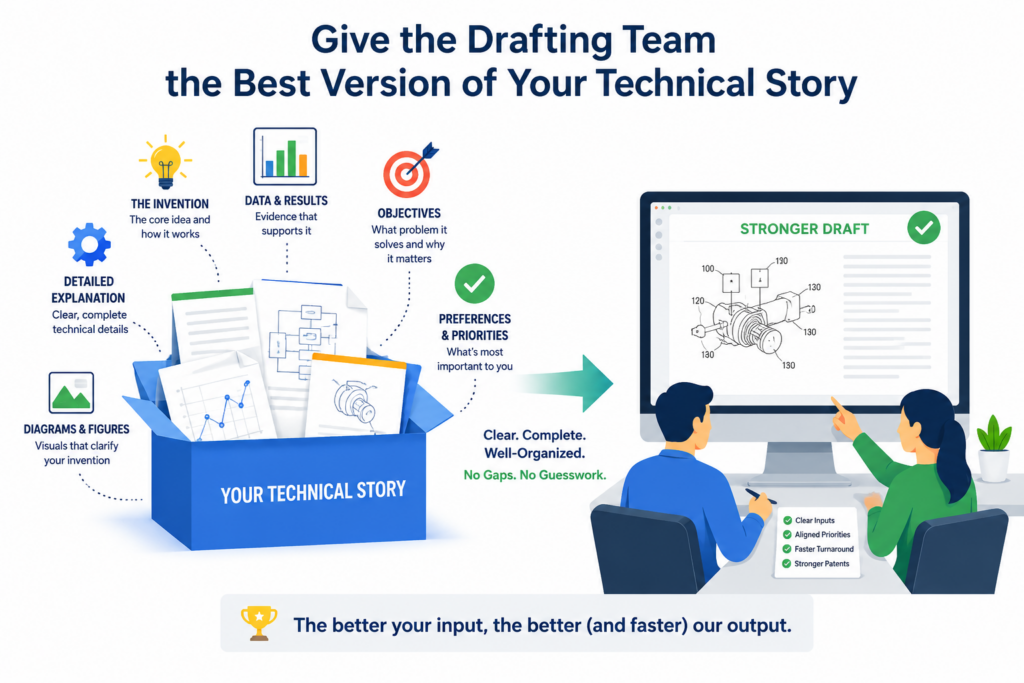
If the story is thin, the draft will need more questions. If the story is clear, the draft moves faster.
Many founders think they need to send a formal invention report. That can help, but it is not the only way. What matters most is that the patent team gets the right technical material in a form they can understand and use.
This material can include diagrams, code notes, product specs, model results, test data, screenshots, demo videos, architecture charts, design docs, or even a clear voice note from an engineer.
The format matters less than the clarity.
The goal is to tell the invention story once, well enough that the attorney does not need to rebuild it from fragments.
Your technical story should explain the system like a path
The best technical stories have movement. They show how information, energy, signals, materials, commands, or user actions move through the system.
This matters because many patent drafts fail when they describe parts without showing how the parts work together. A list of parts is not the same as an invention. A list of features is not the same as a method.
Your patent team needs the path.
For a software system, the path might start with user input, then move through data cleaning, matching, scoring, ranking, output, and feedback.
For a device, the path might move from sensor input to control logic to actuator response. For a manufacturing process, the path might move from raw material to treatment step to quality check to final structure.
When the path is clear, the draft can describe the invention with flow. That makes the application easier to write, easier to review, and easier to defend.
A clear path reduces repeated engineering calls
Back-and-forth often happens because the attorney has to ask the same kind of question in different ways.
What happens next? What triggers that step? What happens if the score is low? What changes after the user responds? Where is that value stored? Which part makes the decision? Is this step required or optional?
These are normal drafting questions. But if the technical story already answers them, the team saves time.
A simple path also helps engineers review faster. Instead of reading a dense draft and trying to find the invention inside it, they can compare the draft to the path they already gave. This makes feedback more focused and less frustrating.
Diagrams are often better than long notes
A good diagram can remove ten emails.
It does not need to be beautiful. It does not need brand colors. It does not need to look like a pitch deck. It just needs to show the parts, the order, and the flow.
A rough box diagram is often enough. One box can show input. Another can show processing. Another can show a model.
Another can show a rules engine. Another can show output. Arrows can show how data or control moves.
For hardware or physical systems, a simple labeled sketch can be just as useful. It can show where parts sit, how they move, where signals come from, or how force, heat, light, fluid, or current travels.
The main value of a diagram is shared understanding. Everyone can point to the same picture and talk about the same thing.
The best diagrams show both the normal case and the edge case
Many inventions are not about what happens when everything is easy. They are about what happens when the system faces a hard case.
A model gets uncertain. A sensor gives noisy data. A user gives incomplete input. A robot slips. A file has missing fields. A device overheats. A signal is delayed. A data source conflicts with another data source.
If your invention handles that hard case in a special way, your diagram should show it.
This makes the draft stronger because it shows why the invention matters. It also prevents late questions.
The attorney does not need to ask, “What happens when this fails?” because your material already shows how the system responds.
At PowerPatent, the goal is to make this kind of technical capture easier for founders and engineers. You can bring in raw material, and the platform helps shape it into a cleaner invention record, with real attorney oversight before filing.
That means less time lost translating engineering work into patent language. Learn more here: https://powerpatent.com/how-it-works
Show what changed from the old way
Your technical story should not only explain what your system does. It should also explain what changed from the old way.
This does not require a full market study. It just means your patent team should understand the before and after.
Before, the system required manual review. Now, it detects the issue and ranks it. Before, the device used a fixed setting. Now, it adjusts based on sensed conditions.
Before, the model retrained from scratch. Now, it updates only a selected part. Before, the workflow treated every case the same. Now, it routes cases based on risk.
This before-and-after view helps the drafter choose what to emphasize.
The change should be tied to a technical effect
The strongest changes are not just business benefits. They are technical effects.
Saving time can be a business benefit, but it may also come from a technical effect, such as reducing computation, avoiding repeated data calls, improving signal handling, lowering memory use, improving control stability, reducing false alerts, or increasing model accuracy for rare cases.
When you explain the technical effect, the patent team can draft with more substance.
This is especially important for software and AI inventions. Saying “the system improves decisions” may be too vague.
Saying “the system reduces false positives by weighting recent user corrections more heavily when the input data is incomplete” is much better.
That level of detail helps the draft feel real. It also reduces the need for later repair.
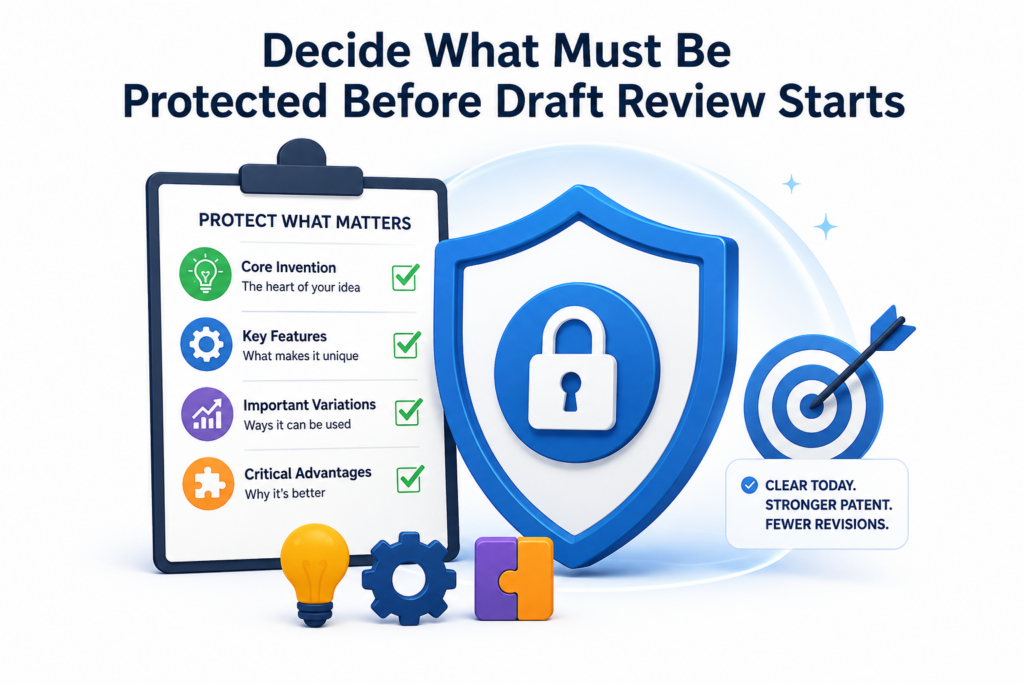
Decide What Must Be Protected Before Draft Review Starts
Patent review gets messy when the team does not know what matters most.
The attorney sends a draft. The founder reads it. The engineer reads it. The product lead reads it. Everyone comments from a different angle. One person wants more product detail.
Another wants less. One person says the claims are too broad. Another says they are too narrow. Someone notices a future feature is missing. Someone else wants to remove a detail that is not live yet.
This is how review cycles stretch out.
The better way is to decide what must be protected before the draft is reviewed.
This does not mean every detail will be perfect. It means the team has a shared priority list in mind, even if it is not written as a list.
Everyone knows the core invention, the key fallback features, the important examples, and the future versions worth mentioning.
The draft should protect the business edge, not every product detail
A patent is not a user manual. It does not need to describe every button, screen, setting, or internal dashboard. It should focus on the parts that create the edge.
This is where founders need to think strategically.
What would hurt if a competitor copied it? What is hard to build? What took real thought? What makes the product better than a basic version? What will still matter two years from now? What is likely to show up in future products, not just the current release?
These questions help separate the core from the noise.
If the draft gives equal attention to everything, it becomes harder to review. The important parts get buried.
The attorney may not know which features deserve stronger coverage. The founder may feel the draft is long but still not protective.
A clear protection focus keeps the draft sharp.
Protection should match your company’s likely future
Startups change fast. Your first product may not be your main product later. Your first customer group may not be your largest market.
Your first model may not be the model you use next year. Your first device shape may change after testing.
That is why patent drafting should not be trapped in the first version.
When you review a draft, ask whether it protects the direction of the company, not just the current screen or prototype. If your invention could be used in different markets, say that early.
If the same method could run on different devices, say that early. If the same logic could work with different models, sensors, data sources, or control rules, say that early.
This reduces back-and-forth because the first draft can include room for growth.
Make future versions clear before the attorney writes the examples
Future versions matter, but they can create confusion if they are shared too late.
Suppose the attorney drafts around a current version that uses a rules engine. Then the founder says the next version may use a machine learning model.
The attorney may need to revise the claims, examples, and figures. Or suppose the draft focuses on cloud processing, but the engineer later explains that edge processing is a major future path. Again, the draft may need a major update.
The solution is simple. Share likely future versions before drafting begins.
You do not need to pretend every future version already exists. You just need to tell the patent team what directions are realistic and important.
Future versions should be plausible and tied to the same idea
Not every dream belongs in the draft. A patent application should not become a wish list.
The best future versions are close enough to the current invention that they help show the range of the idea.
They may use a different model, data source, device type, interface, network setup, training method, sensor, material, or control mode. But they should still connect to the same core problem and solution.
For example, if your system ranks risk based on missing data and user correction history, future examples could cover different kinds of records, different scoring methods, or different user roles. But the draft should still stay anchored to the same invention.
This gives the attorney room to draft broadly without losing focus.
PowerPatent is built for this kind of startup reality. Founders can move fast, capture the current invention, and still think ahead with help from smart software and attorney review.
That can reduce the painful rewrite loop that happens when future product direction comes up too late. See how it works here: https://powerpatent.com/how-it-works
Review should focus on protection gaps first
When a founder reviews a patent draft, it is tempting to edit every sentence. That is natural. You want the draft to sound right. But sentence-level edits are not the first priority.
The first priority is protection.
Does the draft protect the real invention? Does it cover the main workflow? Does it include the key technical steps?
Does it leave room for future versions? Does it avoid being locked to a tiny product detail? Does it include the edge cases that make the invention special?
Those questions matter more than word choice at the first review stage.
Style edits can wait until the invention coverage is right
Patent drafts often sound different from normal writing. They may feel formal, repetitive, or broad. That does not always mean something is wrong. Some of that style is part of patent drafting.
The founder’s most valuable feedback is not “this sentence sounds odd.” It is “this misses the part where the model updates after user feedback,” or “this should not require a mobile device,” or “this should also cover batch processing,” or “this feature is optional, not required.”
That kind of feedback saves time because it goes to the heart of the draft.
Once coverage is right, the attorney can clean up the language. But if the team spends the first review arguing about wording while the invention is still incomplete, the process slows down.
Give Feedback Like a Founder, Not Like a Line Editor
A patent draft is not a blog post, pitch deck, or product page. Reviewing it like one can create extra work.
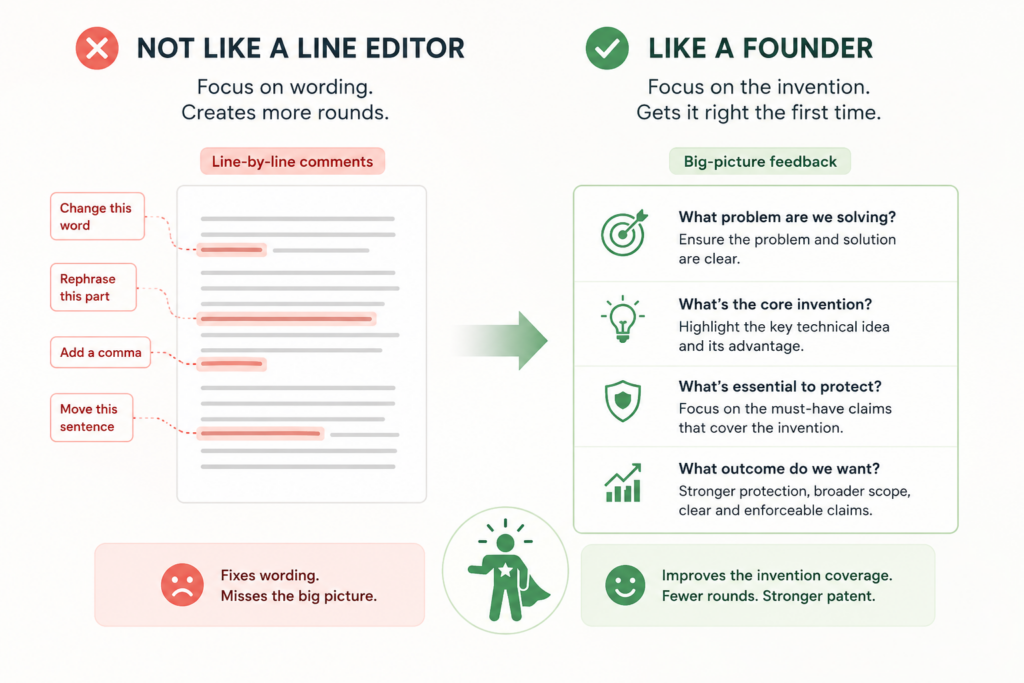
Founders often want to improve every sentence. That instinct is useful in sales copy, fundraising decks, and customer emails. But patent drafts work differently. Some phrases are used for scope.
Some details are repeated to support different parts of the application. Some wording may feel broad because the draft is trying not to limit the invention too much.
This does not mean you should stay quiet. Your feedback is vital. But the best feedback is strategic, not cosmetic.
The goal is to help the attorney understand what is technically wrong, what is missing, what is too narrow, what is too broad, and what needs more support.
The most useful comments explain the reason behind the change
A comment like “fix this” is not very helpful. A comment like “this should not require a server because the system can also run on-device” is much better.
The second comment gives the attorney the reason. It shows the protection concern. It helps the drafter adjust the language in a way that supports the business goal.
Good review comments often explain whether something is required, optional, too specific, too broad, technically wrong, or missing. These are the comments that reduce back-and-forth because they help the attorney solve the real issue the first time.
If you only rewrite a sentence, the attorney may not know why you changed it. They may accept the wording but miss the deeper point. Or they may reject the wording because it creates a legal issue, even though the underlying concern was valid.
Explain the product truth behind the edit
When you leave a comment, try to explain the product truth or technical truth behind it.
For example, instead of writing, “Change cloud server to processor,” explain, “We do not want this limited to cloud use. Some customers may run this locally or on an edge device.”
Instead of writing, “Add model retraining,” explain, “The feedback loop is a key part of the invention because user corrections improve future ranking.”
Instead of writing, “Remove dashboard,” explain, “The invention does not require a dashboard. The output could be sent by API, alert, report, or automated action.”
This kind of feedback helps the attorney draft a stronger version without needing multiple follow-up emails.
Separate true errors from preference edits
Not every issue has the same weight.
A true error is something that makes the draft wrong. Maybe the system does not work the way the draft says. Maybe the wrong component makes the decision.
Maybe the draft says the model is trained after deployment, but in your product it is trained before deployment. Maybe the draft says data is stored when it is not stored.
Those issues should be fixed early.
A preference edit is different. Maybe you would not describe the feature in that exact way. Maybe the sentence feels wordy.
Maybe the example is not your favorite. These edits may still matter, but they should not distract from coverage.
Review moves faster when everyone knows the difference.
Technical errors should be corrected with exact facts
When you find a technical error, give the exact replacement fact.
Do not just say, “This is wrong.” Say what actually happens.
For example, “The ranking score is not based on user role alone. It is based on user role, document type, missing fields, and past correction history.” That gives the attorney the material needed to fix the draft.
This is especially important when engineers review. Engineers often spot issues quickly, but their comments can be too short. A quick “no” in the margin creates another question. A short explanation prevents another call.
PowerPatent helps reduce this friction by making invention review more structured.
Founders, engineers, and attorneys can work from clearer invention material, so feedback is less scattered and more useful. You can explore the workflow here: https://powerpatent.com/how-it-works
Do not rewrite claims unless you are trained to do it
Claims are easy to damage by accident.
A founder may try to make a claim clearer by adding a product detail. But that product detail could narrow the claim.
An engineer may replace a broad term with a precise term from the codebase. But that precise term may limit protection to one implementation. A product lead may add a customer-facing phrase that sounds good but does not help the claim.
This is why claim feedback should focus on meaning, not legal wording.
If a claim misses a key step, say that. If it requires something that should be optional, say that. If it is tied to one version when the invention is broader, say that. Let the attorney handle the wording.
Your job is to flag the gap, not solve the legal phrasing
The best founder feedback on claims sounds like this: “This claim should also cover the case where the score triggers an automated action without showing a user interface.”
That is clear, useful, and strategic.
It tells the attorney what coverage is missing. It does not try to draft the legal phrase. This saves time because the attorney can solve the issue without untangling wording that may create new problems.
When founders review this way, drafts move faster. The attorney gets better input. The team avoids accidental narrowing. The final application is more likely to protect the real invention.
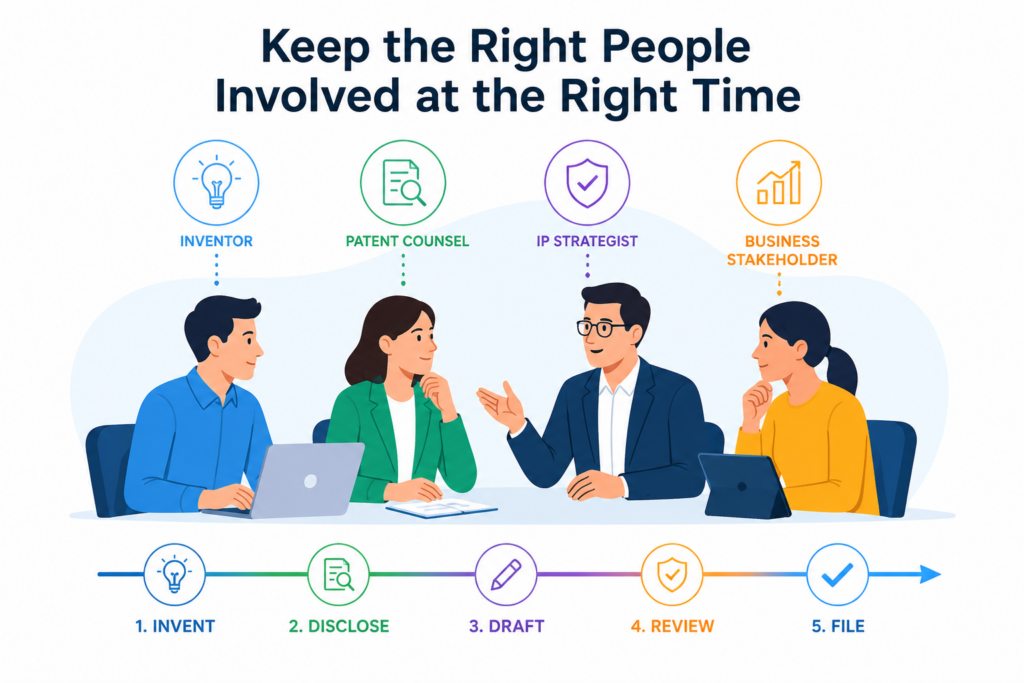
Keep the Right People Involved at the Right Time
Patent drafting slows down when the wrong people review at the wrong stage.
Sometimes the founder handles the whole process alone, even though the key details live with the engineering team. Sometimes every person on the team is invited to comment, and the draft turns into a crowded document full of mixed opinions.
Sometimes legal waits for product input. Sometimes engineering waits until the final version and then finds a major issue.
The solution is not to involve more people at every step. The solution is to involve the right people at the right time.
A smooth patent process needs clear roles. The founder sets the business goal. The technical lead explains how the invention works.
The attorney shapes the protection. Product may help with future direction. Each person adds value, but not all at once and not in the same way.
The founder should own the protection goal
The founder should make sure the draft protects what matters to the company.
That means the founder should explain the business edge, likely competitor risk, future product direction, and what would be painful to see copied. This is not the same as explaining every technical detail. It is about guiding the strategy.
A founder may say, “The most important thing is not the current dashboard. It is the ranking method that works across messy data sources.” That one sentence can steer the whole draft.
Or the founder may say, “We need this to cover both the current medical use case and future compliance workflows.” That helps the attorney avoid drafting too narrowly.
This kind of founder input reduces major revisions later.
Founder review should happen before the draft gets too polished
A common mistake is waiting until the draft looks nearly final before the founder gives strategic feedback.
That is too late.
If the invention focus is wrong, the team may need to revise the claims, figures, examples, and summary.
That creates a lot of extra work. Founder input is most useful at the beginning, when the attorney is still shaping the draft.
The founder does not need to read every word at that stage. But they should confirm the target. They should make sure the draft is aimed at the right invention, the right business risk, and the right future direction.
The technical lead should own how it works
The technical lead is usually the person who can prevent the most errors.
This may be the CTO, lead engineer, scientist, product architect, hardware lead, model lead, or inventor closest to the work. Their job is to explain how the system actually works, not how it is marketed.
They should confirm the data flow, control flow, key steps, required parts, optional parts, edge cases, and technical effects. They should also flag anything that the draft gets wrong.
Without technical review, the draft may sound fine but describe the wrong system. That is dangerous and slow. Once technical errors are found late, the attorney may need to rebuild parts of the application.
Technical review should be focused, not open-ended
Engineers are busy. They do not want to review a long legal draft from top to bottom without guidance.
A better process is to ask them targeted questions.
Does this process flow match what we built? Are any required steps missing? Are any optional steps written as required?
Are any examples technically wrong? Does the figure match the architecture? Does the draft leave room for planned versions?
These questions help the technical lead review faster and give better feedback.
It also reduces comments that do not move the draft forward. The goal is not to make the patent draft sound like an engineering spec. The goal is to make sure it is technically correct and broad enough to protect the invention.
PowerPatent is designed for teams that need this kind of alignment without slowing down. It helps founders and technical teams capture invention details in a clearer way, then brings in attorney oversight so the final work is not just fast, but careful. See how PowerPatent works here: https://powerpatent.com/how-it-works
Too many reviewers can create false conflict
More reviewers do not always mean better quality.
When too many people comment, they may pull the draft in different directions. A product manager may want customer-friendly language. An engineer may want exact code terms.
A founder may want broad protection. An attorney may need wording that supports claim scope. None of these people are wrong, but the draft can become messy if no one sets the rules.
The review process should have a clear owner. That person gathers comments, resolves internal conflicts, and sends clean feedback to the attorney.
This prevents the attorney from having to sort out company debates inside the draft.
One clean feedback pass is better than five scattered ones
Scattered feedback is one of the biggest causes of back-and-forth.
One person comments in the document. Another sends an email. Another records a video. Another posts in Slack.
Then someone updates the product spec, but not the draft. The attorney tries to merge all of it and has to ask which version is right.
A better process is to collect feedback in one place and send one clear pass.
That does not mean every issue must be perfect. It means the team should avoid sending conflicting comments over several days without context.
A clean pass lets the attorney revise with confidence.
Use One Source of Truth for Every Invention Detail
Back-and-forth grows fast when the invention details live in too many places.
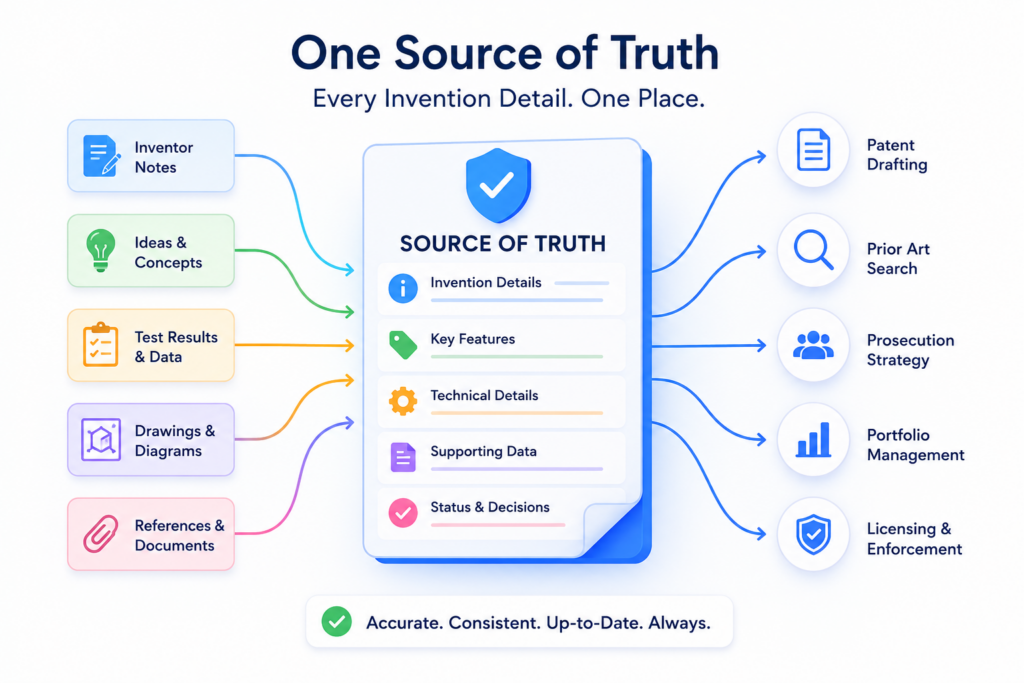
One person has the product spec. Another person has the architecture chart. The engineer has notes in a private doc. The founder has the real business reason in their head.
A designer has the latest workflow. The attorney has an older version of the diagram. Then the draft comes back, and everyone is reviewing from a different source.
That is how small errors become long delays.
The fix is to create one source of truth before drafting starts. This does not need to be fancy.
It can be a single invention brief, a shared workspace, a clean technical memo, or a structured capture inside a patent platform. What matters is that everyone agrees this is the current version of the invention.
When the attorney has one clean place to look, the draft is less likely to include stale facts. When engineers review from that same place, their comments are sharper.
When the founder checks the draft, they can see whether the business value is still in focus.
The source of truth should explain the current invention and the intended coverage
A useful invention source of truth should do two jobs at once. It should explain what has been built or designed, and it should explain what the company wants to protect.
These are related, but they are not the same.
What has been built may be one version of the system. What should be protected may include that version, plus other versions that use the same core idea.
If the attorney only sees the current build, the draft may become too narrow. If the attorney only hears future hopes, the draft may become too vague.
The source of truth should hold both sides in balance.
It should say what the system does today in clear terms. It should also say which parts may change later without changing the invention.
That helps the attorney write examples that are real, while still keeping the draft broad enough to matter.
A single invention brief saves more time than a long email thread
Email is not a great place to build a patent draft. It is too easy for key details to get buried.
Someone answers one question in a reply. Another person corrects it three messages later. A diagram is attached in one thread but not another.
A term changes halfway through. By the time drafting begins, no one is sure which version is final.
A single invention brief avoids this.
The brief does not need to be long. It needs to be stable. It should capture the problem, the core method, the key parts, the examples, the optional versions, and the must-protect features.
If something changes, the brief should be updated so the whole team stays aligned.
This simple habit can remove many rounds of review. Instead of asking, “Where did we say that?” the team can return to one place.
Version control matters even for patent notes
Engineering teams already understand version control for code. The same mindset helps with patent drafting.
If a draft is based on old invention notes, it may miss the latest design. If a reviewer comments on an old draft, the attorney may waste time fixing issues that were already solved. If diagrams are updated but not labeled, the wrong figure may end up in the application.
This is not just annoying. It can change the quality of the patent.
A patent draft needs accurate facts. If the facts are moving, the team needs a clear way to track what changed and what is final.
Date every major update so the team knows what changed
A simple date can prevent a lot of confusion.
When you update the invention brief, mark the date. When you revise a diagram, mark the date.
When you replace a technical example, mark the date. This helps the attorney know whether they are looking at the latest version.
It also helps the founder see how the invention story has changed over time.
For example, the first version may have focused on a rules engine. Later, the system may add model-based scoring. Later still, the system may include feedback from user corrections.
Each change may affect the patent draft. If those updates are tracked clearly, the attorney can adjust without needing to reconstruct the story from scattered notes.
This is especially important for startups because product decisions change quickly. A patent process should keep up with the build, not freeze around an old version by mistake.
PowerPatent helps turn scattered invention material into a cleaner path
Many founders do not have time to create a perfect invention brief. They are building, selling, hiring, shipping, and talking to customers. Patent work can feel like one more heavy task.
That is why the process should meet founders where they are.
PowerPatent helps teams turn raw invention material into a more organized patent workflow. Code notes, product ideas, diagrams, and technical explanations can be shaped into a clearer invention record.
Then real patent attorneys review the work, guide the strategy, and help prepare the application.
This helps reduce back-and-forth because the attorney is not starting with a pile of scattered clues.
The founder is not forced to become a patent expert. The engineering team does not have to explain the same thing again and again.
Better input creates a better first draft
The first draft is where time is either saved or lost.
If the first draft is based on weak input, the review process becomes repair work. The founder has to explain what was missed.
The engineer has to correct the flow. The attorney has to revise the claims, figures, and examples. Everyone feels like the process is slower than it should be.
If the first draft is based on strong input, review becomes refinement. The team can focus on improving coverage, adding useful examples, and making sure the draft supports the company’s goals.
That is the real point of a source of truth. It makes the first draft smarter.
To see how PowerPatent helps founders organize invention details and move from idea to attorney-reviewed patent work, visit https://powerpatent.com/how-it-works
Teach the Drafting Team What Not to Include
Reducing back-and-forth is not only about giving more information. It is also about giving cleaner information.
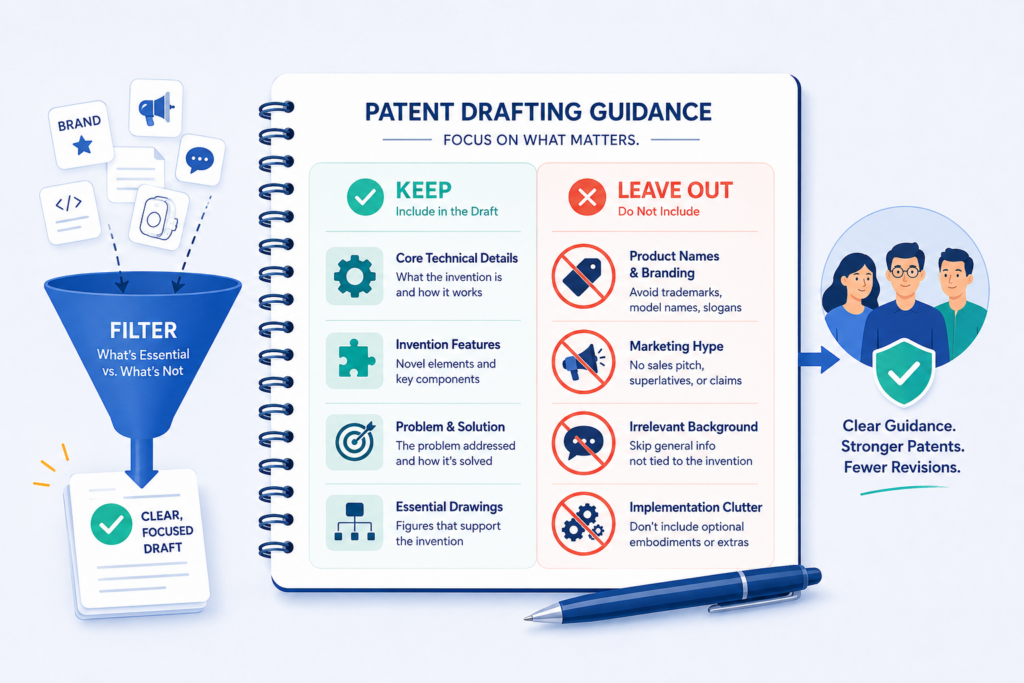
Many patent drafts become slow because too much unrelated detail gets pulled in.
The attorney receives product docs, pitch decks, support notes, old screenshots, roadmap ideas, customer language, and internal labels. Some of this may help. Much of it may not.
The drafting team then has to decide what matters. If the wrong detail gets included, the founder has to remove it later.
If too much product language enters the draft, the application may become narrow or confusing. If old details appear in examples, engineers may need to correct them.
A smart patent process includes a clear “do not include” signal.
This is not about hiding useful facts. It is about keeping the draft focused on the invention that matters.
Not every product feature belongs in the patent draft
Startups are proud of their products, and they should be. But a patent draft should not become a full product tour.
A product may include onboarding, dashboards, user roles, billing, templates, alerts, analytics, permissions, integrations, reports, and settings. Some of those may support the invention. Many may not.
If the invention is a new way to rank risks using missing data and user feedback, then the billing flow probably does not matter.
If the invention is a new control system for a robot joint, then the admin dashboard may not matter. If the invention is a new battery management method, then the customer sign-in page is noise.
Noise creates review work.
The attorney may draft around a detail that looks important in the product material but is not part of the invention. Then the founder has to explain why it should be removed. That is avoidable.
Extra details can accidentally narrow the story
A detail may seem harmless, but it can change how the invention reads.
For example, if every example describes the system as a mobile app, a reader may assume the invention depends on a mobile device.
If every example describes a hospital workflow, the draft may feel tied to healthcare even if the method works in finance, legal, insurance, or manufacturing. If every example uses one kind of model, the draft may not clearly support other model types.
This is why founders should tell the patent team which details are just examples.
The attorney can still include examples, but they can write them in a way that does not trap the invention. The draft can say the system may use a mobile device, not that it must.
It can say the method may apply to medical records, not only medical records. It can say the model may be one of several model types, not just the current one.
This kind of care reduces late-stage rewrites.
Internal names should be handled with care
Internal names are useful inside the company, but they can create confusion in a patent draft.
Your team may call a feature “Signal Brain,” “Trust Layer,” “AutoPilot,” “Review Hub,” or “Magic Match.” Those names may be great for product work. But they usually do not explain what the feature does.
If the attorney uses those names too heavily, the draft may become unclear. A future reader should not need to know your internal language to understand the invention.
The better move is to explain the function behind the name.
Instead of saying “Signal Brain,” explain that the system receives sensor data, filters unstable signals, compares the filtered signal to stored motion patterns, and selects a control response.
Instead of saying “Magic Match,” explain that the system compares incomplete records, scores likely matches, and updates the match after user confirmation.
Define internal terms before they appear in the draft
Sometimes an internal term is useful because the team uses it often. That is fine, but it should be defined clearly.
The first time the term appears in the invention material, explain what it means in plain words. Then the attorney can decide whether to use a more general term in the draft.
This prevents confusion during review. The founder does not have to ask why a term was used. The engineer does not have to explain the same feature again.
The attorney does not have to guess whether an internal name refers to a part, a method, a model, or a workflow.
Clear terms lead to cleaner drafting.
Old product versions should be marked clearly
Old versions are dangerous when they are mixed with current invention material.
A pitch deck from six months ago may describe a feature that no longer exists. A demo video may show a workflow that has changed.
An early system diagram may use a different architecture. A model note may describe an experiment that was not used in the final design.
These materials may still be useful, but only if they are labeled.
If they are not labeled, the attorney may pull old details into the draft. Then the team has to clean them up later.
Do not delete history, but do separate it from the current story
Old versions can help show how the invention developed. They may explain what failed, what changed, and why the final design matters. But they should not be mixed into the current invention story without context.
A simple note can help. Say that a diagram shows an earlier design. Say that a feature was tested but not used.
Say that an old workflow has been replaced. Say that a model result was from an experiment, not the production system.
This gives the attorney better judgment.
PowerPatent helps teams handle this kind of material without turning patent prep into a messy document hunt.
It gives founders a clearer way to shape invention details before attorney review, so the draft can focus on what matters and avoid old noise. See how it works here: https://powerpatent.com/how-it-works
Turn Engineer Knowledge Into Draft-Ready Language
Engineers often know the invention best, but they may not explain it in a way that is easy to draft from.
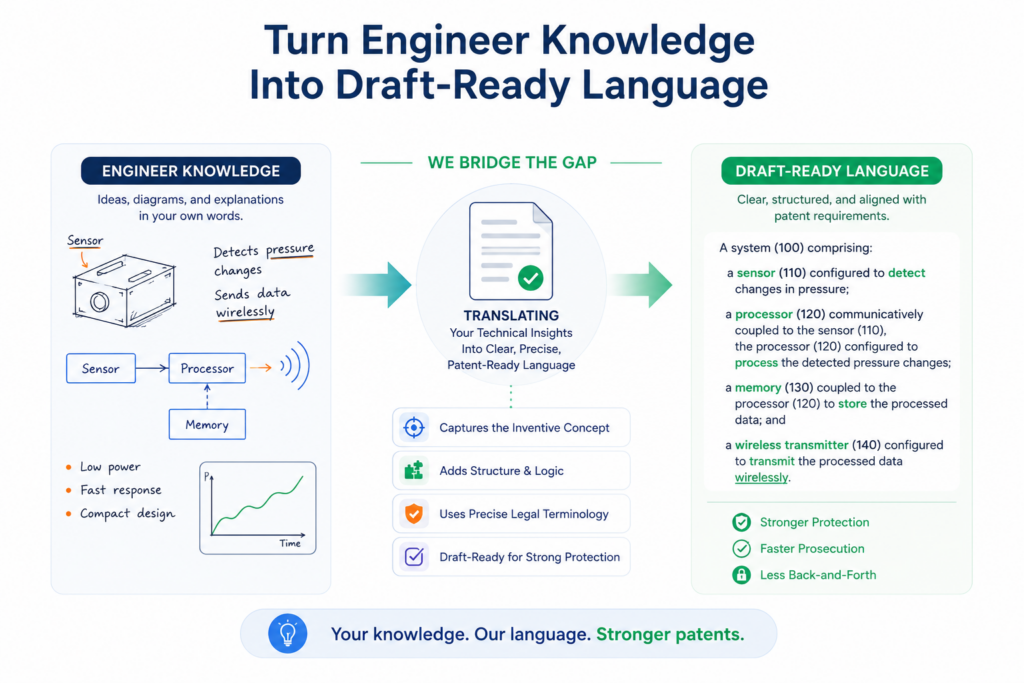
That is not their fault. Engineers are trained to build. They speak in code paths, system limits, edge cases, tickets, data shapes, APIs, model layers, hardware tolerances, and test results. Patent drafting needs that depth, but it also needs a clear story.
The goal is not to make engineers write like attorneys. The goal is to turn engineer knowledge into draft-ready language without losing the truth.
This is one of the best ways to reduce back-and-forth.
When the attorney can understand the engineering logic early, fewer questions come later. When the founder can see the invention in plain words, strategy gets easier.
When the engineer reads the draft, they can tell whether the invention was captured correctly.
Ask engineers for cause and effect, not just features
Engineers often describe what the system does. The patent team also needs to know why it does that and what changes because of it.
For example, an engineer may say, “We cache the embeddings.” That is a feature. The patent team needs more.
Why are the embeddings cached? What problem does caching solve? When are they updated? What happens when the input changes?
What is the result? Does it reduce latency? Does it avoid repeated model calls? Does it improve ranking stability?
Those answers turn a feature into an invention story.
A stronger version might say, “The system stores embeddings for prior records and updates only the embeddings affected by a changed input, which reduces repeated processing and keeps the ranking stable during review.”
That is much more useful for drafting.
Cause and effect helps the attorney find the inventive step
A patent draft should not just say that parts exist. It should show how the parts work together to create a better result.
Cause and effect makes that easier.
The system receives noisy sensor data, so it filters the data before control. The model sees missing fields, so it changes the confidence score.
The device detects heat rise, so it changes power output. The workflow sees a low trust score, so it asks for human review before taking action.
These simple links show why the invention matters.
They also help avoid shallow drafting. Without cause and effect, the draft may sound like a feature list. With cause and effect, it becomes a working system.
Translate code into actions a reader can follow
Code is powerful, but raw code is not always the best starting point for a patent draft.
The attorney may not need every function name, class name, or variable. They need to understand what the code does in plain terms.
For example, instead of only sharing a function called resolve_conflict_score, explain what it does.
Say that the function compares two records, finds fields that disagree, assigns weights to the fields based on importance, and creates a score that controls whether the system asks for review.
That gives the attorney usable material.
The same applies to model pipelines. Instead of only naming the model, explain the path.
The system receives training data, removes low-quality samples, groups rare examples, adjusts weights for under-seen cases, trains the model, tests the output, and updates a threshold.
Plain words do not make the invention weaker
Some technical founders worry that simple language will make the patent draft less serious. The opposite is often true.
Plain language helps the attorney understand the invention faster. It helps the founder review the draft faster. It helps the technical team spot errors faster.
The attorney can still use formal patent language where needed, but the starting point should be clear.
A simple explanation is not a simple invention. It is a clear invention.
This matters a lot in AI, software, hardware, biotech, semiconductors, robotics, and clean tech. Deep inventions still need a clean story. If the story is hard to follow, the drafting process slows down.
Engineers should mark what is required and what is optional
One of the most important things engineers can do is separate required steps from optional steps.
This is a common source of back-and-forth. The draft may say the system always performs a step. Then the engineer says, “No, that step only happens in some cases.”
Or the draft may describe one sensor, one model type, one database, one network setup, or one user action as if it is required. Then the founder worries the draft is too narrow.
This can be avoided early.
When engineers explain the invention, they should say which parts are required for the core idea and which parts are examples.
Optional details can still be valuable examples
Optional does not mean useless.
An optional feature may be a strong fallback position. It may help show a useful version of the invention. It may support a later claim. It may explain how the system works in a real product.
But optional details should not be written like they are required unless they truly are.
For example, the system may use a neural network, but the broader invention may work with other scoring models.
The system may show results on a dashboard, but the broader invention may send results through an API. The device may use one sensor type, but the broader control method may work with other sensors.
Marking this early saves review time.
PowerPatent helps founders and engineers shape technical input into clearer patent material, then combines that with attorney oversight.
That is important because the best patent work needs both sides: real technical detail and smart protection strategy. Learn more here: https://powerpatent.com/how-it-works
Review the Figures Before the Full Draft Gets Too Far
Figures are not decoration. They are one of the fastest ways to align a patent draft.
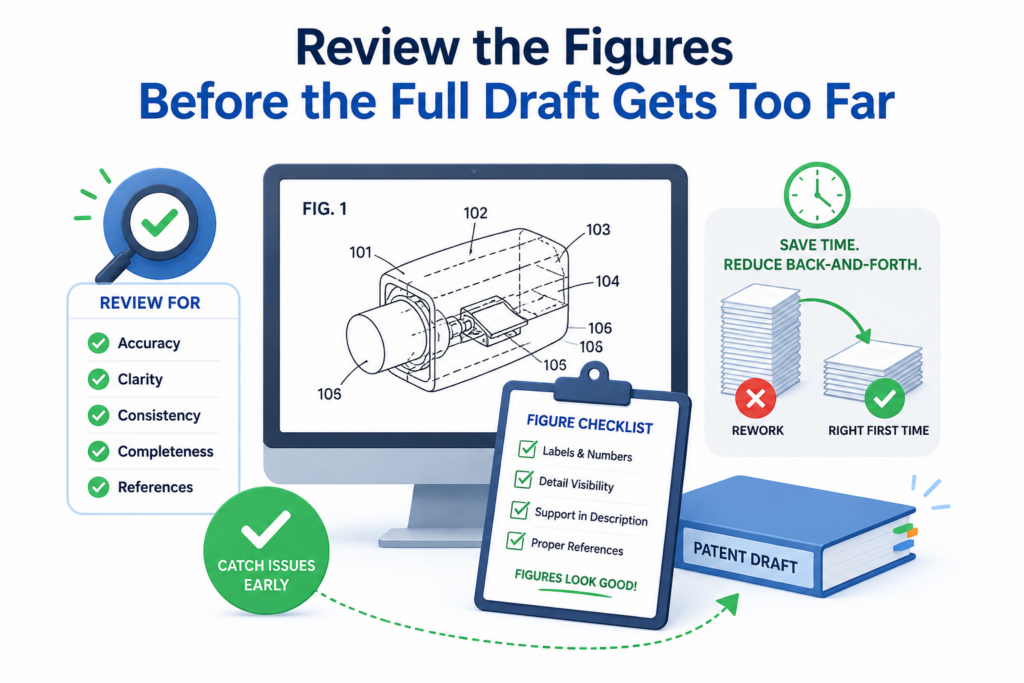
A good figure can show the invention path in a way that words alone cannot. It can show system parts, process flow, decision points, data movement, device structure, feedback loops, and optional paths.
When figures are clear, the written draft becomes easier to build and easier to review.
But when figures are wrong, the whole draft can drift.
If the diagram shows the wrong system architecture, the text may follow it. If a process flow misses a key step, the claims may miss it too.
If a device drawing leaves out an important part, the written description may not support it well. By the time the full draft is done, fixing the figure may mean fixing many pages of text.
That is why figures should be reviewed early.
Start with rough figures before polished patent drawings
Early figures do not need to be formal. In fact, rough figures are often better at the start.
A quick block diagram, flowchart, sketch, or system map can help the team agree on the invention before the attorney invests time in full drafting. The goal is not beauty. The goal is truth.
For software, a rough figure might show input data, processing modules, scoring logic, model update, and output action. For AI, it might show training data, feature extraction, model training, inference, feedback, and retraining.
For hardware, it might show parts, sensors, controllers, movement, and signals. For manufacturing, it might show process steps and changes to material structure.
The rough figure becomes the shared map.
The rough figure should be simple enough to explain in one minute
If no one can explain the figure quickly, it may be trying to do too much.
A strong figure usually has a clear path. A person should be able to point to the start, follow the arrows, and understand what happens next. If the figure needs a long speech to make sense, it may need to be broken into smaller figures.
This matters because the attorney will use the figures to build the draft. If the figure is crowded, the writing may become crowded. If the figure is clean, the writing can be clean.
A simple figure also helps founders review faster. They can quickly see whether the draft is centered on the right idea.
Figures should show decisions, not just boxes
Many technical diagrams show components, but not decisions.
That is a problem because many inventions live in the decision points. The system decides whether data is reliable.
The model decides whether confidence is high enough. The device decides whether to change mode. The workflow decides whether to ask a human or take automatic action.
If the figure only shows boxes, the key invention may be hidden.
A better figure shows where the decision happens and what happens after each result. This is especially useful for software, AI, robotics, medical devices, and control systems.
Decision points help reveal missing claim steps
When a figure shows a decision, it becomes easier to see whether the claims and written description match the invention.
For example, if the system calculates a risk score and then chooses between automatic action and human review, that decision should likely appear in the draft.
If the system updates a model only after user confirmation, that condition may matter. If the device changes power level only when a sensed value passes a threshold, that trigger may be important.
These decision points often become key drafting details.
If they are missing from the figure, they may be missed in the first draft. Then they show up as review comments later. That creates back-and-forth that could have been avoided.
Figure review should happen with the technical lead and founder together
Figures sit at the crossing point between technology and strategy.
The technical lead can say whether the figure is accurate. The founder can say whether it captures the business edge. The attorney can say whether it supports the patent strategy.
When these three views come together early, the draft improves quickly.
The technical lead may say, “This arrow is wrong because the feedback does not go directly to the model. It first goes through a validation step.”
The founder may say, “This figure should not make the dashboard look required because we may send outputs through API.” The attorney may say, “We should add another figure showing the broader system so the claims are not tied to this one example.”
That conversation can save many edits later.
A good figure review prevents text rewrites
Patent text often follows the figures. So if the figure changes late, the text may need to change too.
This is why early figure review is so valuable. It lets the team fix the map before the full written route is built.
At PowerPatent, founders can move faster because invention capture, technical material, and attorney oversight work together in a more modern process.
Instead of waiting until a full draft exposes every mismatch, teams can shape the invention story earlier and reduce expensive review loops. See the workflow here: https://powerpatent.com/how-it-works
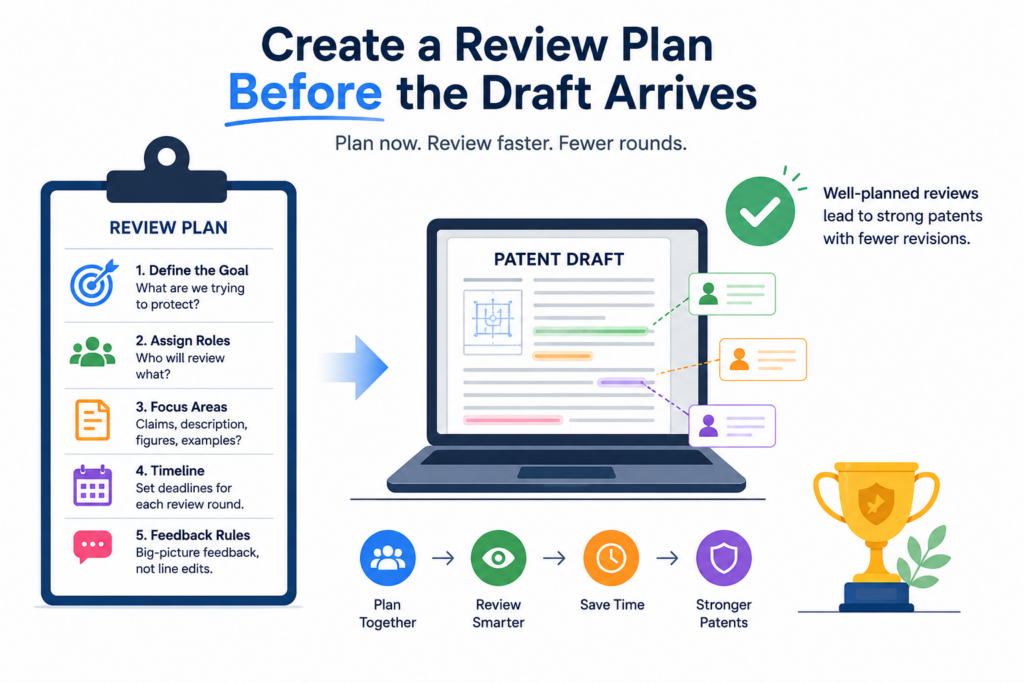
Create a Review Plan Before the Draft Arrives
A patent draft should not land in your inbox without a plan.
When that happens, review becomes reactive. The founder opens the document late at night. The engineer skims a few pages.
Someone comments on wording. Someone else waits for more context. Days pass. The attorney follows up. The team rushes. Important issues get missed, while small wording edits get too much attention.
A review plan prevents this.
The plan does not need to be complex. It just needs to answer three questions before the draft arrives. Who will review it? What should each person check? Where will final comments be collected?
That simple structure can remove a huge amount of back-and-forth.
Assign review roles before the first draft is delivered
Do not wait until the draft arrives to decide who should read it.
By then, everyone is busy. The founder may be fundraising. The CTO may be shipping a release. The product lead may be on customer calls. The attorney may be waiting for feedback to keep the filing moving.
Assign roles early.
The founder should review for business fit and protection goals. The technical lead should review for accuracy and missing technical steps.
The attorney handles the patent language and claim strategy. If product is involved, product should focus on future versions and use cases, not sentence style.
When each person knows their role, comments become cleaner.
Role clarity stops duplicate and conflicting feedback
Without clear roles, reviewers often comment on the same issue in different ways.
The founder may say the draft is too narrow. The engineer may add exact implementation details that make it even narrower. Product may ask for more customer language. The attorney then has to resolve the conflict.
With clear roles, feedback becomes easier to use.
The founder can say, “This should protect the broader ranking method, not just the current compliance workflow.” The engineer can say, “The method can run with different scoring models, not only the current model.”
Product can say, “Future versions may apply this to vendor review and contract review.” These comments support each other instead of fighting.
Review the draft in layers, not all at once
A patent draft has many parts. Trying to review everything at once can be overwhelming.
A better approach is to review in layers. First, check whether the draft is aimed at the right invention.
Next, check whether the technical flow is accurate. Then check whether the examples and figures support the story. Finally, look at wording issues that truly matter.
This layered review keeps the team from getting lost.
If the invention focus is wrong, there is no point polishing small sentences. If the technical flow is wrong, style edits will not save the draft.
If the figures are wrong, the text may need to change. Start with the big issues and move smaller only after the foundation is right.
First-pass review should protect the core
The first pass should answer the most important question: does this draft protect the thing we care about most?
If the answer is no, stop and fix that first.
Do not spend the first pass debating whether a sentence sounds elegant. Do not spend it changing every repeated phrase.
Patent drafts often repeat ideas for a reason. The first pass should focus on scope, accuracy, missing steps, optional features, and future coverage.
This does not mean writing quality does not matter. It means the first review should not lose sight of the main goal.
Send one clean response instead of many small comments
Once the team has reviewed the draft, someone should gather the feedback and send it in one clean response.
This is important.
If comments come in pieces, the attorney may revise too early and then have to revise again. If the founder sends feedback before the engineer has checked the technical flow, later technical corrections may undo earlier edits.
If product sends future use cases after claims are revised, the attorney may need to adjust the draft again.
One clean response is faster than five partial ones.
The best final feedback explains priority
Not all comments matter equally. Your final feedback should make the priorities clear.
The attorney should know which issues are must-fix, which are nice-to-have, and which are questions. This helps the next draft improve in the right order.
For example, a must-fix issue might be that the draft requires cloud processing even though the invention can run locally.
A nice-to-have issue might be adding another example from a future market. A question might be whether the claims should include feedback-based model updates or keep that as a dependent feature.
This kind of feedback helps the attorney act with confidence.
PowerPatent’s process is built to help teams avoid the old, slow patent loop. By combining smart software with real attorney oversight, it helps founders organize invention details, review more clearly, and move toward filing with less wasted motion. Explore how it works here: https://powerpatent.com/how-it-works
Conclusion
Reducing back-and-forth in patent drafting comes down to one thing: clarity before writing. When your team explains the real invention, the problem it solves, the technical path, the must-protect parts, and the future versions early, the draft gets stronger and the review gets faster. You do not need to think like a patent attorney.
You need a clean invention story, the right reviewers, and a process that keeps everyone aligned. PowerPatent helps founders do this with smart software and real attorney oversight, so you can protect what you are building without slowing down. See how it works here: https://powerpatent.com/how-it-works
Leave a Reply