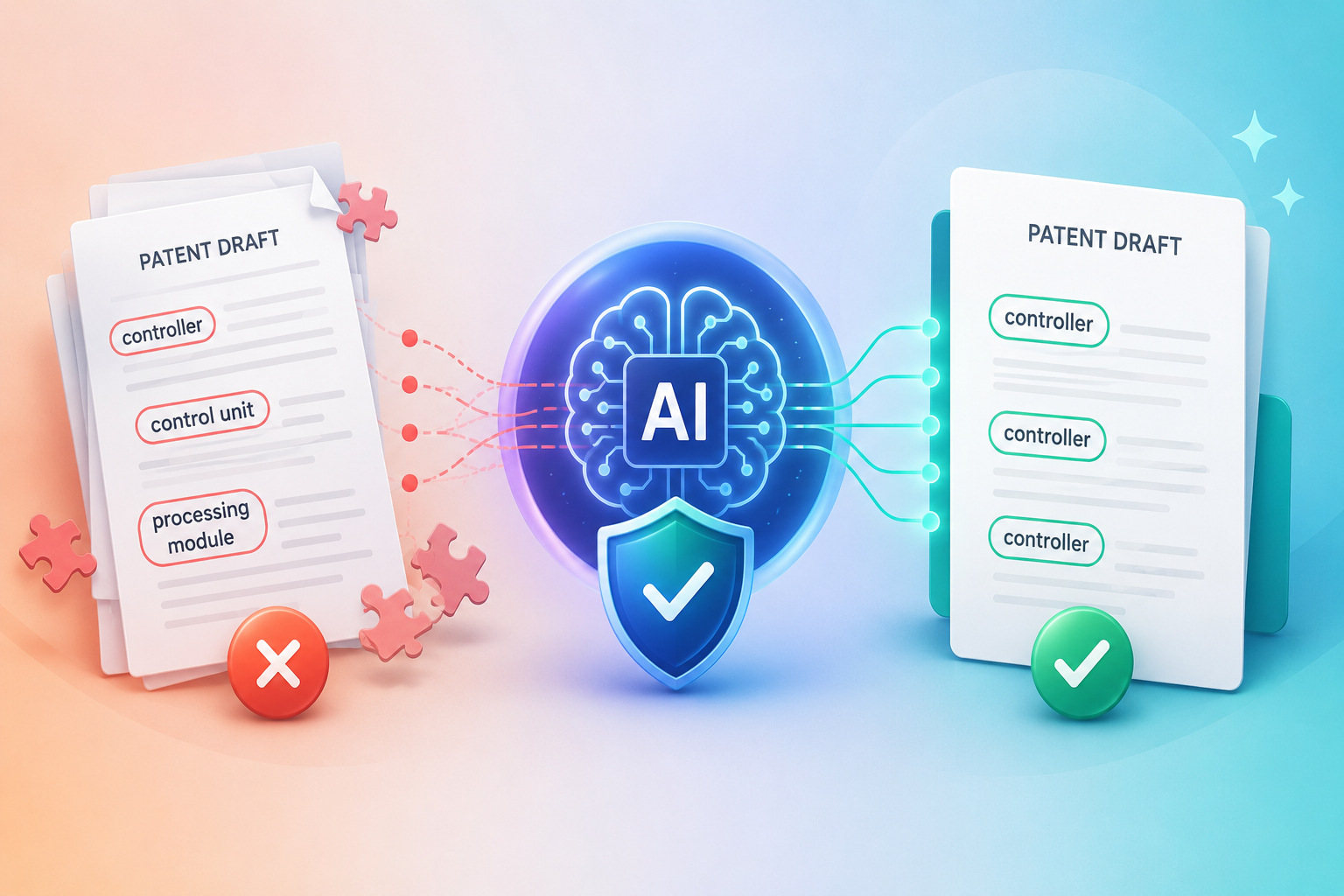
A strong patent can fall apart because of small words. One name in one section. A slightly different name later. A feature called “sensor module” on page three, then “sensing unit” on page nine. To a founder, that may feel harmless. To a patent examiner, investor, buyer, or competitor, it can create doubt. And doubt is costly.
Patent terms must stay steady because every word carries weight.
A patent is not like a normal blog post, pitch deck, or product note. In normal writing, using fresh words can make the writing feel better.
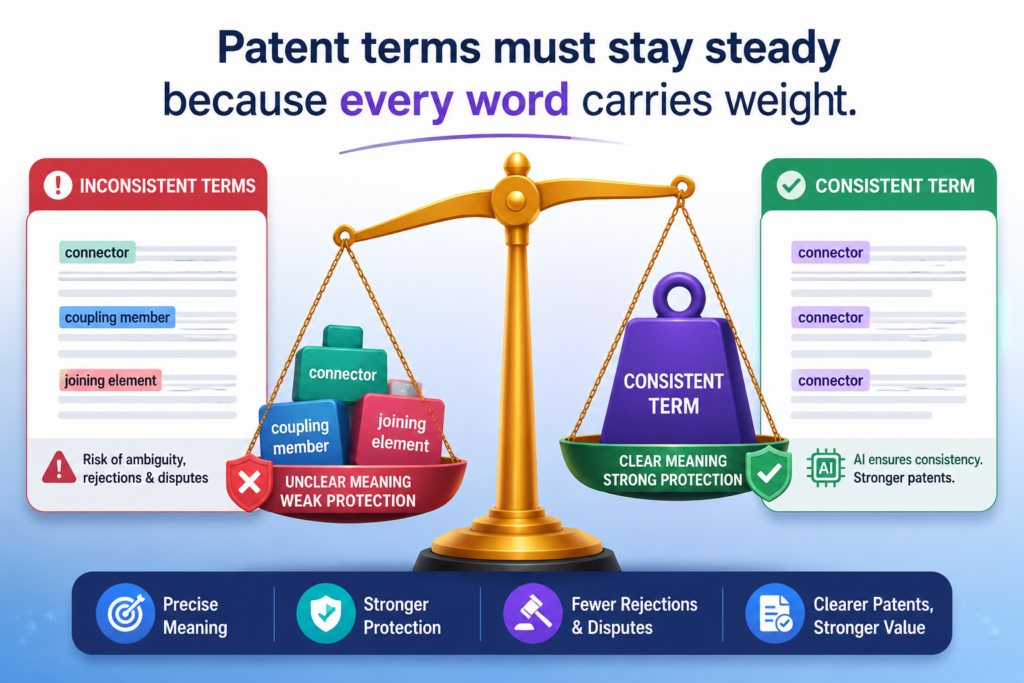
In patent writing, using fresh words in the wrong place can make the filing weaker. That is the part many founders miss.
When a team is building fast, the same part of an invention may get many names. The engineering team may call it a “prediction engine.” The product team may call it an “AI model.”
The patent draft may call it a “machine learning module.” Each name may feel close enough. But in a patent, close enough is not always safe.
The goal is not to sound fancy. The goal is to be clear. A reader should know when two words mean the same thing and when they mean different things. If the draft makes that hard, the patent can become easier to question later.
Clear names help the patent tell one clean story.
A strong patent draft should feel like one steady map. Each part of the invention should have a clear name.
That name should stay the same across the title, background, summary, drawings, detailed description, claims, and any later edits. When the wording is steady, the invention feels more solid.
Think about a founder who built a medical device with a small part that reads body data. In one place, the draft calls it a “sensor.” Later, it calls the same part a “detector.” Then, in the claims, it says “monitoring element.”
The founder may know all three words point to the same thing. But the patent office may not read minds.
A competitor may later argue that those words mean different things. An investor may see the draft as messy. A buyer may worry that the patent will not hold up.
That is why steady language matters. It helps every person who reads the patent understand the invention the same way.
AI can catch small wording shifts before they grow into drafting problems.
AI is useful here because it can review the whole draft without getting tired. It can scan for every term used to describe each part, step, signal, module, layer, tool, model, device, or data flow. It can then flag places where the words drift.
This does not mean AI should replace the judgment of a patent attorney. It means AI can do the hard checking work that humans often miss when they are tired, rushed, or deep in the content.
A real attorney still needs to decide what the words should mean and how the patent should be shaped. But AI can make that review faster and more complete.
For example, AI can notice that the draft says “training data set” in the description but “training dataset” in the claim. That may seem tiny. Still, in patent work, tiny things can matter.
AI can also find cases where the draft says “user profile,” “account profile,” and “member profile” in different places.
It can ask whether these are meant to be the same thing or different things. That question is simple, but it can save a lot of pain.
This is exactly the kind of drafting risk PowerPatent was built to reduce. Founders should not have to chase every wording issue by hand. They should be able to move fast while still getting a careful review.
PowerPatent brings together smart software and real attorney oversight so teams can turn technical work into stronger patent filings with more confidence. You can see how the process works here: https://powerpatent.com/how-it-works
Consistent terms help protect the real invention, not just the words around it.
A patent is supposed to protect what you built. But if the wording is loose, the draft may protect less than you think. It may leave open space for others to work around your idea. It may also make the patent harder to explain later.
This is why term consistency is not just a writing issue. It is a business issue. Your patent may be shown to investors.
It may be reviewed during a deal. It may be used to stop a copycat. It may become part of the value of your company. When the terms are clean, the patent is easier to trust.
A founder does not need to become a patent expert to care about this. The simple rule is this: one thing should have one name unless there is a clear reason to use another name.
When a draft follows that rule, it becomes easier to read, easier to defend, and easier to build on.
Founders should treat patent terms like product names inside the codebase.
Engineers already understand this idea. In code, names matter. A variable with five different names creates bugs.
A function that sounds like another function creates confusion. A system with unclear labels becomes hard to maintain.
Patent drafts work the same way. A “control module” should not become a “controller unit” by accident.
A “risk score” should not become a “threat value” unless the draft clearly explains the difference. A “neural network model” should not turn into a “classifier” in the claims unless that change is planned.
AI helps by acting like a naming guardrail. It looks for drift. It helps keep the language aligned. It gives the attorney and founder a cleaner draft to review.
That means fewer slowdowns, fewer missed errors, and a better chance that the patent says what the invention truly does.
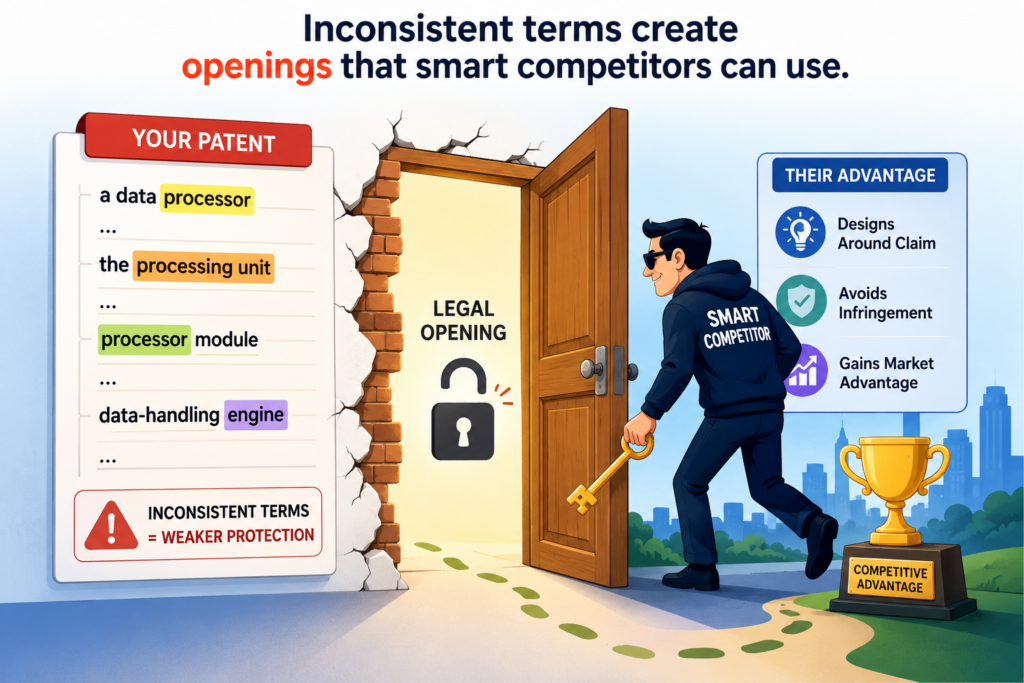
Inconsistent terms create openings that smart competitors can use.
Most patent mistakes do not look scary at first. They look small. A word changes. A label moves.
A feature gets a new name. A sentence uses a term that was never defined. Nobody notices because the team is focused on the big idea.
The problem is that small mistakes can become large openings. If a competitor wants to avoid your patent, they will study the wording.
They will look for gaps. They will ask whether one term means the same thing as another term. They will try to show that the patent is unclear, narrow, or easy to design around.
That is why clean wording is not just about neat drafting. It is about making the patent harder to attack.
A messy draft can make a strong invention look weaker than it is.
Many startups build strong technology but file weak patents because the draft does not explain the invention with steady care. The invention may be brilliant. The filing may still feel unclear.
This often happens when several people add content to the same draft. One founder writes the first notes. An engineer adds system details. A patent professional adds claim language.
Another team member adds drawing labels. The pieces may all be useful, but they may not use the same names. By the end, the draft may have five terms for the same feature.
That kind of draft can create confusion. It may also slow down review. A patent attorney may need extra time to clean up the language. The team may need to answer more questions.
The filing may take longer. And when founders are racing to raise money, ship a product, or talk to customers, delay is expensive.
This is where AI can create real leverage. It can compare terms across the draft and point out where the language breaks pattern. It can find terms that appear once and never show up again.
It can detect when a drawing label does not match the description. It can see when the claims use a phrase that is missing from the body of the draft.
AI does not get bored when checking the same draft again and again.
Human review is powerful, but human attention has limits. A long patent draft can include dozens of pages, many figures, and many claim terms. Even a careful person can miss a small change after reading the same draft several times.
AI is good at this kind of repeat check. It can scan every section with the same level of focus. It can make a term map.
It can show where each term first appears, where it is defined, how often it is used, and whether it has close variants. It can also flag words that may need attorney review.
For example, suppose a draft describes a “transaction scoring engine.” Later, the claims say “fraud scoring engine.” Those terms may overlap, but they are not always the same.
A transaction score could measure many things. A fraud score may be more narrow. If the team meant the broader idea, the wording needs care. AI can catch that mismatch early, before the draft goes out the door.
PowerPatent helps teams catch these issues earlier in the process. The goal is not to add more steps. The goal is to remove the hidden slowdowns that happen when messy drafts need heavy cleanup later.
With PowerPatent, founders get software that helps organize the invention and attorney oversight that helps shape the final filing. You can explore the workflow here: https://powerpatent.com/how-it-works
Term drift can shrink the patent without the founder noticing.
One of the biggest risks with inconsistent terms is that the patent may become too narrow. This can happen when the draft slowly changes from a broad term to a narrow term.
A founder may start with a broad idea like “data processing system.” Later, the draft may call it a “server.” Then the claims may call it a “cloud server.” Each step gets more specific.
That may be fine if the invention really needs a cloud server. But if the invention can also run on an edge device, phone, robot, car, or local machine, the wording may box the invention in too tightly.
That kind of mistake can hurt later. A competitor may build the same core idea on a different device and argue that the patent does not reach them.
The founder may then realize the draft did not protect the full invention.
Consistent terms help keep the claim scope tied to the real technical idea.
A good patent draft should protect the invention at the right level. Not too vague. Not too narrow. Clear enough to understand. Broad enough to matter.
AI helps by showing where terms become narrower without a clear reason. It can flag when “device” becomes “mobile phone,” when “model” becomes “neural network,” when “database” becomes “relational database,” or when “signal” becomes “wireless signal.” These changes may be correct, but they should be intentional.
That is the key word: intentional.
Founders do not want accidental limits. They want smart choices. They want to know when a word choice helps them and when it may hurt them.
AI can bring those choices to the surface. Then a patent attorney can guide the final decision.
This gives founders more control. They can understand the tradeoffs. They can see why a term matters.
They can avoid blind spots before the application is filed. That is far better than finding out later, after the wording is already locked in and harder to fix.
AI makes terminology review faster, but attorney judgment makes it safe.
AI can find drafting issues quickly, but speed alone is not enough. A patent is too important to treat like a spell check task.
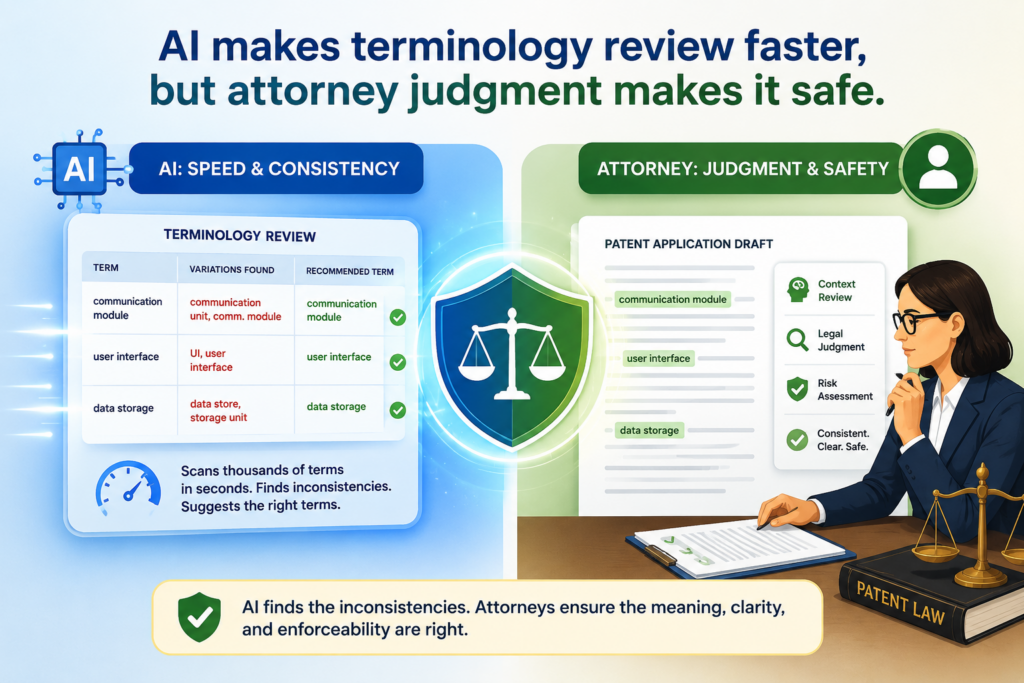
The right process uses AI to find issues and uses human legal skill to decide what to do about them.
That balance matters. AI can tell you that two terms are different. It cannot always know whether they should be different. It can suggest a cleaner word. It cannot always know the best patent strategy for the company.
It can flag a possible error. It cannot replace the judgment of a trained patent attorney who understands claim scope, examiner behavior, and long-term business risk.
The best use of AI is not “let the machine write the patent and hope it works.” The best use is “let the machine catch the hidden issues so the attorney can focus on the hard choices.”
AI is strongest when it works like a careful second set of eyes.
A strong AI review can check the draft in ways that are hard to do by hand. It can build a list of key terms. It can group similar words. It can compare terms in the claims against terms in the description.
It can find parts of the invention that are named in one section but missing in another. It can also point out when a term appears in a claim but has not been explained well enough in the detailed description.
This is very useful for startups because early patent drafts often begin with raw invention notes. Those notes may come from product docs, code comments, slide decks, lab notes, design specs, customer demos, or founder calls.
The information is valuable, but it is rarely clean. AI can help turn that rough material into a more organized draft.
Still, AI should not be the final reviewer. It may not understand every technical nuance. It may confuse two related ideas.
It may suggest language that sounds clean but changes the meaning. This is why attorney oversight matters.
PowerPatent combines software speed with real patent attorney review.
PowerPatent is built around a simple idea: founders should not have to choose between moving fast and filing carefully. Old patent workflows can feel slow, unclear, and painful.
A founder sends notes, waits, gets a draft, sends comments, waits again, and still may not know whether the filing truly captures the invention.
A better process gives the founder more visibility. It helps gather the invention in a structured way. It uses AI to find drafting gaps. Then real patent attorneys review the work so the final result is not just fast, but also thoughtful.
That combination is powerful because each side does what it does best. AI checks patterns. Attorneys make judgment calls.
Founders stay closer to the invention. The draft becomes cleaner before it reaches the final stage.
You can see how PowerPatent helps founders protect technical work with less drag here: https://powerpatent.com/how-it-works
A clean terminology process starts before the first full draft.
The best time to prevent term mistakes is not at the end. It is at the start. Before drafting begins, the team should name the core parts of the invention. These names do not need to be perfect, but they should be clear enough to guide the draft.
For a software invention, that may include the model, the data source, the scoring step, the output, the feedback loop, and the user action.
For a hardware invention, that may include the sensor, controller, housing, actuator, power unit, communication path, and user interface.
For a biotech or medical device invention, that may include the sample, reader, signal, processor, display, and decision step.
The point is not to create a giant glossary. The point is to create a shared language before the draft grows large.
AI can help by reading the invention notes and suggesting a first set of terms. The founder and attorney can then review those terms and decide which names should carry through the application.
The strongest patent drafts make each important term easy to follow.
A reader should not have to guess what a term means. When a draft introduces a key part, it should use the same term later unless there is a clear reason not to.
If a broader term and narrower term are both needed, the relationship should be clear. If two similar parts are different, the draft should explain the difference in plain words.
This is where AI-supported drafting becomes very practical. It can help enforce the naming plan. It can remind the drafter when a term changes.
It can flag terms that were introduced but never used again. It can also check whether drawing labels match the written text.
For founders, this means less wasted time. Instead of hunting through a long document for tiny wording problems, the team can focus on the real invention.
Instead of waiting until late in the process to find messy terms, they can fix them early. Instead of wondering whether the draft is clear, they can see the issues in front of them.
That is how AI helps prevent drafting mistakes. Not by making patents automatic. Not by removing attorneys.
Not by turning invention work into a black box. It helps by making the process clearer, faster, and more controlled.
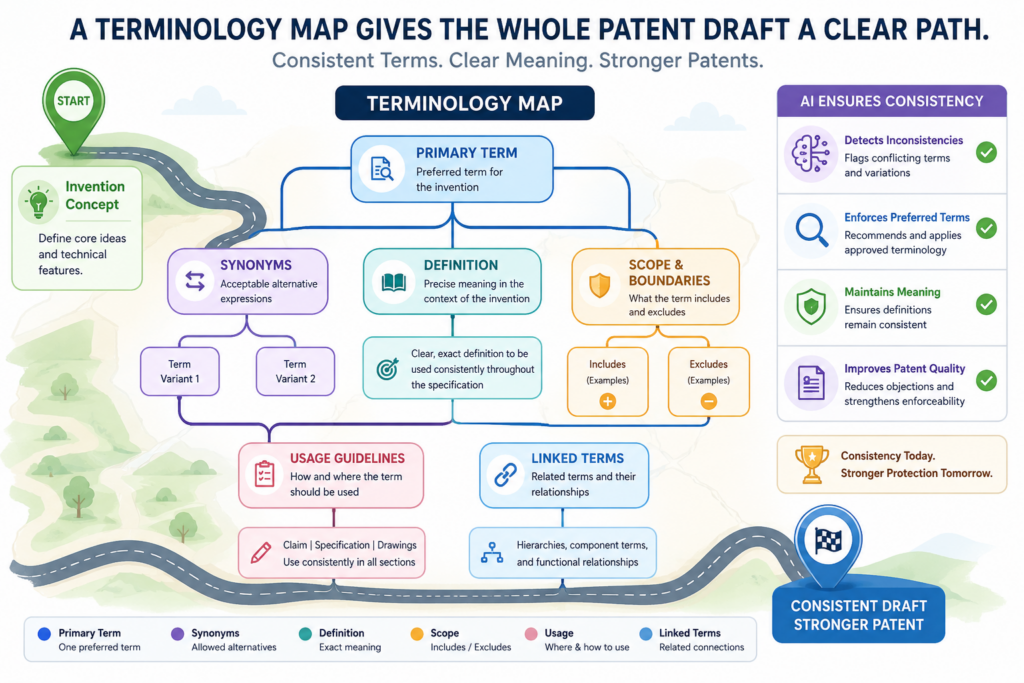
A terminology map gives the whole patent draft a clear path.
A patent draft becomes much easier to control when every key term has a home. Without that home, the draft can start clean and then become messy as more details are added.
This is very common in startup patents because the invention keeps changing while the team is still building. A founder may update the product. An engineer may rename a feature.
A model may get a new role. A system diagram may change after a new customer call. All of that is normal. The danger starts when those changes enter the patent draft without a clear naming plan.
A terminology map is a simple control tool. It is a shared list of the important words in the patent and what each word means. It does not need to be long or hard to use.
In fact, the best version is plain and easy. It tells the team what to call each part of the invention, where that part appears, and whether any similar terms are allowed.
A terminology map helps founders stop confusion before it spreads.
Most drafting mistakes do not start as mistakes. They start as normal team language. One person says “ranking engine.” Another person says “recommendation engine.”
A third person says “matching model.” Each person may be right in a casual product meeting. But in the patent draft, those names need order.
This is where AI can help a lot. It can read the invention notes, the drawings, the draft claims, and the technical description.
Then it can pull out the main terms and show the team where each one appears. It can also find words that look related but may not mean the same thing. That gives the founder and attorney a clear place to begin.
A good AI review might show that the draft uses “profile score” in the summary, “trust score” in the detailed description, and “risk value” in the claims.
The founder can then decide whether these are the same result or three different results. That decision should happen before filing, not after an examiner asks hard questions.
The map should show both the broad term and the narrow examples.
Many patents need both broad words and narrow examples. The broad word protects the bigger idea. The narrow example shows one way to build it. Trouble starts when the draft mixes these two levels without warning.
For example, a draft may use “computing device” as the broad term. That can include a phone, server, laptop, edge box, robot, or other machine.
Later, the draft may say “mobile phone” because the first product runs on a phone. That may be fine as an example. But if the claim only says “mobile phone,” the patent may miss other forms of the same invention.
AI can flag this shift. It can show when the draft moves from broad to narrow words. It can also point out when an example starts acting like a limit.
This is one of the most useful ways AI supports better drafting. It gives the team a chance to ask, “Do we mean only this version, or do we mean the larger idea?”
PowerPatent helps founders handle this without getting buried in patent process. The software helps organize the invention, and real patent attorneys help choose the right wording.
That way, the patent can be both clear and useful. See how PowerPatent works here: https://powerpatent.com/how-it-works
A strong terminology map also helps when the invention keeps growing.
Startups do not stand still. A patent draft may begin with one version of the product, but the team may improve the system before the application is filed. New data may be added.
A new model may be trained. A new user flow may be built. A hardware part may change. A new signal may be measured.
Without a terminology map, each change can add more naming risk. The draft may slowly collect extra words that do not fit the first naming plan.
AI can run a fresh check each time the draft changes. It can compare the new version with the old version and show what terms were added, removed, renamed, or used in a new way.
That is very helpful because it lets the team update the draft with control. The founder does not have to read every page from scratch just to find naming changes.
The attorney does not have to guess which terms came from the latest product update. The process becomes cleaner.
The goal is not perfect language on day one, but controlled language by filing day.
Founders often worry that they need to have every patent word perfect before they start. That is not true.
Early invention notes can be rough. What matters is that the final patent draft is careful.
AI helps by making the rough work easier to clean. It can turn messy inputs into a clearer term structure. It can show the attorney where review is needed. It can help the team avoid last-minute surprises.
This matters because patents are often filed during busy moments. A funding round may be close. A launch may be near. A public demo may be planned.
A customer pilot may be starting. These moments leave little room for slow cleanup. A terminology map gives the team a way to move quickly while still keeping the draft steady.
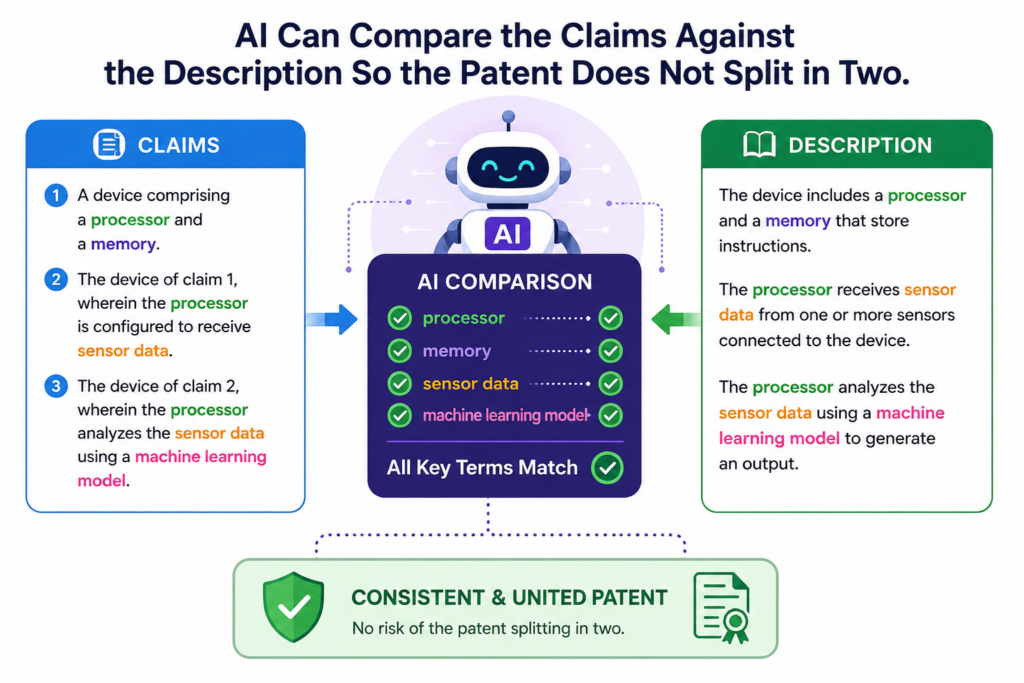
AI can compare the claims against the description so the patent does not split in two.
The claims are often the most important part of a patent. They define the space the patent is trying to protect.
The detailed description explains the invention and supports the claims. These two parts need to work together. If they do not match, the patent can become weaker.
This is one of the places where term consistency matters most. A claim may use a word that does not appear clearly in the description.
The description may explain a feature that never appears in the claims. A term may be broad in one place and narrow in another. These gaps can cause delays, confusion, and risk.
AI can help by comparing the claims and the description side by side. It can look for terms that appear in one part but not the other.
It can find claim words that may need more support. It can also find description terms that may be useful but were left out of the claims.
The claims should not feel like they came from a different document.
A patent draft should feel like one connected piece. The reader should be able to move from the claims into the description and see the same invention. The terms should line up. The steps should match. The parts should have the same names.
When that does not happen, the draft feels split. The claims may say “a content selection module,” while the description says “recommendation service.”
The claims may say “generating an alert,” while the description says “creating a notification.” These pairs may be close, but close is not always enough. A patent reader should not have to guess.
AI can catch these mismatches fast. It can show a claim term and then list where that term appears in the description.
If the term is missing, appears only once, or appears under a different name, the AI can flag it. That gives the attorney a clear review path.
Claim terms need support that is easy to find and easy to understand.
A claim term should not float alone. It should be tied to the story in the description. The draft should explain what the term means, how it fits into the system, and how it helps the invention work.
For example, if the claim uses “confidence score,” the description should explain how that score is made or used. It does not always need every code-level detail, but it should give enough clear support.
If the description only talks about a “model output,” the connection may be less clear. AI can flag that gap and ask whether “confidence score” should be added to the description or whether the claim term should change.
This is where AI makes attorney review more focused. Instead of asking the attorney to hunt through the whole draft, the AI brings possible weak spots forward.
The attorney can then decide whether the wording needs more support, a broader term, a narrower term, or a clearer link.
PowerPatent gives founders a better way to handle this kind of review. It helps turn technical input into patent-ready material, then adds real attorney oversight so important choices are not left to chance.
That is especially useful for software, AI, robotics, hardware, medical devices, and other deep tech fields where the details matter. Learn more here: https://powerpatent.com/how-it-works
AI can also find useful invention details that the claims missed.
Consistency is not only about fixing errors. It can also reveal missed value. Sometimes the description includes a strong technical feature, but the claims do not capture it.
That may happen because the feature was added late, or because it was buried in engineering notes.
AI can help by finding important repeated ideas in the description that are not reflected in the claims.
For example, the description may explain that the system updates a model based on user feedback, but the claims may only mention the first prediction.
The feedback loop may be a key part of the invention. If it is missing from the claims, the patent may not protect enough.
This does not mean every detail should go into the claims. More words do not always mean stronger protection. The point is that the choice should be visible.
AI can help reveal the choice. The attorney can then decide what belongs in the claims and what should remain as support in the description.
Better claim-to-description matching can reduce back-and-forth later.
When the claim language and description language are aligned, the patent process can become smoother. The examiner can understand the invention faster. The founder can review the draft with less confusion.
The attorney can explain the strategy more clearly. Future readers can see the thread from the idea to the claimed protection.
For a startup, this has real value. Cleaner drafts can reduce wasted time. They can also make the patent feel more credible during diligence.
When an investor, partner, or buyer reviews the filing, clean language sends a strong signal. It says the team took the invention seriously.
A messy filing can have the opposite effect. It may make the reader wonder what else was missed. That is not the feeling a founder wants to create when the patent is meant to support company value.
AI does not make the patent perfect by itself. But it gives the team a sharper way to find mismatch early. That is a major win.
AI helps keep drawings, labels, and written terms aligned from start to finish.
Patent drawings are not just pictures. They are part of the way the invention is explained.
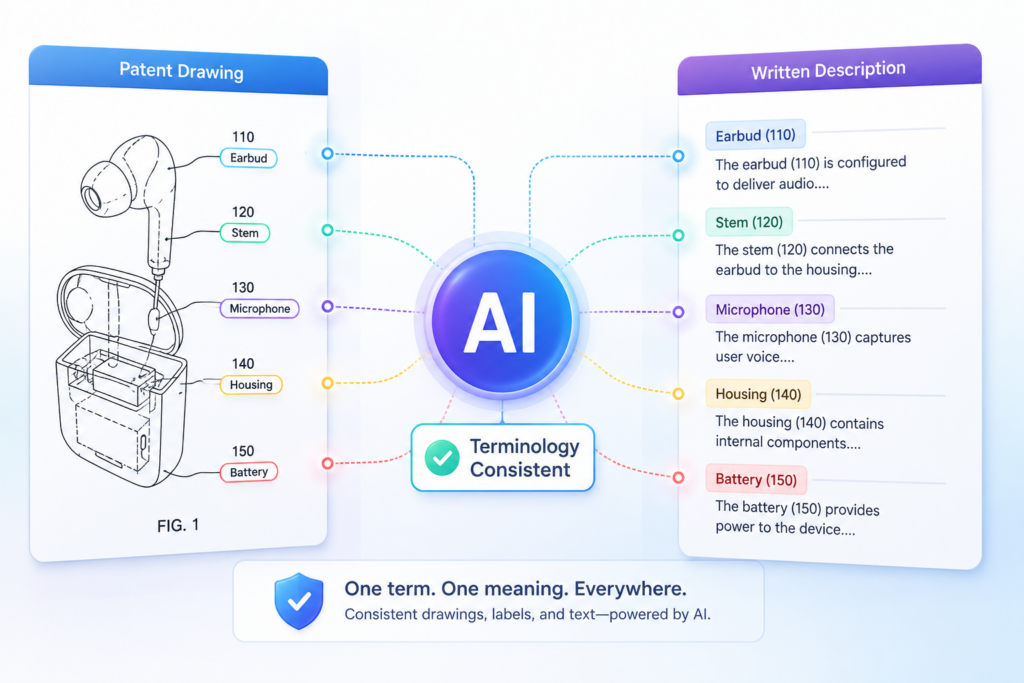
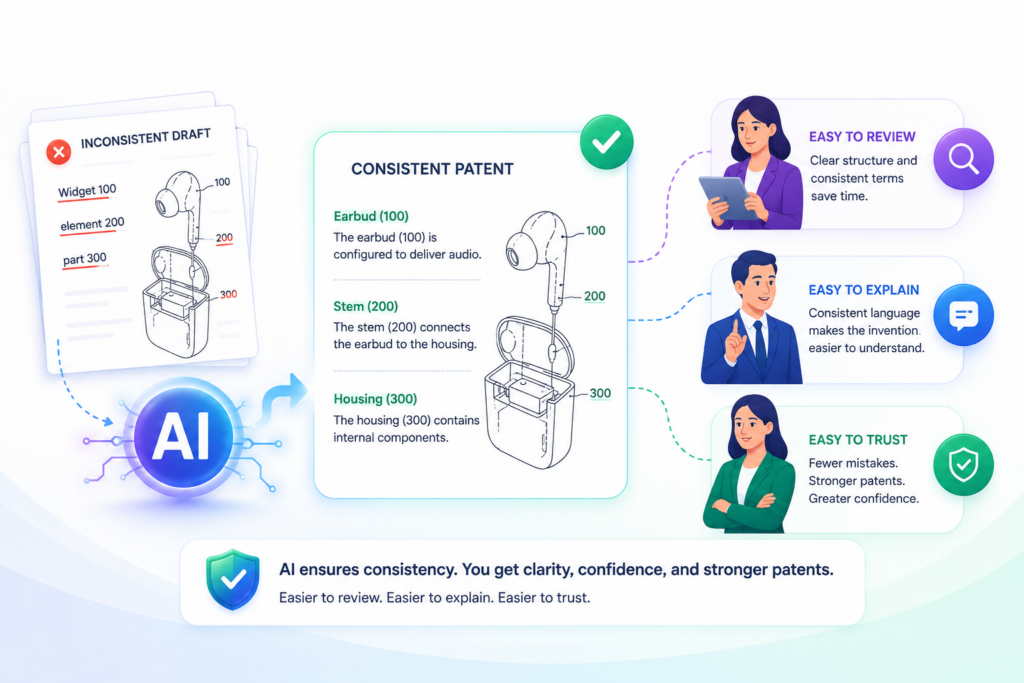
The labels in the drawings should match the terms used in the written draft. If they do not, the reader can become confused.
This is a common problem. A figure may label a part as “data analyzer 120,” while the written text calls it an “analysis engine 120.”
Another figure may use “model trainer 210,” while the claims say “training module.” The founder may know what each label means, but the patent should not depend on the founder being there to explain it.
AI can help by checking the drawing labels against the rest of the patent draft. It can identify label mismatches, missing reference numbers, repeated numbers, and terms that appear in figures but not in the description.
Drawings should make the patent easier to read, not harder.
Good patent drawings help the reader understand the invention quickly. They show how parts connect. They show how data moves. They show how steps happen.
For software inventions, drawings may show system blocks, user flows, data pipelines, model training steps, or output paths. For hardware inventions, drawings may show parts, layers, circuits, housings, sensors, or movement.
But drawings only help if the labels are steady. If the labels shift, the drawings can create more confusion. A term used in a drawing should be easy to find in the written text.
A reference number should point to the same thing each time. If “processor 104” appears in one figure, the same number should not later point to a different part unless the draft makes that clear.
AI can scan for this kind of issue. It can compare labels, numbers, and terms across figures and text.
It can show where a drawing label does not have a matching description. It can also find written terms that should be shown in the drawings but are missing.
Figure terms often reveal hidden drafting problems.
Drawing issues can be a sign of deeper term problems. If a figure says “decision engine” and the text says “classification engine,” the team needs to decide whether these are the same feature.
If they are the same, the draft should use one name or clearly explain the relationship. If they are different, the draft should explain how they differ.
AI can surface these issues early. That matters because drawings are often created from engineering diagrams, product diagrams, or whiteboard sketches.
Those source materials may use team slang or product words. A patent draft needs more controlled language.
For example, an engineering diagram might say “brain,” “runner,” “watcher,” or “router.” Those labels may make sense inside the team.
But in a patent draft, the team may want clearer terms such as “control module,” “execution service,” “monitoring component,” or “routing engine.” AI can identify informal or mixed labels and help the team replace them with terms that fit the patent.
This is another reason PowerPatent is useful for technical founders. The platform helps bring invention materials together, clean them up, and prepare them for attorney review.
It helps founders avoid the slow, painful process of sending scattered notes and hoping everything gets captured correctly. Start here to see the workflow: https://powerpatent.com/how-it-works
Aligned figures make it easier for the founder to review the draft.
Founders are often the best people to spot technical errors, but they are also busy. A patent draft can be long and hard to review.
Clear drawings make that review easier. When the labels match the words, the founder can move through the draft with more confidence.
This is important because a founder should not treat patent review as a passive step. The attorney brings patent skill. The founder brings deep knowledge of the invention.
The best draft comes from both. AI helps by reducing the noise, so the founder can focus on the parts that truly matter.
A clean figure set also helps future readers. An examiner can follow the invention faster. A partner can understand the technology better.
A buyer can see that the filing was built with care. A competitor has fewer loose points to question.
AI can turn drawing review into a repeatable quality check.
The best drafting process is not based on memory. It is based on repeatable checks.
Each time the draft changes, the figures and labels should be checked again. AI makes that possible without turning the process into a burden.
It can check whether each reference number is used in the description. It can flag labels that changed between versions. It can spot terms that appear only in a figure.
It can compare figure captions with the detailed description. It can also help make sure the same part is not given two names in two different figures.
This kind of checking is not glamorous. But it is exactly what prevents avoidable mistakes. It gives the patent draft a cleaner structure. It helps the attorney work faster. It helps the founder stay in control.
That is the real power of AI in patent drafting. It does not need to be flashy to be valuable. It simply needs to catch the small issues that can grow into expensive problems.
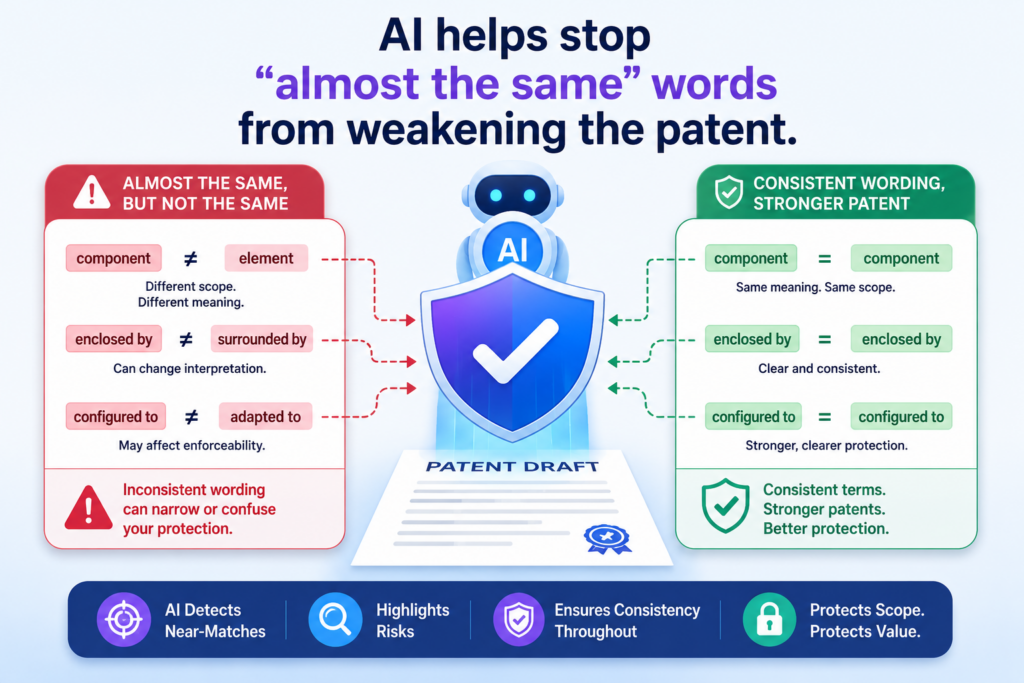
AI helps stop “almost the same” words from weakening the patent.
The hardest terminology mistakes are not the obvious ones. They are the words that feel almost the same. These are the words that slip past smart people because they sound close enough during review.
A founder may read “model,” “engine,” “classifier,” and “network” and feel that the draft is still talking about the same thing.
An engineer may know the team uses those words loosely. But a patent draft cannot rely on loose team habits. It has to stand on its own.
This is where AI can be very helpful. It can catch words that are similar, but not identical. It can show the team where a draft may be using close terms in a way that creates confusion.
It does not need to decide the final answer. It simply brings the issue into view before it becomes a problem.
Similar terms can create silent risk because they sound harmless.
A phrase like “prediction model” may not mean the same thing as “classification model.” A prediction model could predict a number, a class, a timing event, a score, or a future action.
A classification model usually puts something into a class. If the invention works across many kinds of outputs, using “classification model” too often may make the patent feel narrower than it should.
The same issue can happen with words like “database” and “data store.” A database may suggest a certain kind of organized storage.
A data store can be broader. If the draft uses both without explaining the difference, the reader may wonder if they mean the same thing. That question alone can create friction.
Founders often do not see this as a drafting risk because they are focused on what the invention does. That makes sense.
They are thinking about the system, the market, the customer, and the product. But patents are read through words. When the words are not steady, the invention can be harder to protect.
AI can group similar terms so the team can choose the right level of meaning.
One useful AI step is term grouping. The AI can collect words that seem related and place them near each other for review. It may group “processor,” “controller,” “computing unit,” and “processing circuit.”
It may group “training data,” “training set,” “learning data,” and “labeled examples.” It may group “alert,” “notification,” “message,” and “warning.”
This grouping does not mean every word should become one word. Sometimes different words are needed because the invention has different parts.
A notification may be a general message, while a warning may be a special kind of notification.
A processor may be a general part, while a controller may be a processor with a specific role. The point is that the team should make that choice on purpose.
AI can help the founder and attorney ask the right question: are these terms meant to be different, or did the wording drift by accident?
That question is simple, but it is powerful. It turns hidden risk into a clear drafting decision.
PowerPatent helps founders make these decisions without slowing the whole process down. The platform helps organize invention details and uses smart tools to find places where the language may need review.
Then real patent attorneys help shape the draft so the words match the strategy. You can see how PowerPatent supports this here: https://powerpatent.com/how-it-works
Close words can also confuse the technical story of the invention.
A patent is not just a legal document. It is also a technical story. It explains what was built, how it works, and why it matters. If similar words are used carelessly, that story can become harder to follow.
For example, a draft may say that a “scoring engine” receives data, a “ranking engine” sorts results, and a “recommendation engine” sends an output. If those are three separate parts, the draft should explain that clearly.
If they are one part doing three things, the draft should say that too. If the wording changes without a reason, the reader may not know what the system actually includes.
This can be a real issue in AI, software, robotics, medical tools, chips, clean energy systems, and other technical fields. These inventions often have many layers. Data moves from one part to another.
A model may train in one stage and run in another. A device may sense, filter, decide, and act. A small naming mistake can make the flow harder to understand.
The best patent drafts make technical roles easy to follow.
Each important part should have a clear role. If a component collects data, say that. If it cleans data, say that. If it trains a model, say that.
If it runs the model, say that. If it sends an output, say that. The name of each part should support that role instead of making the reader guess.
AI can help by checking whether the same term is used for different roles. For example, it can flag a “processing module” that sometimes filters data, sometimes trains a model, and sometimes sends alerts.
That may be fine if the processing module truly performs all those tasks. But if the draft also uses “filtering module,” “training module,” and “alert module,” the structure may need cleanup.
This is not about making the patent sound pretty. It is about making the patent hard to misunderstand.
When the technical roles are clear, the draft becomes easier to examine, easier to enforce, and easier to explain to business partners.
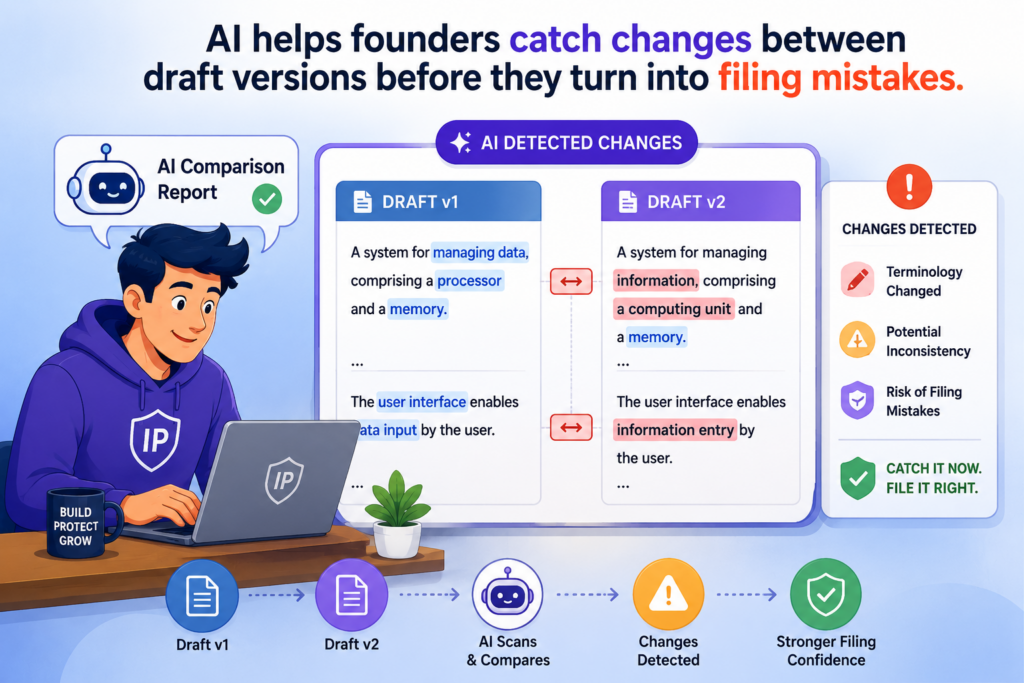
AI helps founders catch changes between draft versions before they turn into filing mistakes.
Patent drafts rarely stay still. The first version is almost never the final version. The founder adds details. The attorney revises the claims. The drawings are updated.
The product team changes a feature name. The engineering team gives more context. The draft improves, but each version creates a new chance for terminology drift.
This is where version review matters. A strong drafting process should not only check one draft. It should compare draft versions.
It should show what changed, what was added, what was removed, and what terms may have shifted. AI makes this much easier.
Version changes can hide terminology mistakes in plain sight.
A team may start with the phrase “authentication token” in the first draft. Later, someone changes part of the description to “access credential.” Then the claims use “security token.”
These words may be related, but they may not be the same. If nobody compares the versions carefully, the final draft may carry all three terms.
This often happens when edits are made for good reasons. An attorney may broaden a term. An engineer may add a more exact term.
A founder may use a product phrase that customers understand. None of these edits are bad on their own. The issue is that the draft needs one controlled language system by the time it is filed.
AI can compare versions and flag these shifts. It can show that a term was replaced in some places but not others. It can find old terms that are still hiding in the draft.
It can find new terms that were added but never explained. It can also find when a change in one section creates a mismatch in another section.
Version comparison is especially useful when a deadline is close.
Many patent filings happen under pressure. A startup may be preparing for a product launch. A research paper may be about to publish. A customer demo may be scheduled.
A funding round may require proof that patent work is underway. When time is tight, the risk of small mistakes goes up.
AI-supported version checking helps reduce that risk. It gives the team a cleaner view of what changed. Instead of relying on memory, the team can review a focused set of possible issues.
That means the founder can spend less time hunting for wording slips and more time checking whether the invention is described correctly.
This is one of the reasons a modern patent workflow is so valuable. Founders need speed, but not careless speed. They need a process that helps them move fast while still catching the details that matter.
PowerPatent gives teams a faster path from invention notes to attorney-reviewed filings, with software that helps spot the drafting issues that slow teams down later. You can explore the process here: https://powerpatent.com/how-it-works
AI can show whether an edit changed the meaning of the invention.
Not all edits are equal. Some edits make the draft clearer without changing meaning. Other edits may change the scope of the invention. That is where founders need to be careful.
For example, changing “receiving sensor data” to “receiving image data” may narrow the draft. Sensor data could include images, audio, temperature, pressure, motion, light, or many other signal types.
Image data is only one kind of sensor data. That may be the right choice if the invention is only about images. But if the invention can work with many signals, the change may create an unwanted limit.
AI can flag this kind of change by comparing broader terms to narrower replacements. It can point out where “data” became “image data,” where “device” became “phone,” where “model” became “neural network,” or where “communication link” became “wireless link.” These edits may be useful, but they should not happen by accident.
Meaning checks help founders stay in control of patent scope.
Scope is one of the most important ideas in patent drafting. In simple words, scope means how much room the patent may cover.
A patent with the right scope can protect the heart of the invention. A patent with poor scope may protect only one small version.
Founders do not need to master every patent rule to care about scope. They only need to know that word choices can shape it.
A broad word can leave more room. A narrow word can add detail but may reduce coverage. The right draft often uses both, with clear structure.
AI helps by making those word choices visible. It can show the founder where a draft may have become narrower over time. Then the attorney can decide whether that change is smart, risky, or simply unclear.
This gives founders more confidence. They can review the patent as a business asset, not just as a document. They can understand why certain words matter.
They can ask better questions. They can make sure the draft protects the invention they are really building, not just the first version they happened to describe.
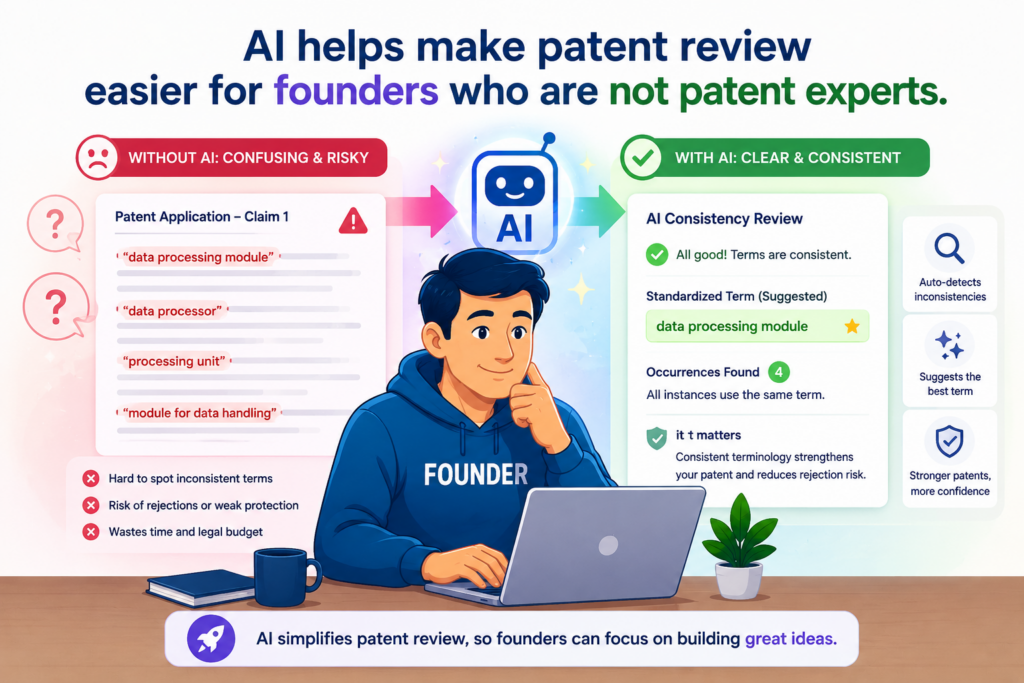
AI helps make patent review easier for founders who are not patent experts.
Most founders do not want to become patent experts. They want to build products, talk to customers, raise capital, hire teams, and ship.
They know patents matter, but the process can feel slow and hard to understand. The draft may be long. The wording may feel strange. The claims may be hard to read. That makes review painful.
AI can make founder review easier by turning a complex draft into a clearer set of questions. Instead of asking the founder to read every sentence with equal attention, AI can highlight the terms that need a decision.
It can show where names changed. It can show which parts are central to the invention. It can make the review feel more like checking a product spec than decoding a legal document.
Founders can give better feedback when the terminology issues are visible.
A founder may not know whether a claim is written in the best form. But the founder usually knows whether “routing engine” and “dispatch engine” are the same thing.
The founder knows whether the model is trained once or updated over time. The founder knows whether the system must run in the cloud or can also run at the edge. The founder knows whether a sensor is required or only one example.
AI can bring those exact questions to the surface. It can flag a term and ask whether it is the same as another term. It can show a possible mismatch between the drawing and the text.
It can point out that a key feature appears in the description but not in the claims. This lets the founder give useful feedback without needing to speak like a patent lawyer.
That is a big deal because the founder’s input can make the patent much stronger. The attorney knows how to draft. The founder knows the invention. AI helps connect those two worlds.
Good AI review turns confusion into simple founder decisions.
A messy draft creates vague worry. A clear AI review creates direct choices. That shift matters. Instead of thinking, “I do not know if this patent is good,” the founder can answer focused questions.
Is this term correct? Is this part required? Can the system work another way? Does this drawing show the latest version? Does this claim miss an important step?
These questions are not busywork. They are the heart of strong patent drafting. They help make sure the application matches the real invention.
They help avoid accidental limits. They help prevent unclear wording. They help the attorney build a better filing.
PowerPatent is designed for this kind of founder-friendly workflow. It helps technical teams share what they built, see where the draft needs attention, and get support from real patent attorneys.
That means less guessing and more control. Learn how PowerPatent helps founders file smarter here: https://powerpatent.com/how-it-works
AI can also help teams build better patent habits over time.
The first patent is often the hardest because the team is learning the process. But after a startup files one patent, it usually keeps inventing.
New features, new models, new devices, new systems, and new methods may all deserve review. The best teams do not treat patents as a one-time task. They build a repeatable way to capture inventions.
Terminology consistency becomes much easier when the team builds simple habits. Product names should be separated from technical names. Internal code names should be cleaned before they enter the patent draft.
Broad terms and narrow examples should be used with care. Drawings should use the same labels as the written description. Claims should match the support in the draft.
AI can help reinforce these habits. It can review new invention notes against older filings. It can flag when the team uses a term in a new way.
It can help keep related patent filings aligned. It can also make sure that later filings do not create confusion with earlier ones.
Strong terminology habits make the whole patent portfolio easier to manage.
A startup may begin with one patent, but over time it may build a portfolio. That portfolio should feel connected. Related inventions should use related language where it makes sense.
New terms should be introduced with care. Important concepts should not be renamed randomly from one filing to the next.
This is especially important for deep tech startups. A company working on AI infrastructure, robotics, climate systems, medical devices, chips, security tools, or developer platforms may file several patents around one core technology.
If each filing uses different language for the same core ideas, the portfolio can become harder to understand.
AI can help by checking consistency across documents, not just inside one document. It can compare a new draft against past filings.
It can show whether a key term has changed. It can help the attorney decide whether to keep the old term, introduce a new term, or explain the relationship.
That kind of control matters because patents are not just paperwork. They can support fundraising, partnerships, deals, hiring, and long-term company value. When the language is clean, the portfolio is easier to explain.
When the portfolio is easier to explain, it is easier for others to see the strength of what the company has built.
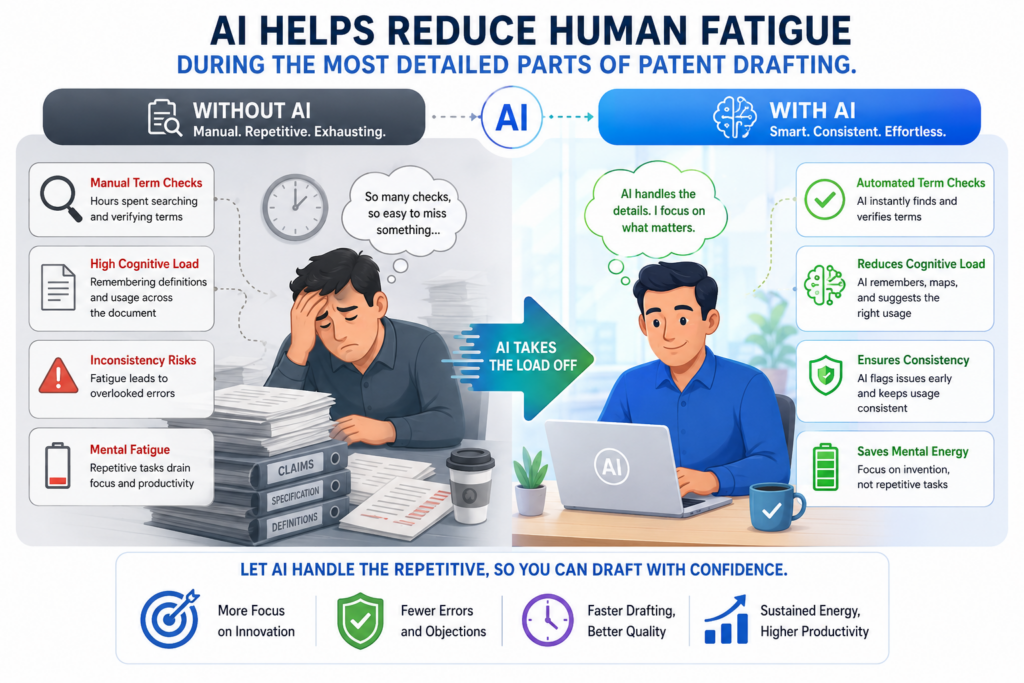
AI helps reduce human fatigue during the most detailed parts of patent drafting.
Patent drafting takes focus. A strong draft may include many pages of claims, figures, examples, system parts, method steps, and technical details.
Even a skilled patent attorney can miss small term changes after reading the same document many times.
Founders can miss them too, especially when they are reviewing the draft between investor calls, product work, hiring, and customer meetings.
This is not a skill problem. It is a human problem. Long documents make people tired. Repeated terms start to blur. A phrase that looked clear on the first read may look normal on the fifth read, even if it changed in the middle.
That is why AI is so helpful in this part of the process. It can keep checking the draft with the same level of attention, even when the human team is tired.
A patent draft needs more than one careful pass to catch wording mistakes.
One review is rarely enough. The first pass may focus on whether the invention is captured. The next pass may focus on claim strength. Another pass may focus on drawings.
Another may focus on terms. If all of this depends only on manual review, small issues can slip through.
AI can run these checks again and again. It can review the whole document for term drift after every major change. It can check whether a renamed feature was changed everywhere.
It can find whether an old product name is still hiding in one paragraph. It can spot when a claim term was added but not explained in the description.
This does not replace careful human review. It makes human review better. The attorney can spend more time on judgment and less time hunting for repeated wording mistakes.
The founder can spend more time checking the real invention and less time trying to read the draft like a proofreader.
Fatigue is dangerous because it makes small mistakes feel invisible.
When a team has looked at a patent draft for days or weeks, the brain starts filling in gaps. A founder may read “detection module” and assume it means “classification module” because they know the product.
An attorney may see “data object” and assume it lines up with “content item” because the draft has been edited many times. The issue is that a future reader will not have that same background.
AI does not bring that bias. It sees the words as they are. It can say, in effect, “This term changed here,” or “This phrase appears only once,” or “This claim term does not appear in the description.”
That simple feedback can prevent a rushed filing from carrying avoidable errors.
This is one reason PowerPatent is useful for fast-moving startups. It helps teams move through the patent process with more control, while still getting real attorney oversight.
The software helps catch the small issues, and the attorney helps make the right call. You can see how this works here: https://powerpatent.com/how-it-works
AI also helps when many people touch the same patent draft.
Patent drafts often pass through several hands. A founder gives the first invention notes. An engineer adds details. A patent attorney shapes the claims. A reviewer updates the figures.
A product lead may add context. Each person may bring useful insight, but each person may also bring different words.
That is how a draft slowly becomes uneven. The same feature may be renamed without anyone meaning to do it.
A term from a product roadmap may enter the draft. A code name may appear in a figure. A narrow customer-facing label may replace a broader technical term.
AI can act like a shared memory for the draft. It can track the names chosen for each part and flag when new names appear.
It can help keep edits aligned across sections. It can show what changed between versions so the team can review changes with care.
Shared review works best when everyone can see the same terminology issues.
A founder should not have to guess what changed. An attorney should not have to ask the same term questions again and again.
An engineer should not have to read the whole patent from top to bottom just to confirm one feature name.
AI can make the review easier for everyone by showing the terminology issues in one place. That creates a more focused conversation. The team can decide whether “matching engine” and “ranking engine” are the same.
They can decide whether “sensor stream” should stay broad or become “video stream.” They can decide whether an internal feature name should be removed from the draft.
That kind of review saves time, but more importantly, it improves the final filing. A cleaner draft gives the patent a stronger base.
AI helps prevent product language from accidentally narrowing the patent.
Startups often use product language before they use patent language. That is normal. Product language helps teams sell, build, and explain. It is clear for customers and useful inside the company.
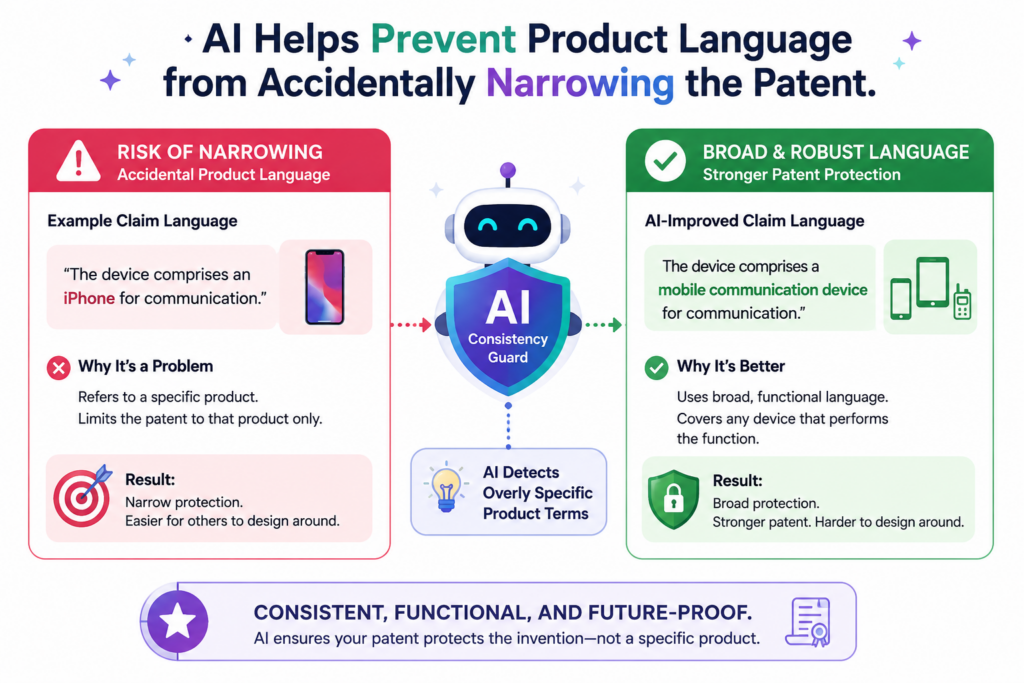
But product language can be risky inside a patent if it is too narrow, too branded, or too tied to the current version of the product.
A patent should protect the invention, not just the current product screen or feature name. This is where many founders need help. They may describe the invention using the exact name of a feature in the app.
They may call a broad technical process by a narrow customer-facing label. They may describe one launch version instead of the deeper system that makes the invention valuable.
Product names can be helpful for context but risky as core patent terms.
A product team may call a feature “Smart Match.” That name may be great for the market.
But in a patent draft, the real invention may be a method for ranking candidates based on changing signals, model confidence, and user feedback. If the draft leans too hard on “Smart Match,” it may fail to show the full technical idea.
The same thing happens in hardware. A device may have a branded part name that sounds simple to customers.
But the patent may need to describe the part by what it does, how it connects, what signals it uses, and how it improves the system. A brand name alone does not carry that meaning.
AI can help by identifying terms that look like product labels, code names, or marketing names. It can ask whether those terms should be replaced with more useful technical language.
It can also help create a bridge between the product term and the broader invention term.
The patent should speak to the invention behind the product.
The product is one version of the invention. The patent should often reach beyond that version. It should describe the deeper idea in a way that can cover future forms, alternate designs, and different use cases when proper.
This does not mean making the draft vague. It means using clear, well-chosen terms that are not trapped inside today’s product name.
For example, a startup may describe a feature as a “doctor dashboard.” But the broader invention may be a user interface that presents ranked clinical alerts to a care team.
If the patent only talks about a doctor dashboard, it may miss nurses, remote care teams, hospital systems, or automated triage tools. The wording needs to match the real reach of the invention.
PowerPatent helps founders avoid this kind of accidental limit. It helps turn raw product notes, technical details, and invention ideas into patent-ready material with attorney review.
That means your draft can protect what you are really building, not just the feature name on your roadmap. See how PowerPatent helps here: https://powerpatent.com/how-it-works
AI can help separate what is required from what is only an example.
This is one of the most practical parts of patent drafting. Some features are required for the invention to work. Other features are just examples. A patent draft should not mix these up.
Product language often makes examples sound required. A founder may say, “The system sends a push notification,” because that is how the current app works. But the invention may only require sending an alert.
That alert could be a push notification, text message, email, dashboard update, sound, light, vibration, or machine signal. If the draft says only “push notification” in the wrong place, the patent may become narrower than needed.
AI can catch this pattern. It can flag narrow terms and ask whether they are examples or requirements. It can identify places where the draft uses “must” language when the feature may only be optional.
It can also compare the claims with the examples to see whether the claim language is too tied to one product form.
Clear example language helps the patent stay flexible without becoming unclear.
The best patent drafts often use broad terms first and then give examples. This helps the reader understand both the main idea and the possible versions.
AI can help check whether the broad term is used consistently and whether the examples stay in their proper role.
For founders, this is very useful. It helps protect future product changes. Your first product may run in the cloud, but the next version may run on-device.
Your first system may use images, but later versions may use audio or motion data. Your first customer may be in one industry, but the same invention may matter in another field.
AI-supported drafting helps the team avoid boxing the invention into today’s version by mistake. It gives the attorney a clearer path to shape the draft with the right balance of detail and room.
AI helps build patents that are easier to review, explain, and trust.
A clean patent does more than help during filing. It can help the company long after the application is submitted. A patent may be reviewed by investors, partners, acquirers, board members, and technical leaders.
It may be used in diligence. It may help show that the company has protected the core work behind the product.
When the terminology is consistent, the patent is easier to trust. The reader can follow the invention without getting stuck on word changes.
The claims feel connected to the description. The drawings match the text. The technical story feels steady. That creates confidence.
Clean terminology makes the patent easier for non-lawyers to understand.
Many important readers are not patent experts. An investor may not understand every claim detail.
A partner may not know patent rules. A founder reviewing a portfolio before a raise may not want to decode complex language. Clear terms help these readers see the value faster.
This matters because patents are not only filed for the patent office. They are also part of the company story. They show that the team is building something worth protecting.
They show that the invention is more than a feature. They show that the company has taken steps to defend its work.
AI helps make this possible by reducing the clutter that makes patents hard to read. It can remove accidental word drift. It can help make the same part appear under the same name.
It can catch gaps between claims, drawings, and descriptions. It can make the draft easier for the attorney to polish and easier for the founder to approve.
A patent that is easier to explain is often easier to value.
When someone reviews your company, they may ask what your patents cover. A clean patent makes that answer easier.
You can point to the key system, method, model, device, or workflow and explain it in plain terms. You do not need to spend time explaining why the draft uses three names for one thing.
This helps in fundraising and deals. It also helps inside the company. New team members can understand what has been filed.
Product leaders can see which inventions have been protected. Engineering teams can identify future improvements that may deserve new filings.
PowerPatent is built to support that kind of clarity. It helps founders capture inventions, use smart AI tools to reduce drafting mistakes, and work with real patent attorneys who guide the final filing.
For a startup, that means speed without losing care. See how PowerPatent helps founders protect their work here: https://powerpatent.com/how-it-works
Consistency turns the patent from a document into a stronger business asset.
A patent is not valuable just because it exists. It is valuable when it clearly protects something that matters. Strong terminology helps that happen. It keeps the invention understandable.
It makes the claims and description work together. It lowers the chance that small drafting issues will create big questions later.
AI is not magic, and it should not be treated like a shortcut around good judgment. But it is a powerful tool for finding the problems that humans often miss. It can scan long drafts quickly.
It can compare versions. It can catch narrow wording. It can map terms across drawings, claims, and descriptions. It can help the attorney and founder spend their time on the choices that truly affect protection.
The best patent process gives founders speed, control, and confidence.
Founders should not feel lost in the patent process. They should know what is being protected, why the wording matters, and where the draft may need attention.
AI helps make that possible. Attorney oversight makes it safe. Together, they create a better way to file.
This is the shift PowerPatent brings to modern patent work. You do not need to choose between moving fast and being careful.
You can use smart software to catch drafting issues early, then rely on real patent attorneys to help shape a strong filing. That is how startups can protect serious work without slowing down the company.
Patent terminology consistency may sound like a small topic. It is not. It is one of the quiet details that can decide whether a patent feels clear, strong, and ready for real business use.
When AI helps catch these mistakes early, founders get a better shot at protecting what they are building before someone else tries to copy it.
Conclusion
Patent terminology consistency is not a small editing task; it is a core part of building a patent that is clear, steady, and useful. When the same invention part keeps the same name, the draft becomes easier to read, easier to review, and harder to question.
AI helps by catching wording drift, missing support, weak labels, and version changes before they become costly mistakes. With PowerPatent, founders get smart software plus real attorney oversight, so speed does not come at the cost of care. Protect what you are building with more confidence here: https://powerpatent.com/how-it-works
Leave a Reply