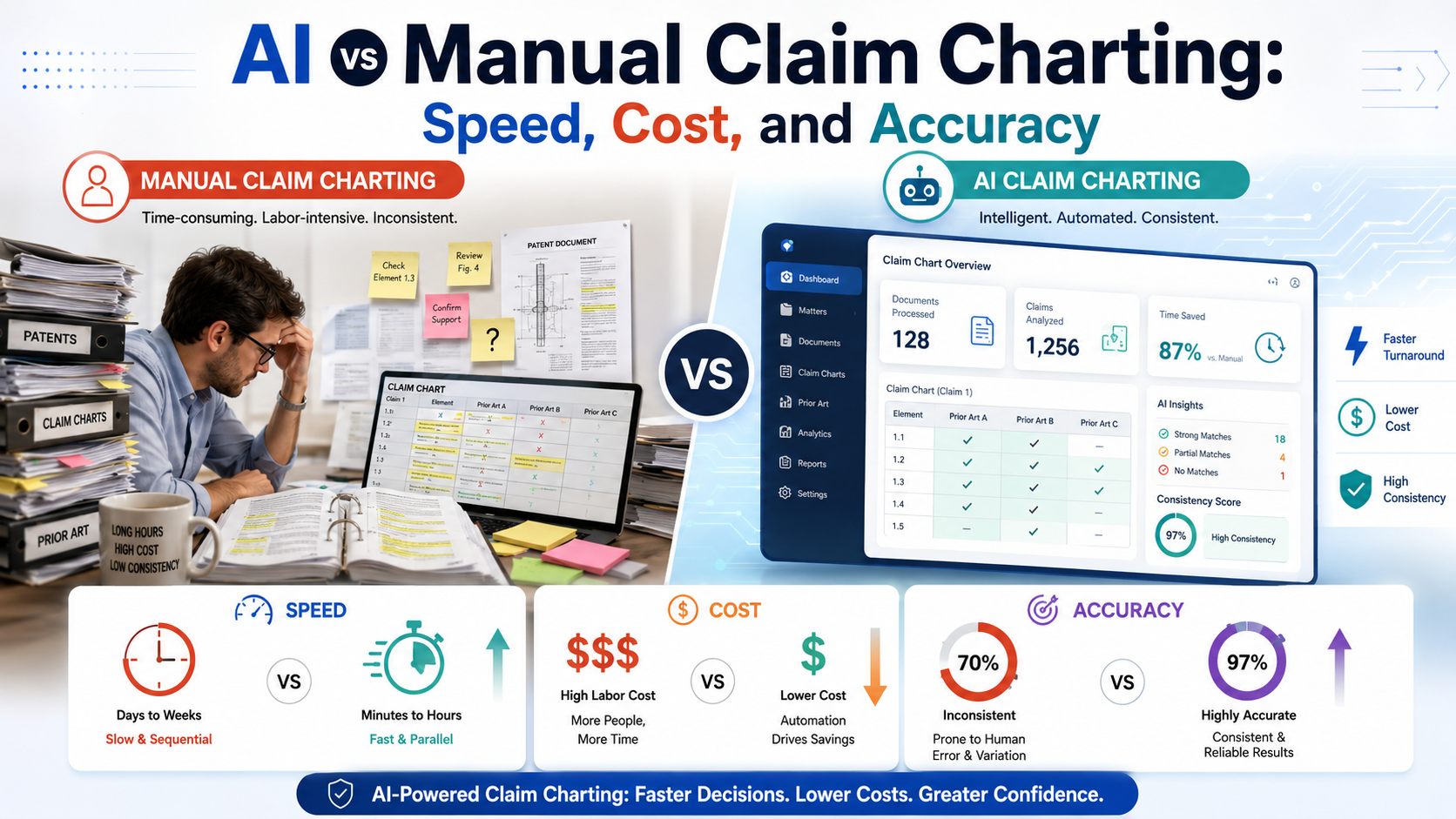
Claim charts are where patent work gets real. They show how each part of a patent claim lines up with a product, system, paper, codebase, or accused feature. When they are strong, they can help a founder, investor, buyer, license partner, or legal team see the value of an invention fast. When they are weak, they can waste time, drain money, and create false confidence.
Claim charting is where patent value becomes easier to see
A patent can look strong on paper and still be hard to use in the real world. That is because a patent claim is not just a broad idea.
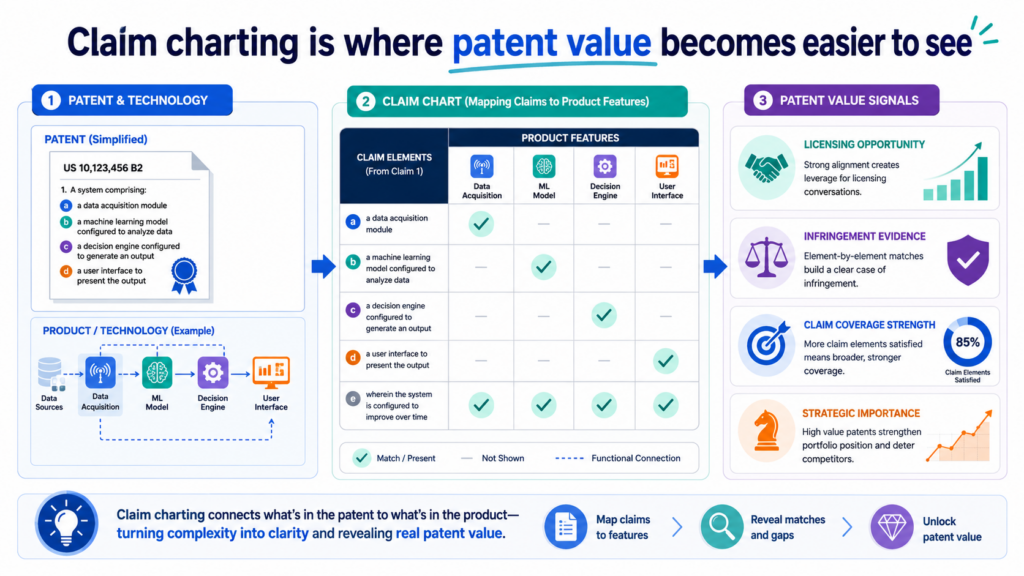
It is a set of exact parts. Each part matters. If one part is missing from the product or system you are studying, the match may fall apart.
This is why claim charts matter so much. A claim chart takes a patent claim and breaks it into pieces.
Then it shows where each piece appears in a product, feature, file, system, standard, article, or source code. In simple words, it answers a key question: does this thing appear to use what the patent claims?
For founders, this can be a big moment. It can help show why an invention is not just smart, but useful, ownable, and worth protecting. For investors, it can make the value easier to understand.
For buyers or partners, it can make a patent feel less abstract. For legal teams, it can save many hours of back and forth.
A weak chart does the opposite. It creates doubt. It makes the patent feel vague. It can lead a team to chase the wrong product, miss better proof, or spend money in the wrong place. That is why the process behind the chart matters.
Manual claim charting has been the old default for a long time
Manual claim charting usually starts with a person reading the claim.
Then that person splits the claim into parts, looks for proof, copies the proof into a chart, and explains why each part matches. This may sound simple, but it is not.
The work can be slow because patent claims are dense. Product docs can be long. Source code can be messy.
Technical papers can be full of terms that sound close but do not mean the same thing. Public websites may hide key details behind marketing words. Sometimes the best proof is spread across many places.
Manual work also depends heavily on the person doing it. A careful person may build a strong chart. A rushed person may miss key facts.
A person who does not understand the technology may force weak matches. A person who understands the technology but not patent claim structure may skip details that matter.
That is the core issue. Manual charting can be powerful, but it is limited by time, cost, focus, and human fatigue.
A good claim chart is not just a table with copied text
Many people think a claim chart is just a spreadsheet. It is not. A chart is only useful when it shows a clear link between claim language and real proof.
That means the chart must do more than paste a product page into a cell. It must explain why the proof matters. It must avoid guessing. It must show the match in a way that a smart reader can follow without needing a long meeting.
For example, a claim might say that a system receives sensor data, processes it with a model, and sends an output to a control unit. A weak chart may point to a product page that says the product uses AI.
That is not enough. A stronger chart would show where the sensor data comes from, how the model works, what the output is, and how the control unit uses it.
This is where AI can help, but also where AI can make mistakes. AI can find possible proof fast. It can compare text.
It can surface patterns. But a strong chart still needs review from people who know what the claim requires and what the proof actually shows.
PowerPatent was built around that same idea. Smart software can move fast, but real attorney oversight helps keep the work grounded.
That mix helps founders move with speed while avoiding the kind of loose work that can create problems later. You can see how PowerPatent combines software and real support here: https://powerpatent.com/how-it-works
Speed is the first big difference between AI and manual charting
Speed is the easiest difference to feel. Manual claim charting can take days, weeks, or longer, depending on the number of claims, the amount of proof, and the type of product being studied.
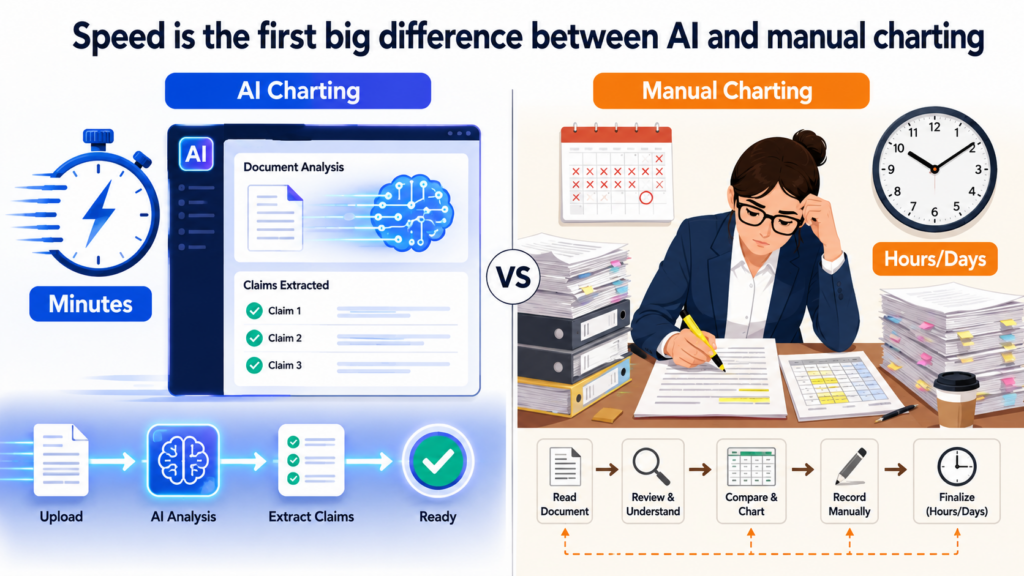
AI can often shorten the first pass by a large amount because it can scan more text faster than a person.
This does not mean AI finishes the whole job by itself. That would be the wrong way to think about it. The better way to see AI is as a fast research helper.
It can pull likely matches, group related evidence, and point the human reviewer toward the right areas. Instead of starting from a blank screen, the team starts with a map.
That matters a lot for startups. A founder may need to understand patent coverage before a fundraise, product launch, acquisition talk, licensing discussion, or investor meeting.
Time is not just a nice thing to save. Time can change the outcome.
Manual charting often slows down because the early search is open-ended.
The person doing the work has to decide where to look, what terms to try, what documents matter, and which findings are worth saving. Each step takes judgment. Each wrong turn adds delay.
AI can speed up that early search. It can test many terms, compare many passages, and keep track of related facts. It can help reduce the empty hours spent looking through large piles of material.
Faster does not always mean better, but slow does not always mean safer
Some people assume manual work is safer because it is slower. That is not always true. Slow work can still be wrong.
A person can spend many hours on a chart and still miss the best evidence. A team can review documents one by one and still overlook a key feature. A chart can take weeks and still rest on weak proof.
The real goal is not speed alone. The goal is speed with control.
AI helps most when it cuts down the heavy search work while still leaving room for careful review. It should help the team get to the right facts faster. It should not push the team to accept the first match it finds.
For example, AI may find five documents that mention a model, a data pipeline, or a device action.
A human reviewer can then check which one actually maps to the claim. This is faster than asking the reviewer to search every document from scratch.
In strong workflows, AI does the broad scan, and people do the final judgment. That is the balance founders should look for.
The best speed gain comes from removing the blank-page problem
The hardest part of claim charting is often the start. You have a claim in front of you. You have a product or target area.
You may have thousands of pages, code files, support docs, GitHub notes, product pages, API guides, papers, videos, screenshots, and internal notes. The question is simple, but the path is not.
Where do you begin?
Manual charting forces the person to build that path by hand. AI can create a first path much faster. It can suggest where claim parts may appear. It can point to repeated terms.
It can show nearby technical language. It can help the reviewer see clusters of proof that would take much longer to spot alone.
This does not remove the need for careful reading. It makes careful reading more focused.
For a founder, that can mean faster answers. Not perfect answers in five minutes. Not magic. But faster movement from “we have no idea” to “we have a clear first view of where the claim may read.”
That kind of speed is useful when you are deciding what to file, what to improve, what to claim, or where your patent position may be strongest.
PowerPatent helps founders use software to move faster while still keeping real patent professionals in the loop. See the process here: https://powerpatent.com/how-it-works
Cost is not just the bill you see at the end
Cost is the second major difference between AI and manual claim charting. Most people think about cost as the invoice. That matters, of course. But the true cost is bigger than that.
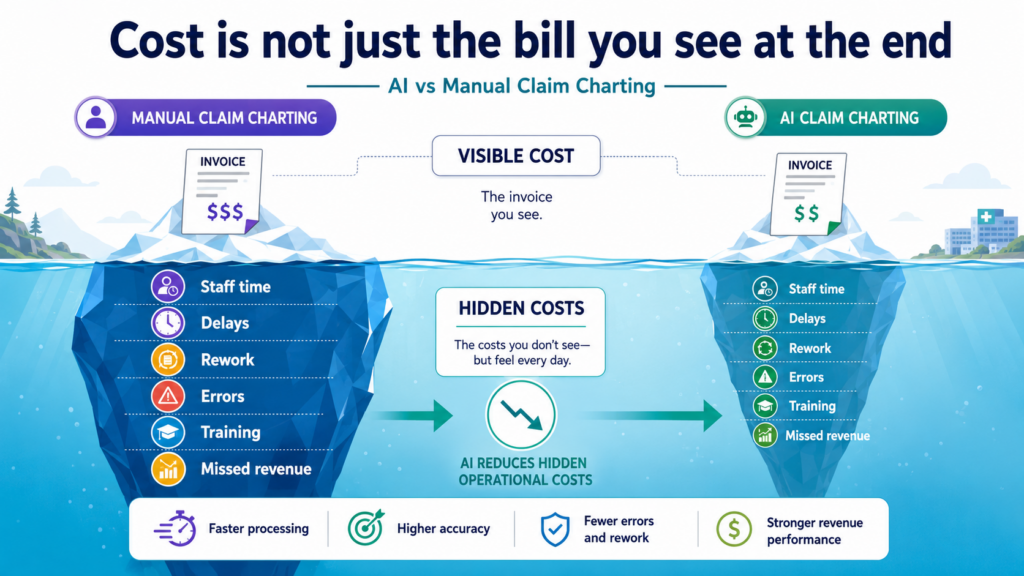
It includes lost time, missed signals, poor choices, slow reviews, delayed filings, and founder attention pulled away from building.
Manual claim charting can become expensive because it uses many human hours. The work is often repetitive. A person may spend hours reading through documents just to find one useful line.
Another person may need to review it. Then someone may need to clean the chart, check the logic, and prepare it for use.
That is normal in patent work, but it can be painful for startups. A startup does not have endless time or money. Every dollar spent on slow legal work is a dollar not spent on product, hiring, sales, cloud spend, testing, or growth.
AI can reduce part of that cost by cutting down the search burden. It can help the team find useful material sooner.
It can make the first draft of a chart less painful. It can also help organize evidence so the reviewer spends more time judging and less time hunting.
But there is a warning here. Cheap AI output can become expensive if nobody checks it.
Bad charting can cost more than good charting
A low-cost chart may look good at first. It may have neat rows, technical words, and many source links. But if the matches are weak, it can mislead the team.
That is where the hidden cost begins.
A founder may think a patent covers a product when it does not. A team may spend money chasing a licensing path that has no real strength. An investor may ask hard questions and find holes.
A lawyer may need to redo the chart from scratch. A deal may slow down because the proof is not clear.
This is why cost and accuracy are tied together. The cheapest chart is not the one with the lowest upfront price. The cheapest chart is the one that helps you make a better decision without rework.
Manual work can be costly because it takes time. AI-only work can be costly because it can create false confidence. The better path is a blended process where AI handles scale and humans handle meaning.
That is one reason founders should be careful when choosing patent tools. The value is not just in having AI. The value is in having AI built into a smart workflow with real review.
PowerPatent focuses on that mix, giving founders smart software plus attorney oversight so they can move faster without treating patents like a guessing game. Learn more here: https://powerpatent.com/how-it-works
Cost should be measured by the quality of the decision it helps you make
The best way to judge claim charting cost is to ask what decision the chart supports. Are you deciding whether to file a new patent?
Are you checking if a competitor product overlaps with your patent? Are you preparing for a funding round? Are you trying to understand whether your current patent claims match your real product?
Each use case has a different level of risk. A quick internal scan may not need the same depth as a chart used in a serious licensing talk.
A chart for early strategy may look different from a chart that supports a legal action.
AI is especially useful when you need a first view. It can help you see where the possible matches are.
It can help you compare many products or documents quickly. It can help you decide where to spend deeper review time.
Manual work may still be needed when the stakes are high, the claim language is tricky, or the proof is hard to read. But even then, AI can reduce waste by giving the reviewer a better starting point.
For startups, this matters because money should go toward judgment, not busywork. You want skilled people spending time on the hard parts, not burning hours copying text from documents.
A good AI-assisted workflow can help shift the budget toward higher-value review.
That is a smarter way to think about patent spend. Not “How little can we pay?” but “How do we get clear answers without wasting money?” That question leads to better patent choices, better investor talks, and fewer painful surprises.
Accuracy is where AI and manual work both need adult supervision
Accuracy is the part everyone worries about, and for good reason. A claim chart can move fast and cost less, but if it is wrong, it is not useful. Accuracy means each claim part is matched to real proof in a way that makes sense.
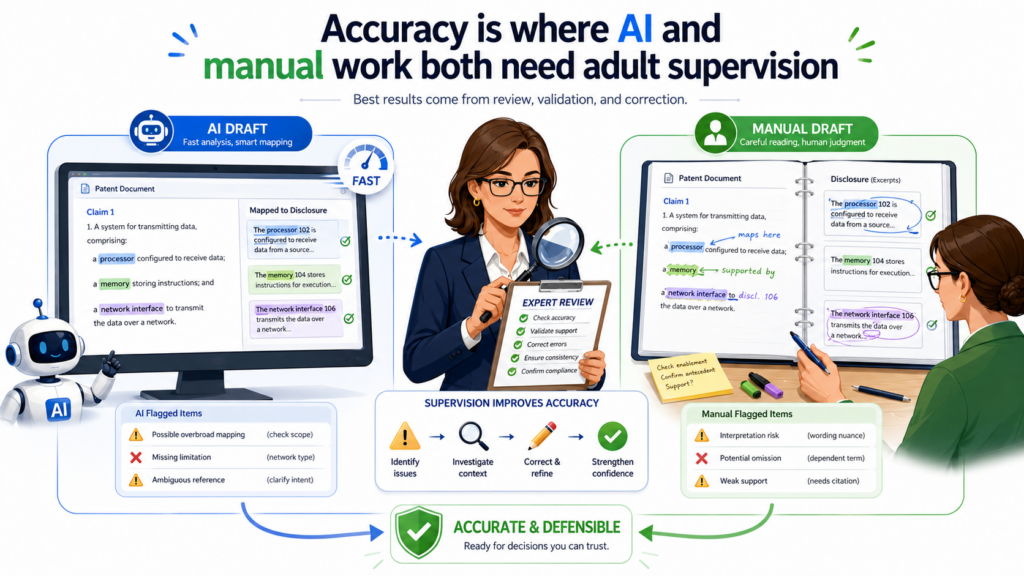
Manual charting can be accurate when the person doing the work is skilled, careful, and familiar with the technology. But humans can miss things. They can get tired. They can copy the wrong passage.
They can rely on broad product claims instead of real technical support. They can also bring bias into the review, especially when they want a match to exist.
AI has a different kind of risk. It can find patterns quickly, but it may overstate a match. It may treat similar words as if they mean the same thing.
It may point to evidence that sounds close but does not fully meet the claim. It may also miss context that a technical founder would catch right away.
This is why the AI versus manual debate is often framed the wrong way. The real question is not which one is perfect. Neither is perfect. The better question is how to build a workflow that catches mistakes before they matter.
The strongest charts come from a human-led AI process
AI should not be the final judge of patent claim meaning. It should help the team move faster, search wider, and compare more material.
The final call should come from people who understand the invention, the claim, and the business goal.
That is the best use of AI in claim charting. Let it handle scale. Let it scan the mountain of material. Let it suggest links. Let it show likely proof. Then let trained humans check the match, clean the logic, and decide what belongs in the final chart.
This is also where founder input can be very valuable. A founder may know why a certain feature matters. An engineer may know where the real proof lives.
A patent attorney may know which claim terms need more care. AI can bring these pieces closer together, but it should not replace them.
In practice, a good AI-assisted chart should be reviewed for three things. The first is whether each claim part has actual support.
The second is whether the proof is specific enough. The third is whether the chart tells a clear story.
That story matters. A chart is not just evidence storage. It is a way to help someone understand why the patent matters.
Accuracy improves when the workflow forces clear proof, not loose guesses
One of the best ways to improve accuracy is to require clear proof for each claim part. If a claim says a system performs a specific action, the chart should show where that action appears.
If a claim says two parts interact, the chart should show that connection. If a claim requires a sequence of steps, the chart should not just show the steps in isolation. It should show the order or relationship when that matters.
AI can help find places where those facts may appear, but the reviewer must still ask the hard question: does this really match?
That simple question prevents many bad charts.
It also keeps the work honest. A strong chart does not need to force every possible match. Sometimes the right answer is that the evidence is weak. Sometimes the better move is to chart a different claim.
Sometimes the patent needs a better claim strategy. Sometimes the product has changed, and the patent work needs to catch up.
This is where PowerPatent’s approach can help founders. The goal is not to make patents feel like a pile of forms. The goal is to help founders understand and protect what they are building with more confidence.
Smart software helps move the work forward. Real patent attorney oversight helps keep the work careful. You can explore the process here: https://powerpatent.com/how-it-works
AI wins when the job is too wide for one person to search by hand
The biggest strength of AI claim charting is reach. A person can read carefully, but only for so long. After many hours, focus drops. Small facts start to blur. Similar terms start to look the same.
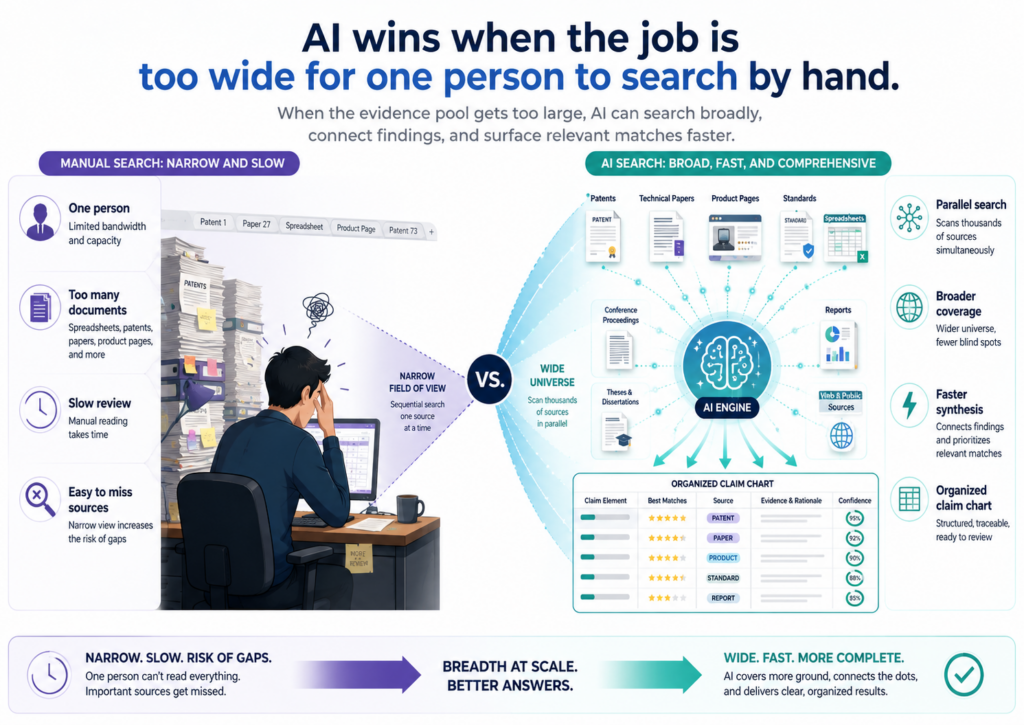
AI does not get tired in that same way. It can scan a large set of files, pages, product notes, papers, web copy, code comments, and support docs much faster than a human team starting from scratch.
That matters because claim charting is often a search problem before it becomes a judgment problem. You first need to find possible proof. Then you need to decide if that proof is strong.
Manual work puts both jobs on the same person at the same time. AI can split the work. It can bring possible matches to the surface, so the human reviewer can spend more time checking meaning.
This is a big deal for technical founders. Your invention may live across code, models, hardware, training data, workflows, and product behavior.
The proof may not be sitting in one clean document. It may be spread across design notes, API docs, diagrams, launch posts, or internal specs. AI can help pull these scattered pieces closer together.
AI is strongest during the first pass through large evidence sets
The first pass is where AI can save the most time. At this stage, the goal is not to make a final call. The goal is to find where the real review should begin.
A strong AI tool can look at claim language and suggest parts of a product or system that may match. It can flag words that appear in many places.
It can find sections that describe similar actions, inputs, outputs, and links between system parts. It can also help compare one claim against many possible sources.
For example, imagine a patent claim that talks about receiving sensor data, cleaning that data, running it through a model, and sending a control signal. A manual reviewer may need to read many product pages and technical files to find those steps.
AI can scan the same material and surface places where those actions may be described. The reviewer can then focus on the best leads instead of digging blindly.
This does not make the work automatic. It makes the starting point stronger.
The founder still needs to know what the chart is trying to prove
AI works best when the goal is clear. A vague goal leads to vague output. Before using AI for claim charting, a founder should know what question the chart needs to answer.
Are you trying to see if your own product is covered by your patent? Are you checking how strong your patent may look to an investor?
Are you studying a competitor product? Are you preparing for a license talk? Are you deciding whether a new patent filing should focus on a certain feature?
Each goal changes how the chart should be built.
A chart for internal product review may focus on learning. A chart for investor support may focus on showing clear value.
A chart for a possible license discussion may need stronger proof and more careful review. The AI can help in each case, but only if the human team knows the purpose.
This is where many teams go wrong. They ask AI to “make a claim chart” without giving enough context. The result may look polished, but it may not answer the real business question.
PowerPatent helps founders avoid that trap by bringing smart software into a process that is built around real patent goals.
It is not just about making documents faster. It is about helping founders protect the parts of their work that matter most. You can see the process here: https://powerpatent.com/how-it-works
Manual review still matters when the words are close but the meaning is not
AI can find similar language, but claim charting is not a word-matching game. A product page may use words that sound close to a patent claim, yet the real system may work in a different way.
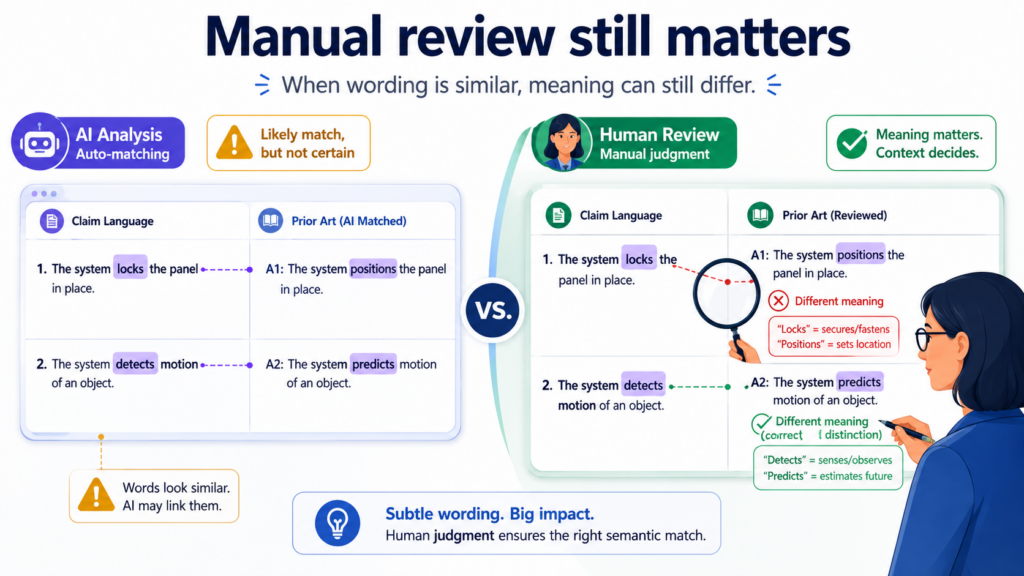
A paper may describe one step clearly but say nothing about another step. A code file may include a function name that looks useful, but the function may not perform the claimed action.
This is where manual review matters. A trained reviewer can slow down and ask what the words actually mean.
A founder or engineer can explain how the product really works. A patent attorney can see which details matter for the claim and which details are just background noise.
Accuracy often depends on these small differences.
A claim chart is weak when it relies on surface-level matches. It is stronger when the reviewer checks the real action, the real structure, and the real connection between claim parts. AI can suggest the match. Manual review tests the match.
Human judgment is needed when the claim has hidden traps
Some patent claims look simple until you break them apart. A claim may include a step that must happen before another step. It may require a certain kind of data.
It may require one system part to send something to another system part. It may use words that seem broad but have a narrow meaning in context.
AI can miss these traps because it may focus too much on related words. A human reviewer can ask the harder question: does this evidence satisfy every part of the claim, or does it only sound related?
That question is not small. It can change the whole chart.
For example, if a claim requires “training a model using user feedback,” a product page that says “AI improves over time” may not be enough.
The proof should show that user feedback is actually used for training, not just that the system becomes better. Those two ideas may sound close, but they are not the same.
This is why manual review is not old-fashioned. It is still needed. The smarter path is not to remove people from the process. The smarter path is to use people where they add the most value.
The best reviewer checks both the claim and the business risk
A good claim chart is not built in isolation. It should match the reason the team needs it.
If the chart is being used for a light internal review, the standard may be more flexible. The team may want to learn where coverage looks strong or weak.
If the chart is being used in a serious business talk, the review should be tighter. The proof should be cleaner. The reasoning should be easier to defend.
This is why attorney oversight matters. Not because founders need more friction. They need less friction. But they also need someone who can spot risk before it becomes expensive.
Founders are often moving fast. They may see a product and think, “That looks like what we built.” Sometimes they are right. Sometimes the match is weaker than it seems. A good reviewer can help separate a strong chart from a wishful chart.
AI can make the work faster. Human review can make it safer. Together, they can help founders make sharper calls with less waste.
That is the kind of balance PowerPatent is built for. The platform helps move patent work forward with software, while real patent attorneys help guide the work so founders are not left guessing. Explore how it works here: https://powerpatent.com/how-it-works
The real comparison is not AI versus people, but weak process versus strong process
It is easy to turn this topic into a fight between AI and manual work. That is the wrong frame. The real question is whether the process helps you reach a clear, useful answer.
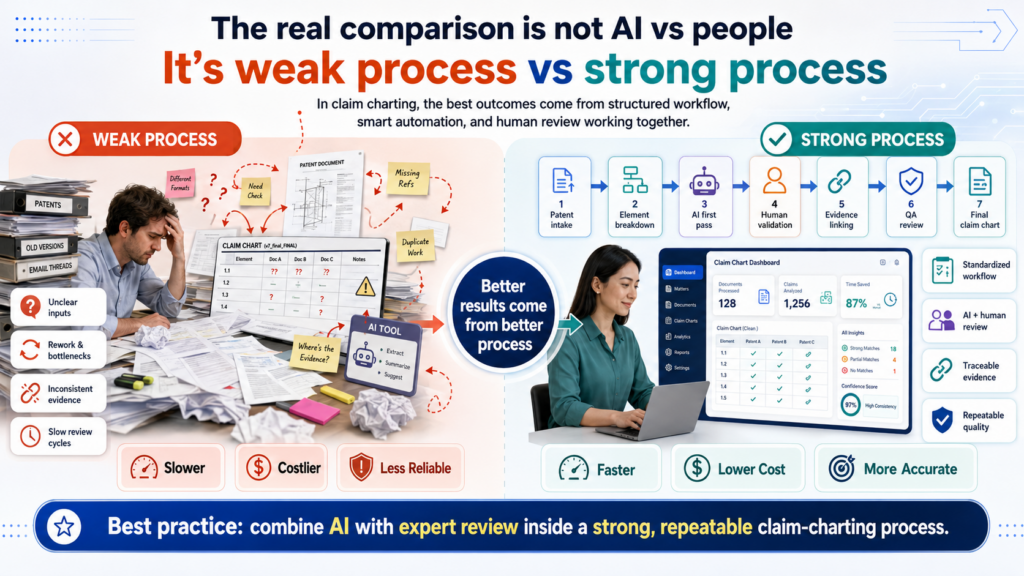
A weak manual process is slow and messy. It depends on one person searching for proof without enough structure.
It may create charts that are long but not clear. It may leave the founder with a document that took a lot of time but still does not support a smart decision.
A weak AI process is also risky. It may create a chart that looks complete but rests on thin evidence.
It may fill gaps with confident language. It may mistake related terms for true matches. It may make the team feel like the work is done before any serious review has happened.
A strong process uses AI and human review in the right order. AI helps with scale, search, grouping, and first drafts. People help with meaning, judgment, context, and final review. That is not just faster. It is more practical.
A strong workflow starts with the claim, not the tool
The tool should not lead the work. The claim should lead the work.
Before anyone searches for proof, the claim should be broken into clear parts. Each part should be understood in plain words. The team should know what needs to be shown. This keeps the chart focused.
Then the evidence search can begin. AI can help scan the target product or system. It can pull possible proof for each claim part. It can help organize the findings in a way that makes review easier.
After that, the human reviewer should test the matches. This is where the chart becomes useful. Weak proof should be removed or marked as weak. Strong proof should be explained clearly.
Missing proof should not be hidden. It should be called out, because knowing what is missing is often just as valuable as knowing what matches.
This process gives founders a better view of where they stand.
The final chart should tell a clean story that a busy reader can trust
A claim chart is often read by people who are short on time. Investors are busy. Buyers are busy.
Patent teams are busy. Founders are busy. A strong chart should make the point clear without forcing the reader to decode a maze.
That does not mean the chart should be shallow. It means the chart should be direct. Each claim part should connect to proof.
Each proof point should have a reason. The chart should avoid vague phrases like “similar to” or “appears to include” unless the uncertainty is real and clearly stated.
A good chart should also show where the evidence comes from. If the source is a product page, it should be clear. If the source is a technical document, it should be clear.
If the source is code, the relevant file or function should be easy to find. Clear source tracking helps the team trust the work later.
This is one of the biggest benefits of AI-assisted workflows when they are built well. They can help keep evidence organized from the start. That makes review cleaner and reduces the chance of losing key proof in a pile of notes.
For founders, this means less chaos. Instead of paying for slow, unclear work, they can build a cleaner view of their patent position. That can help with filings, updates, investor talks, and product strategy.
PowerPatent gives founders a modern way to handle this kind of work. It brings together smart software and real patent attorney support so technical teams can move faster without treating patent quality as an afterthought. Learn more here: https://powerpatent.com/how-it-works
AI can cut the busywork, but it should not cut the thinking
The best reason to use AI in claim charting is not to avoid thinking. It is to protect your best thinking from being buried under repetitive work.
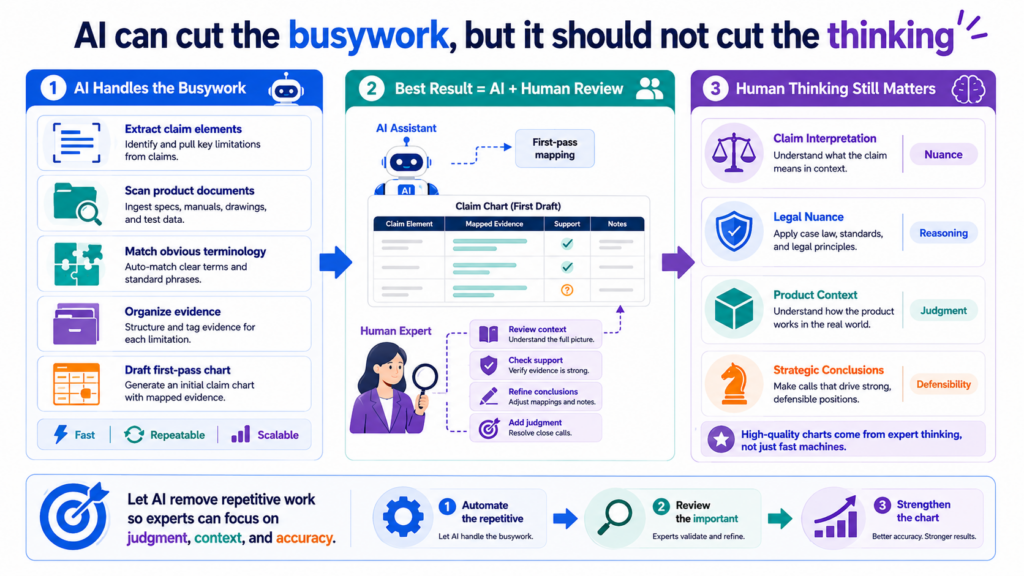
Manual charting has a lot of low-value labor. Someone has to search many files. Someone has to copy text.
Someone has to format rows. Someone has to compare similar passages. These tasks matter, but they are not the highest use of a skilled reviewer’s time.
AI can help reduce that drag. It can collect possible matches, group sources, suggest where evidence may fit, and help form a first draft. That gives the team more time to do the work that actually changes the outcome.
That work includes asking whether the claim is strong, whether the proof is clear, whether the product really matches, whether the chart supports the business goal, and whether the patent strategy should change.
Better tools should make founders more involved, not less involved
A strange thing happens when patent work gets too slow or too complex. Founders step away.
They leave the process to others because it feels hard to follow. That can lead to weak patents, missed details, and claims that do not match the real product.
AI-assisted tools can fix part of that problem by making the work easier to see. When evidence is organized clearly, founders can review it faster. Engineers can spot mistakes sooner.
Attorneys can ask sharper questions. The whole team can work from a shared view.
This matters because founders know the invention best. They know why the product is different. They know what changed after testing. They know what the roadmap looks like. They know which features competitors will care about.
A strong patent process should pull that knowledge into the work instead of hiding it behind slow emails and dense drafts.
The right platform helps turn founder knowledge into stronger patent work
Founders do not need another tool that creates more noise. They need a system that turns their technical work into useful patent assets.
That means the platform should help capture invention details, organize proof, support smart review, and make attorney input easier. It should help founders move fast without making them feel like they are gambling with their IP.
This is where PowerPatent stands out. It is built for founders and technical teams that want speed, control, and real support.
The software helps make the work more efficient. The attorney oversight helps make sure the work is not just fast, but thoughtful.
For a startup, that combination can be the difference between patent work that feels like a burden and patent work that supports growth.
You can see how PowerPatent helps founders protect what they are building here: https://powerpatent.com/how-it-works
The true cost of a wrong claim chart is bigger than the chart itself
A wrong claim chart does not always fail loudly. Sometimes it looks clean. It may have neat rows, nice links, and confident wording. That is what makes it dangerous. The chart may feel useful even when the proof is weak.
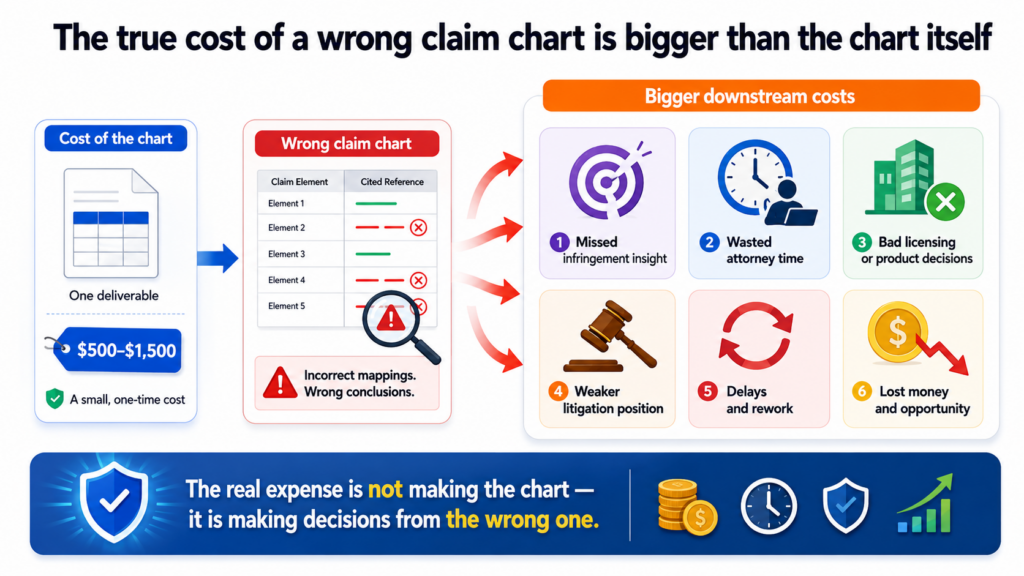
This is a real problem for startups because bad patent signals can lead to bad business moves. A founder may think a patent covers a key competitor feature when the chart does not really show that.
A team may spend time chasing a licensing path that is not strong. A buyer may ask for support during diligence and find gaps. An investor may expect clear proof, but the chart only shows loose matches.
That kind of error can cost more than money. It can cost trust.
Good claim charting helps a team see reality sooner. It shows where the patent looks strong, where the proof is thin, and where more work is needed.
That honest view helps founders make better choices. It also helps them avoid the painful feeling of finding out too late that a patent asset is weaker than they thought.
AI can reduce the chance of missing evidence, but it can also create new risk when used without review. Manual work can catch context, but it can also miss things because the search space is too large.
The safest path is not blind trust in either one. The safest path is a process that checks the output before it becomes a decision.
A bad chart can create false confidence at the worst time
False confidence is one of the biggest risks in patent work. It makes a team feel protected when the real protection is unclear.
This often happens when a chart uses broad proof for a narrow claim. For example, a patent claim may require a specific data flow between two parts of a system.
The chart may point to a product page that says the product uses data and AI. That may sound close, but it may not show the actual flow. The founder may feel good after seeing the chart, but the chart does not truly support the claim.
This kind of gap matters most when the stakes rise. During fundraising, diligence, licensing talks, or a possible dispute, people will ask sharper questions.
They will not just ask whether the chart looks good. They will ask whether each claim part is supported by real evidence.
That is why a claim chart should not be written to impress at first glance. It should be written to survive careful reading.
The best chart tells you what is missing before someone else does
A strong claim chart does not hide weak spots. It makes them clear. That may feel uncomfortable, but it is useful.
When a chart shows that one claim part has weak proof, the team can act. They may look for better evidence.
They may chart a different claim. They may adjust future patent filings. They may decide that the current patent is better for one use case than another. That is progress.
The worst outcome is not finding a gap. The worst outcome is missing a gap and building a plan around a false match.
This is where PowerPatent’s mix of software and attorney oversight can help founders. Smart tools can speed up the search and surface possible evidence.
Real patent professionals can help review the match and spot places where the proof needs more care. That gives founders a clearer picture before they make big moves. You can learn how PowerPatent works here: https://powerpatent.com/how-it-works
Accuracy should be measured by proof, not by how confident the chart sounds
Many weak claim charts sound strong because they use confident words. They say a product “includes,” “performs,” or “matches” a claim part. But strong language does not make weak proof better.
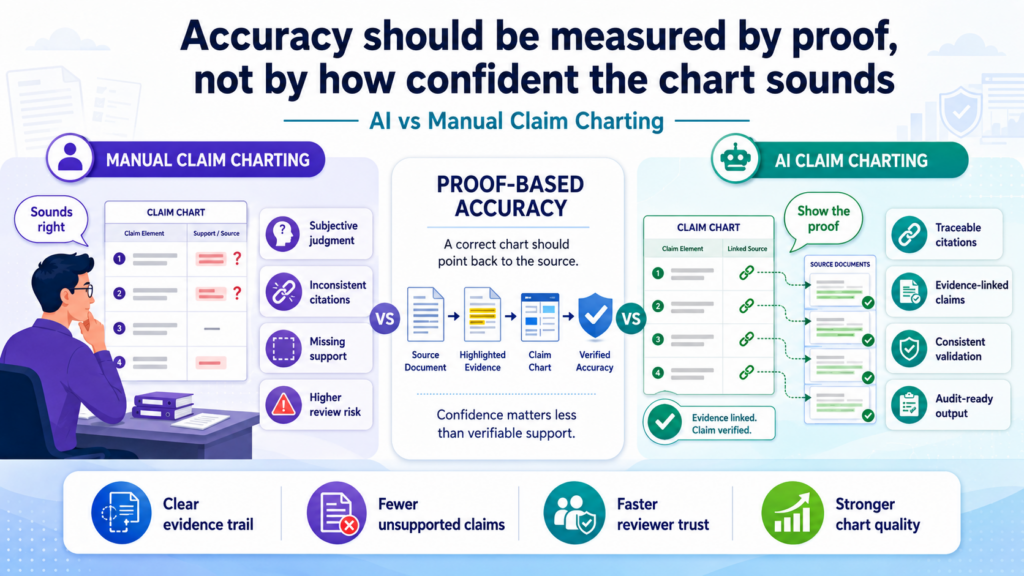
Accuracy comes from the match between the claim and the evidence. The chart should show the reader why the match makes sense. It should not ask the reader to guess.
This is especially important when AI is part of the workflow. AI can write smooth text. It can explain things in a way that sounds clear.
But a smooth explanation is not the same as a correct explanation. The source still matters. The logic still matters. The claim language still matters.
Manual review has the same issue in a different way. A human reviewer may write a careful chart, but if the proof is thin, the chart is still weak.
The goal is not to sound smart. The goal is to be right enough for the decision the chart is meant to support.
A founder should look at every chart with one simple question in mind: can I see the proof, or am I being asked to trust the writer?
Real accuracy comes from matching every claim part with clear support
A patent claim is built from parts. Each part needs attention. If the chart skips a part, blends two parts together, or uses one vague source for several parts, the chart may be weaker than it looks.
For example, a claim may say that a system receives a first input, creates a score, compares the score to a threshold, and changes an output based on that comparison.
A weak chart may point to a document that says the system “uses scoring to improve output.” That may cover the general idea, but it may not show the threshold or the change based on the comparison.
A stronger chart would find proof for each step. It would show the input. It would show how the score is made.
It would show the threshold. It would show the output change. It would connect those facts in a clean way.
That is what accuracy looks like in practice. It is not loud. It is clear.
The chart should make the reviewer’s job easier, not harder
A good chart respects the reader’s time. It should not force the reviewer to open ten links to understand one claim part.
It should not bury the useful proof under long pasted passages. It should not use broad technical talk when a direct explanation would be better.
The best charts are easy to follow because they are built with discipline. They use enough proof to support the point, but not so much that the point gets lost.
They explain the match in plain words. They keep uncertainty visible. They do not pretend a weak match is strong.
This is also why founder-friendly patent tools matter. Founders and engineers should be able to understand what is being claimed and why it matters.
They should not need to decode a legal document just to know whether their invention is being protected well.
PowerPatent is designed to make this process easier for technical teams. It helps founders move faster with smart software while keeping real attorney oversight in the loop, so patent work becomes clearer and more useful. See the process here: https://powerpatent.com/how-it-works
A practical AI-assisted claim charting workflow starts with plain language
The best claim charting process starts before the search begins. It starts by turning the claim into plain language.
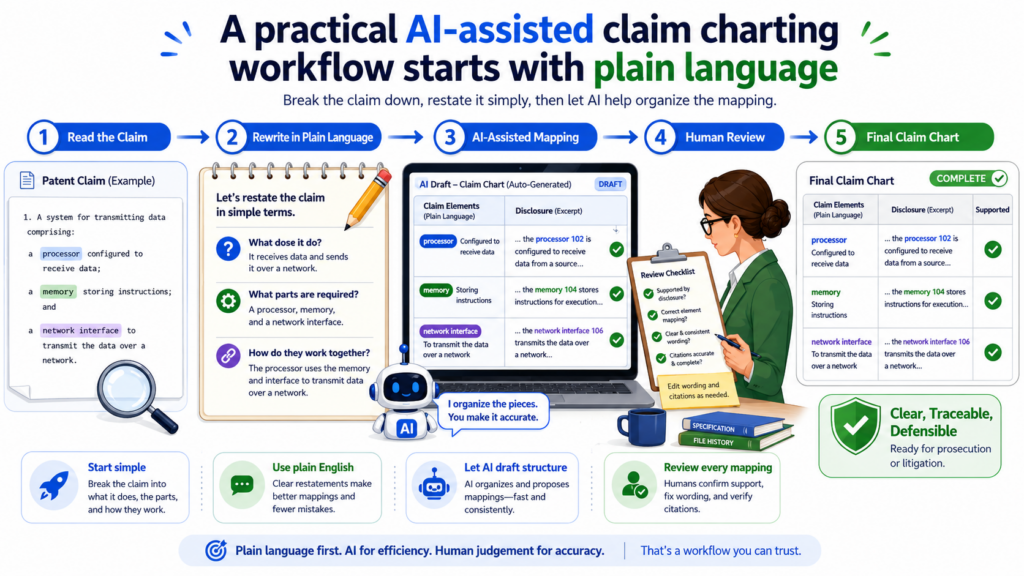
This step sounds simple, but it is powerful. Patent claims are often hard to read because they use careful wording.
That wording matters, but founders still need to understand what the claim is asking for. If the team does not understand the claim, AI will not fix the problem. It may only make the confusion move faster.
A smart workflow begins by breaking the claim into clear parts. Then each part is restated in simple words.
The team should know what proof would count as a match. They should also know what kind of proof would not be enough.
Once that is clear, AI can help search with much better direction. It can look for the right signals instead of chasing every related phrase. It can group possible evidence around each claim part.
It can help show where the match is strong, weak, or missing.
Then human review turns that first pass into something useful. The reviewer checks the sources, trims weak matches, adds context, and makes sure the chart answers the real business question.
The workflow should move from claim meaning to evidence, then to review
The order matters. If the team starts with evidence before understanding the claim, the chart can become messy.
People may grab proof that sounds related but does not meet the claim. AI may do the same thing at greater speed.
Starting with claim meaning keeps the work clean.
After the claim is clear, the team can search for proof. This is where AI can be very helpful. It can scan large source sets and find passages that may relate to each claim part.
It can help compare technical words. It can reduce the time spent on repetitive search.
After that, the team reviews. This is the step that protects quality. The reviewer should ask whether the proof really shows the claimed feature.
They should check whether the chart overstates anything. They should make sure the source is reliable enough for the chart’s purpose.
That review step is not a delay. It is what makes the speed useful.
The founder’s role is to bring context that AI and attorneys may not have
Founders and engineers know things that may not be written down clearly. They know why a feature was built a certain way.
They know which system part does the real work. They know which roadmap items matter. They know what competitors are likely to copy.
That context can make a claim chart stronger.
For example, AI may find a match in an old product document. The founder may know that the feature changed six months later.
An attorney may see that the new version fits the claim better, or that a new filing should cover the updated design. Without founder input, that insight might be missed.
The best workflow makes it easy for founders to stay involved without drowning them in legal work. That is one of the big advantages of a modern patent platform.
PowerPatent helps technical teams move through patent work with more speed and control, while real attorneys help guide the process. You can explore how it works here: https://powerpatent.com/how-it-works
Founders should use AI claim charting to make better patent decisions sooner
Claim charting is not only useful after a patent is granted. It can also help earlier, while the team is still deciding what to file, what to improve, and what to protect next.

This is where AI-assisted charting can be especially useful for startups. A young company may have many inventions forming at once.
Some may be in code. Some may be in model design. Some may be in hardware. Some may be in data handling. Some may be in the way the product behaves for users.
Manual review of all those areas can be slow and costly. AI can help create a first view. It can show where invention details are already well supported.
It can reveal where documentation is thin. It can help the team see which features may deserve deeper patent attention.
That gives founders a better way to spend time and money. Instead of filing based on a vague sense that something is important, they can use a clearer map.
Early charting can help founders file stronger patents before the market gets crowded
Many founders wait too long to think about patents. They build, launch, pitch, sell, and then realize competitors are moving toward the same idea. By then, the patent story may be harder to clean up.
Early claim charting can help prevent that. It can show whether the invention is described clearly enough. It can help the team see which parts of the system are truly different.
It can point out where more technical detail should be captured before memories fade or product changes hide the original idea.
AI makes this more practical because the first pass can happen faster. The team can review more invention areas without turning every question into a long legal project.
Still, the final strategy should not be left to AI alone. A patent attorney can help decide how to frame the invention, what to claim, and how to avoid avoidable mistakes. That mix of speed and review is what founders need.
A faster patent process gives startups more room to build
Startups do not win by slowing down. They win by moving fast on the right things. Patent work should support that motion, not block it.
When claim charting is slow, expensive, and hard to understand, founders push it aside. When it is faster, clearer, and tied to real business choices, it becomes part of the growth plan.
AI helps by removing friction. Human review helps by keeping the work grounded. Together, they can help founders protect important inventions without turning patent work into a full-time job.
That is the heart of the AI versus manual claim charting debate. AI is not here to replace smart judgment.
Manual work is not enough on its own when the evidence is large and time is tight. The winning model is a modern workflow where software handles scale and people handle judgment.
PowerPatent gives founders that kind of path. It helps you move faster, stay involved, and get real patent attorney support without the old-school drag.
See how PowerPatent can help protect what you are building here: https://powerpatent.com/how-it-works
Real startup use cases show why speed alone is not enough
A startup usually does not need a claim chart for fun. It needs one because something important is happening.
A funding round may be close. A partner may ask about the company’s patent position. A competitor may launch a feature that looks familiar. A buyer may want to know whether the company owns something hard to copy.
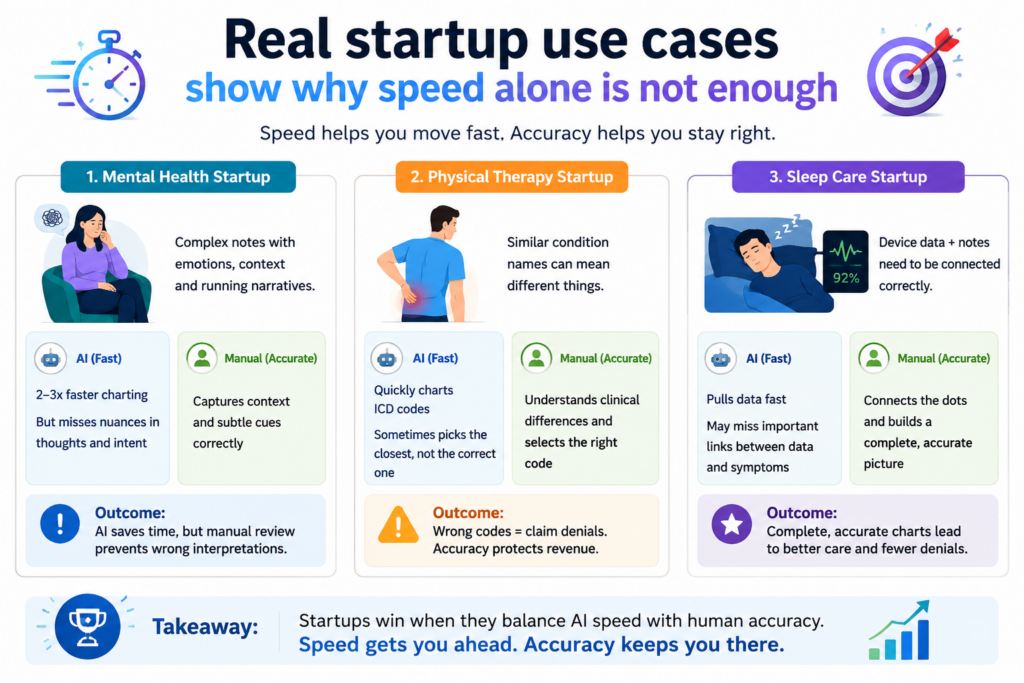
In those moments, speed matters. But speed without clear thinking can hurt. A fast chart that gives the wrong signal can push a founder into a bad move.
A slow chart that arrives after the key meeting can also be useless. The goal is not just to move fast. The goal is to move fast enough, with enough care, to support a smart decision.
This is where AI-assisted claim charting can be very helpful. It gives the team a faster first view. It helps scan more material.
It can help show where the strongest evidence may live. But the chart still needs a human check before the founder treats it as truth.
A founder may use claim charting before a fundraising round
Investors do not always understand patents deeply. But they do understand risk, ownership, and leverage. If your startup says it has strong IP, a smart investor may ask what that really means.
They may want to know what the patent covers, how it maps to the product, and why it could matter in the market.
A claim chart can help answer those questions in a simple way. It can show that the patent is not just a framed document.
It can show that the claims connect to real product features. That makes the patent story easier to trust.
AI can help prepare this view faster by scanning product notes, technical docs, and patent claims.
But attorney review matters because investor-facing material should not overstate the position. Founders need confidence, not hype.
A clear chart can make the IP story easier to explain
A strong chart helps the founder speak plainly. Instead of saying, “We have patents around our AI system,” the founder can explain what part of the system is protected and why that part matters.
That is a much stronger story.
It also helps the investor see that the company is serious. The startup is not just filing patents because it sounds impressive. It is building a moat around the parts of the product that create value.
This is exactly the kind of patent work PowerPatent is designed to support. Founders get smart software to move faster, plus real patent attorney oversight to help keep the work clear and useful. You can see how the process works here: https://powerpatent.com/how-it-works
Claim charting can help founders spot weak patents before they become expensive problems
Many founders assume the hard part is getting a patent filed. But a filed patent is not always a strong patent. The claims may not match the real product.
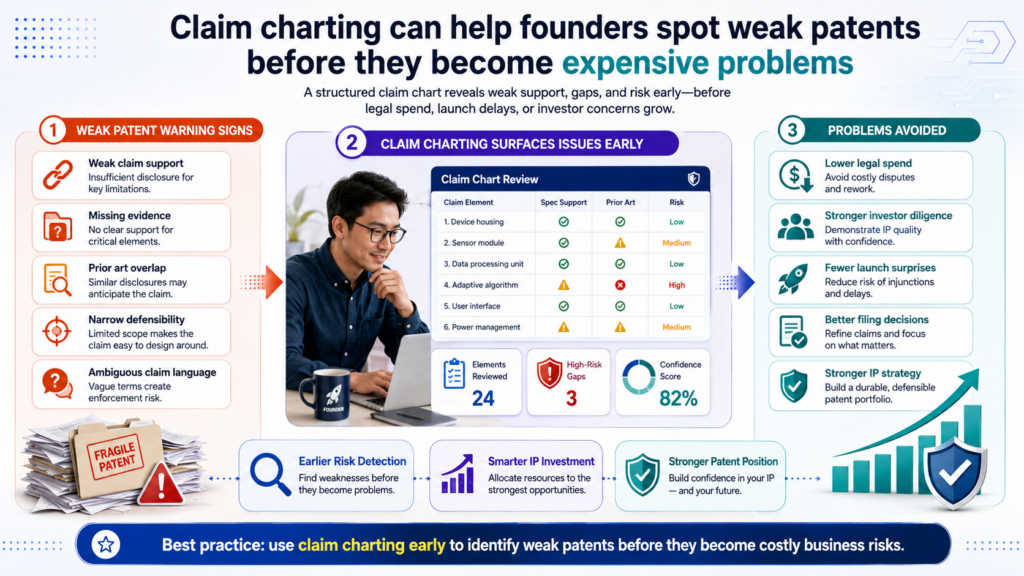
The invention may have changed after filing. The patent may cover an early version, while the business now depends on a newer system.
Claim charting can reveal these gaps. That can feel painful, but it is better to know early. When a founder sees that a claim does not line up well with the current product, the team can act.
They may file a new application. They may capture new details. They may adjust the patent plan before the market gets more crowded.
AI can make this kind of review more practical. Instead of waiting until a big legal event, a startup can use AI-assisted workflows to check alignment more often.
This gives the team a clearer view of whether the patent work is keeping up with the product.
Product changes can break the link between claims and real value
Startups change fast. A model may be replaced. A workflow may be rebuilt. A hardware design may move from one architecture to another.
A feature that once looked central may become less important, while a small technical choice becomes the real edge.
If the patent strategy does not follow those changes, the company may end up with patents that protect yesterday’s product.
Manual review can catch this, but it is often slow and easy to delay. AI-assisted charting can help founders run faster checks.
The team can compare claims against newer product docs and see where the match still looks strong or where the proof has faded.
The best time to find a weak match is before anyone else asks
It is much better for a founder to find a weak patent match during internal review than during investor diligence, partner talks, or a dispute.
When the team finds the issue early, it still has options.
The company may be able to file new claims. It may be able to document the newer invention more clearly. It may be able to build a better patent story around the product as it exists now.
That is why claim charting should not be seen only as a legal task. It is also a business health check. It tells the founder whether the company’s patent assets still match the thing that makes the company valuable.
PowerPatent helps founders make this work easier to manage. The platform helps turn technical work into stronger patent assets with smart software and real attorney support. You can learn more here: https://powerpatent.com/how-it-works
Manual charting still has a place when the stakes are high
AI is powerful, but there are moments when manual review becomes even more important.
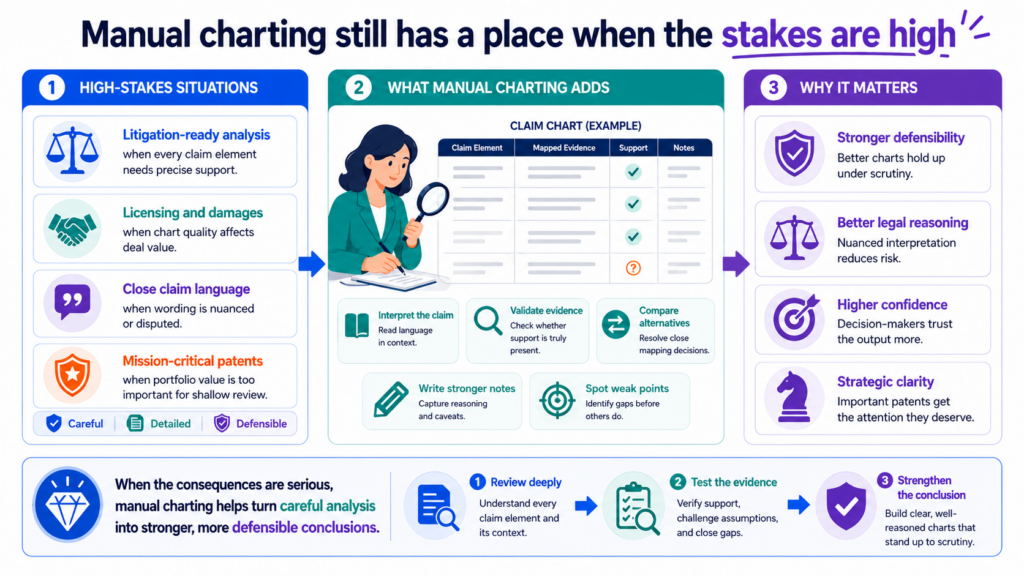
If a chart will be used for a serious licensing talk, an acquisition review, a legal dispute, or a high-stakes investor process, the work needs extra care.
In those cases, the chart must be more than fast. It must be clean, specific, and grounded in strong proof. Every claim part should be checked. Every source should be reviewed. Every weak match should be treated with caution.
This does not mean AI should be removed. It means AI should be used in the right role. AI can help gather and organize evidence.
It can help reviewers avoid missing useful sources. It can prepare a first draft. But the final review should come from skilled people who understand the claim, the technology, and the risk.
High-stakes charts need careful language and careful proof
Words matter in a claim chart. A chart should not say a product clearly does something unless the evidence supports that statement.
It should not turn a maybe into a yes. It should not hide missing proof behind broad language.
This is especially important when people outside the company will rely on the chart. A buyer, investor, license partner, or opposing party may look closely at each line.
They may ask where the proof comes from. They may challenge the match. They may compare the chart against the actual product.
A chart that was made too quickly can fall apart under that pressure.
The goal is to avoid both underclaiming and overclaiming
A weak process can fail in two ways. It can miss strong evidence, which means the company may understate the value of its patent.
It can also overstate weak evidence, which means the company may believe it has more coverage than it really does.
Both are bad.
AI can help reduce the first problem by searching wider. Human review can help reduce the second problem by checking whether the evidence truly supports the claim. Together, they create a better balance.
Founders should not have to choose between speed and care. They need both. PowerPatent was built around that exact idea, using modern software to reduce delay and real attorney oversight to keep the patent work serious.
You can see how PowerPatent helps founders here: https://powerpatent.com/how-it-works
A strong workflow helps founders choose what to chart first
Not every patent, claim, product, or feature deserves the same level of charting right away. Startups have limited time. They need to know where to focus.
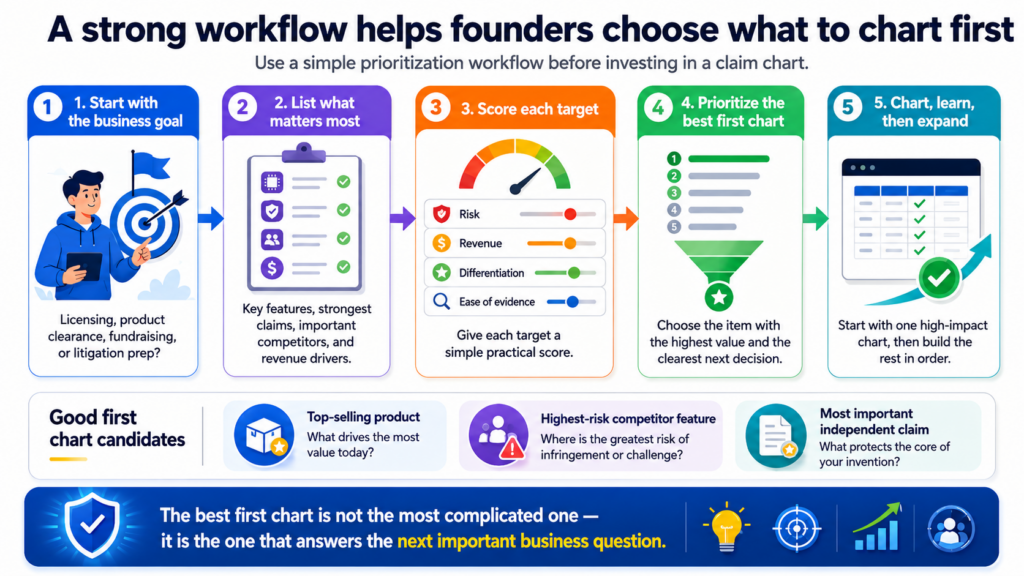
A good workflow starts with business value. Which product feature drives sales? Which technical choice is hard to copy? Which part of the system gives the company an edge?
Which patent claim appears closest to that value? These questions help the team avoid wasting time on low-impact charting.
AI can help compare many claims and sources quickly, but founders still need to guide the process.
The best charting work starts with what matters most to the company. Then the team can use AI to search and organize evidence around that priority.
This keeps the work practical. It also makes the output easier to use.
Founders should start with the claims that connect to real market value
A patent claim has more value when it connects to something the market cares about.
That may be a faster model, a cheaper system, a safer process, a better user experience, a more reliable device, or a workflow that competitors will want to copy.
If a claim maps to a feature nobody uses, the chart may not help much. If a claim maps to the heart of the product, the chart can be very useful.
This is why founders should not chart randomly. They should begin with the claims and features that matter to the business.
AI can then help find evidence faster, but the founder’s business judgment should shape the search.
The smartest charting work supports a real next step
A claim chart should help the team do something. It should not sit in a folder and collect dust.
It may help the company prepare for fundraising. It may help the team decide whether to file a continuation.
It may help support a licensing discussion. It may help explain the company’s moat to a buyer. It may help show where more technical documentation is needed.
When a chart has a clear next step, the work becomes sharper. The team knows what level of detail is needed. The reviewer knows how careful to be. The founder knows how to use the result.
This is another reason PowerPatent can be useful for startups. It does not treat patent work as a slow side project.
It helps founders connect their inventions, documents, and strategy in a clearer workflow, backed by real patent attorney support. See how it works here: https://powerpatent.com/how-it-works
Speed should be judged by how fast the chart reaches a useful decision
Speed in claim charting is not about making a document quickly. A fast but messy chart can waste more time later. Real speed means the team gets to a clear decision sooner.
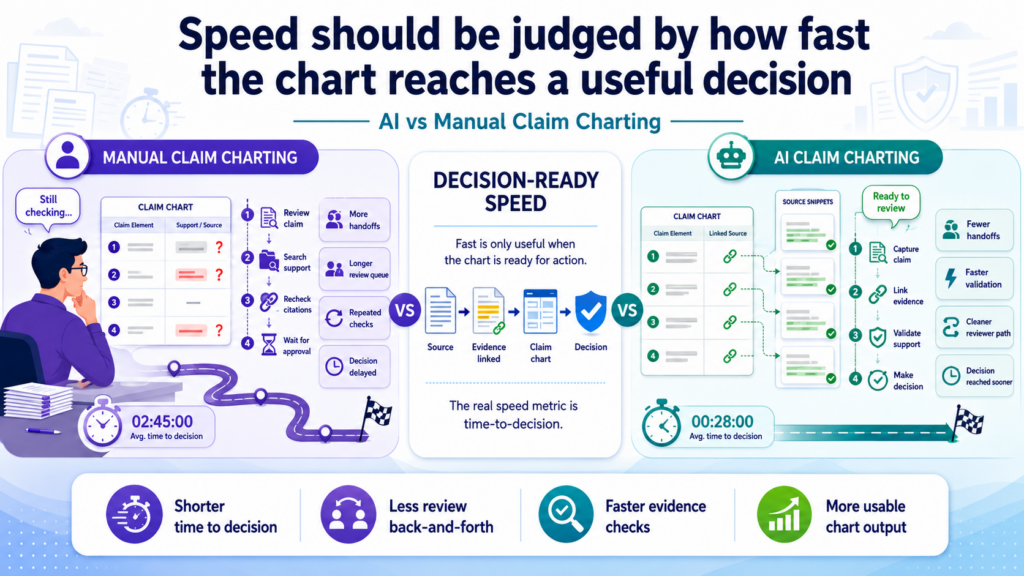
That decision may be to file another patent, adjust a claim strategy, prepare for an investor meeting, study a competitor, or stop chasing a weak path.
Manual claim charting often moves slowly because the work starts from zero. Someone has to read the claim, split it into parts, search for evidence, save the evidence, format the chart, and explain the match. If the target is simple, that may be fine.
But if the target is a modern AI product, a robotics platform, a medical device, a cloud tool, or a deep tech system, the proof may live in many places.
AI can make the first pass much faster. It can scan large files, source material, product pages, specs, and technical notes.
It can suggest where each claim part may match. It can help the team avoid spending hours on dead ends.
But the real win is not that AI creates a chart quickly. The real win is that AI helps skilled people focus faster.
A fast first draft is useful only when it is built for review
A first draft claim chart should not be treated as the final answer. It should be treated as a working map. Its job is to show the reviewer where the best evidence may be and where the gaps may appear.
This is where AI can shine. It can produce a rough structure, place possible evidence near the right claim parts, and give the reviewer a better starting point. Instead of spending most of the budget searching, the team can spend more time checking.
That shift matters because review is where quality improves. A human reviewer can remove weak matches, add missing context, and decide whether the evidence truly supports the claim.
A founder or engineer can add product knowledge that may not appear in public material. A patent attorney can spot claim details that need extra care.
When this process works well, the team moves faster without becoming careless.
The best speed gain comes from cutting the slowest parts, not skipping the safest parts
Founders should be careful with any tool or service that promises instant claim charts with no serious review.
That may sound attractive, especially when time is tight. But skipping review is not real speed. It is just moving risk into the future.
The better approach is to cut the slowest parts of the work. Let AI help with scanning, sorting, grouping, and first-pass matching. Let humans handle claim meaning, evidence strength, and final judgment.
That gives startups a better balance. They can move quickly, but they are not blindly trusting output that only looks complete.
PowerPatent is built around this practical balance. It helps founders use smart software to reduce delay while keeping real patent attorney oversight in the process.
That means you can move faster without turning patent work into a guessing game. See how it works here: https://powerpatent.com/how-it-works
Cost should include founder time, rework, and missed chances
The cost of claim charting is not only the fee paid to create the chart. That fee matters, but it is not the whole picture.
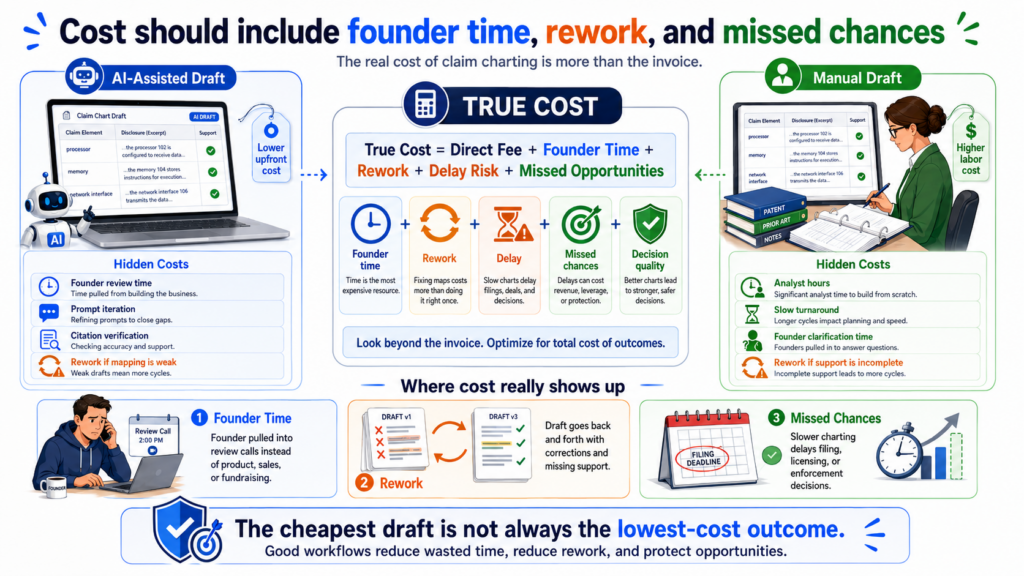
The bigger cost is often hidden inside slow cycles, unclear output, repeated reviews, and missed business chances.
Manual charting can be costly because it takes many hours. A person may read through long documents, copy passages, compare technical details, and build the chart line by line.
If the evidence is hard to find, the cost grows. If the product is complex, the cost grows again. If the first version is weak, the cost grows even more because someone has to fix it.
AI can lower the cost of the first pass by reducing the amount of manual search. It can help find possible proof faster and organize it in a more useful way. That can save money, but only when the AI output is reviewed with care.
Cheap work that has to be redone is not cheap. A low-cost chart that leads to a bad decision is even more expensive.
Manual work often spends too much money on search instead of judgment
Search matters, but it is not where the highest value lives. The highest value comes from judgment.
Does the claim actually match the product? Is the evidence strong enough? Does the chart support the business goal? What should the founder do next?
In a manual-only workflow, too much skilled time can get buried in basic search and formatting.
That is not ideal for a startup. Founders need their patent budget to support decisions, not just document creation.
AI can help shift the spend toward better work. It can handle more of the heavy search load, which gives reviewers more time to think. This is especially useful when the target material is large, scattered, or technical.
The result should not be a cheaper-looking chart. The result should be a more useful chart for the money spent.
A strong workflow helps founders avoid paying twice for the same answer
Rework is one of the most frustrating costs in patent work. A founder pays for a chart, reads it, sees that it does not match the product, sends corrections, waits for revisions, and still may not feel confident.
That is slow. It also creates stress at the exact moment the founder needs clarity.
A better workflow brings founder knowledge into the process early. It uses AI to surface evidence, but it also gives the founder and attorney a cleaner way to review what matters.
This helps catch errors sooner. It also helps make the chart match the real business need.
When the process is clear, the team avoids paying twice for confusion.
PowerPatent helps reduce that kind of waste by giving founders a more modern way to handle patent work.
The software helps speed up the process, while real attorney support helps guide the work toward stronger results. You can explore the workflow here: https://powerpatent.com/how-it-works
Accuracy should be tested claim part by claim part
Accuracy is not a general feeling. A chart is not accurate just because it looks polished or uses the right technical words. It is accurate when each claim part is matched to clear proof and the explanation makes sense.
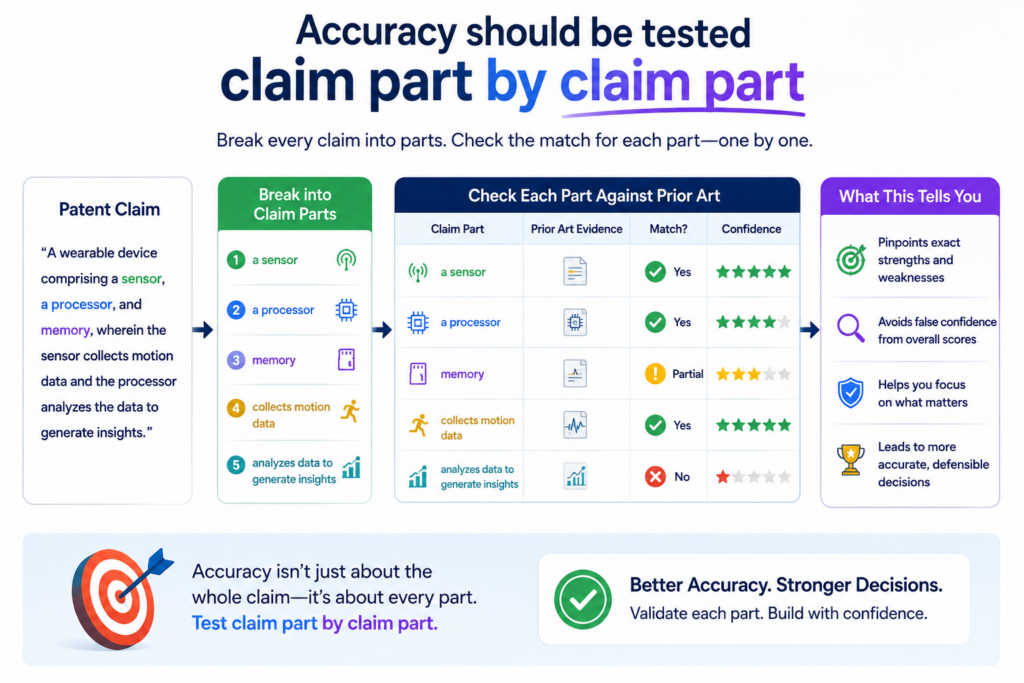
This is why claim charts need discipline. A patent claim may have many parts, and each part has to be checked.
A product may match five parts but not the sixth. That one missing part can change the whole view.
AI can help find possible matches for each part. It can scan widely and bring back passages that may be useful.
But it can also confuse related words with real support. Manual review can catch those mistakes, but manual review can also miss evidence if the search was too narrow.
The best accuracy comes from combining both strengths. AI expands the search. Human review tests the match.
The chart should separate strong proof from weak proof
Not all evidence has the same value. A direct technical document may be stronger than a marketing page.
A clear product diagram may be stronger than a vague blog post. A code reference may be strong in one case but weak in another if it does not show the full claimed action.
A good chart should make that difference clear. It should not treat every source as equal. It should not fill a weak row with long text just to make it look supported.
Founders should look for charts that make proof quality easy to see. If a claim part has direct support, the chart should show it.
If the proof is only partial, the chart should say so in plain words. If the proof is missing, the chart should not hide that fact.
That honesty makes the chart more useful.
The right kind of accuracy helps founders make cleaner moves
Accuracy is not only about avoiding mistakes. It is about making better choices.
If a chart shows strong coverage, the founder may decide to invest more in that patent family. If a chart shows weak coverage, the founder may file a new application or shift focus to a stronger invention.
If a chart shows that a competitor product has only a partial match, the founder may avoid wasting money on a weak path.
This is how claim charting becomes strategic. It stops being a table and becomes a decision tool.
That is also why attorney oversight matters. Founders need more than a document. They need help understanding what the chart means and what to do next.
PowerPatent gives founders smart software plus real patent attorney support, so they can turn complex invention work into clearer patent action. Learn more here: https://powerpatent.com/how-it-works
The best decision framework compares AI and manual work by risk
The simplest way to compare AI and manual claim charting is to ask how much risk is attached to the decision.
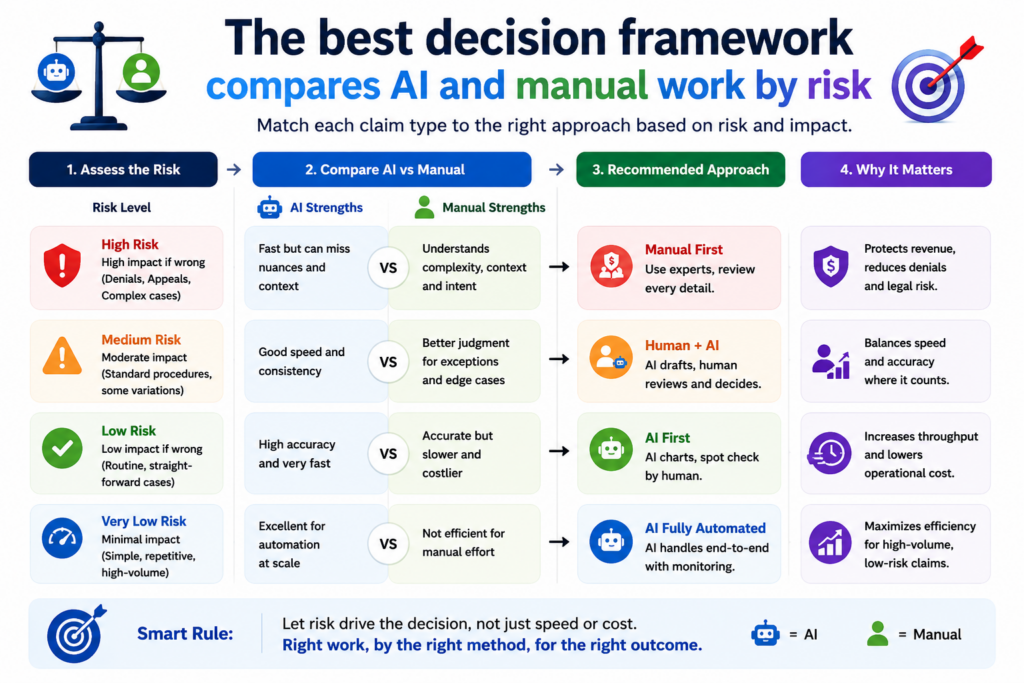
Not every chart needs the same level of depth. A quick internal review is different from a chart used in a serious licensing talk. A chart for learning is different from a chart that may be reviewed by a buyer, investor, or opposing party.
AI is often best for low-to-medium risk early work. It helps founders explore faster, find evidence, and understand where a claim may connect to a product.
Manual review becomes more important as the stakes rise. When a chart will be used outside the company, the proof and language need more care.
The smart move is not to pick one forever. The smart move is to match the workflow to the risk.
Start with AI when you need range, then add review when you need trust
AI is useful when the search space is large. It can help compare claims against many sources, products, or documents. It can give the team a faster view of where to focus.
Manual review is useful when trust matters. It checks the reasoning. It tests the evidence. It helps prevent the chart from overstating the case.
For many startups, the right path is to start with AI-assisted search and then bring in human review as the chart becomes more important. This gives the founder both range and confidence.
For example, a founder may start by using AI to compare several patent claims against the company’s product.
Then, once the strongest claim is found, the team can ask for deeper attorney review. That is a smarter use of time and money than manually charting everything from the beginning.
The workflow should become more careful as the business use becomes more serious
A chart used for internal learning can be lighter. A chart used for board review should be cleaner. A chart used for investor diligence should be clearer still. A chart used for licensing or legal strategy should be handled with serious care.
This does not mean every startup needs a huge legal project every time a question comes up. It means the level of review should match the stakes.
That is where a modern platform can help. PowerPatent makes it easier for founders to move fast when they need speed, while still getting real attorney oversight when quality matters. It is built for technical teams that want strong IP without the old slow process.
You can see how PowerPatent helps founders protect their work here: https://powerpatent.com/how-it-works
Conclusion:
AI and manual claim charting should not be rivals. The best process uses AI to search faster, find stronger proof, and cut waste, while skilled people check meaning, context, and risk. For founders, that means less delay, clearer patent choices, and better control over what you are building. A strong chart should not just look complete.
It should help you decide what to protect, what to improve, and what to do next. PowerPatent brings smart software and real attorney oversight together so startups can move quickly without flying blind. See how it works here: https://powerpatent.com/how-it-works
Leave a Reply