Most founders do not lose patent value because their idea is weak. They lose it because the story is not clear. The product does one thing. The patent draft says another. The proof is scattered across code, diagrams, notes, tickets, demos, and slide decks. That gap can make a strong invention look small.
Product-to-patent mapping turns a messy invention story into a clear proof path
A startup product rarely grows in a clean, straight line. One person writes code. Another tests a model. Someone changes the user flow. A founder updates the pitch deck.
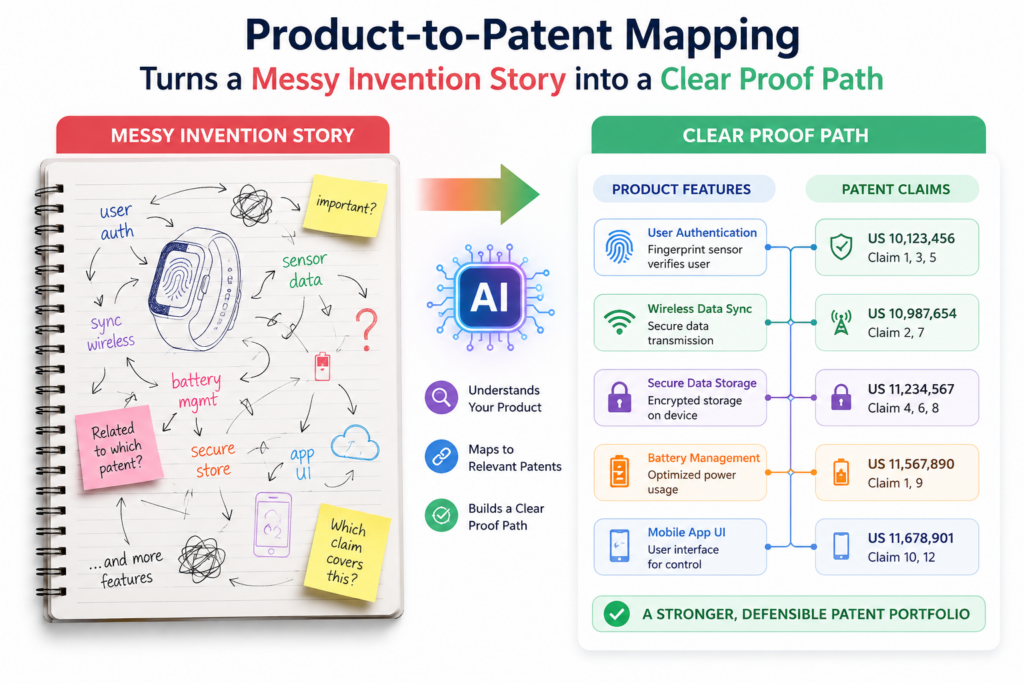
A customer asks for a feature, and the team builds a better version over the weekend. By the time the company is ready to think about patents, the real invention may be spread across many places.
That is normal.
The problem starts when the patent story does not fully match the product story. A patent may describe a broad idea, but miss the exact system that makes the product work.
Or it may focus on one feature while the real value sits inside a backend process, a model step, a data flow, a control rule, or a special way the product reacts to user input.
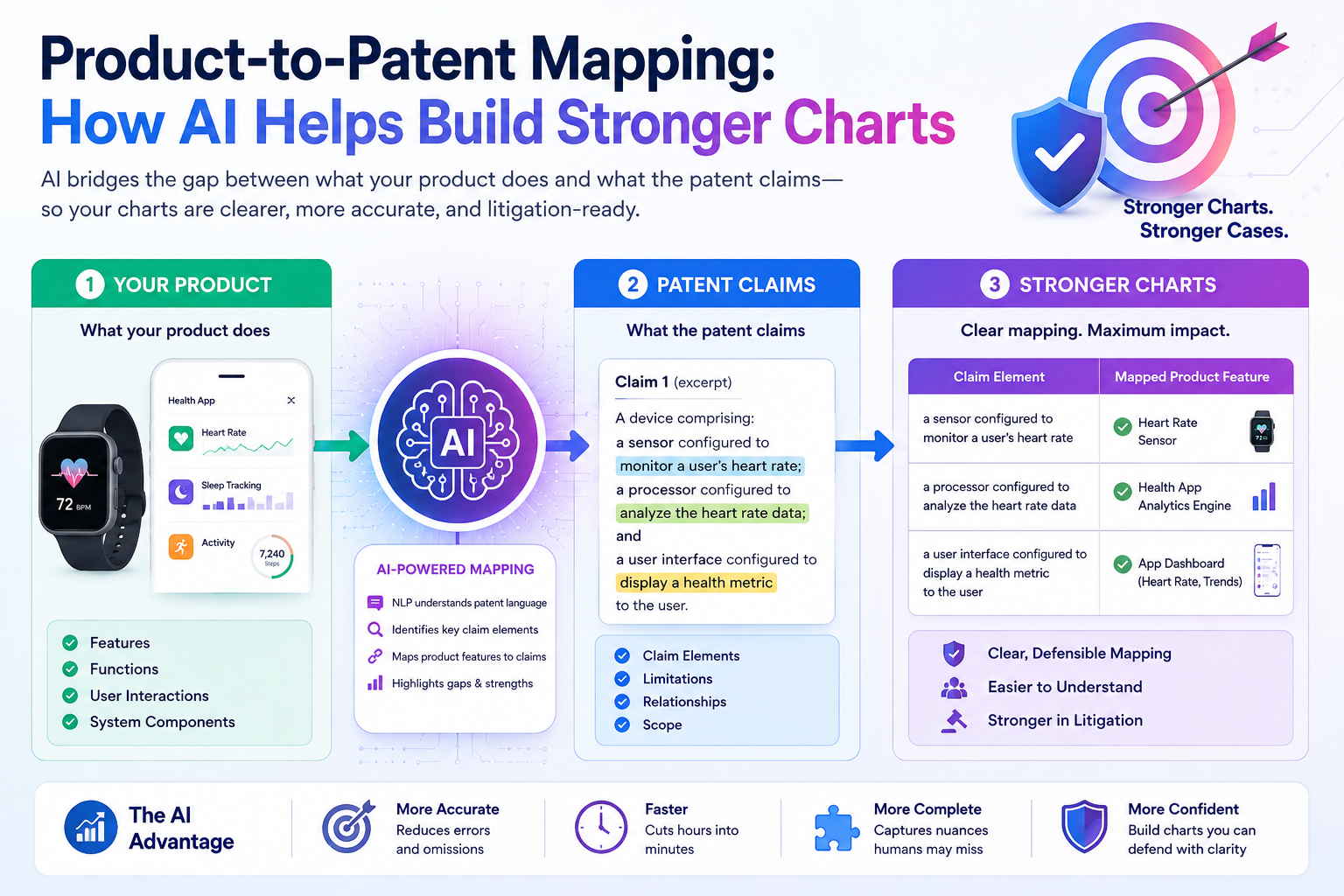
Product-to-patent mapping helps fix that. It creates a clear chart that connects product parts to patent parts. It shows what the product does, where that feature appears in the patent, and what proof supports it.
A product map helps the team see what is actually worth protecting
Most founders think they know what their invention is until they have to explain it in a patent-ready way. Then things get harder. The team may say, “Our AI engine makes better decisions,” but that sentence is too broad.
A stronger patent story needs to show what the engine receives, what it checks, how it changes the result, and why that process is different from a normal setup.
This is where mapping becomes useful. It slows the story down just enough to make it clear. It helps the team move from vague claims to real product facts.
That does not mean the process needs to be painful. With the right software, the map can be built from things your team already has, like notes, diagrams, code comments, product specs, and design files.
The goal is not to turn founders into patent experts. The goal is to help founders hand a cleaner invention story to the people who can protect it.
A strong chart should make the invention easy to check and hard to ignore
A good product-to-patent chart does more than organize text. It gives everyone a shared view of the invention. The founder can see what is covered.
The engineer can confirm what is real. The patent attorney can spot what needs more detail. The company can make smarter choices before filing.
This matters because early patent work often shapes future value. A weak chart can hide the best parts of the product.
A strong chart can show those parts in a way that is easier to draft, review, and defend.
That is one reason PowerPatent focuses on helping startups turn technical work into clear patent-ready material with smart software and real attorney oversight.
It gives founders more control without making them slow down. You can see the process here: https://powerpatent.com/how-it-works
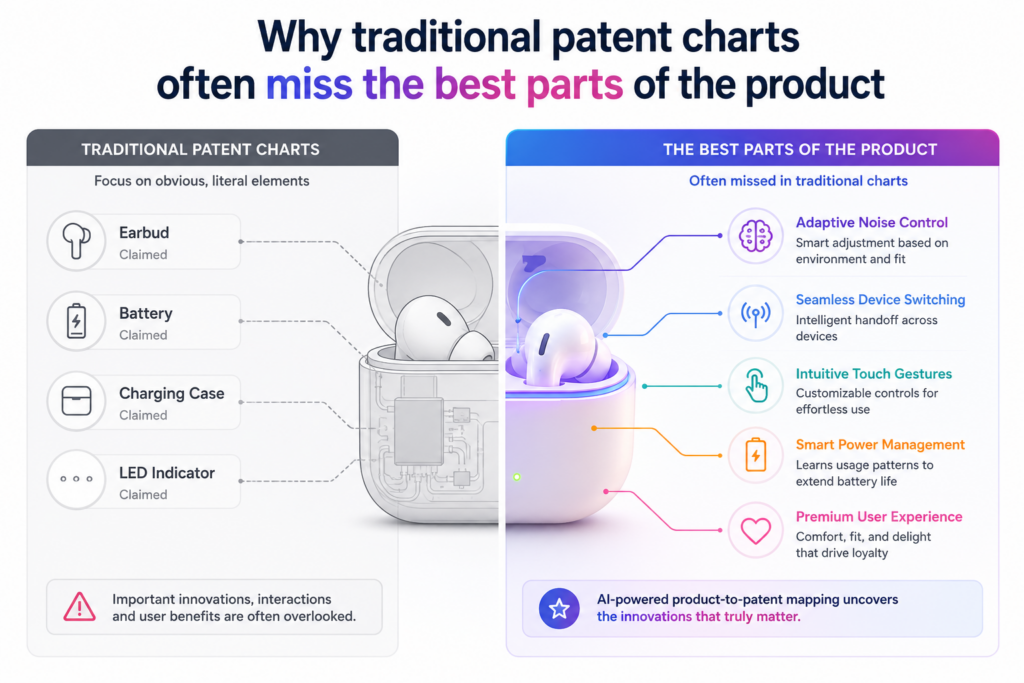
Why traditional patent charts often miss the best parts of the product
Old patent workflows were not built for fast product teams. They often depend on long calls, rough notes, and back-and-forth emails. The founder explains the product once.
The patent team tries to capture the invention. Then the draft comes back, and everyone hopes the key details made it in.
That can work, but it leaves a lot to chance.
Modern products are complex. They may include AI models, data cleaning steps, ranking logic, sensor inputs, device controls, user signals, edge cases, and feedback loops.
A short invention disclosure may not capture all of that. Even worse, the most valuable part of the invention may feel “too technical” or “too normal” to the founder, so it never gets shared clearly.
A chart built from memory can leave gaps that are hard to fix later
When a chart is made by hand from a few notes, it can miss how the product really works. It may say that a system “generates a recommendation,” but fail to show the exact signals used to make the recommendation better.
It may mention a “machine learning model,” but not explain the training data, the input filters, the confidence score, or the rule that changes the final output.
These missing pieces can matter.
A patent is not just a story about an idea. It is a story about an invention that works. The stronger the link between the product and the patent, the easier it is to explain why the invention is real, useful, and different.
A thin chart can make the invention look like a general wish. A deep chart can show the real build.
This is why founders should not treat mapping as busy work. It is a way to protect the hard parts before they get buried under the next sprint.
A better chart captures how the product behaves in real life
The best inventions often show up in the details. A system may handle bad data in a new way. It may switch modes when a risk score crosses a limit.
It may route a request differently when a user gives a certain signal. It may use a model output and then adjust it with a rule that came from months of testing.
These details are easy to skip in a normal patent intake. They are also the details that can make a patent much stronger.
A strong chart should connect product behavior to patent language in a clear way. It should show the feature, the product proof, the possible claim coverage, and the parts that still need review.
That does not replace an attorney. It helps the attorney work from better raw material.
PowerPatent is built for this kind of modern patent workflow. It helps technical teams move faster while still keeping real attorney review in the loop.
For founders who want speed without blind spots, that mix matters. Learn more here: https://powerpatent.com/how-it-works
How AI helps find the real invention inside your product
AI is useful in product-to-patent mapping because it can sort through messy material faster than a human team can do by hand.
It can scan product notes, feature docs, system flows, tickets, diagrams, and draft claims. It can then help find matches between what the product does and what the patent may need to cover.
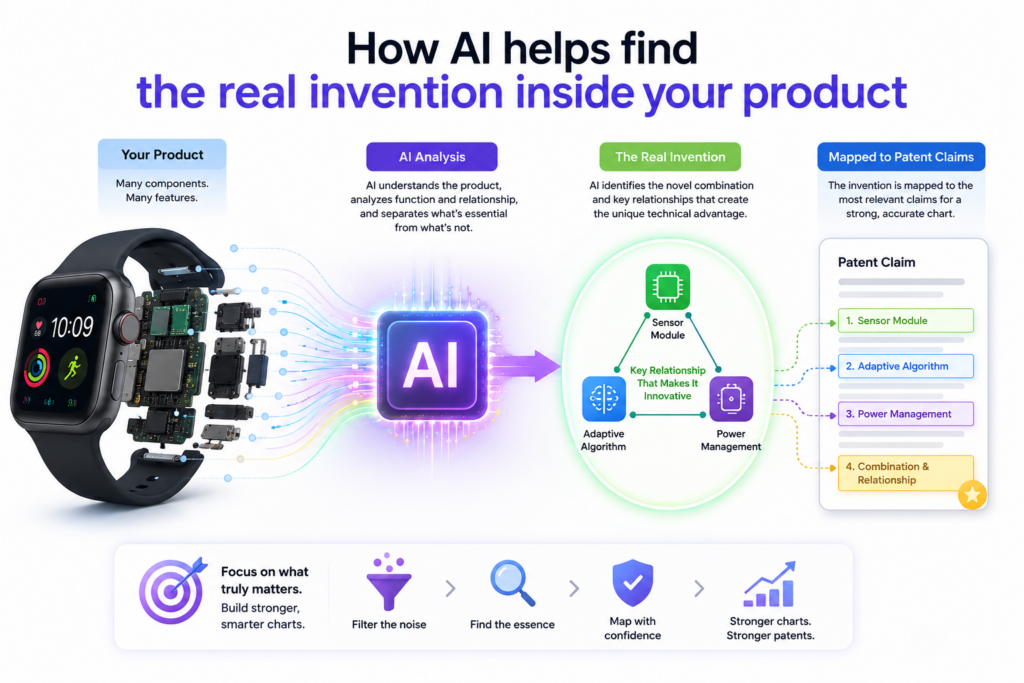
This does not mean AI should make the legal call alone. It should not. The real value is that AI can do the heavy first pass.
It can surface patterns. It can point out missing details. It can help the team see what deserves a closer look.
AI can turn scattered product facts into a cleaner invention story
A founder may have ten different documents that describe the same feature in different ways. The product spec may call it a “priority score.”
The code may call it a “risk rank.” The investor deck may call it “smart routing.” The patent draft may call it a “selection module.”
To a busy team, these may feel like small wording differences. But in patent work, they can cause confusion.
AI can help group related terms, show where they connect, and build a cleaner view of the feature. That makes the chart easier to trust.
The same thing applies to product flows. AI can help trace the path from input to output. It can show that the system receives data, filters it, scores it, compares it, changes a setting, and sends a result.
Once that path is clear, the team can decide which steps are central to the invention.
The best use of AI is not speed alone, but better focus
Speed is helpful, but focus is more important. A fast chart that maps the wrong things is not useful. A strong AI-assisted chart helps the team focus on the parts that may create real value.
It can ask better questions. It can flag vague areas. It can show when a claim term has no clear product support.
For example, a draft patent might say the system uses a “dynamic threshold.” AI can search the product material and find whether that threshold is actually described.
If the product docs only mention a fixed rule, the team now knows there is a mismatch. That mismatch can be fixed before it becomes a bigger problem.
This is where the human side still matters. Engineers confirm what the product really does. Founders explain why it matters. Attorneys decide how to protect it. AI simply helps everyone work from a clearer base.
PowerPatent uses this kind of smart workflow to help founders move from product detail to stronger patent work with less friction.
The aim is not to make patents feel fancy. The aim is to make them feel clear, useful, and worth doing.
What a stronger product-to-patent chart should actually show
A chart is only useful if it helps people make better decisions. A weak chart is just a table with words in it.
A strong chart shows a living connection between the product and the patent. It lets the team answer simple but important questions without digging through old files.
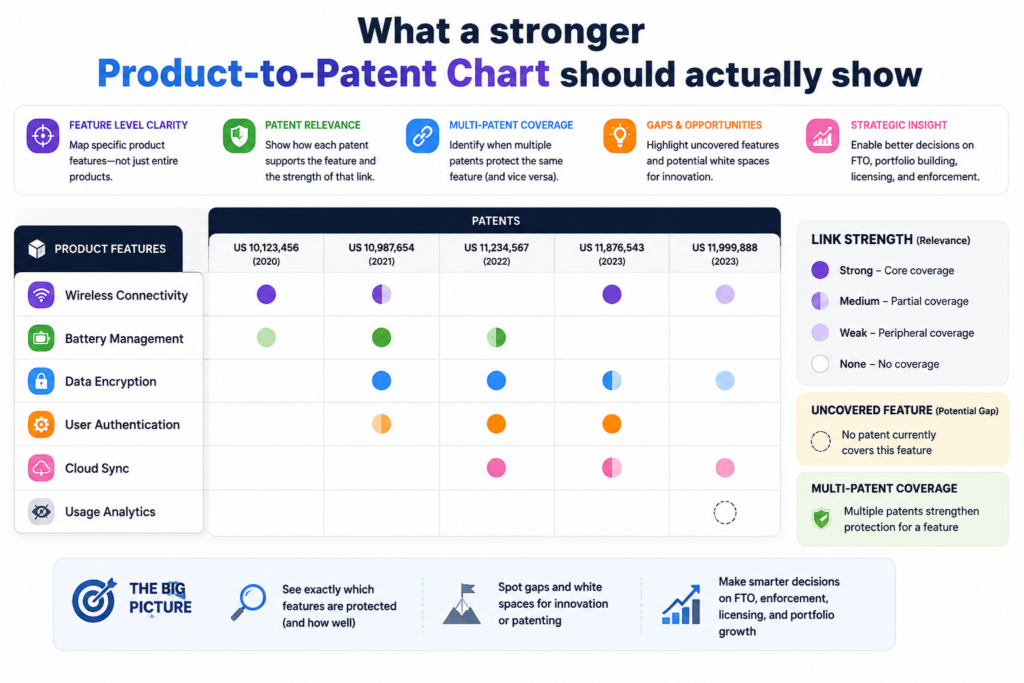
Does this patent cover the product we are building? Does the product have support for this claim?
Are we missing a key feature? Did the draft skip the part that makes our system special? Are we protecting what customers actually value?
Those are the questions a strong chart should help answer.
The chart should connect features, proof, and patent language in plain words
A useful chart starts with the product feature. It explains what the feature does in normal language. Then it ties that feature to the part of the patent that may cover it.
Then it points to the proof, such as a product spec, a diagram, a model flow, a test result, or a code-linked note.
The point is not to create a pile of documents. The point is to make the connection easy to see.
For example, imagine a health tech startup has a system that flags patient risk. A weak chart may say, “AI predicts risk.”
A stronger chart may explain that the system receives patient data, removes poor-quality entries, compares the clean data to a learned pattern, assigns a confidence score, and alerts a care team only when the score passes a changing limit.
That second version is more useful because it gives the patent team something real to work with. It shows the product logic. It shows the flow. It shows what could be protected.
The chart should also show what is missing before the patent is filed
One of the best things a chart can do is reveal gaps early. Maybe a claim mentions a feedback loop, but the product notes do not explain how feedback is collected.
Maybe the product has a valuable error check, but the patent draft never mentions it. Maybe the code has a smart way to save compute cost, but no one raised it during intake.
These are the kinds of gaps that can cost a startup later.
AI can help by flagging missing support, unclear terms, and weak links. It can show that a claim is too broad compared to the product material.
It can also show that the product has more depth than the draft captures. That gives the team a chance to improve the patent story while there is still time.
This is not about making the patent longer. It is about making it stronger. A clear chart helps the team protect the parts that matter and avoid wasting time on parts that do not.
How founders can use AI mapping before they talk to a patent attorney
A founder does not need to wait until a formal patent meeting to start mapping the product. In fact, the earlier the team starts, the better. The goal is simple. Capture what is being built while the details are still fresh.
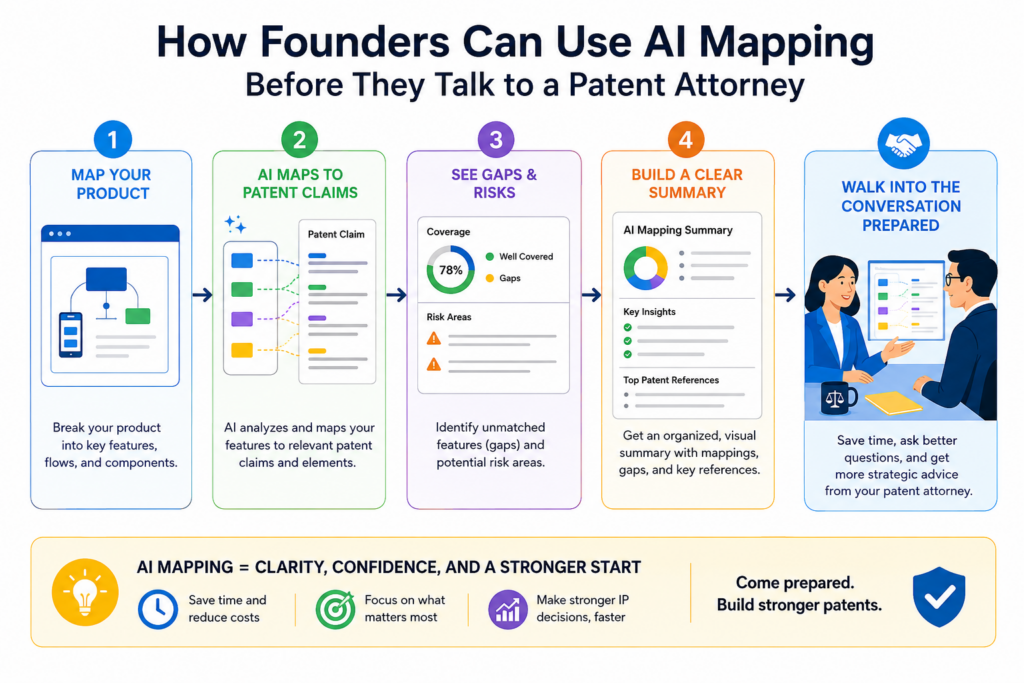
This is especially important for deep tech startups. In many teams, the invention is not one big “aha” moment. It is a chain of smart choices made over time. A model improves.
A sensor flow changes. A process gets faster. A hard edge case gets solved. Those choices may become the heart of the patent.
The best first step is to explain the product like a smart builder, not a lawyer
Founders should not try to sound legal. That usually makes the story worse. A better move is to explain the product in plain words.
What problem does it solve? What does the system receive? What does it change? What does it decide? What happens next? What makes the result better than the old way?
That simple story gives AI useful material. It can then help organize the feature, find related notes, and suggest where the product may have patent-worthy details.
The founder can review the map and correct anything that feels wrong.
This early review matters. AI can help organize, but the team knows the truth of the build.
If a mapped feature does not match the product, the team should fix it. If a key step is missing, the team should add it. The stronger the map, the better the attorney can help.
A founder should use the map to prepare better questions
A good product-to-patent map does more than answer questions. It helps founders ask better ones.
Instead of asking, “Can we patent this?” the founder can ask, “Which part of this flow is most worth protecting?” Instead of asking, “Is our AI feature covered?” the founder can ask, “Does this claim capture how our model filters input and changes the output?” Those are better questions because they are tied to the product.
This is where PowerPatent can make the process much easier. It helps founders turn real product material into a clearer path for patent work, while real attorneys stay involved where judgment matters most.
That gives startups a way to move quickly without treating patents like a black box. See how it works here: https://powerpatent.com/how-it-works
AI mapping helps founders find gaps before those gaps become expensive
Many patent problems start as small missing details. At first, they do not look serious. A diagram skips one step.
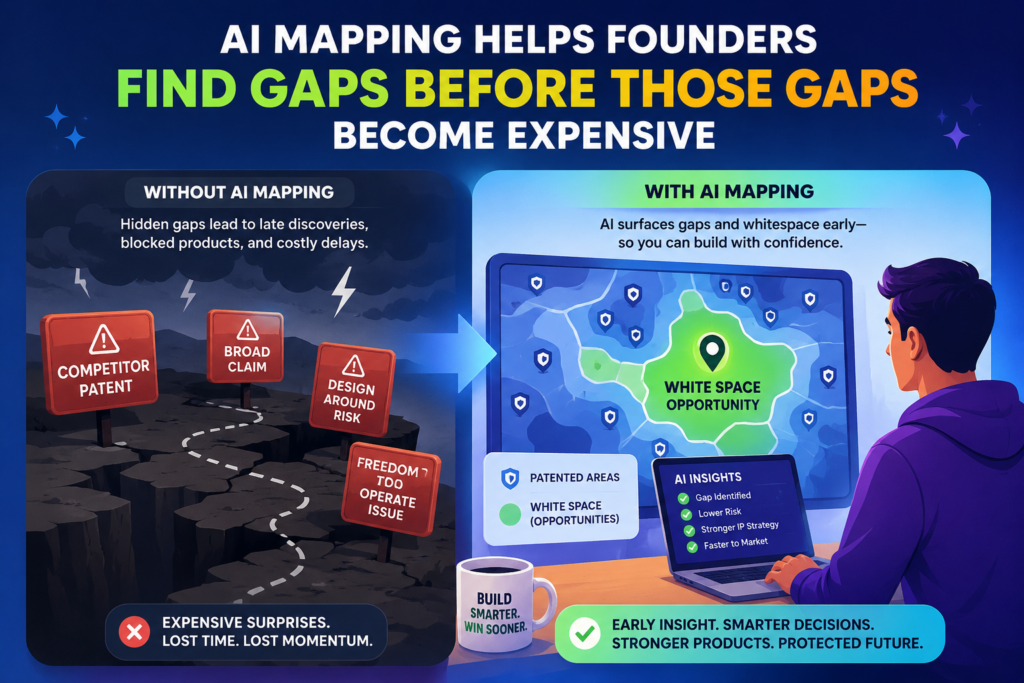
A product note uses the wrong name for a feature. A draft claim mentions a function, but the product file does not explain how that function happens.
Those small gaps can grow into real risk. When the patent story is not tied closely to the product, the company may file something that feels broad but is not well supported.
Or the team may spend money on a draft that misses the one thing investors, partners, or buyers will care about later.
Product-to-patent mapping helps catch these issues early. AI makes that process faster because it can compare many pieces of product material at once.
It can look at the patent chart, product flows, feature notes, and draft language, then point out places where the story does not line up.
The most useful gaps are often hidden in plain sight
A founder may think the main invention is the user-facing feature. That is often where the customer feels the value.
But the strongest patent detail may sit behind the screen, inside the way the product handles data, picks an output, checks an error, or changes a system state.
This is why a strong chart should not only map the final feature. It should map the path that makes the feature work. AI can help follow that path across product files and bring buried details to the surface.
It can show that a small backend step appears again and again in your product logic, which may mean it is more important than the team first thought.
For example, a startup may say its product “matches users with the right expert.” That sounds simple.
But the real invention may be the way it scores urgency, filters low-trust inputs, updates the match after new signals arrive, and avoids sending the same case to the wrong expert twice. Without mapping, those steps may never make it into the patent story.
A gap report is useful only when it leads to action
AI should not just say, “Something is missing.” That is not enough. A useful mapping workflow should help the team understand what is missing, where it is missing, and what kind of input may fix it.
Maybe the patent draft needs a clearer example. Maybe the product team needs to explain a data flow.
Maybe the attorney needs to review whether a feature should be claimed. Maybe the founder needs to decide whether a certain workflow is core enough to protect.
This is where PowerPatent gives founders a better way to move. Instead of waiting for a long back-and-forth process, teams can use smart software to organize the product story and then work with real attorney oversight to make sure the filing path is sound.
That mix helps reduce blind spots without slowing down the company. You can explore the workflow here: https://powerpatent.com/how-it-works
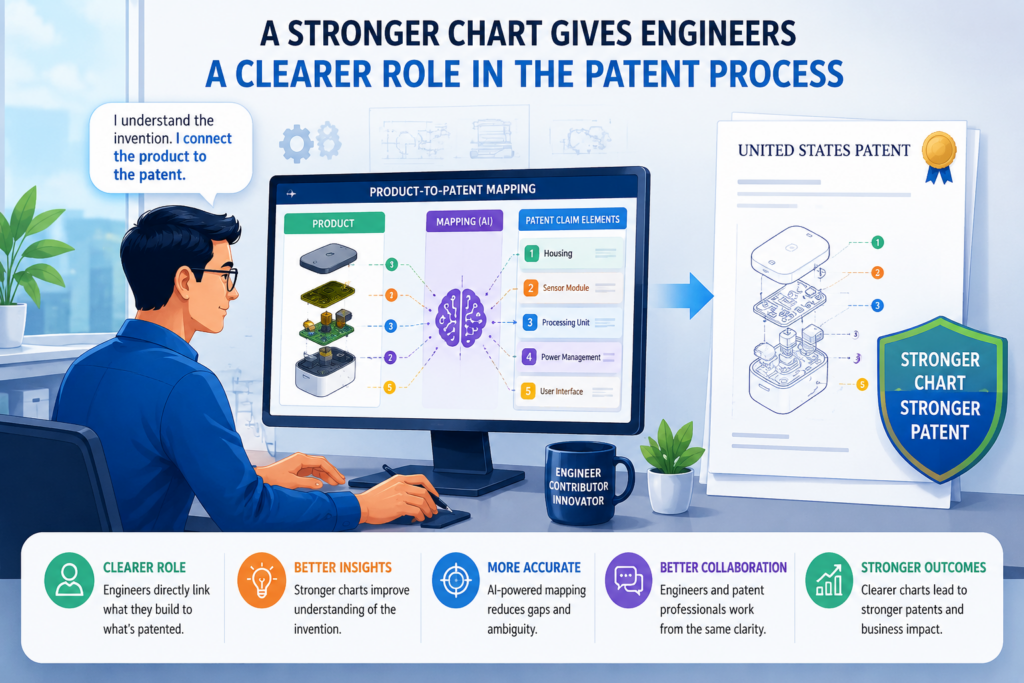
A stronger chart gives engineers a clearer role in the patent process
Engineers often hold the most important details about an invention. They knowwhy a shortcut failed. They know why the system was built a certain way.
They know which edge case took weeks to solve and which feature looks simple only because the hard work is hidden.
Yet many patent workflows make engineers feel like outsiders. They may join one call, answer a few questions, and then see a draft weeks later.
By that point, the draft may use words that do not match the product. The engineer may spot problems, but the review process feels late and rushed.
A product-to-patent chart gives engineers a more useful role. It lets them review the connection between the real product and the patent draft in a clear, structured way.
They do not need to become patent experts. They only need to confirm whether the chart tells the technical truth.
Engineers can validate the map faster than they can rewrite a draft
Most engineers do not want to read a long patent draft line by line. That is fair. They are busy building the product. A chart makes review easier because it breaks the invention into clear parts.
The engineer can look at a mapped feature and say, “Yes, that is how the system works,” or “No, this step happens before the model runs,” or “This output is not sent to the user; it is used by the routing engine.”
Those comments are simple, but they can make the patent much stronger.
AI helps by preparing the first version of the map. It can pull possible feature links from product material, suggest where each feature may connect to the patent draft, and flag unclear words.
Then engineers can correct the map based on how the system really works.
This saves time because the engineer is not starting from a blank page. The chart gives them something concrete to react to.
The best engineer feedback is specific and grounded in the product
A strong review does not need long speeches. It needs clear product facts.
If a chart says the system “selects an output,” the engineer may explain that the system actually ranks three outputs, checks a confidence score, removes one output based on a policy rule, and then sends the top result only when the score passes a set limit.
That one correction can change the whole patent story. It turns a plain feature into a more detailed process. It also gives the attorney better material to work with.
This is one reason AI mapping can be so helpful for technical teams. It does not replace engineering judgment. It gives engineers a faster way to share that judgment with the patent team.
When the product truth is clear, the legal work can be cleaner, faster, and more focused.
For founders, this means less time chasing old notes and more time protecting what the team has actually built.
PowerPatent is designed for that kind of founder-friendly process, where software helps organize the work and real attorneys help guide the outcome.
AI mapping can help connect claims to real product features without making the process feel heavy
Patent claims can feel hard to read. They use a special format, and even smart founders may find them dry or confusing. But claims matter because they describe the protected edge of the invention.
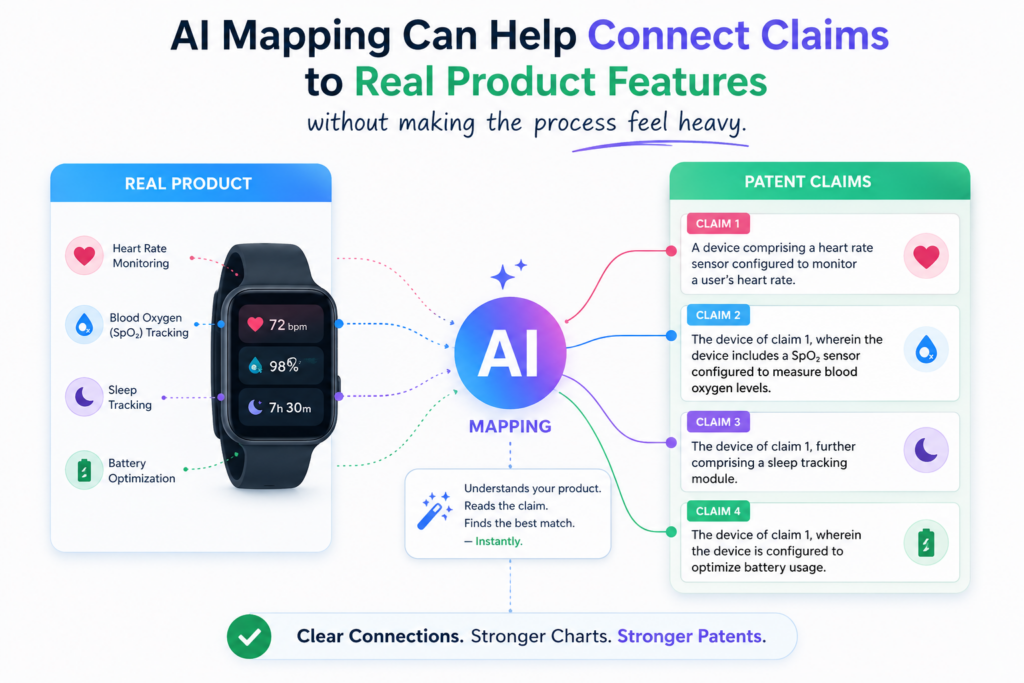
A product-to-patent chart helps make claims easier to understand. It shows which product feature may support which claim part.
Instead of reading a claim in isolation, the founder can see how the claim connects to the product. That makes the review more practical.
AI can help by breaking claim language into smaller pieces and matching those pieces to product evidence. It can look for the feature, the action, the data input, the output, and the system step.
Then it can build a draft chart that helps the team see what is covered and what may need work.
The chart should make claim review feel like product review
Founders are used to reviewing product flows. They can look at a screen, a workflow, or a diagram and understand what is happening.
Patent claim review should feel closer to that. The map should help the founder say, “This part covers our scoring step,” or “This part is too vague,” or “This part misses the feedback signal.”
That kind of review is far more useful than asking a founder to react to dense legal text alone. It helps the team stay grounded in the product.
It also helps the attorney get better comments because the founder is reviewing what they know best.
AI can make this smoother by showing where claim terms appear in the product material. If a claim says “training data,” the map can point to the model documentation.
If a claim says “control signal,” the map can point to a system diagram. If a claim says “risk score,” the map can point to product notes, test results, or a backend flow.
The result is a more practical review loop. The founder does not need to guess what the claim means. The chart gives context.
Strong claim mapping helps prevent false confidence
One danger in patent work is thinking a claim covers the product just because the words sound broad. Broad words can feel safe, but they may hide weak support.
If the patent says the system performs a step, the team should be able to point to where that step is described and how it works.
AI mapping helps reduce false confidence by making support visible. It can show when a claim element has clear product backing. It can also show when the support is thin, missing, or spread across too many unclear files.
That does not mean every gap is fatal. Some gaps can be fixed with a better example, a clearer drawing, or a deeper technical note.
But the team needs to see the gap early. A hidden gap is risky. A visible gap can be managed.
This is where PowerPatent can help founders build with more confidence. The platform helps turn product material into clearer patent work, while attorney oversight helps make sure the company is not relying on software alone.
For startups that need speed and quality, that balance can be a major advantage. See how it works here: https://powerpatent.com/how-it-works
Product-to-patent charts are especially useful for AI, robotics, biotech, and deep tech products
Deep tech products are hard to explain because the value is often hidden inside the system. A simple user action may trigger many steps behind the scenes. A model may use signals that customers never see.
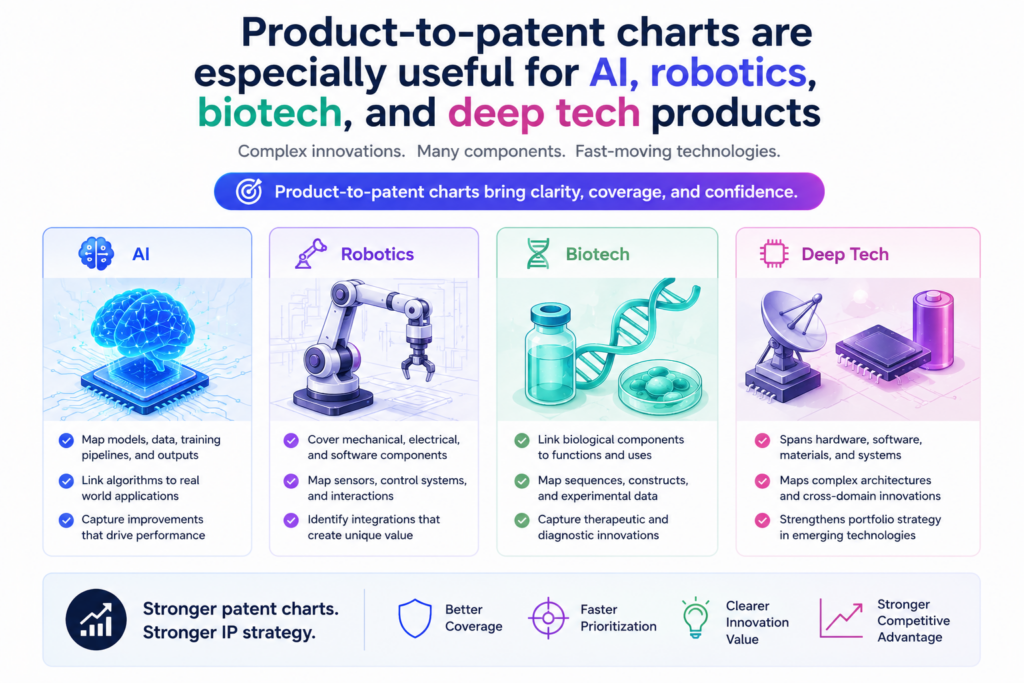
A robot may make tiny control choices many times per second. A biotech platform may rely on a special data process, test method, or screening flow.
These products need stronger mapping because the invention is rarely obvious from the outside. The product demo may look clean and simple, but the protectable detail may live under the surface.
Without a clear chart, the patent team may only capture the visible layer and miss the deeper system.
AI can help by tracing the links between product behavior, technical documents, and draft patent language. It can make the hidden system easier to explain.
That is important because a deep tech patent often needs to show not only what the product does, but how the product gets there.
The map should show the chain of cause and effect
A strong deep tech chart should not stop at the result. It should show the chain. The system receives something, changes something, checks something, and produces something.
Each step should have a reason. Each step should help explain why the invention works.
For an AI startup, that chain may include data intake, feature extraction, model scoring, confidence checks, and output control.
For a robotics startup, it may include sensor reading, path planning, motor control, safety checks, and real-time adjustment.
For a biotech software company, it may include sample data intake, signal filtering, pattern detection, ranking, and lab decision support.
This kind of mapping helps the team avoid vague patent stories. It also helps founders explain their invention to investors, acquirers, and partners in a more useful way.
A clear chart can become a shared source of truth for how the product connects to IP strategy.
A deep tech chart should protect the hard-won lessons, not just the shiny feature
The shiny feature gets attention, but the hard-won lesson may carry the value. Maybe the team learned how to reduce false positives. Maybe it found a way to keep a model stable with limited data.
Maybe it built a safer control process after testing many failed options. Maybe it created a better way to combine human feedback with machine output.
These lessons are easy to leave out because they feel like normal engineering progress. But they may be part of the real invention.
AI mapping can help surface those details by looking across product notes, tests, diagrams, and design choices.
The final call should still involve humans. Founders know which choices shaped the company.
Engineers know which steps were hard. Attorneys know how to frame the protection. AI helps bring the right details into the room faster.
AI mapping helps teams protect what changed from version to version
Startups move fast, and the product you have today may not be the same product you had three months ago. That is not a problem. In fact, that is often where the best invention story lives.
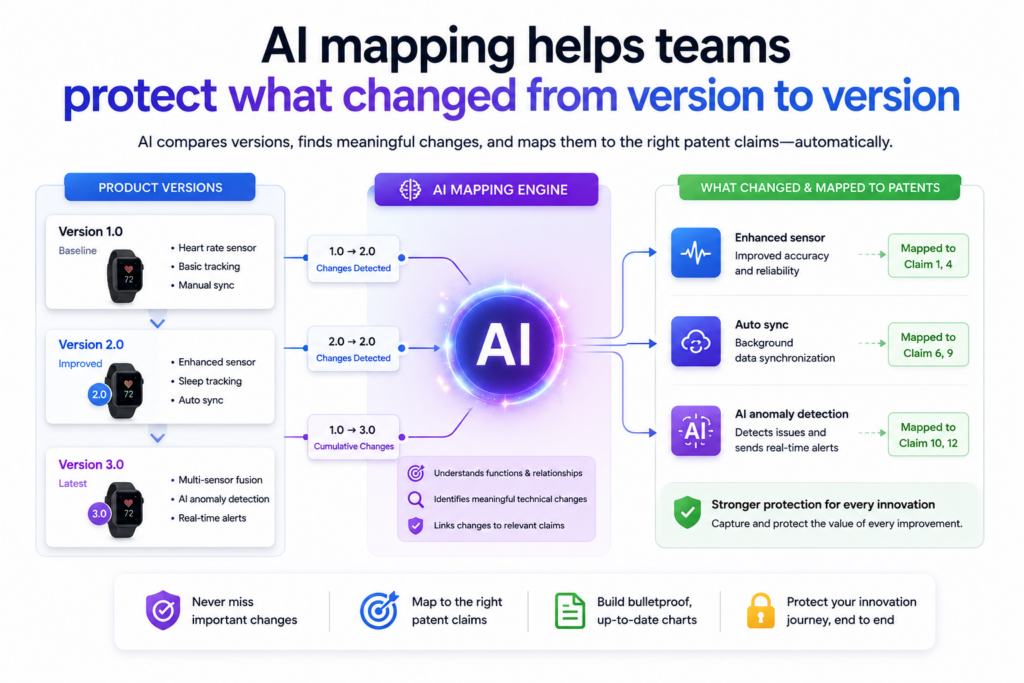
The important part is knowing what changed, why it changed, and whether that change made the product better in a way worth protecting.
Product-to-patent mapping becomes very useful when a team has many versions of the same feature. The first version may have used a basic rule. The second version may have added a score.
The third version may have used a model. The fourth version may have added a feedback step that made the system smarter over time. Each version tells part of the invention story.
AI can help compare product notes, release records, diagrams, and draft patent text to show how the product evolved.
This is powerful because invention is often not one single moment. It is a series of smart fixes that slowly turn a rough idea into something defensible.
A version map can show why the newer product is more than a simple update
Not every product change is worth patenting. Some changes are small. Some are just normal design choices.
But some changes solve a real technical problem in a new way. The hard part is telling the difference early enough to act.
A version-based map helps by showing what the old system did, what the new system does, and what problem the change solved.
This gives the patent team a clearer view of the invention. It also helps the founder avoid filing too early on a weak version or too late after public details have already spread.
For example, a startup may first build a tool that sorts customer requests by time received. Later, the team adds a model that reads urgency signals. Then it adds a rule that prevents the model from sending low-trust results into the main queue.
The real invention may not be the sorting tool. It may be the trust-aware routing flow that came from painful testing.
A clear change history helps founders make better filing choices
A founder does not need to patent every update. That would waste time and money. But the founder does need to know which updates create a stronger edge.
AI mapping can help show those updates in a cleaner way, so the company can make better choices with its attorney.
This matters when a startup is racing toward launch, fundraising, a pilot, or a partnership. The team may need to know whether a new feature should be protected before it is shown more widely.
A clear product-to-patent map gives the company more confidence when making that call.
PowerPatent helps founders bring order to this process. It helps turn product progress into a clearer patent path, with smart software to organize the details and real attorneys to guide the filing work.
For a fast team, that can mean fewer delays and fewer missed chances. Learn how it works here: https://powerpatent.com/how-it-works
AI mapping makes patent review easier for founders who hate legal back-and-forth
Most founders do not want to spend hours going line by line through a patent draft. They want to know whether the draft protects the product, whether key features are missing, and whether anything sounds wrong. That is a fair ask.
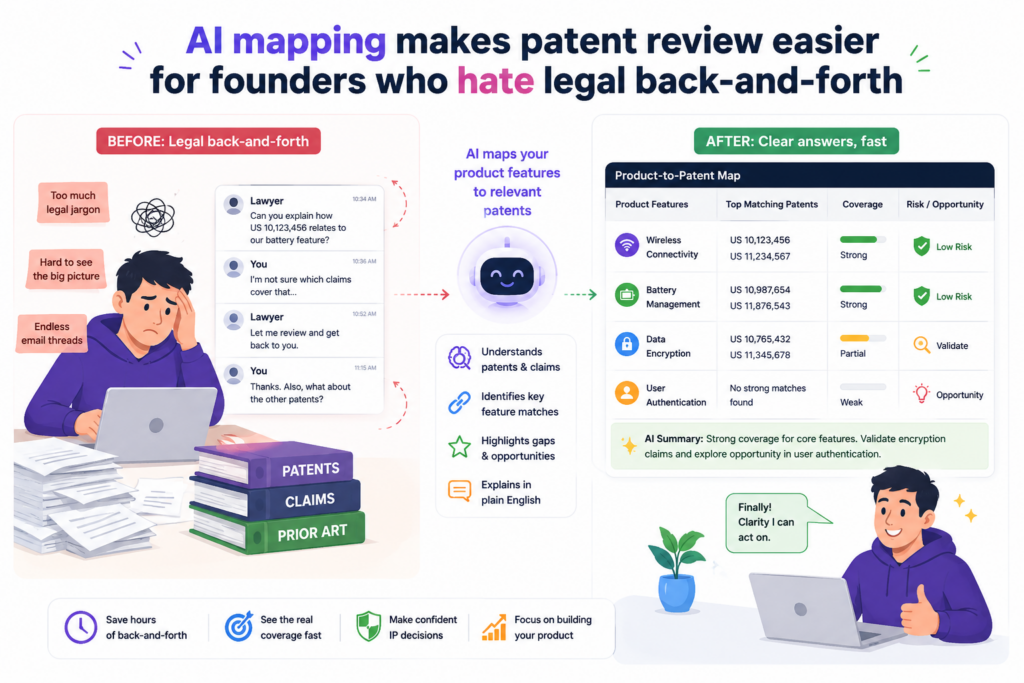
Traditional review can feel hard because the draft is long, the wording is dense, and the founder is expected to catch technical gaps inside legal language.
Even a sharp founder can miss things this way. The issue is not intelligence. The issue is format.
A product-to-patent chart gives the founder a more natural review path. Instead of reading the whole patent cold, the founder can review the product map first.
The chart shows the feature, the product proof, and the patent section tied to it. That makes the review feel more like checking a product spec than decoding a legal document.
A founder should be able to review the chart by asking plain questions
The best review questions are simple. Does this feature match what we built? Is the key step shown clearly?
Did we explain why the output is better? Did we capture the part customers care about? Did we include the part competitors may copy?
AI helps by setting up the chart so these questions are easier to answer. It can pull related product details together, match them to draft patent content, and flag places where the story looks thin.
The founder can then focus on judgment, not document hunting.
This is especially useful when the company has several people involved. The CEO may care about market value.
The CTO may care about technical truth. The product lead may care about customer behavior. The patent attorney may care about claim support. A clear chart gives all of them a shared view.
Better review means fewer late changes and less wasted energy
Late changes are painful. They slow the team down, create confusion, and can increase cost. Many late changes happen because the team did not see the gaps early enough.
A feature was missing. A term was unclear. A key product step was described too broadly. A smart technical detail was left out.
AI mapping can reduce that friction by surfacing those issues sooner. It gives the team a chance to fix the story before the draft is too far along.
That does not mean every draft becomes perfect right away. It means the review process becomes more focused and less stressful.
For founders, this can make patents feel less like a mystery and more like a business tool. You can see what is being protected. You can spot what is missing. You can make better calls before money and time are spent in the wrong place.
That is the kind of control PowerPatent is built to give startup teams. The platform helps founders move from messy product details to clearer patent work, while real attorney oversight helps protect the quality of the final result. See the process here: https://powerpatent.com/how-it-works
The strongest charts show both the customer value and the technical engine
A patent chart should not only describe what the customer sees. It should also show what happens behind the scenes to create that value. This is where many teams fall short. They describe the benefit, but not the engine.
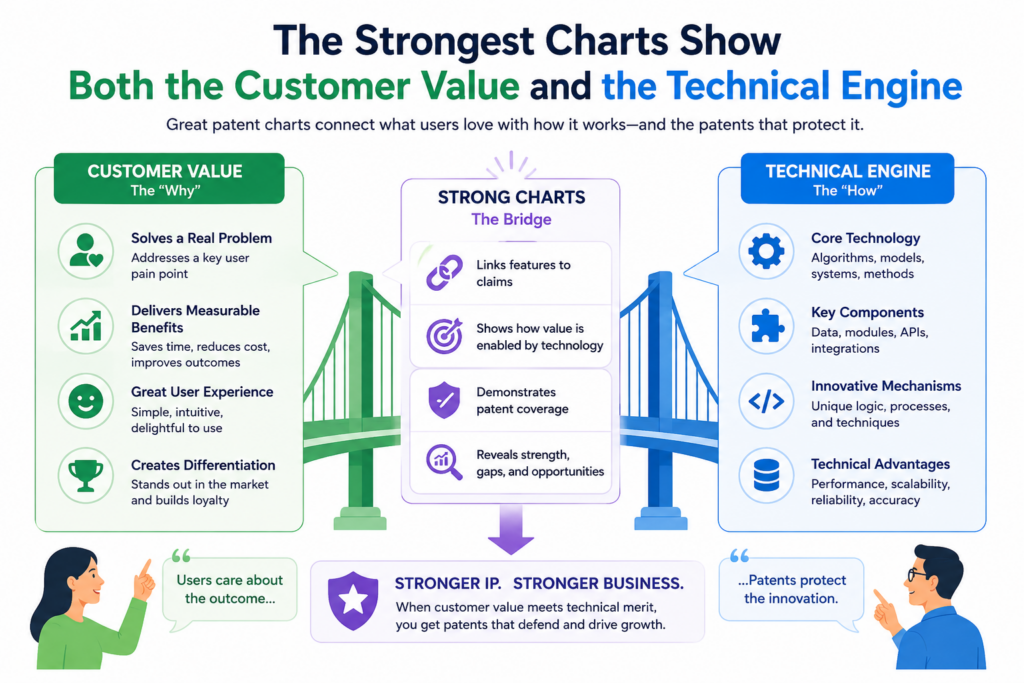
Customer value matters because it explains why the invention is worth caring about. The technical engine matters because it explains how the product delivers that value.
A strong product-to-patent chart connects both sides. It shows the human problem and the system behavior that solves it.
AI can help because it can pull customer-facing language from product pages, pitch decks, and user stories, then compare it with technical details from specs, diagrams, and engineering notes.
This creates a fuller view of the invention. It helps the patent story avoid being too shallow on one side or too technical on the other.
A good chart turns market value into product proof
Founders often explain their product in market terms. They say it saves time, lowers cost, improves accuracy, reduces risk, or makes work easier. Those benefits are important, but they need to be tied to real product steps.
For example, “saves time” may come from a system that removes duplicate tasks, predicts the next action, or skips low-value checks. “Improves accuracy” may come from a model that weighs signals differently based on context.
“Reduces risk” may come from a control step that blocks unsafe outputs before they reach the user.
The chart should make that link clear. It should not leave the attorney guessing how the value is created.
It should show the product behavior that supports the business claim. That makes the invention story stronger and easier to use.
The chart should help the team avoid empty benefit language
Empty benefit language sounds good but does not help much. Words like faster, smarter, better, and safer need support. They should be backed by product details that show why the system performs that way.
AI mapping can help by checking whether benefit claims have technical support. If the chart says the system improves speed, it should point to the process that reduces steps, cuts compute time, or removes manual review.
If the chart says the system improves quality, it should point to the scoring, filtering, ranking, or feedback logic that causes the improvement.
This is where a stronger chart becomes more than a patent tool. It becomes a clarity tool for the whole company. It helps the team explain the product in a way that is honest, concrete, and easier to defend.
For startup founders, that clarity can help in many places. It can help with investor talks, partner calls, technical diligence, and internal planning.
Most of all, it can help make sure the patent work protects the real engine of the business, not just the surface feature.
AI mapping helps startups build a patent record that grows with the product
A patent strategy should not be a one-time event. For many startups, the product keeps changing after the first filing. New features appear. The model gets better.
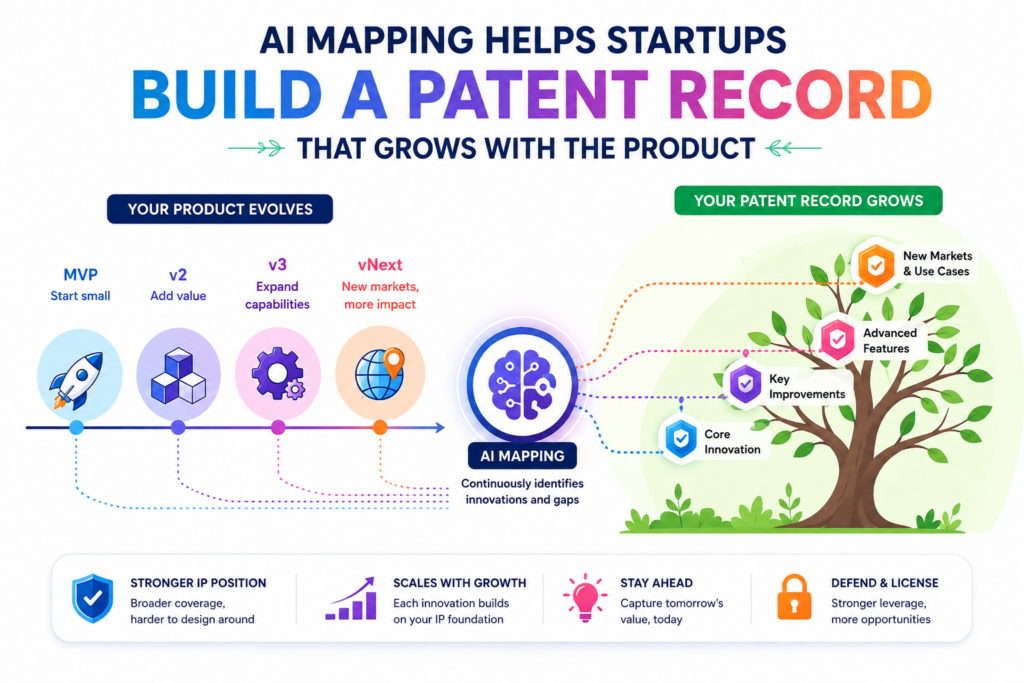
The system learns from new data. Customers push the product into new use cases. Competitors enter the market and reveal what parts of the product may need stronger protection.
This is why product-to-patent mapping should not live in a forgotten folder. It should grow with the company. When the product changes, the map should be updated.
When a new feature becomes core, the map should show it. When an old feature is removed, the map should reflect that too.
AI can make this much easier because it can help watch for changes across product material. It can compare new notes with old maps.
It can highlight fresh features, changed workflows, and new technical choices that may deserve review.
A living map gives founders a cleaner way to plan future filings
A startup may begin with one patent filing, but the strongest companies often build a broader IP position over time.
That does not mean filing randomly. It means watching the product and protecting the parts that become more important.
A living product-to-patent map helps the team see which areas are already covered and which areas may need attention later.
It can show that the first filing covered the core workflow, while a later product update added a new training method, a new control step, or a new user-specific output process. That makes future patent planning more grounded.
This is much better than starting from scratch every time. The team can build on what it already knows. The attorney can review a clearer record of product growth. The founder can make decisions with less guesswork.
A living chart helps protect momentum instead of slowing it down
Many founders worry that patents will slow them down. That fear is real, especially if the process feels manual and unclear. But a better workflow should do the opposite. It should fit around the way the team already builds.
AI mapping helps because it lets the team capture invention details as the product moves.
It reduces the need to reconstruct old decisions months later. It gives the company a running record of what changed, what mattered, and what may be worth protecting.
PowerPatent is designed around this founder reality. It helps startups move faster from invention details to patent-ready work, while real attorneys stay involved to help avoid costly mistakes.
That means founders do not have to choose between speed and care. They can have a process that supports both. You can see how PowerPatent helps here: https://powerpatent.com/how-it-works
AI mapping helps founders see which product details deserve more depth
Not every product detail needs the same level of attention. Some parts of the product are standard. Some parts are helpful but not central.
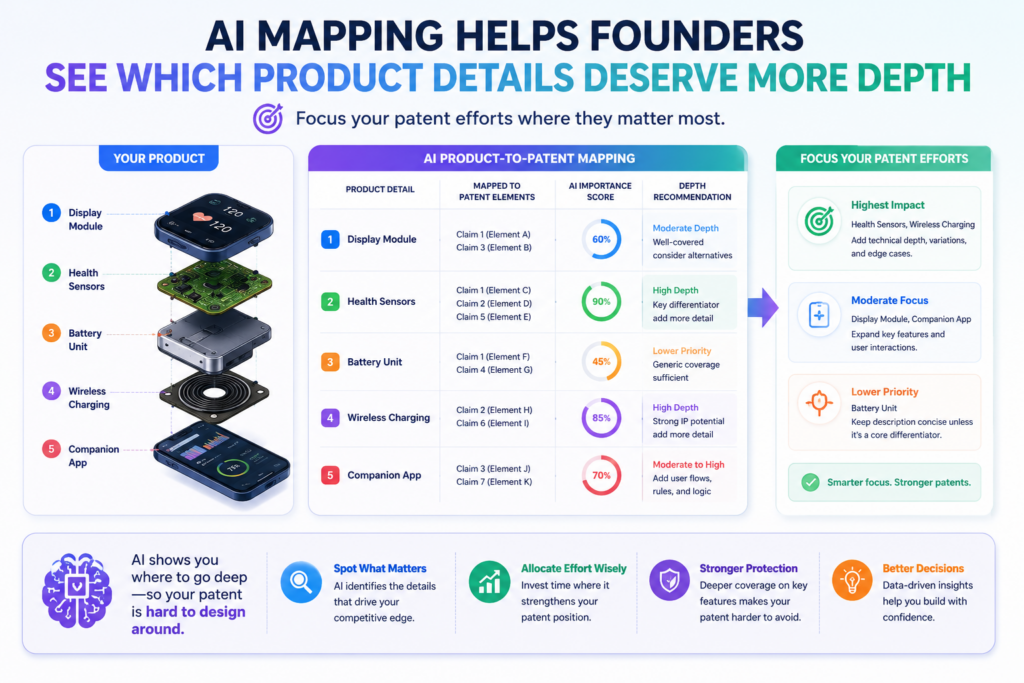
Other parts are the real heart of the invention. The hard part is knowing which is which before time and money are spent on the wrong areas.
This is where AI-assisted mapping can be very useful. It can help sort product details by how often they appear, how central they are to the workflow, and how closely they connect to the product’s core value.
This does not mean AI makes the final call. It means AI helps the team see the product with more structure, so founders and attorneys can make better choices.
A strong patent chart should not treat every feature as equal. It should give more space to the steps that make the product hard to copy.
It should also help the team avoid wasting attention on parts that are normal, generic, or not tied to the company’s edge.
A strong chart should show where the invention has the most weight
A founder may describe the product as one big system, but a patent chart needs to break that system into clear parts. Once those parts are visible, the team can ask which steps matter most.
The key step may be where the system changes raw input into a cleaner signal. It may be where the model checks its own result. It may be where the software decides what not to show the user.
AI can help by finding repeated patterns across the product record. If a certain scoring method appears in product notes, model docs, user flows, and engineering tickets, that may be a sign that the method is important.
If a certain feature appears only once and has little connection to the core workflow, it may need less focus.
This helps founders spend their review time where it counts. Instead of trying to perfect every word in every document, they can focus on the places where the product and the patent must line up clearly.
A depth check can keep the patent from becoming too thin
A thin patent story often sounds broad but lacks detail. It may say the product uses AI to make a decision, but it does not explain how the data is prepared, how the model output is checked, or how the final action is chosen.
That kind of story may feel simple, but it can leave too much value on the table.
A stronger chart helps the team go deeper where depth matters. It can show that a key step needs a better example, a clearer diagram, or a stronger link to the product.
It can also show when a claim term is floating without enough support in the product material.
This is where PowerPatent can help founders move with more confidence.
The platform helps teams organize invention details and work with real attorney oversight, so the patent process does not depend on memory, scattered files, or slow back-and-forth. You can see how it works here: https://powerpatent.com/how-it-works
AI mapping helps turn product evidence into a cleaner patent draft
A patent draft is only as good as the material behind it. If the raw invention story is messy, the draft may be messy too.
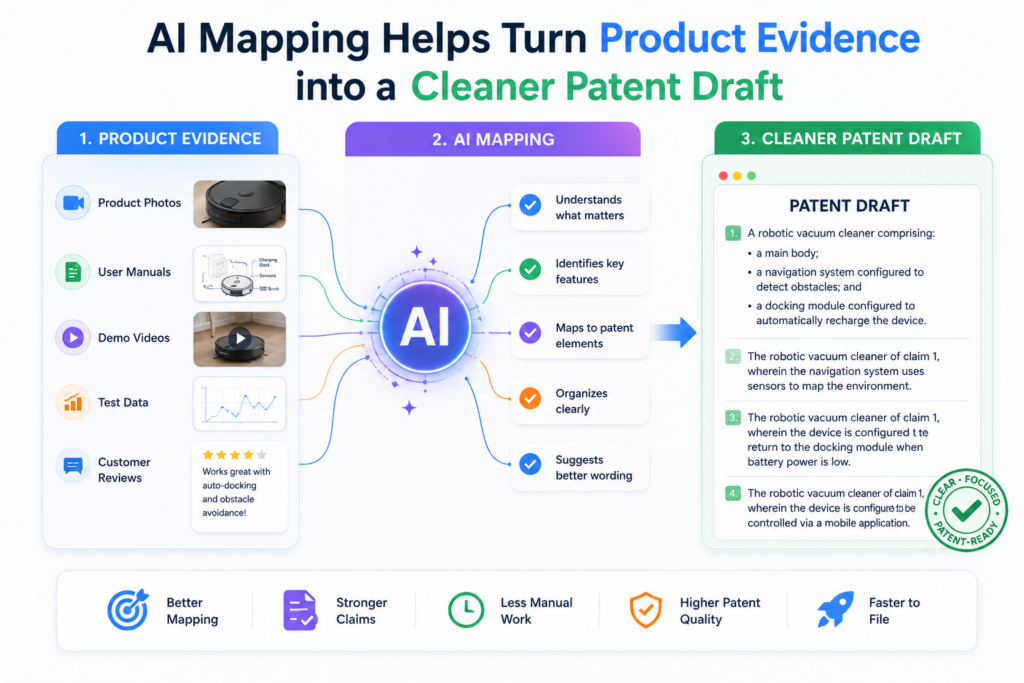
If the product details are clear, the draft has a much better chance of being clear, focused, and useful.
Product evidence can come from many places. It may come from technical notes, code comments, model cards, product specs, system diagrams, customer workflows, test results, and internal design choices.
The challenge is not that the evidence does not exist. The challenge is that it is often spread out.
AI can help bring that evidence together. It can find the product details that support a feature, group related facts, and show how they connect to the patent story.
This gives the attorney a stronger starting point. It also gives the founder a better way to review what is being protected.
A better evidence map helps reduce weak or vague drafting
Vague drafting often happens when the invention is not fully explained before the draft begins.
The patent may use large words to cover a gap, but large words do not fix missing product detail. The better path is to make the product evidence clear early.
For example, a startup may have a feature that adjusts a user workflow based on behavior. That sounds useful, but it is still too vague.
A stronger evidence map may show that the system tracks specific signals, compares those signals to a changing profile, chooses one of several workflow paths, and updates the next choice based on the result.
That kind of evidence gives the draft more strength. It helps the patent describe what the product actually does.
It also helps avoid a common problem, where the patent sounds impressive but does not capture the real engine of the product.
A founder does not need to write the patent alone. But the founder should care deeply about the evidence that feeds the patent. Better input usually leads to better output.
The best evidence is tied to real product behavior
A useful chart should not rely only on high-level claims about what the product can do. It should point to how the product behaves in real use.
That means the chart should show what happens when data enters the system, when a user takes an action, when a model gives a score, or when the software changes its response.
AI can help find these behavior points. It can look through product material and surface action words, system steps, decision points, and result changes. The team can then review whether those items are accurate and important.
This turns the chart into more than a filing aid. It becomes a bridge between the builders and the patent team. Engineers can confirm the behavior. Founders can explain the value.
Attorneys can shape the protection. That is a much healthier process than asking everyone to fix a dense draft after the fact.
PowerPatent is built to make that bridge easier. It helps founders move from product evidence to patent-ready work with smart tools and real attorney review, so the company can protect what it is building without getting buried in process.
AI mapping helps founders explain their invention without sounding like lawyers
One of the biggest mistakes founders make is trying to sound legal too early.
They think patent language needs to be complex, so they start using stiff words that do not describe the product clearly. This can make the invention harder to understand.
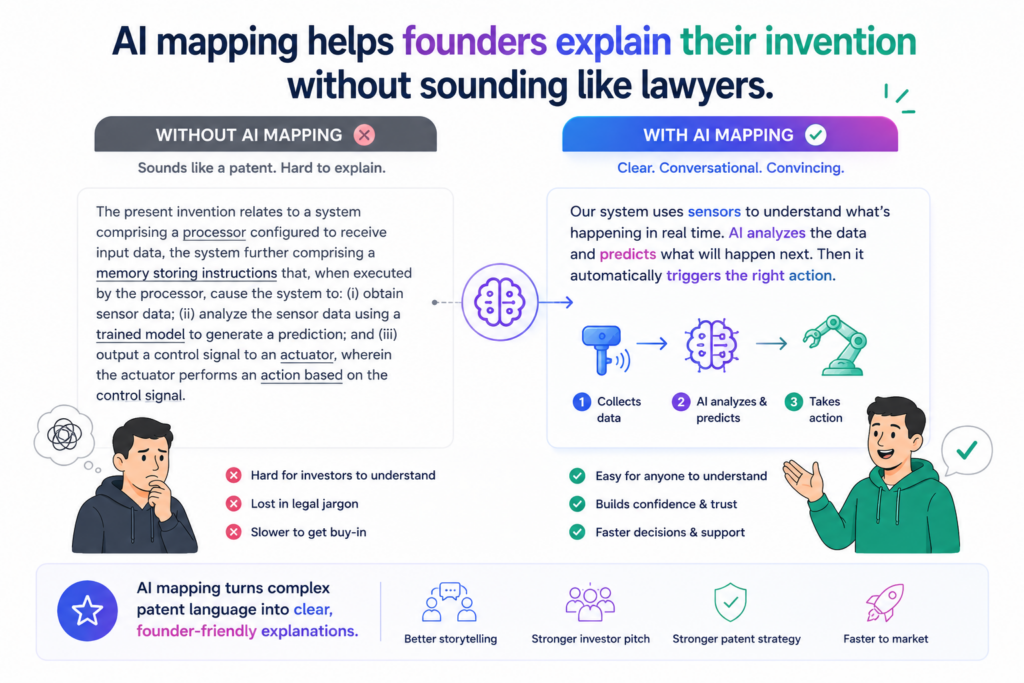
The better move is to explain the invention in simple product terms first. What does the system receive? What does it check? What does it change? What result does it create? Why is that result better?
These questions may sound basic, but they lead to the kind of clear material that can support stronger patent work.
AI mapping can help translate plain product language into a more organized invention chart. The founder stays close to the real product.
The attorney still handles the legal framing. The chart sits between them and keeps the story clear.
Simple language can make a technical invention stronger, not weaker
Some founders worry that simple language will make the invention sound less advanced. The opposite is often true.
Simple language can reveal the real invention faster. It forces the team to explain what the product does without hiding behind buzzwords.
For example, saying “our system uses advanced intelligence to optimize decisions” is not very helpful.
Saying “our system scores three possible actions, removes unsafe options, and sends the highest-trust action to the user” is much better. It is easier to map. It is easier to review. It is easier for an attorney to build from.
AI helps by spotting where the product story becomes too vague.
It can flag words like smart, optimized, automatic, improved, or intelligent when they are not backed by clear steps. The team can then replace those words with real product behavior.
This is a practical habit founders can use right away. When describing a feature, do not start with the benefit. Start with the action. Then connect the action to the benefit.
Clear wording helps the whole team review the same invention
When the map uses plain words, more people can help. The CEO can understand it. The CTO can correct it.
The engineer can test it against the build. The attorney can decide how to protect it. That shared view reduces confusion.
Clear wording also helps prevent accidental drift. Drift happens when the product team says one thing, the patent draft says another, and the business story says something else.
The gap may not seem serious at first, but over time it can create real confusion about what the company owns.
A strong AI-assisted map keeps the language tied to the product. It can show that one feature has several names across files and help bring those names into one clean story.
It can also show when two features sound similar but work differently.
This is why product-to-patent mapping is not just a legal step. It is a company clarity step. It helps the team explain the invention in a way that is simple, true, and useful.
AI mapping can make investor and partner diligence less stressful
Patent work often becomes urgent when a startup is raising money, talking to a partner, or preparing for a major deal.
At that moment, people start asking hard questions. What have you filed? What does it cover? Does it match the product? What parts are still open? What makes this hard for others to copy?

Those questions are much easier to answer when the company already has a clear product-to-patent map. The map gives founders a way to speak with confidence.
It does not replace legal advice, and it should not be treated as a public document without review. But internally, it can help the team understand what has been protected and why it matters.
AI helps by keeping the map connected to the product as the company grows. That way, when diligence starts, the team is not trying to rebuild the invention story from old notes and memory.
A clear chart helps founders tell a stronger business story
Investors and partners usually do not want to read a full patent draft. They want to understand the edge.
They want to know why the product is special, why the team can defend it, and why the company has taken smart steps to protect its work.
A good chart helps the founder tell that story in a grounded way. It can show that the patent work is tied to real product features, not just broad ideas.
It can show that the company has thought carefully about what matters. It can also help the founder explain how future product updates may lead to more filings.
This makes the founder sound prepared. More important, it helps the founder stay accurate. Instead of making loose claims about protection, the founder can speak from a clearer internal view.
PowerPatent helps founders build this kind of clarity earlier in the process.
With smart software and real attorney oversight, the company can move from product detail to patent strategy with less guesswork. Learn more here: https://powerpatent.com/how-it-works
A good internal map can reduce last-minute panic
Last-minute patent cleanup is stressful. It often happens because the product has moved faster than the paperwork.
The team launches new features, changes workflows, and updates technical systems, but the patent record stays frozen in time.
AI mapping can help reduce that risk by making updates easier to see. When new product material appears, the system can help surface changes that may matter.
The founder and attorney can then decide whether the current filings still align with the product or whether new action may be needed.
This does not mean every change needs a new filing. It means the company is not flying blind. A founder can walk into diligence with a better understanding of the product, the patent coverage, and the possible gaps.
For a startup, that confidence is valuable. It helps protect the company’s story at the exact moment when the story matters most.
AI mapping helps founders protect the parts competitors are most likely to copy
A product can have many features, but not all of them create a real moat. Some features make the product nicer to use. Some make it easier to sell. Some make it look better in a demo.
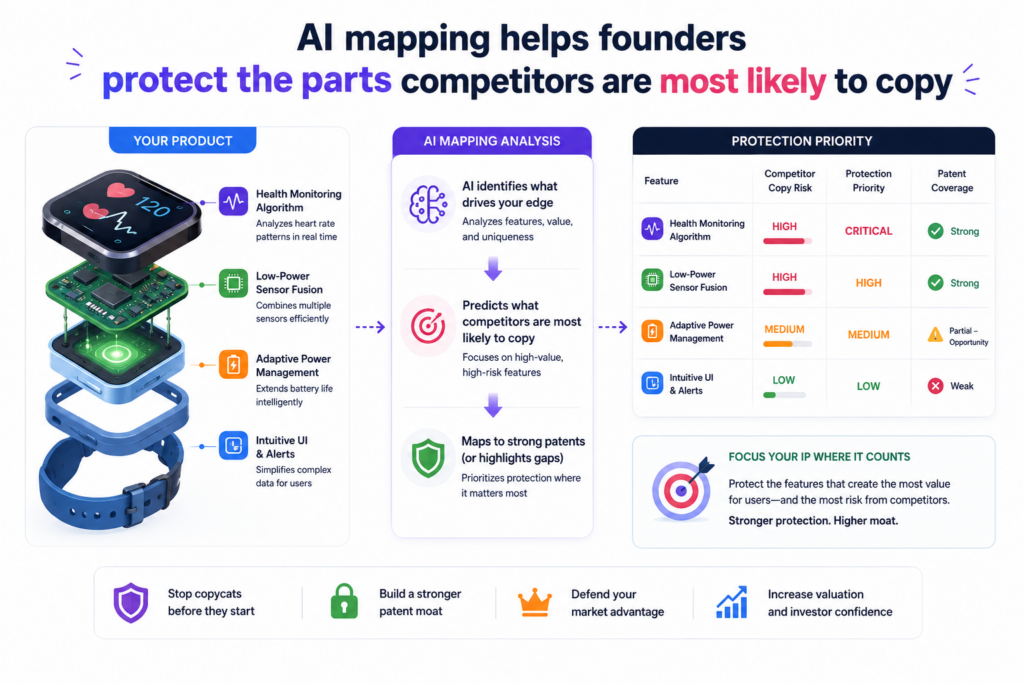
But the features that matter most for patent work are often the ones a competitor would copy if they wanted to build around you.
That is why product-to-patent mapping should not only ask, “What did we build?” It should also ask, “What would someone else try to take?”
AI can help by looking across the product story and finding the parts that repeat across workflows, create the main result, or make the product hard to match.
A strong chart helps the founder see where the product’s real leverage lives. It may not be the dashboard. It may not be the app screen.
It may be the scoring rule, the model check, the signal filter, the routing path, or the way the system updates itself after each use.
The best patent charts think like both a builder and a competitor
Founders know how they built the product. Competitors think about how to copy the outcome. A useful chart should help the team look from both sides.
From the builder side, the chart shows the real product steps. It shows the data, logic, system actions, and results.
From the competitor side, the chart helps ask which steps create the most value and which steps would be tempting to copy.
This matters because some product details are easy to replace. Others are much harder to work around.
If your product depends on a special way to rank options, control an output, clean data, or improve a model result, that step may deserve deeper patent attention.
AI can help compare those steps with the draft patent language.
It can show whether the patent story actually covers the part that makes the product hard to copy. If it does not, the team can fix the map before the draft goes too far.
A copy-risk view can make the chart more useful for business decisions
A patent chart becomes more valuable when it helps founders make choices, not just file documents.
If the map shows that a key feature is not well covered, the company can talk with its attorney about whether to add more detail, adjust the draft, or plan a future filing.
This kind of chart can also help with product planning. If the team sees that one workflow is central to the moat, they may decide to document it better, test it more, or keep certain details tighter before a public launch.
PowerPatent helps founders take this kind of practical view. The goal is not to make patents feel bigger than the business.
The goal is to connect patent work to the product choices that truly matter. With smart software and real attorney oversight, founders can protect the right parts with more confidence. You can see how the process works here: https://powerpatent.com/how-it-works
AI mapping helps teams avoid filing patents that sound broad but feel empty
A broad patent can sound powerful, but broad words alone do not create real strength.
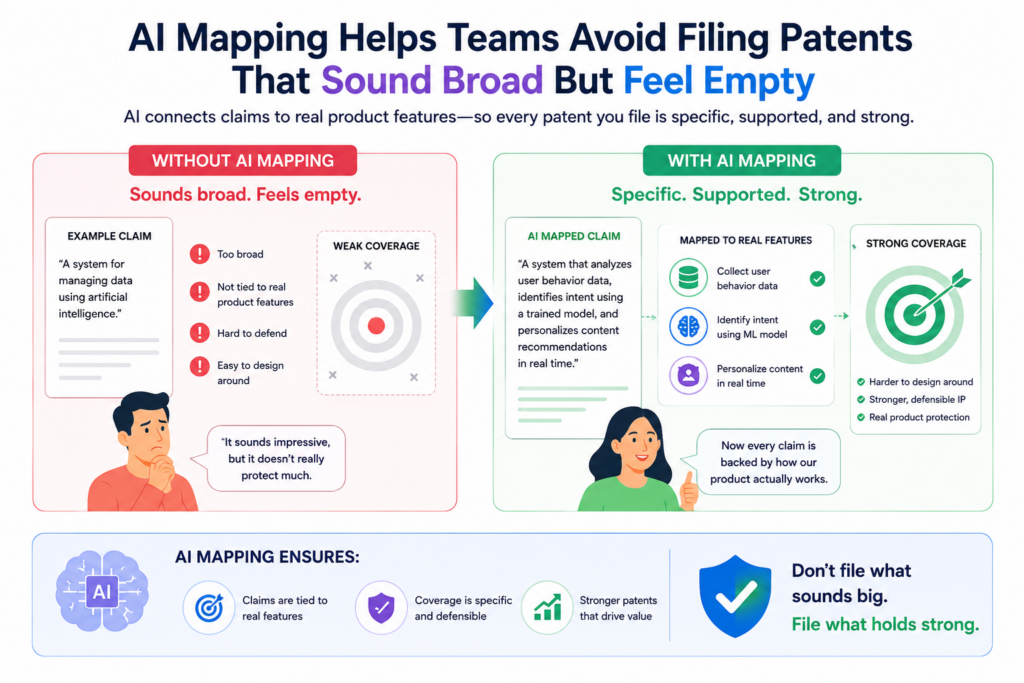
A patent needs a clear invention story behind it. If the chart only says the system “uses AI,” “improves performance,” or “automates a task,” the result may feel big on paper but weak in practice.
This is one of the biggest risks for fast startups. The team wants protection quickly, so the patent story becomes too general. It may describe the goal, but not the path.
It may describe the outcome, but not the system that creates it. That can lead to a draft that misses the real product.
Product-to-patent mapping helps stop that from happening. It forces the team to link each important idea to product proof.
AI makes that easier by checking whether the chart has enough detail behind each key phrase.
Strong patent charts do not hide behind buzzwords
Founders should be careful with words that sound impressive but do not explain much.
Words like intelligent, seamless, automated, adaptive, optimized, and smart can be useful in normal marketing. But in a patent chart, they need support.
If the product is adaptive, the chart should explain what changes, when it changes, and what causes the change. If the system is optimized, the chart should explain what is being improved and how the system chooses a better result.
If the process is automated, the chart should explain what action used to be manual and what product steps now handle it.
AI can help flag places where the chart uses soft language without a clear product step. This gives the team a chance to replace vague words with real actions. That makes the chart stronger and easier for an attorney to use.
The best chart reads like a clear product explanation. It does not try to impress through noise. It wins through precision.
Detail should serve the invention, not bury the reader
A strong chart does not need to include every tiny fact. Too much detail can make the story harder to read. The goal is to include the details that explain the invention.
This is where AI can help sort the useful from the distracting. It can group related facts, remove repeated points, and help the team focus on the product steps that support the patent story.
Then the founder, engineer, and attorney can review the chart with a cleaner view.
The result is not a longer chart. It is a sharper chart. It shows the product path, the key technical choices, the proof behind those choices, and the parts that may need attorney review.
PowerPatent is built for founders who want that kind of clarity. It helps turn product material into patent-ready work without asking founders to become legal experts.
The software helps organize the details, and real attorneys help guide the protection.
AI mapping can help founders decide what to file now and what to save for later
Startups often face a hard timing question. Should they file now, or wait until the product is more developed? There is no single answer that fits every company. But there is a better way to make the decision: look at the product map.
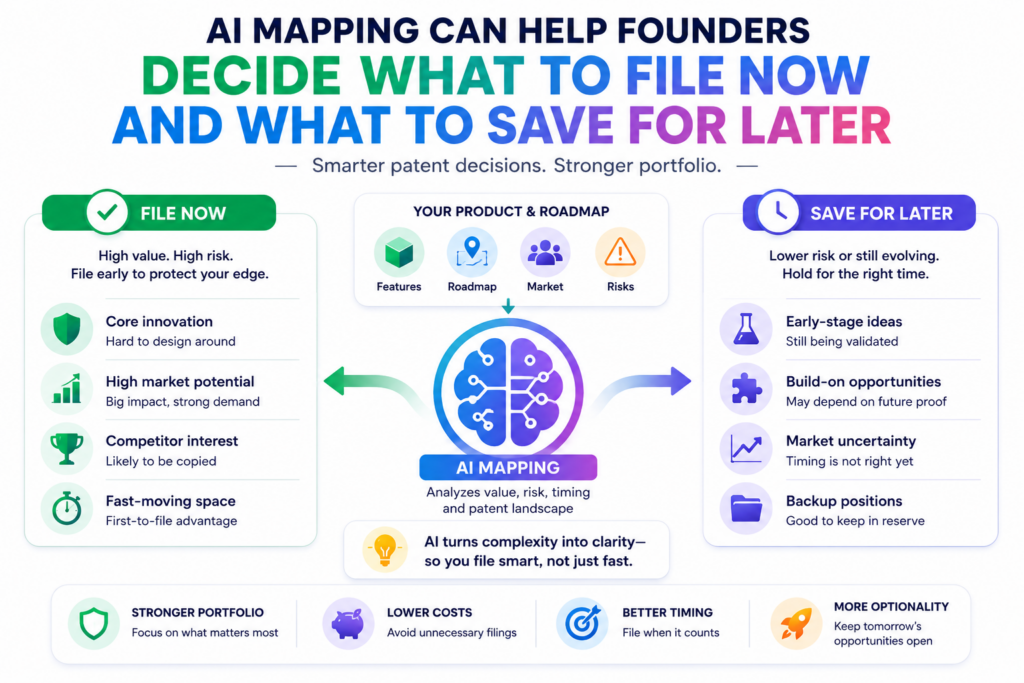
A clear product-to-patent chart can show which parts of the invention are ready to describe and which parts are still changing.
It can also show which features are about to be shared with customers, investors, partners, or the public. That matters because timing can affect the company’s options.
AI helps by turning scattered product updates into a clearer view of filing readiness.
It can show which workflows are stable, which features have enough detail, and which areas still need more explanation before they are ready for serious patent work.
A filing decision should match the product’s real stage
Some inventions are ready to file because the core system is clear. The team knows the inputs, the steps, the outputs, and the reason the process works better.
Even if the product will keep improving, the main invention can be described well enough to start.
Other inventions may need more work before filing. The team may still be testing different methods.
The feature may not have a settled flow. The model may change every week. In that case, the map can help show what is still missing.
This does not mean founders should wait too long. Waiting can create its own risks, especially if the company is about to disclose the product.
But rushing with a weak story can also waste money. A product-to-patent map helps founders avoid both extremes.
The map gives the attorney better facts. The attorney can then help decide the right path based on the company’s goals, timing, and risk.
The map can separate today’s invention from tomorrow’s roadmap
One mistake founders make is mixing the current product with future ideas. They describe what the system does today, what they hope it will do later, and what may happen in a future release. That can make the invention story blurry.
A strong chart separates what exists now from what is planned. It can show the current workflow, the next version, and the longer-term direction.
AI can help by comparing product docs, roadmap notes, and draft patent material to see where the story blends timelines.
This is useful because each timeline may need a different decision. The current product may support one filing. A future improvement may need more testing or a later filing. A broad roadmap idea may not be ready at all.
PowerPatent helps founders make this process clearer. Instead of guessing, teams can use smart software to organize product detail and work with real attorneys to choose a stronger filing path.
That gives founders more control before key launches, investor updates, or customer demos. Learn more here: https://powerpatent.com/how-it-works
Conclusion:
Product-to-patent mapping gives founders a clearer way to protect what they are really building. AI makes that map faster, sharper, and easier to review, but the best results still come from pairing smart software with real attorney oversight.
When your product details, technical proof, and patent story line up, you can move with more confidence and avoid costly gaps. For startups, that means better filings, cleaner decisions, and less stress during growth, funding, or deals. PowerPatent helps turn your product work into stronger patent work without slowing your team down. See how it works here: https://powerpatent.com/how-it-works
Leave a Reply