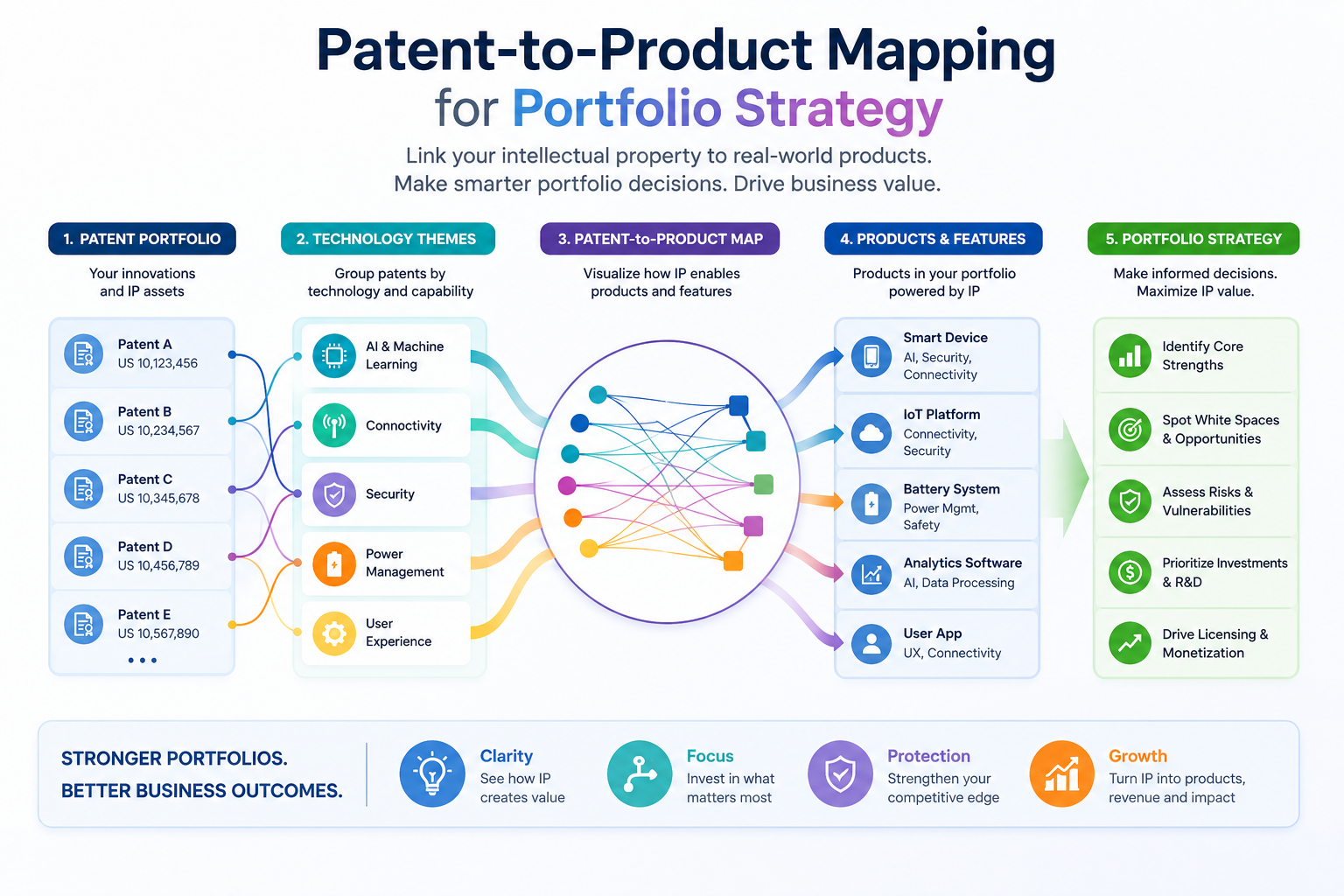
A strong patent is not just a legal file. It is a map of what your company is building, what your team knows, and what your competitors should not be able to copy. PowerPatent helps teams do this with smart software and real attorney oversight, so founders can move fast without losing control. You can see how it works here: https://powerpatent.com/how-it-works
Patent-to-product mapping turns your patent work into a living business tool
Patent-to-product mapping means you connect each patent, patent claim, invention note, and filing idea to the real parts of your product. Not in a vague way.
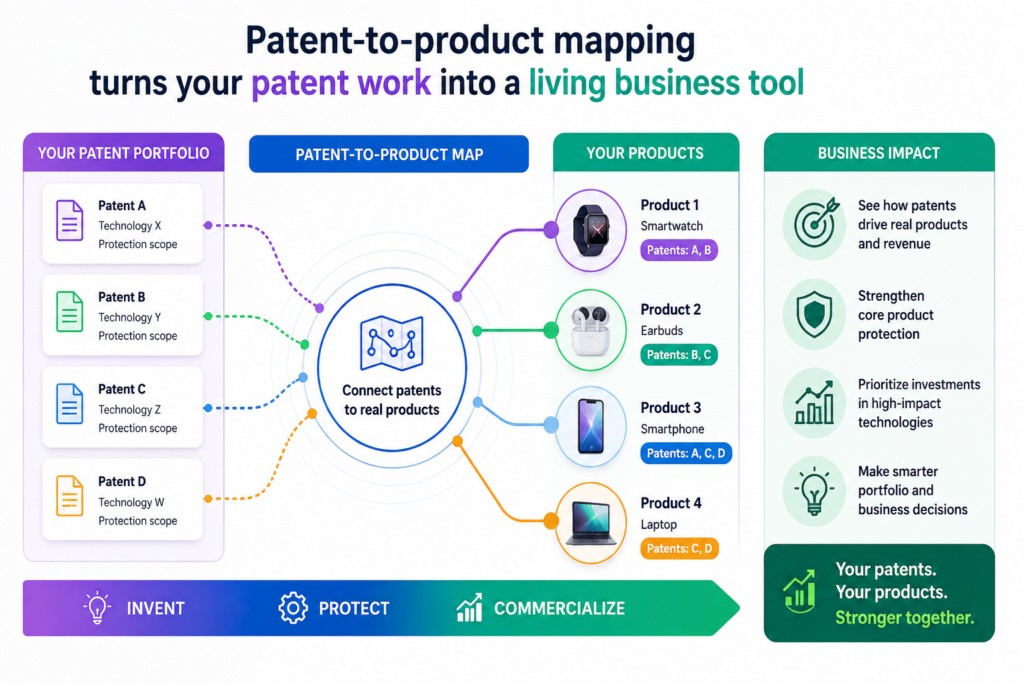
Not with a file name buried in a shared drive. In a clear way that shows what feature, workflow, system, model, data flow, or technical method each patent supports.
This matters because a product is never still. Your team ships, tests, changes, cuts, rebuilds, and learns. A patent portfolio that does not track those changes can lose value fast.
The patent may still exist, but the team may no longer know why it was filed, what it covers, or whether the product has moved beyond it.
For a startup, that is a serious problem. You may think you have protection around your core product, but when an investor, buyer, partner, or competitor looks closer, the story may be unclear.
A strong portfolio should help you explain the product, defend your edge, and plan your next filings with confidence.
PowerPatent helps founders bring order to this work by combining smart software with real attorney oversight.
Instead of treating patents as a slow side task, you can connect your inventions to the product as your team builds. You can see how PowerPatent works here: https://powerpatent.com/how-it-works
The real goal is to know what parts of the product are protected and what parts are still open
Most founders do not need a pile of patents. They need the right patents tied to the right business value.
That starts with a simple question: which parts of the product create the most value, and which of those parts are actually covered?
A product may have many layers. There may be a user-facing feature, a backend system, an AI model, a data pipeline, a control process, an automation flow, a hardware element, or a way the whole system learns over time.
Some of these parts may be easy for others to copy. Some may be hard to see from the outside. Some may become the key reason customers choose you over another company.
Patent-to-product mapping helps you sort that out. It lets you place each patent next to the part of the product it protects.
It also shows the empty spaces. Those empty spaces are often where the next smart filing should happen.
The best map starts with the product, not the patent list
A common mistake is to start with the patent portfolio and ask, “What do these filings cover?” That can help, but it is not enough.
The better move is to start with the product and ask, “What parts of this product would hurt us if someone copied them?”
This shifts the whole process. You stop thinking like someone managing paperwork. You start thinking like a founder protecting company value.
Start with the parts of the product that drive sales, speed, cost savings, accuracy, trust, safety, or user love. Then connect those parts to the patent work.
If a key feature has no matching patent, that is a signal. If a patent covers something the product no longer uses, that is also a signal. Both can guide your next move.
This does not need to slow the team down. With the right system, product and engineering updates can feed into patent planning in a steady way.
That is one reason tools like PowerPatent are useful for technical teams. They help turn day-to-day invention work into clear patent action without pulling founders into a long, painful process.
A patent map helps founders see the portfolio the way investors and buyers will see it
When an investor asks about your patents, they are usually not asking for a long list of filing numbers. They want to know whether your company has protected the parts of the business that matter.
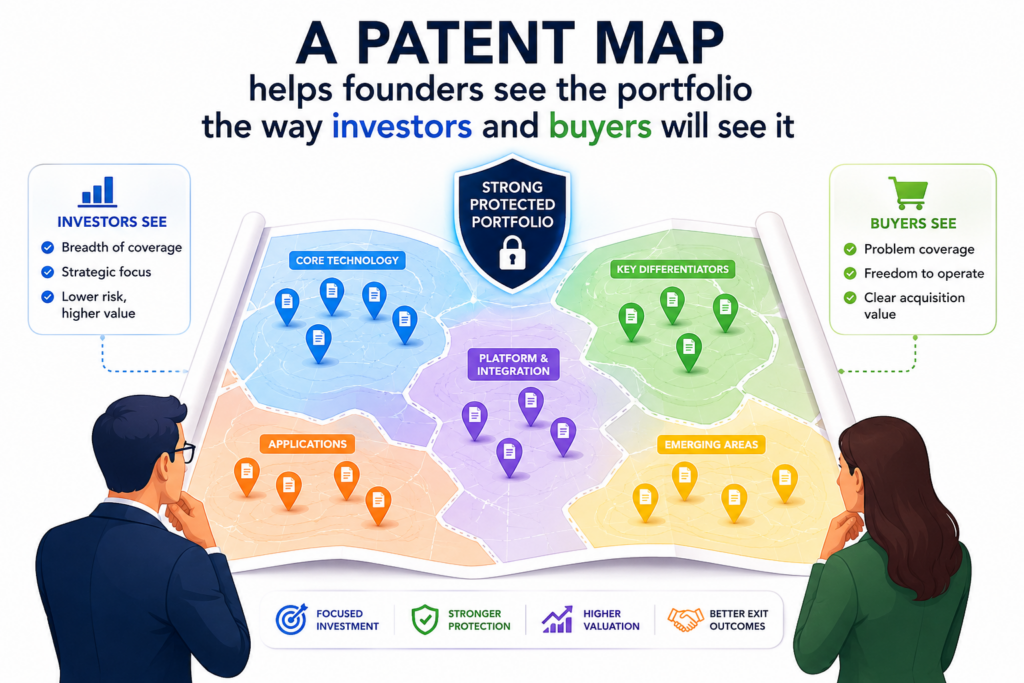
They want to know if your edge is real, if your moat is growing, and if your team understands what makes the product hard to copy.
Patent-to-product mapping gives you a clear way to answer that. Instead of saying, “We have five patents pending,” you can say, “Our filings cover the model training flow, the real-time decision engine, the sensor fusion method, and the workflow that turns raw data into customer-ready output.”
That answer feels different. It sounds grounded. It shows that your patent work is not random. It shows that your filings are tied to the machine that creates value.
This is powerful during funding, sales, partnerships, and acquisition talks. A clean map can help people understand why your company is not just another product in the market.
It can show that your technical work has been captured, organized, and protected in a serious way.
Your patent story should match your product story
Every strong startup has a product story. The story explains the problem, why the old way is broken, how your product works, and why now is the right time. Your patent story should support that same story.
If your pitch says your AI system is faster because it learns from rare events, your patent map should show whether that learning method is covered.
If your sales deck says your robotics platform adapts in real time, your patent map should show whether the control method, sensor loop, or decision process is protected.
If your product claims to reduce cost by automating a hard step, your patent map should show whether that automation is part of the portfolio.
When these stories match, your company looks sharper. When they do not, people may feel the gap. They may not say it out loud, but they notice when the patent portfolio does not line up with the product pitch.
That is why mapping is not just a legal task. It is a business task. It helps your team tell the truth with more strength.
A clean map can make due diligence less stressful
Due diligence can feel heavy because people ask detailed questions fast. They may want to know what was filed, who invented it, what product feature it covers, whether it is still used, and what future claims may matter.
If you are trying to answer all of that from memory, the process can get messy.
A patent-to-product map gives you a source of truth. It can show which filings connect to which product areas. It can show where new invention notes are waiting for review.
It can show which parts of the roadmap may need fresh filings. It can also help your attorney spot weak areas before an outside party does.
This does not mean every small product choice needs a patent. It means your most important choices should be easy to explain and track.
PowerPatent is built for this kind of founder-led clarity. It helps technical teams capture inventions early and work with real patent attorneys, so the patent process becomes more connected to the way the company actually builds. To see the flow, visit https://powerpatent.com/how-it-works
The first step is to break the product into value layers
A product is not one thing. It is a stack of choices. Some choices are visible to users. Some live deep in the system. Some create speed.
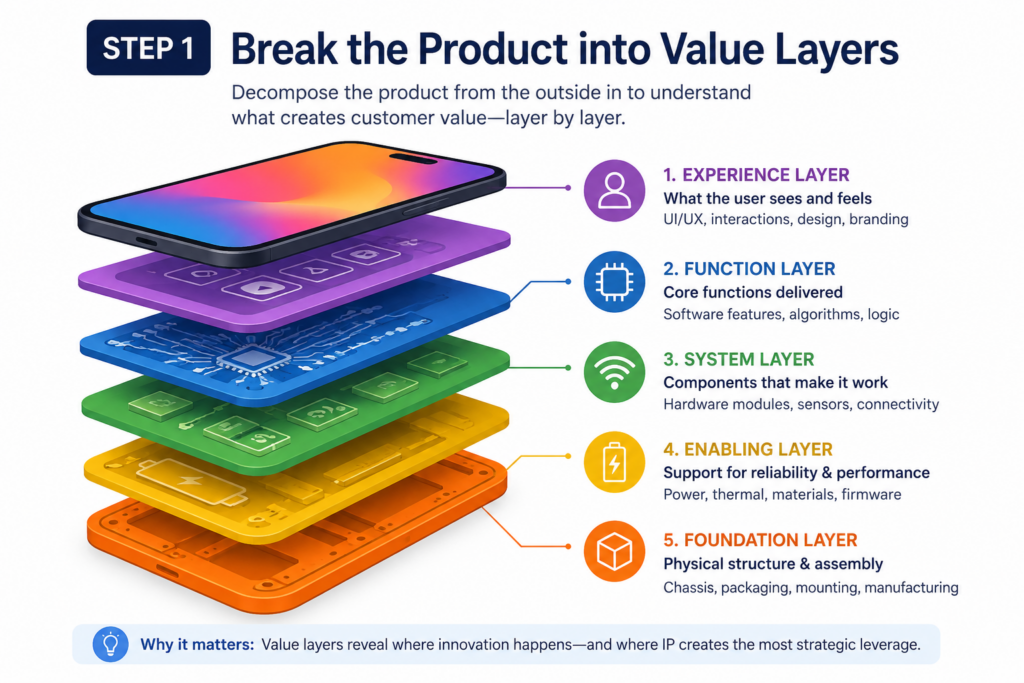
Some create trust. Some make the product hard to rebuild. If you want a useful patent map, you need to break the product into layers that reflect how value is made.
This does not require fancy language. You are simply asking where the product creates its edge.
For a software startup, the layers may include the user flow, the backend logic, the model design, the data process, the way results are ranked, the way errors are handled, and the way the system gets better.
For a hardware startup, the layers may include the device structure, control system, power use, sensor layout, manufacturing method, and the way the hardware connects to software.
For a biotech or deep tech company, the layers may include sample prep, testing steps, model outputs, lab methods, and the way results are turned into action.
The point is to stop seeing the product as a single item. You want to see the value chain inside it.
Each layer should be tied to a customer reason or business reason
A patent map becomes much stronger when each product layer is tied to a reason it matters. This keeps the team from filing patents on things that sound clever but do not help the business.
Ask why each layer matters. Does it make the product faster? Does it cut cost? Does it improve accuracy? Does it reduce risk?
Does it create a better user experience? Does it allow scale? Does it make the product work in a way that others would struggle to match?
Once you know the reason, the patent question becomes sharper. You are no longer asking, “Can we patent this?” You are asking, “Is this part of our edge, and should we protect it before the market catches up?”
That is a much better question for a founder.
The best layers are written in plain product language
Do not start with legal words. Use the language your product and engineering teams already use.
Name the feature, the workflow, the system, or the technical step in plain terms. Then let the attorney help shape the patent language later.
For example, your team may call something “the auto-triage flow,” “the model cleanup step,” “the sensor confidence score,” or “the customer risk engine.” Those names are useful because your team understands them. They make the map easier to use.
The goal is not to make the map sound impressive. The goal is to make it true and useful. A map that your team can understand is far better than a perfect-looking document that no one opens.
This is where founders can save a lot of time.
When the invention capture process uses product language first, engineers can explain what they built without feeling buried in legal terms. Then real patent attorneys can turn that raw detail into stronger filings.
PowerPatent was designed around that kind of workflow, so teams can move from invention to patent action with less friction. Learn more here: https://powerpatent.com/how-it-works
The next step is to connect each patent to the exact product proof
Once the product is broken into layers, the next move is to connect patents to proof. This means you do not just say a patent covers a feature. You link it to real evidence inside the company.
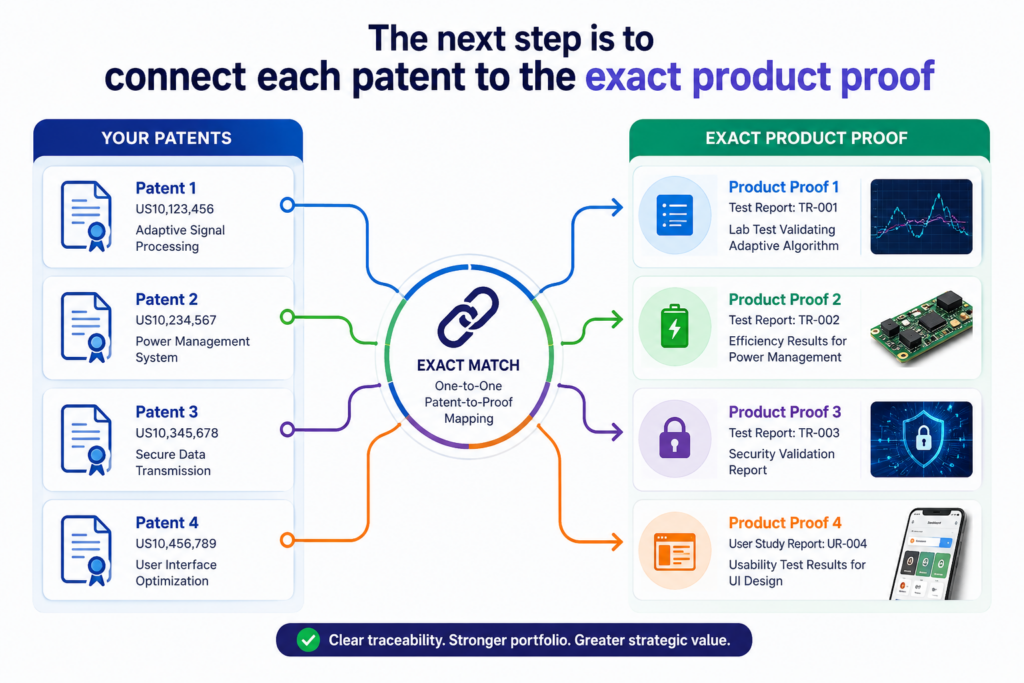
That proof may be a product spec, a system diagram, a model note, a demo, a code module name, a technical memo, a test result, a design file, or a roadmap item.
The goal is to show that the patent is tied to something real, not just an idea that sounded good at the time.
This matters because memory fades. Engineers leave. Roadmaps shift. File names change. If your patent work is not linked to product proof, your team may struggle later to explain why a filing mattered.
Patent-to-product mapping creates a record that stays useful over time. It helps a founder, attorney, product lead, or future buyer understand how the invention fits the product.
Product proof helps your attorney write stronger patents
A strong patent often depends on strong technical detail. If an attorney only gets a thin summary, the filing may miss the best parts of the invention. If the attorney gets product proof, the work becomes much sharper.
Product proof helps show how the system works in real life. It can reveal edge cases, fallback steps, data flows, timing choices, hardware limits, training methods, or control rules that may become important.
These details can help shape better claims and stronger follow-on filings.
This is especially important for AI, robotics, software, medical tools, energy systems, climate tech, and other technical products.
The value is often not in the broad idea. The value is in the specific way the team solved a hard problem.
A patent map should make gaps impossible to ignore
One of the biggest benefits of mapping is that gaps become visible. You may find that a core feature has no patent tied to it.
You may find that a filing covers an old version of the product, while the new version has a better method that has not been captured.
You may find that the roadmap includes a future release that could become a major moat, but no one has started the patent work yet.
That is the point. A good map does not just show what you have. It shows what you need to do next.
For a fast-moving startup, this is gold. It lets you focus patent spend where it matters most. It helps you avoid random filings.
It helps you stay ahead of product changes. It also helps your team build a more serious IP habit without slowing down the company.
The right process should feel simple. Capture what was built. Link it to the product. Review it with smart tools and real attorneys.
File when it supports the business. Keep the map alive as the product grows.
A strong patent map shows what is core, what is useful, and what is no longer important
Not every patent has the same value. Not every feature needs the same level of protection. Some inventions sit at the heart of the company.
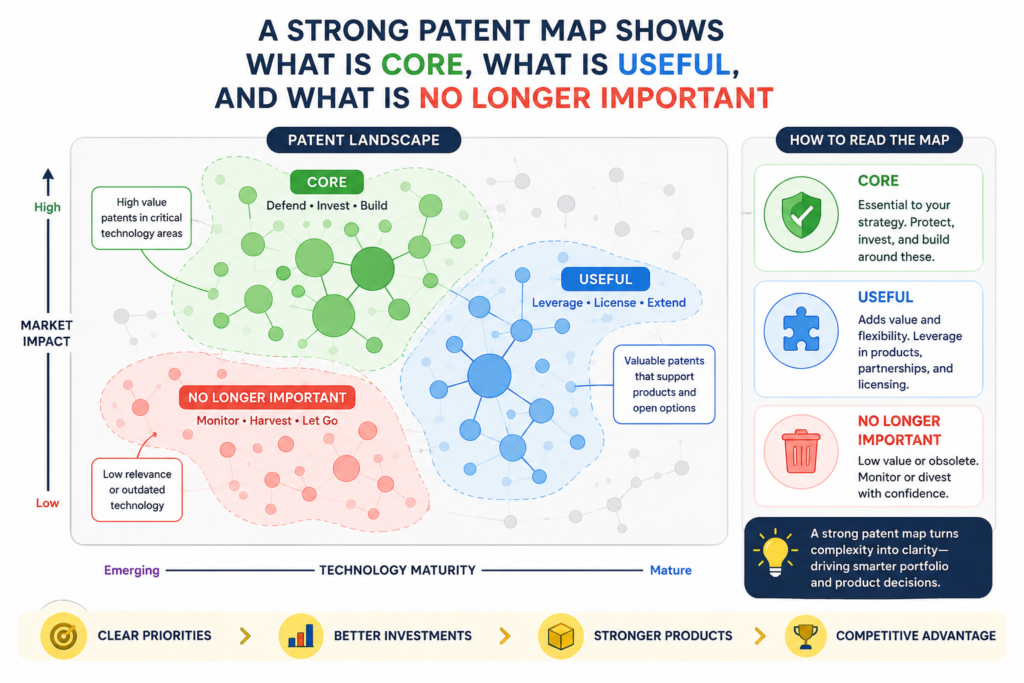
Some support the product but are not the main reason customers buy. Some were important in the early days but no longer match where the product is going.
Patent-to-product mapping helps you sort these out with a clear mind.
This is where a founder can make better choices. Without a map, every patent can feel important because time and money went into it.
But with a map, you can see which filings connect to the strongest parts of the product and which ones may need less focus.
That matters because startup time is limited. Patent budgets are limited. Attorney review time is limited. Your team should spend energy on the inventions that protect the company’s real edge.
A patent map gives you that view. It helps you place each filing into the bigger picture.
It helps you see whether a patent protects a core engine, a helper feature, a future bet, or an older idea that may no longer matter as much.
The most valuable patents usually protect the reason your product wins
A strong patent portfolio should match the reason your product is hard to beat. That reason may be speed. It may be accuracy. It may be a better user flow.
It may be a model that improves with less data. It may be a device that works in harsh places. It may be a control method that makes a machine safer or cheaper to run.
The key is to ask what would happen if a competitor copied that part.
If the answer is that your company would lose a major advantage, that part of the product deserves close attention. It may need a new patent filing. It may need a broader filing.
It may need more technical detail added in a follow-on application. It may also need trade secret care if the best part is hidden and hard to reverse engineer.
This is why mapping is so useful. It does not treat all inventions as equal. It gives you a way to rank them based on how much they matter to the business.
PowerPatent helps founders capture these details while the product is still fresh in the team’s mind.
With smart software and real attorney oversight, the process becomes less about guessing and more about making clear moves. You can see how it works here: https://powerpatent.com/how-it-works
Old filings should still be checked against the current product
Many startups file early patents before the product is fully shaped. That is normal. Early filings can be very useful. But the product may change a lot after the first filing.
The first version may have used one method. The shipped version may use another.
The team may have found a better data process, a cleaner model flow, a faster control loop, or a new way to reduce errors. These later improvements can be more valuable than the first idea.
This is where many teams fall behind. They assume the old filing still covers the product. Sometimes it does.
Sometimes it only covers part of the product. Sometimes it misses the new method that now creates most of the value.
A patent-to-product map helps you check this with care. You can compare each filing against what is live today. You can also compare it against what is coming next.
When the map shows that the product has moved ahead of the portfolio, that is a strong sign to review the gap.
The goal is not to file on every change. The goal is to notice the changes that create business value.
The best patent maps are built with engineers, not only executives
Founders understand the company strategy. Product leaders understand the roadmap. But engineers often know the real invention.

They know which part was hard to build. They know which design failed three times before the team found the right path. They know which model step made the result better.
They know why the system works under real limits. They know what looks simple from the outside but took serious insight to solve.
That knowledge should not stay buried in Slack messages, code comments, meeting notes, or memory. It should feed the patent map.
When engineers are part of the mapping process, the portfolio becomes much stronger. The map becomes more exact.
The attorney gets better source material. The company avoids missing the hidden parts of the product that create real value.
This does not mean engineers need to become patent experts. They should not have to write legal claims or learn complex patent terms.
They should only need to explain what they built, why it matters, and how it is different from the old way.
Engineers should be asked simple product questions, not legal questions
A poor invention process makes engineers feel like they are being pulled into legal work. That creates delay. It also creates weak answers because the wrong questions are being asked.
A better process asks simple questions in plain language.
What did we build that was hard? What changed in the system? What problem did this solve? What does the product do now that it could not do before?
What is faster, safer, cheaper, more accurate, or easier because of this work? What would be hard for another team to copy?
These questions help engineers explain the invention in a useful way. They also help the company decide what belongs in the patent map.
Once the raw details are captured, a patent attorney can do the legal work. The attorney can look at what was built, compare it to the filing strategy, and decide how to shape the patent language.
This is the right split. Engineers bring the truth of the product. Attorneys help turn that truth into protection.
A simple capture habit can prevent major losses later
The best time to capture an invention is close to the moment it is built. That is when the team still remembers why the choice mattered.
The edge cases are still fresh. The tests are still easy to find. The tradeoffs are still clear.
Waiting six months makes the work harder. The team may forget the first version. The person who built it may be gone. The roadmap may have shifted. The reason behind the choice may be lost.
A simple capture habit prevents this. When a feature ships or a hard technical problem gets solved, the team should record the invention in plain words. Then it can be reviewed and mapped to the product.
This is one of the biggest advantages of using a modern system instead of a scattered folder.
PowerPatent helps teams capture invention details early, connect them to real product work, and bring in attorney review without creating a slow, old-school process. Founders can learn more here: https://powerpatent.com/how-it-works
A patent map should guide what you file next, not just explain what you already filed
Many companies treat patent mapping as a record-keeping task. They use it to organize what already exists. That is useful, but it is only half the value.
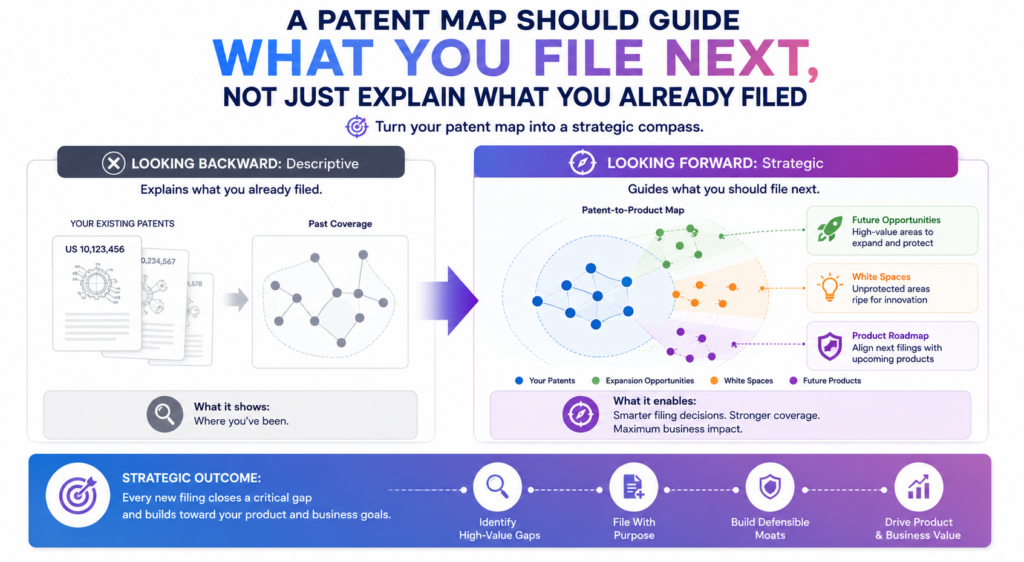
The larger value is forward-looking.
A good patent map helps you decide what to file next. It shows which product layers are protected, which layers are exposed, and which parts of the roadmap may become important soon.
It helps you act before competitors can see where the market is going.
This is especially important for startups that move fast. Your product may change every month.
Your roadmap may include features that are not public yet. Your team may be building the next version before customers even understand the current one.
If your patent strategy only looks backward, it will always be late. If your patent map looks forward, it can become a planning tool.
Roadmap mapping helps protect the future before it becomes obvious
The best patent opportunities are often found in the roadmap. That is where the next edge is forming.
A feature that seems small today may become the main product story in six months. A backend improvement may become the reason the product scales.
A new model flow may become the reason customers get better results. A new hardware design may unlock a market that was not possible before.
When you map patents to the roadmap, you can spot these future value points early. You can ask which upcoming features need invention capture now.
You can decide which filings should happen before launch. You can also make sure public demos, sales talks, investor decks, and conference talks do not get ahead of the patent plan.
That last part matters. Startups often share exciting product details to win attention. That is part of growth.
But sharing too much before the patent work is handled can create risk. A clean mapping process helps the team stay sharp without freezing go-to-market work.
The map should connect filings to product milestones
A useful patent map should not sit apart from the company plan. It should connect to product milestones.
When a new feature moves from research to build, it may be time to capture the invention. When a feature moves from build to beta, it may be time for attorney review.
When a feature moves from beta to public launch, it may be time to confirm whether the right filing is already in place.
This does not need to be heavy. It can be a light process, but it should be clear enough that no one is guessing.
The founder should be able to look at the roadmap and know which technical areas are already covered, which ones are being reviewed, and which ones need attention before launch.
That kind of clarity gives the team more control. It also helps avoid rushed filings when a major launch is already days away.
PowerPatent supports this type of connected workflow. It helps turn product changes into patent action, with software that keeps the process moving and attorneys who help make sure the work is done right.
See the process here: https://powerpatent.com/how-it-works
Patent-to-product mapping helps teams avoid random patent spend
Patent spend can get messy when there is no clear strategy. A team may file because an idea sounds exciting. They may file because a competitor raised money.
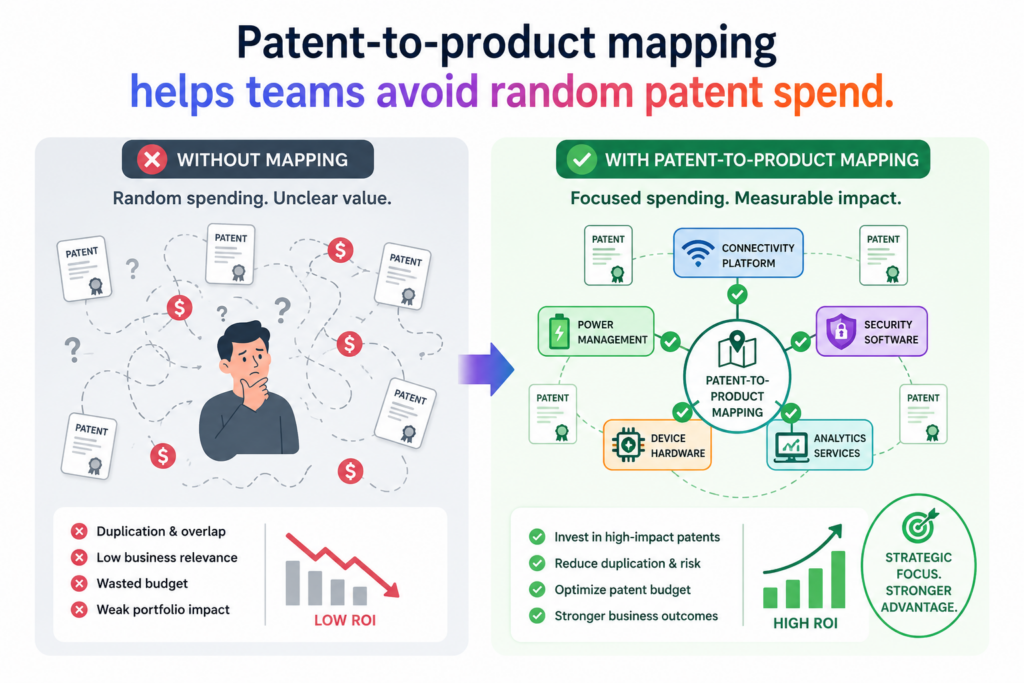
They may file because an advisor said patents are important. They may file because there is pressure before a funding round.
That kind of filing can waste money.
A better approach is to tie patent spend to product value. Patent-to-product mapping makes this possible. It helps you see where each dollar is going and why it matters.
For a startup, this is a major advantage. You do not need the biggest portfolio. You need a portfolio that protects the strongest parts of the business.
You need filings that support the product, the roadmap, the market position, and the story you are telling investors and customers.
A map brings discipline to the process. It turns patent work from a vague expense into a planned business move.
Focused filing beats broad filing without a clear reason
Some founders think more patents always means more protection. That is not always true. A large portfolio can still be weak if it does not cover the right things.
A smaller portfolio can be much stronger if it protects the key product layers that make the company hard to copy.
The goal is not to collect filings. The goal is to protect leverage.
Leverage comes from the parts of the product that create power in the market. That may be the system customers rely on every day. It may be the method that cuts cost. It may be the process that improves output quality.
It may be the model flow that gets better with use. It may be the hardware-software link that makes the product perform better than older tools.
When filings are tied to those areas, patent spend becomes easier to defend. The founder can explain why each filing exists.
The product team can see how it connects to the roadmap. The attorney can focus on the details that matter.
A clear map makes it easier to say no
One of the most underrated parts of strategy is knowing what not to file.
A patent map helps here too. If an invention does not support the main product, does not create a strong edge, does not fit the roadmap, and does not block a competitor in a useful way, it may not deserve immediate filing.
It may be saved for later. It may be handled as know-how. It may simply be left alone.
That kind of choice is not a failure. It is focus.
Startups win by placing smart bets. Patent work should follow the same rule. A clear map gives you the confidence to say yes to the filings that matter and no to the ones that only create noise.
This is why modern patent work should feel connected to the company, not separate from it.
When your patents map to your product, your roadmap, and your business goals, the portfolio becomes easier to manage and more useful in the real world.
A product map helps you see where competitors may enter the market
A patent-to-product map is not only about your own product. It also helps you think about how other companies may try to copy, work around, or attack your position.
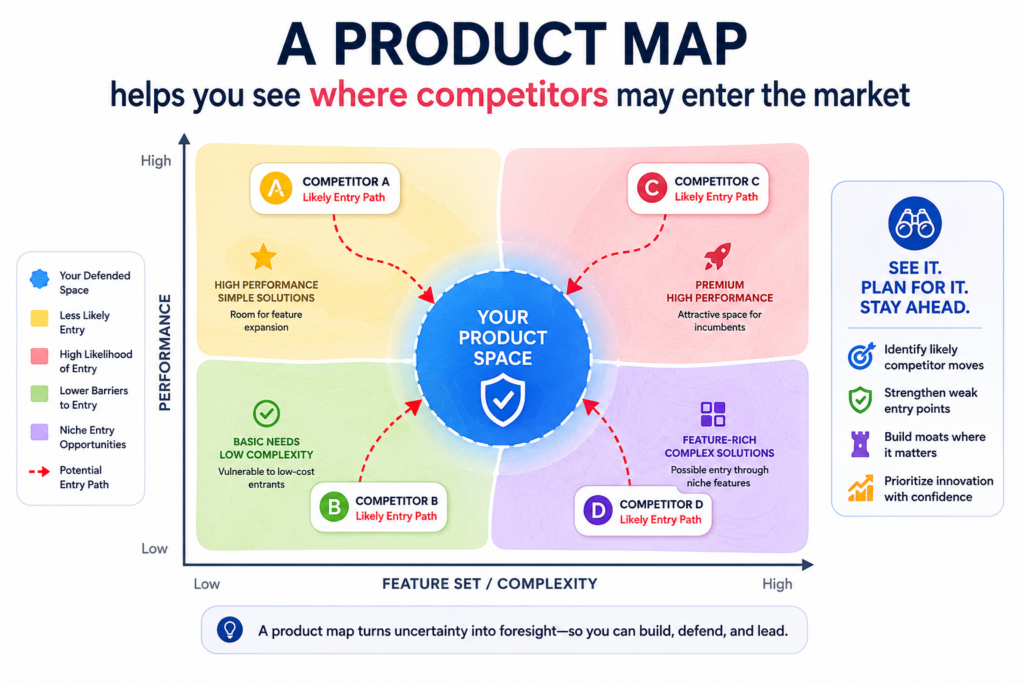
Most competitors will not copy your whole product at once. They will copy the part that customers care about most. They may copy the workflow that saves time.
They may copy the model step that improves results. They may copy the user flow that makes the product feel simple. They may copy the backend method that lets you serve customers at lower cost.
If your patent map shows which product parts matter most, it also helps you see which parts competitors are likely to target. That makes your portfolio more useful.
You can begin to think like the market. You can ask where others will go next, what they will try to copy first, and what you should protect before they get there.
This is not about fear. It is about control. A founder who understands the connection between product value and patent coverage can make sharper moves before the market gets crowded.
The best protection often sits around the path competitors must take
A strong patent strategy does not only protect the exact thing you sell today. It also protects the path others may need to take if they want to solve the same problem in a similar way.
This is where mapping becomes very useful. When you look at your product layer by layer, you may see that one part of the system is not just a feature. It is a choke point.
It is the method that makes the whole product work. If a competitor wants the same result, they may need to pass through that same zone.
That zone is worth careful review.
For example, a health AI company may have many screens and reports, but the real value may sit in how it turns messy patient data into a clean risk score.
A climate tech company may sell a device, but the real value may sit in the control method that makes the device work in unstable field conditions. A robotics startup may have a slick interface, but the real value may sit in the way the system handles uncertainty in real time.
A patent map helps you find these zones. It also helps you decide whether current filings are strong enough or whether new filings are needed.
Competitor thinking should be tied to real product facts
It is easy to guess what competitors might do. It is harder, and far more useful, to tie those guesses to product facts.
Start with the parts of your product that create customer value. Then ask how another company could try to reach the same result. Could they use a different model? Could they use a different data path?
Could they copy the workflow but change the interface? Could they avoid your current patent by changing one technical step? Could they build a cheaper version that still solves the same customer pain?
These questions help your team think beyond the first filing. They help your attorney understand where the market may move.
They also help you shape a portfolio that is more than a snapshot of today’s product.
This is one reason founder-led mapping works so well. The founder sees the market. The engineers see the system.
The attorney sees the patent path. When those views come together, the company can protect the business with far more care.
PowerPatent helps make this easier by giving teams a cleaner way to capture invention details and work with real patent attorneys without slowing the build cycle. You can see how the process works here: https://powerpatent.com/how-it-works
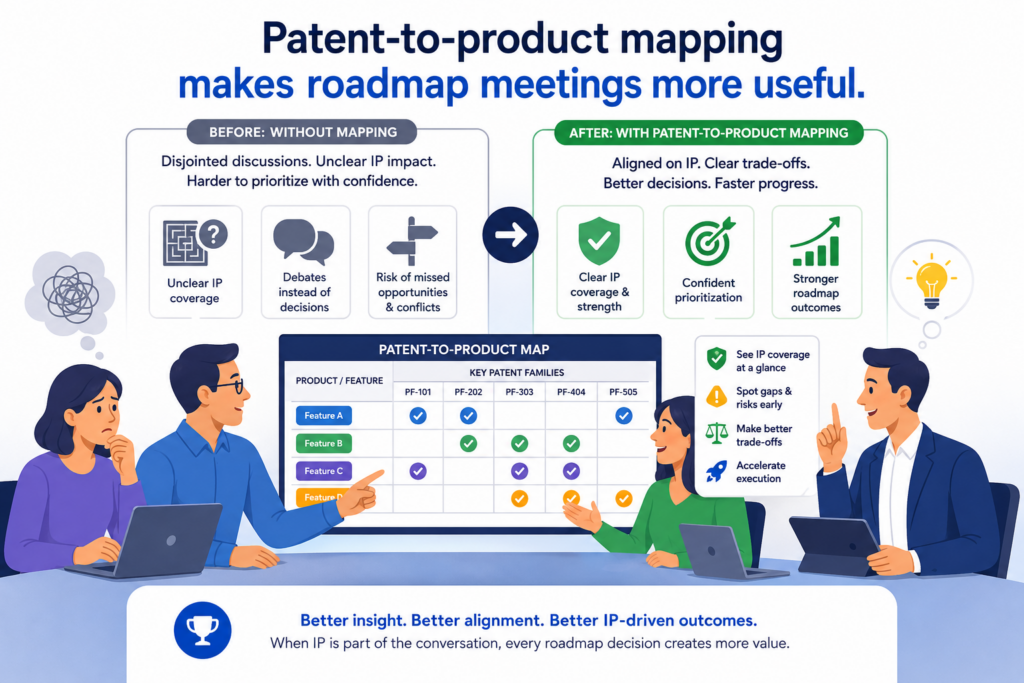
Patent-to-product mapping makes roadmap meetings more useful
Roadmap meetings often focus on what the team will build next, what customers need, what deadlines matter, and what tradeoffs must be made.
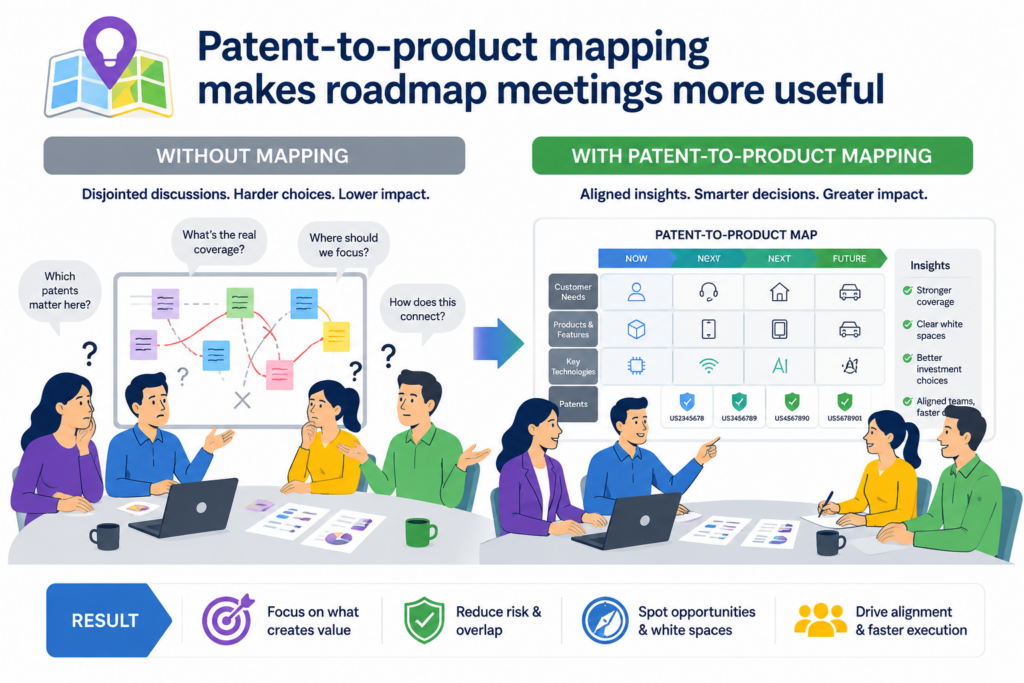
That is exactly where patent thinking should show up, but in a simple and useful way.
The goal is not to turn every roadmap meeting into a patent meeting. That would slow everyone down. The goal is to add one clear lens: which upcoming product changes may create protectable value?
When this becomes part of the rhythm, invention capture stops being a last-minute scramble. The team begins to notice important work earlier.
The founder can see which launches may need patent review before they become public. The attorney gets better information while the invention is still fresh.
This is how patent work becomes part of building, not a painful extra task after building.
A roadmap view helps you protect what is coming before the market sees it
The most valuable invention may not be in the current product. It may be in the next release.
That is why a patent map should include the roadmap, not only the live product. If the team is building a new feature that changes the way the product works, that feature should be reviewed before it is shown widely.
If the team is preparing a major demo, the patent map should help show whether the core method behind that demo has been captured.
If the company is about to launch a new system, the founder should know whether the patent story is ready.
This is especially important for startups that sell to large customers, raise funding, publish technical content, attend events, or run pilots with partners. Public exposure can happen fast.
A casual demo can reveal more than the team planned. A pitch deck can include a key workflow. A customer call can walk through a method that should have been reviewed first.
A roadmap-linked patent map gives the team a simple guardrail. It does not stop selling. It does not stop shipping. It helps the team move with more care.
Patent review should happen before launch pressure takes over
The worst time to start patent review is the week of a major launch. At that point, the team is busy. The founder is selling.
Product is fixing bugs. Marketing is preparing assets. Everyone is moving fast, and the patent work feels like a blocker.
A better process starts earlier.
When a feature enters serious build mode, capture the invention notes. When it moves toward testing, connect those notes to product proof.
When it nears public launch, confirm whether a filing is needed. This rhythm keeps the work light and avoids panic.
The map becomes the guide. It shows what is already handled and what needs action. It also helps the team avoid filing weak, rushed applications simply because a launch date is close.
PowerPatent is built for this kind of steady workflow. Founders and technical teams can capture what matters, keep the process organized, and get attorney oversight before pressure builds. See how it works here: https://powerpatent.com/how-it-works
A useful patent map connects claims to product features in plain language
At some point, your team needs to understand what each patent actually protects. This does not mean everyone needs to read patent claims like a lawyer.
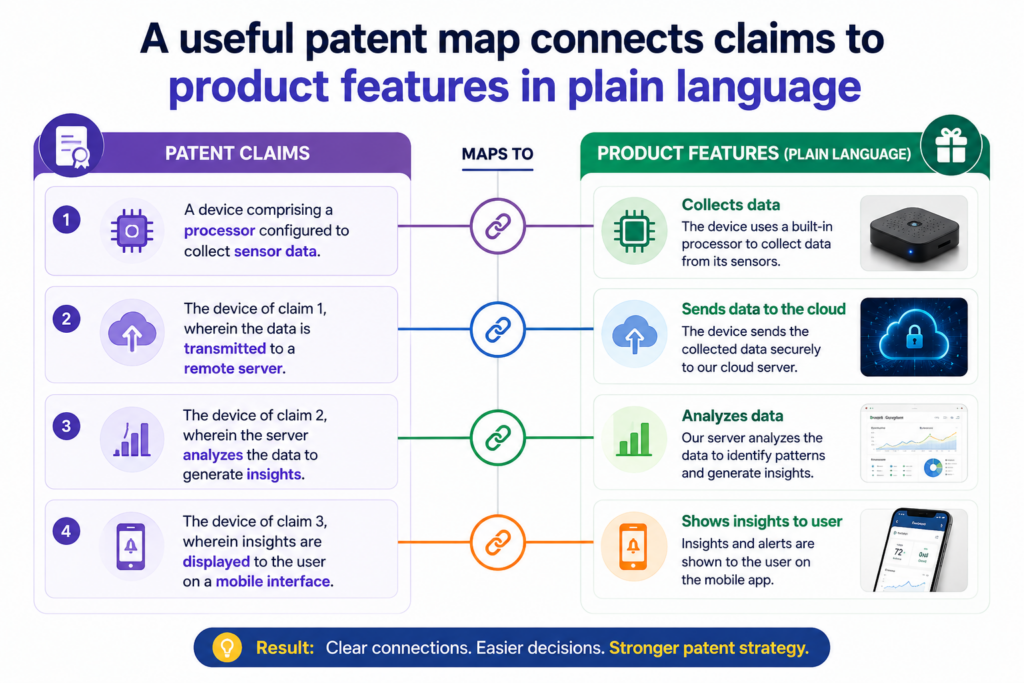
Most founders, product leads, and engineers do not have time for that. They need a plain-language view.
A strong patent-to-product map can bridge that gap. It can translate patent coverage into product terms that the team can use. It can show which claims relate to which feature, system step, model flow, device part, or workflow.
This makes the portfolio easier to manage. It also helps the team spot weak areas. If a patent sounds broad in legal form but only maps to a small product detail, that is worth knowing.
If a claim maps to a major product engine, that is also worth knowing. The map helps everyone see the true role of each filing.
This plain-language view is especially helpful during board updates, investor talks, partner calls, and acquisition review. People want clarity. They want to know what is protected and why it matters.
Claims should be connected to the part of the product customers care about
A patent claim is only useful to the business if it connects to something that matters. That may be a customer-facing benefit or a hidden system that creates that benefit.
For example, a customer may care that a tool gives faster answers. The patent may cover the backend method that makes those faster answers possible. A customer may care that a device uses less power.
The patent may cover a control method that reduces energy use. A customer may care that an AI output is more accurate. The patent may cover how the system selects, cleans, weighs, or updates the data.
A good map connects these dots. It does not stop at “this claim covers this technical step.” It also explains why that step matters to the product and the business.
That is where the map becomes powerful. It turns legal coverage into business meaning.
Plain-language mapping helps non-legal teams make better choices
When teams do not understand patent coverage, they may make poor choices without meaning to. They may stop using a feature that is well protected.
They may build a new feature that sits outside the portfolio. They may talk publicly about a new method before it is captured. They may assume a patent covers something it does not.
Plain-language mapping reduces that risk.
The product team can see which features are tied to filings. Engineering can see which technical choices have been captured.
The founder can see whether the patent story matches the company story. The attorney can see where more detail may be needed.
This does not remove the need for legal review. It makes legal review more useful because the team gives better inputs and asks better questions.
For a startup, that can save time and money. It can also prevent avoidable mistakes.
PowerPatent helps teams bring this kind of clarity into the process with smart software and real attorney oversight, so patent work stays connected to the actual product. Learn more here: https://powerpatent.com/how-it-works
Mapping helps you decide when to use patents and when to keep things secret
Not every valuable invention should be handled the same way. Some ideas may be right for patent filing.
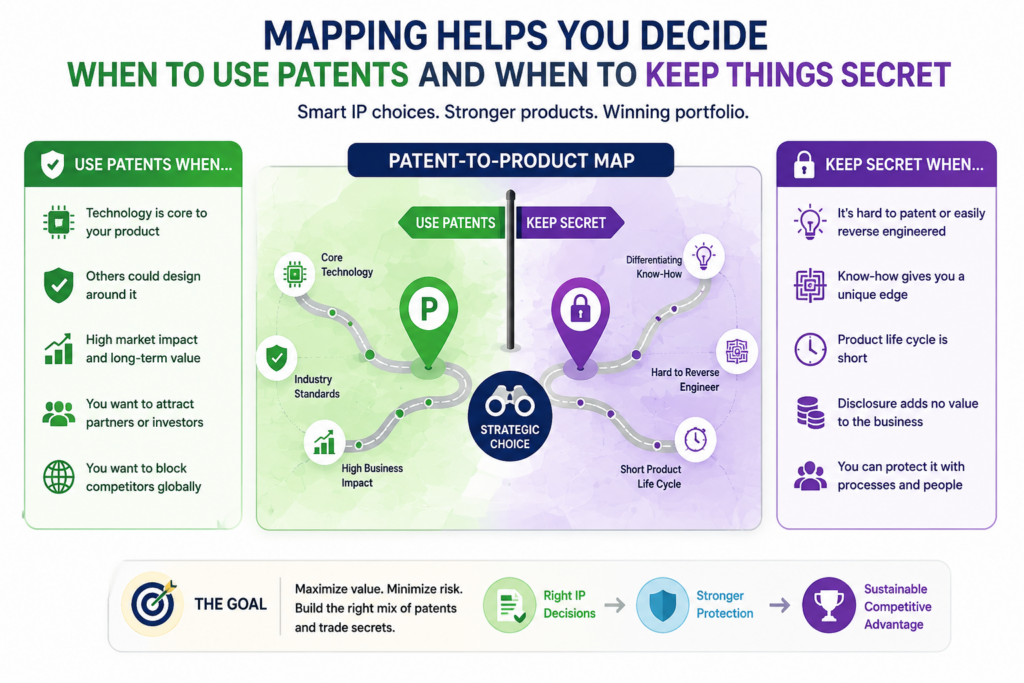
Others may be better kept as internal know-how. A patent-to-product map helps you have that conversation in a practical way.
The choice often depends on how visible the invention is, how easy it is to copy, how central it is to the product, and how long it may stay valuable. A user-facing feature may be easier for competitors to study once it launches.
A backend method may be harder to see from the outside. A manufacturing process may stay hidden if no one can inspect it. A model training method may be partly hidden but still important enough to review for patent protection.
The map helps you compare these choices across the product. It gives you a cleaner way to decide what to file, what to hold close, and what to revisit later.
This is a serious business decision. It should not be made by gut feel alone.
A visible invention often needs faster patent review
If customers, partners, users, or competitors can see how something works, the team should review it early. Once a feature is public, it may become easier for others to copy. It may also affect filing options if the team waits too long.
This does not mean every visible feature needs a patent. It means visible product value should trigger a careful review.
A new interface may look simple, but the workflow behind it may be novel. A device may look normal, but the way it responds to field conditions may be new.
A software feature may look like a button, but the logic behind that button may involve a smart sequence of steps.
Patent-to-product mapping helps your team avoid surface-level judgment. It pushes the team to ask what is really happening underneath the feature.
Hidden methods still need a strategy
Some inventions are not easy to see from the outside. These may include data cleaning methods, model training flows, internal scoring rules, manufacturing steps, calibration methods, and backend control systems.
For these areas, the team may consider keeping details private. But secrecy only works if the company treats the information with care.
If the method is shared widely in decks, demos, public papers, open repositories, or customer materials, it may not stay secret for long.
A patent map can help track this. It can show which hidden methods are important, which ones are being kept private, and which ones may need patent review before any public reveal.
This gives the founder more control. Instead of making random choices, the company can decide with intent.
File where filing makes sense. Keep secret what should stay inside. Revisit the choice when the product or market changes.
That is the heart of good portfolio strategy. It is not about filing everything. It is about protecting the company’s edge in the smartest way possible.
A patent map helps the whole team speak the same language
A growing startup can become noisy fast. Product uses one set of words. Engineering uses another.
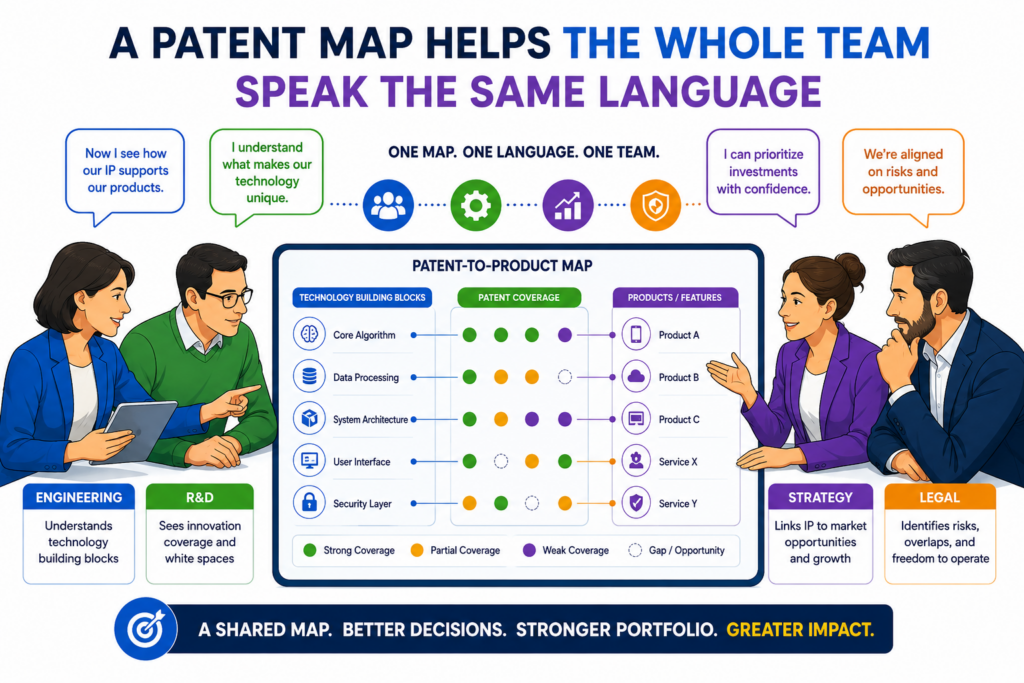
Sales uses a cleaner story for customers. Investors hear a different version in the pitch deck. The patent attorney may hear only a small slice of all of it.
That creates risk.
When the same invention has five different names, it becomes harder to protect well. A feature may be called one thing in the product roadmap, another thing in the codebase, and another thing in the patent file.
Months later, no one is sure whether they are talking about the same system.
Patent-to-product mapping solves this by creating a shared language. It gives the team a clear way to connect product names, engineering names, patent names, and business value.
This does not need to be complex. In fact, the simpler the language, the better. A map should help people understand each other quickly. It should make the product easier to explain, not harder.
When a founder can point to one product area and show the matching patent work, the company feels more mature. The team knows what matters. The attorney gets better input. The story becomes easier to tell.
PowerPatent helps teams create this kind of clean flow by combining smart software with real attorney oversight.
That means founders can capture invention details in plain words, then let experienced patent attorneys help turn them into real protection. You can see how it works here: https://powerpatent.com/how-it-works
Clear names reduce confusion when the company grows
Early teams often rely on memory. Everyone knows what “the smart routing thing” means because only five people are in the room. But as the company grows, that breaks.
New engineers join. Product managers take over features. Sales starts using customer-facing terms.
The roadmap gets longer. Old invention notes get buried. Suddenly, a once-clear idea becomes hard to track.
A good patent map keeps the names connected. It can show that the “smart routing thing” in engineering is the same as the “adaptive workflow engine” in the product deck and the same as the invention covered in a certain filing.
That may sound small, but it matters. Confusion wastes time. Worse, it can cause missed filings, weak updates, and poor communication during funding or deal talks.
The map should translate between teams without changing the truth
The best patent map does not force everyone to use legal words. It acts like a translator.
Engineering can keep its technical terms. Product can keep its feature names. Sales can keep its customer story.
The patent map connects those views so the company can see the same invention from each angle.
This is especially helpful when preparing for investor meetings or board updates.
A founder should not have to dig through dense patent files to explain what the company has protected. The map should make the answer easy to see.
It should show the product area, the technical method, the business reason, the filing status, and the next step.
That gives the founder a strong, simple story without overloading the room.
Good mapping creates trust. It shows that the company is not guessing. It shows that the portfolio is tied to real work. It shows that the team is building and protecting with purpose.
Mapping helps you find the inventions hidden inside normal product work
Many great inventions do not arrive with a big announcement. They show up during normal product work.
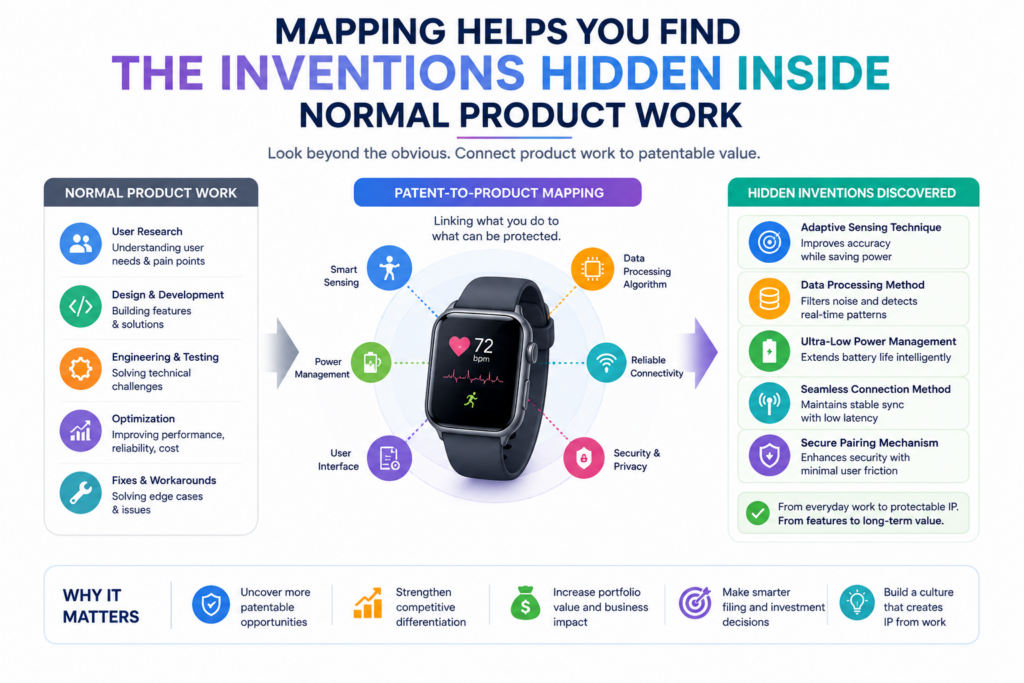
An engineer fixes a speed issue. A model starts giving better results after a new training method. A device works more reliably after a small design change.
A workflow becomes smoother because the team found a better order of steps. These moments may not feel like “patent moments” at the time.
But they can be.
The hard part is that busy teams often move past these wins too quickly. They ship the fix, close the ticket, and move on.
A few months later, the team may not remember why the change mattered. That can mean a valuable invention never gets reviewed.
Patent-to-product mapping helps stop that loss. It creates a habit of looking at product work through a simple lens: did we solve a hard problem in a new and useful way?
If the answer is yes, the work should be captured and mapped. It may or may not become a patent. But it should not disappear.
The best inventions often look obvious after they work
This is one of the traps technical teams face. Once a solution works, it can feel obvious. The team forgets how hard the problem was before the answer existed.
But the struggle matters. The failed attempts matter. The tradeoffs matter. The reason the final design worked matters.
A competitor looking from the outside may not know any of that. They may only see the finished product and assume it was simple. Your patent map can preserve the deeper story.
It can show the path from problem to solution. It can capture why the invention was not obvious to the team when the work began.
That makes the patent review stronger. It also helps the company explain why a certain product layer is important.
Product tickets can become early invention signals
A startup does not need a heavy process to find these hidden inventions. Often, the signals are already inside the tools the team uses every day.
A product ticket that says “reduce false alerts” may point to a new scoring method. A bug fix that says “improve response under low signal” may point to a new control process.
A roadmap note that says “automate review step” may point to a workflow invention. A model update that says “better results with sparse data” may point to a valuable training method.
The key is to review these signals before they fade. A patent map can connect them to product areas, then flag them for attorney review when they look important.
This is where PowerPatent can help technical founders move faster. Instead of waiting until invention details are lost, teams can capture work as it happens and bring in real patent attorneys when it counts.
That keeps the process practical and founder-friendly. Learn more here: https://powerpatent.com/how-it-works
A patent map gives your board and investors a clearer view of your moat
Investors hear the word “moat” all the time. Many startups claim they have one. Fewer can show it in a clear way.
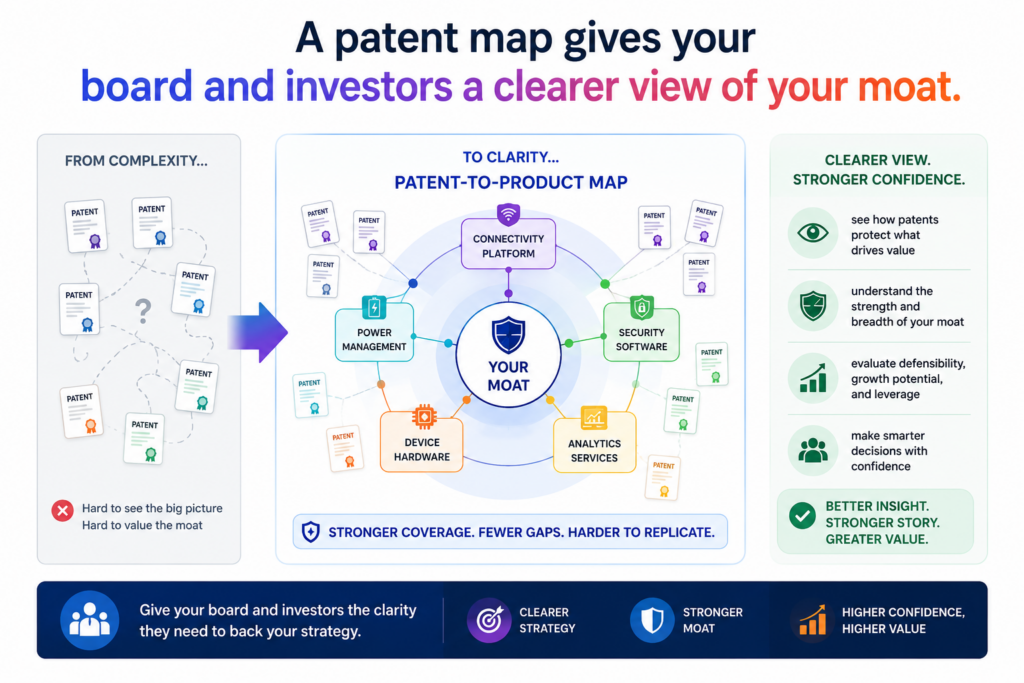
A patent-to-product map helps you show it.
It lets you explain how your protection lines up with your product edge. It shows which filings support the core platform, which support near-term features, and which support future growth.
It also shows that your patent work is not random or only done for show.
This matters because investors do not want vague comfort. They want confidence.
They want to know that the company understands what makes it hard to copy. They want to see that the team is turning technical work into durable business value.
A patent map can make that story much stronger.
Instead of saying, “We have patents pending,” you can explain how your filings protect the parts of the product that create speed, accuracy, scale, cost savings, safety, or customer lock-in. That is a better answer. It connects IP to the business.
A board-ready map should focus on meaning, not file clutter
A board does not need every detail from every filing. They need the pattern.
They need to see the product areas that matter most. They need to know where protection exists.
They need to know where the gaps are. They need to know what the next filing priorities are and why those priorities support the company plan.
A strong map can make this simple. It can show that the company has protection around the core system, active review around the next release, and open questions around a future product line.
It can also show which areas need more invention capture from engineering.
That helps the board give better guidance. It also helps the founder defend budget for the patent work that truly matters.
Patent mapping can make fundraising conversations sharper
Fundraising is not only about what you have built. It is about what you can keep.
A founder can have an amazing product, but investors may still worry that a larger company could copy it. A clear patent map helps answer that concern. It does not promise that no one will compete.
No smart founder should say that. But it does show that the company has thought carefully about the parts of the product that matter.
That can change the tone of the conversation.
The founder sounds more prepared. The company looks more serious. The product story and the patent story support each other.
The investor can see that the team is not treating patents as a checkbox. They are using them as part of a real portfolio strategy.
This is why patent-to-product mapping is so useful before a funding round. It helps clean up the story before tough questions arrive.
PowerPatent helps founders do this in a structured way, with smart tools and attorney support that keep the process clear. See how it works here: https://powerpatent.com/how-it-works
Mapping can reveal when your portfolio is too narrow
One of the most useful things a patent map can show is whether your filings are too close to the current product.
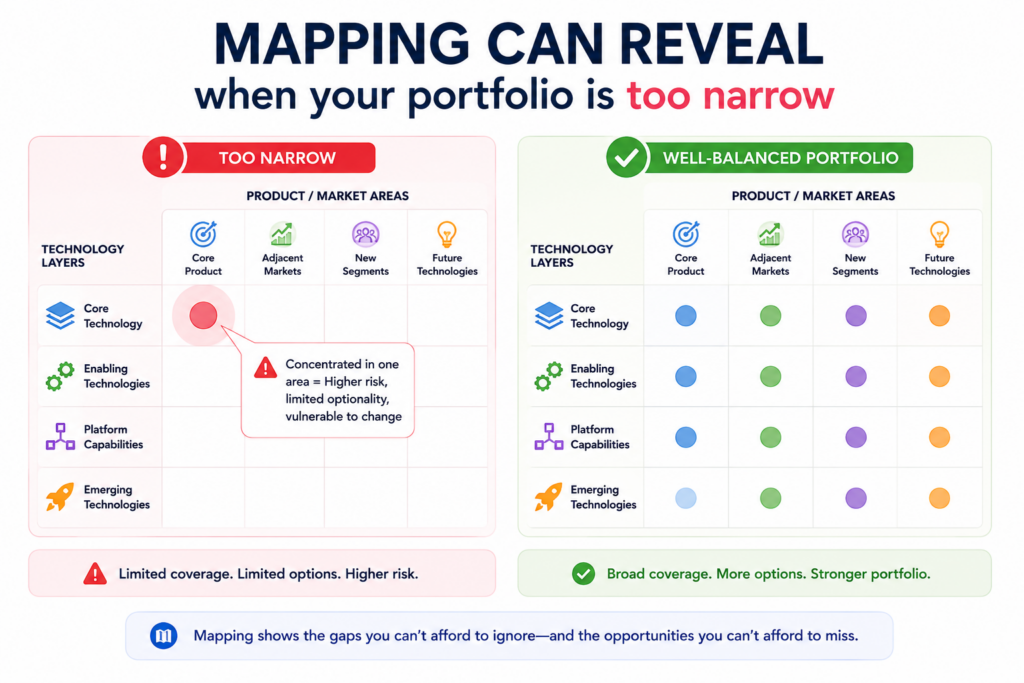
This may sound strange. You do want patents tied to the product. But if every filing only covers the exact current version, the portfolio may not do enough.
Competitors may be able to make small changes and move around it. The company may also outgrow its own filings as the product expands.
A strong portfolio should protect today’s product while also supporting the direction the product is likely to go.
That means your map should not only ask, “Does this filing cover what we built?” It should also ask, “Does this filing support where we are going?”
This is where the map becomes strategic.
It can show whether filings are focused only on one feature, one workflow, one model version, one device shape, or one narrow use case. If the business is moving beyond that, the patent plan may need to grow too.
A narrow filing may still be useful, but it should not be the whole strategy
Narrow filings are not always bad. Sometimes a specific improvement is valuable and worth protecting. A focused patent can be useful when it covers a key technical step or a feature that competitors are likely to copy.
The problem comes when the full portfolio is narrow by accident.
That happens when filings are made one at a time without a product map. Each filing may look fine on its own. But when seen together, they may not cover the full product story.
They may miss the platform layer. They may miss the data flow. They may miss the control method. They may miss the future market direction.
A patent map makes this visible. It helps the founder see whether the portfolio has depth or only scattered points of coverage.
The map should help you protect the platform, not just the feature
Many startups begin with one strong feature. Over time, that feature becomes a platform. The system expands. New use cases appear. Customers ask for more. The product becomes part of a larger workflow.
If the patent strategy stays locked on the first feature, it may fall behind.
A good patent map helps you notice when the company is shifting from feature to platform. It can show which filings still matter, which ones need follow-on work, and which new layers deserve review.
For example, a startup may begin with a tool that automates one task. Later, the value may move into the way the system learns across many tasks. That learning layer may deserve its own patent review.
Another company may begin with a device. Later, the real value may sit in the software that controls a fleet of devices. That control layer may need attention.
The point is simple. Your patents should grow with the product. A living map helps make that happen.
Mapping can show when your product has moved faster than your patents
Fast teams change the product often. That is good. It means the company is learning. It means the team is listening to customers. It means the product is getting stronger.
But there is a hidden risk. The patent portfolio may not keep up.
A patent filed six months ago may have matched the product at that time. But since then, the team may have changed the system, improved the model, replaced a workflow, added a new data source, or found a better way to solve the main problem.
The old filing may still be useful, but it may no longer match the strongest version of the product.
This is why patent-to-product mapping should be updated as the product changes. The map should not be a one-time document. It should be a living view of what the company has built, what has been protected, and what needs a fresh look.
A startup does not need to slow down to do this. The process can be light. The team only needs a clear habit of checking major product changes against the patent map.
The current product should be reviewed against the current portfolio
A simple review can reveal a lot. Look at the product as it works today. Then look at the patent filings and invention notes. Ask whether the strongest product areas are still reflected in the portfolio.
This review may show that the current product is well covered. That is a good result. It may also show that the best new features have no matching filing.
It may show that a patent covers a method the company no longer uses. It may show that a new customer workflow has become more important than the original invention.
These findings are not bad news. They are useful signals. They help the founder make better choices before a funding round, launch, partnership, or acquisition talk.
PowerPatent helps teams keep this work organized, so patent strategy can move with the product instead of falling behind it.
With smart software and real attorney oversight, founders can keep more control over what gets captured and reviewed. See the process here: https://powerpatent.com/how-it-works
A stale patent map can create false comfort
The biggest danger is not having weak coverage. The biggest danger is thinking you have strong coverage when the product has moved on.
False comfort can lead to poor choices. A founder may tell investors that the core product is protected, while the filings only cover an older version.
A team may launch a major feature without realizing it is outside the current portfolio. A buyer may ask detailed questions and find gaps the company has not prepared to explain.
A living map helps prevent this. It gives the team a clear view of the truth. It may show strength. It may show gaps. Either way, the founder can act with more confidence.
The goal is not to make the patent story sound better than it is. The goal is to make it real, current, and useful.
A good map helps you plan follow-on filings with more care
The first patent filing is often only the start. As the product grows, the team may find better methods, new use cases, stronger workflows, and smarter technical paths. These later improvements can be very valuable.
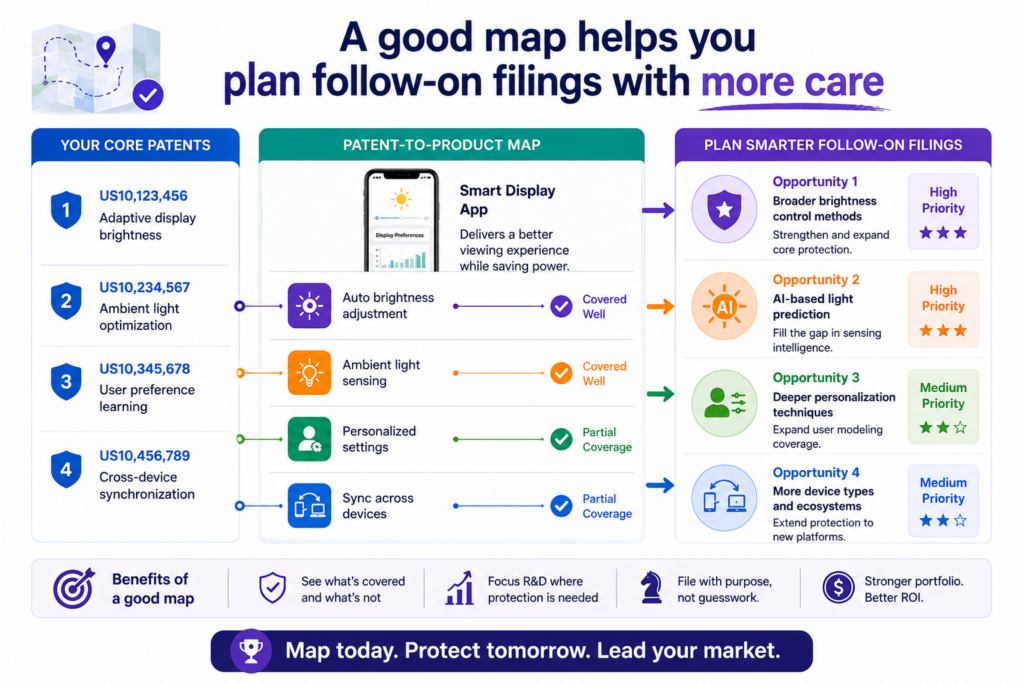
Follow-on filings help capture that growth. But they should not be random. They should come from the product map.
A patent-to-product map helps you see which areas deserve more coverage. It shows where the first filing was strong, where it was narrow, and where the product has developed beyond the original idea.
It also helps the attorney understand how the invention has changed over time.
For startups, this is a smarter way to build a portfolio. Instead of filing one broad idea and hoping it covers everything, the company can keep building protection around the product as the product becomes clearer.
Follow-on filings should protect the lessons the team learned while building
The best improvements often come from hard lessons. The team may learn that the first model worked in clean data but failed with noisy data.
They may learn that a device worked in the lab but needed a new control method in the field.
They may learn that users ignored one workflow but loved another. They may learn that scale created a new problem that required a new technical fix.
These lessons can become patent-worthy inventions.
A patent map helps capture them because it connects product changes to the original filing area. It shows how the system has improved.
It helps the attorney see what is new, what is useful, and how the company’s edge is getting stronger.
This is much better than waiting until the team has forgotten the path. When invention capture happens close to the work, the filing can include richer detail and a clearer story.
The best follow-on strategy protects the product’s direction
A follow-on filing should not only protect a small tweak. It should support where the product is going.
If the company is moving from one customer type to another, the filing strategy may need to reflect that. If the product is shifting from a tool into a platform, the patent map should reveal which platform layers need review.
If the team is expanding from one use case into many, the portfolio should be checked against that broader path.
This is where founder judgment matters. The attorney can help shape the filing, but the founder often sees where the company is headed. A strong map brings those views together.
PowerPatent makes this kind of planning easier for technical teams. It helps founders turn product progress into clear patent action, with attorney support built into the flow. You can learn more here: https://powerpatent.com/how-it-works
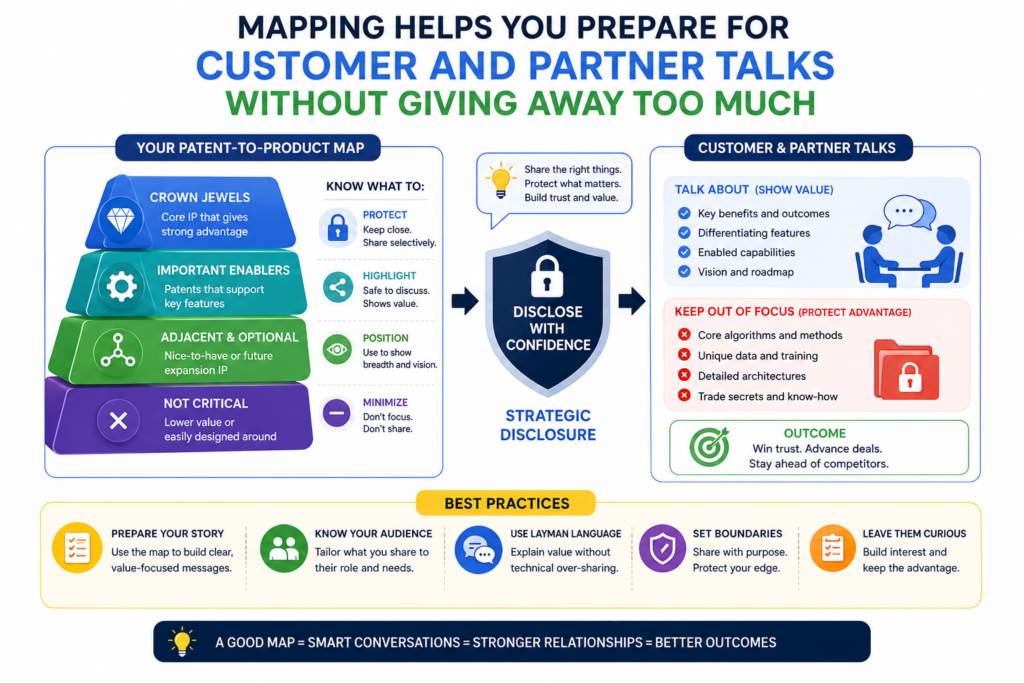
Mapping helps you prepare for customer and partner talks without giving away too much
Startups need to talk about their product. They need to sell. They need to raise money. They need to recruit. They need to run pilots. They need to build trust with partners.
That often means sharing technical details.
The problem is that some details should not be shared too early or too freely. A patent-to-product map helps the team know what is safe to discuss, what has already been filed, and what should stay private until reviewed.
This is not about being secretive in a way that hurts sales. It is about being careful. A founder should be able to explain the value of the product without exposing the exact method that creates the edge.
A map gives the team that control. It separates the customer story from the internal technical story. It helps sales and product teams speak clearly without creating avoidable risk.
The team should know which product details are public, filed, or still private
A useful map can show the status of each key product area. Some parts may already be public. Some may be covered by filed patents.
Some may be under review. Some may be kept as internal know-how. Some may be planned for a future filing.
This status view helps the team make better choices in real conversations.
For example, a founder may be able to say that the system reduces review time by half, but avoid explaining the full backend ranking method.
A product lead may be able to demo the workflow, but not share the data process that makes it work. A sales person may be able to talk about outcomes, while leaving the technical steps out of the deck.
This keeps the company moving. It does not block the business. It simply helps the team speak with more care.
A patent map can reduce mistakes in decks, demos, and calls
Many leaks do not happen through bad intent. They happen because a team is moving fast.
A slide includes too much detail. A demo shows an internal step. A customer call explains the method behind the feature.
A conference talk reveals the system design. A public post shares a breakthrough before the patent work is ready.
A patent map can help prevent this by giving the team a clear reference before external sharing. When a new deck is being made, the team can check whether the technical detail is already filed or still private.
When a demo is planned, the team can review what should be shown and what should stay hidden.
This is especially useful for deep tech startups, where the line between product value and technical secret can be thin.
PowerPatent helps founders keep this process more organized, so invention capture and attorney review happen before key details are exposed. See how it works here: https://powerpatent.com/how-it-works
A strong map can help you spot licensing and partnership value
Patent-to-product mapping is not only about defense. It can also show new business options.
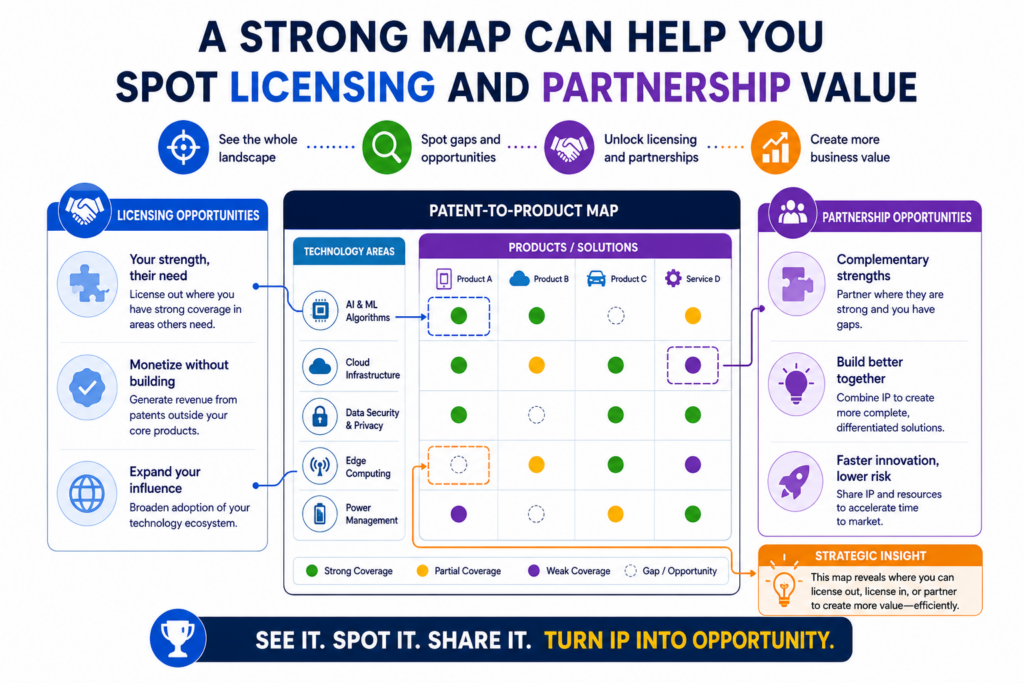
Sometimes a patent covers a product layer that has value beyond the company’s main product.
It may apply to another market, another customer type, another device, another workflow, or another industry. Without a map, that value may stay hidden.
When you map patents to product functions and business outcomes, you can see where else the same invention may matter. This can help with licensing, partnerships, joint development, and strategic deals.
This is not the main goal for every startup. Many founders should stay focused on building and selling their core product. But even then, it is useful to know where the portfolio may create extra leverage.
A clean map helps the company see those options without losing focus.
One invention may support more than one product path
A technical method built for one product can sometimes help in another area. A model training method may apply to more than one kind of data. A control system may work across several device types.
A workflow engine may support many customer processes. A sensor method may be useful in more than one market.
A patent map can show these links. It can connect one filing to multiple possible product paths. It can also show which paths are active now and which may be future options.
This is useful in partner talks because it helps the founder explain the value of the invention without sounding vague. The company can show that a patent is tied to a real product today and may also support future growth.
That kind of clarity can make strategic talks stronger.
Mapping can help you avoid giving away rights too cheaply
Partnerships can be exciting, but they can also create risk. A larger company may want broad rights.
A customer may ask for special access. A partner may want ownership of improvements. A joint project may create new inventions.
If the startup does not understand how its patents map to the product, it may give away too much.
A clear map helps the founder see what is core and what is not. It helps the company protect the parts of the product that must stay under its control. It also helps the attorney review deal terms with more context.
This can matter a lot. The wrong deal can limit future growth. The right deal can open a market while keeping the company’s core edge safe.
Patent-to-product mapping gives the founder a better view before signing anything. It helps turn patents into a business asset the team can use with care, not just a set of files that sit in the background.
Conclusion
Patent-to-product mapping helps founders see what is protected, what is exposed, and what should be filed next. It keeps patents close to the real product, the roadmap, and the parts of the business that create value. This gives your team more control, cleaner investor answers, stronger planning, and fewer costly surprises.
The best patent strategy is not a pile of papers. It is a living system that grows with what you build. PowerPatent helps startups do this with smart software and real attorney oversight, so you can move fast and protect what matters: https://powerpatent.com/how-it-works
Leave a Reply