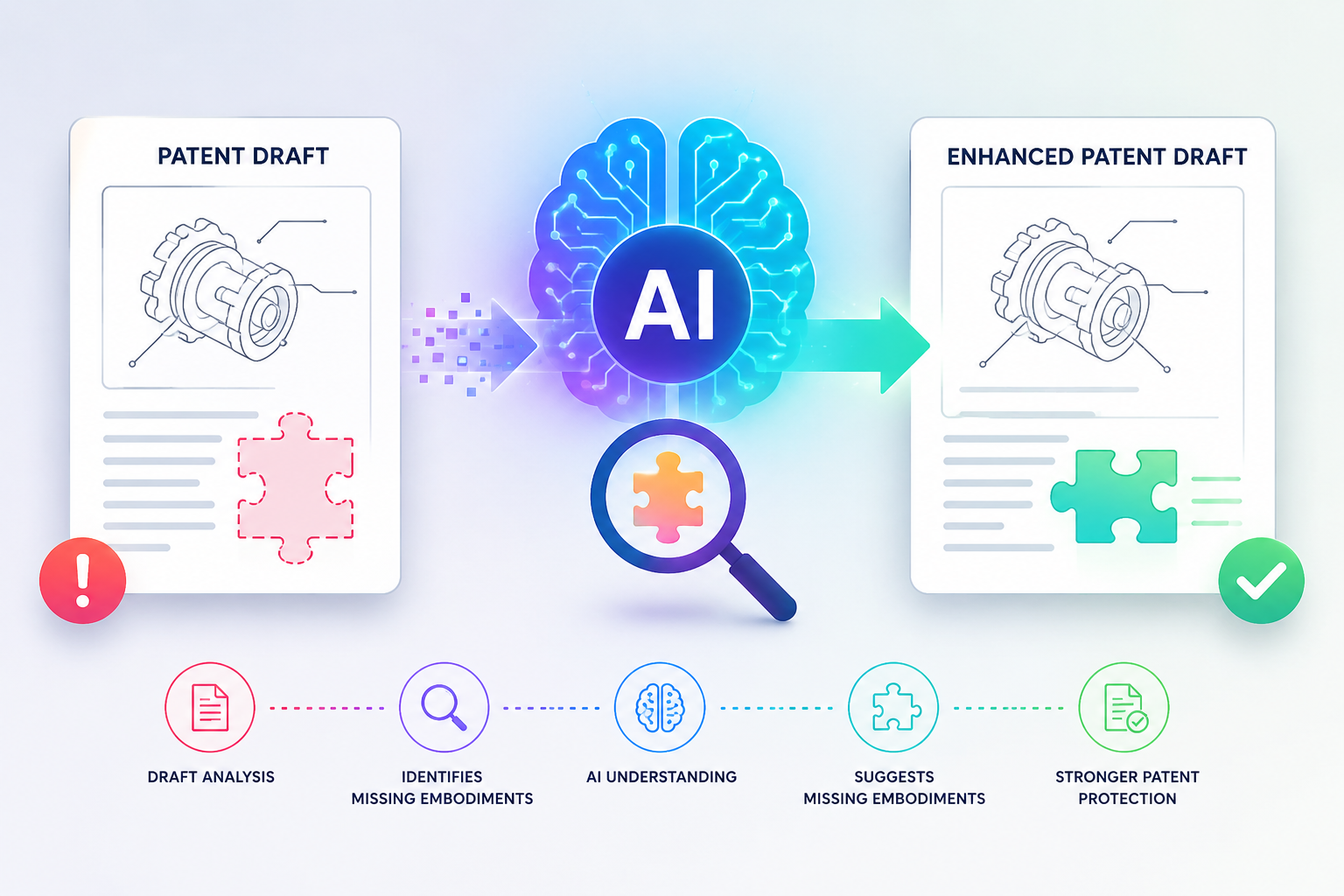
A patent draft is only as strong as the invention paths it covers. The problem is simple: when founders and engineers explain an invention, they often describe the main version first. That version may be right, useful, and clear. But it may not be the only way the invention can work.
Why missing embodiments quietly weaken patent drafts before anyone sees the problem
A patent draft can feel strong because it explains the main invention well. It may show the core system, the main method, and the key benefit. It may even sound polished.
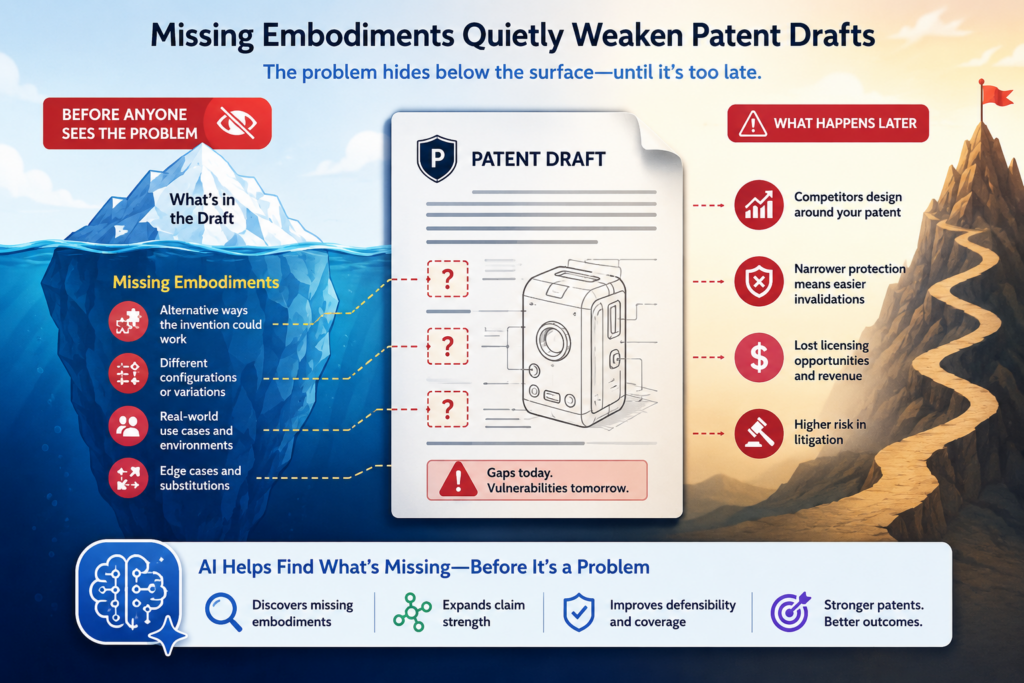
But a polished draft can still miss the full shape of the invention. That is where many startups lose value without knowing it.
An embodiment is just one way the invention can be made, used, trained, run, arranged, or changed. Think of it as a version of the idea. For a software invention, one embodiment may run on a cloud server.
Another may run on a phone. Another may run inside an edge device. Another may use a machine learning model that is updated over time.
Another may use fixed rules instead of a model. The heart of the invention may be the same, but the setup can change.
This matters because startups rarely build only one version forever.
A founder may start with one workflow, then add new data types, new user roles, new devices, new model layers, new outputs, or new ways to connect with other tools.
If the patent draft only covers the first version, it may not match the product six months later.
That is the quiet risk.
The first draft often reflects the first demo, not the full invention. Engineers explain what works right now. Product teams explain what users see right now. Founders explain the feature they plan to ship right now.
But a patent should not only protect the current screen, current API call, current model, or current hardware setup. It should also protect the smart idea behind those things.
This is why missing embodiments are so costly. They can make a patent draft too narrow. A narrow draft may give a competitor an easy path around the patent.
The competitor may keep the same core idea but change the input, output, order of steps, deployment style, user interface, or data source. If those other versions were never described, the patent may not give the startup the room it thought it had.
PowerPatent helps founders avoid this kind of blind spot by using smart software to review invention details with real attorney oversight. The goal is not to make the process more complex.
The goal is to help founders see more of their own invention before it is locked into a filing. You can see how that works here: https://powerpatent.com/how-it-works
The draft usually starts with the version the team knows best
Most invention notes are written from memory. An engineer may describe the version they built.
A founder may describe the version they pitched. A product lead may describe the version users will touch. Each view is useful, but each view can also leave things out.
For example, a team may say, “The system receives sensor data and predicts failure.” That may be true, but it does not say enough. What kind of sensor data? Is it vibration, heat, sound, pressure, image data, or log data?
Does the system need live data, or can it work with stored data? Does the model make a score, a warning, a repair plan, or a control signal? Can it work on a machine, a car, a robot, a drone, or a factory line?
Those questions point to possible embodiments. They are not random extras. They are the natural branches of the invention. If the draft does not explore them, the invention may be described as smaller than it really is.
This happens even with very strong technical teams. In fact, it often happens because the team is strong. Engineers move fast.
They focus on what is real, tested, and useful. They do not always stop to write down every version that could work. That is not a flaw. That is how builders build.
But patent drafting has a different job. It needs to capture the invention in a way that still makes sense when the product grows. That is why the draft must look beyond the first working example.
Missing embodiments can hide inside normal product choices
A missing embodiment does not always look like a big missing chapter. Sometimes it is just one choice that was treated as fixed when it should have been treated as flexible.
A draft may say the model is trained using images. But the same idea may also work with video, depth data, radar data, audio data, text records, or mixed data.
A draft may say the system sends an alert to a user. But the same idea may also trigger an automated action, open a ticket, change a device setting, block a transaction, update a risk score, or call another service.
These details can seem small while drafting. They are not small when a competitor is looking for a workaround.
A good patent draft should show the main path and the nearby paths. It should make clear that the invention is not trapped inside one exact demo.
AI can help by reading the draft and asking, in effect, “What else could this be?” That simple question, asked across the whole draft, can reveal gaps that are easy to miss by hand.
How AI spots narrow language that may leave strong versions uncovered
AI is useful in patent drafting because it can inspect language with a kind of patient attention that humans do not always have time for.
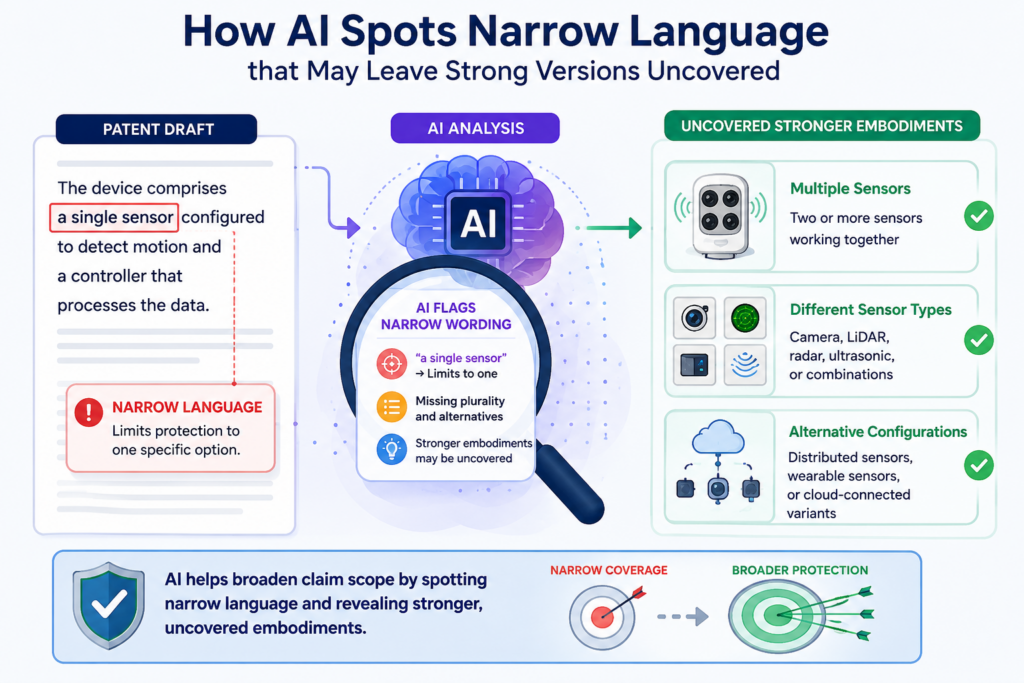
It can read the same idea across the title, summary, drawings, detailed description, and claims. It can notice when one part says the invention is broad, while another part quietly limits it to one version.
This matters because narrow language often slips into drafts by accident. A founder may say “mobile app” because that is the first product.
But the same process may also work through a web app, dashboard, browser plug-in, command line tool, embedded screen, or API.
An engineer may say “neural network” because that is what the current system uses. But the broader invention may work with other model types, rules, search methods, scoring systems, or hybrid logic.
AI can flag those words and ask whether they are meant to be strict limits.
It can point out places where the draft says “must,” “only,” “required,” “always,” or “the user device” when softer and broader wording may better match the invention. It can also help find places where one example became the whole invention by mistake.
That does not mean AI should replace judgment. It means AI can help bring the right issues to the surface faster.
A real patent attorney still needs to decide what should be included, what is supported, and how the invention should be framed. But AI can make the review sharper by finding patterns and gaps across many pages.
This is one reason PowerPatent is built around both software and attorney oversight. Software can move fast through the draft. Attorneys can apply care, strategy, and judgment.
Together, they help founders move with speed while still taking the draft seriously. Learn more about that process here: https://powerpatent.com/how-it-works
AI can compare the invention against nearby technical choices
One of the best ways AI helps is by asking what other technical choices could serve the same role.
If a draft says the invention uses a database, AI can help prompt whether that database could be local, cloud-based, distributed, encrypted, temporary, shared, private, or split across systems.
If a draft says the system receives user input, AI can ask whether the input could come from text, speech, gesture, sensor signals, uploaded files, or another machine.
This is powerful because many embodiments are not wild guesses. They are normal engineering options. A system that processes one kind of input may process another.
A model that runs in one place may run somewhere else. A decision made by software may be made by firmware, hardware logic, or a mix of parts. A result shown on a screen may also be sent to another system or used to control a device.
AI can help map these choices. It can look at each part of the invention and ask whether there are other ways to perform the same function.
This can help the drafting team build a richer description without losing the core story.
The key is not to add empty filler. A strong draft should not throw in random versions just to look bigger.
It should include real, plausible versions that fit the invention. That is where human review matters. AI can suggest. The attorney and inventor can decide.
Narrow terms can be changed only when the invention supports it
There is a right way and a wrong way to broaden a draft. The wrong way is to replace every specific word with a vague word and hope that helps.
That can make the draft weak, confusing, or unsupported. The right way is to add clear examples that show how the invention can work in different forms.
For example, instead of only saying the system uses “camera images,” the draft may explain that the system can use image data from a camera and, in some versions, may use video frames, depth readings, thermal data, or other sensed data that represents the same scene or condition.
That gives the reader real support. It also keeps the draft understandable.
AI can help find the spot where this kind of support is needed. It can flag the narrow term, suggest nearby options, and help draft language that explains the options in plain technical detail.
Then the attorney can check whether those options make sense for the invention.
This is especially useful for deep tech startups. Many inventions sit at the edge of software, hardware, data, and models.
A small wording choice can make the invention sound like it only works in one stack, on one device, or with one model. AI can help catch that early, before the draft is filed and before those choices become harder to fix.
How AI helps uncover missing software, hardware, and data embodiments
Many modern inventions do not live in one box. They move across code, cloud systems, models, devices, sensors, chips, data stores, user tools, and outside services. That makes patent drafting harder.
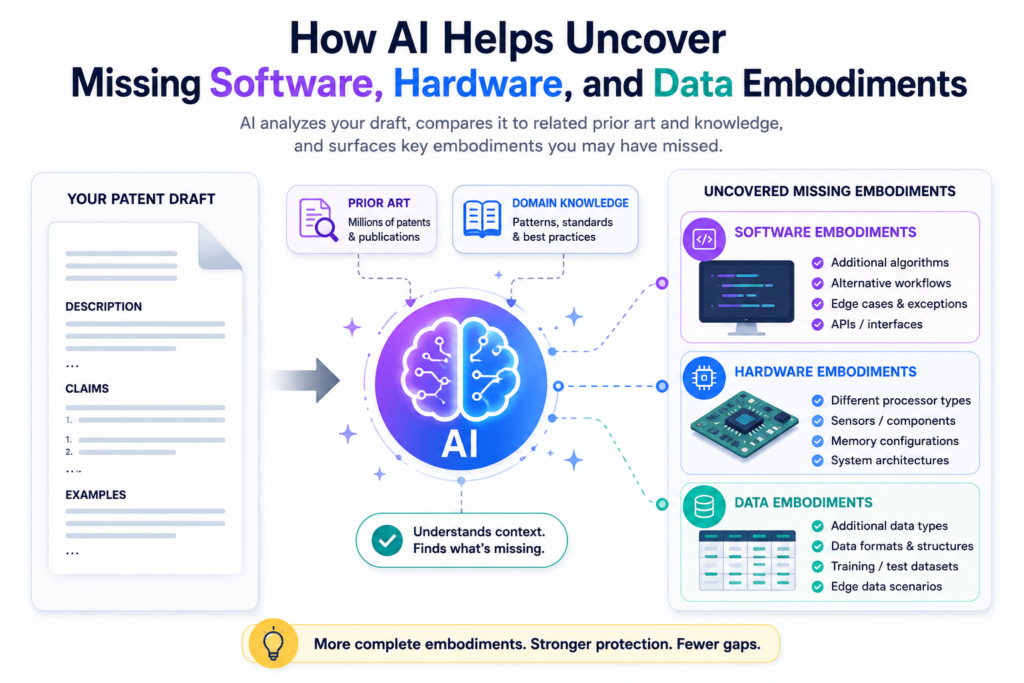
The draft has to explain the invention in a way that covers the real system, but it also has to show the other ways the system can be built.
AI helps by breaking the invention into parts. It can look at where data comes from, where it goes, what changes it, what decisions are made, what outputs are produced, and what happens after the output. Then it can ask whether each part has more than one possible form.
For software, AI may help find missing embodiments around where the process runs.
The invention may run on a server today, but it could also run on a user device, a browser, a private cloud, an edge node, a vehicle, a robot, or a gateway.
It may be sold as a full app now, but later it may be part of an SDK, API, plug-in, workflow tool, or background service.
For hardware, AI may help spot missing embodiments around physical parts. A draft may name one sensor, processor, memory type, network link, display, controller, or device.
But the same invention may work with other parts that serve the same role. A robotics invention may use one arm design today, but the control method may work across many machines.
A medical device invention may use one measurement setup, but the core signal process may apply to other tools. A chip invention may be described in one layout, but the logic may be used in other arrangements.
For data, AI may be even more helpful. Data is often where hidden value lives. A draft may say the invention uses training data, user data, event data, image data, sensor data, transaction data, or log data.
But that may not be enough. The draft may need to explain raw data, cleaned data, labeled data, synthetic data, private data, public data, live data, stored data, combined data, and data made by another model.
When these details are missing, the draft may not fully protect the way the startup actually grows.
AI can trace the full path from input to action
A strong patent draft should not stop at the first output. In many inventions, the real value is what happens after the system makes a result.
The result may update a model, change a machine setting, suggest a next step, rank choices, block a risky action, create a report, send a command, or start a new process.
AI can help trace this chain. It can read the draft and ask whether the flow ends too early. If the draft says “the system generates a prediction,” AI can help ask what the prediction does.
Does it help a person decide? Does it change the next input? Does it tune a model? Does it control hardware? Does it trigger a message? Does it create a new record? Does it feed another model?
These downstream actions are often important embodiments. They show how the invention is used in real life. They can also make the draft more useful because they connect the technical idea to practical outcomes.
For founders, this is a big deal. Investors, partners, and buyers often care about the full product, not just the first calculation. A patent draft that covers the full path can better reflect the value of the company.
That is why PowerPatent focuses on helping teams turn their real technical work into stronger patent filings with less friction. You can explore the workflow here: https://powerpatent.com/how-it-works
The best embodiments often come from asking what could change without changing the core idea
A useful test is simple. Ask what parts of the invention could change while the core idea stays the same. The device may change. The model may change. The data may change.
The user may change. The output may change. The timing may change. The order of steps may change. The place where the work happens may change.
AI is good at asking that question many times across the draft. It does not get tired. It does not assume that one example is enough. It can keep checking whether the draft has covered the likely versions a builder, buyer, or competitor may care about.
But the goal is not to make the draft endless. The goal is to make it complete in the right places. A founder does not need a pile of legal words.
A founder needs a draft that protects the real shape of the invention. AI helps by finding the missing shapes. Attorney review helps decide which ones belong in the filing.
That mix is what makes the process practical. The founder can keep building. The draft can still get deeper. The company can move faster without treating patents like an afterthought.
How AI helps turn one working example into a wider set of protected versions
A working example is a great starting point for a patent draft, but it should not be the whole story. Most inventions begin with one clear version because that is what the team built, tested, or showed to customers.
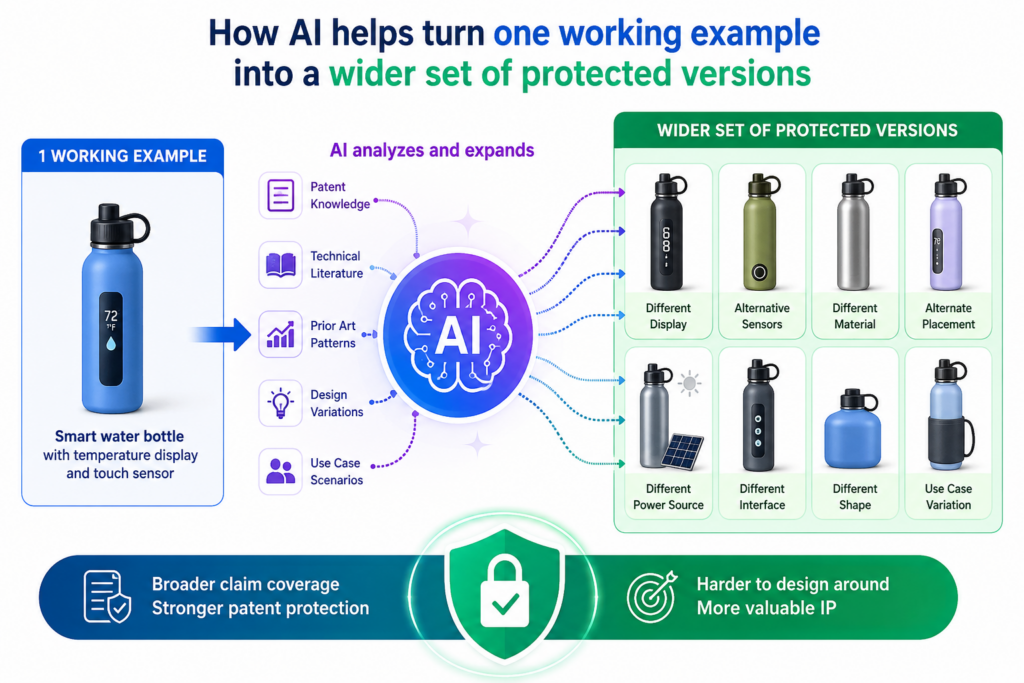
That version matters. It proves the idea can work. It gives the draft real detail. It helps the attorney understand the invention.
But a patent draft needs to do more than describe the first working version. It should help protect the idea as it grows.
This is where AI can be very useful. AI can look at the working example and help stretch it in smart ways. Not fake ways. Not random ways. Smart ways that follow from the invention itself.
For example, a startup may have built a tool that reviews code and finds security risk. The first version may scan Python code in a cloud repo. That is one embodiment.
But the deeper invention may also work with JavaScript, smart contract code, mobile app code, firmware, or machine-generated code.
It may run during a pull request, during local development, inside a CI pipeline, or after release. It may send a warning, suggest a patch, block a merge, open a ticket, or update a risk score.
If the draft only talks about the Python cloud repo version, the patent may miss much of the value.
AI can help by asking what else the system could scan, where else it could run, what else it could produce, and what other actions could follow.
It can also compare the draft against the founder’s own product notes, diagrams, claims, and technical records to see whether some ideas were mentioned in one place but left out of another.
This helps turn the draft from a snapshot into a fuller map. A snapshot shows what exists now. A map shows where the invention can go.
That is important for startups because the product will almost always change. The first version is rarely the final version.
A patent draft that only matches the first product may feel safe today and feel too small later. A stronger draft gives the company room to grow.
PowerPatent helps founders build this kind of draft without turning the process into a long, painful project.
The platform helps organize the invention, surface missing details, and support attorney review, so the final work is more complete and easier to trust. You can see the process here: https://powerpatent.com/how-it-works
The first version should be used as a launch point, not a fence
One mistake founders make is thinking that the patent should only describe what has already been built. That is too narrow.
Another mistake is thinking the patent can describe anything at all, even ideas that have no real link to the invention. That is too loose.
The better path sits in the middle. The draft should start with the real version and then describe other versions that are natural, useful, and tied to the same core idea.
AI can help find that middle path. It can read the working example and identify the main roles inside it.
There may be an input, a filter, a model, a score, a rule, a user action, a storage step, and a feedback loop. Then AI can suggest other ways each role may be handled.
This is more useful than simply making the wording broader. Broad words without support can feel empty.
Clear examples make the draft stronger. They show that the inventor understood the invention beyond one exact build.
For a technical founder, this can be a major unlock. You do not need to become a patent expert.
You need a process that helps pull more of the invention out of your head and into the draft. That is where AI can reduce the mental load.
A wider draft can still stay clear and focused
Some founders worry that adding more embodiments will make the draft messy. That can happen if the draft is not handled well.
But when done correctly, more embodiments can make the draft clearer because they show the true pattern behind the invention.
The key is to group related versions around the same idea. A draft does not need to wander.
It can explain the main system, then show how the input may vary, how the processing may vary, how the output may vary, and how the system may be deployed in different settings. Each part should serve the main invention.
AI can help keep this organized. It can suggest where a missing embodiment belongs. It can help avoid repeating the same concept in five different places. It can also help keep terms consistent so the reader does not get lost.
This is a practical benefit. Strong patent work is not just about adding more words. It is about adding the right words in the right place.
When AI helps find missing versions and a patent attorney shapes them with care, the draft can become broader without becoming bloated.
How AI helps find missing model and machine learning embodiments in patent drafts
AI and machine learning inventions are especially easy to under-describe.
A team may know the model works, but the patent draft may not explain enough about how the model is trained, updated, used, tested, or combined with other parts of the system. That can leave major embodiments out.
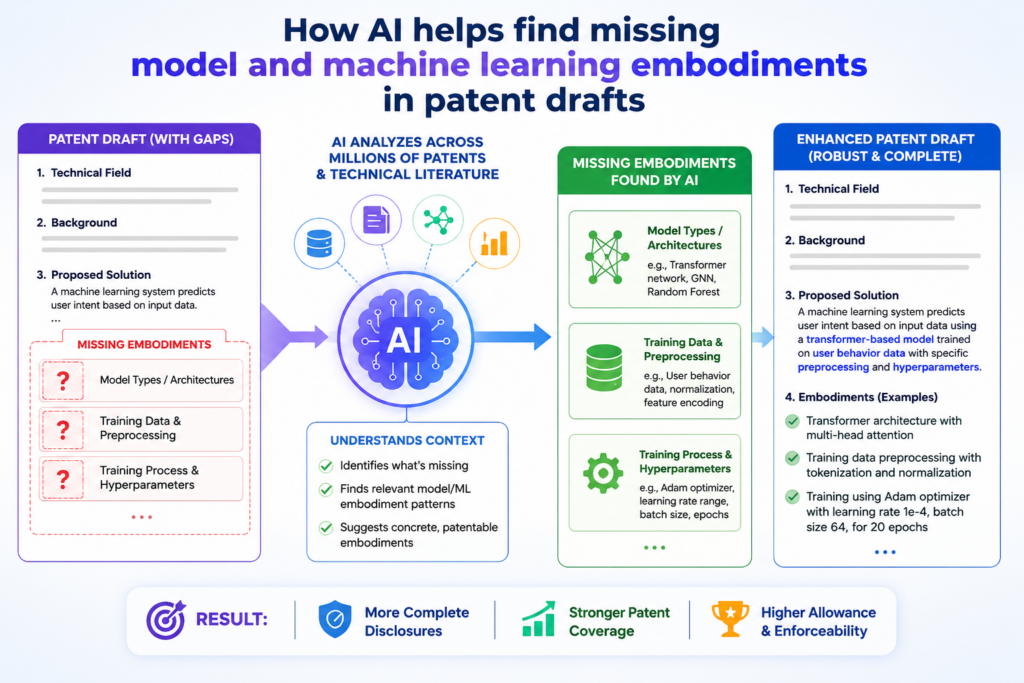
This is a common problem because machine learning teams often talk in shorthand. They may say, “We use a model to classify the input.”
That sounds clear inside the company, but it may be too thin for a patent draft. What kind of input? What kind of model? What features are used?
Is the model trained once or updated often? Does it learn from user feedback? Does it use labeled data, synthetic data, or live data? Does it produce a class, score, ranking, forecast, control signal, summary, or next action?
Each answer may point to an embodiment.
AI can help because it understands that a machine learning system is not just “a model.” It is a chain. Data is collected. Data may be cleaned. Features may be made. A model may be trained.
The model may be tested. The model may be deployed. It may receive new data. It may create an output. That output may be used by a person, another model, or a machine. The result may feed back into the system.
A draft that skips parts of that chain may miss important protection.
For example, a startup may build an AI tool that predicts customer churn.
The first version may use account data and support ticket text. But the invention may also work with product usage data, billing data, chat logs, call notes, survey data, or events from other software tools.
The model may output a churn score, a reason code, a retention plan, or a suggested message. It may update weekly, daily, or after a key event.
Those are not minor details. They may describe the real value of the invention.
AI can help reveal these missing paths by asking what data the model may use, how the model may change, and how the output may drive action.
When paired with attorney review, those prompts can help turn a thin AI patent draft into something much stronger.
The model type is often less important than the role the model plays
Founders often focus on the model name. They may say the invention uses a transformer, classifier, neural network, regression model, decision tree, embedding model, or large language model.
That may be useful detail, but the patent draft should usually go deeper than a model label.
The real question is what the model does in the invention.
Does it detect a pattern? Does it compare items? Does it predict a future state? Does it rank options? Does it create new content?
Does it select a next step? Does it control a device? Does it improve another model? Does it decide when to ask a human for help?
AI can help shift the draft toward that deeper role. This matters because model names change fast.
A startup may use one model today and a better model next year. If the draft is locked too tightly to the first model type, the protection may not match the future product.
A stronger draft can describe the model type while also explaining the function the model performs. It can show that the invention may use different model forms as long as they serve the same inventive role.
That does not mean the draft should be vague. It means the draft should be flexible and clear at the same time. It can name examples, explain how they work, and show why they matter.
Feedback loops are easy to miss and often very valuable
One of the most important missing embodiments in AI drafts is the feedback loop. Many AI systems improve over time, but the draft may only describe one pass through the system. That can leave out a major part of the invention.
A feedback loop may happen when a user corrects an output, when a customer accepts or rejects a suggestion, when a device reports whether a control action worked, when a human labels a result, or when the system compares a prediction to what later happened.
That feedback may update a model, change a rule, adjust a threshold, select new training data, or trigger a review.
AI can help spot when the draft describes an output but does not explain what happens after the output.
It can ask whether the system learns from results. It can also help draft clear language around update cycles, review steps, and model changes.
For founders building AI products, this is huge. The learning loop is often the moat. It is where the product gets better with use. If the patent draft misses that, it may miss the part of the invention that matters most over time.
PowerPatent is built for this kind of technical depth. It helps teams capture not only the feature, but also the system behind the feature, with real patent attorneys helping shape the final filing.
See how PowerPatent helps founders move from invention to filing here: https://powerpatent.com/how-it-works
How AI helps reveal missing user, workflow, and business process embodiments
Many patent drafts focus heavily on the technical engine and say too little about the user flow around it. That can be a problem.
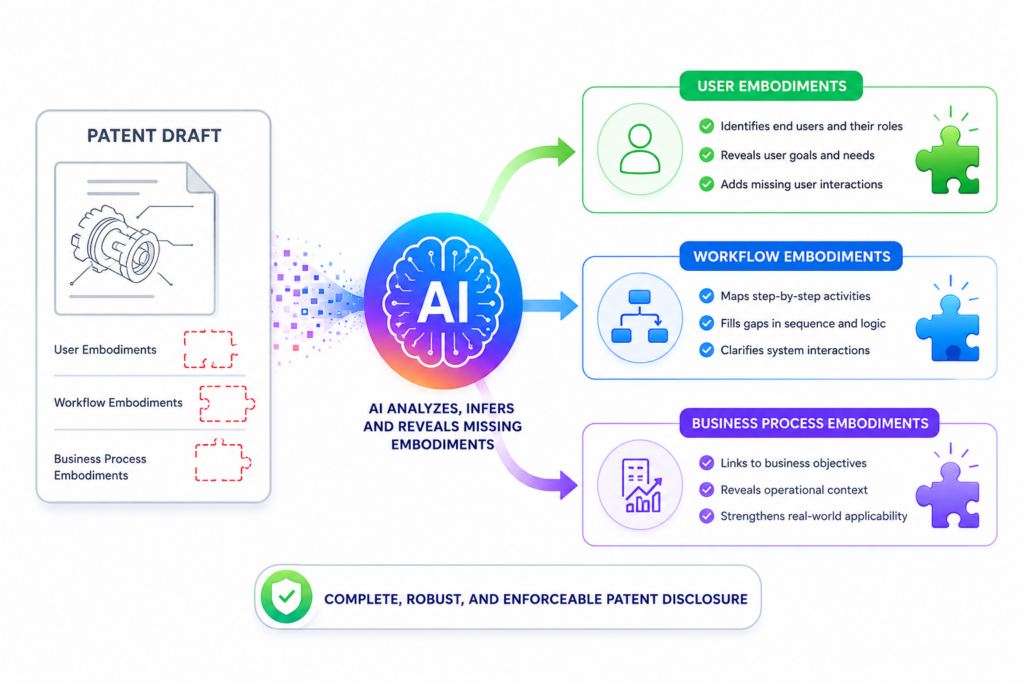
In real products, the technical idea often creates value because of how a person or system uses it. If the draft ignores the workflow, it may miss useful embodiments.
AI can help by reading the draft like a product map. It can look for the user, the task, the trigger, the action, the result, and the next step.
It can ask whether the system is used by one person, many people, an admin, a developer, a field worker, a doctor, a security analyst, a factory manager, or another software system.
It can ask whether the output is shown, stored, shared, approved, edited, ranked, routed, or acted on.
This matters because a product may serve different users in different ways. A founder may describe the invention from the end user’s view, while the patent draft may also need to describe the admin view, the developer view, the system view, or the machine-to-machine view.
For example, a tool that detects fraud may show a risk score to a human reviewer. But another embodiment may block a transaction automatically. Another may send a case to a review queue.
Another may require added identity checks. Another may update a risk profile. Another may train a model using the final decision. Each flow may matter.
A draft that only says “displaying an alert” may be too small.
AI can also help find timing embodiments. The system may act before an event, during an event, after an event, on a schedule, when a threshold is met, when a user asks, or when another system sends a signal.
Timing can change the value of the invention. In some products, acting early is the whole point.
This is why workflow review is so important. A patent draft should not only protect the engine. It should protect the engine inside the real way work gets done.
The user journey often shows embodiments the technical diagram missed
Technical diagrams are useful, but they can hide the human side of the invention. A diagram may show data moving from one box to another. It may not show why the data matters, who sees the result, or what action follows.
AI can help compare the technical diagram with the product journey.
If the product has onboarding, setup, permissions, review screens, alerts, dashboards, approvals, audit logs, or reports, those may point to additional embodiments. Some may be central to how the invention works.
For example, an AI tool for doctors may not only generate a suggestion. It may explain why the suggestion was made, show source data, ask for confirmation, record the doctor’s choice, and change future results based on that choice. Those workflow steps may be part of the invention’s real strength.
A patent draft that only describes the model output may miss the safer, more useful way the product is used.
This does not mean every screen needs a long section. It means the draft should capture the meaningful variations that support the invention.
AI can help find those variations faster by checking the draft against common product flows and the team’s own notes.
System-to-system workflows can be just as important as human workflows
Some of the best embodiments do not involve a human clicking anything. Many modern products run through APIs, background jobs, webhooks, agents, data pipelines, and automated control systems.
If the draft only describes a user interface, it may miss versions where the invention works without a normal screen.
AI can flag this issue. It can ask whether the invention can be triggered by another system, whether the output can be sent to another service, whether an action can happen automatically, and whether the process can run in the background.
For a startup, this can make the patent draft much more future-ready. The first product may have a dashboard because that is easy to sell.
Later, the same invention may become an API, an embedded feature, or an automated service. If those embodiments are missing, the patent may not follow the business as it grows.
That is why PowerPatent helps founders capture the invention from more than one angle. The goal is not just to file faster.
The goal is to file smarter, with a draft that reflects how the technology can actually be used. See how the platform works here: https://powerpatent.com/how-it-works
How AI helps find missing fallback versions when the preferred design changes
A strong patent draft should not depend on the perfect version of the product. Startups change fast. A model gets replaced. A sensor becomes too costly. A cloud service changes its rules.
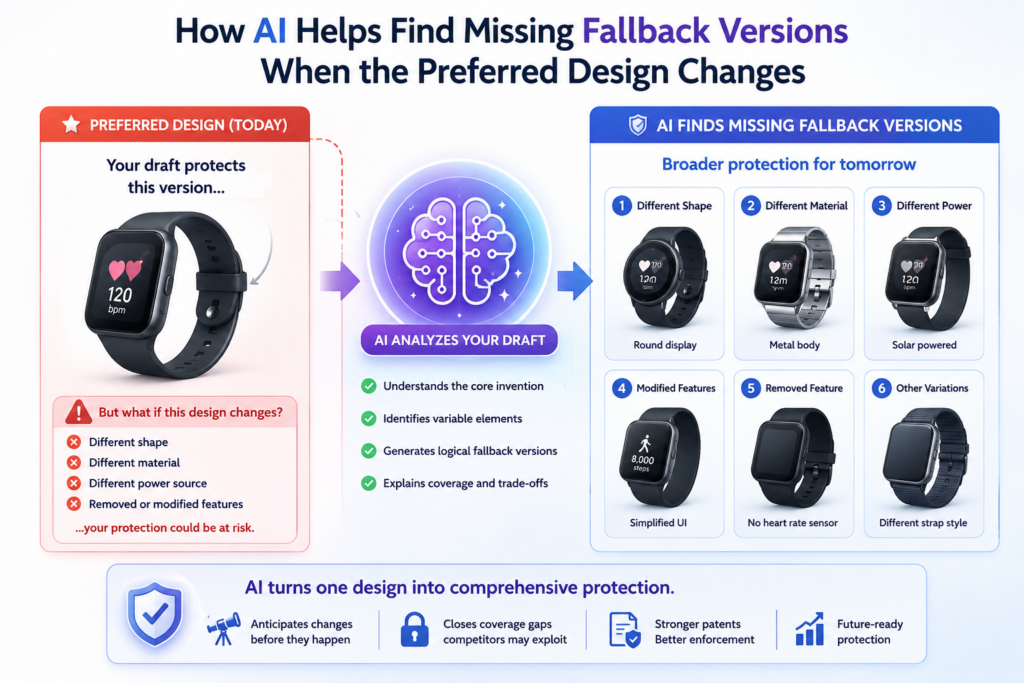
A customer asks for on-device processing. A partner wants a private setup. A buyer wants the system to work with old tools.
These changes are normal, but they can create a problem if the patent draft only describes the first preferred design.
AI can help find fallback versions before the draft is filed. A fallback version is another way to make the invention work when the best version is not used.
This can be a different input, a different model, a different device, a different order of steps, a different output, or a different way to connect the system.
For example, a startup may prefer to use live data because live data gives the fastest result.
But the same invention may also work with stored data, batch data, delayed data, sample data, or a mix of old and new data. If the draft only says live data, the invention may look smaller than it really is.
The same issue comes up with machine learning. A team may prefer one model because it performs best today.
But another version may use a smaller model, a rules-based engine, a search system, a ranking system, or a hybrid approach.
A draft that only names the preferred model may fail to show that the real invention is not locked to that single choice.
This is where AI can act like a careful reviewer. It can scan the draft for parts that seem fixed and ask whether they are truly required.
It can help the team separate what is essential from what is just the current build. That is a big deal because patents should protect the inventive core, not just the first stack.
PowerPatent helps founders do this without slowing the team down. The software helps surface gaps and missing versions, while real patent attorneys help decide what belongs in the draft.
That balance helps founders file with more confidence and less back-and-forth. See how it works here: https://powerpatent.com/how-it-works
A fallback version can protect the same value in a different form
The point of a fallback version is not to pad the draft. It is to protect the same value when the product takes a different path. This matters because real products almost never stay still.
The startup may enter a new market. It may support a new user type. It may move from a dashboard to an API. It may add hardware. It may remove hardware. It may shift from a human review process to an automated one.
AI can help identify which changes still keep the core invention intact. It can ask whether a step could be done before another step.
It can ask whether a person could approve the result, or whether the system could act on its own. It can ask whether data could be received from a sensor, a file, a user, another app, or a connected machine.
These questions are simple, but they are powerful. They help the team avoid writing a patent draft that only fits one narrow product path.
They also help attorneys ask better questions because the missing versions are brought into view earlier.
The best fallback versions come from real product pressure
The most useful fallback versions often come from the startup’s own product pressure. What have customers asked for? What has the team almost built? What did engineers debate?
What might be needed for a regulated customer, a large company, or a low-cost version? Those answers can point to embodiments that belong in the draft.
AI can help review meeting notes, invention notes, technical writeups, and draft sections to spot these paths. It may notice that one document mentions offline mode while the patent draft does not.
It may notice that a diagram shows an edge device, but the text only talks about cloud processing. It may notice that the claims mention a score, while the description never explains alerts, rankings, control signals, or reports.
Those gaps are not just writing issues. They can become business issues. A patent draft should support where the product may go next, not just where it sits today. AI helps make that future room more visible before filing.
How AI helps make patent drafts harder to design around without making them confusing
A competitor does not need to copy every detail to create risk. Sometimes they can keep the main idea and change one visible part.
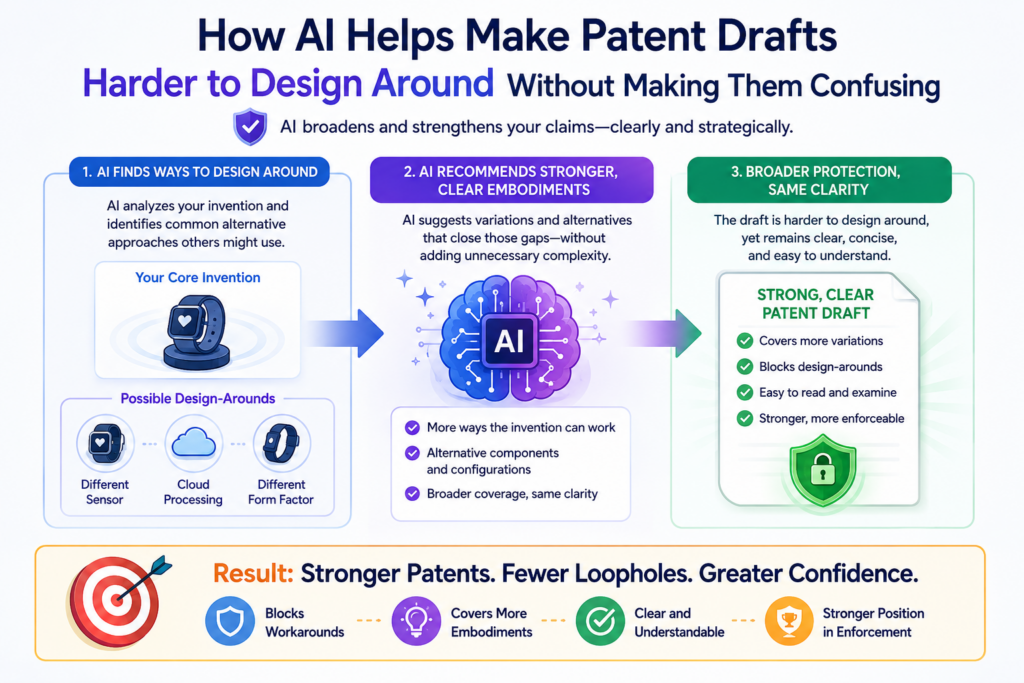
They may use a different data source, a different screen, a different model, a different timing rule, or a different delivery method. If the patent draft only covers one version, that change may be enough to move around it.
AI helps by looking for design-around paths. In plain words, it asks how someone might get the same benefit while avoiding the exact words in the draft.
This is not about guessing every future trick. It is about finding obvious alternate paths that should be considered while drafting.
For example, a draft may describe a system that sends a warning when a risk score is above a limit.
AI may ask whether the system could also sort items by risk, create a heat map, change access rights, pause a process, request more data, or route a case to a human. Those are different outputs, but they may serve the same goal.
A draft may describe a user uploading a file. AI may ask whether the file could instead come from an API, a shared folder, a browser extension, an email, a device, or another app.
A draft may describe a server doing the processing. AI may ask whether part of the work could happen on a phone, laptop, gateway, chip, robot, vehicle, or private network.
These questions help the draft cover the invention with more care. They also help avoid a common mistake: adding broad words without useful support.
The strongest drafts do not just say “other versions may be used.” They explain what those versions are and how they fit.
This is why PowerPatent combines smart AI with attorney review. AI can help surface the likely paths around the first draft. Attorneys can shape those findings into clear, useful language.
Founders get a stronger process without having to become patent experts. You can learn more here: https://powerpatent.com/how-it-works
A design-around review starts with what the invention actually does for the user
The best way to find design-around paths is to focus on the result the invention creates.
What problem does it solve? What hard thing does it make easier? What action does it enable? What cost, delay, or risk does it reduce?
Once that value is clear, AI can help ask how someone else might deliver the same value using a nearby setup. If the invention reduces review time, could the same result happen through ranking instead of filtering?
If it improves machine control, could the system send a setting instead of a command? If it improves model output, could the system change training data instead of changing the model itself?
This style of review keeps the draft focused on the useful invention rather than on surface details. It also helps avoid overfitting the patent to the product demo.
Product demos are built to sell. Patent drafts are built to protect. They need different kinds of detail.
Clear language is what keeps broader coverage from becoming a mess
A draft can become confusing when it tries to cover too much without structure. That is not what AI should be used for.
AI should help find the missing paths, then help place them in a clean order so the reader can follow the invention.
The structure may start with the main system. Then it can explain the input variations, processing variations, output variations, deployment variations, and feedback variations.
Each part should connect back to the same invention. That gives the draft breadth, but it also keeps the story clear.
This matters because clarity is not a nice extra. Clarity helps everyone. It helps the founder understand what is being filed.
It helps the attorney review the work. It helps investors and partners see the value. It helps the company avoid confusion later.
AI can support that clarity by checking whether the same part is named in different ways, whether a term appears once and never returns, whether a drawing shows something the text does not explain, or whether an embodiment is mentioned without enough detail. These checks can make the draft cleaner and stronger at the same time.
How AI helps connect the claims, drawings, and description so embodiments do not fall through the cracks
A patent draft has several moving parts. The claims define the invention in a tight way. The description explains the invention in more detail.
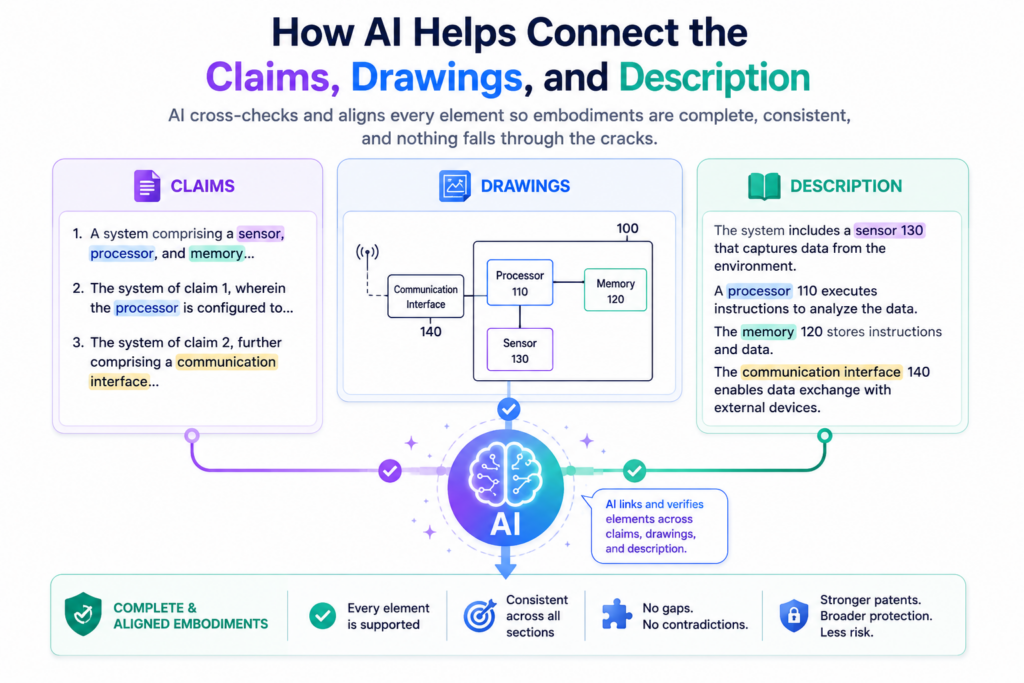
The drawings show systems, flows, parts, and examples. These parts should work together. When they do not, missing embodiments can hide in the gaps.
AI can help by comparing the claims, drawings, and description against each other. If a claim mentions a feedback signal, but the description does not explain examples of feedback, AI can flag that.
If a drawing shows a training module, but the written text barely mentions training, AI can flag that too. If the description explains edge processing, but the claims only point to a central server, AI can raise the mismatch for review.
This kind of cross-check is hard to do manually when the draft is long. It is easy for a human reviewer to focus on one part and miss that another part does not match. AI can move across the whole draft and look for missing links.
This matters because embodiments often appear in pieces. An inventor may describe one version in a diagram. A founder may mention another in notes.
An attorney may capture a third in the summary. If those pieces are not woven into the full draft, some value may never make it into the final filing.
For a startup, this can be painful. The team may think a version is covered because it was discussed during drafting.
But if it does not appear clearly in the filed draft, the company may not get the benefit it expected. AI helps reduce that risk by making hidden disconnects easier to see.
PowerPatent is designed to make this process smoother. It helps gather the invention details, structure the draft, and support review by real patent attorneys.
That means founders can move faster while still giving the draft the care it deserves. See how PowerPatent helps here: https://powerpatent.com/how-it-works
The drawings often reveal embodiments that the text forgot to explain
Drawings are not just pictures. They often show the real shape of the invention. A system drawing may include modules, devices, data paths, user roles, or control steps that are not fully described in the text.
A flowchart may show optional steps that the written section does not explain. A block diagram may show that the invention can work across different parts of a network.
AI can help review drawings and related labels to make sure the description does not skip important parts.
If the drawing shows a local processor and a cloud server, the text should explain how the invention can run in one place, the other place, or both.
If the drawing shows multiple data sources, the text should not sound like only one source is possible.
This is especially helpful for founders because drawings often come from engineering thinking. Engineers naturally show options in diagrams. But those options need words too. AI can help make sure the words catch up with the drawing.
The claims should not be the only place where the broad idea appears
Sometimes a draft tries to make the claims broad while leaving the description thin. That can create trouble.
The description should support the different versions that matter. It should explain them in enough detail that the invention feels real and complete.
AI can help by checking whether broad claim words have enough examples in the description. If the claim says “sensor data,” the description can explain different kinds of sensor data.
If the claim says “outputting a result,” the description can explain alerts, scores, reports, rankings, control signals, recommendations, or other useful outputs.
If the claim says “updating a model,” the description can explain what causes the update and what changes as a result.
This does not mean every possible example must be stuffed into the draft. It means the important versions should be supported in a clear way.
AI helps find places where the draft asks for more breadth than the description has earned. Then the attorney can decide how to fix it.
That review can save a founder from false comfort. A draft may look broad at the claim level, but if the rest of the draft does not support the breadth, the company may not have the strength it expects.
Finding that issue before filing is far better than finding it later.
How AI helps find missing embodiments in the problem, not just the solution
A good patent draft should explain the invention, but it should also show the problem the invention solves. This is where many drafts are too thin.
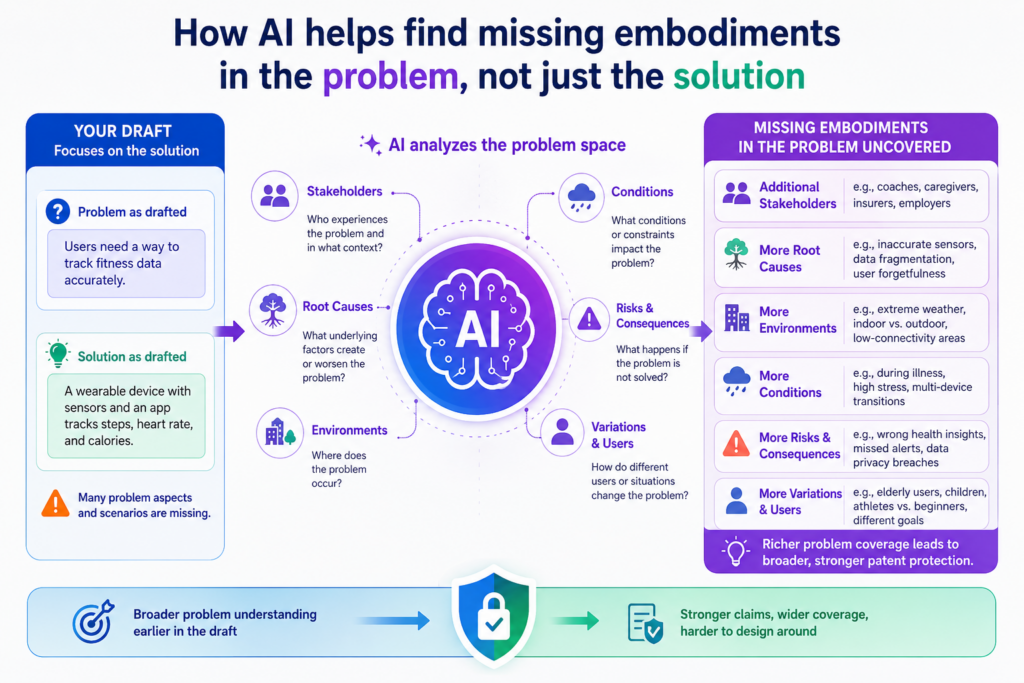
They jump straight into the system and miss the real-world pain that makes the invention matter.
When the problem is not described well, some embodiments can disappear because the draft does not show all the settings where that problem exists.
AI can help by reading the draft and asking whether the problem is too narrow.
For example, a draft may say the invention helps a warehouse robot avoid obstacles. That may be true, but the deeper problem may be safe movement in changing spaces.
That same problem may appear in hospitals, factories, farms, stores, roads, labs, and homes. The robot may be one version, but the invention may also apply to drones, carts, vehicles, arms, tools, or other moving machines.
When the problem is framed too tightly, the solution often becomes too tight as well.
This is why AI can be so useful early in the patent process. It can look at the problem statement and ask whether the draft has only described one setting.
It can help the team see that the same technical problem may show up in other places, with other users, devices, inputs, and limits. Those other places may point to missing embodiments.
This does not mean the draft should claim every field in the world. That would be careless. But it should not trap the invention in one market if the core idea clearly works in more than one setting.
A startup may begin in one small market because that is the best place to sell first. The invention, however, may have a larger technical use.
PowerPatent helps founders find this kind of hidden room before filing. The platform helps capture the invention, reveal missing parts, and bring the work to real patent attorneys who can shape the final draft with care.
Founders can move fast without leaving important versions behind. You can see how that works here: https://powerpatent.com/how-it-works
The way the problem is written can decide how much of the invention is seen
A narrow problem statement can make a strong invention look small. If the draft says the problem is “helping nurses enter patient notes faster,” the invention may sound like a hospital note tool.
But the deeper problem may be turning spoken or messy human input into clean structured records. That problem may also exist in insurance, finance, field service, sales, inspections, legal work, research, and customer support.
AI can help pull that deeper problem out of the draft. It can compare the stated problem with the system steps and ask whether the value is broader than the first use case.
It can also help rewrite the problem in a way that stays honest while giving the invention more room.
The goal is not to make the draft sound bigger than the invention. The goal is to make the draft match the real invention.
If the system improves how data is captured, cleaned, ranked, routed, or acted on, the draft should say that clearly. If it works only in one field because of special rules or data, that should be clear too. AI helps by making those choices easier to see.
A strong draft shows why each version still solves the same core problem
Adding embodiments is not just about adding more examples. Each version should connect back to the same core problem.
That connection keeps the draft focused. It helps the reader understand why the versions belong together.
For example, if the invention helps reduce false alerts in a monitoring system, the draft can explain how that same idea may work for machines, networks, vehicles, buildings, medical devices, or security systems, as long as the technical steps still fit.
The shared thread is not the market. The shared thread is the way the system reduces false alerts.
AI can help test that thread. It can ask whether each proposed embodiment really solves the same problem in the same general way.
If a version feels too far away, it can be removed or narrowed. If a version is clearly linked, it can be added with better detail.
That is how AI helps without turning the draft into a pile of loose ideas. It helps the team find the right branches and keep them tied to the trunk.
How AI helps founders explain future product paths without overclaiming
Startups live in the future. Founders think about what they are building now, what they will build next, and what the product may become if customers pull it in a new direction. Patent drafts should respect that reality.
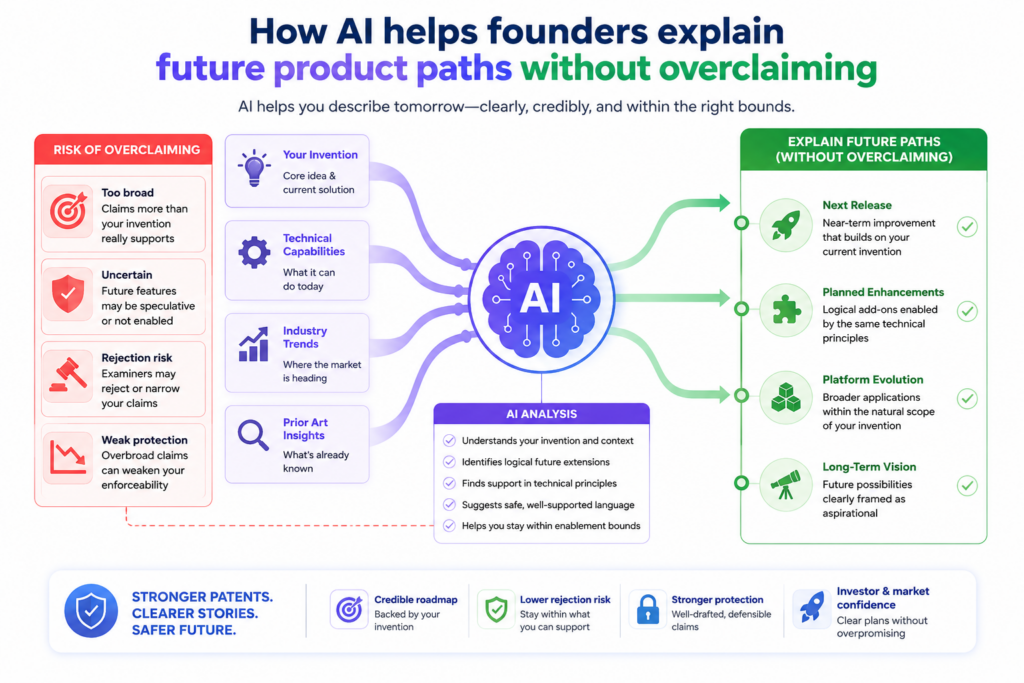
They should not be limited to the first release when the invention clearly supports more. At the same time, they should not pretend the team invented things it has not really thought through.
AI can help with this balance.
It can review the current draft and compare it with product plans, technical notes, roadmap ideas, test results, customer requests, and design choices.
It can help find future paths that are already rooted in the invention. These may include new data sources, new user types, new model updates, new deployment modes, new outputs, or new hardware setups.
For example, a founder may have built a web tool first, but the team already knows the same invention may later run inside a customer’s private cloud. That is not a random dream.
It is a real product path. If the draft does not mention private deployment, on-premise setup, secure local storage, or restricted network use, it may miss an embodiment that matters to future buyers.
AI can help surface those likely paths and turn them into clear questions for the founder and attorney. The attorney can then decide how to describe them in a way that is useful and supported.
This is especially helpful for deep tech teams because their roadmap is often full of technical choices that matter for protection. A model may get smaller. A sensor may move closer to the edge.
A workflow may become more automated. A system may move from human approval to machine action. These shifts can change the product, but the invention may remain the same at its core.
PowerPatent helps make these future paths easier to capture. The software helps organize the invention and reveal missing versions, while real patent attorneys help keep the draft strong, clear, and grounded.
Founders get a faster process without giving up judgment. See how it works here: https://powerpatent.com/how-it-works
Future embodiments should come from real technical direction, not wishful thinking
A patent draft should not be filled with guesses. Empty guesses do not help. They can make the draft confusing and weak. The best future embodiments come from real technical direction.
That direction may come from the product roadmap. It may come from customer needs. It may come from architecture choices the team has already discussed.
It may come from tests, prototypes, failed builds, or design tradeoffs. It may come from the way engineers built the system so it could expand later.
AI can help gather these signals. It can notice when the draft says the system is modular but never explains what modules can change.
It can notice when the product notes mention offline use but the patent draft only describes online use. It can notice when the system architecture supports multiple data sources, but the draft names only one.
These are not small edits. They can change how much of the company’s future is covered.
A founder does not need to know the exact wording. The founder needs to share the real product direction.
AI can help convert that direction into drafting prompts, and the attorney can decide how to use them.
The best question is what the team would still want protected after the product changes
A simple way to find future embodiments is to ask what should still be protected if the product changes. If the app becomes an API, what is still the invention? If the model changes, what is still the invention?
If the user no longer clicks a button and the system acts on its own, what is still the invention? If the data comes from a partner instead of the customer, what is still the invention?
AI can ask these questions across the draft. It can help find the parts that are core and the parts that are temporary. That helps the team avoid treating today’s product choices as permanent limits.
For founders, this is very practical. You are not filing a patent only for the product you have today.
You are filing to protect the technical edge that may help your company win later. AI can help make sure that edge is not hidden under the first version of the product.
That is the value of finding missing embodiments early. It gives the draft room to grow with the company.
How AI helps attorneys and inventors work from the same clear picture
The best patent drafts come from a strong handoff between inventors and attorneys. The inventor knows the technology. The attorney knows how to shape the filing.
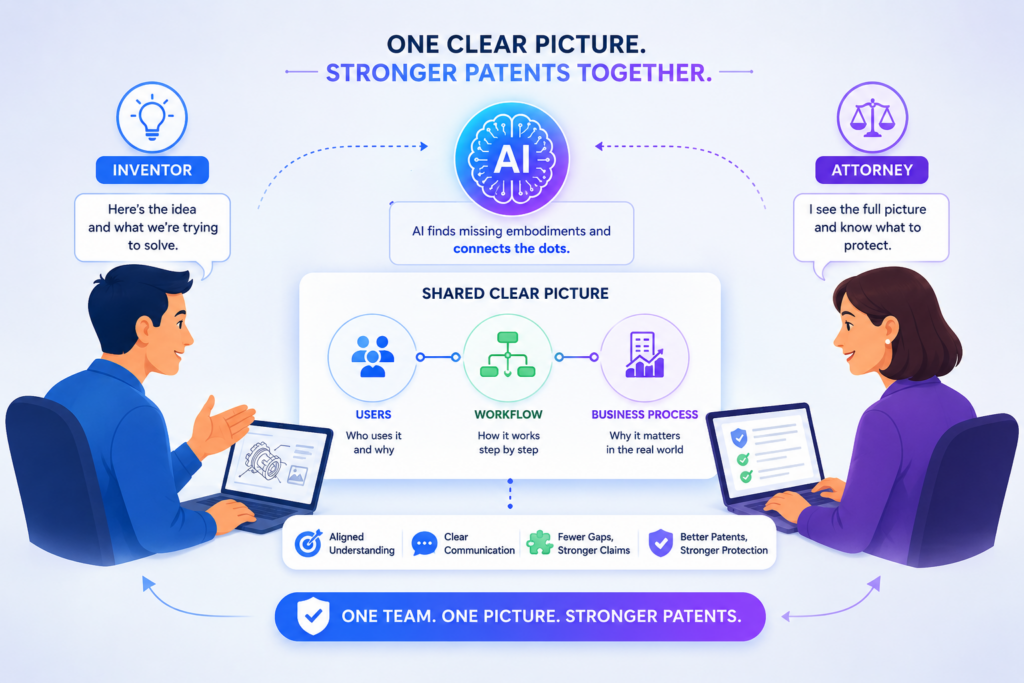
The problem is that these two worlds often speak in different ways. Engineers may talk in code, models, systems, and tradeoffs.
Attorneys may think in claims, support, figures, and scope. Important embodiments can get lost in the gap between those two views.
AI can help close that gap.
It can take technical notes, product explanations, diagrams, and draft text and turn them into a clearer map of the invention.
It can show the main version, possible alternate versions, missing inputs, missing outputs, possible deployment settings, feedback loops, fallback paths, and places where the draft uses narrow words. This gives the attorney and inventor a shared place to start.
That shared view matters. Without it, the attorney may not know that a certain feature is flexible. The inventor may not know that a certain product detail could limit the draft.
The founder may not know that a future market path should be described now. AI can bring those issues into the open before filing.
This does not remove the need for attorney review. It makes that review better.
AI can surface more questions faster, but a real patent attorney still needs to choose the right path, write with care, and make sure the draft is ready for filing.
That is why the PowerPatent approach is built around both smart software and real attorney oversight. Founders get the speed and structure of AI, while still having experienced humans guide the legal work.
That mix helps reduce costly mistakes, avoid delays, and give technical teams more confidence in what they file. Learn more here: https://powerpatent.com/how-it-works
AI helps turn scattered invention notes into a cleaner drafting conversation
Most founders do not start with a perfect invention packet. They have Slack messages, diagrams, rough notes, code comments, pitch deck slides, product specs, customer calls, model results, and half-finished explanations.
The important details are often spread across all of that.
AI can help bring those details together. It can spot repeated themes. It can notice where one note says the system works in real time while another says it can work in batches.
It can notice where a diagram shows three outputs while the draft explains only one. It can notice where the founder talks about automatic action, but the patent text only says the result is displayed.
This gives the attorney better raw material. It also helps the founder feel more in control because the invention is no longer trapped in scattered files and memory.
A cleaner drafting conversation saves time. It reduces back-and-forth. It helps avoid the painful moment when someone says, after filing, “Wait, did we include that version?”
The strongest process uses AI to find gaps and attorneys to make judgment calls
AI is excellent at finding patterns, missing parts, and wording that may be too narrow. But patent drafting is not just pattern matching.
It requires judgment. Some embodiments should be added. Some should be trimmed. Some need more inventor input. Some may not belong at all.
The strongest process uses AI for what it does well and attorneys for what they do best. AI can scan, compare, prompt, and organize. Attorneys can shape, review, decide, and protect the founder’s interests.
For startups, that combination is powerful because time matters. You do not want a slow, confusing patent process that pulls your team away from building.
You also do not want a rushed filing that misses key versions of the invention. The right system gives you speed and care at the same time.
That is the core promise of PowerPatent. It helps founders move from raw invention to stronger patent drafts with smart AI tools and real attorney oversight, so the company can protect more of what it is building without getting buried in the process.
Conclusion:
Missing embodiments can make a smart invention look smaller than it really is. AI helps by finding narrow words, skipped versions, weak links, and future paths that may deserve a place in the draft. But the real power comes when AI works with a skilled patent attorney, not alone.
That mix gives founders speed, clarity, and stronger protection without pulling them away from building. If your team is creating something valuable, do not let the first draft be the smallest version of your idea. See how PowerPatent helps you file smarter here: https://powerpatent.com/how-it-works
Leave a Reply